
Cut off as they were from the other continents of the world, the peoples of the ancient Americas went their own way. In Mexico, Guatemala and Peru they had no horses, no beasts of burden (other than the extremely unsatisfactory llama), no scales or weights. Nor had they invented the arch, which meant that without any means of vaulting they could not build high. If they wished to raise their temples to an impressive height, all they could do was to pile up a vast mound or pyramid and perch it on the top.
Perhaps the first major civilization in Mexico was that of the Olmec. Their immense sculptures of frowning heads pack a powerful punch; and their Great Pyramid at La Venta, though now only about (30 m) 100 ft high, was once the largest structure in Mesoamerica. The Zapotecs arrived slightly later; their civilization begins around 500 BC. Monte Albán was their capital, but their empire spread rapidly. They also developed a kind of hieroglyphic writing, to be seen on some forty carved stones in the main plaza. From all this it is plain that they were a highly intelligent, interesting people; but they could not hold a candle to the Maya.
The Maya – who were responsible for Tikal and Palenque and many other sites – were the most talented of all the early inhabitants of the ancient Americas. First of all they could write, using syllabic signs rather than letters. In mathematics they used a numbering system based on twenty rather than ten, and well understood the concept of zero. They had also learnt to measure the solar year far more accurately than their European contemporaries.
Teotihuacan, with its vast pyramids of the Sun and Moon, is – like Monte Albán and Palenque – a UNESCO World Heritage Site. Later in its history, the Aztecs carried out their human sacrifices, tearing out the still-beating hearts of their victims and offering them to the gods. (The Mexican Tourist Board has been known to refer to these sacrifices as ‘cardiectomies’.)
All the above sites are in Mexico or Guatemala; Caral is in Peru. Only fully brought to light in the present century, it is still little known outside archaeological circles; but it is now generally believed to be the oldest city in the New World.
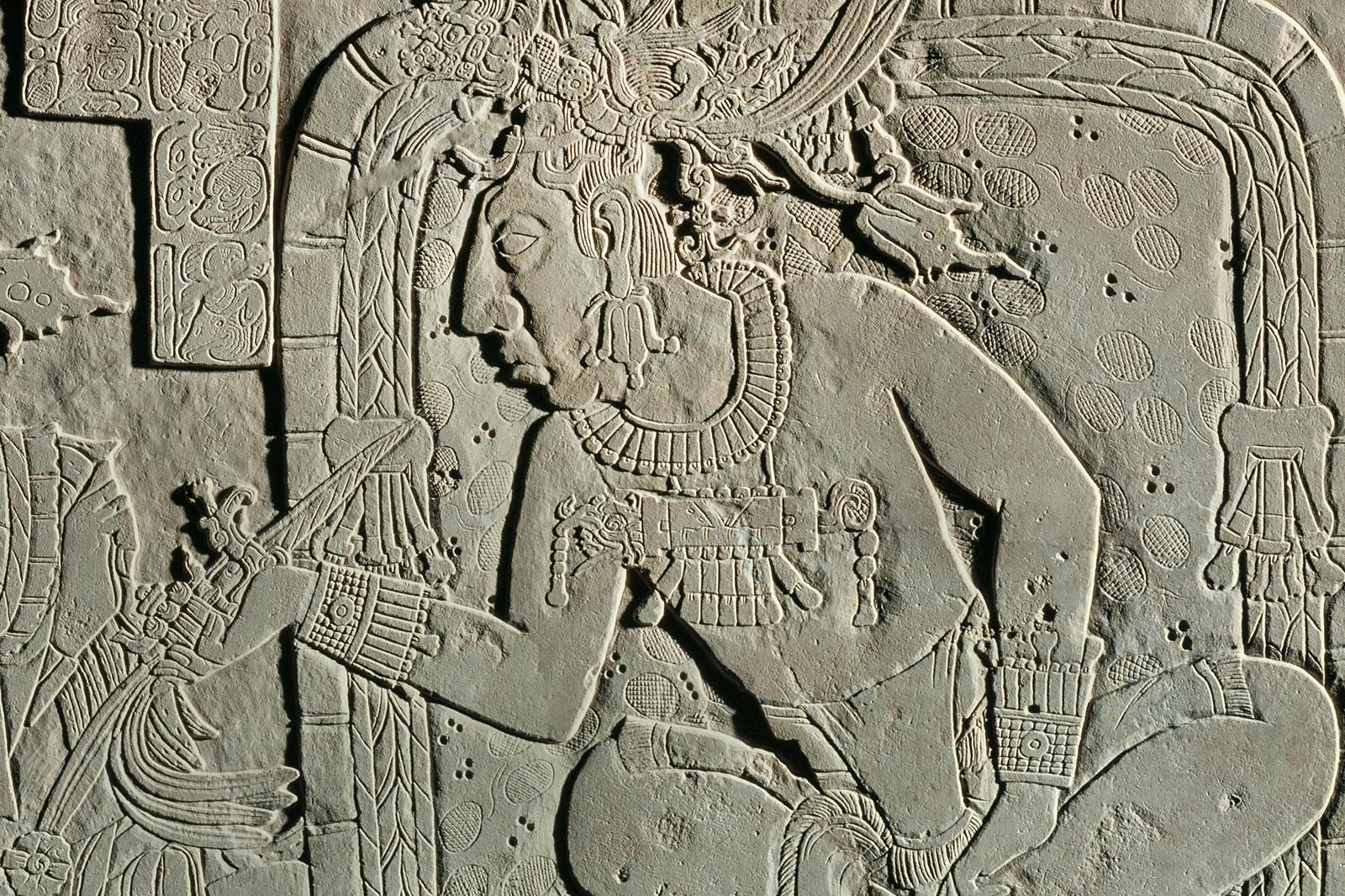
Detail of a relief from Temple XXI at Palenque with a portrayal of the great King Pakal, who ruled over the city from AD 615 to 683 and was responsible for many of its spectacular buildings.
© Jorge Pérez de Lara.
DANIEL H. SANDWEISS
Caral … was the centre of the greatest economic, social, political and religious dynamism of the epoch.
RUTH SHADY, 2006
A small stretch of desert coast and well-watered valleys some 200 km (125 miles) north of Lima, Peru, was home to the first florescence of Andean monumental architecture and incipient urbanism. The North Central Coast (or Norte Chico) comprises five valleys containing dozens of Late Preceramic (c. 3800–1700 BC) sites, many with large mounds of stone and dirt. Discoveries by Peruvian archaeologist Ruth Shady in the Supe Valley have shown that Caral was the biggest and probably most complex of them all, and is arguably the oldest urban centre in the Americas. People were constructing massive platform mounds and impressive architecture here at around the same time that the giant pyramids were being built at Giza in Egypt.
Although the site had been known to archaeologists since the late 1940s, it was not until 2001, as a result of Shady’s research, that Caral (formerly called Chupacigarro Grande) was shown to be Late Preceramic in age. Dates range from before 2400 BC to about 1700 BC. Given the size of the site and the volume of construction, this early date was surprising.
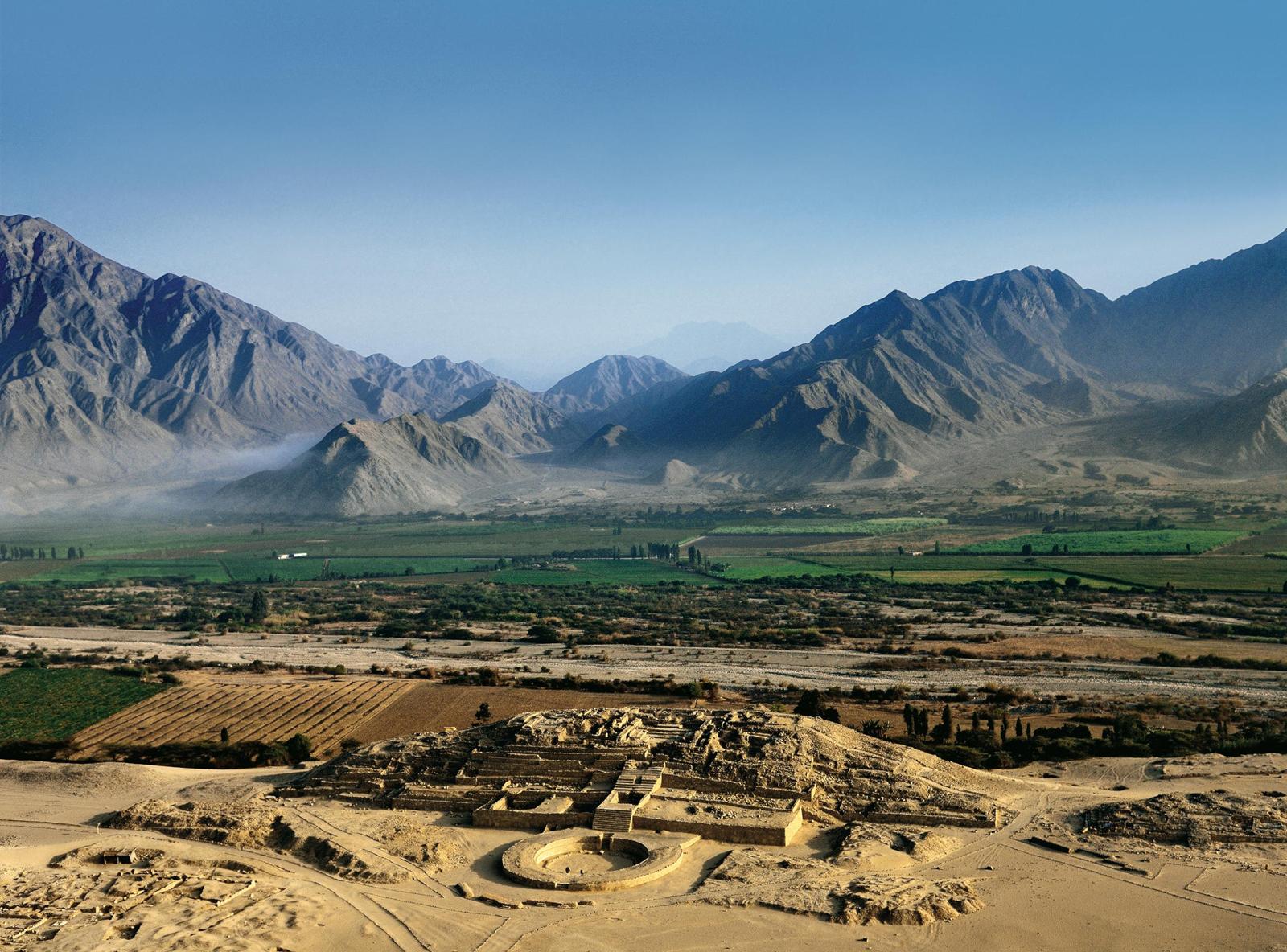
View of the Piramide Mayor or Great Pyramid, with its circular sunken court, set against the spectacular backdrop of the green Supe Valley and the great mountain range beyond. Caral was a large, complex city, with evidence of careful urban planning at a surprisingly early date – possibly the oldest urban centre in the Americas.
© Christopher Kleihege.
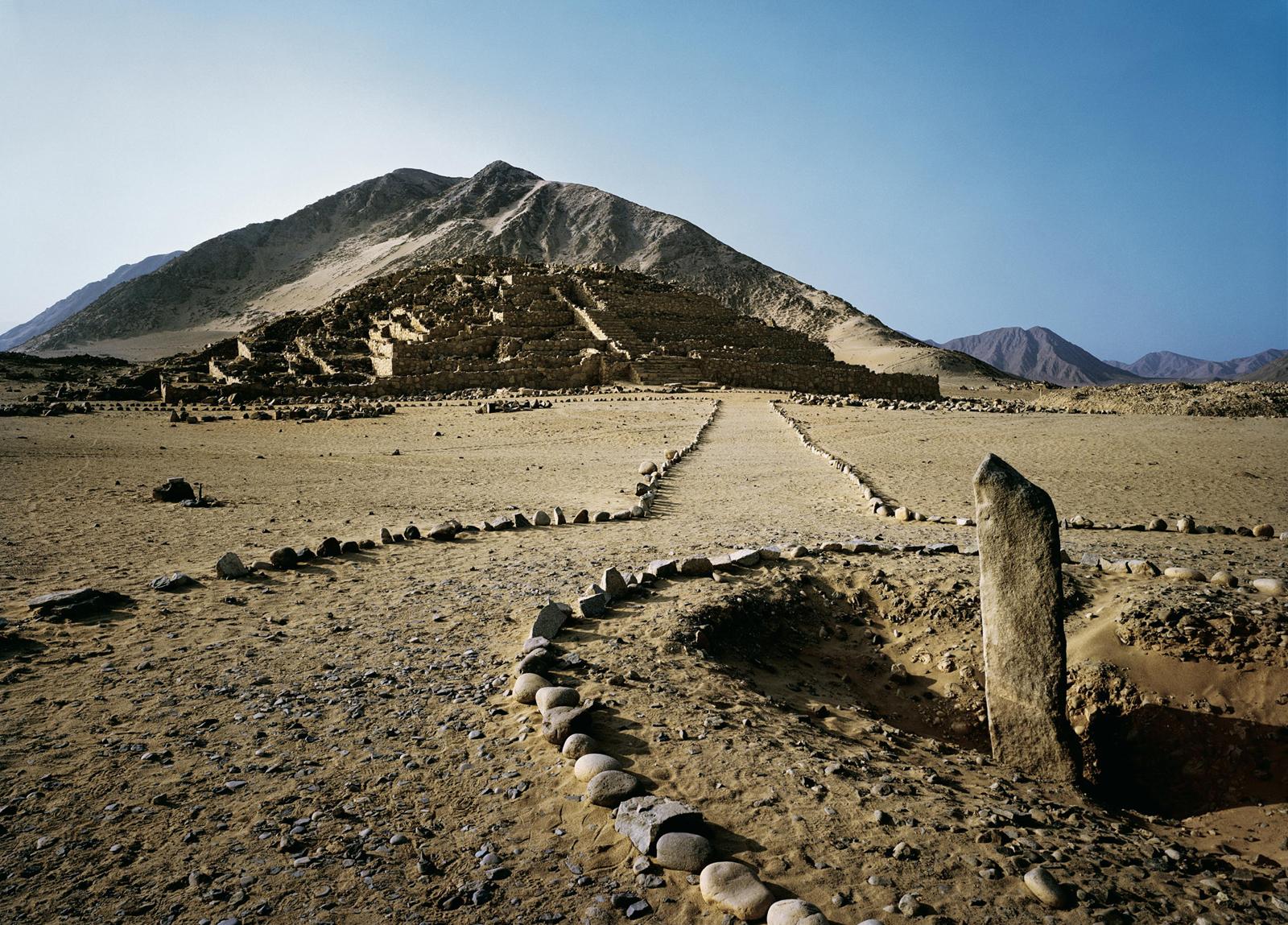
A stone monolith, around 2 m (over 6ft) high, in front of the Piramide de la Galeria (the Pyramid of the Gallery), one of six large platform mounds at Caral. These massive structures are faced with cut stonework, the cores filled with mesh bags containing stones and rubble; they may have been built using communal labour.
© Christopher Kleihege.
Caral’s central zone contains eight sectors of modest houses and grander stone-walled residences, two sunken circular plazas, numerous small mounds and six large platform mounds built from quarried stone and river cobbles. Ceremonial rooms, which possibly served as symbols of a centralized religion, crowned the platform mounds. About 300 m (985 ft) to the southwest of Caral’s central mound complex is a sector known as Chupacigarro, which includes an additional sunken circular plaza and platform mound complex. Residential architecture and occupational debris link Chupacigarro and Caral’s central mound zone as a single site.
Constructed in two massive building phases, the Piramide Mayor is the largest platform mound in Caral’s central zone (160 × 150 m/525 × 490 ft). This structure towers four storeys (18 m/60 ft) high and sprawls over an area equal to four and a half football fields. Even the smallest mound at Caral is as large as any other building in the Andes in the 3rd millennium BC. The two sunken circular plazas (20–40 m/65–130 ft in diameter and 1–3 m/3–10 ft deep) within Caral’s central zone and that at Chupacigarro to the west are similar to examples found at other sites in the Supe Valley.
Pyramid construction at Caral may have been achieved through repeated ceremonial activity, either by the co-operative effort of various social groups from the surrounding region, or by a single centralized urban population. All mound construction involved the same technique. Retaining walls of cut stone were built first. Then shicras, open mesh bags woven from reeds and filled with river cobbles and cut stone rubble, were hauled to the construction site and placed, bag and all, inside the retaining walls to form the core of the mound. The outer faces of the cut stone walls were then carefully covered with multiple layers of coloured plaster.
Caral probably had a population numbered in the thousands of people. The well-designed architectural complexes, the labour required to build the large structures and the need to organize that labour all suggest city planning by a centralized authority. Houses associated with the central mounds had ornate, plastered, stone-walled rooms, while in other sectors the houses were simpler, made of wood poles, cane and mud. These differences suggest that not all of Caral’s inhabitants enjoyed equal status. Variations in the size of the platform mounds may also reflect social distinctions among the separate house complexes associated with each mound.
Shady’s excavations show that most of the animal protein eaten by the inhabitants came from the ocean, some 23 km (14 miles) to the west. The rest of the diet consisted of a mix of domestic and wild plants. The most important crops were cotton and gourds, used for clothing, nets, floats and containers. Irrigation systems were probably in use to increase the harvest. Exotic trade goods from distant areas of the Pacific coast, the Andes mountains and even the Amazon show that Caral maintained contact with distant areas.
Caral was abandoned by about 1700 BC and the other North Central Coast sites not long after. Evidence has been uncovered that a combination of earthquakes, torrential rainfall during El Niño events and the subsequent migration of sand over the fields disrupted agriculture and probably led to the downfall of the Late Preceramic sites of the area. Though people continued to live in the region, it never regained the prominence nor saw the volume of monumental construction of Caral and its contemporaries in their precocious complexity.
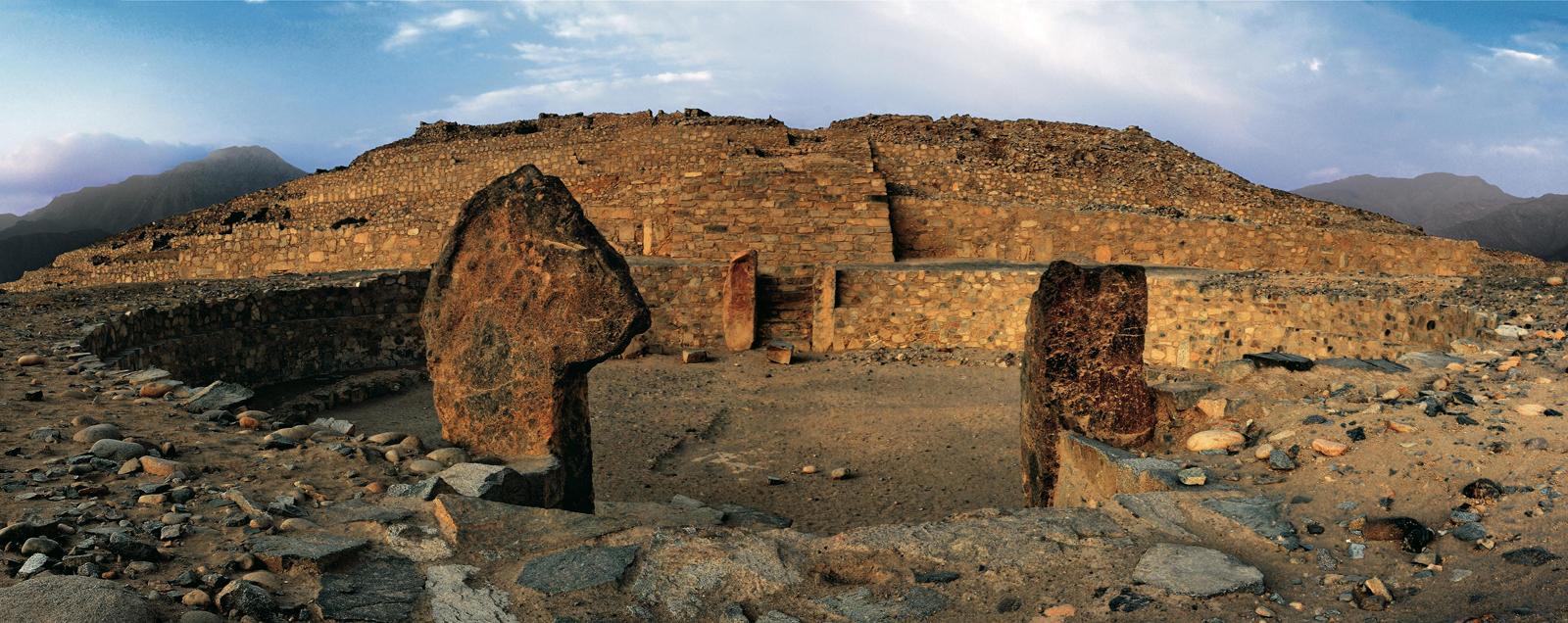
The circular plaza or sunken forecourt in front of the Piramide Mayor. Complexes of ceremonial rooms crown the mounds and the courts and pyramid stairways may have been the scene of ritual processions.
© Christopher Kleihege.