
BETTANY HUGHES
Armies of allies crowd the mighty city of Priam, true, but they speak a thousand different tongues, fighters gathered here from all ends of the realm.
HOMER, c. 8TH CENTURY BC
Troy is getting bigger. This legendary city, which has inhabited the imagination of both east and west across 27 centuries, is a paradox when it comes to scale. For millennia Homer’s city was invisible, physically absent from the landscape of the eastern Mediterranean, sandwiched in-between 40 other habitation layers at the mouth of the Dardanelles. And yet Persians, Greeks, Romans, then medieval European dynasties, the Ottomans, the empire builders of the New World – all refused to let the Troy of the Iliad die. So when Heinrich Schliemann, rich from his trade in saltpetre and brimstone, threw his fortune at the problem in 1870 and ‘found’ a Bronze Age archaeological site at a hill called Hisarlik on the western edge of Turkey, claiming this was indeed Homer’s Ilios or Troy, the critics immediately bayed. How could this be Priam’s city? Schliemann’s hump was simply too small.
Could this scrubby hill really match the magnetic metropolis where the extreme love of a Queen and a Prince sacrificed the warriors of the known world; where Hector taught the world dignity and Andromache pain; from which Aeneas fled on his way to found Rome; where, in 480 BC, Xerxes, King of Persia, came to honour Trojan spirits with libations and the sacrifice of 1,000 cattle; where, in AD 324 (so the historians Zosimus and Sozomenus tell us), Constantine the Great’s new, Christian Rome was first to be built? Even Schliemann himself admitted to a colleague that the settlement he was uncovering hardly seemed bigger than Trafalgar Square.
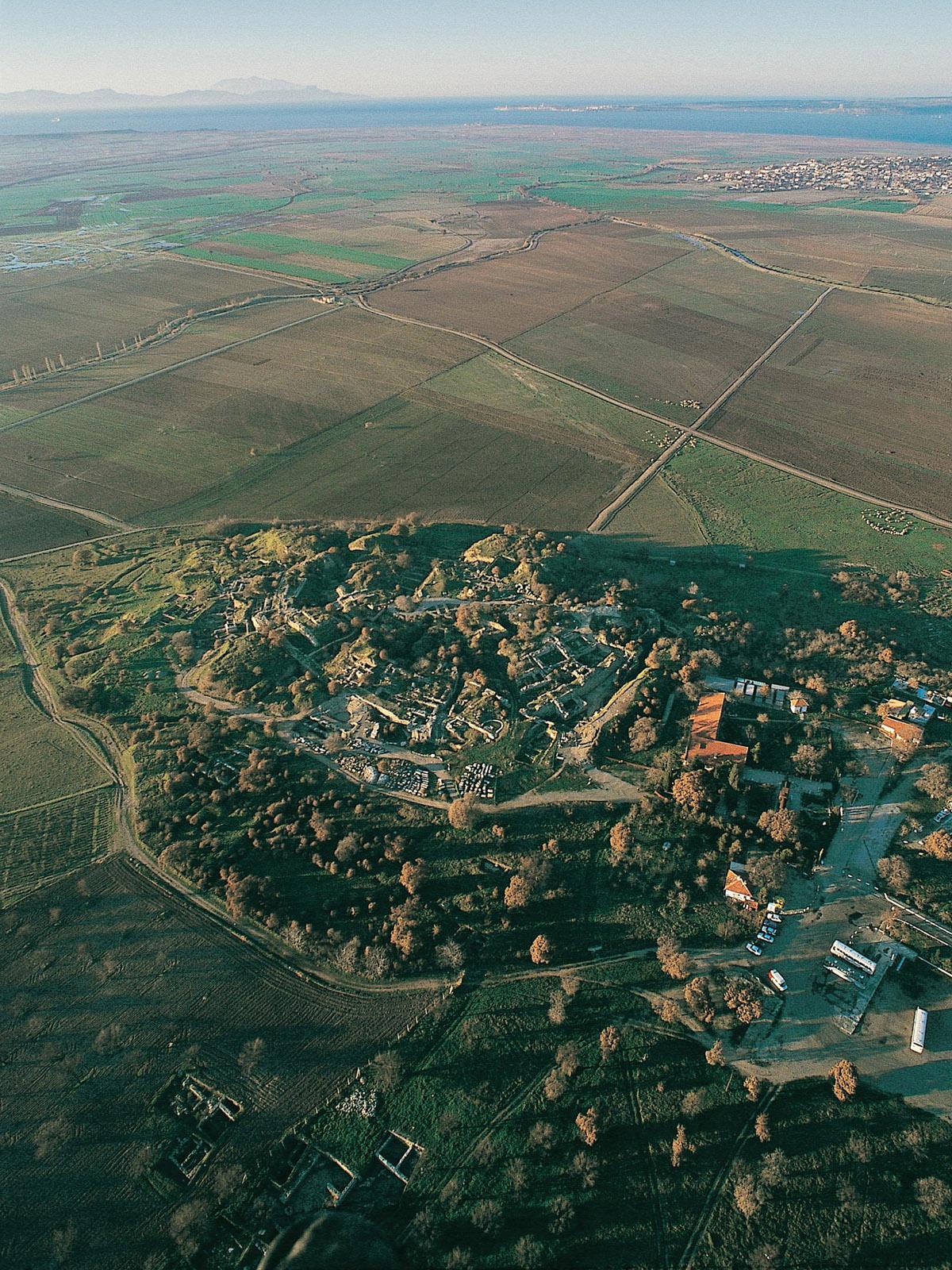
Aerial view of Troy and the surrounding plains. Bronze Age Troy’s great gift was its strategic position at the western edge of the vast Hittite empire – a nodal point between the Mediterranean and the Black Sea.
© Hakan Öge.

Reconstruction drawing of Troy VI: the citadel and lower city. The city is now 15 times larger than was previously thought. Excavations in both the citadel and lower town are ongoing.
Tübingen University, Troia Project and ART+COM AG, Berlin.
But the nay-sayers were missing the point. Because Troy’s impact – from at least the 1st millennium BC onwards – came primarily thanks not to its splendours, but the intensity of the human story that we hear of played out behind its sloping walls. It did not matter that the ‘topless towers of Ilium’ appeared workaday, or that no great temple archive – such as was being discovered in contemporary Bronze Age cities at Hattusa and Knossos – survived. Schliemann might have fallen on ‘Helen’s Jewels’ (delicate, anachronistic gold, comprising improbable diadems constructed from 16,353 individual pieces), and decorated his Greek-sourced young wife with them to impress the press, but the pull of Troy needed no such tricks. For Homer and subsequent authors of antiquity, this was, above all, a city of heroes and the heart.
The earliest systematic archaeology concurred: Troy was not a Persepolis, a Babylon or an Alexandria. Yet today, new archaeological discoveries are in fact propelling Troy VI (which thrived around 1200 BC, close to the traditional Trojan War dating of 1184) into the category of ‘great’. The excavation levels here have, in the last 15 years, revealed polyglot cemeteries, complex, hidden water systems, treasure hoards. The city Homer describes as ruled by ‘stallion-breaker’ kings and princes has indeed yielded a surprising number of horse bones. Deep beneath Troy VI is a mud-brick palace that would have pre-dated Priam’s palace by a full thousand years. And crucially, recent investigations have expanded the overall size of the city by at least 15 times. The lower town, never before excavated, has been shown to ring the central citadel in a generous arc. When Helen, or her Bronze Age equivalent, stood at the Scaean Gate – which has been identified on the western edge of Hisarlik Hill, 4 m (13 ft) wide, set in walls 10 m (33 ft) high – to watch warriors in combat below, she would have gazed out over a heaving shanty town, beyond that to the Scamander plain and then to Troy’s sandy beaching point at Besik Bay, edged by the Aegean Sea.
It is increasingly clear that Troy of the 13th century BC was indeed a city worth sacking. Its strategic position, at the mouth of the Dardanelles, provides unique access between the Black and Aegean seas. This would have been, at the time of Helen and Paris, a settlement heavy with the scent of trade and the smell of money. Homer tells us that Helen’s apartments were ‘richly scented’; Bronze Age records detail frankincense, oil of iris, cumin, coriander and rose petals passing through the trade networks across this region. The aromatics would have been joined by ostrich eggs from Africa, copper from Cyprus and nuggets of amber from the Baltic.
There is gold here, but so far nothing to justify the opinion of later authors such as Euripides that Helen of Sparta was tempted away by ‘the East with its Rivers of Gold’. The greatest wealth lay three days’ ride further inland – in the temple archives and treasure stores the size of football pitches at the great Hittite capital of Hattusa. Because Troy, or Wilusa as it was known around 1200 BC (the ‘W’ eventually drops to give us Homer’s Ilios), was a vassal state of this Hittite superpower – which controlled a great empire – enjoying its protection in return for tribute.
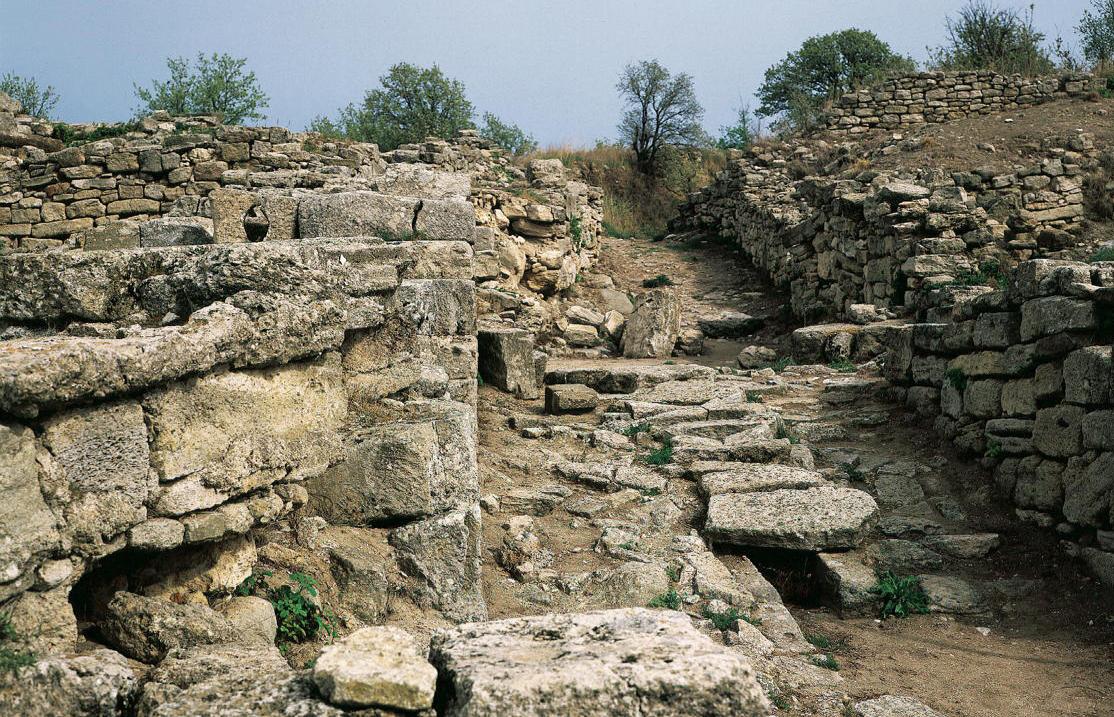
The South Gate and a street leading into the centre of Troy VI. Splendid though these are, the great sorrow of Schliemann’s excavations is that vast quantities of material and spoil were removed from the site during his digs and dumped – doubtless material rich in archaeological interest.
Gianni Dagli Orti/The Art Archive.
Even if the heroes and heroines of the Trojan War epics are just archetypes, they are archetypes with distinct historical features. We have to look to other settlements (Sapinuwa, for instance, a Hittite city a 13-hour drive east of Troy, which was excavated in the 1990s) for a detailed picture of the full cast of characters that would have inhabited Wilusa: royal dynasties, concubines, secondary wives, priests, priestesses, temple assistants, barbers, scribes, sword-swallowers, and bagpipe-, castanet- and cymbal-players. The princes of Troy would have worn their hair long; their chests would have shone with amulets and medallions; earrings would have danced in their ears. Chariot culture was clearly aspirational here – a way of posturing gloriously on the battlefield. Homer, who almost certainly lived around 700 BC, was not a historian, but with each season of archaeological excavations, his stories edge further from fiction and closer to fact. Tantalizingly, one Hittite tablet tells us that a Trojan prince, ALAKSANDU (and don’t forget, Paris has an alternative name, Alexander), had Greek connections, perhaps even a Greek mother. Troy was a place accustomed to housing exotic aliens.
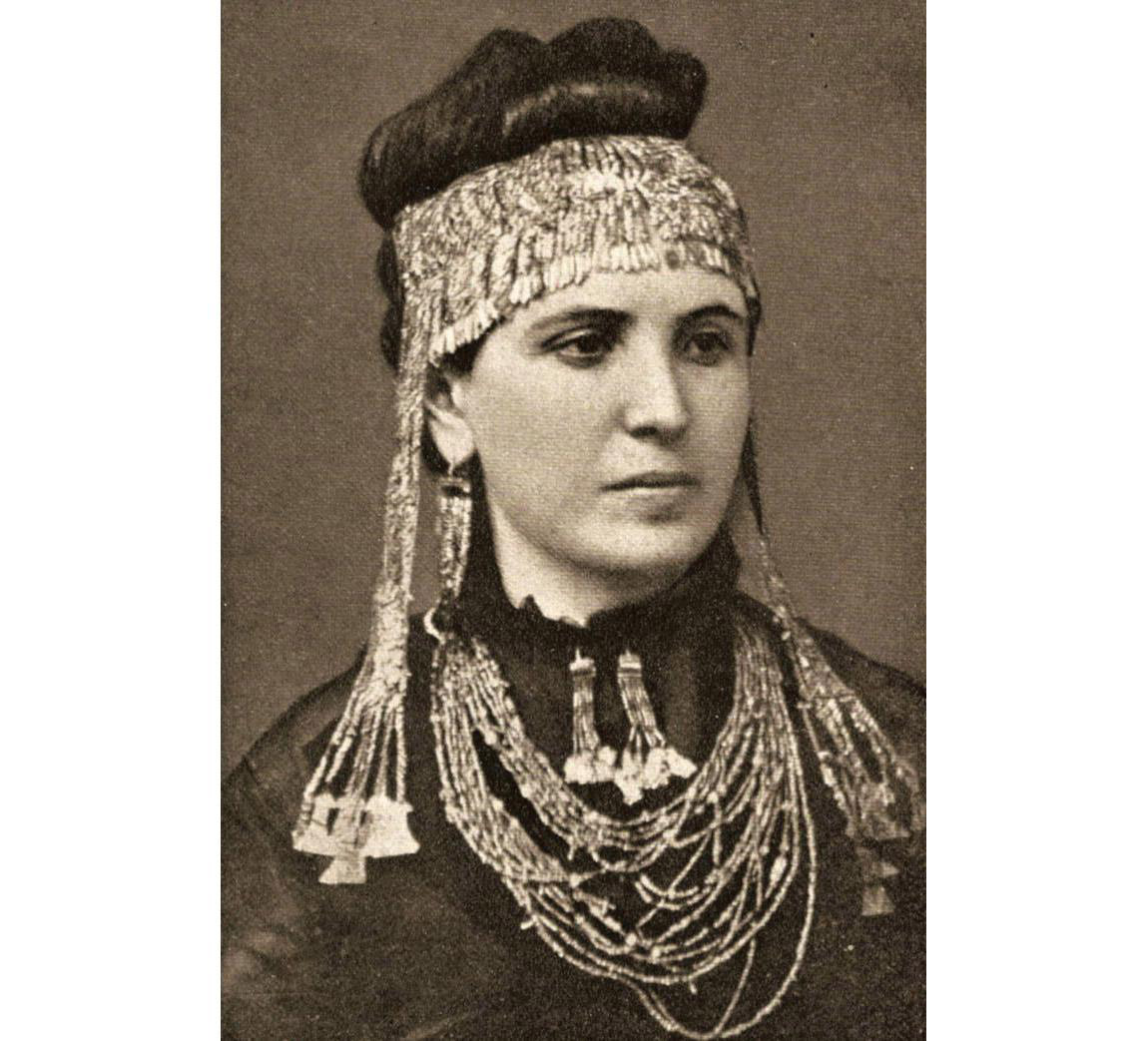
Sophia Schliemann bedecked with ‘Helen's Jewels’. These fabulous decorations in fact date from the 3rd rather than the 2nd millennium BC. Sophia is in every way the ‘fantasy Greek bride’.
At the putative time of the ‘Trojan War’ (personally I think this was a series of skirmishes across two generations c. 1250–1180 BC) the eastern Mediterranean was a fractious theatre of power – there was no invisible faultline dividing East and West. But the tales of Troy fix this bipartite division in our collective imaginations. Herodotus, the Father of History, puts the declaration of a totemic split into the mouth of a Persian: ‘the Greeks, all for the sake of a woman from Sparta, mustered a great host, came to Asia and destroyed the power of Priam. Ever since then we have regarded the Greeks as our enemies.’ The theme was amplified by Simonides, Aeschylus, Euripides et alia. Come the time of Catullus in the 1st century BC, Troy would be described as ‘the common grave of Asia and Europe … the untimely tomb of all heroes and heroic deeds’.
From the moment the Iliad was composed there has not been a single decade when the idea of Troy leaves the human radar. As the ultimate trophy for both Orient and Occident, Priam’s great city was a player not just in its own time, but beyond it. Once Byzantium proved the wiser topographical choice as HQ for Constantine’s global Christian experiment, the emperor couldn’t bear to neglect Troy altogether, consecrating an image of Pallas Athena – said to have been taken from Troy by Aeneas himself – within Constantinople’s foundational porphyry column. In both imagination and archaeological reality, Troy inhabits a space many thousand times greater than the limits of its walls.
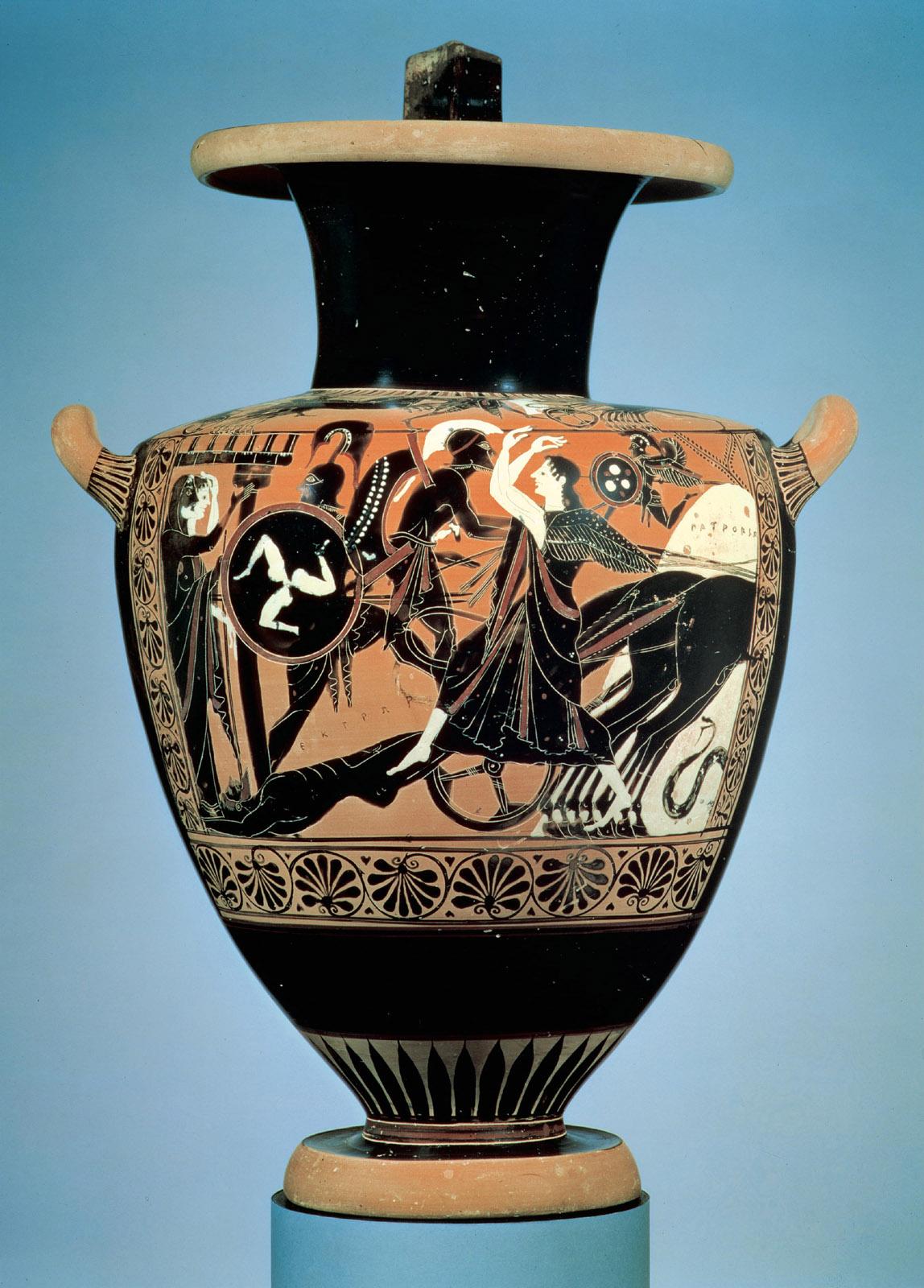
Athenian black-figure vase, 6th century BC, the Antiope Group, showing the body of Hector dragged behind the chariot of Achilles. The story of Troy has, over 27 centuries, never left the human radar and is still a cultural touchstone in the 21st.
Museum of Fine Arts, Boston/Bridgeman Art Library.