
JOAN OATES
Babylon the Great, the Mother of Harlots and of the Abominations of the Earth.… What city is like unto this great city!
BOOK OF REVELATION, 17:5; 18:18
Babylon is one of the best-known cities of the ancient world. In the West its iniquitous reputation is largely derived from its biblical condemnation as ‘the Mother of Harlots and of the Abominations of the Earth’, though that reference in fact alludes not to Babylon but to Rome. Classical descriptions, especially that of Herodotus, of the great city and its ‘hanging gardens’ are familiar but difficult to substantiate. In ancient times Babylon was widely admired for its culture and learning; indeed, when the city first fell to the Assyrians in around 1225 BC, the conquerors removed large numbers of cuneiform tablets to their homeland, apparently yearning for Babylonian culture. Babylon reached the pinnacle of its fame under the 7th-century BC dynasty of Nebuchadnezzar, and its capture was one of Alexander’s greatest triumphs – he chose to make it his eastern capital and was to die there in the royal palace.
While Babylon was undoubtedly the most impressive city of its time, especially under the ‘Neo-Babylonian’ kings (625–539 BC), it was not an ancient one, at least in Mesopotamian terms. Its name is not to be found among the cities of the distant past diligently recorded by Babylonian scribes. First mentioned late in the 3rd millennium BC, it was only in the early 2nd millennium BC that the small village rose to power, perhaps as a result of land salination and the loss of maritime trade routes in southern Mesopotamia. Babylon lay within that small area where the Tigris and Euphrates approach closest to each other, a position controlling two of the most famous roads in the ancient world – the main overland route later known as the Royal Road from Susa in southeastern Iran to Sardis in western Anatolia, and the Khorasan Road to the east, later part of the great Silk Road. Within this small area lay a succession of six great capitals of antiquity.
The first king to exploit this geographical advantage was Hammurabi (r. 1792–1750 BC), noted for his ‘Law Code’. Although he failed to establish an enduring national state, by uniting the country – if only briefly – under Babylon, he did achieve a political result that was to affect the history of Mesopotamia for the next two millennia. Babylon became, almost overnight, the established seat of kingship, a position it was to maintain unchallenged for almost fifteen hundred years. Hammurabi’s dynasty fell in c. 1595 BC, when the Hittites swept down the Euphrates and destroyed the city. They returned equally quickly to their homeland in Anatolia, and Babylon was eventually taken over by Kassites, a people from the east whose origins and language remain little understood. Like many other intruders, the Kassites adopted local language, customs and even religion. They ruled Babylonia for over four centuries, far longer than any native dynasty, but fell eventually to Elamites from southwestern Iran, who carried away to Susa many Babylonian trophies, including Hammurabi’s Law Code stela.
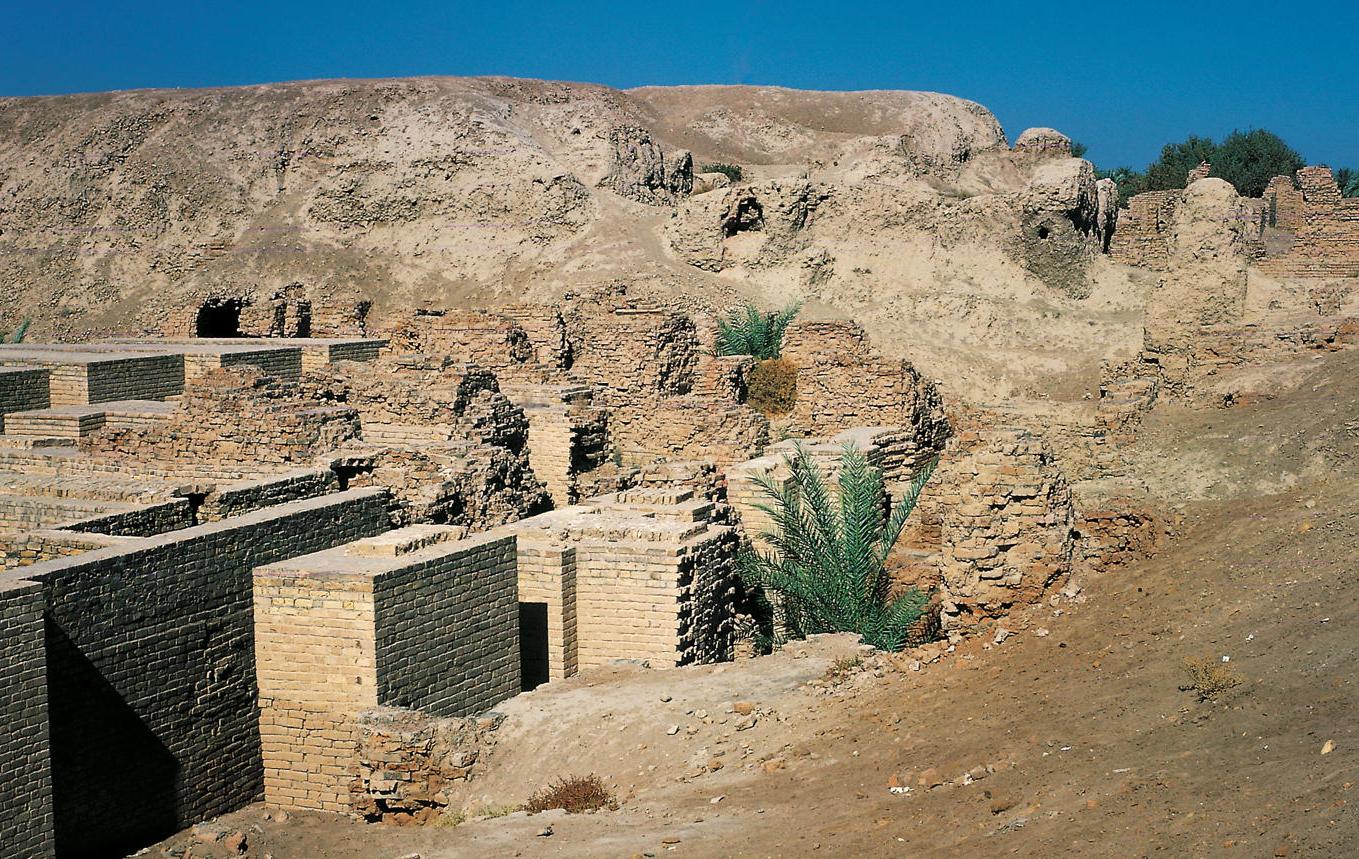
The remains of the Ishtar Gate and the citadel. The ruins of ancient Babylon form the largest surviving ancient settlement in Mesopotamia.
Photo Joan Oates.
In the 1st millennium BC Babylon was ruled by a number of native dynasties, with occasional intrusions from Assyria. In the 8th century BC a Chaldaean tribal sheikh claimed the throne, and with the accession of Nabonassar (747 BC) we enter a new, precisely dated era in the history of Babylon, whose rulers and enemies are recorded in both biblical and classical sources. The era was recognized as a turning point in the history of astronomy, and the very term Chaldaean came to signify ‘astronomer’. In 625 another Chaldaean sheikh, Nabopolassar, seized power, defeating the Assyrians and also establishing a new dynasty under which Babylon achieved its greatest fame.
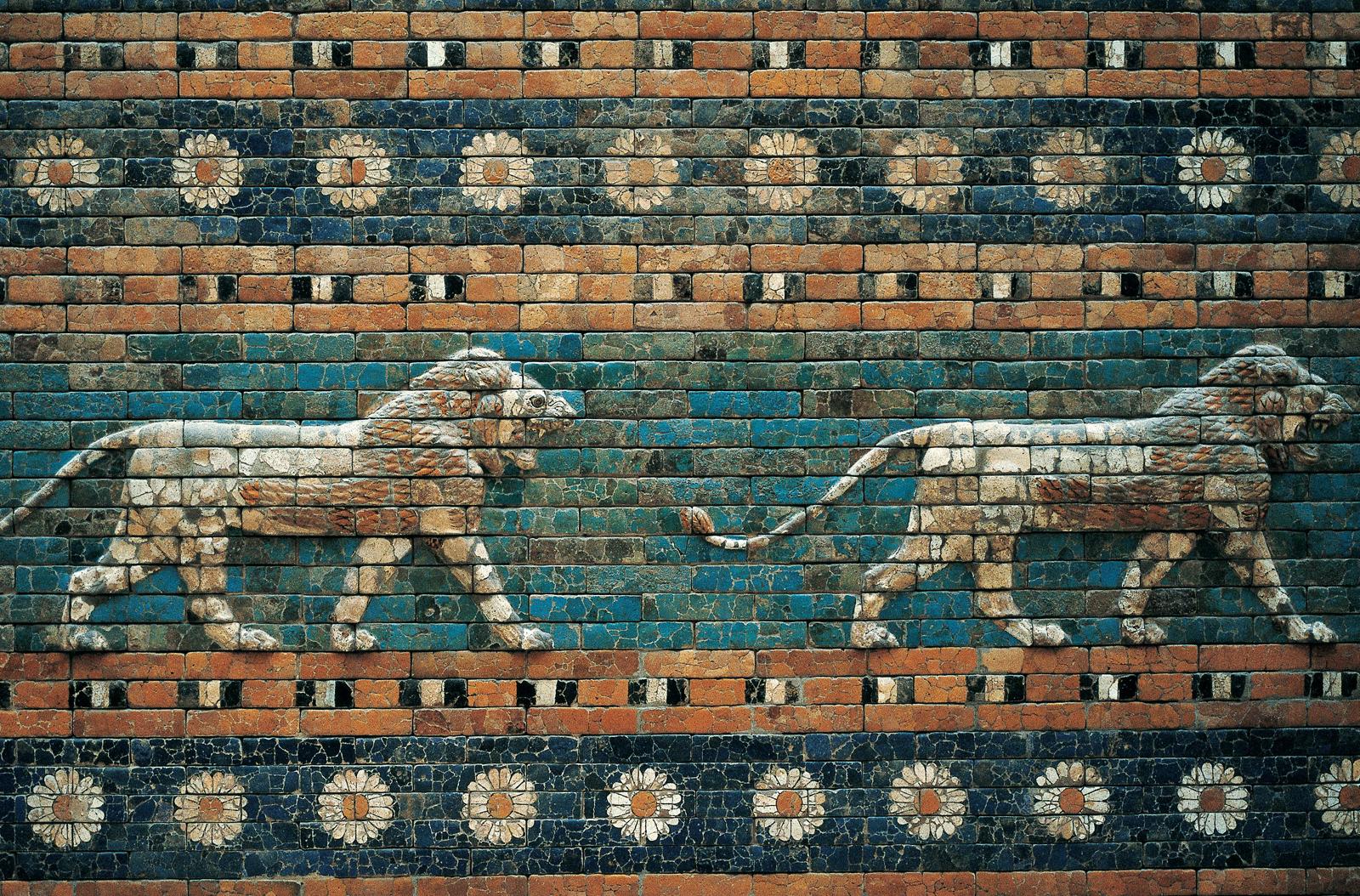
A detail from the Processional Way, which ran through the city to the massive Ishtar Gate. As it approached the gate from the north, it was ornamented with about 120 lions in glazed brick relief.
Photo Will Pryce © Thames & Hudson Ltd, London.
Nabopolassar’s son Nebuchadnezzar (604–562 BC) needs no introduction. The Babylon of Herodotus was largely the work of his architects, and this is the city the visitor still sees today, its ruins extending over some 850 ha (2,100 acres), the largest ancient settlement in Mesopotamia. German excavators worked there between 1899 and 1917; since 1958 Iraqi archaeologists have carried out further excavation and considerable restoration. A visitor to the city notices first its great surrounding double walls. To the north is the Summer Palace, so-called because of its ventilation shafts, of a type still known in the region today. Here the name Babil has survived from ancient times. Next is an inner city, surrounded by another set of massive double walls enclosing the major public buildings, including over 40 temples. Most impressive is the ‘Processional Way’, leading from Babylon’s main temple (Esagila), past the great ziggurat – the ‘Tower of Babel’ – and Nebuchadnezzar’s vast palace, and through the famous Ishtar Gate (reconstructed in the Vorderasiatisches Museum, Berlin), en route to the temple of the New Year Festival. On the way it also passes the earliest known museum, founded by Nebuchadnezzar.

The site of Babylon photographed in 1952, before extensive modern reconstructions and damage. In the centre is the unfinished basalt figure of a lion trampling a man, found by local villagers in 1776 in the ruins of the Northern Palace where it was part of the earliest known museum, founded by Nebuchadnezzar.
Photo Joan Oates.
Much debate surrounds a structure at the palace’s northeast corner – an underground ‘crypt’ consisting of 14 vaulted rooms built to support an enormous weight and containing wells with a unique hydraulic system. This combination has led to its identification as the Hanging Gardens, one of the Seven Wonders of the World. One tradition links these gardens with the queen Semiramis, while another credits them to Nebuchadnezzar, said to have built them for his wife, Amyitis, who was homesick for the trees and mountains of her native Persia. Lists of rations for the Jewish exiles from Jerusalem were found here, however, and it seems more likely that this structure served as a warehouse and administrative unit.
Many buildings continued in use in Persian and Greek times. Darius (521–486 BC) added a new palace with a columned hall for his son Xerxes, who was responsible for the destruction of the city in 482 BC. Greek influence is clearly evident in the now restored theatre. Nearby stood the remains of the funeral pyre ordered by Alexander for Hephaestion, his childhood friend and trusted general, as well as a great mound of brick rubble – debris removed by Alexander when he decided to rebuild the ziggurat destroyed by Xerxes.
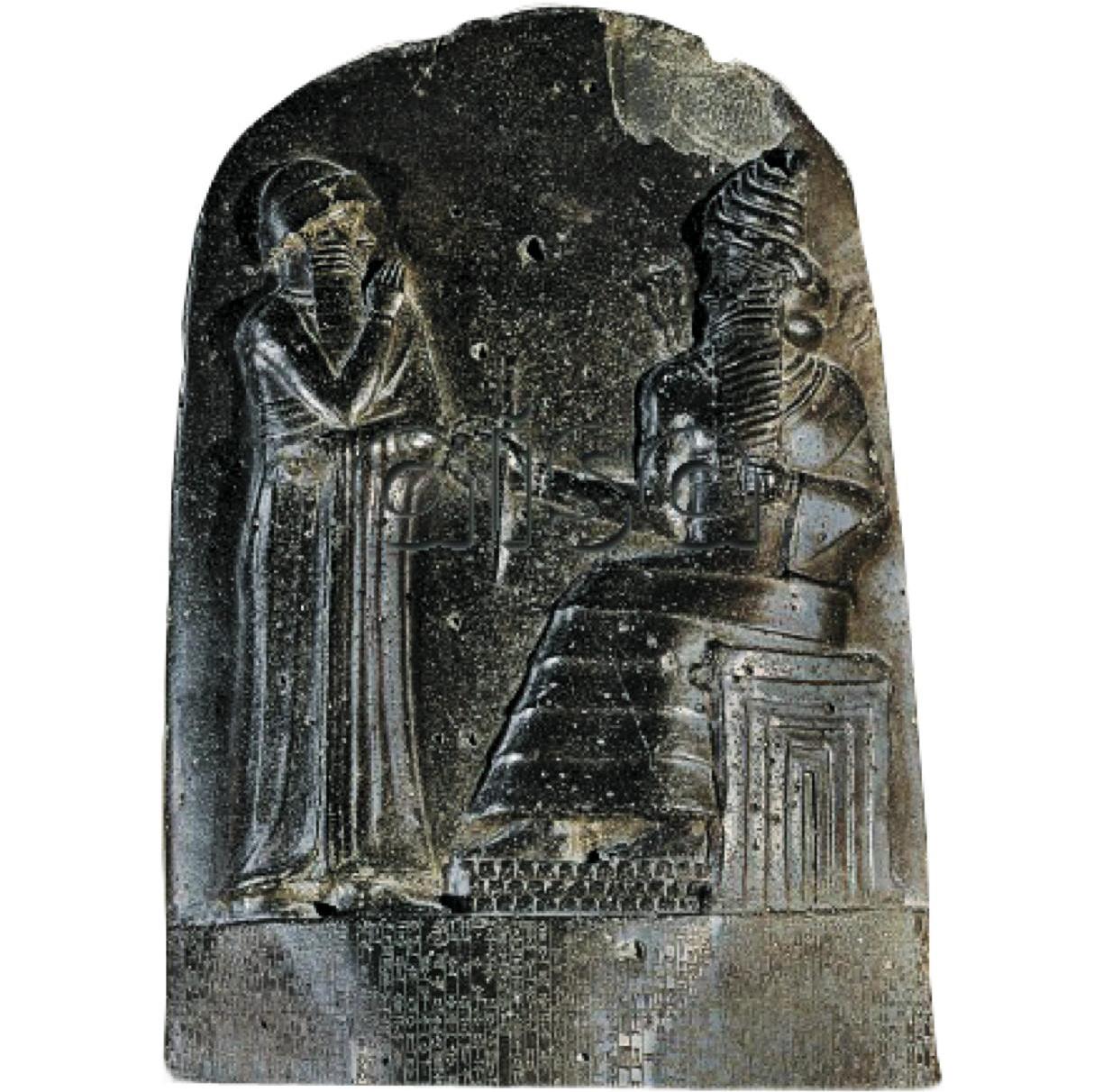
The top of Hammurabi’s basalt Law Code stela, which is now in the Louvre Museum, Paris; the laws themselves were carved in vertical columns below. Hammurabi is shown in an attitude of prayer standing before the sun-god, Shamash, the god of justice. The stela was carried off as a trophy to Susa by the Elamites.
Musée du Louvre, Paris.
Alexander chose Babylon for his eastern capital, but following his early death (323 BC), his general Seleucus founded a new city nearby (Seleucia-on-the-Tigris), marking the end of Babylon’s civil power. Yet Seleucus’ successor rebuilt the temple of Esagila, where Babylonian scholars maintained its great library and where the Babylonian priest Berossus dedicated his history of Babylonia to Antiochus. Babylon’s last known document is dated AD 75. In AD 116 the Roman emperor Trajan wintered in Babylon, and offered a sacrifice in the room where Alexander died.
Babylon was much restored in the late 20th century. Saddam Hussein built himself a palace, for which he created a high artificial mound, a splendid example of a ruler’s attempt to manipulate the past for his own aggrandizement. This was built on the ancient river bed, causing relatively little harm, but the site has not fared so well in recent conflicts. A large area was flattened for heavy vehicles and helicopters, which themselves caused considerable damage both to the underlying site structure and to some standing buildings. A helicopter landing zone led to the destruction and removal of the ziggurat debris left by Alexander’s troops and Hephaestion’s funeral pyre, both of immense archaeological importance. Tanks and heavy vehicles were driven along the Processional Way, destroying forever the well-preserved street surface on which Nebuchadnezzar, Darius and Alexander had once walked and whose bricks preserved their names.