
CHAPTER SEVEN

Atumultuous age began in 235 with the murder of Severus Alexander, the last of the Severans to rule Rome. The relatively docile youth was replaced by the militant giant, Maximinus I ìThraxî who, in an extreme sense, characterizes the era that followed and came to a close in 268, when Claudius II ìGothicusî put Rome on a road to recovery.
For the historian, this is perhaps the darkest in all Roman history. Beginning with the reign of Gordian III, we enter a period in which the written histories are not only sparse but often unreliable. No longer do we have a Suetonius, Tacitus, Herodian or Dio Cassius to guide us, but rather the summary accounts of the Christian writers of the 4th Century (which tend to be ìrevisionistî), and the highly unreliable biographies of the Historia Augusta. The bleakest period occurs from the accession of Philip the Arab in 244 to the capture of Valerian I in 260 when a sparse historical record is further complicated by an alarming number of men (18 of whom struck coins) who claimed the title of Augustus.
Though the fortunes of the Empire were gradually declining from the start of this period, the most serious slips occurred in the early 250s, when invasion and border warfare was incessant and was greatly outstripping the capacity of Rome to respond. Complicating matters was the host of new nomadic peoples by whom the Romans were confronted. Not only did they present problems of their own, but their arrival forced more established enemies out of their own lands and into Roman territory. As a result, defenses along the Danube and Rhine were breached almost yearly, often in a coordinated manner so as to spread thin the Roman armies.
In Asia Minor the situation was no better, because a particularly fierce and gifted man, Shapur I (241ñ272), became king of the Sasanians. He was as terrifying an enemy as Rome had ever known, and in military terms was as destructive as Hannibal or Mithridates VI. There hardly could have been a worse time in Roman history for an enemy of Shapurís ability to emerge, for he was not content with his own kingdom, but wanted to incorporate lands long-held by the Romans. His title alone, ìKing of Kings of Iran and non-Iran,î said it all.
To make matters worse, the fickle frontier legions often hailed their own commanders emperor, forcing one civil war after another ó all at a time when the Empire could least afford to squander its resources. Legions were withdrawn from the borders to support pretenders who marched on Rome. In the meantime, a fresh assault would be launched into the territories that were stripped of their armies. But the soldiers can hardly be blamed. Not only did such campaigns get them away from the cruelties of the front, but they usually meant that a donative was paid out. Moreover, the battles that occurred between two Roman armies were usually nominal or were avoided entirely by negotiation or treachery within the ranks.
The 250s, and especially the 260s, were a period of adjustment in the history of Rome, when it was forced to come to terms with the unpleasantness of its fate. Constant invasion caused frontier legions to revolt with some frequency, often demanding that their own commanders accept the purple. Since this often was equivalent to a death sentence, most did so reluctantly.
The year 260 was disastrous. In the West, Gallienusí youngest son, Saloninus, was executed; in the Balkans, the commander Regalianus revolted; in Asia Minor, Gallienusí father, Valerian I, was captured by the Persians, and in consequence a revolt was staged by Macrianus and Quietus in Antioch. Though Gallienus is much maligned by historians, he showed remarkable energy and dedication in trying to restore an Empire that was under siege on all fronts and several times from within. That his Empire did not completely collapse is remarkable.
Usually the revolts staged by Roman commanders were not successful, but the reign of Gallienus was ripe with opportunity for such men, and two major ìbreakaway statesî or ìseparatist Empiresî were founded. The first, in Gaul, was founded in 260 by the general Postumus, and the second, in Palmyra, was founded in about 261 by the leader Odaenathus. This powerful eastern monarch assumed the titles ìRuler of the Romansî and ìGovernor of the East.î Earlier, breakaway attempts were made in Syria by Uranius Antoninus (253) and Macrianus and Quietus (260ñ261), but both were short-lived. Information on the first two of these ìseparatist Empiresî may be found in chapter 8.
During this period, three unfathomable events occurred. In the summer of 251, the emperor Trajan Decius, his teenage son Herennius Etruscus, and most of their soldiers were killed in a Gothic ambush led by Kniva. They were the first Roman emperors ever to fall in battle against a foreign enemy. Even worse were two other ìfirstsî in Roman history, both of which occurred in 260. The 17-year-old emperor Saloninus was captured and executed at Cologne by the rebel Postumus, and the emperor Valerian I was captured by the Sasanian king Shapur I while attempting to negotiate a truce. Shapur subsequently mutilated the elderly ex-emperor, paraded him about using him as a footstool, and then putting his skinned and stuffed body on display. Both of the latter tragedies contributed to the establishment of separatist Empires.
The coinage suffered greatly during this period. The double-denarii of the late 230s and early 250s were reduced in purity from earlier times, but at 40 percent or more silver they were still readily recognizable as silver pieces. After the reign of Gordian III, the denarius becomes a great rarity. In the later 250s the currency began to slide so severely that, with the exception of denarii struck by the separatist Carausius, no true silver coin was struck again until Diocletianís reform of 294. Gold coinage did not suffer any significant reduction in purity, but it came to be struck with less frequency, and often at weights that were both inconsistent and low.
The aes coinage also suffered, with the as and dupondius gradually being abandoned and the sestertius coming to be struck on small, square planchets of reduced weight. Furthermore, orichalcum (brass), the more valuable copper alloy, was abandoned in favor of leaded bronze, regardless of denomination. A new denomination, the double-sestertius, was introduced by Trajan Decius (249ñ251), but failed to take hold, except during the reign of Postumus, the founder of the separatist Romano-Gallic Empire.
So poor were the final double-denarii of Gallienus that they have only the slightest trace of silver. There was no attempt to maintain the beauty of these coins: they are small, ragged and of poor artistry. Considering that Gallienus was a grand patron of the arts (and a devout Neo-Clas-sicist), the pitiful decline in coinage is a very real reflection of the almost insurmountable difficulties he faced. The Romans established new mints to provide the vast quantities of coinage (however worthless) necessary. The most important of these new facilities were located at Milan, Siscia and Antioch.
Beginning with Claudius II Gothicus in 268, the period of decline comes to an end. Almost every emperor for the next 60 years was of Illyrian origin ó this being a noticeable shift from the heavy concentration of African and Syrian emperors earlier in the century. About a generation after the accession of Claudius II, the Empire saw an even greater degree of organization and efficiency when Diocletian partitioned duties along geographic lines. This innovation certainly helped Romeís plight, but seldom resulted in true peace and prosperity, and never brought back the good fortune of the 2nd Century.
MAXIMINUS I ëTHRAXí A.D., 235ñ238
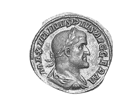
HUSBAND OF PAULINA
FATHER OF MAXIMUS
Gaius Julius Verus Maximinus, A.D. 172/3 or c. 182/3ñ238. A man of truly humble origin, Maximinus ìThraxî (ìthe Thracianî) was supposedly born of a Gothic father and Alan mother, and was destined to be a Thracian herdsman had he not enlisted in an auxiliary unit of the Roman army. Indeed, Maximinus was the first man in history to rise from the ranks to the high office of emperor, and was also the first emperor who did not set foot in Rome during his reign.
Maximinus is best remembered for his great physical stature, legendary strength, paralyzing stare and voracious appetite ó all of which seem to be exaggerated to some degree by the authors of the Historia Augusta, who say he was no less than eight and a half feet tall. In any case, Maximinusí physical attributes were remarkable, and they caused him to be recognized while wrestling at a competition in Thrace that was attended by the emperor Septimius Severus. The emperor was greatly impressed, and thus did his best to Romanize him, and even appointed him as a personal bodyguard.
Caracalla, who also valued Maximinusí skills and loyalty, raised him to the rank of Centurion, but the giant quit the army when Macrinus replaced the murdered Caracalla. He later was voted the power of a tribune under Elagabalus, though apparently he was offended by the youthís perverted advances. He remained aloof from military service until after the accession of Severus Alexander, who appointed him to high posts during the Mesopotamian and German campaigns of the 230s.
A long period of instability in the Empire began in March of 235, when Severus Alexander was murdered by mutinous soldiers in Germany. It seems the soldiers had earlier voted to hail Maximinus as his replacement. His rise to power set the stage for emperor-making in the next half century, during which so many low-born soldiers from the Danubian region claimed the purple. The senate found no comfort in this turn of events, but could do little to change matters.
Two coups were hastily formed and aborted during Maximinusí inaugural year. The first one was a plan to tear down a bridge over the Rhine after Maximinus had crossed it, thus stranding him. The second was formed by the corps of archers from Osrhoene, but it also failed. These attempts produced a level of bitterness and paranoia in Maximinus. One of his remedies was to dismiss high-ranking officers in the army and to replace them with his own hand-picked men.
After solidifying his authority, Maximinus set about pacifying Germany, which he attempted at great personal risk ó in one case leading his army through chest-high water to fight. For his costly but impressive victory at the swamps in Wiirttemberg in 235, the senate (which was sent a painting depicting the Herculean feat) reluctantly awarded him the title Germanicus Maximus. At this time, perhaps, Maximinus also raised his son, Maximus, to the rank of Caesar.
Maximinus next occupied his armies on the Danubian frontier, where he based himself in Sirmium and spent the next two years fighting Sarmatians and Dacians. To pay for these protracted campaigns, the peasantemperor exacted his revenge on the wealthy and upper-classes by taxing them at an extraordinarily high rate, and by demanding payment in bullion or its equal. Even though the more humble classes felt the pinch of Maximinusí taxation, it was the upper-class and the senate which, in the spring of 238, acted upon their dissatisfaction by electing a council of 20 senators to organize the defense of Italy and by declaring Maximinus a public enemy. To back up their decree, the senate supported the revolt of the Gordiani in North Africa, which lasted only three weeks.
Maximinus led an invasion of Italy that he hoped would result in a visit to Rome as conqueror, and the opportunity to punish the noblemen within. In the meantime, the senate appointed two of their own members, Balbinus and Pupienus, to rule and defend Italy during the crisis. Luckily for the two bickering senators, Maximnus met resistance early on, and was unable to take the city of Aquileia, which resisted his advance. Indeed, the minimal actions taken by Pupienus to organize the defense of Italy were hardly necessary.
The Thracianís harsh discipline, incompetent subordinates, and disaffected army (which was facing possible starvation) proved to be his undoing. He and his son, Maximus, were assassinated by soldiers of Legion II Parthica after they were awakened from sleeping off a midday meal. The senate and the people of Rome must have been greatly relieved when the severed heads of the Maximinus and his son were delivered to the capital. The date of their murder is inconsistently reported as being sometime in April, on May 10, or on June 24 of 238.
NUMISMATIC NOTE: The earliest portraits of Maximinus I are mere adaptations of those of his predecessor, Severus Alexander. Though Maximinus had lived in Rome, his bold features and ìjutting chinî apparently were not known to the die engravers. Later, the engravers adopted his true portrait, which appears on the vast majority of his coins.
PAULINA

WIFE OF MAXIMINUS I
MOTHER OF MAXIMUS
Caecilia Paulina, died c. A.D. 235 or before. Very little is known of Paulina, though her memory is consecrated on coinage struck during the reign of Maximinus I. It is an assumption ó though a safe one ó that she was the wife of Maximinus I rather than his mother, sister or other relation. Maximinus is said to have wed during the reign of Caracalla, and as a result fathered a son, Maximus. It seems almost certain that Paulina died before Maximinus became emperor because of the dating of some provincial bronzes.
NUMISMATIC NOTE: We can be certain that Paulina was associated with Maximinus I for she is portrayed on bronze coins of Anazarbus, Cilicia, which is dated to that reign. On the bronze in question, the date ANC indicates year 254 of the local Era of Anazarbus, which began in the fall of 19 B.C. Thus, the Era year 254 equates the date 235/6, just at the start of Maximinus Iís reign. Also from Anazarbus emanated a bronze coinage in the name of Maximus, which bears the identical date. As if further evidence were needed, the portrait of Paulina is closely assimilated with those of Maximinus and Maximus.
MAXIMUS
CAESAR: A.D. 235/6ñ238
(UNDER MAXIMINUS I)

SON OF MAXIMINUS I AND PAULINA
Gaius Julius Verus Maximus, c. A.D. 216ñ238. The son of Maximinus I ìThrax,î and presumably of Paulina, Maximus was raised in the manner of an aristocratic Roman, for his barbarian father had been in the service of the emperors for about two decades before he was born. It is not entirely certain when Maximus was raised to the rank of Caesar. It may have occurred in 235, when his father was hailed Germanicus Maximus, but it may also have occurred in 236. In either case, Maximus was about 20 years old at the time.
Though by all accounts Maximus was handsome and capable, he is said to have abandoned his responsibilities in favor of frivolous pursuits, and his arrogance soon caused him to be as intensely disliked as his father. No doubt he was not anxious to serve on the frontiers, for he was a cosmopolitan Roman on the verge of marrying Junia Fadilla, a descendant of Antoninus Pius (who no doubt was related to Fabia Orestilla, the wife of Gordian I). However, this wedding, which would have mixed the barbarian blood of Maximus with the noble blood of the Antonine House, never occurred. After serving at least two years at his fathers side on the frontiers, Maximus was murdered along with his father outside of Aquileia, and his severed head was delivered to his beloved Rome.
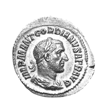
GORDIAN I A.D. 238
(CO-EMPEROR WITH GORDIAN II)
FATHER OF GORDIAN II
GRANDFATHER OF GORDIAN III
Marcus Antonius Gordianus Sempronianus Romanus ìAfricanus,î c. a.d. 157/9ñ238. Gordian I is said to have been descended from the Gracchi on his fatherís side, and from Trajan on the side of his mother. His first wife, Fabia Orestilla, was said to have been a great grand-daughter of Antoninus Pius. It is uncertain how much of this is true, and modern historians have expressed serious doubts about the nobility of Gordianís ancestry. What we can be certain of is that he was perhaps the wealthiest man in all the Empire. His vast estates constituted a small Empire in their own right, and his home in Rome was once owned by Pompey the Great.
The tales of his personal expenditures on public games seem almost beyond belief: he could spend staggering sums on a regular basis without concern that his wealth would be diminished, as his estates produced an enormous and steady flow of income. But his unimaginable resources did not seem to sour his disposition, for he is also said to have been a man of the greatest integrity. We know he was very fond of philosophy and literature, and that he penned 30 books of verse on the lives of Antoninus Pius and Marcus Aurelius. We are told he was especially fond of bathing and sleep, and did nothing to excess.
Later in his life he achieved high offices, including the consulship in Rome in 222, and the governorship of Lower Britain. In 237 or 238, when Gordian was in about his 80th year and nearing the end of his career, he became governor of North Africa. Indeed, he probably hoped that the severe exactions of Maximinus (which especially targeted the wealthy) would end so he could live his remaining days in peace. This was not to be, however. Several local noblemen were levied fines so severe that they would cause their immediate ruin, and so they murdered the procurator rather than paying. Desperate for a leader who could both sympathize with their dilemma and assemble an army, these renegades implored the elder Gordian to accept the title of emperor. The elder Gordian, with some reluctance, agreed to take on the task and was made co-emperor along with his middle-age son. Thus, father and son were drawn into the conflict, presumably on March 19 or 22 of 238.
After entering Carthage and assuming the additional name Africanus, the two Gordians drafted a letter expressing their intent, which arrived at Rome within a few days. Along with the letter, the Gordiani sent one of their agents on a mission to assassinate the praetorian prefect Vitalianus, who was fiercely loyal to Maximinus and was an obstacle to the fledgling revolt. Vitalianus was killed, which no doubt helped the senate to muster its courage to confirm the request of the Gordiani. When news was posted in the Forum, the people rejoiced and there followed several days of riots during which informers, officials and tax collectors of Maximinus were slaughtered to the man.
Maximinus was at Sirmium when news of the rebellion reached him, and he immediately prepared to invade Italy. Meanwhile, the Gordiani committed a fatal error when they demanded the resignation of Capellianus, the governor of neighboring Numidia and a loathsome man with whom the Gordiani had a bitter legal dispute. Instead of surrendering, Capellianus marched on Carthage at the head of his legions. The younger Gordian left Carthage with a group of local militia and crudely armed citizens to oppose Capellianís advance. That the younger Gordian died in battle, and his father hanged himself we are certain, but accounts vary as to whether Gordian I committed suicide before or after news reached Carthage of the defeat. Both of these events are said to have occurred on April 12, ending a joint reign of only three weeks. For more details, see the biography of Gordian II, below.
CHRONOLOGICAL NOTE: It is of some interest that although most historians place this revolt in March and April of 238, at least one authority suggests it occurred in January. Indeed, many of the details of this revolt are probably different from what has come down to us in the Historia Augusta. Historians and numismatists are at a loss to explain how such a well-crafted and well-organized coinage could have been struck at Rome and at Alexandria under circumstances as urgent as those described above. A timeframe of three weeks (21 or 22 days) seems wholly insufficient for the quantity of coinage struck. Rather than a spontaneous revolt, the numismatic evidence suggests theirs was a coup planned in advance with key senators in Rome.
NUMISMATIC NOTE: Because the inscriptions on the coins of Gordian I and Gordian II are identical, the coins can only be distinguished by the characteristics of the portraits. The elder Gordian has a full head of hair, a thin face, beak nose and slightly recessed jaw. The younger Gordian has a receding hairline, a long, flat nose, a pronounced forehead, heavy jaw and jutting chin, and is fleshier in appearance.
GORDIAN II A.D. 238
(CO-EMPEROR WITH GORDIAN I)

SON OF GORDIAN I AND ORESTILLA
UNCLE OF GORDIAN III
Marcus Antonius Gordianus Sempronianus Romanus ìAfricanus,î c. A.D. 191/92ñ238. The son of Gordian I and his first wife, Fabia Orestilla, the younger Gordian was praised by his contemporaries as kind-hearted, remarkably handsome, and in possession of an extraordinary memory. He was a skilled administrator who governed Achaea, served as Quaestor under Elagabalus, and as Prefect of Rome and consul under Severus Alexander. Later, he served as his fatherís deputy in North Africa.
Though he was his fatherís equal in administrative skill and learning (for he had a library of some 62,000 volumes), he did not possess his high level of integrity. He was a staggeringly wealthy middle-aged bachelor with many vices, foremost among them being women. The Historia Augusta tells us that ìÖ he had 22 mistresses formally attached to him, from all of whom he had three or four children apiece.î
Indeed, the most telling assessment of his personal legacy is also found in the Historia Augusta in which he is described as a man who wasted his considerable genius by giving himself over to pleasure. Furthermore, he was ìÖ a man of huge size. Ö He had a craving for cold drinks and passed the summer with great difficulty unless he drank a great many of them.î
As his fatherís deputy in the government of North Africa, the younger Gordian became co-emperor with his father at the request of local nobleman and with the consent of the senate in Rome. He was his fatherís titular equal, except that he did not share the high priesthood. When the Numidian governor, Capellianus, opposed the elevation of the Gordiani, it was the younger Gordian who assembled a large number of locals to prevent his advance on Carthage. Though the Carthaginian forces were far larger in number than the Numidian legionaries, they were an untrained, undisciplined mob consisting of inexperienced local militia and enthusiastic provincials armed with farm implements and knives.
When the two forces met, perhaps on April 12, the Carthaginians lost their composure at the mere sight of the Numidian cavalry, who were renowned for their ability to control their horses precisely and to launch their javelins with deadly accuracy. The ìarmyî of Gordian II fled en masse before the battle had even begun. What followed was not so much a battle as a mass slaughter of Gordian s undisciplined forces, many of whom died of trampling by their own comrades. The slaughter was so complete that the body of Gordian II ó who had reigned only about three weeks ó could not be recognized after the fact. For more details, see the biography of Gordian I, above.
NUMISMATIC NOTE: Because the inscriptions on coins of both Gordians are identical, we must rely on the characteristics of the portraits when determining which Gordian is portrayed. The elder Gordian has a full head of hair, a thin face, beak nose and slightly recessed jaw. The younger Gordian has a receding hairline, a long, flat nose, a pronounced forehead, heavy jaw and jutting chin, and is fleshier in appearance.
PUPIENUS A.D. 238
(CO-EMPEROR WITH BALBINUS)

Marcus Clodius Pupienus Maximus, c. A.D. 164/74ñ238. With the death of the Gordiani in North Africa, the hopes of the senate were dashed, as they realized they had no choice but to defend themselves. Maximinus had begun his invasion of Italy and though he was not making rapid progress, the senators had no reason to expect mercy if he reached Rome.
The senate, which had met in the temple of Castor and Pollux to vote on its support of the Gordiani less than a month before, gathered in the temple of Jupiter Optimus Maximus on the Capitoline Hill to determine its own fate. It had already established a council of 20 members (vigintiviri reipublicae curandae causa) to see the Empire through the crisis, and at this point selected two members of that council, Balbinus and Pupienus, to take the leading positions as joint emperors.
This act was not only practical (one to manage government, the other to defend Italy from Maximinusí invasion) but was also symbolic: Rome traditionally had been ruled by two consuls. It is also of some importance that the two men shared their honors equally (although one manís name had to come before the other, and this proved to be a bone of contention for Balbinus, whose name came second). Even the chief priesthood, the pontifex maximus, was shared by the emperors. Although this had never before occurred with this indivisible office, the practice would appear again under future emperors.
Pupienus was perhaps a few years younger than his colleague and, according to Herodian, hailed from a distinguished Etruscan family (which is more likely than the ìhumble birthî the authors of the Historia Augusta report. Like Balbinus, Pupienus had twice been consul and held governorships in the provinces, and seems also to have been Prefect of Rome sometime in the 230s. The first problem the co-emperors encountered was that the people of Rome were opposed to the leadership of these two patricians. An angry mob demanded that a member of the Gordiani be included, for that family, though also noble, was popular with the poor. The senate thus bestowed the title of Caesar on Gordian III, the 13-year-old grandson of Gordian I, in an effort to placate the public and no doubt to gain access to the considerable wealth of the boyís family.
Balbinus saw to administrative matters, while Pupienus was charged with organizing the military defense of Italy. Pupienus and the council of 20 mobilized troops throughout the province and blockaded the roads around Aquileia, the city at which the army of Maximinus was bogged down in a tiresome siege. In addition to starving Maximinus of supplies, Pupienus was making covert efforts to undermine the loyalty of his soldiers, who in any case were not enthusiastic about waging war on their own people. It did not take long for a plot to hatch, and Pupienus did not even have to leave his headquarters at Ravenna before Maximinus and his son were murdered in their camp after being roused from a midday nap. Immediately, the army of Maximus wished to make peace with the Aquileans, who were wary of a possible ruse. So they first showed the people of Aquileia the severed heads of Maximinus and Maximus before they dispatched them to Pupienus at Ravenna, and subsequently to Balbinus in Rome. Pupienus then went to Aquileia to resolve the concerns of both parties. The armies of both sides disbanded without incident.
Pupienus returned to Rome to great acclaim as the savior of Italy, which did nothing but strain his already tense relationship with Balbinus, who pointed out at every opportunity that his colleague really had done nothing, and that Maximinus had defeated himself. To solve their differences, the two men had hatched a plan which involved their jointly leaving Rome on military campaigns: Pupienus against the Sasanians, and Balbinus against the Goths on the Lower Danube. However, the rivalry had become absurd and destructive, and proved to be their downfall. This spelled opportunity for the praetorians, who were not in favor of being ruled by men whom they did not choose. Riding a tide of public resentment, the praetorians burst into the palace and dragged both men into the streets. (In a stroke of bad timing, Pupienusí German bodyguards were elsewhere, and could not come to their rescue.) After being dragged through the streets and mutilated, the two men were killed, to the relief of everyone but the senate. For more details, see the biography of Balbinus.
CHRONOLOGICAL NOTE: Most authorities agree that the revolt of the Gordiani ended late in April of 238, and that Pupienus and Balbinus were elected as co-emperors in that month (perhaps on the 22nd day). Using that time-frame, a reign of 98 or 99 days would place their murders at the very end of July (perhaps on the 29th day). However, the authors of RIC suggest they reigned from the beginning of April through the end of June, and at least one authority places their revolt in January, and thus dates the rule of the co-emperors from early February through early May.
NUMISMATIC NOTE: All coin portraits of Pupienus are shown slightly from behind, whereas those of Balbinus are shown slightly from the front ó a subtle but purposeful distinction which may indicate the seniority of the latter. The reverses of Pupienus and Balbinus are shared on all denominations except the double-denarius, upon which there is a common reverse design (ìclasped handsî), but six different inscriptions. Each emperor used three of these inscriptions on his own double-denarii, and only on very rare occasions are they mistakenly ìmuledî with an obverse of the other colleague.
BALBINUS A.D. 238
(CO-EMPEROR WITH PUPIENUS)
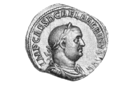
Decimus (or Decius) Caelius Calvinus Balbinus, c. A.D. 178/65ñ238. When the revolt of the Gordiani failed in North Africa, the senate elected two of its own members, Pupienus and Balbinus, as their replacement emperors. Balbinus was a distinguished senator who had been consul in 203 and 213 and held several governorships in the provinces.
While Pupienus was initially in charge of the military defense of Italy, Balbinus was responsible for administrative matters and securing peace in Rome. This was no easy task for the elderly senator, who faced a riotous population, a frantic senate and, worst of all, a dissatisfied praetorian guard that felt slighted for not having been the instrument by which the new emperors were chosen. The schism between the senate and the praetorians was particularly strong, and resulted in violence when senators armed with daggers murdered some unarmed praetorians who had impetuously burst in on one of their meetings.
This incident was followed by an attack on the praetorian camp by two senators, Gallinicus and Maecenas, who led an angry mob of citizens and gladiators, hastily armed and driven to riot. The praetorians repelled the attacks and later went on the offensive themselves, causing a small civil war in Rome for several days. Amidst this chaos, Balbinus attempted to make peace, but to no avail, for he was universally viewed as a weak man with no real authority; he was even wounded when the public pelted him with bricks.
The praetorians were now besieged in their camp, and the citizens attempted to starve them of water. After suffering for a few days, the praetorians burst out of the camp and began to slaughter the citizens. Guerrilla-style warfare ensued and a considerable section of Rome was burned to the ground in the process. Considering the circumstances, it would have been difficult even for a popular emperor to keep the peace, but the unpopular Balbinus had no chance at all.
Once the military threat of Maximinus had ended, Pupienus returned, riding a tide of popularity that only exacerbated the rivalry between the Imperial colleagues. Clearly, Balbinus was the loser in the situation, for while he was barely able to keep Rome from self-destruction, Pupienus had ìwonî an important victory which spared Rome from certain invasion. The two men quarreled over many things ó at first privately but then publicly, as their hostility grew. Their main bone of contention was which of the two rulers should be accorded the highest honor. Balbinus was upset that his colleagueís name had come first in inscriptions from the very outset, even though he believed his own record and ancestry were more illustrious. He was also jealous of the popularity his colleague enjoyed for his easy victory over Maximinus, who had defeated himself. Pupienus could do little in return but call Balbinus a timid, obese, lazy Sybarite.
Balbinus was especially concerned about Pupienusí German bodyguards, who were both loyal and fearless. Understandably, Balbinus feared that he might be assassinated by them. The praetorians had their concerns, for they suspected Pupienus might try to replace them with Germans in the same way Septimius Severus had done with his Illyrians. Finally ó after Balbinus and Pupienus had ruled scarcely three months ó the praetorian guards decided to act before they were acted upon. They stormed the palace while the German guards were occupied elsewhere and dragged the two emperors into the street, where they were mutilated and killed. For more details, especially on the chronology of the reign, see the biography of Pupienus, above.
NUMISMATIC NOTE: The first silver coinage of Balbinus and Pupienus was exclusively of denarii, as that had been the only silver denomination struck for the previous 16 years (under Severus Alexander and Maximinus I). However, to stretch resources the co-emperors soon began to strike double-denarii, an inflationary coin introduced by Caracalla in 214 and which had been abandoned in 222.
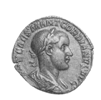
GORDIAN III A.D. 238ñ244
CAESAR: A.D. 238
(UNDER BALBINUS AND PUPIENUS)
AUGUSTUS: A.D. 238ñ244
GRANDSON OF GORDIAN I
NEPHEW OF GORDIAN II
ADOPTED SUCCESSOR OF BALBINUS AND PUPIENUS
HUSBAND OF TRANQUILLINA
Marcus Antonius Gordianus ìPius,î c. A.D. 225ñ244. Although orphaned as a child, Gordian III belonged to a prominent and exceptionally wealthy family, then headed by his grandfather, Gordian I. His mother was Maecia Faustina, a daughter of Gordian I and a sister of Gordian II. Although we have virtually no insight into the personality of Gordian III, we are told by the Historia Augusta that he was light-hearted, handsome, winning and ìÖ was loved by the people, the senate and the soldiers as no prince had ever been before.î
The joint emperors Balbinus and Pupienus raised young Gordian III to the rank of Caesar shortly after his grandfather and uncle perished in their failed North African revolt. For the two emperors it was a prudent move: not only did they fulfill the demands of the rioting populace, but they also placated the praetorian guards, who viewed young Gordian as their candidate. Additionally, the joint-emperors presumably gained access to his familyís enormous wealth, from which it seems they hammered out a large coinage in less than 100 days. Among these coins were ones honoring the young Caesar, though they constituted only a very small portion of the output.
The chronology of this chaotic period is far from certain, although it seems the co-emperors reigned with Gordian as their Caesar until July of 238, when the two Augusti were murdered and Gordian III was hailed emperor in their place. Despite his youth (he was then about 13 years old), Gordian was probably the best candidate, for he was not mature enough to have an agenda of his own.
During this intense civil war, the enemies of Rome had become active. The Goths and the Carpi had crossed the Danube, and the Sasanians made advances in the East. Though his predecessors had planned to meet these challenges (Balbinus against the Goths and Pupienus against the Sasanians), their executions prevented any such action. The first three years of Gordianís reign were ostensibly under the guidance of the senate, though no doubt they were careful not to upset the praetorians or the army in the process. The Danubian frontier was managed through the presence of existing legions and the payment of subsidies.
Among Gordianís earliest tasks was the veneration of his deceased grandfather and uncle, which included the dismissal of the legion that caused their deaths under Capellianus. Although overtures like these, which earned Gordian the title ìPius,î were commendable, in the latter case it opened North Africa to a new revolt in 240 (by the provincial governor Sabinianus) which had to be quelled by soldiers based in Mauretania.
In 241, the 16-year-old Gordian changed the complexion of his reign by appointing Timesitheus, a man of exceptional character and experience, as his commander of the praetorian guard. At the same time he strengthened his ties to Timesitheus by marrying his daughter, Tranquillina. But the ìhoneymoonî was over before it began, for the Sasanian king, Shapur I, had invaded Syria, requiring immediate attention from the emperor and his father-in-law. En route to Syria, Gordian and Timesitheus were delayed on the Danubian frontier, where they defeated the Carpi and re-established peace in the region.
Gordianís army was finally able to engage Shapur in the spring of 243. The Romans quickly gained the upper hand against the Persians, and were able not only to preserve Antioch, but to recover Nisibis, Hatra and Carrhae as Gordianís legions advanced deep into Mesopotamia with the goal of taking the capital, Ctesiphon. But the death of Timesitheus in the winter of 243 dampened the effort. The cause of Timesitheusí death is not certainly known; he either died of natural causes or was murdered by Philip the Arab, his rival in life and replacement in death.
Though Gordian could no longer rely upon the counsel of Timesitheus, he none-the-less led his army further against the Sasanians. It seems, however, that he did not lead aggressively enough to satisfy his soldiers, who no doubt wanted to sack the Sasanian capital and strip it of its legendary wealth. The death of Gordian III at Zaitha in February or March of 244 is a bit of a mystery, and is usually attributed to a coup by Philip I.
Philip told the senate that Gordian had died of natural causes, while Shapur reports that he died in battle against the Sasanians at Misikhe. Regardless of how Gordian ó then 19 years old ó actually died, it must have been a lonely, frightening affair. Gordian was without an adviser he could trust, and was at odds with the ambitious Philip, all the while trying to lead an army so far from the comforts of the Rome he had known as a child. We are told that Gordian, in a fit of desperation, offered to abdicate in place of Philip and take a subordinate role, such as that of Caesar, or even a lesser position, in exchange for his life.
NUMISMATIC NOTE: Gordian III was the last emperor to strike the denarius in quantity, and even in his reign it was being eclipsed by the double-denarius, which had been reintroduced by Pupienus and Balbinus. Denarii of subsequent emperors are extremely rare. Antioch, which had been safeguarded by Gordianís armies, now became a regular Imperial mint.
TRANQUILLINA
AUGUSTA, A.D. 241ñ244

WIFE OF GORDIAN III
Furia Sabinia Tranquillina, lifespan unknown. Tranquillina was the daughter of Gaius Furius Sabinius Aquila Timesitheus, a man of good conscience whom Gordian III appointed as the commander of the praetorian guard in 241. This was presumably before or upon the young emperorís marriage to Timesitheusí daughter in May of that year. We know regrettably little of Tranquillina, but are probably not out of line to assume she was perhaps 16, or of similar age to her husband. Except that she produced no children and accompanied Gordian and her father on their Sasanian campaign, details of the marriage are unknown. Though her father died of illness (or murder) in 243, Tranquillina remained married to Gordian until he died in 244. She appears to have survived him, but her subsequent fate is uncertain.
NUMISMATIC NOTE: The great rarity of Tranquillinaís Imperial coinage is mysterious considering the great volume of coins struck in the name of her husband. Furthermore, under the Antonines and Severans there existed a tradition of striking large coinages in the name of empresses. Adding to this enigma is the fact that her provincial coinage is not terribly scarce. Some researchers suggest that her Imperial coins were recalled from circulation by Philip I, who is said to have despised her father, Timesitheus. However, this seems impractical and unlikely. A more probable theory is that her Imperial coinage was purposely small so as to avoid the appearance of a conflict of interest, considering that her father was the emperorís praetorian prefect and trusted adviser.
PHILIP I ëTHE ARABí A.D. 244ñ249
AUGUSTUS: A.D. 244ñ249
(A.D. 244ñ247: SOLE REIGN)
(A.D. 247ñ249: WITH PHILIP II)

HUSBAND OF OTACILIA SEVERA
FATHER OF PHILIP II
SON OF JULIUS MARINUS
Marcus Julius Verus Philippus, c. A.D. 199/204ñ249. The specifics of Philipís origins are obscure, although we can be certain he was from the Hauran in Arabia Trachonitis, and most likely from the city which he later renamed Philippopolis. One source, Eusebius (4th Century), suggests he was the first Christian emperor, though his actions clearly point to the contrary.
If we believe the worst reports of the ancient historians, Philipís rise to the highest office was a cruel and calculated affair. He is said to have caused the murders of both the prefect Timesitheus and the emperor Gordian III. However, in even the most charitable version ó where both deaths occurred naturally ó Philip cannot be absolved of personal ambition, for he was an acknowledged enemy of Timesitheus, and he purposely roused the army against Gordian.
In any event, Philip replaced Timesitheus as praetorian prefect (joining his brother, Gaius Julius Priscus, the other praetorian prefect) and by the time of Gordianís death in February or March of 244, he was hailed as the next emperor. His first actions were to inform the senate of Gordianís death and negotiate a quick peace with Shapur I. Many found the treaty terms, which included an initial payment of 500,000 denarii (20,000 aurei), were disgraceful ó especially considering the recent success of the Romans. However, Philip may have suspected that taking Ctesiphon would be no easy task, and instead settled for easy terms so he could safely go to Rome. Because of this ìvictory,î Philip assumed the title Persicus maximus.
Philip quickly turned his attention to family affairs by placing his brother, Priscus, in charge of the eastern portion of the Empire (rector Orientis) and by appointing an in-law named Severianus governor of Moesia. He also deified his father, gave his 6- or 7-year-old son the rank of Caesar, and hailed his wife as Augusta. Philip acted hastily in all of these matters, for he did not wish to delay his long journey to Rome, where he was anxious to establish his authority with the senate.
Upon his arrival at Rome in July of 244, Philip was well-received by the senate. From 245 to 247, Philip was occupied on the Danubian frontier, repelling invasions by the Carpi and apparently fighting the Germans. At the conclusion of the campaign in 247 he returned to Rome in triumph and raised his son to the rank of Augustus. In 248 the Imperial family celebrated the Saecular Games, which honored the 1,000th anniversary of the foundation of Rome. Though celebrations began on April 21, the magnificent games (which used exotic animals gathered by Gordian III for his anticipated Persian triumph) seem to have been held later in the year. For the people of Rome, this was a great event accompanied by a donative, which did much to raise their spirits.
Philipís glory was short-lived, for there was trouble once again on the Danube, where soldiers had hailed the commander Pacatian as their emperor. Although the rebellion was eventually stamped out, it proved to be an open invitation for Goths, Carpi and various Germans to invade Roman territories. As bad as this was, it was only one of four revolts that plagued the final year of Philipís rule. Ephemeral revolts by Silbannacus on the Rhine and Sponsianus on the Danube are proven by the numismatic evidence, but are not attested to in the historical record. The most serious revolt occurred in the East, where the cruelties of Philipís brother, Priscus, had enraged both citizen and soldier. The legions chose a certain Jotapian to lead their revolt, which proved difficult to quell, especially since Philip could not attend to it personally.
This series of usurpations shook Philipís confidence as a ruler, and he is even said to have tendered his resignation to the senate, only to be dissuaded by Decius, a senator and the prefect of Rome. But for Philip and his family, the worst was yet to come. Having lost his confidence, Philip appointed Decius to replace his in-law Severianus as commander-in-chief of Moesia and Pannonia. This was a foolhardy move since all of the rebellious legions in that region would now come under the command of a single man. Decius was successful in his mission to restore order to the region before the end of 248.
The inevitable occurred in about June of 249 when the soldiers promoted Decius as emperor. After some initial attempts at negotiation with Philip, Decius was urged to march on Rome. Philip left the capital to engage the approaching legions, which he encountered near Verona (another account suggests Beroea in Macedon) in September or October of 249. Though Philip had a larger army, he lost the battle and perished in the process, either while engaging the enemy or by treachery among his own soldiers.
NUMISMATIC NOTE: The main event Philip celebrated on his and his familyís coinage was the millenniary celebration of Romeís foundation. Many of the coins struck for this important event depicted exotic animals that were featured in the games. One issue in particular, bearing the inscription AETErnitas Avgg, features the elephant, an animal noted for its indelible memory and long lifespan. Particularly noteworthy was the reintroduce tion of the Æ drachm in Alexandria, Egypt, where the denomination had essentially been abandoned. The mint at Rome under Philip was organized into six officinae, which are often indicated on the double-denarii by Roman numerals or Greek letters that appear in the exergue or in the fields. The P M in the inscriptions on some of Philipís coins does not stand for the traditional pontifex maximus, but rather the title Persicus maximus, which he earned for his victory over the Sasanians.
OTACILIA SEVERA
AUGUSTA, A.D. 244ñ249
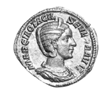
WIFE OF PHILIP I
MOTHER OF PHILIP II
DAUGHTER-IN-LAW (POSTHUMOUSLY?) OF JULIUS MARINUS
Marcia Otacilia Severa, d. A.D. 249(?). Very little is known of Otacilia Severa, an empress for whom a great quantity of coinage was struck. She seems to have married Philip about a decade before he became emperor, and gave birth to their only son, Philip Junior, in about 237. She may have been the daughter of a governor of Pannonia named Severus. Much as with her husband, later Christian writers speculated that Otacilia was a Christian, and that she sought penance from Saint Babylas, Bishop of Antioch, for her role in the murder of Gordian III. It is, of course, unlikely that this is true.
Upon her husbandís accession in 244, Otacilia was given the title Augusta. She later was hailed Mater Castrorum (ìmother of the campsî) and Mater Senatus et Patriae (ìmother of the senate and the countryî). It is not known whether she spent most of the reign in Rome or accompanied her husband on his campaigns, but she almost certainly was in Rome at the time of her husbandís defeat by Decius. Although it seems likely that she was executed by the praetorian guards, one source informs us that she survived the ordeal to pass the remainder of her days in retirement.

PHILIP II A.D. 247ñ249
CAESAR: A.D. 244ñ247 (UNDER PHILIP I)
AUGUSTUS: A.D. 247ñ249 (WITH PHILIP I)

SON OF PHILIP I AND OTACILIA SEVERA
GRANDSON OF JULIUS MARINUS
Marcus Julius Severus Philippus, c. A.D. 237ñ249. This young prince was destined for a short and eventful life, for at about age 7 he was raised to the rank of Caesar when his father was hailed emperor in February or March of 244. The child retained that rank while on the arduous journey from Mesopotamia to Rome, and during the more than two years of warfare against the Carpi and Germans on the Danube. At the conclusion of that campaign, Philip Junior ó then in his 10th year ó was raised to the rank of Augustus when Philip made his triumphant return to Rome in July or August of 247.
The sources differ in their telling of the boyís fate, though his death came as the result of his fatherís death in battle against Decius in September or October of 249. One version is that Philip Junior remained in Rome with his mother, and that he did his best to secure his own safety by administering bribes, perhaps surviving as late as November. But it is just as likely that he was at his fatherís side at Verona, and was either killed in battle or was captured and then taken to Rome, where he was executed by the praetorian guards.
JULIUS MARINUS
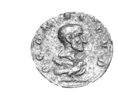
FATHER OF PHILIP I
GRANDFATHER OF PHILIP II
Julius Marinus, d. before A.D. 244. The father of Philip I, Julius Marinus was an Arab chieftain (Sheik) from Trachonitis who also apparently held the rank of a Roman knight. Beyond this, nothing is known with certainty except that he was deified by his son.
Upon the accession of Philip in 244, the name of what presumably was his home town (located about 12 miles from Bostra, the capital of Roman Arabia) was changed to Philippopolis. Furthermore, the town was accorded the status of a Roman colonia, and Philip erected there a temple dedicated to the deified Marinus and, seemingly, another relative (his mother?), for the seated Roma on Philippopolitan coins holds two small figures. Portions of this temple bearing inscriptions naming Philip and his family members were discovered at the archaeological site.
NUMISMATIC NOTE: The coinage of Philippopolis appears to be limited to the reign of Philip I. For this reason it can be presumed that it was a relatively insignificant place, and that despite the lavish honors it briefly received from its emperor-benefactor, it remained so. The most interesting issues of the city are the two denominations struck for Julius Marinus, as coins with his name or image were produced nowhere else. The obverses commemorate his apotheosis not only by means of the appropriate inscription, but also by showing his bust resting upon an eagle with spread wings. The reverse types depict Roma standing or seated.
SILBANNACUS c. A.D. 248(?)
Marcus Silbannacus, d. A.D. 248(?). This man is unknown from any source but a single coin bearing his name, which is in the cabinet of the British Museum. During the final year or two of the reign of Philip I, Silbannacus seems to have led a revolt in the West (perhaps on the Rhine); his coin was found in Lorraine. The reverse type is unusual in that it depicts Mercury holding not only his traditional caduceus, but also a small figure of Victory.
SPONSIANUS c. A.D. 248(?)
Sponsianus, lifespan unknown. Sponsianus may be the most mysterious of all ìissuersî of coins in Roman history. His aurei ó described in RIC as ìstrange and barbarousî ó are placed at the end of the reign of Philip I, when at least two other revolts occurred. Based on their find sites in Transylvania, they may be associated with a revolt on the Danube, if they are to be linked to any revolt at all. Equally as vexing as the barbarous die engraving is the choice of reverse type, which seems to be copied from a Republican denarius struck in 135 B.C. (Cr. 242/1).

PACATIAN c. A.D. 248ñ249(?)

Tiberius (or Titus) Claudius Marinus Pacatianus, d. A.D. 248. The revolt of Pacatian on the Danube in the spring or early summer of 248 proved to be the beginning of the end for Philip I, who had been emperor for nearly four years. The commander pacatian, a consul suffectus in 248, was hailed emperor by Danubian legions, who apparently had tired of Philip. Opinions on the length of his reign vary considerably among historians, with estimates ranging from a few weeks to a few months. In any case, his revolt seems to have been crushed by Decius, who had been sent to the region by Philip to take command in place of his own incompetent in-law, Severianus. As the result of Deciusí arrival, Pacatian was assassinated by his soldiers sometime between the spring of 248 and early 249.
NUMISMATIC NOTE: This usurperís coins appear to have been struck in Moesia. The mint of Viminacium is often suggested, though it is worth noting that if this was his mint, it seems odd no provincial issues were struck there in his name, unless the production demands for his double-denarii were so great that the provincial coinage had to be abandoned. Pacatianís most interesting issue bears the reverse inscription ROMAE AETER(nae) AN (no) MILL(esimo) ET PRIMO, which translates to ìthe thousand and first year of eternal Rome.î
JOTAPIAN c. A.D. 248ñ249(?)

Marcus Fulvius Rufus Jotapianus, d. A.D. 248. When Philip I appointed his brother Gaius Julius Priscus governor of Mesopotamia, with general authority over the Roman East, he no doubt hoped his brother would rule competently in the familyís best interest. However, such a great amount of authority, which included the unorthodox title ìpraetorian prefect and ruler of the East,î seems to have turned Priscus into an autocrat whose ruthless tax collections stirred the locals into revolt in the summer of 248.
In response, the army commander Jotapian was proclaimed emperor by his soldiers. He apparently controlled a vast area, including Northern Syria and Cappadocia, but was assassinated by his soldiers after a reign of no more than a year. Much like the revolt of Pacatian on the Danube, the length of Jotapianís reign is disputed. Though it may have lasted only a few weeks, it more likely endured several months, lasting into early or mid-249. Jotapianís claim to be a relative of Severus Alexander may well have been fictional. Alternatively, he may have been descended from the old rulers of Commagene, as Jotape was a name associated with that dynasty.
TRAJAN DECIUS A.D. 249ñ251
AUGUSTUS: A.D. 249ñ251
(A.D. 249ñ251: SOLE REIGN)
(A.D. 251: WITH HERENNIUS ETRUSCUS AND HOSTILIAN)

HUSBAND OF HERENNIA ETRUSCILLA
FATHER OF HERENNIUS ETRUSCUS AND HOSTILIAN
Gaius Messius Quintus Traianus Decius (earlier Gaius Messius Quintus Decius), c. A.D. 190/201ñ251. Born at Budalia, near Sirmium, Decius was one of the few Danubians of his era who rose to high rank in Rome. Though he hailed from a family of standing, he owed his success no less to his own skills than to his marriage to Herennia Etruscilla, who was descended from a noble Etruscan family.
Quite early in his career Decius gained senatorial rank, and later held important administrative posts, including the governorships of Nearer Spain and Lower Moesia. Toward the end of the reign of Philip I, Decius was the prefect of Rome. His encouragement to the emperor not to abdicate earned him the dubious honor of being sent to the Danubian front to put an end to the revolt of Pacatian and to rid the region of the Goths, Germans and Dacian Carpi who had flooded in during the crisis.
It could hardly have come as a surprise when in July the legions hailed Decius as Augustus, and compelled him to march against Philip. Indeed, Sosimus tells us that Decius warned Philip in advance that this was the inevitable conclusion, but that Philip asked him to go anyway. The veracity of this is doubtful; although Decius made overtures to Philip after the fact, it was clear that the two men could not rule jointly, and so the opposing armies met at Verona (or possibly at Beroea in Macedon) in September or October of 249.
In the resulting battle, Decius was victorious over the larger forces of Philip, who perished. The political chaos that had plagued Philip at the end of his reign was now silenced, and Decius ó the first in a long line of emperors to hail from the Balkans ó was master of the collapsing Roman world. He entered Rome in October, and his colleagues in the senate confirmed his rank and heaped him with honors. Most interesting of these was the bestowal of the surname Trajan, after the famous 2nd Century emperor who not only had an excellent relationship with the senate, but who also defeated the Dacian king Decebalus, and annexed Dacia as a province of the Empire.
Deciusí main social agenda involved the ancient traditions of Rome, most especially the worship of previous emperors and the observation of traditional pagan ritual. This did not bode well for the few Christians in the Empire, who were compelled to honor the pagan rituals or face death. One victim of Deciusí reform was Pope Fabian, who was martyred in 250. However dedicated Decius was to his social causes, the problems on the frontier took precedence, as the withdrawal of Deciusí forces had made the Danubian frontier vulnerable to yet another barbarian invasion.
The Goths and the Carpi invaded Roman territory simultaneously, crossing the frozen waters of the Danube early in 250. Two future emperors became involved in affairs at this point: Trebonianus Gallus, then governor of Upper and Lower Moesia, and Valerian I, for whom Decius invented an office that gave him overall authority in Rome during the emperorís absence.
It was also in 250 that Decius raised his eldest son, Herennius Etruscus, to the rank of Caesar. Though only a teenager, the new Caesar was sent to the front that summer at the head of an army while Decius settled matters in Rome. However, it was not long before Decius too arrived, winning some important engagements against the Goths and the Carpi. He was able to save Nicopolis ad Istrum by inflicting heavy losses on the Gothic chieftain Kniva, who consequently abandoned his siege. Decius was also successful in driving the Carpi out of Dacia.
But after he had suffered a small defeat at Beroe Augusta Trajana, Decius learned that a local governor, Titus Julius Priscus (who had been besieged in Philippopolis for several months), had hailed himself emperor and defected to the Goths. Although Priscus was soon killed, Decius was unable to prevent the ravage of Thrace that resulted. He led his army to the Danube, where he linked up with the legions under the command of Trebonianus Gallus. Together they hoped to defeat the booty-laden Goths as they returned to their homeland. While awaiting the Goths, Decius learned of a rebellion in the city of Rome led by a certain Julius Valens Licinianus (by March this was suppressed by Valerian).
Meanwhile, the opportunity Decius and Gallus had been awaiting on the Gothic front arrived in the spring of 251. The initial engagement was a great success, prompting Decius to raise his eldest son to the rank of Augustus, and his youngest son, Hostilian (who was still in Rome), to the rank of Caesar (alternatively, this may already have occurred in 250). Riding the tide of good fortune, Decius sought a decisive victory over the Goths ó but the opposite occured. Under the leadership of the chieftain Kniva, the Goths ambushed the Romans in the marshes at Abrittus in June, or possibly July, of 251. There, the Goths delivered one of the great defeats in Imperial history, killing the 50- or 60-year-old Decius, his teenage son, Herennius Etruscus, and most of their army.
Unless we take as fact Shapur Is account of Gordian III dying in battle at Misikhe, Decius and Etruscus were the first Roman emperors to fall against a foreign enemy. It remains uncertain whether his defeat was due to the treachery of Trebonianus Gallus, who failed to rescue them with his reserve force, and who was subsequently hailed emperor. In any event, the ambush bears an uncanny resemblance to the even more serious defeat of the emperor Valens by the Goths near Adrianople in 378.
NUMISMATIC NOTE: Decius produced one of the more interesting coinages of the 3rd Century, with his monetary policy seemingly being determined by runaway inflation. Not only did he introduce an entirely new denomination, the double-sestertius, but he also struck a small ae coin usually called a semis by numismatists. Rather than a semis (a low value coin abandoned more than a century before, and one which was of uncertain function even when it was in regular production), the small coin more likely was an as, though greatly reduced in weight. Supporting this theory is the significant reduction in weight which can be observed in the other aes denominations struck by Decius. It is worth noting that if the double-sestertius and the reduced as/semis were intended as remedies for inflation, the measures quickly failed, for they were not adopted by his immediate successors. He also struck a series of double-denarii honoring eleven of his deified Imperial predecessors (which are described in a separate listing following the regular coins of Decius). Many of Deciusí coins celebrate Dacia, Pannonia and Illyricum, all provinces in the region from which he hailed. His double-denarii from Antioch differ from those of Rome not only in the style of artistry, but also by the presence of pellets or numerals either below the bust or in the exergue on the reverse. These pellets and numerals indicate the officina in which the coin was struck ó a system adopted for some later coinages of Antioch.

HERENNIA ETRUSCILLA
AUGUSTA, A.D. 249ñ253(?)

WIFE OF TRAJAN DECIUS
MOTHER OF HERENNIUS ETRUSCUS AND HOSTILIAN
Herennia Cupressenia Etruscilla, lifespan unknown. Despite the commonness of Herennia Etruscillaís coins, the life of this noble Etruscanlady reads like a blank page. Had an inscription not confirmed that she was the wife of Decius, we would have to rely entirely on the numismatic evidence, which in this case is quite strong. There exist a handful of ìhybridî coins on which her obverse dies are paired with reverse dies intended for Trajan Decius and Herennius Etruscus. There is a strong possibility that coinage in her name continued to be struck under Trebonianus Gallus, as Gallusí wife was never hailed Augusta.
HERENNIUS ETRUSCUS A.D. 251
CAESAR: A.D. 250ñ251
(UNDER TRAJAN DECIUS, AND WITH HOSTILIAN(?))
AUGUSTUS: A.D. 251 (WITH TRAJAN DECIUS)
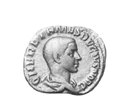
SON OF TRAJAN DECIUS AND HERENNIA ETRUSCILLA
BROTHER OF HOSTILIAN
Quintus Herennius Etruscus Messius Decius, d. A.D. 251. As the eldest son of Trajan Decius, Herennius Etruscus was destined to become involved in the Imperial duties of his father, who had been hailed emperor by his soldiers on the Danubian frontier and, after defeating the armies of Philip I in October of 249, gained the approval of the senate.
Though his father had pacified the Danubian front before leaving to confront Philip I, his battle preparations had deprived the region of the legions that defended it. Thus, the Goths and Carpi exploited this weakness by crossing the Danube again early in 250. As Decius prepared to lead a campaign to reclaim the region, one of the measures he took was to appoint Herennius Etruscus to the rank of Caesar.
Since matters were not yet settled in Rome, Decius placed Etruscus in command of the army, which the teenage Caesar then led to the Danubian front in the summer of 250. Decius joined him on the front soon thereafter, but the problems they faced were manifold, and Decius discovered that he could do little to prevent the Goths from ravaging Roman territory. Instead, the Romans waited to defeat the Goths when they attempted to cross back over the Danube. In the meantime, Decius and Etruscus joined their legions with those of the future emperor Trebonianus Gallus, who was then a governor in Moesia.
When the Goths returned in the spring of 251, Decius and son made their move. The initial engagement was a success, and in May or June of 251 Decius raised Etruscus to the rank of Augustus. At the same time he may also have raised his younger son, Hostilian, then residing in Rome, to the rank of Caesar (if this had not already occurred in 250).
Decius hoped to inflict a great defeat on the Goths. The opposite occurred, however, when the legions under joint command of Decius and Etruscus were ambushed by the Goths in June or July of 251. The teenage Etruscus and his middle-aged father were slaughtered along with the preponderance of their army. Thus, Etruscus and his father are known to history principally as the first Roman emperors to fall in battle against a foreign enemy. Trebonianus Gallus, who was in charge of the reserve force, failed to rescue Decius and his army, and it remains uncertain whether his inaction was treacherous or merely unfortunate.
HOSTILIAN A.D. 251
CAESAR: A.D. 250(?)ó253
(VARIOUSLY UNDER TRAJAN DECIUS, HERENNIUS ETRUCUS(?) AND TREBONIANUS GALLUS(?))
AUGUSTUS: A.D. 251
(WITH TREBONIANUS GALLUS)
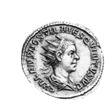
SON OF TRAJAN DECIUS AND HERENNIA ETRUSCILLA
BROTHER OF HERENNIUS ETRUSCUS
ADOPTIVE SON OF TREBONIANUS GALLUS
Gaius Valens Hostilianus Messius Quintus, d. A.D. 251. The reign of Hostilian is one of the sketchiest of the 3rd Century. Not only was his era extremely chaotic, but it is poorly documented by historians. Furthermore, his largely ceremonial status has to be judged in terms of the four Augusti with whom he was associated (and their individual chronologies are far from certain). It is most helpful first to discuss the progression of events, and then to discuss how they may have affected Hostilian.
As the son of Trajan Decius and the younger brother of Herennius Etruscus, Hostilian assumed the junior role in the family power structure, which also included his mother, Herennia Etruscilla, a noblewoman who held the rank of Augusta. Young Hostilian (then perhaps in his early teens) stayed in Rome with his mother while his father and older brother went to the Danube to fight the Goths in the summer of 250. Even at Rome the true power was not in the hands of Hostilian and his mother, for Decius had created a special post for Valerian (the future emperor) that accorded him great authority. This appointment was one of Deciusí more prudent moves. In the early months of 251 Valerian crushed a serious rebellion at Rome that had been staged by a certain Julius Valens Licinianus.
In the course of waging war on the Danubian front, Decius and Etruscus (both of whom then held the rank of Augustus) were killed in an ambush in June or July of 251. Hostilian ó safe in Rome ó was the only surviving male of the ruling family, and he seems to have held only the rank of Caesar at the time of that tragedy.
Immediately after Decius and Etruscus were killed, the Danubian legions hailed their own commander, Trebonianus Gallus, as the new emperor. Gallus rapidly arranged an unfavorable peace with the Goths, and then marched to Rome to receive the confirmation of the senate. Sometime after his arrival, Gallus agreed to share the rank of Augustus with Hostilian. The subordinate rank of Caesar was given to Gallusí own son, Volusian, who also was betrothed to Hostilianís sister.
Though Hostilian had lost his father and brother to the Goths, he still had his mother and sister, and may have found comfort in having a new adoptive father and brother-in-law. But this tidy arrangement ended when Hostilian died of the plague, which at that time was a raging epidemic in the capital as well as through most of the Empire. Despite the lofty titles Hostilian briefly possessed, and the quantity of coins that were struck in his name, he accomplished little or nothing.
CHRONOLOGICAL NOTE: Though most authorities ascribe Hostilianís reign exclusively to 251 (beginning in the spring, when his older brother Herennius Etruscus was hailed Augustus), others suggest he was hailed Caesar in mid- or late 250. All seem to be in agreement, however, that his brief tenure as Augustus belongs to 251, after Gallus arrived in Rome and negotiated their joint-rulership. This can most likely be dated to late June or July of 251. There is some numismatic evidence that during a very brief period after Gallusí arrival in Rome, Gallus was Augustus, Hostilian was Caesar and Volusian had not yet been given a title. But that initial arrangement probably lasted less than a month before Hostilian was made co-Augustus, and Volusian was hailed Caesar. The date of Hostilianís death is equally uncertain, with estimates ranging from August to November of 251.
NUMISMATIC NOTE: A coin type struck by his adoptive father, Trebonianus Gallus (AP0LL[o] SALVTARI, Apollo standing, holding a branch and a lyre) invokes Apollo Salutaris (ìthe health-bringing Apolloî), to deliver the Romans from the plague. Though Gallus could not have known his young colleague would eventually die of the plague, his unusual type demonstrates just how serious the epidemic had become. A similar type was struck by Valerian I, into whose reign the plague persisted.
TREBONIANUS GALLUS A.D. 251ñ253
AUGUSTUS: A.D. 251ñ253
(A.D. 251: WITH HOSTILIAN)
(A.D. 251ñ253: WITH VOLUSIAN)

FATHER OF VOLUSIAN
ADOPTIVE FATHER OF HOSTILIAN
Gaius Vibius Afinius Trebonianus Gallus, c. A.D. 204/6ñ253. Except that he hailed from an old Etruscan family in Perugia, little is known about the early life of Trebonianus Gallus. He was married to Afinia Gemina Baebiana, by whom he fathered Volusian. It comes as no surprise that Baebiana was not hailed Augusta, for the widow of Decius, Herennia Etruscilla, was still alive at the time Gallus was emperor.
Gallusí political career was distinguished, for he was a leading senator who had held the suffect consulship in 245. But the event that enrolled him in the annals of history was his appointment in 250 as governor of Upper and Lower Moesia, a highly unstable but important province that had come under a fresh invasion by the Goths and the Carpi about the time he arrived. Gallus did his best to repel the Goths, but to little effect. The emperor Trajan Decius and his eldest son, Herennius Etruscus, soon arrived at the front, and even their efforts failed when a local governor named Priscus defected to the Goths.
However, what occurred in June or July of the following year (251) was worse than could have been imagined: Decius and Etruscus were ambushed and killed (along with most of their army) by the Goths near Abrittus. It was one of the great defeats in Roman history, and it is still uncertain whether Gallus (who was in charge of the reserve force) treacherously failed to warn Decius of the ambush. In any event, Gallus was promptly hailed emperor by his soldiers.
His first act was to negotiate peace with the Goths, and in so doing he promised an annual tribute of gold and allowed them to keep all of their booty and prisoners. The terms were disgraceful, but considering the success of the Gothic ambush on Decius, they were probably the best he could attain. But the worst was yet to come. Gallus now headed for Rome and prepared for a reign which a 19th Century historian aptly described as ìa succession of miseries, devastations and horrors.î
When he arrived at Rome, Gallus discovered that the city was suffering from an epidemic of the plague that was to cripple the Empire for at least another 15 years. The new emperor secured his position by sharing his authority with Hostilian, the teenage son of Trajan Decius, who had remained in Rome with his mother. Though the boy had held the rank of Caesar under his father, Gallus raised him to Augustus, while at the same time he gave his own son, Volusian, the subordinate rank of Caesar.
This careful arrangement was shattered sometime between August and November of 251, when Hostilian died of the plague. While Gallus raised his own son to the now-vacant office of junior Augustus, his time in the capital was far from pleasant. Not only was the plague causing great harm, but the Goths launched yet another invasion. It was not until the following year (252) that the governor of Lower Moesia, the future emperor Aemilian, crossed the Danube and defeated the Goths.
In that same year ó as if the Romans were not already suffering enough ó the Sasanian king, Shapur I, invaded and captured Armenia. In 252/3 Shapur invaded the wealthy Roman province of Syria, and was so successful that he even sacked Antioch, the third most important city in the Empire. Much like the plague, the armies of Shapur would prove to be a devastating force in the Empire for the next decade. But the destruction in Asia Minor was not limited to Sasanian offensives, for the Goths and other Germanic peoples also raided Asia Minor, probably because they had already stripped the Balkan region of most of its portable wealth.
Although the Goths had no intention of remaining in Asia, their raids were devastating and penetrated as far south as Ephesus. It seems that Gallus found a scapegoat for the ill-fortune of the Empire in the Christians. He renewed the persecutions of Trajan Decius, in which Pope Fabian had been martyred. With all of this chaos, Gallusí one area of success was on the Danubian frontier, where Aemilian was victorious. This may have been good news for the frontier legions, but it did not bode well for Gallus. The victorious Aemilian gave a large bonus to his legions, who then hailed him emperor and urged him to march on Rome.
Gallus had the senate declare Aemilian a public enemy and sent for help from another of his generals, the future emperor Valerian, who was recruiting troops on the Rhine. But the advance of Aemilian that spring (or summer) was too swift, and Valerian was unable to react in time. The small army that Gallus was able to muster was no match for Aemilianís seasoned and bribed legions. Both Gallus and his son, Volusian, were murdered by their own soldiers, who were unwilling to face certain defeat against Aemilian.
We know that these executions were carried out some 20 to 50 miles north of Rome, in rural Umbria, but authorities are divided as to whether they occurred in April or August of 253. Despite the magnitude of the ill-fortune Gallus faced, it is difficult to respect his feeble efforts at salvaging the Empire. Unlike more energetic emperors of the 3rd Century (such as Gallienus, Aurelian or Probus), Gallus seems to have been so overwhelmed that he was paralyzed into inaction.
His reign bears a striking parallel to that of Philip the Arab, as both men began by hastily negotiating peace treaties and making a quick dash to Rome. Later in their reigns, both men took refuge in the capital, hoping that their frontier generals would not only save the Empire but expect nothing in return. The final comparison, of course, is drawn in their manner of death, for both perished when their armies refused to support them in the moment of battle against the next contender.
NUMISMATIC NOTE: Seemingly in an attempt to combat runaway inflation, Gallus introduced a ëradiateí gold coin, which he struck alongside the traditional ëlaureateí piece. The radiate crown normally indicated a double denomination, and Gallusí laureate gold coin may have been intended as a double aureus (a ëbinioí) even though it was only about 50% or 60% heavier than the laureate piece. In this respect it offers a ready parallel to the silver double-denarius of Caracalla. Both of Gallusí gold coins were considerably underweight, with the radiate pieces typically weighing about 5.8 grams, and the laureate coins only about 3.6 grams.
VOLUSIAN A.D. 251ñ253
CAESAR: A.D. 251
(UNDER TREBONIANUS GALLUS AND HOSTILIAN)
AUGUSTUS: A.D. 251
(WITH TREBONIANUS GALLUS)

SON OF TREBONIANUS GALLUS
Gaius Vibius Afinius Gallus Veldumnianus Volusianus, c. A.D. 230ñ253. Despite the volume of his coinage that survives, Volusian achieved very little in his approximately two years of rule, first as Caesar, then as Augustus. Volusian came to power when his father was hailed emperor by his soldiers following the ambush the Gothic king Kniva sprang on Trajan Decius at Abrittus in June or July of 251.
Shortly after Gallus returned to Rome, he was confirmed by the senate and arranged to share the title of Augustus with Hostilian, the son of Trajan Decius who had remained in Rome. Even though Volusian was older than Hostilian, he was given the subordinate rank of Caesar. Ties between Hostilianís family and his own were strengthened by Volusianís betrothal to Hostilianís sister. Furthermore, Gallus did not assign to his own wife (Afinia Gemina Baebiana) the title Augusta, for Herennia Etruscilla, the widow of Decius and mother of Hostilian, was alive and in possession of that title.
But this arrangement unraveled sometime between August and November of 251 when young Hostilian died of the plague that was ravaging not only Rome, but most of the Empire. With this turn of events, Volusian filled the now-vacant office of junior Augustus. No doubt news of terrible aggressions by the Goths and the Sasanians poured into Rome, further dampening the spirit of a population beset with critical problems of their own.
Instead of combating the invasions themselves, father and son remained at Rome, hoping the crises would resolve themselves. When Aemilian, the governor of Lower Moesia, began to have success against the Goths, his frontier legions hailed him emperor. Gallus and Volusian tried to secure aid from the general (and future emperor) Valerian, who was recruiting soldiers on the Rhine, but Aemilian marched to Italy at a furious pace and Valerian came too late to help.
Gallus and Volusian gathered what few soldiers they could muster that spring or summer of 253 and left Rome to face Aemilian. The two emperors didnít get more than about two days march from the capital before they were murdered by their own soldiers, who had no desire to engage the larger and more seasoned army led by Aemilian. We cannot be certain of Volusianís age, but his coin portraits indicate he was a young man, perhaps in his 20s or early 30s.
AEMILIAN A.D. 253
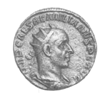
HUSBAND OF CORNELIA SUPERA
Marcus Aemilius Aemilianus, c. A.D. 207/8ñ253. Of this ephemeral emperor we know very little, except that he hailed from an obscure Mauretanian family which perhaps lived on the island of Jerba. A man of considerable talent, Aemilian rose to the high office of consul. During the reign of Trebonianus Gallus and Volusian, the Empire was besieged on all fronts and it was on this stage that Aemilian made his entry into history.
Troubles were numerous: the Sasanians were raiding Roman territory in the East, the plague was ravaging all parts of the Empire, and the Goths had launched yet another offensive across the Danube and made destructive sorties into Asia Minor. In 252, Aemilian, then governor of Lower Moesia (having in 251 taken over the post vacated by Trebonianus Gallus), executed the Goths who remained in Roman territory and crossed the Danube to inflict an important defeat on the remaining tribesman. While Aemilianís success was triumphant for the beleaguered frontier legions, it did not bode well for Gallus and Volusian, who remained in Rome as the frontiers unraveled.
Aemilian was energetic and ambitious, and was not bashful about his desire to become emperor, for he gave to his soldiers the money that was intended to subsidize a peace agreement with the Goths. In a virtual repeat of recent history, Aemilianís frontier legions hailed him emperor in the spring or summer of 253, and urged him to march on Rome. Gallus declared Aemilian a public enemy and sought the support of another of his generals, the future emperor Valerian, who was then raising troops in Germany and Gaul.
But the advance of Aemilian from Moesia to just outside Rome was too swift, and Valerianís efforts were in vain. Gallus was able to gather from the environs of Rome only a small army which, both in size and capability, was no match for Aemilianís seasoned legions. The inferior army of Gallus was not anxious to engage Aemilian, and so they mutinied and murdered Gallus and Volusian at Interamna in rural Umbria.
Being only a day or two from Rome, Aemilian proceeded there at the head of his enlarged army and gained the approval of the senate, which only weeks before had declared him a public enemy. Despite his immediate success, Aemilian would soon meet a similar fate, for the legions that Valerian had gathered from Raetia and Noricum were marching on Italy. Alerted to the advance of the challenger, Aemilian may have sought a compromise, but in any case led his army from Rome.
The armies met at a bridge near Spoleto in Umbria, and Aemilian was killed by his own soldiers. Though the fighting was inconsequential, there must have been an engagement, for thereafter the site came to be known as Pons Sanguinarius, ìthe bloody bridge.î The hasty demise of Aemilian was perhaps a tragedy; he seemed to have the makings of an excellent frontier emperor.
Though authorities agree that Aemilian reigned for about three months, the exact timing is debated. Estimates cover the entire period of April through October. The two best possibilities are April through July, or August through October. The historical record seems to favor the former, whereas the numismatic record may support the latter, as his tetradrachms at Alexandria are dated only to ìyear two,î suggesting that news of his accession reached Egypt sometime after the Egyptian New Year on August 29.
CORNELIA SUPERA
AUGUSTA, A.D. 253

WIFE OF AEMILIAN
Gaia Cornelia Supera, lifespan unknown. This empress is unknown to history except for her appearance on coinage. Indeed, it is exclusively on the strength of the numismatic evidence that she is identified as the wife of Aemilian. Authorities in the 19th Century and earlier had speculated she was possibly the consort of Trebonianus Gallus or the wife of Valerian II.
NUMISMATIC NOTE: Cornelia Superaís Latin issues are limited to double-denarii, which have only two reverse types, Vesta and Juno. Her provincial coinage, though also limited in scale, is more abundant, and includes issues struck at Parium in Mysia, Julia in Phrygia and Aegae in Cilicia.
URANIUS ANTONINUS A.D. 253ñ254

Lucius Julius Aurelius Sulpicius Uranius Antoninus (also Sampsigeramus), d. A.D. 254(?). The chaos of the Roman Empire in the early 250s was viewed as an opportunity by the Sasanian king Shapur I, who occupied Roman Armenia in 252 and in 252/3 invaded the wealthy Roman province of Syria. The Persian armies made great advances and soon divided to attack simultaneously the cities of Antioch and Emesa.
Though Antioch was taken by treachery in the summer of 253 and suffered a terrible fate, Emesa offered tough resistance. Charged with the defense of Emesa was a certain Sampsigeramus, who is almost certainly Uranius Antoninus, a hereditary priest of Aphrodite and the sun-god Elgabal. This was the same office the emperor Elagabalus (from whom Uranius certainly was descended) had held before he became emperor in 218.
Not only did the Emesans defend their city, but they went on the offensive, driving the Sasanians out of their vicinity. It is believed that Uranius Antoninus was urged to assume power based on this achievement. The Roman relief of Syria was understandably slow in coming. Not only was the plague paralyzing much of the Empire, but there was constant invasion across the Danube, and as if matters were not difficult enough, there were three different regimes in 253.
Though temporarily paralyzed, Rome was far from powerless, and the new emperor Valerian I was prepared for action. His first important deed was to nominate his eldest son, Gallienus, co-emperor. Leaving Gallienus in charge of the European theater, Valerian was free to campaign in Asia Minor. Either late in 253 or early in 254, Valerian was able to recover the capital city of Antioch, probably because it had been so completely depleted that the Sasanians simply abandoned it. What happened thereafter at Emesa is not certainly known, except that Uranius Antoninus either abdicated or was forcibly removed from power. It is also unknown whether Uranius Antoninus survived his brief tenure as ruler of Emesa, but the prospect seems unlikely.
HISTORICAL NOTE: Until very recently the circumstances of Uranius Antoninusí revolt was not understood; three usurpers of similar context are reported by ancient historians. A Uranius and an Antoninus are reported by Zosimius (writing c. A.D. 500), and a certain Taurinus is reported by the mid-4th Century historian Victor. Scholars of the 19th Century placed his revolt during the reign of Severus Alexander (222ñ235), and even until quite recently it was dated to c. 248ñ253/4 (for it was thought to have been sparked by the harsh taxations of Gaius Julius Priscus, the brother of Philip the Arab). Prompting this view was an aureus with the reverse type Saecvlares Avgg and depicting a low column inscribed COS I. While this coin seemingly indicates a date no earlier than 248, when Philip I celebrated the millennium of Romeís foundation, it need not be associated with that date, as unrelated festivals bearing that name were also held by other emperors in the 3rd Century. Offering the most reliable evidence is a copper coin of his revolt bearing the date EΞ‘ (year 565 of the Seleucid Era = A.D. 253/4), which certainly places him in power at that time.
Numismatic Note: Since this usurper does not claim the titles of Augustus or Imperator in his obverse inscriptions, he seems not to have taken those titles. The fact that the reverse inscriptions on his aurei end with AVG or AVGG need not alter that conclusion, for they undoubtedly were copied from the reverse inscriptions of regular Roman coins. All of Uranius Antoninusí coinage appears to have been struck at Emesa in 253 and 254. His aurei have Latin inscriptions, whereas his silver, billon and copper coinages have Greek inscriptions. His tetradrachms come in two distinctive types: high silver content pieces struck on thin, broad planchets, and billon pieces struck on thick planchets typical of the era. This usurper employed many different reverse types. References are to H.R. Baldus, Uranius Antoninus, Munzpragiing und Geschicte, Antiquitas 3 (1971).
VALERIAN I A.D. 253ñ260
AUGUSTUS: A.D. 253ñ260 (WITH GALLIENUS)

HUSBAND OF MARINIANA
FATHER OF GALLIENUS
GRANDFATHER OF VALERIAN II AND SALONINUS
Publius Licinius Valerianus, c. A.D. 190/5ñ260+. Little is known about Valerianís life before about the year 250, although he hailed from the distinguished Licinia family of Etruria and had supported the revolt of the Gordiani in 238, a dramatic year during which he was suffect consul. His mark on history, however, was made at the end of his own tragic reign in 260, when he became the first Roman emperor to be captured alive by an enemy.
While a senator, Valerian came into a position of great power in 250, when the emperor Trajan Decius created a special post for him in Rome, providing him with virtually unlimited authority to maintain the peace during the emperorís absence. He used this authority to crush a rebellion in Rome led by a certain Julius Valens Licinianus in the early months of 251.
The succeeding emperor, Trebonianus Gallus (251ñ253), sent Valerian to the Rhine front to recruit soldiers, but his duties were cut short when Gallus urgently requested he lead an army to defend Italy from the advancing legions of the usurper Aemilian. Valerianís response was not fast enough to intercept Aemilian, whose freshly bribed legions marched at a rapid pace. Gallus could only muster a small army, and he was executed by his own soldiers at Interamna, not far outside of Rome. In the meantime, Aemilian extorted the approval of the senate for his own regime.
The news of Gallusí execution arrived while Valerian was en route, and it prompted his soldiers to hail him emperor in opposition to Aemilian. The large armies of the rivals met near Spoleto in Umbria (not far from where Gallus had been executed only three months before), and Aemilian was killed by his own soldiers, seemingly after a minor battle. Exactly when this occurred is debated, but most likely it was in July or October of 253. As these events unfolded, the eldest son of Valerian, Gallienus, was in Rome. An anxious senate seems to have hailed him Caesar before his victorious father arrived, though no coinage was struck reflecting this occurrence. Valerian gained senate approval for his own regime (in September?), and hailed Gallienus co-Augustus.
Though we know in hindsight that the reigns of Valerian and Gallienus ó greatly troubled though they were ó would last many years, there was no indication at the time that this rapid succession of emperors would end with Valerian. To make matters worse, the frontiers were subjected to a fresh wave of assaults as Romeís legions were occupied with yet another civil war. Very early in their joint-reign, Valerian and Gallienus formally divided their responsibilities geographically, with the father taking command in Asia Minor and the son defending the borders in Europe. This was the greatest crisis the Empire had yet known, and had there not been two emperors, the history of the Romans might have been considerably different.
Valerian arrived in the East early in 254 on a mission to expel the Sasanians who under Shapur I had launched a damaging invasion in the previous year. Valerian first recovered Antioch, which had been so completely sacked that the Sasanians seem to have abandoned it before he arrived. He next turned his efforts to Emesa, which was held by the usurper Uranius Antoninus, who was soon expelled.
About this time the Goths were adding a new weapon to their arsenal, a naval fleet, which they seem to have obtained from the Bosporan kings. The pioneering venture, an assault on the town of Pityus in 256 by the Borani, failed miserably. But subsequent attacks with a new fleet in 257 resulted in the burning of Trapezus and the pillaging of Panticapaeum. The Goths quickly took to seafaring, which not only provided another dimension to their attacks, but also allowed them to launch lightning-fast assaults far and wide. Subsequent attacks by sea and land, caused Nicaea, Nicomedia and other important cities to be razed to the ground.
Although Valerian would have had his hands full with the Goths in Bithynia, two more threats emerged at the same time. The first was Shapur, who renewed hostilities for a third time within a generation; the second was an unseen foe, the plague. With three formidable enemies, Valerian was destined to struggle against all hope to save the beleaguered Roman East, while his son Gallienus could offer no help, for he faced similarly desperate conditions in Europe.
As troublesome as the Gothic and Scythian raiders were, the Sasanians were a more serious threat, and so Valerian focused on expelling Shapur, who seems to have been principally interested in looting and destroying rather than in occupying. The kingís invasion was a great success, for he captured 37 cities throughout Mesopotamia, Armenia, Cappadocia and Syria, which included (yet again) Antioch, where Shapur may have installed a short-lived usurper named Cyriades or Mariades (though during which of Shapurís invasions is uncertain).
Seemingly by 258 the Sasanians had withdrawn and relative peace returned to Asia Minor, though any prosperity had been carted away by the Sasanians and Goths. A true recovery was not to take place, though, for in 259 Shapur invaded once again ó his fourth such invasion in a generation. Valerian won a battle near Edessa, but the effects of the plague within his ranks forced him to withdraw to that city, where he was besieged. Seeing no good option, Valerian tried his hand at negotiation in April, May or June of 260 (accounts vary). Accompanied by only a small retinue of his top officials, Valerian was taken prisoner by Shapur, who evidently had no intention of negotiating.
We cannot be certain when Valerian died, for he was used by Shapur as a living trophy of his triumph over the Romans. Shapur is said to have mutilated the elderly emperor, and used his back as a stepping-stool when mounting his horse. When not being humiliated by such acts, Valerian was supposedly kept huddled in a small cage. After he died, we are told his skin was removed, dyed, stuffed and preserved so it could be displayed for a very long time in the royal palace.
Like his son Gallienus, Valerian has been unfairly maligned by later, revisionist historians of Christendom. Sparking this contempt was Valerianís persecution of Christians, whom he used as scapegoats for the monumental ills which Rome faced. His personal touch was to target Christians from the upper echelons in his Empire, against whom he introduced edicts in 257 and 258. Though these laws, reversed by Gallienus, seem indefensible, it is equally unjust to condemn all of Valerianís actions on the basis of this one policy.
NUMISMATIC NOTE: In addition to coinage in his own name, Valerian also struck for his family members. The coinage of Valerian and Gallienus is remarkably complex, and was struck at several mints, with the locations of some being uncertain. Among their most productive mints were Rome, Milan, Trier, Siscia, Sirmium, Cyzicus(?) and Antioch. It is of some interest that Valerian celebrated victories of Gallienus against the Germans, perhaps to increase morale among his own soldiers. His types sometimes refer rather optimistically to his exploits in the East. After his initial success against the Sasanians in 253/4, he issued types declaring him to be the ìrestorer of the Orientí (RESTITVT ORIENTIS) and even ìrestorer of the human raceî (RESTITVT GENER HVMANI). Another type, Apoll Salvtari, invokes ìthe health-bringing Apolloî to deliver the army and the people from the very plague which forced him into the fateful negotiations with Shapur.
MARINIANA

WIFE OF VALERIAN I
MOTHER OF GALLIENUS
GRANDMOTHER OF VALERIAN II AND SALONINUS
Egnatia Mariniana, died c. A.D. 253(?). Little is known of Mariniana, although she is suspected to have been the daughter of a governor of Moesia named Egnatius Marinianus. It is presumed that she died before her husband became emperor because all of her coinage is commemorative. She may have been the mother of both of Valerian Ps children, though some sources suggest she was the mother only of the younger child, and that she was Valerianís second wife. In any case, her coinage is inextricably tied to the reign of Valerian and she almost certainly was his wife. Though Valerian and Marinianaís eldest son, Gallienus, is well-known to students of Roman history, their younger child, Publius Licinius Valerianus, does not make an appearance on coinage and apparently remained in Rome, where he was killed in 268 during the purge of Gallienusí adherents.
GALLIENUS A.D. 253ñ268
AUGUSTUS: A.D. 253ñ268
(A.D. 253ñ260: WITH VALERIAN I)
(A.D. 260: WITH VALERIAN I AND SALONINUS)
(A.D. 260ñ268: SOLE REIGN)

SON OF VALERIAN I AND MARINIANA
HUSBAND OF SALONINA
FATHER OF VALERIAN II AND SALONINUS
Publius Licinius Egnatius Gallienus, c. A.D. 213/8ñ268. The lengthy and chaotic reign of Gallienus is especially difficult to evaluate. Many historians (including ancient historians) have blamed him for the virtual collapse of the Empire, suggesting he was more interested in luxuriating than problem solving. The Historia Augusta scornfully reports that he wasted his time ìÖ in sensual pleasures, visiting taverns, and growing old in the arms of a foreign woman.î
However, Gallienusí vigorous actions and level-headed reform of the army make such criticism unjustified. Indeed, he was a remarkably effective emperor whose accomplishments were limited only by the chaos of the age. Gallienus may also be credited with reversing the edicts that his father had introduced in 257 and 258 to persecute Christians, resulting in nearly four decades of tolerance toward Christianity in the Empire.
Not only did Gallienus suffer great personal loss due to the destruction of his family, but his valiant efforts required that he campaign tirelessly throughout his 15-year reign, only to be struck down by an assassin. Indeed, the external difficulties which descended upon Rome during his principate can hardly be ascribed to his incompetence, for they derived from the failed policies of the past, and the whim of fate. No doubt, even Augustus or Trajan would not have found themselves better able to deal with the multitude of problems that Gallienus faced with such courage, fortitude and resilience.
Gallienus hailed from a distinguished Etruscan family and, like his wife, Salonina (whom he made Augusta upon his accession), was fond of art, literature and philosophy. Gallienus was an accomplished poet, and counted the Neoplatonic philosopher Plotinus among his close friends. He was also an advocate of the sculptural trend which glorified the achievements of the Greeks, and the Romans of the Augustan age.
In marked contrast to this cultured man was the grave task he faced. After his father, Valerian I, became emperor in July or October of 253, Gallienus entered into a partnership to deliver the Empire from certain destruction. He seems to have been hailed Caesar by the senate before his fatherís ìvictoryî over Aemilian at Spoleto; he was quickly invested with the purple along with his father, and the joint-Augusti divided the Empire, with Gallienus taking command in Europe and his father marching to Asia Minor. Little could they have known that when they parted they would never see each other again.
The first five years of Gallienusí reign were primarily spent fighting Germans on the Rhine and Danube, for which he was hailed Germanicus Maximus five times between 255 and 258. In previous reigns, Gothic invasion of the Danube had been the most persistent threat, but with the Goths turning much of their attention to seafaring and raiding cities along the Black Sea, their threat to the European provinces was lessened. Instead, Germanic invasions became more frequent, especially after Valerian had withdrawn troops from the Rhine to check the invasion of Italy by Aemilian. By early 258 the Danube frontier had been invaded again, obliging the emperor (who since 256 had been assisted by his eldest son, the Caesar Valerian II) to lead the campaign in person. Not long after father and son arrived, young Valerian II died, the result either of warfare or natural causes. This was the first in a series of personal losses Gallienus would suffer.
Later in 258, Gallienus abandoned the Danubian campaign that had cost his eldest sonís life so he could repel an invasion of Italy launched over the Rhine by the Alemanni (specifically, the Juthungi). Their advance was so swift that they nearly reached Rome before they were forced to retreat. When they did, they found Gallienus awaiting them near Milan, where he defeated them severely. About this time, Gallienus invested his younger son, Saloninus, with the rank of Caesar to replace Valerian II. Saloninus was then sent to Cologne to establish his court and see to the defense of the western provinces.
Fast approaching was 260 ó the worst year the Romans would ever know. Catastrophes occurred almost simultaneously throughout the Empire. The Historia Augusta exaggerates the chaos of Gallienusí reign by suggesting there were more than 30 men who challenged his authority. In reality, there were perhaps seven serious revolts, but each took its toll on the disintegrating Empire.
In the East, Gallienusí father, Valerian I, was leading an army debilitated by the plague, and thus took refuge at Edessa. The Sasanian king Shapur I besieged him there, and seeing no good option, the elderly emperor tried to negotiate a truce with Shapur. However, the treacherous Persian king took the emperor and the distinguished members of his delegation prisoner, never to be released. Such a catastrophe had never before occurred in the history of the Empire, and Asia Minor was now in a state of chaos. The void was filled by the praetorian prefect Callistus (ìBallistaî) and the quartermaster-general Macrianus Senior. After conspiring to revolt, they installed at Antioch the latter manís two sons, Macrianus and Quietus, as rival emperors to Gallienus.
At about the same time the Rhine defenses were breached by the Alemanni, who invaded Gaul, and by the Franks, who advanced as far south as Spain. Amid this great invasion, the governor of Lower Germany, Postumus, staged his own revolt and besieged Gallienusí son, Saloninus, at Cologne. Postumus soon took the city, executing the teenager and his advisers. As a result, Rome lost its western provinces to a succession of independent rulers for the next 14 years.
Meanwhile, revolts erupted elsewhere in the Empire. There were revolts not resulting in coinage: in Byzantium (in response to the Gothic raids), in Egypt by one Aemilianus (in 262 or 263, thus not the emperor of 253), and in Pannonia and Moesia by Ingenuus. Although all three revolts were crushed, the one by Ingenuus was quickly resurrected by another usurper, Regalianus, whom Gallienus defeated by late 260 or early 261.
At this point one can appreciate the multitude of problems that afflicted Gallienus. Indeed, he could hardly be expected to simultaneously end revolts in the Propontis, Syria, Egypt, the Balkans and Gaul. Other less-spirited emperors before him (notably Philip I and Trebonianus Gallus) lost their nerve during times like this, whereas Gallienus simply continued to fight.
Gallienus had given his general Aureolus (who earlier had defeated Ingenuus) the task of ending the six-month-old revolt of Macrianus and Quietus, based in Antioch. Fortunately, Macrianus Senior and his eldest son, Macrianus, had brought their own army into Illyricum to overthrow Gallienus. There, in the spring of 261 they were defeated by one of Aureolusí commanders, Domitianus (who has been identified by some as the Gallic Domitianus listed in chapter 8). The remaining son, Quietus, held out for eight more months in the East before he was deposed by Odaenathus of Palmyra, who was acting as Gallienusí vice regent in Asia Minor .
Even in these victories, Gallienus found no peace, for his trusted general Aureolus staged his own revolt, seemingly in 262. However, the two men came to terms, and Aureolus was subsequently given command of Gallienusí new cavalry corp. Having restored order throughout most of the Empire, Gallienus returned to Rome in 263 to celebrate his decennalia with great pomp and circumstance.
During the ceremonies, Gallienus was no doubt dressed similarly to the manner described in the Historia Augusta: ìHe went out in public adorned with the radiate crown, and at Rome ó where emperors always appeared in the toga ó he appeared in a purple cloak with jeweled and golden clasps.î Gallienusí style of dress bears a striking resemblance to that of the equally courageous Julius Caesar.
The ever-changing military situation forced Gallienus to make three important changes in military policy, the first being to exclude senators from command posts. Next, he made Milan his military hub, as it was central to the Danube and Rhine and served as a ready deterrent to an invasion of Italy. He also created a field army and a new cavalry corps (a mobile striking force sometimes called his ìDalmatian cavalryî). Though both were expensive additions, they were essential in fighting enemies who tended to coordinate the timing of their invasions, and who in recent years had made more effective use of heavy cavalry.
Reinvigorated, Gallienus and his cavalry commander, Aureolus, set out to recover the provinces lost to Postumus in the West. When the campaign began is uncertain; estimates range from late 263 to early 265. The emperorís progress against Postumus was impressive. He had trapped Postumus in a city in 265, but in the siege that followed Gallienus was injured by an arrow. This was his second such injury in the last few years, and it brought the offensive to a grinding halt.
Gallienus turned command over to Aureolus, who was unable to make further headway and who may justly be suspected of treachery for allowing Postumus to escape a siege which no doubt would have resulted in his death. With the offensive stalled, it would appear as though Gallienus came to some kind of non-aggression pact with Postumus, after which Aureolus was, perhaps, sent to Raetia to raise more troops and then take up a defensive command in Milan.
Asia Minor had been enjoying relative stability under the Palmyrene leader Odaenathus, who had forced the Sasanians to sue for peace in 264. In 266 Odaenathus took the offensive against Shapur I, with some historians suggesting that he advanced so far into Mesopotamia that he sacked Ctesiphon. The growing power of Palmyra was a double-edged sword for Gallienus, who feared Odaenathus might change from ally to aggressor. In any case, Odaenathus and his eldest son were murdered in 267, either in a family squabble or the result of a conspiracy by Gallienus. Odaenathusís place was taken by his wife, Zenobia, and the royal coupleís son, Vabalathus. A seemingly minor effort by the praetorian prefect Heraclianus to dislodge the two new regents failed, and served only to alert the Palmyrenes to Romeís hostility.
In 267, the Goths and the Heruli made preparations to invade Asia Minor and Illyricum in their destructive recent fashion ó jointly by land and by sea. The assault, which began in late 267 or early 268, was particularly fierce, and is said to have involved some 2,000 ships and 320,000 soldiers. So thorough was the invasion that even the islands of Rhodes and Crete were attacked, and the Goths sailed to within sight of Italy before they were compelled by circumstance to return. However, the most intense pillaging was in Thrace, Macedon, Thessaly and central Greece.
After most of the damage had been inflicted and the Goths were returning with the spoils of war, the greatly outnumbered armies of Gallienus delivered to them a monumental defeat at Naíissus, where it is said some 30,000 to 50,000 Goths perished in a single day. There still exists confusion as to whether this victory belongs to Gallienus or to the next emperor, Claudius II, but the evidence, if properly interpreted, may favor Gallienus despite the views of some later Christian writers who favored Claudius II because Constantine the Great, claimed to be a descendant of his.
Unfortunately for the fate of Rome, Gallienus was not able to follow-up on his victory at Naíissus. Early in 268 (about when he had left for the Balkans), Aureolus revolted again, this time openly defecting to Postumus. Gallienus abandoned the Gothic war and arrived at Milan in September, after Aureolus seems already to have been besieged by the commander of the Dalmatian Cavalry, Claudius II. No doubt wanting to finish off Aureolus himself, Gallienus took over command of the siege and placed Claudius II in command of the reserve forces about 20 miles away at Ticinum.
After an exhausting reign of 15 years, Gallienus, then in his 50s, was murdered within a couple of weeks of his arrival at Milan. He was lured, unprotected, outside his command tent by a false alarm that a counter-offensive had been launched. Historians are certain that Claudius II either delivered the fatal stab or was at the very least a leader of the conspiracy. The other men implicated were also of Danubian origin: the prefect Hera-clianus (who had failed to oust Zenobia and Vabalathus), Marcianus (who had helped defeat the Goths at Naíissus), and Aurelianus, who was destined himself to become emperor in 270. After a liberal bribe to the soldiers, Claudius II was hailed emperor in Gallienusí place. He concluded the siege of Milan, executed Aureolus, and then joined the senate ó spiteful about Gallienusí policy of precluding them from commands in his army ó in a massacre of Gallienusí family and adherents in Rome.
NUMISMATIC NOTE: The ìsilverî coinage of the Empire reached its absolute low point during the reigns of Gallienus, Claudius II and Aurelian (pre-reform). The double-denarii are of simple artistry, crudely struck on small, ragged planchets, and often appear to be merely copper (although they typically contain perhaps 2 percent silver). Among the most interesting double-denarii struck by Gallienus are those honoring the legions under his command, and those that portray animals sacred to the deities which the reverse inscriptions invoke to preserve the emperor. The SP in the reverse field of some of Gallienusí double-denarii may stand for Secunda Pannonia, the province in which the mint city Sirmium was located. For listings of the ceremonial ëentryí bronzes struck under Gallienus, see The So-Called Interregnum Bronzes, that follows the values listings of Severina.
Also of note is a coin bearing the obverse inscription DIVO CAES Q GALLIENO and the radiate bust of a boy (and the standard reverse type CONSECRATIO/flaming altar). This may represent another son of Gallienus named Quintus. Although doubts have been expressed about the authenticity of the coin, some researchers consider it to be an issue of Valerian II or Saloninus, in which case the Q might represent quondam (meaning ìformerlyî) rather than the name Quintus.
SALONINA
AUGUSTA, A.D. 254ñ268

WIFE OF GALLIENUS
MOTHER OF VALERIAN II AND SALONINUS
DAUGHTER-IN-LAW OF VALERIAN I AND MARINIANA
Julia Cornelia Salonina Crysogone, d. A.D. 268. Despite the vast quantity of coinage struck in her name, we know very little about Salonina, who was a Greek, perhaps of Bithynian extraction. She married Gallienus in about 240 and was hailed Augusta and Mater Castrorum (ìmother of the campsî) in 254, about a year after her husband became emperor.
It seems that Salonina was an ideal empress, for she had the temperament to endure the privations of war, yet was cultured despite the trials she faced. On many occasions her intervention proved vital to the accomplishments of her husband, and to the loyalty of the army. She had an interest in philosophy, and on that level was compatible with her husband, who was also fond of the arts (himself being an accomplished poet). Both husband and wife were in the circle of Plotinus, the famous Neoplatonic philosopher of the mid-3rd Century.
Salonina was not the only woman in Gallienusí life, however, for he had taken on as a concubine a woman named Pipa, who was the daughter of Attalus, king of the Marcommani. Officially, this was part of a negotiated agreement between the Romans and the Marcommani in which military assistance was given in exchange for land grants. Salonina appears not to have been a Christian, as has been sometimes supposed.
She had three children by Gallienus, two of whom (Valerian II and Saloninus) predeceased their parents during their short, tragic careers in government. The rest of the family was no more fortunate, seeming to have perished in September of 268 or shortly thereafter. Salonina and Gallienus died at Milan, whereas Gallienusí brother and his youngest child, Marinianus (who was consul in 268), perished at Rome during the purge of Gallienusí adherents that followed. Their youngest child, who according to different sources was a 3-year-old son named Licinius Egnatius Marinianus or a daughter named Licinia Galliena, had no coins issued in his or her name.
NUMISMATIC NOTE: Salonina featured prominently in the coinage of Gallienus. The most unusual type of her reign bears the inscription AVGVSTA IN PACE. In the past, this has been taken incorrectly as evidence of her being a Christian. The three children of Salonina are shown as small figures on the reverse of many of her coins and medallions with the inscription PIETAS AVGG (SC).

VALERIAN II
CAESAR: A.D. 256ñ258
(UNDER VALERIAN I AND GALLIENUS)

SON OF GALLIENUS AND SALONINA
BROTHER OF SALONINUS
GRANDSON OF VALERIAN I AND MARINIANA
Publius Licinius Cornelius Valerianus, d. A.D. 258. As the eldest son of Gallienus and Salonina, Valerian II was brought into the Imperial succession early in 256, when he was hailed Caesar. Later he joined his father on the Rhine frontier, where they had considerable success. In 258, however, they began to fight on the Danubian front, where Valerian II died in Illyricum early in the year of natural causes or in battle. This was a terrible blow to Gallienus, who had invested much hope in his eldest son for perpetuating his fledgling dynasty. Gallienus soon raised his next-oldest son, Saloninus, to the rank of Caesar in place of Valerian II. But this ended in tragedy when the young man was killed by the rebel Postumus in 260.
NUMISMATIC NOTE: Valerian IPs lifetime coinage represents the continuation of the father-and-son dynasty originally formed by Valerian I and Gallienus. The most obvious allusion to this is the reverse type IOVI CRESCENTI (ìthe growing Jupiterî), which depicts Valerian II as the infant Jupiter riding on the back of the goat Amalthea. His posthumous coinage was considerable, and no doubt accurately reflects the amount of grief suffered by his family. Some researchers have speculated about more subtle indications of Valerian IPs coinage, such as a long lock of hair that often falls behind the boyís ear, which may have been intended to equate him with the Egyptian god Horus, and thus with the renewal of time.
SALONINUS A.D. 260
CAESAR: A.D. 258ñ260
(UNDER VALERIAN I AND GALLIENUS)
AUGUSTUS: A.D. 260 (WITH GALLIENUS)

SON OF GALLIENUS AND SALONINA
BROTHER OF VALERIAN II
GRANDSON OF VALERIAN I AND MARINIANA
Publius Licinius Cornelius Saloninus Valerianus, c. A.D. 242ñ260. Following the unexpected death of Valerian II in 258, Gallienus invested his next-oldest son, Saloninus, with the rank of Caesar late in that year, almost certainly in concert with his efforts to repel the invasion of Italy by the Alemanni. He then sent Saloninus to Cologne to establish a court from which he could oversee affairs in the western provinces. Aiding his teenage son were the praetorian prefect Silvanus, and Postumus, the governor of Upper or Lower Germany.
The summer of 260 was especially troubled; not only was Saloninusí grandfather captured by the Sasanians, but, in his own part of the world, Germans had invaded Gaul and Spain. Amid all this chaos, the governor Postumus was hailed emperor by his soldiers. From the start, Saloninus and Silvanus were on the defensive, as Postumus laid siege to them in the court-city of Cologne. This dire development (either in June or in the fall of 260) necessitated raising Valerian II from Caesar to Augustus. But the acquisition of a new rank did not stave off the armies of Postumus, which soon took the city. After holding the rank of Augustus for only a few weeks, or at most three or four months, the unfortunate Saloninus, then at approximately age 17, was executed with Silvanus by Postumus, who then constructed a triumphal arch in memory of his victory.
NUMISMATIC NOTE: Saloninusí coinage as Augustus is extremely rare, with perhaps fewer than 20 specimens known. The mint must have been Cologne, the city in which he was besieged when his coinage as Augustus was struck. For a specialized study see N. Shiel, The Coinage of Saloninus as Augustus, ANSMN 24 (1979). The posthumous coinage for Saloninus was extremely small in comparison with that struck for his brother, Valerian II. Indeed, with a single emission from Lugdunum, it almost seems to be an afterthought or an oversight, especially since normal obverse dies (not ones specially inscribed DIVO) were employed. Perhaps Gallienus thought it was in the best interest of the Empire not to issue coins that advertised the crises which had befallen the family in 260, for his father had been captured and Saloninus had been executed under shameful circumstance.
MACRIANUS A.D. 260ñ261
(CO-EMPEROR WITH QUIETUS)
SON OF MACRIANUS SENIOR
BROTHER OF QUIETUS
Titus Fulvius Junius Macrianus, d. A.D. 261. Like many of the usurpers of the 3rd Century, Macrianus and Quietus assumed the title of Augustus under desperate circumstances. In their case, the Sasanian king Shapur I had captured the emperor Valerian I alive, and had led his army on an invasion of Syria. Antioch was sacked so severely that the destruction was more complete than had occurred seven years before, when Uranius Antoninus had revolted.
Since the Roman legions in the East were now leaderless, the commander Macrianus Senior filled the void, and hailed his two sons, Macrianus and Quietus, joint-emperors. The rebels made Antioch their headquarters and their revolt, which began in the fall or winter of 260, soon won approval throughout Asia Minor, Syria and Egypt. The true leaders of the revolt, the young menís father, Titus Fulvius Macrianus Senior and the praetorian prefect Callistus (ìBallistaî), seem not to have appeared on coinage.
The Macriani went on the offensive, presumably to overthrow Gallienus, by leading their army to Illyricum. However, their Syrian legions were defeated by Domitianus, a subordinate of Gallienusí commander Aureolus. Some have speculated that this Domitianus is the one who issued the unique Gallic-style double-denarius (see his entry in chapter 8). Meanwhile, the remaining son, Quietus, and the prefect Callistus held out for eight more months in the East before they were deposed by Odaenathus, the leader of Palmyra, who was then acting as Gallienusí vice-regent in Asia.
NUMISMATIC NOTE: Macrianusí Imperial coinage is limited to aurei and billon double-denarii. The coins of Macrianus and Quietus were struck coins at two mints in the East and can be distinguished on the basis of style. The work at the main mint is of superior style, and the smaller output of the ancillary mint is of cruder style. The location of neither mint is certainly known, though Emesa is an obvious candidate for one of them.
QUIETUS A.D. 260ñ261
(CO-EMPEROR WITH MACRIANUS)
SON OF MACRIANUS SENIOR
BROTHER OF MACRIANUS
Titus Fulvius Junius Quietus, d. A.D. 261. As related in the biography of Macrianus above, Quietus joined his elder brother as co-emperor in the chaos that followed the capture of Valerian I by the Sasanians in 260. Instigating the rebellion was Macrianus Senior, the father of both young men, and the praetorian prefect Callistus. When Quietusí brother and father (collectively known as the Macriani) led their army to the Balkans, where they were defeated by Imperial armies, Quietus remained in the East with Callistus (nicknamed Ballista, meaning ìcatapultî) to maintain the revolt. They managed to hold out for about another eight months, and eventually took refuge at Emesa, where the locals murdered them when Odaenathus of Palmyra laid siege to the city on behalf of Gallienus.
NUMISMATIC NOTE: Quietusí Imperial coinage is limited to aurei, billon double-denarii and asses.
REGALIANUS A.D. 260

HUSBAND OF DRYANTILLA
Cornelius Publius Gaius Regalianus, d. A.D. 260/261. In the same chaotic year that sparked the usurpations of Postumus in Gaul, and Macrianus and Quietus in Syria, a revolt occurred in the Balkans under the leadership of Ingenuus, the governor of Pannonia. Ingenuus was hailed emperor by his army at Sirmium in the summer of 260, but his hastily organized revolt did not long survive. He committed suicide shortly after being defeated in battle at Mursa by Gallienusí general, Aureolus.
Though Ingenuus was defeated, the cause of the revolt had not been extinguished, and the dissatisfied soldiers sought a new leader for their cause. In the fall of that same year they chose a commander named Regalianus, who may originally have fought alongside Aureolus to defeat Ingenuus. Though Regalianus led a quick campaign against the Sarmatians (in which he was victorious at Scupi, in Northern Macedonia), he met defeat at the hands of Gallienus within a few weeks, and was killed by his own soldiers late in 260 or early in 261. Little is known of Regalianus except that he was from Dacia, and that he claimed descent from the famous king Decebalus, who had been defeated by Trajan more than 150 years before.
NUMISMATIC NOTE: The double-denarii of Regalianus were produced with dies of extremely poor workmanship, and were crudely overstruck on earlier double-denarii and denarii drawn from circulation. Since his coins are found in the vicinity of Carnuntum, it is assumed that his revolt was based there, and that his coins were struck in that region, possibly in the city itself.
DRYANTILLA
AUGUSTA, A.D. 260

WIFE OF REGALIANUS
Sulpicia Dryantilla, d. A.D. 260/261(?). Little is known of Dryantilla except that she was the daughter of Claudia Ammiana Dryantilla and Sulpicius Pollio, an important senator and officer under Caracalla. There is no reason to doubt she was the wife of Regalianus, though it has been suggested she was his mother.
NUMISMATIC NOTE: Dryantillaís double-denarii are of similarly crude manufacture to that of her husband.