
Chapter 5
It was in this poisonous atmosphere that the delayed elections for the consuls for 109 BC were held, with Q. Caecilius Metellus and M. Iunius Silanus being elected. Given the nature of the crisis, both at home and in Africa, the two consuls agreed amongst themselves that Metellus should take charge of the Jugurthine War and we hear of no complaints concerning this breach of usual practice.204
The Roman Commander – Q. Caecilius Metellus
Q. Caecilius Metellus hailed from Rome’s leading family in this period. Between 123 and 109 BC, six different members of the family held the consulship, culminating in the aforementioned double Metellan triumph in 111 BC (see Appendix IV for a fuller description of the Metelli in this period). Thus unlike the two previous Roman commanders, the consul of 109 came from the most prominent Roman military family of the day. This gave Metellus a natural advantage in terms of financial and political support in the Senate. Furthermore, it would have been expected that his command would not have been simply for the year of his consulship, as with the previous two commanders, but that he would take pro-consular authority and retain his command in Africa as long as the war lasted. This was what initially happened in 108 BC and would have continued to have been the case, had it not been for an extraordinary set of circumstances. Given his position he took with him a highly-experienced command staff, which included the veterans C. Marius and P. Rutilius Rufus. His staff also included at least one member of the Numidian royal family, Gauda, a half-brother of Jugurtha.205
The Campaign of 109 BC
Finally, with a high-profile commander and with the humiliation of Suthul fresh in their minds, the Jugurthine War effort took centre stage for Rome. As would have been expected Metellus began meticulous preparations for the war, starting with levying a large army from both Roman citizens, allies and the overseas allies. Once again, however, we are given no precise figures for the size of Metellus’ army. Upon arriving in Roman Africa to take over from Sp. Albinus, Sallust reports that Metellus found the province and the remaining Roman forces in disarray. Discipline throughout the army had apparently collapsed, from Sp. Albinus himself to the lowest Roman soldier. Military regulations had been abandoned with the troops supporting themselves by plundering the local population.
Metellus was thus faced with a difficult position, despite his undoubted advantages. Much of the campaigning season had been lost due to his late election to the consulship, with the elections having been postponed from 110 to 109, and the time it had taken to assemble a fresh army in Italy. Furthermore, the Roman forces in North Africa were in disarray and it would have taken some time to restore discipline and integrate the forces in Africa with his fresh troops, all of whom would need further training before seeing action. Acting against this, however, was the weight of expectation that came with him. Given his social and political position and the urgency with which the Senate and People would have expected him to avenge the loss at Suthul, Metellus was under considerable pressure to deliver a quick result. Nevertheless, he went about the initial preparations meticulously; discipline was restored and the legions were trained hard, with forced marches and conditions made to simulate being in hostile territory.
For Metellus, his aims for the war were far clearer than those which had faced his predecessors, namely total victory. Yet, this in itself presented a number of problems. This was still not a war of conquest, but was a war against one man, Jugurtha and the war would not end until Jugurtha had been captured or killed. As detailed earlier, the territory favoured the Numidians, mountains and deserts to hide in and wide open plains on which to use the Numidian light cavalry. For Jugurtha, this new campaign must have presented him with an interesting dilemma. He was at the highpoint of his monarchy, king of a unified Numidia, having utterly defeated the invading Roman armies and, as we are told, embarking on a campaign to enlarge his kingdom at the expense of the neighbouring states and tribes. Yet, given his knowledge of the Romans, he must have realized that under Metellus the situation would be totally different. Here was the scion of Rome’s leading family, the position that the Scipios had been in generations earlier. He must have known that Metellus would have settled for nothing less than complete victory and that, after humiliating Rome both militarily with the victory at Suthul, and politically, with the Romans going under the yoke and agreeing a withdrawal, Rome would never have settled for a negotiated peace.
Nevertheless, we are told that he continued with the tried and tested tactic of sending envoys to discuss peace whilst preparing for renewed conflict. This time, however, it appears that he had met his match, as Metellus adopted the same strategy. A Roman invasion of Numidia was accompanied by attempts to turn the Numidian envoys, persuading them to either assassinate or capture Jugurtha. The Roman invasion met with no initial resistance whatsoever, and Jugurtha had the border towns offering tokens of submission to the Romans and supplies for their army. Metellus used this goodwill to take the town of Vaga as a forward base, placing a garrison here and a forward supply centre. Jugurtha once again sent envoys to negotiate, whom Metellus once again attempted to turn to the Roman cause.206 With the preliminaries aside Jugurtha determined to defeat this Roman invasion and set about selecting a position to face the Romans in battle. The place he chose was near to the Muthul River.207
The Battle of Muthul River (109 BC)
If we can see one characteristic of Jugurtha’s military expertise, it comes through his careful selection of his battle sites. In both 110 at Suthul and at Muthul in 109, he used his knowledge of his kingdom’s geography to select sites that maximised his army’s strengths and exploited the Roman weaknesses. At no point had he been forced or panicked into going to battle, and on both occasions, the Romans fought at a location he had selected.
Sallust, for once, provides us with an excellent description of the battle site:
In the part of Numidia which the partition had given to Adherbal there was a river flowing from the south called the Muthul, and about twenty miles from it was a naturally desolate and uncultivated range of hills running parallel with the river. From about the middle of this range an elevation branched off and extended for a long distance, covered with wild olive, myrtles, and other varieties of trees which grow in a dry and sandy soil. The intervening plain (between the spur and the river) was uninhabited from the lack of water except the parts along the river, which were covered with shrubs and frequented by cattle and farmers.
On the hill then, which flanked the Romans’ line of march, Jugurtha took his position with his line greatly extended. He gave command of the elephants and a part of the infantry to Bomilcar and placed his own men nearer the mountain with all his cavalry and the best of his infantry.208
Thus Jugurtha had chosen an ideal place for an ambush, occupying the higher ground and potentially trapping the Roman army between his own forces and the river (see battle diagram). Furthermore, his army was utilizing the cover of thickets on the hill to conceal his force’s true size from the enemy. However, Metellus, an able commander soon spotted the Numidian army and brought his force to a halt and altered formation to meet the ‘surprise’ attack:
I. The Battle of Muthul River (109 BC), Stage 1
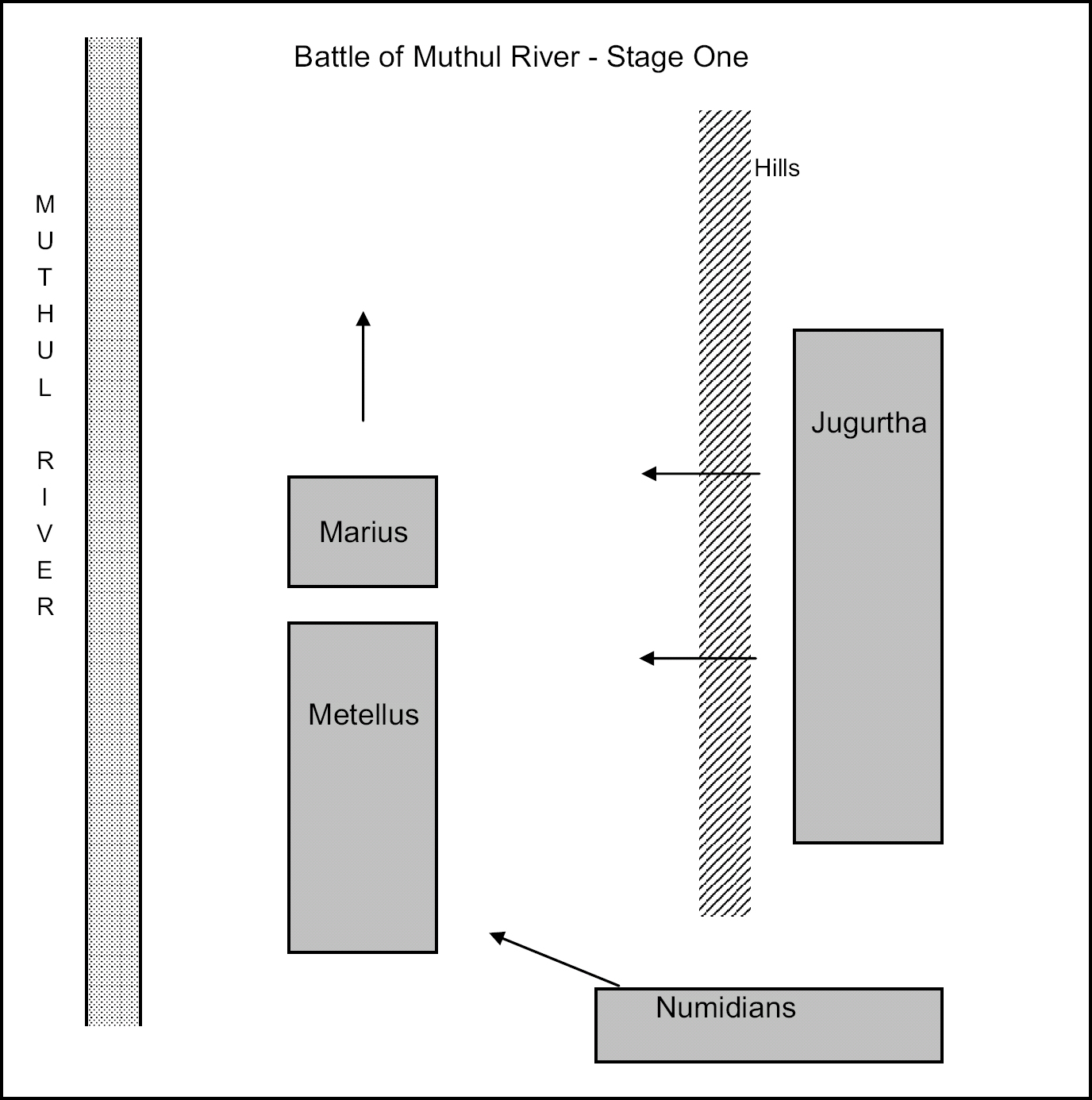
His right flank, which was nearest the enemy, he strengthened with three lines of reserves. Between the maniples he placed the slingers and archers, while on the wings he stationed all the cavalry and after a brief address, which was all that there was time for, led the army down into the plain in its new formation, with what had been its front, marching at right angles to the direction of the enemy.209
As the Romans marched down into the plain, the Numidians held their ground. This led Metellus to believe that Jugurtha planned a series of skirmishes to wear down the army rather than an outright attack. To secure his position he sent Rutilius Rufus and a force of cavalry and lightly armed troops to secure a site by the river for a camp, should one be necessary overnight, thus giving the army access to fresh water. Metellus remained in command of the cavalry at the head of the column, with Marius in command of the main force behind him. Once Metellus’ army had entered the plain, Jugurtha sent a force of 2,000 infantry to block the route the Romans had come from and prevent a possible retreat.
With the trap now in place Jugurtha’s forces attacked:
The rear of Metellus’ column suffered heavy casualties, and both flanks were harassed by mobile assailants who pressed home their attacks and spread great confusion in the Roman ranks. For even the men who resisted with the most courage were disconcerted by the irregular manner of the fighting, in which they were wounded at long range without being able to strike back or come to grips with their enemy.
Jugurtha’s horsemen had been given careful instructions beforehand. Whenever a squadron of Roman cavalry began a charge, instead of retreating in one body, they scattered as widely as possible. In this way they could take advantage of their numerical superiority. If they failed to stop their enemy’s charge, they would wait until the Romans lost their formation, and then cut them off by attacks in the rear and on their flanks.210
Thus, we can see the key to Jugurtha’s strategy: to harass the Romans at distance, by shot and cavalry and deny them their superiority in close quarter infantry combat. Furthermore, the widespread attacks and the terrain acted to disrupt the Roman battle discipline and tight combat formation. We do not know how long this struggle went on for, but the impression Sallust gives is that it continued for some time. As Sallust himself comments, the Romans had both superior quality and number of soldiers, but the Numidians had the ground in their favour and the style of combat played to their strengths.211
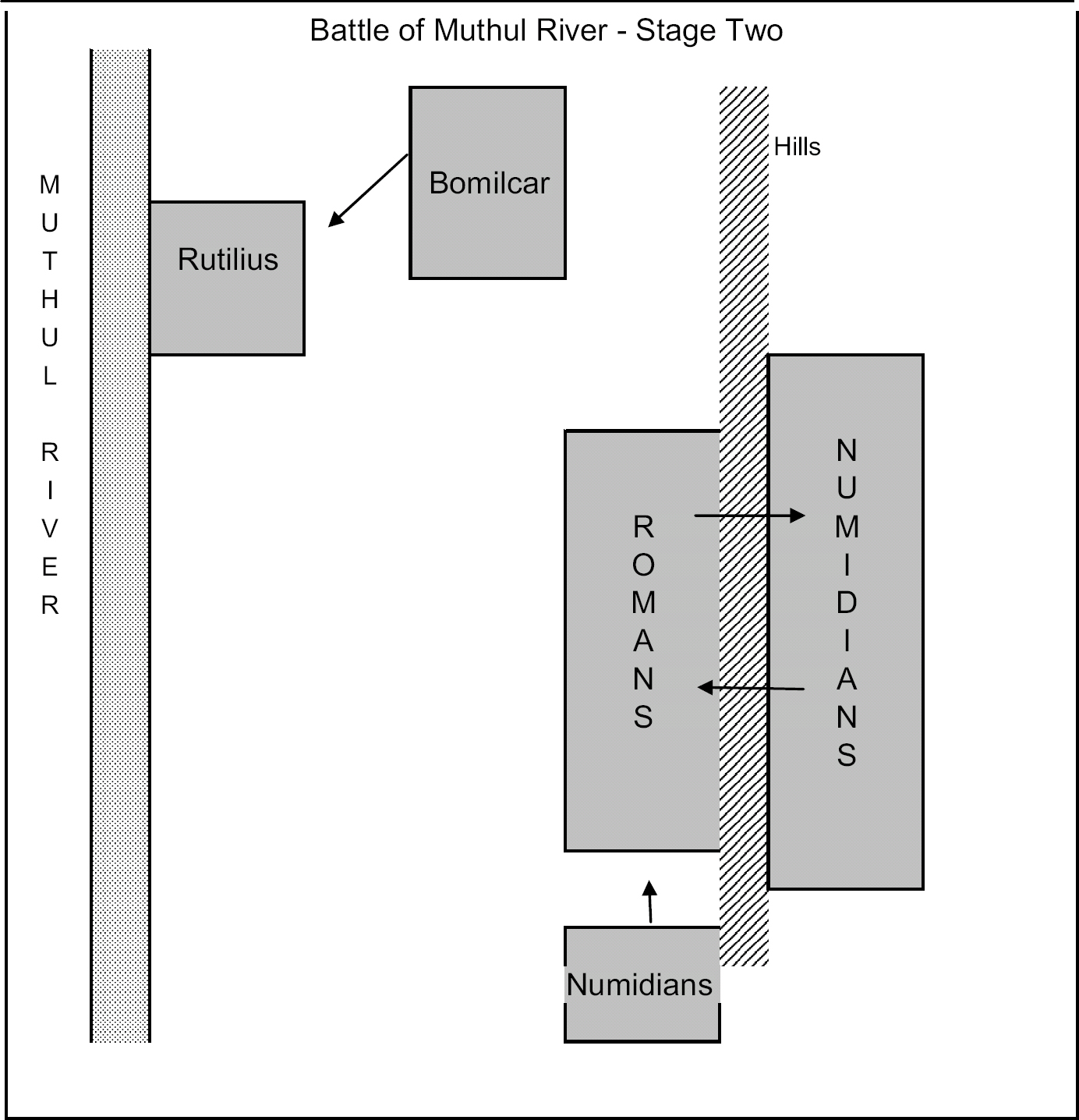
Nevertheless, the key to the Numidian victory would have been the collapse of the Roman formation and an attempted withdrawal. Effectively the Romans were boxed-in, with Numidians ahead and to the right, as well as blocking the route behind them, with the river to their left. Had the Roman troops broken they would have been massacred. Sallust points out that this point was not lost on Metellus who wasted no time in informing his men that retreat was not an option.212Furthermore, the Numidian attack was a series of strikes rather than close-order combat. With this in mind, Metellus ordered an advance uphill towards the Numidians, to force them to fight in close quarters or retreat. Faced with a Roman advance and not wanting to engage the legionaries at close quarters, the Numidians broke and scattered into the mountains.
Attention now shifted to Rutilius’ force by the river. At some point before battle had started, Jugurtha dispatched his lieutenant, Bomilcar, along with a force of forty-four elephants and accompanying infantry to attack the Roman advance force, now making camp by the river. Sallust states that Bomilcar attempted to launch a surprise attack on the Romans using the cover of the wooded region between the two forces. Given that his force had over forty elephants in it, a surprise attack does seem unlikely to have succeeded, especially given the presence of Roman pickets. Upon seeing the massive cloud of dust kicked up by Bomilcar’s force, Rutilius gathered his men into formation and charged out to meet the enemy.
This almost-comic Numidian attack ended as almost as soon as it started when the elephants became entangled in the undergrowth between the two forces, disrupting the Numidian advance. The accompanying Numidian infantry apparently broke and fled for the safety of higher ground leaving the elephants to be slaughtered. Here Sallust provides the only figures for the battle, with forty Numidian elephants killed and four captured.213 With Bomilcar routed, Rutilius then set off to rejoin the main force, by which time night had fallen. Sallust increased the drama of his narrative by having both Roman forces mistaking the approach of the other for the enemy; with battle narrowly being averted thanks to the scouts sent out by both sides. Following the battle we are told that Metellus remained in camp for four days, to rebuild his army, whilst Jugurtha set about raising a fresh one.
What are we to make of the second battle of the Jugurthine War and the first one to receive anything approaching a detailed description in Sallust? It is clear that despite having chosen his ground and tactics perfectly, Jugurtha and the Numidians had been clearly defeated by Metellus, thanks to the quality of the Roman forces. Despite a superior position and the excellent use of his missle weapons (bows and slings) and cavalry on both occasions when faced with Roman legionaries in close quarters, the Numidian troops fled from the battlefield. Naturally, this was aided by the calm and steady leadership of Metellus who had confidence in the superiority of his own forces and the knowledge that this would tell in the final outcome.
II. The Battle of the Muthul River - Stage 2
The overall effect is interesting to consider. One the one hand, the Romans had won a clear victory, restoring Roman pride and the balance of power between the respective forces. The superiority of the Roman military machine had clearly been demonstrated and the weaknesses of the Numidian one made all too plain to see. Nevertheless, we must ask ourselves just how bitter a defeat was it for Jugurtha? Although we have no figures for casualties, Sallust’s narrative makes it clear that the bulk of his forces survived, although he did lose a considerable force of elephants. More importantly, as long as the king himself remained free then the war would continue. However, Sallust does make one important but odd point as a postscript to the battle. He states that despite the reactively low Numidian casualties, the majority deserted Jugurtha, who had to recruit a force of untrained peasants to rebuild his army. Sallust ascribes this to being a quirk of the Numidian culture.214 However, it would perhaps be more logical to see it as the first signs that, although Jugurtha intended to fight on, the Numidian military knew when they were beaten.
Nevertheless, despite his victory, Metellus was left with a serious problem, namely how to bring the war to a speedy conclusion. Jugurtha had been defeated militarily, but until he was in Roman hands the war would continue. In many respects this was the type of warfare that most vexed the Romans; the enemy had been defeated militarily, but the figurehead remained. With Hannibal, they had forced him into exile and, after two decades on the run, eventual suicide; whilst with Viriathus, they had resorted to assassination. With no other option, Metellus began a campaign of denying Jugurtha access to the resources of Numidia, by the country’s total subjugation. This process is best described by Sallust:
He (Metellus) therefore marched into the most fertile parts of Numidia, laid waste the country, captured and burned many strongholds and towns which had hurriedly been fortified or left without defenders, ordered the death of all the adults and gave everything else to his soldiers as booty. In this way he caused such terror that many men were given to the Romans as hostages, grain and other necessities were furnished in abundance and garrisons were admitted wherever Metellus thought it advisable.215
Although this was an admirable strategy in terms of denying Jugurtha access to resources, it would have turned the Numidians against Rome, especially when you consider that Metellus had started this campaign being welcomed by the local inhabitants. Furthermore, if anything, it would have increased support for the flagging campaign of Jugurtha. Another side effect of this policy was that it spread Metellus’ forces over a wide area. This presented an opportunity for Jugurtha, who responded by shadowing Metellus’ main force and mounting lightning strikes with his cavalry against any stray Roman units he came upon. Sallust records that one such unit was ambushed and slaughtered.216 This tactic forced Metellus to adopt more caution when campaigning in the Numidian countryside, with his army split into two main forces, one commanded by him, and one by Marius, with the two shadowing each other. This set the tone for the rest of the campaign of 109 with Metellus and Marius’ forces attacking the various Numidian towns and Jugurtha shadowing them with his cavalry and impeding the Roman progress whenever he could, through spoiling crops or poisoning water sources, but not giving battle.
Thus, once again, the Roman army became bogged down in a long and drawn-out war against an ‘invisible’ guerrilla enemy. The effects on Roman morale can be seen by Sallust again referring to the existence of groups of Roman deserters. Metellus determined to bring Jugurtha to battle once more by attacking the city of Zama, which he hoped would force Jugurtha to make a stand to save the city. It has to be said that this was a vain hope at best and showed just how lacking in ideas the Romans had become. Unfortunately for Metellus, Jugurtha learnt of this plan from a group of Roman deserters who had switched sides and was able to use his greater speed to reach Zama first and make preparations. Zama’s defences were duly bolstered, aided by the presence of the Roman deserters to defend the town. Jugurtha, however, had no intention of being pinned down in one location and swiftly took his cavalry force back into the hills.
Once again, Jugurtha’s superior military intelligence showed through, as he learnt that Marius had taken a small force to the nearby town of Sicca to gain additional supplies. He therefore moved his cavalry force and ambushed Marius as he was leaving the town, planning to surround Marius by having the inhabitants of the town attack Marius from the rear. Marius though, kept his head and advanced swiftly at the enemy, thus escaping from being surrounded and again testing the nerve of the Numidians in front of him. Again, when faced with Roman soldiers charging them, the Numidians broke, and the ambush failed, with few casualties on either side.217
Once more, a familiar pattern was repeated, with Jugurtha’s brilliant tactical ability being negated by the poor quality of his troops.
Despite losing the element of surprise, Metellus continued with his siege of Zama. Jugurtha again, however, proved to be a master of the unexpected and attacked the lightly-defended Roman camp behind Metellus’ army. Once again this resulted in initial success with the Roman guards scattering rather than standing and fighting, the majority of whom were slaughtered. However, Sallust reports that just forty men held firm and defended a ridge or hill-top, long enough for Metellus and Marius to realize the situation and come to their aid.218 Jugurtha, after surprising and embarrassing the Romans once more, had to retreat when faced with overwhelming odds and thus the stalemate continued.
The war continued in this vein, with Metellus continuing with the siege of Zama and Jugurtha ambushing and harrying the Roman lines wherever he could. Sallust preserves a good account of the siege, obviously taken from a first-hand account. In many ways the siege of Zama became a microcosm for the war itself. Overwhelming Roman military might was not enough to take the city, and Jugurtha continued to ambush the Roman forces without being brought to battle and continued to be driven off. In the end, with the onset of winter, Metellus was forced to abandon the siege of Zama and took the bulk of his army back to Roman Africa to winter there. He naturally left garrisons in a number of Numidian towns.
Thus, the campaign of 109, despite the brilliant victory at Muthul River, had ended in stalemate and the war dragged on into a fourth year, with still no obvious Roman success in sight. As on so many occasions, Roman military superiority, in both numbers and quality, could not defeat an enemy who refused to give battle and continued to harry them. Certainly, Metellus had restored Roman pride and military superiority in battle, but had no obvious military strategy to bring the war to an end.
Therefore, with no other option, Metellus once again attempted to end the war by diplomacy through the subversion of Jugurtha’ deputy, Bomilcar, whose position, as he fully understood, was a precarious one. As Sallust points out, Bomilcar, having been Jugurtha’s agent in the murder of the Numidian prince Massiva in Rome, would have been handed over for Roman justice if there were any settlement between Rome and Jugurtha then Bomilcar.219 Furthermore, he must have realized that ultimately the Numidians would not win this war and again he would find himself at the mercy of Roman justice. Therefore, a separate deal between himself and the Romans was the only way of ensuring his own survival. Bomilcar thus attempted to persuade Jugurtha to come to terms with the Romans, successfully as it appears, and negotiations were opened.
We have to question whether Jugurtha had suddenly had a change of heart brought about by Bomilcar or whether this was nothing more than a continuation of his earlier tactic of negotiating with the Romans to muddy the waters. Metellus convened a council of his senior men and sent initial terms to Jugurtha of 200,000 pounds of silver, all his elephants and a number of horses and weapons, along with the return of all Roman deserters, all of which were complied with. It was only when Jugurtha himself was ordered to appear before the Romans, at Tisidium, that he broke off negotiations.
Given that he handed over a considerable portion of his resources to Metellus, we have to consider that Jugurtha was genuinely trying to seek a settlement with Rome. However, following his victory and humiliation of the Romans at Suthul, he must have known that the Romans would never have allowed him to remain as King of Numidia, and in fact it was unlikely that the Romans would have let him remain alive at all. What this incident shows, if anything is that both sides were tiring of this war, with no victory in sight for either party. Thus the war continued into a fourth year (108 BC) with Metellus remaining in command of the campaign as proconsul, which was hardly a surprise given his reputation, accomplishments and formidable political support in the Senate.
Treachery in the Winter of 109/108 BC
However, this support back in Rome came in contrast to his position in Africa. Another year had passed and Jugurtha, despite the set-piece defeat, was still in the field with his army and could act with impunity, striking against the Romans seemingly at random. The war was to drag on into a fourth year, with no obvious military solution in sight and negotiations for a peace had broken down once again. Added to that was the military failure to capture the city of Zama. On the ground, this lacklustre Roman performance had resulted in desertions, as we have seen. With a number of deserters being handed over by Jugurtha, Metellus was at least able to make an example of them and discourage any further such actions. However, it was at a higher level that Metellus faced the most danger, when this discontent found a figurehead, in the shape of his own deputy, Caius Marius. Marius’ background will be examined shortly (Chapter 7), but at this particular time he found himself in an ideal position. That Rome would win the war was inevitable, at least in a military sense, yet the campaign was dragging on and Marius found himself in a position that many deputies find themselves in, being convinced that he could do a better job than his superior.
With the Roman army wintering in the province of Africa, Marius apparently requested of Metellus that he be given leave to return to Rome and stand for consul. For Metellus there were a number of obvious reasons to refuse such a request. For a start Marius was a serving officer on an important campaign and should not be released for personal political reasons. Secondly, it was obvious that Marius was angling to take Metellus’ own command away from him. Thirdly, was the fact that, as Metellus saw it, Marius did not possess the attributes to be elected consul and would fail utterly. Despite his military and political record, he had no real powerbase or allies of his own and had only achieved what he had through being a client of the Metelli. Furthermore, he was an Italian nobleman (albeit with Roman citizenship) but was not a Roman one, an important distinction in the eyes of the Roman aristocracy. For these reasons, it is not a surprise that Metellus refused Marius’ request. Nonetheless, Metellus was now faced with a potentially rebellious deputy to contend with as well.
With the failure of the negotiations, the Romans spent the rest of the winter in their African province, regrouping their forces for the next campaign. This left Jugurtha a relatively free hand in Numidia (Roman garrisons excepted) and he used it to his advantage. He assembled a new army and spent the rest of time trying to win back the towns and cities that had gone over to the Romans (mostly unwillingly) and even trying to subvert the Roman garrisons left behind in a number of towns. Success came in the form of the town of Vaga, one of the first Numidian towns to turn to Metellus in 109 and with a Roman garrison. During a public festival the officers of the garrison were invited to dine with the town’s dignitaries, during which they were murdered. With the garrison leaderless the townspeople attacked the soldiers, cut them off from their citadel and fell upon them in the streets, massacring them. Suspiciously only the Roman commander, T. Turpilius Silanus survived.220
Upon hearing of the disaster at Vaga, Metellus set out at once and crossed the border with a large Roman force intent of avenging the loss. Upon reaching the town, the inhabitants made a fatal mistake. Metellus’ force contained a large number of Numidian cavalry, which had gone over into Roman service (itself a clear sign of Numidian discontent). As the cavalry reached the town before the Roman infantry, the townspeople assumed that they were from Jugurtha and opened the gates and went out to greet them. Naturally, taking advantage of this stroke of fortune the Romano-Numidian cavalry slaughtered the inhabitants and took the gates before they could be closed. Despite some resistance the town fell easily, with inhabitants being slaughtered and the survivors enslaved. Sallust dates the whole rebellion to two days in length.221
The most prominent victim was the garrison commander T. Turpilius Silanus, who was condemned by a military tribunal and scourged and executed.222 What made the matter worse was that Turpilius was a friend of Metellus and only there at his request. Plutarch claims that at the tribunal, Marius pushed for Metellus to sentence his friend to death, which Metellus reluctantly had to do. Plutarch claims that this increased the tension between Metellus and Marius. He then goes onto add that soon after the execution the charge was found to be false and Turpilius was actually innocent. Thus, for Plutarch at least, Marius had got Metellus to execute his friend on trumped-up charges.223 Exactly how Turpilius could be innocent is never stated by Plutarch, nor could we imagine how it could be the case. Even if he did not conspire with the inhabitants then he was at least guilty of gross negligence. As we find none of this in Sallust’s account, we must exercise caution.
Though the rebellion had been swiftly and brutally crushed, ensuring that a repetition was unlikely, it did show the weakness of the Roman position and was another setback for Metellus, showing the danger of Roman inactivity during the winter months.
Jugurtha, however, still faced discontent within his own ranks, again in the form of Bomilcar. Still fearful of his own position and the inevitability of a Numidian defeat, he plotted to remove Jugurtha in a coup. To these ends, he enlisted the help of a Numidian nobleman and army commander, Nabdalsa, who commanded the Numidian forces on the border of Roman Africa. However, on the appointed day Nabdalsa’s nerve cracked and he withdrew from the plot. Bomilcar compounded this failure by writing a letter to him, berating him for his lack of nerve and entreating him to join his plot as it was inevitable that Jugurtha would lose the war. As usually happens in these cases, the letter found its way into the hands of another, Nabdalsa’s secretary, who took it straight to the king. When Nabdalsa found out about the letter’s loss he managed to make it to Jugurtha first and admitted the whole plot. Bomilcar and the rest of his conspirators were rounded up and executed immediately. Nabdalsa was spared, probably due to his position and Jugurtha’s desire to limit the spread of this rebellion. We know the details of this plot thanks to Numidian deserters, probably some of those associated with the plot itself, who made their way to the Roman lines.224 Though the plot had been dealt with, Jugurtha’s weak position in Numidia had been clearly exposed. The inevitability of his defeat seemed to be widely accepted, yet he could not surrender nor could the Romans bring the war to an end.
Thus the campaign of 108 BC began with both sides facing internal divisions and the prospect of another year of stalemate. Whilst Jugurtha rid himself of Bomilcar by a swift execution, Metellus rid himself of Marius by finally acceding to his demand to return to Rome, accepting that it was better to remove a source of discontent from Africa than to let it fester. He did this safe in the knowledge that there was no real chance of Marius being elected consul. Unfortunately for him, however, this safety was only in his own mind, as will be detailed in the next chapter.
The Campaign of 108 BC and the ‘Second Metellan Battle’
The campaigning for 108 began, as was usual, with a Roman invasion of Numidia, yet on this occasion Jugurtha gave battle. Once again Sallust’s limitations as a historian come to the fore as the details of this battle are relegated to just a handful of lines.
Metellus unexpectedly appeared with his army; whereupon Jugurtha made ready and drew up his Numidians as well as time allowed. Then the battle began. Wherever the king was present in person, there was some show of resistance; everywhere else his soldiers broke and fled at the first charge. The Romans captured a considerable number of standards and arms, but few prisoners.225
We are given no reason as to why Jugurtha gave battle. Sallust’s implication is that Metellus was able to surprise him and left him with no choice; yet given both the superior intelligence Jugurtha had access to as well as the speed of his forces compared to the Romans, this seemed unlikely. Sallust does state that Jugurtha was growing increasingly paranoid following the conspiracy of his officers and it is perhaps possible that he sought battle to restore flagging Numidian morale. Standing against this possibility, however, was the inevitable outcome, which Jugurtha must have been aware of: when faced with superior Roman infantry, the Numidians once again broke and fled.
The other possibility is that Metellus was able to corner Jugurtha, yet the speed with which this was accomplished is baffling, given that he had spent the previous year failing to do just that. It is perhaps worth remembering that a number of Numidians had deserted to the Roman side over the winter of 108. We are not told of their rank, but given the strong possibility that they were involved in the attempted coup described above, then it is more than likely that they were a number of senior-ranking Numidians and brought with them considerable intelligence on Jugurtha’s plans. With this knowledge we can speculate that Metellus was able to finally surprise Jugurtha. Nevertheless, with the little evidence we have all we can do is speculate upon this.
Whatever the cause of the battle, the result was clear enough. The Numidians were defeated and Jugurtha fled deeper in Numidia, taking refuge at the royal stronghold of Thala. Metellus swiftly followed up his victory with a dash to Thala in an attempt to capture the king. Despite this swift advance, Jugurtha was able to flee once more, with his children and his treasury. Nonetheless, Metellus determined to capture the stronghold and set about another siege. On this occasion the town fell after a forty-day siege. However, the gains were minimal as the town’s leading citizens fled to the royal palace, taking their treasures with them. After a feast, which included large amounts of wine, these citizens then set fire to the palace, with themselves in it, in an apparent act of mass suicide (though a drunken accident cannot be ruled out).
Unfortunately, this is all that we know of the campaign of 108 BC, the battle and the siege, with Sallust skipping over the rest of the year, perhaps on account of there being little to report. Once again, it appears that although the Romans had defeated Jugurtha once again in 108, the war seemed to be no nearer a conclusion. On the positive side, most of Numidia now lay in Roman hands and Jugurtha was apparently on the run with only a small retinue.
The African War
However, it was at this point, just when he seemed to be at his lowest ebb, that Jugurtha showed his superb diplomatic and tactical abilities and pulled off a coup which resulted in a massive escalation of the war for Rome. Having been cut off from his Numidian resources, Jugurtha widened his influence and gained allies and forces from outside of Numidia, namely the Gaetulians to the south and the Mauri to the west. The Gaetulians were a collection of tribes who lived to the south of the Numidians, by the Atlas Mountains. In the few Roman sources that do mention them they are usually collected together as one race, though the reality was far more complicated.226 Sallust exhibits a typical Roman reaction to the Gaetulians when he describes them as:
a wild and uncivilized race of men who at the time had never heard of Rome. He (Jugurtha) mustered their population in one place and gradually trained them to keep rank, follow the standards, obey orders and perform the other duties of soldiers.227
Aside from overlooking the incredible amount of time it would have taken Jugurtha to train a barbarous people from scratch in the art of ‘western’ warfare, we have a reference from Livy that Gaetulians were to be found in Hannibal’s army and can conclude that they had long been used as mercenaries, and thus were well acquainted both with Rome and an organized form of warfare.228 Given this, we can assume that far from being a case of Jugurtha wandering out of the wilderness, as Sallust paints it, it would haven been more the case that Jugurtha’s money appealed to them.
Further help came from the west in the form of Bocchus, King of the Mauri, a tribal people in the very northwest of Africa (Mauretania). Bocchus was related to Jugurtha by marriage and thus it seems that Jugurtha was able to appeal to family ties, liberally aided by substantial monies, to bring Bocchus to his aid.229 Furthermore, it appears that Bocchus had been snubbed by the Romans when he had approached them for a treaty of alliance at the outbreak of the war (though the date and the Roman commander are not given230. Jugurtha was also able to play upon Bocchus’ fear of the Roman intentions, with them now in control of Numidia. Such a fear may also have been a strong motivating factor in the decision of the Gaetulian tribes to follow Jugurtha.
Thus, at a stroke, Jugurtha had gone from being a fleeing refugee to being the head of a somewhat untested two-nation African alliance against Rome. We must always be cautious in following the apparent short timescales given by our surviving sources and it is more than possible that Jugurtha had been working on these alliances for some time. Nevertheless, for Rome the situation had become potentially grave; where previously they had been facing one king, who did not have the whole support of his nation, they now faced two armies, of Gaetulians and Mauri, commanded by Jugurtha and Bocchus. This latter point has often been overlooked in the histories, with too great a focus on Jugurtha himself. Nevertheless, we must be cautious as to how reliable these new allies were to Jugurtha.
This new hybrid force (which again we have no numbers for) then invaded Numidia and made for Cirta, the site of the siege that had initially caused the war, which by this point of 108 BC was now apparently in Roman hands, though we are not given any details about how it came to be so. By this point Metellus had turned Cirta into a temporary headquarters, housing the Roman supplies, prisoners and captured loot, perhaps for the winter.
One major problem we have with our surviving record concerns the chronology of events.231 Sallust condenses the events in Numidia in a few short sections.232 We do not know when in the year the unnamed ‘Second Battle’ took place. Nor do we have a timescale for Jugurtha’s creation of the Gaetulian–Mauri alliance. The clear implication is that Metellus had turned Cirta into a headquarters to spend the winter, rather than evacuating Numidia once again and losing control. After the siege of Thala we are given no indication of Metellus’ activities in Numidia, and given the sudden appearance of Cirta in Roman hands, we can speculate that Metellus used this time to consolidate the Roman control of Numidia. Thus when Bocchus and Jugurtha invaded Numidia, the onset of winter was approaching.
Metellus, aware of the advance, established a fortified camp near Cirta to await the arrival of this invading army. It was at this point that he received the unexpected news, that not only had Marius been elected to a consulship for 107 BC, but that the assembly had voted him the province of Numidia and the command against Jugurtha, overriding the Senatorial prerogative (see Chapter 7). We do not need Sallust to imagine how Metellus felt at this betrayal, to be replaced by his own deputy and, even worse, one who was a social inferior and a client. For the Roman campaign, this news could not have come at a worse time. When faced with a massive escalation of the war and an invasion by a combined Mauri-Gaetulian army, the last thing the Romans needed was to have their field commander undermined and de-motivated in such a manner.
Metellus responded by use of diplomacy, in an attempt to break up the alliance between Bocchus and Jugurtha. He sent emissaries to Bocchus to convince him that he did not need to become an enemy of Rome or to support Jugurtha’s doomed cause. Unfortunately, Sallust’ narrative of the rest of the 108 campaign tails off at this point, with his interest taken by events in Rome involving Marius.233 This joint attack by Bocchus and Jugurtha on Cirta fails to materialize, perhaps due to Metellus’ diplomacy making Bocchus think twice.
When Marius arrives in Africa in 107 BC (again we are given no clear timescale), the command of the army is handed over to him by P. Rutilius Rufus, at Utica (in Roman Africa). Metellus had understandably refused to hand over command as tradition dictated. Thus by 107 BC, the Roman army was back in the Roman province of Africa, again leaving Jugurtha and Bocchus apparently in charge of Numidia. The gaps in our sources do not give us any detail of how this occurred. As far as they are concerned, Bocchus and Jugurtha suddenly stopped their attack on Cirta and sat around for six months waiting for Marius to arrive and take command of the war, and then restarted their campaigns in early to mid–107, at exactly the same point they had left off. Once again, Roman military history falls foul of the priority given to domestic politics. Had we still had the relevant books of Livy intact, this would not be the case (see Appendix V).
Even if Bocchus had been dissuaded from attacking the Romans, Jugurtha was still in command of the Gaetulian army and Cirta made a tempting target. We are unfortunately left with a series of questions, which, for the foreseeable future, will never be answered: did Jugurtha attack Cirta or did Metellus withdraw all of his forces back to Roman Africa?
We can perhaps find some help in the actions of Marius in the campaign of 107 BC. On the one hand we are told that Jugurtha was attacking towns in Numidia still allied to Rome, but on the other that there were numerous strongholds still in Jugurthan hands.234It is most likely that no serious fighting took place between Metellus and Jugurtha in late 108/early 107, though whether this was the result of Jugurthan or Metellan indifference is impossible to tell. We cannot even be certain that Cirta remained in Roman hands, though this seems most likely from the later context of the campaigns of 107 BC. It is possible that Metellus left Cirta and a number of towns garrisoned and withdrew the bulk of the army back into Roman Africa. Faced with a strong Roman defence and an uncertain ally, it is also possible that Jugurtha was not able to successfully besiege Cirta and when he realized that Metellus was not going to be drawn into battle, gave up the attack and concentrated on bringing the rest of Numidia back to his rule.
Summary – The Metellan Campaigns
i) Rome
In the face of it, the Metellan campaigns were an obvious success for Rome. When Metellus took command in 109 the Romans had just been defeated and humiliated and had been driven from Numidia. In the period that followed the Romans fought two pitched battles against the Numidians, at Muthul River and the so-called ‘Second Battle’, and comprehensively won both, gaining complete control of Numidia and forcing Jugurtha to flee. Yet by 107 BC the situation had, if anything, become potentially more dangerous for Rome than in 109, for two main reasons.
Firstly, despite overwhelming military superiority, the war continued with no obvious end in sight. If anything, Jugurtha was showing the tenacity of the Romans, in the fact that every time he was defeated in battle, he raised a fresh army and continued to fight. Florus drew the parallel to Hannibal, but when Hannibal was defeated in 202 at Zama, Carthage sued for peace and he had to lay down his arms.235 As the undisputed king of Numidia, Jugurtha was able to continue the war, though as noted below his control over Numidia wavered with every defeat. Furthermore, the Roman grip on Numidia itself appeared to be tenuous. Certainly, cities such as Thala, Vaga and Cirta could be taken, by siege if necessary, but the Roman hold on them was tenuous at best, with the ever present danger of a native rebellion. Furthermore, the Roman writ of control only extended to the towns and cities they garrisoned, with the countryside uncontrolled and potentially hostile. This was especially the case when Jugurtha reverted to his guerrilla tactics. With regard to this last point the Metellan campaigns had again shown that although superior in battle, the Roman army was not able to win a war when the enemy refused to come to terms and fought on.
As noted earlier, the war that had broken out centred on the figure of Jugurtha himself, even if there were sound strategic reasons for wanting to limit the power of Numidia. Until he came to terms, was killed or captured, the war would continue. Given the strains at Rome both domestically and with regard to the situation in the north, the Senate needed a speedy conclusion to the war. When, after eighteen months, it looked as though Metellus was not able to deliver this result, these tensions spilled over and saw the extraordinary election of Marius to the consulship and then the command in Numidia.
The second reason was the rise of the Mauri-Gaetulian alliance, which saw a significant escalation of the war. Instead of fighting the Numidians, who had been shown to be militarily of poorer quality, the Romans now faced a coalition of the three main North African races, the Numidians, the Mauri and the Gaetulians, which, if unchecked, threatened Rome’s domination of the North African region. Furthermore, at the same time as Rome faced this alliance, the issue of instability of command was raised once more, with Metellus being undermined by his deputy, and stripped of the command altogether. Although the sources are not clear, this may have resulted in the Roman army failing to engage this new invading North African army and retiring to Roman territory.
Nevertheless, we have to ask ourselves, how much of this situation was down to Metellus. In just eighteen months he had restored Roman discipline and shown the superior Roman military ability in two set-piece battles. Jugurtha had been expelled from Numidia and the country was under nominal Roman suzerainty. Certainly, Jugurtha had re-invaded at the head of a new pan-African army, but this did not mean that either the Mauri or the Gaetulians would prove to be any more of a challenge in battle than the Numidians were.
Thus, it can be argued that the position Metellus left in the beginning of 107 BC was far stronger than the one which he had inherited two years earlier. That the situation had the potential to become worse for Rome did not mean that it would, especially given the Roman military superiority in set-piece battles. Nonetheless, there were no clear signs that the war would come to a speedy conclusion and for that Metellus lost his command.
ii) Jugurtha
For Jugurtha the campaigns of 109–108 BC had been a clear setback. During the winter of 110 he is reported to have been on the offensive, engaging in wars to enlarge his kingdom, which may have included subduing the Gaetulians, having defeated and humiliated the Roman army. By the summer of 108, he had been defeated twice in battle and been driven from his kingdom. His campaigns show both his individual brilliance as a commander and the inherent weaknesses of his position. Both at Muthul River and Thala, he forced the Romans to fight on his terms, using his tactics on his ground. Yet this tactical brilliance was not matched by the quality of the men under his command, who proved to be no match for a Roman legion and usually fled when faced by one at close quarters.
His leadership skills were ably demonstrated by the ‘grand alliance’ he created in 108 BC, as joint head of an army of Gaetulians and Mauri. Yet, if he could not rely on his own countrymen, what chance did he have with mercenaries and untrustworthy allies? Both the Gaetulians and Mauri had been weaker than the Numidians at the start of the war; if the Numidians were no match for Rome then would these new allies prove to be any better?
Nevertheless, his tenacity in continuing to fight was both a result of his character and his desperate position. His actions both at Rome, but especially at Suthul, had ensured that Roman public opinion would brook no peace terms that did not end in his being paraded though Rome. Furthermore, his own position in Numidia was weak, undermined by the seemingly-inevitable Roman victory. The aborted coup of 109/108 BC also showed the weakness of his grip on Numidia, with most Numidians realizing that the war, and all of its associated misery would only end with him killed or captured. If his own countrymen were not trustworthy then the Gaetulians and Mauri were less so. Bocchus had already been open to negotiating with the Romans and the Gaetulians were mercenaries at best and would not be reliable following their first defeat.
Thus as 107 opened, Jugurtha had no option but to keep fighting and had just one glimmer of hope of emerging from the war intact. Defeating the Romans was logistically impossible; they had a far superior military and a near-endless supply of men and commanders. Whilst the Senate may have seen the logic of coming to a negotiated settlement with him, the Roman people, however, were another case. From the outset, this war had been driven by Roman public opinion, usually manifesting itself in the actions of the tribunes. By 107 BC this had resulted in an outsider being elected consul and the Senate having their prerogative of selecting Rome’s military commanders stolen away from them. It is clear that with the circumstances as they were and Jugurtha being the focus of the wrath of the Roman people, peace was impossible. Yet if the circumstances changed and this war became an unnecessary distraction in the face of a greater threat, then peace may indeed have been possible.