
Part V
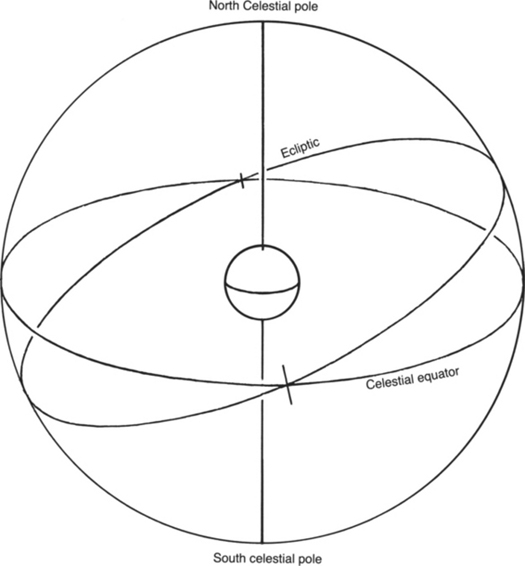
The Celestial Sphere.
Chapter 28
Although a modern reader does not expect a text on celestial mechanics to read like a lullaby, he insists on his capacity to understand mythical ‘images’ instantly, because he can respect as ‘scientific’ only page-long approximation formulas, and the like.
He does not think of the possibility that equally relevant knowledge might once have been expressed in everyday language. He never suspects such a possibility, although the visible accomplishments of ancient cultures – to mention only the pyramids or metallurgy – should be a cogent reason for concluding that serious and intelligent men were at work behind the stage, men who were bound to have used a technical language …1
The quotation is from the late Giorgio de Santillana, professor of the History of Science at the Massachusetts Institute of Technology. In the chapters that follow, we shall be learning about his revolutionary investigations into ancient mythology. In brief, however, his proposition is this: long ages ago, serious and intelligent people devised a system for veiling the technical terminology of an advanced astronomical science behind the everyday language of myth.
Is Santillana right? And if he is right, who were these serious and intelligent people – these astronomers, these ancient scientists – who worked behind the stage of prehistory?
Let us start with some basics.
The wild celestial dance
The earth makes a complete circuit around its own axis once every twenty-four hours and has an equatorial circumference of 24,902.45 miles. It follows, therefore, that a man standing still on the equator is in fact in motion, revolving with the planet at just over 1000 miles per hour.2 Viewed from outer space, looking down on the North Pole, the direction of rotation is anti-clockwise.
While spinning daily on its own axis, the earth also orbits the sun (again in an anti-clockwise direction) on a path which is slightly elliptical rather than completely circular. It pursues this orbit at truly breakneck speed, travelling as far along it in an hour – 66,600 miles – as the average motorist will drive in six years. To bring the calculations down in scale, this means that we are hurtling through space much faster than any bullet, at the rate of 18.5 miles every second. In the time that it has taken you to read this paragraph, we have voyaged about 550 miles farther along earth’s path around the sun.3
With a year required to complete a full circuit, the only evidence we have of the tremendous orbital race we are participating in is the slow march of the seasons. And in the operations of the seasons themselves it is possible to see a wondrous and impartial mechanism at work distributing spring, summer, autumn and winter fairly around the globe, across the northern and southern hemispheres, year in and year out, with absolute regularity.
The earth’s axis of rotation is tilted in relation to the plane of its orbit (at about 23.5° to the vertical). This tilt, which causes the seasons, ‘points’ the North Pole, and the entire northern hemisphere away from the sun for six months a year (while the southern hemisphere enjoys its summer) and points the South Pole and the southern hemisphere away from the sun for the remaining six months (while the northern hemisphere enjoys its summer). The seasons result from the annual variation in the angle at which the sun’s rays reach any particular point on the earth’s surface and from the annual variation in the number of hours of sunlight received there at different times of the year.
The earth’s tilt is referred to in technical language as its ‘obliquity’, and the plane of its orbit, extended outwards to form a great circle in the celestial sphere, is known as the ‘ecliptic’. Astronomers also speak of the ‘celestial equator’, which is an extension of the earth’s equator into the celestial sphere. The celestial equator is today inclined at about 23.5° to the ecliptic, because the earth’s axis is inclined at 23.5° to the vertical. This angle, termed the ‘obliquity of the ecliptic’, is not fixed and immutable for all time. On the contrary (as we saw in Chapter Eleven in relation to the dating of the Andean city of Tiahuanaco) it is subject to constant, though very slow, oscillations. These occur across a range of slightly less than 3°, rising closest to the vertical at 22.1° and falling farthest away at 24.5°. A full cycle, from 24.5° to 22.1°, and back again to 24.5°, takes approximately 41,000 years to complete.4
So our fragile planet nods and spins while soaring along its orbital path. The orbit takes a year and the spin takes a day and the nod has a cycle of 41,000 years. A wild celestial dance seems to be going on as we skip and skim and dive through eternity, and we feel the tug of contradictory urges: to fall into the sun on the one hand; to make a break for the outer darkness on the other.
Recondite influences
The sun’s gravitational domain, in the inner circles of which the earth is held captive, is now known to extend more than fifteen trillion miles into space, almost halfway to the nearest star.5 Its pull upon our planet is therefore immense. Also affecting us is the gravity of the other planets with which we share the solar system. Each of these exerts an attraction which tends to draw the earth out of its regular orbit around the sun. The planets are of different sizes, however, and revolve around the sun at different speeds. The combined gravitational influence they are able to exert thus changes over time in complex but predictable ways, and the orbit changes its shape constantly in response. Since the orbit is an ellipse these changes affect its degree of elongation, known technically as its ‘eccentricity’. This varies from a low value close to zero (when the orbit approaches the form of a perfect circle) to a high value of about six per cent when it is at its most elongated and elliptical.6
There are other forms of planetary influence too. Thus, though no explanation has yet been forthcoming, it is known that shortwave radio frequencies are disturbed when Jupiter, Saturn and Mars line up.7 And in this connection evidence has also emerged
of a strange and unexpected correlation between the positions of Jupiter, Saturn and Mars, in their orbits around the sun, and violent electrical disturbances in the earth’s upper atmosphere. This would seem to indicate that the planets and the sun share in a cosmic-electrical balance mechanism that extends a billion miles from the centre of our solar system. Such an electrical balance is not accounted for in current astrophysical theories.8
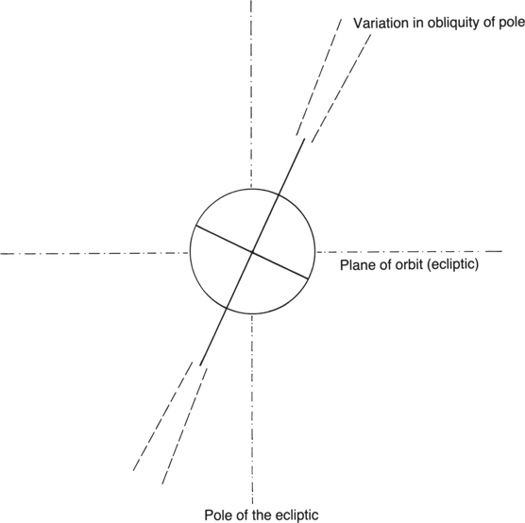
The obliquity of the ecliptic varies from 22.1° to 24.5° over a cycle of 41,000 years.
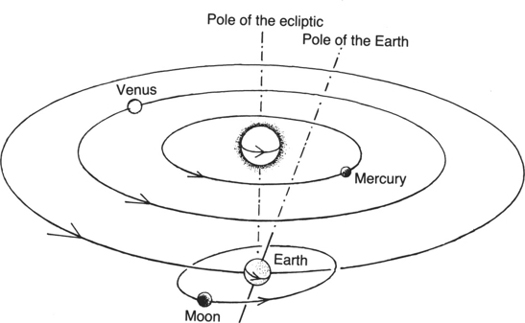
Inner planets of the solar system.
The New York Times, from which the above report is taken, does not attempt to clarify matters further. Its writers are probably unaware of just how much they sound like Berosus, the Chaldean historian, astronomer and seer of the third century BC, who made a deep study of the omens he believed would presage the final destruction of the world. He concluded, ‘I Berosus, interpreter of Bellus, affirm that all the earth inherits will be consigned to flame when the five planets assemble in Cancer, so arranged in one row that a straight line may pass through their spheres.’9
A conjunction of five planets that can be expected to have profound gravitional effects will take place on 5 May in the year 2000 when Neptune, Uranus, Venus, Mercury and Mars will align with earth on the other side of the sun, setting up a sort of cosmic tug-of-war.10 Let us also note that modern astrologers who have charted the Mayan date for the end of the Fifth Sun calculate that there will be a most peculiar arrangement of planets at that time, indeed an arrangement so peculiar that ‘it can only occur once in 45,200 years … From this extraordinary pattern we might well expect an extraordinary effect.’11
No one in his or her right mind would rush to accept such a proposition. Nevertheless, it cannot be denied that multiple influences, many of which we do not fully understand, appear to be at work within our solar system. Among these influences, that of our own satellite, the moon, is particularly strong. Earthquakes, for example, occur more often when the moon is full or when the earth is between the sun and the moon; when the moon is new or between the sun and the earth; when the moon crosses the meridian of the affected locality; and when the moon is closest to the earth on its orbit.12 Indeed, when the moon reaches this latter point (technically referred to as its ‘perigree’), its gravitational attraction increases by about six per cent. This happens once every twenty-seven and one-third days. The tidal pull that it exerts on these occasions affects not only the great movements of our oceans but those of the reservoirs of hot magma penned within the earth’s thin crust (which has been described as resembling ‘a paper bag filled with honey or molasses swinging along at a rate of more than 1000 miles an hour in equatorial rotation, and more than 66,000 miles an hour in orbit’13).
The wobble of a deformed planet
All this circular motion, of course, generates immense centrifugal forces and these, as Sir Isaac Newton demonstrated in the seventeenth century, cause the earth’s ‘paper bag’ to bulge outwards at the equator. The corollary is a flattening at the poles. In consequence, our planet deviates slightly from the form of a perfect sphere and is more accurately described as an ‘oblate spheroid’. Its radius at the equator (3963.374 miles) is about fourteen miles longer than its polar radius (3949.921 miles).14
For billions of years the flattened poles and the bulging equator have been engaged in a covert mathematical interaction with the recondite influence of gravity. ‘Because the Earth is flattened,’ explains one authority, ‘the Moon’s gravity tends to tilt the Earth’s axis so that it becomes perpendicular to the Moon’s orbit, and to a lesser extent the same is true for the Sun.’15
At the same time the equatorial bulge – the extra mass distributed around the equator – acts like the rim of a gyroscope to keep the earth steady on its axis.16
Year in, year out, on a planetary scale, it is this gyroscopic effect that prevents the tug of the sun and the moon from radically altering the earth’s axis of rotation. The pull these two bodies jointly exert is, however, sufficiently strong to force the axis to ‘precess’, which means that it wobbles slowly in a clockwise direction opposite to that of the earth’s spin.
This important motion is our planet’s characteristic signature within the solar system. Anyone who has ever set a top spinning should be able to understand it without much difficulty; a top, after all, is simply another type of gyroscope. In full uninterrupted spin it stands upright. But the moment its axis is deflected from the vertical it begins to exhibit a second behaviour: a slow and obstinate reverse wobble around a great circle. This wobble, which is precession, changes the direction in which the axis points while keeping constant its newly tilted angle.
A second analogy, somewhat different in approach, may help to clarify matters a little further:
1 Envisage the earth, floating in space, inclined at approximately 23.5° to the vertical and spinning around on its axis once every 24 hours.
2 Envisage this axis as a massively strong pivot, or axle, passing through the centre of the earth, exiting via the North and South Poles and extending outwards from there in both directions.
3 Imagine that you are a giant, striding through the solar system, with orders to carry out a specific task.
4 Imagine approaching the tilted earth (which, because of your great size, now looks no bigger to you than a millwheel).
5 Imagine reaching out and grasping the two ends of the extended axis.
6 And imagine yourself slowly beginning to inter-rotate them, pushing one end, pulling the other.
7 The earth was already spinning when you arrived.
8 Your orders, therefore, are not to get involved in its axial rotation, but rather to impart to it its other motion: that slow clockwise wobble called precession.
9 To fulfil this commission you will have to push the northern tip of the extended axis up and around a great circle in the northern celestial hemisphere while at the same time pulling the southern tip around an equally large circle in the southern celestial hemisphere. This will involve a slow swivelling pedalling motion with your hands and shoulders.

Precession.
10 Be warned, however. The ‘millwheel’ of the earth is heavier than it looks, so much heavier, in fact, that it’s going to take you 25,776 years17 to turn the two tips of its axis through one full precessional cycle (at the end of which they will be aiming at the same points in the celestial sphere as when you arrived).
11 Oh, and by the way, now that you’ve started the job we may as well tell you that you’re never going to be allowed to leave. As soon as one precessional cycle is over another must begin. And another … and another … and another … and so on, endlessly, for ever and ever and ever.
12 You can think of this, if you like, as one of the basic mechanisms of the solar system, or, if you prefer, as one of the fundamental commandments of the divine will.
In the process, little by little, as you slowly sweep the extended axis around the heavens, its two tips will point to one star after another in the polar latitudes of the southern celestial hemisphere (and sometimes, of course, to empty space), and to one star after another in the polar latitudes of the northern celestial hemisphere. We are talking here, about a kind of musical chairs among the circumpolar stars. And what keeps everything in motion is the earth’s axial precession – a motion driven by giant gravitational and gyroscopic forces, that is regular, predictable and relatively easy to work out with the aid of modern equipment. Thus, for example, the northern pole star is presently alpha Ursae Minoris (which we know as Polaris). But computer calculations enable us to state with certainty that in 3000 BC alpha Draconis occupied the pole position; at the time of the Greeks the northern pole star was beta Ursae Minoris; and in AD 14,000 it will be Vega.18
A great secret of the past
It will not hurt to remind ourselves of some of the fundamental data concerning the movements of the earth and its orientation in space: • It tilts at about 23.5° to the vertical, an angle from which it can vary by as much as 1.5° on either side over periods of 41,000 years.
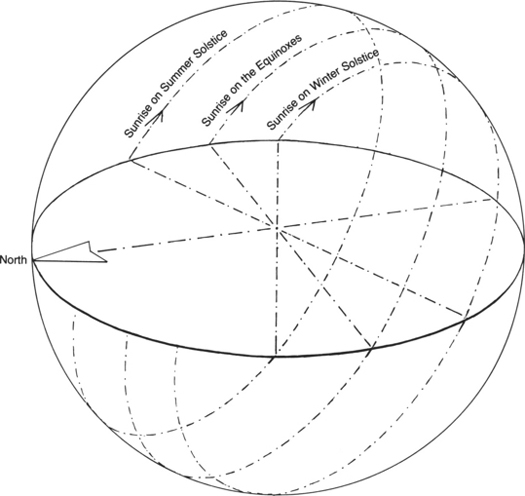
Equinoxes and solstices.
• It completes a full precessional cycle once every 25,776 years.19
• It spins on its own axis once every twenty-four hours.
• It orbits the sun once every 365 days (actually 365.2422 days).
• The most important influence on its seasons is the angle at which the rays of the sun strike it at various points on its orbital path.
Let us also note that there are four crucial astronomical moments in the year, marking the official beginning of each of the four seasons. These moments (or cardinal points), which were of immense importance to the ancients, are the winter and the summer solstices and the spring and autumn equinoxes. In the northern hemisphere the winter solstice, the shortest day, falls on 21 December, and the summer solstice, the longest day, on 21 June. In the southern hemisphere, on the other hand, everything is literally upside down: there winter begins on 21 June and summer on 21 December.
The equinoxes, by contrast, are the two points in the year on which night and day are of equal length all over the planet. Once again, however, as with the solstices, the date that marks the onset of spring in the northern hemisphere (20 March) marks that of autumn in the southern hemisphere, and the date for the onset of autumn in the northern hemisphere (22 September) marks the onset of spring in the southern hemisphere.
Like the subtler variations of the seasons, all this is brought about by the benevolent obliquity of the planet. The northern hemisphere’s summer solstice falls at that point in the orbit when the North Pole is aimed most directly towards the sun; six months later the winter solstice marks that point when the North Pole is aimed most directly away from the sun. And, logically enough, the reason that day and night are of exactly equal length all over the planet on the spring and autumn equinoxes is that these mark the two points when the earth’s axis of rotation lies broadside-on to the sun.
Let us now take a look at a strange and beautiful phenomenon of celestial mechanics.
This phenomenon is known as ‘the precession of the equinoxes’. It has rigid and repetitive mathematical qualities that can be analysed and predicted precisely. It is, however, extremely difficult to observe, and even harder to measure accurately, without sophisticated instrumentation.
In this, there may lie a clue to one of the great mysteries of the past.