
Chapter 29
The plane of the earth’s orbit, projected outwards to form a great circle in the celestial sphere, is known as the ecliptic. Ringed around the ecliptic, in a starry belt that extends approximately 7° north and south, are the twelve constellations of the zodiac: Aries, Taurus, Gemini, Cancer, Leo, Virgo, Libra, Scorpius, Sagittarius, Capricornus, Aquarius and Pisces. These constellations are irregular in size, shape and distribution. Nevertheless (and one assumes by chance!) their spacing around the rim of the ecliptic is sufficiently even to bestow a sense of cosmic order upon the diurnal risings and settings of the sun.
To picture what is involved here, do the following: (1) mark a dot in the centre of a blank sheet of paper; (2) draw a circle around the dot, about half an inch away from it; (3) enclose that circle in a second, larger, circle.
The dot represents the sun. The smaller of the two concentric circles represents the earth’s orbit. The larger circle represents the rim of the ecliptic. Around the perimeter of this larger circle, therefore, you should now draw twelve boxes, spacing them evenly, to represent the constellations of the zodiac. Since there are 360° in a circle, each constellation can be considered to occupy a space of 30° along the ecliptic. The dot is the sun. The inner of the two concentric circles is the earth’s orbit. We know that the earth travels on this orbit in an anti-clockwise direction, from the west towards the east, and that every twenty-four hours it also makes one complete rotation around its own axis (again from the west towards the east).
From these two movements two illusions result:
1 Each day as the planet turns from west to east, the sun (which is of course a fixed point) appears to ‘move’ across the sky from east to west.
2 Roughly every thirty days, as the spinning earth journeys along its orbital path around the sun, the sun itself slowly appears to ‘pass’ through one after another of the twelve zodiacal constellations (which are also fixed points), and again it appears to be ‘moving’ in an east-west direction.
On any particular day of the year, in other words, (corresponding on our diagram to any point we care to choose around the inner concentric circle marking the earth’s orbit), it is obvious that the sun will lie between an observer on the earth and one of the twelve zodiacal constellations. On that day what the observer will see, so long as he or she is up and about well before dawn, is the sun rising in the east in the portion of the sky occupied by that particular constellation.
Beneath the clear and unpolluted heavens of the ancient world, it is easy to understand how human beings might have felt reassured by regular celestial motions such as these. It is equally easy to understand why the four cardinal points of the year – the spring and autumn equinoxes, the winter and summer solstices – should everywhere have been accorded immense significance. Even greater significance was accorded to the conjunction of these cardinal points with the zodiacal constellations. But most significant of all was the constellation in which the sun was observed to rise on the morning of the spring (or vernal) equinox. Because of the earth’s axial precession, the ancients discovered that this constellation was not fixed or permanent for all time but that the honour of ‘housing’ or ‘carrying’ the sun on the day of the vernal equinox circulated – very, very slowly – among all the constellations of the zodiac.
In the words of Giorgio de Santillana: ‘The sun’s position amongst the constellations at the vernal equinox was the pointer that indicated the “hours” of the precessional cycle – very long hours indeed, the equinoctial sun occupying each zodiacal constellation for almost 2200 years.’1
The direction of the earth’s slow axial precession is clockwise (i. e., east to west) and thus in opposition to the direction of the planet’s annual path around the sun. In relation to the constellations of the zodiac, lying fixed in space, this causes the point at which the spring equinox occurs ‘to move stubbornly along the ecliptic in the opposite direction to the yearly course of the sun, that is, against the “right” sequence of the zodiacal signs (Taurus → Aries → Pisces → Aquarius, instead of Aquarius → Pisces → Aries → Taurus).’2
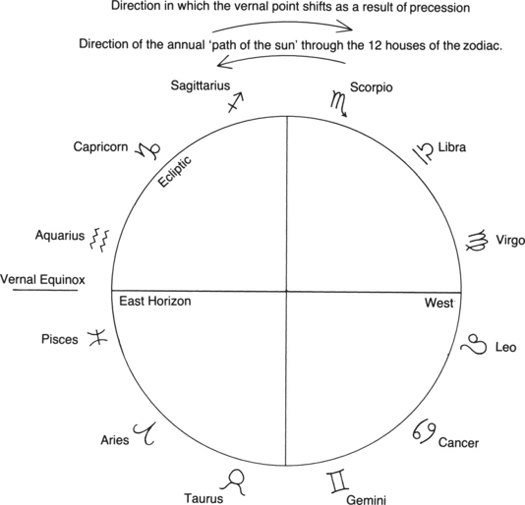
During the course of each year the earth’s movement along its orbit causes the stellar background against which the sun is seen to rise to change from month to month: Aquarius → Pisces → Aries → Taurus → Gemini → Cancer → Leo, etc, etc. At present, on the vernal equinox, the sun rises due east between Pisces and Aquarius. The effect of precession is to cause the ‘vernal point’ to be reached fractionally earlier in the orbit each year with the result that it very gradually shifts through all 12 houses of the zodiac, spending 2160 years ‘in’ each sign and making a complete circuit in 25,920 years. The direction of this ‘precessional drift’, in opposition to the annual ‘path of the sun’, is: Leo → Cancer → Gemini → Taurus → Aries → Pisces → Aquarius. To give one example, the ‘Age of Leo’, i.e. the 2160 years during which the sun on the vernal equinox rose against the stellar background of the constellation of Leo, lasted from 10,970 until 8810 BC. We live today in the astrological no man’s land at the end of the ‘Age of Pisces’, on the threshold of the ‘New Age’ of Aquarius. Traditionally these times of transition between one age and the next have been regarded as ill-omened.
That, in a nutshell, is the meaning of ‘precession of the equinoxes’. And that is exactly what is involved in the notion of the ‘dawning of the Age of Aquarius’. The famous line from the musical Hair refers to the fact that every year, for the last 2000 years or so, the sun has risen in Pisces on the vernal equinox. The age of Pisces, however, is now approaching its end and the vernal sun will soon pass out of the sector of the Fish and begin to rise against the new background of Aquarius.
The 25,776-year cycle of precession is the engine that drives this majestic celestial juggernaut along its never-ending tour of the heavens. But the details of exactly how precession moves the equinoctial points from Pisces into Aquarius – and thence onwards around the zodiac – are also worth knowing.
Remember that the equinoxes occur on the only two occasions in the year when the earth’s tilted axis lies broadside-on to the sun. These are when the sun rises due east all over the world and day and night are of equal length. Because the earth’s axis is slowly but surely precessing in a direction opposite to that of its own orbit, the points at which it lies broadside-on to the sun must occur fractionally earlier in the orbit each year. These annual changes are so small as to be almost imperceptible (a one degree shift along the ecliptic – equivalent to the width of your little finger held up to the horizon – requires approximately seventy-two years to complete). However, as de Santillana points out, such minute changes add up in just under 2200 years to a 30° passage through a complete house of the zodiac, and in just under 26,000 years to a 360° passage through a complete cycle of precession.
When did the ancients first work out precession?
In the answer to this question lies a great secret, and mystery, of the past. Before we try to penetrate the mystery and to learn the secret, we should acquaint ourselves with the ‘official’ line. The Encyclopaedia Britannica is as good a repository as any of conventional historical wisdom, and this is what it tells us about a scholar named Hipparchus, the supposed discoverer of precession:
Hipparchus, also spelled HIPPARCHOS (b. Nicaea, Bithynia; d. after 127 BC, Rhodes), Greek astronomer and mathematician who discovered the precession of the equinoxes … This notable discovery was the result of painstaking observations, worked upon by an acute mind. Hipparchus observed the positions of the stars, and then compared his results with those of Timocharis of Alexandria about 150 years earlier and with even earlier observations made in Babylonia. He discovered that the celestial longitudes were different and that this difference was of a magnitude exceeding that attributable to errors of observation. He therefore proposed precession to account for the size of the difference and he gave a value of 45’ or 46’ (seconds of arc) for annual changes. This is very close to the figure of 50.274 seconds of arc accepted today …’3
First, a point of terminology. Seconds of arc are the smallest subdivisions of a degree of arc. There are 60 of these arc seconds in one arc minute, 60 minutes in one degree, and 360 degrees in the full circle of earth’s path around the sun. An annual change of 50.274 seconds of arc represents a distance somewhat under one-sixtieth of one degree so that it takes roughly 72 years (an entire human lifetime) for the equinoctial sun to migrate just one degree along the ecliptic. It is because of the observational difficulties entailed in detecting this snails’ pace rate of change that the value worked out by Hipparchus in the second century BC is hailed in the Britannica as a ‘notable discovery’.
Would this discovery seem so notable if it turned out to be a rediscovery? Would the mathematical and astronomical achievements of the Greeks shine so brightly if we could prove that the difficult challenge of measuring precession had been taken up thousands of years before Hipparchus? What if this heavenly cycle, almost 26,000 years long, had been made the object of precise scientific investigations long epochs before the supposed dawn of scientific thought?
In seeking answers to such questions there is much that may be relevant which would never be accepted by any court of law as concrete proof. Let us not accept it either. We have seen that Hipparchus proposed a value of 45 or 46 seconds of arc for one year of precessional motion. Let us therefore not attempt to dislodge the Greek astronomer from his pedestal as the discoverer of precession unless we can find a significantly more accurate value recorded in a significantly more ancient source.
Of course, there are many potential sources. At this point, however, in the interests of succinctness, we shall limit our inquiry to universal myths. We have already examined one group of myths in detail (the traditions of flood and cataclysm set out in Part IV) and we have seen that they possess a range of intriguing characteristics:
1 There is no doubt that they are immensely old. Take the Mesopotamian flood story, versions of which have been found inscribed on tablets from the earliest strata of Sumerian history, around 3000 BC. These tablets, handed down from the dawn of the recorded past, leave no room for doubt that the tradition of a world-destroying flood was ancient even then, and therefore originated long before the dawn. We cannot say how long. The fact remains that no scholar has ever been able to establish a date for the creation of any myth, let alone for these venerable and widespread traditions. In a very real sense they seem always to have been around – part of the permanent baggage of human culture.
2 The possibility cannot be ruled out that this aura of vast antiquity is not an illusion. On the contrary, we have seen that many of the great myths of cataclysm seem to contain accurate eye-witness accounts of real conditions experienced by humanity during the last Ice Age. In theory, therefore, these stories could have been constructed at almost the same time as the emergence of our subspecies Homo sapiens sapiens, perhaps as long 50,000 years ago. The geological evidence, however, suggests a more recent provenance, and we have identified the epoch 15,000–8000 BC as the most likely. Only then, in the whole of human experience, were there rapid climatic changes on the convulsive scale the myths so eloquently describe.
3 The Ice Age and its tumultuous demise were global phenomena. It is therefore perhaps not surprising that the cataclysm traditions of many different cultures, widely scattered around the globe, should be characterized by a high degree of uniformity and convergence.
4 What is surprising, however, is that the myths not only describe shared experiences but that they do so in what appears to be a shared symbolic language. The same ‘literary motifs’ keep cropping up again and again, the same stylistic ‘props’, the same recognizable characters, and the same plots.
According to Professor de Santillana, this type of uniformity suggests a guiding hand at work. In Hamlet’s Mill, a seminal and original thesis on ancient myth written in collaboration with Hertha von Dechend (professor of the History of Science at Frankfurt University) he argues that:
universality is in itself a test when coupled with a firm design. When something found, say, in China, turns up also in Babylonian astrological texts, then it must be assumed to be relevant if it reveals a complex of uncommon images which nobody could claim had risen independently by spontaneous generation. Take the origin of music. Orpheus and his harrowing death may be a poetic creation born in more than one instance in diverse places. But when characters who do not play the lyre but blow pipes get themselves flayed alive for various absurd reasons, and their identical end is rehearsed on several continents, then we feel we have got hold of something, for such stories cannot be linked by internal sequence. And when the Pied Piper turns up both in the German myth of Hamelin and in Mexico long before Columbus, and is linked in both places to certain attributes like the colour red, it can hardly be a coincidence … Likewise, when one finds numbers like 108, or 9 × 13 reappearing under several multiples in the Vedas, in the temples of Angkor, in Babylon, in Heraclitus’ dark utterances, and also in the Norse Valhalla, it is not accident …4
Connecting the great universal myths of cataclysm, is it possible that such coincidences that cannot be coincidences, and accidents that cannot be accidents, could denote the global influence of an ancient, though as yet unidentified, guiding hand? If so, could it be that same hand, during and after the last Ice Age, which drew the series of highly accurate and technically advanced world maps reviewed in Part I? And might not that same hand have left its ghostly fingerprints on another body of universal myths? those concerning the death and resurrection of gods, and great trees around which the earth and heavens turn, and whirlpools, and churns, and drills, and other similar revolving, grinding contrivances?
According to Santillana and von Dechend, all such images refer to celestial events5 and do so, furthermore, in the refined technical language of an archaic but ‘immensely sophisticated’ astronomical and mathematical science:6 ‘This language ignores local beliefs and cults. It concentrates on numbers, motions, measures, overall frames, schemas – on the structure of numbers, on geometry.’7
Where could such a language have come from? Hamlet’s Mill is a labyrinth of brilliant but deliberately evasive scholarship, and offers us no straightforward answer to this question. Here and there, however, almost with embarrassment, inconclusive hints are dropped. For example, at one point the authors say that the scientific language or ‘code’ they believe they have identified is of ‘awe-inspiring antiquity’.8 On another occasion they pin down the depth of this antiquity more precisely to a period at least ‘6000 years before Virgil’9 – in other words 8000 years ago or more.
What civilization known to history could have developed and made use of a sophisticated technical language more than 8000 years ago? The honest answer to this question is ‘none’, followed by a frank admission that what is being conjectured is nothing less than a forgotten episode of high technological culture in prehistoric times. Once again, Santillana and von Dechend are elusive when it comes to the crunch, speaking only of the legacy we all owe to ‘some almost unbelievable ancestor civilization’ that ‘first dared to understand the world as created according to number, measure and weight.’10
The legacy, it is clear, has to do with scientific thinking and complex information of a mathematical nature. Because it is so extremely old, however, the passage of time has dissipated it:
When the Greeks came upon the scene the dust of centuries had already settled upon the remains of this great world-wide archaic construction. Yet something of it survived in traditional rites, in myths and fairy-tales no longer understood … These are tantalising fragments of a lost whole. They make one think of those ‘mist landscapes’ of which Chinese painters are masters, which show here a rock, here a gable, there the tip of a tree, and leave the rest to imagination. Even when the code shall have yielded, when the techniques shall be known, we cannot expect to gauge the thought of these remote ancestors of ours, wrapped as it is in its symbols, since the creating, ordering minds that devised the symbols have vanished forever.’11
What we have here, therefore, are two distinguished professors of the History of Science, from esteemed universities on both sides of the Atlantic, claiming to have discovered the remnants of a coded scientific language many thousands of years older than the oldest human civilizations identified by scholarship. Moreover, though generally cautious, Santillana and von Dechend also claim to have ‘broken part of that code’.12
This is an extraordinary statement for two serious academics to have made.