
Chapter 37
I had climbed the Great Pyramid the night before, but as I approached it in the full glare of midday, I experienced no sense of triumph. On the contrary, standing at its base on the north side, I felt fly-sized and puny – an impermanent creature of flesh and blood confronted with the awe-inspiring splendour of eternity. I had the impression that it might have been here for ever, ‘made by some god and set down bodily in the surrounding sand’, as the Greek historian Diodorus Siculus commented in the first century BC.1 But which god had made it, if not the God-King Khufu whose name generations of Egyptians had associated with it?
For the second time in twelve hours, I began to climb the monument. Up close in this light, indifferent to human chronologies and subject only to the slow erosive forces of geological time, it reared above me like a frowning, terrifying crag. Fortunately, I only had six courses to clamber over, assisted in places by modern steps, before reaching Ma’mun’s Hole, which now served as the pyramid’s principal entrance.
The original entrance, still well-hidden in the ninth century when Ma’mun began tunnelling, was some ten courses higher, 55 feet above ground level and 24 feet east of the main north-south axis. Protected by giant limestone gables, it contained the mouth of the descending corridor, which led downwards at an angle of 26° 31ʹ 23˝. Strangely, although itself measuring only some 3 feet 5 inches × 3 feet 11 inches, this corridor was sandwiched between roofing blocks 8 feet 6 inches thick and 12 feet wide and a flooring slab (known as the ‘Basement Sheet’) 2 feet 6 inches thick and 33 feet wide.2
Hidden structural features like these abounded in the Great Pyramid, manifesting both incredible complexity and apparent pointlessness. Nobody knew how blocks of this size had been successfully installed, neither did anybody know how they had been set so carefully in alignment with other blocks, or at such precise angles (because, as the reader may have realized, the 26° slope of the descending corridor was part of a deliberate and regular pattern). Nobody knew either why these things had been done.
The Beacon
Entering the pyramid through Ma’mun’s Hole did not feel right. It was like entering a cave or grotto cut into the side of a mountain; it lacked the sense of deliberate and geometrical purposefulness that would have been conveyed by the original descending corridor. Worse still, the dark and inauspicious horizontal tunnel leading inwards looked like an ugly, deformed thing and still bore the marks of violence where the Arab workmen had alternately heated and chilled the stones with fierce fires and cold vinegar before attacking them with hammers and chisels, battering rams and borers.
On the one hand, such vandalism seemed gross and irresponsible. On the other, a startling possibility had to be considered: was there not a sense in which the pyramid seemed to have been designed to invite human beings of intelligence and curiosity to penetrate its mysteries? After all, if you were a pharaoh who wanted to ensure that his deceased body remained inviolate for eternity, would it make better sense (a) to advertise to your own and all subsequent generations the whereabouts of your burial place, or (b) to choose some secret and unknown location, of which you would never speak and where you might never be found?
The answer was obvious: you would go for secrecy and seclusion, as the vast majority of the pharaohs of Ancient Egypt had done.3
Why, then, if it was indeed a royal tomb, was the Great Pyramid so conspicuous? Why did it occupy a ground area of more than thirteen acres? Why was it almost 500 feet high? Why, in other words, if its purpose was to conceal and protect the body of Khufu, had it been designed so that it could not fail to attract the attention – in all epochs and under all imaginable circumstances – of treasure-crazed adventurers and of prying and imaginative intellectuals?
It was simply not credible that the brilliant architects, stonemasons, surveyors and engineers who had created the Great Pyramid could have been ignorant of basic human psychology. The vast ambition and the transcendent beauty, power and artistry of their handiwork spoke of refined skills, deep insight, and a complete understanding of the symbols and primordial patterns by which the minds of men could be manipulated. Logic therefore suggested that the pyramid builders must also have understood exactly what kind of beacon they were piling up (with such incredible precision) on this windswept plateau, on the west bank of the Nile, in those high and far away times.
They must, in short, have wanted this remarkable structure to exert a perennial fascination: to be violated by intruders, to be measured with increasing degrees of exactitude, and to haunt the collective imagination of mankind like a persistent ghost summoning intimations of a profound and long-forgotten secret.
Mind games of the pyramid builders
The point where Ma’mun’s Hole intersected with the 26° descending corridor was closed off by a modern steel door. Beyond it, to the north, that corridor sloped up until it reached the gables of the monument’s original entrance. To the south, as we have seen, the corridor sloped down for almost another 350 feet into the bedrock, before opening out into a huge subterranean chamber 600 feet beneath the apex of the pyramid. The accuracy of this corridor was astonishing. From top to bottom the average deviation from straight amounted to less than ¼-inch in the sides and 3/10-inch on the roof.4
Passing the steel door, I continued through Ma’mun’s tunnel, breathing in its ancient air and adjusting my eyes to the gloom of the low-wattage bulbs that lit it. Then ducking my head I began to climb through the steep and narrow section hacked upwards by the Arab diggers in their feverish thrust to by-pass the series of granite plugs blocking the lower part of the ascending corridor. At the top of the tunnel two of the original plugs could be seen, still in situ but partially exposed by quarrying. Egyptologists assumed that they had been slid into their present position from above5 – all the way down the 129-foot length of the ascending corridor from the foot of the Grand Gallery.6 Builders and engineers, however, whose trend of thought was perhaps more practical, had pointed out that it was physically impossible for the plugs to have been installed in this way. Because of the leaf-thin clearance that separated them from the walls, floor and ceiling of the corridor, friction would have foiled any ‘sliding’ operation in a matter of inches, let alone 100 feet.7
The puzzling implication was therefore that the ascending corridor must have been plugged while the pyramid was still being built. But why would anyone have wished to block the main entrance to the monument at such an early stage in its construction (even while continuing to enlarge and elaborate its inner chambers)? Moreover, if the objective had been to deny intruders admission, wouldn’t it have been much easier and more efficient to have plugged the descending corridor from its entrance in the north face to a point below its junction with the ascending corridor? That would have been the most logical way to seal the pyramid and would have made plugs unnecessary in the ascending corridor.
There was only one certainty: since the beginning of history, the single known effect of the granite plugs had not been to prevent an intruder from gaining access; instead, like Bluebeard’s locked door, the barrier had magnetized Ma’mun’s attention and inflamed his curiosity so that he had felt compelled to tunnel his way past them, convinced that something of inestimable value must lie beyond them.
Might this not have been what the pyramid builders had intended the first intruder who reached this far to feel? It would be premature to rule out such a strange and unsettling possibility. At any rate, thanks to Ma’mun (and to the predictable constants of human nature) I was now able to insert myself into the unblocked upper section of the original ascending corridor. A smoothly cut aperture measuring 3 feet 5 inches wide × 3 feet 11 inches high (exactly the same dimensions as the descending corridor), it sloped up into the darkness at an angle of 26° 2ʹ 30˝8 (as against 26° 31ʹ 23˝ in the descending corridor).9
What was this meticulous interest in the angle of 26°, and was it a coincidence that it amounted to half of the angle of inclination of the pyramid’s sides – 52°.10
The reader may recall the significance of this angle. It was a key ingredient of the sophisticated and advanced formula by which the design of the Great Pyramid had been made to correspond precisely to the dynamics of spherical geometry. Thus the original height of the monument (481.3949 feet), and the perimeter of its base (3023.16 feet), stood in the same ratio to each other as did the radius of a sphere to its circumference. This ratio was 2pi (2 × 3.14) and to express it the builders had been obliged to specify the tricky and idiosyncratic angle of 52° for the pyramid’s sides (since any greater or lesser slope would have meant a different height-to-perimeter ratio).
In Chapter Twenty-three we saw that the so-called Pyramid of the Sun at Teotihuacan in Mexico also expressed a knowledge and deliberate use of the transcendental number pi; in its case the height (233.5 feet) stood in a relationship of 4pi to the perimeter of its base (2932.76 feet).11
The crux, therefore, was that the most remarkable monument of Ancient Egypt and the most remarkable monument of Ancient Mexico both incorporated pi relationships long before and far away from the official ‘discovery’ of this transcendental number by the Greeks.12 Moreover, the evidence invited the conclusion that something was being signalled by the use of pi – almost certainly the same thing in both cases.
Not for the first time, and not for the last, I was overwhelmed by a sense of contact with an ancient intelligence, not necessarily Egyptian or Mexican, which had found a way to reach out across the ages and draw people towards it like a beacon. Some might look for treasure; others, captivated by the deceptively simple manner in which the builders had used pi to demonstrate their mastery of the secrets of transcendental numbers, might be inspired to search for further mathematical epiphanies.
Bent almost double, my back brushing against the polished limestone ceiling, it was with such thoughts in my mind that I began to scramble up the 26° slope of the ascending corridor, which seemed to penetrate the vast bulk of the six million ton building like a trigonometrical device. After I had banged my head on its ceiling a couple of times, however, I began to wonder why the ingenious people who’d designed it hadn’t made it two or three feet higher. If they could erect a monument like this in the first place (which they obviously could) and equip it with corridors, surely it would not have been beyond their capabilities to make those corridors roomy enough to stand up in? Once again I was tempted to conclude that it was the result of a deliberate decision by the pyramid builders: they had made the ascending corridor this way because they had wanted it this way (rather than because such a design had been forced upon them.)
Was there motive in the apparent madness of these archaic mind games?
Unknown dark distance
At the top of the ascending corridor I emerged into yet another inexplicable feature of the pyramid, ‘the most celebrated architectural work to have survived from the Old Kingdom’13 – the Grand Gallery. Soaring upwards at the continuing majestic angle of 26°, and almost entirely vanishing into the airy gloom above, its spacious corbelled vault made a stunning impression.
It was not my intention to climb the Grand Gallery yet. Branching off due south at its base was a long horizontal passageway, 3 feet 9 inches high and 127 feet in length, that led to the Queen’s Chamber.14 I wanted to revisit this room, which I had admired for its stark beauty since becoming acquainted with the Great Pyramid several years previously. Today, however, to my considerable irritation, the passageway was barred within a few feet of its entrance.
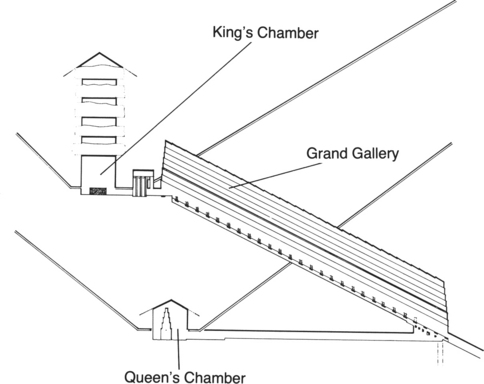
The Grand Gallery and the King’s and Queen’s Chambers with their northern and southern shafts.
The reason, though I was unaware of it at the time, was that a German robotics engineer named Rudolf Gantenbrink was at work within, slowly and painstakingly manoeuvring a $250,000 robot up the narrow southern shaft of the Queen’s Chamber. Hired by the Egyptian Antiquities Organization to improve the ventilation of the Great Pyramid, he had already used his high-tech equipment to clear debris from the King’s Chamber’s narrow ‘southern shaft’ (believed by Egyptologists to have been designed as a ventilation shaft in the first place) and had installed an electric fan at its mouth. At the beginning of March 1993 he transferred his attentions to the Queen’s Chamber, deploying Upuaut, a miniaturized remote-controlled robot camera to explore its southern shaft. On 22 March, some 200 feet along the steeply sloping shaft (which rose at an angle of 39.5° and was only about 8 inches high × 9 inches wide),15 the floor and walls suddenly became very smooth as Upuaut crawled into a section made of fine Tura limestone, the type normally used for lining sacred areas such as chapels or tombs. That, in itself, was intriguing enough, but at the end of this corridor, apparently leading to a sealed chamber deep within the pyramid’s masonry, was a solid limestone door complete with metal fittings …
It had long been known that neither this southern shaft nor its counterpart in the Chamber’s northern wall had any exit on the outside of the Great Pyramid. In addition, and equally inexplicably, neither had originally been fully cut through. For some reason the builders had left the last five inches of stone intact in the last block over the mouth of each of the shafts, thus rendering them invisible and inaccessible to any casual intruder.
Why? To make sure they would never be found? Or to make sure that they would be found, some day, under the right circumstances?
After all, there had from the beginning been two conspicuous shafts in the King’s Chamber, penetrating the north and south walls. It should not have been beyond the mental powers of the pyramid builders to predict that sooner or later some inquiring person would be tempted to look for shafts in the Queen’s Chamber as well. In the event nobody did look for more than a thousand years after Caliph Ma’mun had opened the monument to the world in AD 820. Then in 1872 an English engineer named Waynman Dixon, a Freemason who ‘had been led to suspect the existence of the shafts by their presence in the King’s Chamber above’,16 went tapping around the Queen’s Chamber’s walls and located them. He opened the southern shaft first, setting his ‘carpenter and man-of-all-work, Bill Grundy, to jump a hole with a hammer and steel chisel at that place. So to work the faithful fellow went, and with a will which soon began to make a way into the soft stone [limestone] at this point, when lo! after a comparatively very few strokes, flop went the chisel right through into something or other.’17
The ‘something or other’ Bill Grundy’s chisel had reached turned out to be ‘a rectangular, horizontal, tubular channel, about 9 inches by 8 inches in transverse breadth and height, going back 7 feet into the wall, and then rising at an angle into an unknown, dark distance …’18
It was up that angle, and into that ‘unknown dark distance’, 121 years later, that Rudolf Gantenbrink sent his robot – the technology of our species having finally caught up with our powerful instincts to pry. Those instincts were clearly no weaker in 1872 than in 1993; among the many interesting things the remote-controlled camera succeeded in filming in the Queen’s Chamber shafts was the far end of a long, sectioned metal rod of nineteenth century design which Waynman Dixon and the faithful Bill Grundy had secretly stuffed up the intriguing channel.19 Predictably, they had assumed that if the pyramid builders had gone to the trouble of constructing and then concealing the shafts, then they must have hidden something worth looking for inside them.
The notion that there might have been an intention from the outset to stimulate such investigations would seem quite implausible if the final upshot of the discovery and exploration of the shafts had been a dead-end. Instead, as we have seen, a door was found – a sliding, portcullis door with curious metal fittings and an enticing gap at its base beneath which the laser-spot projected by Gantenbrink’s robot was seen to disappear entirely …
Once again there seemed to be a clear invitation to proceed further, the latest in a long line of invitations which had encouraged Caliph Ma’mun and his diggers to break into the central passageways and chambers of the monument, which had waited for Waynman Dixon to test the hypothesis that the walls of the Queen’s Chamber might contain concealed shafts, and which had then waited again until arousing the curiosity of Rudolf Gantenbrink, whose high-tech robot revealed the existence of the hidden door and brought within reach whatever secrets – or disappointments, or further invitations – might lie behind it.
The Queen’s Chamber
We shall hear more of Rudolf Gantenbrink and Upuaut in later chapters. On 16 March 1993, however, knowing nothing of this, I was frustrated to find the Queen’s Chamber closed, and glared resentfully through the metal grille that barred its entrance corridor.
I remembered that the height of that corridor, 3 feet 9 inches, was not constant. Approximately 110 feet due south from where I stood, and only about 15 feet from the entrance to the Chamber, a sudden downward step in the floor increased the standing-room to 5 feet 8 inches.20 Nobody had come up with a convincing explanation for this peculiar feature.
The Queen’s Chamber itself – apparently empty since the day it was built – measured 17 feet 2 inches from north to south and 18 feet 10 inches from east to west. It was equipped with an elegant gabled ceiling, 20 feet 5 inches in height, which lay exactly along the east-west axis of the pyramid.21 Its floor, however, was the opposite of elegant and looked unfinished. There was a constant salty emanation through its pale, roughhewn limestone walls, giving rise to much fruitless speculation.
In the north and south walls, still bearing the incised legend OPENED 1872, were the rectangular apertures discovered by Waynman Dixon which led into the dark distance of the mysterious shafts. The western wall was quite bare. Offset a little over two feet to the south of its centre line, the eastern wall was dominated by a niche in the form of a corbel vault 15 feet 4 inches high and 5 feet 2 inches wide at the base. Originally 3 feet 5 inches deep, a further cavity had been cut in the back of this niche in medieval times by Arab treasure-seekers looking for hidden chambers.22 They had found nothing.
Egyptologists had also been unable to come to any persuasive conclusions about the original function of the niche, or, for that matter, of the Queen’s Chamber as a whole.
All was confusion. All was paradox. All was mystery.
Instrument
The Grand Gallery had its mysteries too. Indeed it was among the most mysterious of all the internal features of the Great Pyramid. Measuring 6 feet 9 inches wide at the floor, its walls rose vertically to a height of 7 feet 6 inches; above that level seven further courses of masonry (each one projecting inwards some 3 inches beyond the course immediately below it) carried the vault to its full height of 28 feet and its culminating width of 3 feet 5 inches.23
Remember that structurally the Gallery was required to support, for ever, the multi-million ton weight of the upper three-quarters of the largest and heaviest stone monument ever built on planet earth. Was it not quite remarkable that a group of supposed ‘technological primitives’ had not only envisaged and designed such a feature but had completed it successfully, more than 4500 years before our time?
Even if they had made the Gallery only 20 feet long, and had sought to erect it on a level plane, the task would have been difficult enough – indeed extraordinarily difficult. But they had opted to erect this astonishing corbel vault at a slope of 26°, and to extend its length to a staggering 153 feet.24 Moreover, they had made it with perfectly dressed limestone megaliths throughout – huge, smoothly polished blocks carved into sloping parallelograms and laid together so closely and with such rigorous precision that the joints were almost invisible to the naked eye.
The pyramid builders had also included some interesting symmetries in their work. For example, the culminating width of the Gallery at its apex was 3 feet 5 inches while its width at the floor was 6 feet 9 inches. At the exact centre of the floor, running the entire length of the Gallery – and sandwiched between flat-topped masonry ramps each 1 foot 8 inches wide – there was a sunken channel 2 feet deep and 3 feet 5 inches wide. What could have been the purpose of this slot? And why had it been necessary for it to mirror so precisely the width and form of the ceiling, which also looked like a ‘slot’ sandwiched between the two upper courses of masonry?
I knew that I was not the first person to have stood at the foot of the Grand Gallery and to have been overtaken by the disorienting sense of being ‘in the inside of some enormous instrument of some sort.’25 Who was to say that such intuitions were completely wrong? Or, for that matter, that they were right? No record as to function remained, other than in mystical and symbolic references in certain ancient Egyptian liturgical texts. These appeared to indicate that the pyramids had been seen as devices designed to turn dead men into immortal beings: to ‘throw open the doors of the firmament and make a road’, so that the deceased pharaoh might ‘ascend into the company of the gods’.26
I had no difficulty accepting that such a belief system might have been at work here, and obviously it could have provided a motive for the whole enterprise. Nevertheless, I was still puzzled why more than six million tons of physical apparatus, intricately interlaced with channels and tubes, corridors and chambers, had been deemed necessary to achieve a mystical, spiritual and symbolic objective.
Being inside the Grand Gallery did feel like being inside an enormous instrument. It had an undeniable aesthetic impact upon me (admittedly a heavy and domineering one), but it was also completely devoid of decorative features and of anything (figures of deities, reliefs of liturgical texts, and so on) which might be suggestive of worship or religion. The primary impression it conveyed was one of strict functionalism and purposefulness – as though it had been built to do a job. At the same time I was aware of its focused solemnity of style and gravity of manner, which seemed to demand nothing less than serious and complete attention.
By now I had climbed steadily through about half the length of the Gallery. Ahead of me, and behind, shadows and light played tricks amid the looming stone walls. Pausing, I turned my head, looking upwards through the gloom towards the vaulted ceiling which supported the crushing weight of the Great Pyramid of Egypt.
It suddenly hit me how dauntingly and disturbingly old it was, and how completely my life at this moment depended on the skills of the ancient builders. The hefty blocks that spanned the distant ceiling were examples of those skills – every one of them laid at a slightly steeper gradient than that of the Gallery. As the great archaeologist and surveyor Flinders Petrie had observed, this had been done
in order that the lower edge of each stone should hitch like a pawl into a ratchet cut into the top of the walls; hence no stone can press on the one below it, so as to cause a cumulative pressure all down the roof; and each stone is separately upheld by the side walls which it lies across.27
And this was the work of a people whose civilization had only recently emerged from neolithic hunter-gathering?
I began to walk up the Gallery again, using the 2-foot-deep central fllooring slot. A modern wooden covering fitted with helpful slats and side railings made the ascent relatively easy. In antiquity, however, the floor had been smoothly polished limestone, which, at a gradient of 26°, must have been almost impossible to climb.
How had it been done? Had it been done at all?
Looming ahead at the end of the Grand Gallery was the dark opening to the King’s Chamber beckoning each and every inquiring pilgrim into the heart of the enigma.