
Chapter 7
Just after six in the morning the little train jerked into motion and began its slow climb up the steep sides of the valley of Cuzco. The narrow-gauge tracks were laid out in a series of Z shapes. We chugged along the lower horizontal of the first Z, then shunted and went backwards up the oblique, shunted again and went forward along the upper horizontal – and so on, with numerous stops and starts, following a route that eventually took us high above the ancient city. The Inca walls and colonial palaces, the narrow streets, the cathedral of Santo Domingo squatting atop the ruins of Viracocha’s temple, all looked spectral and surreal in the pearl-grey light of a dawn sky. A fairy pattern of electric lamps still decorated the streets, a thin mist seeped across the ground, and the smoke of domestic fires rose from the chimneys over the tiled roofs of countless small houses.
Eventually the train turned its back on Cuzco and we proceeded for a while in a straight north-westerly direction towards our destination: Machu Picchu, the lost city of the Incas, some three hours and 130 kilometres away. I had intended to read, but lulled by the rocking motion of the carriage, I dropped off to sleep instead. Fifty minutes later I awoke to find that we were passing through a painting. The foreground, brightly sunlit, consisted of flat green meadows sprinkled with little patches of thawing frost, distributed on either side of a stream across a long, wide valley.
In the middle of my view, dotted with bushes, was a large field on which a handful of black and white dairy cows grazed. Nearby was a scattered settlement of houses outside which stood small, dark-skinned Quechua Indians dressed in ponchos, balaclavas and colourful woollen hats. More distant were slopes canopied in fir trees and exotic eucalyptus. My eye followed the rising contours of a pair of high green mountains, which then parted to reveal folded and even more lofty uplands. Beyond these soared a far horizon surmounted by a jagged range of radiant and snowy peaks.
Casting down the giants
It was with understandable reluctance that I turned at last to my reading. I wanted to look more closely at some of the curious links I thought I had identified connecting the sudden appearance of Viracocha to the deluge legends of the Incas and other Andean peoples.
Before me was a passage from Fr Jose de Acosta’s Natural and Moral History of the Indies, in which the learned priest set out ‘what the Indians themselves report of their beginning’:
They make great mention of a deluge, which happened in their country … The Indians say that all men were drowned in the deluge, and they report that out of Lake Titicaca came one Viracocha, who stayed in Tiahuanaco, where at this day there are to be seen the ruins of ancient and very strange buildings, and from thence came to Cuzco, and so began mankind to multiply …1
Making a mental note to find out more about Lake Titicaca, and the mysterious Tiahuanaco, I read the following passage summarizing a legend from the Cuzco area:
For some crime unstated the people who lived in the most ancient times were destroyed by the creator … in a deluge. After the deluge the creator appeared in human form from Lake Titicaca. He then created the sun and moon and stars. After that he renewed the human population of the earth …2
In another myth
The great Creator God, Viracocha, decided to make a world for men to live in. First he made the earth and sky. Then he began to make people to live in it, carving great stone figures of giants which he brought to life. At first all went well but after a time the giants began to fight among themselves and refused to work. Viracocha decided that he must destroy them. Some he turned back into stone … the rest he overwhelmed with a great flood.3
Very similar notions were, of course, found in other, quite unconnected, sources, such as the Jewish Old Testament. In Chapter six of the Book of Genesis, for example, which describes the Hebrew God’s displeasure with his creation and his decision to destroy it, I had long been intrigued by one of the few descriptive statements made about the forgotton era before the Flood. According to the enigmatic language of that statement, ‘There were giants in the earth in those days …’ .4 Could the ‘giants’ buried in the biblical sands of the Middle East be connected in some unseen way to the ‘giants’ woven into the fabric of pre-Colombian native American legends? Adding considerably to the mystery was the fact that the Jewish and Peruvian sources both went on, with many further details in common, to depict an angry deity unleashing a catastrophic flood upon a wicked and disobedient world.
On the next page of the sheaf of documents I had assembled was this Inca account of the deluge handed down by a certain Father Molina in his Relacion de las fabulas y ritos de los Yngas:
In the life of Manco Capac, who was the first Inca, and from whom they began to boast themselves children of the Sun and from whom they derived their idolatrous worship of the Sun, they had an ample account of the deluge. They say that in it perished all races of men and created things insomuch that the waters rose above the highest mountain peaks in the world. No living thing survived except a man and a woman who remained in a box and, when the waters subsided, the wind carried them … to Tiahuanaco [where] the creator began to raise up the people and the nations that are in that region …5
Garcilaso de la Vega, the son of a Spanish nobleman and an Inca royal woman, was already familiar to me from his Royal Commentaries of the Incas. He was regarded as one of the most reliable chroniclers of the traditions of his mother’s people and had done his work in the sixteenth century, soon after the conquest, when those traditions had not yet been contaminated by foreign influences. He, too, confirmed what had obviously been a universal and deeply impressed belief: ‘After the waters of the deluge had subsided, a certain man appeared in the country of Tiahuanaco …’6
That man had been Viracocha. Wrapped in his cloak, he was strong and ‘august of countenance’ and walked with unassailable confidence through the most dangerous badlands. He worked miracles of healing and could call down fire from heaven. To the Indians it must have seemed that he had materialized from nowhere.
Ancient traditions
We were now more than two hours into our journey to Machu Picchu and the panorama had changed. Huge black mountains, upon which not a trace of snow remained to reflect the sunlight, towered darkly above us and we seemed to be running through a rocky defile at the end of a narrow valley filled with sombre shadows. The air was cold and so were my feet. I shivered and resumed reading.
One thing was obvious amid the confused web of legends I had reviewed, legends which supplemented one another but also at times conflicted. All the scholars agreed that the Incas had borrowed, absorbed and passed on the traditions of many of the different civilized peoples over whom they had extended their control during the centuries of expansion of their vast empire. In this sense, whatever the outcome of the historical debate over the antiquity of the Incas themselves, nobody could seriously dispute their role as transmitters of the ancient belief systems of all the great archaic cultures – coastal and highland, known and unknown – that had preceded them in this land.
And who could say just what civilizations might have existed in Peru in the unexplored regions of the past? Every year archaeologists come up with new finds which extend the horizons further and further back in time. So why shouldn’t they one day discover evidence of the penetration into the Andes, in remote antiquity, of a race of civilizers who had come from overseas and gone away again after completing their work? That was what the legends seemed to me to be suggesting, legends that most of all, and most clearly, had immortalized the memory of the man/god Viracocha striding the high windswept byways of the Andes working miracles wherever he went:
Viracocha himself, with his two assistants, journeyed north … He travelled up the cordillera, one assistant went along the coast, and the other up the edge of the eastern forests … The Creator proceeded to Urcos, near Cuzco, where he commanded the future population to emerge from a mountain. He visited Cuzco, and then continued north to Ecuador. There, in the coastal province of Manta, he took leave of his people and, walking on the waves, disappeared across the ocean.7
There was always this poignant moment of goodbye at the end of every folk memory featuring the remarkable stranger whose name meant ‘Foam of the Sea’:
Viracocha went on his way, calling forth the races of men … When he came to the district of Puerto Viejo he was joined by his followers whom he had sent on before, and when they had joined him he put to sea in their company and they say that he and his people went by water as easily as they had traversed the land.8
Always this poignant goodbye … and often a hint of science or magic.
Time capsule
Outside the window of the train things were happening. To my left, swollen with dark water, I could see the Urubamba, a tributary of the Amazon and a river sacred to the Incas. The air temperature had warmed-up noticeably: we had descended into a relatively low-lying valley with its own tropical micro-climate. The mountain slopes rising on either side of the tracks were densely covered in green forests and I was reminded that this was truly a region of vast and virtually insuperable obstacles. Whoever had ventured all this way into the middle of nowhere to build Machu Picchu must have had a very strong motive for doing so.
Whatever the reason had been, the choice of such a remote location had at least one beneficial side-effect: Machu Picchu was never found by the conquistadores and friars during their days of destructive zeal. Indeed, it was not until 1911, when the fabulous heritage of older races was beginning to be treated with greater respect, that a young American explorer, Hiram Bingham, revealed Machu Picchu to the world. It was realized at once that this incredible site opened a unique window on pre-Colombian civilization; in consequence the ruins were protected from looters and souvenir hunters and an important chunk of the enigmatic past was preserved to amaze future generations.
Having passed through a one-horse town named Agua Caliente (Hot Water), where a few broken-down restaurants and cheap bars leered at travellers from beside the tracks, we reached Machu Picchu Puentas Ruinas station at ten minutes past nine in the morning. From here a half-hour bus ride on a winding dirt road up the side of a steep and forbidding mountain brought us to Machu Picchu itself, to the ruins, and to a bad hotel which charged us a nonsensical amount of money for a not very clean room. We were the only guests. Though it had been years since the local guerrilla movement had last bombed the Machu Picchu train, not many foreigners were keen to come here any more.
Machu Picchu dreaming
It was two in the afternoon. I stood on a high point at the southern end of the site. The ruins stretched out northwards in lichen-enshrouded terraces before me. Thick clouds were wrapped in a ring around the mountain tops but the sunlight still occasionally burst through here and there.
Way down on the valley floor I could see the sacred river curled in a hairpin loop right around the central formation on which Machu Picchu was based, like a moat surrounding a giant castle. The river showed deep green from this vantage point, reflecting the greenness of the steep jungle slopes. And there were patches of white water and wonderful sparkling gleams of light.
I gazed across the ruins towards the dominant peak. Its name is Huana Picchu and it used to feature in all the classic travel agency posters of this site. To my astonishment I now observed that for a hundred metres or so below its summit it had been neatly terraced and sculpted: somebody had been up there and had carefully raked the near-vertical cliffs into a graceful hanging garden which had perhaps in ancient times been planted with bright flowers.
It seemed to me that the entire site, together with its setting, was a monumental work of sculpture composed in part of mountains, in part of rock, in part of trees, in part of stones – and also in part of water. It was a heartachingly beautiful place, certainly one of the most beautiful places I have ever seen.
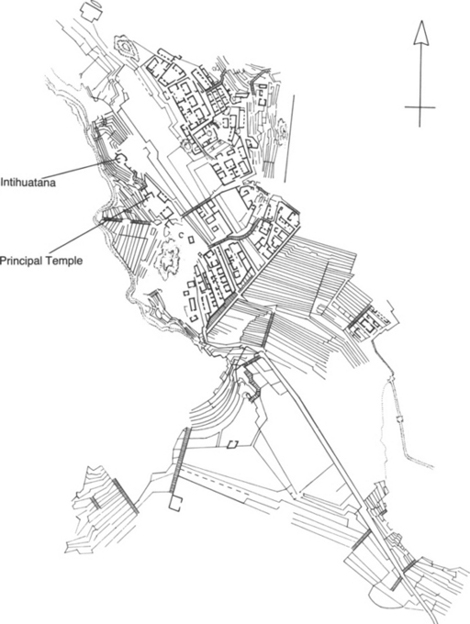
Despite its luminous brilliance, however, I felt that I was gazing down on to a city of ghosts. It was like the wreck of the Marie Celeste, deserted and restless. The houses were arranged in long terraces. Each house was tiny, with just one room fronting directly on to the narrow street, and the architecture was solid and functional but by no means ornate. By way of contrast certain ceremonial areas were engineered to an infinitely higher standard and incorporated giant blocks similar to those I had seen at Sacsayhuaman. One smoothly polished polygonal monolith was around twelve feet long by five feet wide by five feet thick and could not have weighed less than 200 tons. How had the ancient builders managed to get it up here?
Machu Picchu.
There were dozens of others like it too, and they were all arranged in the familiar jigsaw puzzle walls of interlocking angles. On one block I was able to count a total of thirty-three angles, every one intermeshed faultlessly with a matching angle on an adjoining block. There were massive polygons and perfect ashlars with razor-sharp edges. There were also natural, unhewn boulders integrated into the overall design at a number of points. And there were strange and unusual devices such as the Intihuatana, the ‘hitching post of the sun’. This remarkable artefact consisted of an elemental chunk of bedrock, grey and crystalline, carved into a complex geometrical form of curves and angles, incised niches and external buttresses, surmounted at the centre by a stubby vertical prong.
Jigsaw puzzle
How old is Machu Picchu? The academic consensus is that the city could not have been built much earlier than the fifteenth century AD.9 Dissenting opinions, however, have from time to time been expressed by a number of more daring but respectable scholars. In the 1930s, for example, Rolf Muller, professor of Astronomy at the University of Potsdam, found convincing evidence to suggest that the most important features of Machu Picchu possessed significant astronomical alignments. From these, through the use of detailed mathematical computations concerning star positions in the sky in previous millennia (which gradually alter down the epochs as the result of a phenomenon known as precession of the equinoxes), Muller concluded that the original layout of the site could only have been accomplished during ‘the era of 4000 BC to 2000 BC’.10
In terms of orthodox history, this was a heresy of audacious proportions. If Muller was right, Machu Picchu was not a mere 500 but could be as much as 6000 years old. This would make it significantly older than the Great Pyramid of Egypt (assuming, of course, that one accepted the Great Pyramid’s own orthodox dating of around 2500 BC).
There were other dissenting voices concerning the antiquity of Machu Picchu, and most, like Muller, were convinced that parts of the site were thousands of years older than the date favoured by orthodox historians.11
Like the big polygonal blocks that made up the walls, this was a notion that looked as though it might fit with other pieces of a jigsaw puzzle – in this case the jigsaw puzzle of a past that didn’t quite make sense any more. Viracocha was part of that same puzzle. All the legends said his capital had been at Tiahuanaco. The ruins of this great and ancient city lay across the border in Bolivia, in an area known as the Collao, twelve miles south of Lake Titicaca.
We could get there, I calculated, in a couple of days, via Lima and La Paz.