
Introduction, Commentary Notes and Vocabulary by Chris Tudor
AS: Book 18: 1–38, 50–238
A Level: Book 9: 182–431
Introduction
Homer’s Iliad is the earliest surviving work of ancient Greek literature – and must be ranked as one of its greatest. Composed in the second half of the eighth century BC, the poem centres on the tragic figure of Achilles, his wrath and its terrible consequences for those around him. Along the way, the poem engages with some of most fundamental questions of human existence: the relationship between man and the gods, man’s purpose on earth and the meaning of human suffering. It is undeniably a poetic masterpiece.
The influence of the Iliad on Greek culture was colossal, determining much of later literature, thought and art. The tragedian Aeschylus described his own plays as ‘mere slices from the great banquet of Homer’, while Aristotle studied it in detail in his Poetics. Plato quoted the poem extensively in his Republic, while Alexander the Great was said to carry a copy of the poem with him wherever he went. In the history of Western literature, few works have enjoyed a similar status and influence.
The following sections are aimed at providing students with a simple and concise introduction to Homer’s Iliad. We start with the story of the Iliad, before moving on to consider the origin, date and authorship of the poem, the metre of epic poetry, the use of formulae, type-scenes and story patterns, and the language and style of Homeric verse.
The mythic background of the Iliad
The Iliad describes a single episode in the tenth year of the Trojan War: the wrath of Achilles, his withdrawal from the fighting and its disastrous consequences for those around him. The story was a traditional one, and the poet could rely on his audience to be familiar both with its major characters (Achilles, Agamemnon, Hector, etc.) and with the events of the Trojan War itself. For the benefit of the modern reader, however, who may be less familiar with this material, there follows a detailed introduction to the mythic background to the Trojan War, up to the point where the Iliad starts.
The origins of the Trojan War could be traced back to the wedding of the goddess Thetis to the mortal Peleus. Invitations to the wedding had been extended to everyone except for the goddess Eris (‘Strife’), a well-known mischief-maker who had been told to stay at home. Angered by the snub, Eris had come to the wedding anyway, leaving a golden apple in the middle of the wedding feast which she had labelled καλλίστῃ (‘for the most beautiful woman’). This apple was claimed by three goddesses: Hera, Athena and Aphrodite. Unable to decide between themselves which of them was κάλλιστα (‘the most beautiful’), they asked Zeus to make the decision for them. Zeus refused and sent them instead to the Trojan prince, Paris, who agreed to help. With Hermes as their guide, the three goddesses met on Mount Ida for what came to be known as the Judgement of Paris.
On the day of the Judgement itself, each of the goddesses offered Paris a gift related to her personal sphere of influence: Hera offered him kingship, Athena wisdom and success in war and Aphrodite the world’s most beautiful woman: Helen of Sparta. After some consideration, Paris rejected Hera and Athena in favour of Aphrodite and Helen. Shortly afterwards, he made a trip to Sparta where he seduced Helen and smuggled her back to Troy. Helen’s husband, Menelaus, furious at the theft of his wife, appealed to his brother, Agamemnon, to defend his honour and recover Helen. An army was mustered and the Greek forces set sail for Troy – and so began the Trojan War.
The first nine years of the war were inconclusive. Some of the key events in this period included the initial arrival of the Greeks at Troy, the loss of several Greek heroes (Protesilaus, Philoctetes, etc.), the attempt by Odysseus and Menelaus to settle the matter by negotiation and the Greek raids on towns in the surrounding area. While most of these events have little impact on the narrative of the Iliad, two incidents are of particular importance: first, the raid on Lyrnessus, in which Achilles captures the girl Briseïs; second, the raid on Thebe, in which Achilles captures the girl Chryseïs. It is shortly after the raid on Thebe and the capture of Chryseïs that the action of the Iliad begins.
The setting of the Iliad
There are three basic settings for the human action in the Iliad: the Greek encampment, the city of Troy and the plain in between the two. All of these are located in a region known as the Troad. Important geographical landmarks include Mount Ida, located about twenty miles southeast of the city of Troy, as well as two major rivers, the Scamander and the Simoeïs.
The Trojans are based in the city of Troy, otherwise known as Ilium (whence the name ‘Iliad’ = ‘the song of Ilium’). The city is distinguished by its huge walls, said to have been built by Apollo and Poseidon, and the monumental Scaean gate, which provides the major entrance to the city. Other landmarks include the grand palace of Priam (the king of Troy) and the temple of Athena, which forms the highest point of the city.
The Greeks (always referred to as Argives, Achaeans or Danaans) are based in a military encampment on the coast, made up of several hundred Greek ships dragged up onto the beach. In Book 7, the Greeks construct a large rampart and a ditch to further protect their ships. The Greek army is comprised of forces from every part of Greece, and each contingent occupies a different part of the camp. Agamemnon, as commander-in-chief of the whole expedition, is located in the middle, while Achilles and Ajax, the two strongest warriors, are located at either end.
In between the Greek camp and the city of Ilium lies the plain of Troy, where (almost) all the fighting in the poem takes place.
The other key location is Olympus, the divine realm which provides the residence for most of the gods in the poem. It is in this realm that the gods can discuss how they might intervene in the affairs below, where they can receive and dispatch messengers, tend to any injuries they have sustained in the fighting or generally eat, drink and be merry.
A handful of gods do not live on Olympus. Hades is thought of as living in the Underworld with his consort Persephone, while Poseidon lives under the sea. The most important of the non-Olympian gods, however, is Achilles’ mother Thetis, who lives in a submarine grotto with her father, Nereus, and with her several dozen sisters, known collectively as the Nereïds.
The story of the Iliad
The Iliad begins as all ancient epics do – by announcing its subject (‘the wrath of Achilles’, 1.1) and giving a brief overview of what will happen in the poem (‘… which brought uncounted anguish on the Greeks’, 1.2). This traditional opening is known as the proem, and it is here that we told that the wrath of Achilles will cause of deaths of ‘countless heroes’, whose bodies will ‘provide a feast for the dogs and birds’ (1.3-5).
After the proem, the narrative proper begins by describing a plague in the Greek camp. This has been sent by the god Apollo in revenge for the Greeks’ treatment of his priest, Chryses. Chryses’ daughter, Chryseïs, had recently been captured by the Greeks and her father had offered a ransom to the Greeks to get her back. When this request is refused by Agamemnon, Chryses prays to Apollo to punish Agamemnon’s insolence.
After almost two weeks of plague, Achilles decides to call an assembly of the Greek leaders to discuss a solution to the problem, during which it is suggested that Agamemnon return Chryseïs to her father. Agamemnon reluctantly agrees to this, but demands another girl to replace the one he is losing. Achilles suggests waiting until a later raid, but Agamemnon instead demands that Achilles hand over his concubine, Briseïs. An argument breaks out, during which Achilles must be physically restrained from killing Agamemnon by the goddess Athena. After levelling vicious insults at the king, Achilles agrees to let Briseïs go, but announces his intention to withdraw from the fighting with immediate effect. Furthermore, he prays to his mother, Thetis, to ask Zeus to bring death and destruction to the Greeks in order that Agamemnon should recognize his mistake in insulting him so gravely. Zeus agrees to this with a solemn nod that shakes Mount Olympus to its very core (Book 1).
The poem continues with Agamemnon rallying the troops, followed by a long list of the various contingents fighting on the Greek or Trojan side known as the Catalogue of Ships (Book 2). The sides approach one another, but before general fighting begins, a duel is arranged between Menelaus and Paris, with both sides swearing a ‘great oath’ that the duel will settle the war. The duel begins, which Menelaus dominates. When Menelaus is on the brink of killing Paris, however, the goddess Aphrodite spirits Paris away to the city of Troy, leaving Menelaus grasping at thin air. While Menelaus is trying to figure out what has happened, the Trojan archer Pandarus aims at him with his bow, hitting Menelaus and drawing blood. The Greeks are appalled that the Trojans have broken their ‘great oath’ and general hostilities begin (Books 3–5).
The champion warrior on the Trojan side is Paris’ brother, Hector, who decides to find out where his brother has gone and goes to look for him in the city of Troy. While in Troy, he speaks with his wife, Andromache, who tries to persuade him not to go back out to fight, which he refuses. Hector finds Paris and the two return to the battlefield (Book 6). Another duel is arranged, this time between Hector and the Greek hero, Ajax, which ends in a draw and a handshake. Night falls, and the Greeks decide to reinforce their camp, building a wall and digging a ditch (Book 7). At sunrise, hostilities are resumed and the Trojans begin to gain the upper hand, pushing the Greek forces back towards their ships. Night falls again, and the Trojans decide to camp out in the plain, rather than returning to the city (Book 8).
The Greeks assemble to discuss how they can turn the tide of battle against the Trojans and agree to send an appeal to Achilles, who is still refusing to fight. Agamemnon in particular offers grand reparations to Achilles if he will return to the fighting and save the Greeks from the Trojan onslaught. The appeal is made by a delegation of three men – Odysseus, Phoenix and Ajax – each of whom try to persuade Achilles to return to battle. Achilles refuses, although his position does change from leaving immediately in the morning to waiting and seeing what will happen, and then to agreeing to fight if and when Hector reaches his ships (Book 9). There follows a short night-time mission, in which Odysseus and Diomedes capture and execute a Trojan spy (Book 10), before morning comes and fighting resumes again (Book 11).
Over the course of the next five books – and thanks in part to Zeus’ continued support of the Trojans – the Trojans gain the upper hand, injuring several Greek heroes, smashing through the gates into the Greek encampment and setting fire to one of their ships (Books 11–15). At this point, Achilles’ second-in-command, Patroclus, begs Achilles to be allowed into battle in order to push the Trojans back from the Greek ships. Achilles reluctantly agrees, lending Patroclus his weapons and armour for the job, but ordering him only to push the Trojans out of the Greek camp, and not to fight on beyond that. He prays to Zeus to protect his companion in battle, a prayer that Zeus refuses. Patroclus storms into battle and almost single-handedly pushes the Trojans into a mass retreat, killing the Lycian hero Sarpedon in the process. However, he ignores Achilles’ advice and pushes on as far as the walls of Troy, where he is killed by Hector, who strips him of his (i.e. Achilles’) armour (Book 16). There is furious fighting over Patroclus’ body, and the Greeks are once again pushed back towards their camp (Book 17).
Achilles observes the retreat of the Greeks and fears that something terrible has happened to Patroclus. Almost immediately after this, the Greek hero Antilochus arrives to announce that Patroclus has been killed by Hector, sending Achilles into the depths of grief, despair and rage. Achilles announces to his mother, Thetis, that he will return to battle to kill Hector, even if this means that his own death must follow. Thetis reluctantly agrees to this, but Achilles cannot return to battle until he has a new suit of armour, which Thetis agrees to arrange for him. In the meantime, Achilles stands on the ramparts of the Greek camp and lets out an almighty war cry, pushing the Trojans back and allowing the Greeks to recover Patroclus’ body. Night falls, bringing hostilities to an end. Meanwhile, Thetis visits the blacksmith god Hephaestus to ask him to construct a new set of armour for Achilles. The full set of armour, and especially the shield, is described in great detail (Book 18).
After a few formalities, including an apology from Agamemnon to Achilles and the delivery of the gifts that had been promised earlier (Book 19), Achilles returns to battle and devastates the Trojan forces (Books 20–21). With the Trojans in complete disarray, Hector decides to take a stand against Achilles outside the Scaean gate. In full view of the whole city, including his wife and parents, Hector is pursued three times round the city of Troy, before he is finally killed by Achilles. In his rage, Achilles ties Hector’s body to the back of his chariot, dragging it in the dust back to the Greek camp (Book 22).
After a ceremonial funeral for Patroclus, which includes a whole programme of athletic events (Book 23), we are treated to the climactic moment of the poem: Priam’s visit to Achilles in the middle of the night to ask for the body of his son back. After an extraordinary meeting between the two men, where they weep for those they have lost and reflect on the meaning of human suffering, Achilles releases Hector’s body, which is brought back to the city of Troy. The three women in Hector’s life lament for him, and the last lines of the poem describe the funeral of Hector (Book 24).
The origin, date and authorship of the Iliad
Ever since antiquity, there has been a debate about the origin, date and authorship of the Iliad. In this section, we trace some of the prevailing views about the composition of the poem, from the ancients’ view that the Iliad was the work of a single, outstanding poet, through the ideas of the analysts in the nineteenth and twentieth centuries, to the theory of orality developed by Milman Parry and Albert Lord in the 1930s.
Homer
In antiquity, the Iliad was attributed to a single poet known as Homer. The earliest known reference to Homer is by the seventh-century poet Callinus, who claimed that Homer was the author of an epic poem known as the Thebaid. Just over a century later, Homer was already being written about as a poet of exceptional status and influence: the sixth-century poet Xenophanes (born c. 570 BC) wrote that ‘everyone has learned in accordance with Homer’, while for the philosopher Heraclitus (lived c. 500 BC) Homer was ‘the wisest of the Greeks’.
Despite his status, the ancients seemed to have known very little about the basic facts of Homer’s life, and opinions on when and where he lived, his parentage, his real name, the manner of his death, etc., varied widely. The most popular traditions described Homer as a native of the Ionian part of Asia Minor, from either the town of Smyrna or the island of Chios, though other traditions associated him with Rhodes, Athens, Argos, Salamis, Egypt and even Rome. Suggestions for when he lived were similarly diverse, with dates ranging from the fall of Troy itself (which the Greeks believed happened in c. 1200 BC) to the second half of the ninth century BC.
Nor could the ancients agree on Homer’s poetic output. The fifth-century historian Herodotus, for example, records the tradition that Homer was the author not only of the Iliad and the Odyssey but also of the epic poems known as the Epigoni and the Cypria. A set of thirty-three hymns known as the Homeric Hymns were also ascribed to Homer, as were a number of less serious poems, including a poem called the Margites, which is mentioned by Aristotle in his Politics. As time went on, however, it seems that fewer and fewer of these works were considered genuinely Homeric. By the late Roman and early Byzantine periods (c. 300–400 AD), a consensus had arisen that the only genuine works of Homer were the Iliad and the Odyssey, a view that was to persist for the next fourteen hundred years.
Analysts and unitarians
By the seventeenth and eighteenth centuries, new doubts began to be raised over the authorship of the Homeric poems. In 1664, the French playwright and literary critic Abbé d’Aubignac declared that there was no such person as Homer, and that the Homeric poems were cobbled together from earlier oral poems. In 1713, the English scholar Richard Bentley construed a similar picture, suggesting that Homer was an oral poet who lived in the eleventh or tenth century BC whose songs were ‘collected together in the form of an epic poem’ some five hundred years later. By far the most influential book to be published, however, was that of Friedrich August Wolf, whose Prolegomena ad Homerum (1795) argued that the Homeric poems were composed orally in the tenth century BC in the form of short separate songs, but not written down and joined together until four hundred years later.
Wolf’s work began a trend in Homeric scholarship that involved identifying which parts of the poem were older than others. The scholars who engaged in this kind of work came to be known as analysts, and the two basic models that emerged were known as the lay theory and the nucleus theory. The lay theory assumed that the Iliad was the result of a combination of several originally separate and independent short poems, while the nucleus theory claimed that the Iliad consisted of an original ‘core’ to which material had progressively been added. Certain assumptions, however, commanded broad agreement: first, the Homeric poems had been created over a period of several centuries; and second, they had been created from several smaller poems.
In contrast to the analysts stood a group of scholars known as the unitarians, who argued that the artistic unity of the poems proved that they were the work of a single creative mind, and not the result of the addition of material round an original core or the stitching together of several independent poems. The debate between the analysts and unitarians came to be known as the Homeric Question and provided one of the key focuses for Homeric scholarship throughout the nineteenth and twentieth centuries.
The theory of orality
In the 1930s, a new theory came to light, based on the fieldwork of two young American scholars, Milman Parry and Albert Lord. Working with oral poets (or guslari) in what was then Yugoslavia, Parry and Lord noticed several similarities between the kind of poetry produced by the guslari and that of Homer, particularly in its use of repeated phrases and expressions. Parry and Lord concluded that the Iliad must have begun life as an extemporaneously composed oral poem like the poems they were hearing in Yugoslavia, with oral poets drawing on set phrases and expressions, typical scenes and story patterns (known as formulae) to help them compose in performance.
While the theory of orality has proved compelling to many scholars, it is worth keeping in mind that Parry and Lord’s fieldwork was designed to explain a single element in the Homeric poems – its repeated phrases and expressions. Indeed, it is important to note what while Parry and Lord’s theory came to be known as the theory of orality, it did not introduce the idea that the Homeric poems were orally composed and transmitted (which had already been suggested by the Abbé d’Aubignac in 1664), but merely the idea that oral composition was responsible for the poem’s otherwise inexplicable repetitiveness.
The debate over the origins of the Iliad – its authorship, the circumstances of its composition, etc. – is far from settled. One question that remains is whether the Iliad is an oral poem or merely an orally derived one For the Iliad to be a genuinely oral poem, it would have to represent a word-for-word transcription of an oral performance. Many scholars think that this is not the case. Rather, it is argued, the Iliad is a poem that has made extensive use of the repeated phrases and expressions that are characteristic of oral poetry, but has actually been composed with the aid of writing. It is, in other words, a poem formed in the oral tradition, an orally derived poem, but not itself an oral poem.
Neoanalysis
One of the more recent strands in Homeric scholarship is neoanalysis. This considers the relationship between the Iliad and the other poems of the so-called epic cycle, which told of other episodes within the Trojan War. Poems within the epic cycle included the Cypria, which dealt with the origins of the war, as well as the Aethiopis, Little Iliad and Sack of Ilium, all of which dealt with events after the Iliad. While none of these poems survive in full, we do have brief summaries of their contents as well as a handful of fragments where lines from the poem have been quoted by authors whose works do survive.
One relationship that has been of particular interest to the neoanalysts has been that between the Iliad and the lost epic known as the Aethiopis, the plots of which appear to have been extremely similar. In both epics, Achilles withdraws from battle based on a prophecy from his mother, but returns when a friend (Patroclus in the Iliad, Antilochus in the Aethiopis) is killed by a Trojan or Ethiopian champion (Hector in the Iliad, Memnon in the Aethiopis). Achilles manages to kill the person responsible for his friend’s death, but knows that his own death must follow shortly afterwards. The Iliad ends with Achilles still alive, although his death has been repeatedly prophesied, while the Aethiopis depicts his death at the hands of Apollo and Paris, as well as his funeral.
It has been suggested that the poet of the Iliad transposed scenes from the Aethiopis into his own poem, putting them into contexts for which they were not primarily intended. We know, for example, that the Aethiopis contained a scene where Thetis and the Nereids mourned over the body of Achilles. In the Iliad, this becomes the strange scene in Book 18 where Thetis and the Nereids mourn over Achilles while he is still alive. Stranger still is the scene in Book 23 of the Iliad where the Greeks cannot get the funeral pyre of Patroclus to light because the winds are refusing to blow, but no explanation is given of why this might be the case. In the Aethiopis, however, the refusal of the winds to blow is explained by the fact the wind gods are mourning the death of their brother, Memnon, whom Achilles has just killed. Both scenes – the appearance of Thetis and the Nereids in Book 18 and the winds’ refusal to blow in Book 23 – appear to fit much more comfortably into the narrative of the Aethiopis than the Iliad.
The rhythm of epic poetry: dactylic hexameter
Prosody
Unlike the poetry of English, which is based on patterns of stressed and unstressed syllables, Greek metre is based on patterns of long and short syllables. We use a ‘–’ to indicate a long syllable, ‘∪’ to indicate a short syllable and ‘X’ to indicate a syllable that may be long or short.
In order to scan Greek verse, it is necessary to know which syllables are long and which are short. In brief, a short syllable is one where a single short vowel (ε, ο and short α, ι and υ) is followed by no more than one consonant; a long syllable is one containing either a long vowel (η, ω and long α, ι and υ) or a diphthong (e.g. ου, οι, αι), or a short vowel followed by two or more consonants, where ζ [zd], ξ [ks] and ψ [ps] count as double consonants. The scanning of a short vowel as long if it is followed by two consonants is known as lengthening by position.
There are a handful of exceptions to these basic rules of scansion.
First, a short vowel can be scanned short before two consonants if the consonants in question are a mute (e.g. π, β, φ, κ, γ, χ, τ, δ and θ) followed by a liquid (λ, μ, ν and ρ). Thus the combinations πρ, τρ, πλ, etc., do not lengthen the preceding syllable. Exception to the exception: the heaviest combinations of mutes and liquids (e.g. βλ, γλ, γν, γμ, δν, δμ) act like regular double consonants, i.e. they do lengthen the preceding syllable.
Second, a short vowel is sometimes lengthened even before a single consonant (usually δ, λ, μ, ν or σ), where the word was originally spelt with two consonants. This is almost always the case when a word used to be spelt with a digamma (Ϝ). This was a letter that represented a ‘w’ sound, but which fell out of use before the Homeric poems could be written down. It nevertheless retained an impact on the scansion of certain words and expressions. The first syllable of καλά, for example, is long because the word originally contained a digamma after the λ, i.e. καλϜός.
Elision, hiatus, correption and synizesis
In most cases, short open vowels (i.e. not followed by a consonant) at the end of words will be elided if the following word begins with a vowel. In the fourth line of Book 18, for example (τὰ φρονέοντ᾽ ἀνὰ θυμὸν ἃ δὴ τετελεσμένα ἦεν), φρονέοντα is elided by ἀνὰ, leaving φρονέοντ᾽ ἀνὰ. Elision is always marked in Greek verse, unlike in Latin verse, where it is not.
Sometimes, elision does not happen when we expect it to, a phenomenon known as hiatus. Hiatus can occur when the short open vowel at the end of a word immediately precedes one of the main caesurae or diaereses (see below) in the line, or when the word that follows it begins with a vowel, but used to be spelt with a digamma. In the line Ἀτρεΐδη κύδιστε ἄναξ ἀνδρῶν Ἀγάμεμνον (9.96 = 164, 677, 697), for example, the reason κύδιστε does not elide with ἄναξ is because ἄναξ used to be spelt with a digamma, i.e. Ϝἄναξ.
A long vowel or diphthong followed by a word beginning with a vowel may be scanned as short. This is known as epic correption and is relatively common.
Finally, two vowels together within a word or in successive words may be treated as combining into a single, long syllable. This is known as synizesis and is relatively rare.
Metre
As we have already mentioned, the metre used in epic poetry is known as dactylic hexameter. This is a line made of six feet (or metra), each of which will either be a dactyl (long-short-short) or a spondee (long-long). The exception is the sixth foot, which is always made up of two syllables, the second of which may be either long or short. Thus, the line can be represented schematically as follows:
– ∪ ∪ | – ∪ ∪ | – ∪ ∪ | – ∪ ∪ | – ∪ ∪ | – ∪ ∪
To demonstrate the variety of rhythms allowed by the dactylic hexameter line, here is the scansion of the first four lines of Book 18, which shows three different ways the hexameter line could scan (the second and fourth lines have the same rhythm):
– – | – – | – ∪ ∪ | – ∪ ∪ | – ∪ ∪ | – ∪
ὣς οἳ µὲν µάρναντο δέµας πυρὸς αἰθοµένοιο,
– ∪ ∪ | – ∪ ∪ | – ∪ ∪ | – ∪ ∪ | – ∪ ∪ | – ∪
Ἀντίλοχος δ᾽ Ἀχιλῆϊ πόδας ταχὺς ἄγγελος ἦλθε.
– – | – ∪ ∪ | – ∪ ∪ | – – | – – | – –
τὸν δ᾽ εὗρε προπάροιθε νεῶν ὀρθοκραιράων
– ∪ ∪ | – ∪ ∪ | – ∪ ∪ | – ∪ ∪ | – ∪ ∪ | – ∪
τὰ φρονέοντ᾽ ἀνὰ θυµὸν ἃ δὴ τετελεσµένα ἦεν:
Caesurae, diaereses and cola
Beyond this basic metrical framework, almost every line in Homer has a word break (or caesura) near the middle of the line, usually after the first long syllable of the third foot (strong caesura) or after the first short syllable of the third foot (weak caesura), which divides the line into two unequal halves.
Each of these halves may contain a further word break. In the first half of the line, a break may appear (i) between the first and second feet, or (ii) after the first syllable of the second foot. In the second half of the line, a break may appear (i) after the first syllable of the first foot, or (ii) between the fourth and fifth feet. There are technical names for each of these breaks, though for now one only needs to distinguish between the breaks that come within feet, which are known as caesurae (singular: caesura), and those that come between feet, which are known as diaereses (singular: diaeresis).
In any case, the result of these various breaks is the division of the line into a total of up to four sections (or cola, from the Greek for ‘limb’, singular: colon), depending on exactly where each of the caesurae or diaereses fall:
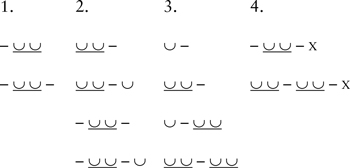
Analysing the line in terms of cola rather than feet is a much more intuitive way of understanding how the oral poet constructed his line. We note in particular that while certain metrical patterns can fit into multiple cola, others can only fit into one: the pattern short-long-short-short (∪ – ∪ ∪), for example, can only fit into the third colon, while long-long-short (– – ∪) can only fit into the second. The upshot of this is that whenever the poet wants to use a word or phrase that scans (e.g.) short-long-short-short, he knows straightaway that he will have to place it in the third colon, since this is the only place it will fit metrically.
Formulae
The tendency for the hexameter line to only accept certain metrical patterns in certain positions made it relatively difficult for the oral poet to compose verse extemporaneously. In order to help him do so, he memorized a vast number of metrically useful phrases and expressions that he could use as and when required. These stock phrases and expressions are referred to as formulae (singular: formula) and could be anything from a single word to a whole line, or even several lines.
Repeated verses and formular expressions
One type of formula is the repeated verse. These were stock lines that the poet could deploy whenever a particular situation arose. To take a simple example, there are four occasions in the Iliad when the narrative moves from a scene of general fighting to something taking place away from the battlefield. Rather than coming up with a new way to describe the change of scene each time, the poet makes use of exactly the same line on all four occasions: ὣς οἳ µὲν µάρναντο δέµας πυρὸς αἰθοµένοιο (‘and so they continued to fight like blazing fire’).
Another type of formula is the formular expression. These had exactly the same function as repeated verses, but were shorter in length. Some of the most easily recognizable formular expressions are the noun-epithet combinations that are used to describe almost all the major characters in the poem, e.g. ‘swift-footed Achilles’ or ‘Agamemnon, lord of men’. While the use of epithets throughout the poem can seem gratuitous, they are actually performing an important metrical function in extending the description of characters from the three or four syllables of their name (e.g. Ἀγαμέμνων, ‘Agamemnon’) to a much more useable length – five, six or seven syllables if the poet wanted to fill the final colon of the line (e.g. κρείων Ἀγαμέμνων, ‘lord Agamemnon’), or eight or nine syllables if he wanted to fill the whole second half of the line (e.g. ἄναξ ἀνδρῶν Ἀγαμέμνων, ‘Agamemnon, lord of men’).
Noun-epithet combinations can be found throughout the poem, and not just for characters’ names. Spears are ‘long-shadowed’ (δολιχόσκιον ἔγχος), ships are ‘hollow’ (νῆας … γλαφυράς), destruction is ‘sheer’ (αἰπὺν ὄλεθρον), fate is ‘black’ (κῆρα µέλαιναν) and so on. In all of these cases, it is important to note that the role of the epithet is primarily metrical, not poetic: when the poet describes spears as ‘long-shadowed’ or the ships as ‘hollow’, for example, these descriptors appear only because the poet needed an expression to fit a particular metrical pattern.
Formular expressions exist for a whole range of different parts of speech, not just the noun-epithet combinations we have seen above. Thus we find formular expressions combining adverbs and verbs, conjunctions and verbs and so on. By far the most common formulae in the poem are those used to describe characters speaking to one another, though the oral poet seems to have memorized stock phrases and expressions for almost every commonly occurring action or situation in the poem, e.g. putting on armour, throwing a spear, falling on the ground, agonizing over what to do, weeping, preparing a meal, drinking wine, or offering a sacrifice.
Type-scenes
In addition to repeated actions and situations, the Iliad also contains entire scenes that recur several times throughout the poem. These are known as type-scenes and include things like the arrival and reception of a guest, the performance of a sacrifice, the preparation of a meal, the arming of a warrior and so on. The first person to study type-scenes in detail was the German scholar Walter Arend, who noted that type-scenes tended to be made up of a sequence of events which occurred in the same order every single time. In the case of a warrior arming himself, for example – something that happens four times in the Iliad – Arend noticed that the scene always began with a line or two of introduction, before describing (in order) the greaves and the breastplate, the sword, the shield, the helmet and the spear.
The use of type-scenes dominates the narrative of the Iliad. The scholar Mark Edwards has even gone so far as to say that the narrative of the Iliad ‘is carried forward almost entirely by a succession of type-scenes, with only occasional use of short passages of description, similes, or apostrophes by the poet’. Indeed, one could analyse the beginning of Book 18 in terms of a succession of type-scenes: the arrival of a messenger (1–34), a scene of mourning (35–64), a divine visit (65–147), a battle scene (148–164), a divine visit (165–202) and so on.
While type-scenes provide the scaffolding for certain scenes in the poem, however, it is not the case that they are all absolutely identical. While the order of elements tended to remain constant, the poet could expand or contract any individual element however he liked, depending on its importance in the context. The type-scene of two warriors meeting on the battlefield, for example, could fill anything from a single line to several hundred lines, as in the case of the meeting of Achilles and Aeneas in Book 20.
The poet could also negate elements altogether. In Book 6, for example, the poet follows Hector as he goes to meet his wife, Andromache. Ordinarily, the type-scene that involves the arrival of a guest ends with the visitor meeting his host. In this case, however, Hector comes to his family home to find that no one is there, a striking negation of what the audience expected to hear next. In Book 16, similarly, we follow Patroclus as he puts on the armour of Achilles. It is the third such scene in the poem, all of which end with the warrior picking up either a single spear or a pair of spears. In this case, however, immediately after Patroclus picks up a pair of spears, the poet adds the detail that there was one spear that he was not able to pick up – ‘the spear of the excellent Achilles … the huge, heavy, massive spear which no other Achaean could wield, but Achilles alone had the skill to handle’ (16.140–3). The expectation that the warrior will complete his arming when he picks up his spear is emphatically denied in the case of Patroclus, and the implication is clear: Patroclus is not quite the warrior that Achilles wants him to be.
Story patterns
In the previous section, we thought about the use of type-scenes, recurring scenes in the poem such as the arrival and reception of a guest, where a sequence of elements tend to appear in the same order. In this section, we move on to story patterns, broader plot structures that underlie whole episodes in the poem.
One of the most fundamental story patterns in the Iliad is that which has been described by scholars as withdrawal, devastation and return. This is a pattern that involves the withdrawal of the hero from society, the subsequent catastrophic effects for that society and/or for the hero himself and a final return to society by the hero that restores peace, order and harmony. In some cases, the focus is not on the devastation of the society abandoned by the hero, but on the experience of the hero himself during his withdrawal, which often involves some kind of test, sometimes a symbolic death and a triumphant return to the society he has left behind.
In any case, it is clear to see how the pattern of withdrawal, devastation and return underpins the main storyline in the poem: Achilles withdraws from battle, the Greek army suffers catastrophic losses in his absence, before Achilles returns to battle and restores order by defeating Hector. At the same time, however, it is interesting to see just how often this basic story pattern recurs, either in part or in full, elsewhere in the poem.
In Book 9, for example, Phoenix attempts to convince Achilles to return to battle by telling him the myth of Meleager (9.524–605). In his story, Phoenix describes how Meleager and the Aetolians were defending their city against the Couretes, when Meleager decided to withdraw from the battle in wrath (550–572), just as Achilles had done (and was continuing to do) at Troy. The story continues with the detail that Meleager had rejected the Aetolians’ offer of gifts to return to battle, and had ultimately been forced to return to battle only when his own house was under attack, at which point the gifts were no longer on offer (573–594). While Phoenix has clearly emphasized the similarities between Meleager’s situation and Achilles’ own for rhetorical effect, it nevertheless remains a repeat of the basic pattern of withdrawal, devastation, return.
We get glimpses of other withdrawals elsewhere in the poem, too. The removal of Paris from the battlefield by Aphrodite in Book 3 leads to a kind of withdrawal on his part for the next three books: he only returns to battle when Hector physically goes to get him in Book 6. Another withdrawal – more fleeting still – is that of Aeneas, who is seen skulking at the back of the fighting in Book 13. The reason for his withdrawal, the poet explains, is on the grounds of his anger at Priam, who has not shown him sufficient honour (13.459–61). No more details are provided, and Aeneas almost immediately returns to battle after some encouragement from Deiphobus, but it is a glimpse of another withdrawal, devastation, return story nonetheless.
While the withdrawal, devastation, return story pattern provides the narrative superstructure for the poem as a whole, the poet appears to make use of a number of other story patterns in individual episodes. Another story pattern that occurs frequently in the poem is that of the revenge killing. Within the main storyline, Patroclus kills Sarpedon, which leads Hector to kill Patroclus, which leads Achilles to kill Hector. But the same basic pattern can be seen in miniature throughout the poem (e.g. in Book 11, Agamemnon kills Iphidamas, which leads Coön to stab Agamemnon, which leads Agamemnon to kill Coön) while similar chains of revenge killings could be found in other episodes from the Trojan War, too (e.g. in the Aethiopis, Memnon kills Antilochus, which leads Achilles to kill Memnon, which leads Apollo and Paris to kill Achilles).
Story patterns are similar to type-scenes in that they provide a poet with a superstructure within which he can build his story. Whereas the type-scene only provides the superstructure for a particular action, however, the story pattern can provide the structure for the whole poem. Like type-scenes, story patterns can appear in a range of sizes: just as duels between warriors can be anything from two to two-hundred lines, so too do we see story-patterns recur in both highly condensed and highly expanded forms – from the ten-line withdrawal and return of Aeneas to the fifteen-thousand-line withdrawal and return of Achilles.
Creativity and innovation in oral poetry
The reliance on formulae, type-scenes and story patterns throughout the Iliad may seem to preclude any kind of creativity or innovation on the part of the poet. Is the Iliad anything more than a poetic ‘paint-by-numbers’, where the poet slots prefabricated blocks of poetry (formulae) into predetermined arrangements (type-scenes, story patterns)?
In some cases, it appears that the poet had very little control over what he could say. In Book 18, for example, the poet describes Achilles as ‘swift-footed’ despite the fact he spends most of the book sitting or lying on the floor. At one point, Achilles even refers to himself as a ‘useless burden on the earth’ (ἐτώσιον ἄχθος ἀρούρης, 18.104), less than ten lines after he has been described as ‘swift-footed Achilles’ (πόδας ὠκὺς Ἀχιλλεύς, 18.97).
If we look a little closer, however, we find that the poet manipulates formulae in creative and innovative ways throughout the poem. At the beginning of Book 18, for example, the poet describes the arrival of Antilochus at the huts of Achilles to deliver the news of Patroclus’ death: Ἀντίλοχος δ᾽ Ἀχιλῆϊ πόδας ταχὺς ἄγγελος ἦλθε (‘Swift-footed Antilochus came as a messenger to Achilles’). The line seems unremarkable at first glance, but when we look closer we realize it is not Achilles who is described as ‘swift-footed’, but Antilochus. It is a surprising reattribution of Achilles’ traditional epithet, but entirely appropriate to the context: Achilles is sitting by the ships, while Antilochus has just run the entire length of the battlefield to deliver his message.
A few lines later, we find another adaptation of a standard formula when Antilochus addresses Achilles. The usual vocative formula for Achilles is ὦ Αχιλεῦ, Πηλῆος υἱέ, μέγα φέρτατ’ Ἀχαιῶν. Here, it is changed to the shorter ὤ μοι Πηλέος υἱὲ δαΐφρονος (18.18), which leads to a harsh enjambment between adjective and noun (λυγρῆς … ἀγγελίης, 18.18-19). Again, the adaptation of the standard formula is entirely appropriate to the context: Antilochus is nervous and the delivery of his message is appropriately inelegant.
When it comes to type-scenes, too, we have already seen how the poet could negate individual aspects to add particular emphasis in specific contexts, e.g. Patroclus’ emphatic failure to pick up Achilles’ spear at the end of his arming scene in Book 16 or Achilles’ emphatic abstention from food after the preparation of the meal in Book 19. These, too, represent creative and innovative departures from the traditional material.
Finally, the story of the Iliad may well have represented a radical departure from traditional stories about the Trojan War. It has been suggested, for example, that Homer was the first to introduce the tragic deaths of previously immortal heroes such as Heracles and the Dioscuri, that his presentation of Achilles in particular was markedly different from traditional stories in which he was simply an unstoppable killing machine and that his sympathetic presentation of Troy and the Trojans was untraditional, if not unprecedented.
The manipulation of traditional material was one the key ways in which oral poets demonstrated their creativity and ingenuity, and the Iliad is brimming with it. If the poem were genuinely an oral poem, the innovative manipulation of formulae and type-scenes that we find throughout may well indicate an oral poet of particular talent or expertise. If it were an orally derived poem, composed with the aid of writing, it may indicate the extent to which writing allowed a poet to introduce a level of creativity previously unattainable by oral means alone.
Translating Homer
Those coming to Homer for the first time may find translation difficult, not least because of the epic dialect. While most grammars provide an exhaustive list of all the differences between Attic and Homeric Greek, which can be overwhelming, this section outlines the differences that appear most often, and which it might be preferable to learn first of all.
Nouns
When it comes to nouns, Homer makes use of alternative endings across all declensions and cases. Many of these are fairly similar to their Attic equivalent, e.g. -αων or -εων instead of -ῶν in the genitive plural, though one should take particular notice of alternative endings for the genitive singular, which are quite different. These include -αο or -εω as alternatives to -ου in the first declension (e.g. Ἀτρείδαο and Ἀτρείδεω, instead of Ἀτρείδου, ‘son of Atreus’) and -οιο as an alternative to -ου for nouns of the second declension (e.g. πεδίοιο instead of πεδίου, ‘the plain’).
In addition to this, Homer alternates freely between -σ- and -σσ-, depending on what is required by the metre. ποσί and ποσσί (dat. pl. of πούς, ‘foot’) are equivalent, for example. The same doubling of the sigma can be found in adjectives, too, e.g. τόσσος and τόσος, μέσσος and μέσος.
Pronouns
Pronouns have a tendency to look quite different from their Attic equivalents, too. This includes the genitive singular, where potential endings include -εῖο, -εο, -εῦ and -εθεν, e.g. ἐμεῖο, ἐμέο (‘me’), σεῖο, σέο (‘you’), as well as the Ionic forms of common pronouns, e.g. ἄμμες, ἄμμε and ἄμμι, which are alternatives to ἡμεῖς, ἦμας and ἡμῖν (‘we’, ‘us’).
Most importantly, it is important to note that what looks like the definite article in Attic Greek (ὁ, ἡ, τό) is (almost always) used not as a definite article, but a third person pronoun (‘him, her, it’). In the line τόφρά οἱ ἐγγύθεν ἦλθεν ἀγαυοῦ Νέστορος υἱὸς (18.17), for example, οἱ means ‘(to) him’ and is governed by the phrase ἐγγύθεν ἦλθεν (‘came close to’, ‘approached’).
Verbs
When it comes to the verb, there are two things to look for. The first is that the aorist and imperfect tenses will often drop their augment: βάλον can appear instead of ἔβαλον, for example, or ἔμβαλε instead of ἐνέβαλε. The second is that verbs can be left uncontracted, i.e. one might find ἐρέω instead of ἐρῶ and so on.
Finally, it is worth noting that the infinitive can end in -εμεν, -μεναι or -ναι, which can make it look like a present participle, e.g. δόµεναι = δοῦναι, ἀκουέµεναι = ἀκούειν. In addition to this, ἔµεν, ἔµµεν and ἔµµεναι are all used as an alternative to the Attic εἶναι (‘to be’).
The dual
In Attic Greek, nouns, adjectives and verbs are usually one of two numbers: singular or plural: βαίνει (‘he/she/it goes’) indicates the movement of a single person, while βαίνουσῐ(ν) indicates the movement of several people and so on.
In Homer, however, there is a third number known as the dual, which can be used when the verb has exactly two people or things for its subject, or if a noun or adjective denotes two people or things. Thus, τὼ καλὼ ἀνθρώπω = ‘the two handsome men’, βαίνετον = ‘they both go’.
The dual is rare in Homer, though there are a string of them at the beginning of the set text in Book 9. The key endings to learn and recognize are (i) the third person endings for verbs in the past tense, which are -την (active) and -σθην (middle/passive), (ii) the third person pronouns, which are τώ (nominative and accusative) and τοῖν (genitive and dative) across all genders and (iii) the endings for nouns and adjectives in the second declension, which are -ω (nom./acc.) and -οιν (gen./dat.).
Like other past tense verbs in Homer, verbs in the dual can be left unaugmented, e.g. βάτην (‘they both went’, 9.182).
The structure of Homeric verse
One of the aspects of Homeric verse that makes it slightly easier to translate than other poetry is the relative simplicity of Homeric syntax. Because oral composition is greatly facilitated by lines that are self-contained units of thought, almost three quarters of the lines in Homer are grammatically complete by the end of the line. This way of structuring the poem gave the poet the freedom to elaborate or qualify a particular thought if he wanted to, or to move on to the next sentence if he did not. An example of this can be seen in the first six lines of the poem quoted below. These have been translated literally to retain the line structure of the original Greek:
μῆνιν ἄειδε, θεὰ, Πηληϊάδεω Ἀχιλῆος
οὐλομένην, ἣ μυρί᾽ Ἀχαιοῖς ἄλγε᾽ ἔθηκε,
πολλὰς δ᾽ ἰφθίμους ψυχὰς Ἄϊδι προΐαψεν
ἡρώων, αὐτοὺς δὲ ἑλώρια τεῦχε κύνεσσιν
οἰωνοῖσί τε πᾶσι, Διὸς δ᾽ ἐτελείετο βουλή,
ἐξ οὗ δὴ τὰ πρῶτα διαστήτην ἐρίσαντε
Ἀτρεΐδης τε ἄναξ ἀνδρῶν καὶ δῖος Ἀχιλλεύς.
Sing, goddess, of the anger of Achilles, son of Peleus
the accursed anger, which brought uncounted anguish on the Achaeans
and hurled down to Hades many mighty souls
of heroes, and which made their bodies the prey to dogs
and to all the birds, and the plan of Zeus was fulfilled,
from the time when the two men quarrelled and stood apart,
Atreus’ son, the lord of men, and godlike Achilles.
1.1–6
As we can see, the sentence could end at the end of any of the six lines: the first line is a complete sentence, as are the first two lines, as are first three lines and so on. Despite the difficulties of the epic dialect, the structure of Homeric verse is much more straightforward than much of later Greek (and Latin) literature. Translation can be tackled line by line, rather than the much more diffuse, difficult syntax of writers like Thucydides and Cicero.
Language and style
Another important aspect of Homeric Greek is the language and style of the poem. In this section, we will discuss the Homeric dialect, before looking at several stylistic elements found within the poem: (1) hapax legomena; (2) similes; (3) ring composition; (4) end-stopping and enjambment; and (5) rhetorical devices.
The epic dialect
Ancient Greek had several literary dialects, which could differ from one another as much as Italian from Spanish. The three major dialects were Ionic, Aeolic and Doric, although there were subdialects of each of these. Attic Greek, the dialect with which students will likely be most familiar, was a subdialect of the Ionic dialect, for example.
Most literature was written in a single dialect: choral lyric tended to be written in Doric, while philosophy, oratory and history tended to be written in Attic. When we come to the language of Homer, however, we find that it is a combination of several dialects: it is primarily Ionic, but also features a great deal of Aeolic and some Attic.
The rationale for using such a mixed language was to give the poet the widest range of material for composition in performance. Having a larger number of options for filling particular material gaps was more important than maintaining dialectical purity. Thus the epic dialect allowed for both the Ionic and Aeolic words for ‘we’ (Ionic: ἡμεῖς, Aeolic: ἄμμες), which mean the same thing but are scanned differently. Other examples of where words from other dialects gave the poet the same words but in a different rhythm include the use of both προτί (Aeolic) and πρός (Ionic), κεν (Aeolic) and ἄν (Ionic) and of all three of μέν (Ionic), μάν (Aeolic) and μήν (Attic).
Sometimes, the Aeolic word was metrically identical to its Ionic equivalent, but allowed for rhythmic manipulation elsewhere in the line. Examples of this include the use of the Aeolic πτόλις and πτόλεμος alongside the Ionic πόλις and πόλεμος, where the double-consonant at the beginning of the Aeolic form ensured that the syllable that came before it would be scanned long.
The desire for metrical flexibility also manifests itself in nouns and verbs. The poet has no fewer than three options for the nominative plural of υἱός (‘son’) – υἱέες, υἱεῖς and υἷες – all of which scan differently, while we have already seen the range of grammatically equivalent but metrically different case endings available to the oral poet, such as the use of both -οιο and -ου in the genitive singular. The admission of both uncontracted verbs and artificially lengthened verbs (e.g. the additional ό in κομόωντες, 18.6, a phenomenon known as diectasis) also serves the same purpose.
Another aspect of facilitating composition in dactylic hexameter was the preservation of certain words and expressions even where they were already several centuries old. The phrase κλέος ἄφθιτον (‘undying glory’), for example, is exactly equivalent to the Sanskrit srávas áksitam and has thus been dated to the second millennium BC. The phrase ‘two-handled cup’ (δέπας ἀμφικύπελλον) must date back to a similar period because two-handled cups seem to have been a product of the Mycenaean period (c. 1600–1100 BC) but not later. In some cases, the metrical usefulness of a word or expression resulted in its preservation even when the meaning of the word itself was lost. The word ἐριούνιος is often used in the Iliad as an epithet for Hermes (e.g. Ἑρμείας ἐριούνιος, 24.457), for example, although its meaning was unknown even to the Greeks.
Finally, many of the grammatical oddities of Homeric verse also appear to be of great antiquity, and we should assume that these too were preserved in the oral tradition in order to facilitate composition in dactylic hexameter. The separation of prepositional pre-verbs from their verbs (e.g. ἐν δ᾽ ἄρα νῶτον ἔθηκ᾽ at 9.207 = Attic ἐνέθηκε), for example, was archaic even by the Mycenaean period, as was the omission of the augment in past tense verbs, but both gave the poet more flexibility when it came to composing his line.
In general, the epic dialect should be seen as being optimized for composition in performance in dactylic hexameter. Anything that could be done to facilitate this process, e.g. the use of words and expressions from different dialects and periods or the ability to add vowels in the middle of words (diectasis) or remove augments or pre-verbs, was preserved in the oral tradition and helps to explain why the epic dialect has the characteristics that it does.
Hapax legomena
Given the reliance of the oral poet on formulaic lines and phrases, special attention must be paid to words that appear only once in the poem. These words are known by the Greek term hapax legomenon (plural: hapax legomena or hapaxes). According to the most recent count of hapaxes in Homer, there are 1,142 such words in the Iliad, or one every 13.7 verses.
Hapaxes are strongly linked to non-formulaic contexts, where the poet is describing something that does not happen often in the poem. Battle-scenes feature very few hapaxes, for example, because they happen frequently throughout the poem, and the poet will rarely throw in a completely new word when describing the same kind of event. A warrior will not suddenly produce a totally new kind of weapon, for example, or engage in a totally different set of actions. Consequently, the books with the fewest hapaxes are also those which are the most battle-heavy – Books 7, 8 and 17.
Where the poet moves into more ‘unusual’ subject matter, however, hapaxes are far more common. The seduction of Zeus by Hera in Book 14, for example, takes the poet into relatively uncharted territory and includes a large number of hapaxes. The same is true of the description of the Shield of Achilles in Book 18, where the poet describes the images that Hephaestus has depicted on its surface: various planets and stars, a domestic scene featuring a quarrel in a village square, various scenes of agriculture, viticulture and animal husbandry and so on. Almost none of this appears elsewhere in the poem, which is why we get so many hapaxes.
The character who uses hapaxes more than any other in the Iliad is Achilles, who uses a total of 80 (1 every 12.2 lines). Eighteen of these words are never used again in the entirety of Greek literature. His use of hapaxes has been seen as a sign of his eloquence, as well as of a character with a uniquely broad philosophical and emotional range.
Similes
A general rule in Homeric verse is that the more important something is, the more time the poet will spend on it. Earlier, we looked at the first six lines of the poem and saw how the structure of Homeric verse allowed for the poet to constantly expand his thoughts line after line by the use of qualifying adjectives, conjunctions or subordinate clauses. Before that, we discussed the use of type-scenes, which could also be greatly expanded if the poet wanted to pause on a moment of particular significance.
Another way that the poet can slow down the narrative, however, is through the use of similes. In Book 17, for example, the poet adds to the gravity of Menelaus’ decision to leave the battlefield by including a simile: he retreats from the battle, we are told, ‘like a great bearded lion driven from a farmstead by dogs’ (17.109–10). If the poet wants to add great emphasis to the importance of a particular moment, he can use several similes in a row. In Book 2, for example, as the Greeks march into battle, the poet produces no fewer than five similes back to back: the Greeks’ bronze armour gleams ‘like annihilating fire’, the various contingents of the Greek forces are ‘like great flocks of flying birds’ or ‘great crowds of swarming flies’, their leaders are like herdsman herding cattle, while Agamemnon himself is ‘like the foremost of all the cattle’.
Similes can be very short, such as the description of the Greeks and Trojans fighting ‘like blazing fire’ (δέμας πυρὸς αἰθομένοιο, 18.1), but they can also be very long, expanding over several lines to describe a whole scene and potentially having several points of contact with the narrative proper. In Book 18, for example, we get the following simile to describe the magical fireball that Athena has conjured round Achilles’ head:
As when the smoke rises up from a city to reach the sky, from an island in the distance, where enemies are attacking and the inhabitants run the trial of hateful Ares all day long, fighting from their city: and then with the setting of the sun the light from the line of beacons blazes out, and the glare shoots up high for the neighbouring islanders to see, in the hope that they will come across in their ships to protect them from disaster – such was the light that blazed from Achilles’ head up into the sky.
18.207–14
The primary point of contact between the narrative and the simile is the fire itself, which is like the ‘signal-beacons’ (πυρσοί, 211) of a city under siege. But there are other points of reference, too. The image of the besieged city clearly evokes Troy, while the besiegers are like the Greeks. Moreover, the detail that the combatants have been fighting ‘all day long’ (πανημέριοι, 209) reflects the full day’s fighting between the Greeks and Trojans in the narrative proper, while the description of the setting sun (ἅμα δ᾽ ἠελίῳ καταδύντι, 210) will be matched by the (actual) setting of the sun just over thirty lines later (ἠέλιος μὲν ἔδυ, 241).
Two more points about similes. First, they tend to draw their imagery from the world that is pointedly not the world of warfare. The subjects for similes include weather and other natural phenomena (storms, floods, fires, etc.), hunting, herding and other animals (lions, boars, birds, etc.) and human technology (carpentry, weaving, etc.). One of the effects of this is to heighten the emotional impact of a scene by virtue of the contrast between the world of the simile and the world of the narrative. To take one example, consider the description of Gorgythion in Book 8, whose head droops down ‘like a poppy in a garden, bent by the weight of its seed and the showers of spring’ (8.306–8). The delicacy of the image of the poppy contrasts strongly with the brutality of Gorgythion’s death, enhancing its emotional impact.
Second, it is important to note that similes can be used by both the narrator and his characters – although they are much less common in direct speech. As we might expect, the character who uses similes the most is Achilles (8 in total, 4 long and 4 short), and his doing so is just another sign of his emotional range and self-awareness. Of particular interest are those moments where Achilles uses similes to analyse his own situation, such as in Book 9, when he compares his situation in the Greek camp as being ‘like a bird that brings back to her unfledged chicks every morsel she can find, and has to go without herself’ (9.323–4).
Ring composition
Speeches in the Iliad – or parts of them – may follow a structural pattern that is known as ring composition. This is where the opening elements of a speech (A, B, C) are mirrored by its closing elements but in reverse order (C’, B’, A’). One of the clearest examples of this is in Book 18, where Achilles announces he will return to battle to kill Hector:
And now I shall go, to find the destroyer of that dear life, Hector – and I shall take my own death at whatever time Zeus and the other immortal gods wish to bring it on me. Even the mighty Heracles could not escape death, and he was the dearest of men to lord Zeus, son of Cronus: but fate conquered him, and the cruel enmity of Hera. So I too, if the same fate is there for me, will lie finished when I die. But now my wish is to win great glory …
18.114–21
This is all clear enough, but note how the speech can be arranged into ‘rings’, where thoughts expressed at the beginning of a passage are answered later on in reverse order.
A And now I shall go, to find the destroyer of that death life, Hector
B And I shall take my own death at whatever time Zeus and the other immortal gods wish to bring it on me
C Even the mighty Heracles could not escape death …
B’ So I too, if the same fate is there for me, will lie finished when I die
A’ But now I shall win great glory
Ring composition underlies the basic architecture in many of the speeches in the poem. It no doubt provided a useful organizing principle for the oral poet, as well as a sense of recognition, satisfaction and completion for his audience.
At times, however, characters will subtly change the point they are making when they come back to it a second time. In the speech of Achilles just mentioned, for example, we notice how the desire to kill Hector (A) is explicitly linked to his desire for glory when he returns to the point later in the speech (A’). Comparing and contrasting the ‘rings’ in a speech in this way can often give subtle pointers about the development of a character’s thought.
End-stopping and enjambment
One of the most commonly used stylistic features in Homeric verse is the use of word position to lend special emphasis to a particular word or phrase. Two things that students should look out for are end-stopping (where the end of the line marks the end of a clause) and enjambment (where the clause runs over to the next line). There is clearly a kind of inevitability to this – lines will either be end-stopped or not end-stopped – so students should look for the repetition of end-stopped lines, or for words placed in what is known as the emphatic runover position, which is where the enjambment consists of a single word, followed immediately by a pause. In general, frequent end-stopping represents slowly spoken, calm, measured speech, whereas frequent emphatic runover words indicate high emotion, anger, bitterness, vehemence and so on.
Achilles’ speech to Odysseus in Book 9 provides fertile ground for seeing this in action. In the first 22 lines of the speech (9.308–29), most of the lines are heavily end-stopped. In the 12 lines that follow, however, we get a series of words in the emphatic runover position. What the structure of these lines shows us is that Achilles begins his speech in a calm, measured way before increasingly losing his temper as he reflects on his treatment at the hands of Agamemnon.
In addition to this, we might note how end-stopped lines allow for greater than usual emphasis on the first word of the following line. This allows for certain words or ideas to be given particular emphasis, or for a series of points to be ‘hammered home’. Again, we can turn to Achilles’ speech to Odysseus in Book 9 for an example of how these two effects can be combined. In the lines quoted below, Achilles is explaining the difference between the kind of material goods that are on offer from Agamemnon (which can be bought back or stolen if they are given away or lost) and his own life (which cannot). The translation attempts to recreate the impact of the original Greek:
ληϊστοὶ μὲν γάρ τε βόες καὶ ἴφια μῆλα,
κτητοὶ δὲ τρίποδές τε καὶ ἵππων ξανθὰ κάρηνα,
ἀνδρὸς δὲ ψυχὴ πάλιν ἐλθεῖν οὔτε λεϊστὴ
οὔθ᾽ ἑλετή, ἐπεὶ ἄρ κεν ἀμείψεται ἕρκος ὀδόντων.
Stealable are cattle and fertile flocks,
Winnable are tripods and chestnut horses,
A man’s life, however, cannot be stolen back
nor caught, once it has passed the barrier of one’s teeth.
9.406–9, my translation
The effect is quite hard to render in English because of the lack of elegant translations for the verbal adjectives ληϊστοὶ, κτητοὶ and ἑλετή. In Greek, however, it makes for a thumping rhetorical tour de force, driven by the end-stopped lines and the placement of key terms at the beginning of the following line.
Rhetorical devices
The poet of the Iliad was highly attuned to the impact of rhetorical devices, and they are deployed carefully and knowingly throughout the poem. Rather than simply identifying different rhetorical devices, students should think about how they enact meaning. What is their impact? If a character uses a rhetorical device, what might this say about that character? How might we read the sentence differently if it had not included that particular rhetorical device?
Anaphora is the repetition of words at the beginning of two or more consecutive clauses. The repetition might be used for emphasis, with each clause building on the last, or it might invite comparison, in which case the anaphora may be accompanied by the particles μέν and δὲ. In Book 18, for example, we read the following lines:
τρὶς μέν μιν μετόπισθε ποδῶν λάβε φαίδιμος Ἕκτωρ
ἑλκέμεναι μεμαώς, μέγα δὲ Τρώεσσιν ὁμόκλα:
τρὶς δὲ δύ᾽ Αἴαντες θοῦριν ἐπιειμένοι ἀλκὴν
νεκροῦ ἀπεστυφέλιξαν.
Three times glorious Hector caught [Patroclus’ body] by the feet from behind, intent on dragging it away, and shouted loud to the Trojans: and three times the two Aiantes, clothed in fighting spirit, battered him away from the corpse.
18.155–8
Here, the use of anaphora (τρὶς … τρὶς, 18.155, 18.157) emphasizes just how close the fighting is over the body of Patroclus: the action of Hector is met by an equal and opposite reaction by the two Aiantes. The balance is further emphasized by the fact that this happens not just once, but ‘three times’. But note also the difference in the length of the clauses: the description of Hector takes up two full lines, while that of the two Aiantes fills takes up just one and a half. Are we to conclude that the tide is turning ever so slightly in the Trojans’ favour?
Asyndeton is the omission of one or more conjunctions. In the Iliad, it often indicates heightened emotions. One of the best examples of the impact of asyndeton can be seen in Book 18, when Antilochus announces the death of Patroclus:
ὤ μοι Πηλέος υἱὲ δαΐφρονος ἦ μάλα λυγρῆς
πεύσεαι ἀγγελίης, ἣ μὴ ὤφελλε γενέσθαι.
κεῖται Πάτροκλος, νέκυος δὲ δὴ ἀμφιμάχονται
γυμνοῦ: ἀτὰρ τά γε τεύχε᾽ ἔχει κορυθαίολος Ἕκτωρ.
Oh, son of warrior Peleus, there is terrible news for you to hear, which I wish had never happened. Patroclus lies dead, and they are fighting over his body. It is naked now – Hector of the glinting helmet has his armour.
18.18–21
We are to imagine Antilochus as a relatively young character. More importantly, he is delivering the worst news imaginable to the greatest hero in the Greek army, who is also notoriously volatile. No wonder he is nervous. The first sign of Antilochus’ nerves come with the awkward enjambment of noun (ἀγγελίης) and adjective (λυγρῆς) in lines 18–19. Then come the words κεῖται Πάτροκλος (‘Patroclus is dead’, 18.20). This is abrupt in itself, but it is made more so by the lack of any kind of conjunction, which emphasizes the fact that Antilochus has blurted out his message, rather than delivering it in a calm, measured way.
Anacoluthon is the absence of the expected grammatical sequence. As with asyndeton, it can indicate moments of high emotion. But it can do more than that, too. Consider the following lines:
ὤ μοι ἐγὼ δειλή, ὤ μοι δυσαριστοτόκεια,
ἥ τ᾽ ἐπεὶ ἂρ τέκον υἱὸν ἀμύμονά τε κρατερόν τε
ἔξοχον ἡρώων: ὃ δ᾽ ἀνέδραμεν ἔρνεϊ ἶσος:
Oh, my misery! Oh, the pain of being mother to the best of men! Because I bore a son who was to be noble and strong, the greatest of heroes … he shot up like a young sapling …
18.54–6, lightly adapted from Hammond
The speaker here is Thetis, who is reflecting on the life of her son, Achilles, who is shortly to die. It is a highly emotional speech, as is shown by the opening ὤ μοι (‘Alas!’) followed by the extraordinary hapax legomenon δυσαριστοτόκεια (lit: ‘unfortunate mother to a child who is the best’). The sentence also contains an example of anacoluthon, since the main clause to which ἐπεὶ ought to be subordinated never actually appears. Most translators actually ignore the anacoluthon altogether, translating as if the ἐπεὶ clause were subordinate to the vocatives in 18.54 or as if the word ἐπεὶ were not there at all. But the anacoluthon is important and should not be ignored. In terms of what it means, we might say simply that Thetis is ‘emotional’ and forgets to finish her sentence. But it might also be an indication of how her mind works: she begins by reflecting on her misfortunes as a mother to a doomed son, but the mention of the birth of her son (τέκον υἱὸν, ‘I gave birth to a son’, 18.55) leads her to ignore whatever it was that she was going to say and to reflect on Achilles’ upbringing at more length. The use of anacoluthon provides a psychologically realistic account of how a grieving mother might actually think.
We can find another example of anacoluthon a little later in Book 18. This time, the speaker is Achilles, who is on the point of announcing he will return to battle. He starts by saying ‘So now, since I shall not return to my dear native land, since I have not been a saving light to Patroclus …’ (νῦν δ᾽ ἐπεὶ οὐ νέομαί γε φίλην ἐς πατρίδα γαῖαν, οὐδέ τι Πατρόκλῳ γενόμην φάος, 18.101–2), and we expect him to say something like ‘… I shall return to battle and kill Hector.’ But he doesn’t say this. Instead, he spends the next eleven lines reflecting on the reasons for his withdrawal from battle and the damage it has done to his companions, his quarrel with Agamemnon and the nature of rivalry itself. It is the kind of flight of fancy in which Achilles often engages, and the anacoluthon provides a satisfying way of representing what might be described as Achilles’ ‘stream of consciousness’.
Paronomasia is a play on words. An example of this is the phrase κούρην δ᾽ οὐ γαμέω Ἀγαμέμνονος Ἀτρεΐδαο (‘I will not marry the daughter of Agamemnon, son of Atreus’, 9.388) which might represent a play on words between Ἀγαμέμνονος (‘Agamemnon’) and οὐ γαμέω (‘I will not marry’). If so, it tells us something about the character of Achilles: despite the brusque start to his speech, the use of paronomasia here perhaps shows us that Achilles can be a little more rhetorical than he and the others give him credit for?
Appendix: Homeric Greek
The Homeric dialect has numerous differences from the Attic Greek that students will be most familiar with. The following section, while not exhaustive, lists some of the main features of the Homeric dialect. More extensive notes are provided where necessary in the line-by-line commentary.
Nouns
First declension
• For ᾱ, we always find η, regardless of where it appears in the word, e.g. χώρη = Att. χώρα, θύρη = Att. θύρα, νεηνίης = Att. νεανίας
• The nom. sing. of some masculines in -ης is shortened to ᾰ, e.g. ἰππότα = Att. ἱππότης, νεφεληγερέτα = Att. νεφεληγερέτης
• The gen. sing. of masculines ends in -αω or -εω, e.g. Ἀτρείδαο, Ἀτρείδεω = Att. Ἀτρείδου
• The gen. pl. of masculines ends in -άων or -έων, e.g. θεάων = Att. θεῶν, νυμφάων = Att. νυμφῶν
• The dat. pl. almost always ends in -ῇσι(ν) or -ῃς, e.g. πύλῃσιν = Att. πύλαις, but θεαῖς
Second declension
• The gen. sing. ends in -οιο as well as -ου, e.g. πεδίοιο and πεδίου
• The dat. pl. ends in -οισι as well as -οις, e.g. φύλλοισι and φύλλοις
• The gen. and dat. dual end in -οιϊν, so ἵπποιϊν, not ἵπποιν
Third declension
• The acc. sing ends in -ιν as well as -ιδα, e.g. γλαυκῶπιν and γλαυκώπιδα
• Endings in -ηα correspond to -εα, e.g. βασιλῆα = Att. βασιλέα
• Gen. sing. endings in -ηος and -ιος correspond to -εως, e.g. βασιλῆος = Att. βασιλέως, πόλιος = Att. πόλεως
• Acc. pl. endings in -ηας correspond to -εας, e.g. βασιλῆας = Att. βασιλέας
• Gen. pl. endings in -ηων correspond to -εων, e.g. βασιλήων = Att. βασιλέων
• The dat. pl. ends in -εσσι and -σι, e.g. πόδεσσι = Att. ποσί, ἔπεσσι = Att. ἔπεσι
• The gen. and dat. dual end in -οιιν, e.g. ποδοῖιν
Pronouns
ἐγώ, σύ, ‘I’, ‘you’
• Gen. sing: ἐμεῖο, ἐμέο, ἐμεῦ, μευ, ἐμέθεν; so with σύ – σεῖο, σέο, etc.
ἕ, ‘him’
• Gen. sing.: εἷο, ἕο, εὗ, ἕθεν = Attic: αὐτοῦ
• = Attic: αὐτῷ
ἡμεῖς, ὑμεῖς, ‘we’, ‘you’
• Acc. pl.: ἡμέας, ἄμμε
• Gen. pl.: ἡμείων, ἡμέων
• Dat. pl.: ἄμμιν; so with ὑμεῖς
σφεῖς, ‘they’
• Acc. pl.: σφε, σφέας, σφας
• Gen. pl.: σφείων, σφέων
• Dat. pl.: σφι, σφισί
τίς, ‘who, what, which’
• Nom. sing.: τίς
• Acc. sing.: τίνα
• Gen. sing.: τέο, τεῦ
• Dat. sing.: τέῳ
• Gen. pl.: τέων
ὁ, ἡ, τό, ‘he, she, it’
• In Homer, ὁ, ἡ, τό is used for the third person pronoun (‘he, she, it’), not the definite article (‘the’)
• Nom. pl.: οἱ, αἱ, or τοί, ταί
• Dat. pl.: τοῖς, τοῖσι, τῇς, τῇσι as well as ταῖς
Verbs
Future
• Generally uncontracted, e.g. ἐρέω = Att. ἐρῶ, &#f964;ελέω = Att. τελέσω
Present/Imperfect
• The endings -σκον and -σκόμην may be used to express repetition of the action, e.g. φύγεσκον = ‘they kept on running away’
Aorist/Imperfect
• The augment may be omitted in both the aorist and imperfect tense, e.g. βάλον = Att. ἔβαλον, ἔμβαλε = Att. ἐνέβαλε
• Third person pl. of aorist passive may end in -εν instead of -ησαν, e.g. φόβηθεν = Att. ἐφοβήθησαν, ἔμιχθεν = Att. ἐμίχθησαν
Moods
Subjunctive
• Appears with a short vowel, e.g. ἴομεν = Att. ἴωμεν
• Second person singular middle ends in -ηαι or -εαι, e.g. εὔξεαι = Att. εὔξῃ
• Third person singular active ends in -σι, e.g. φορεῇσι = φορῇ
• Occasionally used in place of the future tense
Infinitive
• Appears with the endings -μεν, -μεναι and -ναι for -ειν and -ναι, e.g. δόμεναι = Att. δοῦναι, ἴμεν = Att. ἰέναι, ἀκουέμεν(αι) = Att. ἀκούειν
• ἔμεν, ἔμμεν and ἔμμεναι = Att. εἶναι
Contracted verbs
• Verbs in -άω can appear contracted, uncontracted or even expanded with the addition of a like-sounding, short vowel either side of the long vowel, e.g. ὁρόωντες = Att. ὁρῶντες
• Verbs in -έω are generally uncontracted, but sometimes form ει from εε or εει, η from εε or ευ from εο or εου
• Verbs in -όω are generally contracted
Particles
• ἄρα (also ἄρ, ῥά) = ‘so, next’
• δή = ‘indeed’
• ἦ = ‘surely’
• περ = ‘just, even’
• τε = ‘and’, or to show a general remark
• τοι = ‘I tell you’, but may also = σοι (‘to you, for you’)
Further reading
All quotations in this introduction have been taken from Martin Hammond’s prose translation of the Iliad, first published by Penguin in 1987, unless otherwise indicated. Where necessary, the names of characters have been changed to their more familiar Latin forms, e.g. ‘Achilles’ instead of ‘Achilleus’, ‘Achaeans’ instead of ‘Achaians’ and so on.
Short introductions
Barker, E. and Christensen, J. Homer: A Beginner’s Guide (London, 2013).
Graziosi, B. Homer (Oxford, 2016).
Silk, M. Homer: The Iliad (Cambridge, 1987).
Texts and commentaries
Willcock, M.M. (ed.) Homer, Iliad I–XII (Bristol, 1984).
Willcock, M.M. (ed.) Homer, Iliad XIII–XXIV (Bristol, 1984).
Kirk, G.S. The Iliad: A Commentary. Volume I: Books 1–4 (Cambridge, 1985).
Kirk, G.S. The Iliad: A Commentary. Volume II: Books 5–8 (Cambridge, 1990).
Hainsworth, J.B. The Iliad: A Commentary. Volume III: Books 9–12 (Cambridge, 1993).
Janko, R. The Iliad: A Commentary. Volume IV: Books 13–16 (Cambridge, 1992).
Edwards, M. The Iliad: A Commentary. Volume V: Books 17–20 (Cambridge, 1991).
Richardson, N. The Iliad: A Commentary. Volume VI: Books 21–24 (Cambridge, 1993).
Griffin, J. Homer Iliad IX (Oxford, 1995).
Jones, P. Homer’s Iliad: A Commentary on Three Translations (Bristol, 2003).
General studies
Cairns, D.L. (ed.) Oxford Readings in Homer’s Iliad (Oxford, 2001).
Fowler, R. (ed.) The Cambridge Companion to Homer (Cambridge, 2004).
Griffin, J. Homer on Life and Death (Oxford, 1980).
Morris, I. and Powell, B. (eds.) A New Companion to Homer (Leiden, 1997).
Taplin, O. Homeric Soundings (Oxford, 1992).
Oral poetry and composition in performance
Bakker, E. Pointing at the Past: From Formula to Performance in Homeric Poetics (Cambridge, MA, 2005).
Lord, B. The Singer of Tales (Cambridge, MA, 1960).
Parry, M. The Making of Homeric Verse: The Collected Papers of Milman Parry (Oxford, 1971).
Type-scenes
Edwards, M. ‘Convention and Individuality in Iliad 1’, Harvard Studies in Classical Philology 84 (1980), pp. 1–28.
Neoanalysis
West, M. L. The East Face of Helicon: West Asiatic Elements in Greek Poetry and Myth (Oxford, 1997).
Story patterns
Propp, V. Morphology of the Folktale (Austin, 1968).
Nagler,M.N. Spontaneity and Tradition: A Study in the Oral Art of Homer (Berkeley and Los Angeles, 1974).
Heroes and heroism
Cairns, D. Aidōs: The Psychology and Ethics of Honour and Shame in Ancient Greek Literature (Oxford, 1993).
Nagy, G. The Best of the Achaeans: Concepts of the Hero in Archaic Greek Poetry (2nd edn. Baltimore, 1999).
Schein, S.L. The Mortal Hero: An Introduction to Homer’s Iliad (London, 1984).
Acknowledgements
I would like to thank Dr Andrew Sillett (St Anne’s College, Oxford), Mr Mathew Owen (Classics Department, Caterham School) and Revd Richard Smail for their encouragement and expertise in writing this introduction and commentary.
Text
Iliad 18
|
ὣς οἳ μὲν μάρναντο δέμας πυρὸς αἰθομένοιο, Ἀντίλοχος δ᾽ Ἀχιλῆϊ πόδας ταχὺς ἄγγελος ἦλθε. τὸν δ᾽ εὗρε προπάροιθε νεῶν ὀρθοκραιράων τὰ φρονέοντ᾽ ἀνὰ θυμὸν ἃ δὴ τετελεσμένα ἦεν: |
|
|
ὀχθήσας δ᾽ ἄρα εἶπε πρὸς ὃν μεγαλήτορα θυμόν: ὤ μοι ἐγώ, τί τ᾽ ἄρ᾽ αὖτε κάρη κομόωντες Ἀχαιοὶ νηυσὶν ἔπι κλονέονται ἀτυζόμενοι πεδίοιο; μὴ δή μοι τελέσωσι θεοὶ κακὰ κήδεα θυμῷ, ὥς ποτέ μοι μήτηρ διεπέφραδε καί μοι ἔειπε |
5 |
|
Μυρμιδόνων τὸν ἄριστον ἔτι ζώοντος ἐμεῖο χερσὶν ὕπο Τρώων λείψειν φάος ἠελίοιο. ἦ μάλα δὴ τέθνηκε Μενοιτίου ἄλκιμος υἱὸς σχέτλιος: ἦ τ᾽ ἐκέλευον ἀπωσάμενον δήϊον πῦρ ἂψ ἐπὶ νῆας ἴμεν, μηδ᾽ Ἕκτορι ἶφι μάχεσθαι. |
10 |
|
εἷος ὃ ταῦθ᾽ ὥρμαινε κατὰ φρένα καὶ κατὰ θυμόν, τόφρά οἱ ἐγγύθεν ἦλθεν ἀγαυοῦ Νέστορος υἱὸς δάκρυα θερμὰ χέων, φάτο δ᾽ ἀγγελίην ἀλεγεινήν: ὤ μοι Πηλέος υἱὲ δαΐφρονος ἦ μάλα λυγρῆς πεύσεαι ἀγγελίης, ἣ μὴ ὤφελλε γενέσθαι. |
15 |
|
κεῖται Πάτροκλος, νέκυος δὲ δὴ ἀμφιμάχονται γυμνοῦ: ἀτὰρ τά γε τεύχε᾽ ἔχει κορυθαίολος Ἕκτωρ. ὣς φάτο, τὸν δ᾽ ἄχεος νεφέλη ἐκάλυψε μέλαινα: ἀμφοτέρῃσι δὲ χερσὶν ἑλὼν κόνιν αἰθαλόεσσαν χεύατο κὰκ κεφαλῆς, χαρίεν δ᾽ ᾔσχυνε πρόσωπον: |
20 |
|
νεκταρέῳ δὲ χιτῶνι μέλαιν᾽ ἀμφίζανε τέφρη. αὐτὸς δ᾽ ἐν κονίῃσι μέγας μεγαλωστὶ τανυσθεὶς κεῖτο, φίλῃσι δὲ χερσὶ κόμην ᾔσχυνε δαΐζων. δμῳαὶ δ᾽ ἃς Ἀχιλεὺς ληΐσσατο Πάτροκλός τε θυμὸν ἀκηχέμεναι μεγάλ᾽ ἴαχον, ἐκ δὲ θύραζε |
25 |
|
ἔδραμον ἀμφ᾽ Ἀχιλῆα δαΐφρονα, χερσὶ δὲ πᾶσαι στήθεα πεπλήγοντο, λύθεν δ᾽ ὑπὸ γυῖα ἑκάστης. Ἀντίλοχος δ᾽ ἑτέρωθεν ὀδύρετο δάκρυα λείβων χεῖρας ἔχων Ἀχιλῆος: ὃ δ᾽ ἔστενε κυδάλιμον κῆρ: δείδιε γὰρ μὴ λαιμὸν ἀπαμήσειε σιδήρῳ. |
30 |
|
σμερδαλέον δ᾽ ᾤμωξεν: ἄκουσε δὲ πότνια μήτηρ ἡμένη ἐν βένθεσσιν ἁλὸς παρὰ πατρὶ γέροντι, κώκυσέν τ᾽ ἄρ᾽ ἔπειτα: θεαὶ δέ μιν ἀμφαγέροντο πᾶσαι ὅσαι κατὰ βένθος ἁλὸς Νηρηΐδες ἦσαν. 39–49: The poet lists the names of the Nereids. |
35 |
|
τῶν δὲ καὶ ἀργύφεον πλῆτο σπέος: αἳ δ᾽ ἅμα πᾶσαι στήθεα πεπλήγοντο, Θέτις δ᾽ ἐξῆρχε γόοιο: ‘κλῦτε κασίγνηται Νηρηΐδες, ὄφρ᾽ ἐῢ πᾶσαι εἴδετ᾽ ἀκούουσαι ὅσ᾽ ἐμῷ ἔνι κήδεα θυμῷ. ὤ μοι ἐγὼ δειλή, ὤ μοι δυσαριστοτόκεια, |
50 |
|
ἥ τ᾽ ἐπεὶ ἂρ τέκον υἱὸν ἀμύμονά τε κρατερόν τε ἔξοχον ἡρώων: ὃ δ᾽ ἀνέδραμεν ἔρνεϊ ἶσος: τὸν μὲν ἐγὼ θρέψασα φυτὸν ὣς γουνῷ ἀλωῆς νηυσὶν ἐπιπροέηκα κορωνίσιν Ἴλιον εἴσω Τρωσὶ μαχησόμενον: τὸν δ᾽ οὐχ ὑποδέξομαι αὖτις |
55 |
|
οἴκαδε νοστήσαντα δόμον Πηλήϊον εἴσω. ὄφρα δέ μοι ζώει καὶ ὁρᾷ φάος ἠελίοιο ἄχνυται, οὐδέ τί οἱ δύναμαι χραισμῆσαι ἰοῦσα. ἀλλ᾽ εἶμ᾽, ὄφρα ἴδωμι φίλον τέκος, ἠδ᾽ ἐπακούσω ὅττί μιν ἵκετο πένθος ἀπὸ πτολέμοιο μένοντα. |
60 |
|
ὣς ἄρα φωνήσασα λίπε σπέος: αἳ δὲ σὺν αὐτῇ δακρυόεσσαι ἴσαν, περὶ δέ σφισι κῦμα θαλάσσης ῥήγνυτο: ταὶ δ᾽ ὅτε δὴ Τροίην ἐρίβωλον ἵκοντο ἀκτὴν εἰσανέβαινον ἐπισχερώ, ἔνθα θαμειαὶ Μυρμιδόνων εἴρυντο νέες ταχὺν ἀμφ᾽ Ἀχιλῆα. |
65 |
|
τῷ δὲ βαρὺ στενάχοντι παρίστατο πότνια μήτηρ, ὀξὺ δὲ κωκύσασα κάρη λάβε παιδὸς ἑοῖο, καί ῥ᾽ ὀλοφυρομένη ἔπεα πτερόεντα προσηύδα: ‘τέκνον τί κλαίεις; τί δέ σε φρένας ἵκετο πένθος; ἐξαύδα, μὴ κεῦθε: τὰ μὲν δή τοι τετέλεσται |
70 |
|
ἐκ Διός, ὡς ἄρα δὴ πρίν γ᾽ εὔχεο χεῖρας ἀνασχὼν πάντας ἐπὶ πρύμνῃσιν ἀλήμεναι υἷας Ἀχαιῶν σεῦ ἐπιδευομένους, παθέειν τ᾽ ἀεκήλια ἔργα. τὴν δὲ βαρὺ στενάχων προσέφη πόδας ὠκὺς Ἀχιλλεύς: ‘μῆτερ ἐμή, τὰ μὲν ἄρ μοι Ὀλύμπιος ἐξετέλεσσεν: |
75 |
|
ἀλλὰ τί μοι τῶν ἦδος ἐπεὶ φίλος ὤλεθ᾽ ἑταῖρος Πάτροκλος, τὸν ἐγὼ περὶ πάντων τῖον ἑταίρων ἶσον ἐμῇ κεφαλῇ; τὸν ἀπώλεσα, τεύχεα δ᾽ Ἕκτωρ δῃώσας ἀπέδυσε πελώρια θαῦμα ἰδέσθαι καλά: τὰ μὲν Πηλῆϊ θεοὶ δόσαν ἀγλαὰ δῶρα |
80 |
|
ἤματι τῷ ὅτε σε βροτοῦ ἀνέρος ἔμβαλον εὐνῇ. αἴθ᾽ ὄφελες σὺ μὲν αὖθι μετ᾽ ἀθανάτῃς ἁλίῃσι ναίειν, Πηλεὺς δὲ θνητὴν ἀγαγέσθαι ἄκοιτιν. νῦν δ᾽ ἵνα καὶ σοὶ πένθος ἐνὶ φρεσὶ μυρίον εἴη παιδὸς ἀποφθιμένοιο, τὸν οὐχ ὑποδέξεαι αὖτις |
85 |
|
οἴκαδε νοστήσαντ᾽, ἐπεὶ οὐδ᾽ ἐμὲ θυμὸς ἄνωγε ζώειν οὐδ᾽ ἄνδρεσσι μετέμμεναι, αἴ κε μὴ Ἕκτωρ πρῶτος ἐμῷ ὑπὸ δουρὶ τυπεὶς ἀπὸ θυμὸν ὀλέσσῃ, Πατρόκλοιο δ᾽ ἕλωρα Μενοιτιάδεω ἀποτίσῃ. τὸν δ᾽ αὖτε προσέειπε Θέτις κατὰ δάκρυ χέουσα: |
90 |
|
ὠκύμορος δή μοι τέκος ἔσσεαι, οἷ᾽ ἀγορεύεις: αὐτίκα γάρ τοι ἔπειτα μεθ᾽ Ἕκτορα πότμος ἑτοῖμος. τὴν δὲ μέγ᾽ ὀχθήσας προσέφη πόδας ὠκὺς Ἀχιλλεύς: ‘αὐτίκα τεθναίην, ἐπεὶ οὐκ ἄρ᾽ ἔμελλον ἑταίρῳ κτεινομένῳ ἐπαμῦναι: ὃ μὲν μάλα τηλόθι πάτρης |
95 |
|
ἔφθιτ᾽, ἐμεῖο δὲ δῆσεν ἀρῆς ἀλκτῆρα γενέσθαι. νῦν δ᾽ ἐπεὶ οὐ νέομαί γε φίλην ἐς πατρίδα γαῖαν, οὐδέ τι Πατρόκλῳ γενόμην φάος οὐδ᾽ ἑτάροισι τοῖς ἄλλοις, οἳ δὴ πολέες δάμεν Ἕκτορι δίῳ, ἀλλ᾽ ἧμαι παρὰ νηυσὶν ἐτώσιον ἄχθος ἀρούρης, |
100 |
|
τοῖος ἐὼν οἷος οὔ τις Ἀχαιῶν χαλκοχιτώνων ἐν πολέμῳ: ἀγορῇ δέ τ᾽ ἀμείνονές εἰσι καὶ ἄλλοι. ὡς ἔρις ἔκ τε θεῶν ἔκ τ᾽ ἀνθρώπων ἀπόλοιτο καὶ χόλος, ὅς τ᾽ ἐφέηκε πολύφρονά περ χαλεπῆναι, ὅς τε πολὺ γλυκίων μέλιτος καταλειβομένοιο |
105 |
|
ἀνδρῶν ἐν στήθεσσιν ἀέξεται ἠΰτε καπνός: ὡς ἐμὲ νῦν ἐχόλωσεν ἄναξ ἀνδρῶν Ἀγαμέμνων. ἀλλὰ τὰ μὲν προτετύχθαι ἐάσομεν ἀχνύμενοί περ, θυμὸν ἐνὶ στήθεσσι φίλον δαμάσαντες ἀνάγκῃ: νῦν δ᾽ εἶμ᾽ ὄφρα φίλης κεφαλῆς ὀλετῆρα κιχείω |
110 |
|
Ἕκτορα: κῆρα δ᾽ ἐγὼ τότε δέξομαι ὁππότε κεν δὴ Ζεὺς ἐθέλῃ τελέσαι ἠδ᾽ ἀθάνατοι θεοὶ ἄλλοι. οὐδὲ γὰρ οὐδὲ βίη Ἡρακλῆος φύγε κῆρα, ὅς περ φίλτατος ἔσκε Διὶ Κρονίωνι ἄνακτι: ἀλλά ἑ μοῖρα δάμασσε καὶ ἀργαλέος χόλος Ἥρης. |
115 |
|
ὣς καὶ ἐγών, εἰ δή μοι ὁμοίη μοῖρα τέτυκται, κείσομ᾽ ἐπεί κε θάνω: νῦν δὲ κλέος ἐσθλὸν ἀροίμην, καί τινα Τρωϊάδων καὶ Δαρδανίδων βαθυκόλπων ἀμφοτέρῃσιν χερσὶ παρειάων ἁπαλάων δάκρυ᾽ ὀμορξαμένην ἁδινὸν στοναχῆσαι ἐφείην, |
120 |
|
γνοῖεν δ᾽ ὡς δὴ δηρὸν ἐγὼ πολέμοιο πέπαυμαι: μὴ δέ μ᾽ ἔρυκε μάχης φιλέουσά περ: οὐδέ με πείσεις. τὸν δ᾽ ἠμείβετ᾽ ἔπειτα θεὰ Θέτις ἀργυρόπεζα: ‘ναὶ δὴ ταῦτά γε τέκνον ἐτήτυμον οὐ κακόν ἐστι τειρομένοις ἑτάροισιν ἀμυνέμεν αἰπὺν ὄλεθρον. |
125 |
|
ἀλλά τοι ἔντεα καλὰ μετὰ Τρώεσσιν ἔχονται χάλκεα μαρμαίροντα: τὰ μὲν κορυθαίολος Ἕκτωρ αὐτὸς ἔχων ὤμοισιν ἀγάλλεται: οὐδέ ἕ φημι δηρὸν ἐπαγλαϊεῖσθαι, ἐπεὶ φόνος ἐγγύθεν αὐτῷ. ἀλλὰ σὺ μὲν μή πω καταδύσεο μῶλον Ἄρηος |
130 |
|
πρίν γ᾽ ἐμὲ δεῦρ᾽ ἐλθοῦσαν ἐν ὀφθαλμοῖσιν ἴδηαι: ἠῶθεν γὰρ νεῦμαι ἅμ᾽ ἠελίῳ ἀνιόντι τεύχεα καλὰ φέρουσα παρ᾽ Ἡφαίστοιο ἄνακτος. ὣς ἄρα φωνήσασα πάλιν τράπεθ᾽ υἷος ἑοῖο, καὶ στρεφθεῖσ᾽ ἁλίῃσι κασιγνήτῃσι μετηύδα: |
135 |
|
ὑμεῖς μὲν νῦν δῦτε θαλάσσης εὐρέα κόλπον ὀψόμεναί τε γέρονθ᾽ ἅλιον καὶ δώματα πατρός, καί οἱ πάντ᾽ ἀγορεύσατ᾽: ἐγὼ δ᾽ ἐς μακρὸν Ὄλυμπον εἶμι παρ᾽ Ἥφαιστον κλυτοτέχνην, αἴ κ᾽ ἐθέλῃσιν υἱεῖ ἐμῷ δόμεναι κλυτὰ τεύχεα παμφανόωντα. |
140 |
|
ὣς ἔφαθ᾽, αἳ δ᾽ ὑπὸ κῦμα θαλάσσης αὐτίκ᾽ ἔδυσαν: ἣ δ᾽ αὖτ᾽ Οὔλυμπον δὲ θεὰ Θέτις ἀργυρόπεζα ἤϊεν ὄφρα φίλῳ παιδὶ κλυτὰ τεύχε᾽ ἐνείκαι. τὴν μὲν ἄρ᾽ Οὔλυμπον δὲ πόδες φέρον: αὐτὰρ Ἀχαιοὶ θεσπεσίῳ ἀλαλητῷ ὑφ᾽ Ἕκτορος ἀνδροφόνοιο |
145 |
|
φεύγοντες νῆάς τε καὶ Ἑλλήσποντον ἵκοντο. οὐδέ κε Πάτροκλόν περ ἐϋκνήμιδες Ἀχαιοὶ ἐκ βελέων ἐρύσαντο νέκυν θεράποντ᾽ Ἀχιλῆος: αὖτις γὰρ δὴ τόν γε κίχον λαός τε καὶ ἵπποι Ἕκτωρ τε Πριάμοιο πάϊς φλογὶ εἴκελος ἀλκήν. |
150 |
|
τρὶς μέν μιν μετόπισθε ποδῶν λάβε φαίδιμος Ἕκτωρ ἑλκέμεναι μεμαώς, μέγα δὲ Τρώεσσιν ὁμόκλα: τρὶς δὲ δύ᾽ Αἴαντες θοῦριν ἐπιειμένοι ἀλκὴν νεκροῦ ἀπεστυφέλιξαν: ὃ δ᾽ ἔμπεδον ἀλκὶ πεποιθὼς ἄλλοτ᾽ ἐπαΐξασκε κατὰ μόθον, ἄλλοτε δ᾽ αὖτε |
155 |
|
στάσκε μέγα ἰάχων: ὀπίσω δ᾽ οὐ χάζετο πάμπαν. ὡς δ᾽ ἀπὸ σώματος οὔ τι λέοντ᾽ αἴθωνα δύνανται ποιμένες ἄγραυλοι μέγα πεινάοντα δίεσθαι, ὥς ῥα τὸν οὐκ ἐδύναντο δύω Αἴαντε κορυστὰ Ἕκτορα Πριαμίδην ἀπὸ νεκροῦ δειδίξασθαι. |
160 |
|
καί νύ κεν εἴρυσσέν τε καὶ ἄσπετον ἤρατο κῦδος, εἰ μὴ Πηλεΐωνι ποδήνεμος ὠκέα Ἶρις ἄγγελος ἦλθε θέουσ᾽ ἀπ᾽ Ὀλύμπου θωρήσσεσθαι κρύβδα Διὸς ἄλλων τε θεῶν: πρὸ γὰρ ἧκέ μιν Ἥρη. ἀγχοῦ δ᾽ ἱσταμένη ἔπεα πτερόεντα προσηύδα: |
165 |
|
ὄρσεο Πηλεΐδη, πάντων ἐκπαγλότατ᾽ ἀνδρῶν: Πατρόκλῳ ἐπάμυνον, οὗ εἵνεκα φύλοπις αἰνὴ ἕστηκε πρὸ νεῶν: οἳ δ᾽ ἀλλήλους ὀλέκουσιν οἳ μὲν ἀμυνόμενοι νέκυος πέρι τεθνηῶτος, οἳ δὲ ἐρύσσασθαι ποτὶ Ἴλιον ἠνεμόεσσαν |
170 |
|
Τρῶες ἐπιθύουσι: μάλιστα δὲ φαίδιμος Ἕκτωρ ἑλκέμεναι μέμονεν: κεφαλὴν δέ ἑ θυμὸς ἄνωγε πῆξαι ἀνὰ σκολόπεσσι ταμόνθ᾽ ἁπαλῆς ἀπὸ δειρῆς. ἀλλ᾽ ἄνα μηδ᾽ ἔτι κεῖσο: σέβας δέ σε θυμὸν ἱκέσθω Πάτροκλον Τρῳῇσι κυσὶν μέλπηθρα γενέσθαι: |
175 |
|
σοὶ λώβη, αἴ κέν τι νέκυς ᾐσχυμμένος ἔλθῃ. τὴν δ᾽ ἠμείβετ᾽ ἔπειτα ποδάρκης δῖος Ἀχιλλεύς: ‘Ἶρι θεὰ τίς γάρ σε θεῶν ἐμοὶ ἄγγελον ἧκε; τὸν δ᾽ αὖτε προσέειπε ποδήνεμος ὠκέα Ἶρις: ‘Ἥρη με προέηκε Διὸς κυδρὴ παράκοιτις: |
180 |
|
οὐδ᾽ οἶδε Κρονίδης ὑψίζυγος οὐδέ τις ἄλλος ἀθανάτων, οἳ Ὄλυμπον ἀγάννιφον ἀμφινέμονται. τὴν δ᾽ ἀπαμειβόμενος προσέφη πόδας ὠκὺς Ἀχιλλεύς: ‘πῶς τὰρ ἴω μετὰ μῶλον; ἔχουσι δὲ τεύχε᾽ ἐκεῖνοι: μήτηρ δ᾽ οὔ με φίλη πρίν γ᾽ εἴα θωρήσσεσθαι |
185 |
|
πρίν γ᾽ αὐτὴν ἐλθοῦσαν ἐν ὀφθαλμοῖσιν ἴδωμαι: στεῦτο γὰρ Ἡφαίστοιο πάρ᾽ οἰσέμεν ἔντεα καλά. ἄλλου δ᾽ οὔ τευ οἶδα τεῦ ἂν κλυτὰ τεύχεα δύω, εἰ μὴ Αἴαντός γε σάκος Τελαμωνιάδαο. ἀλλὰ καὶ αὐτὸς ὅ γ᾽ ἔλπομ᾽ ἐνὶ πρώτοισιν ὁμιλεῖ |
190 |
|
ἔγχεϊ δηϊόων περὶ Πατρόκλοιο θανόντος. τὸν δ᾽ αὖτε προσέειπε ποδήνεμος ὠκέα Ἶρις: ‘εὖ νυ καὶ ἡμεῖς ἴδμεν ὅ τοι κλυτὰ τεύχε᾽ ἔχονται: ἀλλ᾽ αὐτὸς ἐπὶ τάφρον ἰὼν Τρώεσσι φάνηθι, αἴ κέ σ᾽ ὑποδείσαντες ἀπόσχωνται πολέμοιο |
195 |
|
Τρῶες, ἀναπνεύσωσι δ᾽ ἀρήϊοι υἷες Ἀχαιῶν τειρόμενοι: ὀλίγη δέ τ᾽ ἀνάπνευσις πολέμοιο. ἣ μὲν ἄρ᾽ ὣς εἰποῦσ᾽ ἀπέβη πόδας ὠκέα Ἶρις, αὐτὰρ Ἀχιλλεὺς ὦρτο Διῒ φίλος: ἀμφὶ δ᾽ Ἀθήνη ὤμοις ἰφθίμοισι βάλ᾽ αἰγίδα θυσσανόεσσαν, |
200 |
|
ἀμφὶ δέ οἱ κεφαλῇ νέφος ἔστεφε δῖα θεάων χρύσεον, ἐκ δ᾽ αὐτοῦ δαῖε φλόγα παμφανόωσαν. ὡς δ᾽ ὅτε καπνὸς ἰὼν ἐξ ἄστεος αἰθέρ᾽ ἵκηται τηλόθεν ἐκ νήσου, τὴν δήϊοι ἀμφιμάχωνται, οἵ τε πανημέριοι στυγερῷ κρίνονται Ἄρηϊ |
205 |
|
ἄστεος ἐκ σφετέρου: ἅμα δ᾽ ἠελίῳ καταδύντι πυρσοί τε φλεγέθουσιν ἐπήτριμοι, ὑψόσε δ᾽ αὐγὴ γίγνεται ἀΐσσουσα περικτιόνεσσιν ἰδέσθαι, αἴ κέν πως σὺν νηυσὶν ἄρεω ἀλκτῆρες ἵκωνται: ὣς ἀπ᾽ Ἀχιλλῆος κεφαλῆς σέλας αἰθέρ᾽ ἵκανε: |
210 |
|
στῆ δ᾽ ἐπὶ τάφρον ἰὼν ἀπὸ τείχεος, οὐδ᾽ ἐς Ἀχαιοὺς μίσγετο: μητρὸς γὰρ πυκινὴν ὠπίζετ᾽ ἐφετμήν. ἔνθα στὰς ἤϋσ᾽, ἀπάτερθε δὲ Παλλὰς Ἀθήνη φθέγξατ᾽: ἀτὰρ Τρώεσσιν ἐν ἄσπετον ὦρσε κυδοιμόν. ὡς δ᾽ ὅτ᾽ ἀριζήλη φωνή, ὅτε τ᾽ ἴαχε σάλπιγξ |
215 |
|
ἄστυ περιπλομένων δηΐων ὕπο θυμοραϊστέων, ὣς τότ᾽ ἀριζήλη φωνὴ γένετ᾽ Αἰακίδαο. οἳ δ᾽ ὡς οὖν ἄϊον ὄπα χάλκεον Αἰακίδαο, πᾶσιν ὀρίνθη θυμός: ἀτὰρ καλλίτριχες ἵπποι ἂψ ὄχεα τρόπεον: ὄσσοντο γὰρ ἄλγεα θυμῷ. |
220 |
|
ἡνίοχοι δ᾽ ἔκπληγεν, ἐπεὶ ἴδον ἀκάματον πῦρ δεινὸν ὑπὲρ κεφαλῆς μεγαθύμου Πηλεΐωνος δαιόμενον: τὸ δὲ δαῖε θεὰ γλαυκῶπις Ἀθήνη. τρὶς μὲν ὑπὲρ τάφρου μεγάλ᾽ ἴαχε δῖος Ἀχιλλεύς, τρὶς δὲ κυκήθησαν Τρῶες κλειτοί τ᾽ ἐπίκουροι. |
225 |
|
ἔνθα δὲ καὶ τότ᾽ ὄλοντο δυώδεκα φῶτες ἄριστοι ἀμφὶ σφοῖς ὀχέεσσι καὶ ἔγχεσιν. αὐτὰρ Ἀχαιοὶ ἀσπασίως Πάτροκλον ὑπὲκ βελέων ἐρύσαντες κάτθεσαν ἐν λεχέεσσι: φίλοι δ᾽ ἀμφέσταν ἑταῖροι μυρόμενοι: μετὰ δέ σφι ποδώκης εἵπετ᾽ Ἀχιλλεὺς |
230 |
|
δάκρυα θερμὰ χέων, ἐπεὶ εἴσιδε πιστὸν ἑταῖρον κείμενον ἐν φέρτρῳ δεδαϊγμένον ὀξέϊ χαλκῷ, τόν ῥ᾽ ἤτοι μὲν ἔπεμπε σὺν ἵπποισιν καὶ ὄχεσφιν ἐς πόλεμον, οὐδ᾽ αὖτις ἐδέξατο νοστήσαντα. |
235 |
Commentary Notes
Iliad 18
The story continues from the end of Book 17. The Greeks are in full retreat, attempting to recover the body of Patroclus, who has been killed by Hector. Antilochus, the son of Nestor, is on his way to Achilles to deliver the unwelcome news of his friend’s death.
1–21
Antilochus brings Achilles the news of Patroclus’ death. His speech – just four lines long – is inelegant and disjointed, betraying his anxiety and distress at delivering such an unwelcome message to a man so prone to violence.
1
A formulaic line that is often used for a change of scene, being used twice elsewhere in the poem (11.596, 13.673) and once in a slightly altered form (17.366). Here, we are moving from the general scenes of fighting described at the end of Book 17 to the solitary figure Achilles in the Greek camp.
The use of μὲν (1) and δέ (2) emphasizes the change of both scene and subject: ‘While the Greeks continued to fight … Antilochus went as a messenger.’
ὠς – ‘so’
μάρναντο – ‘they continued to fight’; imperfect tense, with the augment omitted, as is common in Homer.
δέμας – lit. ‘in the shape of’, i.e. ‘like’; adverbial accusative; in Homer, the word is only ever found in this phrase.
2
πόδας ταχὺς – ‘swift-footed’; πόδας is an accusative of respect, governed by ταχὺς, lit. ‘swift with respect to his feet’. It is usually Achilles who is described as ‘swift-footed’; its application to Antilochus here is striking.
Ἀχιλῆϊ – Achilles’ name is spelt interchangeably with one or two lambdas throughout the Iliad.
3
τὸν – ‘him’. In Homer, ὁ, ἡ, τό, is almost always used as a third person pronoun, not the definite article, as is the case in Attic Greek.
προπάροιθε νεῶν – Achilles watches the fighting from ‘in front of his ships’, but is evidently too far away to observe what has happened to Patroclus.
ὀρθοκραιράων – lit. ‘with straight or upright horns’. The word is usually used of oxen, referring to the shape of their horns. Here, it refers to the shape of Achilles’ ships, where prow and stern are turned upright in a kind of crescent shape.
νεῶν – The Greek camp consists of the several hundred ships which have been dragged up onto the beach. Achilles currently sits in front of his contingent of ships, which are located at the very end of the row.
4
τὰ – ‘those things’; the antecedent of ἃ.
ἃ τετελεσμένα ἧεν – ‘which had already come to pass’; the phrase presumably refers to Achilles’ anxiety regarding the death of Patroclus.
ἦεν = ἦν.
5
ὀχθήσας – ὀχθέω can be used for any emotional disturbance, though it most commonly refers to irritation or indignation, as here.
ὃν – ‘his’.
6
τί τ’ ἄρ’ – τε ἄρα does not impact the basic meaning of τί and can be left untranslated.
αὖτε – ‘again’; the word can convey a sense of impatience or irritation, as here.
This is the second time in the poem that the Greeks have been penned in beside the ships. The first time had resulted in Patroclus being sent into battle to push the Trojans back. Achilles now wonders why it is that the Greeks have once again found themselves in trouble.
κάρη κομόωντες – ‘long-haired’. κάρη is an accusative of respect, dependent on the verb κομόωντες; lit. ‘being long-haired with respect to their heads’.
Readers may notice the additional ό in κομόωντες. This is not the uncontracted form (which would be κομάοντες) but the result of an additional short vowel, a phenomenon known as diectasis. It is added for metrical reasons and is common in verbs ending in -αω.
Ἀχαιοὶ – Homer uses the terms ‘Achaeans’, ‘Argives’ and ‘Danaans’ interchangeably to refer to the Greeks.
7
νηυσὶν ἔπι – ‘beside the ships’; the position of the accent on ἐπί/ἔπι provides an important clue as to whether we have a preposition (ἐπί), which governs the word following it, or a postposition (ἔπι), which governs the word preceding it, as here.
κλονέονται = κλονοῦνται; contract verbs in Homer can be left uncontracted for metrical reasons, as here.
ἀτυζόμενοι πεδίοιο – ‘fleeing in terror over the plain’; the word ἀτύζομαι literally means ‘driven by ἄτη’, where ἄτη = bewilderment, confusion, delusion, etc.; πεδίοιο is genitive of the ground covered, a kind of partitive genitive, hence ‘over the plain’.
8
μὴ δή … τελέσωσι – ‘may [the gods] not have fulfilled …’; the aorist subjunctive here has a past force; Achilles’ hope is for something (not) to have happened in the past.
θυμῷ – locative, ‘in my heart’.
9
ὥς – explanatory in force, explaining why Achilles is so worried.
μήτηρ – Achilles’ mother is the sea-nymph Thetis.
διεπέφραδε – The aorist active and middle of some verbs in Homeric Greek are formed by reduplication; διεπέφραδε is the third person singular aorist indicative active of διαφράζω, ‘to declare’.
The prophecy that Achilles now describes – that Patroclus would be killed while Achilles was still alive – has not previously been mentioned in the poem. It appears to have been a common idiom in Greek epic for prophecies to be remembered only after they have already been fulfilled.
ἔειπε = εἶπε.
10
Μυρμιδόνων – The Myrmidons were a tribe from Phthia in an area of northern Greece known as Thessaly. They were called the Myrmidons because they were said to have been created by Zeus from a colony of ants (μύρμηκες).
Μυρμιδόνων τὸν ἄριστον – not Achilles, as we might expect, but Patroclus. Several ancient commentators took issue with this line, remarking that (i) Patroclus was not technically a Myrmidon, since he came from Opuntian Locris, and (ii) the ‘best of the Myrmidons’ was in any case Achilles, not Patroclus. Even so, there is an obvious poetic justification for the prophecy, which contributes to the pathos of the scene.
ἔτι ζώοντος ἐμεῖο – ‘while I am still alive’, genitive absolute.
ζώοντος – another example of diectasis. In Attic Greek, we would expect the contracted form ζῶντος. Unlike κομόωντες above (6), where the additional vowel (ο) was added before the ώ, here it is added after the ώ. Diectasis can put the short vowel either side of the long one, depending on the metrical pattern required.
11
ὕπο – with instrumental or causal sense, i.e. ‘by’, ‘at the hands of’. On the position of the accent on postpositions, see the note on νηυσὶν ἔπι at line 7.
λείψειν φάος ἠελίοιο – lit. ‘to leave the light of the sun’, i.e. ‘to die’.
12
ἦ μάλα – ‘surely’; Achilles surmises from the rout of the Greeks (6–7) and the remembered prophecy (7–11) that Patroclus must have been killed.
Μενοιτίου … υἱὸς – Patroclus; it is common in Homer to refer to a character only as ‘son of X’.
13
σχέτλιος – ‘the fool!’.
ἦ τ᾽ ἐκέλευον – ‘and yet I told him …’. When Achilles agreed that Patroclus could return to the fighting, he gave him strict instructions to return as soon as he had driven the Trojans back from the Greek ships. Patroclus had ignored this advice and pushed on across the plain.
δήϊον πῦρ – the Trojans had been threatening to set fire to the Greek ships, preventing any retreat and effectively ensuring their complete annihilation.
14
μηδ᾽ Ἕκτορι ἶφι μάχεσθαι – actually, Achilles told Patroclus not to fight against any of the Trojans after he had pushed them back from the Greek camp; he did not mention Hector specifically.
ἶφι – ‘by force’; Homeric Greek had a separate instrumental case, a role that was subsumed to the dative case in Attic Greek.
15
εἷος = ἔως, ‘while’; the reversal of the length of vowels (known as quantitative metathesis) is often used for metrical purposes, as here.
κατὰ φρένα καὶ κατὰ θυμόν – the Greeks saw the φρήν as the seat of thought, whereas the θυμός was the seat of emotions, hence: ‘in his mind and in his heart’.
16
τόφρά – τόφρα simply answers εἷος in the previous line; it need not be translated in this instance.
οἱ – ‘to him’, i.e. Achilles.
Νέστορος υἱὸς – Antilochus; on the use of the patronymic in Homer, see note on 12 above.
17
δάκρυα θερμὰ χέων – the Homeric hero seems to have been prone to crying, although we more often see tears of frustration than tears of sorrow. It is interesting that the last time these exact words were used (δάκρυα θερμὰ χέων) was when Patroclus begged Achilles to allow him to return to battle (16.3).
18
ὤ μοι – ‘alas!’; the exclamation highlights Antilochus’ own suffering at the dreadful news, as well as that of Patroclus and Achilles. Most speeches in Homer begin with a one-line speech-introduction; the lack of one here is both unusual and striking.
Πηλέος υἱὲ – Achilles.
ἦ μάλα – for this phrase, see note at 12.
λυγρῆς … ἀγγελίης – the harsh enjambment between adjective and noun would have been striking to Greek ears; a lack of fluidity in Antilochus’ speech may indicate his anxiety and distress at having to deliver such an unwelcome message to someone so prone to violence.
19
πεύσεαι = πεύσει/πεύσῃ. Instead of the second singular middle ending -ει/-ῃ, Homeric verse generally has a diectasis -εαι. As in Attic prose, πυνθάνομαι takes the genitive of the person or thing learned about.
ἣ – technically, a relative pronoun referring to the ‘baneful message’ itself, although the sub-clause actually refers to the content of the message, i.e. the fact of Patroclus’ death.
ὤφελλε – ‘would that …!’; in the aorist, ὀφείλω refers to an impossible wish, i.e. a wish that has not (and will not) come to pass. μὴ is used for the negative.
20
κεῖται Πάτροκλος – the lack of a connecting particle between this and the previous line is striking, further betraying Antilochus’ anxiety and distress. Indeed, Antilochus goes on to deliver his entire message as quickly as he can, telling Achilles (i) who has been killed, (ii) what has happened to the body and (iii) what has happened to the armour in just two lines.
The scansion of these two words – five long syllables in a row – may indicate the solemnity with which these words are spoken.
21
γυμνοῦ = ‘stripped of his armour’, rather than ‘naked’. It was customary in Homeric combat for the victorious warrior to attempt to strip the armour from the body of his defeated foe. The stripping of the armour is especially important in this case because Patroclus was wearing Achilles’ armour when he was killed.
The positioning of γυμνοῦ in the emphatic runover position is striking: ‘They are fighting over his body … which has been stripped of its armour!’.
22–38
Achilles falls to the ground in the agony of grief, covering his head and face in dust, rolling on the floor and tearing his hair. On more than one occasion in the following lines, the description of Achilles seems to be not that of someone in mourning but someone who has actually died.
24
κὰκ κεφαλῆς – ‘down over the head’; κὰκ = κατά, which has had the final vowel (ά) ‘cut off’ (known as apocope) and the final consonant (τ) assimilated to the first letter of the next word – all for metrical reasons.
The image of a face defiled with dust (κόνις) or ash (τέφρα) recurs several times in the Iliad, both of those in mourning (e.g. Priam in Book 24) and of those who have died (e.g. Hector in Book 22).
χαρίεν … ᾔσχυνε – the contrast between χαρίεν and ᾔσχυνε is striking, as is the contrast between Achilles’ ‘sweet-smelling tunic’ and the ‘black ash’ with which he defiles himself on the next line.
25
νεκταρέῳ – when used to describe clothing, νεκτάρεος means ‘perfumed with fragrant oil’, ‘sweet-smelling’. However, the word also has divine associations, given its association with νέκταρ (‘nectar’), the food of the gods.
26
αὐτὸς – looks forward to δμῳαὶ δέ on line 28.
μέγας μεγαλωστὶ – ‘great in his greatness’.
26–27
τανυσθεὶς κεῖτο – elsewhere, this phrase is only ever used of a dead body, not someone who is simply lying down, as Achilles is here. Indeed, just six lines previously (20), Antilochus had used the same verb (κεῖμαι) in the same position to describe the dead Patroclus: the parallelism is surely intentional.
27
κόμην ᾔσχυνε δαΐζων – ‘he disfigured himself, tearing his hear out’; since κόμην is the object of δαΐζων (‘tearing his hair out’), ᾔσχυνε must here be understood intransitively, e.g. ‘he disfigured himself’, unlike on line 24, where ᾔσχυνε governs a direct object (πρόσωπον).
28
ληΐσσατο – the Iliad contains a number of references to the Greeks’ raids on cities other than Troy; Achilles himself recalls expeditions with Patroclus at 18.341–2 and 24.7–8. It seems to have been customary on these occasions for the victorious army to carry off the womenfolk, who would work as maidservants and/or concubines in their captors’ household.
It may be surprising to the modern reader how cordial the relationship is between Achilles and Patroclus and their enslaved maidservants.
29
θυμὸν – accusative of respect, governed by ἀκηχέμεναι.
ἀκηχέμεναι – there is some disagreement as to whether this is the perfect participle of ἀκαχίζομαι (‘to be troubled or distressed’) or ἄχνυμαι (‘to grieve’). However, since ἀκαχίζομαι also means ‘to grieve’ in the perfect tense, it does not make any difference to the translation.
μεγάλα – adverb, equivalent to μεγάλως, ‘greatly’, i.e. ‘loudly’.
θύραζε – lit. ‘to the door’, i.e. ‘out’.
29–30
ἐκ … ἔδραμον – Homeric verse occasionally allows the splitting of words into two parts in order to better fit the metre, a phenomenon known as tmesis (‘cutting’); translate as a single word, ἐξέδραμον, rather than ἐκ + ἔδραμον.
31
πεπλήγοντο – ‘they struck’, another aorist formed with reduplication, this time from the verb πλήσσω (cf. διεπέφραδε above, line 9); the beating of one’s breast is a typical gesture of mourning for women.
λύθεν = ἐλύθησαν; while λύω is usually used transitively, i.e. to let something go, to release something, it is here used intransitively in the sense ‘to buckle’. This is the usual meaning of the verb when found with γυῖα.
ὑπὸ – adv. ‘beneath them, underneath’.
32–5
Ἀντίλοχος δ᾽… ᾤμωξεν – the changes of subject in these four lines are harsh: first Antilochus, then Achilles, then back to Antilochus and finally back to Achilles. The rapid changes of subject may serve to indicate the severity and uncontrollability of Achilles’ grief, as well as the concurrency of both men’s actions.
34
Antilochus is the subject of δείδιε, while Achilles is the subject of ἀποτμήξειε: ‘He (Antilochus) was afraid that he (Achilles) would slash his (Achilles’) throat with a knife.’
δείδιε – third person singular pluperfect indicative active of δείδω; the perfect of this verb is often used with present meaning, so the pluperfect can stand for the imperfect, i.e. ‘he was afraid’.
γὰρ – explains why Antilochus was holding Achilles’ hands (χεῖρας ἔχων Ἀχιλῆος) not why Achilles groaned (ὃ δ᾽ ἔστενε κυδάλιμον κῆρ).
σιδήρῳ – probably a ‘knife’, though σίδηρος can actually denote any tool made of iron. Elsewhere in the poem (4.485), it means ‘axe’, although chopping one’s own head off with an axe is probably beyond even Achilles’ remarkable capabilities.
35
σμερδαλέον – adv. ‘terribly’.
ᾤμωξεν – subject: Achilles.
36
πατρὶ γέροντι – i.e. Nereus, the Old Man of the Sea.
37
κώκυσέν – it’s important to note that Thetis ‘shrieks’ because she has heard the cries of her son; she has no idea that Patroclus is dead.
ἔπειτα – adv. ‘in turn’.
μιν – in Homer, μιν can refer to ‘him’, ‘her’ or ‘it’; here, it refers to Thetis, so ‘her’.
38
Νηρηΐδες – ‘Nereids’, i.e. the daughters of Nereus, of whom Thetis is one.
Lines 39–49 comprise a long list of the names of the Nereids.
50–64
Thetis hears the cries of her son and speaks of her concerns to her fellow Nereids. At times, she speaks as if Achilles has actually died, reflecting on his youth and upbringing, as well as the fact that she will never welcome him home. By the end of the speech, however, she has turned her attention to Achilles’ present suffering and decides to see what the problem is.
50
τῶν … πλῆτο – taken with the genitive, πίμπλημι means ‘to fill with’, hence: ‘was filled with them’, where τῶν refers to the Nereids.
καί – καί connects πλῆτο with ἀμφαγέροντο (37); the sentence was interrupted by the list of Nereids, but it is still the same sentence: ‘The goddesses gathered round her … and the shining white cave was filled with them’.
51
στήθεα πεπλήγοντο – the Nereids engage in the same symbol of mourning as the δμῳαὶ at 31. While the δμῳαὶ mourn for Patroclus, however, the Nereids’ mourning – like many other details in this scene – evokes the funeral of Achilles.
52
ὄφρ᾽… εἴδετ᾽ – ‘in order that you may know’; ὄφρα of purpose, with the subjunctive εἴδετε; note that εἴδετε is part of οἶδα, not ὁράω.
ἔνι = ἔνεστι; the position of the accent provides an important clue when distinguishing between ἐνί = ἐν and ἔνι = ἔνεστι.
53
εἴδετ᾽ – Attic: εἰδῆτε.
55
ἐπεὶ ἂρ … ἡρώων – the main clause to which ἐπεὶ ought to be subordinated never actually appears; Thetis’ sentence trails off as she begins thinking about her son.
56
ἀνέδραμεν – ‘he shot up’.
57
φυτὸν ὣς γουνῷ ἀλωῆς – ‘like a tree on the slope of an orchard’; this phrase seems to have been proverbial, appearing several other times in the Iliad. Modern scholars are still unsure what it actually means. ὣς bears an accent because it refers backwards to φυτὸν.
58
ἐπιπροέηκα – the ἐπι- preposition must mean ‘against [the enemy]’ rather than ‘to [the ships]’.
εἴσω – εἴσω is an adverb, but with the accusative Ἴλιον it has the same effect as if it were the preposition εἰς.
59–60
τὸν δ᾽ οὐχ … εἴσω – lamenting the lack of homecoming for someone who has died – particularly by or on behalf of one’s parents – was a common trope in ancient epic. In this case, there is a slight unease about Thetis’ lament that she will never welcome Achilles back to Peleus’ house given that she apparently no longer lives there. In any case, Thetis’ lament for her son’s death is actually premature: it is only with his speech at 98–126 that Achilles announces his decision to return to battle and die in the fighting.
61
ὄφρα – ‘while, so long as’.
μοι – ‘for me’, dative of interest.
ζώει καὶ ὁρᾷ φάος ἠελίοιο – this phrase is only ever used of Achilles.
62
τί οἱ … χραισμῆσαι – the verb χραισμέω means to be useful to someone (dat.) in something (acc.), hence: ‘I am not able to be useful to him (οἱ) in anything at all (τί)’.
64
ὅττί = ὅπερ.
ἀπὸ πτολέμοιο μένοντα – ‘having withdrawn from the fighting’; Achilles withdrew from the fighting at the very beginning of the Iliad after a quarrel with Agamemnon, the commander-in-chief of the Greek forces.
The participle may have a concessive force, i.e. ‘even though he has withdrawn from the fighting’; what can Achilles possibly have suffered away from the battlefield?
65–77
Thetis makes her way to the Greek camp, accompanied by the Nereids. She asks Achilles why he is weeping, given that the wish he made in Book 1 – the disorderly retreat of the Greek forces – has been accomplished. Just as Thetis began her speech (50–64) by acting as if Achilles had actually died, much of the scene that follows looks like a rehearsal for Achilles’ funeral. Achilles himself lies on the ground, his face covered in ash and dust, while Thetis kneels down beside him and cradles his head – a typical gesture for a mourning wife or mother when presented with the corpse of their husband or son. In the background, the Nereids join in the lament, evoking the other womenfolk who would have been in attendance at a Greek funeral.
66
περὶ – adv. ‘all around’.
σφισι – ‘for them’, dative of advantage.
67
ῥήγνυτο – ‘divided’; elsewhere in the Iliad, the verb used to describe the parting of the sea is λιάζομαι (‘to part’) or ἀναδύομαι (‘to shrink back’); the more violent ῥήγνυμι (‘to break open, shatter’) gives a sense of Thetis’ urgency in getting to Achilles, or perhaps the sheer number of people coming to visit him.
ταὶ – ‘they’.
68
ἐπισχερώ – ‘in a row’; ἐπισχερώ may refer to the way in which the Nereids land on the beach or the arrangement of the Myrmidons’ ships.
ἀλήμεναι – ‘to be penned in’, from εἴλω.
69
εἴρυντο – pluperfect, ‘had been drawn up’, i.e. onto the beach. Throughout classical antiquity, it was customary to drag ships onto dry land if they were not going to be used for long periods. This was to prevent the wood from rotting, which could happen if left in the water for too long.
The verb ἐρύω is used to describe the ‘dragging’ of ships from the water onto dry land, as well as ‘dragging’ them back into the water again.
70
βαρὺ – adv. ‘heavily’, ‘deeply’.
71
κάρη λάβε – holding the head in the hands was the standard gesture of the chief mourner at a Greek funeral, as we see later in the poem when Achilles holds Patroclus’ head (23.136) and Andromache Hector’s (24.724). The gesture is also depicted on several Greek vases.
ἑοῖο – ‘of her’.
73
σε φρένας ἵκετο – σε and φρένας are both objects of ἵκετο; lit. ‘what sorrow comes to you and your heart?’, i.e. ‘what sorrow comes to your heart?’.
74
τὰ – ‘these things’, demonstrative pronoun.
τοι = σοι, ‘for you’, dative of advantage.
75
ἐκ Διός – the position of ἐκ Διός, separated from the rest of the sentence by enjambment, suggests how proud Thetis is of her achievement: ‘These things have all been accomplished for you – and by Zeus, no less!’.
Her misjudgement of the situation – the fact that Achilles is devastated, not delighted that everything has come to pass as he has originally requested – is explicable only because she doesn’t yet know what has happened to Patroclus.
Achilles ironically repeats Thetis’ proud claim at 79.
πρίν – adv. ‘previously’.
76
ἀλήμεναι = ἀλῆναι, from εἴλω; this verb has a range of meanings, though here it means ‘to crowd together, hem in’.
υἷας Ἀχαιῶν – ‘sons of the Achaeans’, a standard collocation for ‘Achaeans’.
77
σεῦ ἐπιδευομένους – lit. ‘with you being wanted’. i.e. ‘with your absence being felt [sc. by the Achaeans]’.
This genitive absolute explains the reason for Achilles absenting himself from the fighting: the worse the Greeks performed in his absence from the battle, the more his absence would be felt.
78–93
Achilles tells his mother that Patroclus has been killed in the fighting and vows to take revenge on Hector. The structure of Achilles’ first (79–93) and second (97–126) speeches are remarkably similar. Both begin with a statement of grief and Hector’s involvement in it (79–84 = 98–103) followed by an impossible wish (84–7 = 104–13) and a return to the present situation with νῦν δέ (88 = 114). Achilles affirms his desire to take revenge on Hector, even if it has a bearing on how long he himself has to live (88–93 = 114–26).
80
ἀλλὰ τί μοι τῶν ἦδος – ‘what pleasure in these things is there for me?’ Verbs and nouns of desire generally take the genitive case, hence τῶν ἦδος (‘pleasure in these things’).
τῶν = ταύτων.
81
Πάτροκλος – Achilles places his friend’s name in the emphatic runover position. He will go on to place emphatic words at the beginning of lines 83, 89–91 and 93 (δῃώσας, παιδὸς, οἴκαδε, ζώειν, Πατρόκλοιο) to create one of the heaviest-hitting speeches in the whole poem.
περί – ‘beyond’, ‘over and above’ (+ gen.).
82
ἶσον ἐμῇ κεφαλῇ – ‘equally with my own life’; ἶσον is an adverb; κεφαλή is often used in the broader sense of ‘life’ or ‘self’.
In fact, Achilles values Patroclus more than his own life, as his next speech makes clear.
τὸν ἀπώλεσα – the verb ἀπόλλυμι can mean either ‘to lose’ or ‘to destroy’, so τὸν ἀπώλεσα can either mean ‘I have lost him’ or ‘I have destroyed him’. Both are equally plausible, and the ambiguity here may be intentional.
Achilles’ words are given added emphasis by their position between the main caesura and the so-called bucolic diaresis, i.e. a word break between the fourth and fifth feet.
83
θαῦμα ἰδέσθαι – ‘a wonder to behold’; ἰδέσθαι is an epexegetic infinitive, an infinitive that clarifies, explains or qualifies a noun or adjective.
85
ἤματι τῷ … εὐνῇ – the marriage of Peleus and Thetis is one of the central myths in the background of the Trojan War. The most common version stated that Zeus wanted to father a child with Thetis, but learnt that Thetis was destined to bear a son that was greater than his father. Not wanting to give birth to a child that was greater than himself, Zeus forced Thetis to marry the mortal Peleus, which resulted in the birth of Achilles (who was indeed much greater than his father).
The marriage appears not to have been a happy one: by the time of the events of the Iliad, it appears that Thetis lives in the sea with her father and sisters, while Peleus lives back in Phthia in Thessaly.
ἔμβαλον – ἐμβάλλω is a verb with a range of meanings; here, it means ‘to bring’.
σε – i.e. Thetis.
86
αἴθ᾽ ὄφελες – ‘would that you had …’, governs the infinitive.
ἁλίῃσι – substantive use of ἅλιος, ‘goddess of the sea’. Interestingly, while Achilles wishes that his father had married a mortal woman instead of a goddess, his wish for his mother is for her to have never been married at all.
87
ἀγαγέσθαι – ἄγω (‘to lead, bring’) here has the sense of ‘to lead to one’s home’, i.e. ‘take as one’s wife’, ‘marry’.
88
νῦν δ᾽ – ‘but now’, ‘as it is’, etc. The combination of an imagined situation followed by what has actually happened is highly characteristic of Achilles’ thought and language.
This line is highly elliptical, and we must supply several thoughts to complete the sense, including a main clause to govern the result clause. The sense as a whole must be something like this: ‘But as it is (νῦν δ᾽) [you married Peleus], so that for you too (ἵνα καὶ σοὶ) [as well as for me] there should be grief (πένθος … εἴη) [but in your case it will be] without measure (μυρίον).’
89
παιδὸς ἀποφθιμένοιο – ‘for a son who has died’; governed by πένθος (‘grief’) on the previous line.
89–90
τὸν οὐχ … νοστήσαντ᾽ – Achilles repeats the words that Thetis had used at 59–60.
90
ἄνωγε – ‘commands, bids’; the verb ἄνωγα is perfect in form but present in meaning.
91
οὐδ᾽ ἐμὲ … μετέμμεναι – οὐδ᾽ ἐμὲ may be read as ‘not me either’, i.e. ‘my heart bids that [because Patroclus has been killed] I should not live either’.
A more straightforward reading would take οὐδε with ζώειν οὐδ᾽ ἄνδρεσσι μετέμμεναι (92): ‘My heart bids that I should neither live nor be among men’ μετέμμεναι = μετεῖναι.
91
αἴ κε = ἐάν.
92
ὑπὸ … τυπεὶς, ἀπὸ … ὀλέσσῃ – two instances of tmesis.
93
ἕλωρα – ἕλωρ means ‘prey’ for wild beasts or birds; the word ἕλωρα, found only here in the Iliad, is abstract, meaning something like ‘the compensation due for preying upon someone/something’, ‘blood-price’ is a good translation.
94–6
Thetis replies that if Achilles kills Hector, his own death will follow shortly thereafter. Thetis’ speech is remarkably brief given that she is telling her son that he will die young. One scholar implies its brevity is based on its prophetic nature, which were always short so as not to reveal too much detail as to what would happen in the future. Another suggests that Achilles has interrupted his mother before she can finish what she is saying.
The nature of Achilles’ fate becomes increasingly clear throughout the poem. In Book 1, we are only told Achilles will have a short life (1.352, 416, 505), while in Book 9, Achilles himself says that he has a choice of two fates (9.411). Now we learn that Achilles will die shortly after Hector. In the books that follow, it is further revealed that Achilles will be killed ‘by a god and a man’ (19.417), ‘under the armed Trojans’ wall, by … Apollo’ (21.275), and finally by ‘Paris and Apollo … at the Scaean gate’ (22.359).
95
ὠκύμορος – lit. ‘swift-fated’, i.e. ‘doomed to a short life’; the word is only ever used of Achilles in the Iliad.
ἔσσεαι = ἔσει (or ἔσῃ); the future tense is important, since it shows that this is the apodosis of a conditional statement (i.e. ‘you will be doomed to a short life [sc. if you do X]’, rather than the statement of a fact.
οἷ᾽ ἀγορεύεις – ‘from what you say’. Achilles has said that he will kill Hector (92). This is the condition under which Achilles will be ὠκύμορος.
96
ἔπειτα – ‘in that case’, i.e. in the case that you kill Hector, not simply ‘afterwards’, further emphasizing that Achilles’ short life is conditional on him killing Hector.
ἑτοῖμος – lit. ‘ready’, i.e. ‘certain to be fulfilled’.
97–126
Achilles replies that he has made up his mind – he will return to battle to avenge the death of Patroclus, even if it means dying himself. In a highly imaginative speech, Achilles offers his thoughts on the nature of both ἔρις (‘rivalry’) and χόλος (‘anger’), before affirming his desire to take revenge on Hector.
98
αὐτίκα – Achilles repeats the word used by Thetis at 96. We may read this as a sign that Achilles’ choice has been made, i.e. Thetis: ‘If you do as you say, you will die immediately (αὐτίκα) after Hector’ (95–6); Achilles: ‘Well may I die immediately (αὐτίκα), then!’ (98).
It is characteristic of a Homeric hero to choose a short life and glorious death over an inglorious life and death in old age.
οὐκ ἄρ᾽ ἔμελλον – ‘it turns out I was not to …’, an idiomatic Greek phrase.
99
κτεινομένῳ – a powerful line-beginning.
100
ἔφθιτ᾽ – φθίω tends to suggest a slow decline, rather than being killed in battle. Here, the word is used in a more general sense: ‘he died’.
δῆσεν – a doubtful form for ἐδέησεν, ‘he needed’; the aorist of δέω is usually ἐδεύσεν; governs the genitive.
ἄρεω ἀλκτῆρα – ‘defender against harm’; ἀλκτῆρα refers to ἐμεῖο, but is accusative as the predicate of γενέσθαι.
101
νῦν δ᾽ – a lengthy digression follows this line as Achilles’ thoughts turn from his own death to his failure to save Patroclus and the other Greeks (102–6), his thoughts on the nature of ἔρις (107–10) and his renunciation of his quarrel with Agamemnon (111–13). The initial thought is only resumed at 114 with the repetition of νῦν δέ.
For Achilles’ use of the phrase νῦν δέ, see 88.
νέομαί – future in sense, i.e. ‘I will [not] come’.
102
φάος – lit. ‘light’, here in the sense of ‘saving light’.
103
οἳ δὴ πολέες = ‘many of whom’.
δάμεν = ἐδάμησαν, aorist passive.
104
ἄχθος ἀρούρης = ‘burden to the earth’.
105
An ancient commentator on this line wrote that Achilles’ remarks here are ‘boastful and vulgar’ (ἀλαζών … καὶ φορτικός), although he is certainly not alone among the heroes of the Iliad to engage in self-praise of this kind.
106
δέ – ‘although’.
καὶ ἄλλοι – not simply ‘other Greeks’, but ‘others than those who excel in battle’.
107
ὡς – introducing a wish. This is Achilles’ second impossible wish in twenty lines, cf. 86–7.
108
ἐφέηκε – ‘causes’; ἐφέηκε is a ‘gnomic’ aorist (one that describes a general truth) and should be translated using the present tense. The verb governs the infinitive.
ὅς τ᾽ … ὅς τε – both refer to χόλος.
109
γλυκίων μέλιτος – it is usually words of peace and reconciliation that are ‘sweeter than honey’, not anger, which gives the comparison special emphasis here. Achilles’ admission that anger has an element of pleasure finds support in both ancient writers (e.g. Arist. Rhet. 2.2) and modern evolutionary psychology.
καταλειβομένοιο – the image seems to be that of honey ‘trickling’ down a tree trunk, as happens when wild bees construct their hives in the hollows of dead trees.
110
ἀέξεται – ‘mounts up’, ‘spreads out’.
ἠΰτε καπνός – if the image of ‘tricking honey’ in the previous line does evoke wild bees, the ‘smoke’ mentioned here might evoke the practice of ‘smoking out’ bees in order to get to their honey.
111
ὡς – ‘just as’; Achilles now moves from his general thoughts about χόλος to a specific instance of it – his own anger at Agamemnon.
112
ἐάσομεν – Achilles here speaks both for himself and Agamemnon.
προτετύχθαι – ‘to be over and done with’.
113
θυμὸν – ‘anger’.
114–26
Achilles’ speech demonstrates the ring composition that is relatively common in ‘set-piece’ speeches:
A I will kill Hector (114–15)
B and accept death whenever Zeus wills it (115–16)
C for even Heracles died (117–19)
B’ so I shall die as well (120–1)
A’ but now I shall win great glory (121–5)
114
νῦν δ᾽ – for Achilles’ use of this phrase, see 88.
φίλης κεφαλῆς – Achilles’ language is ambiguous; his words could refer equally to Patroclus (‘a life that was dear to me’) or to himself (‘my own life’). The ambiguity may be deliberate, of course. For κεφαλή = ‘life’, see 82.
117
οὐδὲ γὰρ οὐδὲ – the first οὐδὲ belongs to the whole sentence, connecting it with what precedes, while the second belongs to βίη Ἡρακλῆος, hence: ‘for neither did even’.
βίη Ἡρακλῆος – ‘the might of Heracles’, periphrasis for ‘Heracles’.
The choice of Heracles here is important: in most versions of the myth, Heracles was granted immortality at the end of his mortal life. If Achilles lives in a world where ‘even Heracles died’, there really isn’t any hope for him.
119
ἀργαλέος χόλος Ἥρης – Hera’s ‘baneful anger’ stems from the fact that Heracles was the product of an extramarital relationship between her husband, Zeus, and the mortal Alcmene. The χόλος of Hera echoes the χόλος that Achilles spoke about at 108–10.
120
ὁμοίη μοῖρα – ‘the same fate’, i.e. the same as Heracles.
τέτυκται – in the passive voice, the verb τεύχω is used synonymously with εἶναι or γενέσθαι, i.e. ‘to be, become, take place’.
121–4
Achilles’ long and vivid description of a woman weeping and tearing her cheeks is perhaps a little insensitive given the impact that his own (now inevitable) death will have on his mother, to whom he is speaking.
121
νῦν δ᾽ – Achilles once again returns to the situation at hand with the use of νῦν δε.
κλέος ἐσθλὸν – the acquisition of ‘glory’ (κλέος) is the raison d’être of the Homeric hero, a set of attitudes referred to by some scholars as the ‘heroic code’. Its fullest expression is by Sarpedon in Book 12 (310–28).
ἀροίμην – ‘let me win’; a wish, as are the optatives in 124 and 125.
122
βαθυκόλπων – ‘deep-breasted’, referring either to the deep folds of women’s robes or to their cleavage.
124
ἁδινὸν – ἁδινός means ‘thick, esp. of things densely crowded and in motion’; the adverb has a broad range of meanings, but here adds emphasis to the verb στοναχῆσαι, i.e. ‘to groan deeply’.
ἐφείην – for ἐφίημι meaning ‘to cause’, see 108.
125
γνοῖεν – a wish like the preceding optatives, although its expression of the result of the first wish almost makes it a result clause, i.e. ‘may I win good glory … so that they may know …’.
δηρὸν – while it has been at least two weeks since Achilles withdrew from battle, fighting between the Greeks and Trojans has been ongoing for only three days in that time.
126
οὐδέ με πείσεις – note how the stark three-word summary of Achilles’ position contrasts with the longer sentences in most of the rest of his speech.
127–37
Thetis accepts Achilles’ decision, but reminds him that he does not have a suit of armour to wear, since Patroclus was wearing his when he was sent out to battle. She vows to go to the blacksmith god, Hephaistos, in order to procure him a new set.
128
ναὶ δὴ … ἐστι – Thetis’ reaction to what Achilles has just said might strike some readers as being unrealistic: why does she make no effort to dissuade her son from re-entering the fighting, when doing so means certain death? Indeed, why does she positively encourage his return to the fighting by arranging for a new suit of armour to be made?
ναὶ δ̀η ταῦτά γε – ταῦτά is used as an exclamation without any strict construction; here, it is strengthened by ναὶ δ̀η, so that the whole phrase means something like ‘yes, as you say …’.
ἐτ́ητυμον – adv. ‘truly’, ‘indeed’, etc.
130
ἔχονται – ἔχονται is passive, with ἔντεα as the subject. While neuter plural nouns are usually found with a singular verb, a plural may be used when the noun denotes several distinct objects, as here. In this case, ἔντεα denotes a shield, breast-plate, helmet and greaves: ‘set of armour’ might be an appropriate translation.
μετὰ Τρώεσσιν – ‘by the Trojans’; ὑπὸ Τρώων would be the more usual way of expressing this in Attic prose.
132
ἔχων – ‘possessing it’, i.e. Achilles’ suit of armour.
133
ἐπαγλαϊεῖσθαι – the verb ἐπαγλαΐζομαι (‘to pride oneself on a thing’) is mostly found in Greek comedy; Thetis’ use of it here suggests a level of contempt for Hector’s undignified behaviour.
134
μή … καταδύσεο – μή + aorist imperative is relatively rare in Greek literature; the usual construction for a negative command is μή + subjunctive.
μῶλος Ἄρηος – ‘the toil of war’.
135
πρίν … ἴδηαι – the use of the subjunctive after πρίν instead of the more usual infinitive emphasizes the certainty of the result.
Homeric Greek omits the ἄν (= κε in Homeric Greek) that we would expect to find in Attic Greek with πρίν followed by the subjunctive.
ἐν ὀφθαλμοῖσιν – ‘before your eyes’.
136
ἠῶθεν – since it is already late in the day, Hephaestus is evidently required to work on Achilles’ new set of armour overnight.
νεῦμαι = νέομαί; future in sense, as at 101.
ἅμ᾽ ἠελίῳ ἀνιόντι – ‘with the rising sun’.
137
παρ᾽ Ἡφαίστοιο ἄνακτος – lit. ‘from lord Hephaestus’, i.e. made by him.
138
πάλιν – here: ‘away from’ (+ gen.).
141
ὀψόμεναί – the future participle can express purpose without the addition of ὡς (which is regularly found in prose).
143
αἴ κ᾽ ἐθέλῃσιν – ‘to see if he would be willing’.
147
ἐνείκαι – aorist optative from φέρω.
148–201
Meanwhile the struggle for Patroclus’ corpse continues, with Hector fighting furiously against the two Aiantes. Hera sends Iris to rouse Achilles, who will show himself to the Trojans bathed in divine fire.
148–50
Changes of scene in Homer are usually facilitated by the movement or observation of a character. Here, the change is unusually abrupt, coming half-way through the line with the words αὐτὰρ Ἀχαιοὶ.
150
φεύγοντες – ‘driven in flight’.
Ἑλλήσποντον – the Hellespont was the narrow strait of water that linked the Aegean to the Propontis, now known as the Dardanelles.
ἵκοντο – an example of the ‘conative’ imperfect, implying a desire or an attempt to do something, i.e. ‘The Achaeans were attempting to reach …’.
151
οὐδέ κε … ἐρύσαντο – the κε shows that this clause is the apodosis in a conditional; the protasis only appears fifteen lines later with εἰ μὴ … Ἶρις. The sense in full is: ‘Nor would the Achaeans have dragged Patroclus’ body from the fighting … if Iris had not …’.
περ – the use of περ implies that while the Achaeans could have made it back to the ships, they could not do so while still recovering the corpse of Patroclus.
152
ἐκ βελέων – ‘out of range’.
153
τόν – i.e. the corpse of Patroclus.
154
ἀλκήν – accusative of respect; lit. ‘like fire’ with respect to his strength, i.e. ‘like fire in his strength’.
155
τρὶς μέν … τρὶς δὲ – this ‘three times …’ motif occurs several times in the Iliad, occasionally with a decisive ‘but the fourth time …’. In this case, the motif emphasizes how finely balanced the struggle is between Hector and the Aiantes.
ποδῶν – verbs of touching or holding take the (partitive) genitive.
157
δύ᾽ Αἴαντες – the two ‘Aiantes’ are Ajax, son of Telamon, and Ajax, son of Oileus; when we last saw Patroclus’ corpse in Book 17, Menelaus and Meriones were carrying the corpse from the battlefield, while the two Aiantes attempted to keep the Trojan forces at a distance.
θοῦριν ἐπιειμένοι ἀλκὴν – ‘clothed in furious strength’.
158
ὁ δ’ – the focus returns to Hector.
πεποιθὼς – the perfect and pluperfect of πείθω can be used to mean ‘to put trust in’, ‘depend upon’ (+ dat.).
159
ἐπαΐξασκε – forms in -σκον, created from either the present or aorist of a verb, are common in Homer as frequentatives, denoting an action that takes place repeatedly. ἐπαΐξασκε is a frequentative, as is στάσκε in the following line; both emphasize the ceaseless energy of Hector’s attack.
160
μέγα ἰάχων – Homer often uses a short form a motif to anticipate an expanded form later in the poem. In this case, Hector’s war cry anticipates that of Achilles at 217.
οὐ … πάμπαν – ‘by no means’.
161–2
One purpose for which the poet uses similes is to describe the ‘ordinary’ world which goes on away from the battlefield where the poem is set.
163
δύω Αἴαντε κορυστὰ – ‘the two Aiantes, fully armed’; dual.
167
θωρήσσεσθαι – ‘prepare for battle’, rather than ‘arm oneself’; the word limits the sense of ἄγγελος ἦλθε, lit. ‘she came as a messenger in order that he should prepare for battle’, i.e. ‘she came to tell him to prepare for battle’.
168
κρύβδα – the gods in the Iliad often do things behind each other’s backs, both to advance their own schemes and to frustrate those of others. The adverb takes the genitive to describe from whom the secret is being kept.
πρὸ … ἧκέ – tmesis.
169
ἀγχοῦ = ἄγχι.
170
ὄρσεο – ‘up now!’ Achilles is still lying on his back, as he was when he first heard the news that Patroclus had died. Judging by its other uses in the poem, ὄρσεο appears to have been scornful in tone.
171
οὗ εἵνεκα – ‘for whose sake’, i.e. Patroclus’; the word ἕνεκα/εἵνεκα is regularly found following the word it governs (postposition).
172–5
οἳ μὲν … οἳ δὲ – the construction here is slightly confusing, since the verb in the οἳ μὲν is a participle (ἀμυνόμενοι), while that in the οἳ δὲ clause is a finite verb (ἐπιθύουσι). The sentence should be translated as if both clauses had the same construction, i.e. ‘some are defending the body, others are trying to drag it back to the city’.
177
πῆξαι ἀνὰ σκολόπεσσι – ‘to impale on a stake’; it is highly unusual for a hero to decapitate a corpse post mortem: it happens only once in the whole poem (13.202), although a handful of others claim they are planning on doing so, including both Achilles and Hector.
An ancient commentator on this line claimed that Iris was not telling the truth in order to better rouse Achilles to action. This does not square with the description of Hector at 17.126–7 ‘pulling [Patroclus’ body] away, to cut the head from his shoulders … and drag off the body to give it to the dogs of Troy’.
178
ἄνα = ἀνάστηθι, i.e. ‘get up!’.
σέβας δέ σε θυμὸν ἱκέσθω – ‘let shame come over your heart’; the word σέβας occurs only here in the Iliad.
179
Τρῳῇσι κυσὶν μέλπηθρα – ‘a plaything for Trojan dogs’; we have already had Iris refer to one form of mutilation in Hector’s supposed desire to impale Patroclus’ severed head on a spike. Here, we return to a far commoner threat: that of non-burial, such that the body becomes prey for wild dogs and birds. The additional detail that Patroclus will be eaten by Trojan dogs is perhaps designed to add insult to injury.
180
σοὶ λώβη – ‘shame on you!’.
αἴ κέν … νέκυς … ἔλθῃ – a relatively ambiguous phrase, which might mean ‘if the body is brought back’, ‘if the body goes [away]’ or ‘if he goes to [join] the dead’. In the last case, νέκυς must be taken as accusative plural, rather than nominative singular.
τι … ᾐσχυμμένος – this refers to the atrocities mentioned at 177 (decapitation) and 179 (body eaten by dogs).
188
ἴω – deliberative subjunctive.
ἐκεῖνοι – i.e. the Trojans; the word ἐκεῖνος suggests dislike.
189
οὔ … εἴα – ‘forbade’.
191
στεῦτο – always used in the sense of ‘to declare’, either as a boast or a promise, as here.
πάρ’ – the position of the accent shows that this is a postposition, governing the word that comes immediately before it (Ἡφαίστοιο).
192
The meaning of this line is relatively clear (‘I don’t know anyone whose armour I can use’), although the grammar can be a little confusing. Here, τευ = τινός (indefinite) while τεῦ = τίνος (interrogative). We might have expected a relative pronoun (τοῦ or ὅτευ, ‘whose’) instead of the interrogative, but there are parallels of this admittedly unusual construction in Attic prose (e.g. Xen. Anab. 2.1.15, where the interrogative τίς must mean ‘of the man who’). The genitive ἄλλου τευ has been attracted from its natural accusative case (as direct object of οἶδα) into the case of the interrogative pronoun (τεῦ).
The ancient commentators on this line make a number of practical suggestions as to why Achilles could not simply wear Patroclus’ armour (which he must have left behind when he went into battle), although none suggest the obvious poetic motive of wanting a grand arming scene before Achilles’ final showdown with Hector.
193
Αἴαντός … σάκος – The shield of Ajax, son of Telamon, was famously large and formidable.
194
ἔλπομ’ – ‘I suppose’, parenthetical.
197
ὅ = ὅτι.
198
αὐτὸς – ‘yourself’, ‘as you are’, i.e. without armour.
ἐπὶ τάφρον – the Greek camp is protected by a rampart and a ditch. While Iris tells Achilles to go ἐπὶ τάφρον, she must mean for him to stand at the top of the rampart ‘above the ditch’.
199
αἴ κέ = Attic ἐάν, which here has the sense of ‘in the hope that’.
202–38
Achilles’ appearance enveloped in fire and smoke is enough to scatter the Trojans and allow the recovery of Patroclus’ body.
203
αὐτὰρ Ἀχιλλεὺς ὦρτο Διῒ φίλος – Achilles has evidently been lying down since 26. His actions here symbolize the end of his withdrawal from battle, which he had affirmed in his speech at 98–126.
204
ὤμοις – of Achilles.
αἰγίδα – the ‘aegis’ appears to have been some kind of tasselled shield or cloak that was brandished by the gods in order to strike fear in one’s enemies.
206
ἐκ δ᾽ αὐτοῦ – i.e. from the cloud. The flame comes out of the cloud, just as the fire comes out of the smoke in the following simile.
207–14
A simile compares the divine fire that now surrounds Achilles’ head to signal beacons from a besieged city. The simile has several points of contact to the narrative: the besieged city suggests Troy and those attacking it, the Greeks, while the signal beacons may represent the razing of Troy once the Greeks have entered the city. Note also that the fighting has gone on ‘all day’ (πανημέριοι), just as it has done between the Greeks and the Trojans.
207
ἰὼν – ‘rising’, rather than simply ‘going’.
208
τηλόθεν – a potentially confusing detail; the island on which the city is located is ‘far away’ only from the point of view of the poet. We are to imagine viewing this conflict from some distant point.
ἐκ νήσου – stands in apposition to ἐξ ἄστεος in the previous line, clarifying where the city is located, i.e. ‘as when smoke rises from a city, from an island which is far away …’.
One ancient commentator suggested that the mention of an island increases the besieged city’s sense of isolation, while their reliance on signal-fires (as opposed to messengers on foot) reflects the Greeks’ own reliance on Achilles.
τὴν – relative pronoun; based on its gender, this must refer to the island (νήσου) rather than the city (ἄστεος), though ἀμφιμάχωνται must refer to the enemies surrounding the city rather than the island.
209
οἳ δέ – ‘the townspeople’.
στυγερῷ κρίνονται Ἄρηϊ – lit. ‘they contest [with one another] in hateful war’, i.e. ‘they fight’. Here, as earlier (134), Ἄρης = ‘war, slaughter’, not ‘Ares’.
ἄστεος ἐκ σφετέρου – i.e. from their walls and towers.
210
ἅμα δ᾽ ἠελίῳ καταδύντι – ‘at the setting of the sun’.
211
πυρσοί – ‘beacon-fires’; the word occurs only here in Homer.
212
περικτιόνεσσιν ἰδέσθαι – ‘for their neighbours to see’.
213
αἴ κέν πως – ‘in the hope that …’.
214
ὣς – when ὡς is accented it may (as here) stand for οὕτως, or be a postpositive (cf. φυτὸν ὣς at 57).
215
ἐπὶ τάφρον … ἀπὸ τείχεος – the ditch surrounding the Greek camp has been dug ‘at a distance from the wall’ (ἀπὸ τείχεος).
216
πυκινὴν – here = ‘wise’ or ‘sagacious’; Thetis had told Achilles not to re-join the fighting until she returned with his new set of armour.
219
ὅτ᾽ … ὅτε – the first ὅτε introduces the general idea (‘Achilles cries as when a clear voice [is heard]’), the second adds a specific example (‘when a war-trumpet calls’).
σάλπιγξ – depending on one’s reading of the following line, this ‘war-trumpet’ may belong either to the defenders of a city or to its attackers.
220
ἄστυ περιπλομένων … θυμοραϊστέων – there is some debate as to the exact meaning of this line. It is possible to see ἄστυ περιπλομένων as being attached to δηΐων (‘enemies who are surrounding a city’). Alternatively, ἄστυ περιπλομένων may be taken as going with σάλπιγξ (‘the war-trumpet of those surrounding a city’), in which case δηΐων ὕπο θυμοραϊστέων would be taken as an independent phrase. In either case, the expression is unusual, even for a simile.
ὕπο – ‘by reason of’.
221
Αἰακίδαο – i.e. Achilles, who is not Aeacus’ son, but his grandson.
222
ὄπα χάλκεον – the description of Achilles’ voice as ‘brazen’ may strike readers as unusual. In fact, the word is a surprisingly versatile descriptor in the Homeric poems, being applied elsewhere to the hearts of fighting men, the sleep of a dead warrior and the sky. In this case, the poet may still be thinking of the σάλπιγξ mentioned in 219, which was presumably made of bronze.
Since ὄπα is feminine, the poet must be treating the adjective χάλκεος as if it were of two terminations.
224
ὄσσοντο – i.e. the horses.
225
ἔκπληγεν = ἐξεπλήγησαν.
226
δεινὸν – adv. ‘terribly’.
228
τρὶς μὲν … τρὶς δὲ – for this construction, see note on 155.
231
ἀμφὶ σφοῖς ὀχέεσσι καὶ ἔγχεσιν – scholars have been perturbed by the apparent vagueness of this phrase, which seems to ask a lot of the preposition ἀμφὶ. The general sense is that a disorganized retreat, in which several Trojans are trampled by their own horses, run over by their own chariots or fall on their own weapons.
233
κάτθεσαν = κατέθεσαν.
236
φέρτρῳ – the word φέρτρον appears only here in Homer.
237
ἤτοι – the use of the particle ἤτοι betrays a level of emotion – perhaps Achilles’ own? – in the poet’s description of Patroclus’ death. The particle may be left untranslated.
σὺν ἵπποισιν καὶ ὄχεσφιν – there was no mention of ‘horses and chariots’ when Achilles sent Patroclus out to fight in Book 16; he had entered the battle on foot.
238
οὐδ᾽ αὖτις … νοστήσαντα – the framing of the death of a hero in terms of them not returning home again is common in the poem. Thetis herself had reflected on Achilles’ lack of homecoming in almost exactly the same terms at 59–60.
Vocabulary
Iliad 18
An asterisk * denotes a word in OCR’s Defined Vocabulary List for AS.
|
ἀγάλλω |
to glorify, exalt |
|
Ἀγαμέμνων -ονος, m. |
Agamemnon |
|
ἀγάννιφος -ον |
snow-capped |
|
ἀγαυός -ή -όν |
wondrous, illustrious, noble |
|
ἀγγελίη -ης, f. |
message, report |
|
*ἄγγελος -ου, m. |
messenger |
|
ἀγλαός -ή -όν |
splendid, shining, bright |
|
ἀγορεύω |
to speak, say |
|
ἀγορή -ῆς, f. |
assembly |
|
ἄγραυλος -ον |
dwelling in the field, epithet of shepherds |
|
ἀγχοῦ, adv. |
near, nearby |
|
*ἄγω |
to bring, lead; (middle) to take as a wife |
|
ἁδινός -ή -όν |
close, thick, esp. of things densely crowded and in motion |
|
ἀείρομαι |
= αἴρομαι |
|
ἀεκήλιος -ον |
unwished for, unwelcome, woeful |
|
ἀέξω |
to grow, increase |
|
ἀθάνατοι -ων, m. pl. |
the immortals, i.e. the gods |
|
ἀθάνατος -ον |
immortal |
|
Ἀθήνη -ης, f. |
Athena |
|
αἴ |
= εἰ |
|
Αἰακίδης -ου, m. |
descendent of Aeacus, i.e. Achilles |
|
Αἴας -αντος, m. |
Ajax; there are two Greek heroes with this name in the Iliad: (1) Ajax, son of Telamon (‘Greater Ajax’), and (2) Ajax, son of Oileus (‘Lesser Ajax’). The plural, Αἴαντες, is used to describe both Ajaxes operating in unison. |
|
αἰγίς -ίδος, f. |
the aegis |
|
αἰθαλόεις -όεσσα -όεν |
smoky, sooty |
|
αἴθε |
(introduces a wish) ‘would that…!’ |
|
αἰθήρ -έρος, f. |
the upper air, sky |
|
αἴθω |
to burn |
|
αἴθων |
shining; (of animals) tawny |
|
αἰνός -ή -όν |
dreadful, horrible, terrible |
|
αἰπύς -εῖα -ύ |
steep, sheer |
|
αἴρομαι |
to take up for oneself, i.e. to carry off, win, gain |
|
*αἱρέω |
to take with the hand, grasp, seize |
|
ἀίσσω |
to shoot, dart, spring, flit |
|
*αἰσχύνω |
to disfigure, defile |
|
ἀίω |
to hear |
|
ἀκάματος -ον |
untiring, unresting, epithet of fire |
|
ἄκοιτις -ιος, f. |
wife |
|
*ἀκούω |
to hear |
|
*ἀκτή -ής, f. |
headland, promontory |
|
ἀλαλητός -οῦ, m. |
a loud, resounding shout |
|
ἄλγος -εος, n. |
pain, grief |
|
ἀλεγεινός, -ή -όν |
grievous, painful |
|
ἅλιαι -ίων, f. pl. |
the Nereids |
|
ἅλιος -α -ον |
of the sea |
|
ἀλκή -ῆς, f. |
strength, might |
|
ἄλκιμος -ον |
brave, bold |
|
ἀλκτήρ -ῆρος, m. |
defender against (+ gen.) |
|
*ἀλλά |
but |
|
*ἀλλήλους -α |
each other, one another |
|
*ἄλλος -η -ο |
other, another |
|
ἄλλοτε … ἄλλοτε |
now … then, at one moment … at another moment |
|
ἅλς, ἁλός, m. |
the sea |
|
ἀλωή -ής, f. |
orchard |
|
*ἅμα (+ dat.) |
at the same time as, together with |
|
ἅμα, adv. |
at once, at the same time |
|
ἀμείβω |
to reply, answer |
|
ἀμείνων -ον |
better |
|
ἀμύμων -ον |
blameless, excellent |
|
*ἀμύνω |
to keep off, ward off |
|
ἀμφαγείρομαι |
to gather around |
|
*ἀμφί (+ acc.) |
around, about |
|
ἀμφί (+ dat.) |
around, over, on |
|
ἀμφιζάνω |
to settle upon (+ dat.) |
|
ἀμφιμάχομαι |
to fight around |
|
ἀμφινέμομαι |
to dwell in or around (+ acc.) |
|
ἀμφίστημι |
to stand around |
|
*ἀμφότερος -α -ον |
both |
|
ἄνα |
‘up!’, ‘get up!’ |
|
*ἀνά (+ acc.) |
in, on |
|
*ἀνάγκη -ης, f. |
force, necessity |
|
ἄναξ -ακτος, m. |
lord, master |
|
ἀνάπνευσις -εως, f. |
respite from something (+ gen.) |
|
ἀναπνέω |
to catch one‘s breath, have a respite |
|
ἀνατρέχω |
to run up, shoot up, i.e. to grow quickly (of plants) |
|
ἀνδροφόνος -ον |
man-slaying, murderous, epithet of Hector |
|
ἄνειμι |
to go up, to rise (of the sun) |
|
ἀνέχω |
to hold up, lift up |
|
*ἀνήρ, ἀνδρός, m. |
man |
|
*ἄνθρωπος -ου, m. man, (pl.) |
mankind |
|
Ἀντίλοχος -ου, m. |
Antilochus, son of Nestor |
|
ἄνωγα |
(perf. with pres. meaning) to command, order |
|
ἁπαλός -ή -όν |
soft to the touch, tender |
|
ἀπαμάω |
to cut off, sever |
|
ἀπαμείβομαι |
to reply, answer |
|
ἀπάτερθε |
apart, aloof |
|
ἀπέχω |
to hold from, keep from; (mid.) to keep oneself from, to abstain from (+ gen.) |
|
*ἀπό (+ gen.) |
from, away from |
|
ἀποβαίνω |
to go away, disembark |
|
ἀποδύω |
to strip off (from another) |
|
*ἀπόλλυμι |
to lose, destroy; (mid.) perish, die |
|
ἀποστυφελίζω |
to drive away by force, knock back (from + gen.) |
|
ἀποτίνω |
to pay back |
|
ἀποτμήγομαι |
to cut off, sever |
|
ἀποφθίνω |
die, perish |
|
ἀπωθέω |
to push back |
|
*ἄρα |
… then … (often no recognizable impact on the meaning) |
|
ἀργαλέος -α -ον |
painful, baneful, troublesome |
|
ἀργυρόπεζα |
silver-footed |
|
ἀργύφεος -η -ον |
silver-shining, silver-white |
|
ἀρείων, ἄρειον |
better, superior, mightier |
|
ἀρή -ῆς, f. |
bane, ruin, destruction |
|
ἀρήιος -α -ον |
warlike |
|
Ἄρης -ηος, m. |
Ares, the god of war; battle, combat |
|
ἀρίζηλος -ον |
conspicuous, clear |
|
ἄριστος -η -ον |
best, excellent, noble |
|
ἄρνυμαι |
to win, gain |
|
ἄρουρα -ης, f. |
earth, ground |
|
ἀσπάσιος -α -ον |
welcome, glad, joyful |
|
ἄσπετος -ον |
lit. unspeakable, unutterable, i.e. immense, vast, endless |
|
*ἄστυ -εος, n. |
town, city |
|
ἀτάρ |
and, but |
|
ἀτύζομαι |
to flee in terror |
|
αὐγή -ῆς, f. |
beam, gleam, glow (esp. of the sun) |
|
αὖθι |
right there or then, on the spot (of place or time) |
|
αὐτὰρ |
and, but |
|
αὖτε, adv. |
again; on the other hand, however |
|
*αὐτίκα, adv. |
straightaway, immediately |
|
αὖτις |
again |
|
*αὐτός -ή -ό |
self, myself, yourself, etc. (reflexive pronoun); him, her, it (in oblique cases, used for personal pronoun) |
|
αὔτως, adv. |
as it is, even so, nevertheless |
|
αὔω |
to cry aloud, shout, call aloud |
|
Ἀχαιοί -ών, m. pl. |
the Achaeans, i.e. the Greeks |
|
ἀχεύω |
to grieve, mourn |
|
ἄχθος -εος, n. |
weight, burden |
|
Ἀχιλλεύς -έως, m. |
Achilles |
|
ἄχνυμαι |
to grieve, mourn |
|
ἄχος -εος, n. |
pain, distress |
|
ἄψ, adv. |
back, back again |
|
βαθύκολπος |
deep-breasted, i.e. with deep folds in the garment |
|
*βάλλω |
to throw, cast |
|
*βαρύς -εῖα -ύ |
heavy, grievous, severe |
|
βέλος -εος, n. |
missile, shot, anything thrown or shot (e.g. arrow, stone) |
|
βένθος -εος, n. |
depth (of the sea) |
|
*βίη -ης, f. |
bodily strength, force, might |
|
βοῶπις -ιδος |
ox-eyed, epithet of Hera |
|
βροτός -οῦ, m. |
a mortal man (with or without ἀνήρ) |
|
γαῖα -ης, f. |
land |
|
*γάρ |
for, since |
|
*γε |
at least, at any rate |
|
*γέρων -οντος, m. |
old man, (as adjective) old |
|
*γίγνομαι |
to come into being, to happen; to be |
|
*γιγνώσκω |
to come to know, learn |
|
γλαυκῶπις -ιδος |
gleaming-eyed, epithet of Athena |
|
γλυκύς -εῖα -ύ |
sweet |
|
γόος -οῦ, m. |
weeping, wailing |
|
γουνός -οῦ, m. |
rising ground, slope, hill |
|
γυῖα, γυίων, n. pl. |
limbs, legs |
|
*γυμνός -ή -όν |
stripped of one’s armour, naked |
|
δαίζω |
to tear, cut through, wound |
|
δαίφρων -ον |
warlike; skilful, prudent |
|
δαίω |
to kindle, set in a blaze |
|
δάκρυ -ου, n. |
tear |
|
δακρυόεις -εσσα -εν |
tearful, in tears |
|
δαμάζω |
to overcome, overpower, kill |
|
Δαρδανίς, f. |
Dardanian woman |
|
*δἾ |
and, but |
|
δειδίσσομαι |
to terrify, scare (away from something, + gen.) |
|
δείδω |
to be afraid (that, + μὴ) |
|
δειλός -ή -όν |
miserable, wretched |
|
*δεινός -ή -όν |
dreadful, terrible |
|
δειρή -ῆς, f. |
neck, throat |
|
δἾμας (+ gen.) |
in the shape of, like |
|
δεῦρο |
hither, to here |
|
*δέχομαι |
to take, receive, welcome, accept |
|
*δέω |
to need a person or a thing (+ gen.) |
|
*δή |
(emphasizes preceding word) |
|
δήϊος -η -ον |
hostile, destructive; (of fire) burning, consuming; (as noun) enemy |
|
δηιόω |
to cut down, slay |
|
δηρός -ά -όν |
long, too long (of time) |
|
διαφράζω |
to show plainly |
|
*δίδωμι |
to give |
|
διίημι |
to drive or thrust through a thing |
|
δίομαι |
to scare or drive away |
|
δῖος -α -ον |
divine |
|
δμωή -ής, f. |
maidservant, serving-woman |
|
δόμος -οῦ, m. |
house, home |
|
δόρυ, δουρός, n. |
spear |
|
δύο, δύω |
two |
|
δυσαριστοτόκεια, f. |
unhappy mother of the noblest son |
|
δύω |
to enter, make one‘s way into, plunge into; to come upon, take possession of |
|
δυώδεκα |
twelve |
|
δῶμα -ατος, n. |
house, palace, mansion |
|
*δῶρον -οῦ, n. |
gift, present |
|
ἕ |
= οὗ |
|
*ἐάω |
to allow, permit someone (acc.) do something (inf.) |
|
ἐγγύθεν, adv. |
near |
|
ἔγχος -εος, n. |
spear |
|
*ἐγώ, ἐγών |
I |
|
*ἐθέλω |
to be willing, to want (to do something, inf.) |
|
*εἰ |
if |
|
εἶδον |
(not used in act. pres.) I saw, perceived |
|
εἴκελος (+ dat.) |
like |
|
εἴλω |
to crowd together, hem in |
|
*εἰμί |
to be |
|
*εἶμι |
I shall go |
|
εἷος |
= ἕως |
|
εἶπον |
I said, spoke |
|
*εἰς (+ acc.) |
to, towards |
|
εἰσαναβαίνω |
to go up to |
|
εἴσω, ἔσω |
towards, into (often following an accusative of destination, e.g. Ἴλιον εἴσω, ‘to Troy’) |
|
*ἐκ or ἐξ (+ gen.) |
out of, from |
|
*ἕκαστος -η -ον |
each, every |
|
*ἐκεῖνος -η -ο |
that |
|
ἔκπαγλος -ον |
terrible, fearful |
|
ἐκπλήσσω |
to dismay, terrify |
|
ἐκτελέω |
to bring to an end, fulfil, consummate |
|
ἐκτρέχω |
to run out |
|
Ἕκτωρ -ορος, m. |
Hector |
|
*ἕλκω |
to draw, drag |
|
Ἑλλήσποντος -ου, m. |
the Hellespont, the narrow strait that links the Propontis to the Aegean Sea; now known as the Dardanelles |
|
ἔλπομαι |
to expect, think |
|
ἕλωρα, n. pl. |
penalty to be paid, blood-price |
|
ἐμβάλλω |
to throw or cast in; to bring (85) |
|
ἐξάρχω |
to begin, take the lead in (+ gen.) |
|
ἐξαυδάω |
to speak out |
|
ἔξοχος (+ gen.) |
standing out from, far above |
|
*ἐμός -ή -όν |
my |
|
ἔμπεδος -ον |
firm, steadfast |
|
*ἐν (+ dat.) |
in, on, onto, among |
|
*ἕνεκα (+ gen.) |
on account of, for the sake of, because of |
|
*ἔνθα, adv. |
where, there |
|
ἐνί |
= ἐν |
|
ἐνόρνυμι |
to arouse, stir up in or among (+ dat.) |
|
ἔντεα -έων, n. pl. |
amour |
|
ἑός, ἑή, ἑόν |
his own, her own, its own |
|
ἐπαγλαίζομαι |
to pride oneself on a thing, glory or exult in it |
|
ἐπαίσσω |
to rush at, assault |
|
ἐπακούω |
to hear |
|
ἐπαμύνω |
to bring aid to, come to the defence of (+ dat.) |
|
*ἐπεί |
when, after (temporal); since, because (causal) |
|
*ἔπειτα |
then, afterwards |
|
ἐπήτριμος -ον |
closely woven, thick together, numerous |
|
*ἐπί (+ acc.) |
to, towards |
|
*ἐπί (+ dat.) |
at, to, towards |
|
ἐπιδεύομαι |
to lack, be in need of (+ gen.) |
|
ἐπιειμένος -η -ον |
clothed in (+ acc.) |
|
ἐπιθύω |
to strive vehemently to do a thing (+ inf.) |
|
ἐπίκουρος -ου, m. |
ally |
|
ἐπιπροίημι |
to send forth |
|
ἐπισχερώ, adv. |
in a row, one after another |
|
*ἕπομαι |
to follow |
|
ἔπος -εος, n. |
word |
|
*ἔργον -οῦ, n. |
deed, act |
|
ἐρίβωλος -ον |
fertile, fruitful |
|
ἔρις -ιδος, f. |
strife, contention, rivalry |
|
ἔρνος -εος, n. |
young sprout, shoot |
|
ἐρύκω |
to hold back, restrain, detain someone (acc.) from something (gen.) |
|
ἐρύω |
to drag, draw; to drag up onto the beach (of ships) |
|
*ἔρχομαι |
to come, go |
|
ἐς |
= εἰς |
|
ἐσθλός -ή -όν |
good |
|
*ἑταῖρος -οῦ, m. |
friend, companion |
|
ἑτέρωθεν, adv. |
from or on the other side |
|
ἐτήτυμον, adv. |
actually, truly |
|
*ἔτι |
still, yet (often with negative) |
|
*ἑτοῖμος -ον |
at hand, ready, prepared; (of the future) sure to happen, certain |
|
ἐτώσιος -ον |
useless, fruitless, of no purpose |
|
*εὖ, ἐύ, adv. |
well |
|
ἐυκνήμις -ιδος, f. |
well-greaved |
|
εὐνή -ῆς, f. |
bed |
|
*εὑρίσκω |
to find |
|
*εὐρύς -εῖα -ύ |
broad, wide |
|
*εὔχομαι |
to pray |
|
ἐφετμή -ῆς, f. |
command, behest |
|
ἐφίημι |
to send, let fly; to incite someone (acc.) to do something (inf.) |
|
*ἔχω |
to have, hold, possess |
|
*ἕως |
while |
|
*Ζεύς, Διός, m. |
Zeus |
|
ζῶ |
to live |
|
ἦ μάλα |
surely |
|
ἠδὲ |
and |
|
ἦδος -εος, n. |
pleasure, delight |
|
ἠἾλιος, -ου or -οιο, m. |
sun |
|
ἧμαι |
to sit |
|
ἦμαρ -ατος, n. |
day |
|
ἠνεμόεις -εσσα -εν |
windy, breezy |
|
ἡνίοχος -ου, m. |
charioteer |
|
Ἡρακλῆς -ῆος, m. |
Heracles |
|
Ἥρη -ης, f. |
Hera |
|
ἥρως, ἥρωος, m. |
hero |
|
ἤτοι |
to be sure |
|
ἠύτε |
as, like; as when |
|
Ἥφαιστος -ου, m. |
Hephaestus, the blacksmith god |
|
ἠῶθεν, adv. |
in the morning |
|
*θάλασσα -ης, f. |
sea |
|
θαμέες -ειαί |
thick, close-set, densely packed |
|
θαῦμα -ατος, n. |
a wonder, marvel |
|
*θεά -ᾶς, f. |
goddess |
|
*θεός -οῦ. m. |
god |
|
*θεράπων -οντος, m. |
attendant, comrade-at-arms |
|
θερμός -ά -όν |
warm, hot |
|
θεσπέσιος -α -ον |
divine, vast, wondrous |
|
Θέτις -ιδος, f. |
Thetis, mother of Achilles |
|
θέω |
to run |
|
θνήσκω |
to die, be killed; (perfect) be dead |
|
θνητός -ή -όν |
mortal |
|
θοῦρις -ιδος, f. |
rushing, impetuous, furious, epithet of ἀλκή |
|
θυμοραιστής -οῦ |
life-destroying |
|
θυμός -οῦ, m. |
heart |
|
θύραζε, adv. |
out of doors, out |
|
θυσσανόεις -εσσα -εν |
tasselled, fringed |
|
θωρήσσομαι |
to prepare oneself for battle, arm oneself |
|
ἰάχω |
to cry, shriek, shout |
|
*ἵημι |
to send |
|
ἱκάνω |
to come to, reach, arrive at |
|
ἱκνέομαι |
to come |
|
Ἴλιος -ου, f. |
Ilium, the city of Troy |
|
*ἵνα |
in order that, so that |
|
*ἵππος -ου, m. |
horse; can also denote chariots or charioteers, esp. in contrast to λαός or λαοί (‘foot-soldiers’) |
|
Ἶρις -ιδος, f. |
Iris, the messenger of the gods |
|
*ἴσος -η -ον |
equal to, the same as (+ dat.) |
|
*ἵστημι |
(transitive) to stand something up, set in place; (intransitive) to place oneself, come to a stand, rise |
|
ἴφθιμος -η -ον |
mighty, strong |
|
ἶφι, adv. |
by force |
|
*καί |
and, even, also |
|
*κακός -ή -όν |
bad, evil |
|
καλλίθριξ -τριχος |
with beautiful manes (of horses) |
|
*καλός -ή -όν |
beautiful |
|
καλύπτω |
to cover, conceal, overshadow |
|
καπνός -οῦ, m. |
smoke |
|
κάρη κομόωντες |
long-haired |
|
κάρη, κάρητος, n. |
head |
|
κασιγνήτη -ης, f. |
sister |
|
*κατά (+ acc.) |
down, according to, by, in, throughout |
|
καταδύω |
to go down, set (of the sun) |
|
καταλείβω |
to pour down |
|
κατατίθημι |
to put or lay down |
|
καταχέω |
to let fall down (of tears) |
|
κέ, κέν |
= ἄν |
|
*κεῖμαι |
to lie down, be dead |
|
*κελεύω |
to order, command, tell |
|
κεύθω |
to hide, conceal |
|
*κεφαλή -ῆς, f. |
head; life |
|
κῆδος -εος, n. |
care, anxiety, grief |
|
κήρ, κηρός, f. |
doom, fate |
|
κῆρ, κῆρος, f. |
heart |
|
κιχάνω |
come upon, reach |
|
κλαίω |
to cry, lament |
|
κλειτός -ή -όν |
celebrated, famous |
|
κλέος, n. |
glory |
|
κλονἾομαι |
to rush wildly, be driven in confusion |
|
κλυτός -ή -όν |
famous, illustrious, renowned |
|
κλυτοτέχνης -ου, m. |
famous for his art, epithet of Hephaestus |
|
κλύω |
to hear |
|
κόλπος -ου, m. |
bosom, lap |
|
κόμη -ης, f. |
the hair on one’s head |
|
κόνις -ιος, f. |
dust |
|
κορυθαίολος -ον |
with glancing helmet, epithet of Hector |
|
κορυστής -οῦ, m. |
helmeted, armed for battle, epithet of the two Aiantes |
|
κορωνίς -ίδος |
crook-beaked, curved (of ships) |
|
κρατερός -ά -όν |
strong, mighty |
|
κρίνομαι |
to get a contest decided, measure oneself (in battle) |
|
Κρονίδης -ου, m. |
son of Cronus, i.e. Zeus |
|
κρύβδα, adv. |
in secret from, without the knowledge of (+ gen.) |
|
κτείνω |
to kill, slay |
|
κυδάλιμος -ον |
glorious, renowned |
|
κυδοιμός -οῦ, m. |
uproar, confusion |
|
κῦδος -εος, n. |
glory, renown |
|
κυδρός -ή -όν |
glorious, illustrious, noble |
|
κυκάω |
to stir up |
|
κῦμα -ατος, n. |
wave, swell (of the sea) |
|
κύων, κυνός, m. |
dog |
|
κωκύω |
to shriek, wail |
|
λαιμός -οῦ, m. |
throat |
|
*λαμβάνω |
take hold of, seize |
|
λαός -οῦ, m. |
the people or men of the army |
|
λείβω |
to pour, pour forth |
|
*λείπω |
to leave |
|
λέχος -εος, n. |
funeral couch, bier |
|
λέων -οντος, m. |
lion |
|
ληίζομαι |
to carry off as booty |
|
λυγρός -ά -όν |
baneful, mournful |
|
*λύω |
to loosen, let go; (of one‘s legs) to weaken, buckle |
|
λώβη -ης, f. |
outrage, insult |
|
*μακρός -ά -όν |
long, tall, high, deep |
|
*μάλα, adv. |
very, exceedingly |
|
μαρμαίρω |
to flash, sparkle, gleam |
|
μάρναμαι |
to fight, do battle with (+ dat.) |
|
*μάχομαι |
to fight |
|
μεγάθυμος -ον |
great-hearted, high-spirited |
|
μεγάλα, adv. |
greatly, loudly |
|
μεγαλήτωρ -ορος |
great-hearted, proud |
|
μεγαλωστί, adv. |
greatly, far and wide, over a vast space |
|
*μέγας, μεγάλη, μέγα |
great |
|
μἾλας -αινα -αν |
black |
|
μέλι -ιτος, n. |
honey |
|
*μέλλω |
to be going or about to do something (+ fut. inf.) |
|
μέλπηθρον -ου, n. |
plaything |
|
μέμαα |
(perf. with pres. meaning) to be eager to do something (+ inf.) |
|
μέμονα |
(perf. with pres. meaning) to have in mind, be minded to do something (+ inf.) |
|
Μενοίτιος -ου, m. |
Menoetius, father of Patroclus |
|
*μένω |
to remain, wait, hold one’s ground |
|
μεταυδάω |
to speak among |
|
*μετά (+ acc.) |
after; towards, to, into |
|
μετά (+ dat.) |
by |
|
μέτειμι |
to be among, intervene |
|
μετόπισθε(ν) |
from behind |
|
*μή |
(and compounds) see οὐ |
|
*μήτηρ, -έρος or -ρός, f. |
mother |
|
μίγνυμι |
to mix with, come into contact with |
|
μιν |
him, her, it |
|
μόθος -ου, m. |
the tumult or din of battle, battle |
|
μοῖρα -άς, f. |
part, portion; one‘s lot, destiny, fate |
|
μυρίος -α -ον |
numberless, countless, infinite |
|
Μυρμιδόνες -ων, m. pl. |
Myrmidons, the Thracian tribe of which Achilles is the leader |
|
μύρομαι |
to melt into tears, shed tears, weep |
|
μῶλος, m. |
toil and moil of war |
|
*ναί |
yes |
|
ναίω |
to dwell, inhabit |
|
*νεκρός -οῦ, m. |
corpse |
|
νεκτάρεος -έα -εον |
nectarous, fragrant |
|
νέκυς -υος, m. |
corpse |
|
νέομαι |
to go, come |
|
Νέστωρ -ορος, m. |
Nestor, father of Antilochus |
|
νεφἾλη -ης, f. |
cloud |
|
νέφος -εος, n. |
cloud |
|
Νηρηίς -ίδος, f. |
a daughter of Nereus, a Nereid |
|
*νῆσος -ου, f. |
island |
|
νηῦς, νηός, f. |
ship |
|
νοστέω |
to return (home) |
|
*νῦν, adv. |
now |
|
ὁ, ἡ, τό |
he, she, it; who, which; (rarely) the |
|
ὀδύρομαι |
to lament, bewail |
|
οἳ μὲν … οἳ δὲ |
some … others |
|
*οἶδα |
to know |
|
*οἴκαδε, adv. |
to one‘s home, homeward |
|
οἰμώζω |
to wail aloud, lament |
|
*οἷος, οἵη, οἷον |
such, of such a kind |
|
ὄλεθρος -ου, m. |
ruin, destruction, death |
|
ὀλέκω |
to ruin, destroy, kill |
|
ὀλετήρ -ῆρος, m. |
destroyer, murderer |
|
*ὀλίγος -η -ον |
little, small |
|
ὄλλυμι |
to destroy |
|
ὀλοφύρομαι |
to lament, wail |
|
Ὀλύμπιος -ου, m. |
the Olympian, i.e. Zeus |
|
Ὄλυμπος -ου, m. |
Olympus, a mountain in Thessaly which was the abode of the gods |
|
ὁμιλέω |
to associate or go with, to engage (in battle) |
|
*ὁμοῖος -η -ον |
like, resembling; the same |
|
ὁμοκλάω |
to call or shout to (+ dat.) |
|
ὀμόργνυμι |
to wipe, wipe away |
|
*ὀξύς -εῖα -ύ |
sharp (of weapons), piercing or shrill (of sounds) |
|
ὀπίζομαι |
to regard with awe, to respect |
|
ὀπίσω, adv. |
backward, behind |
|
ὁπότε, ὁππότε |
whenever, when |
|
*ὁράω |
to see, behold, look on |
|
ὀρθόκραιρος -α -ον |
with straight or upright horns, (of ships) horned, high-horned, high-sterned, etc. |
|
ὀρίνω |
to stir, rouse, move |
|
ὁρμαίνω |
to ponder, think over (+ acc.) |
|
ὄρνυμι |
to arouse, awake, excite; (mid. and perf.) to rouse oneself, arise, spring up |
|
ὅς, ἥ, ὅ |
he, this, that (demonstrative pronoun); who, that, which (relative pronoun) |
|
ὅς, ἥ, ὅν |
his, her, its |
|
*ὅσος |
or ὅσσος, -η, -ον how great, how much, how many, etc. |
|
ὄσσομαι |
to see, foresee |
|
*ὅστις, ἥτις, ὅ τι |
whoever, whichever, whatever |
|
*ὅτε |
when |
|
*οὐ / οὐκ / οὐχ / οὐχί / μή |
not |
|
*οὖν |
so, then |
|
ὀφείλω |
(introduces an impossible wish), e.g. ‘would that…!’ |
|
*ὀφθαλμός -οῦ, m. |
eye |
|
ὄφρα |
in order to; while, so long as |
|
ὀχθἾω |
to be irritated or indignant |
|
ὄχος -εος, n. |
chariot |
|
ὄψ, ὀπός, f. |
voice |
|
*παῖς or πάϊς, παιδός, c. |
child |
|
πάλιν (+ gen.) |
away from |
|
Παλλάς -άδος, f. |
Pallas, epithet of Athena |
|
πάμπαν, adv. |
altogether, entirely |
|
παμφανόων -ωσα |
bright-shining, radiant |
|
πανημέριος -η -ον |
all day long |
|
*παρά (+ acc.) |
to the side of, unto, to |
|
*παρὰ (+ gen.) |
from (a person) |
|
*παρὰ (+ dat.) |
beside, next to |
|
παράκοιτις -ιος, f. |
wife |
|
παρειαί, παρειάων, f. pl. |
the cheeks |
|
παρίστημι |
to come up to, stand by or near |
|
*πᾶς, πᾶσα, πᾶν |
every, all |
|
*πάσχω |
to suffer |
|
*πατήρ, πατέρος, m. |
father |
|
πάτρη -ης, f. |
native land, native country |
|
*πατρίς -ίδος, f. |
native land, native country |
|
Πάτροκλος -ῆος, m. |
Patroclus, son of Menoetius |
|
*παύω |
to cease, bring to an end; (middle) leave off from, rest from (+ gen.) |
|
*πεδίον -ου, n. |
plain |
|
*πείθω |
to persuade |
|
πεινάω |
to be hungry |
|
πελώριος -α -ον |
huge, gigantic |
|
*πέμπω |
to send |
|
πένθος -εος, n. |
grief, sorrow |
|
πέποιθα |
(perf. of πείθω) to put trust in, depend on (+ dat.) |
|
πέρ |
very, at least, even, just |
|
περί (+ dat.) |
around |
|
*περί (+ gen.) |
above, beyond; about, for, on behalf of |
|
περικτίονες -όνων, m. pl. |
dwellers around, neighbours |
|
περιπέλομαι |
to be or go around, surround |
|
πήγνυμι |
to fix, plant firmly |
|
Πηλείδης -ου, m. |
son of Peleus, i.e. Achilles |
|
Πηλείων -ωνος, m. |
= Πηλείδης |
|
Πηλεύς -ῆος, m. |
Peleus, father of Achilles |
|
Πηλήιος -η -ον |
of or pertaining to Peleus, father of Achilles |
|
πίμπλημι |
to fill |
|
*πιστός -ή -όν |
trusty, faithful |
|
πλήσσω |
to strike, hit, beat |
|
ποδαρκής -ές |
swift-footed, epithet of Achilles |
|
ποδήνεμος -ον |
wind-swift, epithet of Iris |
|
ποιμήν -ένος, m. |
herdsman, shepherd |
|
πόλεμος -ου, m. |
war |
|
*πολύς, πολλή, πολύ |
many |
|
πολύφρων -ον |
thoughtful, ingenious |
|
*ποτέ, adv. |
once, one time |
|
ποτί |
= πρός |
|
πότμος -ου, m. |
one‘s fate or destiny (always in a bad sense) |
|
πότνια -ης, f. |
revered, honourable (usually used as a title of honour for goddesses or ladies) |
|
*πούς, ποδός, m. |
foot |
|
Πριαμίδης -ου, m. |
son of Priam, i.e. Hector |
|
Πρίαμος -ου, m. |
Priam, father of Hector and king of Troy |
|
*πρίν |
before, until |
|
πρίν, adv. |
before, formerly |
|
*πρό (+ gen.) |
before, in front of |
|
προίημι |
to send on or forward, to send |
|
προπάροιθε(ν) (+ gen.) |
in front of |
|
*πρὸς (+ acc.) |
to, towards |
|
προσαυδάω |
to speak to, address |
|
πρόσφημι |
to speak to, address |
|
πρόσωπον -ου, n. |
face |
|
προτεύχω |
to be past; (perf. pass.) to be over and done with |
|
πρύμνα -ης, f. |
the hindmost part of the ship, the stern |
|
*πρῶτος -η -ον |
first, foremost |
|
πτερόεις -εσσα -εν |
winged, feathered |
|
πτόλεμος |
= πόλεμος |
|
πυκινός -ή -όν |
wise, prudent |
|
πυνθάνομαι |
to learn about, hear of someone or something (+ gen) |
|
*πῦρ, πυρός, n. |
fire |
|
πυρσός -οῦ, m. |
torch, beacon |
|
πω |
up to this time, yet (always with a negative) |
|
*πῶς |
how? |
|
*πως |
in any way, at all, by any means |
|
ῥήγνυμι |
to break, burst |
|
σάκος -εος, n. |
shield |
|
σάλπιγξ -γγος, f. |
war-trumpet |
|
σέβας, n. |
shame |
|
σέλας -αος, n. |
brightness, light, gleam |
|
σίδηρος -οῦ, m. |
iron, anything made from iron, e.g. a sword or knife |
|
σκόλοψ -οπος, m. |
a sharpened pole or stake |
|
σμερδαλέον, adv. |
(of shouting or wailing) terribly |
|
σπέος -εος, n. |
cave, cavern, grotto |
|
στενάχω |
to groan, sigh |
|
στένω |
to moan, groan |
|
στεῦμαι |
to promise (to do something, + fut. inf.) |
|
στέφω |
to put on as a crown, to crown with something |
|
στῆθος -εος, n. |
breast |
|
στοναχέω |
to sigh, lament |
|
στρέφω |
to turn round the other way |
|
στυγερός -ή -όν |
hated, abominated, loathsome |
|
*σύ |
you |
|
*σύν (+ dat.) |
with |
|
σφεῖς, σφέων |
they, them |
|
*σφέτερος -η -ον |
their, their own |
|
σφός |
= σφέτερος |
|
σχέτλιος -α -ον |
foolish, headstrong |
|
*σῶμα -ατος, n. |
corpse, carcass |
|
τάμνω |
= τέμνω |
|
τανύω |
to stretch out (on the ground) |
|
τάφρος -ου, f. |
ditch, trench |
|
*ταχὺς -εῖα -ύ |
quick, swift, fleet |
|
*τἾ |
and |
|
*τἾ … καί |
both … and |
|
τείρω |
to oppress, distress, exhaust |
|
*τεῖχος -εος, n. |
wall (of a city or town, or of any fortification) |
|
τέκνον -ου, n. |
child |
|
τέκος -εος, n. |
child |
|
Τελαμωνιάδης -ου, m. |
son of Telamon, i.e. Ajax |
|
τελἾω |
to complete, fulfill, accomplish |
|
*τέμνω |
to cut, cut up |
|
τεῦχος -εος, n. |
(mostly in plural, τεύχεα) armour |
|
τεύχω |
to make, render; (pass.) to be, become, take place |
|
τέφρη -ης, f. |
ash |
|
τηλόθεν |
from far away |
|
τηλόθι (+ gen.) |
far away, far from |
|
τί |
why? how? |
|
τίκτω |
to give birth to |
|
*τις, τι |
someone, something; anyone, anything |
|
τίω |
to honour, revere |
|
τοῖος, τοία, τοῖον |
such, of such a kind (corresponding to οἷος) |
|
*τότε, adv. |
at that time, then |
|
τόφρα, adv. |
(following ἕως) while … in that time |
|
*τρέπω |
to turn |
|
τρέφω |
(of a parent) to bring up, rear (a child) |
|
*τρέχω |
to run |
|
τρὶς, adv. |
three times, thrice |
|
Τροίη -ης, f. |
Troy, either the city itself or the surrounding area (also known as the Troad) |
|
Τρῳάς -άδος, f. |
Trojan woman |
|
Τρῶες, Τρώων, m. pl. |
the Trojans |
|
*τύπτω |
to beat, strike, hit |
|
*υἱός, υἱοῦ or υἷος, m. |
son |
|
ὑπἾκ, ὑπἾξ (+ gen.) |
out from under, from beneath, away from |
|
*ὑπὲρ (+ gen.) |
over, above |
|
*ὑπὸ (+ acc.) |
under |
|
*ὑπὸ (+ dat.) |
under; by (a person or thing) |
|
*ὑπὸ (+ gen.) |
by or from (a person) |
|
ὑπὸ, adv. |
below, underneath |
|
ὑποδείδω |
to shrink in fear, cower before |
|
ὑποδέχομαι |
to receive at home |
|
ὑψίζυγος -ον |
high-throned, high-ruling, epithet of Zeus |
|
ὑψόσε, adv. |
aloft, on high |
|
φαίδιμος -ον |
shining, famous, illustrious |
|
*φαίνω |
to show; (mid. and pass.) to come to light, appear |
|
φάος -εος, n. |
light |
|
φέρτρον, n. |
litter, bier for the dead |
|
*φέρω |
to carry, bear |
|
*φεύγω |
to flee from, escape from |
|
*φημί |
to say, speak, declare |
|
φθέγγομαι |
to call aloud, cry out |
|
φθίω |
to decay, wane, dwindle |
|
*φίλος -η -ον |
one’s own; friendly, pleasing; beloved |
|
φλεγέθω |
to blaze, glow (of fire) |
|
φλόξ, φλογός, f. |
flame, blaze |
|
φόνος -ου, m. |
murder, slaughter, death |
|
φρήν, φρενός, f. |
heart, mind |
|
φρονἾω |
to think, reflect, consider |
|
φυλοπις -ιδος, f. |
the din of battle |
|
φυτόν -οῦ, m. |
plant, tree |
|
φωνέω |
to speak |
|
*φωνή -ῆς, f. |
the sound of the voice, voice |
|
φώς, φωτός, m. |
man |
|
χάζομαι |
to give way, fall back |
|
χαλεπαίνω |
(of the weather) to be hard, severe; (of persons) to rage, be angry |
|
χάλκεος -είη -εον |
made of bronze |
|
χαλκός -οῦ, m. |
bronze |
|
χαλκοχίτων -ωνος |
bronze-clad |
|
χαρίεις -εσσα -εν |
graceful, beautiful |
|
*χείρ, χειρός, f. |
hand |
|
χἾω |
to pour, scatter, let fall (of tears) |
|
χιτών -ῶνος, m. |
tunic |
|
χόλος -ου, m. |
anger |
|
χολόω |
to anger, provoke |
|
χραισμέω |
to be useful to one (+ dat.) in something (+ acc.) |
|
χρύσεος -η -ον |
golden, made of gold |
|
ὤ μοι |
alas! |
|
ὠκύμορος -ον |
lit. ‘swift-fated’, i.e. soon to die, doomed to a short life, etc. |
|
ὠκύς, ὠκεῖα, ὠκύ |
quick, swift, fleet |
|
ὦμος -ου, m. |
shoulder |
|
ὣς, adv. |
so, thus |
|
*ὡς |
like, as; so that, in order that; ὡς can also introduce a wish |
Text
Iliad 9
The Greeks have agreed to send a delegation to Achilles to persuade him to return to battle. We join the action as the three heroes chosen to lead the delegation – Odysseus, Phoenix and Ajax – make their way towards Achilles’ huts.
|
τὼ δὲ βάτην παρὰ θῖνα πολυφλοίσβοιο θαλάσσης πολλὰ μάλ᾽ εὐχομένω γαιηόχῳ ἐννοσιγαίῳ ῥηϊδίως πεπιθεῖν μεγάλας φρένας Αἰακίδαο. |
|
|
Μυρμιδόνων δ᾽ ἐπί τε κλισίας καὶ νῆας ἱκέσθην, τὸν δ᾽ εὗρον φρένα τερπόμενον φόρμιγγι λιγείῃ καλῇ δαιδαλέῃ, ἐπὶ δ᾽ ἀργύρεον ζυγὸν ἦεν, τὴν ἄρετ᾽ ἐξ ἐνάρων πόλιν Ἠετίωνος ὀλέσσας: τῇ ὅ γε θυμὸν ἔτερπεν, ἄειδε δ᾽ ἄρα κλέα ἀνδρῶν. |
185 |
|
Πάτροκλος δέ οἱ οἶος ἐναντίος ἧστο σιωπῇ, δέγμενος Αἰακίδην ὁπότε λήξειεν ἀείδων, τὼ δὲ βάτην προτέρω, ἡγεῖτο δὲ δῖος Ὀδυσσεύς, στὰν δὲ πρόσθ᾽ αὐτοῖο: ταφὼν δ᾽ ἀνόρουσεν ἈχιλλεἈς αὐτῇ σἈν φόρμιγγι λιπὼν ἕδος ἔνθα θάασσεν. |
190 |
|
ὣς δ᾽ αὔτως Πάτροκλος, ἐπεὶ ἴδε φῶτας, ἀνέστη. τὼ καὶ δεικνύμενος προσέφη πόδας ὠκἈς Ἀχιλλεύς: ‘χαίρετον: ἦ φίλοι ἄνδρες ἱκάνετον ἦ τι μάλα χρεώ, οἵ μοι σκυζομένῳ περ Ἀχαιῶν φίλτατοί ἐστον.’ ὣς ἄρα φωνήσας προτέρω ἄγε δῖος Ἀχιλλεύς, |
195 |
|
εἷσεν δ᾽ ἐν κλισμοῖσι τάπησί τε πορφυρέοισιν. αἶψα δὲ Πάτροκλον προσεφώνεεν ἐγγἈς ἐόντα: ‘μείζονα δὴ κρητῆρα Μενοιτίου υἱὲ καθίστα, ζωρότερον δὲ κέραιε, δέπας δ᾽ ἔντυνον ἑκάστῳ: οἳ γὰρ φίλτατοι ἄνδρες ἐμῷ ὑπέασι μελάθρῳ.’ |
200 |
|
ὣς φάτο, Πάτροκλος δὲ φίλῳ ἐπεπείθεθ᾽ ἑταίρῳ. αὐτὰρ ὅ γε κρεῖον μέγα κάββαλεν ἐν πυρὸς αὐγῇ, ἐν δ᾽ ἄρα νῶτον ἔθηκ᾽ ὄϊος καὶ πίονος αἰγός, ἐν δὲ συὸς σιάλοιο ῥάχιν τεθαλυῖαν ἀλοιφῇ. τῷ δ᾽ ἔχεν Αὐτομέδων, τάμνεν δ᾽ ἄρα δῖος Ἀχιλλεύς. |
205 |
|
καὶ τὰ μὲν εὖ μίστυλλε καὶ ἀμφ᾽ ὀβελοῖσιν ἔπειρε, πῦρ δὲ Μενοιτιάδης δαῖεν μέγα ἰσόθεος φώς. αὐτὰρ ἐπεὶ κατὰ πῦρ ἐκάη καὶ φλὸξ ἐμαράνθη, ἀνθρακιὴν στορέσας ὀβελοἈς ἐφύπερθε τάνυσσε, πάσσε δ᾽ ἁλὸς θείοιο κρατευτάων ἐπαείρας. |
210 |
|
αὐτὰρ ἐπεί ῥ᾽ ὤπτησε καὶ εἰν ἐλεοῖσιν ἔχευε, Πάτροκλος μὲν σῖτον ἑλὼν ἐπένειμε τραπέζῃ καλοῖς ἐν κανέοισιν, ἀτὰρ κρέα νεῖμεν Ἀχιλλεύς. αὐτὸς δ᾽ ἀντίον ἷζεν Ὀδυσσῆος θείοιο τοίχου τοῦ ἑτέροιο, θεοῖσι δὲ θῦσαι ἀνώγει |
215 |
|
Πάτροκλον ὃν ἑταῖρον: ὃ δ᾽ ἐν πυρὶ βάλλε θυηλάς. οἳ δ᾽ ἐπ᾽ ὀνείαθ᾽ ἑτοῖμα προκείμενα χεῖρας ἴαλλον. αὐτὰρ ἐπεὶ πόσιος καὶ ἐδητύος ἐξ ἔρον ἕντο, νεῦσ᾽ Αἴας Φοίνικι: νόησε δὲ δῖος Ὀδυσσεύς, πλησάμενος δ᾽ οἴνοιο δέπας δείδεκτ᾽ Ἀχιλῆα: |
220 |
|
χαῖρ᾽ Ἀχιλεῦ: δαιτὸς μὲν ἐΐσης οὐκ ἐπιδευεῖς ἠμὲν ἐνὶ κλισίῃ Ἀγαμέμνονος Ἀτρεΐδαο ἠδὲ καὶ ἐνθάδε νῦν, πάρα γὰρ μενοεικέα πολλὰ δαίνυσθ᾽: ἀλλ᾽ οὐ δαιτὸς ἐπηράτου ἔργα μέμηλεν, ἀλλὰ λίην μέγα πῆμα διοτρεφὲς εἰσορόωντες |
225 |
|
δείδιμεν: ἐν δοιῇ δὲ σαωσέμεν ἢ ἀπολέσθαι νῆας ἐϋσσέλμους, εἰ μὴ σύ γε δύσεαι ἀλκήν. ἐγγἈς γὰρ νηῶν καὶ τείχεος αὖλιν ἔθεντο Τρῶες ὑπέρθυμοι τηλεκλειτοί τ᾽ ἐπίκουροι κηάμενοι πυρὰ πολλὰ κατὰ στρατόν, οὐδ᾽ ἔτι φασὶ |
230 |
|
σχήσεσθ᾽, ἀλλ᾽ ἐν νηυσὶ μελαίνῃσιν πεσέεσθαι. ΖεἈς δέ σφι Κρονίδης ἐνδέξια σήματα φαίνων ἀστράπτει: Ἕκτωρ δὲ μέγα σθένεϊ βλεμεαίνων μαίνεται ἐκπάγλως πίσυνος Διί, οὐδέ τι τίει ἀνέρας οὐδὲ θεούς: κρατερὴ δέ ἑ λύσσα δέδυκεν. |
235 |
|
ἀρᾶται δὲ τάχιστα φανήμεναι Ἠῶ δῖαν: στεῦται γὰρ νηῶν ἀποκόψειν ἄκρα κόρυμβα αὐτάς τ᾽ ἐμπρήσειν μαλεροῦ πυρός, αὐτὰρ ἈχαιοἈς δῃώσειν παρὰ τῇσιν ὀρινομένους ὑπὸ καπνοῦ. ταῦτ᾽ αἰνῶς δείδοικα κατὰ φρένα, μή οἱ ἀπειλὰς |
240 |
|
ἐκτελέσωσι θεοί, ἡμῖν δὲ δὴ αἴσιμον εἴη φθίσθαι ἐνὶ Τροίῃ ἑκὰς Ἄργεος ἱπποβότοιο. ἀλλ᾽ ἄνα εἰ μέμονάς γε καὶ ὀψέ περ υἷας Ἀχαιῶν τειρομένους ἐρύεσθαι ὑπὸ Τρώων ὀρυμαγδοῦ. αὐτῷ τοι μετόπισθ᾽ ἄχος ἔσσεται, οὐδέ τι μῆχος |
245 |
|
ῥεχθέντος κακοῦ ἔστ᾽ ἄκος εὑρεῖν: ἀλλὰ πολἈ πρὶν φράζευ ὅπως Δαναοῖσιν ἀλεξήσεις κακὸν ἦμαρ. ὦ πέπον ἦ μὲν σοί γε πατὴρ ἐπετέλλετο ΠηλεἈς ἤματι τῷ ὅτε σ᾽ ἐκ Φθίης Ἀγαμέμνονι πέμπε: τέκνον ἐμὸν κάρτος μὲν Ἀθηναίη τε καὶ Ἥρη |
250 |
|
δώσουσ᾽ αἴ κ᾽ ἐθέλωσι, σἈ δὲ μεγαλήτορα θυμὸν ἴσχειν ἐν στήθεσσι: φιλοφροσύνη γὰρ ἀμείνων: ληγέμεναι δ᾽ ἔριδος κακομηχάνου, ὄφρά σε μᾶλλον τίωσ᾽ Ἀργείων ἠμὲν νέοι ἠδὲ γέροντες. ὣς ἐπέτελλ᾽ ὃ γέρων, σἈ δὲ λήθεαι: ἀλλ᾽ ἔτι καὶ νῦν |
255 |
|
παύε᾽, ἔα δὲ χόλον θυμαλγέα: σοὶ δ᾽ Ἀγαμέμνων ἄξια δῶρα δίδωσι μεταλήξαντι χόλοιο. εἰ δὲ σἈ μέν μευ ἄκουσον, ἐγὼ δέ κέ τοι καταλέξω ὅσσά τοι ἐν κλισίῃσιν ὑπέσχετο δῶρ᾽ Ἀγαμέμνων: ἕπτ᾽ ἀπύρους τρίποδας, δέκα δὲ χρυσοῖο τάλαντα, |
260 |
|
αἴθωνας δὲ λέβητας ἐείκοσι, δώδεκα δ᾽ ἵππους πηγοἈς ἀθλοφόρους, οἳ ἀέθλια ποσσὶν ἄροντο. οὔ κεν ἀλήϊος εἴη ἀνὴρ ᾧ τόσσα γένοιτο οὐδέ κεν ἀκτήμων ἐριτίμοιο χρυσοῖο, ὅσσ᾽ Ἀγαμέμνονος ἵπποι ἀέθλια ποσσὶν ἄροντο. |
265 |
|
δώσει δ᾽ ἑπτὰ γυναῖκας ἀμύμονα ἔργα ἰδυίας Λεσβίδας, ἃς ὅτε Λέσβον ἐϋκτιμένην ἕλες αὐτὸς ἐξέλεθ᾽, αἳ τότε κάλλει ἐνίκων φῦλα γυναικῶν. τὰς μέν τοι δώσει, μετὰ δ᾽ ἔσσεται ἣν τότ᾽ ἀπηύρα κούρη Βρισῆος: ἐπὶ δὲ μέγαν ὅρκον ὀμεῖται |
270 |
|
μή ποτε τῆς εὐνῆς ἐπιβήμεναι ἠδὲ μιγῆναι ἣ θέμις ἐστὶν, ἄναξ, ἤτ᾽ ἀνδρῶν ἤτε γυναικῶν. ταῦτα μὲν αὐτίκα πάντα παρέσσεται: εἰ δέ κεν αὖτε ἄστυ μέγα Πριάμοιο θεοὶ δώωσ᾽ ἀλαπάξαι, νῆα ἅλις χρυσοῦ καὶ χαλκοῦ νηήσασθαι |
275 |
|
εἰσελθών, ὅτε κεν δατεώμεθα ληΐδ᾽ Ἀχαιοί, Τρωϊάδας δὲ γυναῖκας ἐείκοσιν αὐτὸς ἑλέσθαι, αἵ κε μετ᾽ Ἀργείην Ἑλένην κάλλισται ἔωσιν. εἰ δέ κεν Ἄργος ἱκοίμεθ᾽ Ἀχαιϊκὸν οὖθαρ ἀρούρης γαμβρός κέν οἱ ἔοις: τίσει δέ σε ἶσον Ὀρέστῃ, |
280 |
|
ὅς οἱ τηλύγετος τρέφεται θαλίῃ ἔνι πολλῇ. τρεῖς δέ οἵ εἰσι θύγατρες ἐνὶ μεγάρῳ εὐπήκτῳ Χρυσόθεμις καὶ Λαοδίκη καὶ Ἰφιάνασσα, τάων ἥν κ᾽ ἐθέλῃσθα φίλην ἀνάεδνον ἄγεσθαι πρὸς οἶκον Πηλῆος: ὃ δ᾽ αὖτ᾽ ἐπὶ μείλια δώσει |
285 |
|
πολλὰ μάλ᾽, ὅσσ᾽ οὔ πώ τις ἑῇ ἐπέδωκε θυγατρί: ἑπτὰ δέ τοι δώσει εὖ ναιόμενα πτολίεθρα Καρδαμύλην Ἐνόπην τε καὶ Ἱρὴν ποιήεσσαν Φηράς τε ζαθέας ἠδ᾽ Ἄνθειαν βαθύλειμον καλήν τ᾽ Αἴπειαν καὶ Πήδασον ἀμπελόεσσαν. |
290 |
|
πᾶσαι δ᾽ ἐγγἈς ἁλός, νέαται Πύλου ἠμαθόεντος: ἐν δ᾽ ἄνδρες ναίουσι πολύρρηνες πολυβοῦται, οἵ κέ σε δωτίνῃσι θεὸν ὣς τιμήσουσι καί τοι ὑπὸ σκήπτρῳ λιπαρὰς τελέουσι θέμιστας. ταῦτά κέ τοι τελέσειε μεταλήξαντι χόλοιο. |
295 |
|
εἰ δέ τοι Ἀτρεΐδης μὲν ἀπήχθετο κηρόθι μᾶλλον αὐτὸς καὶ τοῦ δῶρα, σἈ δ᾽ ἄλλους περ ΠαναχαιοἈς τειρομένους ἐλέαιρε κατὰ στρατόν, οἵ σε θεὸν ὣς τίσουσ᾽: ἦ γάρ κέ σφι μάλα μέγα κῦδος ἄροιο: νῦν γάρ χ᾽ Ἕκτορ᾽ ἕλοις, ἐπεὶ ἂν μάλα τοι σχεδὸν ἔλθοι |
300 |
|
λύσσαν ἔχων ὀλοήν, ἐπεὶ οὔ τινά φησιν ὁμοῖον οἷ ἔμεναι Δαναῶν οὓς ἐνθάδε νῆες ἔνεικαν. τὸν δ᾽ ἀπαμειβόμενος προσέφη πόδας ὠκἈς Ἀχιλλεύς: ‘διογενὲς Λαερτιάδη πολυμήχαν᾽ Ὀδυσσεῦ χρὴ μὲν δὴ τὸν μῦθον ἀπηλεγέως ἀποειπεῖν, |
305 |
|
ᾗ περ δὴ φρονέω τε καὶ ὡς τετελεσμένον ἔσται, ὡς μή μοι τρύζητε παρήμενοι ἄλλοθεν ἄλλος. ἐχθρὸς γάρ μοι κεῖνος ὁμῶς Ἀΐδαο πύλῃσιν ὅς χ᾽ ἕτερον μὲν κεύθῃ ἐνὶ φρεσίν, ἄλλο δὲ εἴπῃ. αὐτὰρ ἐγὼν ἐρέω ὥς μοι δοκεῖ εἶναι ἄριστα: |
310 |
|
οὔτ᾽ ἔμεγ᾽ Ἀτρεΐδην Ἀγαμέμνονα πεισέμεν οἴω οὔτ᾽ ἄλλους Δαναούς, ἐπεὶ οὐκ ἄρα τις χάρις ἦεν μάρνασθαι δηΐοισιν ἐπ᾽ ἀνδράσι νωλεμὲς αἰεί. ἴση μοῖρα μένοντι καὶ εἰ μάλα τις πολεμίζοι: ἐν δὲ ἰῇ τιμῇ ἠμὲν κακὸς ἠδὲ καὶ ἐσθλός: |
315 |
|
κάτθαν᾽ ὁμῶς ὅ τ᾽ ἀεργὸς ἀνὴρ ὅ τε πολλὰ ἐοργώς. οὐδέ τί μοι περίκειται, ἐπεὶ πάθον ἄλγεα θυμῷ αἰεὶ ἐμὴν ψυχὴν παραβαλλόμενος πολεμίζειν. ὡς δ᾽ ὄρνις ἀπτῆσι νεοσσοῖσι προφέρῃσι μάστακ᾽ ἐπεί κε λάβῃσι, κακῶς δ᾽ ἄρα οἱ πέλει αὐτῇ, |
320 |
|
ὣς καὶ ἐγὼ πολλὰς μὲν ἀΰπνους νύκτας ἴαυον, ἤματα δ᾽ αἱματόεντα διέπρησσον πολεμίζων ἀνδράσι μαρνάμενος ὀάρων ἕνεκα σφετεράων. δώδεκα δὴ σἈν νηυσὶ πόλεις ἀλάπαξ᾽ ἀνθρώπων, πεζὸς δ᾽ ἕνδεκά φημι κατὰ Τροίην ἐρίβωλον: |
325 |
|
τάων ἐκ πασέων κειμήλια πολλὰ καὶ ἐσθλὰ ἐξελόμην, καὶ πάντα φέρων Ἀγαμέμνονι δόσκον Ἀτρεΐδῃ: ὃ δ᾽ ὄπισθε μένων παρὰ νηυσὶ θοῇσι δεξάμενος διὰ παῦρα δασάσκετο, πολλὰ δ᾽ ἔχεσκεν. ἄλλα δ᾽ ἀριστήεσσι δίδου γέρα καὶ βασιλεῦσι: |
330 |
|
τοῖσι μὲν ἔμπεδα κεῖται, ἐμεῦ δ᾽ ἀπὸ μούνου Ἀχαιῶν εἵλετ᾽, ἔχει δ᾽ ἄλοχον θυμαρέα: τῇ παριαύων τερπέσθω. τί δὲ δεῖ πολεμιζέμεναι Τρώεσσιν Ἀργείους; τί δὲ λαὸν ἀνήγαγεν ἐνθάδ᾽ ἀγείρας Ἀτρεΐδης; ἦ οὐχ Ἑλένης ἕνεκ᾽ ἠϋκόμοιο; |
335 |
|
ἦ μοῦνοι φιλέουσ᾽ ἀλόχους μερόπων ἀνθρώπων Ἀτρεΐδαι; ἐπεὶ ὅς τις ἀνὴρ ἀγαθὸς καὶ ἐχέφρων τὴν αὐτοῦ φιλέει καὶ κήδεται, ὡς καὶ ἐγὼ τὴν ἐκ θυμοῦ φίλεον δουρικτητήν περ ἐοῦσαν. νῦν δ᾽ ἐπεὶ ἐκ χειρῶν γέρας εἵλετο καί μ᾽ ἀπάτησε μή μευ πειράτω εὖ εἰδότος: οὐδέ με πείσει. ἀλλ᾽, Ὀδυσεῦ, σἈν σοί τε καὶ ἄλλοισιν βασιλεῦσι φραζέσθω νήεσσιν ἀλεξέμεναι δήϊον πῦρ. ἦ μὲν δὴ μάλα πολλὰ πονήσατο νόσφιν ἐμεῖο, καὶ δὴ τεῖχος ἔδειμε, καὶ ἤλασε τάφρον ἐπ᾽ αὐτῷ |
340 |
|
εὐρεῖαν μεγάλην, ἐν δὲ σκόλοπας κατέπηξεν: ἀλλ᾽ οὐδ᾽ ὧς δύναται σθένος Ἕκτορος ἀνδροφόνοιο ἴσχειν: ὄφρα δ᾽ ἐγὼ μετ᾽ Ἀχαιοῖσιν πολέμιζον οὐκ ἐθέλεσκε μάχην ἀπὸ τείχεος ὀρνύμεν Ἕκτωρ, ἀλλ᾽ ὅσον ἐς Σκαιάς τε πύλας καὶ φηγὸν ἵκανεν: |
350 |
|
ἔνθά ποτ᾽ οἶον ἔμιμνε, μόγις δέ μευ ἔκφυγεν ὁρμήν. νῦν δ᾽ ἐπεὶ οὐκ ἐθέλω πολεμιζέμεν Ἕκτορι δίῳ αὔριον ἱρὰ Διὶ ῥέξας καὶ πᾶσι θεοῖσι νηήσας εὖ νῆας, ἐπὴν ἅλαδε προερύσσω, ὄψεαι, αἴ κ᾽ ἐθέλῃσθα καὶ αἴ κέν τοι τὰ μεμήλῃ, |
355 |
|
ἦρι μάλ᾽ Ἑλλήσποντον ἐπ᾽ ἰχθυόεντα πλεούσας νῆας ἐμάς, ἐν δ᾽ ἄνδρας ἐρεσσέμεναι μεμαῶτας: εἰ δέ κεν εὐπλοίην δώῃ κλυτὸς ἐννοσίγαιος ἤματί κε τριτάτῳ Φθίην ἐρίβωλον ἱκοίμην. ἔστι δέ μοι μάλα πολλά, τὰ κάλλιπον ἐνθάδε ἔρρων: |
360 |
|
ἄλλον δ᾽ ἐνθένδε χρυσὸν καὶ χαλκὸν ἐρυθρὸν ἠδὲ γυναῖκας ἐϋζώνους πολιόν τε σίδηρον ἄξομαι, ἅσσ᾽ ἔλαχόν γε: γέρας δέ μοι, ὅς περ ἔδωκεν, αὖτις ἐφυβρίζων ἕλετο κρείων Ἀγαμέμνων Ἀτρεΐδης: τῷ πάντ᾽ ἀγορευέμεν ὡς ἐπιτέλλω |
365 |
|
ἀμφαδόν, ὄφρα καὶ ἄλλοι ἐπισκύζωνται Ἀχαιοὶ εἴ τινά που Δαναῶν ἔτι ἔλπεται ἐξαπατήσειν αἰὲν ἀναιδείην ἐπιειμένος: οὐδ᾽ ἂν ἔμοιγε τετλαίη κύνεός περ ἐὼν εἰς ὦπα ἰδέσθαι: οὐδέ τί οἱ βουλὰς συμφράσσομαι, οὐδὲ μὲν ἔργον: |
370 |
|
ἐκ γὰρ δή μ᾽ ἀπάτησε καὶ ἤλιτεν: οὐδ᾽ ἂν ἔτ᾽ αὖτις ἐξαπάφοιτ᾽ ἐπέεσσιν: ἅλις δέ οἱ: ἀλλὰ ἕκηλος ἐρρέτω: ἐκ γάρ εὑ φρένας εἵλετο μητίετα Ζεύς. ἐχθρὰ δέ μοι τοῦ δῶρα, τίω δέ μιν ἐν καρὸς αἴσῃ. οὐδ᾽ εἴ μοι δεκάκις τε καὶ εἰκοσάκις τόσα δοίη |
375 |
|
ὅσσά τέ οἱ νῦν ἔστι, καὶ εἴ ποθεν ἄλλα γένοιτο, οὐδ᾽ ὅσ᾽ ἐς Ὀρχομενὸν ποτινίσεται, οὐδ᾽ ὅσα Θήβας Αἰγυπτίας, ὅθι πλεῖστα δόμοις ἐν κτήματα κεῖται, αἵ θ᾽ ἑκατόμπυλοί εἰσι, διηκόσιοι δ᾽ ἀν᾽ ἑκάστας ἀνέρες ἐξοιχνεῦσι σἈν ἵπποισιν καὶ ὄχεσφιν: |
380 |
|
οὐδ᾽ εἴ μοι τόσα δοίη ὅσα ψάμαθός τε κόνις τε, οὐδέ κεν ὧς ἔτι θυμὸν ἐμὸν πείσει᾽ Ἀγαμέμνων πρίν γ᾽ ἀπὸ πᾶσαν ἐμοὶ δόμεναι θυμαλγέα λώβην. κούρην δ᾽ οὐ γαμέω Ἀγαμέμνονος Ἀτρεΐδαο, οὐδ᾽ εἰ χρυσείῃ Ἀφροδίτῃ κάλλος ἐρίζοι, |
385 |
|
ἔργα δ᾽ Ἀθηναίῃ γλαυκώπιδι ἰσοφαρίζοι: οὐδέ μιν ὧς γαμέω: ὃ δ᾽ Ἀχαιῶν ἄλλον ἑλέσθω, ὅς τις οἷ τ᾽ ἐπέοικε καὶ ὃς βασιλεύτερός ἐστιν. ἢν γὰρ δή με σαῶσι θεοὶ καὶ οἴκαδ᾽ ἵκωμαι, Πηλεύς θήν μοι ἔπειτα γυναῖκά γε μάσσεται αὐτός. |
390 |
|
πολλαὶ Ἀχαιΐδες εἰσὶν ἀν᾽ Ἑλλάδα τε Φθίην τε κοῦραι ἀριστήων, οἵ τε πτολίεθρα ῥύονται, τάων ἥν κ᾽ ἐθέλωμι φίλην ποιήσομ᾽ ἄκοιτιν. ἔνθα δέ μοι μάλα πολλὸν ἐπέσσυτο θυμὸς ἀγήνωρ γήμαντα μνηστὴν ἄλοχον ἐϊκυῖαν ἄκοιτιν |
395 |
|
κτήμασι τέρπεσθαι τὰ γέρων ἐκτήσατο Πηλεύς: οὐ γὰρ ἐμοὶ ψυχῆς ἀντάξιον οὐδ᾽ ὅσα φασὶν Ἴλιον ἐκτῆσθαι εὖ ναιόμενον πτολίεθρον τὸ πρὶν ἐπ᾽ εἰρήνης, πρὶν ἐλθεῖν υἷας Ἀχαιῶν, οὐδ᾽ ὅσα λάϊνος οὐδὸς ἀφήτορος ἐντὸς ἐέργει |
400 |
|
Φοίβου Ἀπόλλωνος Πυθοῖ ἔνι πετρηέσσῃ. ληϊστοὶ μὲν γάρ τε βόες καὶ ἴφια μῆλα, κτητοὶ δὲ τρίποδές τε καὶ ἵππων ξανθὰ κάρηνα, ἀνδρὸς δὲ ψυχὴ πάλιν ἐλθεῖν οὔτε λεϊστὴ οὔθ᾽ ἑλετή, ἐπεὶ ἄρ κεν ἀμείψεται ἕρκος ὀδόντων. |
405 |
|
μήτηρ γάρ τέ μέ φησι θεὰ Θέτις ἀργυρόπεζα διχθαδίας κῆρας φερέμεν θανάτοιο τέλοσδέ. εἰ μέν κ᾽ αὖθι μένων Τρώων πόλιν ἀμφιμάχωμαι, ὤλετο μέν μοι νόστος, ἀτὰρ κλέος ἄφθιτον ἔσται: εἰ δέ κεν οἴκαδ᾽ ἵκωμι φίλην ἐς πατρίδα γαῖαν, |
410 |
|
ὤλετό μοι κλέος ἐσθλόν, ἐπὶ δηρὸν δέ μοι αἰὼν ἔσσεται, οὐδέ κέ μ᾽ ὦκα τέλος θανάτοιο κιχείη. καὶ δ᾽ ἂν τοῖς ἄλλοισιν ἐγὼ παραμυθησαίμην οἴκαδ᾽ ἀποπλείειν, ἐπεὶ οὐκέτι δήετε τέκμωρ Ἰλίου αἰπεινῆς: μάλα γάρ ἑθεν εὐρύοπα ΖεἈς |
415 |
|
χεῖρα ἑὴν ὑπερέσχε, τεθαρσήκασι δὲ λαοί. ἀλλ᾽ ὑμεῖς μὲν ἰόντες ἀριστήεσσιν Ἀχαιῶν ἀγγελίην ἀπόφασθε: τὸ γὰρ γέρας ἐστὶ γερόντων: ὄφρ᾽ ἄλλην φράζωνται ἐνὶ φρεσὶ μῆτιν ἀμείνω, ἥ κέ σφιν νῆάς τε σαῷ καὶ λαὸν Ἀχαιῶν |
420 |
|
νηυσὶν ἔπι γλαφυρῇς, ἐπεὶ οὔ σφισιν ἥδέ γ᾽ ἑτοίμη ἣν νῦν ἐφράσσαντο ἐμεῦ ἀπομηνίσαντος: Φοῖνιξ δ᾽ αὖθι παρ᾽ ἄμμι μένων κατακοιμηθήτω, ὄφρά μοι ἐν νήεσσι φίλην ἐς πατρίδ᾽ ἕπηται αὔριον ἢν ἐθέλῃσιν: ἀνάγκῃ δ᾽ οὔ τί μιν ἄξω.’ |
425 |
|
ὣς ἔφαθ᾽, οἳ δ᾽ ἄρα πάντες ἀκὴν ἐγένοντο σιωπῇ μῦθον ἀγασσάμενοι: μάλα γὰρ κρατερῶς ἀπέειπεν: |
430 |
Commentary Notes
Iliad 9
It is evening after a long and hard day’s fighting. The Trojans have been rampant on the battlefield, pushing the Greeks back to their encampment. They eagerly await morning when they can renew their assault – and perhaps annihilate the Greek forces once and for all.
In desperation, Agamemnon sends a delegation to Achilles to try to persuade him to rejoin the fighting. Agamemnon has already outlined the magnificent reparations that he will offer to Achilles to the rest of the Greeks, but now the offer must be presented by Achilles himself. We join the action as the three men chosen to lead the delegation – Odysseus, Ajax and Phoenix – make their way towards Achilles’ part of the camp to deliver the news.
182–224
Odysseus, Ajax and Phoenix make their way along to Achilles’ part of the camp. On arrival, they are welcomed by Achilles, who offers them food and drink.
182
τὼ δὲ βάτην – the appearance of the dual in this verse and several times over the next eighteen verses is one of the most notorious problems in the Iliad. Nestor has just named three men to go on the embassy to Achilles – Phoenix, Ajax and Odysseus – but the duals clearly indicate a delegation of just two men. The most likely explanation is that the duals have been left over from some previous version of the poem in which the embassy consisted of just two men – though exactly how such a glaring error made it into the final version of the Iliad remains a mystery. The aorist is left without its augment, as is common in Homer.
παρὰ θῖνα … θαλάσσης – The Greek camp consists of several hundred ships which have been dragged up onto the beach and sit in a long line running along the shore. The delegates have just left the huts of Agamemnon, which are located in the middle of the camp, and are now walking ‘along the shore’ towards the huts of Achilles, which are located at one end of the camp.
183
πολλὰ – adv. ‘eagerly’, strengthened by the μάλα that follows.
γαιηόχῳ – ‘earth-holding’, perhaps because the ocean was originally thought of as embracing and supporting the earth, with the land floating on top of it.
ἐννοσιγαίῳ – ‘Earth-shaker’, i.e. Poseidon. The delegates pray to Poseidon as one of the staunchest supporters of the Greek cause, as well as being the patron god of the sea, beside which they are now walking.
The name ‘Earth-shaker’ may come from the fact that Poseidon was considered the patron god of earthquakes, or simply because the waves of the sea are considered to be constantly ‘beating’ the land.
184
πεπιθεῖν – the infinitive describes the intended result of their prayer, ‘in order that they might persuade …’.
μεγάλας φρένας – ‘proud heart’; the φρήν (or φρένες) was an internal organ situated in the chest and associated with a wide range of thoughts and emotions. The organ is referred to interchangeably in both the singular and the plural.
Αἰακίδαο – ‘grandson of Aeacus’, i.e. Achilles. Words in -ίδαο and -ιάδης are usually patronymics, i.e. denoting a father-son relationship, e.g. Λαερτιάδης, ‘son of Laertes’, Μενοιτιάδης, ‘son of Menoetius’. Αἰακίδης, by contrast, is an avonymic, denoting a grandfather-grandson relationship. No reason for this preference is given.
185
Μυρμιδόνων – The Myrmidons were a tribe from Phthia in an area of northern Greece known as Thessaly, so-called because they were said to have been created by Zeus from a colony of ants (Greek: μύρμηκες).
186
τὸν – ‘him’, i.e. Achilles. In Homer, ὁ, ἡ, τό, is almost always used as a third person pronoun, not the definite article.
φρένα τερπόμενον φόρμιγγι λιγείῃ – This is the only instance in the Iliad where we find music in the world of men. Indeed, Achilles is the only character in the Iliad to engage in any kind of creative pursuit apart from Helen, who we find in Book 3 ‘weaving many scenes of the conflict between the horse-taming Trojans and the bronze-clad Achaeans’ (3.125–7).
187
ἐπὶ … ἦεν – in Homer, it is possible for prepositions to become detached from the main verb, a phenomenon known as ‘tmesis’ (‘cutting’). In these cases, students should translate as if the preposition and the verb formed a single word, i.e. ἐπῆεν. ἐπῆεν (= Attic ἐπῆν) is the imperfect of ἔπειμι, which here means ‘to be attached [to something]’. The object of the verb, i.e. the lyre, must be understood from the previous line.
ζυγὸν – the crossbar joining the two ‘horns’ of the lyre, to which the pegs or other fittings that carried the strings were attached.
188
τὴν – ‘it’, i.e. the lyre; see note on τὸν above, 186.
πόλιν ὥετίωνος – the ‘city of Eëtion’ was Thebe, near Troy. The raid that Achilles made on this city is referred to several times throughout the poem. In addition to the lyre that he now plays, other items acquired by Achilles in this raid that are mentioned in the poem include a horse, Pedasus (16.152–4) and a lump of pig iron which Eëtion apparently used as a discus (23.826–7). It was also in this raid that Achilles killed Andromache’s father, Eëtion himself, as well as all seven of her brothers (6.414–16, 421–4).
189
ὅ – ‘his’.
ἄειδε … κλέα ἀνδρῶν – ‘he was singing about the glorious deeds of men’. Scholars have noted the self-referential (or meta-poetical) nature of Achilles’ singing: the Iliad is itself a poem about the glorious deeds of men.
190
οἱ – ‘him’, i.e. Achilles; the pronoun is governed by ἐναντίος, which takes the dative case.
ἧστο – pluperfect, ‘had taken a seat’.
σιωπῇ – ‘in silence’; from the small number of descriptions that we have of poetic performances of this kind, it seems that the etiquette was for the audience to sit in silence until the poet finished his song.
191
δέγμενος – ‘waiting for’.
192
ἡγεῖτο – Odysseus walks in ahead of the others.
193–224
The arrival and reception of guests is a common type-scene in the Homeric poems. As with all type-scenes, the sequence of events is more or less fixed: the host rises and leads his guest(s) to a seat, offers his guest(s) food and drink and only then enquires about the reason for their visit.
193
στὰν – a shorter form of the third person plural ἔστησαν.
αὐτοῖο – i.e. Achilles.
ταφὼν – the verb τέθηπα (‘to be astonished’) is perfect in form, but present in meaning.
194
αὐτῇ σὺν φόρμιγγι – ‘lyre and all’, i.e. with the lyre still in his hand.
ἔνθα – ‘where’, relative adverb.
θάασσεν – imperfect in the Greek, though we should translate with the pluperfect in English, i.e. ‘where he had been sitting’.
196
τὼ – ‘them’, accusative dual, object of δεικνύμενος.
δεικνύμενος – ‘welcoming’, perhaps with a wave of the hand. Although the word is related in form and sense to δείκνυμι (‘to point at’), it is more directly connected with δειδίσκομαι (‘to pledge, greet’).
197–8
Achilles’ greeting to his friends is a little disjointed, not least because of the insertion of the parenthetical phrase ἦ τι μάλα χρεώ in the middle of the sentence; the οἵ of 198 refers back to φίλοι ἄνδρες in the previous line.
197
ἦ τι μάλα χρεώ – lit. ‘indeed there is great need’. Achilles does not state explicitly what there is a need of, though we can assume he means there is need of him. He had spoken explicitly of this need earlier in the poem (χρειὼ ἐμεῖο, 1.341), and Thetis seems to refer to the same thing later on in Book 18 (σεῦ ἐπιδευομένους, 18.77).
198
σκυζομένῳ περ – ‘incensed though I am’; the verb σκύζομαι refers to an anger that is particularly deep-felt; the use of περ + participle is the equivalent of the Attic καίπερ + participle.
Ἀχαιῶν φίλτατοί – a curious detail; nothing else in the poem suggests that Achilles was particularly close to either Ajax or Odysseus. In fact, there seems to have been a traditional antipathy between Odysseus and Achilles, a theme which forms the subject of one of Demodocus’ songs in the Odyssey (8.74ff.). This less-than-friendly relationship between the two men may underlie much of what follows.
ἐστον – This is the final dual in the long sequence that began at 182.
200
εἷσεν – aorist of ἵζω, ‘he seated them’.
ἐν κλισμοῖσι … πορφυρέοισιν – i.e. on chairs with rugs spread over them.
202
κρητῆρα – ‘mixing-bowl’; the Greeks of the eighth century BC diluted their wine with water, using a large, deep bowl known as a κρατήρ to mix the two liquids. The presence of the word ka-ra-te-ra (i.e. crater, mixing bowl) on a Linear B tablet suggests the practice goes back to Mycenaean times.
Μενοιτίου υἱὲ – i.e. Patroclus.
καθίστα – ‘set down’, present imperative; because of its size and weight, the mixing bowl was most likely set up on the floor, rather than on a table.
203
ζωρότερον δὲ κέραιε – ‘mix it stronger’, i.e. stronger than usual. We cannot be sure how strong the heroes of the Iliad usually took their wine. In Hesiod’s Works and Days (596), a mixture of three parts water to one of wine is recommended.
204
οἱ – ‘these’, demonstrative pronoun, as usual in Homer.
ὑπέασι μελάθρῳ – ‘under my roof’; technically, the word μέλαθρον referred to the crossbeam of a house, which supported the rafters and the roof. Since the architecture of Achilles’ hut is assumed to be rather modest, he must be using the term idiomatically to mean simply ‘roof’.
205
Patroclus offers no reply to Achilles, but simply does what has been asked of him, i.e. to prepare the wine and distribute drinking cups to each of the guests. Ancient commentators were touched by Patroclus’ silence, seeing it as a sign of his kind and gentle nature.
206–21
Achilles and his companions prepare a meal for their guests in what is the most elaborate non-sacrificial meal in Homer. Unlike other type-scenes (e.g. arming-scenes), where expansion takes place through the elaboration of individual elements, the poet expands the meal-preparation type-scene through the addition of more and more elements.
206
ὅ – ‘he’, i.e. Achilles.
κρεῖον – ‘carving-dish’, used for the preparation of meat. It is one of five hapax legomena in the next fifteen verses, the others being: ἀνθρακιά (‘glowing embers’), ἐλεόν (‘side-table’), θυηλαί (‘parts burnt as sacrifice’) and κρατευταί (‘support-blocks’).
κάββαλεν = κατέβαλεν, aorist of καταβάλλω.
ἐν πυρὸς αὐγῇ – ‘in the light of the fire’; Achilles places the carving-dish next to the fire, presumably so he can see what he is doing. Given that it is now evening in the Greek camp, we can assume that this fire is the only source of light in his hut.
207
ἐν … ἔθηκε – tmesis; see note on ἐπὶ … ἦεν at 187. In this case, the verb ἐνέθηκε is the third person singular aorist of ἐντίθημι, which here means ‘to place [something] in [something else]’.
νῶτον – ‘the back’ or ‘the chine’, a cut of meat containing the backbone; ῥάχις in 209 refers to the same cut of meat. To avoid repetition, students might like to translate νῶτον as ‘back’ and ῥάχις as ‘chine’. They were in any case the best cuts of meat available to the Homeric hero.
208
ἐν – we must supply ἔθηκε from the previous line, resulting in another example of tmesis.
τεθαλυῖαν ἀλοιφῇ – ‘smeared with fat’; the ἀλοιφή refers not to the inherent fatness of the hog, but the lard that has been smeared over the surface before roasting.
209
τῷ – ‘for him’, i.e. Achilles.
ἔχεν – Automedon holds the meat in place while Achilles ‘chops’ (τάμνεν) it into joints. In the next line, he ‘slices’ (μίστυλλε) each of the joints into smaller pieces ready to be threaded onto spits and roasted. Note that each of these verbs are imperfect: ‘he held’, ‘he chopped’, ‘he sliced’.
210
τὰ – ‘them’, i.e. the large chunks of meat that have just been prepared by Achilles; he now slices them into smaller pieces.
ἀμφι – ‘onto’.
212
κατὰ … ἐκάη – tmesis. The meat is not roasted in the open flame; only the hot embers (ἀνθρακιὴν) are used for roasting, the spits of meat being arranged directly over them.
214
πάσσε δ’ ἁλὸς θείοιο – ‘sprinkled some salt’, partitive genitive; one ancient commentator explained the ‘holiness’ of the salt on the basis of its preservative power.
κρατευτάων – κρατευταί are the stone or clay blocks placed either side of a fire in order to lay something horizontally above it. It is possible, if a little anachronistic, to translate as ‘andirons’ or ‘firedogs’ – although ‘blocks’ or ‘supports’ perhaps remains the safest bet.
ἐπαείρας – conveys the idea of lifting something (acc.) up and placing it on something (gen.).
215
εἰν = ἐν.
ἐλεοῖσιν – ‘serving-boards’.
216
τραπέζῃ – ‘to each table’; the τράπεζα was a small, portable table that would be removed at the end of the meal. Each of the guests has a τράπεζα in front of them.
219
τοίχου τοῦ ἑτέροιο – ‘by the opposite wall’, genitive of place. Some scholars have taken Achilles’ decision to sit directly opposite Odysseus as a sign of his distrust, although it seems to have been standard etiquette to sit opposite one’s guest.
220
Πάτροκλον – this is the last mention of Patroclus for exactly four hundred lines.
ὃν – ‘his’; ὅς is one of the more versatile words in Homer; it can be used as a demonstrative pronoun (‘this’, ‘that’, ‘he’, ‘she’), a relative pronoun (‘who’, ‘which’), as well as a reflexive adjective (‘one’s own’), as here.
θυηλάς – ‘a sacrificial offering’; technically, θυηλή refers to the part of the sacrificial victim that was offered in a burnt-sacrifice, but the simpler ‘sacrificial offering’ will do here.
222
ἐξ … ἕντο – tmesis.
223
Ajax nods to Phoenix to start speaking, but it is Odysseus who steps in to make the first speech. It is possible that Ajax has simply made a mistake, forgetting that Odysseus was supposed to make the first speech, although most scholars take this line as indicating that Odysseus has ignored the prearranged order of speakers and decided at the last minute to deliver the first speech himself.
224
δείδεκτ’ – ‘he pledged [Achilles]’; for the meaning of this word, see the note at 196 above.
225–306
Odysseus makes the first of three speeches aimed at persuading Achilles to return to battle. In a long and well-organized speech, Odysseus informs Achilles of the desperate situation faced by the Achaeans and recounts the extensive list of gifts that have been offered by Agamemnon if he will deliver the Achaeans from destruction. His speech ends with an appeal for Achilles to take pity on his friends and to put a stop of the arrogant and insulting behaviour of Hector.
225
χαῖρ᾽ Ἀχιλεῦ – ‘your health, Achilles!’.
δαιτὸς … ἐΐσης – according to one commentator, the feast is ‘equal’ because it is one of the rituals by which the hero class affirm their status as equals distinct from (and better than) the community at large.
οὐκ ἐπιδευεῖς – sc. ἐσμέν, ‘we are not lacking’; the adjective ἐπιδευής, like all words conveying a want or need of something, governs the genitive case.
226–7
ἠμὲν … ἠδὲ = ‘both … and’.
226
ἐνὶ κλισίῃ Ἀγαμέμνονος – Immediately before coming to see Achilles, the three delegates to Achilles had been in the hut of Agamemnon, where they had been treated to a large meal (9.90–2). Ancient commentators complained that it was unrealistic for the heroes to eat twice in the same evening, and suggested emending some of the details so that the delegates only tasted the food Achilles had provided for them. In fact, the primary purpose of the meal is to demonstrate the character of Achilles: angry though he is, he still behaves with exemplary etiquette in the hospitality he provides for his guests.
227
ἠδὲ καί – ‘even as’.
πάρα = πάρεστι; the position of the accent on πάρα/παρά provides an important clue as to whether we have a preposition (παρά) or whether πάρα = πάρεστι, as here.
228
δαίνυσθ᾽ – ‘for us to dine on’; δαίνυσθαι is used here in a sense that clarifies, explains or qualifies a noun or adjective (known as an epexegetic infinitive).
οὐ … μέμηλεν – ‘are not our concern’; ἡμῖν must be understood.
229
διοτρεφὲς – ‘nourished by Zeus’; little does Odysseus know, Achilles had prayed in Zeus in Book 1 to cause the ‘very great suffering’ (λίην μέγα πῆμα) that Odysseus now describes (1.408–9).
εἰσορόωντες – students may notice the additional ό in this word. This is not because the verb has been left uncontracted (which would be εἰσοράοντες), but the result of the addition of short vowel before the normal contracted ending (-ωντες), a phenomenon known as diectasis.
230
ἐν δοιῇ – ‘it is in doubt’, ἐστί must be understood.
230–1
σαωσέμεν … νῆας ἐϋσσέλμους – ‘whether we save our well-benched ships or perish’. σαωσέμεν and ἀπολέσθαι are both aorist active infinitives, though only σαωσέμεν is transitive. Despite its position after ἀπολέσθαι, therefore, νῆας must be the object of σαωσέμεν, not ἀπολέσθαι. The technical name for an inversion of word order of this kind is hyperbaton.
231
δύσεαι – ‘put on’, i.e. as a garment; future tense.
232
τείχεος – i.e. the wall of the Achaeans’ camp, not the walls of the city of Troy.
αὖλιν ἔθεντο – ‘they have set up camp’; after a day of success in the field, the Trojans have taken the apparently unprecedented step of sleeping outside the walls of the city. The reason for this, as explained by Hector, is to prevent the Achaeans from escaping during the night, adding to the general sense of desperation felt by the Achaeans.
233
ἐπίκουροι – the Trojans are aided in the defence of their city by a range of ‘far-famed allies’. Most prominent among them are probably the Lycians, led by Sarpedon and later Glaucus, and the Thracians, led by Rhesus. A full list can be found at 2.819 ff.
234
κηάμενοι … κατὰ στρατόν – the famous description of the hundreds of Trojan campfires lighting up the plain can be found at 8.554–65. κατὰ + accusative can mean ‘through’, ‘throughout’.
234–5
οὐδ᾽ ἔτι φασὶ σχήσεσθ᾽ – ‘and they say they will not be held back’; σχήσεσθαι is middle with passive meaning, and the subject is the Trojans, not the Achaeans. As in Attic Greek, οὐ + φημί = ‘I say that … not’, not ‘I do not say …’.
235
ἐν νηυσὶ … πεσέεσθαι – ‘to fall upon the ships’, i.e. to attack them.
236–7
ἐνδέξια σήματα … ἀστράπτει – the ‘signs’ (σήματα) referred to here are lightning bolts. The appearance of lightning on the right hand side (ἐνδέξια) was seen to be a favourable omen, as was a clap of thunder (ἀστράπτει). Zeus is favouring Hector and the Trojans.
237
σθένεϊ βλεμεαίνων – ‘exulting in his strength’; the same formula is used of Hector by the poet himself at 8.337.
239
λύσσα – the word λύσσα (‘rage’) has the same root as the Greek word for ‘wolf’ (λύκος), and perhaps referred originally to the furious rage of a wolf or the madness of a rabid dog. Odysseus is exaggerating Hector’s behaviour for rhetorical effect: while Hector was fighting furiously the last time we saw him, there is no sense of him raging like a madman, as stated here.
241
στεῦται – ‘he is threatening’; like all verbs of promising and threatening, στεῦμαι governs the future infinitive (ἀποκόψειν).
ἄκρα κόρυμβα – ‘the ends of the stern-posts’; in Homer, the ships of the Achaeans are thought of being shaped like the horns of an ox, with both front and back turned upright. Most depictions of these ships indicate that the more prominent upright was at the front, which may have been decorated with simple ornamentation or even a figurehead. It is this ornamentation that we are to imagine Hector ‘cutting off’ (ἀποκόψειν) here, perhaps to keep as a kind of trophy.
242
αὐτάς, i.e. the ships.
πυρός – ‘with fire’; a partitive genitive where the instrumental dative (πυρί) might have been expected.
243
παρὰ τῇσιν – ‘beside them’, i.e. next to the ships.
ὀρινομένους ὑπὸ καπνοῦ – ‘having been roused by the smoke’; the smoke is imagined as coming from the burning ships. One ancient commentator compares the ‘smoking out’ of the Achaeans to that of wasps from their nest.
244
ταῦτ᾽ – refers to the μή-clause that follows.
οἱ – ‘for him’.
245
ἡμῖν δὲ δὴ αἴσιμον εἴη – ‘and in that case, our fate would be …’, the optative (εἴη) is used to show that this is a remote fear than the one just mentioned, i.e. that the gods would fulfil Hector’s threats.
246
φθίσθαι … ἑκὰς Ἄργεος ἱπποβότοιο – the motif of ‘dying far from home’ is frequently employed by the poet as a means of generating pathos for the fallen warrior.
247
ἄνα – ‘get up!’, ‘come on!’.
καὶ ὀψέ περ – ‘late though it is’.
248
ἐρύεσθαι – infinitive for imperative; the verb may be taken as the middle infinitive of ἐρύω, ‘draw away’, or as the active infinitive of ἐρύομαι, ‘save’; ‘rescue’ captures the force of both.
249
τοι = σοι, ‘for you’.
249–50
οὐδέ τι … εὑρεῖν – ‘nor will there be any means to find a cure to the disaster when it has happened’. Note the wordplay between ἄχος (‘pain, distress’) and ἄκος (‘cure, remedy’).
250
ῥεχθέντος κακοῦ – may be genitive absolute or governed directly by ἄκος; the meaning is the same in both cases.
251
φράζευ = φράζου, imperative, ‘take thought’; the word will be echoed by Achilles at 347, φραζέσθω, ‘let Agamemnon take thought’.
252–8
Odysseus here recalls the parting words of advice given to Achilles by his father, Peleus.
252
ὦ πέπον – ‘my dear friend’; the term is informal, almost colloquial, as well as being potentially patronizing coming from Odysseus. Elsewhere in the poem, the word is only ever used of a superior talking to their inferior, in each case expressing more or less open disapproval.
253
Φθίης – ‘Phthia’, the city in Thessaly which is home to Achilles and the Myrmidons.
254–8
Odysseus moves from describing Peleus’ parting words to Achilles to actually quoting them directly, a rhetorical technique known as prosopopoeia.
254
Ἀθηναίη τε καὶ Ἥρη – like Poseidon, Athena and Hera are both staunch supporters of the Achaean cause.
256
ἴσχειν – ‘restrain’, infinitive for imperative, as with ληγέμεναι in the next line.
φιλοφροσύνη – ‘friendliness’, hapax legomenon, but cf. Helen’s use of the word ἀγανοφροσύνη (‘gentleness’, ‘kindliness’) to describe the deceased Hector at 24.772.
257
ληγέμεναι – ‘cease from’; the advice is not for Achilles to avoid quarrels (though he should presumably do that as well), but to put an end to them if and when they arise.
κακομηχάνου – lit. ‘devising evil’, i.e. ‘malicious’. This description might bring to mind the goddess Eris’ malicious plan to toss a golden apple into the wedding feast of Peleus and Thetis. Alternatively, we might think of Achilles himself as κακομήχανος: in Book 1, he prayed to Zeus to bring death and destruction to his own side.
μᾶλλον – ‘so much the more’.
259
ὃ – ‘this’.
261
ἄξια – ‘valuable, worthy’; the word ἄξιος denotes something that is ‘equal in value’ to something else. It is implicit in Odysseus’ speech that Agamemnon’s gifts should be seen as ‘equal in value’ to his insult of Achilles in Book 1. Achilles, by contrast, considers the gifts as if they are supposed to be ‘equal in value’ to his own life – which he will decide they are not.
δίδωσι – ‘offers’.
262
εἰ – used fairly often in Homer as an exclamation, e.g. ‘well then’, ‘come then’.
κέ τοι καταλέξω – ‘I will recount for you …’, the aorist subjunctive (καταλέξω) with κέ may be translated as if it were the future tense.
264–99
Odysseus now lists the gifts that Agamemnon will offer to Achilles if he will give up his anger and return to battle. The list is repeated almost verbatim from earlier in the book (122–57), when Agamemnon himself had listed the gifts to the assembled Achaeans.
264
ἀπύρους – ‘untouched by fire’, i.e. never used.
266
πηγούς – ‘strong’, lit. ‘solidly built’, from the verb πήγνυμι.
ἄροντο – ‘win’, from ἄρνυμαι.
267–9
‘He would not be a poor man (οὔ κεν ἀλήϊος εἴη ἀνὴρ), nor would he be unpossessed of precious gold (οὐδέ κεν ἀκτήμων ἐριτίμοιο χρυσοῖο), he for whom there was (ᾧ … γένοιτο) as many prizes as the horses of Agamemnon won with their speed’ (τόσσα … ὅσσ᾽ Ἀγαμέμνονος ἵπποι ἀέθλια ποσσὶν ἄροντο). The sentence is rather unwieldy, though its meaning is clear: the prizes that Agamemnon’s horses have won would amount to a large fortune.
267
ἀλήϊος – ‘poor’, although the word technically means ‘without booty’.
270
ἀμύμονα ἔργα ἰδυίας – lit. ‘knowing excellent deeds’, i.e. ‘skilled in excellent handicraft’.
271
αὐτὸς – ‘you yourself’, i.e. Achilles. Agamemnon is in the rather embarrassing situation of compensating Achilles with booty that he himself had won.
272
τότε – i.e. at the time when the spoils of the raid on Lesbos were divided between the Achaean heroes.
κάλλει ἐνίκων φῦλα γυναικῶν – lit. ‘who conquered the race of women with their beauty’, i.e. who were the most beautiful of those captured during the raid on Lesbos.
273
τοι = σοι, ‘to you’.
μετὰ – ‘among them’.
274
κούρη Βρισῆος – i.e. Briseïs, the girl whom Agamemnon confiscated from Achilles in Book 1.
ἐπὶ … ὀμεῖται – tmesis.
275
μή ποτε – ‘that he has never …’, governs the infinitive.
τῆς – ‘her’, i.e. belonging to Briseïs.
276
ᾧ θέμις … γυναικῶν – ‘which is the custom of both men and women’, i.e. the activities described in the previous line, rather than the taking of oaths.
277
αὖτε – ‘later’, ‘in the future’; note the antithesis to αὐτίκα earlier in the line.
278
ἄστυ μέγα Πριάμοιο – i.e. the city of Troy.
δώωσ’ ἀλαπάξαι – ‘grant us to destroy’; the use of δίδωμι + infinitive to mean ‘grant’, ‘allow’ is a regular idiom in Attic Greek; δώωσι = δῶσι.
279
χρυσοῦ καὶ χαλκοῦ – genitive after νηήσασθαι, as with all verbs denoting ‘filling with’ something.
νηήσασθαι – ‘to load up’, infinitive for imperative, as are ἑλέσθαι (281) and ἄγεσθαι (289).
280
εἰσελθών – most likely refers to ‘entering into’ the meeting at which the spoils are divided, rather than ‘entering into the conquered city’.
283
Ἄργος … Ἀχαιϊκὸν – i.e. the Peloponnese.
οὖθαρ ἀρούρης – lit. ‘udder of the soil’, i.e. ‘the most fertile of lands’; Note that the noun phrases are next to each other (placed in apposition), so that the quality of fertility adds to our recognition of Argos.
284
οἱ – ‘to him’, i.e. Agamemnon.
Ὀρέστῃ – Orestes was Agamemnon’s only son; he is only mentioned in the Iliad here and in the ‘mirroring’ speech Agamemnon had given earlier, which Odysseus is now relating (almost word for word) to Achilles.
285
θαλίῃ ἔνι πολλῇ – ‘amid great abundance’.
287
Χρυσόθεμις καὶ Λαοδίκη καὶ Ἰφιάνασσα – the names of Agamemnon’s daughters may be surprising given the (now much more famous) depiction of the children of Agamemnon in later Attic tragedy. There, Agamemnon’s daughters were named as Electra and Iphigenia. If Iphianassa is to be identified with Iphigenia, the poet must have been unaware of – or have simply ignored – the tradition in which Iphigenia was sacrificed by her father before the Greeks sailed to Troy.
288
τάων – ‘of these’, i.e. of three girls just mentioned.
ἐθέλῃσθα – ‘you may choose’.
φίλην – ‘his own’.
ἀνάεδνον – ‘without paying the bride-price’; under ordinary circumstances, the bridegroom would be expected to pay the bride’s father on marriage.
289
ἐπὶ … δώσει – tmesis.
μείλια – ‘peace offerings’; the word is connected to μειλίσσω, ‘to soften’.
291
εὖ ναιόμενα – ‘well-populated’.
292–5
The seven towns mentioned by Agamemnon are surprisingly far south-west of his actual kingdom in and around Mycenae in the north-east Peloponnese (2.569–75). If anything, the cities are actually in the territory of Nestor, even being described at 295 as being located ‘at the furthest point of sandy Pylos’. It is unclear how Agamemnon expected to redistribute cities that were outside of his kingdom.
295
νέαται Πύλου ἠμαθόεντος – ‘at the furthest point in sandy Pylos’, i.e. on the borders of Pylos.
296
πολύρρηνες πολυβοῦται – the two adjectives sit in asyndeton, i.e. without a conjunction between the two words, a relatively common feature in Homeric verse, especially where two adjectives have the same beginning, as here.
297
ὣς – ‘like’; the word is accented like this when it follows the word it is governing.
298
λιπαρὰς … θέμιστας – ‘rich taxes’.
τελέουσι – ‘they will pay’, future indicative.
299
μεταλήξαντι χόλοιο – here, as often, the participle has conditional force: ‘if you will cease from your anger’.
300–6
In the original speech at 9.122–57, Agamemnon had ended with the extraordinary demand that Achilles should ‘take his place below me’ (μοι ὑποστήτω, 160) on the grounds that he was both ‘more kingly’ (βασιλεύτερός, 160) and ‘older by birth’ (γενεῇ προγενέστερος, 161). It is a detail that Odysseus tactfully omits, returning instead to the desperate situation faced by the Achaean army as a whole and the outrageous behaviour of Hector.
300
ἀπήχθετο … μᾶλλον – ‘he has become too hated’, i.e. for you to accept his offer of compensation.
κηρόθι – ‘in your heart’; the suffix -θι is locative.
301
σὺ δ᾽ – this begins the main clause after the conditional in the previous line.
ἄλλους περ – ‘the others, at any rate’.
303
σφι – ‘among them’, ‘in their eyes’.
304
μάλα τοι σχεδὸν ἔλθοι – lit. ‘he would come very close to you’, i.e. he would approach you on the battlefield.
306
ἔμεναι = εἶναι.
307–429
Achilles’ reply to Odysseus is one of the most powerful speeches in the whole poem. While his speech is not as structured as that of Odysseus, it can be broken into five more or less distinct parts: after a short introduction (308–14), Achilles lists his grievances against Agamemnon (315–45), before describing what has happened and what will happen to the Achaeans in his absence (346–63). After that, Achilles thinks about what life will be like back at home (364–77), before going through exactly what he thinks of the gifts that Agamemnon has offered him (378–416). The speech ends with some advice to the Achaeans and an invitation to Phoenix (417–29).
308
The contrast between the honorific formality of Achilles’ addressing of Odysseus and the speech which follows may suggest that Achilles’ words are spoken ironically.
309
τὸν μῦθον – ‘my will’, ‘what I am thinking’.
ἀπηλεγέως ἀποειπεῖν – ‘to declare forthrightly’; Achilles’ speech makes use of a range of aural effects, including assonance and alliteration. The repeated ἀπ- here is the first of several examples.
310
ᾗ περ … ἔσται – lit. ‘how I am thinking (ᾗ περ δὴ φρονέω) and what shall come to pass (ὡς τετελεσμένον ἔσται)’.
311
τρύζητε – ‘murmur’, ‘mutter’; some scholars have read the word as denoting the ‘cooing’ of doves (Greek: τρυγόνες), others as the ‘croaking’ of frogs.
ἄλλοθεν ἄλλος – ‘one man after another’; the phrase is obviously also alliterative, cf. ἀπηλεγέως ἀποειπεῖν at 309.
312
κεῖνος = ἐκεῖνος, ‘that man’.
ὁμῶς – ‘like’, governs the dative.
313
χ’ = κε; consonants which have an aspirated form employ it when an elision precedes a word with a rough breathing.
ἕτερον … ἄλλο – ‘one thing … another’.
314
ὥς – ‘how’, not ‘what’; Achilles is referring to how he will deliver his message, i.e. bluntly (ἀπηλεγέως, 309), not what he is planning to say.
315–16
οὔτ᾽ … οὔτ᾽ … οὐκ – Achilles’ refusal is underlined by the threefold repetition of the negative.
316
ἄρα … ἦεν – ‘it now appears that there is …’, a regular use of the particle ἄρα with the imperfect.
χάρις … μάρνασθαι – χάρις + inf. = ‘gratitude for doing something (+ inf.)’
317
ἐπ᾽ – ‘against’.
318
μένοντι – ‘for the man who stays behind’, i.e. the man who doesn’t contribute to the fighting; Attic Greek would have used the definite article here, i.e. τῷ μένοντι, so also with κακὸς and ἐσθλός below (both 319).
319
κακὸς – ‘the coward’.
ἐσθλός – ‘the brave man’.
320
κάτθαν᾽ – this is a gnomic aorist, expressing a timeless truth, and should thus be translated as if it were in the present tense.
ὅ τ᾽ ἀεργὸς ἀνὴρ ὅ τε πολλὰ ἐοργώς – the use of ὁ, ἡ, τό as a definite article is rare in Homer; its use here has led some scholars to suggest this verse is a late addition to the text.
The line is highly assonant. Note in particular the balance between the ὅ τ’ and ὅ τε, and the words ἀεργὸς and ἐοργώς. If the digamma was still pronounced, the line would have also had the repeated w-sounds in ἀϝεργὸς (= awergos) and ϝἐϝοργώς (= weworgōs).
321
οὐδέ τί μοι περίκειται – lit. ‘nor is anything left over for me’, i.e. ‘nor do I get any advantage’.
322
ἐμὴν ψυχὴν παραβαλλόμενος – ‘risking my life’.
πολεμίζειν – infinitive of purpose.
323–4
Achilles utters more similes than any other character in the poem, which may indicate his emotional and rhetorical range. Similes spoken by characters tend to be shorter and more intense compared to those spoken by the poet. It is striking that the warlike Achilles compares himself with a bird feeding its unfledged young.
323
ἀπτῆσι – dative plural of ἀπτήν, ‘unfledged’.
324
κακῶς δ᾽ ἄρα οἱ πέλει αὐτῇ – ‘and it fares badly for herself’; technically a separate sentence, though the connection with the previous sentence is so strong that we might choose to translate it as a subordinate clause, e.g. ‘even though it fares badly for herself’.
οἱ … αὐτῇ = ἑαυτῇ.
325
ἀΰπνους νύκτας ἴαυον – ‘passed sleepless nights’; the verb ἰαύω usually means ‘to sleep’, a meaning which would obviously be oxymoronic alongside ἀΰπνους (‘sleepless’).
327
ὀάρων ἕνεκα σφετεράων – ‘for their wives’, i.e. the wives of the people Achilles is fighting against, who would form a key part of the spoils from a defeated enemy.
329
πόλεις and ἀλαπάξαι must be understood from the previous line.
330
κειμήλια πολλὰ καὶ ἐσθλὰ – ‘much, good treasure’, hendiadys with two words joined by ‘and’ expressing a single idea.
331
δόσκον – the addition of -σκ- in the middle of the verb indicates that this is a frequentative use of the imperfect, i.e. indicating an action done on multiple occasions, so ‘I always gave’, rather than simply ‘I gave’. So also for δασάσκετο and ἔχεσκεν in 333. The frequentative imperfect never takes an augment.
333
διὰ … δασάσκετο – tmesis.
334
ἄλλα … δίδου γέρα – ‘Other things he gave as booty …’.
335
τοῖσι μὲν ἔμπεδα κεῖται – lit. ‘for them it lies steadfast’, i.e. the booty of the other Achaeans is left untouched once it has been distributed.
336
ἄλοχον – ‘my wife’, i.e. Briseïs. Briseïs is not Achilles’ wife so much as his captured concubine, but the conceit is useful when comparing his own relationship to that of Menelaus and Helen.
336–7
θυμαρέα … τῇ … τερπέσθω … τί … Τρώεσσιν – The repetition of ‘t’ sounds gives the impression that Achilles is spitting out his words in furious anger, cf. Oedipus’ furious response to Tiresias in Sophocles’ Oedipus Tyrannus: τυφλὸς τά τ᾽ ὦτα τόν τε νοῦν τά τ᾽ ὄμματ᾽ εἶ (‘you are blind in your ears, in your mind and in your eyes’, 371).
336
τῇ – i.e. Briseïs.
337–9
Note the rhetorical effect of (i) a series of enjambments, (ii) emphatic pauses after the first word of the new line and (iii) the repetition of proper names, especially Ἀτρείδης (‘son of Atreus’) as the first word. The drama of the lines is heightened by three rhetorical questions.
337
τερπέσθω – ‘let him have his pleasure’; we might see Achilles’ comments here as a response to Agamemnon’s oath (at 274–5) that he has never touched Briseïs.
338
λαὸν – to be understood as the object of both ἀγείρας and ἀνήγαγεν, i.e. ‘to assemble an army and lead it here’.
339
ἦ οὐχ – ‘was it not …?’.
341
ἐπεὶ – ‘no, for’.
ὅς τις ἀνὴρ – ἐστί must be understood, i.e. ‘any man who is …’.
342
τὴν αὐτοῦ – understand ἄλοχον, i.e. ‘his own wife’; this use of the article with the possessive pronoun is unique in Homer.
343
ἐκ θυμοῦ – ‘from the heart’, i.e. sincerely, deeply.
δουρικτητήν περ – ‘even though she was won by my spear’; Briseïs was captured by Achilles during his raid on the town of Lyrnessus.
φίλεον – the use of the past tense is striking.
344
ἀπάτησε – ‘cheated’, rather than ‘deceived’; Agamemnon has cheated Achilles by not rewarding him sufficiently for his efforts in the field. It is a line of argument that Achilles will return to at 371.
345
μή μευ πειράτω εὖ εἰδότος – ‘let him not try me: I know him too well’.
347
φραζέσθω – ‘let Agamemnon consider how’, used with the infinitive; Achilles echoes the φράζευ used by Odysseus at 251.
348
ἦ μὲν – ‘for sure’.
νόσφιν ἐμεῖο – lit. ‘without me’, i.e. ‘in my absence’.
The repeated use of the conjunctions καὶ and δὲ, as well as the repetition of δὴ, emphasizes the sarcasm of these lines: ‘Oh, I see Agamemnon has been really busy in my absence …’.
349
ἐπ᾽ αὐτῷ – ‘in front of it’.
350
μεγάλην – ‘deep’, since the word here refers to a ditch.
ἐν … κατέπηξεν – tmesis.
352
ὄφρα – ‘as long as’.
μετ᾽ Ἀχαιοῖσιν – ‘with the Achaeans’, i.e. among them, on their side.
353
ἀπὸ τείχεος – ‘away from the wall’, i.e. the walls of Troy.
354
ὅσον ἐς – ‘only as far as’.
Σκαιάς … πύλας – the Scaean gate represented one of the two main entrances to the city of the Troy, and the only one that Homer mentions by name.
355
οἶον – refers to Achilles, not Hector.
357
ἱρὰ … ῥέξας – ‘having made a sacrifice’.
358
νηήσας εὖ νῆας – Achilles once again echoes the words of Agamemnon, who said that Achilles could ‘pile his ships high with gold and bronze … if the gods grant us to sack the great city of Priam’. Achilles’ words here represent a rejection of that offer: he can pile his ships high with treasure right now and does not need Agamemnon’s permission to do so.
ἐπὴν = ἐπεί κε.
359
After the participles ῥέξας (357) and νηήσας (358), we would expect a first person main verb to complete the sentence; instead, Achilles begins a new clause with the words ἐπὴν ἅλα δὲ προερύσσω, ‘when I put out to sea’.
361
ἐν δ’ – ‘and in them’, i.e. Achilles’ ships; another ὄψεαι must be understood, ‘you will see …’.
364
ἔστι – the position of the accent indicates that this is the ‘existential’ use of ἔστι, i.e. ‘there is/are’.
κάλλιπον = κατέλιπον.
ἔρρων – the verb ἔρρω, which has the basic meaning of ‘to go’, is strongly pejorative, i.e. ‘to go at one’s cost, to go with pain or difficulty’; some creativity in translation may be required, e.g. ‘when I made this doomed voyage here’ (Hammond), ‘when I came unluckily here’ (Willcock), ‘when, to my cost, I came here’ (Green), etc.
365–7
Achilles enumerates the booty he will take back home with him in a list that is similar in kind, if not in number, to that of Agamemnon. The implication is clear: Achilles already has precious metals and female slaves – why would he want any more from Agamemnon?
365
ἄλλον – ‘besides’, i.e. in addition to what I already have at home.
ἐνθένδε – ‘from here’, i.e. from Troy.
367
ἅσσ᾽ ἔλαχόν γε – ‘all the things which I have been allotted’, i.e. ‘my regular share of the booty’, contrasted with γέρας later in the line, ‘my special gift of honour’.
ἅσσ᾽ = ἅτινα.
369
ἀγορευέμεν – infinitive for imperative.
372–8
Note the rhetorical effectiveness of the short statements with irregularly placed pauses.
372
ἀναιδείην ἐπιειμένος – ‘clothed in shamelessness’.
373
εἰς ὦπα ἰδέσθαι – ‘to look me in the eye’; Achilles mocks the fact that Agamemnon didn’t have the courage to deliver his message himself, but relied instead upon a delegation.
375
ἐκ … ἀπάτησε – tmesis.
376
ἅλις δέ οἱ – ‘that is enough for him’, i.e. let him be content with what he has done.
376–7
ἕκηλος ἐρρέτω – ‘let him go to hell at his leisure!’, a curse.
377
ἐκ … εἵλετο – tmesis.
εὑ = οὑ, ‘his’.
378
τίω δέ μιν ἐν καρὸς αἴσῃ – ‘I value him at a splinter’s worth’; the word κάρ is thought to have derived from κείρω (‘to cut’), thus denoting anything ‘cut off’, e.g. a scrap, a clipping, or a splinter.
379
τε καὶ – ‘or even’.
380
οἱ νῦν ἔστι – i.e. as much as has already been offered.
ποθεν – ‘from somewhere else’.
381
οὐδ’ ὅσ᾽ – ‘not even if he should offer me as much wealth as’; between οὐδε and ὅσα, there must be understood the εἰ τόσα δοίη from 379.
Ὀρχομενὸν … Θήβας – Orchomenus and Thebes were the two great cities of ancient Boeotia, in central Greece.
382
Αἰγυπτίας – the addition of ‘Egyptian’ at the beginning of the line switches the reference from the Boeotian Thebes to Thebes in Egypt. It is unclear whether this sudden change of geography was in the text all along, or whether 382–3 were later additions to the text. Egypt is not mentioned elsewhere in the whole poem.
ὅθι – ‘where’.
ἐν – postposition, governing δόμοις.
383
ἀν᾽ ἑκάστας – ‘through each one’, i.e. through each gate; πύλας must be understood from the preceding adjective, ἑκατόμπυλοί (‘hundred-gated’).
387
‘until he has paid me back in full for his heart-rending insult’.
ἀπὸ … δόμεναι – tmesis.
388
οὐ γαμέω Ἀγαμέμνονος – there may be a play on words here between οὐ γαμέω (‘I will not marry’) and Ἀγαμέμνονος (‘of Agamemnon’).
389
κάλλος – ‘in her beauty’, accusative of respect, as with ἔργα on the following line.
389–90
ἐρίζοι … ἰσοφαρίζοι – Greek poets do not use rhyme intentionally, but here the repetition of final syllables gives weight to the statements of impossibility.
392
ἐπέοικε – ‘suits’.
βασιλεύτερός – Achilles repeats a word that Agamemnon used at 160, but which Odysseus had prudently not repeated to him.
396
ῥύονται – lit. ‘they defend’, i.e. ‘rule’.
397
τάων ἥν κ᾽ ἐθέλωμι φίλην – Achilles again echoes the language of Agamemnon, cf. τάων ἥν κ᾽ ἐθέλῃσθα φίλην at 288; the verb ἐθέλω here means ‘to choose’, rather than its more common meaning of ‘to be willing’.
398–400
A complicated sentence, lit. ‘My noble heart (μοι … θυμὸς ἀγήνωρ) bids me (ἐπέσσυτο, sc. με) very much (μάλα πολλὸν), having married (γήμαντα) a regularly courted wife (μνηστὴν ἄλοχον), a well-matched partner (ἐϊκυῖαν ἄκοιτιν), to take pleasure in the possessions (κτήμασι τέρπεσθαι), which the old man Peleus possesses’ (τὰ γέρων ἐκτήσατο Πηλεύς).
399
γήμαντα – agrees with the με that must be understood after the main verb.
401–5
The subjects of this sentence are the two ὅσα clauses that start at 401 and 404, respectively; we must also understand an ἐστί to go with ἀντάξιον, which stands as a predicate adjective, lit. ‘all the things which they say the city of Troy possesses (ὅσα φασὶν Ἴλιον ἐκτῆσθαι) are not worth the same as my life’ (οὐ … ἐμοὶ ψυχῆς ἀντάξιον [sc. ἐστί]).
402
εὖ ναιόμενον πτολίεθρον – Achilles’ words again echo those of Agamemnon, cf. εὖ ναιόμενα πτολίεθρα, 291.
403
τὸ πρὶν – ‘beforehand’, i.e. before the war, as explained by ἐπ᾽ εἰρήνης (‘during peace-time’).
404
λάϊνος οὐδὸς ἀφήτορος – ‘the stone threshold of the archer’, i.e. the whole temple, an example of synecdoche, where the part represents the whole. ‘The archer’ is a reference to Apollo, named at the start of the next line.
ἐέργει – ‘encloses’.
405
Πυθοῖ – Pytho is the older name for the oracle of Apollo at Delphi, located in the foothills of Mount Parnassus in central Greece. The poet of the Iliad often talks about the wealth which accumulated in temples and sacred precincts at the site, e.g. 2.549, Od. 3.274, Od. 12.346.
ἔνι – the position of the accent indicates that this is a postposition, governing the word preceding it.
406–7
ληϊστοὶ μὲν … κτητοὶ δὲ – sc. εἰσί in both cases; ληϊστοὶ refers to booty plundered or stolen during wartime, κτητοὶ to possessions owned legitimately via barter or trade.
407
τρίποδές … ἵππων – tripods and horses were some of the gifts that Agamemnon had offered Achilles (264–5), and he may be thinking particularly of Agamemnon at this point.
ἵππων … κάρηνα – i.e. ‘horses’, another example of synecdoche, cf. 404.
408
πάλιν ἐλθεῖν – sc. ὥστε, i.e. ‘so that it comes back again’.
409
ἀμείψεται ἕρκος ὀδόντων – ‘gets past the barrier of his teeth’, the dead man’s life or soul (ψυχὴ) was thought of as leaving the body via the mouth.
410–16
Achilles here outlines the choice available to him: he can either continue to fight at Troy, die young and win imperishable glory, or he can return home and live a long and peaceful life, but one without glory. This is one of several times in the poem where Achilles talks about his fate, although the choice here outlined is never explicitly mentioned in the poem again.
410
μέ – object of φερέμεν on the following line, with κῆρας (411) the subject of the subordinate clause, i.e. ‘that two fates carry me’, not ‘that I carry two fates’.
413
ὤλετο – ‘is lost’, aorist with perfect meaning, as at 415; the use of the aorist in the apodosis of a future conditional marks the result as being particularly certain.
κλέος ἄφθιτον ἔσται – ‘my glory will be imperishable’; the winning of κλέος, or ‘glory’, is the fundamental aim of the Homeric hero.
ἔσται – ‘there shall be’, ‘existential’ use of εἰμί.
417
καὶ δ’ – this is the only time in Homer these two particles are found together; the καὶ indicates an additional thought, the δέ that what follows is distinct from what has preceded, i.e. ‘and another thing’.
418–19
οὐκέτι δήετε τέκμωρ Ἰλίου αἰπεινῆς – ‘you will no longer find your goal of lofty Troy’, i.e. the goal of sacking it.
418
δήετε – present indicative with future sense.
419
ἑθεν = οὖ, reflexive pronoun.
422
τὸ γὰρ γέρας ἐστὶ γερόντων – ‘for that is the privilege of the elders’.
424
σαῷ – subjunctive, contracted from σαόῃ.
425
ἥδέ – ‘this one’, i.e. this plan, with μῆτις understood from 423.
426
ἐμεῦ ἀπομηνίσαντος – ‘in my furious absence’; the ἀπο- prefix probably indicates that Achilles’ anger has led him to withdraw himself from the rest of the Achaeans. Most translators focus on Achilles’ anger rather than his isolation, e.g. ‘in the time of my anger’ (Hammond), ‘because of my implacable anger’ (Green).
428
φίλην ἐς πατρίδ’ – Achilles’ homeland has become the adopted home of Phoenix, who speaks next after Achilles. In his speech, Phoenix explains how he fled from his own home and settled in Phthia where Peleus (Achilles’ father) gave him a new life ruling over the Dolopes, a neighbouring tribe, as well as how he helped teach the young Achilles, at times rearing him as if he were his own son.
429
ἀνάγκῃ δ᾽ οὔ τί μιν ἄξω – ‘I will not bring him by force’, i.e. I will not force him to come.
430–1
A final couplet describes the stunned reaction to Achilles’ astonishing speech.
Vocabulary
Iliad 9
While there is no Defined Vocabulary List for A Level, words in the OCR Defined Vocabulary List for AS are marked with * so that students can quickly see the vocabulary with which they should be particularly familiar.
|
*ἀγαθός -ή -όν |
good, noble, excellent |
|
ἄγαμαι |
to be amazed, astonished |
|
Ἀγαμέμνων -ονος, m. |
Agamemnon |
|
ἀγγελία -ας, f. |
message |
|
ἀγείρω |
to gather together, assemble |
|
ἀγήνωρ -ορος |
bold, proud |
|
ἄγομαι |
to take for oneself, as one‘s own, esp. to take as one‘s wife |
|
ἀγορεύω |
to speak, say, declare |
|
*ἄγω |
to bring, lead |
|
ἄεθλον -ου, n. |
prize |
|
*ἀεί, adv. |
ever, always |
|
ἀείρομαι |
to take for oneself, i.e. to win |
|
ἀεργός -όν |
lazy, idle |
|
Ἀθηναίη -ης, f. |
Athena |
|
ἀθλοφόρος -ον |
prize-winning |
|
αἴ |
= εἰ |
|
Αἰακίδης -αο, m. |
descendent of Aeacus, i.e. Achilles |
|
Αἴας -αντος, ὁ |
Ajax |
|
Ἅιδης -ου, m. |
Hades, either the god himself or his realm |
|
Αἰγύπτιος -α -ον |
Egyptian |
|
αἰεί |
= ἀεί |
|
αἰέν |
= ἀεί |
|
αἴθων -ωνος |
shining, bright |
|
αἱματόεις -εσσα -εν |
bloody, bleeding |
|
αἰνῶς, adv. |
terribly, dreadfully |
|
αἴξ, αἰγός, m. |
goat |
|
Αἴπεια -ας, f. |
Aepea, a town in Messenia, belonging to Agamemnon |
|
αἰπεινός -ή -όν |
high, lofty |
|
*αἱρέω |
to take, grasp; to capture, sack (e.g. a city); (middle) to take for oneself, to choose |
|
αἶσα, f. |
part |
|
αἴσιμον -η -α |
decreed by fate |
|
αἶψα, adv. |
immediately, at once |
|
αἰών -ῶνος, m. |
life, lifetime |
|
ἀκήν, adv. |
silently |
|
ἄκοιτις -ιος, f. |
wife |
|
ἄκος -εος, n. |
cure, remedy |
|
*ἀκούω |
to listen |
|
ἄκρον -ου, n. |
point |
|
ἀκτήμων |
without possession of (+ gen.) |
|
ἅλαδε, adv. |
to or towards the sea |
|
ἀλαπάζω |
to destroy, sack |
|
ἄλγος -εος, n. |
pain, grief |
|
ἀλέξω |
to ward off X (acc.) from Y (dat.) |
|
ἀλήιος -ον |
without land, i.e. poor |
|
ἅλις, adv. |
abundantly, plentifully; enough |
|
ἀλιταίνω |
to sin or transgress against |
|
ἀλκή -ῆς, f. |
strength, might |
|
*ἀλλά |
but |
|
ἄλλοθεν ἄλλος |
lit. ‘one from one side, another from another’, i.e. ‘one after another’ |
|
*ἄλλος -η -ο |
other, another |
|
ἀλοιφή -ῆς, f. |
grease, fat |
|
ἄλοχος -ου, f. |
wife |
|
ἅλς, ἁλός, f. |
the sea |
|
ἀμείβω |
to cross, traverse |
|
ἀμείνων -ον |
better |
|
ἀμπελόεις, -εσσα, -εν |
rich in vines |
|
ἀμύμων -ον |
excellent |
|
ἀμφαδόν, adv. |
openly |
|
ἀμφί (+ dat.) |
around, over, on |
|
ἀμφιμάχομαι |
to fight around |
|
*ἄν |
would, could indefinite |
|
*ἀνάγκη -ης, f. |
force |
|
ἀνά (+ acc.) |
up to, up through; in; throughout |
|
ἄνα 'up!', |
‘get up!’ |
|
*ἀνάγκη -ης, f. |
force, necessity |
|
ἀνάγω |
to lead |
|
ἀνάεδνος -ον |
without bride-price |
|
ἀναίδεια -ας, f. |
shamelessness |
|
ἄναξ -ακτος, m. |
lord, master |
|
ἀνδροφόνος -ον |
man-slaying |
|
*ἀνήρ, ἀνδρός, m. |
man |
|
Ἄνθεια -ας, f. |
Anthea, a town in Messenia, belonging to Agamemnon |
|
ἀνθρακιά -ιᾶς, f. |
glowing coals |
|
*ἄνθρωπος -ου, m. |
man, (pl.) mankind |
|
ἀνίστημι |
to stand or get up |
|
ἀνορούω |
to leap up, spring up |
|
ἀντάξιος -ον |
equivalent in value to, worth as much as (+ gen.) |
|
ἀντίον, adv. |
opposite (+ gen.) |
|
ἄνωγα |
(perf. with pres. meaning) to command, order |
|
*ἄξιος -α -ον |
suitable, worthy; of equal value, worth |
|
ἀπαμείβομαι |
to answer, reply |
|
ἀπατάω |
to cheat, deceive |
|
ἀπαυράω |
to take away |
|
ἀπειλή -ῆς, f. |
threat, boastful promise |
|
ἀπεῖπον |
to refuse |
|
ἀπεχθάνομαι |
to incur hatred |
|
ἀπηλεγέως, adv. |
bluntly, forthrightly |
|
*ἀπό (+ gen.) |
from |
|
ἀποδίδωμι |
to atone for |
|
ἀποκόπτω |
to chop off |
|
*ἀπόλλυμι |
to destroy |
|
Ἀπόλλων -ωνος, m. |
Apollo |
|
ἀπομηνίω |
to be angry, furious |
|
ἀποπλέω |
to sail away, sail home |
|
ἀπόφημι |
declare, say clearly |
|
ἀπτήν -ῆνος |
unfledged |
|
ἄπυρος -ον |
untouched by fire (of kettles or tripods), i.e. unused |
|
*ἄρα |
… then … (often no recognizable impact on the meaning) |
|
ἀράομαι |
to pray |
|
Ἀργεῖος -α -ον |
of or from Argos, Argive |
|
Ἄργος -εος, n. |
the city of Argos; (in a wider sense) the whole of Greece |
|
ἀργύρεος -α -ον |
made of silver, silver |
|
ἀργυρόπεζα |
silver-footed, epithet of Thetis |
|
ἀριστεύς -ῆος, m. |
chief |
|
ἄρνυμαι |
to win |
|
ἄρουρα -ης, f. |
only found in the phrase οὖθαρ ἀρούρης, ‘the most fertile of land’ |
|
ἀστράπτω |
to hurl lightning |
|
*ἄστυ -εος, n. |
city |
|
ἀτὰρ |
and, but |
|
Ἀτρείδης, -αο or -εω, m. |
son of Atreus |
|
αὐγή -ῆς, f. |
light, glow (of a fire) |
|
*αὖθις, adv. |
again, back again |
|
αὖλις -ιδος, f. |
encampment |
|
ἄυπνος -ον |
sleepless |
|
*αὔριον, adv. |
tomorrow |
|
αὐτὰρ |
and, but |
|
αὖτε, adv. |
again, on the other hand, however |
|
*αὐτίκα, adv. |
straightaway, immediately |
|
αὖτις, adv. |
= αὖθις |
|
*αὐτός -ή -ό |
self, myself, yourself, etc. (reflexive pronoun); him, her, it (in oblique cases, used for personal pronoun) |
|
αὔτως, adv. |
in the same way |
|
ἀφήτωρ -ορος, m. |
the archer, i.e. Apollo |
|
ἄφθιτος -ον |
undying, imperishable |
|
Ἀφροδίτη -ης, f. |
Aphrodite |
|
Ἀχαιικός -ή -όν |
Achaean |
|
Ἀχαιοί -ών, m. pl. |
the Achaeans, i.e. the Greeks |
|
Ἀχιλλεύς -έως, m. |
Achilles |
|
ἄχος -εος, n. |
pain, distress |
|
βαθύλειμος -ον |
with deep, grassy meadows |
|
*βαίνω |
to walk |
|
*βάλλω |
to throw |
|
*βασιλεύς -ῆος, m. |
king, noble, chief |
|
βλεμεαίνω |
to exult in something (+ dat.) |
|
βοῦς, βοός, m. or f. |
ox (m.), cow (f.) |
|
Βρισεύς, -έως, m. |
Briseus, the father of Briseïs |
|
γαῖα -ης, f. |
land |
|
γαιήοχος |
earth-holding, epithet of Poseidon |
|
γαμβρός -ού, m. |
son-in-law |
|
*γαμέω |
to marry |
|
*γάρ |
for, since |
|
*γε |
at least, at any rate |
|
γέρας -αος, n. |
gift of honour |
|
*γέρων -οντος, m. |
old man |
|
*γίγνομαι |
to be, exist |
|
γλαυκῶπις -ιδος |
gleaming-eyed, grey-eyed, epithet of Athena |
|
γλαφυρός -ή -όν |
hollow |
|
*γυνή, γυναικός, f. |
woman |
|
δαιδάλεος -α -ον |
skilfully made |
|
δαίνυμι |
to eat |
|
δαίς -τός, f. |
meal |
|
δαίω |
to kindle, light (a fire) |
|
Δαναοί, -ών, m. pl. |
Danaans, i.e. the Greeks |
|
δατέομαι |
to divide up |
|
*δέ |
and, but |
|
*δεῖ |
it is necessary for X (acc.) to do Y (inf.) |
|
δειδίσκομαι |
to greet, welcome |
|
δείδω |
to be afraid, fear something |
|
δέκα |
ten |
|
δεκάκις, adv. |
ten times |
|
δέμω |
to build |
|
δέπας -αος, n. |
drinking cup, beaker |
|
δέχομαι |
to wait for someone (acc.) until (ὁπότε); to receive, accept |
|
*δή |
(emphasizes preceding word) |
|
δήιος -η -ον |
hostile |
|
δηιόω |
to cut down, slay |
|
δηρός -ά -όν |
long, too long (of time) |
|
δήω |
to find, meet with |
|
διαπρήσσω |
to spend time, pass time |
|
*δίδωμι |
to give; to grant, i.e. allow something to happen (+ inf.) |
|
διογενής |
Zeus-born, epithet of heroes |
|
δῖος -α -ον |
divine, godlike |
|
διοτρεφής -ές |
nourished, cherished by Zeus |
|
διχθάδιος -η -ον |
double, twofold |
|
δοιή -ής, f. |
doubt, perplexity; only in the phrase ἐν δοιῇ, ‘in doubt’ |
|
*δοκέω |
to appear, seem (to someone, + dat.) |
|
δόμος -ου, m. |
house, home |
|
δορίκτητος -ον |
won by the spear |
|
*δύναμαι |
to be able (to do something, + inf.) |
|
δύνω |
to put on, don (of clothes) |
|
δώδεκα |
twelve |
|
*δῶρον -ου, n. |
gift |
|
δωτίνη -ης, f. |
gift |
|
*ἐάω |
to let something go, give it up |
|
*ἐγγύς, adv. |
near, nearby |
|
*ἐγγύς (+ gen.) |
near to, next to |
|
ἐγκαταπήγνυμι |
to thrust firmly in |
|
*ἐγώ, ἐγών |
I |
|
ἐδητύς -ύος, f. |
food |
|
ἕδος -εος, n. |
seat |
|
*ἐθέλω |
to be willing, to want (to do something, + inf.); to choose |
|
*εἰ |
if; (occasionally used as exclamation) ‘well then’, ‘come now’, etc. |
|
εἶδον |
(not used in act. pres.) I saw, perceived |
|
εἰκοσάκις, adv. |
twenty times |
|
εἴκοσι |
twenty |
|
*εἰμί |
to be |
|
εἰν (+ dat.) |
in, on |
|
*εἰς (+ acc.) |
to, towards |
|
εἰσέρχομαι |
to enter, go in |
|
εἰσοράω |
to look upon |
|
ἔισος -η -ον |
epic form of ἶσος, i.e. alike, equal |
|
ἑκάς (+ gen.) |
far from |
|
*ἕκαστος -η -ον |
each, every |
|
ἑκατόμπυλος |
hundred-gated |
|
*ἐκεῖνος -η -ο |
that |
|
ἕκηλος, adv. |
at one‘s leisure, freely |
|
ἐκπάγλως, adv. |
terribly, exceedingly |
|
ἐκτελέω |
to bring to pass, fulfil |
|
Ἕκτωρ -ορος, m. |
Hector |
|
*ἐκφεύγω |
to flee from, escape from |
|
ἐλαύνω |
to lay out, extend |
|
ἐλεαίρω |
to take pity on |
|
Ἑλένη -ης, f. |
Helen |
|
ἐλεόν -οῦ, n. |
side-table |
|
ἑλετός -ή -όν |
able to be caught |
|
Ἑλλήσποντος -ου, m. |
the Hellespont, the narrow strait that links the Propontis to the Aegean Sea; now known as the Dardanelles |
|
ἔλπω |
to hope |
|
*ἐμός -ή -όν |
my |
|
ἔμπεδος -ον |
firm, immovable |
|
ἐμπρήθω |
to kindle, set alight |
|
*ἐν (+ dat.) |
in, on, onto, among |
|
*ἐναντίος -α -ον |
opposite (someone or something, + dat.) |
|
ἔναρα -ων, n. pl. |
spoils, booty |
|
ἕνδεκά |
eleven |
|
ἐνδέξια, adv. |
on the right hand side, from left to right |
|
*ἕνεκα |
for the sake of, on account of (+ gen.) |
|
ἔνθα, adv. |
where, there |
|
*ἐνθάδε, adv. |
here |
|
*ἐνθένδε, adv. |
from here |
|
Ἐννοσίγαιος -ου, m. |
Earth-shaker, i.e. Poseidon |
|
Ἐνόπη -ης, f. |
Enope, a town in Messenia, belonging to Agamemnon |
|
ἐντός, adv. |
within |
|
ἐντύνω |
prepare, make ready |
|
ἐξαιρέω |
to take away for oneself |
|
*ἐξαπατάω |
to cheat, deceive |
|
ἐξαπαφίσκω |
to cheat, deceive |
|
ἐξίημι |
to let something go, (of desire) to satisfy it |
|
ἐξοιχνέω |
to go forth |
|
ἑός, ἑή, ἑόν |
his own, her own, its own |
|
ἐπαείρω |
to lift up and place something (acc.) on something (gen.) |
|
ἐπεί |
when, after (temporal); since, because (causal) |
|
ἔπειμι |
to be on something |
|
ἐπέοικε |
(perf. with no pres. in use) to suit someone (+ dat.) |
|
ἐπήν |
when, after |
|
ἐπήρατος -ον |
lovely, charming |
|
*ἐπί (+ acc.) |
to, towards |
|
*ἐπί (+ gen.) |
in the time of |
|
*ἐπί (+ dat.) |
at, upon, over |
|
ἐπιβαίνω |
to mount (+ gen.) |
|
ἐπιδευής -ές |
lacking, in need of something (+ gen.) |
|
ἐπιδίδωμι |
to give as a dowry |
|
ἐπιειμένος |
clothed in |
|
ἐπίκουρος -ου, m. |
ally |
|
ἐπινέμω |
to distribute |
|
ἐπιπείθομαι |
to obey (+ dat.) |
|
ἐπισεύω |
to want, intend |
|
ἐπισκύζομαι |
to be angry |
|
ἐπιτέλλω |
to order, command |
|
*ἕπομαι |
to follow |
|
ἐπόμνυμι |
to swear (an oath) |
|
ἑπτά |
seven |
|
ἔργα -ων, n. pl. |
matters, affairs |
|
ἔργω |
to shut in, enclose |
|
ἔρδω |
to do |
|
ἐρέσσω |
to row (of a boat or ship) |
|
ἐρίβωλος -ον |
fertile, fruitful |
|
ἐρίζω |
to compete with, to rival |
|
ἔρις -ιδος, f. |
strife |
|
ἐρίτιμος -ον |
highly prized, precious |
|
ἕρκος -εος, n. |
barrier |
|
ἔρρω |
to go away (pejorative) |
|
ἐρυθρός -ά -όν |
red, ruddy |
|
ἐρύω |
to rescue |
|
*ἔρχομαι |
to come, go |
|
ἔρως, ἔρος, m. |
desire |
|
ἐς |
= εἰς |
|
ἐσθλός -ή -όν |
good |
|
*ἑταῖρος -ου, m. |
companion |
|
ἕτερος -η -ον |
other |
|
ἕτερος μὲν ... ἄλλος δέ |
one … another |
|
*ἔτι |
still, yet (often with negative) |
|
*ἑτοῖμος -ον |
ready, prepared; (of plans) feasible |
|
εὔζωνος -ον |
beautifully girdled |
|
εὔκομος -ον |
lovely haired |
|
ἐυκτίμενος -η -ον |
well built |
|
εὐνή -ῆς, f. |
bed |
|
εὔπηκτος -ον |
well built, strong, sturdy |
|
εὔπλοια -ας, f. |
a good voyage, fair sailing |
|
*εὑρίσκω |
to find |
|
εὐρύοπα |
wide-seeing, epithet of Zeus |
|
*εὐρύς -εῖα -ύ |
broad, wide |
|
εὔσελμος -ον |
well-decked (of ships) |
|
*εὔχομαι |
to pray (to someone, + dat.) |
|
ἐφυβρίζων, adv. |
insultingly |
|
ἐφύπερθε, adv. |
above |
|
ἐχέφρων -ον |
sensible, prudent |
|
*ἐχθρός -ά -όν |
hateful |
|
*ἔχω |
to hold, to hold back |
|
ζάθεος -η -ον |
divine, sacred |
|
*Ζεύς, Διός, m. |
Zeus |
|
ζυγόν -οῦ, n. |
the crossbar of a lyre |
|
ζωρός -όν |
strong (of wine) |
|
ᾗ, adv. |
how, as |
|
ἦ, adv. |
in truth, surely |
|
*ἡγέομαι |
to lead, lead the way |
|
ἠδὲ |
and |
|
ἠμαθόεις -εσσα -εν |
sandy |
|
ἧμαι |
to sit |
|
ἦμαρ -ατος, n. |
day |
|
ἠμέν … ἠδέ |
both … and |
|
ἦρι, adv. |
early in the morning |
|
ἤτε ... ἤτε |
both … and |
|
Ἠώς, Ἠοῦς, f. |
Dawn |
|
θαάσσω |
to sit |
|
*θάλασσα -ης, f. |
sea |
|
θαλίη -ης, f. |
abundance |
|
θάλλω |
to abound in, teem with (+ dat.) |
|
*θάνατος -ου, m. |
death |
|
*θαρσέω |
to be bold, confident, full of courage |
|
θεῖος -α -ον |
sacred, holy |
|
θέμις, θέμιστος, f. |
custom; (pl.) tribute, dues |
|
*θεός -οῦ, m. |
god |
|
Θέτις -ιδος, f. |
Thetis, mother of Achilles |
|
Θῆβαι -ῶν, f. pl. |
Thebes |
|
θήν, adv. |
doubtless |
|
θίς, θινός, f. |
shore (of the sea) |
|
θοός -ή -όν |
swift |
|
*θυγάτηρ, -τέρος, f. |
daughter |
|
θυηλαί -ών, f. pl. |
the parts of a sacrificial victim that is burned in a burnt-offering, a sacrificial offering |
|
θυμαλγής, -ες |
distressing |
|
θυμαρής -ές |
pleasing to the heart, i.e. dear |
|
θυμός -οῦ, m. |
heart |
|
*θύω |
to make a sacrifice, make a burnt-offering |
|
ἰάλλω |
to send out, often used of ‘sending out’ one‘s hands towards (e.g.) food, i.e. to reach out for something |
|
ἰαύω |
to spend (of nights) |
|
ἵζω |
to sit |
|
ἱκάνω |
to come to |
|
ἱκνέομαι |
to come, arrive at, reach |
|
Ἴλιος -ου, f. |
Ilium, the city of Troy |
|
ἱππόβοτος -ον |
horse-nourishing |
|
*ἵππος -ου, m. |
horse |
|
ἱρά, n. pl. |
sacrifices |
|
Ἱρή -ής, f. |
Ire, a town in Messenia, belonging to Agamemnon |
|
ἰσόθεος -ον |
godlike, always with φῶς |
|
ἰσοφαρίζω |
to deem oneself equal to someone (acc.) in something (acc.), to rival them |
|
*ἵστημι |
to stand |
|
ἴσχω |
to check, restrain |
|
Ἰφιάνασσα, f. |
Iphianassa, daughter of Agamemnon |
|
ἴφιος -η -ον |
strong, fat, only ever used with μῆλα |
|
ἰχθυόεις -εσσα -εν |
fishy, full of fish |
|
*καί |
and, even, also |
|
*καθίστημι |
to set down |
|
κακομήχανος -ον |
malicious |
|
*κακός -ή -όν |
bad, evil, cowardly |
|
κάλλος -εος, n. |
beauty |
|
*καλός -ή -όν |
beautiful |
|
κάνεον -ου, n. |
basket, esp. for bread or meat |
|
καπνός -ού, m. |
smoke |
|
Καρδαμύλη -ης, f. |
Cardamyle, a town in Messenia belonging to Agamemnon |
|
καρός |
(gen.) (doubtful word) a whittling, a splinter; only in the phrase τίω σέ μιν ἐν καρὸς αἴσῃ (9.378) |
|
κάρτος -εος, n. |
might, power |
|
*κατά (+ acc.) |
down, according to, by, in, throughout |
|
καταβάλλω |
to put down |
|
καταθνήσκω |
to die |
|
κατακαίω |
to burn down, burn out |
|
κατακοιμάω |
to sleep |
|
καταλέγω |
to list, enumerate, recount |
|
κέ, κέν |
= ἄν |
|
*κεῖμαι |
to lie, be placed or situated |
|
κειμήλιον -ου, n. |
treasure |
|
κεῖνος -η -ο |
= ἐκεῖνος |
|
κεραίω |
to mix |
|
κεύθω |
to hide |
|
κήδομαι |
to be concerned for, care for |
|
κήρ, κηρός, f. |
doom, fate |
|
κῆρ, κῆρος, f. |
heart |
|
κηρόθι, adv. |
in one‘s heart, with all the heart |
|
κιχάνω |
to catch up with, overtake |
|
κλέος, n. |
glory; (pl.) glorious deeds |
|
κλισίη -ής, f. |
hut |
|
κλισμός -ού, m. |
chair |
|
κλυτός -ή -όν |
famous, illustrious, renowned |
|
κόνις -ιος, f. |
dust |
|
κόρυμβος -ου, m. |
stern-post (of a ship) |
|
κούρη -ης, f. |
girl |
|
κρατερός -ά -όν |
strong, mighty, powerful |
|
κρατευταί -ῶν, m. pl. |
stone blocks on which a spit rests |
|
κρέα, κρεῶν, n. pl. |
pieces of meat, meat |
|
κρεῖον -ου, n. |
carving dish, for the preparation of meat |
|
κρείων -οντος, m. |
ruler, lord, master |
|
κρητήρ -ῆρος, m. |
mixing bowl (for wine) |
|
Κρονίδης -ου, m. |
son of Cronus, i.e. Zeus |
|
κτάομαι |
to possess |
|
κτήματα -ων, n. pl. |
treasure |
|
κτητός -ή -όν |
able to be acquired peacefully, legitimately |
|
κῦδος -εος, n. |
glory, renown |
|
κύνεος -α -ον |
shameless |
|
λαγχάνω |
to obtain by lot |
|
Λαερτιάδης -ου, m. |
son of Laertes, i.e. Odysseus |
|
λάινος -η -ον |
of stone |
|
λανθάνω |
to forget |
|
Λαοδίκη, f. |
Laodice, daughter of Agamemnon |
|
λαοί -ῶν, m. pl. |
people, army |
|
λέβης -ητος, m. |
kettle, cauldron |
|
*λείπω |
to leave |
|
λεϊστός -ή -όν |
= ληιστός |
|
Λεσβίς -ίδος, f. |
Lesbian woman, i.e. from the island of Lesbos |
|
Λέσβος -ου, f. |
the island of Lesbos |
|
λήγω |
to leave off, cease from (+ gen.) |
|
ληίς -ίδος, f. |
booty, spoils |
|
ληιστός -ή -όν |
able to be plundered, to be carried off as booty or spoils |
|
λιγύς -εῖα -ύ |
clear-toned (of musical instruments) |
|
λίην, adv. |
exceedingly, very much |
|
λιπαρός -ά -όν |
rich |
|
λύσσα -ης, f. |
rage, fury |
|
λώβη -ης, f. |
insult, outrage, dishonour |
|
μαίνομαι |
to rave or rage, like a mad person |
|
μαίομαι |
to find |
|
*μάλα, adv. |
very, exceedingly |
|
μαλερός -ή -όν |
fierce, raging (of fire) |
|
*μᾶλλον, adv. |
more, so much the more |
|
μαραίνω |
to die gradually away (of fire) |
|
μάρναμαι |
to fight, do battle |
|
μάσταξ -ακος, f. |
a mouthful of food, food |
|
μεγαλήτωρ -ορα |
proud |
|
μέγαρον -ου, n. |
house, home |
|
*μέγας, μεγάλη, μέγα |
big, great |
|
μείλια -ων, f. pl. |
peace offerings, goodwill offerings |
|
μέλαθρον -ου, n. |
roof; hut, dwelling |
|
μέλας -αινα -αν |
dark, black |
|
μέλω |
to be an object of care (to someone, dat.) |
|
μέμαα |
(perf. with pres. meaning) to be eager to or eagerly do something (+ inf.) |
|
μέμονα |
(perf. with pres. meaning) to have in mind, to spare a thought for |
|
μέν |
in truth, indeed, certainly |
|
*μέν … δέ |
(marks a contrast) |
|
μενοεικής -ες |
pleasing, satisfying |
|
Μενοιτιάδης -ου, m. |
the son of Menoetius, i.e. Patroclus |
|
Μενοίτιος -ου, m. |
Menoetius, father of Patroclus |
|
*μένω |
remain, wait |
|
μέροψ, μέροπος |
mortal |
|
*μετά (+ acc.) |
after |
|
*μετά (+ dat.) |
with |
|
μεταλήγω |
to leave off, cease from (+ gen.) |
|
μέτειμι |
to be among |
|
μετόπισθε, adv. |
afterwards, in the future |
|
μῆλα -ων, n. pl. |
flocks of sheep or goat |
|
μητίετα |
counselling, all-wise, epithet of Zeus |
|
*μή |
(and compounds) see οὐ |
|
μῆτις -ιος, f. |
plan, strategy |
|
*μήτηρ, -έρος or -ρός, f. |
mother |
|
μῆχος -εος, n. |
way, means (of doing something) |
|
μίγνυμι |
to lay with someone, have sex with them |
|
μίμνω |
to wait, remain |
|
μιν |
him, her, it |
|
μιστύλλω |
to cut up into small pieces |
|
μνηστός -ή -όν |
wedded |
|
μόγις, adv. |
with difficulty, scarcely |
|
μοῖρα -ης, f. |
part, portion, share |
|
μοῦνος -η -ον |
alone, only |
|
μῦθος -ου, m. |
request |
|
Μυρμιδόνες -ων, m. pl. |
Myrmidons, the Thracian tribe of which Achilles is the leader |
|
ναίω |
to live, dwell; be situated |
|
νέατος -η -ον |
furthest, outermost |
|
νέμω |
to deal out, distribute |
|
νέος -ου, m. |
young man |
|
νεοσσός -οῦ, m. |
young bird, nestling, chick |
|
νεύω |
to nod, to give a signal by nodding |
|
νηέω |
to load, fill a ship with cargo |
|
νηῦς -ός, f. |
ship |
|
*νικάω |
to conquer |
|
νοέω |
to perceive, notice |
|
νόστος -ου, m. |
return home, homecoming |
|
νόσφι(ν) (+ gen.) |
apart, away from (+ gen.) |
|
*νῦν, adv. |
now |
|
*νύξ, νυκτός, f. |
night |
|
νωλεμές, adv. |
continually, unceasingly |
|
νῶτον -ου, m. |
the chine, a cut of meat containing the backbone |
|
ξανθός -ή -όν |
reddish-yellow, chestnut, sorrel (of horses) |
|
ὁ, ἡ, τό |
he, she, it; who, which; (rarely) the |
|
ὄαρ -αρος, f. |
wife |
|
ὀβελός -οῦ, m. |
a spit (for roasting meat) |
|
ὀδούς, ὀδόντος, m. |
tooth |
|
Ὀδυσσεύς -ῆος, m. |
Odysseus |
|
ὅθι, adv. |
where |
|
*οἶδα |
to know |
|
*οἴκαδε, adv. |
to one‘s home, homeward |
|
*οἶκος -ου, m. |
house, home |
|
οἶνος -ου, m. |
wine |
|
οἶος -α -ον |
alone |
|
ὄις, ὄιος or οἰός, f. |
sheep |
|
ὀίω |
to think, suspect |
|
ὄλλυμι |
to destroy, to sack (a town or city) |
|
ὀλοός -ή -όν |
destructive, deadly |
|
*ὄμνυμι |
to swear (an oath) |
|
ὁμῶς, adv. |
equally as, just as (+ dat.) |
|
ὀνείατα -ων, n. pl. |
food |
|
*ὄπισθε(ν), adv. |
behind |
|
ὀπτάω |
to roast |
|
ὅπως |
how |
|
Ὀρέστης -ου, m. |
Orestes, son of Agamemnon |
|
ὀρίνω |
to stir, rouse (of anger and other emotions) |
|
ὅρκος -ου, m. |
oath |
|
ὁρμή -ῆς, f. |
attack, assault |
|
ὄρνις -ῖθος, m. |
bird |
|
ὄρνυμι |
to arouse, awake, excite |
|
ὀρυμαγδός -οῦ, m. |
loud noise, din, crash, often of crowds of men, esp. in battle |
|
ὅς, ἥ, ὅν |
his, her, its |
|
ὅσος or ὅσσος, -η, -ον |
how great, how much, how many, etc. |
|
*ὅστις, ἥτις, ὅ τι |
whoever, whichever, whatever |
|
*ὅτε |
when |
|
*οὐ / οὐκ / οὐχ / οὐχί / μή |
not |
|
οὐδός -οῦ, m. |
threshold |
|
οὖθαρ -ατος, n. |
only found in the phrase οὖθαρ ἀρούρης, ‘the most fertile of land’ |
|
οὔποτε / μήποτε |
never |
|
*οὗτος, αὕτη, τοῦτο |
this |
|
ὄφρα |
as long as; in order that, so that |
|
ὄχος -εος, n. |
chariot |
|
ὀψέ, adv. |
late |
|
Παναχαιοί, m. pl. |
the Achaeans |
|
πάρα |
= πάρεστι |
|
*παρά (+ acc.) |
along, alongside |
|
*παρὰ (+ dat.) |
beside, next to |
|
παραβάλλω |
to risk, stake |
|
παραμυθέομαι |
to encourage, exhort someone (+ dat.) to do something (+ inf.) |
|
*πάρειμι |
to be present, at hand |
|
πάρημαι |
to sit beside or near |
|
παριαύω |
to sleep alongside, next to |
|
*πᾶς, πᾶσα, πᾶν |
every, all |
|
πάσσω |
to sprinkle |
|
*πάσχω |
to suffer, experience |
|
*πατήρ, πατρός, m. |
father |
|
πατρίς -ίδος, f. |
native land, native country |
|
Πάτροκλος -ῆος, m. |
Patroclus, son of Menoetius |
|
παῦρος -ον |
little, small; (pl.) few |
|
*παύω |
cease |
|
πεζός, adv. |
on foot |
|
*πείθω |
to persuade |
|
πειράω |
to make trial of, test |
|
πείρω |
to pierce, run through |
|
*πέμπω |
to send |
|
πέπων -ονος, n. |
my dear friend |
|
πέρ |
very, at least, even, just |
|
περίκειμαι |
to be an advantage for someone (+ dat.) |
|
πετρήεις -εσσα -εν |
rocky |
|
πηγός -ή -όν |
strong, tough |
|
Πήδασος -ου, m. |
Pedasus, a town in Messenia, belonging to Agamemnon |
|
Πηλεύς -ῆος, m. |
Peleus, father of Achilles |
|
πῆμα -ατος, n. |
suffering, woe, harm |
|
πίμπλημι |
to fill a vessel or container (acc.) with something (gen.) |
|
*πίπτω |
to fall |
|
πίσυνος -ον |
trusting in, relying on (+ dat.) |
|
πίων, πίειρα, πῖον |
fat |
|
*πλέω |
to sail |
|
ποθέν, adv. |
from some place, from elsewhere |
|
ποιήεις -εσσα -εν |
grassy |
|
πολεμίζω |
to fight, wage war |
|
πολιός -ά -όν |
grey |
|
*πόλις, -ιος or -ηος, f. |
city |
|
πολύ, adv. |
much |
|
πολυβούτης -ου, m. |
rich in cattle |
|
πολυμήχανος -ον |
much-contriving, resourceful, inventive |
|
πολύρρηνος -ον |
rich in sheep |
|
πολύς, πολλή, πολύ |
many |
|
πολύφλοισβος -ον |
loud-roaring |
|
πονέομαι |
to toil, work hard |
|
πορφύρεος -η -ον |
purple |
|
πόσις -ιος, f. |
drink |
|
*ποτέ, adv. |
once, one time |
|
ποτινίσσομαι |
to go in at, enter |
|
*που |
perhaps, possibly, I suppose |
|
πούς, ποδός, m. |
foot |
|
Πρίαμος -ου, m. |
Priam, father of Hector and king of Troy |
|
πρίν |
before someone (+ acc.) did something (+ inf.) |
|
πρίν, adv. |
beforehand |
|
προερύω |
to drag something forward, usu. of ships to the sea, i.e. to launch them |
|
πρόκειμαι |
to lie in front of |
|
*πρὸς (+ acc.) |
to, towards |
|
πρόσθε(ν), adv. |
in front of, before someone (+ gen.) |
|
πρόσφημι |
to speak to, address |
|
προσφωνέω |
to speak to, address |
|
προτέρω, adv. |
forward |
|
προφέρω |
to bring |
|
πτολίεθρον -ου, n. |
town, city |
|
Πυθώ -οῦς, f. |
Pytho, the ancient name for the oracle of Apollo at Delphi |
|
*πύλη -ης, f. |
gate |
|
Πύλος, Πύλου, m. |
Pylos |
|
*πῦρ, πυρός, n. |
fire |
|
πω |
up to this time, yet (always with a negative) |
|
ῥάχις -ιος, f. |
the chine, a cut of meat containing the backbone |
|
ῥέζω |
to do, act; to offer or perform a sacrifice |
|
ῥηιδίως, adv. |
easily |
|
ῥύομαι |
to defend, i.e. rule |
|
σαόω |
to save, preserve |
|
*σῆμα -ατος, n. |
sign, signal |
|
σθένος -εος, n. |
might, strength |
|
*σῖτος -ου, m. |
bread |
|
σιωπῇ, adv. |
silently |
|
Σκαιαί -ών, f. pl. |
(usually with πύλαι) the Scaean Gate, the only gate of the city of Troy that Homer mentions by name |
|
σκῆπτρον -ου, n. |
staff, sceptre |
|
σκόλοψ -οπος, m. |
wooden stake |
|
σκύζομαι |
to be angry |
|
στεῦμαι |
to promise, threaten (to do something, + fut. inf.) |
|
στῆθος -εος, n. |
breast |
|
στορέννυμι |
to spread out |
|
*στρατός -οῦ, m. |
army |
|
*σύ |
you |
|
συμφράζομαι |
to share council with someone (+ dat.) |
|
*σύν (+ dat.) |
with |
|
σῦς σίαλος, συὸς σιάλοιο, f. |
fat hog |
|
σφεῖς, σφέων |
they, them |
|
*σφέτερος -η -ον |
their, their own |
|
σχεδόν, adv. |
near, near to (+ dat.) |
|
τάλαντον -ου, n. |
a talent (a unit of weight for precious metals) |
|
τάμνω |
to cut up, cut in pieces |
|
τανύω |
to arrange |
|
τάπης -ητος, m. |
rug or coverlet, laid upon chairs |
|
τάφρος -ου, f. |
ditch, trench |
|
τάχιστα, adv. |
most quickly, speedily |
|
τέ |
and |
|
τέ … καί |
both … and |
|
τέθηπα |
(perf. with pres. meaning) to be astonished, amazed |
|
τείρομαι |
to be hard-pressed, afflicted |
|
*τεῖχος -εος, n. |
wall (of a city or town, or of any fortification) |
|
τέκμωρ, n. |
goal, end |
|
τέκνον -ου, n. |
child, son |
|
τελέω |
to fulfil, pay (e.g.) money, tribute, gifts to someone (+ dat.) |
|
*τέλος -εος, n. |
end |
|
τέρπομαι |
to enjoy oneself, take pleasure in (+ dat.) |
|
τηλεκλειτός -όν |
far-famed |
|
τηλύγετος -η -ον |
dearly beloved, darling |
|
*τίθημι |
to set up |
|
*τιμάω |
to honour |
|
τις, τι |
someone, something; anyone, anything |
|
τίω |
to value, show honour to |
|
τλάω |
to dare, have the courage to do something (+ inf.) |
|
τοῖχος -ου, m. |
wall (of a house or enclosure) |
|
τόσσος -η -ον |
so great, so much, so many |
|
*τότε, adv. |
at that time, then |
|
τράπεζα -ης, f. |
table |
|
τρεῖς |
three |
|
τρέφω |
to raise (of a child) |
|
τρίπος, τρίποδος, m. |
tripod |
|
τρίτατος -η -ον |
third |
|
Τροίη -ης, f. |
Troy, either the city itself or the surrounding area (also known as the Troad) |
|
τρύζω |
to mutter or murmur; to coo; to croak |
|
Τρῳάς -άδος, f. |
Trojan woman |
|
Τρῶες, Τρώων, m. pl. |
the Trojans |
|
τῷ |
therefore |
|
*υἱός, υἱοῦ or υἷος, m. |
son |
|
ὕπειμι |
to be under |
|
ὑπερέχω |
to hold something (acc.) over something |
|
ὑπέρθυμος -ον |
high-spirited |
|
ὑπέχω |
to possess |
|
*ὑπό (+ gen.) |
by, at the hands of |
|
*ὑπό (+ dat.) |
under |
|
φαίνω |
to reveal, show; mid. to appear |
|
*φέρω |
to carry, bear |
|
φηγός -οῦ, f. |
oak tree |
|
φημί |
to say, speak, declare |
|
Φηραί, f. pl. |
Pherae, a town in Messenia, belonging to Agamemnon |
|
Φθίη, -ης, f. |
Phthia in Thessaly, the home of Achilles |
|
φθίω |
to die, perish |
|
*φίλος |
beloved, dear, one‘s own |
|
φιλοφροσύνη -ης, f. |
friendliness, kindliness |
|
φλόξ, φλογός, f. |
flame |
|
Φοῖβος -ου, m. |
Phoebus, another name for Apollo; the expression Φοῖβος Ἀπόλλων (‘Phoebus Apollo’) is common. |
|
Φοῖνιξ -ικος, m. |
Phoenix |
|
φόρμιγξ -ιγγος, f. |
lyre |
|
φράζομαι |
to consider, think, put one‘s mind to something |
|
φρήν, φρενός, f. |
heart, mind |
|
φρονέω |
to have in mind, think, consider |
|
φῦλον -ου, n. |
race, tribe |
|
φωνέω |
to speak |
|
φώς, φωτός, m. |
man |
|
*χαίρω |
to be glad, joyful; (as imperative) ‘hail!’, ‘your health!’, etc. |
|
χαλκός -οῦ, m. |
bronze |
|
χάρις -ιτος, f. |
thanks, gratitude; thanks for something (+ inf.) |
|
*χείρ, χειρός, f. |
hand |
|
χέω |
to pour |
|
χόλος -ου, m. |
anger |
|
χρεώ, χρέος, f. |
a want or need |
|
*χρή |
X (acc.) must do Y (inf.) |
|
χρύσεος -η -ον |
golden, made of gold |
|
Χρυσόθεμις, f. |
Chrysothemis, daughter of Agamemnon |
|
*χρυσός |
gold |
|
ψάμαθος -ου, f. |
sand |
|
ψυχή -ῆς, f. |
life |
|
ὦκα, adv. |
swiftly, quickly |
|
ὠκύς, ὠκεῖα, ὠκύ |
swift |
|
ὣς, adv. |
so, thus |
|
*ὡς |
like, as; so that, in order that |
|
ὤψ, ὠπός, f. |
eye, face |