
Introduction, Commentary Notes and Vocabulary
by Neil Croally
AS: 271–356, 663–758, 869–905
A Level: 214–270, 364–409, 1019–1055, 1136–1230
Introduction
Fifth-century Athens and the dramatic festivals
Fifth-century Athens was a distinctive place; even other contemporary Greeks thought so. The reason was that probably in 508–507 BC the Athenians established an entirely new form of government, or at least the outline of it, called democracy. While early on the Athenians seemed to have called their political experiment isonomia (equality before the law), and while there were various additions and reforms to the system during the fifth century, we can still assert with some confidence that fifth-century Athens was a democracy. However, we need to be clear that it was not one like the representative democracies with which we are familiar today. Athens was a direct democracy. All citizens – free-born Athenian men over the age of 18 – were entitled to attend the sovereign, legislative assembly (ekklesia) and to serve on the annually selected and very large jury body of 6,000. Citizens over the age of 30 could also be elected by lot to serve for a year in the many of the offices of state, but most importantly perhaps in the boule, the 500-strong executive body of the city. In the funeral oration that appears in Thucydides, Pericles (the dominant Athenian politician of the 440s and 430s BC) asserts that the citizen who minded his own business had no business in Athens at all (Thucydides 2.46). Athens demanded the political and military involvement of its citizens. It is in this highly civic context that tragedies were performed.
Drama at Athens took place at festivals, that is to say, at city-sponsored events with a religious and civic dimension, which occurred at regular times in the festival or ritual calendar. There were a number of dramatic festivals held in various parts of Attica and established at different times, but the most important dramatic festival was the Great or City Dionysia, which took place in central Athens in March of each year. This festival seems to have been established in the 530s BC under the tyrant Peisistratus but, along with other institutions that pre-existed the democracy, the festival seems to have become part of the collection of institutions of fifth-century Athenian democracy. (Most scholars agree that there is something political about the festival; some argue that we should not see it as distinctively democratic.)
What is clear, though, is that the city of Athens was directly involved in the organization of the Great Dionysia. In the fifth century an official called the archon eponymos (a democratic official elected by lot – this is called ‘sortitive’ election) selected the three tragic poets and the five comic poets whose plays would be performed; he also selected the rich individuals (choregoi) who would be asked to pay for the costs of each production (a form of taxation called a liturgy). The cost of funding a tragic production was expensive, almost as expensive as the other main liturgy, namely, paying for the upkeep of a trireme for a year. It is also possible that at some point in the fifth century the city of Athens established a special fund (the theorika) to subsidize the cost of attending the festival. The council (boule) was also involved, organizing the sortitive election of the ten citizens who would judge the contests of both playwrights and actors. The sequence of events is much disputed but it looks as though the festival consisted of a procession with a statue of Dionysus Eleutherios to and back from Eleutheria, some dithyrambic contests, some pre-play ceremonies and the performance of each of the tragedians’ three tragedies and one satyr play, and five comedies, each by an individual playwright. (The dithyramb is a choral song in honour of Dionysus. Satyrs were mythical creatures, partly equine, partly human. They become associated with Dionysus. There is one extant satyr play – Euripides’ Cyclops. Satyr plays, as far as we can tell, dealt with mythical themes in a more rumbustious, perhaps cruder way than tragedy.)
The ceremonies that preceded the plays and the constitution of the audience demonstrate the political nature of the festival, though evidence is shaky in both cases. It looks as though, before the plays, the generals, the highest officers of the city, made offerings to the gods; crowns were awarded to citizens judged to have contributed importantly to the city; on the stage the tribute from the empire was displayed; there was a procession of new citizens (dressed as hoplites), distinctive because their fathers had died in battle and the city had taken over the cost of their upbringing. The audience watching these ceremonies and then the plays was enormous and mainly made of Athenian citizens. We used to think that as many as 15,000 citizens were in the audience but recent archaeological work has shown that that figure is unlikely: the new estimate is between 4,000 and 7,000. But that it is still very large, given that the citizen population of Athens is estimated to have been between 30,000 and 50,000, and that attendance at the assembly is unlikely to have been more than 6,000. We know that there would have been foreign representatives at the Great Dionysia (they would have brought the tribute), but there is still much debate as to whether women and slaves were present in the audience. The fact remains that there was a very large audience mainly made up of Athenian citizens.
Medea was first performed in 431 BC. This was a significant year for Athens. Pericles, who would die a couple of years later, was arguing that Athens should not concede to Sparta’s demands and should be prepared to go to war. The Peloponnesian War was to last off-and-on for twenty-seven years, with Athens losing. Interestingly, Corinth, which is the scene of Medea, was an ally of Sparta and an enemy of Athens. We have no evidence as to how this affected the audience’s response to the play.
Formal aspects of Athenian tragedy
Stage space, actors and so on
Plays at the Great Dionysia were performed at what is now called the Theatre of Dionysus, which sits underneath the Acropolis at the very heart of Athens. The ruins there now are of a later Roman building. Recent archaeological work shows that in the fifth century, it was likely that the stage and the auditorium were made of wood and were erected each year. The audience was probably seated in a large rectangle, as in the surviving stone theatre at Thorikos in Attica. The plays used four connected but distinct spaces for their performance. The space nearest the audience, and the lowest on the vertical axis, was the orchestra, used almost entirely by the chorus. We now think of this as almost circular, but in the fifth century it may have been quadrilateral. Just beyond the orchestra was a slightly raised, shallow platform called the logeion, which was the space from where the actors spoke. Behind the logeion sat the skene, a sort of rectangular hut probably made of wood, decorated but not specifically, which represented offstage space indoors (house, palace, etc.). The top of the skene, called the theologeion, could be used for appearances of gods. Finally, there was a device, a sort of crane, called the mechane, which rose above everything else. Probably originally employed to help with the construction of the stage and auditorium, this too was used for even more striking appearances of the gods (hence the phrase deus ex machina). In a coup de théâtre Euripides uses the mechane at the end of Medea to show Medea with her dead children towering above a distraught Jason. This is a striking use of the possibilities of vertical stage space: has her murder of the children received divine support? Has the murder solved anything?
Actors made their entrances and exits from either side of the skene. These passages were called eisodoi or parodoi and could be used to indicate where a character was entering from, namely, city or elsewhere. Playwrights occasionally used a sort of trolley, the ekkyklema, which came out from the skene and which allowed dying or dead characters to be displayed on stage, though there seems to be no use of this in Medea.
By the time Medea was performed the convention was that there were three speaking actors, all of whom were men. Medea can be performed with two actors, but that would require the part of Medea to be played by more than one actor. What would the effect of using two rather than three actors be? Given the play shows Medea in a series of confrontations and exchanges, might it be best to give the (stunning, virtuoso) role of Medea to one actor, necessitating the use of two others? There seems to have been no limit on the number of mute performers. All the actors, whichever part they were playing, were masked, and probably in a fairly generic way (older men bearded, younger men not and so on). Costumes, depending on the resources of the choregos, were likely to have been splendid. We know this because so much fuss was made about how awful Electra looked in Euripides’play Electra.
The chorus is a distinctive part of Attic tragedy. By the time of Medea, the chorus would have numbered 15 trained dancers and singers (again, all men, indeed citizens). The chorus (the Greek word for ‘dance’) had a number of roles. The choral lyrics, which interrupted the dramatic action, were sung and danced (though we know little about the music or the style of dancing), often in highly lyrical metres. They could be used to comment on the events of the play in various ways. Sometimes choruses represent a sort of collectivity (as in Medea or Sophocles’ Antigone); sometimes they do not, and are not much involved in the action; some choruses are important players (Eumenides and Bacchae are good examples).
Metre
Greek tragedy uses different metres for its various scenes. However, for the most part, the dramatic episodes are conducted in a metre known as the iambic trimeter. Indeed, all of the prescribed text is in this metre.
In order to understand how the metre works, it is important to understand the following rules or conventions (note: this is a simplified version of how the metre works):
• Greek metre generally, including the iambic trimeter, distinguishes between short and long syllables;
• there are syllables that are necessarily long because they contain long vowels, such as η and ω and diphthongs (two vowels together forming one vowel sound);
• syllables are also long when a short vowel is followed by two or more consonants, whether those consonants are in the same word or not;
• a double consonant following a short vowel such as ζ, ξ or ψ also makes the syllable long;
• when the second of the two consonants which follow a short vowel in the same word is λ, μ, ν or ρ, the syllable can be short or long, as the metre requires;
• a short vowel at the end of a word is elided before a word that begins with a vowel (elision). Unlike in Latin, this is marked by an apostrophe;
• a short vowel at the beginning of a word is elided when it is preceded by a long vowel (prodelision). This is also marked by an apostrophe;
• when two words in sequence have a long vowel at the end of a first word and a long vowel at the beginning of the second word, a single long vowel is formed (synizesis).
Modern analysis of the iambic trimeter works on the basis of there being three metra in each line. Each metron is made up as follows, where ∪ = a short syllable, and – = a long syllable and × = the so-called anceps (‘doubtful’) where the syllable can be either long or short:
× – ∪ –
So, a whole line looks as follows:
× – ∪ – || × – ∪ – || × – ∪ – [though, note, the last syllable can be short]
A caesura (‘cutting’) is a natural word break within the line, normally after the fifth syllable (if there are no resolutions; see below), but sometimes after the seventh syllable.
The iambic trimeter is, in theory, a twelve-syllable line. However, because of so-called resolutions, the line may have more syllables. Resolutions are when two short syllables replace a single long syllable, that is, in place of the long syllables at positions 2, 4, 6, 8 (and sometimes 10, at least in Euripides).
However, the scheme described above – apparently easy to understand and clear – is not accepted by all scholars. Some prefer a more traditional approach that stresses the ‘iambic’ rather than the ‘trimeter’. In this scheme there are six feet rather than three metra (this may be to do with the influence of the hexameter, the six-footed line of epic poetry). Below are some of the common metrical units (but in the iambic trimeter the most common are the iamb and the spondee):
Iamb ∪ –
Spondee – –
Tribrach ∪ ∪ ∪
Dactyl – ∪ ∪
Trochee – ∪
Anapaest ∪ ∪ –
Below is iambic trimeter (as understood in the traditional scheme):
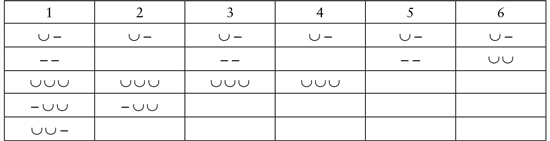
It is sometimes argued that the iambic trimeter is the metre most like prose. Certainly, it allows for conversation that sounds natural. As with all metres, a poet can use the scheme to achieve certain effects, but it should be said that there is not much metrical variation in Medea. Of the play’s 1030 iambic lines there are 75 in which a unit other than an iamb or a spondee is used. There are no anapaests in Medea’s iambic trimeters.
Language and style
Euripidean language does not always follow the rules taught to twenty-first-century pupils about ancient Greek. Below are listed some grammatical usages that are rarely found in prose (if at all):
• omission of the article, where it would be expected in prose (as in line 220);
• alternative dative plural forms, i.e. -αισι(ν) and -οισι(ν);
• crasis (the joining of two words to make one word, where the first word is either the article or καὶ) is fairly common (e.g. οὑμὸς at 229);
• placing the preposition after the noun it governs (as at line 217);
• different pronoun forms: accusative plural (394: σφε); dative plural (399: σφιν);
• non-compound forms of verbs that would normally be compounds in prose (e.g. κτενῶ in line 394).
Below are some common features of tragic language:
• asyndeton – the lack of connection – can be used for stylisic effect, as Greek prose normally insists on clear connection between every sentence;
• in stichomythia – an exchange between two actors where each actor speaks one line – the syntax can be interrupted by the other speaker, or the syntax of one speaker’s line might be completed by the other speaker, or by the first speaker in their next line;
• ἐστί is often omitted (as at line 345);
• while there is occasional enjambement, most lines have some form of punctuation at the end of the line;
• word order – flexible in Greek prose – is even more varied in verse.
A brief note on technical terms
Some commentaries and introductions to tragedy like to make not inconsiderable use of technical terms. This author’s view is that it is perfectly possible to respond to Medea in an interesting and sophisticated way without persistent recourse to such terms. However, there is one term that does appear several times, namely, metonymy (a form of metaphor in which one term is used for another). In Medea this is most common with the various words for ‘bed’ (explanations are given in the commentary).
|
aphorism |
a principle or precept expressed pithily. |
|
|
hendiadys |
a stylistic feature whereby a single idea is expressed by two words joined by a conjunction. |
|
|
litotes |
understatement, sometimes by the use of a double negative. |
|
|
metaphor |
non-literal language. |
|
|
metonymy |
a form of metaphor, in which one term stands for another, e.g. ‘Downing Street announced today’. |
|
|
tautology |
repetition or saying the same thing twice. |
Medea – the myth
With a small number of notable exceptions, tragedy took its stories from existing bodies of myth. Medea is no exception to this rule. But, as is often the case with other tragedies, we do not have a full treatment of the various parts of the Medea myth before Euripides’ play. We think that an earlier epic poet called Eumelus may have written an extensive treatment in a lost epic poem, Corinthiaca, and there seems to have been another lost epic, Naupactia (no author known), which dealt with the Medea myth. There are allusions to various parts of the story in Homer, Hesiod and Pindar, but we have no full account of the expedition of the Argonauts until Apollonius Rhodius’ epic of the third century BC. From Apollonius the story of Jason and the Argonauts runs as follows. Jason’s father, Aeson, had his kingship of Iolcus in Thessaly usurped by his half-brother, Pelias. When Jason, on reaching adulthood, tried to claim the kingdom as his birthright, Pelias demanded that Jason first fetch the Golden Fleece from Colchis on the Black Sea. Pelias expected that the task would be impossible. Jason and his comrades built the first ship, the Argo, sailed to Colchis and secured the Golden Fleece with the help of Medea, the daughter of the king of Colchis, Aeetes. To delay her father’s pursuit, Medea killed her brother. When she and Jason returned to Iolcus, Medea persuaded the daughters of Pelias to cut up their father and boil him in order to restore his youth. Following Pelias’ not unexpected death, Jason and Medea fled to Corinth.
The important thing to remember is that authors were free to vary the details of the myth (Euripides, for instance, wrote a play in which Helen was never in Troy at all), and were also free to concentrate on one particular section of the story. As with most myths, there is a considerable variety in the different versions, in relation to, for instance, how Medea murders her brother, where Jason and Medea live, the number of children they have and how and by whom the children are killed (in one version it is the Corinthians rather than Medea who murder the children). That said, allusion is made in the play to the Argonauts’ expedition, where Jason was charged to get hold of the Golden Fleece, and also the help that Medea gave Jason to acquire the fleece, including the murder of her brother, Apsyrtus, possibly to slow down Medea’s father as he pursues Jason. Euripides’ play, though, refers to killing Apsyrtus ‘at the hearth’ (line 1334): killing a relative in their home is particularly horrible. Reference is also made to Medea causing the death of Pelias (see lines 9, 486–7, 504–8): it was the usurper Pelias who asked Jason to take on what he thought was the impossible task of fetching the Golden Fleece.
There is some fragmentary evidence that there was a Medea written by an earlier tragedian called Neophron. It is even claimed that Euripides based his play on Neophron’s, or even passed off Neophron’s play as his own. There is a very careful consideration of this in the introduction to Mastronarde’s commentary (Mastronarde 2002: pp. 57–64). While accepting that debate about Neophron’s play is likely to continue, Mastronarde concludes that the fragments we have are likely to come from a play written after Euripides’ version.
In fact, based on the allusions to the myth that occur in earlier authors, it looks as though Euripides may have provided the following innovations: the character of Glauke, Jason’s marriage to her, Aegeus’ involvement, the use of a poisoned robe to kill Creon and his daughter, Medea’s deliberate murder of the children, Medea’s escape in a chariot given to her by her grandfather, the Sun. However, we should not be confident that each of these were Euripidean innovations: we simply lack the evidence to demonstrate that.
Medea – the play
Medea is a very powerful play, which has inspired both an extensive body of scholarly work and a large number of modern theatrical productions. This short introduction cannot do justice to the variety of critical approaches (please see the ‘Suggestions for further reading’), but it does try to deal with the structure of the play, some of its important themes, the staging of the play and the reception of the play both in antiquity and in modern times.
The play’s structure
Medea is organized to create as much dramatic and emotional impact as possible. At first, even though she plans a murderous revenge, Medea has the chorus (and the audience in modern productions, at least) on her side. To be able to achieve the revenge she has actually planned, Medea needs to be confident she has a sanctuary after she has committed the murders. This explains the Aegeus scene (even though some scholars have found the plotting unsatisfactory). It is only after this scene that the chorus realize what Medea actually plans to do. The Aegeus scene is surrounded by two contrasting encounters between Jason and Medea. In the first she tells (what she believes to be) the truth about Jason’s treatment of her, and achieves nothing, confronted by Jason’s complacent misogyny. After the Aegeus scene, she has a very different meeting with Jason, where she pretends to be reconciled to his new marriage, and where she offers presents, through which she hopes to secure the deaths of Glauke and Creon. Once news reaches Medea that she has been successful, the play relentlessly leads to the murder of the children, and to her triumph over Jason. The play’s structure is often analysed in rather a technical way, but understanding the structure can also help with understanding plot, theme and character. The following description of the structure is borrowed from Mastronarde’s commentary. To make sense of it, the following technical terms will be useful:
parodos entry of the chorus
episode spoken scene between actors
stasimon sung choral lyric
exodos the last scene of the play (literally: the going out)
Prologue (1–130)
• Nurse’s monologue (1–48)
• dialogue between the Nurse and the tutor (49–95)
• anapaestic exchange between the Nurse and Medea indoors (96–130)
Parodos (131–213)
anapaests of Nurse and Medea, with some choral song
First episode (214–409)
• Medea’s monologue with brief comment from the chorus (214–70)
• dialogue between Medea and Creon (271–356)
• Medea and the chorus (357–409)
First stasimon (chorus) (410–45)
Second episode (446–626)
debate between Medea and Jason
Second stasimon (627–62)
Third episode (663–823)
• dialogue between Medea and Aegeus (663–763)
• Medea and chorus (764–823)
Third stasimon (824–65)
Fourth episode (866–75)
• dialogue between Medea and Jason, with the children brought out by the tutor
Fourth stasimon (976–1001)
Fifth episode (1002–80)
• dialogue between Medea and the tutor (1002–20)
• Medea’s great monologue (1021–80)
Anapaestic interlude, in place of a chorus (1081–1115)
Sixth episode (1116–1250)
• dialogue between Medea and the messenger (1116–35)
• messenger speech (1136–1230)
• Medea and the chorus (1231–50)
Fifth stasimon (1251–92)
Exodos (1293–1419)
• dialogue of Jason and chorus (1293–1316)
• iambic dialogue between Medea and Jason (1317–88)
• anapaestic dialogue between Medea and Jason (1389–1414)
• chorus’ summary (1415–19)
Themes
Medea is a very rich and sophisticated play, organized around Medea’s revenge on Jason for his betrayal (revenge is not uncommon as a motivating device in tragedy). It shows an acute interest in Medea’s psychology; it represents Medea as a powerful ‘other’ figure, both as barbarian and as woman; key interests of the play are rhetorical efficacy, sexual politics and religious propriety. The imagery used in the play – naval, medical, animal, military – serves to deepen and sharpen the play’s concerns as listed above (Mastronarde 2002: 34–6 is good but concise on the imagery in the play).
To achieve her revenge Medea has to overcome a number of obstacles. First, she has to overcome her own despair, which dominates the opening of the play; second, she needs someone on her side and looks here for the chorus’ sisterly support; third, she needs a little extra time and manages to persuade Creon to give her a day; fourth, she needs sanctuary once she has committed the murders, and she succeeds in persuading Aegeus to give her a home in Athens; fifth, she needs to win Jason round so that the lethal gifts can be delivered to Glauke and Creon; finally, she needs to overcome her own psychological difficulties.
It is most especially in relation to the killing of the children that Euripides’ complex portrait of a woman divided against herself is seen. This is best demonstrated in her famous monologue (1019–80), where her veering back and forth between preparing to murder her children to shouting the impossibility of such an act for a mother is passionate, powerful and realistic. At the same time, Euripides’ psychological interest is also apparent in the way that the wildly despairing Medea of the early part of the play can become an acute analyst of sexual inequality, a powerful orator arguing against misogyny and unfair dealing, an extremely skilful manipulator of men and – finally – the extreme and extremely vengeful and violent figure whom we see at the end of the play. The portrait, in its compelling variety, is powerful and complex.
One of the reasons for Medea’s acute sense of betrayal is that Jason swore an oath to her, made by joining right hands. Oaths – and the breaking of them – pervade the play (see, for instance, 160ff., 209, 412–13, 439, 492–5, 659–92, 698, 731ff., 745ff., 1352, 1364). Hands are important in relation to oaths (496–8), and as a sign of familial connection (see 899, 1069–73), but they are also important in supplication (e.g. 324ff.) and, more troublingly, as the agents of violence (e.g. 857, 864, 1055, 1239, 1244, 1254, 1279, 1283, 1309, 1322, 1365). This pervasive reference to oaths and supplication, and thereby to Greek gods and religious institutions, demonstrates the complicated relationship that the barbarian Medea has to Greek mores.
It is in the various representations of Medea as ‘other’ – as a woman, as a barbarian, as a barbarian with special magical powers and as a woman whose grandfather is the Sun – that Medea is most extraordinary and most threatening. Commonly described as frightening (e.g. 38ff., 271, 282, 316), as difficult (525), as different (579), both Jason and Medea agree that there is something about Medea’s barbarian origins that marks her out, though there is nothing in the way she speaks Greek or in her attitudes to, say, Greek religious practice that substantiates that view. However, Jason argues that had he not brought Medea to Greece from her barbarian land, she would not be enjoying the rule of law guaranteed by Greek civilization (536–8), so the distinction between Greek and barbarian remains important ideologically. Medea thinks that Jason finds having a barbarian wife no longer respectable (591–2). She also claims to Aegeus that she has a special knowledge of drugs (717–18). Medea seems in many ways special but it is in her confronting of male supremacy that her challenge, her threat is most obvious.
We first hear Medea lamenting from inside the house. Nearly her first words when she appears on stage are ‘I have come out of the house’ (214). Thus she begins her appropriation of what in fifth-century Athenian ideological terms was supposed to be the exclusive possession of men, namely, engaging in rhetoric and violence outside the house (women were supposed to confine themselves inside, and to keep quiet: see the note on 214–15). In her first great speech (214ff.), Medea decries how badly the institution of marriage treats women (though it is not clear she is married to Jason – note, however, line 910 where Jason himself implies that they are married – and the institution she describes looks very fifth-century and very Athenian). At lines 248–51, she offers a direct challenge to male supremacy based on men’s participation in war. She manipulates Creon successfully, even though he is wary, and she makes a passionate though unsuccessful case against Jason in their first debate (i.e. Jason is not persuaded of her case, though the chorus are). She manipulates Aegeus to secure sanctuary in Athens. She manages to keep the chorus complicit, even when they realize that she plans to murder her children. She persuades Jason to take the children bearing presents to Glauke. She brings about the deaths of Glauke and Creon, and manages to kill her own children. Her achievements in persuasion, manipulation and violence are remarkable. In a series of confrontations with (mainly) men, who are characterized as variously fearful (Creon), complacent and unpleasant (Jason) or easily manipulated (Aegeus), she for the most part wins.
Why is Medea such a threat? First of all, it is because she so dominantly and successfully does what men claim they do (that’s the rhetoric and the violence). Second, it is whom she chooses to kill. By killing Glauke, she destroys one part of Jason’s future and one way in which, in a patrilineal society, he can secure his legacy. By killing her own children, she destroys another part of his future. In short, her attack is one against patriarchy itself. No wonder the play may have been perceived as shocking in 431 BC; no surprise that the early twentieth-century suffragettes took up the play as a rallying cry.
It is a typically Euripidean irony, though, that a play seen by many as proto-feminist is one in which a mother kills her own children.
Staging
The skene – the rectangular hut at the back of the stage – represents the house where Medea and Jason have been living in Corinth. It does not quite seem to be in the centre of the city. One of the exits leads to the centre of the city, where Creon’s palace is situated; the other leads to the gates at the city walls. Interestingly, all the characters except Aegeus enter and exit using the city side, though it is not clear whether the chorus entered from both sides. There are few props required for the play: some mark of royalty, such as a sceptre, for Creon and Aegeus; perhaps some weapons for Creon’s attendants; Medea’s gifts to Glauke.
Tragedy at the time of Medea used three male actors. It is likely that the lead actor – the protagonist, who competed in the protagonists’ competition – would have taken the part of Medea. The second actor could perhaps have played the parts of the Nurse, Creon and Jason, while the third could have been the tutor, Aegeus and the Messenger. There are a number of silent parts: the attendants of Creon and Aegeus, and possibly for Jason as well, and, of course, the children.
The masks and costumes of the actors are likely to have been conventional. So Creon would have been bearded but perhaps greying, while Aegeus and Jason would have been bearded but without grey. Costume may have been used to distinguish the free (and indeed noble) from the slaves. Most discussion in this area has centred around Medea herself. The Nurse in the prologue describes her as not eating and as crying continually. It is not clear whether that was reflected in her mask but there is some reason to doubt that it was: appearances that departed from convention are normally commented on in the texts themselves, as in the case of Electra’s rags in Electra and Orestes’ wild hair in Orestes. More interesting is whether Medea was costumed in an overtly non-Greek way, as iconographic depictions of Medea produced after 431 BC have her wearing elaborate eastern robes of various sorts (this is not the case with iconographic representations produced before 431 BC). Another way that Medea’s otherness may have been indicated was by the colour of her skin (Herodotus 2.104 says that the Colchians were dark-skinned like the Egyptians), but no iconographic depiction has her with anything other than light skin.
As already mentioned, the most stunning theatrical effect of Medea is the use of the mechane at the end of the play. This piece of theatre kit allowed characters to appear way above the acting space. What is shocking about the use of it in Medea is that the mechane is normally reserved for gods (in the play the mechane is explicitly said to be the chariot belonging to her divine grandfather, the Sun). Yet here we see a mother with the corpses of the children she has murdered. At the same time, the use of the device visually represents her superiority over Jason but perhaps also the fact that she has left the human realm.
Reception
It seems fairly clear that Euripides’ Medea, though it did not win the first prize in 431 BC, had become, by some time in the fourth century, if not earlier, something of a ‘classic’. Certainly, there seem to have been a number of literary treatments in the fourth century BC, and there is a good collection of iconographic representations of Medea from the fourth century BC which seem to show an interest in Euripides’ version. What is particularly fascinating is how Medea is so often represented in a chariot and also so often in non-Greek clothing (for an interesting online discussion, with images of the vase paintings, please go to ‘The Underworld Painter and the Corinthian adventures of Medea: An interpretation of the crater in Munich’ by Ludovico Rebaudo, which can be accessed at http://www.engramma.it/eOS2/index.php?id_articolo=1380).
The play proved popular among the Romans as well, with adaptations written by Ennius, Accius, Ovid, Seneca the Younger and Hosidius Geta. In the modern era one of the most celebrated of productions was the 1907 production at the Savoy Theatre, using Gilbert Murray’s translation. This is sometimes referred to as the ‘votes-for-women’ production, during which mass arrests of women activists were made. After the Second World War, the French playwright Jean Anouilh translated the play in 1946 and there was a highly popular production on Broadway directed by Robinson Jeffers in 1947. There is a magnificent film released in 1969, directed by Pier Paolo Pasolini, and starring the great opera singer Maria Callas as Medea. The German novelist Christa Wolf published a novel Medea in 1996 (translated as Medea: A Modern Retelling by John Cullen). Recent years have seen some famous productions in London: Diana Rigg starred as Medea in 1993, and Fiona Shaw played the role in 2001. In 2014, Helen McCrory played the part, and in 2015, in another modern retelling by writer Rachel Cusk, Medea was played by Kate Fleetwood.
Clearly, the play retains its power.
Euripides – a brief note
Euripides, born probably in the 480s BC, was one of the three great Athenian tragedians of the fifth century. We have seventeen tragedies in more or less complete form written by Euripides, compared to seven each for Aeschylus and Sophocles. The first sure date of his life is 455 BC, the date of his first production at the Great Dionysia. The earliest play that we have is Alcestis (438 BC). Medea is, in fact, the second of the plays that we have, performed in 431 BC. Euripides died in 406 BC, and two of his surviving plays (Iphigeneia at Aulis and Bacchae) were performed posthumously between 405 and 400 BC.
Euripides had a distinctive reputation in antiquity; he still does. One view – backed up by the fact that he won only four first prizes in the dramatic competition at the Great Dionysia, compared with Aeschylus’ 13 and Sophocles’ possible 20 – was that Euripides was not popular with the Athenian audience. However, the fact that he was granted entry to the dramatic festival on at least twenty occasions (there is evidence that Euripides had 92 plays performed) would suggest otherwise. One common critical response to his relative lack of success in the dramatic competition is to argue that there is something about the plays themselves that the audience found troubling or even scandalous.
One area where this may have been true was the shocking representation of women – and Medea certainly seems to fit into that category. (The plot of Aristophanes’ Thesmophoriazusae is based on the hostility of the women of Athens to Euripides because of the dramatic female figures he created.) Another area – again much satirized in Aristophanes – is the pervasiveness in his plays of sophistic thought and rhetoric, used to challenge and even subvert some of fifth-century Athens’ most cherished values. The picture of Euripides as a transgressive, subversive iconoclast is not new; that does not mean, though, that it is not true.
However, we probably do need to provide a slightly more nuanced picture. Aristophanes’ Frogs, produced a year or so after Euripides’ death, confirms that Euripides was already seen as one of the three great tragedians. Challenging and subversive though his plays can be, Euripides can also be seen as an innovative practitioner who contributed to changes in and the development of tragic convention. Certainly, his popularity increased after his death, and his literary influence is significant, not only on the New Comedy of the fourth century but also on authors as different as Ovid and Seneca.
Suggestions for further reading
The critical literature on Medea is vast and still expanding. Below are a few items. Many articles from scholarly journals are now available online at JSTOR.
Commentaries
Elliott, Alan (ed.) Euripides Medea (Oxford: Oxford University Press, 1969).
Mastronarde, Donald J. (ed.) Euripides: Medea (Cambridge: Cambridge University Press, 2002).
Mossman, J. (ed.) Euripides: Medea (Oxford: Aris and Phillips, 2011) (with facing translation).
Page, D.L. (ed.) Euripides: Medea (Oxford: Oxford University Press, 1938).
Translations
Harrison, J. (ed.) Euripides Medea. Translated by Judith Affleck (Cambridge: Cambridge University Press, 1999).
Kovacs, David. Euripides Volume I (Cambridge, MA: Harvard University Press, 1994).
Morwood, James. Euripides: Medea and Other Plays (Oxford: Oxford University Press, 2008).
Rutherford, Richard B. (ed.) Medea and Other Plays. Translated by John Davie (London: Penguin, 2003).
Vellacott, P. Euripides: Medea/Hecabe/Electra/Heracles (London: Penguin, 1963).
Critical treatments
Allan, W. Euripides: Medea (London: Duckworth, 2002).
Barlow, S.A. ‘Stereotype and reversal in Euripides’ Medea’, Greece and Rome 36 (1989): pp. 158–71.
Clauss, J.J. and Johnston, S.I. (eds.) Medea: Essays on Medea in Myth, Literature, Philosophy and Art (Princeton, NJ: Princeton University Press, 1997).
Easterling, P.E. ‘The infanticide in Euripides’ Medea’, Yale Classical Studies 25 (1977): pp. 177–91.
Foley, H.P. ‘Medea’s divided self’, Classical Antiquity 8 (1989): pp. 61–85.
Knox, B.M.W. ‘The Medea of Euripides’, Yale Classical Studies 25 (1977): pp. 193–225.
McDermott, E. Euripides’ Medea: The Incarnation of Disorder (Pennsylvania, 1989).
The text is from Diggle, J. Euripidis Fabulae. Tomus 1 (Oxford: Oxford University Press, 1984).
Text
|
Μή. |
Κορίνθιαι γυναῖκες, ἐξῆλθον δόμων |
|
|
μή μοί τι μέμψησθ᾽· οἶδα γὰρ πολλοὺς βροτῶν σεμνοὺς γεγῶτας, τοὺς μὲν ὀμμάτων ἄπο, τοὺς δ᾽ ἐν θυραίοις· οἱ δ᾽ ἀφ᾽ ὀσύχου ποδὸς δύσκλειαν ἐκτήσαντο καὶ ῥᾳθυμίαν. δίκη γὰρ οὐκ ἔνεστ᾽ ἐν ὀφθαλμοῖς βροτῶν, |
215 |
|
|
ὅστις πρὶν ἀνδρὸς σπλάγχνον ἐκμαθεῖν σαφῶς στυγεῖ δεδορκώς, οὐδὲν ἠδικημένος. χρὴ δὲ ξένον μὲν κάρτα προσχωρεῖν πόλει· οὐδ᾽ ἀστὸν ᾔνεσ᾽ ὅστις αὐθάδης γεγὼς πικρὸς πολίταις ἐστὶν ἀμαθίας ὕπο. |
220 |
|
|
ἐμοὶ δ᾽ ἄελπτον πρᾶγμα προσπεσὸν τόδε ψυχὴν διέφθαρκ᾽· οἴχομαι δὲ καὶ βίου χάριν μεθεῖσα κατθανεῖν χρἴζω, φίλαι. ἐν ᾧ γὰρ ἦν μοι πάντα, γιγνώσκω καλῶς, κάκιστος ἀνδρῶν ἐκβέβηχ᾽ οὑμὸς πόσις. |
225 |
|
|
πάντων δ᾽ ὅσ᾽ ἔστ᾽ ἔμψυχα καὶ γνώμην ἔχει γυναῖκές ἐσμεν ἀθλιώτατον φυτόν· ἃς πρῶτα μὲν δεῖ χρημάτων ὑπερβολῇ πόσιν πρίασθαι δεσπότην τε σώματος λαβεῖν· κακοῦ γὰρ τοῦτ᾽ ἔτ᾽ ἄλγιον κακόν. |
230 |
|
|
κἀν τῷδ᾽ ἀγὼν μέγιστος, ἢ κακὸν λαβεῖν ἢ χρηστόν· οὐ γὰρ εὐκλεεῖς ἀπαλλαγαὶ γυναιξὶν οὐδ᾽ οἷόν τ᾽ ἀνήνασθαι πόσιν. ἐς καινὰ δ᾽ ἤθη καὶ νόμους ἀφιγμένην δεῖ μάντιν εἶναι, μὴ μαθοῦσαν οἴκοθεν, |
235 |
|
|
οἵῳ μάλιστα χρήσεται ξυνευνέτῃ. κἂν μὲν τάδ᾽ ὀμῖν ἐκπονουμέναισιν εὖ πόσις ξυνοικῇ μὴ βίᾳ φέρων ζυγόν, ζηλωτὸς αἰών· εἰ δὲ μή, θανεῖν χρεών. ἀνὴρ δ᾽, ὅταν τοῖς ἔνδον ἄχθηται ξυνών, |
240 |
|
|
ἔξω μολὼν ἔπαυσε καρδίαν ἄσης ἢ πρὸς φίλον τιν᾽ ἢ πρὸς ἥλικα τραπείς· ὀμῖν δ᾽ ἀνάγκη πρὸς μίαν ψυχὴν βλέπειν. λέγουσι δ᾽ ὀμᾶς ὡς ἀκίνδυνον βίον ζῶμεν κατ᾽ οἴκους, οἱ δὲ μάρνανται δορί, |
245 |
|
|
κακῶς φρονοῦντες· ὡς τρὶς ἂν παρ᾽ ἀσπίδα στῆναι θέλοιμ᾽ ἂν μᾶλλον ἢ τεκεῖν ἅπαξ. ἀλλ᾽ οὐ γὰρ αὑτὸς πρὸς σὲ κἄμ᾽ ἥκει λόγος· σοὶ μὲν πόλις θ᾽ ἥδ᾽ ἐστὶ καὶ πατρὸς δόμοι βίου τ᾽ ὄνησις καὶ φίλων συνουσία, |
250 |
|
|
ἐγὼ δ᾽ ἔρημος ἄπολις οὖσ᾽ ὑβρίζομαι πρὸς ἀνδρός, ἐκ γῆς βαρβάρου λελῃσμένη, οὐ μητέρ᾽, οὐκ ἀδελφόν, οὐχὶ συγγενῆ μεθορμίσασθαι τῆσδ᾽ ἔχουσα συμφορᾶς. τοσοῦτον οὖν σου τυγχάνειν βουλήσομαι, |
255 |
|
|
ἤν μοι πόρος τις μηχανή τ᾽ ἐξευρεθῇ πόσιν δίκην τῶνδ᾽ ἀντιτείσασθαι κακῶν τὸν δόντα τ᾽ αὐτῷ θυγατέρ᾽ ἥν τ᾽ ἐγήματο, σιγᾶν. γυνὴ γὰρ τἄλλα μὲν φόβου πλέα κακή τ᾽ ἐς ἀλκὴν καὶ σίδηρον εἰσορᾶν· |
260 |
|
|
ὅταν δ᾽ ἐς εὐνὴν ἠδικημένη κυρῇ, οὐκ ἔστιν ἄλλη φρὴν μιαιφονωτέρα. |
265 |
|
|
Χο. |
δράσω τάδ᾽· ἐνδίκως γὰρ ἐκτείσῃ πόσιν, Μήδεια. πενθεῖν δ᾽ οὔ σε θαυμάζω τύχας. ὁρῶ δὲ καὶ Κρέοντα, τῆσδ᾽ ἄνακτα γῆς, |
|
|
στείχοντα, καινῶν ἄγγελον βουλευμάτων. Κρ.σὲ τὴν σκυθρωπὸν καὶ πόσει θυμουμένην, Μήδει᾽, ἀνεῖπον τῆσδε γῆς ἔξω περᾶν φυγάδα, λαβοῦσαν δισσὰ σὺν σαυτῇ τέκνα, καὶ μή τι μέλλειν· ὡς ἐγὼ βραβεὺς λόγου |
270 |
|
|
τοῦδ᾽ εἰμί, κοὐκ ἄπειμι πρὸς δόμους πάλιν πρὶν ἄν σε γαίας τερμόνων ἔξω βάλω. αἰαῖ· πανώλης ὀ τάλαιν᾽ ἀπόλλυμαι· Μή.ἐχθροὶ γὰρ ἐξιᾶσι πάντα δὴ κάλων, κοὐκ ἔστιν ἄτης εὐπρόσοιστος ἔκβασις. |
275 |
|
|
ἐρήσομαι δὲ καὶ κακῶς πάσχουσ᾽ ὅμως· τίνος μ᾽ ἕκατι γῆς ἀποστέλλεις, Κρέον; Κρ.δέδοικά σ᾽, οὐδὲν δεῖ παραμπίσχειν λόγους, μή μοί τι δράσῃς παῖδ᾽ ἀνήκεστον κακόν. συμβάλλεται δὲ πολλὰ τοῦδε δείγματα· |
280 |
|
|
σοφὴ πέφυκας καὶ κακῶν πολλῶν ἴδρις, λυπῇ δὲ λέκτρων ἀνδρὸς ἐστερημένη. κλύω δ᾽ ἀπειλεῖν σ᾽, ὡς ἀπαγγέλλουσί μοι, τὸν δόντα καὶ γήμαντα καὶ γαμουμένην δράσειν τι. ταῦτ᾽ οὖν πρὶν παθεῖν φυλάξομαι. |
285 |
|
|
κρεῖσσον δέ μοι νῦν πρός σ᾽ ἀπεχθέσθαι, γύναι, ἢ μαλθακισθένθ᾽ ὕστερον μεταστένειν. |
290 |
|
|
Μή. |
φεῦ φεῦ. οὐ νῦν με πρῶτον ἀλλὰ πολλάκις, Κρέον, ἔβλαψε δόξα μεγάλα τ᾽ εἴργασται κακά. χρὴ δ᾽ οὔποθ᾽ ὅστις ἀρτίφρων πέφυκ᾽ ἀνὴρ |
|
|
παῖδας περισσῶς ἐκδιδάσκεσθαι σοφούς· χωρὶς γὰρ ἄλλης ἧς ἔχουσιν ἀργίας φθόνον πρὸς ἀστῶν ἀλφάνουσι δυσμενῆ. σκαιοῖσι μὲν γὰρ καινὰ προσφέρων σοφὰ δόξεις ἀχρεῖος κοὐ σοφὸς πεφυκέναι· |
295 |
|
|
τῶν δ᾽ αὖ δοκούντων εἰδέναι τι ποικίλον κρείσσων νομισθεὶς ἐν πόλει λυπρὸς φανῇ. ἐγὼ δὲ καὐτὴ τῆσδε κοινωνῶ τύχης· σοφὴ γὰρ οὖσα, τοῖς μέν εἰμ᾽ ἐπίφθονος, τοῖς δ᾽ ὀσυχαία, τοῖς δὲ θατέρου τρόπου, |
300 |
|
|
τοῖς δ᾽ αὖ προσάντης· εἰμὶ δ᾽ οὐκ ἄγαν σοφή, σὺ δ᾽ αὖ φοβῇ με· μὴ τί πλημμελὲς πάθῃς; οὐχ ὧδ᾽ ἔχει μοι, μὴ τρέσῃς ὀμᾶς, Κρέον, ὥστ᾽ ἐς τυράννους ἄνδρας ἐξαμαρτάνειν. σὺ γὰρ τί μ᾽ ἠδίκηκας; ἐξέδου κόρην |
305 |
|
|
ὅτῳ σε θυμὸς ἦγεν. ἀλλ᾽ ἐμὸν πόσιν μισῶ· σὺ δ᾽, οἶμαι, σωφρονῶν ἔδρας τάδε. καὶ νῦν τὸ μὲν σὸν οὐ φθονῶ καλῶς ἔχειν· νυμφεύετ᾽, εὖ πράσσοιτε· τήνδε δὲ χθόνα ἐᾶτέ μ᾽ οἰκεῖν. καὶ γὰρ ἠδικημένοι |
310 |
|
|
σιγησόμεσθα, κρεισσόνων νικώμενοι. |
315 |
|
|
Κρ. |
λέγεις ἀκοῦσαι μαλθάκ᾽, ἀλλ᾽ ἔσω φρενῶν ὀρρωδία μοι μή τι βουλεύῃς κακόν. τοσῷδε δ᾽ ἧσσον ἢ πάρος πέποιθά σοι· γυνὴ γὰρ ὀξύθυμος, ὡς δ᾽ αὔτως ἀνήρ, |
|
|
ῥᾴων φυλάσσειν ἢ σιωπηλὸς σοφή. ἀλλ᾽ ἔξιθ᾽ ὡς τάχιστα, μὴ λόγους λέγε· ὡς ταῦτ᾽ ἄραρε, κοὐκ ἔχεις τέχνην ὅπως μενεῖς παρ᾽ ὀμῖν οὖσα δυσμενὴς ἐμοί. |
320 |
|
|
Μή. |
μή, πρός σε γονάτων τῆς τε νεογάμου κόρης. |
|
|
Κρ. |
λόγους ἀναλοῖς· οὐ γὰρ ἂν πείσαις ποτέ. |
325 |
|
Μή. |
ἀλλ᾽ ἐξελᾷς με κοὐδὲν αἰδέσῃ λιτάς; |
|
|
Κρ. |
φιλῶ γὰρ οὐ σὲ μᾶλλον ἢ δόμους ἐμούς. |
|
|
Μή. |
ὦ πατρίς, ὥς σου κάρτα νῦν μνείαν ἔχω. |
|
|
Κρ. |
πλὴν γὰρ τέκνων ἔμοιγε φίλτατον πολύ. |
|
|
Μή. |
φεῦ φεῦ, βροτοῖς ἔρωτες ὡς κακὸν μέγα. |
330 |
|
Κρ. |
ὅπως ἄν, οἶμαι, καὶ παραστῶσιν τύχαι. |
|
|
Μή. |
Ζεῦ, μὴ λάθοι σε τῶνδ᾽ ὃς αἴτιος κακῶν. |
|
|
Κρ. |
ἕρπ᾽, ὦ ματαία, καί μ᾽ ἀπάλλαξον πόνων. |
|
|
Μή. |
πονοῦμεν ὀμεῖς κοὐ πόνων κεχρήμεθα. |
|
|
Κρ. |
τάχ᾽ ἐξ ὀπαδῶν χειρὸς ὠσθήσῃ βίᾳ. |
335 |
|
Μή. |
μὴ δῆτα τοῦτό γ᾽, ἀλλά σ᾽ ἄντομαι, Κρέον. |
|
|
Κρ. |
ὄχλον παρέξεις, ὡς ἔοικας, ὦ γύναι. |
|
|
Μή. |
φευξούμεθ᾽· οὐ τοῦθ᾽ ἱκέτευσα σοῦ τυχεῖν. |
|
|
Κρ. |
τί δ’ αὖ βιάζῃ κοὐκ ἀπαλλάσσῃ χερός; |
|
|
Μή. |
μίαν με μεῖναι τήνδ᾽ ἔασον ὀμέραν καὶ ξυμπερᾶναι φροντίδ᾽ ᾗ φευξούμεθα, παισίν τ᾽ ἀφορμὴν τοῖς ἐμοῖς, ἐπεὶ πατὴρ οὐδὲν προτιμᾷ μηχανήσασθαί τέκνοις. οἴκτιρε δ᾽ αὐτούς· καὶ σύ τοι παίδων πατὴρ |
340 |
|
πέφυκας· εἰκὸς δέ σφιν εὔνοιάν σ᾽ ἔχειν. τοὐμοῦ γὰρ οὔ μοι φροντίς, εἰ φευξούμεθα, κείνους δὲ κλαίω συμφορᾷ κεχρημένους. |
345 |
|
|
Κρ. |
ἥκιστα τοὐμὸν λῆμ᾽ ἔφυ τυραννικόν, αἰδούμενος δὲ πολλὰ δὴ διέφθορα· |
|
|
καὶ νῦν ὁρῶ μὲν ἐξαμαρτάνων, γύναι, ὅμως δὲ τεύξῃ τοῦδε. προυννέπω δέ σοι, εἴ σ᾽ ὀ ‘πιοῦσα λαμπὰς ὄψεται θεοῦ καὶ παῖδας ἐντὸς τῆσδε τερμόνων χθονός, θανῇ· λέλεκται μῦθος ἀψευδὴς ὅδε. |
350 |
|
|
νῦν δ᾽, εἰ μένειν δεῖ, μίμν᾽ ἐφ᾽ ὀμέραν μίαν· οὐ γάρ τι δράσεις δεινὸν ὧν φόβος μ᾽ ἔχει. |
355 |
357–63: This is a short response from the chorus, which sympathizes with Medea, but also wonders what Medea can do in the circumstances she finds herself in.
|
Μή. |
κακῶς πέπρακται πανταχῇ· τίς ἀντερεῖ; |
|
|
ἀλλ᾽ οὔτι ταύτῃ ταῦτα, μὴ δοκεῖτέ πω. ἔτ᾽ εἴσ᾽ ἀγῶνες τοῖς νεωστὶ νυμφίοις καὶ τοῖσι κηδεύσασιν οὐ σμικροὶ πόνοι. δοκεῖς γὰρ ἄν με τόνδε θωπεῦσαί ποτε εἰ μή τι κερδαίνουσαν ἢ τεχνωμένην; |
365 |
|
|
οὐδ᾽ ἂν προσεῖπον οὐδ᾽ ἂν ὀψάμην χεροῖν. ὁ δ᾽ ἐς τοσοῦτον μωρίας ἀφίκετο ὥστ᾽, ἐξὸν αὐτῷ τἄμ᾽ ἑλεῖν βουλεύματα γῆς ἐκβαλόντι, τήνδ᾽ ἐφῆκεν ὀμέραν μεῖναί μ᾽, ἐν ᾗ τρεῖς τῶν ἐμῶν ἐχθρῶν νεκροὺς |
370 |
|
|
θήσω, πατέρα τε καὶ κόρην πόσιν τ᾽ ἐμόν. πολλὰς δ᾽ ἔχουσα θανασίμους αὐτοῖς ὁδούς, οὐκ οἶδ᾽ ὁποίᾳ πρῶτον ἐγχειρῶ, φίλαι· πότερον ὑφάψω δῶμα νυμφικὸν πυρί, ἢ θηκτὸν ὤσω φάσγανον δι᾽ ἥπατος, |
375 |
|
|
σιγῇ δόμους ἐσβᾶσ᾽, ἵν᾽ ἔστρωται λέχος. ἀλλ᾽ ἕν τί μοι πρόσαντες· εἰ ληφθήσομαι δόμους ὑπερβαίνουσα καὶ τεχνωμένη, θανοῦσα θήσω τοῖς ἐμοῖς ἐχθροῖς γέλων. κράτιστα τὴν εὐθεῖαν, ᾗ πεφύκαμεν |
380 |
|
|
σοφοὶ μάλιστα, φαρμάκοις αὐτοὺς ἑλεῖν. εἶἑν· καὶ δὴ τεθνᾶσι· τίς με δέξεται πόλις; τίς γῆν ἄσυλον καὶ δόμους ἐχεγγύους ξένος παρασχὼν ῥύσεται τοὐμὸν δέμας; οὐκ ἔστι. μείνασ᾽ οὖν ἔτι σμικρὸν χρόνον, |
385 |
|
|
ἢν μέν τις ὀμῖν πύργος ἀσφαλὴς φανῇ, δόλῳ μέτειμι τόνδε καὶ σιγῇ φόνον· ἢν δ᾽ ἐξελαύνῃ ξυμφορά μ᾽ ἀμήχανος, αὐτὴ ξίφος λαβοῦσα, κεἰ μέλλω θανεῖν, κτενῶ σφε, τόλμης δ᾽ εἶμι πρὸς τὸ καρτερόν. |
390 |
|
|
οὐ γὰρ μὰ τὴν δέσποιναν ἣν ἐγὼ σέβω μάλιστα πάντων καὶ ξυνεργὸν εἱλόμην, Ἑκάτην, μυχοῖς ναίουσαν ἑστίας ἐμῆς, χαίρων τις αὐτῶν τοὐμὸν ἀλγυνεῖ κέαρ. πικροὺς δ᾽ ἐγώ σφιν καὶ λυγροὺς θήσω γάμους, |
395 |
|
|
πικρὸν δὲ κῆδος καὶ φυγὰς ἐμὰς χθονός. ἀλλ᾽ εἶα φείδου μηδὲν ὧν ἐπίστασαι, Μήδεια, βουλεύουσα καὶ τεχνωμένη· ἕρπ᾽ ἐς τὸ δεινόν· νῦν ἀγὼν εὐψυχίας. ὁρᾷς ἃ πάσχεις; οὐ γέλωτα δεῖ σ᾽ ὀφλεῖν |
400 |
|
|
τοῖς Σισυφείοις τοῖσδ᾽ Ἰάσονος γάμοις, γεγῶσαν ἐσθλοῦ πατρὸς Ἡλίου τ᾽ ἄπο. ἐπίστασαι δέ· πρὸς δὲ καὶ πεφύκαμεν γυναῖκες, ἐς μὲν ἔσθλ᾽ ἀμηχανώταται, κακῶν δὲ πάντων τέκτονες σοφώταται. |
405 |
410–662: Following Medea’s speech there is a famous chorus, often referred to as the ‘New Song’, in which the members of the chorus announce that now everything has changed. At last there can be a poetry that praises and celebrates women, and criticizes men.
Following the chorus there is the first argument between Medea and Jason, in which Medea is sharply critical of Jason, and in which Jason is complacent about what he is about to do.
Before this scene the chorus reflect on the nature of love, specifically on both its good and destructive effects. The chorus also, as a way of understanding Medea’s plight, ask never to be made homeless and stateless.
Aegeus arrives having come from the oracle at Delphi, where he has been asking about whether he will ever be able to have children.
|
Αἰ. |
Μήδεια, χαῖρε· τοῦδε γὰρ προοίμιον κάλλιον οὐδεὶς οἶδε προσφωνεῖν φίλους. |
|
|
Μή. |
ὦ χαῖρε καὶ σύ, παῖ σοφοῦ Πανδίονος, Αἰγεῦ. πόθεν γῆς τῆσδ᾽ ἐπιστρωφᾷ πέδον; |
665 |
|
Αἰ. |
Φοίβου παλαιὸν ἐκλιπὼν χρηστήριον. |
|
|
Μή. |
τί δ᾽ ὀμφαλὸν γῆς θεσπιῳδὸν ἐστάλης; |
|
|
Αἰ. |
παίδων ἐρευνῶν σπέρμ᾽ ὅπως γένοιτό μοι. |
|
|
Μή. |
πρὸς θεῶν, ἄπαις γὰρ δεῦρ᾽ ἀεὶ τείνεις βίον; |
670 |
|
Αἰ. |
ἄπαιδές ἐσμεν δαίμονός τινος τύχῃ. |
|
|
Μή. |
δάμαρτος οὔσης ἢ λέχους ἄπειρος ὤν; |
|
|
Αἰ. |
οὐκ ἐσμὲν εὐνῆς ἄζυγες γαμηλίου. |
|
|
Μή. |
τί δῆτα Φοῖβος εἶπέ σοι παίδων πέρι; |
|
|
Αἰ. |
σοφώτερ᾽ ἢ κατ᾽ ἄνδρα συμβαλεῖν ἔπη. |
675 |
|
Μή. |
θέμις μὲν ὀμᾶς χρησμὸν εἰδέναι θεοῦ; |
|
|
Αἰ. |
μάλιστ᾽, ἐπεί τοι καὶ σοφῆς δεῖται φρενός. |
|
|
Μή. |
τί δῆτ᾽ ἔχρησε; λέξον, εἰ θέμις κλύειν. |
|
|
Αἰ. |
ἀσκοῦ με τὸν προύχοντα μὴ λῦσαι πόδα … |
|
|
Μή. |
πρὶν ἂν τί δράσῃς ἢ τίν᾽ ἐξίκῃ χθόνα; |
680 |
|
Αἰ. |
πρὶν ἂν πατρῴαν αὖθις ἑστίαν μόλω. |
|
|
Μή. |
σὺ δ᾽ ὡς τί χρἴζων τήνδε ναυστολεῖς χθόνα; |
|
|
Αἰ. |
Πιτθεύς τις ἔστι, γῆς ἄναξ Τροζηνίας. |
|
|
Μή. |
παῖς, ὡς λέγουσι, Πέλοπος, εὐσεβέστατος. |
|
|
Αἰ. |
τούτῳ θεοῦ μάντευμα κοινῶσαι θέλω. |
685 |
|
Μή. |
σοφὸς γὰρ ῴνὴρ καὶ τρίβων τὰ τοιάδε. |
|
|
Αἰ. |
κἀμοί γε πάντων φίλτατος δορυξένων. |
|
|
Μή. |
ἀλλ᾽ εὐτυχοίης καὶ τύχοις ὅσων ἐρᾷς. |
|
|
Αἰ. |
τί γὰρ σὸν ὄμμα χρώς τε συντέτηχ᾽ ὅδε; |
|
|
Μή. |
Αἰγεῦ, κάκιστός ἐστί μοι πάντων πόσις. |
690 |
|
Αἰ. |
τί φἴς; σαφῶς μοι σὰς φράσον δυσθυμίας. |
|
|
Μή. |
ἀδικεῖ μ᾽ Ἰάσων οὐδὲν ἐξ ἐμοῦ παθών. |
|
|
Αἰ. |
τί χρῆμα δράσας; φράζε μοι σαφέστερον. |
|
|
Μή. |
γυναῖκ᾽ ἐφ᾽ ὀμῖν δεσπότιν δόμων ἔχει. |
|
|
Αἰ. |
οὔ που τετόλμηκ᾽ ἔργον αἴσχιστον τόδε; |
695 |
|
Μή. |
σάφ᾽ ἴσθ᾽· ἄτιμοι δ᾽ ἐσμὲν οἱ πρὸ τοῦ φίλοι. |
|
|
Αἰ. |
πότερον ἐρασθεὶς ἢ σὸν ἐχθαίρων λέχος; |
|
|
Μή. |
μέγαν γ᾽ ἔρωτα· πιστὸς οὐκ ἔφυ φίλοις. |
|
|
Αἰ. |
ἴτω νυν, εἴπερ, ὡς λέγεις, ἐστὶν κακός. |
|
|
Μή. |
ἀνδρῶν τυράννων κῆδος ἠράσθη λαβεῖν. |
700 |
|
Αἰ. |
δίδωσι δ᾽ αὐτῷ τίς; πέραινέ μοι λόγον. |
|
|
Μή. |
Κρέων, ὃς ἄρχει τῆσδε γῆς Κορινθίας. |
|
|
Αἰ. |
συγγνωστὰ μέντἄρ᾽ ἦν σε λυπεῖσθαι, γύναι. |
|
|
Μή. |
ὄλωλα· καὶ πρός γ᾽ ἐξελαύνομαι χθονός. |
|
|
Αἰ. |
πρὸς τοῦ; τόδ᾽ ἄλλο καινὸν αὖ λέγεις κακόν. |
705 |
|
Μή. |
Κρέων μ᾽ ἐλαύνει φυγάδα γῆς Κορινθίας. |
|
|
Αἰ. |
ἐᾷ δ᾽ Ἰάσων; οὐδὲ ταῦτ᾽ ἐπἴνεσα. |
|
|
Μή. |
λόγῳ μὲν οὐχί, καρτερεῖν δὲ βούλεται. ἀλλ᾽ ἄντομαί σε τῆσδε πρὸς γενειάδος |
|
|
γονάτων τε τῶν σῶν ἱκεσία τε γίγνομαι, οἴκτιρον οἴκτιρόν με τὴν δυσδαίμονα καὶ μή μ᾽ ἔρημον ἐκπεσοῦσαν εἰσίδῃς, δέξαι δὲ χώρᾳ καὶ δόμοις ἐφέστιον. οὕτως ἔρως σοὶ πρὸς θεῶν τελεσφόρος |
710 |
|
|
γένοιτο παίδων καὐτὸς ὄλβιος θάνοις. εὕρημα δ᾽ οὐκ οἶσθ᾽ οἷον ηὕρηκας τόδε· παύσω γέ σ᾽ ὄντ᾽ ἄπαιδα καὶ παίδων γονὰς σπεῖραί σε θήσω· τοιάδ᾽ οἶδα φάρμακα. |
715 |
|
|
Αἰ. |
πολλῶν ἕκατι τήνδε σοι δοῦναι χάριν, |
|
|
γύναι, πρόθυμός εἰμι, πρῶτα μὲν θεῶν, ἔπειτα παίδων ὧν ἐπαγγέλλῃ γονάς· ἐς τοῦτο γὰρ δὴ φροῦδός εἰμι πᾶς ἐγώ. οὕτω δ᾽ ἔχει μοι· σοῦ μὲν ἐλθούσης χθόνα, πειράσομαί σου προξενεῖν δίκαιος ὤν. |
720 |
|
|
τοσόνδε μέντοι σοι προσημαίνω, γύναι· |
725 |
|
|
ἐκ τῆσδε μὲν γῆς οὔ σ᾽ ἄγειν βουλήσομαι, |
726 |
|
|
ἐκ τῆσδε δ᾽ αὐτὴ γῆς ἀπαλλάσσου πόδα· |
729 |
|
|
αὐτὴ δ᾽ ἐάνπερ εἰς ἐμοὺς ἔλθῃς δόμους, |
727 |
|
|
μενεῖς ἄσυλος κοὔ σε μὴ μεθῶ τινι. |
728 |
|
|
ἀναίτιος γὰρ καὶ ξένοις εἶναι θέλω. |
730 |
|
|
Μή. |
ἔσται τάδ᾽· ἀλλὰ πίστις εἰ γένοιτό μοι τούτων, ἔχοιμ᾽ ἂν πάντα πρὸς σέθεν καλῶς. |
|
|
Αἰ. |
μῶν οὐ πέποιθας; ἢ τί σοι τὸ δυσχερές; |
|
|
Μή. |
πέποιθα· Πελίου δ᾽ ἐχθρός ἐστί μοι δόμος |
|
|
Κρέων τε. τούτοις δ᾽ ὁρκίοισι μὲν ζυγεὶς ἄγουσιν οὐ μεθεῖ᾽ ἂν ἐκ γαίας ἐμέ· λόγοις δὲ συμβὰς καὶ θεῶν ἀνώμοτος φίλος γένοι᾽ ἂν κἀπικηρυκεύμασιν τάχ᾽ ἂν πίθοιο· τἀμὰ μὲν γὰρ ἀσθενῆ, |
735 |
|
|
τοῖς δ᾽ ὄλβος ἐστὶ καὶ δόμος τυραννικός. |
740 |
|
|
Αἰ. |
πολλὴν ἔδειξας ἐν λόγοις προμηθίαν· ἀλλ᾽, εἰ δοκεῖ σοι, δρᾶν τάδ᾽ οὐκ ἀφίσταμαι. ἐμοί τε γὰρ τάδ᾽ ἐστὶν ἀσφαλέστερα, σκῆψίν τιν᾽ ἐχθροῖς σοῖς ἔχοντα δεικνύναι, |
|
|
τὸ σόν τ᾽ ἄραρε μᾶλλον. ἐξηγοῦ θεούς. |
745 |
|
|
Μή. |
ὄμνυ πέδον Γῆς πατέρα θ᾽ Ἥλιον πατρὸς τοὐμοῦ θεῶν τε συντιθεὶς ἅπαν γένος. |
|
|
Αἰ. |
τί χρῆμα δράσειν ἢ τί μὴ δράσειν; λέγε. |
|
|
Μή. |
μήτ᾽ αὐτὸς ἐκ γῆς σῆς ἔμ᾽ ἐκβαλεῖν ποτε, |
|
|
μήτ᾽, ἄλλος ἤν τις τῶν ἐμῶν ἐχθρῶν ἄγειν χρἴζῃ, μεθήσειν ζῶν ἑκουσίῳ τρόπῳ. |
750 |
|
|
Αἰ. |
ὄμνυμι Γαῖαν φῶς τε λαμπρόν Ἡλίου θεούς τε πάντας ἐμμενεῖν ἅ σου κλύω. |
|
|
Μή. |
ἀρκεῖ· τί δ᾽ ὅρκῳ τῷδε μὴ ‘μμένων πάθοις; |
|
|
Αἰ. |
ἃ τοῖσι δυσσεβοῦσι γίγνεται βροτῶν. |
755 |
|
Μή. |
χαίρων πορεύου· πάντα γὰρ καλῶς ἔχει. κἀγὼ πόλιν σὴν ὡς τάχιστ᾽ ἀφίξομαι, πράξασ᾽ ἃ μέλλω καὶ τυχοῦσ᾽ ἃ βούλομαι. |
759–868: Once Medea has secured the agreement of Aegeus that she can settle in Athens, she first of all celebrates the likelihood of her vengeance being effective. But she also announces – to the chorus – that she will kill her own children. The chorus beg her not to do that, but Medea is keen to cause as much hurt as possible to Jason.
The chorus then sing a beautiful lyric in praise of Athens and beg Medea to change her mind. At this point Jason, as requested by Medea, enters.
|
Μή. |
Ἰᾶσον, αἰτοῦμαί σε τῶν εἰρημένων |
|
|
συγγνώμον᾽ εἶναι· τὰς δ᾽ ἐμὰς ὀργὰς φέρειν εἰκός σ᾽, ἐπεὶ νῷν πόλλ᾽ ὑπείργασται φίλα. ἐγὼ δ᾽ ἐμαυτῇ διὰ λόγων ἀφικόμην κἀλοιδόρησα· Σχετλία, τί μαίνομαι καὶ δυσμεναίνω τοῖσι βουλεύουσιν εὖ, |
870 |
|
|
ἐχθρὰ δὲ γαίας κοιράνοις καθίσταμαι πόσει θ᾽, ὃς ὀμῖν δρᾷ τὰ συμφορώτατα, γήμας τύραννον καὶ κασιγνήτους τέκνοις ἐμοῖς φυτεύων; οὐκ ἀπαλλαχθήσομαι θυμοῦ; τί πάσχω, θεῶν ποριζόντων καλῶς; |
875 |
|
|
οὐκ εἰσὶ μέν μοι παῖδες, οἶδα δὲ χθόνα φεύγοντας ὀμᾶς καὶ σπανίζοντας φίλων; ταῦτ᾽ ἐννοηθεῖσ᾽ ᾐσθόμην ἀβουλίαν πολλὴν ἔχουσα καὶ μάτην θυμουμένη. νῦν οὖν ἐπαινῶ σωφρονεῖν τέ μοι δοκεῖς |
880 |
|
|
κῆδος τόδ᾽ ὀμῖν προσλαβών, ἐγὼ δ᾽ ἄφρων, ᾗ χρῆν μετεῖναι τῶνδε τῶν βουλευμάτων καὶ ξυμπεραίνειν καὶ παρεστάναι λέχει νύμφην τε κηδεύουσαν ἥδεσθαι σέθεν. ἀλλ᾽ ἐσμὲν οἷόν ἐσμεν, οὐκ ἐρῶ κακόν, |
885 |
|
|
γυναῖκες· οὔκουν χρῆν σ᾽ ὁμοιοῦσθαι κακοῖς, οὐδ᾽ ἀντιτείνειν νήπι᾽ ἀντὶ νηπίων. παριέμεσθα, καί φαμεν κακῶς φρονεῖν τότ᾽, ἀλλ᾽ ἄμεινον νῦν βεβούλευμαι τάδε. ὦ τέκνα τέκνα, δεῦρο, λείπετε στέγας, |
890 |
|
|
ἐξέλθετ᾽, ἀσπάσασθε καὶ προσείπατε πατέρα μεθ᾽ ὀμῶν καὶ διαλλάχθηθ᾽ ἅμα τῆς πρόσθεν ἔχθρας ἐς φίλους μητρὸς μέτα· σπονδαὶ γὰρ ὀμῖν καὶ μεθέστηκεν χόλος. λάβεσθε χειρὸς δεξιᾶς· οἴμοι, κακῶν |
895 |
|
|
ὡς ἐννοοῦμαι δή τι τῶν κεκρυμμένων. ἆρ᾽, ὦ τέκν᾽, οὕτω καὶ πολὺν ζῶντες χρόνον φίλην ὀρέξετ᾽ ὠλένην; τάλαιν᾽ ἐγώ, ὡς ἀρτίδακρύς εἰμι καὶ φόβου πλέα. χρόνῳ δὲ νεῖκος πατρὸς ἐξαιρουμένη |
900 |
|
|
ὄψιν τέρειναν τήνδ᾽ ἔπλησα δακρύων. |
905 |
906–1018: The chorus respond with relief and hope that Medea has indeed changed her plans. Jason also commends Medea on her change of heart, and asks his sons to grow into strong and loyal young men.
An exchange between Medea and Jason follows, in which Medea asks Jason to ask Creon to allow her children to stay. In order to bring Creon round Medea sends the children off with Jason with presents (a dress and a golden crown) for his bride-to-be.
The chorus sing an ode in which they sing of the certain death of the children, and of Glauke, and of the ignorance of Jason.
The children’s tutor returns with the children to tell Medea that the children’s banishment has been cancelled and cannot understand Medea’s distraught response.
|
Μή. |
δράσω τάδ᾽. ἀλλὰ βαῖνε δωμάτων ἔσω |
|
|
καὶ παισὶ πόρσυν᾽ οἷα χρὴ καθ᾽ ὀμέραν. ὦ τέκνα τέκνα, σφῷν μὲν ἔστι δὴ πόλις καὶ δῶμ᾽, ἐν ᾧ λιπόντες ἀθλίαν ἐμὲ οἰκήσετ᾽ αἰεὶ μητρὸς ἐστερημένοι· ἐγὼ δ᾽ ἐς ἄλλην γαῖαν εἶμι δὴ φυγάς, |
1020 |
|
|
πρὶν σφῷν ὀνάσθαι κἀπιδεῖν εὐδαίμονας, πρὶν λουτρὰ καὶ γυναῖκα καὶ γαμηλίους εὐνὰς ἀγῆλαι λαμπάδας τ᾽ ἀνασχεθεῖν. ὦ δυστάλαινα τῆς ἐμῆς αὐθαδίας. ἄλλως ἄρ᾽ ὑμᾶς, ὦ τέκν᾽, ἐξεθρεψάμην, |
1025 |
|
|
ἄλλως δ᾽ ἐμόχθουν καὶ κατεξάνθην πόνοις, στερρὰς ἐνεγκοῦσ᾽ ἐν τόκοις ἀλγηδόνας. ἦ μήν ποθ᾽ ὀ δύστηνος εἶχον ἐλπίδας πολλὰς ἐν ὑμῖν, γηροβοσκήσειν τ᾽ ἐμὲ καὶ κατθανοῦσαν χερσὶν εὖ περιστελεῖν, |
1030 |
|
|
ζηλωτὸν ἀνθρώποισι· νῦν δ᾽ ὄλωλε δὴ γλυκεῖα φροντίς. σφῷν γὰρ ἐστερημένη λυπρὸν διάξω βίοτον ἀλγεινόν τ᾽ ἐμοί· ὑμεῖς δὲ μητέρ᾽ οὐκέτ᾽ ὄμμασιν φίλοις ὄψεσθ᾽, ἐς ἄλλο σχῆμ᾽ ἀποστάντες βίου. |
1035 |
|
|
φεῦ φεῦ· τί προσδέρκεσθέ μ᾽ ὄμμασιν, τέκνα; τί προσγελᾶτε τὸν πανύστατον γέλων; αἰαῖ· τί δράσω; καρδία γὰρ οἴχεται, γυναῖκες, ὄμμα φαιδρὸν ὡς εἶδον τέκνων. οὐκ ἂν δυναίμην· χαιρέτω βουλεύματα |
1040 |
|
|
τὰ πρόσθεν· ἄξω παῖδας ἐκ γαίας ἐμούς. τί δεῖ με πατέρα τῶνδε τοῖς τούτων κακοῖς λυποῦσαν αὐτὴν δὶς τόσα κτᾶσθαι κακά; οὐ δῆτ᾽ ἔγωγε· χαιρέτω βουλεύματα. καίτοι τί πάσχω; βούλομαι γέλωτ᾽ ὀφλεῖν |
1045 |
|
|
ἐχθροὺς μεθεῖσα τοὺς ἐμοὺς ἀζημίους; τολμητέον τάδ᾽· ἀλλὰ τῆς ἐμῆς κάκης τὸ καὶ προσέσθαι μαλθακοὺς λόγους φρενί. χωρεῖτε, παῖδες, ἐς δόμους. ὅτῳ δὲ μὴ θέμις παρεῖναι τοῖς ἐμοῖσι θύμασιν, |
1050 |
|
|
αὐτῷ μελήσει· χεῖρα δ᾽ οὐ διαφθερῶ. |
1055 |
1056–1135: Medea continues her monologue, changing her mind a number of times. The chorus sing an ode about what it means to have children.
Then a messenger brings news of what has happened at the palace. The messenger is horrified; Medea is exultant.
|
Ἄγγ. |
ἐπεὶ τέκνων σῶν ἦλθε δίπτυχος γονὴ σὺν πατρί, καὶ παρῆλθε νυμφικοὺς δόμους, ἥσθημεν οἵπερ σοῖς ἐκάμνομεν κακοῖς δμῶες· δι᾽ ὤτων δ᾽ εὐθὺς ἦν πολὺς λόγος |
|
|
σὲ καὶ πόσιν σὸν νεῖκος ἐσπεῖσθαι τὸ πρίν. κυνεῖ δ᾽ ὁ μέν τις χεῖρ᾽, ὁ δὲ ξανθὸν κάρα παίδων· ἐγὼ δὲ καὐτὸς ὀδονῆς ὕπο στέγας γυναικῶν σὺν τέκνοις ἅμ᾽ ἑσπόμην. δέσποινα δ᾽ ἣν νῦν ἀντὶ σοῦ θαυμάζομεν, |
1140 |
|
|
πρὶν μὲν τέκνων σῶν εἰσιδεῖν ξυνωρίδα, πρόθυμον εἶχ᾽ ὀφθαλμὸν εἰς Ἰάσονα· ἔπειτα μέντοι προυκαλύψατ᾽ ὄμματα λευκήν τ᾽ ἀπέστρεψ᾽ ἔμπαλιν παρηίδα, παίδων μυσαχθεῖσ᾽ εἰσόδους. πόσις δὲ σὸς |
1145 |
|
|
ὀργάς τ᾽ ἀφἴρει καὶ χόλον νεάνιδος, λέγων τάδ᾽· Οὐ μὴ δυσμενὴς ἔσῃ φίλοις, παύσῃ δὲ θυμοῦ καὶ πάλιν στρέψεις κάρα, φίλους νομίζουσ᾽ οὕσπερ ἂν πόσις σέθεν, δέξῃ δὲ δῶρα καὶ παραιτήσῃ πατρὸς |
1150 |
|
|
φυγὰς ἀφεῖναι παισὶ τοῖσδ᾽ ἐμὴν χάριν; ὀ δ᾽, ὡς ἐσεῖδε κόσμον, οὐκ ἠνέσχετο, ἀλλ᾽ ᾔνεσ᾽ ἀνδρὶ πάντα, καὶ πρὶν ἐκ δόμων μακρὰν ἀπεῖναι πατέρα καὶ παῖδας σέθεν λαβοῦσα πέπλους ποικίλους ἠμπέσχετο, |
1155 |
|
|
χρυσοῦν τε θεῖσα στέφανον ἀμφὶ βοστρύχοις λαμπρῷ κατόπτρῳ σχηματίζεται κόμην, ἄψυχον εἰκὼ προσγελῶσα σώματος. κἄπειτ᾽ ἀναστᾶσ᾽ ἐκ θρόνων διέρχεται στέγας, ῴβρὸν βαίνουσα παλλεύκῳ ποδί, |
1160 |
|
|
δώροις ὑπερχαίρουσα, πολλὰ πολλάκις τένοντ᾽ ἐς ὀρθὸν ὄμμασι σκοπουμένη. τοὐνθένδε μέντοι δεινὸν ἦν θέαμ᾽ ἰδεῖν· χροιὰν γὰρ ἀλλάξασα λεχρία πάλιν χωρεῖ τρέμουσα κῶλα καὶ μόλις φθάνει |
1165 |
|
|
θρόνοισιν ἐμπεσοῦσα μὴ χαμαὶ πεσεῖν. καί τις γεραιὰ προσπόλων, δόξασά που ἢ Πανὸς ὀργὰς ἤ τινος θεῶν μολεῖν, ἀνωλόλυξε, πρίν γ᾽ ὁρᾷ διὰ στόμα χωροῦντα λευκὸν ἀφρόν, ὀμμάτων τ᾽ ἄπο |
1170 |
|
|
κόρας στρέφουσαν, αἷμά τ᾽ οὐκ ἐνὸν χροΐ· εἶτ᾽ ἀντίμολπον ἧκεν ὀλολυγῆς μέγαν κωκυτόν. εὐθὺς δ᾽ ὀ μὲν ἐς πατρὸς δόμους ὥρμησεν, ὀ δὲ πρὸς τὸν ἀρτίως πόσιν, φράσουσα νύμφης συμφοράν· ἅπασα δὲ |
1175 |
|
|
στέγη πυκνοῖσιν ἐκτύπει δραμήμασιν. ἤδη δ᾽ ἀνελθὼν κῶλον ἑκπλέθρου δρόμου ταχὺς βαδιστὴς τερμόνων ἂν ἥπτετο· ὀ δ’ ἐξ ἀναύδου καὶ μύσαντος ὄμματος δεινὸν στενάξασ᾽ ὀ τάλαιν᾽ ἠγείρετο. |
1180 |
|
|
διπλοῦν γὰρ αὐτῇ πῆμ᾽ ἐπεστρατεύετο· χρυσοῦς μὲν ἀμφὶ κρατὶ κείμενος πλόκος θαυμαστὸν ἵει νᾶμα παμφάγου πυρός, πέπλοι δὲ λεπτοί, σῶν τέκνων δωρήματα, λευκὴν ἔδαπτον σάρκα τῆς δυσδαίμονος. |
1185 |
|
|
φεύγει δ᾽ ἀναστᾶσ᾽ ἐκ θρόνων πυρουμένη, σείουσα χαίτην κρᾶτά τ᾽ ἄλλοτ᾽ ἄλλοσε, ῥῖψαι θέλουσα στέφανον· ἀλλ᾽ ἀραρότως σύνδεσμα χρυσὸς εἶχε, πῦρ δ᾽, ἐπεὶ κόμην ἔσεισε, μᾶλλον δὶς τόσως ἐλάμπετο. |
1190 |
|
|
πίτνει δ᾽ ἐς οὖδας συμφορᾷ νικωμένη, πλὴν τῷ τεκόντι κάρτα δυσμαθὴς ἰδεῖν· οὔτ᾽ ὀμμάτων γὰρ δῆλος ἦν κατάστασις οὔτ᾽ εὐφυὲς πρόσωπον, αἷμα δ᾽ ἐξ ἄκρου ἔσταζε κρατὸς συμπεφυρμένον πυρί, |
1195 |
|
|
σάρκες δ᾽ ἀπ᾽ ὀστέων ὥστε πεύκινον δάκρυ γνάθοις ἀδήλοις φαρμάκων ἀπέρρεον, δεινὸν θέαμα· πᾶσι δ᾽ ἦν φόβος θιγεῖν νεκροῦ·τύχην γὰρ εἴχομεν διδάσκαλον. πατὴρ δ᾽ ὁ τλήμων συμφορᾶς ἀγνωσίᾳ |
1200 |
|
|
ἄφνω παρελθὼν δῶμα προσπίτνει νεκρῷ. ᾤμωξε δ᾽ εὐθὺς καὶ περιπτύξας χέρας κυνεῖ προσαυδῶν τοιάδ᾽· “Ὦ” δύστηνε παῖ, τίς σ᾽ ὧδ᾽ ἀτίμως δαιμόνων ἀπώλεσεν; τίς τὸν γέροντα τύμβον ὀρφανὸν σέθεν |
1205 |
|
|
τίθησιν; οἴμοι, συνθάνοιμί σοι, τέκνον. ἐπεὶ δὲ θρήνων καὶ γόων ἐπαύσατο, χρἴζων γεραιὸν ἐξαναστῆσαι δέμας προσείχεθ᾽ ὥστε κισσὸς ἔρνεσιν δάφνης λεπτοῖσι πέπλοις, δεινὰ δ᾽ ἦν παλαίσματα· |
1210 |
|
|
ὁ μὲν γὰρ ἤθελ᾽ ἐξαναστῆσαι γόνυ, ὀ δ᾽ ἀντελάζυτ᾽· εἰ δὲ πρὸς βίαν ἄγοι, σάρκας γεραιὰς ἐσπάρασσ᾽ ἀπ᾽ ὀστέων. χρόνῳ δ᾽ ἀπέστη καὶ μεθῆχ᾽ ὁ δύσμορος ψυχήν· κακοῦ γὰρ οὐκέτ᾽ ἦν ὑπέρτερος. |
1215 |
|
|
κεῖνται δὲ νεκροὶ παῖς τε καὶ γέρων πατὴρ πέλας, ποθεινὴ δακρύοισι συμφορά. καί μοι τὸ μὲν σὸν ἐκποδὼν ἔστω λόγου· γνώσῃ γὰρ αὐτὴ ζημίας ἐπιστροφήν. τὰ θνητὰ δ᾽ οὐ νῦν πρῶτον ὀγοῦμαι σκιάν, |
1220 |
|
|
οὐδ᾽ ἂν τρέσας εἴποιμι τοὺς σοφοὺς βροτῶν δοκοῦντας εἶναι καὶ μεριμνητὰς λόγων τούτους μεγίστην μωρίαν ὀφλισκάνειν. θνητῶν γὰρ οὐδείς ἐστιν εὐδαίμων ἀνήρ· ὄλβου δ᾽ ἐπιρρυέντος εὐτυχέστερος |
1225 |
|
|
ἄλλου γένοιτ᾽ ἂν ἄλλος, εὐδαίμων δ᾽ ἂν οὔ. |
1230 |
Commentary Notes
The prologue is delivered by the Nurse. At the very beginning of the play she laments that Jason ever launched the Argo in order to secure the Golden Fleece. She describes how Jason on his return, after many years with Medea, has decided to leave her and marry Glauke, the daughter of Creon, the king of Corinth. She also describes the extreme emotional effect this ‘betrayal’ has had on Medea.
After the prologue Medea’s children enter with their tutor and, in the exchange between the tutor and the Nurse that follows, the tutor reveals that the rumour is that Creon plans to banish Medea and her children.
We then hear Medea lamenting and complaining from inside the house – represented on stage by the skene – as well as the Nurse’s and the chorus’ responses to Medea’s fevered and violent language.
214–66
Medea’s speech, in its calmness at least, contrasts with what we have heard from her so far. However, it should be noted that tragedy does not require the consistency and development of character that it is so much a feature of modern European drama and prose. The ‘rhetoric of the situation’ (to use A.M. Dale’s phrase) is arguably a more important determinant of how a character behaves and presents herself. Medea, while apparently more rational than she has been while still inside the house, utters a speech in which the thought is not always clear. On Medea’s costume and appearance, and on whether she is accompanied by (silent) attendants, see the Introduction 4: Staging.
214–15
Κορίνθιαι γυναῖκες: The address to the Corinthian women, the chorus, is important in the sense that the solidarity between Medea and chorus in their shared outrage at Jason’s behaviour is a characteristic of the first part of the play. That solidarity makes the chorus’ later change of opinion all the more dramatic. Medea also uses a very formal address, stressing the Κορίνθιαι, thereby also highlighting her own non-Corinthian status. ἐξῆλθον δόμων: this works as a sort of stage direction (‘Here is Medea’), but it is also interesting from an ideological point of view. If, at the level of ideology, women were supposed to stay inside the house (see, e.g., Xenophon Oeconomicus 7.30), then this is a bold opening statement, and anticipates the dramatic acts of persuasion and violence that Medea performs in the remainder of the play in the outside space ordinarily reserved for men. μή μοί τι μέμψησθ᾽: Medea directly seeks support. μή + subjunctive need not follow a verb of fearing; it can be used when there is any sense of apprehension.
215–27
These lines are a reflection on what it means to be an outsider, whether that is because one is perceived as haughty (‘σεμνοὺς’), as distant or aloof (‘ἀφ᾽ ἡσύχου ποδὸς’: literally ‘from a quiet foot’) or as a foreigner (ξένον).
216
ὀμμάτων ἄπο means literally ‘away from eyes’, i.e. ‘out of sight’.
217
ἐν θυραίοις means literally ‘in doorways’, though it is often used to mean ‘outside’. The contrast is surely between being out of sight on the one hand and being in public on the other. Still, ‘in doorways’ is perhaps a strange way to talk of being in public and may reflect the liminality of women’s position in fifth-century Athens. ἀφ᾽ ἡσύχου ποδὸς is an intriguing metaphor (even a metonymy) and probably means something like ‘quiet life’.
218
There is hendiadys in this line: ‘they have acquired a bad reputation and laziness’ = ‘a bad reputation for laziness’.
219–21
βροτῶν is the antecedent of ὅστις. These lines are a generalized complaint about prejudice. σπλάγχνον must mean here something like ‘real character’ but is often used metaphorically to refer to the seat of emotions (especially violent or extreme ones such as anger).
222
προσχωρεῖν is used metaphorically here, i.e. ‘conform’ or ‘comply’. It is no surprise that Medea brings up the problem of being a foreigner so quickly (ξένον), for her outsider status is at the very core of her problem.
223–4
ᾔνεσ᾽ = ᾔνεσα = ‘I approve’. We might expect a present tense, but the tense here has been described as a ‘dramatic’ aorist. The effect of using an aorist has produced a variety of answers. Is it polite? Or tentative? Or, by contrast, is it emphatic? The foreigner’s status is contrasted with that of a bolshy local (ἀστὸν is not quite citizen – πολίτης) and can be used to refer to women, who were not citizens in any Greek polis). There are a lot of negatives in this couplet: αὐθάδης means ‘headstrong’ or ‘stubborn’ (and is ironically a quality often associated with heroes); πικρὸς – bitter; ἀμαθίας – ignorance or irrationality.
225–9
There is pathos in these lines. What has happened to Medea has been unexpected (ἄελπτον), but has still destroyed her (διέφθαρκ᾽). She sees and addresses the chorus as friends (φίλαι), but at the moment she pleonastically confirms that she wants to die (I depart - οἴχομαι; letting go the delight of life - βίου χάριν μεθεῖσα; I want to die - κατθανεῖν χρῄζω). The cause of her problem is the man on whom she depended for everything (πάντα): she confesses her new understanding (γιγνώσκω καλῶς) that he has turned out (ἐκβέβηχ᾽) to be the worst of men (κάκιστος ἀνδρῶν). These are very powerful lines: the πάντα is emphatic, as is the contrast between the adverb καλῶς at the end of 228 and the superlative adjective κάκιστος at the beginning of 229. Note also how the actual identification – οὑμὸς πόσις – is left until the end (οὑμὸς = ὁ ἐμός; this joining together of words is called crasis). It is important, anyway, to note how important the theme of marriage (and Jason’s behaviour as a husband) is in the play.
230–66
This is an extended and celebrated reflection on the status and experience of women in the ancient world, as true of the world of the fifth-century Athenian audience as of any other Greek city or time. Medea deals with the inequities of getting married, of the experience of marriage and childbirth for a woman, of the contrasting and freer experience of a husband. She ends with an appeal to the chorus for support in her efforts to take vengeance on Jason.
230–1
Medea starts with a generalization and an extreme one (note πάντων and the superlative adjective ἀθλιώτατον). φυτόν refers to anything that has grown; it could be said to be not a very positive word for women (‘creature’ perhaps). At Homer Iliad 16.446–7 Zeus says nothing is more wretched than a man; Medea thinks that women are even more wretched.
232–4
Medea describes the economic process of getting married. The description is highly rhetorical: a husband is bought (πόσιν πρίασθαι) for an extravagant sum (χρημάτων ὑπερβολῇ), when what one is really buying is a master of one’s body (δεσπότην σώματος). The dowry system described is a feature more of the classical period than of the world described in myth. Women in classical Athens possessed almost no rights, and certainly would not have possessed the assets to pay a dowry; that normally came from the father of the bride. Line 234 is a good summary of why getting married is such a bad deal for women.
235–7
A woman’s experience in marriage is here contrasted with that of a man. The implication is that marriages are arranged – that is why women will not know whether their husband is good or bad until they are married. The problem is again described in extreme terms (ἀγὼν μέγιστος). In addition, Medea claims that respectable divorces are not possible for women (it was possible but very rare in fifth-century Athens), and that denying husbands (presumably sexual favours) is not possible. The description is stark and perhaps exaggerated, but that is no reason to think it unrealistic, broadly speaking. Women could return to their father’s house, citing their husband’s unreasonable behaviour, but they might not be welcome.
238–40
Medea now moves to her more specific problems as a foreign wife. The strangeness and dislocation of the experience is emphasized in the adjective καινὰ (new), as well as in the care in which both ἤθη and νόμους are mentioned. In this context, where both words are used, the former probably refers to cultural practices at the individual or familial level, the latter to broader cultural practices (including laws). Medea’s description of how difficult it is for a foreign wife is economically expressed in the three-word phrase ‘it is necessary to be a seer’ (δεῖ μάντιν εἶναι). Some irony here, perhaps, as Medea is (in)famous for her own magical powers. ‘To be a seer’ is followed by the indirect question of line 240: the thing that needs to be divined is how to manage one’s bed-partner. οἵῳ is in the dative agreeing with ξυνευνέτῃ, which is itself dependent on χρήσεται. The line can be translated: ‘with what sort of man she will have to deal as a husband’. Sex, its successes and failures, will be important when Jason and Medea first argue.
241–3
Even the positive side of marriage is expressed conditionally (crasis: κἂν = καὶ ἐάν), emphasizing the hard work that is necessary to achieve a reasonably good outcome: ἐκπονουμέναισιν; μὴ βίᾳ φέρων ζυγόν. The latter phrase refers to a husband’s experience of marriage but in an interesting way. It is normally women who are said to be under the yoke in marriage.
243
The only alternative to a (reasonably) positive experience of marriage is death, baldly expressed (θανεῖν χρεών).
244–5
Men’s experience of marriage is different: they can seek comfort elsewhere. Note the contrast between being bored indoors (ἔνδον) and being able to go outside (ἔξω μολὼν). The τοῖς of τοῖς ἔνδον is masculine plural in the conventional Greek way, but the phrase clearly refers to women. Mastronarde thinks that the phrase, though plural, refers to the man’s wife; others think it can refer to the household as a whole. ἔπαυσε is an example of what is called a gnomic aorist, that is to say, an aorist used in a proverbial or generalized way. ξυνών can have a sexual connotation.
246
This line is interesting in two ways: first, the metre is odd (the alpha of ἥλικα should be long but, for various reasons, it must be short); second, the idea that a husband might be consoling himself with other women is qualified.
247
Women’s experience in marriage is necessarily (ἀνάγκη) tied to one person. A concise and powerful line.
248–51
These are celebrated lines. Medea confronts male-dominated ideology, in which it is said that women leading domestic lives (ζῶμεν κατ᾽ οἴκους) experience no danger (ἀκίνδυνον βίον), while men, by contrast, because of their need to fight in battle (οἱ δὲ μάρνανται δορί), deserve power and wealth. Medea addresses the most basic division of labour – women produce children; men fight – and states that the different rewards based on that division are entirely wrong. If pain and risk are the criteria by which political and economic power is secured, then women should have that power. This is one of the most direct challenges to patriarchy as exists in Athenian tragedy. Note how Medea expresses this belief in patriarchy as common (λέγουσι), but concisely says that the belief is wrong (κακῶς φρονοῦντες). In lines 250–1, note also how the phrase is enveloped by the contrasting numbers (τρὶς … ἅπαξ). ἡμᾶς in line 248 is what is known as a proleptic object, that is, one that anticipates the subject of the dependent clause ὡς ἀκίνδυνον βίον ζῶμεν κατ᾽ οἴκους.
252–8
Medea now contrasts her situation with that of the (Greek) chorus.
252
The situation for Medea and the Greek women of the chorus is different. The use of ἀλλά… γὰρ marks a change in Medea’s train of thought. λόγος here must mean something like ‘argument’ or ‘reasoning’. αὑτὸς … κἄμ᾽: crasis of ὁ αὐτός … καὶ ἔμ’. In this episode it is likely that Medea will be talking to one of the chorus, hence the singular σὲ (the same pronoun is singular in 259).
253–8
It is in these lines that the contrasts between Medea’s and the chorus’ situations are most explicitly expressed. In lines 253–4, Medea claims that the chorus possess four positive things: a polis, a father’s home (πατρὸς δόμοι), enjoyment of life (βίου … ὄνησις) and the company of friends (φίλων συνουσία). In lines 255–8, Medea claims her life is in explicit contrast: she is not only apolis (to be citiless was a disaster in the classical world: one had no rights or protections) but abandoned (ἔρημος – note the emphatic asyndeton as well; note also that ἔρημος and βαρβάρος are both dual termination adjectives, i.e., the masculine and feminine endings are the same); she has been violated by her husband (ὑβρίζομαι πρὸς ἀνδρός); using very strong vocabulary she claims that she was taken as plunder (λελῃσμένη); and she now lacks all familial support (listed for emphasis οὐ μητέρ᾽, οὐκ ἀδελφόν, οὐχὶ συγγενῆ). The extremity of her condition is confirmed in the final word – συμφορᾶς (in the genitive case after the infinitive μεθορμίσασθαι, which is used epexegetically, i.e. as an added explanation).
259–63
Because of her parlous situation, Medea turns to the chorus for help. The chorus, however, must be viewed as thinking the same way. The individual chorus member talking to Medea is a representative of the chorus as a whole. The future tense – βουλήσομαι – is probably an idiomatic use, making the request a little more polite (‘I would like …’). In lines 260–1 Medea confirms that she wishes to take vengeance on Jason (δίκην πόσιν … ἀντιτείσασθαι: δίκην πόσιν is a double accusative), but makes it conditional (see line 260). It is a reasonable question to ask how advanced and detailed her plans are, especially when we look at line 262. The first word of line 263 makes clear what Medea wants of the chorus: silence. But there is an irony in that. Silence is the condition prescribed for women in classical Athens (see Pericles in the Funeral Oration: Thucydides 2.45.1). Yet, as Medea launches her attack on Jason (and on patriarchy), it is precisely that male-prescribed female quality that Medea wants. Since the chorus is on the stage most of the time, there are sometimes good dramatic reasons for actors to ask for the chorus to be silent.
263–6
Medea concludes her remarkable speech with a generalization about female psychology. In lines 263–4 Medea casts women as fearful in the conventional male realms of war and fighting. There is some irony here, as Medea will move into the outside world of women where she will perform several acts of horrific violence. The claim in line 265 that what really provokes a woman into bloody and violent action is something going wrong with the bed (εὐνὴν) is one that is repeated by Jason at lines 569–72. The various words for bed are used metonymically throughout the play to stand for marriage, desire and reproduction. One commentator – Mastronarde – notes interestingly that these lines raise the problem of misogynistic statements put into the mouths of women. He notes the following possible interpretations: the represented female has internalized the ideology of the dominant group; it is a representation of real women who have accepted male dominance as the status quo; either the speaker or the audience is aware of the incongruity. Dramatically, Medea is trying to persuade the chorus to be on her side and may, for that reason, be simplifying her situation.
267–8
The chorus respond. They are on Medea’s side and will do as she asks (δράσω τάδ᾽); they think her vengeance is just (ἐνδίκως; and they should be aware that it is going to be bloody, as Medea had ended her speech with the bloody adjective μιαιφονωτέρα); they empathize with her misfortune (πενθεῖν δ᾽ οὔ σε θαυμάζω τύχας [indirect speech after θαυμάζω is rare]). At this point in the play, Medea seems clearly to be the wronged party. The chorus’ sympathy is normally felt by audiences as well – at least this far in the play. Medea’s rhetoric – normally an area for male achievement – has been successful.
269–70
Tragedy had no written stage directions. This is one of those couplets that acts as such. Creon is coming (and he should, by his costume and the number of attendants, obviously be important). There is something ominous in the adjective καινῶν: new decisions can be bad for Medea.
271–356
Creon, the ruler of Corinth, has just entered, probably with attendants (see line 335). Medea awaits his ruling. Creon means to stamp his authority on the situation as quickly as possible.
271–2
Opening with σε shows how abrupt and direct Creon wants to be (the other two men to appear, Jason and Aegeus, will be similarly abrupt); two negative adjectives in these lines, related to Medea’s attitude to Jason (σκυθρωπὸν καὶ πόσει θυμουμένην), precede Creon’s address to Medea.
272–3
Creon’s edict is given very briefly. Note the tense of ἀνεῖπον: one might expect a present tense; perhaps the aorist signifies Creon’s view that there can be no argument that the decision has been made. An alternative view is that such aorists are normally deemed to be polite, and that therefore Creon is mixing brusque authority with a more polite and diffident approach. The edict confirms the tutor’s view earlier (70–2) that Medea is to be exiled with her two children. One could reasonably speculate as to why Creon needs to banish the children, given that they are the children of his soon-to-be son-in-law. Note how the two children frame ‘with yourself’ (δισσὰ σὺν σαυτῇ τέκνα).
274–6
An interesting use of μέλλειν here, meaning something like ‘hesitate’ or ‘delay’. βραβεὺς may originally have been an umpire of an athletic contest. In these lines there is further emphasis of Creon’s determination to be rid of Medea. All three verbs are first person singular, and the first person pronoun sits at the beginning of the clause.
277
Medea responds with extreme negativity: all the words but the definite article stress that (αἰαῖ … πανώλης … etc.).
278–9
κάλων is the accusative singular of κάλως, which – broadly – means ‘sail’. More specifically, the word refers to lines at the bottom of sails which could travel up the surface of a sail (these are known as ‘brails’). Letting out the brails exposes the whole sail to the wind and therefore increases speed. (Nautical imagery pervades the play, perhaps unsurprisingly given Jason’s launch of the Argo; see, e.g., 258.) The metaphor – making the biggest possible effort – may be said to be appropriate: Medea needed refuge when she escaped with Jason; she claims not to have such a haven now. εὐπρόσοιστος = ‘easy to approach’, and may continue the nautical imagery, especially as ἔκβασις can mean a ‘landing place’.
280–1
Medea, though badly treated (she claims), asks Creon why she is to be expelled.
282–3
Creon’s answer is surprising but concise. He even justifies his plain-speaking (παραμπίσχειν means ‘cover up the meaning’). There is some dramatic irony in his fear. Creon is already onto the idea that Medea may harm his daughter.
284
πολλὰ … δείγματα (‘many pieces of evidence’) is the subject, followed (here at least) by a genitive; συμβάλλεται means something like ‘come together’.
285–6
Creon briefly characterizes Medea: σοφὴ (clever), κακῶν πολλῶν ἴδρις (skilled in many harms) and grieving because deprived (literally) of her husband’s bed (λυπῇ = second person singular; ἐστερημένη is the perfect participle passive of στερέω). It is important to note here how throughout the play various words for bed (λέκτρων here) stand for marriage, sex and reproduction.
287–9
Creon explains that he has heard that Medea has threatened not only Jason but also his daughter and himself. δράσειν is dependent on ἀπειλεῖν. τὸν δόντα refers to Creon, γήμαντα to Jason and γαμουμένην to Glauke. In ancient Greece, when men marry, the verb is active; when women marry, it is middle.
289–91
For Creon it’s all about self-defence, though he might be exhibiting some anxiety that he is acting pre-emptively. ἔστι needs to be supplied with κρεῖσσον. Note the contrast between νῦν and ὕστερον. μαλθακισθένθ᾽ is from μαλθακίζομαι, a rare verb. φεῦ φεῦ: this exclamation stands outside the metre. In 291 note the compound verb μεταστένειν: the meta stresses how the lamentation will occur later, or afterwards.
292–315
Famous lines, these, in which Medea describes the problems of being thought clever by other people. Also, Medea refers to the gender politics that pervade the play.
292–3
οὐ νῦν με πρῶτον ἀλλὰ πολλάκις: highly rhetorical. Medea cleverly does not launch a direct criticism of Creon. Both με and κακά are the objects of εἴργασται.
294–5
Rather proverbial. ἀρτίφρων (of sound mind) and σοφούς are both part of the vocabulary of cleverness. ἐκδιδάσκεσθαι is a good example of the middle voice: it means ‘have one’s children taught’.
296–7
ἧς is genitive by attraction. 296 should be translated: ‘Apart from the other disadvantage, namely, idleness …’ There are lots of negative words in this couple: ἀργίας (idleness or uselessness), φθόνον (envy) and δυσμενῆ (difficult). ἀλφάνουσι, though familiar in epic, is rare in tragedy.
298–9
Parodied at Aristophanes Thesmophoriazusae 1130ff., these lines once again describe the dangers of appearing too clever, especially to the stupid (σκαιοῖσι). The paradoxical quality – bringing wise things (σοφὰ) but not appearing wise (σοφὸς) – is typical of Euripides. Note also the crasis of κοὐ = καὶ οὐ.
300–1
Take ἐν πόλει with νομισθεὶς in line 301. τῶν … δοκούντων is comparative genitive after κρείσσων.
302
Medea confirms that she is in the position she has been describing. Note the emphasis of ἐγὼ δὲ καὐτὴ (and note the crasis).
303–5
Grammatical gender returns. When Medea had been talking generally, she used the masculine form of σοφὸς (line 299) and λυπρὸς (line 301). Now that he is talking specifically about herself she is σοφὴ. Many commentators have found these lines, and especially 304, baffling (note the similarity of line 304 to line 808). Medea’s argument seems to be as follows: because I am clever, some are jealous of me, others think I am quiet, others that I am of an other nature, others again that I am useless. Commentators have found some of the descriptions redundant. However, a case could easily be made that Medea’s sense of how she is perceived need not be entirely logical or concise. She is perceived as clever and that, in her opinion, causes her several problems. 303 and 305 start and end with the same word – σοφὴ. Cleverness is central to Medea’s self-definition, and to the way she thinks others perceive her.
But then she says ‘I am not too clever’. What does she mean? She could be starting to try to convince Creon that he has nothing to fear. She could be obliquely commenting on the irony of her situation: how does a clever person come to be on the point of being exiled? There could also be some (dramatic) irony: her sophia will be used to devastating effect later in the play.
306
The μὴ continues syntactically from the verb of fearing in the first part of the line.
307–8
The opening phrase uses ἔχει with an adverb to mean ‘That is not how it is for me’. Note the direct address to Creon as part of the parenthetical ‘don’t fear me’ and the acceptance of the realities of power in line 308.
309
The τί here is probably better translated ‘how?’, though the more normal ‘why’ is also possible. Note the contrast between σὺ and μ᾽.
309–11
ἐξέδου is second person singular aorist indicative middle (‘you gave your daughter in marriage for your own interests’). Creon is even complimented: he has acted in a sensible manner (σωφρονῶν – a participle).
312
τὸ … σὸν – literally ‘your thing’; so, your interests, welfare, happiness.
313
An imperative (νυμφεύετ᾽) followed by an optative expressing a wish for the future (πράσσοιτε), both in the plural. That the first is the plural is more confusing, as νυμφεύετ᾽ surely refers to Creon marrying his daughter to Jason; some confusion may persist with εὖ πράσσοιτε: is Medea including Jason in this group she hopes will prosper?
313–15
First of all a direct appeal, using an imperative (ἐᾶτέ). Then a concessive use of a participle (ἠδικημένοι – though wronged), then (arguably) a causal one explaining her promise of silence (νικώμενοι – because we have been defeated). Line 315 perhaps sums up the position of women in fifth-century classical Athens: we will be silent, conquered by those who are more powerful.
316–23
Creon’s reply.
316–18
The adjective Creon uses – μαλθάκ᾽ – picks up the participle he used in 291. ἀκοῦσαι is an epexegetic infinitive (‘you say words that are soothing to hear’). ὀρρωδία – uncommon in tragedy – introduces the syntax used with a verb of fearing, even though it is a noun.
319–20
Creon seems to suggest that Medea is not ὀξύθυμος and not like a man, and more like (a dangerous) quiet clever woman (σιωπηλὸς σοφή). Medea can be seen by the audience or reader as both ὀξύθυμος and σιωπηλὸς σοφή: that is why she is so dangerous. Creon has not quite grasped this.
321
Firm: an imperative with a superlative and a prohibition – don’t talk (useless) words!
322–3
Creon once again reveals how much he fears Medea’s cleverness (the word here is τέχνην). ἄραρε is the perfect tense of ἀραρίσκω used intransitively, i.e. ‘be firmly fixed’. κοὐκ ἔχεις τέχνην ὅπως = ‘and you have no device by which’; the ὅπως-clause, with its indicative verb, may, according to Mastronarde, ‘be classed with the normal object clauses with verbs of effort and striving’ (Mastronarde, ad loc.).
324–39
Stichomythia, i.e. line-by-line dialogue.
324
Medea appeals (formally by Creon’s knees) and – rhetorically interesting, this – by his daughter, described as ‘newly married’. There are two resolutions in line 324, i.e. where two short syllables take the place of one long syllable. Might this stress the earnestness of Medea’s appeal?
325
An incomplete conditional here: even if you were to try, you would never persuade me.
326
Medea tries to appeal to Creon’s sense of shame (αἰδέσῃ), which is often adduced as the correct attitude to hold towards the gods and rituals that invoke them, such as oaths and supplication.
327
Creon makes clear that he loves his own household more than Medea.
328
At first, it is not clear which country Medea refers to when she addresses ὦ πατρίς. Most commentators assume that it is her homeland of Colchis. But there is no reason – given that she is about to be expelled and has been living in Corinth for some years – to think that she is not referring to Corinth. It may be true that the apostrophe marks the end of Medea’s attempt to converse with Creon.
329
An oddly pious line from Creon (only my children are more important to me than my fatherland). Does he understand what Medea is saying? In stichomythia, by using the particle γὰρ, a speaker assents to what has been said in the line before.
330
A proverbial line from Medea. The ‘loves’ (ἔρωτες) that cause trouble surely refer to Medea and Jason, but do they also refer to Jason and his new bride-to-be.
331
Creon – prosaically – continues Medea’s line: ‘[that depends], I suppose, on how the fortunes stand by’.
332
Medea, in her desperation, now calls on Zeus.
333
Creon, rudely, reminds Medea that he must go.
334
Medea uses both πονοῦμεν and πόνων – she understands what trouble is. This can be seen as quite a sharp response to the king, someone she needs something from (κεχρήμεθα meaning ‘need’ or ‘be in want of’ takes the genitive).
335
A real threat from Creon here – note the use of βίᾳ (violence). Note also that the reference to attendants (ὀπαδῶν) allows for non-speaking actors to be on stage. ὠσθήσῃ is the future passive of ὠθέω.
336
The opening of this line – μὴ δῆτα τοῦτό γ᾽ – is ‘No, not that.’ δῆτα stresses the plea Medea is making; the γ᾽ emphasizes the thing she wishes to avoid.
337
The noun ὄχλον is interesting. Often it means ‘mob’ or ‘crowd’; here it must mean something like ‘nuisance’ or ‘trouble’.
338–9
οὐ τοῦθ᾽ ἱκέτευσα σοῦ τυχεῖν = ‘it was not to get this from you that I begged [you]’. σοῦ is ‘from you’. Medea accepts that she will be leaving. Creon is confused about what she therefore wants. βιάζῃ = second person singular (why are you acting violently?). The fact that Medea has made physical contact in her supplication makes it ritually more difficult to deny.
340–7
Medea makes a direct appeal to Creon, both for herself (allow me to stay for one day) and for her children. For the latter appeal, Medea refers to the fact that Creon is a father as well. An actor could make something of the many ‘m’ and ‘p’ sounds.
341
ξυμπερᾶναι = ‘bring to full completion’; ᾗ φευξούμεθα is an indirect question dependent on ξυμπερᾶναι.
342
ἀφορμὴν is best taken as an object of the phrase ξυμπερᾶναι φροντίδ᾽ (‘complete my plans for resources for my children’).
343
προτιμᾷ has the sense of ‘give priority to’.
344
The opening of this line is a direct, brief appeal. The following lines stress the hardship the children will face.
345
Medea appeals to Creon’s reasonableness, at least in relation to his (soon-to-be) grandchildren (supply ἐστί with εἰκὸς).
348–56
Creon’s response to Medea’s supplication.
348–9
Creon states that he is not excessively tyrannical (τυραννικόν), and does possess tact or a sense of shame (αἰδούμενος). πολλὰ δὴ διέφθορα means ‘I have made a mess of many things’.
350
There is a pathos in Creon’s confession of fallibility here (ἐξαμαρτάνων). And in 351 he grants her wish for an extra day.
351–4
A certain firmness returns here, reiterating the terms of the exile and confirming that the consequence of not abiding by the terms will be death (θανῇ). Line 352 is a rather tortuous and solemn way of saying ‘tomorrow’. The solemnity continues in the final words of 354.
355–6
Some scholars argue that the reasoning of these lines is absurd. However, there is strong irony in these lines in the apparent confidence of Creon’s assertion.
357–63: This is a short response from the chorus, which sympathizes with Medea, but also wonders what Medea can do in the circumstances she finds herself in.
364–7
These lines from Medea could be construed as quite aggressive. The phrases are short and curt; there is some plosive alliteration in lines 364 and 365. There is the rhetorical question at the end of 364 and the imperative at the end of 365. There are also the threats of 366 (to the newly-weds) and in 367 to other family members. Note the litotes as well: the struggles for the family will be οὐ σμικροὶ (this form of adjective is archaic and poetic).
368–9
The τόνδε refers to Creon. Medea characterizes herself as seeking advantage (κερδαίνουσαν) and as scheming (τεχνωμένην). Her question to the chorus is rhetorical and is stated in conditional form. (Normally, when participles are used in the protasis, the εἰ is omitted.)
370
Medea confirms that the only way she would have addressed or touched Creon was because she needed something from him. χεροῖν is dative dual plural.
371–5
The idiom of the result clause in 371–2 is very Greek (he has arrived at so great a level of stupidity that …); ἐξὸν is accusative absolute; ἑλεῖν would ordinarily mean ‘capture’, but better here ‘control’ or even ‘thwart’. βουλεύματα and its cognates appear very frequently as words referring to Medea’s plans for revenge (except perhaps at lines 1078–9). Understand ‘me’ (i.e. Medea) as the object of ἐκβαλόντι. The day’s grace granted by Creon is going to allow Medea to complete her revenge which she describes in these lines as the murder of Creon, Glauke and Jason (described as ‘my husband’, with the ἐμόν emphatically placed at the end of the line). No mention is made of the children at this early point.
376–7
To use roads in this sort of metaphorical way was as common in ancient Greek literature as it is in ours. Medea stresses how many options she has. ἐγχειρῶ is a deliberative subjunctive (‘should I put my hands to’). Note how the chorus are addressed as ‘friends’: at this point in the play Medea seems to need agreement that she has been wronged and friendly support for her plans to take vengeance.
378–80
Medea runs through some of her options: arson in 378 and then a stealthy (σιγῇ) murder in the bedroom in 379–90. The liver is often seen in ancient Greek literature as the seat of life or the emotions (cf. ‘heart’). Various words for bed – it is λέχος here – are used throughout the play to refer metonymically to the site of sexual desire, the place where children are conceived and even to marriage itself. ἔστρωται is the perfect passive of the verb στόρνυμι (‘I spread’).
381–3
ἕν τί means ‘one unspecified thing’. τί, though accented, is still enclitic. πρόσαντες continues the road metaphor of 376, meaning something like ‘obstruction’. ὑπερβαίνουσα means here ‘crossing over [the threshold] into’ and τεχνωμένη means not just ‘planning’ but ‘doing the thing I planned to do’, hence Vellacott’s ‘in the act’. Note how τεχνωμένη picks up the same participle in 369. Line 383 is important for the characterization of Medea: she hates the idea of being mocked or being a laughing stock to her enemies. That is a common characteristic of heroes (note especially Sophocles’ Ajax). The line means that we should not hesitate to think of Medea as a (tragic) hero in the manner of an Ajax. Note also how the world is already being divided up into friends (e.g. the chorus) and enemies (Creon, Glauke and Jason).
384–5
Medea comes to a conclusion about the best method, namely, poison (φαρμάκοις). However, it is the way that Medea talks about this and what her way of talking says about herself that is interesting. One needs to supply the word for ‘road’ with εὐθεῖαν (i.e. it’s best to take the straight way) so once again the road metaphor (begun in line 376) continues. Note also that Medea says that poison has the advantage of being where her natural abilities lie (ᾗ πεφύκαμεν/σοφαὶ μάλιστα; ἑλεῖν here means not just ‘take’ but ‘kill’). This ability as a poisoner, who is clever (σοφοὶ – the masculine form is used here), is precisely what Creon fears. But Medea is emerging as an extremely distinctive figure: barbarian, heroic, clever.
386
εἶἑν: this little stand-alone exclamation indicates a pause in Medea’s thinking.
386–9
Now the planning for after the revenge has taken place starts (καὶ δὴ τεθνᾶσι – the perfect tense has the sense of something like ‘Suppose that they are dead’). Medea is wise enough to realize that there are unlikely to be any cities (line 386) or any individuals (387–8) who will give sanctuary to a murderer. The two adjectives in 387 (ἄσυλον … ἐχεγγύους) are both to do with security. The impossibility of any city or friend coming to her aid is starkly expressed in 389 (οὐκ ἔστι = ‘there is none’).
389–91
The first alternative (ἢν μέν) is discussed, namely, that someone may appear who could offer her refuge. That there may be some optimism in this hope is perhaps expressed by the fact that Medea says she will only have to wait a small time (389: σμικρὸν χρόνον) and that her rescuer will be a tower (πύργος: a common metaphor in Greek and one which we use as well, e.g. ‘tower of strength’). But Medea’s hope is expressed as a condition; what follows from that condition being fulfilled is a murder carried out with cunning and in silence (δόλῳ … καὶ σιγῇ). This is another piece of important self-characterization.
392–4
The second alternative (ἢν δ’) is rehearsed: there is no help forthcoming. Here Medea imagines using a sword rather than poison, direct face-to-face violence rather than cunning. ἀμήχανος in line 392 grammatically describes ξυμφορά, but it is really Medea who will be resourceless (so this is a sort of transferred epithet). Medea is prepared to take this action even if she is to die (the aorist infinitive is sometimes used after μέλλω). In 394, Medea says she will kill them (σφε) but she does not say who exactly or how many. (In line 375 she had listed the father – Creon –, his daughter – Glauke – and her husband, Jason.) The final phrase of 394 is an elegant variation on the more normal ‘to this point of daring’.
395–8
Medea invokes Hecate. Hecate is a pre-Olympian goddess, associated with all that is magical and mysterious. She is also invoked by Thessalian witches. Medea therefore characterizes herself as a witch, though this is the only such reference in the play. There is something interesting in the way Medea describes Hecate spatially, that is, as occupying the innermost recesses of her hearth. In classical Athens, altars to Hecate stood outside houses and outside the gates of the city, and at crossroads. Medea seems to associate Hecate with – for men – the dangerous powers of the inside of the house. Note the emphatic position of the ‘no’ or ‘not’ at the beginning of 395. χαίρων in line 398 literally means ‘rejoicing’ or ‘being happy’ but has the sense, as Elliot says, of ‘getting away with it’.
399–400
Medea promises the violence to come. Three things are mentioned: the marriage, the joining of families by marriage (κῆδος) and Medea’s exile. In all three cases Creon et al. will have a bitter experience: note the repetition of the adjective – πικροὺς and πικρὸν – both placed emphatically at the beginning of their lines.
401–2
Medea addresses herself. (ἀλλ᾽ εἶα is common in Euripides and means something like ‘but come on’.) It is notable that three attributes of intellectual capacity are stressed (ἐπίστασαι, βουλεύουσα … τεχνωμένη): her ability to scheme (τεχνωμένη) has already been described in lines 369 and 382, using the same word. Perhaps even more interestingly is the way that Medea explicitly addresses herself. First, her hold on herself, on who she is and what she is doing will become increasingly uncertain as the play progresses. Second, for Greeks there was always something in a name. Medea’s is related to μήδομαι and μῆδος, both to do with scheming and planning.
403–7
Medea continues to address herself and to demand that she be extreme and bold. Note the shortness of the first three phrases, with an imperative beginning the first, νῦν the second. This second half of 403 seems to invoke exhortation before battle; this sits interestingly with what Medea said at lines 249–51 about preferring to stand in the hoplite phalanx rather than give birth. In lines 404–6, Medea again repeats the (heroic) idea that mockery must be avoided (see line 383) but here with the added context of her royal and divine lineage. Line 405 needs some explanation. Literally it must mean ‘this Sisyphean marriage of Jason’. Sisyphus, a figure with various reputations in myth, was the founder of Corinth so, by metonymy (common in Greek literature), Sisyphean means ‘Corinthian’. But it could also be more critical, in that one of Sisyphus’ reputations was as a trickster and oath-breaker. The beginning of 407 refers back to 401 (i.e. ‘know’).
407–9
ἐπίστασαι in 407 means ‘you have the knowledge’. πρὸς here is adverbial (‘in addition’). Medea ends with an aphorism about the nature of women. The lines are nothing if not hyperbolic: note the two superlatives. Note also how the one that is negative (ἀμηχανώταται) is related to good things (ἔσθλ᾽), while the one that is (ambivalently) positive (σοφώταται) is related to bad things (κακῶν), indeed all (πάντων) bad things. It is reasonable to ask whether the chorus agree with this scathing generalization about women.
Overall, Medea’s is a fascinating self-presentation. She is prepared to take vengeance (though she does not yet reveal her plans for her own children, or for where she will find sanctuary); she is prepared to scheme and plan; she is clever; she hates the idea of being mocked; she is fully aware of her ambivalent social status – non-Greek but divine and royal.
410-662: Following Medea’s speech there is a famous chorus, often referred to as the ‘New Song’, in which the members of the chorus announce that now everything has changed. At last there can be a poetry that praises and celebrates women, and criticizes men. Perhaps we should be alert to the irony: is this – Euripides’ Medea – the first instance of the new poetry? Does a play in which a mother will kill her own children celebrate women?
Following the chorus there is the first argument between Medea and Jason, in which Medea is sharply critical of Jason, and in which Jason is complacent about what he is about to do. From Medea’s point of view, the argument goes nowhere (even though the chorus are in obvious support).
Before this scene the chorus reflect on the nature of love, specifically on both its good and destructive effects. The chorus also, as a way of understanding Medea’s plight, ask never to be made homeless and stateless.
Aegeus arrives having come from the oracle at Delphi, where he has been asking about whether he will ever be able to have children.
663–4
Aegeus, the king of Athens (and the soon-to-be father of Theseus), arrives onstage (with silent attendants to mark his status). Remarkably, Aegeus’ greeting is very brief and very uninformative. Some critics see his unexplained arrival as a clumsy piece of plotting. However, Corinth is on the route between Delphi and Troezen (a city on the north of the Peloponnese that belonged to Athens). To that extent, there is nothing unusual about Aegeus’ appearance. His arrival is important not only in terms of plot – Aegeus will provide the sanctuary Medea needs – but also in terms of the theme of fathers and children. Also, Aegeus seems to know Medea already, but there is no way from the extant myths to explain that. Still, it is important that Aegeus, like Medea, sees the world in terms of friends (and, presumably, enemies).
665–6
Medea responds in a similarly friendly fashion, with a little flattery (παῖ σοφοῦ Πανδίονος). πέδον in 666 goes with γῆς τῆσδ᾽, i.e. the ground of this land (it’s a little pleonastic).
667–707
This sort of exchange between two actors, where each speaks a line, is called stichomythia.
667ff.
Aegeus tells Medea that he has been to the oracle at Delphi to ask about his prospects of having children.
668
Medea interestingly casts Delphi as the centre of the earth (ὀμφαλὸν = literally navel). One myth, as narrated by Pindar, has Zeus releasing two eagles, one from the east, one from the west. He observed where the two eagles met; that place was Delphi. Delphi as the centre of the earth is important for the spatial interests of the play (Medea, remember, comes from the edges of the earth).
669–74
ὅπως γένοιτό μοι can be seen as either a purpose clause or an indirect question but, either way, the sense (‘how there might be for me’) is clear. Medea and Aegeus exchange information about his trip to Delphi and about the god’s answers to his queries about children. Note the use by Medea of λέχους in line 672 to refer metonymically to marriage. Aegeus responds, perhaps rather pompously, that he is not unyoked (ἄζυγες – litotes) of a bed (εὐνῆς). There are two participles in line 672: the first is a genitive absolute; the second is in the nominative agreeing with Aegeus.
675–8
In response to Medea’s question about what the oracle says, Aegeus replies that (a) it is too clever (σοφώτερ᾽), and (b) he needs someone with Medea’s sort of mind to interpret it (σοφῆς picks up the earlier comparative). The oracle was notorious for providing opaque or ambiguous answers. κατ᾽ ἄνδρα means ‘in accordance with the nature of a human being’ or, more briefly, ‘by human standards’. That Aegeus thinks Medea capable of interpreting the answer is another sign of her unusual cleverness. But that cleverness, because she is a woman, is perceived by some as dangerous.
679–88
Line 679 reads oddly for a modern audience: literally it means ‘don’t loose the projecting foot of the wineskin’. Animal hides were used to hold wine, but the meaning of the oracle – which, interestingly, Medea does not interpret – seems to be that Aegeus will conceive a child the next time he has sexual intercourse, but that he should not have sexual intercourse before returning to Athens. However, in Troezen Aegeus slept with the daughter of Pittheus (mentioned in 683) named Aithra, by whom he had a son, Theseus. Note how the stichomythia allows for the exchange between Medea and Aegeus to be lively and dramatic: there is interruption, anticipation and all the usual features of conversation. 680 continues the syntax of 679: this often happens in stichomythia. 683: Pittheus is only known by his family connection to Theseus. 684: Medea seems to know a number of Greeks, at least by reputation (ὡς λέγουσι), and she likes the characteristic of wisdom (686: σοφὸς used predicatively, that is, the man is wise; note also the crasis of ἁνὴρ). It is not clear in which war Aegeus fought with Pittheus (line 687), but Medea anyway in line 688 offers just good wishes (and no interpretation of the oracle). ὅσων is in the genitive case after τύχοις. By a process known as attraction, it remains in the genitive case even though it is the object of ἐρᾷς.
689–708
Aegeus sees that Medea is troubled, asks her why, receives her explanation and offers his opinion on Jason’s behaviour.
689
συντέτηχ᾽ is the perfect of συντήκω used intransitively (‘has wasted away’). ὅδε means ‘this [skin] of yours’.
690
Medea is very emphatic about Jason: he is the worst of all men (κάκιστός … πάντων).
691–2
Aegeus asks for a clear answer as to the cause of Medea’s low spirits (δυσθυμίας). Medea’s response emphasizes that Jason has wronged her: the verb ἀδικεῖ starts the sentence; Medea also stresses that she has done nothing wrong to Jason.
693–6
Aegeus is at first unsure what he has heard, as he asks Medea in line 693 to explain to him more clearly (σαφέστερον picks up σαφῶς in line 691). Medea explains that Jason has another woman (or wife – γυναῖκ᾽ can mean either) whom he has installed as Medea’s mistress (ἐφ᾽ ἡμῖν δεσπότιν). The superlative αἴσχιστον in line 696 shows us that Aegeus is shocked by this news; οὔ που expresses an incredulity. 696 is further confirmation of Medea’s changed situation: she used to be φίλοι (friends) with Jason; now she is ἄτιμοι (lacking honour).
697–9
Aegeus’ question in 697 suggests that, in some circumstances, a husband taking another lover might just be acceptable, though it is not clear from the alternatives given by Aegeus which is worse, falling in love with another woman or falling out of love with one’s wife. Once again the word λέχος is used, but because it is juxtaposed with ἐρασθεὶς, which normally refers to sexual desire, it seems here that ‘bed’ is used as a shorthand for sex. Medea’s response in 698 is perhaps sarcastic – ‘Oh yes (γ᾽), he’s very much (μέγαν) in love (ἔρωτα: this word is in the accusative, the object of ἐρασθεὶς, continuing the syntax from line 697)’. The words ἐρασθεὶς and ἔρωτα point to sexual desire rather than to the family relations normally described with verbs and other words related to philos. She also describes Jason as disloyal to his friends: another instance where the world is viewed as made up of friends and enemies. Aegeus in 699 picks up on this very basic offence to Greek morality – if he is bad, let him go (ἴτω). Note, though, that the Athenian is not yet fully committed to Medea’s story (εἴπερ, ὡς λέγεις – if, as you say …).
700–3
In this exchange Medea reveals that Jason has fallen for the king of Corinth’s daughter. κῆδος is used to refer to family connection; τυράννων here means ‘royal’, and it is not clear whether the word in this context is pejorative. 701 shows that now Aegeus is intrigued. 702 is simply factual. 703 shows that Aegeus sees the seriousness of the situation. Note the crasis of μέντοι and ἄρα. ἦν with ἄρα shows that Aegeus knew that something was true all along: ‘it was pardonable [and it always was] that you were grieving’. συγγνωστὰ is neuter plural.
704–8
704: Medea expresses her feelings of abandonment in one word (ὄλωλα is used intransitively, and the perfect tense has the force of a present) and then adds (πρός γ᾽; πρός is used adverbially – ‘in addition’) that she is to be exiled. Aegeus’ response in 705 is one of shock: this is most obvious in the phrase καινὸν αὖ λέγεις κακόν. πρὸς with the genitive means ‘at the hands of’; τοῦ is an alternative form of the interrogative pronoun τίνος. Medea in 706 is again factual and to the point. Aegeus in 707 is again shocked, asking an incredulous question (ἐᾷ δ᾽ Ἰάσων;) and expressing his disapproval (οὐδὲ ταῦτ᾽ ἐπῄνεσα; note the aorist, used instead of the present tense would expect). In 708 Medea answers Aegeus’ question, but it is difficult to translate or to settle on the tone. Some commentators see the line as sarcastic, i.e. he says that he doesn’t like it, but he is willing to endure it; others see some recognition on Medea’s part that Jason has or may have tried to limit harm to Medea.
709–18
Medea now begins to supplicate Aegeus (ἱκεσία … γίγνομαι), hoping for sanctuary in Athens. She does so formally, by touching both his beard (γενειάδος) and his knees (γονάτων). Supplication is an appeal with a religious dimension; to turn down a formal supplication such as this might have very serious consequences. However, it is not clear whether we should see Medea as kneeling before Aegeus.
711–13
Medea begs for pity, repeating the imperative at the beginning of line 711. She also stresses the wretchedness of her situation (711: δυσδαίμονα; 712: ἔρημον) and asks quite explicitly in 713 for a home in Athens (note the tautological emphasis of χώρᾳ καὶ δόμοις). ἐφέστιον (‘a guest at one’s hearth’) seems in the context of supplication to point to more than the ordinary responsibilities a host has to a guest; it is also a dual-form adjective, like ἔρημον in the line before.
714–18
These are important lines for the understanding of Medea’s character. The opening couplet seems at first rather bland in expressing hopes that Aegeus will have children, though ‘may your desire be end-bringing’ (ἔρως … τελεσφόρος) is a striking phrase. Line 716 marks a sort of change: what is this discovery that Aegeus has been unaware of (and note the cognate accusative of εὕρημα … ηὕρηκας )? Line 717–18: it is Medea herself, who with her potions (φάρμακα) will ensure that Aegeus has children (note how in lines 717–18 she repeats the idea: I will stop you being childless and will cause you to have children). We should note that Medea actually has no role in Aegeus becoming a father.
719–22
Aegeus’ response seems at first straightforward. He is eager (πρόθυμός) to grant the favour (χάριν), because of the gods (πρῶτα μὲν θεῶν) and because of Medea’s promise to help him have children, an area in which he confesses he is completely ‘useless’ or ‘utterly undone’ (φροῦδός εἰμι πᾶς ἐγώ). Both θεῶν and παίδων are in the genitive case dependent on ἕκατι; ὧν is in the genitive dependent on γονάς.
723–8
Aegeus’ offer of help is, however, conditional. He will give sanctuary to Medea but only if she can get to Athens herself and without his help. Should she manage this, he promises to keep her protected (ἄσυλος; note that Medea had been worried about this; see line 387) and not hand her over to anyone. There has been some discussion about the sequence of the lines. Mastronarde follows Diggle in placing 729 before 727. There is detailed discussion at Mastronarde ad loc. That 726 and 729 effectively repeat the same idea is not necessarily a reason to remove one of the lines: Aegeus is clearly concerned that he is not to be the one to take Medea to Athens. And there is a perfectly reasonable connection between 729 and 730 – You must get yourself out of Corinth, because I do not want to give any reasons to criticize to my (Corinthian) hosts. In 728 note the use of οὐ μή + subjunctive to express a strong future statement (‘I will not give you up’).
729–30
Aegeus first reiterates that Medea must organize her own departure (using a distinctive Greek idiom: release your foot from this land) and then explains that there is a politics to this: he does not want to be seen as blameworthy by his Corinthian hosts.
731–3
Medea agrees to Aegeus’ terms but wants the further guarantee of an oath (does this mean that Medea is aware of the revulsion her murders will cause?). Aegeus is surprised at first not to be trusted (μῶν οὐ πέποιθας = ‘surely you do not doubt what I say’; note also the perfect tense used where we might expect a present).
734–5
Medea explains that she has enemies – first the house of Pelias and then Creon. Pelias was the king of Iolcus who asked Jason to get the Golden Fleece, thinking that Jason would fail (Jason had a right to the throne of Iolcus). Having secured the fleece and returned to Iolcus, Medea persuades Pelias’ daughters to chop him up and boil him, claiming that he would in this way be rejuvenated. The enmity of the house of Pelias is therefore not a surprise.
734–40
Medea explains why a sworn oath is so important. Though a friend of Aegeus’, she does not believe promises not backed up by sworn oaths will truly bind him (note ζυγεὶς). She also continues to see the world in terms of the friend/enemy polarity (line 738) and in terms of power (lines 739–40). τούτοις agrees with ἄγουσιν (which is a participle used conditionally); ὁρκίοισι depends on ζυγεὶς; μεθεῖ᾽ = μεθεῖο, which is a second singular aorist middle optative, i.e. ‘let go of’; κἀπικηρυκεύμασιν means ‘demands’ (and is another example of crasis).
741–5
Aegeus takes Medea’s demands for a sworn oath either with aplomb or with a degree of exasperation (‘great indeed is the foresight you have shown …’). He goes on to explain how swearing an oath makes political sense for him. Again – see especially line 744 – the world is seen in terms of friends and enemies. (744 means ‘having some excuse to show to your enemies’.)
746–7
Medea names the gods by whom Aegeus must swear. Her grandfather, the Sun, is included, but then so is the whole race of gods (θεῶν … ἅπαν γένος).
748–55
The business of the oath is carried out. Aegeus asks what he should swear (748: note the two future infinitives – δράσειν), Medea gives the detail (749–51: note the repetition of μήτ᾽ – Medea is keen to stress what Aegeus must not do; ἤν in 750 means ‘if’). Aegeus swears by all the gods that Medea had named (752–3). Medea is satisfied but asks about the penalty for breaking the oath (754 – note the optative πάθοις: used without ἄν it must be a main verb, and therefore must be a wish – ‘What are you going to wish to suffer …?’). μὴ ‘μμένων in 754 is prodelision from μὴ ἐμμένων. Aegeus gives a standard answer (755).
756–8
Tragedy has no stage directions. Here is an example of a character saying something that amounts to a stage direction: Aegeus is going to exit. Medea’s description of what she plans to do before arriving in Athens is neutral; alternatively, we could see her statement as one that betrays no doubt at all.
759-865: Once Medea has secured the agreement of Aegeus that she can settle in Athens, she first of all celebrates the likelihood of her vengeance being effective. But she also announces – to the chorus – that she will kill her own children (children are an important theme, of course, especially in the Aegeus scene). The chorus beg her not to do that, but Medea is keen to cause as much hurt as possible to Jason.
The chorus then sing a beautiful lyric in praise of Athens, but one which wonders how even Athens can harbour a murderess like Medea (hence her insistence on the oath). The chorus continue to beg Medea to change her mind. At this point Jason, as requested by Medea, enters.
This is the second encounter between Jason and Medea. Medea acts in a very different way, emollient and charming rather than critical and aggressive, appealing to Jason’s vanity and repeating the sorts of positions he adopts. In her earlier exchange with Jason she had – arguably at least – told the truth, won the argument (in principle), but had achieved nothing. Here she lies and achieves what she wants. This is a sophisticated and typically Euripidean approach to the strengths and weaknesses of rhetoric. Jason enters, presumably with the slave sent to fetch him.
866–8
Jason is brusque, but says that he will listen. In fact, he presents himself in a positive way. The participle in line 866 is used concessively: ‘although you are hostile’. In 867 τοῦδέ γ’ is dependent on οὔ … ἁμάρτοις (‘you would not fail to get this’, i.e. my coming at your request).
869–71
Medea addresses Jason directly. Note that the verb for beg (αἰτοῦμαί) is brought near the beginning of the sentence, and Medea is clear to ask for forgiveness (συγγνώμον᾽). Her appeal is based on their earlier loving relationship (νῷν πόλλ᾽ … φίλα: νῷν is first person dual pronoun and is dative of agent – ‘by us two’). ἐστί is to be understood after εἰκός.
872–8
Medea describes her internal dialogue, and she does so in extreme rhetorical terms. She has castigated herself (κἀλοιδόρησα); she addresses herself as foolish or perverse (Σχετλία); she accuses herself of being mad and resentful (μαίνομαι καὶ δυσμεναίνω), and of being hostile to Creon and Jason (ἐχθρὰ δὲ γαίας κοιράνοις καθίσταμαι πόσει θ᾽,). And all this is contrasted with a new image of Jason as planning things well (τοῖσι βουλεύουσιν εὖ), and of doing only what is most advantageous for the family (τὰ συμφορώτατα). The marriage into the royal family is not now seen as an affront but as a benefit, as are future royal siblings for Medea’s children.
878–9
Medea asks herself two rhetorical questions. Anger (θυμοῦ) is an important part of Medea’s heroic character, but here she asks whether she should get rid of it.
880–1
More rhetorical questions, again reinforcing the ideas of (a) exile and (b) lack of friends.
882–3
Medea confesses directly here that she was foolish and absurdly angry before. Note the use of θυμουμένη, which picks up the noun θυμοῦ in 879.
884–5
Medea moves from castigating herself to praising Jason (this is a pretty complete rhetorical performance). He is praised for being sensible (σωφρονεῖν), contrasted with Medea’s silliness (ἄφρων). Once again the new family connection is commended (κῆδος); προσλαβών has the sense of ‘taking on in addition’.
886–8
These lines are a little disturbing as Medea suggests that not only should she have helped with Jason’s plans; she should also take pleasure (ἥδεσθαι) in tending to the bride (νύμφην) and standing by the marriage bed (παρεστάναι λέχει).
889–90
Medea concludes this little passage with a pithy generalization about the nature of women. Note how γυναῖκες emphatically starts line 890.
890–1
On the basis of women’s inferior nature, Medea asks Jason not to imitate women and not to be drawn into a competition of foolishness (ἀντιτείνειν νήπι᾽ ἀντὶ νηπίων).
892–3
The section of the speech addressed to Jason reaches its conclusion, uttered directly and briefly (verbs dominate the couplet). παριέμεσθα is the middle of παρίημι, meaning ‘I ask for pardon.’ The vocabulary picks up earlier parts of the speech: κακῶς φρονεῖν echoes the σωφρονεῖν and ἄφρων of lines 884–5; βεβούλευμαι is related to Jason’s plans in 886 (τῶνδε τῶν βουλευμάτων).
894–9
Medea addresses the children, repeating τέκνα: the effect is pathetic. She also repeats her instruction to come outside (λείπετε στέγας, ἐξέλθετ᾽); this is another stage direction. Some scholars think the children enter with their tutor. Further imperatives ask the children to embrace and speak to their father. 897 contrasts friends and enemies again, abandoning previous hostile relations (πρόσθεν ἔχθρας) towards friends (ἐς φίλους). In 896–7 take μητρὸς μέτα with the imperative διαλλάχθηθ᾽, i.e. be released along with your mother from … 898 uses the formal, technical term for a treaty (σπονδαὶ) for Medea’s claimed new relationship with Jason. The verb ‘to be’ has to be understood in the first part of the line; the subject of the second part of the line comes at the end, so that the line is framed by σπονδαὶ at the beginning and χόλος at the end. μεθέστηκεν in 898 is the perfect of μεθίστηι, used intransitively (i.e. ‘has gone’). 899 has Medea asking the children to take their father’s right hand: that would be a sign of détente.
899–900
The ὡς is there to explain why Medea has suddenly exclaimed οἴμοι. There is dramatic irony in what she says: the audience (and the chorus) will think that the ‘hidden evils’ refer to the planned murder of the children. It is not clear what Jason thinks they refer to.
901–2
οὕτω should be taken with ὀρέξετ᾽. Again, the dramatic irony is sharp: if Medea goes through with her plan, the children will not live for a long time.
902–3
ἀρτίδακρύς must mean something like ‘ready to cry’.
904–5
νεῖκος πατρὸς translates as ‘quarrel with your father’. ὄψιν is a metonymy, not ‘sight’ itself but the thing that does the seeing, i.e. the face. τήνδ᾽, agreeing with ὄψιν, suggests that Medea is referring to the face of one of her children.
906-1018: The chorus respond with relief and hope that Medea has indeed changed her plans. Jason also commends Medea on her change of heart and asks his sons to grow into strong and loyal young men.
An exchange between Medea and Jason follows, in which Medea asks Jason to ask Creon to allow her children to stay. In order to bring Creon round Medea sends the children off with Jason with presents (a dress and a golden crown) for his bride-to-be.
The chorus sing an ode in which they sing of the certain death of the children, and of Glauke, and of the ignorance of Jason.
The children’s tutor returns with the children to tell Medea that the children’s banishment has been cancelled and cannot understand Medea’s distraught response.
1019–20
When Medea says ‘I will do these things’ she refers to the tutor’s advice not to grieve so violently. There is pathos in these lines as well: if Medea kills the children, they won’t have any daily needs (οἷα χρὴ καθ᾽ ἡμέραν). The very ordinariness of the lines is in contrast to the awful violence that Medea plans.
1021–39
Medea reflects on the future and how hopeless and desolate it will be for her.
1021–3
Again a double pathetic address to the children (note σφῷν, which is the second person dual pronoun). The children will now have both a city (πόλις) and a house (δῶμ᾽), and Medea will be left wretched (ἀθλίαν), the children deprived of their mother (μητρὸς ἐστερημένοι) – though she is more likely to be talking of her own deprivation (because she knows they are to die).
1024–7
Here Medea stresses her exile (φυγάς) and how that will mean she cannot partake in the various rituals associated with boys growing up, principally those to do with marriage (note here especially lines 1026–7, where she mentions water, wives, marriage beds and torches). The word for water (λουτρὰ) is an emendation. The manuscripts have λέκτρα, meaning beds. Some editors have found the tautology (with λέκτρα and εὐνὰς) too much. But using two words for bed, given the various things they can metaphorically stand for, does not seem odd. And one could note line 1338 in this play, where the phrase εὐνής ἕκατι καὶ λέχους appears. No subject is stated in the πρὶν clauses, as the subject is the same as that of the main verb in 1024 (i.e. ἐγὼ). ἀγῆλαι is the aorist infinitive of ἀγάλλω (adorn).
1028–31
αὐθαδίας is in the genitive as it gives the reason for Medea feeling so wretched. The noun and its related adjective are rarely used in Euripides, but, meaning ‘stubbornness’ or ‘being headstrong’, they are very appropriate for Medea. Lines 1029 and 1030 both begin with the adverb ἄλλως. This repetition, technically anaphora as the repeated words both start their clauses, stresses the uselessness of her nurture of the children and the pain she suffered in giving birth to them. πόνοις is regularly used to refer to labour in childbirth, and the idea of pain in childbirth is explicitly picked up in the phrase στερρὰς … ἀλγηδόνας (cruel pains). The metaphor of κατεξάνθην is striking and extreme. The verb καταξαίνεσθαι refers to the practice of combing out impurities in wool with an instrument something like a comb with very sharp points. However, the verb can also mean ‘to be tortured’, as when people’s bodies were dragged over a sharp-toothed object, causing severe lacerations and bleeding.
1032–6
In 1032 Medea uses another adjective from the extensive Greek vocabulary of suffering (δύστηνος). Overall, the lines induce a sense of pathos, as Medea lists her (rather conventional) hopes she had for her children (i.e. that they would look after her in her old age, would bury her when the time came, would be a source of envy). Medea concludes with an economically expressed statement that her hopes have gone (note how the verb ‘has died’ has moved into an early position in the clause). ζηλωτὸν ἀνθρώποισι: ζηλωτὸν is neuter in apposition to the preceding phrase. This phrase means something like ‘a thing wanted/admired/envied by [all] men’.
1036–7
Medea gives a contrasting account of what her future will actually hold. ἐστερημένη is a perfect passive participle. In 1037 she describes her future life as both anguished (λυπρὸν) and painful (ἀλγεινόν).
1038–9
The children will no longer see their mother. The explanation Medea gives of this in 1039 (‘having moved away into another condition of life’) is a rather disturbing euphemism (though it could be seen as a reiteration of the Greek religious idea that the dead continued to dwell somewhere). Dramatically, however, it is important that the children do not know what is going to happen to them.
1040ff.
One of the reasons Medea is so celebrated and has been so attractive for modern directors and actors is because of the complicated psychological portrait delivered by Euripides in these lines.
1040–1
The children look at their mother (another stage direction, this) with the same eyes that few lines ago were no longer going to look at her. If they are indeed laughing, as 1041 suggests, that is sharply inappropriate, and Medea’s adjective πανύστατον (last of all) is ominous, and in tragedy is used to describe the last action before death. γέλων is a cognate accusative (‘why do you smile your last smile?’).
1042–3
She starts with another exclamation meaning ‘alas’, picking up the φεῦ φεῦ from two lines before. δράσω is a deliberative subjunctive (what should I do?). The image of her heart departing is a touching one, and she once more is addressing the chorus. The reason for her change of heart is, again, the very sight of her children. εἶδον is aorist, but we translate as present.
1044–5
In 1044 δυναίμην is optative because it is part of a conditional sentence in which the ‘if’ clause is omitted e.g (if you were to ask or force me to do it, I couldn’t). χαιρέτω is a third person singular imperative, meaning here ‘let it (bouleumata) be done with’. βουλεύματα clearly here refers to the plans to kill the children; in line 1079 the very same noun will refer to some sort of rational faculty which would stop Medea killing her children. This whole scene presents Medea as under intense psychological pressure. In line 1045 she emphatically changes her plans.
1046–7
Medea notes the irrationality of her plans to kill the children: making her children suffer (τοῖς τούτων κακοῖς – κακοῖς is an instrumental dative) to hurt their father and thereby suffer twice as much herself. Unusually, τῶνδε and τούτων both refer to the children. No doubt an actor could make something of all the ‘t’ and ‘k’ sounds in these lines.
1048
οὐ δῆτ᾽ ἔγωγε is a very emphatic phrase. Medea then repeats the last two words of line 1044. This looks like certainty but could connote the very opposite.
1049–50
Medea veers back sharply to her earlier views. Again, as at line 383, Medea hates the idea of being a figure of ridicule (γέλωτ᾽ ὀφλεῖν) and of allowing (μεθεῖσα here) her enemies to go unpunished. The world continues to be seen by Medea in those polarized friend/enemy terms.
1051–2
τολμητέον: verbal adjective indicating obligation (like a gerundive in Latin); the verb ἐστί is understood; τάδ’ most obviously refers to the plan to kill the children. κάκης is in the genitive because it explains why she has admitted ‘soft words’ into her heart. κάκης – from the noun κάκη – should here be translated ‘cowardice’. προσέσθαι is from προσίημι, which means ‘admit’ or ‘allow into’. In exclamations, such as this, an infinitive is sometimes used (with or without the article; here the article is used). So, the sentence means: ‘but it is as a result of my cowardice, the admission of soft words into my heart’.
1053–5
Medea instructs the children to enter the house, a stage direction with an ominous quality. In tragedy, women often commit violence inside the house. θύμασιν means ‘sacrifices’. One editor dismisses the idea that Medea is using this metaphor in order to divest herself of personal responsibility for the killings. However, casting murders as sacrifices is relatively common in tragedy. In Medea’s case, we know that the killings will have a religious dimension as, at the end of the play, she will appear in a chariot given to her by her grandfather, the Sun. There is also the possibility that Medea, in accordance with what she says in lines 1046–7, sees the killings as a sort of self-sacrifice. διαφθερῶ is future tense and would ordinarily mean ‘I shall destroy.’ Other suggestions for here are ‘I shall weaken.’ χεῖρα, literally ‘hand’, is often used metonymically to refer to violence.
1056–1135: Medea continues her monologue, changing her mind a number of times. She ends with a famous couplet that means something like ‘I understand that what I am about to do is wrong. But my spirit/anger (thumos) is more powerful than my moral/rational faculties (bouleumaton).
The chorus sing an ode about what it means to have children.
Then a messenger brings news of what has happened at the palace. The messenger is horrified; Medea is exultant.
Messenger speeches are common in tragedy. The sorts of actions which we expect to see on stage and in films – fights, violence, worse – tend to be reported in these (to us) rather long narratives. But, given the pre-eminence of Homer and the pervasiveness of epic narrative, it is perhaps no surprise that tragedy should include narratives of these sorts.
This messenger speech contrasts the initially happy scenes at the palace with what happens once the presents are opened and the dress is put on.
1136–40
δίπτυχος literally means ‘two-folded’ but here just means ‘two’. The messenger – one of the δμῶες (attendants) – is clearly on the side of the royal family. He stresses that the house entered is νυμφικοὺς (bridal). The attendants’ pleasure (ἥσθημεν) is contrasted with their sympathy for Medea’s plight (σοῖς ἐκάμνομεν κακοῖς). δι᾽ ὤτων literally means ‘through our ears’, but the whole phrase must mean something like ‘a lot of talk buzzed through our ears’. This is followed by an indirect statement – that’s why ἐσπεῖσθαι, from σπένδω, is in the infinitive (in the perfect tense: the sense is ‘to have reached a truce’).
1141–3
The positive feelings arising from the end of the quarrel between Medea and Jason continue in these lovely images of one of the attendants kissing one of the boys’ hand and another their blond hair. The messenger notes his own pleasure.
1144–6
ξυνωρίδα means ‘pair’. Arguably, it is at least insensitive of the messenger to say that he and the other attendants now admire their new mistress, and how she has only eyes for Jason (πρόθυμον … ὀφθαλμὸν).
1147–9
Lines 1147–8 describe an apparently shy, awkward young girl. On seeing the boys, she hides her eyes and turns away (or perhaps there is some bitterness?). μυσαχθεῖσ᾽ is from μυσάττoμαι, used here for the only time in tragedy: it is easiest to translate it as ‘dislike’.
1149–50
These are just about the first positive words said about Jason (apart from by Jason himself, of course). ἀφῄρει is imperfect (and the phrase is similar to line 456) and has the sense of ‘he kept trying to take away’. Note how the messenger stresses the youth of the bride (νεάνιδος).
1151–5
The messenger reports what Jason said to Glauke. Οὐ μὴ … ἔσῃ: one editor notes that the future indicative used in this way indicates a vehement instruction (‘You will not …’). These lines also see the world in terms of friends (and enemies). After instructing Glauke to stop being angry (παύσῃ δὲ θυμοῦ), to turn around, to judge the friends of her husband as her own, he moves quickly in lines 1154–5 to ask Glauke to ask her father to revoke his children’s exile. This is a little confusing, as the children’s tutor had said at 1002 that the exile had been revoked.
1156–62
These lines describe the pleasure before the pain. It is a lovely portrait of a young, happy, in-love girl, delighted with her gifts. ἠνέσχετο – from the verb ἀνέχω – is what is called a doubly augmented form. The same is true of ἠμπέσχετο from ἀμπέχω. μακρὰν is adverbial – a long way away. βοστρύχοις translates as ‘curls’. The little mirror scene (1161–2) is perhaps a little disturbing, mainly in the juxtaposition between Glauke’s laughter (προσγελῶσα) at her lifeless form (ἄψυχον). She soon will be lifeless, and not in a reflection.
1163–6
This little pen portrait shows the princess’ delight in her new robe and crown. Again, it will be a contrast to the awful violence that starts in just a few lines. ἀναστᾶσ᾽ translates as ‘standing up’; ἁβρὸν is used adverbially (‘daintily’); πολλὰ πολλάκις means ‘many, many times’. τένοντ᾽ refers to the thick tendon in the back of the leg (she may be looking at the tendon as she stretches her leg to see how the dress hangs).
1167–70
The horror begins (a terrible sight to behold – δεινὸν … θέαμ᾽ ἰδεῖν). The next three lines are dominated by verbs, because things start happening and changing so quickly: her skin colour changes; she starts moving sideways (λεχρία), shaking, barely able to sit down. The language is quite difficult: κῶλα is an accusative of respect (‘shaking as to her limbs’); μόλις φθάνει/θρόνοισιν ἐμπεσοῦσα μὴ χαμαὶ πεσεῖν is a difficult phrase, which means literally ‘she barely anticipates falling on her chair so as not to fall on the ground’ (μὴ χαμαὶ πεσεῖν includes an epexegetic infinitive). The sense is clear: she just reaches her chair.
1171–5
The narrative zooms out, including the perspectives of others who have not really been mentioned thus far. An old attendant thinks that something divine is causing what is happening to Glauke. The choice of Pan is perhaps not surprising, as he is a god often associated with madness. ἀνωλόλυξε refers to the ritual wailing women engaged in during certain religious rituals. But the old attendant sees foam coming from Glauke’s mouth (διὰ στόμα χωροῦντα λευκὸν ἀφρόν), her pupils disappearing (ὀμμάτων τ᾽ ἄπο κόρας στρέφουσαν = ‘twisting the pupils away from the eyes’) and no blood in her skin.
1176–7
Difficult to translate, but this means ‘she let out (ἧκεν is from ἵημι) a great wail (κωκυτόν) sounding against (ἀντίμολπον) the ὀλολυγῆς’.
1177–80
These lines describe the frenetic action, as attendants react to Glauke’s predicament. Note ἡ μὲν … ἡ δὲ; note also that it is the (authoritative) male figures – father and husband – who need to be informed. Lines 1179–80 emphasize all the running about (πυκνοῖσιν … δραμήμασιν) and the noise it makes (ἐκτύπει).
1181–4
The opening couplet is difficult: by now (ἤδη), having gone along the leg (κῶλον) of the full track (ἑκπλέθρου δρόμου: ἑκπλέθρου means six plethora; a plethron is a sixth of a stade; ἑκπλέθρου therefore means a stade, i.e. 200 yards), a quick runner (ταχὺς βαδιστὴς) would have touched the finish (τερμόνων ἂν ἥπτετο). There is much scholarly discussion about how far exactly the runner is supposed to have run: but this is an adverbial clause that really means ‘quickly’. ἐξ ἀναύδου means ‘from non-speaking’, i.e. ‘after some silence’. μύσαντος is from μύω, which means ‘I am shut’.
1185–9
In 1185 διπλοῦν means ‘double’; ἐπεστρατεύετο is a military metaphor. In lines 1186–7 the fantastic effects (θαυμαστὸν) of Medea’s magic is made clear: a stream of all-consuming fire (νᾶμα παμφάγου πυρός) issues from the crown; at the same time the finely wrought robe (πέπλοι δὲ λεπτοί) beings to eat away the princess’ flesh (note the imperfect: ἔδαπτον).
1190–4
In these distressing lines the princess tries to escape, to throw the crown from her head. She is still on fire (πυρουμένη), shaking hair and head this way and that (line 1191). Horribly, the crown stays firmly (ἀραρότως) in place, and the more she shakes her hair, the more the fire burns.
1195–203
This is a very extreme description of Glauke’s physical demise. 1195 stresses how overwhelmed she is: πίτνει begins the line; νικωμένη ends it. She is unrecognizable except to her father (δυσμαθὴς ἰδεῖν). κατάστασις means ‘condition’: her facial features are no longer clear. ἔσταζε is from στάζω meaning ‘drop’. Fire and blood, now mixed, pour from her head. Perhaps the nastiest image is of the way her flesh comes away from her bones, compared here (ὥστε = like) to pine resin dropping (πεύκινον δάκρυ), because of the unseen jaws (γνάθοις ἀδήλοις) of Medea’s potions (φαρμάκων). There is a lot of metaphor to unpack in these lines. The whole thing is summed up briefly in 1202: it is a terrible sight. 1202–3: the princess is now dead (νεκροῦ): all are scared to touch her; what they have witnessed – τύχην unusually means ‘what has happened’ here – is lesson enough (διδάσκαλον).
1204–21
These lines describe the entry and death of Creon. They are full of pathos. He is wretched (τλήμων), ignorant at first of what has happened to his daughter (συμφορᾶς ἀγνωσίᾳ), but as soon as he sees her dead on the floor, falls next to her (προσπίτνει), wails, embraces her, kisses her and speaks (1206–7).
1207–10
Creon addresses his dead daughter, mainly by asking a series of questions, which express his incomprehension. His grief is palpable, most especially when using the optative he states that he would prefer to die with her (συνθάνοιμί). There is possibly a colloquial usage in 1209: τὸν γέροντα τύμβον should mean ‘the old man who is a grave’; presumably, it means ‘the old man close to the grave’.
1211–21
Creon’s death is described pathetically. He stops lamenting and wailing, and then tries to get up. But, in another ghastly simile, his useless efforts to disentangle himself from his daughter – and her finely wrought robe (λεπτοῖσι πέπλοις – the same phrase as at 1188) – are compared to the way that ivy clings to the branches of laurel (κισσὸς ἔρνεσιν δάφνης). Just as the earlier sight was terrible, so is this struggle (δεινὰ δ᾽ ἦν παλαίσματα). And, just as Glauke’s earlier struggles with the crown caused things to get worse, the same happens here with Creon. The more he tries to get up, the more he is held down. The vocabulary of pathos is pervasive: σάρκας … ἀπ᾽ ὀστέων (the same as Glauke); ὁ δύσμορος; he is no longer to win the struggle (κακοῦ γὰρ οὐκέτ᾽ ἦν ὑπέρτερος). As the corpses lie together, line 1220 pairs the child and her father in the order of the words (παῖς τε καὶ γέρων πατὴρ). Line 1221 has caused editors some trouble. πέλας could be comprehensible, going with the line before. And the last three words might mean ‘a disaster [causing] a longing for tears’ (although most editors think this is doubtful).
1222–3
The messenger addresses Medea briefly, mainly in order to say he has nothing more to say, and wants no part of her affairs (τὸ σὸν – literally ‘your thing’).
1224–30
The messenger ends with a series of general observations. This is not uncommon in Euripides: see, e.g., Andromache 1161ff.; Bacchae 1150ff.; Helen 1617ff.; Supplices 726ff.
The idea that mortal life is a shadow is a fairly common idea in Greek literature (see, e.g., Sophocles Ajax 126). οὐδ᾽ ἂν τρέσας εἴποιμι means ‘I can confidently say.’ The view that those who seem clever are actually the most stupid is also not uncommon (τούτους in 1227 picks up τοὺς σοφοὺς βροτῶν, etc. in 1225–6). The final three lines of the speech are also conventional. No mortal is happy, even if they seem so. The final couplet works as follows: with wealth flowing in (genitive absolute: ὄλβου δ᾽ ἐπιρρυέντος), one man might seem more fortunate than another (εὐτυχέστερος ἄλλου γένοιτ᾽ ἂν ἄλλος), but he is not happy (εὐδαίμων δ᾽ ἂν οὔ).
Following the messenger speech, Medea goes inside the house and kills her children. Their shrieks are reported by the chorus, who also reflect on Ino, another mother who killed her children.
Jason arrives on stage, angry and suffering because of the deaths of Glauke and Creon. He has to be informed that his children are dead as well. He demands to see Medea.
She appears, but not on stage, but with the dead children in the mechane, the sort of fireman’s lift usually used for appearances of gods (note: deus ex machina). The mechane represents the chariot lent to her by her grandfather, the Sun. Jason and Medea exchange angry words, and Medea refuses to let Jason touch or bury the children. As Medea leaves, Jason reflects on his disastrous situation.
Vocabulary
An asterisk * denotes a word in OCR’s Defined Vocabulary List for AS.
|
ἅ |
the |
|
ἃ |
the |
|
ἀβουλία, ἡ |
thoughtlessness |
|
ἁβρός |
delicate, luxurious |
|
*ἄγαν |
too much |
|
*ἄγγελος |
messenger |
|
*ἄγω |
I lead, bring |
|
ἀγάλλω (aor. infinitive ἀγῆλαι) |
I honour, adorn |
|
ἀγνωσία |
ignorance, unawareness |
|
*ἀγὼν |
contest, trial |
|
*ἀδελφός |
brother |
|
ἄδήλος |
unknown |
|
*ἀδικέω |
I wrong, injure |
|
*ἀεὶ |
always |
|
ἄελπτος |
unhoped for |
|
ἀζήμιος |
unpunished |
|
ἄζυγής |
unyoked, unmarried |
|
ἄθλίος |
wretched |
|
αἰαῖ |
alas |
|
Αἰγεῦς |
Aegeus |
|
*αἰδέομαι |
I feel shame, respect |
|
αἰεὶ |
always |
|
*αἷμά (n.) |
blood |
|
αἰνέω (aor. = ᾔνεσ᾽) |
I praise |
|
*αἱρέω |
I take |
|
*αἰσθάνομαι |
I perceive |
|
*αἰσχρός |
shameful, disgraceful |
|
*αἴτιος |
responsible |
|
αἰτοῦμαί |
I beg |
|
αἰών |
age, period |
|
ἀκίνδυνος |
not dangerous, riskless |
|
*ἀκούω |
I hear |
|
*ἄκρος |
top (of) |
|
ἀλγεινός |
painful |
|
ἀλγηδών (irregular neuter comparative = ἄλγιον) |
pain, grief |
|
ἀλγύνω |
I feel pain, grieve |
|
ἀλκή |
strength, force |
|
*ἀλλά |
but |
|
ἀλλάσσω |
I exchange |
|
*ἄλλος |
other, another |
|
ἄλλοσε |
to another place |
|
ἄλλοτε |
at another time, at other times |
|
ἄλλως |
otherwise |
|
ἀλφάνω |
I acquire, incure |
|
*ἅμα |
at the same time |
|
ἀμαθία |
ignorance, irrationality |
|
*ἁμαρτάνω |
I make a mistake, fail |
|
ἄμεινον (iregular neuter comparative of *ἀγαθός) |
better |
|
ἀμήχανος |
without resources, impossible |
|
ἀμπέχω (3rd sing. aor. middle = ἠμπέσχετο) |
I put on (clothes) |
|
*ἀμφὶ + acc. |
around, about |
|
*ἄν |
would, could indefinite |
|
*ἀνάγκη |
necessity |
|
ἀναινομαι (infinitive = ἀνήνασθαι) |
I reject, refuse |
|
ἀναίτιος |
blameless, not responsible |
|
ἀναλίσχω (2nd pers. sing. = ἀναλοῖς) |
I waste |
|
ἄναξ |
lord |
|
ἀναύδος |
speechless |
|
ἀνέρχομαι |
I go up |
|
ἀνέχω (poetic aorist infinitive = ἀνασχεθεῖν) |
I hold up, support |
|
ἀνέχω (3rd sing. aor. middle = ἠνέσχετο) |
I continue, persist |
|
ἀνήκεστος |
incurable |
|
*ἀνήρ |
man |
|
*ἄνθρώπος |
man, human being |
|
ἀνίστημι (aor. participle ἀναστᾶσ᾽) |
I stand up |
|
*ἀντὶ + genitive |
instead of, in return for |
|
ἀντιλάζομαι |
I receive in return |
|
ἀντιλέγω |
I gainsay, speak against |
|
ἀντίμολπος |
different in sound from |
|
ἀντιτείνω |
I offer in return, pay |
|
ἀντιτίνω (aor. middle infinitive = ἀντιτείσασθαι) |
I exact a penalty |
|
ἄντομαί |
I meet, entreat |
|
ἀνολολύζω |
I cry aloud, wail |
|
ἀνώμοτος |
unsworn |
|
ἀπαγγέλλω |
I report |
|
ἄπαις |
childless |
|
ἀπαλλαγή |
divorce |
|
ἀπαλλάσσω |
I remove from, escape from, take away |
|
ἅπαξ |
once |
|
*ἅπας |
all |
|
*ἀπειλέω |
I threaten |
|
ἄπειμι |
I am absent |
|
ἄπειρος |
unused to, ignorant of |
|
ἀπορρέω |
I flow or fall away from |
|
ἀποστρέφω |
I turn back or aside |
|
ἀπέχθομαι |
I am hated |
|
*ἄπο + gen. |
away from, from |
|
ἄπολις |
cityless, stateless |
|
*ἀπόλλυμι |
I destroy, lose, die (middle) |
|
ἀποστέλλω |
I send away, despatch |
|
*ἅπτομαι (1st sing. aor. = ἡψάμην) |
I bind, grasp |
|
*ἄρα |
then (or introduces a question) |
|
ἀραρίσκω (intransitive perfect 3rd person = ἄραρε) |
I am firmly fixed |
|
ἀραρότως |
closely, strongly |
|
ἀργία |
idleness |
|
ἀρκέω |
I am sufficient, ward off |
|
ἀρτίδακρύς |
ready to cry |
|
ἀρτίφρων |
of sound mind, intelligent |
|
ἀρτίως |
just, recently |
|
*ἄρχω + gen. |
I rule |
|
ἄση |
pain, distress |
|
*ἀσθενής |
weak |
|
ἀσκός |
wine skin |
|
ἀσπάζομαι |
I welcome, embrace |
|
*ἀσπίς |
shield |
|
ἀστός |
townsperson |
|
ἄσυλος |
unharmed |
|
*ἀσφαλὴς |
safe |
|
ἄτη |
madness, fury, delusion |
|
ἄτιμος |
unhonoured |
|
*αὖ |
again |
|
αὐθάδης |
headstrong, stubborn |
|
αὐθαδία |
stubbornness |
|
*αὖθις |
again |
|
*αὐτὸς |
self, same, him, her, it, them |
|
αὔτως |
similarly |
|
ἀφίημι (aor. infinitive = ἀφεῖναι) |
I let go |
|
ἀφαιρέω |
I take away |
|
*ἀφικνέομαι |
I arrive |
|
*ἀφίσταμαι |
I revolt |
|
ἀφίστημι |
I cause to revolt |
|
ἄφνω |
suddenly |
|
ἀφορμή |
haven, place of safety |
|
ἄφρων |
mindless |
|
ἄχθομαι |
I am burdened, vexed |
|
ἀχρεῖος |
useless, unprofitable |
|
ἀψευδὴς |
truthful |
|
ἄψυχος |
lifeless |
|
βαδιστὴς |
a runner |
|
*βαίνω |
I go |
|
*βάλλω |
I throw |
|
*βάρβαρος |
barbarian |
|
βιάζω |
I force |
|
*βία |
force, violence |
|
*βίος |
life |
|
βίοτος |
life |
|
*βλάπτω |
I harm, injure |
|
*βλέπω |
I see |
|
βλώσκω (infinitive μολεῖν) |
I go |
|
βόστρυχος |
hair |
|
βούλευμα |
plan, decision |
|
*βούλομαι |
I want |
|
βραβεὺς |
judge |
|
βρότος |
mortal |
|
γαῖα |
earth, land |
|
γαμέω (aor. participle = γήμας) |
I marry |
|
γαμήλιος |
bridal |
|
γάμος |
marriage |
|
*γέ |
at least |
|
*γελάω |
I laugh (at), mock |
|
γενειάς |
beard |
|
*γένος (n.) |
type, family, race |
|
γεραιός |
old |
|
*γέρων |
old man |
|
γηροβοσκέω |
I look after in old age |
|
*γῆ |
land, earth |
|
*γίγνομαι |
I become, happen |
|
*γιγνώσκω |
I know, understand |
|
γλυκύς |
sweet |
|
γνάθος |
jaw |
|
*γνώμη |
opinion, judgement |
|
γονὴ |
offspring, family |
|
γόνυ |
knee |
|
γόος |
wailing |
|
*γυνὴ |
woman, wife |
|
δαίμων |
god, spirit |
|
δάκρυον |
tear |
|
*δακρύω |
I shed tears |
|
δάμαρ |
wife |
|
δάπτω |
I devour, tear |
|
δάφνη |
laurel |
|
*δέ |
and, but |
|
δέδοικά |
I fear |
|
δεδορκώς |
having seen, having sight |
|
*δεῖ + acc. |
it is necessary |
|
δεῖγμα |
sample, evidence |
|
δείκνυμι |
I show |
|
*δεινός |
terrible, clever, strange |
|
δέμας |
body |
|
δέχομαι |
I receive |
|
δεξιά |
right hand |
|
*δέομαι |
I need, ask |
|
δέσποινα |
mistress |
|
*δεσπότης |
master |
|
*δεῦρο |
hither |
|
*δή |
indeed (stresses the previous word) |
|
*δῆλος |
clear, certain |
|
*δῆτα |
of course, certainly |
|
*διὰ + acc. |
because of, on account of |
|
*διὰ + gen. |
through |
|
διαλλάσσω |
I change, exchange |
|
διάγω |
I pass time |
|
* διαφθείρω |
I destroy |
|
διδάσκαλος |
teacher |
|
*δίδωμι |
I give |
|
διέρχομαι |
I go, pass through |
|
*δίκαιος |
just, fair |
|
*δίκη |
justice |
|
διπλόος |
double |
|
δίπτυχος |
double, twofold |
|
δὶς |
two times, twice |
|
δισσός |
double, twofold |
|
δμῶες |
attendants |
|
*δοκεῖ + dat. |
it seems good |
|
*δόλος |
trick, stratagem |
|
δόμος |
house, home |
|
*δόξα |
opinion, glory |
|
δόρυ |
spear |
|
δορύξενος |
ally |
|
δραμημα |
course, race |
|
δράω |
I do |
|
δρόμος |
course, race |
|
* δύναμαι |
I can |
|
δυσδαίμων |
ill-starred, unhappy |
|
δυσθυμία |
despondency, anxiety |
|
δύσκλεια |
dishonour |
|
δυσμαθὴς |
hard to learn, difficult |
|
δυσμεναίνω |
I bear ill-will |
|
δυσμενὴς |
hostile |
|
δύσμορος |
ill-fated |
|
δυσσεβέω |
I act impiously |
|
δυστάλαινα |
very miserable |
|
δύστηνος |
wretched |
|
δυσχερές |
annoying, troublesome |
|
δῶμα |
home, house |
|
*δῶρον |
gift |
|
*ἐάω |
I allow |
|
ἐάνπερ |
if |
|
ἐγείρω |
I wake, rouse |
|
ἐγχειρέω |
I take in hand, undertake, attempt |
|
*ἐγώ |
I |
|
*ἔγωγε |
I at least |
|
*ἔθελω |
I want |
|
*εἰ |
if |
|
εἶα |
Well now! |
|
εἶἑν |
well |
|
εἰκός |
likely, probable, reasonable |
|
εἰκών |
image, likeness |
|
εἰμι |
I am |
|
εἶμι |
I shall go |
|
ἐργάζομαι |
I work, make |
|
*εἰς + accus. |
to, towards |
|
εἷς (fem. accus. singular = μίαν) |
one |
|
εἰσβαίνω |
I go into |
|
εἴσοδος |
entrance |
|
εἰσοράω |
I look at |
|
εἶτε . . . εἶτε |
whether . . . or |
|
*ἐκ or ἐξ + genitive |
out of |
|
Ἑκάτη |
Hecate |
|
ἕκατι + gen. |
on account of |
|
ἐκβάλλω |
I throw out |
|
ἔκβασις |
exit |
|
ἐκδιδάσκομαι |
I have someone taught |
|
ἐκδίδωμι (aor. middle 2nd sing. = ἐξέδου) |
I give in marriage |
|
ἐκλείπω |
I desert, abandon |
|
ἐκμανθάνω |
I learn |
|
ἑκούσιος |
voluntary, willing |
|
ἐκπίπτω |
I fall out, lose |
|
ἕκπλεθρος |
six plethra long |
|
ἐκποδὼν |
out of the way |
|
ἐκπονέομαι |
I work through |
|
ἐκτίνομαι (future middle ἐκτείσῃ) |
I take vengeance on |
|
*ἐλαύνω |
I drive |
|
ἐλπίς |
hope |
|
ἐμαυτοῦ |
of myself, my own |
|
ἐμμένω |
I abide, stand fast |
|
*ἐμός |
my |
|
ἔμπαλιν |
backwards, again |
|
ἐμπίπτω |
I fall upon |
|
ἔμψυχα |
alive |
|
*ἐν + dat. |
in, on |
|
ἐνδίκως |
justly |
|
ἔνδον |
inside |
|
ἔνειμι |
I am in |
|
ἐννοοῦμαι |
I consider, reflect |
|
ἐντὸς |
inside |
|
ἐξαιρέομαι |
I remove |
|
ἐξαμαρτάνω |
I fail, make a mistake |
|
ἐξανίστημι (aor. infinitive = ἐξαναστῆσαι) |
I raise up, stand up |
|
ἐκτρέφω (aor.ἐξεθρεψάμην |
I raise, nurture |
|
ἐξελαύνω |
I drive out |
|
ἐξέρχομαι |
I go out |
|
ἐξευρίσκω |
I find out, discover |
|
ἐξηγέομαι |
I dictate, name |
|
ἔξειμι (present imperative = ἔξιθ᾽) |
I go out |
|
ἐξίημι |
I let out, loosen |
|
ἐξικνέομαι |
I reach, arrive at |
|
*ἔξεστι + dat. |
it is possible |
|
ἔξω |
outside |
|
ἔοικα |
I am like |
|
ἐπαγγέλλομαι |
I promise |
|
*ἐπαινέω |
I praise |
|
*ἐπεί |
when |
|
ἔπειμι (prodelision of participle = 'πιοῦσα) |
I come |
|
*ἔπειτα |
then |
|
ἐπικηρύκευμα |
demand (by a herald) |
|
ἐπιστρατεύομαι |
I wage war on |
|
ἔπος (n.) |
word |
|
ἐπιρρέω |
I flow |
|
*ἐπίσταμαι |
I know |
|
ἐπιστροφή |
reaction, recoil |
|
ἐπιστρωφάω |
I come to |
|
ἐπίφθονος |
envious, jealous |
|
*ἕπομαι + dat. |
I follow |
|
ἐράω |
I love, desire |
|
*ἔργον |
work, task, deed |
|
ἐρευνάω |
I seek, search, explore |
|
*ἔρημος |
deserted, abandoned |
|
ἔρνος (n.) |
shoot (of a plant) |
|
ἕρπω |
I go, come |
|
*ἔρχομαι |
I go |
|
ἔρως |
love, desire |
|
ἐς + acc. |
to, towards |
|
ἐσθλός |
good, decent, honourable |
|
ἑστία |
hearth |
|
ἔσω |
within |
|
*ἔτι |
still, yet |
|
*εὖ |
well |
|
εὐδαίμων |
fortunate, prosperous |
|
εὐθύς (feminine acc. = εὐθεῖαν) |
straight |
|
*εὐθὺς |
immediately |
|
εὐκλεής |
of good reputation |
|
εὐνή |
bed (marriage) |
|
εὔνοια |
goodwill, kindness |
|
εὐπρόσοιστος |
attainable, easy |
|
εὕρημα |
discovery, gain |
|
*εὐσεβής |
pious |
|
*εὐτυχής |
fortunate |
|
εὐτυχέω |
I am fortunate |
|
εὐφυής |
graceful |
|
εὐψυχία |
good courage |
|
*ἐπί + acc. |
against, onto, on, at |
|
*ἐπί + dat. |
on |
|
*εὑρίσκω (2nd sing. perfect = ηὕρηκας) |
I find |
|
ἐφέστιος |
by one’s hearth |
|
ἐφίημι (3rd person aor. = ἐφῆκεν) |
I allow |
|
ἐφοράω |
I look on |
|
ἐχεγγύους |
responsible, trustworthy |
|
ἐχθαίρω |
I hate |
|
*ἐχθρός |
hostile |
|
*ἔχω |
I have, hold, + adverb ‘be’, + infinitive ‘can’ |
|
*ζάω |
I live |
|
ζεύγνυμι (aor. passive participle = ζυγεὶς) |
I yoke, bind |
|
*Ζεῦς |
Zeus |
|
ζηλωτὸς |
enviable |
|
ζημία |
punishment, penalty |
|
ζυγόν |
yoke (of marriage) |
|
*ἦ |
or |
|
*ἡγέομαι |
I lead (+ dat.), consider |
|
*ἤδη |
now, already |
|
*ἥδομαι (aor. = ἥσθημεν) |
I enjoy, am glad |
|
ἡδονή |
pleasure |
|
ἦθος (n.) |
custom |
|
*ἥκιστα |
least, not at all |
|
*ἥκω |
I have come |
|
ἥλικα |
as big as |
|
Ἥλιος |
The sun |
|
*ἡμεῖς |
we (us) |
|
*ἡμέρα |
day |
|
ἥπαρ |
liver |
|
ἧσσων |
weaker, inferior |
|
ἡσυχαῖος |
quiet |
|
ἥσυχος |
quiet |
|
θανάσιμος |
deathly, fatal |
|
θάτερος |
other |
|
*θαυμάζω |
I am amazed, admire |
|
θαυμαστός |
amazing, marvellous |
|
θέαμα (n.) |
sight, spectacle |
|
θέλω |
I want |
|
θέμις |
lawful, just |
|
*θεός |
god |
|
θεσπιῳδός |
prophetic |
|
θηκτός |
sharpened |
|
θιγγάνω (aor. infin. = θιγεῖν) |
I touch |
|
θνήσκω |
I die |
|
θνητὰ |
mortal |
|
θρῆνος |
wailing, lamentation |
|
θρόνος |
throne, chair |
|
*θυγάτηρ |
daughter |
|
θῦμα |
sacrifice |
|
θυμὸς |
spirit, anger |
|
θυμόομαι |
I am angry |
|
θυραῖος |
outside, outdoors |
|
θωπεύω |
I flatter |
|
Ἰάσων |
Jason |
|
ἴδρις |
experienced, skilful |
|
ἵημι (3rd sing. present = ἵει) |
I send out |
|
ἱκέσιος |
suppliant, supplicating |
|
ἱκετεύω |
I supplicate, entreat |
|
*ἵνα |
so that, in order to |
|
κἀγὼ = καί ἐγώ |
and I |
|
*καθίσταμαι |
I am appointed, get into a state |
|
*καί |
and, even, also, actually |
|
καινός |
new |
|
*καίτοι |
and yet |
|
*κακός |
bad, wicked, cowardly |
|
κἀλοιδόρησα = καί ἐλοιδόρησα (see λοιδορ-έω) |
and I rebuked |
|
κάλως |
rope, cable |
|
κἄμ᾽ = καί ἐμέ |
and me |
|
*κάμνω |
I toil, am weary |
|
κἀμοί = καί ἐμοί |
and to/for me |
|
κἀν = καί ἐν |
and in |
|
κἄπειτ᾽ = καί ἔπειτα |
and then |
|
κἀπιδεῖν = καί ἐπιδεῖν (see ἐφοράω) |
and to look on |
|
κἀπικηρυκεύμασιν = καί ἐπικηρύκεύμασιν |
and by their demands |
|
κάρα |
head |
|
καρδία |
heart |
|
κάρτα |
very, very much |
|
καρτερέω |
I endure, persevere |
|
καρτερός |
utmost verge, strongest point |
|
κασίγνητος |
brother |
|
κατά + acc. |
in, according to |
|
κατάστασις |
institution |
|
καταξαίνω |
I comb, tear to pieces |
|
καταθνήσκω |
I die |
|
κάτοπτρον |
mirror |
|
καὐτὸς = καί |
and you yourself |
|
κέαρ |
heart |
|
κεἰ = καί εἰ |
and if |
|
κεῖνος |
that |
|
*κεῖμαι |
I lie, am situated |
|
*κελεύω |
I order |
|
κερδαίνω |
I gain, profit |
|
κηδεύω |
I care for, marry |
|
κῆδος |
care, concern, marriage |
|
κισσὸς |
ivy |
|
κλαίω |
I lament, wail |
|
κλύω |
I hear |
|
κοινωνέω |
I have a share in |
|
κοίρανος |
ruler, leader |
|
κόμη |
hair |
|
κόρη |
girl |
|
Κορίνθιαι |
Corinthian women |
|
κόσμος |
good order, decoration |
|
κοὐ = καί οὐ |
and not |
|
κοὐδὲν = καί οὐδὲν |
and nothing |
|
κράς |
head |
|
κράτιστος |
most powerful, best |
|
κρείσσων |
more powerful |
|
Κρέων |
Creon |
|
*κρύπτω |
I hide (something) |
|
*κτάομαι |
I obtain, acquire |
|
κτείνω |
I kill |
|
κτυπέω |
I ring, resound |
|
κυνέω |
I kiss, entreat |
|
κυρέω |
I am, meet |
|
κωκυτός |
wailing |
|
κῶλον |
limb |
|
*λαμβάνω |
I take, capture |
|
*λανθάνω |
I escape the notice of |
|
λαμπὰς |
torch |
|
λάμπομαι |
I shine |
|
λαμπρός |
bright |
|
*λέγω (futrure = ἐρήσομαι) |
I say, tell, speak |
|
*λείπω |
I leave behind, abandon |
|
λέκτρον |
bed (marriage) – often in plural |
|
ληίζομαι (perfect passive participle = λελῃσμένη) |
I am seized as plunder |
|
λεπτός |
delicate, fine, subtle |
|
λευκός |
white |
|
λέχος (n.) |
bed |
|
λεχρίος |
slanting, oblique |
|
λῆμα |
character, spirit |
|
λιτή |
prayer, entreaty |
|
*λόγος |
word, account, reason, story, argument, speech |
|
λοιδορ-έω |
I rebuke, scold |
|
λουτρόν |
bath, libation |
|
λυγρός |
gloomy, miserable |
|
λυπέομαι |
I am grieved, distressed |
|
λυπρὸς |
wretched, distressed |
|
*λύω |
I loosen, release |
|
μὰ |
by (Zeus!) |
|
μαίνομαι |
I am mad |
|
*μακρός |
long, big |
|
μαλθακίζω |
I soften |
|
μαλθάκός |
soft, weak, effeminate |
|
*μάλιστα |
very much, especially |
|
*μᾶλλον |
more |
|
μάντευμα (n.) |
an oracle |
|
*μάντις |
prophet |
|
μάρναμαι |
I fight, struggle |
|
μάταιος |
idle, foolish, vain |
|
*μάτην |
in vain |
|
*μέγας |
big |
|
μεθίημι (aor. participle = μεθεῖσα; aorist indic. = μεθῆχ᾽; aor. subjunctive = μεθῶ; μεθεῖο, which is a second singular aorist middle optative; future infin. = μεθήσειν) |
I let go |
|
μεθίστημι (3rd sing. perfect = μεθέστηκεν) |
I go |
|
μεθορμίζω |
I find refuge |
|
*μένω |
I stay, remain |
|
μέλεω |
I am an object of care, concern |
|
*μέλλω |
I intend, hesitate |
|
μέμφομαι |
I blame |
|
*μέν |
on the one hand |
|
μέντἄρ᾽ = μέντοι ἄρα |
truly |
|
*μέντοι |
however, certainly |
|
μεριμνητής |
someone who is careful about . . . |
|
*μέτα + gen. |
with |
|
μεταστένω |
I lament afterwards |
|
μέτειμι |
I will go about |
|
*μή |
not |
|
Μήδεια |
Medea |
|
*μηδὲν |
nothing |
|
μήν |
indeed |
|
*μήτε . . . μήτε |
neither . . . nor |
|
*μήτηρ |
mother |
|
*μηχανή |
device, plan |
|
μηχανάομαι |
I contrive, devise |
|
μιαίφονος |
bloodthirsty, murderous |
|
μίμνω |
I remain, wait |
|
*μισέω |
I hate |
|
μνεία |
memory |
|
*μόλις |
scarcely, with difficulty |
|
μοχθέω |
I am weary |
|
μῦθος |
story, speaking |
|
μυσάττομαι (aor. participle is μυσαχθεῖσα) |
I feel disgust |
|
μυχός |
recess |
|
μύω |
I am shut, closed |
|
μῶν = μή οὖν |
not therefore |
|
μωρία |
stupidity |
|
ναίω |
I dwell |
|
νᾶμα |
stream |
|
ναυστολέω |
I sail |
|
νεᾶνις |
girl |
|
νεῖκος |
quarrel, strife |
|
*νεκρός |
corpse |
|
νεογάμου |
newly married |
|
νεωστὶ |
just now, recently |
|
νήπιος |
childish, foolish |
|
*νικάω |
I defeat, beat |
|
*νομίζω |
I think, calculate, reckon |
|
*νόμος |
law, custom, convention |
|
νυμφεύω |
I betroth |
|
νύμφη |
bride |
|
νυμφικός |
bridal, nuptial |
|
νυμφίος |
newly wedded, bridal |
|
*νῦν |
now |
|
νῷν |
us two |
|
ξανθός |
yellow |
|
*ξένος |
stranger, foreigner |
|
*ξίφος (n.) |
sword |
|
ξυμπεραίνω |
I accomplish jointly |
|
ξυμφορά or συμφορά |
disaster, event, misfortune |
|
ξύνειμι |
I live with |
|
ξυνεργὸς |
partner, associate |
|
ξυνευνέτης |
bed-partner |
|
ξυνοικέω |
I live together |
|
ξυνωρίς |
pair |
|
ὁ |
the |
|
*ὅδε |
this |
|
*ὁδός (f.) |
road, way |
|
*οἶδα |
I know |
|
*οἰκέω |
I live in, inhabit |
|
οἴκοθεν, |
from home |
|
*οἴκος |
house, home |
|
*οἰκτείρω |
I pity |
|
οἶμαι |
I think |
|
οἴμοι |
alas |
|
οἰμώζω (aor. = ᾤμωξε) |
I wail, groan |
|
*οἷος |
such as |
|
οἴχομαι |
I depart |
|
ὄλβιος |
happy, wealthy |
|
ὄλβος |
happiness, wealth |
|
ὀλολυγή |
loud crying (of joy or lamentation) |
|
ὄμμα (n.) |
eye |
|
*ὄμνυμι |
I swear |
|
ὁμοιόομαι |
I become like |
|
ὀμφαλός |
centre |
|
*ὅμως |
nevertheless |
|
ὀνίνημι (infin. = ὀνάσθαι) |
I profit, benefit |
|
ὄνησις |
profit, benefit |
|
ὀξύθυμος |
quick to anger, passionate |
|
ὀπηδός (gen.pl. = ὀπαδῶν) |
attendant |
|
ὁποῖος |
of what sort |
|
*ὅπως |
so that, how |
|
ὁράω (future = ὄψεται) |
I see |
|
*ὀργή |
anger |
|
ὀρέγομαι |
I aim, desire |
|
*ὀρθός |
straight, correct |
|
ὅρκιος |
bound by oath |
|
*ὅρκος |
oath |
|
ὁρμάω |
I set out for |
|
ὀρρωδία |
shuddering |
|
ὀρφανός |
bereft |
|
*ὃς |
who |
|
*ὅσος |
as much, as big |
|
ὀστέον |
bone |
|
*ὅστις |
who, whoever |
|
*ὅταν |
whenever |
|
οὐ or οὐκ or οὐχ or οὐχὶ |
not |
|
οὖδας (n.) |
ground |
|
*οὐδὲ |
and not, nor, not even |
|
*οὐδείς |
no one |
|
οὐδὲν |
nothing |
|
*οὐκέτι |
no longer |
|
*οὔκουν |
not |
|
οὑμὸς = ὁ ἐμός |
mine |
|
*οὖν |
and so, therefore |
|
οὖς (gen. plur. = ὤτων) |
ear |
|
οὔτε . . . οὔτε |
neither . . . nor |
|
οὕτω or οὕτως |
thus, so |
|
*ὀφθαλμός |
eye |
|
ὀφλισκάνω (aor. infin. = ὀφλεῖν) |
I owe, incur |
|
ὄχλος |
nusiance, trouble |
|
ὄψις |
sight |
|
*παῖς |
child |
|
*παλαιός |
former, ancient |
|
πάλαισμα |
struggle |
|
*πάλιν |
back, again |
|
πάλλευκος |
all white |
|
παμφάγος |
all-devouring, voracious |
|
Πανδίων |
Pandion |
|
Πάν |
Pan |
|
πανταχῆ |
in every way |
|
πανύστατος |
last of all |
|
πανώλης |
utterly ruined |
|
*παρά + acc. |
against |
|
*παρά + dat, |
with, beside |
|
παραιτέομαι |
I beg, ask for a favour |
|
παραμπίσχω |
I clothe, disguise |
|
παρίστημι (aor. subjunctive = παραστῶσιν; perfect infin. = παρεστάναι) |
I stand by |
|
πάρειμι |
I am present |
|
παρέρχομαι |
I enter |
|
*παρέχω |
I provide, cause, produce |
|
παρηίς |
cheek |
|
παρίημι |
I concede, give up |
|
πάρος |
before, formerly |
|
*πᾶς |
all, every |
|
*πάσχω |
I suffer |
|
*πατὴρ |
father |
|
*πατρίς |
fatherland |
|
πατρῷος |
belonging to one’s father |
|
*παύω |
I stop |
|
πέδον |
ground |
|
*πείθω (1st person perfect = πέποιθά) |
I persuade |
|
*πειράομαι |
I try |
|
πέλας |
near |
|
Πελίης |
Pelias |
|
Πέλοψ |
Pelops |
|
πενθέω |
I lament, mourn |
|
πέπλοι |
clothes |
|
περαίνω |
accomplish, finish |
|
περᾶν |
I go, I go across |
|
*πέρι + gen. |
about, concerning |
|
περιπτύσσω |
I embrace |
|
περισσῶς |
excessively |
|
περιστέλλω |
I wrap up, cloak, cover |
|
πεύκινος |
made of pine- or fir-wood |
|
πῆμα (n.) |
misery, calamity |
|
πικρὸς |
bitter, harsh |
|
πίμπλημι (aor. indicative = ἔπλησα) |
I fill up with |
|
*πίπτω (alternative form = πίτνω) |
I fall |
|
πίστις |
faith, pledge |
|
*πιστὸς |
reliable, faithful, trustworthy |
|
Πιτθεύς |
Pitheus |
|
πλημμελὲς |
faulty, unpleasant |
|
*πλὴν + gen. |
except |
|
πλόκος |
hair |
|
πούς |
foot |
|
ποθεινός |
desiring, calling for |
|
πόθεν |
from where |
|
ποικίλος |
many coloured, varied |
|
*πόλις |
city |
|
*πολίτης |
citizen |
|
*πολλάκις |
often |
|
*πολὺς |
much, many |
|
*πόνος |
toil, labour |
|
*πονέω |
I toil, suffer |
|
*πορεύομαι |
I go, march |
|
πορίζω |
I provide |
|
πόρος |
means, way |
|
πορσύνω |
I prepare, provide |
|
πόσις |
husband |
|
*ποτε |
when, at some time |
|
*πότερον . . . ἢ |
whether . . . or |
|
*που |
where? |
|
*που |
I suppose |
|
*πρᾶγμα (n.) |
thing, matter |
|
*πράσσω |
I do, fare, manage |
|
πρίαμαι |
I buy |
|
*πρίν |
before, until |
|
*πρὸ + gen. |
in front of, before |
|
*πρόθυμός |
eager, ready |
|
προμήθεια |
forethought |
|
προξενέω |
I am a protector or patron |
|
προοίμιον |
introduction (especially of a speech) |
|
*πρός + acc. |
to, towards, against |
|
πρός + gen. |
out of, from |
|
προσάντης |
arduous, unpleasant |
|
προσαυδάω |
I address |
|
προσγελάω |
I smile at |
|
προσδέρκομαι |
I look at |
|
προσείχομαι |
i am held firm |
|
προσημαίνω |
I foretell, announce |
|
προσίημι (infinitive = προσέσθαι) |
I admit, allow into |
|
*πρόσθεν |
before |
|
προσλαμβάνω |
I gain |
|
προσλέγω |
I address, speak to |
|
προσπίπτω |
I fall upon, embrace |
|
πρόσπολος |
attendant |
|
προσφέρω |
I use, apply |
|
προσφωνέω |
I address, speak to |
|
προσχωρέω |
I approach |
|
πρόσωπον |
face |
|
προτιμάω |
I take heed of |
|
προκαλύπτω |
I veil, cover |
|
προυννέπω |
I proclaim, announce |
|
προέχω |
I jut out |
|
*πρῶτον |
first |
|
πυκνοῖσ |
dense, crowded |
|
*πῦρ (n.) |
fire |
|
πύργος |
tower, bulwark |
|
πυρόομαι |
I am on fire |
|
πω |
at all |
|
ῥᾴδιος (comparative = ῥᾴων) |
easy |
|
ῥᾳθυμία |
meaning, i.e. laziness, carelessness |
|
*ῥίπτω |
I throw |
|
ῥύομαι |
I rescue, defend |
|
σάρξ |
flesh |
|
*σαφής |
clear |
|
σέβω |
I honour, worship |
|
σέθεν |
your |
|
σείω |
I shake |
|
σεμνός |
haughty, proud |
|
*σιγάω |
I am silent |
|
*σιγή |
silence |
|
σίδηρος |
iron |
|
Σισυφείοις |
Sisyphean (i.e. Corinthian) |
|
σιωπηλὸς |
silent |
|
σκαιός |
stupid |
|
σκῆφις |
excuse, pretence |
|
σκιά |
shadow |
|
σκοπέομαι |
I consider, examine |
|
σκυθρωπός |
sullen |
|
σμικρός |
small |
|
*σὸς |
your |
|
*σοφὸς |
wise |
|
στάζω |
I drip |
|
σπανίζω |
I lack |
|
σπαράσσω |
I tear, rend |
|
στέλλω |
I make a journey |
|
σπένδω (infinitive = ἐσπεῖσθαι) |
I make up (a quarrel) |
|
στερέω (perfect passive participle = ἐστερημένη) |
I deprive |
|
σπείρω |
I sow, beget |
|
σπέρμα |
seed |
|
σπλάγχνον |
heart (seat of the emotions), real character |
|
σπονδαὶ |
agreement, treaty |
|
στέγη |
house |
|
στείχω |
I walk, go |
|
στενάζω |
I groan |
|
στερρός |
hard, harsh |
|
στέφανος |
crown |
|
στόμα |
mouth, speech |
|
στόρνυμι (perfect passive = ἔστρωται) |
I spread out |
|
στρέφω |
I turn |
|
στυγέω |
I hate |
|
*σύ |
you |
|
*συγγενής |
related, kin |
|
συγγνώμων |
indulgent, disposed to forgive |
|
συγγνωστός |
forgiveable |
|
συμβάλλομαι |
I contribute |
|
συμβαίνω |
I come to an agreement |
|
συμφύρω (perfect participle = συμπεφυρμένον) |
I knead together |
|
σύμφορος |
advantageous |
|
σὺν + dat. |
with |
|
σύνδεσμος |
a binding, fastening |
|
συνθνήσκω |
I die together |
|
συνουσία |
company |
|
συντήκω (perfect = συντέτηχ᾽) |
I waste away |
|
συντίθημι |
I put together |
|
*σφε |
them |
|
σχετλίος |
hard-hearted, cruel |
|
σχῆμα |
form, type |
|
σχηματίζομαι |
I arrange (hair) |
|
*σώμα |
body |
|
σωφρονέω |
I am sensible |
|
τάλας (feminine form = τάλαινα) |
wretched, long-suffering |
|
τἄλλα = τά ἄλλα |
other things |
|
τἀμὰ = τά ἐμά |
my |
|
τἂν = τοι ἄν |
would, could |
|
*τάχα |
quickly |
|
*ταχὺς |
quick |
|
*τε . . . καί |
both . . . and |
|
τείνω |
I stretch |
|
τίκτω (aor. infinitive = τεκεῖν) |
I give birth to |
|
τέκνον |
child |
|
τέκτων |
craftsman |
|
τελεσφόρος |
bringing fulfillment |
|
τέρην |
tender |
|
τέρμων |
boundary |
|
*τέχνη |
craft, skill |
|
τεχνάομαι |
I contrive |
|
τίθημι (fem. aor. participle = θεῖσα) |
I place, make |
|
*τις, τι |
a certain . . ., somewhat |
|
*τίς, τί |
who? what? |
|
τλήμων |
wretched, long-suffering |
|
*τοι |
I assure you |
|
τοιάδε |
such as |
|
τόκος |
child |
|
*τολμάω |
I dare |
|
τόλμα |
daring |
|
τοσόνδε |
to such an extent |
|
*τοσοῦτος |
so great, so many |
|
τόσος |
so great |
|
τόσως |
so much, as much as |
|
*τότε |
then, at that time |
|
τοὐμὸν = τό ἐμόν |
mine |
|
τοὐνθένδε = τό ἐνθένδε |
from here |
|
τρεῖς |
three |
|
τρέμω |
I tremble |
|
*τρέπω (aor. passive participle = τραπείς) |
I turn |
|
τρέω |
I fear |
|
τρίβω |
I spend, waste (time) |
|
τρὶς |
three times |
|
Τροζηνίος |
Trozenian |
|
*τρόπος |
way, manner |
|
*τυγχάνω (2nd person future = τεύξῃ) |
I happen to be + participle, I get + gen. |
|
τύμβον |
tomb |
|
τυραννικός |
royal |
|
τύραννον |
king |
|
*τύχη |
chance, luck, fortune |
|
ὑβρίζομαι |
I am violated |
|
*ὑμεῖς |
you |
|
ὑπεργάζομαι |
I perform (a service) |
|
ὑπερβαίνω |
I step over |
|
ὑπερβολή |
extravagance |
|
ὑπέρτερος |
superior to |
|
ὑπερχαίρω |
I am exceedingly happy |
|
*ὕπο + gen. |
through, with |
|
*ὕστερον |
later |
|
ὑφάπτω (aor. subjunctive = ὑφάψω) |
I set on fire from underneath |
|
φαιδρός |
radiant, bright |
|
*φαίνομαι |
I appear |
|
φάρμακον |
drug, potion, remedy |
|
φάσγανον |
sword |
|
φείδομαι |
I spare |
|
*φέρω |
I carry, bear, endure |
|
φεῦ |
alas |
|
*φεύγω |
I flee |
|
*φημί |
I say |
|
*φθάνω |
I do something first |
|
*φθόνος |
grudge, envy |
|
φθονέω |
I grudge |
|
*φίλος |
friend |
|
*φιλέω |
I like, love |
|
*φοβέομαι |
I fear |
|
*φόβος |
fear |
|
Φοῖβος |
Phoebus (Apollo) |
|
φόνος |
murder, slaughter |
|
φράζω |
I speak, declare |
|
φρὴν |
mind |
|
φρονέω |
I think, understand |
|
φροντίς |
thought, reflection |
|
φροῦδός |
gone, departed |
|
φυγὰς |
an exile |
|
*φυλάσσω |
I guard |
|
φυτεύω |
I produce, plant |
|
φυτόν |
creature |
|
φύω |
I am |
|
φῶς (n.) |
light |
|
*χαίρω (imperative = χαῖρε) |
I rejoice (imperative = ‘Hello!’ or ‘Goodbye’) |
|
χαίτη |
hair |
|
χαμαὶ |
on the ground |
|
χάρις |
favour, sake |
|
*χείρ (note the acc. plural χέρας) |
hand |
|
χθών |
land |
|
χόλος |
anger |
|
*χράομαι + dat. (fut. = χρήσεται) |
I use, treat |
|
χράω |
I prophesy |
|
*χρὴ (or χρῆν or χρεών) |
it is necessary |
|
χρῄζω |
I desire, need |
|
*χρῆμα (n.) |
thing, property |
|
χρησμός |
an oracular response |
|
χρηστήριον |
oracle |
|
χρηστός |
good, useful |
|
χροιά |
skin |
|
*χρόνος |
time |
|
*χρυσός |
gold |
|
*χρυσοῦς |
golden |
|
χρώς |
skin |
|
*χώρα |
land, place, country |
|
*χωρέω |
I go |
|
χωρὶς + gen. |
without, apart from |
|
ψυχὴ |
soul, mind, life |
|
ὦ |
O! |
|
*ὧδε |
thus |
|
ὠθέω (future = ὤσω; 2nd sing. future passive = ὠσθήσῃ) |
I push |
|
ὠλένη |
arm |
|
*ὡς |
as, when, that, because, how |
|
*ὥστε |
so that (result) |