
CHAPTER TWO
I
COSENZA, JUST ABOVE ITALY’S TOE in Calabria, is not too used to visitors. It is a place where people may stop and ask if you are a local, rather hoping you’re not as it makes a change. Though there are no important sights to see, it is a welcoming, likeable city. The old town which sits on a hillside beneath a castle and above the confluence of two rivers, the Crati and the Busento, contains a maze of steep, winding streets and stairways. Calabria may be one of Italy’s poorest regions but Cosenza is working hard to improve itself. The main square of the new town has just been remade, with elaborate skateboard slopes and a long pedestrianized street is filled with modern artworks for Cosenzans to admire as they take their evening passeggiata.
It was a smaller and sleepier city when, at dawn on 19 November 1937, a group of people gathered by the riverside, at the point where the Busento and Crati rivers meet. They included all of Cosenza’s high officials, led by the prefect. As well as being bleary and a little resentful at having been forced to get up at such an early hour, they were also nervous. They had assembled at the request of a visitor who had arrived with his wife and interpreter the evening before. The three had had a long and trying drive. They had begun by ascending Vesuvius only to find it was cold, windy and lost in cloud. After a further 350 kilometres and several breakdowns they finally reached Cosenza after midnight. The visitor was the commander of the German SS, Heinrich Himmler.
Himmler’s interpreter, Eugene Dollmann, later wrote an account of what happened that morning. Himmler surveyed the river, which was low almost to the point of dryness, and cautiously tested the muddy waters. He then began to lecture the Cosenzan officials on ways in which the river might be diverted from its course so its bed could be drained. At this point, a second group appeared beside the river, made up of French archaeologists led by a young and attractive female diviner:
As the dawn light grew stronger Sweet France became ever more appealing to the Italian delegation … The enraptured eyes of the sons of the south followed each movement of her diviners’ rods that rose and fell with her ample breasts. The willowy sticks acted like Circe’s magic wand and the sombre city representatives slowly edged further from Himmler and closer to the French, and especially to their diviner. Impassive, cold, undeviating, only the melancholy prefect and the police chief stayed beside their German ally, to whom nothing remained except to promise speedily to send an archaeological expedition from Germany.1
Himmler and the French water diviner had both been drawn to Cosenza by a narrative written fourteen centuries earlier by the chronicler Jordanes. In his History of the Goths, Jordanes recounted how in AD 410 Visigothic warriors had halted at the very spot where Himmler and the French archaeologists now gathered. The warriors had their slaves divert the Busento from its stream and then dig a deep grave. In it they placed a corpse, together with numerous other items, before filling in the grave and returning the river to its old path, so the burying place was concealed by its waters. The warriors then killed all the slaves to ensure the grave’s precise location would remain forever secret. In it lay Alaric, the Visigoths’ king, and the objects buried with him, Jordanes wrote, were all the golden treasures of Rome, which Alaric and his followers had looted only a few weeks earlier.
The Visigoths’ road to Rome was a long and convoluted one. It had begun more than two centuries before Alaric’s death on the southern shores of the Baltic. Here the Visigoths’ ancestors had followed the glint of Roman gold, raiding and conquering their way south along trade routes to the Black Sea, where they established kingdoms that stretched from the Danube to the Crimea. Their move south made them neighbours of the Roman Empire and an intense and frequently violent relationship began, which would have a profound effect on the destiny of both.
The first aggression was by the Goths. From the late 230s AD they and other barbarian peoples launched waves of raids into the southern Balkans, Asia Minor and Greece, sacking some of the Empire’s greatest cities, from Ephesus and Corinth to Athens. The Goths played their part in what is known as the Third Century Crisis: a dire fifty years for the Roman Empire, during which it struggled to cope with barbarian attacks, invasions by the Persian Empire, runaway inflation and endless civil wars between would-be emperors. At times it seemed questionable whether the Roman state would survive.
A century later the Romans got their revenge. By the fourth century AD the Goths were doing well in their Black Sea kingdoms, modernizing their farming and developing simple industries. In AD 327 Emperor Constantine crossed the Danube and led his forces into Gothic territory to show who was boss. The Goths fell back to the Carpathian mountains but it was not far enough. Constantine starved them into surrender and forced them to accept a humiliating treaty that made them vassals of the Empire.
Worse was to come. Half a century later, in AD 376, several Gothic peoples camped by the Danube frontier and begged the Romans to give them sanctuary inside their empire. They had been forced into this humiliating position because of attacks by a Central Asian people, the Huns, whose tactics even the warlike Goths found impossible to cope with. Hun cavalry archers would shower them with arrows from a safe distance and then move in for the kill. Some Goths fled to the fringes of the Roman Empire in Central Europe. The rest, camped by the Danube seeking pity from their old enemies, would gradually become fused into a new people, who called themselves the Valiant Goths, or Visigoths.
Valens, the Eastern Roman Emperor – by now the Empire was so unwieldy that it was split in two – let them in, probably because they were too numerous to keep out. He may also have hoped to use them to bolster his armies. Whatever his thinking, it proved a bad mistake. Roman officials profited from the Visigoths’ hunger by selling them overpriced food and then made a botched attempt to kidnap their leaders at a banquet. The Visigoths responded with a rampage of plundering. Two years later, at the battle of Adrianople, they inflicted the Romans’ worst defeat for five hundred years, massacring two-thirds of the Eastern Empire’s field army and killing Emperor Valens. It was a sea change moment. Thereafter the Romans, who ever since their recovery after the battle on the Allia had been confident of defeating barbarian enemies, fought them with caution, as equals.
For the next three decades the Visigoths were unwelcome tenants of the Empire, with which they were sometimes at war and sometimes at peace. Driven by fear of the Romans and the need to extort payoffs from them, their tribes united. The Visigoths also picked up some Roman habits. They abandoned their old pagan gods and took up Christianity. To some extent this was forced upon them, as Emperor Valens had insisted their leaders convert before they could be admitted into the Empire. The Visigoths took up a creed favoured by Valens – Homoean Christianity – which would bring them all kinds of difficulties in the future. After Valens’ death the Eastern Empire adopted the approach that would become mainstream Christianity, leaving the Goths stranded as heretics. Yet it was an arrangement that probably suited them, as it meant their religion was safely outside Roman control.

A seventeenth-century view of Alaric’s forces in battle, from Alaric or the Conquest of Rome by Georges de Scudery, 1654.
It was also during these limbo years that the Visigoths chose Alaric as their leader. The sources tell us almost nothing about his character or even his appearance, describing only what he did, yet one can understand a good deal from his actions. He rose to power on a surge of Visigothic resentment at the way the Romans treated them. At the battle of Frigidus in AD 394 the Visigoths were required by treaty obligations to fight for the Eastern Emperor against a western usurper. Placed on the front line the Visigoths suffered huge casualties, leading them to suspect – correctly – that the Romans were deliberately seeking to weaken them. Alaric led them in a second revolt against the Empire, embarking on raids into Greece that were among the most destructive the region had ever seen. Athens was sacked and huge numbers of people were taken as slaves. Five years later Alaric did much the same in northern Italy. One begins to envisage him as a kind of action film villain, spoiling for a fight and revelling in his own cruelty.
Yet the truth was very different. Sources of the time do not portray Gothic leaders bellowing orders but rather ruling through persuasion. Alaric may have enjoyed raiding but it was also something he needed to do, as if he did not reward his warriors with regular loot they would turn against him. To stay at the top of the greasy pole of Visigothic politics, which Alaric did with great success, he must have had a talent to convince, even charm. Also revealing is his military record. In his years as leader he fought surprisingly few battles, while those he did fight were rarely if ever decisive. Alaric played for the draw rather than the win. One can understand his caution. A single major defeat and his people would have been destroyed: enslaved or drafted into the Roman army. He himself would have been publicly garrotted at an imperial triumph.
What led cautious, charming Alaric from the Balkans to the walls of Rome? The answer lies with another skilled political survivor of this era, Flavius Stilicho. Half Roman and half Vandal German, Stilicho was the military chief of the Western Empire at this time and the power behind its young emperor, Honorius. Having fought Alaric twice, beating back his earlier raids in Greece and then northern Italy, in AD 406 Stilicho proposed they ally against the Eastern Empire. To this day it is not entirely clear why, though conflicts between the two halves of the Empire were common. Alaric, whose Visigoths were lost in limbo in the Balkans, in a world that was growing ever more dangerous – the Huns had now set up camp in Central Europe – needed a powerful patron and he accepted.
But the alliance never happened. Alaric fulfilled his part of the deal, moving his people into today’s Albania to link up with Stilicho’s forces, but Stilicho did not turn up. He had a good excuse. Within weeks of the alliance being agreed several Germanic peoples, pushed by Hun aggression, swept into what is now France. It was the beginning of the attacks that would eventually destroy the Western Empire. Alaric waited in Albania for a year and then lost patience. His followers would have been growing impatient for loot. He marched them to the Alps where he could hover threateningly above the Western Imperial Court in nearby Ravenna, and then demanded 4,000 pounds of gold for his trouble.
Stilicho, who had more than enough worries already, agreed to pay up, but it cost him dearly. A Roman senator named Lampadius complained that paying off Alaric was not peace but servitude. His outburst was the beginning of the end for Stilicho. As the gold was raised and paid, his enemies at the Ravenna court poisoned Emperor Honorius against him, claiming that Stilicho, whose Germanic origins made him suspect in Roman eyes, had secret dynastic ambitions for his young son. Late Roman regime change was anything but pretty. In August 408 AD Stilicho was beheaded in a Ravenna church and all his close associates, including his son, were killed. Worse, his death provoked a wave of anti-barbarian feeling across Italy, as Roman troops massacred the families of Germanic soldiers whom Stilicho had recruited.
Alaric’s patron had been killed and his fellow Goths slaughtered. One might have expected him to seek revenge. The force he commanded was stronger than ever, as he had recently been joined by another tribe of Visigoths, led by his brother-in-law Ataulf, as well as numerous warriors fleeing from the pogroms in Italy. As ever, though, Alaric was cautious. He needed to make a new deal with emperor Honorius, yet his demands were modest: all he asked for was a home for his people in a part of the Empire that was barely under Roman control any more, in today’s Hungary and Croatia. The Ravenna government, which was still locked into anti-barbarian intransigence, still refused. Frustrated, Alaric finally struck out, but even now his thinking was tactical. He needed a bargaining chip that would force the Emperor to make a deal: a place that had not yet been destroyed, and which the Romans valued so highly that they would make any concession to ensure it was not harmed.
The Visigoths packed up their possessions and began heading south in a forced march. Though little can be said about them with absolute certainty, they were not a war band, like Brennus’ Gauls but were a whole people on the move: warriors, their wives and their children. There were also many non-Goths. Alaric’s followers were no simple horde but had a complex and clearly defined hierarchy. At the top was a small political elite. Below them was a large group of free warriors, who formed fewer than half the total and may have accounted for as little as one-fifth. Beneath these was a subservient population who outnumbered the warriors and who were also divided, some of them slaves and others free, and who were probably prohibited from intermarrying with their superiors. Only the minority of free warriors truly thought of themselves as Goths and it is doubtful how willingly the rest followed them. Though they would not have seemed so at the time, Gothic tribes were fragile entities. If the free minority became too reduced in numbers the whole tribe would collapse.
The Visigoths, though, were in no danger of collapse now. Their total numbers have been estimated as some 150,000 people, or enough to populate a good-sized city of the Roman Empire, of whom as many as 30,000 were fighting men. By the standards of the time, when imperial armies were growing ever smaller, it was a huge horde: an exodus of people, some on horseback, others on foot and yet others crowded into carts. Long-haired – the German fashion of the time – the elite would have had finely ornamented weapons and metal armour, while the rest made do with leather tunics or scavenged Roman breastplates and helmets. They would have carried an array of weapons from shields and lances to swords and even wooden clubs. And, like Brennus’ followers, they must have stunk and been infested with lice. This was the multitude that, on a November day in AD 408, appeared as if from nowhere outside the walls of Rome.
II
What kind of city awaited Alaric and his Visigoths? Mostly they would have found themselves looking up at a high wall. Though Alaric would not have known, it was something for which he himself was partly responsible. This was not the Servian Wall that had been built after the Gallic sack, most of which had long ago succumbed to demolition and city construction. This wall – the Aurelian – was twice as long as the Servian had been, and it showed precisely how the city had shifted over eight centuries. The lozenge-shaped Servian Wall had enclosed only the seven hills, while the Aurelian formed a square that reached down to the river and beyond, to the Trans Tiberina district on the far bank. It had been built towards the end of the Third Century Crisis, when, for the first time in many generations, Rome again seemed vulnerable, and it was built in a hurry, slicing through buildings and gardens. Constructed too low, it was raised a few decades later, and when Alaric’s Visigoths raided northern Italy in 401–3, Stilicho raised it again to 20 metres. He also built a new section that encircled Trans Tiberina on the far side of the river, which had previously been left undefended. The city Alaric looked upon in the autumn of AD 408 had never been so well protected.
And inside the walls? If someone had been transported across the centuries from the Rome of the Gallic sack to the Rome of AD 408 they would have hardly known where to look. The small town they had known had grown forty times over. Though its greatest days had been three centuries earlier, and many of its buildings would have been a little run down, it was still the largest metropolis on earth, whose architectural treasures made the Roman Empire’s other leading cities, from Trier to Carthage and Constantinople, seem drab and provincial. Rome in 387 BC had been a city of timber and brick. Now it gleamed white and red: white walls and red terracotta roof tiles. Its great temples and palaces were faced with every kind of marble: white marble from Tuscany, Greece and the Sea of Marmara; black-red and purple marble from Asia Minor; green marble from Euboea; pink-grey marble from Chios; red marble from the southern Peloponnese and yellow marble from North Africa.
Itineraries of the city from just a few decades prior to Alaric’s arrival tell us that Rome had 2 main markets, 2 colossal statues, 2 circuses, 2 amphitheatres, 3 theatres, 4 gladiator schools, 5 artificial lakes for mock sea battles, 6 obelisks, 8 bridges, 10 basilicas, 11 forums, 11 public baths, 19 aqueducts, 22 equestrian statues, 28 libraries, 29 avenues, 36 marble arches, 37 gates, 46 brothels, 74 ivory statues of gods, 80 gold statues of gods, 144 public latrines, 254 bakeries, 290 warehouses, 423 neighbourhoods, each with its own temple, 856 private bath houses, 1,790 houses, 2,300 oil sellers, and 46,602 blocks of flats.
Was there anything that an early republican from the time of the Gallic attack would have recognized? Not much. The Forum Boarium animal market was still held in the same spot, between the river and the Palatine Hill, though its shrines would have been rebuilt many times. The Circus Maximus chariot-racing circuit was still in the valley between the Aventine and Palatine hills, though by AD 408 its simple wooden stands had long ago been replaced by a vast structure, with two stone tiers of seats and more above of wood, that could hold a quarter of a million Romans. Races that had been rare celebrations of military victories were now commonplace events, held throughout the year. Even the parade that opened the games had changed. Though floats still made their way down from the Capitoline Hill they no longer contained images of Rome’s gods. They almost certainly displayed images of the Emperor.
Here at least was something that had not changed. Looking up, an early republican would see the familiar profile of the temple to Jupiter Best and Greatest, dominating the city’s skyline just as it had done eight hundred years earlier. But it was not the same temple. The original one had burned down and been rebuilt three times since the Gallic sack. Compared to the wood and brick original the present version was gaudy: covered with marble and with golden roof tiles. And our early republican would be shocked when he came closer. Rome’s most famous temple was closed. It had not been used for more than a decade.
But there was one tiny building that they would find wholly familiar. To reach it one had only to cross the main Forum and climb up to the Palatine Hill, which had changed completely over the centuries, even in its shape, as huge platforms had been built out from it, artificially extending its summit. The grand aristocratic houses that overlooked the Forum in 387 BC were long gone and the crown of the hill was now occupied by a vast single dwelling: the Imperial Palace. For the past four centuries the Roman state had been an autocracy ruled by emperors.
Emperors? The word conjures up an image of a romantic, courtly world but the truth was rather different. In some ways, the Roman imperial state seems eerily familiar in our own times when dictatorships try to pass themselves off as democracies. After Rome’s first new autocrat Julius Caesar was assassinated for seeming too like a king, his successors kept up a pretence that the old Republic still existed.
Emperors had spin doctors and propagandists, and leading poets extolled their rulers’ virtues. Free speech had been among the Empire’s earliest victims; even under the more benign emperors, writers who dared to criticize their ruler or mock him – and few did – could find themselves accused of treason and exiled, or worse. In AD 408, republican officials were still appointed though their titles were purely ornamental, rather like a modern British knighthood. Real power lay with imperial officials, including their secret police, the much-feared frumentarii. Occasionally, Romans found the courage to express resentment through sheer force of numbers, and unpopular emperors might be jeered by the crowd in one of the city’s large arenas. Yet even mass protest could be dangerous, and more visible complainers could find themselves dragged away by imperial agents.
In 387 BC, Roman politics had been a public business, argued over in the Senate, the Forum and the city’s streets. Now it was private, secret and also curiously domestic. An ambitious politician needed to be able to flatter, bribe or scare those who mattered. Most of all he (in this age no females held high office) had to be able to swallow his pride. To win the era’s greatest political prize – a few moments alone to whisper in the emperor’s ear – he needed to charm those who were closest to him, whether this was his wife, his mistress, his steward, his food taster or his slave dresser.
But no bribing or crawling was going on in the Imperial Palace when Alaric arrived outside the city walls in November AD 408. It was empty. The last time it had been used was a few months earlier, when the young Western Emperor Honorius paid a visit with his court: the occasion when the Senate met to agree to pay Alaric’s gold and when Senator Lampadius sealed Stilicho’s fate by denouncing the decision as servitude. Imperial visits were now rare and decades could pass without one, while no emperor had lived permanently on the Palatine for more than a century. Rome was no longer capital of her own empire. These days the emperors made their homes close to the frontier and to the soldiers who could make or destroy them: in Milan, in Trier on the Rhine, or in the new Rome of the east, Constantinople. As we saw, Emperor Honorius’ court was currently in Ravenna, where it was kept safe from roving barbarians by encircling marshes. The balcony of the Palatine Palace, from which emperors had once greeted crowds of morning visitors, would have looked forlorn these days, as would the vast throne room behind, the courtyard with its ornamental fountain and the great banqueting hall.
Beyond these, in a small open space by the Temple to the Great Mother, was the building our republican Roman would have found familiar. After eight centuries the Hut of Romulus still survived. It is documented as standing just a decade or two before Alaric and his Visigoths appeared beneath the walls of Rome and so was almost certainly still to be found in AD 408. Several centuries earlier Dionysius of Halicarnassus described how it was carefully preserved by priests who, ‘add nothing to it to render it more stately, but if any part of it is injured either by storms or the lapse of time they restore the hut as nearly as possible to its former condition’.2 In AD 408 there had been no priests to look after it for at least ten years so it would have been in a poor state, and the thatched roof may have fallen in. Romans had not forgotten their ancient origins and they still loomed large in their thinking.
But our early republican would be shaking his head. How had autocrats, whom the Romans had been so proud of having thrown out, crept back? For an answer one has only to step down the grand entrance ramp from the Palatine Palace and walk towards the river. Here, facing each other just a few hundred yards apart, were two vast structures, created to impress and awe the Roman population. The Theatre of Pompey was built by its namesake, one of the greatest generals and politicians of the last decades of the Republic. The Theatre of Marcellus was begun by the rival who defeated him: Julius Caesar. Pompey and Caesar were two of a number of military politicians who grew so wealthy and powerful that they could no longer be contained by the Republic’s constitutional rules. In many ways Rome’s aristocrats, whose ancestors created the Republic, were responsible for its fall. Eager to outdo one another they destroyed the class of small farmers that had been the pillar of the early Roman state, evicting them from their land to create highly profitable slave estates. The Republic was also a victim of its own success. Its victories led its armies ever further away, till soldiers lost their sense of loyalty to Rome and instead followed the general who led and fed them. Eventually they were willing to fight for him against other Romans, and to march against Rome itself, as Julius Caesar had them do.
Caesar not only killed off the Republic, he and Pompey also inadvertently murdered Roman drama, which was long dead by AD 408. In their determination to impress Romans the theatres they built were absurdly large. The Theatre of Marcellus held over 20,000 people, most of whom could barely see the actors on the stage, let alone hear them. Plays were adapted, becoming simplified to key quotes that were recited by a chorus, while actors, whose masks and clothes made them easily recognizable, performed a kind of miming dance. Themes, too, became increasingly crude: a mother mourning her massacred children or incest between a father and daughter. Highly popular was the story of a wicked brigand named Laureolus, who was eventually caught and executed. Roman drama reached its lowest point in the late first century AD when the actor playing Laureolus would be switched shortly before the end of a production and replaced by a condemned criminal who was then killed live on stage.
It is not hard to see where this idea had come from. Across the main Forum lay another of Rome’s great landmarks: the Colosseum, which in AD 408 was still known as the Flavian Amphitheatre. Its later name would come from a colossal golden statue 35 metres high that stood just beside it. The statue had been commissioned by Emperor Nero, whom it depicted, quite naked, until his successor Vespasian had the head removed and replaced by that of the sun god Helios. The towering Flavian Amphitheatre was by far the largest of its kind in the Empire: a dazzling feat of engineering that could be emptied of its 50,000 spectators in minutes and which had water fountains at every level. It was a source of immense pride to Romans, though it was less solidly designed than one might think. The highest seating levels were poorly supported and became strained when the huge awning over the stadium – which was suspended by a complex arrangement of masts and ropes – was buffeted by high winds. The awning was also susceptible to lightning strikes and in the early third century the whole north-east section of the building burned to the ground.
In AD 408, though, the Colosseum was in full working order. Its subterranean tunnels would have been filled with men and wild animals, ready to be raised through trapdoors into the arena. Killing as public entertainment was a phenomenon that was beginning to decline at this time, and thanks to Christian pressure gladiator fights had been banned just four years earlier. They were originally an Etruscan invention – a form of human sacrifice in which a pair of gladiators fought to the death at the funeral of an important figure – and appeared in Rome two centuries after the Gallic sack in 387 BC. They soon became hugely popular, so much so that attempts were made to rein in extravagant games financed by ambitious individuals. It was no use. Though sensitive Romans found killings in the arena abhorrent, most were hooked. For the best part of six hundred years they watched gladiators fighting and killing gladiators, gladiators fighting wild animals, wild animals fighting each other, and animals mauling condemned criminals to death. Though gladiatorial combat may have been abolished, fights between men and wild animals would continue in Rome’s arena for another century and more.
To our eyes killing as entertainment seems only abhorrent. If any explanation for such a thing can be found, it is that this was a far more violent age than our own, not only in Rome but worldwide, and that a certain amount of brutality was part of everyday life. The Romans developed their own justifications, claiming that a visit to the games was their patriotic duty, and that having their children – and especially their sons – watch the gore of gladiator fights toughened them up, as befitted future defenders of the Empire.
A first visit to the amphitheatre was an important rite of passage. It was also a day out and families would bring elaborate picnics. Finally, Romans went to the Colosseum in the hope of making a penny or two. They were addicted to gambling, whether on chariot races, dice or gladiators, and the crowd’s exultant shouts of, ‘Well washed!’ when one gladiator managed a lethal stab against another and blood gushed, was all the louder because they had just won some money. The Colosseum was often almost deserted during public executions because no bets could be made.
The main reason Romans went to the amphitheatre, though, was neither patriotism nor to bet, but for thrills. A single visit could be enough to leave even the most reluctant visitor addicted. To this day the Colosseum remains the world’s most concentrated killing ground, and it is estimated that between a quarter and half a million people had their lives abruptly ended in its arena, along with several million animals large and small, common and rare. Species became extinct in its service. Perhaps its most disturbing legacy, though, is what it says about human nature. Humans, if they are reassured that their behaviour is socially acceptable, are quite capable of enjoying the sight of others enduring a gruesome death in front of them, and of enjoying it again and again.
If Romans were proud of their amphitheatre, visitors to the city tended to be more impressed by the city’s public squares, the fora. At the time of the Gallic sack there had only been one, which was the city’s political heart, where crowds gathered, speeches were made and the Senate met. By AD 408 political power had long ago migrated and the main Forum was more like a modern Italian piazza: a place where you ran into friends, settled a few business matters and perhaps did a little shopping. In appearance it has been compared with the Piazza San Marco in Venice: faintly triangular in shape, lined with porticoes and shops, and with a series of tall flagpoles along one side. However, Rome’s main Forum would have been far more cluttered than the Piazza San Marco, with statues, shrines and monuments to past and present emperors. The cluttering may have been a deliberate ploy to extinguish ghosts of public politics and to crowd out popular gatherings.
By AD 408 the only political activity that still went on in the main Forum took place inside the Senate House: a relatively new building, which, like everything else in the Forum, had been rebuilt following a bad fire in AD 283. Imposingly tall and square though it was, little of importance occurred inside at this time. Once the Senate had ruled the whole Mediterranean but after the fall of the Republic its power had steadily seeped away. Emperor Constantine tripled its membership to 2,000, making it bloated and ineffective. Three generations later, Emperor Valentian I, who, like many emperors before him had a strong fear of magic spells, made its powerlessness brutally apparent. In a McCarthy-like witch hunt, senators and their wives were tried for adultery, incest and, most of all, sorcery, and some of Rome’s leading citizens were tortured; something that would have been unimaginable in earlier times. In AD 408 the Senate was little more than a town council notable for its sycophancy. Senator Lampadius’ outburst against Stilicho was highly unusual and probably reflected higher political stirrings rather than his own independence of mind. When a new emperor rose to power Rome’s senators would chant their approval in unison.
As the Senate lost its significance, so did the Forum. Fora, like theatres, offered emperors a chance to leave their mark and by AD 408 the original Forum was one of eleven. Of these, visitors to the city were particularly impressed by that of Emperor Trajan, which was part of a vast complex whose construction had required the removal of an entire hillside. It included a huge equestrian statue of Trajan; Trajan’s famous column that depicted his epic campaign to conquer Dacia, modern Romania (most of which had long ago been abandoned as imperial territory by AD 408) – as well as a huge basilica hall, two libraries, one for Latin texts and one for Greek, and also a kind of ancient Roman mall that contained shops on three elegant, curving levels. Like other great monuments of the Empire, the complex had been built using a substance that had not been dreamed of at the time of the Gallic sack: concrete. Made from lime and volcanic sand, it was poured into temporary wooden moulds till it set, and then faced with brick and stone. With concrete, Roman emperors could build gargantuan structures that perfectly reflected their own power and offered their subjects a suitable sense of their own insignificance.
But Romans’ skill with concrete could also produce great beauty. The Pantheon temple, built by Emperor Hadrian three centuries before Alaric’s Visigoths marched on Rome, used the substance masterfully. Its dome, with a huge circular hole at its centre, was ingeniously constructed from different mixes of concrete that grew lighter as the dome became higher and thinner. The Pantheon showed how far the Romans had come in developing their own architectural style and if the city’s early temples were Greek imitations the Pantheon was purely Roman. In place of Greek straight lines, the Pantheon – aside from the portico fixed awkwardly to its front – was all curves, inside and out. It was an exquisite building, whose interior was proportioned precisely to contain a vast sphere. The floor sloped imperceptibly towards tiny holes in the paving, through which rainwater from the hole in the ceiling drained away. Yet something appears to have gone badly wrong with its portico. The decoration on the main part of the building does not align with its roof, and is far higher. Likewise, the supports beside the doorway do not match the portico’s columns and are much wider. It seems something went awry with the granite columns, which came from Egypt. They may have arrived too small or the right ones may have sunk to the bottom of the Mediterranean and had to be a replaced in a hurry.
The Pantheon was not Rome’s only place of wonder. Although classical Rome did not yet have the beauty it would one day achieve – it was a chaotic, crowded, functional city – it did have oases of beauty. There were delightful parks, both private and public, such as the Portico of Octavia, which contained a whole posse of equestrian statues looted from Greece that depicted Alexander the Great and his generals charging into battle. Alongside the vast buildings one could also find others that were small and delicate. At the northern end of the Campus Martius was an instance of Roman art at its best: Augustus’ Temple to Peace, whose exquisite reliefs included a portrait of Augustus, his family and the Roman elite attending a sacrifice.
Then Rome in AD 408 was crammed with art. There were numerous famous Greek statues, some looted from Greece and others that were Roman copies of Greek originals. To our eyes these would seem rather gaudy as they were not plain marble – as their survivors have now become – but had every detail, from their faces to their clothes, brightly painted. Alongside Greek masterpieces Rome’s open spaces were crowded with drearier statues that depicted emperors, city prefects and other high officials who had achieved the great Roman dream and been immortalized in stone. Though many had been immortalized less than they hoped, and a good few had already had their heads changed.
Yet this was not the only odd thing one might notice about them. To modern eyes, a careful look at Rome’s statues could give the impression that time had somehow gone into reverse. The older ones were delicate and realistic in a way we associate with the classical world. By comparison the newer ones seemed more primitive: heavier in style with emotionless faces and large staring eyes. The same was true of the inscriptions on the plinths. Those carved two centuries ago or more had perfectly squared letters, while the new ones were rounder, less upright and more crowded together. This artistic change occurred during the Third Century Crisis when the Roman Empire struggled to stay afloat. It may have resulted simply from a lack of skilled craftsmen, or, in an era of high inflation and low tax revenues, from a lack of money to pay them. Or the new style may have reflected a deeper change. As their empire wobbled and life became increasingly a matter of survival, people ceased to be so interested in perfection.
Another great change had been going on in the decades before AD 408 and for signs of it one needed only to look down almost any street. Rome was a city crowded with religious buildings. Alongside temples to the traditional Greek and Roman gods were temples to gods that our early republican would have found entirely unfamiliar. The cults of most of these reached Rome during the late Republic and early Empire and though at first they had been regarded with some suspicion, they eventually became accepted as fully Roman. They also tolerated one another. Some cults permitted images of rival gods to be kept in their temples, though naturally their own gods always held pride of place.
In the Campus Martius stood a huge temple belonging to the Greek–Egyptian cult of Isis and Osiris, who offered worshippers hopes of paradise. Rome also had temples to Syrian gods and Algerian gods, as well as those dedicated to a whole series of deified emperors, from Julius Caesar onwards. There were temples to the ancient cult of Mater Magna – the Great Mother – which had developed a bizarre ritual whereby devotees became reborn to eternity by standing beneath a grate and being spattered with blood from a lamb or bull that had its throat cut above them. The cult of Mithras offered its male-only worshippers old-fashioned morality and dinner gatherings, and had three dozen cave-like meeting places across the city.
Among the best known of these temples was that of Asclepius on the Tiber Island, which was not only a temple but was, in its strange way, the nearest the city had to a hospital. In its heyday, it was crowded with Romans suffering from every kind of medical complaint, and who hoped that the god Asclepius would guide them to a cure. In Asclepius’ great temples in the eastern Mediterranean – and the one on the Tiber Island was probably no different – patients slept in underground chambers filled with incense, hoping that the god would visit them in their dreams and give them instructions for a cure. If their dreams were unclear – as they frequently were – priests (who fortunately had medical experience) would help with interpretation. Even then, prescriptions could be very odd. Asclepius instructed one patient with a stomach abscess to carry the heaviest stone he could find into the temple. A pleurisy sufferer was told to add wine to ashes from the temple’s altar and place the mixture by his side. If Asclepius’ dream advice did not work there was always the hope that one of the temple’s sacred snakes might bring a cure by licking one’s wound.
Yet in AD 408 every pagan temple in Rome, from that of Asclepius to the temple of Jupiter Best and Greatest that dominated the city, had been closed for more than a decade. It was the latest stage in a slow squeeze that had begun almost a century earlier, when Emperor Constantine won the battle of the Milvian Bridge, just north of Rome, captured the city and declared himself a supporter of Christianity. During most of the fourth century the old pagan religions, in spite of Church pressure to ban them, had largely been left in peace. That this tolerance ended was, in some ways, the Visigoths’ fault. The last religiously easy-going emperor was the Valens they killed at the battle of Adrianople. His successors took a harsher line. In AD 383 Emperor Gratian confiscated temples’ estates, and priests – including the Vestal Virgins – lost their tax breaks. Eight years later Emperor Theodosius went further and closed all Rome’s pagan temples altogether.
In AD 408 only two kinds of religious institution were still permitted to function. Rome had a number of Jewish synagogues, which remained open despite blood-curdling anti-Semitic rhetoric by some emperors, and two recent arson attacks, both inspired by churchmen. Most of all, though, Rome had churches, which were its newest great monuments. By AD 408 there were at least seven churches within the city. Most were built over the remains of apartment blocks or grand aristocratic houses, where Christians may have met in earlier times, when Christianity was illegal and its followers had to keep a low profile. The building of Rome’s first officially sanctioned church, the Lateran basilica, was ordered by Emperor Constantine himself. Pointedly, he had it constructed on the demolished headquarters of the city’s cavalry regiment, which he had disbanded together with the Praetorian Guard, as punishment for their both having fought against him. These new Christian temples would have looked very familiar to Romans as they were modelled on that most Roman of buildings, the basilica: an all-purpose hall with aisles and a higher central section with windows, which was used for everything from court trials to army drill.
Rome’s greatest churches, though, were not in the city but outside its walls. The Romans were fortunate that the Visigoths had converted to Christianity and so treated these churches with respect. These were cemetery churches, built directly above the tombs of Christian martyrs: San Sebastiano, San Lorenzo, Sant’Agnese, San Paolo fuori le Mure and, dwarfing all the rest in size, St Peter’s on the Vatican Hill. Plain on the outside, they were lavish within. St Peter’s, whose construction had involved the removal of part of a hillside, had a grand colonnade, a gleaming atrium with a fountain, columns made from stone of five different colours, a ceiling adorned with gold leaf, huge chandeliers and a large gold cross that had been presented by Constantine and Empress Helena.
By the late fourth century St Peter’s had its own great ceremonies, and on 29 June – the feast day of Peter and Paul – it became filled with huge crowds for whom quantities of food were made ready on tables. It was already much more than just a church, and by AD 408, like several other martyr churches, it formed the nucleus of a religious township, whose devout inhabitants wanted to live as close as they could to the saint’s tomb. Most Romans, whether pagan or Christian, would still have found such a choice distasteful. Romans had long seen corpses as unclean things that should be kept well away from the living and buried outside the city. But times were beginning to change.
By AD 408 St Peter’s was drawing in visitors from far away. Rome was already becoming a great pilgrimage site and its martyr churches had stolen the temple of Asclepius’ role as a healing centre, attracting crowds of the sick, the blind and the disabled. They also drew those who believed they were possessed, who might be seen outside their doors, howling and barking like animals, writhing and twisting as they screamed the names of pagan gods – the demons they believed were within them – in the hope that the saint would drive them out. Most of all, though, pilgrims came in the hope that they might be forgiven their sins and improve their chances of reaching paradise. Saint Peter, as prince of the apostles, was believed to hold the keys to heaven. Feeling they were in the actual presence of a saint, pilgrims became highly excited and the city’s great churches were carefully designed to keep them at a distance from martyrs’ body parts. Visitors to the church of San Lorenzo could see his grave but were prevented from touching it by a heavy silver grille. Saint Peter was better protected still. Visitors unlocked a little gate to reach a kind of well into which they could lower a piece of cloth to the tomb below and then pull it up, supposedly heavier as it was now steeped with blessings.
This was the dawn of a new age of martyrs. On the wane were guardian angels, Christianity’s first personal protectors, who were believed to shepherd individuals through life. By AD 408 Christians were looking increasingly to martyrs who, like pagan gods, offered specialist help, carrying one through every kind of dangerous situation, from a sea journey to childbirth. Martyrs, who were believed to have a living presence in the churches that held their remains, were important to their local towns, bringing them pilgrims and putting them on the map. Competition was intense. In the Christian world Rome was second only to Jerusalem as a pilgrimage centre, yet this had not happened by accident and a good deal of work had been required. When Christianity became the official religion of the Empire under Constantine it was the cities of the Eastern Empire and North Africa that were best provided with martyrs, as it was here that persecution – which had been far less extensive than the Church liked to claim – had been most thorough. By contrast Rome was poorly provided with martyrs.
In the 370s and ’80s AD an energetic bishop of Rome, Damasus, remedied the situation by actively seeking out new martyrs. Some, like San Agnese and San Lorenzo, he plucked from obscurity by giving them a church in their name. Others, such as Saint Sebastian, were foreign saints who had died in Rome and who – much to the annoyance of the inhabitants of their home towns – Damasus now claimed for the city. Even then Damasus needed more. He retrieved bones from abandoned catacombs and came up with a new crowd of saints, some of whom were barely remembered, and others who had never even existed. Under Damasus’ guardianship they were each provided with a name, a feast day and an account in verse of their grisly death. Their ends were memorably varied, from Saint Lawrence, who was grilled to death on a large gridiron, to Saint Sebastian, who was shot full of arrows and, when this failed to kill him, cudgelled to death. By the end of Damasus’ reign every road into Rome had a martyr’s shrine or catacombs for pilgrims to descend into, and the city was completely encircled by dead Christian heroes, fictional or otherwise.
Yet the most important work to place Rome firmly at the top of Christianity’s hierarchy – at least after Jerusalem – had already been done long before. At some unremembered moment during Christianity’s early, wilderness years, Rome’s bishops claimed a unique authority for themselves. They traced their office directly back to Jesus himself, through the city’s first bishop, Saint Peter, whom Jesus was said to have anointed. It was no wonder that St Peter’s was Rome’s greatest church.
Yet there is some doubt as to whether the claim by Roman bishops was actually true. None of the early scriptures mention that Peter ever came to Rome. He fades from the record soon after Jesus’ death. Rome’s Christians claimed he came to the city with Saint Paul, but this seems a little unlikely. There are hints in the scriptures that Paul, who never met Jesus and who led the religion away from Jesus’ brand of Judaism so that it could appeal to non-Jews, had strained relations with Jesus’ disciples in Jerusalem. During the Second World War Pope Pius XII decided to do some investigating and had a German churchman, Ludwig Kaas, excavate the ancient cemetery beneath St Peter’s. Sure enough, directly beneath the cathedral’s altar Kaas found a plain tomb monument, yet his discovery brought more questions than answers. Among graffiti scratched into the walls Peter’s name was written only once (by contrast, in the cemetery beneath San Lorenzo, Lawrence’s name was scratched numerous times). Worse, the bones in the grave, which belong to a man in his sixties, appeared to date from the time not of Emperor Nero, when Peter was said to have died, but of Emperor Vespasian. Neither Pius nor Kaas were happy with the finds and the bones went missing for a while. It seems the claim on Saint Peter by Rome’s early Christians may have been a case of sleight of hand.
If so, it was a dazzlingly successful one, which would be the making of Rome, keeping the city afloat during the long, difficult centuries that lay ahead. By AD 408 it did not matter who really lay in the simple grave far below the altar of St Peter’s, as everyone believed it was Peter. He and Paul were fast stealing the role of Rome’s protectors from that other alliterative pair, Romulus and Remus, and the great and the good sought to be buried in the city of Christianity’s famous martyrs. Emperor Constantine built a complex for his family on the Via Nomentum, which included an exquisite circular church tomb for his daughter – Santa Costanza – filled with mosaics that were barely Christian, depicting birds, people treading grapes to make wine, and strange, staring blue faces. In AD 408 the Western Emperor Honorius had just completed a tomb complex for himself and his family beside St Peter’s.
The direct link back to Jesus was also useful when it came to religious politics. At this time, Rome’s bishops held sway all across the fracturing Western Empire and their supremacy was accepted by bishops from as far afield as Gaul, Spain and Britain. Though they were still not yet quite popes, they were on their way. They also lived very comfortably, at least according to the pagan historian Ammianus Marcellinus, who, in the late fourth century, reported that they rode in carriages, enjoyed splendid gifts from wealthy women, dressed in finery and outdid kings in the lavishness of their meals.
A post of this kind was clearly worth having and competition for it could be intense, even violent. In the late 360s AD, both Damasus and a rival, Ursinus, were proclaimed bishop of Rome in different parts of the city, and for two years the supporters of each launched raids against their opponents’ churches. In one skirmish more than a hundred people were killed. The dispute seems not to have been theological but was instead a turf war between Christians on either side of the Tiber. The imperial authorities responded by prohibiting factional Christian meetings within twenty miles of the city, but it would take a lot more than a legal ban to prevent such disputes, which continued to dog Catholicism for the next thousand years.
Of course Rome in AD 408 was not only a city of government and religion. In many ways the functional side of the city – the machinery required to keep Romans fed, watered and clean – was every bit as impressive as its monuments. Rome’s eleven aqueducts provided the city with the equivalent of a million bathtubs of water every day. As well as supplying numerous street fountains and – for a lucky few – fountains in private homes, the aqueducts also supplied Rome’s eight hundred baths, large and small. Here was another opportunity for emperors to outdo their predecessors. In AD 408 the city had eleven great public baths. The greatest were those of Diocletian, built barely a century earlier, whose vast complex had required the demolition of an entire district of the city. Diocletian’s baths were the size of a dozen football pitches and could accommodate 9,000 bathers in the open-air swimming pool, the cold hall, tepid hall and the spacious hot hall.
As well as bathing, Romans had to be fed. Between May and September AD 408 when the seas were calm, convoys of ships sailed across the Mediterranean, as they had done every summer for centuries, to Rome’s main port. Here grain, olive oil, wine, fish sauce and every luxury the city could demand, from Chinese silks to spices from Sri Lanka and eastern Indonesia – lands so distant that the Romans knew of them only from hearsay – were unloaded into river barges, which were then hauled by slaves along 35 kilometres of winding Tiber river to Rome’s river docks. Above these, on the left bank of the Tiber, stood a remarkable testament to the extent of Romans’ appetite. It was a good-sized hill though it was like no other hill on earth. It was formed entirely from the remains of imported clay jars that were used to transport olive oil from Spain and the province of Africa. The jars could not be reused and so, after their contents were poured into barrels, they were broken in two and chucked on to the constantly growing heap.
At the docks, Rome’s food supplies were transferred to handcarts, wheelbarrows or on to the backs of donkeys or slaves, but not into horse-drawn carts, not in daytime, anyway. Since the days of Julius Caesar such carts had been banned from Rome’s streets except at night, to prevent the city becoming gridlocked. Earlier Roman writers complain that thanks to the carts’ endlessly rattling through the hours of darkness, among many other disturbances, it was almost impossible for Romans to sleep, and though evidence concerning life in early fifth-century Rome is harder to come by, as sources are rarer, there is nothing to suggest that matters had changed. Considering the Romans’ skills in organization and engineering, their city was surprisingly poorly designed. Most streets were very narrow, aside from a handful of main streets, and none of them were wide. Back lanes were crammed with rubbish. Fire was a constant danger and despite nightly patrols by firemen, blazes occurred with distressing regularity. The central area that contained most of the city’s great monuments was not exempt and, even though they were protected by a huge firewall, in AD 283 the main Forum was burned to the ground. Rome’s labyrinthine topography also made it a mugger’s paradise and most Romans avoided going out at night without a bodyguard to see them safely home.
It was an option few Romans could afford. Here is something else that would have shocked our early republican. If Rome had been a place of social extremes in the 380s BC then it was far more so now. The city had never been so unequal, a situation that helped its barbarian attackers, as it diminished poorer Romans’ sense of loyalty to their state. At the top end of the social scale were a small number of immensely wealthy Romans who formed a closely knit class of educated, interrelated families. Grouped around the Senate, theirs was a world not unlike that of Jane Austen’s novels, in which parents sought good marriages for their daughters and a promising post in the army or in the imperial administration for their sons. Launching a son’s career was an expensive business. A first rung on the ladder to power was one of the old republican offices – the quaestorship and praetorship – whose chief role was largely confined to staging lavishly expensive games. Fortunately, there were many who could pay the bills for such events, as Rome’s great families were astonishingly wealthy. They owned landed estates that stretched across the Western Empire. They lived in huge town houses, of which some owned a dozen or more. The home of one wealthy family beneath Palazzo Valentini, which has been carefully excavated, was a vast pile, more than 1,800 square metres in area, that contained garden courtyards, stables, storerooms and even a private bath complex.
One of the pleasures of Rome’s nobility was to hold dinner parties. Romans could dine out, as the city had hotels with dining rooms that catered to their needs, but overwhelmingly they entertained at home. Most of what is known about Roman banquets comes from two or three centuries earlier, but they still took place at the beginning of the fifth century and there is no reason to imagine they had greatly changed. They mixed formality with pure pleasure, and by all accounts they could be hugely enjoyable. Hosts and guests reclined on large couches – usually there were nine, sometimes eighteen and occasionally twenty-seven – and guests’ proximity to their host’s couch was decided by their status. Wives sat up next to their reclining husbands. Guests were welcomed with a glass of spiced wine or mead and wore wreaths (a tradition which was opposed by Christians and may have been dying out by AD 408). The air would have been thick with the smell of incense and perfume that was used by guests both female and male. Guests ate mostly with their fingers and might wipe their hands on a napkin that they had brought, or on the tablecloth, or in the hair of one of the serving boys, who were encouraged to grow it long for this purpose. Each dish was announced and all the while slaves would sing, dance, act, recite poetry, juggle and even fence to keep everyone entertained.
As to the dishes themselves, these were divided, rather as they still are in Rome, between a first course, a second course and a pudding, and classical Romans may have eaten an early form of pasta (Greek texts refer to something called lasagnon). Otherwise, though, imperial Roman and modern Italian cuisine have little in common. To our taste classical Roman dishes would be more Thai than Mediterranean. They would have been quite alien to a visitor from early republican Rome used to a simple diet of vegetables and an occasional binge on sacrificial meat, not least because they included something completely unknown to early republicans: sea fish. They were also highly flavoured. A popular ingredient, which seems to have been a Carthaginian invention, was a fermented fish sauce, garum, that probably tasted much like today’s Thai and Vietnamese fish sauces. Roman cooking also used coriander and plentiful quantities of black pepper, giving it a spicy flavour. Many recipes would have been simpler than we might expect: cucumber salad, cauliflower with cumin, eggs with anchovies. Though at a grand feast one might be offered highly exotic items, such as dolphin balls, sausages of lobster and other fish, sow’s womb and nipples, flamingo or ostrich ragout.
Eventually guests’ hands were given a good wash and dishes were cleared away for some after-dinner enjoyment. This might be a session of drinking and conversation. One of the diners would be appointed to decide how much watered wine everyone could have without them becoming maudlin, aggressive or simply drunk. Also carefully controlled were the subjects discussed, and conversation would be halted if it grew too argumentative. Guests could recline and settle into some storytelling, or they could play a game, from backgammon, draughts and dice to something sillier, like trying to sink a little boat floating in a bucket by hurling wine at it.
The delights of a grand dinner, needless to say, were known to few Romans in AD 408. For most, life was very different. Ordinary Romans lived in apartment blocks that were not too different in structure and appearance from central Rome’s apartment blocks today, though in terms of comfort they were far more basic. Beneath the main stairway was a shared latrine and residents regularly trudged up the stairs, carrying water, and down, carrying chamber pots. Five, six and even seven floors high, a single block contained a rainbow of social layers. The wealthiest residents – who might own the building – lived on the ground floor, where the haulage of fluids was fairly painless and where they probably had their meals prepared in a small, slave-run kitchen. The higher up the stairway one climbed, the worse everything became. A second-floor apartment had balconies and perhaps a simple portable stove or two on which to cook. Higher again and cooking became all but impossible, so people relied on the hot food bars that lined every street and which offered simple dishes similar to those consumed by early republicans eight centuries earlier: porridge, bread, bean stew and vegetables. The top floor was a slum crowded with inhabitants who endured leaking roofs and flimsy wooden walls that left them baking in summer and frozen in winter. And, of course, there was the constant fear of fire. The higher you lived, the less chance you had of saving yourself.
Another constant cause of fear was disease. Here, the Romans had some reasons to be thankful. The city’s streets were kept fairly clean, its aqueducts left Romans relatively safe from waterborne diseases, and its baths would have reduced infestation by parasites. Still, the picture was far from good. Rome stank. As we have seen, apartment blocks were built above cesspits, and poorer Romans’ homes were filthy. The city’s six main sewers, filled with the discharges of baths, latrines, food stalls and every kind of workshop, flowed directly into the Tiber, which was so polluted that fish caught at sea within miles of its estuary were all but inedible. At dawn the air was fresh but it soon became filled with odours, dust and, most of all, with smoke that poured from the city’s hot-food shops, from stoves and from its 800 bathhouses, large and small.
Mostly, Rome was unhealthy because it was large, crowded and cramped. Its huge population meant that measles, mumps, tuberculosis and smallpox were endemic. The city’s greatest scourge, though, was malaria. A poem by the first-century AD satirist Juvenal reveals that Romans commonly became infected with three forms of malaria simultaneously. When, after months of dangerous fevers, they came down with quartan fever – the least dangerous, which until then had been masked by the other two – they knew they were finally on the mend. Judging by better documented times the city would have been struck by an intense malaria epidemic every half-dozen years, usually after heavy summer rainstorms. The disease was worst near the river, where mosquitoes thrived and which, naturally, was where the poorest Romans lived. Children were particularly at risk, as were visitors from the north, who lacked immunity.
All in all, Rome was not a healthy place. Figures from the early modern era reveal it was a population sieve, that needed constant replenishing with immigrants to keep up its numbers, and this was almost certainly true also at the start of the fifth century. Studies have estimated that classical Romans lived on average to around the age of 25 but it is probably more useful to distinguish two quite separate life expectancies. Most poor Romans would have lived considerably less long while the rich – many of whom lived far away from the malarial lowlands, on one of the seven hills, and who could leave the city for their country homes when the disease was at its worst in August and September – would have lived longer.
If sick, Romans who could afford it would visit a doctor. In AD 408 there were large numbers of these, from well-informed professionals to quacks. The better ones had studied the medical writings of Hippocrates and Galen, who, though they had some misleading notions, and claimed that bad health stemmed from an imbalance of the four humours, each of which could be too hot or too cold and too wet or too dry, also offered some good advice based on careful observation. Some doctors had studios in their homes, others had a shop on a street. Others again visited patients in their homes, carrying bronze boxes with sliding lids that were filled with remedies (of which some four-fifths have been calculated as having no medical value). Or one could bypass the medical profession entirely. The temple to Asclepius might be closed but one could turn to his successors and pray to a saint in his church.
Despite their city’s unhealthiness, there were plenty of Romans. It is generally thought that at its height in the second century, Rome probably had a little over a million inhabitants, and possibly as many as a million and a half. The population is thought to have declined after AD 150, as the city was struck first by a plague (possibly smallpox) and then by political chaos and inflation during the Third Century Crisis, but then it appears to have recovered. Studies of records of food dole rations indicate that in the late fourth century the city still had a vast population, of at least 800,000, making it the largest city on earth.
Our early republican would be mystified by talk of dole rations. Rome had become a city of handouts. Food distribution centres across the town offered grain, oil, wine and pork. To modern eyes the logic of who was included in the lists of recipients seems odd, if not bizarre. Food was given out not to feed the desperate but rather to honour ordinary Romans for being Romans. The very poorest Romans were not on the lists and for them life would have been a grim round of begging, hunger and sleeping rough. Though change was beginning to come. During the last decades of the fourth century a new patron had begun to help them out: the Church.
But what, our early republican might ask, of the plebeians? What of their impressive political organization, their state within a state, that had had its own temples, archives, and strategy of strike action? All of this vanished during the later Republic and ordinary Romans had become politically neutered centuries before AD 408. Only when their food dole was cut, because of bad weather at sea or perhaps a usurping general in Africa, did they come to life, rioting, or burning down the house of the city prefect.
The root cause of their political powerlessness walked beside them: slaves. In the early Republic slaves were still relatively scarce – except after the capture of Veii – but at the height of the Empire they abounded. They came from across the Roman state and from far beyond its borders. Together with the city’s free immigrants they made Rome as cosmopolitan as today’s London or New York: a city where one might hear a dozen languages on a single street, from German to Syrian to Scythian. Slaves were found everywhere and did everything: they worked as house servants and house builders, as water haulers, prostitutes, shopkeepers, cooks, concierges, decorators, entertainers, jewellery makers and just about anything else one could think of. In the country, armies of slaves manned huge farming estates. Free Romans found their role undermined in all activities except warfare, and with it their political power.
In AD 406, just two years before Alaric appeared outside Rome, the city’s slave markets would have been crowded. A large group of Goths, whose leader Radagaisus was less cautious than Alaric, raided Tuscany only to be trapped, starved and captured en masse by Stilicho. Though some had ended up in Stilicho’s armies and, after his death, fled the anti-German pogroms to join Alaric, others remained captives inside the walls. This slave glut, though, was exceptional. In this era, as the Empire struggled to win battles and take prisoners, Rome’s slave economy was firmly in decline. If very rich Romans had no difficulty procuring slaves, their poorer compatriots struggled to afford them. Romans were forced to look after themselves as they had been in republican times, six centuries earlier.
Another area where time seemed to moving backwards was the family. A stroll through the city during its heyday in the first and second centuries AD would have given the impression that, in terms of the power balance between men and women, Romans’ views had not changed much since the days of the harsh laws of the Twelve Tables in the fifth century BC. Few women would have been visible on the streets, while affluent Roman women rarely worked, and spent most of their time at home or visiting the homes of friends. Men, or their slaves, even did the shopping at the market and those women who did venture out often wore a veil, so Rome would have felt a little like some Middle Eastern cities today. Yet this impression would be misleading, as in many respects Roman society in its prime was quite modern. Rome’s laws had changed greatly since its early days and women – or at least well-off women – frequently controlled their own inheritance, and kept it if they divorced. Many had no husbands to tell them what to do, as it was common for women to marry at around fifteen years of age, to men who were a decade or so older, so widowhood was common. Children, too, were much better off than they had been in early times. Affluent children were treated kindly by their parents, if not downright spoiled.
Yet by AD 408, as with the city’s statues and inscriptions, family life was regressing. From the Third Century Crisis onwards a new traditionalism became fashionable. Women were again expected to behave modestly and with subservience towards men. One might ascribe this change to the rise of Christianity, whose values were intensely conservative but, curiously enough, it began several decades before Christianity’s triumph. In fact, Christianity may have appealed in part because it matched a deeper cultural shift. As Rome was assailed by enemies, confidence became fragile and fears grew, and so people of the Empire turned to the past.
A similar transformation also occurred in sexual attitudes. At the height of the Empire, three centuries before Alaric’s Visigoths appeared, Romans’ views on sex seem to modern eyes both refreshingly open and lamentably brutal. Romans viewed sex positively, as a pleasure given to them by the gods that should be enjoyed. The enjoying of it was even thought to produce healthier children. Nor were Romans much troubled by what kind of sex it was, whether between males and females or males and males (though they were uneasy when it came to females and females). Compared to society today, Romans were uninterested in sexual categorization. If a man slept with a woman or a man that did not mean he was expected to keep doing the same thing. He could seek out pleasure wherever he saw it.
Yet Romans did have sexual taboos and, like so much else in classical Rome, these were all about class. For a rich Roman to sleep with another aristocrat’s wife was adultery, but he was free to sleep with a social inferior. That was so long as the aristocrat was the active partner and the inferior an object of exploitation. Nobody greatly cared if a master, or mistress, made sexual use of their slaves, as they were his or her property. There were instances – regarded at the time as rather humorous – of Romans who saved on trips to the slave market by fathering their whole slave household. Likewise, Romans were not much bothered by the thought of men sexually abusing children so long as they were not the children of aristocrats.
This last attitude, which we find entirely unacceptable, probably did not exist at the time of the Gauls’ sack of Rome in 387 BC. It appears to have been imported a couple of centuries later from the Greek east. Yet its acceptability was already waning by AD 408, as Christianity brought Near Eastern morality westwards. As exploitation of children became taboo, though, so did sexual openness. Saint Paul’s Christianity regarded all but the plainest and most functional sexual activity as abhorrent, and all sex – let alone its enjoyment – was seen as highly doubtful. Devout early Christians idealized virginity, chastity and sexless marriages. The change could hardly have been more extreme.
Not that everybody thought in this way. Rome’s rulers had been Christians for almost a century and, as we have seen, it was now a city of great churches, whose temples were shut for more than a decade, yet closed temples did not mean that pagan belief was dead. In all the Empire, Rome was the city where the old religions still survived most strongly. They held sway particularly among aristocrats who saw Rome’s greatness and their own prestige as inseparable from her ancient beliefs.
As it happened, Alaric and his Visigoths arrived outside Rome at a fascinating moment. Though public pagan worship had been banned for more than a decade, both paganism and Christianity still had strong adherents among the city’s elite. And in wealthy families, Christians and non-Christians dined side by side. There must have been tensions, especially when a family member changed loyalties, as the thinking of the two groups could hardly have been more different. While pagans looked to logic and philosophical argument, Christians looked to faith and their own intense emotion. Each side had good reason to view the other with a certain amount of disgust. To Christians, pagans were worshippers of demons who possessed and ruled them. To pagans, Christians defiled themselves with their love of cadavers. As the short-lived last pagan emperor, Julian, complained, ‘You keep adding many corpses newly dead to the corpse of long ago. You have filled the whole world with tombs and sepulchres.’3
Yet struggles between the pagans and Christians in Rome seem to have been relatively civil (it was very different elsewhere). Battles were fought, most of all, over that favourite deity of early Rome, Victory. The Senate had an ancient tradition that before beginning the day’s business they had to offer a sacrifice on an altar to Victory. Emperor Constantius II, Constantine’s son and successor, had the statue of Victory removed, but when he visited Rome in AD 357 he was so impressed by the city’s monuments that he ordered the statue to be brought back. A generation later, in AD382, the emperor Gratian had Victory removed again. A leading pagan of the time, Symmachus, begged Gratian to change his mind, and became embroiled in a debate with the bishop of Milan, but he got nowhere. Victory did not return.
Some Roman Christians probably viewed Symmachus’ efforts with sympathy. If both churchmen and devout pagans saw no room for compromise, many Romans strove to find a kind of religious middle ground, in which Christianity was seen as compatible, if not with pagan beliefs, then with a patriotic nostalgia for old pagan ways. Though the Empire had been ruled by Christians for a century – with a brief interlude under pagan Julian – in AD 408 paganism was still widely present in Romans’ lives. To the disgust of zealous Bishop Ambrose in Milan, crowds of Romans, including Christians, continued to enjoy taking part in the city’s old pagan festivals. Especially popular was Lupercalia, during which groups of young men ran round the city, honouring the she-wolf by striking young women with thongs, which was believed to make them fertile. Also hugely popular was the old midwinter pagan festival of Saturnalia, when Romans gave one another gifts, and servants and masters briefly exchanged roles. Likewise, most Romans saw nothing wrong with living surrounded by images of pagan gods, which still decorated the city’s great monuments and stood in its closed temples. Schoolchildren continued to learn by heart the patriotic prophecy of the pagan god Jupiter, from Virgil’s Aeneid, which foretold that Rome would endure without end. Even the emperors who acted against paganism had a contradictory attitude. Theodosius, who ordered Rome’s old temples closed, also issued decrees ordering them to be protected. Churchmen might see these buildings as the devil’s work but to Theodosius they were an important part of the Empire’s heritage and his own prestige.
The greatest tensions, at least within Rome’s aristocracy, were often not between pagans and Christians, but between both of them and a small group of intensely devout Christians. These were Christian ascetics: a circle, mostly female, that formed in the early 380s AD around an anti-materialist priest, Jerome, whose views even some Roman churchmen found extreme. Jerome (later Saint Jerome) was disgusted by the way Rome’s wealthy Christians paid lip service to their beliefs while taking care to look after their dynastic needs. If they gave one daughter to Christ as a virgin they would keep another firmly in the world and, if need arose, they felt no qualms at taking Christ’s virgin back and putting her on the market for a good marriage. Similarly, they saw nothing wrong in holding lavish dinner parties, using a handsome set of antique plates decorated with pagan symbols. And while they were delighted to give money to the poor – preferably in public view, outside St Peter’s – they made sure to preserve their real wealth to pass on to the next generation.
Under Jerome’s encouragement, women in his circle spurned such compromises. When widowed, they refused to remarry, even if this meant they left no heir, and they sought to give away their fortunes to the Church and the poor. Naturally this behaviour went down badly with their families, who saw it as a threat to all they held most dear: the continuance of their dynastic power. The first of Rome’s ascetics, Marcella, was disinherited by her own mother in the 380s AD, to prevent her from disposing of the family’s fortune. When Jerome’s patron and protector, Bishop Damasus, died, Jerome was all but hounded out of the city.
Yet Rome’s Christian ascetic movement continued without him. Just before the end of the fourth century a young couple brought it back to life: Valerius Pinianus and his wife Melania, whose grandmother – Melania the Elder – had been one of Jerome’s circle. Melania the Younger, after nearly dying in childbirth, became determined to give up all her worldly goods. A glance at what she and her husband sought to be rid of reveals how astonishingly unequal late Roman society had become. At a time when most Romans lived on handouts and many lacked even these, Melania’s husband alone had an annual income of at least 2,000 pounds of gold. This was half the amount that Alaric sought for all his Visigoths from the Western Roman Empire. Pinianus owned a house on the Caelian Hill in Rome that was so valuable it was beyond the means even of the Western Emperor Honorius’ niece. Between them Melania and Pinianus possessed estates that extended across the Western Roman Empire, in southern Italy, Sicily, Spain, Tunisia, Algeria, Morocco and Britain.
Melania and Pinianus’ desire to give it all away played a part in bringing Alaric to Rome. Their efforts were blocked in the courts, which were run by their fellow aristocrats, which decided that Melania, though twenty years old, was still too young to make such a rash decision. Frustrated, Melania and Pinianus decided to pull a few strings. In late 407 or early 408 AD, when the imperial court paid its rare visit to Rome, they asked Stilicho’s wife Serena to appeal to Emperor Honorius on their behalf. Serena was sympathetic and managed to win Honorius round. It was at the very same meeting of the Senate, where Stilicho gained the senators’ agreement to pay off Alaric – with their own gold – which elicited Lampadius’ famous outburst that it was not peace but servitude, that the Senate also found itself approving Melania and Pinianus’ act of class betrayal. By making high-ranking enemies Serena’s intervention may well have contributed to her husband Stilicho’s downfall, which in turn left Alaric a patronless loose cannon.
Melania and Pinianus did not linger. Having tried and failed to sell Pinianus’ sumptuous town house to the emperor Honorius’ niece, they set in motion the sale of their Italian, Gallic, Spanish and British estates and then sailed away to Africa. By this point they were probably far from welcome in Rome. As events turned out, their timing could not have been better. Just a few months after they left, Alaric and his Visigoths had sealed off the city and cut all traffic on the Tiber.
III
The Romans were baffled by the vast horde that appeared below the city walls. The Visigoths had moved so rapidly that they arrived without warning, and at first the Romans wondered if they were a force of Roman auxiliaries that one of Stilicho’s generals was leading against the Empire. Even when they realized the truth, the Romans were optimistic. It was true that, thanks to Emperor Constantine having spitefully disbanded the city’s cavalry regiment and the Praetorian Guard a century previously, they had no garrison, yet they were confident that the Empire would come to their rescue. How could it not when it had itself been created by Rome? It seemed unimaginable that the city would be left to its fate. There was also the matter of who was in Rome. Alaric’s arrival had been so sudden that nobody had had a chance to escape. As well as some of the wealthiest landowners in the Empire, there were several celebrities of the era, including Stilicho’s widow, Serena, the widow of the emperor Gratian, and also Galla Placidia, emperor Honorius’ sister.
But nobody came to Rome’s rescue. Emperor Honorius did not dare intervene. A new usurper, Constantine III from Britain, had recently set up camp in Arles, just over the Alps, ready to pounce into Italy, and Honorius feared – probably rightly – that if he sent troops to Rome he would give Constantine his chance. With 800,000 or more Romans in the besieged city, conditions quickly began to deteriorate. The city prefect cut the bread ration to half and then to a third. People went hungry. After eight centuries of ladling out punishment to enemies near and far, the Romans, who had thought themselves immune from disaster, now found they were at the sharp end of things. The shock must have been tremendous. Romans’ first instinct was to find a scapegoat. Stilicho’s widow Serena, who was doubtless still resented by wealthy Romans for having helped Melania and Pinianus with their great inheritance giveaway, was accused, groundlessly, of having drawn the enemy to Rome and, in the hope that Alaric might lose interest once she was gone, she was strangled to death. But, of course, Alaric had not come for Serena: he had come for treasure and to win a settlement for his people. The siege went on. Emperor Gratian’s widow and her mother distinguished themselves by distributing food but, with hundreds of thousands of mouths to feed, charity could not do much. Hunger turned to famine and then, as people grew weaker, disease struck. As ancient laws forbade burials within the city, bodies were left in the open and a terrible stench filled the air.
By now word of what was happening had spread. The Empire had suffered its fair share of catastrophes during previous decades, but still the news caused profound shock. The Christian thinker Augustine of Hippo at first refused to believe the rumours. By contrast, ascetic Jerome in the Holy Land was happy to enjoy a little Schadenfreude towards the Romans who had flung him out, and decided that their hunger was a just punishment for having lived so extravagantly. They were certainly suffering. The pagan historian Zozimus wrote, ‘… the distress was now arrived in such an extremity that they were now in danger of being eaten by one another. They tried all methods of support which are abominable in the eyes of mankind.’4 No rat or cat was safe. Eventually the city’s desperate authorities decided to send an embassy to Alaric. The Romans took an aggressive line, claiming that the city’s inhabitants had been training for war and were ready to sally forth and attack. The encounter inspired an account that offers a rare, brief glimpse of Alaric’s personality, though whether it holds much truth is doubtful, as it seems a cliché of barbarian arrogance that could have been ascribed to Brennus, eight centuries earlier:
When Alaric heard … that the people had been training to fight and were ready for war, he remarked, ‘The thickest grass is more to easy to cut than the thinnest.’ He then laughed immoderately at the ambassadors … He declared that he would raise the siege only if he was given all the gold and silver in the city, all the household goods, and all the Barbarian slaves. When one of the ambassadors observed, ‘If you take all these, what will you leave for the citizens?’ Alaric replied, ‘Their Souls.’5
It was at this moment that the Roman authorities did something rather interesting. They looked to their past. As Zozimus wrote,
Pompeianus, the prefect of the city met by chance with some people who had come to Rome from Tuscany, and who explained how their town, Neveia had saved itself from great danger. The Barbarians were driven back from it by storms of thunder and lightning, which had come because of the inhabitants’ devotion to the ancient gods. Having talked with these men, he performed all that was in his power according to the books of the chief priests.6
Pompeianus then got cold feet. Realizing that he could find himself in a good deal of trouble for what he had done, he consulted the bishop of Rome, Innocentius. Rather surprisingly, Innocentius gave the nod to making an appeal to the devil’s agents. Things must have been very bad. The sources differ as to what took place next, each picking a narrative that showed their religion was not blame for what happened afterwards. According to pagan Zozimus, when senators realized that tradition required them to make public sacrifices on the Capitoline Hill and in markets of the city, they lost heart. By contrast the Christian writer Sozomen claimed the sacrifices were made but were useless.
Reluctantly the Roman authorities sent a second delegation to Alaric. They returned with the news that, like Brennus before him, Alaric was willing to be paid off, though his price made Brennus’ demand seem a bargain. Alaric wanted 5,000 pounds of gold, 30,000 pounds of silver, 4,000 silk robes, 3,000 scarlet fleeces and 3,000 pounds of pepper. He also wanted all slaves of barbarian origin in the city, who would have included Radagaisus’ captured Goths. Additionally, he wanted the sons of a number of high imperial figures as hostages. There was nothing for the Romans to do but pay. The only ones who could come up with such a ransom were the city’s wealthy and an emergency tax was calculated on their estates, but Rome’s rich obfuscated, hiding their fortunes. Desperate, Pompeianus resorted to an act that appalled Zozimus:
The evil genius who presided over the human race at that time then incited the persons employed in the transaction to the highest pitch of wickedness. They resolved to supply the deficiency from the ornaments that were about the statues of the gods . . . they not only robbed the statues of their ornament, but also melted down those that were made of gold and silver. Among these was that of Valour or Fortitude, which the Romans call Virtus. This having been destroyed, all that remained of the Roman valour and intrepidity was wholly extinguished.7
Yet the melted statues did the trick. Alaric was paid and Rome was saved. The crisis, though, was far from over. During the next year it went through a number of complex evolutions in which the city was always the loser. Alaric took his loot, and his forces, swelled by freed Gothic slaves, withdrew to Tuscany, only to find that the imperial court at Ravenna was still locked in belligerence: Emperor Honorius refused to make a peace deal and would not even hand over hostages. In the autumn of AD 409 Alaric marched south and besieged Rome for the second time in a year, but this time he tried a new tack and appealed to the Romans to take his side against their emperor. The Romans, faced with another dose of famine, agreed. So the Senate chose their own usurper emperor, an ambitious aristocrat from the east named Attalus.
For a short time, Rome was not the besieged but the besieger, as Attalus, Alaric and the Visigoths surrounded Honorius in Ravenna. Honorius was on the point of fleeing when he received reinforcements from the Eastern Empire. Safe now behind his swamp, he began to squeeze his attackers, ordering the governor of Africa to stop food convoys sailing to Rome. So, for the second or third time in just over a year, Romans starved, now thanks to the efforts of their own emperor. Merchants hoarded grain to force prices even higher and so add to their profits, and as Zozimus recounts, ‘By these means the city was reduced to such extremities that some persons, as if they wished that human flesh might be eaten, cried out in the Hippodrome, “Fix a price on human flesh.”’8
Alaric was as far as he ever was from gaining the peace deal he wanted. In July 410 AD he sacked his puppet emperor, Attalus, and travelled north to negotiate directly with Honorius, but instead of gaining a deal he was ambushed. As he waited outside Ravenna to begin negotiations he was attacked by a fellow Visigoth named Sarus, who was probably an old rival for the Visigothic throne. Whether Honorius had sent Sarus against him is unknown but Alaric, who emerged unscathed, clearly thought so. In August he once again marched on Rome. This time, finally, he got inside. As to how the Visigoths overcame Rome’s high new walls, the church historian Sozomen tells us that, ‘Impelled by rage and terror at this incident, Alaric retraced his steps, returned to Rome and took it by treachery.’9 The Visigoths did not need to break down walls or dig tunnels or climb scaling ladders. Somebody opened the gates and let them in.
As to who it was, the only narrator who offers an answer is Procopius of Caesarea, an Eastern Roman historian who wrote a century and a half after the events, though he offers too many answers. According to Procopius, Alaric, finding himself thwarted outside Rome once again, came up with an ingenious plan. He gathered together 300 Visigothic beardless youths who were chosen both for their courage and their good birth. Ambassadors were then sent to the Roman Senate to explain that Alaric was so impressed by the senators’ bravery that he had decided to raise the siege and give them each some beardless youth slaves as a gift. The senators, suspecting nothing, accepted their presents and watched as the Visigoths outside the walls began to pack up to leave:
But when the appointed day had come, Alaric armed his whole force for the attack and held them in readiness close by the Salarian Gate where they had been encamped from the beginning of the siege. At the time agreed upon, the youths came to the gate and, taking the guards by surprise, killed them all. They then opened the gates and received Alaric and the army into the city at their leisure.10
Perhaps realizing that this story might seem a little far-fetched, Procopius then offered an alternative:
But some say that Rome was not captured in this way by Alaric, but that Proba, a woman of unusual eminence in wealth and fame among the Roman senatorial class, felt pity for the Romans who were being destroyed by hunger and other suffering. For already they were tasting each other’s flesh. And seeing that every good hope had left them, since both the river and the harbour were held by the enemy, she commanded her domestics, they say, to open the gates by night.11
This second version may seem far more plausible than the first, yet it, too, is open to doubt. It could have been fabricated by Proba’s enemies, of whom she would have had many. Anicia Faltonia Proba, to give her full name, was a member of one of Rome’s wealthiest families, the Anicii, who had opposed the selection of Attalus as emperor. She was also a Christian ascetic and kept a small colony of virgins in her home; some suspected she was intending to follow Melania’s example and give away her fortune. Yet even if Proba was innocent, Procopius’ second account may offer some truth as to what happened. Whoever opened the gate may have done so because they could not endure the prospect of yet another siege.
So, in the heat of a summer’s night, on AD 24 August 410, Alaric’s stinking, lice-ridden Visigoths poured through the Salarian Gate and into the city. As to what happened next, the sources who describe the actual sack – all of whom were Christian – agree that the occupation was brief, lasting only three days. That, though, is about the only thing they agree on. Their accounts are so much at odds, in fact, that one could be excused for wondering if they are describing the same event.
The church historian Socrates of Constantinople, writing three decades after the sack, reports that numerous senators were killed and that most of the city’s monuments were burned. Likewise, Procopius, writing a century later again, states that the Visigoths destroyed most of the Romans. It is ascetical Jerome, though, writing in his home in the Holy Land just two years after the sack, who offers the most apocalyptic version of what took place. He states that by the time Alaric’s Visigoths entered the city most of the inhabitants had already died of famine:
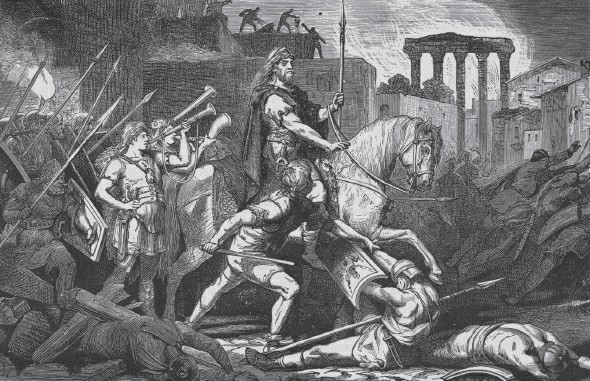
A nineteenth-century imagining of Alaric’s entrance into Rome.
In their frenzy the starving people had recourse to hideous food and tore each other limb from limb that they might have flesh to eat. Even the mother did not spare the babe at her breast. In the night was Moab taken, in the night did her wall fall down. Oh God, the heathen have come into your inheritance. Your holy temple they have defiled. They have made Jerusalem an orchard. The dead bodies of your servants are meat for the fowls of the heavens, the flesh of your saints is taken by the beasts of the earth. Their blood they have shed like water round about Jerusalem, and there were none to bury them. Who can tell of the carnage of that night? What tears are equal to its agony? A sovereign city of ancient date has fallen, and lifeless in its streets and houses lie numberless bodies of its citizens.12
Another source, Orosius, who wrote eight years after the sack, probably in Spain, painted a very different picture, reporting that the sack involved little if any loss of life, and was instead a remarkable example of Christian charity. Orosius claims that Alaric went to great lengths to protect the Romans, especially Christian Romans, from danger:
[Alaric] gave orders that all those who had taken refuge in sacred places, especially in the basilicas of the holy Apostles Peter and Paul, should be permitted to remain inviolate and unmolested; he allowed his men to devote themselves to plunder as much as they wished, but he gave orders that they should refrain from bloodshed.’13
Orosius then tells a story of a Visigoth who found an elderly Christian virgin taking refuge in a church and demanded she give him her gold and silver. The elderly virgin brought out great quantities of both but then warned the Visigoth that they were the sacred plate of Saint Peter, and that if he took it, he would be punished by God. The Visigoth then
ordered that all the vessels, just as they were, should be brought back immediately to the basilica of the Apostle, and that the virgin also, together with all Christians who might join the procession, should be conducted thither under escort. The building, it is said, was at a considerable distance from the sacred places, with half the city lying between. Consequently the gold and silver vessels were distributed, each to a different person; they were carried high above the head in plain sight, to the wonder of all beholders. The pious procession was guarded by a double line of drawn swords; Romans and barbarians.14
The church historian Sozomen, writing a little after Orosius, offered another story of a Visigoth with a good heart. Having drawn his sword to rape a beautiful Christian woman, he was taken aback when she offered him her neck:
For she preferred to die in her chastity than to survive, after having consorted lawfully with a husband, and then to be attempted by another man. When the barbarian repeated his purpose, and followed it with more fearful threats, he accomplished nothing further; struck with wonder at her chastity, he conducted her to the church of Peter the apostle, and gave six pieces of gold for her support to the officers who were guarding the church, and commanded them to keep her for her husband.15
As to how such different accounts could be written, all by Christians, the explanation is that they represented two wholly different responses to what had happened. The advocates of a brutal sack, including Jerome – who was doubtless still smarting at the wealthy Romans who had driven him out of their city – saw the disaster as divine punishment of the Romans for their luxury and paganism. In Jerome’s eyes the sack must have been terrible because that was what the Romans deserved. By contrast, those who supported the gentle sack looked to a bigger political picture. They wanted to counter pagan accusations that the sack had taken place because the Romans had closed the temples to their old gods and melted down their images. This second group wanted to show that Peter and Paul had done a good job protecting the city and that, thanks to their lobbying, God had softened the hearts of the Visigoths.
So much for propaganda. What actually happened? Archaeology has no religious affiliations and so should provide some more reliable answers. In a living city like Rome excavations are necessarily patchy, but they have nevertheless yielded some interesting discoveries. A good number of hurried human burials from this time have been discovered around the Colosseum. As most Romans felt repugnance towards allowing the living and the dead to mix, and burying corpses inside cities was prohibited, these give a glimpse of the horror of the city’s sieges.
And the sack? Buildings in the monumental centre that are known to have been damaged around this time include the huge Basilica Aemilia in the main Forum, which was largely burned out, along with the nearby secretariat of the Senate House and the Forum of Peace, both of which are both mentioned by the sources as being targets of Visigothic violence. Several of the city’s great mansions were also badly affected. A house on the Caelian Hill that belonged to the Valerii family was damaged and abandoned afterwards. The Domus Gaudentius, also on the Caelian, was transformed into stables, workshops and poor-quality housing. Finally, Procopius, writing 150 years later, tells us that the home of the early imperial historian, Sallust, which was just inside the Salarian Gate, was partially burned down and was still unrepaired when he visited Rome.
It is not a very long list. So far, Orosius and the friendly sacking group seem to be closer to the truth. One can almost picture the scene. Before they entered the city, Alaric commanded his Visigoths to behave themselves. Such an approach would fit with his cautious nature. If he destroyed Rome the city would lose all value as a bargaining counter and he would have little chance of striking a deal with the Western Empire. In spite of his orders, when the Visigoths poured in through the Salarian Gate some of them grew over-excited at having finally entered the city after repeated frustrating sieges, and they burned down a few houses close to the gate, including that of Sallust.
They then made their way into the city centre and enjoyed a little further catharsis. The secretariat of the Senate would have suffered because of its connection with the city’s rulers, who, having changed sides twice – supporting Honorius, Attalus and then Honorius again – would not have impressed the Visigoths. The Basilica Aemilia was close by and might have caught fire by accident. As to the Forum of Peace, there is no mystery as to why this was attacked. For three centuries it had housed the great menorah and other valuables that had been looted by the Roman commander Titus from the Great Temple of Jerusalem in AD 70. We know that the Visigoths made off with these objects after the sack. Finally, the Visigoths looted a few of the city’s great houses, lighting a fire or two as they went.
All in all, Rome had a lucky escape in AD 410. Compared to the fate of other cities that were sacked at this time, which saw extensive arson and their inhabitants enslaved, Rome got off very lightly indeed. Yet we should not underestimate what happened. Orosius’ and Sozomen’s stories of soft-hearted Visigoths are probably far from the mark. Archaeological work has uncovered a good number of inscriptions recording rebuilding work that dates from just after the Visigothic attack. Rome was still capable of restoring itself, and some destruction may have escaped notice because it was repaired.
Passages in some sources hint at the brutality of the event. The papal history, Liber Ponficalis, reports that the barbarians carried away a 2,000-pound silver tabernacle, which was not the act of good Christian Samaritans. Augustine of Hippo, who responded to the sack from North Africa in a series of sermons, from which grew his famous work, City of God, mentions that Roman refugees were present in his congregation. They would hardly have fled their city if the sack had been a non-event. In a passage that now seems decidedly sinister, Augustine also addresses Roman virgins who had been raped during the sack, insisting that God had not misjudged them or let them down, and insinuating that they may have brought rape upon themselves for having been excessively proud of their virginity.
Telling details have also survived relating to a number of individual Romans – all of them wealthy ascetic Christians – who were caught up in the sack. The palatial house of Melania’s husband Pinianus, on the Caelian Hill, was left so badly damaged by the Visigoths that it was all but worthless. Anicia Faltonia Proba, too, saw her splendid home partially ruined, while the Visigoths also made off with all her virgins. If she had let them into the city, as Procopius claimed, they were very ungrateful. Finally, there is the story of the very first of Rome’s ascetics, Marcella, who in AD 410 was an old woman. Her tale was recounted by Jerome, in a letter to Marcella’s friend Principia, but which was clearly intended for general circulation. It was in this same letter that Jerome made melodramatic claims that starving Romans had torn one another limb from limb, yet the passage concerning Marcella is calmer and has a strong ring of truth. He tells of how a group of Visigoths broke into Marcella’s house demanding gold:
She pointed to her coarse dress to show them that she had no buried treasure. However they would not believe in her self-chosen poverty, but scourged her and beat her with cudgels. She is said to have felt no pain but to have thrown herself at their feet and to have pleaded with tears for you [Principia] that you might not be taken from her, or owing to your youth have to endure what she as an old woman had no occasion to fear.16
Marcella died just a few days later. Her badly damaged home was never repaired. Perhaps the most telling account of the sack is by one of the few writers who was actually there. This was an austere British monk named Pelagius, whose ideas would develop into a heresy that Augustine of Hippo became much involved in stamping out. In a letter to a Roman woman he described how it had felt: ‘Everyone was mingled together and shaken with fear: every household had its grief and an all-pervading terror gripped us. Slave and noble were one. The same spectre of death stalked before us all.’17
And then after three days, to the great relief of the Romans, the Visigoths left the city and marched south. Alaric hoped to travel to Sicily and then go on to Africa but he was unable to cross the Straits of Messina. Two months later he died in Cosenza, probably of malaria contracted in Rome. The city had had its revenge. His tomb has yet to be discovered, though attempts continue to be made. If it ever is found, it is very doubtful that it will contain more than a few trinkets. Among Germanic tribes plunder bought loyalty and power, and was far too important to bury in the ground.
For a time the Visigoths’ light burned brightly. Alaric’s brother-in-law and successor, Ataulf, led them out of Italy to Gaul where, in Narbonne, he made a brief and unsuccessful attempt to found his own imperial dynasty, marrying part of the loot taken from Rome: Emperor Honorius’ sister, Gallia Placidia. Her wedding gifts were said to include the treasures of the temple of Jerusalem that the Visigoths had seized in Rome – further evidence that Himmler was wasting his time. In AD 418 the Visigoths finally succeeded where Alaric had failed and made a treaty with Rome that gave them a permanent homeland within the Empire, in Aquitaine. For several decades they were the Romans’ firmest allies and they fought side by side at the Western Empire’s last great battle in AD 452, at the Catalaunian Fields, close to Troyes, where they drove back Attila and his Huns. Several decades later, as the Western Empire went down for the third time, the Visigoths created an empire of their own, which included most of Iberia. Here they merged with the local aristocracy and finally abandoned their heretical Christianity for orthodox Christianity. But they lost all in AD 711, when Muslim Arabs invaded. They are last heard of in the mountains of the Asturias in the far north of Spain, where they formed part of a small local resistance group, from which would eventually grow the Spanish Reconquista.
As to Rome, though the city had not been destroyed, it had still endured quite a mauling. Many Romans had died in the famines, while others had fled and had no wish to go back. The city’s pork supply lists indicate that in AD 419 the population was still little more than half what it had been before the sack. No less serious was the damage done to the city’s reputation. After AD 410 the prophecy of Jupiter from Virgil’s Aeneid, that every Roman schoolboy learned by heart, and which boasted that Rome would endure without end, seemed very hollow. The most devastating blow to Rome’s self-image as the civilizer of the world came from North Africa. The shock disaster of the sack inspired Augustine of Hippo to attack the whole moral basis of Roman power. Citing examples of Rome’s early history – from the same Livy who described Brennus’ sack – Augustine argued that the Roman Empire was no different or better than other empires that had preceded it, and he claimed that, rather than being founded to bring civilization to the world, it had been built from a simple lust for domination. The Veiians would have agreed with him. If Christians wanted an eternal city, Augustine urged, they should look to the Heavenly City of Jerusalem that awaited them in the sky. No earthly city, including Rome, would endure for ever.
Still, Romans could count themselves lucky that things had not been worse. In many ways the city recovered surprisingly quickly from its disaster. A year after the sack the would-be imperial usurper across the Alps, Constantine III, was dead and the emperor Honorius was finally able to leave Ravenna. He visited Rome to celebrate games and to encourage people who had fled to return, which many did. In AD 414 the urban prefect, Albinus, wrote to Honorius requesting that grain supplies be increased, as they were no longer enough to feed the city. Rome’s population might have halved but it was still the largest and greatest city in Western Europe, if not in all of Europe. Most of its great monuments had survived unscathed and in AD 418 Orosius complained that from the way Romans talked and acted one would think that nothing had happened.
It was a pretence that would not be possible for long.