
CHAPTER THREE
I
THESE DAYS THE TINY ISLAND of Martana in Lake Bolsena, 120 kilometres north of Rome, cannot be visited. Crescent-shaped, like an upturned new moon, it is privately owned and its only inhabitant is the custodian who watches over the island’s few buildings and cares for the gardens. If you are curious and have money to burn, a boat can be hired from the nearby port of Marta that will tour you around the island so you can see its rocky, wooded shore.
By all accounts almost nothing remains from the one time Martana achieved notoriety, in AD 535. There are a few steps on the shore that the Ostrogothic princess Amalasuntha might have walked on when she was brought to the island at the end of April that year. Remnants of walls could be the ruins of the building where she was held prisoner. We have no idea if, a few weeks after she arrived, she saw the boat that set out from the shore of the lake. Having ruled all of Italy, Sicily and a good part of the western Balkans for eight years, she would have had a shrewd understanding of the politics of her age and, if she did see it, she probably guessed its significance. Sure enough, those on board, who were Ostrogoths like herself, were coming to kill her. What she could not have guessed were the consequences that would follow from her murder. It would be used to justify an invasion of her former kingdom, and would lead to one of the most destructive wars in Italy’s violent history. At its centre would be Rome. In March 537, less than two years after Amalasuntha died, a huge army of Amalasuntha’s Gothic compatriots appeared outside the city, determined to retake what they saw as rightfully theirs.

Rome, 546 AD
Like their cousins the Visigoths, the Ostrogoths’ journey to Italy had been a long one. We have already glimpsed them once, if briefly, 150 years before Amalasuntha met her death. When the Visigoths’ ancestors were camped by the Danube, begging the Roman Empire to give them sanctuary from the Huns, the ancestors of the Ostrogoths were taking their chances outside the imperial borders, in Central Europe. Things did not go easily for them. While Alaric’s followers were enjoying their time in the sun, raiding their way round the Mediterranean, their Gothic cousins were subjugated by the Huns, who occupied the Hungarian Plain. For two generations they were Hun vassals, required to grow their crops and fight their wars.
When the Huns’ empire finally collapsed in the 450s, their servants broke free. Living on the fringes of the Eastern Roman Empire, in today’s Bulgaria and former Yugoslavia, they underwent the same process of amalgamation that the Visigoths had gone through, as different tribes fused together to form a force large enough to stand up to the Eastern Romans, and to threaten them into handing over food and gold. In the 480s they became united under a single leader, Theodoric. Their name, Ostrogoths, which meant Eastern Goths, was not their own choice but was given to them by the Roman authorities, to distinguish them from the Visigoths. The Eastern Roman Emperor of the time, Zeno, was understandably nervous of this new power bloc on his doorstep and his anxiousness in turn made Theodoric uneasy. Theodoric knew how skilled the Eastern Empire could be at setting Goths at one another’s throats. Zeno might prise their fragile new federation apart. Most of all Theodoric feared that Zeno might connive in having him assassinated.
In 488, Zeno and Theodoric agreed on a solution that suited both sides. Theodoric should lead his Ostrogoths to Italy. As far as Zeno was concerned, it was up for grabs. A decade earlier, in 476, Odovacar, the Germanic leader of the remnants of the imperial army in Italy – an army that was now almost entirely made up of barbarians – decided that the Western Roman Empire, which was largely a dead letter, should finally be laid to rest. With Zeno’s tacit approval, Odovacar deposed the last Western Roman Emperor, Romulus Augustulus, and sent him into retirement near Naples. Zeno now proposed that Theodoric oust Odovacar and rule what he could seize of the Western Empire as his, Zeno’s, viceroy. As Alaric had done eighty years earlier, Theodoric organized his people in a vast convoy of wagons, and they trekked across the Balkans, fighting another barbarian people, the Gepids, who blocked their path, to reach the Julian Alps and then the Po valley. Getting rid of Odovacar did not prove easy, but after besieging him in Ravenna for three years Theodoric eventually settled matters by negotiating a truce and then, at a celebratory banquet, personally slicing him in two. For the next thirty-three years Theodoric ruled Italy and an expanding list of territories, which he did more efficiently than any Roman emperor had done for centuries, as king of the Ostrogoths and viceroy of the Eastern Empire.
Theodoric, though, had a problem. He had two daughters but no sons. Germanic peoples were more open to the idea of female rulers than the Romans, but only just. Theodoric did what he could. He made sure his daughters were well educated – Amalasuntha became fluent in Gothic, Latin and Greek – and well married. Amalasuntha’s husband was a high-ranking Ostrogothic warrior, Eutharic, by whom she had soon had a son, Athalaric. Unfortunately, Eutharic, who might have acted as a stand-in leader till their son came of age, then died. In 526, so did Amalasuntha’s father, King Theodoric. Amalasuntha was evidently an able politician. For eight years she ruled as regent on behalf of her young son, countering the plots of disgruntled Ostrogothic nobles, and also of her cousin, Theodohad, who had political ambitions of his own. Then in 534 disaster struck. Amalasuntha’s son Athalaric, who was now fourteen years old, died. Her position as the kingdom’s ruler was gravely undermined.
The blow could hardly have come at a worse moment. Having come close to collapse the previous century, the Eastern Roman or Byzantine Empire was finally experiencing better times and was stronger than it had been for generations. Its emperor, Justinian, decided it was time to rebuild the old empire, at least in part, by reconquering its lost, western lands. In 533 he sent his ablest general, Belisarius, against the Germanic Vandals in modern Tunisia, whom Belisarius overcame with surprising ease. Encouraged, Justinian turned his eyes to Ostrogothic Italy.
For all that happened next we rely heavily on one account: A History of the Wars, by Procopius of Caesarea; so much so that we should know a little about the man. He is the same Procopius who told us that Alaric entered Rome by means of a commando unit of beardless youths. Fortunately, he is far more plausible when it comes to great events of his own time, many of which he witnessed at first hand. Having worked as a lawyer and rhetorician in Constantinople, he then accompanied Belisarius as his private secretary during his campaigns in Africa and Italy. Later, Procopius returned to Constantinople, where he wrote a highly sycophantic account of the emperor Justinian’s building campaign in the city, Buildings. The sycophancy proved effective and he was raised to the high rank of Illustris. Procopius, though, was living dangerously. He had written a third book, which, wisely, he kept secret. In the Anecdota, better known as The Secret History, he vented his frustrations with the elite of the Eastern Empire, and especially the emperor and empress.
In Procopius’ clandestine account Justinian is depicted as ‘insincere, crafty, hypocritical, dissembling his anger, double-dealing, clever, a perfect artist in acting out an opinion which he pretended to hold’ and, ‘a fickle friend, a truceless enemy, an ardent devotee of assassination and of robbery’. Yet Justinian gets off relatively lightly compared to his empress, Theodora. According to Procopius she first came to Justinian’s notice as one of Constantinople’s most notorious prostitutes:
The girl had not a particle of modesty, nor did any man ever see her embarrassed, but she undertook shameless services without the least hesitation, and she was the sort of a person who, for instance, when being flogged or beaten over the head, would crack a joke over it and burst into a loud laugh; and she would undress and exhibit to any who chanced along both her front and her rear naked.2
Even Belisarius, whom Procopius praises in History of the Wars, comes in for criticism, notably for being in thrall to his unfaithful, devious, sorceress wife, Antonina, who was a close friend of empress Theodora. Overall, though, the impression left by the History of the Wars and The Secret History together is that Belisarius was resourceful, brave and, when compared to other imperial commanders of the time, ungrasping.
Procopius tells us how, after her son died, Amalasuntha tried to shore up her political position. She invited her ambitious cousin, Theodohad, who had a power base in Tuscany, and a bad reputation for illegally seizing people’s lands, to become her co-ruler. One can guess at her thinking. By ruling alongside Theodohad she would counter Ostrogothic unease at having a female ruler, and she would ease the resentments of her greatest political rival. It proved to be a bad miscalculation. Procopius claims Amalasuntha had Theodohad swear a secret oath that she would remain the real power in the land but if she did, the oath had little effect. Theodohad used his new position to move against her. Within months his followers seized her, took her from Ravenna to the island of Martana where, some weeks later, Theodohad had her killed.
According to Procopius, Amalasuntha had been a friend and ally of the Eastern Emperor, Justinian, and, when he heard of her killing he was so angry that he ordered his general, Belisarius, to prepare for an invasion of Theodohad’s kingdom. Justinian’s real thinking was probably more devious. His wife Theodora had kept up a secret correspondence with Theodohad’s wife, Gudelina, and Procopius claims that Theodora used Gudelina to encourage Theodohad to execute Amalasuntha, promising that Byzantium would turn a blind eye. The claim is in Procopius’ poisonous Secret History where he gives Theodora a suitably malevolent motive, writing that she wanted the regent dead because she feared that Amalasuntha, who was known for her beauty and intelligence, might steal away her husband. It is an unlikely story and yet within it there may be some truth. Justinian may have encouraged Amalasuntha’s murder to give him an excuse to attack the Ostrogothic kingdom. He needed an excuse as, in theory, he was attacking his own territory, which was ruled by his viceroy. He may also have felt that Theodohad would prove a less dangerous opponent than Amalasuntha.
If this was his thinking, he was soon proved right. In many ways Theodohad made an unlikely Ostrogothic king. Germanic people in this era were suspicious of learning, especially in their leaders, as they felt it undermined their warlike instincts. Theodohad was not only literate but highly educated in Plato and Latin literature, and he considered himself a philosopher. In his case, Germanic prejudices were proved correct. In 535 Belisarius seized Sicily. The following year he landed in mainland Italy and captured Naples, which he did by sneaking soldiers into the city through an aqueduct, and where his troops went on a spree of killing and plunder. Theodohad did nothing, remaining in Rome, frozen with indecision. It seemed that Italy would fall even more easily than Africa. But then the Ostrogoths, disgusted at their philosopher king, cut his throat and acclaimed a new and more warlike leader: Witigis.
As with Alaric and Brennus before him, we know disappointingly little about Witigis. He was born into the Ostrogothic elite, served in King Theodoric’s bodyguard and led Ostrogothic forces with success in the western Balkans. He was not a skilled tactician, yet his first decisions as king were shrewd enough. As well as Belisarius’ army in the south, he faced war bands of Franks, who Justinian had encouraged to raid from across the Alps. Witigis decided to deal with the Franks first. He marched north, leaving a garrison of several thousand Ostrogoths in Rome in the hope that the Romans would prove loyal. The Romans, though, had no risk of suffering the sort of killings and plundering that the Neapolitans had just endured at the hands of Belisarius’ soldiers. They sent a delegation to Belisarius inviting him into the city. Cannily, they also managed to persuade the Ostrogothic garrison to leave. So, on 9 December 536, as the Ostrogoths filed out through the city’s northern Flaminian Gate, Belisarius’ troops marched in through the Asinarian Gate to the south. The Romans could hardly have arranged matters more tidily. They had switched sides without so much as a scuffle. It seemed their war was over.
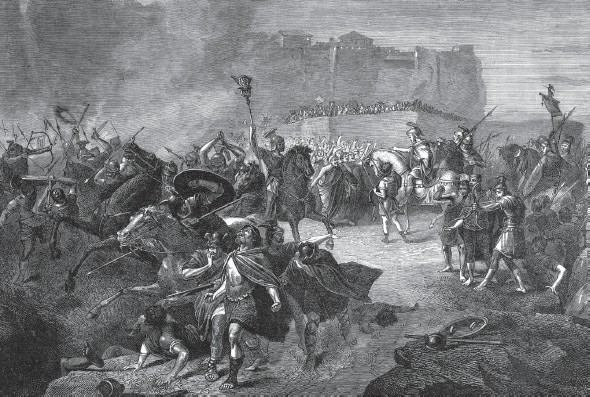
A late nineteenth-century depiction of Belasarius entering Rome, from Cassell’s Illustrated Universal History by Edward Ollier, 1890.
But it would not be quite so easy as that. King Witigis quickly made peace with the Franks. Hearing that Belisarius’ army was far smaller than he had thought, he determined to crush this puny invasion and turned his forces southwards. Unlike Alaric’s horde more than a century earlier, this was not a whole tribe on the move – the warriors’ wives and children remained in the north and central Italy, where they had settled – but an army. In other respects, though, it resembled Alaric’s forces. Some Ostrogoths would have been on foot, others on horseback or riding in the back of wagons. They would have carried a variety of weapons, though, like the Visgoths, an aristocratic minority would have been noticeably better equipped than their underclass helpers. As ever, they all would have stunk and been infected with lice. And they were many. Procopius claims Witigis’ army totalled 150,000 men and though his figure is almost certainly much exaggerated there is no doubt that it was a huge force. In March 537, only three months after the Romans had believed they had saved themselves, the Ostrogoths came in sight of Rome’s walls.
II
As to what kind of Rome awaited them, if a Roman had been transported there from the previous century, just before before Alaric’s sack, he or she would have been shocked at the state of the city. Most of all they would have found it eerily empty. It has been estimated that by 530 the city’s population was in the tens of thousands, or a tenth or twentieth of what it had been in 408. Streets once teeming with people would have felt almost deserted. Blocks of flats that had been packed with Romans had become desolate, with families camped out on ground floors, as upper levels were now a chaos of rotting timbers, fallen stairways, leaking roofs and birds’ nests. Many buildings would have been wholly abandoned.
Rome was also more parochial. Long gone were the days when one could hear a dozen languages in a single street. In 537 most Romans would have spoken one language only: a crude Latin that was already tending towards an early form of Italian. A few would have spoken a little Gothic German, but the bilingualism of the grand days of Empire was long gone and only the most highly educated Romans would have had a good knowledge of Greek. Though, as Belisarius’ army marched into the city, some Romans were doubtless brushing up on their Greek grammar as fast as they could. They would have needed it. More than a century earlier Latin had ceased to be the official language of the Eastern Empire, and now few high officials spoke anything but Greek.
Something had gone very badly wrong for Rome. When last seen, it was in good shape, recovered from Alaric’s sack-lite to the extent that its inhabitants were behaving as if nothing had happened. The answer lay on the Capitoline Hill. The temple to Jupiter Best and Greatest that had dominated the city’s skyline for a thousand years was now in ruins, its roof stripped of its bronze tiles. More clues could be found in the main Forum, which had been crowded with statues but was now filled with empty marble plinths. In June 455, four decades after Alaric’s attack, the city was sacked again, and far more brutally, by a war band of Vandals from Africa led by Genseric. The Vandals stayed in the city for two weeks, during which time, among other destructive acts, they made off with the temple of Jupiter’s roof tiles and heaved away statues by the cartload. The city suffered again seventeen years later when it became a battleground in one of the Western Empire’s last civil wars, in which the military chief Ricimer hunted down Emperor Anthemius, whom he had beheaded in one of Rome’s churches. It was no wonder that most Romans had voted with their feet and abandoned their city.
Rome was not only damaged by war. Sources of the time describe how it suffered also at the hands of its own inhabitants. In 458 Emperor Majorian, who was the latest in a long line of emperors to issue ineffective decrees intended to halt Rome’s decay, complained that the city’s ancient buildings were being torn down and their fabric used for minor repairs elsewhere. Rome’s antiquities were often desecrated with the connivance of the city authorities, and even Majorian accepted that some were now so far gone that they might as well be scavenged. In the decades before Witigis’ arrival the bronze elephants on the Via Sacra were decrepit. Aqueducts were being misused – their water was probably being siphoned off – and decorative bronze and lead were regularly stolen from public buildings. The old granaries used to distribute food to the Romans were in a bad way, as was an elegant curved portico in the old Forum, which was only saved by being turned into private housing.
Archaeology confirms the bleak picture. After Alaric’s sack, the area around the Crypt of Balbus, between the theatres of Pompey and Marcellus, became a waste ground of collapsed porticoes, fallen columns and robbed paving. For a time it seems to have been used as a depot for looted marble. As well as being pillaged by Romans, the area was also damaged by earthquakes, of which there were a number at this time, and which would have had a doubly destructive effect on buildings that had been robbed of stone, and also of the metal clamps that held their stonework together. As the fifth century wore on, houses and apartment blocks became filled with rubbish. Parks and squares turned to empty wilderness. Belisarius found there was enough grassland within the city walls to graze all of his cavalry’s horses. From this collapse emerged one of Rome’s few growth industries of the era. In the Forum and elsewhere lime kilns were built, where marble columns, plinths, statues and parts of buildings were baked and destroyed to be sold as plaster.
Yet however wrecked Rome was, it was still in a better state than most other Italian cities. It still had functioning aqueducts and baths and it could still amaze and impress visitors. Cassiodorus, who served as chief minister under Ostrogothic rulers, wrote that, ‘It can be truly said that the whole of Rome is a marvel,’ and described it as ‘a wonderful forest of buildings’ with, ‘baths built as large as provinces, the huge Colosseum whose top is almost beyond human vision; the Pantheon with its lofty and beautiful dome as large as a whole region of the city’.3 It was probably also a little less unhealthy than it had been. Malaria will have been as prevalent as ever but with the city’s population reduced and the streets far less crowded, diseases such as measles would no longer have been endemic.
And the city still had admirers who sought to preserve its wonders. The most determined of these, a little surprisingly, was the barbarian leader who had led the Ostrogoths into Italy and who sliced his rival in two over dinner: Theodoric. During Theodoric’s three-decade rule he came to Rome at least once, probably twice, staying in the old palace on the Palatine for six months, which was longer than any imperial visit for two centuries. It seems it was not a comfortable visit and he afterwards set aside 200 pounds of gold to have the palace repaired. He also had 25,000 tiles made to repair other buildings in the city, including the Baths of Caracalla, the remnants of the burned-out Basilica Aemelia in the main Forum, Emperor Domitian’s old athletic stadium in the Campus Martius, and even the Temple to Vesta, which had been empty of virgins for more than a hundred years. He ordered that the city’s sewers should be cleaned and repaired, the aqueducts too, and gave Rome an architect to supervise the upkeep of the city’s old buildings.
Theodoric was not only interested in the architecture. He also sought to preserve the city’s ancient traditions. He revived the corn dole and ordered a million litres of wheat to be distributed to the inhabitants along with rations of pork. Though he had no liking for the games, which he considered morally repugnant, he nevertheless revived them to bring the Romans a little pleasure, and hired acrobats, who offered a new and economical form of entertainment: rather than killing wild animals they would taunt them and leap out of their way, in an early form of bullfighting. Finally, Theodoric honoured the Roman Senate in a way that had not been seen for a long time. On coins and official inscriptions he used the old abbreviation SC, meaning Senatus Consulto, or ‘by decree of the Senate’, and Res Publica, keeping alive the five-hundred-year-old fiction that Rome was still a Republic. He even referred to Invicta Roma, or ‘Unconquered Rome’: a rather optimistic claim, seeing as by this time it had already endured two sackings.
It is doubtful Theodoric’s good intentions had much effect. Twenty-five thousand tiles would have made little difference to the city’s decaying monuments while reviving ancient titles could not make Rome what it had been. As ever, the city’s traditions were kept alive by its aristocratic class and this was in a poor way by the sixth century. A wealthy Christian noble from 408 would have found their cosy social world had all but vanished. The Senate, which in their time had included 2,000 members, was now reduced to between 50 and 80, many of whom probably struggled to meet the required property qualifications. Most of the city’s great families had fled to Sicily or Constantinople after the Vandals’ sack, and their town houses were closed up or ruined. The city was now dominated by a single family, the Anicii – the family of Proba, who was blamed for opening the city’s gates to Alaric’s Visigoths – which now formed an international clan, with highly placed cousins from Gaul to Constantinople.
Rome’s traditions declined with her aristocrats. The last time that we hear of a senator spending lavishly on games is in 424, a decade after Alaric’s attack. After the Vandal sack expensive games were beyond anyone’s budget. Besides, with the Vandals occupying North Africa it was hard to procure exotic animals. By the end of the fifth century even cheap games were so rare that senators no longer bothered to have their names carved on their seats in the Colosseum. The ancient republican positions that included responsibility for holding games likewise vanished. We know of no consular games after 523 and no consuls after 534.
Yet even in these difficult days, when much of Rome was decaying, there was also new growth. Several of Rome’s finest churches were created at this time. The vast Santa Maria Maggiore was built in 430s, the elegant church of Santa Sabina on the Aventine Hill was completed about the same time and the circular Santo Stefano Rotondo on the Caelian Hill was built later in the same century. The satellite settlements around the great martyrs’ churches to Peter, Paul and Lawrence expanded, with new monasteries and hostels for pilgrims, who were plentiful during the four decades of Ostrogothic peace. Around the year 500, a large public latrine was set up in front of San Pietro for their needs.
This brings us to another great change in the city. Our Christian aristocrat from 408 would have found Rome in 537 almost free of paganism. Christianity was on the verge of achieving absolute triumph. Sadly this did not mean the city was religiously unified, and in many ways it was more divided than before, though tensions were now among Christians. From 498 to 506, the Church in Rome experienced one of its worst schisms between rival papal candidates, which was all the more divisive because it had both class and international dimensions. At this time the stability of the Byzantine Empire was threatened by the passionate struggle of two rival Christian movements, the Monophysites and Dyophysites, who disagreed as to the human and divine natures of Jesus. The Byzantine emperor Anastasius tried to heal the split by imposing a compromise dogma, Henotoikon, and backed a papal candidate, Laurentius, who would cooperate. Ordinary Romans resented Anastasius’ interference, which they saw as a challenge to their pope’s primacy above Constantinople. Class warfare broke out, as the city’s aristocrats and high clergy supported Laurentius and low clergy and the poor supported his rival, Symmachus. Even the city’s chariot teams became involved, with fans of the populist Green team backing Symmachus and the aristocratic Blues, Laurentius. The greatest violence came from the city’s aristocrats who had their slaves attack Symmachus’ followers and drive them from the city centre. Street battles were fought, priests were murdered and nuns were flung from their convents, stripped and beaten. The dispute was so protracted that it affected Rome’s buildings. As Symmachus was barred from central Rome he embarked on construction in the suburbs, where new churches sprang up, such as San Pancrazio on the Gianicolo Hill. St Peter’s, which was also outside the city at this time, gained a grand new stairway, a new fountain and its new public latrine.
The only figure who remained scrupulously neutral throughout the dispute was King Theodoric, yet even he was eventually drawn into religious conflict. Like Alaric’s Visigoths, he and most of the Ostrogoths followed Homoean Christianity – now usually referred to as Arianism – which held yet another view of the nature of the human and divine natures of Jesus, and was regarded as heretical by Monophysites and Dyophysites alike. Theodoric had a rather modern, relaxed attitude towards religion and never sought supremacy for his form of Christianity, yet he did expect it to be tolerated. Towards the end of Theodoric’s reign, Emperor Justinian’s uncle and predecessor, Justin, began a campaign of persecution in the Byzantine Empire against Arian Christians and also Jews. To make matters worse, intolerance then spread west. In 523 the pope in Rome, John, tried to rededicate Rome’s several Arian churches, and mobs burned synagogues in Ravenna, Verona and Rome. In reprisal Theodoric had those responsible lashed and a church in Verona burned. The dispute soured the last years of what had been an otherwise highly successful period of rule, causing an ugly rift between Theodoric and many Romans.
When Belisarius marched into Rome a decade later more religious trouble beckoned. Like Anastasius before him, Justinian supported a new, compromise doctrine, Theopaschism, which he hoped would heal his empire’s divisions. He needed a solution also for personal reasons. While, like the population of the Empire’s capital, Constantinople, Justinian was Dyophysite, his wife Theodora was pro-Monophysite. On Justinian’s orders, one of Belisarius’ first actions in Rome was to depose the pope, Silverius, who was a Gothic appointee and so was unlikely to cooperate with Justinian’s plans. Silverius was dispatched to the island of Palmaria where he promptly and conveniently died. He was replaced by Justinian’s candidate, a former papal legate to Constantinople, Vigilius, who could be relied upon to support Justinian’s Theopaschism. Whether Vigilius would last any longer than Silverius was soon doubtful, though. He had barely been installed when Witigis and his vast army of Ostrogoths appeared outside the city.
III
The Romans’ first loss was their comforts. Witigis invested the city, building seven large fortified camps around its northern side and cutting its aqueducts. Belisarius – who knew all about the dangers posed by aqueducts after his attack on Naples – then made matters more permanent by blocking the sections inside the city with tons of masonry. The city’s baths ceased to function and the Romans, who had enjoyed public bathing for more than six centuries, were forced to clean themselves and drink from the city’s springs and wells or from the Tiber. They were short of food and sleep, too, as Belisarius required them to do night guard duty on the walls.
Yet comfort was not the Romans’ greatest concern. Like Witigis, they had been struck by how tiny Belisarius’ army was. Its numbers had been modest when it first landed in Sicily and it had been depleted since then by Belisarius’ need to leave garrisons in the cities he captured. His forces in Rome totalled fewer than 5,000 men. As we saw, Procopius claims that Witigis’ Ostrogoths totalled 150,000, and though 25,000 to 30,000 is probably closer to the mark, his army still dwarfed that of Belisarius. The Romans began to regret inviting him into the city, complaining that they had never asked him to invade Italy. When Witigis heard of their grumbling he sent an envoy to demoralize them further. Having denounced them for their treachery he then reproached them for having, as Procopius tells us, ‘exchanged the power of the Goths for Greeks, who were not able to defend them, although they had never before seen an army of the Greek race come to Italy except actors of tragedy or mime and thieving sailors’.4
Interestingly, some Romans responded to their fears in the same way as their ancestors had done during Alaric’s first siege. They looked to the past. Long before, when Rome went to war, the doors to the Temple of Janus were opened. The temple, which was beside the Senate House in the main Forum, was still in a good state and Procopius, who saw it himself, describes it as a square, bronze building just large enough to contain a statue of Janus. As Witigis’ siege dragged on, some of the city’s inhabitants secretly visited the temple and tried to open its doors. They failed, as the hinges must have been too rusted, but it was evident the attempt had been made as the doors were no longer closed true. As Procopius tells us, ‘those who had attempted to do this escaped detection; and no investigation of the act was made, as was natural in a time of great confusion, since it did not become known to the commanders, nor did it reach the ears of the multitude, except of a very few’.5 Times had changed since Alaric’s day. Then some of the most powerful men in the city had flirted with paganism. Now it was only an unknown few, who were lucky to escape punishment.
Yet the Romans, like the Witigis, had underestimated Belisarius. If the Ostrogoths’ tactics and weapons had changed little since Alaric’s time, this was not true of the Eastern Roman Empire. In these cash-strapped days the Byzantines could not field the vast armies of earlier times but they had become adept at making the most of the little they had. Belisarius’ army had almost nothing in common with the heavy infantry legions of the old Roman Empire, and in many ways it was closer to a war band of Huns. For that matter, it contained Huns, along with Slavs, Germanic Heruli, Gepids and Lombards, and also the Isaurians, a tough people from the mountainous south of Asia Minor. All of these disparate elements had one thing in common: they were expert archers. So was Belisarius himself. In one of the first skirmishes of the siege he aimed an arrow at an ox that was pulling an Ostrogothic siege tower and killed it with one shot.
Belisarius took on the besiegers Hun-style, sending out small parties of mounted bowmen, who lured the Ostrogoths from their camps, showered them with arrows, inflicting high casualties, and then sped away having hardly lost a man. He also employed an array of ingenious machines. Ballistae fired large metal bolts with great force for long distances, and one impaled a gigantic Goth against a tree. Wild-asses – a form of catapult – hurled boulders. Wolves, which were portcullislike frames with jagged points, were suspended above the battlements, and when enemies tried to scale the walls on ladders they were swung down, stabbing into attackers’ backs. The defenders also used anything that came to hand. When a force of Ostrogoths managed to reach the strongpoint of Hadrian’s Tomb unseen, by sneaking beneath the long portico built to keep pilgrims dry on their way to St Peter’s, the defenders beat them back by breaking up the huge statues on the tomb’s summit and hurling pieces on to their heads.
Belisarius was also helped by Witigis’ strategic errors. Most of all he failed to fully encircle the city, as his seven encampments contained Rome only from the north. He established just one fortress to the south, which was created by blocking up the arches of two intertwined aqueducts, and which reduced supplies to the city, but he failed to take Rome’s seaport, Portus. For a time the Romans were reduced to eating wild herbs, but then supplies were sneaked into the city several times, along with money and soldiers from the east. The Romans were even able to grind flour for their bread. When mills driven by the aqueducts ceased to function, Belisarius ingeniously built floating mills on the Tiber that were powered by the river’s current. As Witigis’ army slowly became depleted by hunger, disease, and skirmishes with archer cavalry, Belisarius’ force was strengthened by reinforcements. Eventually he was able to spare some troops, who slipped out of Rome and made their way to the Adriatic coast, where many of the Ostrogoths’ families lived, unprotected. Witigis panicked and in March 538, after a siege that had lasted almost exactly a year, his Ostrogoths burned their camps and marched away. Two years later, Witigis, deserted by his followers, surrendered to Belisarius in Ravenna. Only the Ostrogoths north of the river Po still held out. The war appeared to be all but over.
Yet celebrations proved premature. Having won, the Byzantines then threw away all their gains. The Empire’s other war, with Persia, went badly wrong and Belisarius was recalled to the east. The commanders he left behind in Italy proved fractious, sluggish and most of all grasping. Emperor Justinian, who was determined that Italians should pay for their liberation, sent an imperial fiscal agent or logothete named Alexander, who was nicknamed ‘Clippings’ from his habit of shaving off the edges of coins that passed through his hands. As well as squeezing all he could from Italy’s struggling population and seizing their property, Alexander drastically cut payments to the imperial army in Italy, which in turn encouraged soldiers and commanders – who needed no lessons in rapaciousness – to join in his extortion. Procopius writes that the Italians soon longed for barbarians.
Then, when Italians already had more than enough troubles, they were struck by an even greater catastrophe. Italy suffered an outbreak of the same bubonic plague that would rage across Europe eight centuries later as the Black Death. Procopius had left Italy with Belisarius by this time, so we have no descriptions of how Rome was affected, but he gives a vivid account of what happened in Constantinople, which, unlike Rome, was still a thriving, heavily populated city:
…at first the deaths were a little more than the normal, then the mortality rose still higher, and afterwards the tally of dead reached five thousand each day, and again it even came to ten thousand and still more than that. Now in the beginning each man attended to the burial of the dead of his own house, and these they threw even into the tombs of others, either escaping detection or using violence; but afterwards confusion and disorder everywhere became complete. For slaves remained destitute of masters, and men who in former times were very prosperous were deprived of the service of their domestics who were either sick or dead, and many houses became completely destitute of human inhabitants.6
If it was as lethal as the Black Death – which is highly likely, as it was the same disease – then between a third and half of the Italians would have succumbed.
With wars being lost on two fronts and his citizens dying by the tens of thousands, Emperor Justinian knew just what to do. He embarked on further religious interference. His last attempt to find a compromise between the Monophysites and Dyophysites having got nowhere, he now tried another, which involved the official condemnation of three Christian texts known as The Three Chapters. Unfortunately Pope Vigilius in Rome, though he had been installed by Justinian, refused to follow the new doctrine. On 22 November 545, Vigilius was in the midst of celebrating mass in the church of Santa Cecilia in Trans Tiberina when he was seized by a squad of imperial troops and marched to a ship waiting on the Tiber. Vigilius had a poor reputation in Rome at this time, as he was widely believed to have murdered both his secretary and his niece’s husband, and he was followed by a crowd of bemused Romans who, as the ship cast off – Vigilius still reciting the final blessings of his interrupted mass – threw stones and shouted that the plague should take him.
It was not Justinian’s religious interference, nor his rapacious tax-gathering, nor the plague that finally undid Byzantium’s hold on Italy. The Ostrogoths north of the river Po, who Belisarius’ lacklustre successors had never got round to subduing, chose a new leader who proved far more formidable than Witigis: Totila. For once we have a description, if brief, of his character: Procopius writes that he was ‘a man gifted with remarkable discretion, energetic in the extreme and held in high esteem by the Goths’.7 Discreet, energetic Totila discovered an answer to his Ostrogoths’ tactical inferiority. He used surprise, catching out his enemies with ambushes that allowed his warriors to get past the showers of arrows and inflict damage close up. The Byzantines, struggling in their war against the Persians to their east, were unable to reinforce their Italian forces.
Totila was also politically shrewd and far more skilful at winning Italian hearts and minds than his opponents. After inflicting several crushing defeats on Belisarius’ successors in the north, he bypassed Rome and besieged Naples, and when the city surrendered, Totila treated its famished inhabitants with scrupulous concern. They were so weak that had they fled the city in panic, many would have died. Totila locked them inside the city and brought in supplies of food until they were strong enough to venture out. When one of his bodyguards raped a Neapolitan woman Totila insisted on having him executed, even though the man was very popular in the Ostrogothic army. He also left Italian farmers in peace, urging them to till their fields but to pay taxes to him rather than to the grasping imperial officials. Most were probably happy to do so.
Having taken Naples, Totila then turned his eyes on Rome, but he was careful not to repeat Witigis’ mistakes. First he captured a series of cities to the north, including nearby Tibur (Tivoli). Next he created an Ostrogothic navy of small, fast ships, which he based in Naples and the Aeolian Islands, ready to intercept convoys sent from the east. This blockade from a distance proved far more effective than Witigis’ incomplete siege. At the end of 545, seven years after Witigis had departed, Totila was finally ready to move on Rome itself. The Byzantine commander in the city, a Goth named Bessas, tried to replicate Belisarius’ tactics and sent out a force of mounted archers to harry the besiegers, only to be lured into one of Totila’s ambushes and suffer high casualties. It was the last time Bessas risked an attack.
As the siege began to bite and Romans grew hungry, help was sent from an unexpected source. Pope Vigilius, who we last saw sailing down the Tiber as a Roman mob hurled stones and abuse, was being held in Sicily to reconsider his religious scruples over condemning The Three Chapters. As chance would have it, Sicily was one of the few places in the region at this time that was peaceful enough to enjoy a relative abundance of food. Vigilius sent several grain ships to help out his Roman parishioners. The Romans, though, were out of luck. As the ships approached Portus they were spotted by some Ostrogoths, who slipped inside the harbour and hid. Imperial troops on the battlements tried to warn the vessels away by waving their cloaks but the crews misunderstood, thinking they were excited to see them, and sailed on. All were captured. If Totila could be kindly to ordinary Italians, he had no tolerance of those who opposed him. He had the ships’ crews killed and when a bishop was found aboard the convoy, Totila enquired about the man, concluded that he was an out and out liar and cut off both his hands.

An eighteenth-century engraving of Pope Vigilius, elected 536.
Even if Vigilius’ food had reached Rome, it is doubtful whether it would have reached many of the Romans. As Procopius tells us, the city’s commander, Bessas, saw the siege as a chance to make his fortune and he and his commanders:
… stored away a vast supply of grain for their own use within the walls of the city of Rome … they as well as the soldiers were constantly taking from the portion assigned for their own needs and selling it at a great price to such Romans as were rich, for the price of a bushel had reached seven gold pieces.8
When desperate Romans sent a deputation to Bessas complaining that he should either feed them, kill them or let them leave, Bessas and his officers replied that to feed them was impossible, to kill them would be unholy, and that to release them would be too dangerous. Poor Romans ate boiled nettles and the rich spent their gold on Bessas’ extortionate grain. When they ran out of gold they offered their valuables. Eventually, even the garrison ran out of food and everybody – aside from Bessas himself – was reduced to nettles.
But this food was insufficient for them, for it was utterly impossible to satisfy themselves with it, and consequently their flesh withered away almost entirely, while their colour, gradually turning to a livid hue, gave them a most ghostly appearance. And it happened to many that, even as they walked along chewing the nettles with their teeth, death came suddenly upon them and they fell to the ground. And now they were even beginning to eat each other’s dung. There were many, too, who because of the pressure of the famine, destroyed themselves with their own hands; for they could no longer find either dogs or mice or any dead animal of any kind on which to feed.9
After a father of five leapt to his death from one of the city’s bridges in front of his children, Bessas finally relented and allowed the Romans to leave the city, which a good number did, but by then they were so weakened that many died fleeing, while others were caught and killed by the besiegers.
Then, just when all seemed lost, there was new cause for hope. Belisarius landed with a new army at Portus. Justinian, parsimonious and mistrustful of his general, had given him only a meagre force but Belisarius was determined to do the best he could, and he devised an ingenious plan to relieve the city. Knowing that Totila had blocked the Tiber between Portus and Rome with a chain and two high wooden towers, Belisarius built a convoy of fortified riverboats, one of which had a wooden tower higher than those of the Goths, on top of which he placed a small rowing boat filled with pitch, sulphur, resin and other combustible materials. Leaving his wife – whom he brought with him on his campaigns – in Portus, and instructing the commander Isaac that he was not, under any circumstances, to risk venturing outside the city walls, Belisarius set out with his convoy.
He soon succeeded in raising the chain blocking the river, and in burning down one of the Goths’ towers with the incendiary rowing boat. Then, though, Isaac, hearing of Belisarius’ successes and determined to share in his glory, sallied out from Portus and attacked the Gothic camp outside, only to fall into an ambush and be captured. When a garbled account of what had happened reached Belisarius, he was ‘thunderstruck at what he heard and without investigating in what manner he could have been captured, but thinking that both Portus and his wife were lost… he fell into a state of speechlessness, an experience which he had never had before’.10
Belisarius hurried back to Portus. When he realized his mistake and saw the opportunity that he had thrown away, he fell sick – probably from either plague or malaria – and almost died. Rome’s last chance had passed.
In Rome, Bessas, intent on his self-enrichment schemes, had neglected to make sure that the city was properly guarded. Officers failed to do night rounds of the walls and guards – of whom there were few now, as most Romans had died or left – dozed. Four Isaurians who were in charge of the Asinarian Gate next to San Giovanni in Laterano, saw a money-making opportunity of their own. They lowered ropes outside the wall, climbed down, made their way to Totila’s camp and offered to let him into the city. Totila agreed to reward them generously and a few nights later, on 17 December 546, as his army gathered nearby, the Isaurians led four Goths up the ropes on to the wall. Using axes, the Goths smashed the huge wooden bars that held the doors shut and the ironwork of the lock, and the gates swung open. After a year-long siege, Rome had again fallen not to assault or famine but through treachery:
… tumult and confusion, as was natural, fell upon the city, and most of the Roman soldiers were fleeing with their commanders through another gate, each one taking whatever course he found easy to follow, while only a few with the rest of the Romans were taking refuge in the sanctuaries. Among the patricians Decius and Basilius, in company with a few others (for horses happened to be at hand for them) succeeded in escaping with Bessas … Among the common people, however, it so fell out that only 500 men had been left in the whole city, and these with difficulty found refuge in the sanctuaries.11
The Ostrogoths, intoxicated by their having got into the city after eight years of trying, killed any Romans they found, till a churchman, Pelagius, convinced Totila to make them stop, and they turned to plunder instead: ‘Now he [Totila] found much of value in the houses of the patricians, but most of all in the house where Bessas had lodged. For that ill-starred wretch had been collecting for Totila the outrageous sums which, as set forth above, he had charged for the grain.’12
In 1,500 years and three sackings the Romans had never reached the depths they did now: ‘They found themselves reduced to such straits that they clothed themselves in the garments of slaves and rustics, and lived by begging bread or any other food from their enemies.’ Totila protected the women of the city from his soldiers, so that ‘not one of them had the ill fortune to suffer personal insult, whether married, unwed, or widow’, but he felt no pity for the city itself. Fires broke out and the whole district of Trans Tiberina, on the far bank of the river, went up in flames. Totila prepared to destroy the remainder. After rebuking the few senators he had caught for their ingratitude to the Goths, he ‘tore down the fortifications in many places so that about one third of the defences were destroyed. And he was on the point of burning the finest and most noteworthy of the buildings and making Rome a sheep-pasture.’13
That he changed his mind, so Procopius tells us, was thanks to Belisarius. Having learned of Totila’s intentions he sent him a letter, which Procopius quotes in full. This is almost certainly the work not of Belisarius but Procopius; however, it is a remarkable text. Procopius, as we have seen, had spent time in Rome during the first siege and it had clearly made a great impression on him. His words are far truer of the city today than when they were written, fifteen centuries ago:
Now among all the cities under the sun, Rome is agreed to be the greatest and most noteworthy. For it has not been created by the ability of one man, nor has it attained such greatness and beauty by a power of short duration, but a multitude of monarchs, many companies of the best men, a great lapse of time, and an extraordinary abundance of wealth have availed to bring together in that city all other things that are in the world, and skilled workers besides. Thus, little by little, have they built the city, such as you behold it, thereby leaving to future generations memorials of the ability of them all, so that insult to these monuments would properly be considered a great crime against the men of all time.14
After reading the letter several times, so Procopius tells us, Totila relented and agreed not to burn the city after all. Rome had been saved. Still it was a nadir moment:
As for the Romans, however, he kept all the members of the Senate with him while all the others, together with their wives and children he sent into Campania, refusing to allow a single soul into Rome, but leaving it entirely deserted.15
For the first time in its existence, Rome, which a century and a half earlier had been the largest and greatest city on earth, with close to a million inhabitants, was empty.
The sources report that it remained so for forty days. Even then its traumas were not over and during the next five years it changed hands no fewer than three times. Totila, having spent years capturing the city, then abandoned it, marching away to campaign in the south. Seeing his chance Belisarius hurried up from Portus, enticed a few inhabitants back with offers of food and had his troops pile stones back into the walls’ breaches. Totila, realizing his mistake, thundered back but Belisarius managed to hold off his Ostrogoths, despite the fact that the city’s gates had no doors, by packing them with soldiers and scattering four-pronged caltrops to thwart the Gothic cavalry. It was a short-lived victory. Two years later, in 549, Totila again besieged the city for a year and again he broke in thanks to treachery, when some more Isaurians, impressed by how rich their compatriots had become from their betrayal, decided to follow their example.
This time at least, Totila had no thoughts of destroying Rome. Instead he made it his capital. Eager to impress a Frankish princess whom he hoped to marry, he gave orders that all damage was to be repaired without delay, though it seems hard to believe much was accomplished in a city that was barely inhabited. Totila summoned all members of the Senate he could find and had them meet. He even organized horse races in the Circus Maximus.
At this moment of triumph, the Ostrogoths would never have guessed that their days were almost over. The Byzantine Empire’s eastern war with the Persians finally went better, and in 551 Justinian sent out a new and comparatively large army to Italy under the command of an ageing eunuch named Narses. After two decades of fighting the Ostrogoths had become so reduced in number that, for once, they were outnumbered by imperial forces. Worse, Totila had forgotten how to ambush. In early 552 at Taginae in Umbria, his cavalry tried and failed to catch Narses’ army by surprise. Narses’ mounted archers overwhelmed them and Totila himself was killed. After several further struggles the elite, free Ostrogoths became too few to sustain their tribe and in 561 their nation imploded, ceasing to exist as a political force. Over the next centuries Gothic names occasionally appear in the Italian records, but ever less frequently. After a few generations they vanish altogether.
Rome had survived, yet it was profoundly changed by the Gothic War, and far more so than it had been by the sackings by Alaric’s Visigoths or the Vandals. As far as is known, Totila’s horse races were the last ever held in the Circus Maximus and within decades it had become a grassy wasteland. Justinian, who had intended to bring the city gloriously back within the folds of the Empire, had instead accelerated its decline. During and after the wars the last of the city’s old ways died away. Justinian, in his Pragmatic Sanction, which outlined his plans for the new imperial province of Italy, announced that he would repair the main Forum, the city’s river embankments, its port and its aqueducts, but little if anything was done.
One casualty of the wars was cleanliness. The final mention we have of functioning public baths, of which Rome had once possessed more than eight hundred, is from just a few decades later. This change was not only the result of a lack of resources. Public bathing was becoming ideologically unfashionable. In Christian eyes water was for drinking, not bathing, while it was certainly not for pleasure bathing, which smacked of licentiousness. Two centuries after the Gothic War a couple of aqueducts were restored and their waters were diverted to simple baths outside St Peter’s and San Lorenzo, for use by clergy and also recently arrived pilgrims – who would have needed a thorough wash – but soap was rarely provided. Dirt was the new clean. As to private baths, only a single one remained in working order after the Gothic War. Alone and unique, it continued to function for centuries. It was in the Lateran Palace, home of the popes.
As public baths disappeared so did the state food dole. In the decades after the Gothic War what remained of the old system was replaced by Church distributions to the poor. In some cases Church handouts were organized in the old state granaries. It was a sign of the times: Church was replacing state. Despite its defeat of the Ostrogoths, the Byzantine Empire’s hold on Italy proved fleeting. In 568, only seven years after the last Ostrogoth holdouts had been defeated, a new Germanic people swept into the country. These were the Lombards, who had first been introduced to Italy when serving in the Byzantine Empire’s armies. Imperial rule became reduced to a handful of areas close to the sea. As Byzantine control faded, power shifted to the Church. Popes had no interest in preserving the imperial, pagan past and, free of political authority, they actively erased it. At the end of the sixth century Pope Gregory embarked on a thorough purge of the city’s pagan statues. Shaken by earthquakes and with no King Theodoric or Emperor Majorian to keep an eye on them, Rome’s great pagan monuments suffered from decay and pilfering. In the lower parts of the city they were also damaged by floods. As the Tiber embankments rotted, the city suffered devastating inundations two or three times each century. One of the worst occurred in 589 and was described two centuries after the event by Paul the Deacon, whose account reveals yet another casualty of this era, reliable reporting:
In this outpouring of the flood the river Tiber at the city of Rome rose so much that its waters flowed in over the walls of the city and filled great regions of it. Then through the bed of the same stream a great multitude of serpents and a dragon of astonishing size passed by the city and descended to the sea.16
Yet some of Rome’s monuments were actually preserved thanks to the tough times. The century and a half that followed the Gothic War saw, unusually, almost no new churches built in Rome, at least of any size, as the popes struggled to maintain those already built. Vast St Peter’s was a particular headache and required constant repair. Unable to construct new buildings, the papacy resorted to reusing the old. In the late sixth century a vestibule of the old Imperial Palace was remade as the church of Santa Maria in Antiqua and the old office of the city prefect in the Forum became the church of Santi Cosma e Damiano. In the eighth century the former office of the Senate became the church of Santi Martino e Luca. Best of all, in the early seventh century Rome’s most beautiful pagan temple, the Pantheon, became the church of Santa Maria AD Martyres, and so was saved from the slow ruin of other great temples.
The institutions of Rome were not so lucky. As we have seen, republican posts died away before the Gothic War began, but one ancient body had endured: the Senate. In 554 Justinian had it reconstituted, reducing the property qualification from 100 to 30 pounds of gold. He was obliged to do so, as by this time wealthy Roman landowners were an endangered species: most had fled to Sicily or Constantinople, while others lost the last of their fortunes paying ransoms to rescue relatives seized by the Lombards. Even Justinian’s compromises, though, were not enough to stem the rot. The Senate died so quietly that we do not know exactly how or when it met its end. In the late 570s it was still sending embassies to Constantinople, begging the Eastern Emperor of the time for help against the Lombards. In 603 senators, along with the pope and the city’s clergy, are said to have greeted the Byzantine emperor Phocas when he paid a brief visit to Rome, though the claim is questionable. Pope Gregory, who died the very next year, is said to have declared that ‘The Senate is no more.’ There is no question that the Senate had vanished by the time of Pope Honorius, who reigned from 625 to 638, as he transformed the old Senate House into the church of Sant’Adriano. An assembly that had once ruled the Mediterranean world, and had existed since the time of Rome’s kings, 1,200 years ago, was gone.
Yet, as one set of institutions vanished, another rose to take their place. Ambitious, well-connected Romans followed the money. For a time they sought posts as officials or soldiers for the Eastern Empire. Then, as the Empire’s influence faded, they turned to the Church, which, thanks to donations by wealthy Christians hoping to secure their places in paradise, was fast becoming Europe’s greatest landowner. Within a century of the Gothic War Rome was ruled by a power order that was at once new and also rather familiar. At its summit, employing the title that emperors had done since the time of Julius Caesar – chief priest, or Pontifex Maximus – was the pope. Beneath were his high clergy, who wore silk slippers, just as had Rome’s senators.
Not for the last time, when it seemed that things could get no worse, Rome was helped by the misfortunes of others. The Lombard invasions of Italy caused such havoc that people flocked to the safety of its walls, repopulating the city, and by the end of sixth century the number of Rome’s inhabitants is estimated to have swollen to between forty and fifty thousand. Four decades later the Byzantine Empire became a shadow of its former self as Muslim armies from Arabia snatched away half its territory, seizing lands from Tunisia to Syria. Around 636 Jerusalem fell and became all but unreachable to pilgrims. It was at this time that Rome’s first guidebook for pilgrims appeared: De Locis Sanctis Martyrum, and Romans began to sell little phials of holy oil that had previously been a religious souvenir exclusive to Jerusalem. With its chief rival knocked out of the ring, Rome found itself Christendom’s number one pilgrimage destination.

Rome, 1084