
CHAPTER SIX
I
THESE DAYS THE QUIRINAL PALACE in the heart of Rome is a busy place. Tall uniformed Corazziere – the personal guards of the president of Italy – shepherd tourists and school groups through security checks and into the state rooms, to the gardens and the stables, to see the palace’s paintings, its grand chandeliers, and its collection of antique plates and clocks. If they are lucky, visitors may catch a whiff of haute cuisine prepared for foreign dignitaries, or even glimpse the president as he passes through the courtyard in his official car.
It was a very different place on the evening of 24 November 1848, when the French ambassador, the duc d’Harcourt, approached in his carriage. Then it was not a presidential but a papal palace. It was also a place where something bad had happened recently. One of the main doors was scorched black and a good number of windows had been shattered. There would have been a discernible tension in the air as Harcourt’s carriage was stopped and he presented himself, not to members of the pope’s Swiss Guards, as would have been the case only a few days earlier, but to soldiers of the National Guard. These were Rome’s citizens in uniform and they were less concerned with protecting the pope than with making sure he did not leave. They were his jailers. Harcourt, as a friend of the pope, would have been viewed with suspicion.
But they let him into the palace. He was escorted up the grand stairway to the papal apartments where Pope Pius IX was waiting. Considerately – and unwisely – the National Guards allowed the door to be closed so Harcourt and the pope could talk in private. It was a strange sort of discussion. For a short time the National Guardsmen outside would have heard the voices of both men, but then only Harcourt’s, speaking loudly enough for them both. By now Pope Pius had slipped into an adjoining room, where he hurriedly changed from his papal robes into the vestments of an ordinary priest. Putting on a pair of dark glasses he, together with a papal servant, Benedetto Filippani, left Harcourt talking to himself and as Filippani lit the way with a small, flickering candle they hurried through the shadow-filled halls of the palace. John Francis Maguire, who wrote an account of events a few years later, describes what happened next:
As they passed through one of the apartments, the taper was suddenly extinguished, and both the pope and his attendant were left in total darkness. To proceed further without light was impossible; so Filippani was obliged, in order to re-light the taper, to return to the same cabinet in which the French Ambassador had been purposely left waiting. On seeing Filippani return, the Duke was seized with astonishment and terror, believing that some untoward occurrence had occasioned the extinction of the taper, and deranged the entire plan of escape.1
But the duc d’Harcourt need not have worried. Filippani relit his candle, hurried back to Pius and led him to the oval stairway on the far side of the palace. In the courtyard below, where a horse-drawn city cab was waiting, the pope had another scare, when a servant recognized him and went down on his knees to be blessed. Fortunately, the National Guards, who kept up a poor sort of watch that night, did not notice. Pius climbed into the cab, which rattled out of the palace. After taking a roundabout route through Rome’s streets to avert suspicion, Pius exchanged his cab for the carriage of the Bavarian ambassador, who was another conspirator and who gave Pius his doctor’s passport. In the middle of that same night Pope Pius IX crossed the frontier to the kingdom of the Two Sicilies. He had successfully escaped from his kingdom. Only five months later a large, modern and professional French army of between eight and ten thousand soldiers advanced towards the walls of Rome, determined to put him back.
The mid-nineteenth century was an age of revolutions, when Europeans longed for or dreaded the sudden overthrow of their established orders. These dreams and fears had their origins half a century earlier, in France’s revolution, which, with the help of French armies, was then exported across Europe. France’s radical new vision of a forward-looking, rational, meritocratic world reached Italy in 1796, brought by France’s new star general, Napoleon Bonaparte. Napoleon did his best to free Romans of their antiquated aristocratic ways. A liberty tree was planted in the Forum and the pope, Pius VI, was kidnapped and dethroned to die in exile. A decade later, now as Emperor of the French, Napoleon proclaimed Rome the second city of his empire and capital of a kingdom of Italy. The country, though occupied, was more united than it had been for a thousand years.
Most Romans had little liking for the French during these years and remained strongly loyal to their pope. In 1798 the poor of Trastevere rebelled and were subdued only with violence. Yet after the French left Italy in 1814 many Italians found they were nostalgic, not for French occupation but for some of the changes the French had brought. Educated, bourgeois Italians were blocked from advance by exactly the entrenched aristocratic elite that French revolutionaries had so reviled. Politics, too, went into reverse. Italians, like other Europeans, found themselves ruled by absolute monarchs who imposed strict censorship and suppressed any sign of dissent. No Italian government was more reactionary than that of the Papal States, whose jails became crowded with political prisoners. In the 1830s and ’40s Pope Gregory XVI even rejected technological change, banning the telegraph, gas lighting and also railways, which he claimed would carry radical contagion to Rome, denouncing them as chemins d’enfer, or ‘the ways of hell’. Italians also felt national humiliation. The French had been replaced by new occupiers: Habsburg Austrians. After 1815 several Italian states were ruled by members of the Habsburg family, and Venice, which had been an independent republic for more than a thousand years, was now a province of the Austrian Empire, as was Milan. The desire of Italians to unite and end foreign occupation of their country, which we saw flare briefly in 1525, burned again.
Italian opposition began through art. Italians became captivated by a wave of romantic novels, histories, paintings, plays and operas in which patriots battled to defend the honour of their wives and daughters from defilement by brutal foreigners. Next came rebellion. Revolts broke out in northern Italy in 1820 and again in the early 1830s. Though all failed, by 1847 an expectation had grown up that a great revolutionary upheaval was coming. This belief was first inspired, rather surprisingly, by the same Pope Pius IX who we just saw scurrying down dark corridors to flee his own state.
Pius began his career as a radical. His family, the Mastai, were supporters of Italy’s revolutionary national movement and his predecessor as pope, the reactionary Gregory XVI, complained that even Cardinal Mastai’s cat was a Freemason (a supporter of liberal reforms). Mastai, whose Church career had been outside Rome, and who knew little of Vatican politics, was something of an innocent: approachable, informal and very devout. Having been elected in June 1846 as a compromise candidate between two high-profile cardinals, he quickly showed his political colours. He freed political prisoners and allowed political exiles to return, removed censorship, created an elected advisory council, and even established a French revolutionary style National Guard of Roman citizens. He also announced his intention of modernizing his state by introducing the telegraph, gas lighting and railways.
Reform-starved Romans were ecstatic. When Pius freed political prisoners people wept with joy and a huge crowd marched to the Quirinal Palace to give thanks. Thereafter, when Pius passed through the city people threw flowers from balconies, knelt down by the roadside, and even removed the horses from his carriage and pulled it along themselves. A patriotic fervour seized the city as festivals were held, bands played revolutionary hymns and churches were illuminated with the Italian tricolour. It was not only Romans who were excited by the strange spectacle of a radical pope, and by 1847 his reforms raised expectations across Europe. These hopes became self-fulfilling and in early 1848 uprisings broke out in Palermo, Naples and across the Kingdom of the Two Sicilies, whose intensely reactionary king, Ferdinand II, was forced to offer his people a constitution. In February and March revolutions engulfed mainland Europe. In Paris, Vienna, Berlin and across Germany and Italy, governments teetered as monarchs fled their palaces and offered constitutions to their peoples. After five days of street fighting the Milanese flung out a 19,000-strong Austrian garrison and King Carlo Alberto of Piedmont declared war on Austria. To Romans it seemed it could only be a matter of time before Pius IX was president of a free and united Italy.
Their pope, though, had rather different ideas. Pius enjoyed his popularity but he had no intention of losing his kingdom, even to become president of Italy. He also feared that if he provoked the Habsburgs, Austria might secede from the Catholic Church, as England had under Henry VIII. Stresses grew as Romans began to doubt his revolutionary convictions. On 29 April 1848, against the advice of his cabinet, who resigned en masse, Pius shocked Romans by announcing that he would not join other Italian states in going to war with Austria.
Greater disappointment followed. Over the next few months Italians, disunited and poorly led in battle, saw their hopes of a free, unified Italy slipping away. At the battle of Custoza in late July, Carlo Alberto’s Piedmontese army was routed by a smaller Austrian force and, shamefully, Carlo Alberto abandoned the Milanese to the Austrians. The revolutionary tide was turning all across Europe as conservatives rediscovered their confidence. In Naples, Ferdinand shelled his rebellious subjects into submission, earning himself the nickname, ‘King Bomba’. It seemed Rome was doomed to go the same way as everywhere else. Pope Pius, who was now detested for his betrayal of the national cause, tightened his grip on power. He appointed a conservative chief minister, Pellegrino Rossi, who purged the Roman police of radicals, exiled two leading revolutionaries and reintroduced censorship. By the autumn there was a widespread expectation that Rossi was about to launch a coup d’état and that the constitution that Pius had recently granted would be annulled.
The Romans, though, were in no mood to be suppressed. In the early afternoon of 15 November Rossi set out to meet the legislature of the Papal States, which was meeting in the Palazzo della Cancelleria. The American writer Margaret Fuller, who lived in Rome throughout these times, recounted what happened. Rossi’s
carriage approached, attended by a howling, hissing multitude. He smiled, affected unconcern, but must have felt relieved when his horses entered the courtyard of the Cancelleria. He did not know he was entering his place of execution. The horses stopped; he alighted in the midst of a crowd; it jostled him as if for the purposes of insult; he turned abruptly and received as he did so the fatal blow.2
He had been stabbed in the throat and within moments he was dead. It was a measure of his unpopularity that papal troops watched the killing without a word, while neither they nor anybody else made any attempt to seize his assassin. Soldiers later joined a large crowd which, cruelly, gathered beneath the house of Rossi’s new widow to sing, ‘happy the hand which rids the world of tyrants’.
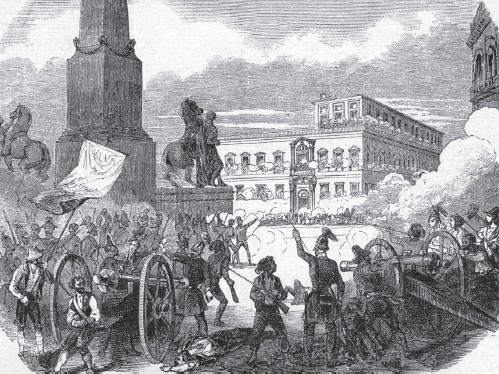
The Quirinal Palace under siege, contemporary engraving.
The following day the pope’s powerlessness was fully revealed. A crowd gathered in the piazza in front of the Quirinal Palace to demand the appointment of a radical, pro-nationalist government. When the tiny force of Swiss Guards inside the palace fired, causing injuries, the piazza filled with the pope’s own troops, from papal regiments and also the new National Guard of Roman citizens. After they shot at the palace windows, killing one cleric, the pope accepted defeat and appointed revolutionaries to his government. He also replaced his Swiss Guards with members of the National Guard, becoming a prisoner in his palace. One week later he made his escape to the territory of King Bomba of Naples. On 6 January 1849 any last hopes of reconciliation were extinguished when Pius excommunicated the Romans for their ‘monstrous act of undisguised felony and of actual rebellion.’3
Popeless, the Papal States proceeded down the revolutionary path they had chosen. Elections were held for a constitutional assembly and on 9 February a new Roman Republic was declared. The Italian tricolour flew from the Senatorial Palace on the Capitoline, the equestrian statue of Marcus Aurelius wore a tricolour garland round its neck, bells were rung, cannon fired and even beggars wore red liberty caps. After the defeats of the year before, Rome’s revolution gave new hope to Italian republicans and nationalists, many of whom made their way to the city.

Proclamation of the Second Republic from the balcony of the Capitoline, 9 February 1849.
Notable among these were two of the greatest figures in the history of Italian unification, Giuseppe Garibaldi and Giuseppe Mazzini. Superficially the two men had much in common. Both came from the same part of Italy. Mazzini was born in Genoa, where he grew up reading patriotic romantic novels and dreamed of becoming a literary critic. Garibaldi was brought up just along the coast at Nizza – now French Nice, but then a half-French, half-Italian city that belonged to the Italian kingdom of Savoy – where he spent his younger years working aboard sailing ships trading to the Black Sea. Both men took part in the failed revolutionary uprisings of the 1830s and both were arrested. Garibaldi – always the more dramatic of the two – was sentenced to death but escaped.
In terms of their characters, though, the two men could hardly have been more different, as was revealed by how they spent their years of exile. Mazzini quickly assumed the mole-like existence of a revolutionary conspirator. He hid himself away in an apartment in Marseilles, hardly leaving the building, though his enemies managed to discover him nonetheless, causing him to move to Switzerland, and then, in 1837, to London. Here he became accustomed to the city’s dirt, bedbugs and drunkenness and led an austere, monk-like existence, working day and night and keeping himself awake with coffee and cigars. At times he was so short of money that he was forced to pawn his watch, to walk rather than pay for omnibus fares, and he struggled to buy postage stamps for his coded letters. Yet he gradually built up a revolutionary organization, the Young Italy Movement. Creating a network of informants and supporters across Europe, Mazzini became the PR man of Italian nationalism, cultivating contacts among English liberals and producing a stream of journalistic pieces. It was a measure of his success that the leader of European conservatism, the Austrian chancellor Prince Metternich, considered him the most dangerous man in Europe.
By contrast, Garibaldi’s exile was exhilaratingly outdoors. He fled to newly independent South America where he soon became involved in a doomed separatist struggle, fighting for the Republic of Rio Grande that sought to break away from Brazil. Garibaldi was shipwrecked, captured and tortured yet remained largely unscathed. He learned how to ride a horse, how to fight guerrilla warfare and, from free-living gaucho ranchers, he acquired his distinctive look, which he would make famous, including the felt hat and poncho. He also found the love of his life, Anita, whom he stole away from a dull husband, and who, fortunately, was no less adventurous and fearless than he was.
Losing hope in the struggles of the Republic of Rio Grande, Garibaldi and Anita made their way to Montevideo, which was also embroiled in war, against the dictator of Buenos Aires, Juan Manuel de Rosas. Garibaldi created an Italian Legion of like-minded exiles who took as their uniform a consignment of red shirts intended for abattoir workers. In early 1846 the Italian Legion defeated Rosas’ forces at San Antonio del Salto. Afterwards Garibaldi and his followers enhanced their reputation by refusing to take any reward from the Uruguayan government. The battle of Salto was a turning point in Garibaldi’s career. Thanks largely to Mazzini’s tireless journalistic promotion his name began to be known in Europe. He was eminently promotable. His public persona – the courageous, self-denying patriot – perfectly matched a hero from the pages of one of the romantic novels that Italians had been reading for decades.
News that revolution had broken out in Italy brought both him and Mazzini hurrying home and in the summer of 1848 they finally joined forces. It was an unhappy collaboration. By then the Italian national cause was already struggling. After Piedmontese armies were defeated by the Austrians at Custoza, Mazzini joined Garibaldi’s volunteers, who were harassing Habsburg troops near Lake Maggiore. Mazzini’s mole-like existence had left him poorly prepared for the life of a foot soldier and a few days of forced marches were enough to send him hurrying across the frontier to Switzerland. Garibaldi’s volunteers defeated an Austrian unit, in one of the few Italian successes of that disastrous summer, but he was soon forced to follow Mazzini to Switzerland, where the two had a bitter falling-out over tactics.
The flight of Pope Pius IX and the declaration of the Roman Republic took them both south, and each assumed a key role in Rome’s new revolutionary state. In March 1849 Mazzini, riding high on his name as a revolutionary organizer, became the Roman Republic’s effective leader, so dominating the ruling triumvirate that its decisions were largely his. Garibaldi led his legion of volunteers. It was clear to both men that the Roman Republic was unlikely to survive for long. By early April 1849 Europe’s revolutionary tide had ebbed to the point where Rome, Venice and Hungary were the last holdouts in a sea of reaction. Four powers – Austria, Spain, Naples and France – had announced their determination to defeat Rome’s Republic and place Pope Pius back on his throne. Austria was in the process of seizing towns in the northern Papal States and Ferdinand of Naples – King Bomba – was threatening from the south and east.
Yet, doomed though it seemed to be, Garibaldi and Mazzini were agreed that the Roman Republic was of immense importance, as it might breathe new life into the national cause by offering an inspiring example. As ever, they had different ideas as to what kind of example this should be. Garibaldi wanted the Romans to show their courage and prove, after the humiliations of the previous year, that Italians would fight bravely for their country. To Mazzini, the public relations man, Romans needed also to show their moderation so the national cause could win foreign friends. To this end he acted quickly against any attacks on churchmen, Church property or the rich. Mazzini was not a traditional Catholic – his beliefs were mystical – but he was careful to show that, though he was at war with the pope, he was not at war with Catholicism. During the popeless Easter of 1849 he found a pro-revolutionary churchman to bless the crowd from the balcony of St Peter’s as Mazzini stood beside him.
Mazzini also tried to impress with his own lifestyle. He lived as frugally as ever in a single room, unguarded and approachable, and he dined simply at a nearby trattoria. His efforts may not have held much sway with Europe’s great powers but they did with foreign writers, such as Margaret Fuller. They also impressed Romans and Mazzini gained the support of a key local figure, the wine merchant Angelo Brunetti, who was known by Romans as Ciceruacchio (and whose son Luigi had assassinated the prime minster, Rossi). With Ciceruacchio’s support Romans, though they were at first doubtful of Mazzini, were won round. The new and fragile Republic had grown some roots.
Mazzini saw Garibaldi as something of a liability. For all his popularity, Garibaldi was unpredictable and his views could be radical. His loathing of priests had led him to declare himself an atheist: a stance that was seen as beyond the pale by most Europeans at this time. There were also his views on marriage. He had famously stolen Anita from her legitimate husband and they did not marry until after the birth of their first child. Accordingly, Mazzini declined to appoint Garibaldi as the Republic’s military commander, instead choosing a plodding and stodgily respectable Roman, Pietro Roselli. Garibaldi was sent to the hill town of Rieti, to train his legion and guard the Republic’s eastern border against possible Neapolitan attack. Garibaldi, who knew full well why he had been sent there and was struck by a bad bout of rheumatism, became frustrated and moody, one moment excitable, the next grumbling that his volunteers were a generation of hermaphrodites.
It was not from the east, though, that danger would come. On 25 April General Oudinot landed a large, well-equipped and professional French force at Civitavecchia, just forty miles west of Rome. It was discouraging news yet Mazzini remained optimistic, sure his publicity talents might yet carry the day. Of the Republic’s four declared enemies, France was the least obdurate. Its new president, Louis Napoleon, was an unlikely reactionary as, like Mazzini, he had spent most of his life as a radical conspirator, plotting and enduring time in jail. In his youth he had dabbled in Italian nationalist revolutionary politics, and Mazzini had met him in London when they were fellow political exiles. Nor did Louis Napoleon seem a leader who would have much stomach for conflict. One of the few women close to him with whom he had not had an affair, Hortense Cornu, offered a memorable assessment of his character. He was kind and loyal, she said, but also lazy and lacking in any kind of principle. ‘Everything wearies him,’ she reported. ‘He gets up bored, he passes the day bored and goes to bed bored.’4
Mazzini had hopes also of winning round French public opinion. Only a year before, France had been a beacon of revolution, and though the country had been moving steadily to the right since then, it was still a republic and elections to its new assembly were approaching. Mazzini had posters printed that displayed, in French, the fifth article of France’s new republican constitution – ‘The French Republic will never employ its forces against the liberty of any other people’ – which he had placed on walls along the road from Civitavecchia to Rome.
Mazzini’s hopes, though, were misplaced. Most of the French population outside radical Paris admired the pope and they believed him when, from his exile in Gaeta, he declared that Rome was ‘a forest of roaring beasts, overflowing with men of every nation, apostates, or heretics, or leaders of communism and socialism’. (The foreigners were Mazzini, Garibaldi and their supporters.) General Oudinot’s officers were not republicans and nor were his troops, most of whom were farmers conscripted from France’s conservative countryside. They paid no attention to Mazzini’s posters but marched straight on towards Rome.
II
As to what kind of Rome awaited the French, one change to the city since 1527 was immediately evident. Oudinot and his army were advancing on a wall that had not existed in the early sixteenth century. In a classic example of shutting the stable door after the horse has bolted, it had been built in the decades after Spanish and Lutheran attack, to protect the western side of the city that had proved so vulnerable. Starting at Castel Sant’Angelo, it encircled the Vatican and its feeble Leonine Wall, then ran along the top of the Gianicolo ridge, encompassed the district of Trastevere, before finally descending to the river. By nineteenth-century standards it was already antiquated but, supported by a thick barrier of earth and containing a series of bastions for cannon, it was far superior to the Aurelian Walls on the other side of the river, which had hardly changed since Alaric’s time. Oudinot was marching towards the one part of the city that could put up a good fight.
Within the walls Rome had, for once, not swelled or shrunk or moved. The abitato had encroached a little on the empty disabitato but not greatly, and a good half of the area inside the city walls was still green. Yet, if the city had not changed much in size, a visitor from the early 1520s would still have found it largely unrecognizable. Most of all they would have been impressed. Rome was vastly transformed for the better.
It was now a city of fountains, and the tinkling of water could be heard everywhere, flowing from hundreds of street taps and dozens of great fountains, some of which, like the Trevi and the Four Rivers, were great works of art. In the 1840s fresh, clean, drinking water was available to all. Rome was also a city of dazzling architecture. Among numerous new palaces and great houses, the most spectacular was the Quirinal Palace, which overlooked the city from the Quirinal Hill, and which had already been the main home of the popes for 250 years, after they turned their backs on the malaria-ridden Borgo. Vast and with fine gardens, the Quirinal Palace was almost as impressive as the older Vatican Palace. Rome was also filled with new, striking churches with ornate Baroque facades and, inside, ceilings covered with gold leaf, or paintings depicting crowds of saints looking down from heaven. Even the city’s medieval churches had been gaudily refurbished, their ancient columns encased in colourful marble. Rome was now a city of beautiful piazzas of every shape and size, from the small and intimate to St Peter’s Square, with its two vast, curving colonnades.
A visitor from the early sixteenth century would have had their greatest surprise, though, if they climbed one of Rome’s hills and looked back at the city’s skyline. In 1527 Rome had been a pincushion city bristling with towers. In the 1840s it was a city of domes. It had some six dozen of them, large and small. The greatest, of course, was St Peter’s. A building site in 1527, the cathedral was now complete, having been consecrated in 1626, just a century behind schedule. Rome was also now a city of vistas, with some long straight streets that culminated in an ancient Egyptian obelisk (and, occasionally, a fake new one). These grand views were carefully framed, and nowhere better than in the Piazza del Popolo, whose two twin churches (not identical though they seemed so, thanks to an ingenious optical illusion) perfectly set off the mile-long Corso to the Capitoline Hill.
Looking at this visual feast, a visitor from 1527 would probably have imagined that the Catholic Church had been thriving since their day. In fact much of what they saw had been inspired by the Church’s failures. In the 1550s, as the Council of Trent led Catholicism down the road of purism and intolerance, the papacy belatedly responded to the disaster of the Protestant Reformation, as popes Pius IV and Pius V attempted to renew both Catholicism and its capital. They set in motion long overdue work to clean up the city’s drains and ordered the repair of Rome’s one functioning classical aqueduct, the Acqua Vergine, which produced only a dribble of water. In 1570, for the first time in centuries, it became a torrent, which was used to power fountains that were then built all across the Campo Marzio. More fountains followed when, in 1587, a second ancient aqueduct, the Acqua Felice, was brought back to life. On the other side of the Tiber the Damasiana was repaired and then, in 1612, the ancient Acqua Paola flowed once again, bringing quantities of fresh water to Trastevere and the Borgo. Romans no longer had to drink Tiber water, though some continued anyway, claiming they preferred it.
Improvements were also made above ground. The Capitoline Hill was slowly remade to Michelangelo’s design, with the Senator’s Palace and two others facing one another around a trapezoid piazza. Seventeenth-century Rome’s transformation accelerated under the influence of two architects in particular. Francesco Borromini produced intense designs that included the twizzle-shaped tower of Sant’Ivo alla Sapienza and the intricate pattern work of the church of San Carlo alle Quattro Fontane. His great rival, the prolific artist and architect Gian Lorenzo Bernini produced the Tritone and Four Rivers fountains in Piazza Navona and the immense bronze canopy – the baldacchino – in St Peter’s.
Yet Rome’s real transformation would require a further dose of Catholic sense of failure. A visitor from 1527 would have been surprised to learn that a great number of the city’s new sights were the work of a single pope, Alexander VII, who reigned for just twelve years from 1665 to 1677. Prior to his election, when he was Cardinal Fabio Chigi, he had worked as a papal negotiator at the peace negotiations at Münster that ended the carnage of the Thirty Years War. The resulting treaty accepted for the first time that Protestant churches were a permanent part of Europe’s religious landscape. Catholicism’s greatest setback, the Reformation, which had lost it a large portion of its European parishioners, was now official. Chigi, who was left traumatized, was determined to restore the Church’s prestige. At the start of his reign the former queen of Sweden, Christina, came to Rome, having renounced her throne and converted to Catholicism. Alexander VII, hopeful that he might win more high-ranking converts, sought to return the city to its former glory so it could become a showcase of Catholicism.
Alexander had Rome’s most renowned antiquities cleared of detritus, replacing several columns of the Pantheon that had been lost to medieval violence and relandscaping the Piazza della Rotunda to make the building more visible. He tidied up streets and piazzas, forcing owners to rebuild the frontages of their houses so they were properly aligned. He restored old churches and built new ones. He gave Rome new vistas and framed those that existed, as with the twin churches in Piazza del Popolo that set off the Corso. He remade Rome’s squares, from Piazza Collegio Romano to Piazza Venezia and Santa Maria in Trastevere. He gave Rome what became among its most popular sights, such as Bernini’s elephant in Piazza della Minerva. Most of all he and Bernini – his chief collaborator – gave St Peter’s Square its vast curving colonnades.
Even the disabitato was transformed. In 1527 it had been working countryside, made up of fields and vineyards with the occasional church or country home. In the 1840s it was largely comprised of holiday homes for Rome’s rich: country villas surrounded by ornamental parkland. One of the largest of these, the Villa Borghese, had its own lake. The Villa Doria Pamphili, which lay outside the city walls, just beyond the new fortifications above the Vatican – and through which General Oudinot’s soldiers marched towards Rome – had two lakes, each with a small waterfall.
If he had been able to look into the future, Alexander VII would have been disappointed. His efforts did not cause a flood of foreign VIPs to convert, and northern Europe remained obstinately Protestant. Yet his beautified Rome succeeded in other ways, becoming a must-see city for Catholics and Protestants alike. So we come to another change that would have surprised a time traveller from 1527. Rome in the 1840s was crowded with a wholly new kind of visitor. These were not pilgrims (though there were still plenty of these as well) but sightseers. The new Grand Tour had arrived.
It had been building up for some time. As we saw in the last chapter, Emperor Charles V could be considered one of the first cultural tourists. Many more would follow. Barring occasional hiccups, such as when Pope Pius V excommunicated Queen Elizabeth I, or when French revolutionaries invaded Italy, the Grand Tour became ever more popular with wealthy northern Europeans, for whom it was the accepted way to round off one’s education. When Napoleon’s occupation of Rome ended, tourists poured south, much to the annoyance of Lord Byron, who complained that the Continent was ‘pestilent with English – a parcel of staring boobies who go about gaping, wishing to be at once cheap and magnificent. A man is a fool who travels now in France or Italy, till this tribe of wretches is swept home again.’5
Byron would be in for a long wait. In 1846 Rome had 300,000 visitors, or double the city’s population. Tourists were the most visible foreign element on the city’s streets, as pilgrims stayed only for only a week or two while tourists would often remain for a whole season, from October to the spring, when the city was largely malaria free. They came for the culture, for the sunlight, and in some cases to save money. The earl of Shrewsbury boasted that by spending his summers in Rome – rashly, in view of the malaria risk – he saved himself £2,000 a year. Rome became their home away from home and, as well as seeing the sights, they would call on one another, have their portraits painted by resident artists – who were mostly northern Europeans like themselves – and dabble in a little painting and writing.
Writers were especially drawn to Rome. Dickens and Byron, Ruskin and Lear, Irving, Cooper, Emerson and Nathaniel Hawthorne all spent time there. Elizabeth Gaskell claimed her days in Rome were ‘the tiptop point of our lives. The girls may have happier ones – I never shall.’6 The American sculptor and writer William Wetmore Story spent much of his life in the city. Keats, though he was in Rome for just a few months, became a kind of honorary Roman after dying there. He was far from alone. In 1849 the non-Catholic cemetery, just below Cestius’ pyramid, was crowded with the bones of eminent foreigners who had succumbed to typhoid, tuberculosis, malaria or riding accidents.
Tourists still happily alive set themselves to work on the serious business of sightseeing. As well as the city’s classical ruins, palaces and churches there were its paintings, and it was all but obligatory to see the portrait of Beatrice Cenci – whose authenticity is now questioned – and lament the injustice of her fate (she was abused by her monstrous father and, after she and her siblings killed him, was executed). Though there were numerous guidebooks to the city, John Murray’s, first published in 1843, quickly became the guidebook for English-speakers, causing William Wetmore Story to observe that, ‘Every Englishman carries a Murray for information and a Byron for sentiment, and finds out by them what he is to know and feel at every step.’7
As well as describing the sights, Murray offered practical advice on where to stay, where to eat and how to avoid being cheated. Most of his suggestions concern the area around Piazza di Spagna. A relatively new neighbourhood – the Spanish Steps and Trevi Fountain had been built the previous century – its housing was less cramped than that of other districts and its straight streets were wide enough to take a carriage. By the 1840s the area had become a foreign – and especially English – colony; so much so that Romans called it the Ghetto degli Inglesi. Aside from the Anglican Church, which thanks to papal sensibilities had to remain outside the city walls, almost every service that English visitors might need was to be found here, frequently offered by other English people. There was an English livery stable, an English reading room, an English circulating library and an English club (proposal strictly by existing members). Among numerous English tradesmen – whom Murray recommended above locals, ‘as they are more to be relied upon for punctuality, good articles and honesty’ and who refrained from, ‘bribing servants to obtain their masters’ custom’8 – there were English tailors and wine sellers, English bakers, hatters, boot- and shoemakers, English saddlers, dressmakers, hairdressers and booksellers, and even an English greengrocer. The English, together with other resident foreigners, had their own passeggiataon the Spanish Steps. Teams of the English played cricket against one another in the gardens of Villa Pamphili. The English even had their own pack of hounds – maintained by subscription – for hunts outside the city.
With tourism came souvenir shops. William Wetmore Story found these distasteful, complaining that ‘Pictures and statues have been staled by copy and description, until everything is stereotyped,’ from the Dying Gladiator to Beatrice Cenci, who ‘haunts one everywhere with her white turban and red eyes’.9 Tourism also brought crowds, especially during Holy Week at Easter when hotels were packed and the price of a city cab doubled or tripled. Dickens, watching the pope convey the sacrament from the Sistine Chapel to the Capella Paolina noted that, of the crowd watching this sombre Catholic ceremony, three-quarters were Protestant English.
We owe much to the Victorian tourists. The accounts they wrote of their visits provide a far more vivid portrait of the city than those of any previous era. Rome in the 1840s excited strongly partisan responses, as it still does today. Many loathed it. Nathaniel Hawthorne complained of its ‘sour bread … enormous prices for poor living, beggars, pickpockets, ancient temples with filth at the base’, and its ‘shabby population smoking bad cigars’.10 Young John Ruskin both loathed and loved it. He despised ancient Rome, declaring it to be ‘a nasty, rubbishy, dirty hole – I hate it’. But he adored the city’s landscape, observing that there was ‘not a single corner of a street which if studied closely and well would not have been beautiful’. Then he loathed it all again, deciding that it was ‘the bluest place conceivable. Everybody in it looks like a vampyre; the ground is cold and church-like; the churches are full of skeletons; the air is sulphurous; the water is bilge; the sun is pestiferous; and the very plaster of the houses looks as if it had got all the plagues of Leviticus.’11 William Wetmore Story adored it all, even the stink: ‘It was dirty but it was Rome, and to anyone who has long lived in Rome even its very dirt has a charm which the neatness of no other place ever had.’12
The tourists came, above all, to enjoy a dizzying sense of time past and greatness lost – though it was now much harder to appreciate Rome’s lost glories as a good portion of them had disappeared. A visitor from 1527 would have been disappointed to see how many of the city’s ruins had vanished, their stone recycled and their marble baked to make plaster. The new St Peter’s was the worst culprit and a large part of it had been constructed from the collapsed portion of the Colosseum. But at least what remained was more visible. Thanks to the city’s Napoleonic rulers, who sought to prepare for Napoleon’s triumphal progress through his second capital (which never happened), centuries of detritus had been removed from the Forum and the buildings and market stalls encroaching on the Pantheon were demolished.
Although there was a little less to see in Rome there were new possibilities outside the city. Adventurous tourists could now explore a quite new kind of ruin: Etruscan cities and tombs. For a century these had fascinated northern Europeans, so much so that English aristocrats had Etruscan rooms installed in their country homes, and Josiah Wedgwood’s copies of Etruscan pottery (most of which were in fact Greek) became so popular that in 1769 he named his new factory Etruria. Etruscomania led to an interesting rediscovery. In 1839 Elizabeth Gray paid a visit to a ruined city north of Rome, whose walls she found were in the process of being eaten away as, ‘every peasant has been at liberty to carry off the stones, destroy the remnants of walls and buildings and dig up the ancient highways, in order to fence round his own sheepfold, or patch of corn land; to build his conical hut’.13 The vanishing city was Rome’s ancient rival, Veii. Rome’s first victim was finally back in the limelight.
When not describing Rome’s cultural sights, tourists complained – and there was much that annoyed them. Rome may have improved beyond all measure since 1527, yet when compared to other nineteenth-century European cities it was old-fashioned, even bewilderingly so. Visitors were irritated by its antiquated bureaucracy, and by its main post office where they went to collect their letters, and which would close for no reason anyone could understand. They grumbled about the city’s numerous feast days when cafés and restaurants were only permitted to serve plain, light food (though Protestants could sometimes get round the rules). They were confused by the city’s clocks, whose hours were numbered from one to six, and whose hour hand (there was no minute hand) made a full circuit of the clock face four times a day. And they were baffled by Rome’s incomprehensible time system, under which each day began at the Ave Maria (half an hour after sunset) though the exact moment was set officially, with adjustments announced every few weeks in the official papal almanac, the Diario Romano.
Protestant tourists also loved to complain of what they saw as the strange superstitions of Catholicism. Despite the ravages of Charles V’s Landsknechte, many of these still remained. In St Peter’s, hidden in repositories and shown to the public only on special feast days, were part of Longinus’ lance, with which he had stabbed Jesus’ side, as well as Saint Andrew’s head and even the Veronica cloth, which had supposedly been burned or sold in an inn in 1527. However, these days the popularity of all three was eclipsed by a new miraculous object: the Bambino of the church of Santa Maria in Aracoeli, which was a wooden figure of Jesus, dressed in satin, gold lace and precious jewels. It was widely believed to have healing powers and was brought to sick patients accompanied by physicians, who – fortunately – were able to give actual medical advice. When the Bambino passed through streets, often in his own carriage, Romans would kneel, cross themselves and women would cover their heads. Dickens described it as ‘a little wooden doll, in face very like General Tom Thumb, the American dwarf’.14
The greatest number of tourists’ grievances, however, were reserved for their lodgings. Though they might spend a day or two in a hotel on their arrival, most then moved to a rented apartment that was both more spacious and less costly. Yet, living as the Romans did could be a sorry experience. Sir George Head described dirty stairways, poorly fitting doors, badly made locks and draughty windows, observing that many properties were ‘so questionable that, in any other place than Rome, one would think it disreputable to enter’.15 It did not help that the tourists visited Rome in the autumn and winter, although the buildings they stayed in were designed to keep out the intense summer heat. Nathaniel Hawthorne found himself sitting by a smoking, cheerless fireside wearing more clothes than he had ever worn in his life. Fleas were a constant problem as they infested almost all rented housing, from the poorest to the best.
There was also the noise. Ceilings were anything but soundproof, while apartments were often reached through a labyrinth of different entrances, so ‘one may hear one’s fellow lodger stamping continuously for weeks or months’, without ever being able to catch him at the door and ask him to be quieter. There was also an infuriating device that was used all over Rome to carry water to upstairs rooms, which involved ‘a copper vessel suspended by a ring to a slanting wire, and drawn up and down to an upper window, which process is an extraordinarily noisy one’. The copper vessel was so small that it had to be hauled up repeatedly; and as there were half a dozen or so such wires in every piazza, ‘the same disagreeable, grating, rattling and splashing disturbance is repeated continually’.16
And of course there was the stink. Despite plaques placed all over the city threatening dire penalties to anyone who deposited rubbish, it was dumped everywhere, along with worse things. All grand tourists concurred that Rome smelt terrible and they disagreed only as to where, if anywhere, smelt even worse. August von Kotzebue thought Naples was worse, James Johnson picked Lisbon and John Ruskin favoured Edinburgh. Lady Morgan claimed Rome had no paragon, while she considered the approach to St Peter’s Rome’s vilest spot, declaring grandly, ‘Here the streets of the filthiest city in Europe are found filthiest.’17 Hawthorne warned anyone passing through the Forum that ‘you must look well to your steps or they will be defiled with unutterable nastiness’.18
Rome’s streets had annoyances other than dirt. Most were unpaved. Some had large elliptical-shaped openings to drains below, through which valuables could easily fall. Though, as Sir George Head recounted, a remedy was usually at hand: ‘Some small lean boy, trained by frequent practice to squeeze his carcass through the aperture is invariably to be found ready to redeem the lost treasure.’19 In hot weather the drains became refuges for colonies of cats, whose faces could be seen peering out of the openings.
Most of all though, thanks to Gregory XVI’s distaste for gas lamps, Rome’s streets were dark, and at night they were far from safe. A common ploy of robbers was to ask for a light for their cigar. When the victim reached out obligingly they would find a dagger pressed to their chest. Odo Russell, the unofficial British representative to the Vatican (no official one being acceptable from a heretic, Protestant country), was told by his Roman servant, ‘to offer no resistance if I am attacked, but to give up my money as he promises he will get it all back from the police the next day. But he says if I resist they will run a long knife into me and then run away.’20
Romans might seem alarming to foreign tourists but they posed little threat to the wider world. A visitor from 1527 would have been disappointed to find how much of a kitten their home town had become on the world stage. In the early sixteenth century, as the headquarters of Europe’s religion, and as the capital of a second-tier, yet significant, military power, Rome was still a city of consequence. By the 1840s it was a fascinating and picturesque oddity. It is hard to think of a moment since Brennus’ Gauls attacked when the city had been more of a backwater. The world had moved on and left it behind, small and provincial. Between 1520 and 1849 its population had not quite doubled, from around 80,000 to 150,000, while during the same period London’s population had grown over forty times and it was now in excess of two million. Hardly a single building of consequence had been constructed in Rome for a century and some things had not changed in a thousand years. Watermills were still moored to the Tiber Island. Rome was in a rut even when it came to art. In the 1840s most of the city’s artists were second-rate foreigners scraping a living by painting portraits of tourists. The nineteenth century’s Michelangelos were in France, Spain, Germany or England but not Rome.
The city’s economy, too, was far sleepier than it had been three centuries earlier. At a time when Europe’s northern cities were powerhouses of industry, the French political economist Jean Charles de Sismondi offered a damning assessment of Rome’s productiveness: ‘In Rome, with the exception of artists, hoteliers, coach drivers and shopkeepers selling trinkets to foreigners, everyone languishes, everyone struggles, every project fails, every industry is regulated into poverty, except that of begging.’21
As the city had declined, so had its aristocracy. By the 1840s there were only a dozen or so families who, like the Pamphili, owned tracts of land, villas, palaces and art collections, and who could look rich northern Europeans in the eye. Far more common were Romans who, though they had a title and a decent-sized house, were rentiers, struggling to make an income from letting out an apartment or two to tourists. John Murray warned his readers that they should be sure to obtain a rental contract, ‘however respectable the landlord may appear.’22
If most of Rome’s aristocrats suffered reduced circumstances, at least they enjoyed a warmer family life than their predecessors. In the past, Italy’s urban nobility lived in large, extended families, but from the late eighteenth century aristocratic newly-weds emulated the bourgeoisie, setting up their own homes. They also became more intimate with one another. Aristocratic mothers brought up their children themselves rather than handing them over to wet nurses, and there was less reserve between husbands and wives and parents and children. Italian family life had reached the elite. Rome’s nobility also enjoyed better food, at least to our taste buds (a visitor from 1527 would have found it a little bland). From the seventeenth century Eastern spices ceased to appeal to Europe’s wealthy, in part because they had become too cheap to give status. Sweet and sour sauces lost their popularity and sugar – which had been added to almost everything – was relegated to desserts. In the 1840s Rome’s wealthy preferred delicate-tasting local foods, such as beans, artichokes, broccoli, pasta, potatoes, and fish or veal in a white sauce. They also enjoyed tomato sauces, whether on pasta or meat. Roman food was finally emerging as the cuisine we know today.
All these dishes were also popular with the poor, though, unsurprisingly, their tomato sauce was poured on to different cuts of meat. Choice parts went to the rich while the poor made do with tripe, liver and other remnants, which were becoming the basis of many classic Roman dishes. Life for Rome’s poor was as tough as in previous ages, if not tougher, and many made their living from odd jobs or busking. The nineteenth century saw a sharp rise in the number of illegitimate births in Italy and more Italians than ever made use of the ruota: the device built into the walls of orphanages that allowed mothers to leave their babies anonymously. The prospects for abandoned newborns were not good. With more foundlings and fewer wet nurses, infant mortality in Italian foundling hospitals was higher in the nineteenth century than it had been in the Middle Ages.
Not many tourists took time off from their cultural tours to see how Rome’s poor lived, but William Wetmore Story did. In classical times Rome’s poorest had lived in the highest part of apartment blocks but now they were in the lowest, right by the noise and stink of the street. Story found them crouching over a little earthenware pot of coals to keep warm, in rooms with cheap brick paving, stains on the walls and shabby, rickety furniture, though there was ‘no place so mean as to be without its tawdry picture of the Madonna, with a little onion-shaped lamp burning below’.23
Rome’s struggling economy was not the people magnet it had been in the past. Immigrants drawn to the city were mostly from rural areas of the Papal States where prospects were even worse. But at least these days a Roman had a better chance of finding a wife. As immigration shrank, so did the city’s gender gap. In 1600 men had outnumbered women by three to two, but by the 1840s the difference was barely one in twenty. It did not take long for arrivals from the country to take on Roman ways and they were soon largely indistinguishable from the rest of the population. As a consequence, tourists usually assumed they were all locally born and – despite the fact that the city had enjoyed eighteen centuries of immigration from all over the Mediterranean – they romanticized them as the direct descendants of the ancient Romans. Many claimed to see a clear resemblance between their faces and those of classical statues. They were particularly fascinated by the Trasteverini whom they found delightfully picturesque. Story described them, ‘going home with their jackets hanging over one shoulder. Women in their rough woolen gowns, stood in the doorways, bare-headed, looking out from windows and balconies, their black hair shining under the lantern.’24
Tourists even romanticized poor Romans’ violence. Knife fights were common, and though they were usually caused by disputes over women and honour they could erupt over the most trivial of things. In one incident in 1866 a street musician was thrown a coin from an upstairs window, which a bystander then covered with his foot. When the musician complained and forcibly tried to move his foot the other man stabbed him in the neck. Tourists liked to see such incidents as a debased resurfacing of the fighting spirit of Livy’s republican heroes but their real cause was more prosaic. Romans fought one another not because it was their nature but because they had no faith in papal justice and preferred to take matters into their own hands. Culprits vanished into the crowd and were protected by friends and neighbours. Few were caught.
Then again, the Church authorities were not too concerned by such crimes. They were much more interested in another form of transgression: adultery. Here was a change which would have greatly surprised a visitor from the easy-going days of the early sixteenth century. Rome in the 1840s was a city of intense moral policing. Though its roots lay in the strictures of the Council of Trent, the new approach came fully into effect under the conservative popes who ruled after the French revolutionary era. This was the age when ornate images of Jesus, the Madonna and flying cherubs appeared above every Roman street corner, and the Roman dialect poet, Giuseppe Gioachino Belli wrote that SPQR stood for, ‘Solo Preti Qui Regnano, e Ssilenzio’ (Only priests rule here, and silence).
Reaction reached a high point under Pope Leo XII, who reintroduced an antique and grisly form of execution – mazzolatura – in which the condemned was struck on the head with a large hammer and had his throat cut. He also banned inoculation on the grounds that it caused a dangerous mixing of the human and the animal, closed Rome’s drinking houses, forbade wine except with meals, and prohibited card-playing, coffee and dancing the waltz. During the Holy Year of 1825 (which drew disappointingly few pilgrims) he ordered daily religious processions and banned all non-sacred music. Leo XII was greatly concerned with extramarital sex and, as well as having his Swiss Guards patrol the streets watching for women in tight-fitting clothes that might excite lustful thoughts, he sometimes took off his papal robes and personally toured the streets as a plain-clothes pope, sniffing for sin.
Inevitably these strictures had quite an effect on Romans’ sex lives which, in the late eighteenth and early nineteenth centuries had been notoriously open, at least for the rich. The French general, Marmont, who visited Rome in 1790, wrote that, ‘The freedom of women passes all belief, and their husbands permit it, speaking cheerfully and without embarrassment of their wives’ lovers.’25 Extramarital affairs had their own traditions, and it was accepted that married women could be attended to by their lovers – termed cicisbei – during the day, so long as they returned home to their husbands at night. As for the husbands, they were said to be happy with the arrangement, as it meant they were free to indulge in daytime affairs of their own.
Naturally such arrangements were no longer possible when Leo XII ruled. Rome’s eternal sex-workers, too, found life increasingly hard. Long gone were the days when elegant, educated courtesans were regular visitors to the papal palace, or one might, at Carnival, find oneself struck by a perfumed egg thrown by one of the city’s many prostitutes. A growing number of restrictions against them were introduced in the eighteenth century, and in the nineteenth they were banned altogether: Pius IX denounced prostitution as a sin and so a crime. Yet this did not mean it disappeared. In the middle of Pius’ reign, the chief medical officer of the French army in Rome, Dr Jacquot, observed that though prostitutes faced imprisonment, fines, torture and every kind of harassment, Rome remained ‘a notorious centre of European prostitution where women solicit openly in the streets, in dark corners, in brothels, under deserted porticoes and along remote thoroughfares’.26
Then the papacy’s chief moral concern was not prostitutes so much as misbehaving Romans. To prevent them from transgressing, Rome’s streets were patrolled each night by priests, police and sbirri – a kind of papal beagle – who kept a close watch on suspect individuals. Priests drew up maps of parish sinfulness and sent reports to higher church authorities, such as this one, recorded on 23 May 1823:
I took myself during the night to the house of Maria Gertrude Armezzani to see if she was alone and to observe if she was in an enjoined state. I found her with the bolt shut, together with a young man who was dining with her. I once again admonished her and though she sought to give me various excuses, her confusion made it easy enough to see her life.27
The Church was especially concerned with secret adulterers who lived in ‘a state of concubinage as if they are cohabiting legitimately’. Lapses in paperwork were no excuse and priests were told, ‘If you have any doubts address yourself as to where they came from, and if foreigners, require them to give proof of their marriage, treating them with much suspicion …’28 Though Church authorities were kept in the dark over street knifings, they found ample collaborators when it came to rooting out adulterers and prostitutes. Romans enjoyed the sport of spying on their neighbours, and wives were happy to report prostitutes or local seductresses who might tempt their husbands. And yet, despite all the risks, a good number of Romans still flouted the law and lived together outside matrimony. Some did so because they could not afford to marry, others found themselves blocked by paperwork, while some simply did not get round to it, or loathed the Church. Parish priests sought out couples who went to elaborate lengths to appear married, dining together, walking out together, but who were ready to move away if a priest came knocking at their door.
The Church’s zealousness in this area could even affect foreign visitors, though it was rare, as they generally arrived with their own strong sense of keeping to the rules. Odo Russell, the unofficial British representative to the Holy See, had to deal with a young Englishwoman who left her chaperone and moved alone into an apartment on the Corso, where a Roman man paid her regular visits. Russell decided to leave her to the mercies of the Church authorities, and a visit by a squad of papal police scared her so much that she fled back to her chaperone. Foreign trespassers were unlikely to get into real trouble. Then the same was true of Romans, a fact which highlights the strangeness of papal justice, which was run on wholly different principles from justice anywhere else. It was less concerned with just punishment than with the confession of sins and forgiveness. Once an unmarried couple had been caught they were often not punished at all but were forced to marry, frequently in jail. Adulterous couples in which both parties were married to somebody else posed more of a problem, yet they too were treated mildly. They were usually given light sentences, made to confess and then warned never to speak to one another on pain of a much longer spell in jail.
Even condemned murderers were treated with a kind of gentleness. Before being delivered into the hands of Giovanni Bugatti, Rome’s long-lived executioner, who had been dispatching papal subjects since 1796, the condemned spent their last night with two comforters from the Fratelli della Arciconfraternita di San Giovanni Decollato, who would try to cheer them up with pictures of the Virgin and Jesus on the cross. The next morning, as they were led to the city guillotine – a souvenir of French revolutionary rule – that was set up by the river, close to the church of Santa Maria in Cosmedin, other comforters would encourage them to have good thoughts. Executions were frequently delayed for hours until the condemned confessed. Luckier murderers escaped execution, spending time in jail or pulling oars on a papal galley, and ended their days working as gardeners in one of the city’s parks. Sir George Head observed a group of them on the Pincio, watched by a soldier, and was struck by how relaxed they were, remarking, ‘no other class of the Pope’s subjects appear more thoughtless and lively than these galley-slaves’, while their guard was ‘on the easiest terms with them, all laughing and conversing’.29
Rome was forgiving to many who were treated harshly elsewhere. Begging was not frowned upon and though competition could be intense, the life of a beggar in Rome was comfortable when compared to London or Paris. The Church had kept up its ancient responsibility of catering for the poor, so Rome’s beggars were fed by the city’s monasteries. If sick they could go to one of the city’s many hospitals. As a result Rome was crowded with vagrants and William Wetmore Story graphically describes how they would brandish their infirmities: ‘every kind of withered arm, distorted leg and unsightly stump. They glare at you out of horrible eyes that look like cranberries.’ Yet they could also use charm, especially on foreign females ‘on the cold side of thirty’, addressing them as, ‘bella, illustrissima’ and, ‘principessa’. They particularly targeted foreigners, pursuing them with their chant, ‘Signore, povero strappiato, datemi qualche cosa per amore di Dio.’ The only way to be free of them, Story advised, was ‘to be black-haired, to wear a full beard, to smoke in the street … and shake the forefinger of the right hand when besieged for charity’30 – in other words, to be Italian. Though he added that Italians gave more generously than any visitors.
Tourists found Rome’s beggars infuriating but also fascinating. Their persistence knew no bounds. Tourists visiting country fairs miles outside Rome found familiar Roman beggars lying in wait for them. One Englishwoman who had removed herself to Tuscany for the malaria season discovered that one had come all the way to Lucca. This was King Beppo, the most famous of all Rome’s beggars, who appears in numerous accounts of the city. Strongly built, aside from his crippled legs, he pushed himself around on a wooden platter and was sometimes found begging from a donkey, which he could mount without help by hauling himself up with a rope. Charming and good-humoured, he ruled all Rome’s beggars like an emperor and was said to be so wealthy that he acted as their moneylender.
The Church had not always been so tolerant of beggars. In the late seventeenth century, at the height of the Little Ice Age, when harvests were poor, the city became so overwhelmed that an establishment was set up to turn them into useful members of society. San Michele a Ripa still existed in the 1840s: a huge institution, somewhere between a poorhouse, a jail and an academy, that towered above the Tiber in Trastevere. Influenced by seventeenth-century French ideas, in many ways it was ahead of its time and it won much praise from the English prison reformer John Howard when he paid a visit in the 1790s. Entrance requirements were strict. Older residents had to have been residents of Rome for at least five years and to have no family to support them. Younger ones had to be between seven and eleven and had to prove they were fatherless, and that their mothers, if alive, had had at least three children. The restrictions were necessary because places at San Michele were much sought after. Young residents were taught a whole range of skills, from carpentry and shoemaking to printing, tapestry, metalwork, dyeing, medal-making and clothes-making, to architecture and art. Promising young painters were taught by the best artists in Rome. In 1835 San Michele held a public show of its young residents’ work. The institution was so highly regarded that richer parents of non-orphans paid their children to go there, though they endured the same simple living conditions as the orphans.
If the papacy showed humanity towards the poor, orphans, and even to criminals, it was less kindly to those it regarded as its enemies, or as being outside its world. Until Pius IX released them, the papacy’s political prisoners were kept far from sight in the popes’ gulag, the fortress of Civita Castellana forty miles north of Rome. Females could find themselves badly received if they failed to fit the Church’s ideal of womanhood: modest, sexless baby-makers who spent their days at home. Rape was included in a blurred legal category that included both seduction and adultery, and women who had been sexually attacked often found that instead of winning justice, they were cautioned against misbehaviour while the attacker was let be.
And of course there were Rome’s Jews, who in the 1840s were still locked away in their Ghetto. A visitor from 1527 would be confused. The idea of a ghetto in Rome would have seemed unthinkable in the early sixteenth century, when popes acted to protect Jews from Spanish persecution, and when Michelangelo found models among Rome’s Jewish inhabitants for his Old Testament figures in the Sistine Chapel.
That such a place existed was thanks to Paul IV, the Senator-McCarthy-like pope whom we met at the end of the last chapter. When elected pope in 1555 he quickly set about restricting the lives of Rome’s Jewish inhabitants. Their property was confiscated and they were required to rent properties in their new Ghetto, located in a low-lying area north of the Tiber Island that was vulnerable to flooding. The zone was walled off and Jews were only allowed to leave it during the day. Ten synagogues were closed down and worship was permitted in just one. Jews had to wear distinguishing clothes – caps for men, shawls for women – in obedience to humiliating and long-ignored medieval rules. They were banned from employing Christian servants or wet nurses, or from having commercial dealings with Christians, while Jewish doctors – who had included many of the city’s best physicians – could no longer treat Christians. Jews who had owned fine businesses were forced to become rag merchants, who could trade only in second-hand or discarded goods. Soon after Paul IV’s reign all Rome’s Jews were required to attend a weekly sermon in the church of San Gregorio della Divina Pietà, to be lectured on the errors of their religion.
These restrictions were not only mean-minded. They had a clear purpose: to extinguish the city’s Jewish community once and for all. Thanks to a ruling by Gregory I, a thousand years earlier, which prohibited forced conversion, misery was the only means available to the papacy to persuade the Jews to abandon their religion. As an experiment, the Ghetto was a colossal failure. Rome’s Jewish community, which had led European Jewish learning in medieval times, became steadily degraded and by the 1840s, unusually in Western Europe, half its members were illiterate, yet it did not disappear but survived and grew. At a ceremony during the carnival festivities before Lent, the latest Jewish converts were put on parade and in the 1840s tourists were amused to note that there was only one, who had to be shown year after year.
Still, failure proved no discouragement to those who had created the Ghetto. During the two and a half centuries of its existence, popes tightened and loosened regulations but none questioned that Rome’s Jews should lead separate – and more degrading – lives from the city’s Christians. Rome’s Jews had tantalizing glimpses of freedom, when Rome was occupied by French revolutionary and Napoleonic forces, but from 1815 the old restrictions were again enforced. By the 1830s, as Jews gained full civic rights elsewhere in Europe, the existence of Rome’s Ghetto appeared increasingly barbaric, and, in 1836, France, Austria and the Rothschild family all urged that reforms should be made. The railway-hating Gregory XVI reluctantly allowed the Ghetto to be enlarged a little, to include the Palazzo Cenci, but that was all.
In the 1840s the Ghetto was a popular tourist sight and its gloomy lanes and cramped courtyards were a must-see for adventurous tourists. A number of writers left descriptions, which often manage to disparage papal cruelty while also throwing in a little anti-Semitism. Thus William Wetmore Story wrote that the Rome’s long-suffering Jews had a ‘greasy, anointed look’, with their ‘thick peculiar lips, narrow eyes set close together, nose thin at the junction with the eyebrows and bulbous at the end’.31 All were agreed that the Ghetto was dirty and crowded. Dickens said it was ‘a miserable place, densely populated and reeking with bad odours’.32 Story felt the Jews were lucky to live in an area at high risk of flooding as it meant that ‘Old Father Tiber washes out this Augean Stable’.33
Yet life in the Ghetto was not all bad. Cruelty from outside brought its inhabitants closer together, and if their culture had grown rougher and less literate it had also grown stronger. Rome’s Jews developed their own version of Italian, which had an important impact on Roman dialect. Containing a good number of Hebrew words, it was full of richly graphic phrases, such as, ‘A black bargain’ (a bad deal), ‘A real serpent’ (a long queue), ‘A mirror’ (someone whose mood reflects that of the person they are with, and who is cheerful on the street and scowls at home) and ‘Better king of a hovel than a slave in a palace’. They also developed their own food, which included dishes such as salted cod, courgette flowers filled with mozzarella and anchovies, and deep-fried artichokes, all of which became classics of Roman cuisine.
Rather surprisingly, the Ghetto was a relatively healthy place to live in. Thanks to Jewish religious concerns with cleanliness it may have been far less dirty than tourists assumed, and its inhabitants were relatively unaffected by the cholera epidemic that struck Rome in the 1830s. And though it was in a low-lying area right by the Tiber, it was malaria free. The mystery of how such a thing could be perplexed many foreign visitors. Tourists imagined malaria was caused by emanations from the earth, and claimed that visitors put themselves at risk if they moved too quickly from a hot and sunny spot to a cool damp one (which tourists regularly did when visiting a crypt or catacombs on a warm spring day). Consequently, some claimed the Ghetto was malaria free because, as William Wetmore Story observed, it was a place where ‘the air is much beaten by a constant concourse of people’.34 Though wrong, Story was not as wrong as one might think. The Ghetto had no malaria because there was no room for gardens, which meant there were no puddles or pots filled with standing water where mosquitoes could breed.
For all the tourists’ comments, it is doubtful that Christian Romans were any cleaner than their Jewish neighbours. Though Rome in the 1840s had some public bathhouses these were few, and Story thought them poorer than those in any other city he knew. He claimed that ordinary Romans ‘are not a bathing people’, and showed ‘a common horror at the Anglo-Saxon idea of a cold bath each morning’. Even wealthy Romans, like wealthy Anglo-Saxons half a century earlier, ‘wash themselves but they do not take baths. They use the wash bowl, but the bathing-tub and the shower-bath frighten them.’35
When it came to their health, 1840s Romans had some advantages over their Renaissance ancestors. Surgery techniques had improved and diagnosis had advanced with the development of the stethoscope. Smallpox had been much reduced by campaigns of vaccination (despite Pope Leo XII’s ban) while the city’s improved drains reduced outbreaks of typhoid, and its aqueducts and fountains did the same for waterborne diseases. Though malaria was still a major worry, especially for people who could not leave the city in the summer – and who did not live in the Ghetto – there was now a remedy, at least for those who could afford it. Since the beginning of the seventeenth century rich Romans could take doses of the bark of the Peruvian cinchona tree, which helped combat the disease.
In its fundamentals, though, 1840s medicine had advanced remarkably little since the 1520s, or for that matter since the days of the Roman Empire. Doctors still followed the theories of Hippocrates and Galen that claimed sickness resulted from an imbalance in the humours. As with the French Disease in the 1520s, early nineteenth-century physicians failed to comprehend, let alone treat, the new disease of their age, cholera, which they believed was caused by stinking air. That Romans could expect to live longer than their ancestors was largely down to good luck. Since the late seventeenth century Rome and all of Europe had been free of bubonic plague, which had vanished as mysteriously as it had first appeared.
Yet, outside the malarial season, Rome’s health dangers did not put off the tourists and, for all their grumbling, many adored the city. As well as being fascinated by its ruins and paintings, they found Rome a visual feast. Many commented on the food stalls and shops to be found in streets around the Pantheon, which, at the end of Lent, were filled with highly elaborate displays of all the delicacies Romans would shortly be able to eat again. At dusk on the last day of Lent the city produced one of its great sights, when St Peter’s was illuminated by scores of paper lanterns, acquiring, as Story described it, ‘a dull furnace-glow, as of a monstrous coal fanned by a constant wind, looking not so much lighted from without as reddening from an interior fire’.36 There was the spectacle of Easter pilgrims, many of whom came from the nearby countryside dressed in local costumes, chanting psalms as they passed. In addition there were also more traditional-looking pilgrims dressed in oilcloth, with long staffs, scallop shell badges and rosaries, and whose ‘dirty hands held out constantly for, “una santa elemosina pel povero Pellegrino”.’37 Though, as Story explained, most of these were not real pilgrims at all but Rome’s usual army of beggars trying a different tack.
Visitors found Rome’s street life endlessly fascinating. When they strolled through the city they saw Romans playing the same ball games that they had in classical times. They saw washerwomen beside the city’s fountains passing time by insulting one another, and passers-by, in rhyming verse. Charles Dickens described a strange procession he saw, that was ‘…preceded by a man who bears a large cross; by a torch-bearer; and a priest: the latter chanting as he goes’: it was the dead cart, filled with bodies of the poor, on their way to be thrown into a pit outside the walls.38Story saw a Roman funeral that looked like it should for a pirate, its black banners ‘gilt with a death’s head and crossbones’, and its group of accompanying friars, ‘shrouded from head to foot in white, with only two holes for their eyes to glare through’.39
Or one could spend an evening at one of the city’s theatres: a popular passion for Romans, who crowded in to see a new play and became so involved that they would cheer the hero and hiss the villain. Though productions could be hard to follow. Until the election of Pius IX, papal censors went through every scene, striking out anything they considered subversive, and some plays were so badly cut they made little sense. Even operas were mauled. Any with a religious or rebellious theme was prohibited, as were any that depicted a wicked pope. Heckling was banned and Lady Morgan described how anyone who hissed was immediately seized by soldiers, ‘with which the theatre is filled, (for the most military government in Europe is the Pope’s) and then taken to Piazza Navona, mounted in a sort of stock and flogged. Then carried back and placed in his seat, to enjoy the rest of the opera, with what appetite he may.’40
And of course there was always the city’s religious spectacle. Experienced tourists became adept at recognizing orders of friars from the colour of their robes. Story’s favourites – and most Romans’ – were the Franciscans and Capuchins, Rome’s other army of beggars, who went from house to house asking for donations. As Story writes, ‘They are very poor, very good-natured and very dirty. They seem to have a hydrophobia.’ Another order, the Saccone, was filled by wealthy men who had chosen to live in poverty and who also begged for alms, going about in pairs, dressed entirely in white. ‘They often amuse themselves by startling foreigners … Many a group of English girls, convoyed by their mother, and staring into some mosaic or cameo shop, is scared into a scream by the sudden jingle of the box, and the apparition of the spectre in white who shakes it.’41
There was always the hope one might catch a glimpse, in a carriage clattering by, of a cardinal in his scarlet robes, or even the pope himself. Yet a visitor from the 1520s would be surprised at how remote and invisible popes had become. Even the tradition under which a newly elected pope rode through the city on horseback, distributing silver and gold, had been watered down: after an accident in 1769, popes now travelled in the safety of a carriage. Popes blessed crowds from the balcony of the Quirinal Palace and they celebrated mass at Christmas, usually in Santa Maria Maggiore, but in the 1840s there was only one papal procession. This was held on the feast of Corpus Domini on the first Sunday of Pentecost and was a huge event. The parade included church scholars, attendees of charity schools and hospitals, the city’s friars – chanting and carrying candles – then the chapters, canons and choirs of Rome’s seven greatest churches, followed by monsignori, bishops and cardinals, and finally the pope himself, carried on a splendid platform. Yet, compared to the marathon processions of medieval times it was very modest, managing just one circuit of St Peter’s Square.
If Rome’s religious processions were a little dull these days, the city was justly famous for its popular holidays. The October Festival held on Monte Testaccio – the last remnant of Romans’ medieval holiday – included dancing and games, for which poor Roman girls would dress up in their best finery and hire a carriage, as many as fourteen of them cramming inside, all ‘shouting, screeching and playing the tambourine, like a party of wild Indians’.42 Before Christmas the city filled with Pifferari: musicians from the mountains of Abruzzo, one of whom played a pipe while another played the bagpipes. On Christmas Day, after celebrating mass, Romans would walk through the city eating quantities of torone and pangiallo: a cake made with plums, lemon and almonds. At the beginning of January the area around the church of Sant’Eustachio became crammed with stalls selling noisy toys, and children – and their parents – would enjoy making a huge din with whistles, tambourines and trumpets.
But the greatest festival of all – greater even than Holy Week – was Carnival. Held during the last two weeks before Lent, it was a mix of colour, chaos and nineteenth-century animal cruelty, at which Romans showed their capacity for letting themselves go, and normally strait-laced northern visitors enthusiastically joined them. It took place on the Corso, which by mid-morning would already be crowded with carriages and pedestrians. People wore elaborate costumes. Small boys dressed and walked like old men, and Romans with bushy beards strode about in white dresses and straw bonnets. Sir George Head describes a man who claimed to be a professor of music who had taught cats to sing. On his shoulders he carried a large wooden box containing six cats and from time to time he would launch into a song, pulling the cats’ tails until they squealed.
Some costumes were elegant, though they did not stay so for long. All around the Corso portable stalls sold nosegays – bunches of wild flowers held together with string – and comfits: pea-sized pellets made from lime or plaster of Paris. The Corso became a battleground as nosegays were hurled and comfits burst on people’s clothes, powdering them white. Attacks were launched from all directions: by pedestrians, by people in carriages and others on balconies. Some carriages were like wooden fortresses, filled with young Romans who kept up a steady fire on all around them, while if they passed another gang a huge fight ensued. Occasionally disaster struck, as when a young English girl on a balcony threw a handful of comfits at a papal policeman. The carabiniere, furious, marched up to the balcony – from which the girl had already fled – though fortunately he ‘was a good natured fellow and consented very willingly to drink the Pope’s health with a glass of rosolio’.43
Each day of Carnival culminated in a race. Fourteen unfortunate horses were brought to the Piazza del Popolo, decorated with coloured ribbons and large flapping pieces of tinfoil. Each horse had four large patches of pitch stuck to its flanks from which hung four heavy pear-shaped spurs, covered in half-inch spikes. When released, the horses, which were riderless and terrified by the roar of the crowd and the jabbing of the spikes, hurtled down the Corso, the crowd opening and closing around them as they went, as everybody wanted to see (occasionally someone wrongly assumed all the horses had passed and was run down), till they reached the Piazza Venezia, where they were forced down a side street and collided with a barrier of blankets.
Finally, on the last evening of Carnival there was the festival of tapers. The Corso became thronged with people holding tiny candles, all joining in a game of trying to extinguish everyone else’s while keeping their own lit. Anyone who doused another’s candle would shout in triumph, ‘senza moccolo!’ (without light). Some tried to improve their chances by tying bunches of candles together or bringing torches.
Struggles grew intense. Pedestrians leapt on to carriages to try and put out their occupants’ lights. Battles broke out between upper and lower balconies, as people hurled sopping handkerchiefs or tried to behead candles with wire loops on long sticks. Ladies’ bonnets were crushed in the melee, and strange sights were witnessed, as when Sir George Head saw, together on one balcony, an Italian priest, an English clergyman and a princess from the House of Brunswick, all fighting furiously and ‘engaged like children at blind man’s buff’.44 All the while, for anyone able to stand back and watch, the Corso was an extraordinary sight of constantly twinkling lights, from which the cries of senza moccolo produced, ‘a sound indescribable – an earthly moaning, which can be compared to nothing better than the howling of the wind in a ship’s shrouds in a hurricane’.45
In the heady days of the spring of 1847 Rome saw new kinds of celebration. After Pius IX’s cardinal secretary announced that elections would be held to choose a council to advise the pope, a huge crowd with torches assembled in the Piazza del Popolo and then streamed slowly down the Corso to the Quirinal Palace, where they lit fireworks. When Pius appeared on the balcony they shouted vivas and went down on their knees to receive his blessing. A few days later an open-air popular dinner was held in the ruins of the Baths of Titus, overlooking the Colosseum, where an effigy of Romulus, Remus and the she-wolf was set up. There was music and speeches, including one by a novelist who recounted events in Rome’s history and made particular reference to the moment when, at the castle of Canossa, the ruler of Germany, King Henry IV, was forced to beg forgiveness from the pope. (The Austrians afterwards complained.)
The following July, after trouble broke out between cowherds and some of Rome’s Jews, there was an equally notable celebration. The inhabitants of Regola and Trastevere, who were old enemies of the city’s Jews, wanted to avenge the cowherds but the populist leader Ciceruacchio persuaded them instead to make a pact of friendship with the Jews. That same night 2,000 Romans entered the Ghetto singing and carrying torches in what was, by all accounts, a remarkable moment of reconciliation. The following spring there were more celebrations in the Ghetto, after Pius ordered the walls to be demolished.
During the months that followed Rome was on a political seesaw. In October, as Prime Minister Rossi tightened the reins of Pope Pius’ power, the mood changed and sbirri – the papal beagles – led an attack on the Ghetto which saw three days of plundering and burning. Within weeks Rossi was dead, the pope had fled and in February Romans joined in celebrations of their new republic. Two months later, on 30 April 1849, it seemed all was about to change again, as General Oudinot led his army towards Rome.
III
The French did not expect much trouble. As has been seen, Louis Napoleon had been following papal pronouncements from Gaeta and he assumed that the Romans were impatient to be freed from oppressive rule by foreign revolutionaries such as Garibaldi and Mazzini, and that they would welcome French troops as liberators. Wary of antagonizing French radicals, his instructions to General Oudinot were both optimistic and unclear, as he hoped to pull off something of a magic trick by installing a reactionary prince without himself seeming too reactionary. Oudinot was not to recognize either the Roman Republic’s ruling Triumvirate or the Roman republican assembly, yet he was to treat members of each with polite respect. The task of the French was to bring about reconciliation between the Romans and their pope, who was to be reinstated but was to keep the constitution he had granted his people. If the Romans resisted, though, Oudinot was to use force.
General Oudinot, like his president, anticipated a quick and easy policing operation. Revolutionary movements had crumbled with little resistance everywhere else in Europe and this one promised to be no different. Oudinot felt the best tactic was to strike quickly before the Romans had had time to respond to his arrival. He organized his forces at Civitavecchia as quickly as he was able and then marched them east towards Rome. According to his intelligence reporters he had many supporters among the clergy in the Borgo. His map of the city showed there was a gate in the walls – Porta Pertusa – at the top of the Vatican Hill, which would be the perfect place to break in and unite with his Roman allies. If there were a hitch, his soldiers would march down to the Porta Cavallegieri where his intelligence told him that friendly clerics would open the gate. He did not bother to bring scaling ladders, or heavy siege guns that would slow him down, making do with light field guns that would be enough to break open Porta Perusa’s doors. He did not waste time stopping to examine the city’s defences but marched straight for the Vatican. Military professionalism led him to send out a column of troops to protect his right flank, though it seemed doubtful they would be needed. The whole business should all be over in a few hours and Oudinot looked forward to dining that evening in Rome.
On the other side of the walls that same morning the American sculptor and writer William Wetmore Story took a stroll round the city and would have agreed with Oudinot’s assessment. He wrote in his notes, ‘All the streets deserted, gloomy and morose, as before some terrible thunderstorm.’ There were no women to be seen and the shops were all closed, ‘with here and there a door half open and revealing the form of a soldier peering out’. Story had heard rumours that the Roman National Guard ‘are nearly unanimous in desiring the return of the pope and the abolition of the Triumvirate and the Republic, and that they will not fight’.46
One could understand the Romans having a sense of buyers’ remorse, as their situation was far from promising. The city’s defenders outnumbered the French army but not greatly, while compared to Oudinot’s disciplined, well-trained troops they were a very mixed bag, and most had little or no military experience. Included among them were 1,400 Roman volunteers who had fought the Austrians the previous year and so had some battle experience, though it had largely consisted of defeats. Others did not even have this. There were 2,500 Papal troops and carabinieri, and also recent Roman volunteers: 1,000 National Guards – the citizen army created by Pius IX – together with 300 students and several hundred Trasteverini, armed with knives and shotguns. A force of Lombards led by Giacomo Medici who did know how to fight were unable to do so. They had fallen into the hands of the French at Civitavecchia and to extricate themselves had given their word of honour that they would not take up arms against them, at least for the present.
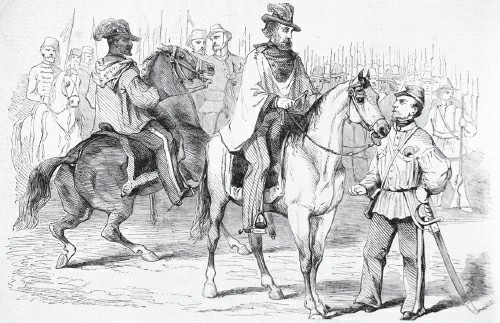
Garibaldi in Rome with his servant, Aguyar.
It is doubtful how well any of these elements would have fared without the help of another force that arrived just three days before Oudinot appeared outside Rome. If Garibaldi was viewed with suspicion by Mazzini, he had an ally in the Roman Republic’s minister of war, Giuseppe Avezzana, and when news came that the French had landed at Civitavecchia, Avezzana hurriedly sent word to him at Rieti. Two days later Garibaldi and his legion of 1,300 entered Rome. They quickly caused a stir as, with their long hair and beards and their small felt hats, they looked like no ordinary soldiers. Some of the officers, who had accompanied Garibaldi all the way from a Montevideo, had American saddles and wore their famous red shirts. Most striking of all was Garibaldi himself in his trademark poncho, accompanied by a giant freed Brazilian slave named Aguyar who was his helper and bodyguard. And yet, even though the new arrivals had an invigorating effect on Rome’s defenders, few of them had much fighting experience. Several hundred were students and artists.
Fortunately, luck was with the Romans. It came in the form of Oudinot’s plan of the city. When French scouts came in sight of the walls of Borgo they were greeted with two surprises. The first was a sharp blast of gunfire, which told them they were not going to be welcomed as liberators after all. The second was the fact that Porta Pertusa, which Oudinot intended to break open with his light field guns, was walled up, which it had been for years. Oudinot’s plan was badly out of date.
Still Oudinot was not discouraged. He sent a column of troops down the hill towards Porta Cavalleggeri, which, his intelligence told him, would be opened by friendly clerics. For good measure he sent another column around the walls on the north side in the direction of Castel Sant’Angelo. His decisions were poor. His soldiers were already tired, having been marching all morning in heavy uniforms beneath the hot spring sun, and now they had to pick their way down steep paths, heaving their field guns under withering fire from the walls. Those who managed to reach the Porta Cavallaggeri discovered no friendly clerics, and the gate remained firmly closed, while they found themselves caught in an indent in the walls, exposed to fire from both the north and the east. Lacking scaling ladders, a few tried to climb the walls using spike nails before Oudinot ordered them back. The assault had lasted barely an hour.
Yet the battle was far from over. To the south, in the grounds of the Villa Pamphili gardens, just in front of the city walls, Garibaldi learned of Oudinot’s setback and decided to attack. Three hundred students and artists, none of whom had experienced battle till now, clambered over the wall of the gardens into a deep lane beyond. Just as they did so a column of a thousand French troops, which Oudinot had sent out to cover his flank, came into sight. The artists and students charged, briefly pushing the French back before themselves being chased out of the lane and back into the park.
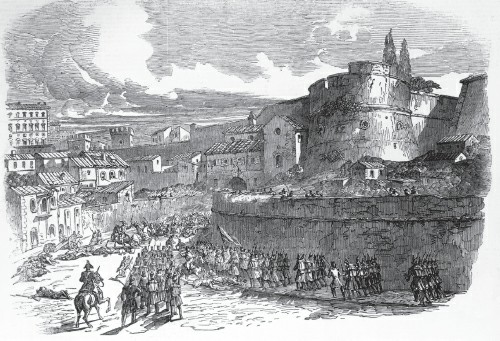
French troops under Lieutenant-General Charles Oudinot make their first attack on Rome near the Porta Angelica, engraving from Illustrated London News, 19 May 1849.
So began a furious struggle. The rest of Garibaldi’s legion joined in but were repelled, and clusters of the students and artists took refuge in outhouses in the gardens, where they struggled to hold out. Garibaldi, realizing that the fight was going against him, sent word to Colonel Galletti, who commanded 800 troops in the Gianicolo walls just to his rear. These were the Roman volunteers who had fought the Austrians the previous year. Eager to make up for their earlier defeats they joined the fray and their numbers and enthusiasm soon told. Garibaldi, whose presence had an inspirational effect on his troops, personally led charges through the woods and copses of the gardens. The French were forced to retreat to an area of vineyards beyond the lane and for a time each side fired at the other. The deadlock was finally broken by the Roman side, in their most courageous action of the battle. They jumped down into the lane into a fusillade of French fire and then charged up to the vineyard. After a hand-to-hand struggle with bayonets the French turned and ran. Several hundred were captured.
After the battle came disagreements. Garibaldi, who was injured by a bullet to his side, had wanted to pursue the French and drive Oudinot into the sea, but he was overruled. Mazzini did not want to aggravate the French, with whom he still hoped to reach an accord. Garibaldi was left feeling resentful. Yet there was no denying that the Roman Republic had had a great victory. Its mixed bag of forces had defeated a professional army and Rome was saved, at least for now. The Romans were exultant and a little surprised at themselves. That night the city was lit up with candles burning in every window and the streets were filled with cheering crowds. They had reason to be proud. Despite the pope’s claims that the Republic was ruled by a dictatorship of foreigners, the great majority of the soldiers who had defeated the French were Romans.
For a time it seemed Mazzini’s republic might have saved itself. The French threat had barely been staved off when an even larger enemy force advanced on Rome – 10,000 Neapolitan troops led by King Bomba – but after suffering two crushing defeats by Garibaldi they fled back south, and in the middle of May there was new cause for hope. Oudinot offered a truce and a French envoy, Ferdinand de Lesseps, arrived in Rome to negotiate an accord with the Triumvirate. De Lesseps, who had expected to be dealing with radical, anticlerical terrorists, was impressed by Mazzini’s moderation. The French soldiers who had been captured in the battle in the Villa Pamphili Gardens were treated kindly and were given a sightseeing tour of Rome before being returned without condition to Oudinot. Church property and clerics had not been harmed and even those who Mazzini knew were plotting against his Republic were left at liberty. After two weeks of talks De Lesseps and the Triumvirate reached a deal. The question of the restoration of the pope was put off for the moment, but it was agreed that the French would occupy positions around Rome to protect the city from the Austrians.
Unfortunately the negotiations were a sham. Louis Napoleon saw it as a matter of national pride that French arms be vindicated and, unknown to De Lesseps, his talks were intended all along to distract the Romans while Oudinot waited for reinforcements. The very day after the De Lesseps accord was agreed Oudinot declared the truce was over. By now his forces had doubled and he had 20,000 men backed by engineers and siege guns, with more on the way.
Oudinot, determined not to be caught out in another attack, then played a second trick on the Romans. He had noticed – as had Garibaldi – that Rome’s Gianicolo defences hinged on a single spot: a four-storey country retreat, the Villa Corsini, that lay just inside the Pamphili Gardens. Situated on a high knoll, it overlooked the city walls from only a few hundred yards away. In the weeks since the victory on 30 April Villa Corsini should have been fortified with earthworks and guns, and that it had not been was the fault of General Roselli, Mazzini’s ploddingly respectable military commander. When Oudinot ended his truce he promised, with deliberate vagueness, that he would not attack ‘the place’ before Monday 4 June, so that any French still in the city would have time to leave. On the evening of Saturday 2 June, Roselli paid a visit to the garrison around the Villa Corsini – a pitiful 400 troops without guns or trenches – and told them to get a good night’s sleep as there would be no attack on them that night.
Just a few hours later French soldiers poured through the Pamphili Gardens. General Oudinot had employed a verbal trick that would cause lasting bitterness on the Roman side. He claimed he was free to attack the Villa Corsini as it was outside ‘the place’. Despite brave resistance by the defenders the villa was quickly taken. Garibaldi, who had only just returned from campaigning against King Bomba’s Neapolitans, and was convalescing from the bullet wound he had received on 30 April, hurried up the Gianicolo Hill to organize a counter-attack. So began the second battle for Rome, though in effect it was over before it began, as everything was against the Italians. To attack they had to make their way to a small gate in the wall of the Pamphili Gardens, beyond which they found themselves at the pointed end of a funnel-shaped space with no cover of any kind, where they faced furious French fire from the Villa Corsini. It was a killing ground.
Matters were not helped by Garibaldi, whose skills lay in open, guerrilla warfare rather than close fighting of this kind. He would have been wiser to wait until his guns had had time to batter the Villa Corsini to rubble, but instead he ordered wave after wave of attacks, that were more like suicide assaults. Still those involved did not flinch from doing as they were ordered. Among them were the Lombardy Bersaglieri who had been unable to fight in the previous battle because they had given their word of honour to the French. Torn apart as they charged the villa, they knelt down in the open and fired at the building, towards enemies they could not see, yet each one kept his place till their losses had become so great that their commander, Manara, sounded the retreat. Several times the Italians managed to drive the French from the villa but the building was impossible to defend from the other side and was soon retaken. By the end of a day in which the Italians lost many of their finest troops, they had to accept that the position too was lost.
From this moment anyone with the faintest military knowledge could see that the city faced certain defeat. It could only be a matter of time before the French would break through, while the Roman Republic could expect no help from outside. Along with France, Austria and Naples, its declared enemies now included Tuscany, and Spain had landed troops south of the city. Britain and the United States both regarded Mazzini’s republic warily and had no desire to become involved. Even The Times was no friend. The newspaper’s correspondent, who was embedded with Oudinot’s forces at Civitavecchia, took his hosts’ view of the conflict and told his readers that Mazzini’s Rome was in the hands of dictatorial foreigners, ‘who rob and assassinate under the name of liberty’, and that ‘three or four priests who had the courage to appear in public have been butchered in open day, and their flesh, cut up in morsels, thrown into the Tiber’.47
Hopeless though their situation was, the Romans fought on. Their battery on the ancient hill of broken amphorae, Monte Testaccio, fought artillery duels with French guns on the Gianicolo. From a bastion beside Porta San Pancrazio a band played the Marseillaise to shame the French, though without success. Oudinot’s forces tried to distract the Romans by lobbing shells into the city from batteries south and north of the Aurelian Walls. Fortunately, the damage done to Rome’s buildings was relatively light and the greatest victim of the bombardment was Pope Pius IX, who would be resented for it for many years. Two balls that struck St Peter’s were sent to him in Gaeta and when a shell came down Romans shouted, Ecco un Pio Nono (‘Here comes another Pius the Ninth’). Romans put out fizzing shells with pans of water and threw them into the Tiber.
At times the bombardment could be beautiful. In a melancholy moment towards the end of the siege, the American writer Margaret Fuller, who had become a passionate supporter of the Roman Republic and who helped tend wounded soldiers in the Quirinal Palace – now being used as a hospital – described watching shells fall at night: ‘’Tis pretty, tho’ a terror, to see the bombs, fiery meteors, springing from the horizon line upon their bright path to do their wicked message. ’Twould not be so bad, meseems, to die of one of these ...’48
Margaret Fuller showed the lie of Pius’ claims that Rome was in the hands of militant foreign terrorists. She had never known the city so safe, she wrote, and had often walked through its streets alone without once seeing violence. Bar occasional hissing, even the French in the city were left in peace. Romans were content to mock their enemies, which they did, as ever, via their talking statue Pasquino, who now spoke through a satirical magazine, Don Pirlone.
The French slowly pressed forward. Their easiest option would have been to move against the Gianicolo walls head on but they were prevented by the survivors of Giacomo Medici’s Lombardians who, despite constant shelling and repeated bayonet charges, held out in a small but strategically placed villa just beyond Porta San Pancrazio – the Vascello – which they defended almost to the end. As a result the French were forced to focus on a bastion to the south, slowing their progress. But they had all the time they wanted. Gradually, their siege guns reduced the ramparts to rubble and their trenches zigzagged forward. Almost three weeks after they took Villa Corsini, Oudinot’s soldiers broke through and seized a section of the walls by today’s Villa Sciarra park, yet they still found themselves held. Garibaldi had established a new defensive line a few hundred yards further back, using a stretch of the 1,400-year-old Aurelian Walls.
Here, heavily outnumbered and outgunned, the Romans showed a courage that would have impressed Livy, holding out for another nine days. In the midst of the fighting Garibaldi’s pregnant wife Anita appeared unexpectedly from Nice, determined to be at her husband’s side. By now he was fighting Mazzini as much as he was the French. As usual, the two fell out over strategy. Garibaldi the guerrilla fighter wanted to take what remained of the Republic’s forces and lead an insurrection in the hills of central Italy. Mazzini the spin doctor wanted to fight on in Rome to the last so that the Republic would be seen never to have surrendered. Matters were finally decided on 30 June after another French breakthrough. Garibaldi, who had just learned that his bodyguard and friend Aguyar had been killed by a shell, appeared before Rome’s assembly stained with dust and blood, his sword so buckled from use that it would only fit halfway into the scabbard. The assembly offered him three options. The Republic could surrender, it could continue to fight on in Rome, or it could take the battle to the hills. Naturally Garibaldi chose the hills, declaring, ‘Dovunque saremo, colà sarà Roma’ – ‘Wherever were we go, there will be Rome.’
Two days later his army assembled in St Peter’s Square. Garibaldi was so besieged by well-wishers that he could hardly get through to his troops. The moment inspired one of his most celebrated speeches:
Fortune, who betrays us today, will smile on us tomorrow. I am going out of Rome. Any who wish to continue the war against the foreigner come with me. I offer neither pay nor quarters nor provisions. I offer hunger, thirst, forced marches, battles and death. Let him who loves his country in his heart and not just with his lips follow me.49
After two months of resistance and almost a month of continuous fighting the battle for Rome was over. Later that same day Garibaldi and some 4,000 volunteers gathered by San Giovanni. They included most of the survivors of the city’s defence, as well as Ciceruacchio and his two sons, and Anita, wearing the red shirt of her husband’s legion. Slowly they marched out of Porta San Giovanni and left the city behind. Garibaldi’s offer of the morning would prove all too accurate. His resistance in the hills quickly became a flight to escape, in which his army was steadily whittled away. Ciceruacchio and his two sons – the youngest only thirteen years old – were captured and shot by the Austrians and pregnant Anita died of exhaustion and disease. Only Garibaldi survived to fight again.
The day after he and his army left, the French entered Rome, and so began two decades of restored papal rule. Of the seven attacks described in this book, without doubt this one was least like a sacking, and the city suffered little or no material damage, yet it was terrible in its way. The French broke up the elected Roman assembly with fixed bayonets, disarmed the population, tore down all emblems of the Republic, expelled foreigners who had served it, and began hunting down leading figures in Mazzini’s government. Many were saved by the British and American consuls who, to the disapproval of their governments, issued passports by the hundred. Mazzini, who was too well known for the French to arrest, stayed in the city for several days, hurriedly setting up an underground resistance.
He was probably behind the Romans’ response to the French occupation. Margaret Fuller saw a resistance pamphlet that appeared the day after the French entered the city and which called on Romans to treat them with icy disdain. They were to ignore any French soldier who addressed them; when they entered a cafe or restaurant all Romans were to leave; windows should be closed when they passed, and any Romans who fraternized with the French – especially any Roman females – would be cursed. As the pamphlet declared, ‘Let the liberticide soldier atone in solitude and contempt for having served priests and kings.’50

A French visitor is set upon by patriotic citizens and their dog, engraving from Illustrated London News, 6 October 1849.
Yet it soon became clear that the Romans’ worst oppressors were not the French but papal officials. A month after they took Rome the French handed power to three cardinals who Romans named the Red Triumvirate, in reference not to their politics but their scarlet vestments. So began a prolonged struggle between the French who, for the sake of their own reputation, tried to steer the papacy towards a moderate course, and the papacy, which sought revenge and absolutist control. The papacy usually prevailed. One of the first actions of the Red Triumvirate was to offer an amnesty which excluded so many that it seemed more like a proscription. Among those denied papal forgiveness were all former members of the Roman Republic’s government and assemblies, all its high-ranking military officers, and all those whom Pius had amnestied when he had first been elected, in 1846. Margaret Fuller commented, ‘It seems he cannot rest or his counselors cannot rest till he had recanted every good thing he ever did.’51 During the first eight months after the Republic fell, an estimated 20,000 Romans – or an eighth of the city’s population – left Rome, half of them expelled.
Pius did keep one of the promises of his early radical days. Over the next years Rome became linked with the rest of Europe by telegraph, and by railway and the city was finally lit with gas lamps, which were fuelled by a smoke-belching gasworks on the old Circus Maximus chariot-racing course. In every other respect, though, Rome returned to the reactionary days of Pope Gregory XVI. Once again the Papal States became a land of informers, of surveillance, of opened letters and of political prisoners. By 1853 there were more than a thousand of these, many of them held in a special wing of the huge San Michele workhouse in Trastevere. Executions resumed, as did censorship. Theatre and opera productions were meticulously controlled and books on the papal Index of prohibited books were publicly burned on church steps.
For Rome’s Jews, too, life had an unwelcome sense of déjà vu. In October 1849 the papal beagles – the sbirri – claimed that the Ghetto was full of stolen treasure and induced French soldiers to join them in a three-day search, which, though it unearthed no stolen goods, involved looting, destruction and arbitrary arrests. The restrictions that Pius had lifted were enforced again and Jews were banned from almost all trades. In theory they were still permitted to move out of the Ghetto but bureaucratic obstacles and delays made setting up home elsewhere in the city almost impossible. Like Gentiles, many Roman Jews voted with their feet and by 1853 a quarter of the Papal States’ Jewish population had left. By 1860 over half of Rome’s Jews had no property and lived by begging.
Romans, Christian and Jewish alike, sullenly resisted. William Wetmore Story wrote that the city was ‘stricken with a morose silence’.52 Romans secretly passed one another copies of satirical cartoons from their brief revolutionary days. They protested when they saw a chance. In November 1849 Margaret Fuller was in the church of Sant’Ignazio for the annual service for the dead when ‘… a deep voice sounded from the crowd the words, “Peace be with those who perished for their country!” and at the same time a shower of roses and myrtles was thrown upon the catafalk, while the crowd shouted a fervent, “Peace. Peace. Amen.”’53 Though the authorities tried to find the culprits, the crowd would not give them up. The papal authorities frequently found themselves frustrated and plans to purge Rome’s administration of disloyal elements had to be abandoned, as nobody would inform on their fellow officials.
Pius himself was left in doubt as to how he was regarded by the Romans. On the day he finally returned to Rome from the kingdom of Naples, in April 1850, an attempt was made to burn down the Quirinal Palace. Shortly afterwards he moved to the Vatican Palace, which – with its escape walkway to Castel Sant’Angelo – was safer. There he received foreign dignitaries, including Odo Russell, the unofficial representative of heretic Britain. Russell considered Pius a vindictive and bloodthirsty old man who was increasingly divorced from reality. In one of their meetings Pius assured Russell that Italians had merely been led astray by foreign, revolutionary agents, and that, ‘When they have suffered more they will repent and return to us.’54 He was also convinced that the British were about to abandon Protestantism and return to the Catholic fold.
Romans had reason to hope that they would see an end to their troubles. In part this was because of what they themselves had achieved. Their defence of Rome had been undeniably courageous and it soon attracted notice, being seen as an example of brave patriotism, just as Mazzini and Garibaldi had hoped. Written accounts of the city’s defence appeared and one was translated into English by W. E. Gladstone. Mazzini’s years of patient spin-doctoring came good and Italian unifiers found they had powerful new friends. Among them, rather surprisingly, was the same Louis Napoleon who had brought about the Roman Republic’s defeat. In early 1859, now Emperor of France, he helped Piedmont to eject the Austrians from Italy. His change of heart was caused less by conscience and more by fear. During the late 1850s he survived no fewer than three assassination attempts by Italian patriots determined to avenge the Roman Republic. The third, which took place in January 1859, was the most dramatic. Organized by a former follower of Mazzini, Felice Orsini, it was carried out as the emperor and empress arrived at the opera. Three bombs were thrown, blowing out gas lamps and plunging the street into darkness and chaos. Louis Napoleon’s carriage was destroyed and a number of people were injured, though not the imperial couple. Just two months later Louis Napoleon had French officials hold secret meetings with those of Piedmont to discuss a joint attack on Austria.
Mazzini’s refusal to let Garibaldi pursue Oudinot’s retreating army may have been the right decision after all, as a crushing French defeat would have made support for the Italian cause far harder to justify. Louis Napoleon’s change of heart was a turning point. Within months the Austrians had been ejected from Lombardy and Prime Minister Cavour was organizing plebiscites in Tuscany and other Italian states, that joined them to a new kingdom of Italy in the north. Garibaldi then doubled its territories. Having landed in Sicily with a thousand poorly armed volunteers, he managed, through strategy and enthusiasm, to overcome the professional armies of the kingdom of Naples. His reputation as the nineteenth century’s revolutionary superstar was made. When visiting London a few years later he was greeted by the Victorian equivalent of Beatlemania, mobbed by vast crowds, and scandalous scenes took place as respectable Englishwomen ‘flew upon him, seized his hands, touched his beard, his poncho, his trousers, any part of him they could reach’, conducting themselves in ‘an indecent manner’.55
As Italy became unified and the pope saw most of his kingdom break away and join the new state, expectations rose in Rome. Crowds held up pictures of Garibaldi, hissed papal police, and puzzled them by chanting ‘Viva Verdi’, by which they meant not the operatic composer, but Vittorio Emanuele Re d’Italia (Victor Emmanuel, king of Italy). When they were charged by papal dragoons Romans answered with boycotts, ceasing en masse to smoke, or to buy papal lottery tickets, even refusing to go to the carnival. The Corso was left deserted as crowds instead gathered outside the city walls, near the Porta Pia. Pope Pius replied by trying to scare them into submission, sending the city’s veteran executioner, Giovanni Bugatti, to ride among them.
Pius held on, at least for now. Louis Napoleon may have helped Italian nationalists against Austria but he had no wish to see the pope defeated, so the French garrison stayed. Yet even Pius could see the end was coming. Increasingly he turned his back on the physical world and concentrated on realms from which he could not be deposed. In 1864 he published The Syllabus of Errors, which set the Church against every kind of new thinking, from pantheism and naturalism to materialism, rationalism, socialism, communism, secret societies, Bible societies, liberalism and Masonic sects. Yet if Pius rejected rationalism and science, science proved rather useful to him. Thanks to the telegraph, railways and steam travel, in the late 1860s he was able to summon a council of bishops from all across the Catholic world. It was the first time such an assembly had been held since the sixteenth century and Pius used it to establish a new principle within Catholicism, of papal infallibility, according to which the pope was the only true interpreter of the Church.
At the very moment Pius made himself a dictator of dogma his actual kingdom fell apart. The doctrine of papal infallibility was agreed in July 1870. Days later the French army mobilized for war with Prussia and within weeks Louis Napoleon had withdrawn his garrison from Rome. In September, at the battle of Sedan, he suffered a disastrous defeat and was himself taken prisoner. With no French to guard it, Rome was ripe for the taking. Pius refused to negotiate a compromise with King Vittorio Emanuele and now it was his turn to find himself alone: no great power would come to his aid and when he appealed to the Romans only 200 offered to fight for their pope. Pius looked for help from elsewhere. Though old and overweight he took himself to the Santa Scala steps near the Lateran, which, like innumerable pilgrims before him, he climbed on his knees, praying.
It was of no use. On 20 September 1870 Italian guns blasted a modest-sized hole in the Aurelian Walls close by Porta Pia and soldiers swept into the city. Of the many invasions Rome had experienced this one was unquestionably the mildest and the only casualties were Romans who succumbed to stray bullets, or to a few shells lobbed into the centre by an overenthusiastic Italian commander. Within hours, papal troops had surrendered and were escorted to the Vatican by Italian soldiers, who protected them from angry crowds.
The Italian authorities had envisaged Pius retaining a miniature kingdom that would include the Vatican, the inhabited Borgo area beside it, and also the green stretch of land beneath the Gianicolo walls, but in the end even this was not possible. The population of the Borgo had no wish to remain under papal rule and angrily demonstrated, forcing Pius into the humiliating position of having to ask the Italian authorities to send troops to protect him. The occupation became permanent after plebiscites were held to approve Rome’s union with the rest of Italy. The main part of Rome voted yes by 40,785 to 46 while the Borgo, whose inhabitants had a separate vote, agreed by 1,566 votes to none at all. Pius replied, a month later, by excommunicating everyone who had helped take away his kingdom.
Romans had a final chance to show their feelings towards their former ruler in the early hours of 13 June 1881. Pius, having spent his last years sequestered in the Vatican plotting for the reconquest of his lost state, had died three years earlier, leaving a problem. He had given instructions that he wanted to be buried not in the Vatican but in the church of San Lorenzo on the far side of Rome. After three years of delay the Italian prime minister Agostino Depretis decided the moment had come to move Pius’ corpse to its new home. Depretis decided it should be done in the middle of the night, in the hope that nobody would notice.
He was mistaken. Word spread and by midnight a crowd of 100,000 thronged the area around St Peter’s Square. The burial procession, which included devout Catholics, chanting and carrying candles, became a moving battleground as it was set upon by Romans, who had not forgotten or forgiven the shells fired on their city in Pius’ name. Stones were thrown and when Pius reached the Ponte Sant’Angelo there were shouts of, ‘Into the river with him,’ His bones eventually made it safely to San Lorenzo, but without much dignity. To escape the crowd his cortège had to speed up and cross the city at a brisk trot.
It was the first time Pius had left the Vatican for eleven years. Had he been able to see the city, he would have found it was changing so fast that some areas were already barely recognizable. Rome was undergoing yet another great metamorphosis, now as the capital of Italy.