
CHAPTER SEVEN
I
THE VILLA ADA SAVOIA, in the affluent north-east suburbs of Rome, does not look like a place where anything important would have taken place. Today it is the embassy of the Arab Republic of Egypt and a couple of bored-looking soldiers keep watch over the main entrance. It lies at the edge of the Villa Ada, one of Rome’s great parks, where locals enjoy Sunday picnics and walk their coiffured dogs. The building is not old, dating from the later nineteenth century, nor is it especially grand. Square in shape and with a fake medieval tower just beside it, it could be a game show host’s Tuscan holiday home. A glance around the area, however, soon offers clues that it once belonged to someone of significance. An abandoned building just behind, now boarded up and covered with graffiti, was once a stable filled with pedigree horses. Also nearby is an ornamental garden, a tiny amphitheatre overlooked by a dilapidated summerhouse and, most telling of all, a large underground bomb shelter. If one had not already guessed from the building’s name, all is made clear from the coat of arms on the fake medieval tower: that of the royal House of Savoy. In the summer of 1943 this was the private residence of the king of Italy, Vittorio Emanuele III.

Rome, 1930s
At five in the afternoon on Sunday 25 July he had a visitor: Benito Mussolini. A small convoy drew up to the building. The three escort cars full of guards and adjutants drove back to the entrance to the park, leaving Mussolini and his secretary, Nicola De Cesare, who was carrying a large portfolio full of documents, to climb out of their sedan. The king was waiting at the entrance of the villa to welcome them, which he did with some warmth, greeting Mussolini as Duce, a term he had avoided during twenty years of Mussolini’s leadership. The door to the villa closed behind Mussolini and his secretary, and carabinieri (police officers) had their driver park the sedan in a quiet corner of the grounds. He might have noticed, as he drove, that hidden from sight beside the villa was an ambulance.
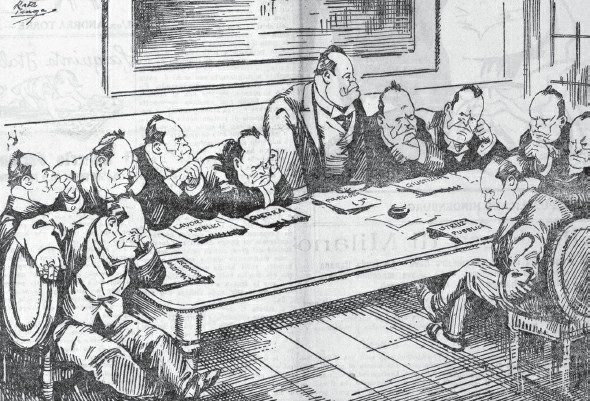
Mussolini looked tired that afternoon and according to one source his chin was covered with stubble because – uncharacteristically – he had forgotten to shave. Then he had had a long and trying night. He had presided over a meeting of the Fascist Grand Council, the first held for several years, which had lasted for ten hours and became increasingly rancorous as leading Fascist leaders blamed one another – and especially blamed Mussolini – for Italy’s disastrous conduct of the war. A few days afterwards a Swiss journalist, M. de Wyss, who lived in Rome throughout this time and left an account of all she witnessed, pieced together what happened from some of those who had been present:
Furious personal attacks and violent invectives poured forth. For instance, De Vecchi shouted at Frattari: ‘You are kept by this prostitute’ – for Frattari was backed by Mussolini’s notorious mistress, Petacci. Everybody screamed. Some pounded the tables with their fists. Some cried. The Minister Pareschi even fainted.1
The meeting finally ended at three in the morning when the council voted to strip Mussolini of his powers and to place the king in charge of Italy’s armed forces. Mussolini had been deposed. But, waking up the next morning, he decided to ignore the whole business. After all, the Grand Council only had a consultative role. He would carry on as usual, quietly arranging a little revenge on his treacherous colleagues. He arrived at his office in Palazzo Venezia at nine, just as usual, and in the early afternoon he went home to the Villa Torlonia in the north-east of the city. Here he learned that the king had summoned him to the Villa Ada Savoia. A little oddly, Mussolini was instructed not to come in the military uniform he habitually wore, but to wear civilian clothes. His wife, Rachele, was suspicious and told him not to go, but Mussolini ignored her and, in a blue suit and black hat, he set out through the heavy summer heat.
M. de Wyss wrote an account of Mussolini’s meeting with the king, which she described as a bitter one, in which each furiously denounced the other. Her contacts, though, seem to have exaggerated and reports gathered months later from those who had been present offer a less dramatic picture. The king told Mussolini that he knew what had taken place at the Grand Council meeting. Mussolini, who had anticipated that this subject would be raised, hurriedly leafed through the portfolio of documents his secretary had brought, looking for one to show that the Grand Council’s role was purely advisory. The king insisted the vote showed that confidence in Mussolini’s leadership had collapsed, and then announced that he had decided to appoint a new political leader: Marshal Badoglio. Fearing that Mussolini might become violent, he had an adjutant concealed in the next-door room, ready with a loaded pistol, but the precaution was not needed. Mussolini seemed to crumple.
The interview over, the king conducted Mussolini and his secretary to the villa entrance, calling out, ‘Where’s the Duce’s car?’ Instead of their sedan, though, it was the ambulance that had been hidden behind the palace that appeared. As the king disappeared into the villa Mussolini found his path blocked by a carabiniere officer, Captain Vigneri, who told him that, for his own protection, he must go with him. At this moment the rear doors of the ambulance opened to reveal a squad of well-armed carabinieri. Mussolini took a step away, murmuring that he did not need any protection, but Vigneri took him firmly by the arm and led him towards the ambulance. By one account, as Mussolini climbed inside he pissed himself.
King Vittorio Emanuele was an unlikely figure to have deposed the country’s dictator in a coup. Known for his tininess – Queen Victoria, herself no giant, remarked of him, ‘he is dreadful short’2 – he had never wanted to be king and in his youth he tried to persuade his father to nominate his dashing cousin the duke of Aosta in his place. When his father was assassinated in 1900, Vittorio Emanuele accepted his role without enthusiasm. He was far happier breeding horses, hunting and finding new items for his large coin collection – or, during the First World War, spending time with Italian troops at the front – than performing public duties. Frugal, even stingy, he used the Quirinal Palace only for state events, preferring to live in the far smaller Villa Ada Savoia. When Mussolini seized power in 1922 Vittorio Emanuele was grateful to him for, as he believed, having saved both Italy and the monarchy from Bolshevism. For the next two decades he left decision-making to Mussolini and kept a low profile.
The backseat monarch was transformed into a man of action by the disastrous war Mussolini had brought upon their country. By 1943 it was clear that it would be lost, and as early as January the king’s advisors urged him to depose Mussolini and sue for peace with the Allies. The king, who was by nature cautious and fatalistic, prevaricated. Then, on 19 July 1943 Rome was bombed for the first time. A huge day raid that involved more than 600 US aircraft showed up Italy’s lack of preparedness with painful clarity. The king, watching from Villa Ada Savoia, saw that there was not a single Italian fighter in the skies, while the city’s anti-aircraft guns lacked the range to reach the American planes. Unopposed, the bombers approached in perfect formation. As the dust cleared from the destruction more scandalous failings emerged. Shelters had been inadequate and no teams were ready to begin digging out survivors. In the San Lorenzo district, where most bombs fell, some 1,500 Romans died.
The attack also revealed what Romans thought of their monarchy. When the pope, Pius XII, visited San Lorenzo after the attack and distributed money he was met with cheering and tears of gratitude. When Vittorio Emanuele and his wife Elena appeared a little later, they were hissed. Vittorio Emanuele was called a cuckold and Queen Elena a whore. One woman tried to spit on her. When the king offered people money they tore it up and threw it back.
Six days later the king had Mussolini arrested and appointed the career soldier Marshal Badoglio in his place. When they heard the news of Mussolini’s fall late that evening the Romans burst into the hot summer streets to celebrate, some of them still in their pyjamas. Pictures of Mussolini were thrown from shops and offices, firemen brought down Fascist insignia, the Fascist Party headquarters was attacked, the offices of the city’s main Fascist newspaper Il Tevere was set alight and prisoners were freed from Regina Coeli prison. Police looked on, grinning. A few Fascists caught on the street were beaten up and one or two killed – the local party boss in Trastevere was said to have been chopped into small pieces in a butcher’s shop – but, as de Wyss observed, ‘taking it all in one cannot imagine a quieter and smoother overthrow of a dictatorial rule after twenty-two years of its abuses’.3
Badoglio, in his first broadcast as leader, insisted the war alongside Germany would go on, but few took him seriously and Romans were hopeful they would soon have peace. Sadly, it would not be so easy as that.
Badoglio was a great survivor. As one of the Italian army’s commanders he had endured the First World War, despite being blamed for Italy’s greatest defeat of the conflict, at Caporetto. Next he had made it through Mussolini’s rise to power, despite having urged that Fascism should be resisted. Mussolini, who rather liked to have something damning hanging over the heads of his close colleagues in case he chose to be rid of them, entrusted him with Italy’s invasion of Abyssinia. Now, as Fascism fell apart, Badoglio had survived once again, jumping from the sinking ship just in time: he had taken a leading role in the king’s coup d’état. But he was more than seventy years old and as cautious as his king. Though from the first he intended to switch sides, instead of doing so swiftly he delayed, negotiating with the Allies.
All the while Hitler, who never for a moment believed Badoglio’s assurances of loyalty, poured troops into Italy. After 45 days Italy announced an armistice with the Allies. Within hours German troops began to advance on Rome.
II
As to what Rome awaited them, to see it in anything like a state of normality we should step back a few years, to before the war began. If a Roman from the 1840s had been transported almost a century into the future, to the late 1930s, the first thing that would have struck him or her was how huge the city had become. In 1939 there were almost one and half million Romans. The population had increased tenfold since we last saw it and, finally, there were more Romans than there had been in classical times.
The city was vastly busier and noisier. In place of a few sleepy cabs and carriages it now had buses, electric trams and no fewer than 30,000 cars clogging its congested streets. The city had more bridges than ever before: ten (in classical times there had been eight). It had begun to extend beyond the old Aurelian Walls and, in another first since classical times, its empty areas, the disabitato, had largely disappeared. With it had gone most of Rome’s elegant Baroque parks and villas, though fortunately not all of them. The Villa Borghese had survived, as had the vast Villa Pamfighli, where Garibaldi’s volunteers had fought the French in the spring of 1849, and also the Villa Ada, where, as we saw, King Vittorio Emanuele had his residence. The disabitato had succumbed to a construction boom of the 1870s and ’80s when Rome, as the new capital of Italy, became a vast building site. Plans of the city’s remaking were frequently ignored and numerous ancient relics were lost in the frenzy of development.
It could have been even worse. During this same era medieval Paris was largely razed to the ground by Prefect Georges-Eugène Haussmann. In Rome some especially outrageous proposals were seen off, such as plans to demolish a section of the Aurelian Wall, to destroy a stretch of the older Servian Walls near Termini railway station, and to remake the Appia Antica as a tramway. And some good came out of the destruction. Under the guidance of the archaeologist Rodolfo Lanciani the Colosseum was given a spring clean and the Pantheon – once again – was cleared of accretions, including two seventeenth-century bell towers that Romans referred to as ass’s ears. If much was lost to development, much was also found. By the late 1880s, 192 marble statues had been unearthed along with 266 busts and heads, a thousand inscriptions and more than 36,000 coins. Eventually, belatedly, the city’s antiquities became properly protected. Shortly before the First World War the city’s socialist mayor, Ernesto Nathan, ring-fenced the Theatre of Marcellus, the Baths of Diocletian and the Portico of Octavia from development and transformed the Forum, the Palatine and nearby areas into an archaeological park.
Along with the city’s vastness, a visitor from the 1840s would have been astonished by its political display. In the earlier nineteenth century Rome had been a city of the popes that was dominated by churches, Catholic institutions, papal insignia and street corner images of Mary and Jesus. In the late 1930s these still existed but alongside them was a new layer of symbols that celebrated everything the Church detested. The Liberal governments which ruled Rome after 1870 had made their new capital into a vast theatre of propaganda in their cold war with the papacy. Unified, royal Italy celebrated itself with new main streets that cut across the city: Via Nazionale, that led from the Piazza Venezia to Termini railway station; Via Settembre XX, that led to the Quirinal Palace from the spot where royal troops broke through the wall in 1870 (and was named after the day when they did so) and Corso Vittorio Emanuele II. This last, which sliced through the maze of lanes across the river from the Vatican, and had been the dream of past popes and of Rome’s Napoleonic conquerors, finally made the city traversable from the Tiber to the start of the Corso. Destructive though it was, it could have been worse, twisting and weaving so the finest buildings of the area were preserved.
To papal fury the city centre was now home to non-Catholic churches: Anglican All Saints’ Church on Via Babuino, American Episcopal St Paul’s within the walls on Via Nazionale, and, close to Piazza Venezia, a church belonging the Waldensians, whose members had once been burned as heretics. And there were the statues. These now crowded Rome as they had in classical days and hardly an enemy of the popes was absent. As well as Liberal politicians, in Trastevere there was now a statue to the early nineteenth-century Roman dialect poet Giuseppe Gioachino Belli, who had enjoyed taking a dig at priests. On the Capitoline Hill, ancient seat of civic resistance to papal rule, stood a statue of Cola di Rienzo, the unstable fourteenth-century would-be founder of the new Roman Republic, now reinvented as a national hero. In the Campo de’ Fiori towered a statue of Giordano Bruno, the philosopher and mathematician who in 1600 had been burned in that very spot by Pope Clement VIII, while panels on the statue’s plinth honoured celebrity rebels against the papacy, from John Wycliffe to Jan Hus.
The Gianicolo Hill, where Garibaldi and his volunteers fought, had become a vast open-air shrine to the battles of 1849. Streets around the hill were named after those involved: Via Emilio Dandolo, Via Emilio Morosini, Viale Aurelio Saffi, among many others. In pride of place, naturally, was Via Garibaldi, which snaked its way up the hill. Around Piazza Garibaldi on the hill’s summit were busts of dozens of those who had fought for Italy’s unification, and in the square stood a huge equestrian statue of Garibaldi himself, staring out over Rome in his trademark fez and poncho. A short distance away an ornamental lighthouse flashed out the green, white and red of Italy’s national flag, and every noon a gun was fired to wake up Romans to the need to defend their country. To the ire of the popes, Garibaldi and his horse’s backside were clearly visible from the windows of the Vatican Palace.
Yet the Gianicolo was not Rome’s greatest tribute to the victory of Italy’s unifiers. Far more imposing was a monument Garibaldi and his horse peered out towards: the vast, glaringly white Vittoriano, or monument to Vittorio Emanuele II. Overlooking Piazza Venezia, it had swallowed up the whole northern slope of the Capitoline Hill. Loathed by many – Romans called it the wedding cake or typewriter, and one described it as a luxury pissoir – its making had involved extensive destruction, including the Tower of Paul III and the cloisters of the church of Santa Maria in Aracoeli. Opened in 1911 after twenty-six years of planning and work it was 135 metres wide and 70 metres high. It supported sixteen vast statues that represented each of Italy’s provinces, and a gargantuan equestrian statue of King Vittorio Emanuele II, which was so huge that twenty-one of those involved in its making were famously photographed sitting at a table enjoying a drink of vermouth inside the horse. As intended, it offered a riposte to the equally vast bulk of St Peter’s across the river.
Other slights to the papacy were marked by what had vanished. A visitor from the 1840s would be surprised to find that the jumble of medieval housing, alleys and courts of the Ghetto had gone. With the exception of a small section that had been added only in the earlier nineteenth century, it had been demolished in the 1880s, replaced by high apartment blocks and a towering new synagogue. Most Jewish Romans had been happy enough to see it go, though many, by force of habit, continued to live there or close by. Most were strong supporters of the new national state that had freed them, and under which Italy’s small Jewish population, numbering only a few tens of thousands, had thrived, particularly in the professions from which they had previously been excluded: politics and the military. In 1910 Rome was governed by a Jewish mayor, Ernesto Nathan (whose family had helped Mazzini during his exile in London, and who moved to Italy in Ernesto’s youth). 1910 was also the year in which one Jewish prime minister of Italy, Sidney Sonnino, was succeeded by another, Luigi Luzzatti. Five years later, when Italy entered the First World War, there were three Jewish admirals and fifteen generals. Though, as we will see, by the late 1930s life for Jewish Romans had greatly changed.
Another part of Rome that had vanished was its riverside. This transformation, for once, did not represent a slight towards the popes, but had been a practical measure to save Rome from further disastrous floods. The last of these struck on New Year’s Eve 1870, and was gleefully seized on by Pope Pius IX as divine judgement on the seizure of his kingdom. Garibaldi, as a member of the Italian Senate, became involved in the debate over what should be done, proposing that a Tiber canal should be built to divert floodwater, in a vast work project that would toughen up decadent Italians. He also urged that the Tiber be paved over to create a roadway where the New Italy could be celebrated with huge military parades. It is probably as well that he did not get his way on the last proposal, though the run-off canal might have served Rome well. Instead, following the example of London and Paris, high embankments were built on either side of the river. Rome was made safe from floods, but at a cost. Riverside sections of the Aurelian Walls disappeared along with three churches, a theatre and four palaces. The greatest casualty, though, was Rome’s dreamy riverfront, whose houses had reached to the water’s edge, hanging above the stream.
From destruction emerged a new Rome. Under four and a half decades of Liberal rule from 1870 to 1915, the city was remade as a European capital, with a monumental new law court, a national bank, a military academy and numerous ministries. Outside the old city walls Rome had a new power station on Via Ostiense and it was guarded by fifteen new forts and three gun batteries. It had new sports associations, a horse racing track and even a velodrome. Most of all, Rome was filled with new housing. Already by the late 1880s the city had more than 3,000 new apartment blocks, which formed a series of new districts whose squares were named – naturally – in honour of the new Italy: Piazza Cavour, Piazza Mazzini, and Piazza Risorgimento. Even street plans could be political. The new residential area of Prati was constructed directly beside the Vatican yet locals point out that the papal city can be very hard to see. They claim that ingenious developers ensured that most streets would point away from St Peter’s and the Vatican, so it was visible to few, except servants washing laundry on their masters’ and mistresses’ rooftops.
Yet all of this was only one part of the propaganda in stone that filled 1930s Rome. There was also another, which a visitor from the 1840s would have found altogether more alien. If Liberal Rome was designed to blend in with the buildings of the past, and did so reasonably well, the next stratum of the city made no such compromises. Its plain columns and hard frontages with undecorated windows had a faintly barracks-like appearance, as well they might. They had been created by a movement of Italy’s First World War veterans: Fascism.
As Fascist Rome was largely created by a single individual, Benito Mussolini, we should know a little about the man. He was brought up in a small village just outside the sleepy town of Predappio in Emilia-Romagna in north-east Italy, where his mother was a devoutly Catholic schoolteacher and his father was a sometime blacksmith and sometime drunk, womanizer and layabout, who was drawn to radical politics. Benito followed in the footsteps of his father but with far more success. Charismatic, egotistical and restlessly ambitious, he was allegedly expelled from two schools for stabbing his fellow pupils. A talent for political journalism and oratory made him a rising star in Italy’s socialist party, and he became editor of its main newspaper, Avanti, but then the First World War changed his political direction. Soon after the conflict broke out, when Italy was still neutral, he abandoned pacifism and socialism and – possibly financed by the British secret services – he urged Italians to join the Allies against Austria and Germany. After serving in the war for two years without great distinction he discerned an element in Italian society that could prove a powerful political force: embittered ex-soldiers who returned from the front to find their families struggling and their jobs gone. Mussolini urged them to seize power as a new elite: the trincerocrazia, or trenchocracy. He led them against his former socialist colleagues. As squads of ex-soldiers violently broke up left-wing demonstrations and strikes, Mussolini became the darling of Italy’s wealthy, who saw him as their best defence against Bolshevik revolution. With their help, on 28 October 1922, as Fascist squads descended on the capital in the March on Rome, he became national leader.
Benito Mussolini in a satirical cartoon published in a weekly antifascist magazine, Il Becco Giallo, which ran from 1924–26.
In his early, radical days, Mussolini had had little time for Rome, which he described as ‘a parasitic city, full of landladies, shoe shine boys, prostitutes and bureaucrats’.4 Romans returned the compliment and showed negligible interest in Fascism until it overwhelmed them. From 1922, though, as his capital and his home, Rome became one of Mussolini’s chief preoccupations. Like many an emperor and pope before him, he was determined to make it a showpiece of his thinking that would be passed on to future generations as a legacy of the Fascist era.
Naturally this transformation would involve a good deal of destruction. Mussolini was concerned to preserve Rome’s medieval, Renaissance and, most of all, classical heritage, all of which dated from times when Italy had been a major force in the world, but he had little time for the Baroque, when the country had been in decline, and he positively disdained anything from the Liberal era. In his eyes Fascism was the antithesis of Liberal rule, which he despised as disorganized, selfish, feeble, indolent, amoral and decadent. To him the nineteenth century had been the age of the individual and the twentieth century would see the triumph of collectivism and the state. If Liberals had made Rome into a propaganda weapon against the popes, Mussolini used it as a weapon against Liberalism, even in terms of people’s homes. Liberal-era Romans had lived in dark, dusty old buildings on narrow, winding streets. Fascist Romans would live beside wide, straight roads, in apartments filled with air and light, and that would help remake them as a tough, dynamic people. (Some new boulevards would also help alleviate Rome’s chronic traffic problems.)
Destruction began on 21 April 1926: Rome’s 2679th birthday. Mussolini, who was never one to miss a photo opportunity, began the process himself, appearing with the pickaxe that would become a familiar sight over the next few years. His target was the neighbourhood of Piazza Montanara just by the Theatre of Marcellus, which had been a favourite haunt of nineteenth-century tourists seeking the picturesque and which, in the 1920s, was one of the few spots where that side of Rome could still be found. It was a place where country people gathered to seek a day’s work, where salesmen traded in old coins and where scribes wrote letters in the open air for illiterate customers. The area represented everything Mussolini loathed: a backward Italy, patronized as quaint by foreign tourists, whom Fascists blamed for having turned the country into a land of servants.
Yet the liquidation of Piazza Montanara was not only undertaken to reverse past humiliations. Like all of Mussolini’s grand schemes in Rome it was intended to alleviate unemployment, and demolition work was done not by machinery but by hand to create more jobs. The demolished area also provided land for the first section of a new boulevard, the Via del Mare, which would eventually stretch all the way from the centre of Rome to the sea. As well as easing traffic jams, the road was intended to make Romans look to the oceans, inspiring them to once again become a world-conquering people. It also took them to the beach, where they could enjoy sunlight, air and healthy exercise. Finally the destruction would allow Romans to be inspired by their past. The classical Theatre of Marcellus, the Arch of Janus, several temples and the medieval church of San Giorgio al Velabro all emerged from the destruction, isolated and visible as they had not been for centuries.
Many neighbourhoods – or slums, as the Fascist authorities preferred to call them, regardless of what treasures they contained – went the way of Piazza Montanara. In 1932 work began on a second great thoroughfare, the Via dei Monti, which was to take Romans into the healthy air of the hills. Its first stretch was a wide avenue, the Via dell’Impero, which, lined with flagpoles and statues of emperors, passed across the old classical fora, slicing through a low ridge and destroying an entire neighbourhood. The Basilica of Maximus was newly revealed and the Colosseum became pleasingly visible from Mussolini’s office in the Palazzo Venezia, but churches and palaces vanished, along with housing that had contained 6,000 bedrooms.
By 1933 almost 100,000 Romans had lost their homes to the destruction yet it continued apace. In 1934 Mussolini’s interest turned to the tomb of Emperor Augustus, whom he regarded as an example to Fascist Italians. Augustus was a logical choice as he had destroyed constitutional government and replaced it with his own dictatorship. The tomb, which had been concealed for a thousand years beneath, variously, a medieval fortress, hanging gardens, a bullring, the artist’s studio where the vast equestrian statue of Vittorio Emanuele had been made and, most recently, Rome’s main concert hall, proved disappointing when it finally emerged into the light, lower in height and more ruined than was expected.
In October 1936 it was the Borgo’s turn. Mussolini appeared with his pickaxe on a rooftop above the area of narrow streets between St Peter’s and the river known as the Spina. Its demolition was to celebrate one of Fascism’s greatest coups. In 1929 the poisonous enmity between Italy’s rulers and the popes was finally brought to an end by the Lateran Treaties. The new peace was celebrated by the creation of the wide, straight Via della Conciliazione, which would make the facade of St Peter’s visible from afar. It was not a new idea. It had been proposed by French occupiers for Napoleon’s procession through the city, and before them it had been suggested by Rome’s leading architect of the Baroque era, Bernini. Even in his time the idea had had its critics and Cardinal Pallotta commented that at the end of a wide, long avenue, St Peter’s would shrink away to nothing. He was quite right and the drama of walking through a narrow lane and being suddenly confronted by the vastness of St Peter’s Square was lost. It was a pattern that was repeated across the city. The French writer André Gide observed that under Fascism Rome had become grand but it had lost its allure. Previously everything had needed to be discovered. Now it was glaringly displayed.
Not all that Mussolini did was deleterious to the city. His enthusiasm for classical Rome brought about some preservation, such as of ruined republican temples in what is now Largo Argentina, which had been about to be lost to development. Nobody missed the removal of Pius IX’s gasworks, along with a scrap iron heap and a pasta factory, which had covered the old Circus Maximus. It was thanks to Mussolini that Augustus’ Temple to Peace – the Ara Pacis – which contained some of classical Rome’s finest reliefs, was reconstructed. Visitors to Rome enjoyed being able to see the city’s ancient buildings more clearly, while some Fascist buildings had a kind of stark beauty. Yet the remaking of Rome diminished the city’s texture: its layers of the past crowded one on top of another. Rome also became more disjointed. As Mussolini demolished areas to reveal early treasures, it gained a series of soulless bald patches between its warrens of narrow streets.
Out of destruction rose the new. By the late 1930s Rome had new Fascist bridges, a new university, four new post offices and a number of new ministry buildings, which included, on Via Veneto, the Ministry of Corporations, that were to be Fascism’s answer to capitalist exploitation and Marxist class hatred. Following the conquest of Abyssinia, work began on a new Ministry of Africa next to the Circus Maximus, in front of which stood an ancient Ethiopian obelisk taken from Axum. All across Rome there were new apartment blocks up to ten floors high, where Romans were to enjoy air and sunlight. There were new schools where young Romans were taught about Italy’s victories in the First World War and Fascism’s triumphs. One, on the Aventine Hill, was named after the schoolteacher who was presented as an inspiration to all Italy: Mussolini’s mother.
There were new centres for the Fascist youth organization, the GIL. An especially lavish complex by Porta Portese in Trastevere included a cinema, on its wall emblazoned the slogan: NECESSARIO VINCERE PIV NECESSARIO COMBATTARE (You must win but above all you must fight). Here, and in their schools, young Romans gathered each Saturday afternoon in their uniforms – which looked much like those of the Boy Scout and Girl Guide movements, on which the GIL was modelled – to shout patriotic slogans, vow loyalty to their duce, Mussolini, and take part in callisthenics and, for the boys, military drill. More fortunate GIL members could go skiing, horseback riding and spend time at summer camps by the sea or in the mountains. And of course they could sing the anthem of the movement, the hymn of the Balilla:
Up little wolves and eagles
Like Sardinian drummers
Let your spirit beat in your breast
Full of virtue
The flag of Italy flutters
And you are part of that fluttering
Proud of eye and quick of step
Each year in May tens of thousands of GIL members from across Italy gathered at Camp Dux, a huge sports area by the Ponte Milvio where for a week they competed and learned to put selfishness behind them, and lost themselves in Fascist collectivism. The luckiest 25,000 paraded past the Colosseum in front of Mussolini himself. For adults who sought healthy exercise there was the Foro Mussolini below Monte Mario. A vast complex, it included an Olympic tennis stadium, the headquarters of Italy’s Olympic Committee and a sun therapy camp on the slope of Monte Mario. Its main arena, the Marble Stadium, was surrounded by statues of sixty-four athletes, each of which was made in and represented a different Italian city. On the edge of the complex stood a 20-metre-high obelisk made of 300 tons of Carrara marble, on which was written in bold capital letters, MUSSOLINI DUX. Yet a good part of the Foro Mussolini – like many of Mussolini’s projects – remained unfinished as the 1930s drew to an end. The new National Fascist Party headquarters, the Casa Littoria, was still under construction, while work had barely begun on a towering statue that was to stand two and half times higher than the obelisk, which it would face. It was to represent Fascism and the head had already been completed. It bore a strong likeness to Mussolini.
Under Fascism Rome became a city of exhibitions: about Fascism, naturally. The first of these, the Mostra della Rivoluzione Fascista, opened on the tenth anniversary of the March on Rome, in October 1932, and was a kind of temple to the new Fascist religion, designed to transform all who passed through its rooms into true believers. The building it was held in, the Palazzo delle Esposizione on Via Nazionale, dated – embarrassingly – from the despised Liberal era, and its frontage was concealed behind a fake facade with four huge metallic fasces as pillars. The display inside recounted Fascism’s brief history, culminating in the dimly lit Hall of Martyrs, which contained a seven-metre-high cross and a thousand electric lights in the walls. The English hiker Roland G. Andrew, himself a keen Fascist, was impressed:
Little pennants hung there in the twilight, each bearing the word presente and the name of the man who had died to save his country from the international disease that was gnawing at her vitals. From a distance came the strains of music: the Giovanezza hymn played softly for those who had died for the Cause, but were still present, hallowed in the memory of the New Italy they had anointed with their blood.5
Some five million visitors passed through the exhibition, though some will have been motivated less by ideology than by the chance of enjoying a cheap trip to Rome. A stamp at the end of the exhibition entitled one to 70 per cent back on the cost of one’s train tickets. Even left-wing French writers Simone de Beauvoir and Jean-Paul Sartre, who came to Italy to deride Fascism in 1932, shamelessly took the discount.
The Mostra della Rivoluzione Fascista, which continued for several years, marked the beginning of a Fascist obsession with displaying itself. After it was cleared of gasworks and the pasta factory, the Circus Maximus became the site of a series of Fascist showcases: on the Fascist women’s movement; on how to raise healthy Fascist children; on Italy’s national minerals; on Italy’s textile industry and on the Fascist after-work leisure organization, Dopolavoro. On 23 September 1937 – Emperor Augustus’ 2000th birthday – Mussolini opened an exhibition of Augustus and Romanness. At a militaristic and highly choreographed opening, Mussolini was presented with a live eagle. On the very same day a second Mostra della Rivoluzione Fascista was opened across the city in the Museum of Modern Art. The biggest display, though, was yet to come. In the late 1930s, a few miles south of Rome, work began on a permanent and truly vast exhibition of Fascism, in an area designated E-42, for 1942, the 20th anniversary of Fascism, when it was to be opened.
As well as exhibitions, Fascists also had a strong fondness for grand public gatherings and Rome became filled with processions and demonstrations. Military parades processed through the city, and especially along the wide Via dell’ Impero between the Colosseum and Piazza Venezia. Huge crowds were summoned to Piazza Venezia to applaud Mussolini’s great campaigns: the Battle of the Births, which was to inspire Italians to increase their numbers; the Battle of the Grain, which was to increase Italy’s wheat production; the Battle of the Lira, which was to restore the currency’s value; the project to drain the Pontine marshes and cleanse the country of malaria; the invasion of Abyssinia that would create a new Italian empire, and – when the League of Nations replied by imposing sanctions on Italy – the Autarky campaign for economic self-sufficiency.
Fascism was everywhere in Rome. It was in fasces and eagles carved into buildings. It was in slogans on posters: Mussolini is always right! The Fascist does not take the elevator! Most of all it was in the face of Mussolini whose cult, by the late 1930s, was little less than a religion, in which he was presented as something between a saint, a film star and a superhero. When he appeared on cinema screens, the audience rose to their feet as one. Mussolini, who claimed he had remade himself as a kind of machine who needed almost no sleep as he watched over the Italian nation, looked down from the walls of offices, shops, hairdressers’, tobacconists’ and railway waiting rooms. He could be purchased on postcards in dozens of different poses: Mussolini the orator, Mussolini the statesman in a frock coat, Mussolini the uniformed soldier, Mussolini the yachtsman, the flyer, the horseman; fashionable Mussolini driving a sports car, fit Mussolini leaping over an obstacle, rural Mussolini harvesting wheat or planting a tree in Calabria, fearless Mussolini stroking a wild beast, cultured Mussolini playing the violin, history-making Mussolini marching on Rome, or simply Fascist Mussolini doing a Roman salute. The French novelist and journalist Henri Béraud observed: ‘Wherever you go, whatever you do, his gaze follows you everywhere ... Mussolini is omnipresent like a God.’6
Even Rome’s time had become Fascist. On newly built monuments there were now two dates: the familiar Christian one and also another, much shorter, marked A.F. for Anno Fascista: 1922, when Mussolini took power, was Italy’s year zero. Rome’s calendar, too, was Fascist. The city’s great holiday of Carnevale was gone. Wearing fancy dress in public was now illegal and the only trace of the old festivities was that the Corso became a little more crowded in the days before Lent. In 1930, the key holiday for Liberal, Risorgimento Italy, of 20 September – the day when Rome was conquered and the country fully unified – was quietly dropped. New civic celebrations included 23 March (when the Fascist movement was founded in Milan in 1919); 21 April (Rome’s birthday); 4 November (Italy’s First World War victory at Vittorio Veneto) and of course, in pride of place, 28 October: the anniversary of the March on Rome.

Propaganda poster featuring Benito Mussolini.
Yet the Fascists did not have it all their own way. As well as possessing Christmas and Easter, in 1925 the Church under Pius XI promoted the celebration of the Feast of Christus Rex: a new anti-socialist cult whose feast day fell on the last Sunday of October, and so clashed directly with the anniversaries of both the March on Rome and the battle of Vittorio Veneto. At Easter 1933, when the Mostra della Rivoluzione Fascista was in full swing, Pius XI brought crowds of his own by inaugurating an extra Holy Year, to celebrate the 1,900th anniversary of Jesus’ death. The papacy competed also through architecture, creating large new churches in Fascism’s new urban areas.
The word totalitarian may have been an invention of Fascist Italy yet the country was never as totalitarian as Fascists would have liked. From the start Mussolini had to share Italians with two other leaders. The king was content to take a political back seat but he had the loyalty of many in the armed forces and the police, and if peace with the Vatican made Fascism more popular with many Italians, it also meant the Catholic Church was more demanding. One of the papacy’s first requests after reconciliation was that Mussolini remove the statue of Garibaldi that was so irritatingly visible from the Vatican. Mussolini, determined to show who was in charge, refused, and instead added a new statue of Garibaldi’s wife, Anita: depicted in a heroic pose, on a galloping horse, a pistol in one hand and a baby in the other.
Mussolini saw Rome as a kind of huge machine of brick and stone, which had two functions: to glorify Fascism to the world and to help re-forge Italians as an aggressive, conquering people. How far his efforts changed Italians we will come to later. As to the impression Fascist Rome made on foreigners, there were relatively few of them to offer a judgement. In the 1930s they had a modest presence in the city, which was less cosmopolitan than it had been in most eras we have looked at. Rome had many immigrants but almost all were Italian, while most, as usual, came from provinces close to Rome. In 1931, of a million Romans only 5,000 were foreigners, of whom the largest two groupings were Americans and Germans. The Ghetto degli Inglesi was a poor shadow of its 1840s self and only a few vestiges survived. As well as the Anglican Church on nearby Via Babuino, the Piazza di Spagna still had the Union Club, an English chemist’s and Mrs Wilson’s bookshop and lending library. For most of their needs English-speaking residents in Rome now had to resort to shops run by Romans. It was also no longer the home of the city’s great hotels and in the 1930s the most luxurious of these – the Ambasciatori, the Excelsior and the Grand – were all on the Via Veneto, which had not existed in the early nineteenth century.
That Rome had lost its allure for foreign writers, poets and artists was largely the result of its success. As we have seen, after it became Italy’s capital in 1870 it became a building site filled with crowds and traffic, and it soon lost the eccentric charm of its papal days. And after the Wall Street Crash few northern Europeans or Americans could afford to idle away half a year abroad, especially in Italy, which, thanks to Mussolini’s campaign to push up the value of Italy’s currency – the Battle of the Lira – had become an expensive destination.
Even short-term tourism struggled. Aside from the question of expense, some visitors were put off by Fascist rhetoric, which railed against foreigners who sought out antiquities and art rather than coming to see the new Fascist Italy. Some radical Fascists urged that all foreigners who carried a copy of Baedeker and a Kodak camera should be turned back at the frontier. Even when, in the hungry ’30s, the government tried to encourage tourism, the regime’s preferred visitors were those who showed interest in Fascism’s revolution, which some did. Many, such as the English hiker Roland G. Andrew, came pre-converted and, like Andrew, wrote accounts of their visits to spread the word of their new faith.
Even Fascist Rome, with its construction sites and traffic jams, won praise. There was no denying that there had been improvements. The traffic might be bad but at least drivers were agreed as to which side of the road to drive on: prior to the First World War Romans drove wherever they liked. Quality Roman hotels might be expensive but they were spotless, well managed and they were required to display room prices clearly, so cheating was impossible. Tipping was now illegal (though the 1930 Baedeker guide claimed it was still expected by porters and cab drivers). The city was clean and, thanks to hundreds of new lavatories, Romans were no longer seen relieving themselves in the street. Rome was safer and, with squads of Fascist militiamen patrolling trains, trams and railway stations, one ran no risk of being robbed of one’s luggage. Prostitutes, who had been firmly removed to state-licensed brothels, no longer assailed one on the street. Most remarkable of all, Rome was, for the first time in many centuries, beggar free. Fascist hiker Roland Andrew passed a whole week in the city without being asked for money once.
Rome was also easier to reach. Italy’s roads, which had been famously bad, were transformed under Fascist rule. The same was true of the rail network, with new stations, new and faster lines, electric services and, famously, trains that ran on time. Those in a real hurry could even reach Rome by air. After the opening of a seaplane port at Ostia one could travel from London to Rome with Imperial Airways in a mere 27 hours. As the 1930 Baedeker guide explained, the luggage allowance was 100 kilograms, which may seem generous by today’s standards, but which included the weight of the passenger.
Rome in the 1930s was also healthier than it had ever been. True, the city was still rife with tuberculosis and trachoma and there were regular typhus epidemics, but the city’s worst scourge, malaria, had finally been defeated. Thanks to developers’ destruction of Rome’s great Baroque parks, with their ponds and puddles and pots full of water, the disease had disappeared from Rome by the end of the nineteenth century and, after Mussolini’s campaign to drain the Pontine marshes, all of Italy was largely, if not entirely, free of the disease by the end of the 1930s. As in most of Europe, Italians’ life expectancy, which had changed relatively little over previous centuries, soared after the 1840s, as death rates halved.
Romans were more literate than they had been even in classical times, with the majority able to read and write. And some aspects to life under Fascism were undeniably popular. Young Romans enjoyed taking part in Fascist sports events and Saturday afternoon patriotic assemblies of Fascism’s equivalent of the Scouts. For grown-ups, the dopolavoro leisure movement offered unadulterated Fascist fun. To the annoyance of more militant Fascist leaders, dopolavoro was never used to indoctrinate its members. At their local dopolavoro clubhouse Romans could play darts or cards or football, listen to the radio, enjoy a glass of wine or grappa at the refreshments bar, and perhaps watch a film, or put on an amateur theatrical production. Dopolavoro holidays included cultural bus tours, sea cruises with ballroom dancing, and jaunts to Riccione on the Adriatic, which was Italy’s answer to Blackpool or Atlantic City. Such trips may have been scorned by educated, middle-class Romans but they were immensely popular with dopolavoro members, of whom there were almost four million in 1939.
Fascism could also be cosy. For those who did not question it, and especially for those Romans who benefited the most – the city’s middle classes – the world felt reassuringly safe thanks to the regime’s rigid control of information. Mussolini, whose own career had begun in political journalism, was intensely concerned with what news reached Italians, even to the detriment of more pressing political matters. All foreign newspapers were banned, with the exception of the Vatican’s paper, L’Osservatore Romano, while even it sometimes had to be sold under the counter. Though most newspapers were not directly Fascist-controlled, all were intimidated into obedience within the first few years of the regime and their journalists were required to join the Fascist Party. The information that reached them was tightly restricted, coming from a single Fascist-controlled news agency, Agenzia Stefani. If anything untoward did slip through, a stream of censorship orders was sent out each day, detailing what could not be written.
As a result of all of these efforts, Italians who knew the world only through Italy’s news coverage existed in a state of happy reassurance. For them Italy was a land without political demonstrations or crime, where there was no corruption, no embezzlement and no train crashes. They were spared the pain of reading about the 1930s Great Depression. Little happened even outside Italy as Mussolini, wary of reducing his diplomatic options, insisted that other regimes should also be treated with respect. Even Fascism’s supposed foe, Bolshevik Russia, was not criticized until Mussolini threw in his lot with Hitler in 1936. Radio news was equally bland, as were the newsreels shown in Rome’s sixty-odd cinemas, most of which were viewed personally by Mussolini before release. Typically these included a story from abroad, one or two sports items, and another that showed a member of the royal family, the Fascist Party Secretary, or most usually Mussolini himself, announcing a new campaign or inaugurating a new ship or bridge or building. A newsreel’s final story was designed to leave watchers in a good mood, and might be about a celebrity from the world of entertainment, or something amusing involving children or pets. Violence, crime, sex and women in short skirts were noticeably absent. Even Italy’s wars could go largely unreported. Though the conquest of Abyssinia was well covered, and was presented as an impressively modern operation in which Ethiopian faces were rarely seen, Italy’s extensive involvement in the Spanish Civil War was hardly mentioned.
Feature films were equally mild. Along with some patriotic romps and foreign imports, which only became subject to censorship in 1939, Romans were treated to endless romantic comedies involving wealthy, fashionable people – dubbed the white telephone set – which, to take them further from reality, were usually set in Budapest. One might have imagined Romans would have become frustrated at living in this bubble of blandness and comfort, but no. Though a large number of them had their own radios in the 1930s and could easily have listened to foreign channels, including some that broadcast in Italian, few did.
Of course, in spite of the newsreels, for many Romans life under Fascism was anything but cosy. This was especially true for those who fell short of the Fascist ideal: tough, patriotic, law-abiding, respectable in appearance, unquestioningly loyal and – preferably – male. Intellectuals and artists, who often found it hard to remain unquestioning, were regarded warily by the regime. Compared to their equivalents in the Soviet Union or Nazi Germany, Italy’s intelligentsia were treated fairly gently, but their world became ever more inward-looking and parochial, while some individuals suffered badly. Arturo Toscanini, one of the greatest conductors of his age, who had supported Fascism but then grew disillusioned, was beaten up by Blackshirts for refusing to play the Fascist anthem ‘Giovinezza’ before a performance.
In Rome, as in all Italy, the ones who fared least well under Fascism were the poor. For all the ideology’s boasts that it had created a harmonious society free of class hatred, the truth was rather different. The corporations system, loosely modelled on medieval guilds, claimed to have created a new third way, under which employers and employees, guided by Fascist trade unionists, worked harmoniously together for the good of the nation. In reality it was a sham under which employers were free to exploit their employees as they wanted. Fascist trade union leaders did not represent their members but bullied them like little Mussolinis. At meetings there was no room for debate and any who protested were reported to the police as subversives. The much-vaunted Fascist welfare system was no better. Though employees paid high contributions towards their healthcare, pensions and unemployment benefit, the funds they paid into were regularly raided by the state to pay for its wars and its grand projects, such as Mussolini’s remaking of Rome.
Fascism was very much a dictatorship for the affluent and respectable. Even Rome’s old aristocracy did well. During the 1920s and ’30s all but one of Rome’s governors were from the city’s nobility: the Cremonesi, the Potenziani and the Ludovisi. In 1936 the city was ruled by a member of the Colonna family. At the end of the 1930s only one-sixth of Italians made it past primary school and most of these had educated, affluent parents. In Rome the best new housing – apartments with elegant balconies and marble foyers – was theoretically available to all but it almost always ended up in the hands of Fascist officials, or wealthy Romans with Fascist connections. Poorer Romans were likely to find themselves in suburban Case Popolari, up to ten floors high. The flats they contained were mostly small and crowded, so much so that the only moment when parents had a chance to do their bit for the Battle of Births was on Fascist Saturday, when their children were away shouting slogans at their youth organization meeting. Life in the Case Popolari was simple, to say the least. Cooking was done on a coal or wood stove. In 1931 nine out of ten Rome apartments lacked their own bathroom and residents shared lavatories in the corridors outside, which usually had nothing but a hole in the concrete floor, and a hook on the wall on which were speared scraps of newspaper. Young and old made use of chamber pots at night, which were emptied into the communal loos the next day.
Romans in the 1930s may have been cleaner than Romans of the 1840s but they were not much cleaner. Many apartments lacked piped water, which had to be carried in by bucket. Most Roman men did not shave every day and when they did so it was in the evening, using warm water left over from cooking. They washed themselves in the kitchen sink with laundry soap so they smelt like their clothes. Women, most of whom did not work and – as we will see – were discouraged from doing so, washed the next morning, using water from large, cylindrical bed warmers that still had a little faint warmth. They washed standing up with the help of a curious contraption, which consisted of an iron frame with a mirror at the top and two bowls beneath: one for soapy water and another with clean water for rinsing. As electricity was exorbitantly expensive, piped hot water was an impossibility for almost everybody, and even middle-class Romans managed to bathe properly only during warmer weather.
But there was much worse than the Case Popolari. There were the borgate: Rome’s new outer suburbs. By the late 1930s a fortunate few of these, such as Tiburtina to the east of the city, had managed to evolve into fully functioning parts of the city - Tiburtina had an open air school (chilly in winter but better than nothing) as well as a gym, a Fascist Party office and even a swimming pool. But most borgate were slums that lacked drainage or roads. They were a Rome that very few visitors saw. One who did was the French writer Maurice Lachin, who in 1935 toured the borgateof Garbatella and Sette Chiese, where he found families crowded into tiny spaces, and some living in caves that had been designated as accommodation by the authorities. The borgate were Fascism’s dumping grounds. Far from the city centre, they were hard to escape. As well as unfortunates who had lost their homes to Mussolini’s demolitions, their inhabitants included all those whom the regime wanted out of the way: the unemployed, the criminal, beggars and unlicensed freelance prostitutes. And of course there were people who were opposed to Fascism who could be more easily watched in such places.
Yet the borgate were not Rome’s only slums. The city also had others that were not officially sanctioned and had grown up of their own accord, built by those who had nowhere else to go, many of them refugees from acute rural poverty. Homes consisted of shacks that the Romans called barruché, after Abyssinian huts. In 1933 there were as many as 6,000 of these in the area beyond Termini railway station. They lacked water, electricity and drainage, and life for their inhabitants would not have been much more comfortable than it had been for Rome’s earliest hut-dwelling inhabitants, 2,500 years earlier.
Life under Fascism was not always easy even for affluent Romans, especially if they happened to be female and aspirational. In some ways Roman women had enjoyed better career possibilities in the eleventh century than they did under Fascism. As early as 1920 Mussolini declared that, ‘Women are a charming pastime, when a man has time to pass … but they should never be taken seriously.’7 It was a view he kept. In the early years of Fascism Italy’s feminist groups were quickly abolished and though one women’s organization was sanctioned by the regime – Fasci Femminili – this was not intended to mobilize women but to dispense propaganda to them. In Fascism’s view a woman’s national duty was to stay at home, support the workforce (their husbands) and raise young Fascists-to-be.
The Church fully agreed, if for different reasons: Fascists wanted women to help them win the Battle of the Births while the Church saw any restraint on procreation as sinful against God. Both stood vehemently against abortion and under Fascist rule any doctors or midwives suspected of offering it were sent into internal exile on a prison island. Both shared the same ideal of womanhood, as sensible, virtuous, plain-living, unadorned – even unsexy – and of course firmly shackled to the home. Fascism especially loathed women with short hair, and derided as neurotic all women who were fashionable, sociable or wore lipstick. Newspapers were forbidden to include photographs of women with small dogs, on the grounds that women should be devoting all their affections to baby Fascists. By contrast prolific mothers were honoured by the state. On 24 December, which was designated Mother and Child Day, mothers with seven, or ideally as many as eleven, children were presented with awards. Fathers of large families gained promotion in state jobs and they and their families enjoyed free medical care, free school meals and free tram tickets. By contrast, men who failed to marry were required to pay a special bachelor tax.
Roman women were positively discouraged from working. In 1934 Mussolini warned them that work was not only dangerous to them but could leave them sterile. As early as 1923 women were banned from being heads of middle schools, or from teaching history or philosophy. In 1939 the state took firmer action, announcing that henceforth women were barred from all management positions, and that a maximum of 10 per cent of professional workers could be female. Yet some opportunities for females continued right through the Fascist years. Roman women could join one of the city’s dozens of brothels, which Fascist leaders – nostalgic for their soldiering days – approved of, on the grounds that they toughened up Italian males and provided harmless release for husbands, who might otherwise endanger marital stability by embarking on affairs.
If brothels were permitted, little else was. Here was an aspect of Roman life that a visitor from the 1840s would have found very familiar. As it had been under the train-hating pope Gregory XVI, Rome in the 1930s was a city of moral policing. In the 1840s its streets had been patrolled by priests watching for sexual misbehaviour. In the 1930s they were patrolled by Fascist militiamen. As Maurice Lachin observed in 1935, Rome was no place for lovers: ‘True love and sentimental walks have become perilous … It is not wise to venture through the streets of Rome in the company of a woman as there are roundups, in which zealous agents often see wickedness where it does not exist.’8 Even holding a conversation with a woman could put one in trouble with the militiamen, who patrolled their localities from dusk to dawn. Women required a chaperone to visit the cinema or to go dancing and were excluded from bars. Visitors to dopolavoro clubhouses were almost wholly male. Embracing and kissing in public were strictly prohibited and any woman who seemed to be lingering alone in a public place was likely to be questioned and, even if her papers were in order, might find herself spending a night in jail. Unmarried or separated women about whom gossip circulated, which suggested they were sexually loose, could find themselves arrested and removed to one of the country’s prison islands.
As well as unromantic, 1930s Rome had next to no nightlife. When Simone de Beauvoir and Jean-Paul Sartre visited the city in 1932 they found the night-time streets almost empty. Feeling rebellious they decided to provoke Fascism a little and to stay up till dawn. At midnight they sat chatting beside one of the fountains of a deserted Piazza Navona, till they were approached by two Blackshirts. As Simone de Beauvoir recounted, ‘That we were tourists won their indulgence but they told us firmly to go to bed.’ Undaunted, the couple moved to the Colosseum, where at three in the morning they were approached again: ‘A light shone on us. What were we doing? This time it seemed that our behaviour was indecent even for tourists. Sighing at the thought of a long, Madrid night, we ended up going back to the hotel.’9 It was as if Mussolini had transformed Rome into a vast version of the local town where he had grown up: sleepy, respectable, dull Predappio.
Yet if it was dull, Rome could also be dangerous. As a foreigner, Simone de Beauvoir knew she was unlikely to get into trouble, but Romans had no such confidence. In the 1930s many of them imagined they were being watched and often they were. Between 1926 and 1943 some 40,000 Italians were placed under surveillance, monitored by three separate spying agencies, which were also bitter rivals. Between them they ran hundreds of informers who operated networks of sub-informers. Post was opened, houses searched and 400 stenographers diligently typed out tapped telephone conversations. Hoteliers were required by law to report on guests, doctors had to report on patients who suffered from alcoholism or mental illness, and bar owners lost their licences if they refused to spy on their customers. Even architecture was put to use: the Case Popolari were given few entrances so it was easier for police to keep watch on their inhabitants.
Fascism’s surveillance was so successful that it almost put itself out of business. By the early 1930s its main targets, anti-Fascist groups, were largely broken. New targets were found in anyone the regime found un-Fascist or distasteful. Homosexuality was not illegal under Fascism, as the regime refused to admit it existed, but gay men were watched and arrested, along with the mentally ill, alcoholics, pimps, loan sharks, child abusers, drug dealers and Jehovah’s Witnesses. Rome of the 1930s was an anxious city where people were careful what they said in public. Though some were more anxious than others. As was usually the case with Fascism, life was much easier if one was respectably wealthy and had Fascist connections. In 1936 George Mosse, a Jew who had recently escaped from Germany to Italy, found himself on a train when, to his alarm, his well-dressed fellow passengers began telling Mussolini jokes, though a Carabinieri officer was within easy earshot. As Mosse had feared, the officer walked over to them, only to begin telling Mussolini jokes of his own. The situation would probably have been very different if jokes had been told by someone who was poor or drunk, who had mental problems, or was known to be idle, a loudmouth, or an old leftist. In other words, someone with an anarchist streak like Mussolini’s father, or for that matter like Mussolini himself in his younger days.
Such people could find themselves in deep trouble over the most trivial of matters. Late on a hot summer’s night in 1937 a middle-aged tinsmith and former anarchist named Ruggeri Leggi was enjoying rides with friends on a roundabout in Piazza dei Coronari in the centre of Rome. When a killjoy civil servant fetched a squad of militiamen to have the roundabout shut down for the night, Ruggeri, who had been drinking, grumbled to the militiamen that he would do whatever he wanted as he was free and couldn’t care less about the law. He was given three years of internal exile. In the north of Italy another known troublemaker was sentenced to a year’s internal exile because he placed his pet rabbit on a restaurant table and told it, ‘Move it, Mussolini.’
In October 1938 a whole new group of Romans found they were now viewed with suspicion by the state: the Jews. In previous years, the regime, though it contained several vehement anti-Semites, had been tolerant of its Jewish citizens. Then, Fascism had many Jewish supporters. Among Rome’s Jewish community was the city’s deputy police chief. Everything changed when Mussolini, eager to keep up with his ally Hitler, introduced the 1938 Racial Laws. For a brief time these were harsher even than those of Germany, and they became more restrictive the following year. Jews were banned from holding positions in the army, the police and from teaching in universities or schools. Jewish children were excluded from Italian state education, forcing Jewish Romans hurriedly to improvise a school of their own. Some restrictions were small-minded and mean, such as the ban on Jews from taking holidays by the sea or riding in trams. Others were grimly familiar. As they had been in previous centuries, Jews were prohibited from professions and from managing shops. They were allowed only to sell goods from small, portable stalls and eventually not even from these. But, as ever in a country where most arrangements were personal and complicated, there were exemptions, notably for Jews who had been wounded in the First World War. As Jewish Romans had felt strongly patriotic towards the state that had freed them, there were a good number of these.

Announcement in a Fascist magazine explaining the activities from which Jewish people are excluded, from La Difesa della Razza, 5 November 1938.
When it came to those who got on the wrong side of the government, Fascism liked to boast that, when compared to the Soviet Union, it was not a murderous regime, and in some ways this was true. The death penalty was used sparingly and between 1926 and 1943 only twenty-five people were executed in Italy for political crimes. Yet if Fascism did not take many Italian lives, it wrecked many. In this same period 10,000 Italians were sent into internal exile, the great majority of them male and breadwinners, whose absence left their dependent families in a desperate state. Numerous letters from internal exiles have survived – many addressed to Mussolini himself – praising the regime in lavish terms and with their writers begging to be released, or for their families to be given support.
Even lesser punishments could be devastating. Fascism grew out of violence – squads of ex-soldiers beating up their political enemies – and for all Mussolini’s attempts to make the movement respectable, violence was never far from its heart. In the late 1930s militiamen of the MSVN – an organization that evolved directly from the squads of the early days – routinely beat up people who failed to take off their hats when a Fascist procession went by. They raided districts – Rome’s working-class area of San Lorenzo was a favourite choice and, after 1938, the Ghetto – where they smashed up shops and bars. They took people back to their headquarters to beat them up again, or force-feed them castor oil or petrol. Some victims died or were left with permanent injuries, while in a land obsessed with status to soil oneself in public after a dose of castor oil was a kind of death – of reputation.
Fascism could cause havoc to people’s lives simply by exclusion. People who offended the regime, by failing to enrol their children in the Fascist youth movement or by making a joke to the wrong person, could find that their party membership, their work permit or their Fascist Trades Union card was withdrawn, and that they had no job, no livelihood and no social benefits. Fascism extinguished people’s very joy of life. One of the regime’s most surprising achievements was that it made the Romans – a people who were famously loud – go quiet. The French writer Béraud lamented the silence of Rome, where even singing a song could be dangerous if, like one that had the refrain, ‘don’t get angry, life is short’, it was regarded as anti-Fascist. By the late 1930s spies employed to inform the government on the state of the nation complained that their work was becoming impossible as people refused to speak in public. On trains and trams if someone started badmouthing the regime – usually one who was drunk or had mental problems, as nobody else would be so rash – others would quickly shut them up, fearful that simply hearing this could put them in trouble.
One of Fascism’s many victims was Fascism itself. Beyond the law and beyond criticism, Fascists high and low quickly became corrupt. Militiamen engaged in theft, extortion, confidence tricks, violence and sometimes murder. Leading Fascists who had been born poor grew mysteriously wealthy. Local Fascist leaders were seen eating in the best restaurants – often without paying the bill – and went on lavish holidays. Their wives used official cars to go shopping for the latest fashions. People waiting in the interminably slow bureaucratic offices saw Fascists and their friends and relatives jump the queue. The lower a Fascist’s rank, the more pompous and bullying his or her (it was almost always his) behaviour. Fascism could also be used. People denounced their neighbours, sometimes to win favour with the regime, sometimes to settle old scores.
The pattern was set at the very top and part of the problem lay with Mussolini himself. He was not himself avaricious but he was willing to tolerate failings, including corruption, in his close colleagues if it gave him scandalous information on them that might prove useful. Fascists further sullied their reputation by hurling dirt at one another. When fighting local power battles they would publicly accuse one another of sexual transgression with prostitutes, mistresses, other Fascists’ wives, and occasionally with men. By the late 1930s even honest Fascists were widely assumed to be corrupt.
Some Romans saw that, for all its boasts, Fascism was also incompetent. Aside from the draining of the Pontine Marshes, most of its great campaigns were failures. The Battle of the Births had no discernible impact on the country’s declining birth rate. The Battle of the Grain increased wheat production but had a woeful effect on all other farming. The Battle of the Lira made exports and tourism less competitive, helping to push Italy into a deep economic crisis two years before the Wall Street Crash. Under the elected Liberal governments that Mussolini so despised, Italy had had one of Europe’s fastest-growing economies, ahead even of Germany’s. Under Fascism it was one of the slowest. By the end of the 1930s even the new African Empire was in trouble, as local guerrilla insurgencies began to turn Abyssinia into an Italian Vietnam.
Finally, Fascist propaganda was a failure. By the late ’30s few Italians believed it or took any notice. Despite a dozen years of state hectoring, in 1937 young Italian females had no wish to spend their lives siring eleven children: most felt one or two would be enough. Nor did they intend to stay at home cooking: most wanted to work, ideally in a good profession. In October 1938 when the state turned against its Jewish citizens, Romans remained thoroughly unconvinced. By 1939 spy reports to the Fascist leadership reluctantly admitted that Romans had been ‘conditioned by an unrelenting compassion for the Jews’,10 who they felt had done nothing wrong. Priests attacked the Racial Laws and Romans were overheard saying that the city’s Jews were better than many Christians, being often more able in business, more honest and more compassionate to the poor. Another report stated that ‘everyone said the government was wrong, everyone said that this nastiness will soon be over’.11Even high Fascist officials insisted the Jews were no danger to the state and some gave shelter to Jews fleeing from other countries.
Yet, arguably Fascism’s greatest failure was in the very campaign that Mussolini had most set his heart on: to remould the Italians as a driven, aggressive nation. In the 1930s, in the hands of the pedantic Fascist Party Secretary Achille Starace, the project became not inspirational but irritating. Italians were told not to wear slippers, in an anti-bourgeois campaign to shake them from their complacency. State officials were forced to buy and wear Fascist uniforms that were expensive and itchy. Instead of shaking hands, which was denounced as unhygienic, Romans had to greet one another with the raised right arm of the Roman salute. And they were told to stop addressing one another with the traditional lei, instead using the plural voi, which was seen as tougher and more formal. Spy reports admitted that almost nobody used voi, while those who did often did so facetiously, with a smirk.
By the late 1930s it was evident that Fascism was in deep trouble. On paper it was more successful than ever. It faced no opposition and between 1931 and 1938 party membership had swelled from 800,000 to five million. Italians assembled in huge crowds for the ever-growing number of Fascist meetings and Fascist marches. Yet it was a hollow triumph. Spy reports to the regime’s leaders warned that enthusiasm for Fascism was largely dead. Rather than making Italians dynamic, Fascism’s control had made them apathetic. They joined the party and turned up for marches and meetings because they had no choice. At the entrances to Piazza Venezia, where Mussolini made his famous speeches from the balcony, Fascist militiamen set up tables to collect people’s party cards so they could see who had failed to appear. In October 1935, when demonstrations were organized to cheer his announcement of Italy’s invasion of Abyssinia, arriving demonstrators panicked when they found the militiamen had not turned up.
By the end of 1938 apathy turned to loathing, and largely because of coffee, or rather the lack of it. The government’s latest campaign, for national self-sufficiency or Autarky – a riposte to League of Nations’ sanctions against Italy for invading Abyssinia – had caused a grave economic crisis. Prices rose and the government, short of money, became grasping, increasing the costs of union dues. As exports struggled, imports became unaffordable and the country grew short of oil, sugar and, most of all, coffee. Romans found themselves taking their morning break in coffee-less bars or queuing for hours for their supply. As they queued they complained, if quietly. Until then senior figures in the regime such as Starace had been hated but Mussolini had remained largely above criticism, the Teflon dictator. In May 1939 government spies noted an alarming rise in Mussolini jokes, such as, What does M stand for? Misery.
Not that the regime was in danger. For all its unpopularity Fascism’s machinery of control remained intact and was staffed by people who had had much to lose if the government fell. Left to itself, the dictatorship would probably have endured for many more years. To discover the reason why it did not one can go to a spot just to the south-east of Rome’s ancient Aurelian Walls. Here in the spring of 1938 a gleaming new railway station had just been built to impress a visitor to the city: Adolf Hitler. Having stopped at Florence to enjoy the art, he arrived in Rome on the evening of 3 May. He had quite a welcome. Thousands of citizens had been organized to cheer and wave along the railway route. Ostiense station, which was hung with vast eagles and swastikas, was decorated with two gigantic murals, one representing Mussolini and Fascism, the other Hitler and Nazism. Even street names offered a welcome. The short road from the station to Porta San Paolo was now Viale Adolf Hitler and the adjoining square, which contained his statue, was Piazza Adolf Hitler. Hitler’s motorcade took him along Mussolini’s new boulevards: past the Colosseum, across the fora to Piazza Venezia and then to the Quirinal Palace. During Hitler’s stay, which lasted several days, he and Mussolini visited the Foro Mussolini to watch young Fascists mass into a huge M and then a swastika.
The new alliance, though, was never popular in Italy. Germany, and especially Austria, were the country’s traditional enemies, against whom the struggle for national unification had been fought. To make matters worse, by 1938 it was clear that Mussolini was very much the junior member of the partnership. Hitler did as he liked – shortly before his visit to Rome he had, without a word of warning, annexed Mussolini’s client state of Austria – while Mussolini emulated and tried to impress, commanding Italians to goosestep, to do Roman salutes and to turn against their Jews.
Almost no Italians wanted war. They had enough trouble paying bills and finding coffee. But on 10 June 1940 – nine months after his ally Hitler – Mussolini went to war with France and Britain. His chief motive was fear. With France on the verge of capitulation he was worried he would lose his place at the peace conference and miss out on his share of the spoils. American Colonel J. Hanley watched the huge crowd summoned to Piazza Venezia to cheer Mussolini’s declaration of war and he observed that people seemed glum and subdued. Later he heard that Italian newsreels of the event had had to be dubbed with cheering from sports events. According to government surveillance reports some Italians accepted that one had to be on the winning side but many felt ashamed at stabbing their old ally France in the back. Only a few students and keen Fascists showed any enthusiasm for the conflict.
The instincts of the Piazza Venezia crowd were soon proved right. Romans blacked out their windows and Fascist militiamen yelled Luce if they saw a glimmer of light, but Mussolini never did take his place at the peace conference. Three years later Italy was still fighting, now against Free France, Brazil, Britain, the Soviet Union and the United States. Newspapers reported regular German and Italian victories in Russia and North Africa yet these victories crept obstinately closer to home. By early 1943 it was clear to all that the conflict would be lost. As to what had gone wrong, the subject of this book is Rome, not Italy in the Second World War, yet one myth is worth disposing of: that Italians were somehow incapable of fighting. They had fought bravely in the First World War and with some success, despite facing enemies who were wealthier and better equipped. Even during the Second World War one Italian unit, the Folgore Parachute Division, proved highly effective in the North African war against the British, who regarded it with great respect. But it had been trained by Germans.
The Italians did poorly in the Second World War for two reasons: because it was a war they did not believe in and because they were disastrously let down by their rulers. Though Fascism had poured money into the military it got very little for its lira. Poorly supervised industry produced submarines that were dangerous to their crews, bombers whose engines regularly failed (and whose test data was falsified), a fighter plane that was considered the worst in Europe and tanks that were so tiny and thinly armoured that Italians called them sardine cans. Italy’s military was bloated with too many officers and too many empty boasts. In 1939 the air force claimed it had 8,500 aircraft ready for war when it actually had a tenth as many. Mussolini was no better. As war approached he claimed that Italy had twelve million bayonets in 150 well-equipped divisions when in fact the country had ten divisions, all of them below strength and none properly equipped. Some had guns that had been captured from the Austrians in 1918. Once again Fascism compared poorly with the elected, Liberal governments Mussolini so despised. Italy had been far better prepared when it went to war in 1915.
Finally there was the problem of Mussolini himself. Hitler has been accused of disastrously overruling his generals. Mussolini, who was minister of war, of the air force and the navy, would not even allow them to attend his strategic meetings. As a war leader he was both too aggressive and too timid, he vastly overestimated his country’s capabilities and, most of all, he kept changing his mind. In the autumn of 1940 when Britain was beaten and vulnerable, he sent his bombers to Belgium to raid London (which it emerged they did not have the range to reach) and dispatched his trucks to Trieste in readiness for an invasion of Croatia, only to decide that he would attack British Egypt instead. Lacking trucks, proper air cover, and protected by their feeble sardine can tanks, Italian soldiers had to walk across the desert, to be overwhelmed by a British force a tenth their size.
Defeat followed defeat yet Fascism staggered on, zombie-like. By the spring of 1943 it had lost the power even to frighten its own citizens. Government spies wrote despairingly that in theatres and cinemas, on trams, trains and in air raid shelters people denounced the regime quite openly, blaming Mussolini as readily as the rest. As they turned their backs on their government, Italians looked to their pope. The population of Rome, which, unlike other Italian cities had not yet been bombed, grew to two million as people fled there, hoping Pius XII’s presence would keep them safe. The number of people who applied to join the priesthood, and so could avoid being called up, likewise swelled.
Even now Rome hardly felt like a city at war. Unlike in Britain or Russia there was no mass mobilization of the nation. When M. de Wyss visited the beach at Ostia she found Rome’s coastline was guarded by two soldiers who had to share a pair of boots. Mussolini’s great construction projects had all ground to a halt, and the opening of the vast E-42 exhibition of Fascism was indefinitely postponed, but the regime did its best to keep up its propaganda war, celebrating its 20th anniversary with a third (and last) Mostra della Rivoluzione Fascista in the Museum of Modern Art. Its main purpose was to promote the war effort and the racial campaign. A Sala del Cinema displayed carefully selected film stills of well-known actors in military roles: Americans and British looking scared or foolish and Italians looking tough. Other exhibits and caricatures warned of the danger to the nation posed by Africans and Jews, and photographs of classical statues and lookalike modern Italians were placed side by side to show the enduring purity of the race. On 10 May 1943, as in previous years, Empire Day was celebrated, and posters appeared depicting Italians in colonial helmets, despite the fact that every inch of Italy’s African Empire had now been lost. Optimistically the posters declared, ‘Torneremo!’ (We will return!) though some were rewritten by Romans as ‘Perderemo!’ (We will lose!)
III
Romans’ prediction came good on the evening of 8 September 1943, when Marshal Badoglio announced the country’s surrender to the Allies. Romans celebrated in the streets, if more warily than they had when Mussolini had been deposed six weeks earlier. They hoped that the Allies would appear quickly and that their war would be over.
When she woke the next morning M. de Wyss was cautiously optimistic. Everything seemed much as usual. Walking through the city centre she saw a young Roman striding off to a tennis party with his racquet. True, from the early hours of the morning she had heard the faint sound of guns, which seemed to be growing gradually louder, but there was no knowing whose guns they were. The newspapers were no help. They had announced the armistice but regretfully, like a spouse who is leaving a marriage but hopes that the separation will be amicable. To add to the confusion some papers also offered stirring – and quite untrue – reports from the Calabrian front, describing how German and Italian units had pushed the Allies back. Romans were told to remain calm as the Italian authorities negotiated the transfer of German forces to the north. As the well-informed de Wyss knew, Rome was ringed by large numbers of Italian troops, including a well-equipped motorized division, who should have been able to keep the Germans at bay till the Allies appeared.
Leading figures on the German side fully agreed. The Allies were landing forces at Salerno and Hitler worried that his troops in the south of Italy would be cut off unless they retreated without delay. His commander in southern Italy, Albert Kesselring, who had his headquarters just south of Rome at Frascati – in chaos after a devastating American bombing raid – concurred. He expected the Allies to drop parachutists in Rome and perhaps make a further sea landing near the city. The Italian forces around Rome far outnumbered his own and Badoglio, Kesselring assumed, would already be moving them against him. Kesselring ordered his troops near Rome to advance on the city and test the water. In the city centre German diplomats burned documents and sent their families away. Neither de Wyss not Kesselring knew the shameful truth. In all the previous attacks on Rome examined in this book, its defenders were sometimes incompetent or ineffective, yet the city was never so badly served as it was by the former Fascists, and those who had risen high under Fascism, who governed in early September 1943.
Italy’s armistice with the Allies had been secretly signed on 3 September at Cassabile in Sicily and was to be announced five days later. The Allied commander in the Mediterranean, Eisenhower, sought to make good use of the time left to him before the news broke. As Kesselring had guessed, Eisenhower had arranged that 2,000 parachutists would descend on Rome on the evening of 8 September to secure the city’s airfields and help Italian forces defend the city from German attack, and the next day his troops would land at Salerno. To prepare for the parachute drop two US generals, Taylor and Gardiner, were smuggled into Rome the evening before. Arriving in the city late they soon became concerned by what they found. They were taken to the Palazzo Caprara beside the Ministry of War where, instead of being introduced to key figures engaged in Rome’s defence as they had expected, they were brought a splendid meal from the nearby Grand Hotel, which included consommé, veal with vegetables, crêpe suzette and vintage wine. Losing patience, they demanded to see Badoglio and were driven to his grandiose home. It was a discouraging meeting. Badoglio, who the Americans had supposed would be frantically preparing for the next day’s events, was fast asleep and had to be woken. While they waited his nephew explained that the announcement of the armistice would have to be delayed by a few days as nothing was ready, and the parachute drop should be cancelled as the Germans had taken all the available fuel. Badoglio, when he eventually appeared, looked scared. ‘I’m an old general who has won two wars,’ he told the Americans. ‘Don’t leave me to the Germans. If they catch me …’12 He made a sign of his throat being cut.
He and Vittorio Emmanuele had had five days to prepare for Italy’s surrender yet all they had done was look after themselves. Vittorio Emanuele sent his daughter-in-law to Switzerland and Badoglio sent relatives both there and to Tangiers. It was only in the afternoon of 8 September, when the announcement of Italy’s armistice was imminent, that the king finally held a meeting with his ministers and military chiefs at the Quirinal Palace to consider what to do. The Minister of War, Antonio Sorice, and General Carboni, both of whom were nervous of the German response to Italy’s unilateral surrender, proposed that the Italians should pretend that they had not surrendered after all. Major Marchesi, the assistant to the king’s chief minister, Ambrosiano, who had been present at the surrender in Sicily, scotched the idea, pointing out that the Americans had filmed the whole ceremony. Then discussion became irrelevant, as news arrived that Eisenhower was speaking on the radio and announcing the armistice. The king declared, ‘Now there’s no doubt,’13 and Badoglio hurried to Rome’s broadcasting centre on Via Asiago, to announce it, too.
From that moment Italy’s rulers behaved less like a government and more like a theatre audience wondering what would happen next. Badoglio, the king and a number of high ministers assembled at the Ministry of War on Via XX Settembre. At this stage reports suggested that the Germans were retreating north. After a modest dinner, Badoglio and the royal family, who were all early sleepers, went to bed. The king and queen took the precaution of sleeping in their clothes. When everyone woke shortly before dawn they were told that the Germans had cut off all routes out of Rome except one, which led east to the Apennines and the Adriatic.
There was little or no discussion as to what should be done. Then again, this was a moment that Vittorio Emanuele had been anticipating for some time. Ever since he had deposed Mussolini he had kept a naval vessel at Civitavecchia ready to whisk him away. Just after five in the morning he, his family, Badoglio and their helpers assembled with their luggage in a courtyard of the Ministry of War and a convoy of seven cars took them on to Via Napoli, made its way up the Via Nazionale, past Termini station, San Lorenzo and out of the city. So fled Italy’s royal family and head of state. The only one who was troubled was the heir to the throne, Prince Umberto, whom everyone called Beppo, and who said, ‘Dio Mio! Che figura!’ (‘My God, how bad we’ll look’.) His mother, Queen Elena, told him sharply in French, ‘You’re not going back, Beppo. They’ll kill you.’ Badoglio, pale and nervous, kept murmuring to himself, ‘If they get us they’ll cut all our throats.’14
Some seventy more cars followed soon afterwards and that afternoon the small port of Ortona on the Adriatic was crammed with royals, government ministers and generals, anxiously waiting for a boat to take them away. Though not everyone of high rank was there. In Rome a group of anti-Fascist partisans paid a visit to the Ministry of Trade and Industry. The main door was wide open and there were signs of a chaotic departure. In the main meeting room they found the minister, Leopoldo Piccardi, with his head in his hands. ‘I’m all alone,’ he told them despairingly. ‘They left me. They ran.’15
Yet fleeing Rome and abandoning their people was not the worst thing that the king and his government did that day. Worse were the instructions they left. Two clear orders were issued. First, the navy was told to send the cruiser Scipione and two corvettes to collect a group of ‘high personages’ (the king and his government) and take them south to Allied territory. Second, the army commander Roatta ordered the armoured division outside Rome – the most effective Italian unit – to proceed to Tivoli, east of the city, to establish an eastern front. As there was no enemy to establish a front against (the Germans were behind them, advancing on Rome) Roatta’s purpose was obvious. The division was to cover the country’s rulers’ flight. Rome was denuded of its most capable defenders to help its leaders escape.
Changing sides in the middle of a war was never going to be easy but it was not even attempted. A few of the more fanatical Fascists favoured the Germans but most Italian troops felt little liking for them and would, if clearly instructed, have fought to defend their country. Their orders, though, were anything but clear. Even Badoglio’s announcement of the surrender had been murkily ambiguous. He told Italian forces to ‘Cease all hostile acts against the Anglo-Americans,’ and to ‘Oppose attacks by all hostile forces.’16 During the night of 8 September, as the king slept in his clothes in the Ministry of War, his chief minister Ambrosiano sent out an order forbidding Italian forces from taking hostile action against the Germans, and instructing them that if Germans advanced without aggression they were to let them pass through their positions. Ambrosiano evidently hoped that if the Italians did not aggravate the Germans they would go away. By contrast there was nothing ambiguous about the orders of Field Marshal Kesselring, who, as the Allies’ Salerno landing became bogged down, began to change his mind about abandoning Rome. He told his troops that the Italians were to be disarmed and if necessary attacked, adding that, ‘There is no need to show any pity towards these traitors. Heil Hitler!’17
Some Italians fought bravely. South of Rome at the Magliana Bridge, beneath the half-constructed buildings of Mussolini’s E-42 exhibition area, Germans holding a white flag advanced on a position held by the First Regiment of Sardinian Grenadiers. The Italian commander went to meet them, only to be cut down by machine-gun fire. His soldiers reacted furiously and a battle began that lasted through the night, with the Italians several times losing and retaking their position. The Germans also struggled north of Rome near Monterotondo, where a force of their paratroopers became pinned down by Italian soldiers and local hunters, so badly that by the evening of 9 September, having lost 300 men killed or wounded, the Germans were forced to seek a truce.
Elsewhere, though, the Germans met little resistance. They soon grasped the orders that Italians had been given and advanced on their positions with white flags, then trained their guns on the Italians, disarming them and killing any who resisted. Many Italians, having long ago lost all belief in their government and the war, threw away their weapons, changed their uniforms for civilian clothes and made themselves scarce. The entire La Piacenza division dissolved without trace. Soldiers were also let down by their commanders. Some abandoned their troops. One officer left to make sure his prize racehorses were safe and when he returned to his battalion, three hours later, found it had vanished. A very few units, which included two battalions of Blackshirts, joined the Germans.
By the morning of 10 September the Germans were advancing towards the centre of Rome. Confusion reigned. Streets were deserted, doors and shutters were closed, and buses and trams stood abandoned in mid-journey. Civilians seized weapons, some of which they found in the streets left by deserting soldiers. Carabinieri, concerned to keep order, tried to stop them. A second diarist of these days, who published an account under the name of Jane Scrivener but was later revealed to have been an American nun in Rome, Mother Mary St Luke, saw a column of German prisoners being marched down a street by their Italian guards and assumed the Italians were winning. At eleven she heard that a deal had been struck and that the Germans had agreed not to enter Rome. By noon shells were landing on the city and Italian guns were firing back. In front of Termini railway station German soldiers fired from the window of the Continentale Hotel and were attacked by grenadiers in armoured cars and tram workers throwing bombs.
By the late morning the Germans were close to Porta San Paolo and Ostiense railway station: the same spot where, five years earlier, Hitler had been welcomed by the cheering crowds. A mixed bag of volunteers hurried to meet them, including Catholic Communists, Bersaglieri soldiers from their barracks in nearby Trastevere and a crowd led by an actor, Carlo Nichi; many of them were unarmed. By one in the afternoon fighting was intense around the Piazza Adolf Hitler in front of the San Paolo Gate but it was a hopelessly unequal struggle. For all their numbers and passion the defenders had no organization, many soldiers had only a few rounds left and their tanks stood no chance against German Panzers. To make matters worse, news was spreading that the king and his government had fled the city. By the afternoon the Germans had broken through Porta San Paolo and were advancing along the same route Hitler had taken in his motorcade: along the Viale Africa to the Colosseum and then down the Via dell’Impero to the Piazza Venezia.
A final battle took place at Termini. A hundred officers and soldiers from Monterotondo arrived on a sequestered train, a small artillery piece on the engine, to help the Romans. They set up machine guns on the platforms, railwaymen fought at their side and it took five hours for the Germans to overwhelm them. The railwaymen they executed. By six in the evening Mother Mary found all was quiet. On the street below her convent she saw German cars speeding by while little knots of Romans talked anxiously together. When she turned on her radio, the Rome station, which before had played only music, she found now broadcast in German or in Italian spoken with a strong German accent.
Rome was occupied.
In the first few days Rome experienced the twentieth-century equivalent of a sacking, which was fairly mild compared to what the city had endured in the past. As businesses reopened and hungry Romans emerged on the streets seeking food, German soldiers looted shops, mugged people of their valuables, took cars and bicycles at gunpoint, and a few Roman women suffered the horror of rape. Romans comforted themselves with the thought that the Allies would arrive soon. Even the gloomiest expected them within two weeks. It would prove to be a very optimistic prediction.

Allied propaganda urging Italians to join them against the Germans: ‘They’re kicked out of Sicily. Let’s kick them out of Italy.’

Allied propaganda against the Social Italian Republic, which was Fascism raised from the grave, after Mussolini was freed from royal captors at an Appenine ski resort by German parachutists.
The first bad news came on the evening of 18 September when Romans were treated to a moment of unwanted nostalgia. On their radios they heard Mussolini’s voice, praising Hitler, railing bitterly against the king and urging Italians to support him. He sounded so weak that many doubted it was really Mussolini, but it was. He had been rescued a few days earlier in a daring German raid on the Apennine ski resort where he had been held. His escape was bad news for the Romans. He proclaimed himself leader of a new Social Italian Republic and, though he was little more than a German puppet leader, his return provided a rallying point for true believers, and for those who were so compromised that there was no turning back. Fascism, which had seemed dead, staggered back to life. With the example of the Germans beside them, Italy’s desperate new Fascists would prove much worse than the old. In early October they set up their Roman headquarters in Palazzo Wedekind on Piazza Colonna, which they guarded with tanks and machine guns.
As the Germans settled in they became more active. Romans of military age were told to report to the authorities for military service or labour. When hardly any did so the Germans seized some on the street. Roundups had begun. The city already had many in hiding, including a thousand freed British prisoners of war along with large numbers of anti-Fascists, and Italian soldiers and officers, and now the numbers swelled. A popular joke of the moment described a group of tourists who asked their guide where they could find the statue of Moses, only to be told that, ‘For some days he has been staying in the home of friends.’ People hid in convents, in hospitals, and even in the lunatic asylum, causing de Wyss to comment that Rome had never had so many madmen. Most hid in private homes and it became a commonplace that half of Rome was hiding the other half. Large bounties were offered for the surrender of the British prisoners of war and death was threatened to any who concealed them, yet few if any were given up. One elderly Roman woman who hid several British prisoners told de Wyss that she understood the risks but then she thought of how the prisoners each had a mother worrying about them, and she knew she had to keep them.
On 6 October it was the turn of the king’s tall Cuirassier guards to be taken. There was further revenge against the king when the Villa Ada Savoia – where Vittorio Emanuele had had Mussolini arrested – was looted of furniture, paintings, statues, tapestries and even, as Mother Mary reported, bed linen. ‘Everything went, including the nails in the walls.’18 On 8 October the Germans moved against the Carabinieri: the elite police force whose loyalty had always been to the king and who had played a key role in Mussolini’s arrest: 1,500 of them were taken away to Germany, many never to return. Fortunately, word of the arrests spread quickly and another 5,000 escaped capture.
The most terrible roundup, though, was yet to come: of Rome’s Jews. A fortunate few had left Italy before the war began, when the Racial Laws were first introduced, but most had nowhere to go and no money to take them there. News that the Germans were advancing on the city led some Jews to go into hiding and a wise few stayed hidden, but as days passed and nothing happened most re-emerged. They could not afford to stay without work and did not want to keep imposing on their Catholic friends. Besides, they were the world’s oldest Jewish community, who had survived for more than two thousand years and repeated papal attempts to convert them out of existence.
Warnings came. BBC radio broadcast stories of massacres and camps with gas chambers. Rome’s chief rabbi, Israel Zolli, who had been brought up in Eastern Europe and knew about pogroms, urged that the synagogue be closed and that the Jewish community should be told to hide or leave the city. Two Jewish Romans, Renzo Levi and Settimio Sorani, who ran the local branch of an Italian Jewish refugee organization DELASEM, and who knew precisely what was happening to Jews in the concentration camps, urged Jews to go south to Allied-controlled territory. There were also warnings, more surprisingly, from Germans in the city, notably two diplomats, the German ambassador to the Holy See, Baron Ernst von Weizsäcker, and his secretary, Albrecht von Kessel. Neither had any liking for the Nazis – Kessel was strongly outspoken against them and Weizsäcker, who was an old-fashioned aristocrat, despised them – and both were as aware as the two DELASEM officials of the fate of Jews elsewhere in Europe (Weizsäcker had personally seen the minutes of the Wahnsee conference that launched the Final Solution). Kessel asked a Swiss contact, Alfred Fahrener, to have Jewish Romans linked to the Vatican spread the word that the community was in grave danger.
Sadly, few Roman Jews took these warnings seriously. The BBC reports were assumed to be the exaggerations of Allied propaganda and Rabbi Zolli was an outsider and not much liked. Besides, so far the Germans had done nothing aggressive. Most Jewish Romans agreed with their community president, Ugo Foà, who assured them that they were safe enough. They were a relatively small community of about 12,000 people and Foà felt they would be of little interest to the Germans, who would not want to risk trouble with the pope. The important thing, he believed, was that Roman Jews should do nothing to give the Germans cause to act against them. They should keep a low profile and quietly carry on with their lives. The furnishings of the Jewish Temple were removed and hidden but no other precautions were taken.
The first move against Jewish Romans came on Sunday 26 September when the Gestapo chief in the city, SS Major Herbert Kappler, summoned the Jewish community’s two leaders, Ugo Foà and Dante Almansi, to his office at the main German embassy, Villa Wolkonsky. He told them that Rome’s Jews must hand over a ransom of 50 kilograms of gold within two days or 200 of them would be deported. If they paid up, no Jews would suffer any harm. Though some doubted Kappler’s promise, most felt he would keep his word. If this seems naïve, Giacomo Debenedetti, a Jewish Roman writer, had an explanation: ‘Convinced by centuries of experience that their fate is to be treated like dogs, Jews have a desperate need for human sympathy; and to solicit it, they offer it. Will they behave this way with the Germans? Yes, unfortunately.’19 Debenedetti also felt that Jews, thanks to their religious beliefs, had a deep-rooted acceptance of authority and expectation of justice. Nazi beliefs, by contrast, were simpler. Whatever impression Jews might give, all of them were determined enemies of the German people.
The morning after Kappler made his demand a collection point was set up in a room on the second floor of the synagogue complex. At first, few came and a delegation was sent to the Vatican to seek help. Pius XII offered an interest-free loan but in the event it was not needed, as by early afternoon a long queue had formed below the synagogue. Most were poor Jews from the Ghetto area, whose offerings were tiny but when added together soon formed a considerable amount. Rich donors gave generously, and included Christian Romans. When the gold was handed over Rome’s Jews felt relieved, convinced that they were now out of danger. Sadly, they could not have been more wrong. The very day before he first demanded the gold, Kappler had received orders from Berlin that Rome’s Jews were to be rounded up and deported. Evidence suggests that Kappler organized the gold demand – which was wholly his idea – because he knew he would not be ready to round the Jews up for several weeks and wanted to distract them so they would not go to ground. His ploy succeeded. The Jews were dismayed by further shocks. German troops seized all of the community’s documents and later they seized the books of the community’s two libraries, which included priceless ancient volumes that had never been catalogued or studied (and which have never been recovered: they were lost to Allied bombing on their journey north or, as some Jewish Romans believe, remain hidden in Germany). Yet even these shocks caused few to go into hiding.
One man tried to save the community from catastrophe and once again, he was a German. Eitel Friedrich Möllhausen, who was the acting German ambassador not to the Vatican but to the Italian state, learned of the roundup order when it first reached Major Kappler. Möllhausen at once drove to Frascati to persuade Kesselring that Jews should not be rounded up but should be used as forced labour: an arrangement Kesselring had employed for Tunisian Jews. Kesselring, who had no troops to spare for any roundups, willingly agreed. Unfortunately Möllhausen’s efforts were in vain. The SS in Berlin, realizing that obstacles were being put in their way by local German officials, circumvented them. An SS force under Captain Theodor Dannecker, who had presided over the roundup of Parisian Jews the previous year, was sent to Rome with a detachment of troops.
The first that Rome’s Jews knew of Dannecker’s arrival was in the early morning of 16 October, when inhabitants of the Ghetto were woken by the sound of exploding grenades and shots fired at their windows. The attack, which lasted for several hours, was intended to keep them in their homes, and it succeeded. At five thirty, as autumn rain poured down, soldiers sealed off the area and began banging on doors.
It is hard to conceive that anything good could come from what happened that day but one solitary thing did: a forty-page account by Giacomo Debenedetti, entitled, October 16 1943. Debenedetti’s brief masterpiece recounts the unfolding horror not dispassionately – how could it have? – but with a sense of precise, bitter observation, that included the Germans involved. He portrays them not as purposefully cruel but as hurried, and brutal because brutality helped them complete their task. Thus the SS soldiers were constantly shouting, ‘For no good reason, probably only to maintain an air of terror and a sense of authority, so that they wouldn’t run into any snags and the whole thing would be done quickly.’20 They did what they had been told and, with one or two exceptions, nothing more. They followed the lists of names they had been given – most of which came from a register kept up under Mussolini’s Racial Laws – and banged on doors. To those who answered they gave cards that told them they had twenty minutes to get ready and listed what they must take. Debenedetti imagines their thinking: ‘The good glasses – it’ll be better to leave them at home. And suitcases, where are we going to get one for everybody? The children will just have to share.’21
Some Germans did less than they had been ordered. One woman, whom Debenedetti refers to as Signora S., was warned of what was happening by the shouts of a neighbour. Her leg in a cast from a recent accident, she stumbled down the stairs. Reaching the street she saw two German guards, whom she approached and offered cigarettes, which they accepted. In local legend the two were soon thought of as Austrians:
‘Taking away all the Jews,’ the older of the two answers the woman. She slaps her hand against her plaster cast.
‘But I have a broken leg – going away with my family – hospital.’
‘Ja, ja,’ the Austrian nods and gestures with his hand that she can slip away. But while she waits for her family, Signora S. decides to take advantage of her friendship with the two soldiers and save some neighbours. Now it is she who calls up from the street.
‘Sterina, Sterina.’
‘What’s the matter?’
‘Get out. They’re taking everyone.’
‘In a minute. I’ll dress the baby and be right down.’
Unfortunately dressing the baby was fatal. Signora Sterina, her baby, and her entire family were taken.22
Signora S. rescued her own family and then went back, like ‘nurses who make their rounds during epidemics with a carefree, almost irritating, disdain for prophylaxis, and nevertheless are precisely the ones who get away with it, as if disease had no power over them’.23 Through pure bravado she persuaded other Germans that she was not herself Jewish and then saved four children of a neighbour.
But most were not so lucky. Some who might have escaped if they had fled at once made the mistake of locking themselves into their homes. The Germans broke down their doors: ‘Behind them, stony and stiff as the most frighteningly surrealistic of family portraits, their residents stood in terrified attention – their eyes as if hypnotized and their hearts in their mouths.’ They were led along Via del Portico d’Ottavia towards the Theatre of Marcellus:
Straggling single-file down the middle of the street. SS troopers at the head and tail of each little band are guarding them, keeping them more or less in line, prodding them on with the butts of their machine guns although no one is resisting with anything more than tears, moans, cries for mercy, confused questions … The children search their parents’ eyes for reassurance, comfort the latter can no longer give, and this is even more devastating than having to say, ‘there isn’t any,’ to a child asking for bread.24
The Jews initially assumed the Germans would want men for forced labour, so it was the men who tried to escape, which some managed to do, clambering over rooftops. Others were saved because they were smokers and had got up early to queue for cigarettes at the bar on the Tiber Island. Of those who were taken away in trucks that day, women outnumbered men two to one, and three-quarters were children.
News of the roundup spread rapidly and all across Rome Jews went to ground. Many fled to the homes of friends. Kappler’s report on the operation to his superiors makes it clear that Romans showed no support for the seizures, while many tried to thwart them, hiding Jewish neighbours and blocking solitary arresters. In one instance soldiers knocking at an apartment door were prevented from entering by a Fascist in full Blackshirt uniform who insisted the place was his own. Some Jews were hidden in hospitals and given fake operations. One hid in a hospital morgue.
Many were concealed by the Church. When the monks at Fatebenefratelli hospital on the Tiber Island saw Jews fleeing from the Ghetto they took them in, as did the nuns at the nearby convent of Our Lady of Sion. Some institutions demanded that Jews convert to Catholicism and others required a recommendation from someone known to them, but most took them without question. Many churchmen showed the greatest kindness and sensitivity towards those they gave sanctuary. Jews were hidden by parish priests in rooms by their churches, they were hidden in seminaries, and Jewish children were given places in Catholic boarding schools for negligible payment. Mother Mary wrote proudly that the pope had saved a great number of Rome’s Jews, a claim that would be widely believed after the war.
The truth, though, was rather different. Pius XII knew of the roundup almost immediately. A Roman aristocrat, Princess Enza Pignatelli Aragona Cortes, who knew Pius, heard what was taking place from a friend who lived near the Ghetto. Having no car she borrowed one – from the German embassy – and having seen the dejected crowd waiting beneath the Theatre of Marcellus she went direct to the Vatican where she was quickly able to meet Pius and tell him her story. Taken aback by the news, he made a phone call in her presence, probably to the German ambassador to the Vatican, Weizsäcker. Sadly, that was all he did.
The Jews were unlucky in their pope. As we have seen, for several centuries few popes had shown liking towards Jewish Romans and they showed even less after the Jews became supporters of the unified Italy, yet Pius XII was particularly lacking in sympathy. Born Eugenio Pacelli, of a Roman family closely linked with the Vatican, he made his name as a Church lawyer, quickly rose through Church ranks and at the end of the First World War he was posted to Munich. There he witnessed the excesses of the short-lived Bavarian Soviet Republic, which confirmed Pacelli’s belief that Bolshevism – which he saw as a strongly Jewish movement – was the Church’s greatest threat, and one that must be opposed at any cost. Pacelli was not particular as to whom he employed in his struggle against Bolshevism. In 1933, six years before he became pope, he negotiated an agreement between the papacy and the new Nazi state, under which he promised that powerful German Catholic organizations would keep out of politics, thus clearing the way for Hitler to assume absolute power.
The war did not change his views and as Germany struggled, Pacelli, now Pope Pius, hoped to arrange peace between Hitler and the Western Allies so Germany could have a free hand against Russia. Pius had no wish to do anything that might undermine Germany or set the country against the Vatican. Though it is not easy to prove, evidence suggests that Pius may have held anti-Semitic views, as many in the Vatican did at this time. In 1942, when news of the Holocaust emerged, he refused to speak up about what was happening despite strong pressure from President Roosevelt, who smuggled a special representative, Myron Taylor, to Rome to plead with him to act.
Now the Holocaust had come to Pius. The Jews seized in the Ghetto were temporarily held at the Collegio Militare, which was only a few hundred yards from the Vatican Palace, while some of the truck drivers taking them there, eager to do a little sightseeing, stopped right by St Peter’s Square. The British ambassador to the Holy See, D’Arcy Osborne, managed to see Pius within hours of the roundup and urged him to protest, but was told that the papacy had no complaints against the German authorities in Rome, as they had respected Vatican neutrality, while protests to Ambassador Weizsäcker had led to the release of many Jews. This was not true. Vatican officials had intervened but only on behalf of a handful of Jews who had converted to Catholicism (and without success). Of the 1,250, captives in the Collegio Militare almost a fifth were released, but only because they had managed to convince the SS commander, Theodor Dannecker, that they should not have been seized in the first place. The pope never once protested at the roundup. The Vatican’s only comment came nine days afterwards in the Vatican newspaper, the Osservatore Romano, but this did not mention the Jews and merely lamented the suffering of all innocents in the war.
Once again, German diplomats did much more. Greatly disappointed by papal inaction, the two German ambassadors, Weizsäcker and Möllhausen, embarked on an elaborate plot in which they tried to alarm the authorities in Berlin by claiming the pope was about to denounce what had happened (though they knew he would do nothing of the kind). They concocted a letter supposedly written by a German bishop in Rome, Alois Hudal, to the German commander in Rome, General Stahel (who was also in on the conspiracy), that warned of the pope’s anger, and which was sent to the Foreign Ministry in Berlin with a telegram from Weizsäcker, who again urged that Jews seized in Rome should be released and used as forced labour. It was a forlorn effort. The letter and telegram languished in the Berlin Foreign Ministry for days before being passed on to the SS. The SS were unlikely to have taken any notice and in the event did not need to. By the time Weizsäcker’s telegram finally reached them the seized Roman Jews, who numbered more than a thousand, had reached or were about to reach Auschwitz. Most were gassed at once. Of the thousand only fifteen would survive and return to Rome.
The Ghetto roundup was the cruellest episode of the occupation yet, but it would be far from the last terrible event. By late October Romans’ predictions that the Allies would appear in two weeks or less seemed sadly optimistic. Naples had been liberated early in the month, after Neapolitans flung the Germans out in a furious insurrection – at great cost to both the city and themselves – but the Allies were then halted by a formidable German defensive line south of Monte Cassino at the Volturno river. The war had stalled. By November bitter graffiti was appearing on Roman walls: Russians hurry up! The Allies are waiting for you on the Volturno.
Little by little, life in Rome grew worse. Buses and trams became rarer and more overcrowded. Taxies vanished altogether. Shops bricked up their windows and doors to avoid being looted, giving streets a sinister look, while those that were not boarded up had little on display: shoe polish, insect powder or a few wooden bottles and plates. Luxury jewellery shops sold cheap tin ornaments. The only lively places were cafés, while even here there was little to eat or drink.
By November, as the weather grew cold, all food was in short supply, as were salt and matches, and gas for cooking came on briefly three times per day. Tea and coffee were almost unobtainable and Mother Mary was reduced to drinking coffee substitute made from barley, and tea made from lime leaves, blackberry leaves or dried orange peel. Though the lira was almost worthless, free enterprise found new opportunities. As food grew scarce the black market boomed and for those who had the money it was possible to send a letter and receive a reply from Naples, across Allied lines. For a larger sum one could send oneself.
Posters announced ever-growing lists of forbidden activities. Sabotage, desertion, failing to fulfil labour obligations and possessing a radio transmitter were all punishable by death, as was harbouring Jews or Allied prisoners of war. By now, they were not the only people trying to make themselves scarce. De Wyss told of a Roman woman who was concealing several Italian army officers and was horrified to see a German parachutist marching into her house. It turned out to be her gardener: a German had held him up at gunpoint and forced him to exchange clothes so he could desert. De Wyss also told of two German officers who asked to stay the night in the home of some elderly Italians. The next morning the Germans had vanished, leaving their attaché cases and their uniforms neatly folded on their beds, along with a note that read, ‘Thank you for having helped us stop fighting.’ De Wyss spoke German and many soldiers told her that all they wanted was to go home to their families.
Occasionally there was a welcome piece of news. On 28 November the Gestapo and members of the Italian African Police raided the headquarters of Rome’s Fascists. The Fascists were widely detested for their corruption and aggression: threatening tram conductors with hand grenades to avoid paying the fare, or throwing them at cinema screens because they disliked the film. One of their chiefs, Pollastrini, went too far when he threatened an opera audience with a machine gun because they failed to stand up when the Giovinezza was played. Some of those present had been German. The raid uncovered torture chambers, three torture victims, quantities of stolen goods and a live cow, presumably to provide fresh milk for the Fascists’ cappuccinos. Yet Romans’ delight would be short-lived. The Blackshirts were soon replaced by others who would prove less braggartly, more efficient and much more dangerous.
At the beginning of November the Germans requisitioned the best hotels on the Via Veneto for their headquarters. They were clearly expecting to stay for some time. Yet they were about to find life more difficult. Early on in the occupation two rival resistance organizations had formed in Rome, the royalist FMCR and the republican CLN. Neither achieved much in themselves, beyond scheming against one another, but from the CLN there emerged several partisan groups which had already blown up a Fascist barracks, assassinated a number of Blackshirts and scattered roads with four-pronged nails, causing havoc to German convoys. In mid-December one of the partisan groups, the communist Gruppi di Azione Patriottica or GAP, decided to target German forces so that they would no longer feel safe in the city. During the second half of December they launched a series of sudden, daring attacks. They killed eight Germans dining in a trattoria in the Prati district and then a further eight getting into a truck. They threw bombs through the windows of one of the Via Veneto hotels used by the Germans, the Flora, with devastating results. They attacked the guardhouse of Regina Coeli prison, and three Germans on the Mazzini Bridge were killed by a bomb hurled by a cyclist, who then escaped, pedalling furiously.
Romans may have been pleased that the Germans now had to look over their shoulder but the attacks made their lives harder too. The city had long been subject to a curfew – it had first been imposed by Badoglio – but now it was greatly extended and began at 7 p.m. Bicycles, which had become the best way of getting round the city, were banned and anyone seen cycling would be shot without warning. Streets quickly became filled with tricycles, which were still permitted and became Rome’s new trucks, pulling home-made trailers full of goods.
As the partisans grew more active so did the city’s Blackshirts. A new force of them had arrived, led by half-Italian, half-German Pietro Koch, who had been given authority by Mussolini to root out those in hiding and members of Rome’s resistance. His Reparto Speciale di Polizia, which Romans called the Banda Koch (Koch’s band) proved very useful to the Germans. Until then they had been reluctant to search Church buildings for fear of making trouble with the pope. Now Koch could raid them – with German assistance – and the SS could disclaim all responsibility. On the night of 21 December three Church institutions were struck and more than fifty people were discovered and taken.
Church properties no longer seemed safe and many left them. Jews went where they could, moving from place to place. A few hid out for a time in their old homes in the now deserted Ghetto. Since the October roundup they had been left largely in peace but now searches and arrests resumed. The authorities offered rewards of 5,000 lire for a Jewish man and 2,000 to 3,000 for women and children. Some Romans – though not many – took the money. There could even be danger from fellow Jews, and a young Jewish woman, Celeste di Porto, gained infamy by helping the Germans. Nicknamed La Pantera Nera (the Black Panther) she would stand on the Tiber Island bridges near the Ghetto and point out Jews she recognized. As thanks for her betrayal the Germans later freed her brother, who was due to be executed, but he was so ashamed of his sister that he turned himself in again and was killed.
Romans had an occupied Christmas. Midnight masses were cancelled because of the curfew. The pope’s Christmas speech urged Romans to abstain from violence, while avoiding any mention of the crimes that were taking place all around him. By now the city had a new commander, General Mälzer: a heavy drinker who tried to improve his country’s battered image by providing Christmas dinner at the Hotel Regina on Via Veneto Hotels for 150 British prisoners of war. A new year began. On 13 January 1944, Romans were distracted from their hunger by the sight of dogfights over their city. Spectators included Mother Mary:
One Allied airman met his enemy coming head on: the German plane was cut in two, and the American came down as well. In all five American planes came down, but their crews bailed out safely; on landing they were taken prisoners, of course… To those who had never seen anyone bail out before, the parachutes looked like great white blossoms floating earthward.25
And then just a few days later there was miraculous news. Mother Mary wrote on 21 January,
It seems too good to be true. We haven’t many details yet, but we are so delighted that nothing seems to matter beyond the fact that they are so close to us, at last. It is as if a cloud had lifted from the city. People in the streets look happier than they have for a long time.26
Allied forces had landed at Anzio just thirty miles from Rome. Once again German diplomats hurriedly prepared to leave and there were chaotic scenes at the railway station, where the German transport officials did not know whether munitions should be unloaded or sent back north. Trucks were confiscated and at night de Wyss heard machine guns rattle, as cars roared through the city and planes flew overhead.
Days passed and nothing happened. There was no pounding of guns. De Wyss could not understand: ‘The Allies don’t advance,’ she wrote. ‘Why? Why? The way to Rome lies open.’27 She was quite right, the way to Rome was open, or at least it had been. The Anzio landing remains a controversial subject. An Allied force of 50,000 troops and 5,000 vehicles landed on a stretch of coast defended by 100 Germans. In Rome the Germans had two police battalions that totalled only 1,500 men. The Allied commander General John Lucas could have swept into the city with ease and seized the Alban Hills, which he had also been ordered to occupy. Instead he stayed in his bridgehead and dug in.
Lucas would be widely reviled for his caution. Yet he may have had a point. The last Allied landing at Salerno had been met with such a furious German counter-attack that it was nearly driven back into the sea. Lucas’ landing was to have been combined with a breakthrough by the main army below Monte Cassino, but the attack failed. Fifty thousand troops may seem like a large force but by 1944 standards it was modest. By the time de Wyss was wondering why the Allies were not in Rome, Kesselring had already raced reserves down from northern Italy and his forces outnumbered those of the bridgehead army by two to one. If Lucas had advanced on Rome he might have turned the city into battleground. Instead he turned Anzio into a graveyard where 11,000 Allied troops would die.
Rather than being Rome’s salvation the landing was a disaster for the city. From the start of the occupation the Germans had declared Rome to be a demilitarized open city, yet this was disingenuous and they used the city centre, which was comparatively safe from Allied air attack, as a vast car park for their guns and tanks. With the war now just thirty miles away, German military traffic through Rome tripled and the city centre became packed with military equipment. Since the devastating raid of 19 July Rome had suffered relatively little bombing. Now, as the Allies struggled to defend their beachhead they struck the city almost daily, targeting railway yards, stations and gasworks. Rome is not usually thought of as a city that greatly suffered from bombing during the Second World War, and the centre was little touched, but the outskirts were extensively damaged, and an estimated 7,000 Romans died in air raids. Usually there was little warning as the Germans, insisting that Rome was an open city, did not sound a siren. When a raid began trams and buses stopped where they were and people were ordered into shelters, which Mother Mary described as ‘death traps, flimsy and ineffectual’, and ‘full of a more or less hysterical crowd’.28 She preferred to trust her luck in a church.
Bombs fell on the borgate districts of Quadraro and Centocelle where Mussolini had dumped anti-Fascists and the poor. On 17 February the Protestant cemetery was hit and the graves of Keats and Shelley were torn open; on 14 March a raid on the railway workers’ district of San Lorenzo struck women queuing for water at a street pump – many died and one was decapitated by the blast; and on 18 March the university hospital area of Policlinico was hit together with a tram crammed with passengers. All the attacks were day raids and so early each morning crowds of Romans made their way to St Peter’s Square and spent the day camped out beneath the colonnades before going back to discover if their homes were still standing. Some brought their cows. The Allies’ constant bombing and their failure to liberate Rome when it seemed they had had the chance made them increasingly loathed. De Wyss wrote that, ‘The bitterness against the Allies is so acute that it is difficult to show one’s pro-Allied feelings. Admiration for the Germans grows … One needs a strong character indeed not to lose one’s faith in future big Allied successes.’29
The Anzio landing was also a disaster for the Roman resistance. In the first few months of the occupation members of the FMCR and the CLN, knowing that lines were tapped, had scrupulously avoided communicating by telephone but when they heard of the Anzio landing, assuming that they were hours from liberation, they rang one another freely with the good news. Kappler’s SS squads and Koch’s gang enjoyed a spree of arrests. Among many others, Colonel Montezemolo, the leader of the FMCR, was captured and his organization soon became a broken force. Word leaked out of terrible tortures endured by captives at the Gestapo’s headquarters, on Via Tasso, where Kappler’s second in command, SS Captain Erich Priebke, became an enthusiastic self-taught torturer. The headquarters’ floors were said to be littered with pulled teeth.
Yet if the Anzio landing had done little for Rome, Rome did a great deal for the soldiers on the beachhead, as they endured pouring rain, shellfire and First World War style trench warfare. Shortly before the landing took place an American agent, Peter Tomkins, was smuggled into Rome to help organize an insurrection to link with an Allied attack on the city. When it became clear that his role was redundant, Tomkins turned his energies to relaying information on German movements. His source was a remarkable information-gathering network improvised by the Socialist Party activist, Franco Malfatti. Malfatti’s network was impressively well connected and included Italian officers and officials who had access to the highest German decision-making, doctors who talked to wounded German soldiers, and many scores of people whose homes or farms lay between Rome and Anzio and who watched German movements. Audaciously, Malfatti set up his office in the back room of a German bookshop directly across the road from the German-sequestered Hotel Excelsior on the Via Veneto. Here was brought information on the Germans’ attack plans and the precise location of their tanks, gun emplacements and ammunition dumps. All was given to Peter Tomkins, who had the most important details passed to a hidden radio transmitter which then sent them to Allied command. In the middle of February the Anzio battle reached its height and the beachhead came perilously close to being overrun. That it survived, as both Marshal Kesselring and the US General Donovan readily admitted afterwards, was largely down to intelligence: Malfatti’s Socialist Information Service.
None of this was known to any but a few Romans. For most, life was an unheroic business of enduring cold – on 6 March it snowed – and trying to find food and a means of cooking it. Mother Mary’s nuns began taking in relatives and friends of the convent’s servants and by the end of January they had twenty people hiding out. People on the streets looked frozen and hungry and some young children were barefoot. The distant sound of guns at Anzio seemed to taunt Romans. All that they wanted was peace.
Yet peace was still far away. On the late of afternoon of 23 March M. de Wyss went to visit a photographer who developed her films, and who lived on Via Rasella near Piazza Barberini:
I am still shivering … there was a terrific explosion, then screams and yells. Then wild machine-gun fire made me spin round and run for my life, while out of the corner of my eye I saw the Germans catching people who tried to escape. I doubled like a hunted hare and stopped only in the Piazza di Spagna. A boy of about twelve stood near me, panting. He told me that he had been caught already, but had ducked under the German soldier’s arms and slipped away. He didn’t know what had happened. He was in the street, playing. Then a terrific explosion threw him on to the pavement. He heard shouts, groans, machine-gun fire and saw people running away and did the same.30
Rome’s partisans had staged a spectacular. The 23rd of March was the 25th anniversary of Fascism’s foundation and they had initially intended to strike at a grand parade and rally by the city’s Blackshirts, but the Germans, who worried that such an ostentatious display would be resented by hungry Romans, had insisted the Fascist celebrations be reduced to a meeting in the heavily guarded Fascist headquarters, which was now in the old Ministry of Corporations on Via Veneto. The partisans changed their plans. Unwittingly, the Germans had put themselves in the firing line.
The target was around 150 military police of the 11th company of the SS Polizeiregiment Bozen, who for the past few mornings had marched north across Rome to practise at a firing range, returning to their barracks near the Via Nazionale in the afternoon. As it happened, these soldiers were newly German, as they came from the bilingual northern Italian city of Bozen, or Bolzano, that had been annexed by Hitler from Italy only a few months earlier. Two groups of Roman partisans, the Gappisti and the socialist Matteotti Brigade decided to combine their forces in a grand attack that broke the rules of partisan warfare. Partisan assaults worked best when they were small, simple and sudden, as they had been until this point. This attack, which was to take place on the narrowest street on the Germans’ route – Via Rasella near Piazza Barberini – involved no fewer than seventeen people, a bomb hidden in a wheeled litter bin and a further action with mortars and machine guns. Yet the operation could hardly have gone more smoothly. The bomb exploded, leaving a huge crater in the road amid dead and injured soldiers. The surviving Germans, when they were hit by the partisans’ mortars, thought they had been attacked from the rooftops above and began firing furiously at windows. All seventeen partisans managed to slip away. With more than half its men killed or wounded the SS company was effectively destroyed.
Yet if the men and women of GAP Central and the Matteotti Brigade had got away scot-free, others would not be so fortunate. The city’s commander, General Mälzer, who was on the scene within moments, and had been enjoying a heavy drinking lunch, demanded that all the houses in the vicinity be blown up and that 200 bystanders who had been rounded up – none of whom had had anything to do with the attack – must be shot. The SS chief, Kappler, the acting German ambassador Möllhausen and also Eugene Dollmann – who we last saw by Alaric’s supposed tomb in Cosenza, and who was now an SS colonel and Himmler’s personal representative in Italy – all tried to calm him down, but before long an even angrier voice joined the fray. News of the incident reached Hitler in his East Prussia command centre, where, unluckily for the Romans, he was enjoying a quiet day and so could devote his full attention to what had happened. Breaking into one of his famous rages he demanded that a whole neighbourhood of the city must be razed to the ground and that for every German who had been killed, thirty or fifty Romans must die.
Kappler managed to reduce the number of Romans to die for each German to ten but this still left him with the problem of who they would be, which grew greater as ever more soldiers died of their wounds – eventually there were thirty-three – raising the total required. After an increasingly desperate search his eventual selection included a few captured partisans, several dozen Jews awaiting deportation (the youngest was only fifteen), two anti-Fascist priests, three dozen Italian army officers (one of whom was the FMCR chief colonel Montezemolo, who had bravely stood up to weeks of torture without betraying his comrades) and ten unlucky bystanders rounded up after the bombing, among them a barman and two salesmen in a handbag shop.
The day after the bombing 335 men and boys were driven to a network of cave-like abandoned diggings on the Via Ardeatina just south of the city. It was a chaotic, slipshod massacre, all the more so because nobody wanted to do it. Kappler initially ordered the survivors of the SS unit that had been attacked to do the killings but their commander, SS Major Dobbick, refused, claiming, rather mysteriously, that his soldiers suffered from Alpine superstitions. When the regular army also refused, the task fell on Kappler and his SS staff, most of whom were not soldiers but office workers who had hardly fired a gun. To help them through the ordeal they were given quantities of cognac and became drunk, shooting increasingly wildly. Even the number of prisoners was wrong. Thirty-three soldiers had died in the attack so according to Kappler’s logic, only 330 should have been brought. Five had been taken by mistake, though they would be killed anyway for what they had witnessed.
The first of the victims, who were tied together in pairs and led into the diggings, put up no resistance, but others did. One was beaten to death. Some were shot repeatedly when the first bullets failed to kill them, and several dozen were executed so inexpertly that their heads were severed from their bodies. Some were not killed at first but suffocated under the weight of corpses piled on top of them. Months later, when the diggings were explored, one body was found some distance away from the rest. The man had still been alive when the Germans blew up and sealed the entrance, and had crawled into a corner to die alone. The killing, which would become known as the Fosse Ardeatina (the Ardeatina diggings), was the worst atrocity of the war in Italy.
The Germans announced the reprisal, keeping back any details of where it had taken place, claiming that all those killed had been communists or Badoglio supporters. Yet most Romans still felt angrier towards the Allies. When de Wyss questioned people a few days after the killings she found that though they hated the Fascists, most of all they resented the Allies far more than the Germans: ‘People say: “The Germans are good and human. Provided you don’t irritate them they are very kind.” It made me so angry to hear it that I could hardly speak.’31
At least the main cause of Romans’ anger towards the Allies – their bombing of the city – was largely over. Few raids took place after the Via Rasella attack. Spring finally arrived and the Romans no longer froze, though they were hungrier than ever. Frequently the bread ration failed to materialize and when it did it was hardly nutritious. De Wyss had her tiny daily loaf tested by a chemist friend who told her that, as well as rye, dried chickpeas and maize flour, it contained mulberry leaves and elm tree bark. Mother Mary noticed how starved everyone looked, ‘It gives one a heartache to see it. No longer is it complimentary to allude to loss of weight; on the contrary the subject is tactfully avoided.’32 In early April, she reported that two women who had been brought to the Littorio Hospital in Monteverde suffering from shock after an air raid had died in their hospital beds – of hunger.
The Vatican tried to bring food into the city, using trucks marked with Vatican colours, but some were unwittingly bombed by Allied aircraft, while matters were not helped when German trucks also used Vatican colours, or drove behind Vatican trucks in the hope that they would be protected. By mid-April, newspapers were filled with personal ads offering valuables for sale as people tried to raise money to buy extortionate black market food. Even dog meat was exorbitant, while the city’s cats had long vanished. Bread riots broke out among Roman women queuing at bakeries. In one incident ten women who attacked a bakery in the Via Ostiense area, which supplied German troops, were taken to the Tiber and shot. By May, even wealthy Romans were going hungry.
As well as starved, Romans were frightened. Manhunts for forced labour continued. In March one of those hiding out in Mother Mary’s convent, Nello, was seized, to the despair of his family. Several times he managed to avoid being deported, by slipping to the back of a queue of those to be sent north, and when he was sent to clear rubble by the Via Ostiense he managed to dart under a train carriage and escape. Others were less fortunate. In mid-April, after three Germans were killed in the Quadraro borgate, a huge manhunt was conducted there and 2,000 men and boys were seized, of whom 750 were sent north to Germany. Half never returned. Jews continued to be taken, along with members of the Roman resistance and partisan fighters.
The Koch gang was now as active as Kappler’s SS and their base, the Pensione Jaccarino on the Via Romagna, near the main railway station, was infamous. Mother Mary heard that it had,
… the same hideous instruments as the one in Via Tasso; pincers for pulling out teeth and fingernails, whips, rods, and means of heating knives red hot. Some of our friends who live near there and hear the screams and groans, particularly at night, say that it is diabolical … It seems impossible to be writing all this in cold blood, as if they were just a matter of course, but then it is a matter of course; it would be incredible if we were not right up against it. And one is so utterly helpless!33
Romans were beginning to lose hope. For months the Allied line had hardly moved and people guessed – correctly – that Italy was no longer a priority for the Americans and British, who were now focused on an approaching invasion of France. But then, when it seemed as if nothing would ever change, on 12 May news came of another Allied offensive in the Monte Cassino area. The British commander in Italy, General Alexander, had given himself a large numerical advantage over the Germans by secretly moving troops across from the Adriatic coast, and by giving the false impression that he was planning a new landing north of Rome. His superior numbers told. After several days of fighting, their defensive line was breached and the Germans began to fall back in retreat.
News of the breakthrough soon reached Rome. As Mother Mary wrote, ‘Rome is tense. The Romans are in high spirits but they dread what the Germans may do before they go.’34 They remembered Naples, where insurrection had left the city extensively damaged and many Neapolitans dead. Already the mood in some parts of Rome was growing ugly and Mother Mary reported that no German now dared go alone into Trastevere. If Romans feared an outbreak of street fighting so did the German commander, General Mälzer, who ordered food to be distributed in the city’s poorest areas. He had no wish to have Romans rise against him when German troops were trying to escape through the city.
There was no doubt that they would soon be doing precisely that. On 27 May de Wyss saw German trucks loading up: ‘They are going away! They are really going away!’35 That same night a steady stream of German vehicles sped through the city, heading north. Romans queuing by water fountains excitedly told one another that it couldn’t be long now. A small minority were anything but pleased. On 26 May the Allies’ Anzio radio station had broadcast the names of those who had helped the Blackshirts and Germans. The next day Mother Mary wrote, ‘Two of the informers mentioned yesterday by the Anzio wireless are the porter of a house which we know, and his wife. They have specialized in reporting the whereabouts of Jews. This morning they are sitting in their lodge shedding tears; and well they may.’36 It was Italians who had most to fear. One of the nuns’ house guests witnessed an interchange between a German soldier and a Blackshirt that graphically illustrated the Fascists’ predicament: ‘“Me,” said Jerry, “I do this” – and he held up his hands; “you,” pointing an imaginary gun at the republican’s chest, “poum, poum, poum, finish!”’
It was at this moment that something shameful occurred on the Allied side. US General Clark managed to break out from the Anzio beachhead and so, five months late, his force was finally ready to achieve its original purpose and, in a mini-Stalingrad, cut off the German 10th Army as it fled north. Clark, though, was determined to go down in history as the man who captured Rome. His superior, General Alexander, had ordered him to cut off the Germans at the town of Valmontone, but Clark sent only a token force in that direction while his main force turned north. The retreating Germans would escape. Not that the Romans cared. All they wanted was to be rescued.
On the night of 3 June, Mother Mary used her diary to try and calm herself, like ‘the small boy who whistled when going down a dark alley’, and she told herself, ‘I do not think that the Germans will make Rome a battlefield. (But the fighting is very close tonight.)’37 Happily, her prediction would be right. As it had been so many times in the past, Rome was lucky. Treasures that had survived Alaric, Totila, Robert Guiscard, Charles V’s Spanish and Lutherans and the French siege of 1849 survived once again. Mother Mary believed that this was the pope’s work and there was no doubting that Pius had urged the Germans to leave his native city untouched, but it is doubtful that he had much influence. Kesselring decided not to make Rome into a battlefield because it made no strategic sense. German troops in the city would be encircled and captured and he had none to waste. Even then Rome did not remain entirely unscathed. On 4 June, as the Germans withdrew from the city, it was rocked by huge explosions. The Macao Barracks in the Castro Pretorio – once home to the emperor’s Praetorian Guard – was blown up, along with the Fiat works on Via Manzoni, the telephone exchange and several railway yards. More would have been destroyed had not quick-thinking Romans disabled explosives. Even trees on the main boulevards had been planted with mines, which, fortunately, the Germans had no time to detonate
De Wyss went on to a terrace of her building with a pair of binoculars and saw trucks and scores of officers’ cars on the move: ‘There is no doubt. They are retreating! My heart beats. Finally they go away!’ Afterwards she went into the streets of the city to watch:
There were lorries and wagons so overloaded with soldiers that they all hung around in bunches; carts with soldiers, also soldiers on horseback, peasant vehicles crammed with dead-tired men. Once soldiers passed riding oxen, finally came endless rows of those going on foot. Their faces grey with fatigue, eyes popping out, mouths wide open, they limped, barefoot, dragging their rifles after them … Near Porta Pinciana a German soldier stops me; ‘Is that the right way to Florence?’ he asks. I am taken aback. ‘To Florence? But that is about three hundred kilometres.’ His face is grey. He goes away without waiting for my answer.38
Mother Mary watched them go too:
The Germans went on, wild-eyed, unshaven, unkempt, on foot, in stolen cars, in horse-drawn vehicles, even in carts belonging to the street cleaning department. There was no attempt at military formation. Some of them dragged small ambulances with wounded in them. They went, some with revolvers in their hands, some with rifles cocked … Whereas last September they came with machine guns trained on the Romans, it was a different matter now. They were frightened.
As to the Romans, ‘… unobtrusively and ironically they began to stroll about the streets mainly used for German traffic. They made no remarks, but looked on with Olympian serenity.’ The most piteous sight was that of the Italians who had thrown in their lot with the Germans:
Some Blackshirt soldiers, members of the pitiable Barbarigo and Nettuno Divisions, were desperately waving to occupants of German motor cars, begging for a lift. The latter … passed on, unheeding … Two of them, who tried to climb up on a gun carriage in Piazza del Popolo, were kicked off by German parachute men.39
The German soldier who told a Blackshirt, ‘You poum, poum, poum, finish,’ was prophetic. After the war the Fascist police commander in Rome, Pietro Caruso, would be executed, as would Pietro Koch, and of course Mussolini himself, whose corpse was famously strung up by the feet above a Milan petrol station. The Germans involved got off more lightly. Kesselring and Mälzer were both sentenced to death but their killings were cancelled. Kesselring was jailed for six years and released. Kappler was jailed for twenty-nine years before escaping to Germany, where he died the following year. His assistant in the Rome SS, Erich Priebke, who had proved such an enthusiastic torturer, escaped to Argentina using a Vatican-issued Red Cross passport, only to be unmasked by an American television news reporter almost fifty years later. He was extradited to Italy and jailed in 1997 and released some years later. The SS captain responsible for the Ghetto roundup, Theodor Dannecker, was captured by the Americans and hanged himself in his cell.
The Germans were still withdrawing through the northern outskirts of the city when the Allies began to appear from the south. The first American tanks made their way into the city cautiously, wary of snipers and booby traps. Soon after dusk they reached the Tiber Island, where Romans at first assumed they were German. When they realized their mistake the Americans found themselves overwhelmed by a huge, noisy welcome. The first Mother Mary knew of their arrival was when she was looking out from her convent and, ‘Suddenly, from the direction of Porta Pia, came a burst of wild cheering.’ She had her own first sighting of the Allies early the next morning: ‘Opening a window at about 6 o’clock, I saw one little jeep with four Americans soldiers in it, making its way slowly and soundlessly along the street. No one else was about. The thing looked so solitary, yet so significant in the cool stillness of the dawn. I had it all to myself for a few seconds.’40
Allied troops were soon pouring into the city through the southern and eastern gates: Porta San Sebastiano, Porta Maggiore, Porta San Giovanni and Porta San Paolo, where the Germans had broken into Rome nine months earlier. Mother Mary went to Via Veneto, where she saw Romans applauding every car that passed, every plane that flew overhead and laughing and congratulating one another for having survived. Two lines of American soldiers marched down the street:
They were dusty, battle-worn and unshaven, but they smiled and waved in response to the greetings of the crowd. They had roses in the muzzles of their rifles, and miniature Italian flags which had been thrown to them; they had roses stuck in the camouflage nets of their helmets, and in their shirts. One has read these things in books and accepted them as fiction, never dreaming of witnessing them as we did today.41
Mother Mary also described how, as if by magic, bicycles appeared from their hiding places – and not only bicycles:
The population of Rome seemed double what it had been; men who had been hiding for months – patriots, Italian soldiers; Allied prisoners of war who had escaped from their prison camps, young men of military age and persecuted Jews – were out and about.42
They were many. Of Rome’s 12,000 Jews, more than 10,000 had survived.
The nightmare was over. To Romans the previous four years felt like a time to forget. As well as hunger and fear they had also experienced humiliation. After Mussolini’s boasts that Italy was a powerful, modern nation the country had been led into a war in which it had been unable to defend itself. Romans had been let down by their leaders and had seen their state and their army disintegrate around them.
Yet in some ways the nine months of Nazi occupation, terrible though they were, were the Romans’ finest hour. Centuries of cynicism and distrust of authority had borne fruit. In other parts of occupied Europe people assisted the Nazis in their work. The Romans were not all angels and some cooperated with the Nazis, whether for money or short-term advantage, but they were few. Many Roman churchmen and women showed the greatest concern and sensitivity towards Jews. Of ordinary Romans, a Jewish woman, Olga Di Veroli said, ‘They opened their house to us, they gave us their bedrooms. There’s no way around it: the people of Rome opened their hearts to us. Some did so out of self-interest, but a lot of them did it out of pure generosity. What little they had they shared with us.43
The great majority of Romans thwarted the occupiers. They thwarted them with information, gathered through a vast network of people who saved the Allied beachhead at Anzio. They thwarted them with bureaucracy, issuing fake documents. They thwarted them with inaction and disobedience, and by hiding the people that Nazism demonized, at great risk to their own lives. Most of all they thwarted them with their humanity, by refusing to be carried along by an ideology of fear and hatred.