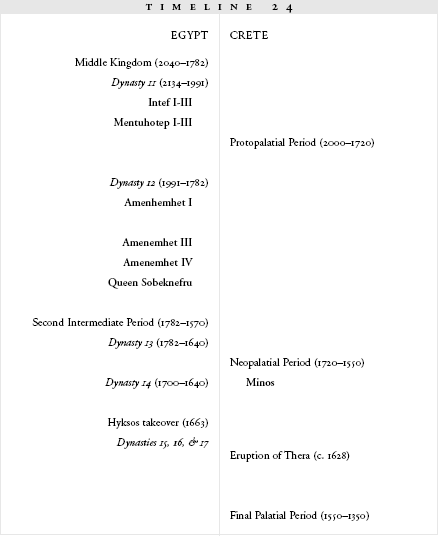
On Crete, between 1720 and 1628 BC, the Minoans sacrifice to the god of the sea
NORTH OF THE NILE DELTA, far up in the Mediterranean Sea, a long mountainous island lay southeast of the unnamed messy peninsula that jutted down from the European mainland. The inhabitants may have come over from Asia Minor long before; by the time of the Hyksos, they too had joined the ranks of countries with kings, and had built a palace for their unknown monarch.
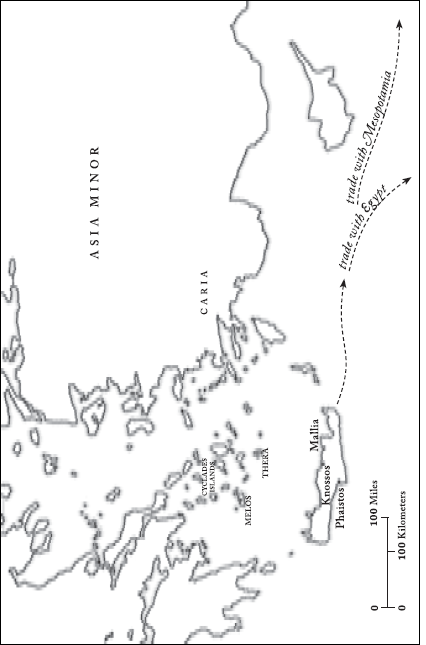
The palace stood at the center of Knossos, a settlement just inland from the very center of the northern coastline, and a strategic place from which to keep tabs on the east and west ends of the island. Not long after it was built, other, slightly smaller palaces went up at other key locations: at Mallia, east of Knossos on the northern coast itself, and Phaistos, just in from the southern coast.1
Since these early people left no writing behind them, we don’t know exactly who lived in these palaces. But they stood at the centers of sprawling towns, networks of roads and houses. The people of these towns traded with the civilizations across the water. Their brightly painted pottery jars (possibly once holding wine or oil for trade) have been uncovered not only on the surrounding islands, but also along the Nile river and on the Mediterranean coast where the Western Semites lived.
They also practiced human sacrifice. Earthquakes shook the mountainous island with regularity; one of them collapsed a temple, situated on the mountain now called Mount Juktas and facing the northern sea, onto the inhabitants inside. Their skeletons lay undisturbed for almost three thousand years, until archaeologists uncovered the scene: a young man bound and lying on his side on a stone-and-clay altar, a bronze blade dropped on top of his body, and in front of the altar, a man in his forties, wearing a ceremonial ring and seal. A woman lay on her face in the southwest corner.2
Human sacrifice wasn’t carried out very often. Traces of sacrifice have been uncovered in only one other location: a house in the western part of the town of Knossos, where two children had apparently been not only sacrificed, but carved up and cooked along with snails in some sort of ritual feast.3 The ruins don’t tell us what the sacrifice meant, or what horrible dilemma drove the priests and priestesses of Knossos to such an extreme act of worship.
But we can make a good guess.
SOMETIME AROUND 1720, an earthquake knocked down the early palace at Knossos. A new palace was built overtop of it and partially incorporating its ruins. This second palace was much more elaborate. The people of Knossos had progressed to the point where they needed a more royal king.
The Greeks, who called the island Crete, believed that a powerful king named Minos lived in Knossos in the days of this “Second Palace.”66 According to Greek myth, Minos was the stepson of a Cretan nobleman. Wishing to rule over the country, he told the people of Crete that he could prove he was divinely chosen for the kingship; whatever he prayed for would be given to him by the gods. The people challenged him to prove his boast, so Minos asked Poseidon to send him a bull for sacrifice. Immediately a magnificent bull walked up out of the sea onto the Cretan shore. It was so magnificent, in fact, that Minos couldn’t bring himself to sacrifice it. He herded it into his own flock and sacrificed a lesser bull instead.
The Cretans acclaimed Minos as king. But Poseidon was displeased by Minos’s greed, and cursed his wife Pasiphae with a lust for the bull. With the help of the legendary architect Daedalus, Pasiphae and the bull managed a rather odd coupling in which a wooden cow on wheels figured prominently; Pasiphae then gave birth to a horribly deformed child, a human figure with the face of a bull. Minos, seeing the baby, shut it up in a prison beneath the Knossos palace. The prison, which was designed by Daedalus as punishment for helping out Pasiphae, was made up of so many winding passages that the child—named Asterius by his mother, but known as the Minotaur—could never escape. In this prison, the Labyrinth, the Minotaur grew to adulthood. Minos fed it on human flesh; after a battle with the inhabitants of the Greek mainland, he ordered them to send seven young men and seven young women each year to be eaten by the Minotaur.4
24.1 The Minoans
This story appears in the Library, a Greek collection of stories from the second century BC.67 Behind the fog of this myth, we may be able to achieve a glimpse of a civilization which has left no other stories behind it.
Minos may well have been the name not just of one legendary ruler, but a line of kings who governed in Knossos and lent their name to Crete’s earliest civilization. The story of the Minotaur, with its exchange of cargo between cities, reflects the ongoing international sea trade carried on by the Minoan people. So do the remains of Second Palace goods found around the ancient world. An alabaster jar lid uncovered at Knossos is marked with the name of the third Hyksos king, and the Hyksos palace at Avaris has on its walls the remains of a fresco painted in the Minoan style. Contact with the eastern coast of the Mediterranean was regular; possibly the Minoans even traded as far over as Mesopotamia. Some of the pictorial representations (most notably on seals) of Gilgamesh and his fight with the Bull of Heaven—a story which begins to appear on clay tablets between 1800 and 1500 BC, right at the height of Minoan civilization—show Gilgamesh grappling with a partly human bull who wears a kind of wrestling belt. The monster has a bull’s body and man’s head, which is a reversal of the Minotaur’s deformity, but the resemblance between the two monsters suggests that Minoan and Mesopotamian sailors swapped stories in port.5
Although the organized Greek civilization from which Minos was theoretically compelling this yearly tribute is an anachronism (there were only scattered settlements on the peninsula this early), Minos’s ability to demand payment from abroad reflects the military power of Crete during the Second Palace Period. The Library says that Minos was “the first to obtain the dominion of the sea; he extended his rule over almost all the islands.” Minoan towns have been uncovered on a number of the nearby islands, including Melos, Kea, and the small unstable Thera. The towns served not only as trading stops, but as naval bases. The Greek historian Thucydides writes that Minos was the first ancient king to have a navy. “He made himself master of what is now called the Hellenic Sea,” Thucydides says, “and ruled over the Cyclades [the Aegean islands to the north], into most of which he sent the first colonies, expelling the Carians [settlers from southwest Asia Minor] and appointing his own sons governors; and thus did his best to put down piracy in those waters, a necessary step to secure revenues for his own use.”6 According to Herodotus, the Carians remained on the islands but became Minos’s subjects, a pool of experienced sea-hands who would “man ships for him on demand.”7 The Minoan empire was built on water.
Around 1680 or so it reached the full extent of its power. Pirates had always been a problem in the Mediterranean—Thucydides explains that Knossos was originally built inland, away from the sea, “on account of the great prevalence of piracy”—but Minos’s navy put an end to piracy, at least in the sea around Crete. This new peace meant that the peoples on the islands and coast were able to “apply themselves more closely to the acquisition of wealth, and their life became more settled.”8 Trade flourished, new buildings went up, painting and sculpture reached a new level of sophistication.
But there is a lingering threat in the story of King Minos: the bull-monster beneath the palace. That malicious presence, just out of sight, is the visible sign of Poseidon’s ill will. It threatens not just the peoples who pay tribute to Minos, but Minos himself. It is an untamed and hungry power that literally undermines the foundation of his palace and demands constant sacrifice.
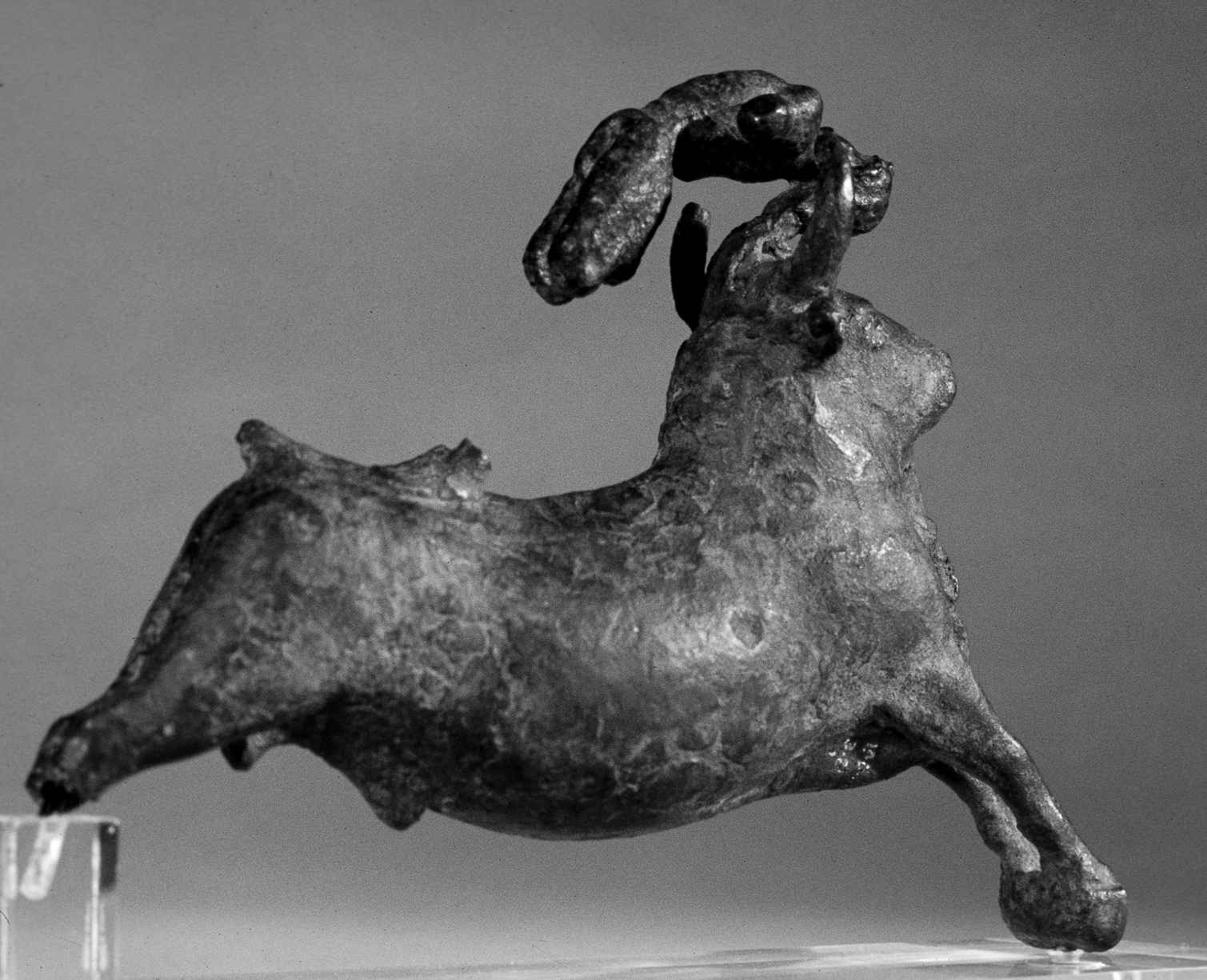
24.1. Bull-dancer. A Minoan bronze of an acrobat, leaping over the back of a bull. British Museum, London. Photo credit HIP/Art Resource, NY
The palace at Knossos was ornamented with frescoes: wall paintings created by laying bright colors made from carbon, yellow ochre, iron ore, and other minerals directly onto a damp layer of lime plaster. In these frescoes, sacred bulls lower their horns in threat while worshippers vault over the horns onto the bull’s back, and from there spring to the ground. The most famous bronze sculpture from the Knossos ruins preserves the same bull-dance, frozen at its most dangerous moment.
Presumably the worshippers who took part in this ritual were young, athletic, and ready to die. The story of the Minotaur may well preserve a very old form of human sacrifice in which the dedicated victims were not laid on an altar, but set loose in front of the bull. Excavation of the so-called Bull Courts, the central courts at Knossos where the bull-dancing apparently took place, show an entire network of doors, stairs, and corridors opening onto the courts from the surrounding buildings: a veritable labyrinth.9 There is another connection between the Minotaur story and the religious practices of Crete. The fourteen victims are eaten by the Minotaur; the sacrificial site uncovered at Knossos indicates some sort of ritual feasting on the dead.
What sort of divine anger required this kind of sacrifice?
In the later Greek version of the Minotaur story, Poseidon, the god of the sea, is also called Earthshaker, and the bull is his sacred animal. The island of Crete and the sea around it were constantly shaken by earthquakes and the destructive waves that followed. Only constant pleading to Earthshaker could stave off the threat that came from the sea.
SOMETIME AROUND 1628, the earthquakes around nearby Thera grew more frequent.68 The island was an active volcano, and more than one eruption had already taken place. But for some years, the island had been quiet enough for Thera’s only large town, Akrotiri, to grow large and prosperous.10
When the earthquakes first intensified, the inhabitants of Akrotiri rebuilt the walls that the earthquakes knocked down. As the tremors grew more severe, they began to flee. Excavations of the ruins have revealed no skeletons, and the city seems to have been emptied of precious items such as jewelry and silver.11
24.2 Thera Before and After
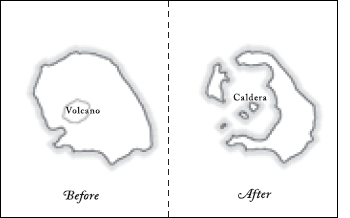
Shortly afterwards, the volcano at the center of the island began to spew out pumice. The pumice that coats the ruins appears to have crusted over, meaning that it was exposed to the air (before being coated by the ash of the final eruption) for some time—any amount of time from two months to as much as two years. The rumblings at Thera went on a long time while the nearby islands listened in trepidation. Two years is a long time to wait for a looming catastrophe; long enough to sacrifice in hopes that the disaster will go away.
And then the volcano literally turned the island inside out, hurling fifteen feet of ash over the city. Enormous boulders flew from the depths of the volcano and rained down with the ash like gargantuan hail.12 A gash opened in the side of the island, allowing the sea to pour into the crater left by the volcano. When the eruption finally succeeded, Thera was no longer a round island with a volcano at its center; it was a ring of land around a central inland sea, an enormous caldera.
This was the end of the Minoan town of Akrotiri, which would remain preserved under ash until it was excavated, beginning in the 1960s. It’s less clear how much damage this gigantic eruption had on the Minoans of Crete. For a little while after Thera’s explosion, the Minoan civilization continued as usual. Eventually, though, the population began to shrink; the houses grew shabby; trade trickled to a halt.
The decline may well have been related to the volcanic eruption.69 Indications on Thera itself suggest that the volcano erupted in late June or early July, just before the harvest.13 Ash fall, blown by the wind, missed the western end of Crete, but certainly reached the eastern half of the island, perhaps destroying a season’s worth of food. Traces of ash on the shores around Thera suggest that the eruption caused a tsunami that submerged nearby islands, and that may still have been over thirty feet high when it crashed against the shores of Crete, twenty-five minutes after the eruption.14 The huge cloud probably blocked the sun for some time. Electrical storms, heavy and violent thunderstorms, and sinking temperatures followed. For months, the sunsets would have been a deep blood red.
Even if the volcano were not directly responsible for the Minoan decline, all of these weird manifestations were likely to have had much the same effect as the dropping of the Nile down in Egypt. Such portents showed that Poseidon was angry. The royal house was no longer pleasing the gods. Very likely the catastrophe had been merely the forerunner of more extreme divine displeasure, looming on the horizon. The Earthshaker was not to be trifled with; and he always lurked in the depths, ready to bring an end to fragile prosperity. It was best to get away from such fury as quickly as possible.70