
In Sumer, slightly later, a very great flood occurs
NO RAIN HAS FALLEN for months. In a field near the salty head of the Gulf, a woman is harvesting the shrivelled heads of wheat. Behind her, the walls of her city rise up against a lead-colored sky. The ground is stone beneath her feet. The reservoirs, once filled with water from the yearly floods, hold only an inch of liquid mud. The irrigation channels are empty.
A drop of water dents the dust on her arm. She looks up to see clouds creeping from the horizon towards the peak of the sky. She shouts towards the walls of the city, but the streets are already filled with men and women, thrusting pots, basins, and hollowed shells into every open space. Far too often, the squalls blow across the plains in moments.
But not this time. The drops strengthen and stream down. Water collects, pools, and swells. In the distance, an unfamiliar roar strengthens and shakes the earth.
ANCIENT PEOPLES without deep wells, dams, or metropolitan water supplies spent a large part of their lives looking for water, finding water, hauling water, storing water, calculating how much longer they might be able to live if water were not found, and desperately praying for water to fall from the sky or well up from the earth beneath. But in Mesopotamia, an unexpected fear of water exists alongside this vital preoccupation. Evil and malice lurk in deep water; water may bring life, but catastrophe is not far behind.
The history of the earth (so geologists tell us) has been punctuated by great catastrophes which apparently wiped out entire categories of life forms. But only one echoes down in the words and stories of a dozen different races. We don’t have a universal story that begins “And then the weather began to grow VERY, VERY COLD.” But at some point during the living, storytelling memory of the human race, water threatened man’s fragile hold on the earth. The historian cannot ignore the Great Flood; it is the closest thing to a universal story that the human race possesses.
Apart from the brief mention of the flood in the king list, the Sumerian story of the flood comes to us only indirectly, translated thousands of years after the event into Akkadian (a Semitic language spoken later in Mesopotamia) and preserved in an Assyrian library. Enlil, king of the gods, grows exasperated because the roar of men on the earth keeps him from sleeping; he convinces the other gods to wipe out mankind, but the god Ea, who has sworn an oath to protect mankind, whispers news of the plot to the wise man Utnapishtim in a dream.5 And then
the gods of the abyss rose up
the dams of the waters beneath were thrown down
the seven judges of hell lit the land with their torches
daylight became night,
the land was smashed as a cup
water poured over the people as the tides of battle.1
Utnapishtim, warned, escapes in a boat with his family, a few animals, and as many others as he can save.
The Babylonian version of this story is called the “Poem of Atrahasis” (Atrahasis, translated, means something like “Super Wiseman”). Atrahasis, the wisest king on earth, is warned of the coming disaster. He builds an ark and—knowing that he can spare only a few—invites the rest of his subjects to a great banquet, so that they may have one last day of joy before the end. They eat and drink, and thank him for his generosity; but Atrahasis himself, knowing that the feast is a death meal, paces back and forth, ill with grief and guilt.
So they ate from his abundance
and drank their fill,
but he did nothing but come in, and go out,
come in, and go out,
never seated,
so sickened and desperate was he.2
Even the wisest king on earth cannot always assure the survival of his people, in the face of overwhelming disaster.
But the most familiar flood story is undoubtedly the one told in Genesis. God determines to cleanse his creation of corruption, so he tells Noah, “blameless among his people,” to build an ark which will save him and his family from destruction. Rain falls, and the “great springs of the deep burst, and the floodgates of the heavens were opened,” and water swallows the earth.
Three cultures, three stories: too much coincidence of detail to be dismissed.6
Nineteenth-century geologists, with Genesis as their guide, searched for traces of the Great Flood and often found them: disordered geological layers, shells on tops of mountains. But the slow movement of ice sheets across land, a theory first suggested by Louis Agassiz in 1840, also explained many of those geological formations previously attributed to a universal flood. It was also more in tune with the growing scientific consensus that the development of the universe was uniform, gradual, always affected by the same logical processes, moving evenly forwards in a predictable pattern in which unique, unrepeatable events had no part.7
Yet the stories of a Great Flood remained. Students of Mesopotamia continued to champion the existence of a real flood—not a universal flood, since this was no longer philosophically respectable, but a Mesopotamian flood destructive enough to be remembered for thousands of years. Archaeologist Leonard Woolley, known for his excavations of Ur, wrote, “The total destruction of the human race is of course not involved, nor is even the total destruction of the inhabitants of the delta…but enough damage could be done to make a landmark in history and to define an epoch.”3 Looking for the footprints of a flood, Woolley (not surprisingly) found them: a ten-foot layer of silt, dividing early Mesopotamian settlements from later.
Seventy years or so later, the geologists William Ryan and Walter Pitman suggested that the flood stories represent, not a devastating Mesopotamian flood, but a permanent inundation, “a flood that never subsided…[that] expelled a people from their former homeland and forced them to find a new place to live.”4 As ice melted and the Mediterranean Sea rose, the Bosphorus Strait, at that point a solid land plug, burst open. The Black Sea overran its banks and settled into a new bed, forever drowning the villages on its edge; the people who escaped travelled south, and took with them the memory of the disaster.
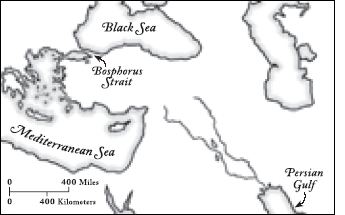
2.1 Before the Ryan-Pitman Flood
Less spectacular answers have been suggested as well. Perhaps the flood story represents a sort of generalized anxiety about flooding, which undoubtedly was a regular occurrence near the braided stream that ran through Mesopotamia.5 Or maybe the story of the earth-changing flood reflected the reshaping of the Sumerian homeland as the Gulf crept northwards, swallowing villages in its rising tide.
All of these explanations have their difficulties. Leonard Woolley’s silt layer, as further excavation revealed, was far too localized to strike the Mesopotamian residents as civilization-ending. (It also dates to around 2800 BC, which puts it right in the middle of Sumerian civilization.) It is difficult to see how centuries of rising and falling floods, each of which receded and then came again, could be transformed into one single cataclysmic event which forever changed the face of the earth. And although the rising of the Gulf probably inundated villages, the waters crept up at a rate of one foot every ten years or so, which is unlikely to have produced a huge amount of angst.
Pitman and Ryan’s theory—based on samples taken from the bottom of the Black Sea—is more engaging. But their flood dates to about 7000 BC, which leaves a question unanswered: How did stories of a universal flood make their way into the oral traditions of so many peoples who, by any reckoning, were far away from Mesopotamia by 7000 BC?
In China, where two independent farming cultures—the Yang-shao and the Longshan—grew up during the centuries that the Sumerians were building their cities, a treacherous warleader tears a rent in the sky’s canopy and water rushes through, covering the whole earth and drowning everyone; the only survivor is a noble queen who takes refuge on a mountaintop along with a small band of warriors. In India, a fish warns the wise king Manu that an enormous flood is coming, and that he should build a ship and climb into it as soon as the waters begin to rise. “The waters swept away all the three heavens,” the Rig Veda tells us, “and Manu alone was saved.”6
More intriguing are the flood stories from the Americas, some of which bear an uncanny resemblance to the Mesopotamian stories (and seem to predate Christian missionaries who brought the book of Genesis with them, although this is not always certain). In the Mayan version, “four hundred sons” survive the flood by turning into fish; afterwards, they celebrate their deliverance by getting drunk, at which point they ascend into the heaven and become the Pleiades. (Alert readers will notice the odd parallels to the Noah story, in which signs also appear in the sky, and in which Noah gets insensibly drunk once he’s on dry land.) In Peru, a llama refuses to eat; when its owner asks why, the llama warns him that in five days water will rise and overwhelm the earth. The man climbs the highest mountain, survives, and repopulates the earth. (No woman climbs up with him, which seems an unfortunate oversight.) If these American flood stories are related to the Mesopotamian tales, the flood could not have happened in 7000 BC; as the historian John Bright suggests, the shared disaster must have taken place before 10,000 BC, when hunters migrated across the Bering Strait.7
So what happened?
Water flooded man’s world; and someone suspected, before the flood crashed down, that disaster was on its way.
AFTER THE WATER, the earth dries out. Man starts again, in a world redder in tooth and claw than it was. Something has been lost. In Genesis, Noah is told that it is now acceptable to kill an animal for its meat; in the Sumerian flood story, the gods lament the destruction of the world that was:
Would that famine had wasted the world
Rather than the flood.
Would that pestilence had wasted mankind
Rather than the flood.8
Surely it is not a coincidence that the creation stories of so many countries begin with chaotic waters which must recede so that man can begin his existence on dry land. In the Akkadian creation story, discovered on fragmented tablets along with the Epic of Gilgamesh, the first lines read:
When above were not raised the heavens:
And below on earth a plant had not grown up;
The abyss also had not broken open their boundaries:
The chaos Tiamat was the mother of the whole of them.9
In the creation of the world, the sea-being Tiamat is killed, and half of her body is tossed into the heavens, so that death-bringing salt water will not cover the newly dry land.
“In the year and the day of the clouds,” the Mixtec creation legend begins, “the world lay in darkness. All things were orderless, and water covered the slime and ooze that then was the earth.”10 “Truly,” the Indian Satapatha-Brahamana tells us, “in the beginning was water, nothing but a sea of water.” “In the beginning, in the dark, there was nothing but water,” the Bantu myth begins. And perhaps best known to those of us born into Christianity or Judaism, the words of Genesis: “In the beginning, the earth was without form and void, and darkness covered the waters; and the Spirit of God hovered over the deeps.”
There is no way of knowing what was destroyed by the waters. But like many other peoples, the Sumerians had a tale of lost paradise. In the very ancient Sumerian poem “Enki and Ninhusag,” this paradise is described as a place where
the lion does not kill,
the wolf does not seize the lamb,
the wild dog, devourer of kids, is unknown,
he whose eyes hurt does not say: “My eyes hurt.”
He whose head aches does not say, “My head aches.”11
But this dream city, filled with fruit trees and watered by fresh streams uncorrupted by salt, is lost to man.
We are still fascinated by water, and its inundation of the dry and orderly spaces where we live. Witness our ongoing obsession with the Titanic; the decks began to tilt, the water crept upwards, and the officers who had certain foreknowledge of the coming catastrophe could do nothing to avert it. Stories of deep water still frighten and attract us; as though, philosopher Richard Mouw suggests, “images associated with ‘the angry deep’ have an enduring power in the human imagination that has little to do with our geography.”12
But this is the territory of theologians and philosophers. The historian can only observe that the brewing of beer seems to have gone on as long as farming, and that the world’s oldest wine (found at a village site in the present-day country of Iran) dates to the sixth millennium. For as long as man has grown grain, he has tried to recapture, if only temporarily, the rosier and kinder world that can no longer be found on a map.