
Between 157 and 121 BC Romans destroy Carthage, put down a slave revolt, and deal a death blow to the Republic
BACK IN ROME, trade had resumed with Carthage. The North African city was a good source for gold and silver, wine and figs; and so the two cities kept an uneasy but useful peace.1
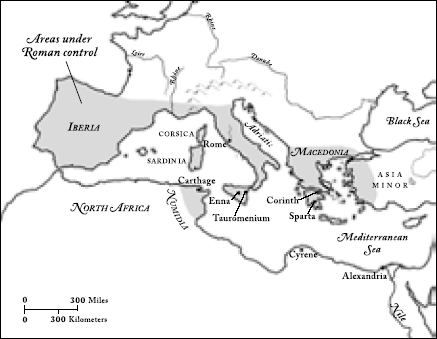
But Carthage was in peril. The treaty that closed the Second Punic War had deprived Carthage of most of its army and navy, which made the city vulnerable to other attackers. The most feared of these were the Africans of Numidia, a kingdom which lay on the North African coast below Carthage. The king of Numidia, Masinissa, was a Roman ally; he had sent soldiers to fight with Scipio Africanus against Carthage, and Rome had helped him enlarge his own North African kingdom. (He had also tattled on the Carthaginians when they entertained messengers from Perseus of Macedonia, back when Perseus was trying to whip up support to drive the Romans out.) Since the end of the Second Punic War, Masinissa had been carrying on armed attacks against bits of Carthaginian territory and claiming them for himself: “An easy matter for a man who had no scruples,” Livy remarks, since the Carthaginians were forbidden by Roman treaty to use weapons against any ally of Rome.2
In 157, a Roman delegation, led by the elderly statesman Marcus Cato, travelled down to North Africa in order to tell the Numidians to leave Carthage alone. But Cato, who had always been one of the most vehement anti-Carthaginians in the Senate, was horrified at what he found at Carthage. It was not “low and in an ill condition,” as the Romans had assumed, but (in Plutarch’s words) “well manned, full of riches and all sorts of arms and ammunition.” He returned to Rome posthaste and warned the Senate that “they themselves would fall into danger, unless they should find means to check this rapid new growth of Rome’s ancient irreconcilable enemy.”3
Not all the Senators were convinced that Roman troops needed to march on Carthage at once; Cato, nearly eighty, sounded as though he were simply rehearsing past fears. When he was opposed, he resorted to annoying the senators by ending every single speech he made, no matter what the topic, with, “And to conclude, I think that Carthage ought to be utterly destroyed.”4
So exhorted, the Senate made continual demands on Carthage to prove its loyalty. Finally, Rome demanded that the Carthaginians desert their city and rebuild it at least ten miles away from the coast. The Carthaginians refused, indignantly. In 149, Roman ships sailed for the North African coast under the command of Scipio Aemilius, grandson of the great Scipio Africanus, and a three-year siege began. It was purely a punitive measure, sometimes labelled the “Third Punic War.”5 As soon as the siege began, Cato died of old age; his epitaph, in the mouth of many Romans was that “Cato stirred up the third and last war against the Carthaginians.”6
Carthage was not the only problem on the senatorial agenda. Over in Greece, Sparta was causing trouble.
Sparta was no longer the dominant city in the Achaean League, its old association, and the other cities of the League had been running roughshod over it. Unhappy with a League decision, Sparta announced its intention to appeal directly to Rome (now tacitly recognized as the real power on the Greek peninsula). The other League cities immediately passed a regulation saying that only the League as a whole could appeal to Rome.
The Spartans reacted to this as Spartans had reacted for centuries: they armed themselves and threatened to fight. Indignant letters went off to Rome from both sides of the debate. A Roman ambassador who was up in Macedonia settling another problem sent a message down, ordering them to knock it off until Roman officials could arrive and help them sort the matter out. But it was too late. By 148, swords had already been drawn.
The following year, Roman diplomats showed up to mediate the dispute. They held their deliberations in the city of Corinth, and came to a decision favoring the Spartans, which was not the cleverest of arrangements; the Corinthians, moved to fury, stormed out and mauled anyone who looked like a Spartan. The Roman officials, caught in the riot, got beaten up themselves.
The indignant Romans returned to Rome and put the worst possible spin on the incident: “They declared,” Polybius says, “that they had a narrow escape of actually losing their lives…. they represented the violence which had been offered them as not the result of a sudden outbreak, but of a deliberate intention on the part of the Achaeans to inflict a signal insult upon them.”7
In response, a Roman fleet sailed for Greece, where a force of twenty-six thousand men and thirty-five hundred cavalry, under the command of the consul Mummius, pitched camp at the Isthmus of Corinth. Some of the Achaean League cities tried to fight back, under the command of a Corinthian general, but the Greek army soon broke; the Corinthian commander fled, and then poisoned himself; the defeated Achaean League soldiers ran to Corinth and hid in the city. Mummius set the city on fire, and Romans overran it.
Rome had finally swallowed Greece.
As far as Polybius is concerned, the Greek cities brought this disaster on themselves: “The Carthaginians at any rate left something for posterity to say on their behalf,” he writes, “but the mistakes of the Greeks were so glaring that they made it impossible for those who wished to support them to do so.” He might have said the same about Macedonia, which continued to play host to men who claimed to belong to the Macedonian royal line until the Romans annexed it and turned it into a province, taking away even the small freedoms that the republics had been permitted.
Meanwhile Carthage, which had “left something for posterity to say on its behalf,” was in flames. In that same year, Scipio Aemilius and his men finally brought the city down. Roman soldiers ran through the streets, setting buildings on fire. It took two weeks for Carthage to burn to the ground. Polybius himself was there, standing beside Scipio Aemilius as Carthage collapsed: “At the sight of the city utterly perishing amidst the flames,” he writes, “Scipio burst into tears…. And on my as king him boldly (for I had been his tutor) what he meant…he immediately turned around and grasped me by the hand and said, ‘O Polybius, it is a grand thing, but I know not how, I feel a terror and dread, lest someone should one day give the same order about my own native city.’”8
THE LAND where Carthage had once stood now became the Roman province of North Africa. Rome had conquered all of the ancient powers that lay within easy reach; Parthia, Egypt, and what was left of the Seleucids still lay beyond.
Before further campaigns, Rome had domestic troubles to settle. The success of the Roman wars to this point had brought thousands and thousands of foreign-born captives into the Roman provinces as slaves. Roman slaves were the property of their masters and could be beaten, raped, or starved at will, but as soon as a Roman master set his slave free, that slave became a Roman citizen, with all the rights of citizenship. This, as the historian M. I. Finley has pointed out, made Roman slavery a very odd institution indeed. In a single act, a piece of property became a human being, and since Roman slaves came in all shades (unlike slaves of the American South, who, even freed, carried in their skin color the reminder that they had once belonged to a slave class), freedmen then “melted into the total population within one or at the most two generations.”2169
Practically speaking, badly treated slaves knew perfectly well how close they were, in essence, to their masters. By 136, there were thousands of these slaves in Sicily, which had prospered after its release from Carthaginian mastery. The Sicilians, writes Diodorus Siculus, “treated them with a heavy hand in their service, and granted them the most meagre care, the bare minimum for food and clothing…. The slaves, distressed by their hardships, and frequently outraged and beaten beyond all reason, could not endure their treatment. Getting together as opportunity offered, they discussed the possibility of revolt, until at last they put their plans into action.”10
The rebellion broke out first in the city of Enna, where four hundred slaves banded together to murder a slaveowner notorious for his cruelty. They killed everyone in the slaveowner’s house, even the babies, with the sole exception of one daughter who had shown kindness to her father’s slaves. Then they appointed as their king and leader a charismatic slave named Eunus, who was rumored to have magical powers. Certainly he was a smooth and convincing talker, and proved himself to be no mean strategist either: “In three days,” Diodorus writes, “Eunus had armed, as best he could, more than six thousand men…. Then, since he kept recruiting untold numbers of slaves, he ventured even to do battle with Roman generals, and on joining combat repeatedly overcame them with his superior numbers, for he now had more than ten thousand soldiers.”11
His particular rebellion was soon joined by other slave leaders who acted as generals under his command. Somewhere between seventy thousand and two hundred thousand slaves eventually joined in this revolt, which became known as the First Servile War. Other sympathetic slave rebellions flared up in Rome, and then in several Greek cities. These were put down, but the Sicilian fighting continued.
The First Servile War dragged on for three years, in part because the plight of the Sicilian slaveholders did not rouse much pity in the breasts of Sicilian laborers: “When these many great troubles fell upon the Sicilians,” Diodorus Siculus writes, “the common people were not only unsympathetic, but actually gloated over their plight, being envious because of the inequality in their respective lots.” Many peasants took the opportunity to set fire to the estates of the rich and blame the devastation on the rebellious slaves.12 They did nothing to restore the old order, because they had suffered under it themselves.
In this, Sicily was not alone. Not only Rome’s provinces but Rome itself was suffering from an increasing gap between rich and poor. Rome’s constant warfare meant that hundreds of thousands of Roman foot soldiers had marched off to fight, and had returned, poorly paid and sometimes disabled, to badly kept farms, crumbling houses, and unsettled debts.13 Meanwhile merchants were taking advantage of the newly opened trade routes to do a booming business, and public officials were earning higher and higher salaries from newly taxed lands.
Rome’s management of its conquered lands had also been less than stellar. The Roman historian Appian, who wrote his Civil Wars some two hundred years later, describes the general procedure for territory seized on the Italian peninsula:
As the Romans conquered the Italian tribes, one after another, in war, they seized part of the lands…. Since they had not time to [sell or rent] the part which lay waste by the war, and this was usually the greater portion, they issued a proclamation that for the time being any who cared to work it could do so for a share of the annual produce…. The wealthy, getting hold of most of the unassigned lands…and adding, part by purchase and part by violence, the little farms of their poor neighbors to their possessions, came to work great districts instead of one estate.14
To work these large tracts, landowners needed plenty of labor, but Roman law said that hired men, if free, could be drafted into military service. So the wealthy bought more and more slaves, who were exempt from the draft. “Thus,” Appian says, “the powerful citizens became immensely wealthy and the slave class all over the country multiplied,” while common laborers were held down “by poverty, taxes, and military service.”
The most vocal opposition to this badly planned system was a tribune by the name of Tiberius Sempronius Gracchus, son of a consul. He had served under Scipio Aemilius in the campaign against Carthage, where he gained fame as the first man to mount the enemy wall.15 In his other foreign service, he had seen the countryside of the Roman provinces dominated by the rich, with shepherds and farmers thrown off their land, and he returned to Rome and embarked on political office determined to bring reform. It was ridiculous, he argued in his public speeches, for Roman generals to order their soldiers to fight for home and hearth, when those very soldiers were on the edge of losing their homes: “He told them,” Plutarch relates, “that they fought indeed and were slain, but it was to maintain the luxury and the wealth of other men. They were styled the masters of the world, but in the meantime had not one foot of ground which they could call their own.”16
The reforms Tiberius Gracchus suggested, which would have crimped the estate-building of the rich, were naturally unpopular with wealthy Romans. They convinced his fellow tribunes to veto Tiberius’s bill. This was perfectly legal; any tribune had the right to veto a law proposed by another. Tiberius suspected that bribes had been offered, though, and acted on his suspicions by breaching Rome’s constitution. With the help of his supporters, he blocked a whole range of public services and announced that they would not start again until his bill was brought up for the popular vote.
This was breaking the law in order to do good, and it was this action which began to turn more and more Roman lawmakers against Tiberius Gracchus. No matter what his intentions were, he was introducing a dangerous precedent: he was using his personal popularity with the masses to get his own way.
Their fears were not calmed when the bill passed and Tiberius put himself, his father-in-law, and his younger brother Gaius in charge of seeing that it was enforced. More people began to mutter—not just lawmakers, but the commoners who had always been on Tiberius’s side. He had bypassed the authority of his fellow tribunes, and the office of tribune was supposed to serve as a protection for the common people. They wanted his reforms passed, but many of them were worried about his methods.
The suspicions surrounding Tiberius Gracchus blazed up into a riot in 132, when he stood for reelection to the office of tribune. On the day of the elections, he was in the Capitol when rumors began to pass through the crowd: the wealthy would not allow a vote for him to be cast; assassins were coming to find him. The men around him began to grow more agitated. In the middle of all this, Tiberius put his hand to his head. Appian says that this was a sign to his followers that it was time to resort to violence to get him into office; Plutarch says that those around him thought he was asking to be crowned (a highly unlikely request). Clubs and sticks appeared. Whoever struck the first blow, the whole crowd erupted. Senators themselves were seen wrenching apart benches and using the legs as weapons. According to Plutarch, the first man to strike Tiberius himself was another one of the tribunes, who was armed with the leg of a stool. Tiberius fell and was beaten to death, along with three hundred other victims of the riot. He was barely thirty-one.
All of the bodies, including that of Tiberius Gracchus, were thrown without ceremony into the Tiber. “This,” Plutarch says, “was the first sedition amongst the Romans, since the abrogation of kingly government, that ended in blood.”17 Before, Senate and commons had managed to resolve their differences within the boundaries set by the Roman constitution; the murder of Tiberius Gracchus ripped those boundaries apart, and they were never fully stitched together again. Later, Romans themselves would look back to the blow that felled him as the fatal wounding of the Republic. But in fact Tiberius Gracchus had begun to insert the knife himself, when he had decided to bypass his fellow tribunes for the sake of the poor. “He lost his life,” Appian concluded, “because he followed up an excellent plan in too lawless a way.”18
76.1 Slave Revolts
In that same year, the First Servile War in Sicily finally came to an end when the consul Publius Rupilius crushed the rebellion with startling severity. He besieged the leadership of the revolt in the city of Tauromenium, and refused to lift the siege even when conditions inside became unspeakable: “Beginning by eating the children,” Diodorus says, “they progressed to the women, and did not altogether abstain even from eating one another.”19 When the city surrendered, Rupilius tortured the slaves inside and then threw them, still living, over a cliff. He then pursued the slave-king Eunus across Sicily, captured him, and threw him into prison, where “his flesh disintegrated into a mass of lice.”20
EIGHT YEARS AFTER Tiberius Gracchus’s death, his brother Gaius Gracchus—nine years younger—stood for election to the tribunate as well. He was, Plutarch says, earnest and vehement where Tiberius had been calm and composed; passionate and zealous where his brother had been careful and precise in speech. He won enough votes to become a junior tribune, and soon showed that he intended to make good his brother’s death. His reforms were even more radical than Tiberius’s had been; he proposed that all public lands be divided between the poor, that foot soldiers should be clothed by the state, that all Italians should be given the vote as part of their citizenship, and half a dozen other enormous shifts in Roman practice. The consuls did their best to block his changes. In frustration, Gaius rounded up his own supporters to “oppose the consuls by force,” and when the two parties came face-to-face another riot broke into bloodshed.21
Gaius Gracchus was murdered in the fighting. His killers hacked off his head and brought it to one of the consuls as a trophy. Three thousand other Romans fell in the riots as well. Once again the bodies were thrown into the Tiber, which this time came close to choking with the corpses. Tiberius Gracchus had died in a battle fought by clubs and wooden planks, but the riot that killed Gaius Gracchus was carried on with swords. The two sides had armed for war ahead of time.
