
CHAPTER EIGHT

The poet is going to war. Although he is forty-five years old, on September 25 he is ready to wear once more the same old breastplate that he had worn ten years earlier at Marathon. This time he will surely want to fight on deck, as a marine, or to go below deck and pull an oar. Doesn’t Athens need every man? Yet he will not complain if, in the end, the commanders decide that there are enough younger men to serve at sea and that he, instead, should line the beach at Salamis, waiting to drive his pike into any Persian survivor who is fool enough to stagger ashore. He is a patriot of the old school. He is also one of the most famous men in the city, having won first prize at the Festival of Dionysos only four years earlier, in 484 B.C. He is a local boy; from Salamis you can practically see his birthplace across the water at Eleusis, the birthplace as well of his brother Cynegirus, may the gods rest his soul, heroically departed a decade ago on the battlefield of Marathon. The son of Euphronius, he is the tragedian Aeschylus.
Eight years later, in 472 B.C., Aeschylus would again win first prize at the festival, this time for a tragic trilogy that included The Persians, his play about Salamis. He wrote from experience, because he had served at Salamis himself. So says Ion of Chios (ca. 480s—before 421 B.C.), a poet who came to Athens, knew Aeschylus personally, and published memoirs with a well-deserved reputation for accuracy. But after Aeschylus died in 456 B.C., his gravestone mentioned only Marathon and not Salamis. Perhaps the poet had ordered that, in order not to look as if he was trying to outdo his brother Cynegirus.
But what might really have moved Aeschylus was snobbery. The better people in Greece, as the upper classes called themselves, loved Marathon but turned up their noses at Salamis. Marathon was won by good, solid, middle-class farmer-soldiers, but Salamis was a people’s battle, fought by poor men who sat on the rower’s bench. And Aeschylus, who grew ever more conservative with age, might have had ever less use for those people. So, the poet might well have preferred to forget Salamis.
But in 472 B.C. Aeschylus could still see the white horses of the sun rising over the earth that morning and the red stain widening in a Persian grandee’s beard. He remembered things that he described in clichés, but they were earned clichés, as he might have thought; anyone who was there that day had the right to stumble in his words.
He remembered the power in the ship, when everyone was rowing, when you could hear the oars groan from rubbing against the leather oar port sleeves, when you could hear the rushing sound of many oars rowing as one, striking the deep salt sea. He remembered the fishermen, who were everywhere on Salamis, grumbling about the moorings that they had lost to the fleet, then trading theories about strategy in the taverns. Only the fishermen really know the water and the winds and the wrinkles on the surface of the sea at sunrise. They could have spread their nets and picked up dead Persians that day, thick as tuna in the water, split open and boned like mackerel.
But if Aeschylus remembered the look on the Greek sailors’ faces that night, when it was not yet morning, and the captains called them to their stations, and they knew that this was it, the day of death had finally come, and the Athenians among them had to worry about their wives and children here on Salamis—if Aeschylus remembered that, he did not tell. And yet, to anyone who was there, that was the story to remember. The looks of grit or discomfort or relief or fear or ferociousness: no one has recorded those.
It might have been hard for the Greeks on Salamis to sleep the night before the battle, on shore beside the ships, between the sound of Xerxes’ army on the march, echoing across the straits, and the knowledge that the Greek generals were battling with words in Salamis Town. The generals from the Peloponnese were all for rowing westward and fighting for their homes, while they still had them. As for the Athenians, Megarians, and Aeginetans, they might have been ready to fight the other Greeks rather than give up the chance to stay at Salamis and drive the Persians back. The crewmen did not know if the fleet would hang together or split apart. They did not know where they would fight, but they knew it would be soon, that is, unless some renegade turned traitor to the enemy, but maybe that thought was too much to bear.
To relieve the tension, some men might have told jokes. They might have laughed at Themistocles’ itchy fingers, for example, or at the spectacle of the gentry, pale and overweight, trying to pull an oar. They might have traded gripes about rowing masters. They might have argued over who had fought better at Artemisium. They might have wondered when the statues of Aeacus and his sons would ever get to Salamis.
And then it came: first the news that the enemy had snuck past the Greeks and surrounded them in the straits. Then the transcendent call rang forth. The Greeks would fight. It was a call of fear and a call of freedom. It was a battle cry to remind the men of why they had not surrendered to the Persians as most Greeks had: because, as Aeschylus puts it, they “are not called slaves nor subjects of any man.”
And so the Greeks would fight at Salamis. At that hour, suddenly, there were no more Athenians, no more Spartans, no more Corinthians. There were only Greeks. For a brief moment, just before dawn on September 25, 480 B.C., the Greeks achieved a unity that had always eluded them. It was an imperfect unity, because a roughly equal number of Greeks were lined up across the straits, on Persia’s ships, as fought on the Greek side. Yet the men at Salamis represented not just the flower of the city-states but a cross section of their male population. They ranged from the richest to the poorest, from cavalier to knave, from Panhellenic champions to losers at the childhood game of knucklebones, from representatives of families so old that they seemed to have sprung from the soil itself to immigrants from obscure villages somewhere in Thrace or Sicily. As a group they comprised citizens, resident aliens, and slaves. They spanned the ranks of the Greek military, from horsemen to hoplites (infantrymen), from marines to rowers, from archers to scouts. They were going to their ships to fight at last.
It should not have taken them long to get ready. All the Greeks had sharpened their weapons for battle; the debate concerned only where they would fight. The rowers needed just to grab their gear, including a little food and water to bring aboard. But first, they would eat. Since the Athenians had probably brought livestock with them to Salamis, the Greeks might have been able to add cheese to their pre-battle meal. It would all have been washed down with wine, diluted, in the ordinary Greek way, with water. This was the standard way of sending off a warrior with a shot of courage.
But seventy thousand men, the number of men gathered on the eastern shore of Salamis, ready to board their ships, cannot move at once. Thousands more men, Athenian hoplites, many of them presumably teenagers or quinquagenarians, stood ready to line the shore as soon as the ships pulled out. Nor can we be sure that there weren’t other, even older men on the hills and in the town behind them, and women and children, too, peering down into the camp and onto the beaches, trying to grab a glimpse of their men, calling out advice and encouragement, and perhaps even clapping their hands and singing. It was a morning like no other.
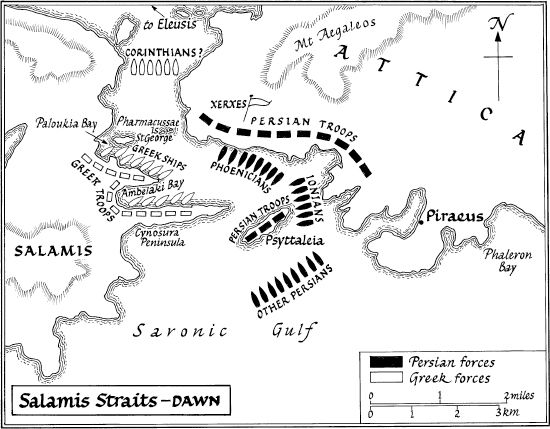
From Paloukia Bay southward along the island’s winding coastal curves to Ambelaki Bay, 368 Greek ships stood ready, moored at Salamis’s shoreline, stern first. With the addition of the trireme from Tenos, they represented twenty-three city-states, from Athens, which had 180 triremes at Salamis, to Seriphos, which provided a penteconter. The civilization that we call Greece was made up of a variety of ethnic groups. They all spoke the same language and worshipped the same gods, but they had a variety of laws and customs. The sailors at Salamis represented a virtual cross section of Greek ethnic groups: they included Ionians and Dorians, which were the two main groups, as well as Achaeans, Dryopes, and Macedonians.
The Spartans provided the commanding general, so they were assigned the traditional position of honor at the extreme right of the line, at the southern end of Ambelaki Bay. The Greeks considered the extreme right to be the position of honor, because in an infantry battle, each hoplite held his shield in his left hand, which left his right flank exposed. Every man was able to protect his right by taking advantage of the overlapping shield of the man in line to his right, except for the man on the extreme right. He stood in the most dangerous and therefore the most honorable place.
Tradition also assigned a spot to the city that claimed the next position in importance: the left wing. At Salamis, that honor went to Athens, whose ships were presumably moored in Paloukia Bay. Aegina held the spot to Athens’s right, to judge from the close communication between an Athenian and an Aeginetan commander during the battle.
According to this arrangement, the Spartans stood opposite the Ionians and perhaps other Greeks, while the Athenians and perhaps the Aeginetans faced the Phoenicians. In other words, the best Greek triremes were matched against the best Persian triremes. (It is not known where the other Greek contingents stood in the battle line.)
With full complements, 368 ships would have been filled with about sixty-two thousand rowers. As they took their seats, the rowers turned to one another and shook hands. These men were the backbone of the battle, and yet we do not know the name of a single one. Only a few captains and commanders are known by name. In fact, the ancient literary sources—histories, dramas, lyric poetry, philosophy—never mention a single rower by name, except for mythical heroes like the Argonauts. Their silence reflects both an age-old tendency in naval warfare to focus on boats instead of individuals and the upper-class bias of ancient literature. But in spite of the literary writers, the names of several hundred rowers in the Athenian fleet around 400 B.C. do survive, preserved in a public document, that is, in a lengthy inscription on stone. There we learn, for instance, of one Demochares of the deme of Thoricus, an Athenian citizen; of Telesippus of Piraeus, a resident alien; of Assyrios the property of Alexippos, a slave; and of Simos, a mercenary from the island of Thasos. These names, of course, mean almost nothing today, but perhaps that is the point. At Salamis, the freedom of Greece depended on ordinary men with undistinguished names. It was indeed democracy’s battle.
On the Athenian triremes if not others, the all-important pilot or helmsman was also a product of democracy. Standing in the stern with a rudder handle in each hand (the trireme had a double rudder), the pilot steered the ship. He made decisions, sometimes split-second decisions, which might provide the margin of victory. Not only did a pilot have to be steady, knowledgeable, and dogged, he also had to be quick, intelligent, and independent. And these were precisely the qualities that Athenian democracy promoted. The society that produced Themistocles would prove to be a fertile recruiting ground for pilots.
Ace pilots might play a critical role at Salamis. The narrowness of the straits would leave little leeway for steering error. Furthermore, the large number of Persian marines and archers would render the Greeks vulnerable to a mauling if their ships were rammed and boarded. It was up to the pilots to avoid Persian rams while landing Greek rams in the enemy.
As they funneled into their ships, some sailors may have faced the possibility of death, while others shunned the thought that they would never step on the earth again. They probably knew that, should they die, even if they won the battle, they might never be buried, and the Greeks had a particular horror of leaving a corpse unburied. They even considered it miserable to have to settle for burial by strangers rather than by one’s loved ones.
When someone dies in the water, his corpse floats for several hours, then loses the air in its lungs and sinks. Unless wind and waves deposit it on the shore sooner, a corpse will not resurface for several days, when bacteria in the abdomen generally emit enough gases to bring it floating up. But a puncture wound in the lung, such as from an arrow, a javelin, or a sword, allows gases to escape and delays the corpse’s ascent. If not found within four days, a corpse’s face will no longer be identifiable. On one occasion Spartan hoplites seem to have brought written identification with them into battle, but we know nothing otherwise of the primitive dog tags that ancient Greek combatants might have carried.
A sailor’s body, therefore, might never be brought home. In later years, when Athens held an annual public funeral for its war dead, there was an empty coffin to symbolize the missing.
No doubt the cause and the camaraderie gave comfort to the men who came on board. But they might also have rallied and found faith in their ships. For the Greeks, triremes were not merely machines, nor even merely “wooden walls”: they were alive and sacred, just as mountains and groves and springs were sacred.
Every warship had a name. Although we do not know the name of a single trireme that fought at Salamis, we do know hundreds of such names surviving from fifth- and fourth-century Athens. Ships were considered female. They were named for goddesses, like Artemis and Aphrodite; for demigods, like Thetis and Amphitrite; for ideals, like Democracy, Freedom, and Equality; for animals, like Lioness, Gazelle, and Sea Horse; for nautical locations, like Cape Sunium and Salamis; for weapons, like Javelin; for soldiers, like Hoplite or Ephebe (young recruit); and even for piratical notions like Rape and Pillage. Outside of Athens (and in some cases, outside Greece), we know of ships named, for example, after a sphinx, a snake, an eagle, a flower, a horse and rider, and for the heroes Castor and Pollux.
Every ship had its name depicted on a painted plaque attached to the prow. The name was possibly written out as well, but the painted image served several important purposes. It was relatively easy to identify in battle, it provided a symbol around which the crew could rally, and, not least, it was comprehensible. The majority of rowers in ancient fleets were almost certainly illiterate or only partially literate. Some of them would have had trouble making out writing, but the picture gave them something to remember.
Each trireme carried other decorations as well. Every stern pole was ornamented with a sculpted object. These represented a region rather than individual ships, and plausibly all the triremes in a given fleet carried the same stern ornament. It appears that Greek ships were all decorated with swan heads. Persian ships seem to have carried a human head in Persian clothing; perhaps this represented a heroic warrior or even the Great King. Stern ornaments were detachable, and were carried off as a victory trophy when a ship was sunk. Phoenician triremes also carried a bow ornament, possibly of a guardian god.
Finally, every trireme, indeed every ship, both in Greece and elsewhere in the ancient Mediterranean, had polished, painted-marble plaques on either side of the prow, each depicting an eye. Aeschylus calls triremes “the dark-eyed ships.” The custom of depicting eyes went back to early Egypt. The eyes symbolized the ship’s protective deity. Just as a human lookout sat in the prow and sent messages back to the pilot, so the eyes allowed the ship’s deity to scan the horizon. Aeschylus refers to a ship’s “prow that looks at the way ahead with its eyes obeying . . . the guiding rudder.”
The eyes also marked the prow as sacred space. It was not by accident, for example, that when the Persians captured the trireme from Troezen off the island of Sciathos in August and sacrificed a Troezenian marine named Leon, they chose the ship’s prow as the place to cut his throat.
The prow eyes, the ship’s name (especially if it honored a divinity or hero), and the stern ornament all symbolized the faith and trust of the common sailor in the protection of the gods. Athena might have let her temples on the Athenian Acropolis be destroyed, but she would not let them go unavenged.
Men heading into battle are likely to pray, and the sailors on Salamis would have been no exception. The Greeks always sacrificed an animal before battle. We do not know if, at Salamis, they made one sacrifice on behalf of everyone or if the individual city-states each sacrificed separately. The Spartans always sacrificed a goat to Artemis, so if Eurybiades carried out the rite on behalf of the entire fleet, he certainly would have chosen a goat. The Athenians might well have done likewise. They sometimes selected a different animal to kill before battle, but at Marathon in 490 B.C. they had vowed to sacrifice as many goats to Artemis after the battle as enemies killed. Since they slaughtered six thousand Persians at Marathon, that proved impractical, so instead they sacrificed five hundred goats a year on the sixth day of the month of Boedromion (roughly September). We might imagine, then, that at Salamis they would have been glad to stick to success and sacrifice a goat to Artemis.
In addition, the Greeks would have prayed to the gods for a safe trip. Just before the moment of departure, when every ship was fully loaded with its crew and the ladders had been pulled up, each commander would have carried out the ceremony. He would have recited prayers, followed by the singing of a hymn by his crew, and concluding with the pouring of a cup of wine from each ship’s stern.
It was standard procedure to offer the gods animal sacrifice before battle and a libation of wine before departure. But myths clung to the ceremonies marking so momentous an enterprise as the launching of the Greek fleet at Salamis. It might have been on this occasion, for example, that, at a predawn moment when Themistocles was speaking from the deck of his ship, an owl was supposedly seen to fly through the fleet from the right and land on the halyards of his mast. Everyone who saw it took this as a favorable omen, since the owl was Athena’s bird and had come from the right, that is, the auspicious side.
More lurid is the story of Themistocles’ sacrifice. According to the philosopher Phanias of Lesbos, who was a student of Aristotle, Themistocles sacrificed three human victims beside his trireme. Decked out in gold jewelry, they were high-ranking Persians indeed, no less than the sons of Xerxes’ sister Sandauce and her husband Artaüctus. Apparently an animal sacrifice was in progress when they were brought to Themistocles. At that point, a seer named Euphrantides claimed to witness a conspicuous flame shoot up from the altar and to hear a sneeze from the right. Thrilled, he clasped Themistocles by the hand and told him to sacrifice the three young men to Dionysus Carnivorous if he wanted a victory. Themistocles refused, but the crowd dragged the Persians to the altar and slit their throats. Plutarch, who repeats the story from Phanias, thinks it has merit, but he also tells what seems to be another version, in which Aristides captures the prisoners later, during the battle, before Themistocles allegedly has them sacrificed.
At daybreak, around 6:15 A.M., the outline of the Persian ships across the straits was visible. The Greek generals held an assembly. It was not unusual to launch a fleet before sunrise, but it would have been impractical to hold an assembly of more than three thousand men in the dark. In addition, the Greek commanders had other reasons to delay the launching of the fleet, as will become clear presently.
The assembly consisted of only the marines. It may seem strange that the rowers were not invited, but this was standard procedure in the pre-battle assemblies of ancient Greek navies. An assembly of the marines of over three hundred ships amounted to more than three thousand men; to include the rowers would have meant an assembly of more than sixty thousand men, and there wasn’t a hillside in Greece big enough to accommodate such a crowd. Besides, it would have delayed the fleet’s embarkation dangerously to wait until after the assembly to fill so many ships with so many men. Far better to have the rowers file onto their benches aboard ship first, while the assembly was in session, and then to have the marines clamber onto the deck.
The purpose of the assembly was to inspire the men. Greek generals usually addressed their troops before sending them into battle. The rowers certainly needed to be inspired as well, but perhaps the marines seemed to be in greater danger, considering that they sat on deck and might well have to engage in hand-to-hand fighting.
But there was a final reason to address the marines and not the rowers, and that was the prestige of the armed man. Marines carried sword and spear but rowers did not. In 480 B.C., the marines were probably drawn from the social class that supplied Greece’s infantrymen: the men of middling wealth, most of them farmers. These men came from families that, for generations, had supplied the backbone of the Greek armies. The rowers, meanwhile, certainly included men of modest wealth: the rowing benches could not be filled without them. But many of the rowers were poor men, sometimes dirt-poor, and Greek manpower needs dictated that they would even include slaves. Poor men in Greek land armies served only in a supporting role, as light-armed troops, and sometimes served not at all. By addressing the marines, therefore, the commanders paid homage to the martial tradition of the Greek people. They also reminded the marines, at least symbolically, that they were elite troops.
So the marines gathered round. Each is likely to have worn a short-sleeved, belted tunic and perhaps also a cloak against the morning chill on the water. He would be carrying a shield, a spear, and a sword. Many would be wearing a breastplate.
Various commanders spoke, but Themistocles seemed to say things best. What the others said is not recorded, and only the gist of his remarks survives. Herodotus reports:
All his words contrasted the better with the worse in human nature and the human condition. He told the men to choose the better, he finished his speech resoundingly, and he gave orders to board their ships.
At first sight, Themistocles’ words are disappointing. Then, on a second look, they reveal the eloquence of simplicity. There may have been no better way to tell the men how much depended on their behavior during the next day.
Or maybe, for once, Themistocles knew when to hold his tongue. Nothing that he said could have affected the men as powerfully as the sacrifices or the prayers or the omens. Indeed, at the very last minute, when Themistocles had finished and the marines were boarding their ships, another augury of success appeared. The trireme from Aegina, sent to fetch the statues of the sons of Aeacus, arrived. If seventy thousand voices had cried out in unison “The gods and heroes are with us!,” the effect could not have been greater.
If Themistocles noted the arrival from Aegina with approval, he no doubt focused on the fleets. His men, fresh from a night on shore and fired to avenge their gods and defend their homes, faced an enemy whose ships were still finding their places in line and whose captains had perhaps begun to fret. The Persians had expected to find a broken fleet on the verge of flight; instead, they faced a battle-ready foe, while they themselves had tired crews and boats positioned for the wrong assignment. Within the space of a day, the Greeks had gone from despair to the real possibility of victory. The gods had given the Greeks an opportunity that most of them had never imagined.
The gods, that is, through their faithful servant, Themistocles. The Athenian was irreverent to men but he was a lifelong devotee of Artemis. He owed the goddess more than a goat for the advantage bestowed upon the Greeks by his ruse with Sicinnus. And yet, it may be that Themistocles had still more tricks to play before the battle began. The ancient sources are so difficult on this subject that we can do no more than judge these tricks as plausible: we do not know if they actually happened or if they only grew in legend later. But when dealing with Themistocles, it would be unwise to ignore any possible ploy.
The first trick has to do with the role of Corinth in the battle. Years later, around 430 B.C., when Corinth and Athens had become the bitterest enemies, the Athenians insisted that, at the outset of the battle of Salamis, the Corinthians hoisted their sails and fled instead of fighting. In other words, they behaved just as the Samians had at Lade in 494 B.C. Yet all the other Greeks denied this. Furthermore, before 430 B.C. the Athenians had allowed the Corinthians to set up victory monuments on Salamis. Herodotus, who reports the facts, is neutral.
The story about Corinth might amount to nothing more than slander, but then again, it might contain a grain of truth. Suppose the Corinthians indeed had raised their sails and fled, but only to deceive the Persians. In that case, the Persians would believe with certainty in the Greek collapse. Softened up by deception, they would have been shocked by the fury of the Greek charge. In the meantime, the Corinthians could have quickly furled their sails and entered the battle.
The second trick, involving winds and waves, is even more complex. It is said that only the fishermen really know the winds. To earn their livelihood, fishermen must know when it is safe to go out to sea and when they must stick to shore; they need to know if they can sleep until dawn or if they must be up earlier, in order to find a smooth sea on which to toss their nets. A good fisherman can make a fair guess, the night before, about the winds that the next morning will bring.
A smart naval commander knows, therefore, that fishermen are valuable resources. We may imagine that Themistocles took the trouble to get to know the fishermen on Salamis personally. In his usual politician’s manner, he might have learned their names, kissed their babies, and asked about the winds.
It seems a good guess that as soon as he finished addressing his marines that morning, Themistocles had his finger up to the wind, because the fishermen had already given him information. They had told him that within two hours of dawn, the aura would begin to blow.
The aura is a sea breeze. In the region of Attica, it blows in from the south, off the Saronic Gulf. The aura is a gentle breeze, rarely blowing as much as four or five nautical miles per hour. In the Attica region, the aura usually begins to blow between 8:00 and 10:00 A.M. Another common phenomenon is for the aura to be proceeded by a north wind, blowing off the land.
If Themistocles expected an aura on the morning of September 25, the information might have been of great interest to him. He knew that the aura was intensified by the narrow Salamis straits, by what meteorologists today call the channeling effect. No doubt he had seen the results himself. He did not expect a hurricane, but he knew that the aura would make boats bounce and waver on the water. And that might make a difference in the battle.
Here the historian enters intriguing if dangerous ground. Herodotus says nothing about the winds at Salamis. Then again, he says nothing about the winds in any naval battle. Our information comes from Plutarch. Although he wrote six centuries after Salamis, Plutarch had access to several fifth century B.C. accounts besides Herodotus, accounts that no longer survive today. Plutarch was, in general, a careful scholar, with a habit of labeling tall tales clearly. He was a Greek to boot, so he knew the weather.
Plutarch reports that Themistocles waited for the aura before he gave the order for the Greek triremes to charge. He waited for “a brisk breeze . . . from the sea and a swell to roll down the straits.” He expected that these conditions might give the Persians trouble because he knew that their triremes “rose high in their sterns, and had bulwarks and would come down heavily.” In other words, the waves would upset the Persian ships because of their height. Themistocles worried little about the effect of the swell on the Greek ships, because “they had light drafts and lay low in the water.” Indeed, Themistocles may have been right, because other evidence confirms that Phoenician triremes contained bulwarks. This feature, aimed at protecting the large number of men on deck, rendered the ships vulnerable to wind.
We might also add that the Greeks had the advantage of knowing what awaited them. The Persians, by contrast, were sailing blind: they had no locals to ask about the wind, since Attica had been evacuated. They had to rely on the exiled family of the ex-tyrant of Athens, most of whom hadn’t seen Athens in thirty years, and none of whom was likely ever to have spent much time with the fishermen there.
If Plutarch is right, then Themistocles had yet another card to play against the Persian fleet. But only a very few men of the tens of thousands in the Greek fleet can have shared his knowledge of the strategic overview. Most of them made out only the threatening mass of the enemy triremes and the back of the oarsman astern of them or the early light reflected on a forest of spear points or the blood dripping from the sacrificial goat’s throat.
Somewhere in the crowd, either on a trireme or in the ranks along the shore, a poet, we may imagine, intermingled obligation with iambic meter not yet sung. Phrases like “lord of the oar,” “rich in hands and rich in rowers,” “to join in battle with their triremes’ rams,” and “to shut out the invincible wave with sturdy walls” rushed through his mind in turn. Yet however many lines he may have spun, Aeschylus kept returning to one verse in particular: theoi polin soizousi Pallados theas. “The city of Athena will be rescued by the gods.”
As for Themistocles, he had achieved all that he had sought. In spite of every effort by his allies to avoid it, in spite of every effort by his enemies to wage it on better terms, one cunning Athenian had created a clash of a thousand warships precisely where he wanted it, and precisely when. Themistocles had arranged the perfect battle. All that remained was to fight it.