
By Charles Chaplin (1933) 3
The most popular actor in the world pieces together the fragments of his youth and his struggles, recapturing the past in today’s glory
In the past twenty years I have made seven trips from Los Angeles to New York and one memorable visit to Europe. These excursions were for business reasons only and were never without the sword of Damocles above my head. No wonder, when living in Los Angeles for twenty years, that in the interim of work I became an easy victim to sentimental lapses. Hence all my troubles.
The disillusion of love, fame, and fortune left me somewhat apathetic. There seemed nothing, to turn to outside of my work, and that, after twenty years, was becoming irksome. I needed emotional stimulus.
I am tired of love and people and like all egocentrics, I turn to myself. I want to live in my youth again, to capture the moods and sensations of childhood, so remote from me now—so unreal—almost like a dream. I need to turn back time,; to venture into the blurred past and bring it into focus.
Thrilled with this adventure I buy maps of London and here in my California home I retrace road lines, bringing back memories of places that affected me as a boy.
High factory walls that depressed me, houses that frightened me, bridges that saddened me. I want to capture some of the hurt and joy again. To see the orphan asylum where, as a child of five, I lived two long years. Those cold bleak days in the playground! I want to see the drill hall where on rainy days we were sheltered, sniveling around half-heated water pipes; the large dining-room with its long tables and forms; the smell of sawdust and butter as we entered the kitchen.
These memories have landmarks and I want to stand in the midst of them before it’s too late. Something may have happened. The school may be pulled down. I cannot bear to be disappointed this time.
My first trip to England was a disappointment. Not my reception. On the contrary. Friends and everyone were kind to me. But in another respect, which reason I shall explain.
It is necessary to digress and go back to a spiritually starved youth of nineteen earning a sporadic living as a vaudeville sketch artist,4 as we termed ourselves. In those days life was lonely. My social precincts were limited. I yearned for more than my environment could give me. Those were melancholy days without romance or beauty until one August night something happened.
We were playing a suburban theater. I was standing in the wings, waiting my turn to go on. A troupe of girls was dancing. One of them slipped and the rest smiled—one especially, a brunette with big brown laughing eyes.
She turned to the wings and caught my gaze. Never had I beheld such beauty. I was enthralled. She was conscious of my admiration for her smile became a look of embarrassment.
When she came off to change, however, she asked me to mind her wrap. It had a perfume of lavender. I have liked this perfume ever since.
When they had finished she came for it.
“Thank you,” she said and we both stood smiling, but the moment was interrupted by the manager of the troupe.
“Come on, girls, we’re late.” They were working in another theater. She turned to pick up her things.
“Let me help you,” I exclaimed taking her makeup box and opening the exit door.
“See you tomorrow night,” she said eagerly.
I could only nod, not trusting myself to speak. As she was leaving through the outer door, she looked back over her shoulder. “Don’t forget,” she said shyly.
“I won’t forget,” I replied.
That was the beginning. Each night we would meet for a few moments. We never saw each other during the day, both being busy with rehearsals, and so we arranged to meet at Kennington Gate Sunday afternoon at four o’clock.
I was all dressed up for the occasion; a double-breasted coat pinched at the waist, derby hat, cane, and gloves. I rattled my thirty shillings impatiently.
The Sunday was a typical one. Discarded tram tickets littered the deserted streets and a news sheet blew aimlessly in the road. It was four minutes to four. I was wondering what she looked like without her stage make-up. Somehow I couldn’t visualize her features. The more I tried, the more vague my impressions became. Perhaps she was not so beautiful off-stage.
At last I saw someone approaching who answered her description. My heart sank as she came nearer. Not a trace of the beauty I had imagined. I was despondent. However, I braced up. I must give the impression of being enthused, I thought. It would be cruel to display signs of disappointment.
She was almost up to me now. She was looking directly my way. I was about to smile. But she turned her head and passed on. It was not she! Thank heavens, it was not she! I breathed a sigh of relief. The suspense was terrific. It was one minute past four.
A street car slowed up. The occupants were getting off. At last a slender-looking girl, neatly dressed in blue serge and looking radiantly beautiful, alighted and came toward me. I recognized her at once. It was Hetty, more lovely than I had dreamed. What a wonderful day that was!
That night after seeing her home I walked the Thames Embankment. I was all choked up with emotion. I wanted to express my happiness. I wanted to make a gesture. There were nineteen shillings left in my pocket. I lined up a crowd of derelicts to a near-by coffee stall and handed out tea and sandwiches until the money was spent. Such was the reaction of a youth in love.
What happened was the inevitable. After all, the episode was but a childish infatuation to her, but to me it was the beginning of a spiritual development, a reaching out for beauty. I suppose I must have burdened her with my unabated attentions, for she tired quickly and we parted.
I went through the youthful misery of unrequited love. Later she left with the troupe for the Continent and I lost sight of her for two years, but the next time we met it was in a curious way.
I was crossing Piccadilly when the screech of an automobile made me turn in the direction of a black limousine, which had stopped abruptly. A small, gloved hand waved from the window. There must be some mistake, I thought, when a voice unmistakably called, “Charlie!”
As I approached, the door of the car opened and there was Hetty, beckoning me to get in. She had left the troupe and had been living on the Continent with her sister. Oh yes, her sister had married an American multimillionaire. All this as we drove along.
“Now tell me something about yourself,” she said eyeing me kindly.
“There is very little to tell,” I answered. “I am still doing the same old grind—trying to be funny. I think I shall try my luck in America.”
“Then I shall see you there,” she interposed.
“Oh, yes, I’ll fix that up with my secretary,” I laughed ironically.
“But I mean it,” she insisted. “You know I’ve thought of you a good deal since the old days.”
Again I was lifted into paradise, yet in the back of my mind I knew it was more hopeless than ever now.
That evening we spent visiting her brother and mother; Hetty was to leave the following day for Paris. We said good-bye and she promised to write. But after one letter she ceased corresponding. Later I left for America.
Soon after I read of her arrival there with her sister. The thought of meeting her now embarrassed me. The affluence of her position added to my sense of inferiority complex. Yet I would often walk by the house on Fifth Avenue where she lived, hoping to meet her accidentally, but nothing ever came of it. Eventually I gave up the idea of ever seeing her again.
Then came my adventure into motion pictures—my sudden rise to popularity.
I had arrived in New York to sign million-dollar contracts. Now is my opportunity to meet her, I thought, but somehow I cannot do it normally. I couldn’t go to her house or send a letter. I am too shy. However, I stayed on in New York, hoping to meet her accidentally.
A New York paper had a headline: “Chaplin in Hiding—Nowhere to be Found.” Nothing of the kind. If they had noticed a taxi waiting on the opposite side of a certain house on Fifth Avenue, they would have found the culprit.
At last I ran across her brother. I invited him to dinner. He was always aware of my devotion to his sister and was a little shy about discussing her. So during the meal we talked of my affairs.
Eventually I broached the subject. “By the bye, how’s your sister?”
“Oh, she’s quite well. Of course you know she’s married and living in England.”
I immediately made up my mind to leave New York and all the nonsense and get back to work.
During the year that intervened, I would occasionally glance over my mail on the chance of finding a particular “e” that was characteristic of her writing. One day a letter came.
I recognized it at once. I tore it open immediately. It was signed “Mrs.—“and in brackets, “Hetty.”
She began: “Do you remember me after all these years? I have often thought of you, but never had the courage to write.”
What irony! She never had the courage to write!
In conclusion she stated: “If ever you come to London, look me up.”
The contents seemed strange and far off. But I was going to London. How wonderful it would be to see her again—this time without the inferiority of my youth. It would be an intellectual adventure.
Whatever happens, I thought, I will not be disappointed. I am too philosophical for that.
I had several weeks before the completion of my picture, but at last my affairs were in shape and I was on my way to England.5
The boat arrived in Southampton. There was a tremendous reception. I was received by the mayor. Hundreds of telegrams and wirelesses were waiting, inviting me to banquets and parties. The excitement was intense.
Hetty’s brother was on the dock. Perhaps Hetty is with him, I thought. We greeted each other warmly. But she was not there! After the interviews with the press and the crowd demonstrations at the train, we were at last on our way to London.
Sonny, Hetty’s brother, was in the carriage sitting beside me, telling me of the excitement in London and what a welcome I was to expect there. I listened politely, but I was preoccupied with other thoughts—. The thrill of meeting Hetty, what she would say, how she would act. I intended to be disarming, simple, and natural. You can afford to be yourself when you’re successful.
Sonny and I were alone in the carriage. I hadn’t noticed until then. There was something strange about his appearance. As usual, he avoided any mention of Hetty. There was a pause in the conversation. I looked out of the window at the revolving panorama of green fields. At last I ventured to remark: “Is your sister Hetty in town?”
“Hetty?” he said quietly. “I thought you knew. She died three weeks ago.”
I was prepared for every disappointment but this. I felt I had been cheated out of an experience and my holiday had suddenly become aimless.
Up to that time I had lived with a vague ideal, a faint hope—never definitely analyzed—but always in the back of my mind. My success I had looked upon as a bouquet of flowers to be addressed to someone, and now the address was unknown.
So I have made up my mind not to be disappointed this time. It is dangerous to depend too much on people. They grow up and become other persons or pass out of our lives.
London, I feel, will remain the same. What little change has taken place will not affect my general impression and if I can capture some fragments of my youth, I shall feel amply rewarded.
The day I completed my current picture, City Lights, was one of extreme relief. After fretting and stewing for almost two years, to see the end in sight was like the finish of a marathon.
Usually after each picture I go to bed for a day or two to replenish my nerves, but this time there was another task ahead—the composing of the music and synchronizing it to the picture.6 I can assure you it was a most nerve-racking experience,. But eventually everything was ready for the premiere showing in Los Angeles.
All first nights are terrifying. On these occasions I always feel that the picture was a mistake and should never have been made. The audience is excited and enthusiastic waiting for it to start.
If only I can sustain this enthusiasm, for there’s always that lurking fear that they may be disappointed after they’ve seen it. However, I must walk the plank and accept what the gods have in store for me. When the first laugh comes, what music it is to my anxious ears.
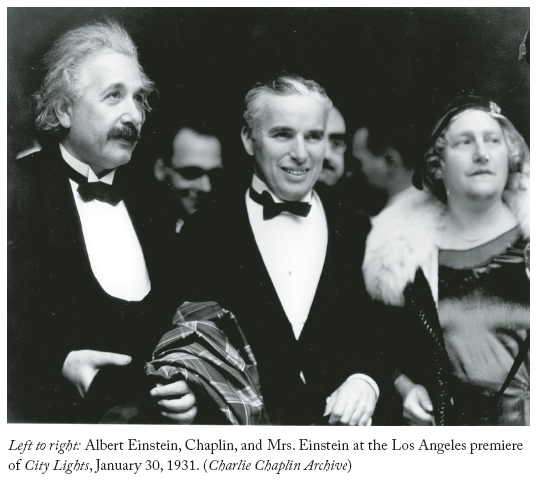
Professor Einstein and his wife dined at my house that evening and went to the theater afterward. I sat between them during the performance. Occasionally I glanced at the professor. What a simple man he is! To think that with his mind he could enjoy a movie with the enthusiasm of a child.
He would laugh and exclaim, “Ach, das ist wunderbar! Das ist schön!” I shall write of the professor, but in a later chapter.
My friends convinced me that I had a success and after the ordeal of that first night in Los Angeles, I made plans to leave the following evening for New York.
Upon my arrival there7 I invited the late Ralph Barton, the famous caricaturist and writer,8 to come as my guest to Europe. He confessed to me that he had been feeling depressed, and that recently he had attempted suicide. Poor Ralph! I remember I tried to appeal to his ego.
“Life could never defeat me,” I said. “Nothing matters, only physical pain. Our tragedies are only as big as we make them.”
Ralph was creatively exhausted. This, I think, preyed on his mind and was partly the cause for his later killing himself.
I tried to cheer him up. “All artists experience a lull in their work. It is a period of replenishing the soil—of plowing in and turning under our past experiences and watering them afresh with new ones. But later you’ll reap a creative harvest,” I laughed. “What you need is adventure, so come to Europe.”
He accepted my invitation, and we sailed for England on the Mauretania.
All journeys are long if you’re in a hurry, and I counted the hours. My entourage consisted of my friend Ralph Barton, Carl Robinson,9 my secretary, and Kono, “my man Friday,” as I call him. He is everything—nurse, valet, private secretary, and bodyguard. He is Japanese and jack-of-all-trades.
Ralph was feeling better. I was “selling” him England. He was pro-French some three years ago and during my divorce troubles, he would implore me to leave America and come and live with him in France. “America is not civilized,” he said. “Artists’ lives are too much exposed to the scrutiny of the puritanical. But in France it is different. They are more intelligent about such matters.”
Ralph had only recently returned from France, giving up his residence there because he felt he was too far away from his work.
He confessed he had never cared for England or the English. “They are a strange cold people, all bound up in archaic traditions and prehistoric customs. They are snobbish.”
But I remonstrated. “Snobbishness is the national fault of all countries. Republics are the same. Take America—for example, its social register and its exclusive clubs, busy excluding. Your occupations and your sports come under a snobbish category. If you can claim two generations of polo-playing in your family, your social position is usually unassailable.”
And so the time would pass, sitting up far into the night, discussing the pros and cons of everything.10
We were to land at Southampton, but I discovered Sir Malcolm Campbell11 was getting off there, and thinking that the celebrated should divide the celebrating, we decided to get off at Plymouth and leave Southampton to Sir Malcolm.
It is seven in the morning when we arrive, but there are friends to greet us. After the preliminary interview with the press, we are safely installed in a private carriage on our way to London. Several journalists are on the train, some wanting special interviews, but I have to decline. If I started that sort of thing, I should never have a moment to myself.
However, they are very considerate and let me take a few minutes’ nap. On awakening I find I am looking into three cameras. I have been snapped in every known position, both asleep and awake.
The English countryside looks sedate with its red brick houses and green fields, snugly hedged on all sides. There are new types of houses, similar to our small California bungalows. England has done a great deal of building since my last visit. Ralph is going into raptures over the beauty of the Devonshire countryside.
London at last! There is an enormous crowd at the station. As I get out I face a battery of fresh cameras. The police are trying to keep the crowds back. They are frenzied with excitement and I am enjoying it all. We are being carried along in the crush and they are all pushing and shoving. But I love it! It feels like an affectionate embrace.
I am looking into eager faces, eyes that dance with excitement, eyes that reveal the warmth of their affection. We are all caught up in the same emotions. It is their welcome as well as mine.
Why is it that London always wrings my heart? Is it the love of my people? They are my people, these Cockneys. I am one of them. As I look into their faces I see that spiritual hunger, that inner craving. Their emotions have made them inarticulate. They are only expressed by the eager clutching of my sleeve. How little must come into their lives! How appreciative they are for the trivial thing that I’ve done.
I turn to look at Ralph. There are tears in his eyes. Good heavens! If he starts that I’ll be doing it also. But I check myself. This would appear maudlin. So I smile, pressing a finger and clutching a hand as we are bundled into a waiting limousine.
There is a rousing cheer as we leave. “God bless you, Charlie!” and we’re on our way to the Carlton Hotel.

My companions are visibly affected. My own emotions are mixed. I have an intense feeling of joy and pity that leaves a vacuum under my ribs. I sit back in the car, telling myself that I am in London—telling myself that ten years have intervened since my last visit. But too much is going on within me to fully drink in the realization of it. Things all appear two-dimensional. My impressions are surfaces. I sit back, numbed with excitement.
Crowds are waiting at the hotel. Again I am stirred. People’s affection hurts me but it’s a beautiful pain.
The Carlton Hotel! How many times I have looked through its doors as a boy and wondered at its grandeur, never realizing that I should ever engage a suite of rooms there. As I enter its portals these inner thoughts flash quickly through my mind, yet on the surface I seem to take it all for granted.
We are shown into a spacious suite of rooms. Letters and invitations are waiting for us. That night we dine at Sir Philip Sassoon’s12 house in Park Lane.
Wealth is usually a handicap to initiative. Nevertheless Sir Philip is one of the rich young men who have made careers for themselves in the government. I’ve always admired him for his active part in public affairs and the efficient service he renders his country.
The next morning I am up with the lark and before breakfast, I take a long walk over to the West End and then taxi over to Kennington, my old home.
The morning is bright and promising. As I pass each familiar spot I get a thrill. Dear old London! It is still the same. Here it is eight o’clock in the morning and I find myself all emotional, weeping on street corners.
It is no self-pity. It is the beauty of realization. The past seems to stand revealed, smiling and friendly. Feelings and sensations recur like strange dreams.
As I stand in Kennington Park a woman is sitting on a bench, and a little child runs lambent about the grass before her.
I see myself playing like that little child. I was about five at the time. A woman is sitting on that very same bench. My mother.
I remember there was something hopeless about that day. I never understood the situation. I had been playing in the Children’s Gymnasium and decided to return and surprise her. As I approached quietly from behind, I became aware that she was softly weeping. I was so shocked that I ran to her side and wept also. It was hours before she could pacify me.
Soon after, we went to the poorhouse, and parks have always depressed me ever since.
I had left Ralph in bed and when I returned, he had almost finished breakfast. Delicious English sole, toast, and marmalade were his fare, but I wanted fresh herrings. I had yearned for these for the past ten years. So I ordered them rolled in flour and fried in butter.
After breakfast letters were segregated and those that needed answering personally I put aside. During my stay it was necessary to engage three extra secretaries for this work.
Ralph and I had been invited to lunch at Lady Astor’s.13 When we arrived, we were shown into a spacious Georgian room, sparsely furnished but in excellent taste.
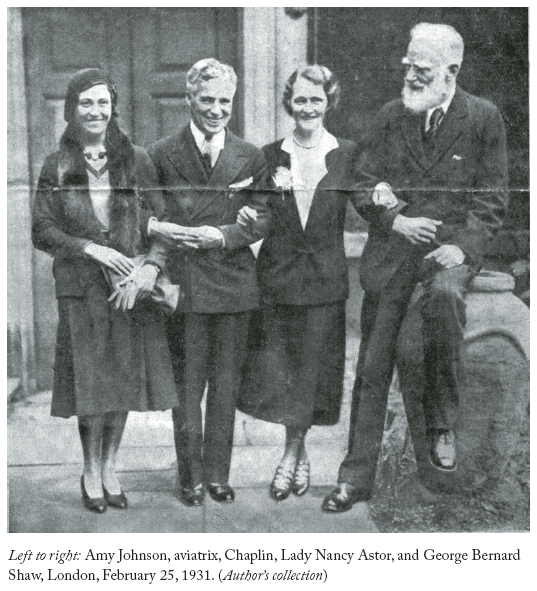
Lady Astor is a dynamic personality. The moment she enters the room the air is electrically charged. One feels immediately a generous, warm-hearted soul. Ralph and I are introduced to the guests.
It is quite a large gathering. There is one tall gentleman with a white beard standing at the left of the fireplace. Of course I recognize him at once. It is Bernard Shaw.14 I think I detect a slight shyness in his manner.
Lady Astor introduces me and I smile foolishly. “Oh yes, of course—Mr. Bernard Shaw,” and then a nervous little “ha ha.” I am so overwhelmed I am stumped for words.
Now Lady Astor has moved away, leaving Shaw and me alone. Everyone else in the room is talking except us.
I grin foolishly. If only I could think of something to say. We both keep changing from one foot to the other, but nothing seems to break the awful silence.
I’m about to remark on the weather. Thank God, Lady Astor comes up at that moment and announces luncheon.
During the meal she was most amusing. She has a gift for mimicry and gave us an imitation of a horsewoman of the Gay Nineties, going on and keeping the party in gales of laughter.
After lunch the ladies adjourned and the men drew their chairs together for a chat over the coffee. The general conversation was a little stilted and somehow couldn’t get started. As for myself, I was completely hopeless and made up my mind to relax and listen. But Mr. Shaw kept the ball rolling and told a few anecdotes. This, I thought, was gracious and revealed an amiable side of him.
During conversation I had an opportunity to study him at close range. I was surprised at the freshness of his complexion. His eyes still have the clear blue twinkle of a much younger man and are keen and intense when conversing. I tried to imagine his features without the beard. I have an impression that the chin is long and the lower lip full, with a kindly expression. Shaw does not give you the impression of a satirist. His voice is pontifical.
As I sat listening to him, my mind was forming judgment. I like him and admire his intellect, but perhaps that’s what disconcerts me. Wasn’t he quoted as saying that all art should be propaganda?
To me, such a premise would restrict art. I prefer to think the object of art is to intensify feeling, color, or sound—if object it has—for this gives a fuller range to the artist in expressing life, in spite of the moral aspect of it. I would like to broach him on the subject, but I know that in such a controversy his intellect would win out.
Later we adjourned to the garden, where Lady Astor, Amy Johnson,15 Mr. Shaw, and I had a picture taken.
“Turn this side, Mr. Shaw,” said one of the cameramen.
“I’ll do nothing of the kind,” he replied good-naturedly. “This is the only side you’ll get.”
I’m always the last to leave any house. After the guests had gone, Lady Astor, Ralph, and I sat around and talked things over. We got onto the subject of politics. We discussed the future prospects of the labor government, the crisis, and its causes. It was almost teatime before we left.
As we walked back to the Carlton, Ralph asked me what I thought of Shaw.
“He has wonderful charm, a great mind, and loves to play with ideas. But I don’t see him in the Mephistophelean role depicted by the press. To me he is a benign gentleman who uses his intellect as a defensive mechanism to hide his sentimentality.”
“Why do you think so?” Ralph inquired.
“His approach to art and his attachments to his friends partly disclose the fact. For example, those published letters to Frank Harris. In spite of their provoking frankness, they reveal a sentimental friendship.”
London fascinates me! I shall never get enough of it. I find myself traversing the same ground I did ten years ago, steeping myself in its romantic tradition.
There is the world of affluence. Hyde Park, Lancaster Gate, Regent Street, Grosvenor Square. Each of these districts has a soul, a character.
Grosvenor Square, with its dignified houses uniformly arrayed in a circle with their respectable Greek columns like sentinels, elegant and austere. To me it represents the elegance of the Victorian era, an epoch of England’s illustrious figures.
I can imagine four-in-hands with prancing thoroughbreds foaming at the mouth and proud flunkeys opening carriage doors, a Lord Palmerston or a Disraeli making a call. I see gentlemen of quality with black stock ties and fawn silk hats meticulously placed to bring out the elegance of their sideburns, and demure ladies with bustles and proud puffed sleeves and ivory-handled parasols, airing their poodle dogs in a morning stroll.
Then Parliament Street that leads up to Trafalgar Square. How many times I’ve walked along there and paused before that beautiful building, King Charles’s Banqueting Hall.
It was through the hall that Charles the First walked to his execution and came out through the corner window onto the scaffold built in front of it. That very window still exists, the very same stone masonry around which the scaffold was built.
I have the soul of a tourist, for I love to visit the spots where the deed took place. I try to get an empathy, a feeling into things. I imagine myself as Charles the First coming through that window to be beheaded—where he might have looked. Then as a spectator, placing myself in a position where the citizens must have stood that day.
Then again there’s the personal side. Lambeth, Kennington, Brook Street, West Square, and Westminster Bridge Road. How well I remember as a child the stores there.
The artificial limbs’ shop, the depressing wax foot that demonstrated a fallen arch, and the horrible colored lithographs of the human anatomy, exposing a labyrinth of nerves like the design of some coral undersea growth.
The shabby corset shop and the indecent wax bust of a female with an elaborate headdress, smiling inanely over her shoulder. Among the shabbiness of these stores, one touch of respectability—the blue-painted door front of the dentist with polished brass fittings and a small showcase at the entrance.
As a child I would gaze at that showcase with its savage-looking teeth. How alive they looked, yet impotent. It was a habit of mine to look in the mirror of the case and after all these years, it is still there but impoverished. There is only one set of teeth, and I can no longer see myself in the mirror. It is tarnished and blistered with age.
Lambeth, the land of concertina music! As I walk along the darkened streets, I hum to myself some of the old familiar tunes again:
Why did I leave my little back room in Bloomsbury,
Where I could live on a pound a week in luxury—
These old songs have their associations and a flood of memories surges through my mind. The streets are deserted and there is a slight mist. The houses are just visible in outline. Here in these humble quarters I walk along as though I were visiting some fairyland. Another song has come to me:
For old time’s sake, don’t let old enmity live,
For old time’s sake, say you’ll forget and forgive,
Life’s too short to struggle,
Heart are too precious to break,
Shake hands and let us be friends
For old time’s sake
How often I have heard this waltz refrain on a Saturday night played on concertinas by Cockney lads as they strolled by the house, the music gradually diminishing in the distance, dying off into the night.
Now I make my way to a fried fish shop and pause outside. I’d love to buy a pennyworth, but I haven’t the courage. One of the customers recognizes me, so I steal away in the darkness before they have a chance to follow.
I’d give anything if I could hear a concertina now. But that’s gone. As I pass a house, someone has turned on a radio and a solemn symphony comes forth. How paradoxical! This pretentious music coming from such humble quarters. It is going on eleven o’clock. I must go over to West Square.
West Square! At the back of the Bedlam Lunatic Asylum. This is as far back as I can remember as a child. It was there somewhere around the age of three, we lived in a large house.
It was there I almost died through swallowing a halfpenny. I had taken my money box to bed with me. My brother had been impressing me with conjuring tricks, pretending to swallow the coin and bringing it back through his nose. Of course I did it realistically with the awful consequences.
What a rumpus it caused! I have a vague memory of being held upside down, shaken, slapped, and probed and brought into the glaring light of the sitting room. Then for some reason everything subsided and I slept.
Soon after my accident I remember causing great hilarity in the household. I was playing on the floor and suddenly made a discovery that was the bone of my mother’s ankle.
Bones, like halfpennies, I associated with swallowing and when informed what it was, I exclaimed, “You must have swallowed a big one to have it stick out like that.”
As I walk around West Square, I come upon a stationer’s shop, where they sell toys, sweets, and tobacco. The store has an odor that awakens memories. It smells Christmasy. In the window I see a Noah’s ark with painted wooden animals. I can’t resist it. I go in and buy it just to get a whiff of the paint and the feel of the excelsior that” packed inside.
I have always wanted to see an English prison and to see it preferably of my own free will. Arrangements were made to visit the Old Bailey,16 which is the central criminal court of London, and Wandsworth Gaol, the prison where Oscar Wilde was confined for a while.
The Sheriff of London kindly consented to conduct us through Old Bailey and scheduled the program. We were to hear two cases, then lunch with the judges.
I was present at the conclusion of a case where a woman was being tried for throwing vitriol in the face of her paramour. There were extenuating circumstances in the prisoner’s favor. She had been ill treated by the man and was driven to desperation. Fortunately, the man escaped the vitriol and the victim himself would not prosecute. The point in question was whether or not the act was premeditated.
The judge in summing up said, “Vitriol-throwing is a horrible and cruel crime, but if the act was done on the impulse of the moment, I will be lenient. If premeditated, I will impose the extreme penalty of the law—ten years.”
It was for the jury to decide. The woman had a good character and every favorable fact was taken into consideration. The jury returned with a verdict of guilty, but recommended mercy as the act was not premeditated. She was given six months with hard labor. This, I thought, was a very fair and just trial. The case took no longer than twenty minutes. Afterward we adjourned for lunch.
We sat down to a T-shaped table, about twenty in all, the sheriff presiding with the dignitaries of the law on either side of him. It is a tradition that the sheriff of London pays the cost of the luncheon daily out of his own pocket.
The scene has a look of the theatrical. It could be the Green Room of the Drury Lane Theater. The judges now are a little less dignified than before, having removed their wigs and gowns. The only remnant left of their legal splendor is the Samuel Johnson neckwear known, I believe, as cleats.
For dessert we were served the traditional red apple and currant cake. The sheriff made a speech and several of the judges also. I got up and responded as well as I could.
From there we were conducted to Wandsworth Gaol, where we were shown through the departments by the prison governor. England still has the system of enforced silence among her prisoners. I cannot understand why this is continued. To deprive a man of that most civilizing factor in human society—speech—seems to me unscientific.
We were finally shown the condemned cell and execution room. I noticed chalk marks left upon the trap doors, evidently where the last unfortunate man had stood. The lighting was weird and dramatic. It came from a high small window and threw us into silhouette. Not like the American sentimental method of cutting strings to release the trap, the English frankly pull a lever, which is done by the legal executioner. It was very depressing, but thank heaven nobody was awaiting execution.
We ended our visit by having tea with the governor and his wife, who were very charming and cordial to us.
Alistair MacDonald, whom I met in California, had kindly invited me to meet his father, the Right Honorable Ramsay MacDonald,17 the British Prime Minister, at his official country house, Chequers,18 situated among the glorious hills of Buckinghamshire, the battlefields of Oliver Cromwell.
Upon arriving with his son, Alistair, we were met by the Prime Minister and his daughter Ishbel, who were taking a quiet stroll. I was given a cordial welcome and we left the car and joined them in their walk.
The Prime Minister has a handsome face with the eyes of a dreamer, and speaks with a slight Scotch accent. He loves to walk and he took me for a climb to the top of a hill, where we got a view of the magnificent scenery of Buckinghamshire, but the bitter cold winds soon drove us into the house, where tea was served in the main hall and I was shown Cromwellian relics.
Eventually we got comfortably settled around a warm fire. Now is an opportunity, I thought, to discuss a little politics. The conversation had veered around to my visit to England.
“Do you know,” I said, “I find a great difference in England since I was here ten years ago? Then there were gray-haired old ladies sleeping on the Thames embankment and shops looked poorly stocked and the children poorly clad.
“But today there is a difference. Those old ladies have gone, the shops look well stocked, and the children well clad. And,” I continued, “they can say what they like about the dole, but I think it’s been the saving grace of England. It has kept the wheels of industry going and money in circulation is necessary, no matter where it comes from.”
But the Prime Minister would have none of it. He just nodded with an “Is that so?” expression. To draw him into politics was quite hopeless.
That evening Princess Bibesco19 was a guest for dinner. The affair was delightful. The Prime Minister was in excellent form and told many anecdotes.
I was shown through the kitchen and had a long visit with the house staff. I made a special hit with the cook. She was from Manchester and had heard that I’d lived there. Since she had met me, she said, I was to be given a place of honor over the mantelpiece in her sitting room.
“There are my favorites,” she said, pointing to a mirror upon which were stuck printed news pictures of all the royal family. “Of course I can’t put you with them, but I’ll place you at the side.”
“I don’t care where you put me so long as it’s at your left side,” I said coyly.
Alistair MacDonald and I left for London after dinner. We were met outside by the press and as usual I was bombarded with all sorts of questions. But I have a technique now for such interviews. I usually answer in monosyllables and to foolish questions just smile.
And so the interview went something like this:
““Did you find the Prime Minister interesting?””
“Yes.”
“Did you discuss politics?”
“No.”
“Did you do your funny walk for him?”
Smile.
“Are you going to put it in a funny picture?”
Another smile.
And so I would “yes” and “no” and smile my way through the interview.
Monday morning was devoted to shopping. There is nothing more delightful than doing this in London.
I made several purchases, including some gaudy pajamas and dressing gowns. I think my appetite for these dates back to the time I was a small boy. How longingly I would look at the beautiful garments in the Burlington Arcade. I would often declare that if I ever got rich, I would buy out a whole stock of them.
Afterward we lunched at Quaglino’s20 with Randolph Churchill21 and several friends, among whom was Lord Birkenhead,22 the son of the famous statesman. At that time he was writing a biography of his father. This was quite a task, I thought, and wondered if a son, in doing such a biography, could sufficiently detach himself from the subject so as to see the deep shadows as well as the highlights that are necessary to a true portrait of a great man.
After luncheon I got away early. I had a desire to visit Tower Bridge. I had had recurring dreams of walking over it and the scenery was so vivid and always the same. Now I wanted to find out whether the background of my dreams was a reality or not.
Ralph thinks I am crazy, but I insist. I am tired of seeing London through taxis and motorcars, so I mount the top of a bus. Of course in the mad scurry up the steps, I slip and tear my trousers. This little accident caused me to be recognized by everyone inside the bus who immediately crowded outside. It was no use. I had to set off after signing several postcards and pocketbooks.
However, I hail another one. Ralph remonstrates, but I am insistent. This time I catch a running one, hoping to elude the crowd, but they follow and pile in after us. Ralph, who is extremely nervous and loathes crowds, is beside himself.
“Look here, Charlie, you’re going to create a riot.”
I eventually relent and hail a taxi, and to my disappointment discover that Tower Bridge is nothing like my dreams. I shall never again trust the authenticity of locales in the realms of Morpheus.
The following day I had luncheon at the House of Commons with Sir Philip Sassoon and later took tea with Lloyd George23 in his private chambers there. I was immediately struck by the charm and easy manner of this great statesman.
He has that faculty of putting you instantly at your ease. I found myself discussing all sorts of projects and enterprises for the relief of the unemployed. He was very patient and even assumed an air of enthusiasm when I suggested rebuilding the southwest side of London and turning it into a modern business center, doing away with the slum district.
“London is too narrow and the streets are too congested,” I said. “The advent of the automobile has made them inadequate for rapid transportation and is a handicap to British commerce.”
In spite of his interest I could not help noticing a stifled yawn and then I saw Sir Philip look at his watch. So I suggested I would not take up any more of his time with my nonsense.
“Not at all,” he said kindly. “I understand you are dining with Lady Astor next Wednesday here at the House of Commons, and I have been invited, so we shall have the pleasure of continuing our conversation.”
And with that we shook hands and I took my departure.
Lady Astor’s dinner was a glorious affair. She had arranged for a representative of each political party to be present that evening and they all met on neutral ground.
There were conservative, liberal, and labor members—even communists—all sitting at the same table, about twenty in number. Lloyd George sat on Lady Astor’s right and I on her left. Facing “L.G.,” as everyone calls him, sat Kirkwood,24 the communist, a brawny Scotsman whom Lloyd George had put in prison during the war. And now they were dining together. After dinner we all made speeches, the subject being what we would do if we had the power of a Mussolini to help England in her present crisis. I was the first to speak. For some unknown reason I wasn’t nervous. Fools shout where angels fear to whisper, and so I started.
“The first thing I would do is reduce the government. The world is suffering from too much government and the expense of it. I would have government ownership of banks and revise many of their laws and those of the Stock Exchange. I would create a government Bureau of Economics, which would control prices, interests, and profits.
“I would endeavor to bring about an amalgamation of England’s colonies into an economic unity. I would issue scrip to alleviate the expense of the budget, to use internally for those commodities which England can produce, such as the purchasing of coal, the payments of rents, and so on, the scrip to cease as soon as economic order could be arranged.
“My policy would stand for internationalism, world cooperation of trade, the abolition of the gold standard, and world inflation of money.
“The limited amount of gold is not sufficient to serve an increasing population as a medium of exchange, especially with the rapidly decreasing man power in labor. Gold scales are too small. They have ceased to weigh man’s output. Larger ones are necessary. Gold, as a medium of exchange, is as inefficient as trying to deliver a ton of coal in a child’s toy cart. The coal may eventually be delivered piece by piece, but in the meantime the household is freezing to death. Enlarge those scales to silver ones or something else. Broaden your trucks and let’s make adequate deliveries, for there’s plenty of coal and plenty of fire grates to consume it.
“I would endeavor to raise the standard of living, preferably internationally, otherwise throughout the British Domain.
“My policy would stand for the reduction of the hours of labor and for a minimum wage of no less than a comfortable amount to all men and women over the age of twenty-one. I would stand for private enterprise so far as it would not deter the progress or well-being of the majority.”
The speech was taken good-naturedly and many edifying and serious ones followed, although some were pessimistic, one saying he didn’t think anything could be done unless it was the discovery of more gold or the creation of new enterprises which would stimulate industry.
Lloyd George, in summing up, took the facts of everyone’s speech in consideration and examined them, agreeing in part with many. He was, however, adamant in his principles of free trade.
That evening Lloyd George showed evidence of his power of leadership. He was an interested listener, sympathetic and encouraging, imparting constructive criticism with discretion, with a force and conviction native to his genius.
Ralph and I would occasionally ramble over London at midnight. We would poke around the back of Fleet Street into the land of Samuel Johnson. One can step into the fifteenth and sixteenth centuries there.
One night we were passing through Trafalgar Square, where several derelicts were standing around. I was recognized. “Good old Charlie!” and one of them approached and was about to make a touch.
But another shouted, “Hey, leave him alone! Don’t you know who that is?”
The deference shown me was pathetic and complimentary. I wasn’t a touch—I was a friend, and I was deeply moved by it. The Cockneys are wonderful people.
Another compliment was from a respectable old gentleman, well clad and muffled up, who was walking briskly down Pall Mall on a winter’s day. Upon recognizing me, he stepped aside and politely doffed his hat.
The gesture was so simple. There was no familiarity, no handshakes. It was the beaming look on his face and the simple raising of his hat that stirred me so.
Today I am going to visit the workhouse school,25 where I spent two years as a child—from the age of five to seven. More than anything else this school has been the object of my visit to Europe. I suppose I spent the unhappiest time of my life there. To me it was a prison and a house of shame. We had gone through extreme poverty, and poverty was a crime. Even at the early age of seven I realized this.
And now I am to turn back the years and look into the past. I am almost afraid to tell the driver where to go. The name of the school is my only source of information. I haven’t the faintest idea as to the direction. The chauffeur looks puzzled when I inquire. The suspense is awful.
“Let me see—that must be Highgate way.”
Thank heavens he is at least cognizant of its existence. Throughout the journey I am trying to recognize the familiar spots. I only know in my childhood the school seemed far out in the country, but now everything is built up. We stop at a crossroad and the chauffeur inquires from a policeman:
“Which is the way to S—?”
“That must be the booby hutch,” says the constable.
The chauffeur turns to me. “Is it the booby hutch you want?”
“The booby hutch? What’s the booby hutch?” I answer weakly.
“The madhouse—where they’re a little—you know,” said the policeman pointing to the top of his helmet. My spirits are getting lower.
“Oh, no,” I said, “this is a school for children—an orphanage.”
“Oh, the orphanage,” said the officer. “That’s about two miles from here, then turn to the left.”
Once again I’m relieved, yet we pass nothing but buildings. As we turn to the left, however, there are vacant lots and fields ahead of us. My spirit rises. We now turn into a lane and come suddenly upon a building with Roman pillars, the first recognition of my infant days. I am so thrilled and excited I can hardly wait to get out of the car.
We have no letters or permits. We have come purely on speculation as to whether we shall get in or not. Upon inquiry, we are shown into a room and meet the head of the school.
“Oh, yes, we were expecting you in a way,” he said. :There was a rumor you were coming. As a matter of fact,” he went on, “I have been looking up some old files and discovered the record of your entry and discharge dated 1896. It read, ‘Sydney Chaplin handed back to mother March 10, 1896. Charles, ditto.’”

Ralph and I giggled. “There, you see? You’re just a ‘ditto,’” Ralph commented.
The head official is very courteous. Would we like a cup of tea before going around? But I am too anxious to see the interior of the school. I can’t wait for anything, so I politely decline. He has told off an attendant to show us around and we start on our way.
There is the yard, just as it was when I was a child. Contrary to some ideas about objects or locations appearing smaller after one grows up, it looks just as big as it ever did. There are the tailor’s shop, the school steps; the punishment room; the blacking hole where we would shine our boots on a frosty morning; the dormitories and the depressing slate wash sinks.
I went in and up the stairs that used to seem so close to me as I climbed them, the walls pressing in on me, the tread of the stairs so near my face. It was the same now. These stairs, enclosed, steep, narrow, pressed in on me just as they had then. I felt those walls. I felt the steepness of the steps. I felt myself going up them with the same sensation of oppression and confinement that I had then.
Yes, it was all there, and the children were all there. The same types, only more smiling and happier. I went into the dining room—a large hall—and there was my place, the third seat at the fourth table. I wonder who occupies it now!
How well I remember one Christmas Day sitting on that same seat, weeping copious tears. The day before I had committed some breach of the rules. As we came into the dining room for Christmas dinner, we were to be given two oranges and a bag of sweets.
I remember how excited I was awaiting my turn. How joyous and bright the oranges looked in contrast to the gray surroundings. We never saw oranges but once a year and that was at Christmas.
I am speculating what I shall do with mine. I shall save the peel and the sweets I shall eat one a day. Each child is presented with his treasure as he enters the dining-room. At last it is my turn. But the man puts me aside.
“Oh, no—you’ll go without for what you did yesterday.”
And there, on that seat at the fourth table, I wept bitterly. The children were more humane than the attendants were and so the little ones at our table contributed one candy apiece and made up my loss.
As I stand in the dining room there are hundreds of smiling faces looking up at me. The children seem happy and light-hearted—so different from the days when I was there.
Then the attendant, as though reading my mind, remarks, “The school has a different policy since the days when you were here, sir. Then it was very military with strict discipline, but today the children have more freedom and get better treatment.”
And it’s quite obvious, for the children are smiling and playing around in front of the head master without any restraint. It is apparent that he is adored by them all.
He calls them to attention and makes an announcement: “Children, you’re to be presented with a motion picture machine. We are to have a gala night with motion pictures, and sweets and oranges will be served.”