
I am looking forward to a visit with my friend, the Right Honorable Winston Churchill. Ralph and I are invited to his beautiful country residence in Westerham, Kent. The first time I met Mr. Churchill was in California while he was lecturing there.
I was charmed by his direct, unassuming manner. He has a slight lisp when he talks and a stoop in his carriage like Napoleon. You feel immediately a dynamic force—a man with a thirst for accomplishment. He is a wonderful talker and will rattle off brilliant epigrams. Besides being a statesman, he is a great writer and an excellent painter.
He told me he had read that I was considering making a picture of the life of Napoleon. “You must do it,” he said. “Apart from the drama, think of its possibilities for humor. Napoleon in his bathtub arguing with his imperious brother, who’s all dressed up, bedecked in gold braid, and using this opportunity to place Napoleon in a position of inferiority.
“But Napoleon, in his rage, deliberately splashes the water over his brother’s fine uniform and he has to exit ignominiously from him. This is not alone clever psychology,” said Mr. Churchill. “It is action and fun.”
When Ralph and I arrived at his home in Westerham, it was quite dark. We motored down and took our dress clothes with us. It was a bitter cold evening and I was thankful for the nice warm bath that awaited me.
I changed in Mr. Churchill’s bedroom. Desks were piled with papers and stacks of books were everywhere. I noticed hurriedly a set of Plutarch’s Lives and many volumes on Napoleon.
At dinner there were several young Members of Parliament present who added much to a dialectic evening. Mr. Churchill loves to talk shop. He loves his profession. During dinner he humorously heckled and harangued some of the young Members and much wit sallied forth.

Someone referred to Gandhi as being a menace to the peace of the Far East.
I ventured a remark—that Gandhis or Lenins do not start revolutions. They are forced up by the masses and usually voice the want of a people.
Mr. Churchill laughed. “You should go into Parliament.”
“No, sir,” I replied. “I prefer to be a motion picture actor these days. However, I believe we should go with evolution to avoid revolution, and there’s every evidence that the world needs a drastic change.”
Nevertheless we were one and for progressive government. Mr. Churchill said much has to be done to preserve civilization and guide it safely back to normal.
One of his hobbies is laying bricks. He has built several beautiful walls around his estate. In his dining room I noticed several paintings—still lifes and landscapes—signed “Churchill.” Ralph Barton and I had an opportunity to examine them. Ralph, who was an expert on these things, said they were masterful.
He is surrounded by a charming family. His wife and children are a source of inspiration and delight to him. He is a real family man and a sincere patriot, and, I might say, a healthy reactionist in the House of Commons, which is most necessary today.
Tomorrow is the opening of my picture. It is arranged that I should dress at the theater so as to avoid the crowds. I am to have a meal in the dressing room. All this is irritating. To think I can’t dine somewhere like an ordinary normal person.
About five o’clock Ralph and I left for the theater and dined quietly in the dressing room, and waited for the opening, which was to take place at nine o’clock.1
Dear old London! True to tradition it always rains at the wrong moment, and a regular cloudburst happened around eight. This did not dampen the spirits of the people, however. They were out in thousands. I would occasionally go to the window of the theater and wave to them. But whatever I did, I could never compensate them for their devotion and good will.
The evening went off with a bang. Mr. Gillespie, the impresario, and the man who was to exploit my picture in London did exceedingly well and produced it in excellent style.
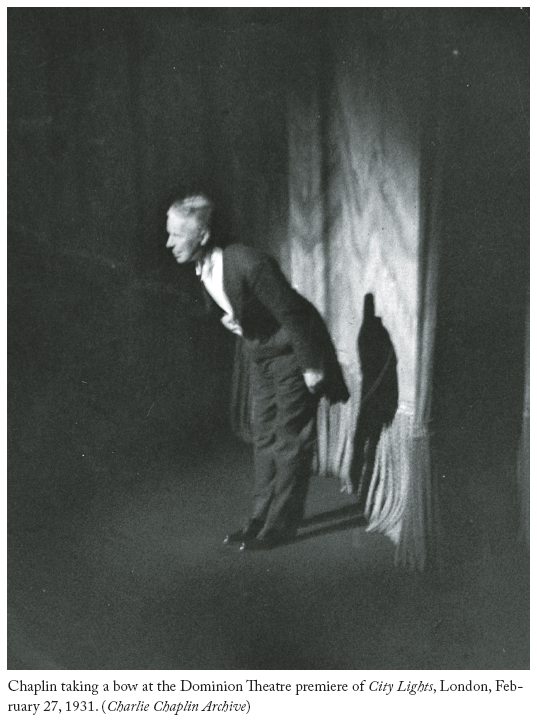
I sat next to Bernard Shaw throughout the performance. I was anxious to hear what he had to say about it. He made several favorable comments.
I was called upon to make a speech, but I was so thrilled and excited that nothing seemed to come out. However, the audience was most appreciative.

I had arranged a party afterward at the Carlton Hotel, inviting everyone I knew—about two hundred people in number.
The Right Honorable Winston Churchill made a speech and started as follows: “My lords, ladies and gentlemen—” and ended by paying me a charming tribute.
In responding, I took the cue from Mr. Churchill and began: “My lords, ladies and gentlemen—” Then realizing the eminence of the occasion, it behooved me to become more grandiloquent and I continued, “—my friend, the late Chancellor of the Exchequer—”
Then I heard the voice of Mr. Churchill boom forth, “I like that—‘the late, the late,’” he repeated laughingly.
“Pardon me,” I said nervously, “I mean the Ex—the Ex-Chancellor of the Exchequer—”
After this I was gone. However, I started again. “My friend, Mr. Winston Churchill—.”2
This caused more merriment, and so the speech went on. Later there was entertainment and dancing.
Incidentally, I meet a lady with whom I dance the tango several times,3 but my secretary is a little concerned.
“Let up awhile,” he whispers, “and dance with someone else or the press will have you reported engaged.”
But tonight they can say what they like. I’m going to be myself and enjoy the evening.
And so we went on into the morning until five o’clock, at which time I got to bed.
The following day, we were busy scrutinizing the papers for the reviews of the picture. Nearly all were enthusiastic, but it was obvious that a certain section of the press was deliberately otherwise. However, these adverse criticisms had little effect on me. I had made up my mind to enjoy my holiday.
My friend Ralph Barton is leaving tomorrow for America.4 His behavior has been strange lately. A few days ago he told me that he hated the ticking of clocks and if he got the chance, would stop them. Strangely enough, I found the clock in our room, which was electrically wired, had been cut. Ralph confessed he had done it because it got on his nerves. I never placed much importance on his action at the time, but since his death, I realize its psychological significance.
All the next day was spent preparing for his departure. He was feeling much better and was anxious to get back to work. This was the last I heard from him.
Although he promised to write, never a word came and about two months later, during my stay in the south of France, I read of his suicide.
Poor Ralph! It was an awful shock to me. He had such a quiet pensive manner I little realized he was capable of such violence. He was one of the most charming cultured men I have ever known and in the circle of my few intimate friends, he has left a vacuum.
I have been besieged by all sorts of invitations and requests, and letters are piling up. I must change my location, otherwise my social affairs will become complicated. One cannot find time to see all one’s friends, and I cannot make too many plans ahead. So there is only one thing left. If I do not wish to offend them, I must pack up and leave. I suddenly make up my mind to visit Germany.
We have arrived in Holland and I am journeying on my way to Berlin. Holland has a distinct character different from any other country, with its canals and windmills and stubby trees, all uniformly pruned with their branches turned upward.
At various stations there are for sale wooden Dutch shoes filled with chocolates and prettily tied with blue ribbons. These I purchase to send to friends.
The Dutch countryside is neat and tidy. Nothing looks out of place. And what a tremendous number of cyclists along the road! Bicycles are everywhere.
The Dutch press board the train en route. They are very courteous and most of them speak English so I have no difficulty in giving an interview.
One informs me there is a bridge in Rotterdam in construction that will have a statue of myself placed on it. My comment is somewhat banal. “Oh, really? How wonderful!” I exclaim, endeavoring to cover up my excitement, but at the next station I have to get out and walk.
My manager came up to me all excited and impressively exclaimed, “Do you know they’re building a statue of you on one of the bridges in Rotterdam?”
“So I understand,” I remarked lightly. Then assuming an air of equanimity, I continued to walk up and down the platform. However, I darted into the telegraph office and wired my brother the news.
On my first visit to Berlin in 1921 I was little known, as very few of my pictures had been shown there during the war.5
But this time it is different. I had been told that in Germany I had become a favorite and that I must expect quite a reception. I can assure you I’m not disappointed. Thousands cover the station and throngs are outside. I hear in English such phrases as “Gold Rush Charlie! . . . Circus Charlie!” Everybody is excited. Pressmen and officials are all mixed up and swept aside by the multitudes.
Throngs were along the roads. That, I think, was the most exciting reception of all—even greater than London.
At the Hotel Adlon6 we are met by more crowds, so I am shot up into the elevator and into my room, where I immediately go out onto the balcony and wave to them below. There is a “Hoorah!” in response and I leave the window. Eventually we are left to ourselves for a refreshing cup of coffee.

Again there are letters and invitations from friends, one from the British Embassy. I am to have dinner with the Right Honorable Sir Horace Rumbold,7 the British ambassador and his family, and go to the opera afterward.
Then there is my friend von Vollmueller,8 poet and author of Max Reinhardt’s great production, The Miracle. He has arranged a Bohemian party for me at his flat.
I have engaged Countess York as my secretary. She is most interesting, being a modern young German who knows her Berlin thoroughly.
That evening we visited a rathskeller, a place of amusement, where we saw Garro,9 a popular favorite of Berlin. He is a comedian of the slapstick type—very unctuous and full of rough and tumble, and an artist.
During the performance he heard that I was in front and so made an announcement. I was brought onto the stage. He said something in German. Suddenly he turned and embraced me, and before I knew it, I was kissed. Then he waxed eloquent. I heard “circus” and “gold rush” mentioned.
Then he mimicked some gesture of mine and the audience went into gales of laughter. Then again he became dramatic, punctuating his remarks with effective pauses and with modulated voice. Tears came to his eyes. Then with a dramatic gesture, he pointed to me. The house went into rounds of applause. Then with rapid transition he spoke an aside and again embraced me with a kiss, which brought another roar of laughter. We then left the stage amidst tremendous applause.
I haven’t the faintest idea what he said. I only know that he played upon the emotions of the audience at will.
The program for the following day was to take tea with the officials of the government and afterward to visit the prisons and police museum.10 For dinner I was to be the guest of von Vollmueller.
In the afternoon I had tea with several members of the Reichstag. They were all worried about the economic future of Germany.
“It is impossible to go on for another year,” they said. Every member seemed pessimistic of the future.
“What would actually happen if you did not go on?” I inquired.
“Bankruptcy,” was the answer.
Government officials and men in civil service would not be paid. There would be a general disintegration of all the government departments. In other words, it would mean anarchy and Bolshevism. Their plight seemed pretty awful and their future dark.
“Even if we get through this year,” they said, “we shall have trouble. Just think of the conditions of our universities. We have young men graduating in qualified professions and passing their examinations, only to leave college and stand in the bread line with the rest of the unemployed. These things are bound to create trouble and it does not look as though conditions will improve.”
When I returned to the hotel, von Vollmueller had left a note saying dinner would be early on account of going to the theater. Later there was to be a supper at his flat with a few friends.
The entertainment was a musical comedy and the production and cast were excellent, as well as the music. I should say that the German theater excels above all others in Europe for ensemble and stagecraft.
I saw a production of Liliom in the Workmen’s Theater. This is a wonderful institution built by the workmen and supported by them. It is reputed they produce the best plays in Berlin. I know the one I saw was magnificently put on.
They have a revolving stage and scenes are produced by magic lantern slides thrown on a blank background. Such a method facilitates rapid change of scenery and wonderful effects are achieved. The admission is all one price. No seats can be reserved. They are obtained by lottery.
After the entertainment we finished at von Vollmueller’s apartment for supper.
There were several interesting people there, Friedrich Hollander,11 the composer of “Falling in Love Again” and other melodies, who gave us a few little sketches at the piano. Also a beautiful German girl, “G,”12 a well-known dancer; and as the evening progressed, we each performed. “G” danced beautifully for us, I gave an imitation of a bullfight, and several others contributed to a charming Bohemian night.
Tomorrow we are to visit Potsdam.13 Prince Henry of Prussia, nephew of the Kaiser, is to conduct us over the palace. Sir Philip Sassoon has arrived in Berlin for a couple of days and is coming with us.
We lunch at Potsdam. The town seems deserted and there is little left of the brilliancy of bygone days. The exterior of the palace would be beautiful but for the ridiculous figures that stand upon the edge of the roof. They are for all the world like balancing acrobats.
The approach is beautiful, but I find that all palaces are alike. They all have that same candy-colored interior, one baroque room after another. Before we were halfway through, I was exhausted and depressed. As far as comfort is concerned, it is nil. One room was especially awful, done in shells, and gave me the feeling of the interior of an oyster bar or the entrance to some Coney Island concession. Every known shell in the world was supposed to be in it. I never saw such a conglomerate mass of barnacles. It looked like the bottom of a pier painted for a carnival. However, the gardens were lovely. Here the pretentiousness of man cannot offend.
On our return we had tea with Marlene Dietrich. She was in Berlin at the time, enjoying a well-earned rest.
I heard much of the Berlin nightlife and thought it would be interesting to do the rounds. There are all sorts of wild rumors as to what goes on in these cafés; men dressed as women and women as men. So we arranged to go to a certain café where we would see things unprintable.
I must say I was very disappointed. It was a most feeble entertainment and very self-conscious of its naughtiness. As we entered, the band struck up and two effeminate youths danced together. This was the big noise of the evening, the something unspeakable we were privileged to see. Each time fresh customers would enter, the same youths would hurry to their feet again.
We were too horrified to enjoy this form of vice for long, so hurriedly drank our ginger ale and fled out into the night and as Oscar Wilde said, “down the long and silent street, the dawn with silver sandaled feet, crept like a frightened girl.”
Professor Einstein telephoned this morning. He has returned from Hollywood and I am invited for tea. He has given me instructions how to reach his flat, but the directions go askew and I have difficulty in finding the street. We pull up the car and inquire the way from a passer-by. No one seems to know the street or the number. At last I have an idea.
“Could you tell me where Professor Einstein lives?”
“Ach, ja,” and I am immediately given the directions.
I could not imagine the kind of surroundings that Professor Einstein would live in, for his personality does not fit into any background. He seems detached from everything.
It is a small modest flat, the comfortable home of any workingman. The sitting room I recognize from pictures I have seen in magazines.
I will try and give you an impression of this great man. The eyes have a look as though they see clearly the simplicity of all things. The brow wears no furrows. One feels that all the superficial entanglements of thought that obscure our vision have been swept aside by him, and that he sees only the fundamentals. His voice in conversation seems like inspired whispers. There’s a warmth in his personality.
I remember in Los Angeles when he came to my house I was nervous and concerned and prepared to be awed, but the moment he entered, I was put at my ease. I felt immediately someone human and kindly. His simplicity is disarming. You forget the professor, the illustrious man of science. You welcome a congenial friend, a man with a twinkle in his eye and a sense of humor, and a quiet, subtle one at that.
After dinner I arranged an entertainment—some little Japanese children to dance for him. One of them presented her autograph book for me to sign, and I drew a comic sketch of my big shoes. Then the little girl whispered, “Will the professor sign it?”
He smiled and took the autograph book, and with a chuckle drew one of his famous geometric equations.
“But yours is more interesting,” he said humorously, comparing the two sketches.
“More comprehensible to the little girl perhaps,” I laughed, “and to me and many others.”
Arriving at his flat I was introduced to his family. He has a son and daughter, the latter a very good sculptress, and I was shown some specimens of her work. But one doesn’t dare admire anything in Einstein’s house.
“That is beautiful,” I commented, pointing to one of her pieces.
“Do you want it? You may have it.”
And I have to vigorously decline. I see I must have more restraint in my admiration.
We sat down to delicious home-baked tarts made by Mrs. Einstein. During the course of conversation, his son remarked on the psychology of the popularity of Einstein and myself.
“You are popular,” he said, “because you are understood by the masses. On the other hand, the professor’s popularity with the masses is because he is not understood.”
Mrs. Einstein told many anecdotes about the professor and gave interesting sidelights on his character. When he is not working, he is extremely lazy and indulges himself puttering around in his sailboat, which is his hobby.
One interesting story went back a few years. He had been working assiduously for several days alone in his study. One morning he came into the drawing room and sat down at the piano, running his fingers nervously over the keys. Suddenly he turned to his wife.
“Do you know, I’ve got a wonderful idea!” he said with all the enthusiasm of a novelist who has discovered the plot of his next book.
He then got up and returned to his study whence he emerged two days later with papers and data that shook the world of science with his theory of relativity.
All conversation eventually converges to that one topic—the world’s crisis.
“These are dangerous times,” he said, “with depression and growing unemployment.
“But most of the wise men,” I remarked, “when discussing the depression, will invariably answer that it all happened before and that history is only repeating itself.
“Only the other day I was speaking to a prominent business man who said England never thought she could pay her national debt after the Battle of Waterloo because of the lack of trade. But steam came along and started new industries. Then electricity developed and put men back to work. Depressions come periodically he insisted, but new enterprises crop up like the automobile industry or radio and solve the problem.”
Professor Einstein listened attentively and I was encouraged to hold forth.
“History today is not repeating itself,” I said. “The recovery of past economic depressions may have been due to inventions and new enterprises, but since those days the necessity of man power has been rapidly decreasing because of modern machinery, and whatever new enterprises crop up in the future, they will not require the man power that was necessary in the past. Therefore as man’s only means of consuming what machinery produces is by work, our problem becomes a different one.”
“Whatever the problem may be,” said the professor, “a change of some kind is necessary to keep men from starving.”
“The business world,” I continued, “has acquiesced and welcomed the fundamental industrial change from man power to machine power, which has cheapened the cost of all our commodities. But it stands resolute against any fundamental change in the capitalistic system that might cheapen money and facilitate the means of buying those cheap goods.
“They insist on maintaining the gold standard, at the same time doing business with credit, using both as a medium of exchange. They use credit for business expansion to improve values, only to knock them down again by restricting credit and reducing values to the gold standard.
“These two mediums of exchange—credit and gold—will never stabilize prices, for credit is more elastic than gold. Therefore, the value of all our enterprises built up by credit will always be at the mercy of the gold standard, which can reduce those values at will.”
Professor Einstein smiled.
“You’re not a comedian,” he said. “You’re an economist. However, how could you cure all this?”
“Three things,” I said. “Reduce the hours of labor, print more money, and control prices.”
“I’m not especially interested in the business mathematics of it,” he said smilingly, “but I think that every man living should be clothed and fed, with a roof over his head, for there is enough for all.”
Before leaving, we exchanged photographs. One had been taken of the professor and myself in California that he signed as follows: “To Charlie, the Economist.”14
I autographed one in return and for the life of me, I couldn’t think what to say. The professor came to my rescue.
“Why not ‘Et tu, Brute’?” he smiled.
“Modesty forbids,” I said jokingly and signed it as he suggested. “To Professor Einstein—‘Et tu, Brute.’”
It was my last and wonderful evening in Berlin, for tomorrow I was to leave for Vienna.15 When I returned that evening to the hotel, Sir Philip Sassoon was waiting for me.
“G” was to dine with us, so I quickly scrambled into evening clothes. We had dinner at the Adlon and danced to the strains of a tango.
“G” is very lovely. When I first saw her dance, I was struck by her extraordinary charm, the rhythmic motion of her body, and her volatile expression. She knew I appreciated the nuances and subtleties of her dance.
That evening after Sir Philip left, “G” and I sat and talked. I attempted to define the quality of her art.
“In your dance you seem to express an exotic loneliness—to be in pursuit of some strange beauty. This quality is part of your real personality.”
“G” took my hand. Hesitating to find words, she replied, “Charlie, I love you—you’re so appreciative. Although we may never see each other again, I will not regret it, for we have met in our pilgrimage. It is good to know that you are in life, and a living part of it.”
That was “G”—that was her philosophy.
The following day I saw Sir Philip off to England and at midday we departed for Vienna.
I arrived to another big demonstration. Each crowd seems to get bigger and more demonstrative, God bless them! This time I am carried shoulder high out of the railroad station. It is impossible to retain one’s personality in this fashion. One looks foolish and concerned.
As we progress, I am thrown more out of balance, but am eventually dumped into a touring car, with my secretary and Kono being pushed in after me. And so we sally forth, waving and honking our way out of the crowds.
Vienna is sad. One feels the spirit of gayety has left it. It is a city of yesterdays. As we pass through the wide avenues and broad cobblestone streets, I count many café bars as they are called. People buy their cup of coffee and sit for hours in these places, doing their correspondence and negotiating their business. It is an address for many people—where one can meet.
Upon arriving at the hotel, I am ushered into a palatial apartment. It is the royal suite. The rooms are large and lofty, painted white and decorated in rococo style. It is extremely impressive, but you get tired of it after a few days.
I attempt to go shopping. I do not take my entourage with me. When my secretary and Kono are along, they seem to do something to attract attention. They march each side of me as though I were under arrest. So I decide to go alone.
I meander through the city. Were I addicted to cacoethes scribendi I should go into pages of rhetorical rapture extolling the beauties of Vienna. Therefore, I shall spare you all too suffering readers any conscious pleonasms on my part.
I find myself on a bridge over the Danube River. I can understand the charm of Vienna. It must have been wonderful before the war. I seem to be walking along an endless avenue with shops and beer gardens. Occasionally I am recognized, but there are no demonstrations.
There is a psychology in the gathering of crowds. I can be walking along a thoroughfare with an occasional recognition. People just look and nudge one another, then go on their way. But occasionally an excitable wench will exclaim, “Oh, look—there’s Charlie Chaplin!” and the crowd immediately takes on her excitement and gathers around until I have to make for a taxi. But this day I am lucky and so have a chance to enjoy myself.
I have an extensive program for this afternoon. I am to visit the Workmen’s Apartments. These are flats built by the government with rents at a minimum cost and with little or no profit to the state. Then I am to take in the museum and the late emperor’s palace, and later dine with two charming ladies and go to the theater. After the theater we went to a cabaret. I danced several tangos and was having a wonderful time until we struck one of those excitable wenches. This time there were fireworks.
She was a Hungarian. “Ach, here is a great artist,” she announced, eulogizing me with all the superlatives she could think of.
I am not a man of false modesty, but I actually squirmed. She suddenly fell to her knees and with a panache gesture, grabbed my hand and kissed it. In endeavoring to pull away, she yanked me off my balance and I toppled over on her.
I might mention I was perfectly sober, not having had a drink that evening, but the manner in which the proprietor picked me up convinced me that he suspected that I had.
“Everything is all right, Mr. Chaplin. It is quite all right.” Feeling an explanation necessary, I endeavored to tell him I was perfectly sober, but he insisted. “Don’t mention it, Mr. Chaplin.”
The affair was exasperating and I left with a resolve never to enter a cabaret again.
The following day I met Oscar Straus,16 the composer of The Chocolate Soldier, et cetera. He wanted to arrange a party for me, but there was no opportunity as I was leaving the next day, and that night I was dining at the British Legation.
There were over three hundred guests present, all bedecked in their finery and decorations, Vienna striving to recapture some of its bygone splendor, which only accentuated its sadness. There was an atmosphere of shabby gentility—impecunious old Austrian families making heroic efforts to keep up appearances. There were stories written on many faces.
During the evening I met members of the French Legation. They had a message from Paris stating that Monsieur Briand expressed a desire to meet me, and would arrange a luncheon when I went there.
I intended making an extensive tour through Italy before going to Paris,17 but upon hearing this, I changed my plans and decided to go immediately after my visit to Venice, which was my next destination.
Everything is packed and we are leaving. There is politeness everywhere— the hotel manager, the waiters, the porters, even to the man in the street. They are a nice people and I am sad to leave them.
The northern part of Italy is a miniature California grown old. I am excited about Venice, wondering whether it will come up to my expectations. I have heard so much about the moonlight nights, the music, and the gondolas.
On crossing the border I was in slumber land. A note was left by an Italian custom officer: “Greetings, Charlie, here comes my address. Have it a signature on it and send it again to me. Did not want to wake up your sleep so good-bye.”
At last we arrive in Venice. Latin temperament is at its height. Upon leaving the train, I am seized by an ardent admirer, a young man about twenty, who shoulders me high and proceeds out of the station. I am carried by four of them, but the weight is not evenly distributed.
The bulk of the burden is upon this young gentleman. I feel him trying to change the position a little, only to increase the burden upon himself. I endeavor to explain he should put me down and let me walk. But no! He insists upon carrying me on. Wherever we were going seemed interminable. I doubted whether he understood, and so I made signs to him, but he was resolute.
Poor lad! I can feel him sweat and grunt under a weary lot. I try to tell the others to distribute the weight more evenly, but they succeed in making it heavier for him. He has the sharpest collarbone I ever sat on. Give me Austrian collarbones to Italian ones! They’re plumper.
The journey from the station to the canal is a half mile, so I am resigned to let the lad die of his own insistent will. There is hope, however. Now he has stopped hooraying and his breathing becomes more difficult. Again I will plead with him. This time I am more successful. He throws me down in disgust, and without saying good-bye moves on into the crowd, rubbing his paralyzed neck. Poor lad! I feel I’ve lost an ardent admirer.
One’s first view of the canal is overwhelming. The color and beauty of its architecture are beyond description. One can only sit in silence, awed by its splendor.
Crowds are along the canal,18 shouting and applauding as we pass. One hears on all sides, “Chow.” It is their greeting, and so I am “chowing” from then on.
At last we are settled in the hotel. My secretary and Kono have gone to the station to arrange about my baggage and other things and I am alone.
For some reason the holiday takes on an aspect of utter futility. Perhaps it’s the condition of my nerves. I am exhausted. I am in a new city and asking myself, “What am I here for?”
I wish I were home in California at work again. What an abject animal man is. It seems he is never happy unless he has the burden of some task.
My room is on the first floor. As I move about the apartment, the crowd can see me from the outside. I ring for the waiter to pull the curtains. There is a murmur of disappointment—“aw”—like one hears at a motion picture when the film breaks, so I make one final appearance on the balcony, hoping they’ll leave.
My nerves are on edge. I know these demonstrations are a great compliment, but there are moments when one wants to feel alone. I’ve often thought of my popularity. I’ve never been impressed by the magnitude of it. I happen to have the good fortune to work in a medium that has a large circulation. But I am impressed with the quality of it, which inspires affection more than admiration.
Someone once remarked, “How does it feel, Charlie, to meet so many smiling faces? You rarely see sad ones.”
The streets of Venice are just as beautiful as the canals. As we wandered through the labyrinth of winding thoroughfares, some so narrow permitting only three to walk abreast, we would come upon medieval plazas and squares, in the center of which was usually some ancient church.
The hour is midnight and in the dim light of street lamps, one sees the outline of cloaked figures passing through shadows. A street is occasionally broken by a flood of light coming from a doorway or restaurant. Groups of young men are standing on corners in animated conversation. Italians love to talk.
I ask my friend to translate the nature of their conversation, and this was a phrase he heard: “Art is the treatment applied to work, and has nothing to do with the subject matter.”
That night I went to bed encouraged with life and a passionate belief in the Italian people.
The following day I had tea with the British consul and his charming wife, later visiting the prisons and dungeons under water. The horrors were not as bad as I expected. In ancient times the cells had been paneled in wood, not half as grim as our good old dungeons in the Tower of London.
That evening we were the guests of a touring company which was playing the local theater. As a special privilege, we were permitted to use the dining room for a supper dance. Venice is very strict about her music permits, and no music is allowed in any public place after a certain hour, which is rather early.
On this night we were devilish and played the phonograph until twelve-thirty. I was a little surprised to discover such conditions in Italy. They are bad enough in England and in some parts of America, but I am shocked at the Latin temperament permitting such restrictions.
Leaving Venice en route for Paris, the Duke and Duchess of Westminster boarded the train. Later we were introduced. The duke is a tall, handsome, powerful-looking man with a congenial manner. The duchess is grace and beauty personified.
They have invited me to their place in Normandy to go boar hunting and I am to let them know when I am free to leave Paris.
I have a letter from Cami, the humorist-writer, stating he will be at the station in Paris to meet me. I haven’t seen Cami in ten years. In the meantime, he writes he has learned a little English.
Paris!19 Crowds showing, gendarmes pushing, Cami hugging, ropes breaking, crowds oncoming, rushing for limousine, slamming of doors, photographers remonstrating, police demonstrating, horns honking, gears shifting, and we’re off!
I sit back with a sigh of relief. Cami is talking, but I am too tired to listen. My nerves are all upset. I have discovered his English is as good as my French, and that’s saying a small mouthful. However, we get along famously in pantomime.
Mr. Guy Croswell Smith, my Paris representative, is to accompany me to lunch with M. Briand. It is for one o’clock and as we have a little time to spare, we go for a drive and visit Napoleon’s tomb.
One can hardly realize that in that marble casket lies the most dramatic mortal that has ever lived. I think for sheer drama, Napoleon comes first. As I glance over the balcony, I am reminded of the line in Gray’s “Elegy”—“The paths of glory lead but to the grave.”
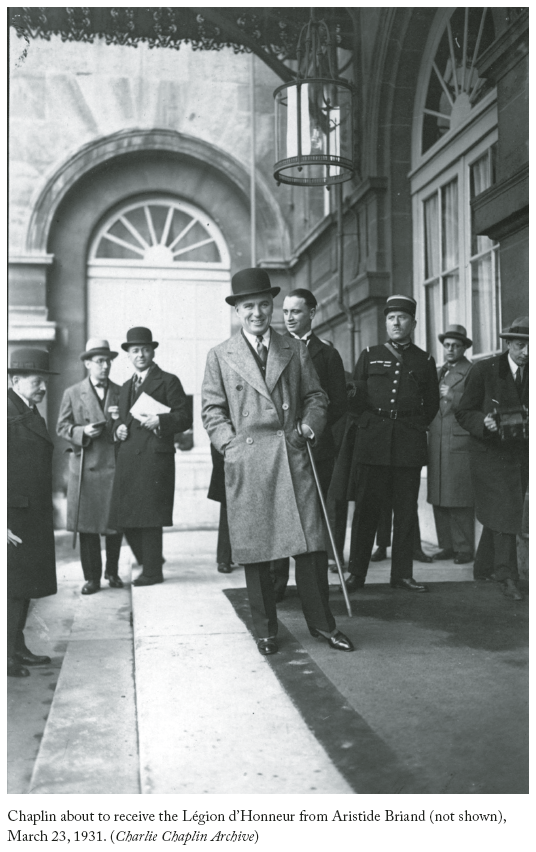
Lunch was at the French Ministry Building. Upon arriving, I was introduced to many celebrities. The celebrated poetess, Countess de Noailles,20 was present. She is an alert, active little lady with birdlike movements and a scintillating mind.

M. Berthelot, the Permanent Secretary of the French Cabinet, was there also. He was the gentleman who afterward decorated me. M. Bailby, then the editor of L’Intransigeant, Princess Murat, Prince and Princess de Bourbon, M. Rothschild, and many others were present.
M. Briand arrived a few moments later—a small, delicate man, round-shouldered, whose face bore lines of responsibility. There was a hidden humor in his expression and a look of weary resignation. He lacked the twinkle of Lloyd George. Briand has a tragic face. Unfortunately, he did not speak English. In giving a toast, he turned to the countess and said:
“I drink to your future, and to Monsieur Chaplin, I drink to the present.”
He was in excellent form, and during luncheon remarked to the countess, “I see so little of you these days. Your presence is as rare as one’s discarded mistress.”
Afterward we sat around and talked. “Mr. Chaplin, you are a poet,” said the countess.
“A poet without verse,” I replied smilingly.
“On the contrary, your verses are moving,” she said quietly.
Someone asks, “Why are the themes of your pictures so sad? I suppose like all comedians, you like the tragic.”
“Not actually,” I answer. “As a matter of fact, I dislike tragedy. Life is sad enough. I only use pathos as a means of effecting beauty, for so much of the tragic is in all beauty.”
On my return to the hotel, I received the following an anonymous letter, which a friend translated for me:
Dear Sir: Allow me to thank you for all the happiness you have given this sad old world. I have read an announcement that you are to be decorated. During the war I myself was given the Legion of Honor, and now I give it to you, having no further use for it, as I’ve only a little while to live. By the time you receive this, I shall probably have passed on. It is my express desire that you keep it as a token of my appreciation for all the good you have done humanity. There is no one more worthy to wear it than yourself.21
I was deeply impressed. Unfortunately, there was no way of finding out the name or address of the sender.
That evening Count LeMuir and I dined quietly, going later to witness a rehearsal of a revue at the Folies Bergère.
I had heard that Alfred Jackson, an old associate of mine, was working there with his troupe of dancers. Jackson and I were kids together in his father’s troupe called The Eight Lancashire Lads.
Upon arriving at the Folies Bergère, I met his father also, and after a warm greeting, we started to reminisce.
“My lad,” said Jackson’s father, “I remember the very first laugh you got from an audience.”
And then he recalled an incident that occurred at the London Hippodrome. I was about eight at the time. The troupe was engaged to play cats and dogs in the pantomime, Puss in Boots. I was dressed as a dog. It was the first performance and on we came.
Wanting to give a little touch of nature to my portrayal of the canine species, I ran lambent over to the corner of the scenery and proceeded to go through the motions of absolute realism that my childish impressionable mind had seen other little dogs do.
The house came down in an uproar. With the laughter and appreciation of the audience, I was inspired to go further, and so I started to take a sniffing interest in the other little dogs on the stage. This also was most realistic and brought forth another burst of laughter. I would sniff, then look suddenly at the audience. This action was most successful.
It appears that my dog’s mask wore a startled expression. At each sniff, the audience would laugh and I would look at them. There was a sort of tempo to it, the laughter, the look, and the sniff. This seemed to work the audience into a state of hysteria. I was feeling very happy and encouraged until my attention was drawn to the side of the wings. There were Mr. Jackson and several gentlemen in white shirtfronts, all protesting violently, shaking their heads and making motions for me to exit. This left me bewildered and somewhat discouraged, so I put my tail between my legs and slunk off the stage to the tune of laughter and applause.
“What on earth are you doing?” they all said. “You’ll have the police close up the theater if you carry on like that.”
I thought everybody ungrateful after giving such a splendid characterization.
“Ah,” concluded Mr. Jackson, “you were a whimsical little fellow in those days. I always knew you had something in you.”
“I must have been a pretty bad lot,” I laughed.
“Not at all,” said Jackson, “you were gentle as a little girl.”
Mr. Jackson is a grand old man. He is well into the seventies, but he is just as bright and vigorous as he ever was. I see little change in him in all these years and he is still actively running troupes of dancers and finding new talent. It was his schooling that laid the foundation for my career. He was a good teacher—a just and kind man.
The King of the Belgians22 was in Paris and expressed a desire to meet me. It was arranged that I should go to the Belgian Embassy. The appointment was for three o’clock.
When we arrived, the King had evidently just returned from some official affair. We were kept waiting in the dark recesses of the reception hall. Suddenly a door opened from one of the chambers, and a tall stooped figure appeared with no coat and braces dangling, and with his back toward us, went ambling down the corridor in a preoccupied manner. He turned to enter another chamber and as he did so, he caught sight of us, then exited rapidly.
I had my suspicions as to the identity of the gentlemen and I think everybody else did, but we pretended not to notice it. One of the emissaries, however, remarked that the King might be changing his uniform as he usually does four or five times a day should official occasions warrant it.
After a minute or so the Belgian ambassador appeared, and after signing the visitors’ book, I was ushered into the presence of His Majesty. The ambassador, having introduced me, made his exit and we were left alone.
His Majesty pointed to a chair and commanded me to be seated, at the same time drawing one up for himself. The King is an extremely tall man with a benevolent face and quiet manner. His imposing height accentuates his royal dignity.
Unfortunately, my seat was extremely low and the King, drawing his chair—a high one—in close proximity to mine, added greatly to the contrast in our height. My nose was somewhere up to His Majesty’s knee when we were finally seated. His Majesty was quiet, so I felt I should start the conversation. “It is a great honor and pleasure, Your Majesty, to be given this opportunity to meet you.”
The King nodded. After this I was at a loss.
“I suppose you’re not staying here long,” I said.
“No,” he answered quietly.
And I proceeded, “I understand you flew here.”
“Yes,” the King replied.
With my voice becoming weaker and my confidence gradually ebbing away, I continued, “Well, that’s wonderful—quite wonderful. I enjoy flying myself. Yes, I enjoy flying,” I repeated. “It is so thrilling and exciting.” Somehow I can’t get off the topic. “Yes,” I said with my hands in the attitude of prayer and looking toward the window thoughtfully, “it has come to stay—the airplane is here to stay.” The last phrase somehow confused me. Was I discussing airplanes or talking pictures?
I saw His Majesty looking strangely at me. I smiled somewhat sickly. “I suppose you are a busy man these days.” Now I feel I have said something too familiar. Should I have said “man”? Yet one could hardly say, “I suppose you are a busy king these days.”
His Majesty, as though not having heard anything I’d said, asked, “Do you make all your pictures in California?”
“Yes, sir,” I answered quickly.
“Isn’t it possible—since the advent of artificial lights and all the new appliances that you have developed in photography—that you could make them anywhere now?”
“Oh, yes,” I replied.
This seemed to break the ice and from then on, the conversation was easier. It wasn’t confined to pictures, but to art, literature, and science, and the King was most stimulating on these subjects.
When leaving, again I became a little confused as to the etiquette of my departure. I had been told as a child one must back out of a room before royalty, but being alone with His Majesty, I felt this preposterous. However, I compromised and went out like a crab, sidling myself to the door and groping for the handle as I bade farewell to His Majesty.