
After we had lived in Merion for approximately two years, Mr. Drinker had a chance to sell his little house. The Trapp Family had to find another summer home. The whole family had lengthy discussions about whether to rent a house or buy a piece of land. Renting seemed to us impractical and uneconomical. Every month we would spend our hard-earned money, and then it would be gone. If we bought a piece of land, we would spend the money once and then own the land, so we decided to buy.
When we lost our money in the bank failure in 1933, we were young. It then became a challenge for us to do things for ourselves that had previously been done for us. We quickly understood that there was great potential within each of us to meet this challenge, and we became a do-it-yourself family. In addition, a kind of pioneer spirit arose among us. I guess to my father’s disappointment, we did not aspire to a South Sea voyage but instead talked about a farm where we would all work, build our own log houses, and plant vegetables and fruit trees. The idea of acquiring a farm was so firmly in our minds that when the ship that was to take us to America for the first time was named the American Farmer, we took it as a sign from heaven. Of course, the primary reason we had come to America had been to give concerts, but that did not dampen our dream of owning a farm.
Now that most of us were grown up, with ages ranging from two years to thirty years, strong and healthy, we considered buying a farm and operating it ourselves. It had been our dream, and it meant we could stay together. When we were still living in Aigen, Papá once talked to us about the subject of sticking together. As we were sitting in front of the fireplace, he took a stick and said, “Do you think I can break this stick in two?” We said, “Yes, Papá.” He broke it in two pieces. Then he took several sticks in his hand and asked us again, “Do you think I can break these sticks apart?” We said, “We don’t know, Papá.” He tried it, and sure enough he could not break the bundle of sticks apart. Then he made the analogy: if we go in different directions, each one of us can get lost or get in trouble, but if we stay together, we will be strong. Even though this lesson may not have been in the forefront of our minds, we nevertheless felt we should buy a piece of land for the whole family to own together.
That summer of 1941, we rented a small tourist home called “Stowe Away” near the village of Stowe, Vermont, for the four months until the next concert season started. Since we had no home of our own to go to after that particular tour, we knew we had to find some land to buy before we went on tour. After spending the summer in Vermont, we knew we liked the Green Mountain area because it reminded us of Austria.
While Mother was in New York conferring with our manager, the family decided to pray for a place to buy. We set up a little altar in the Stowe Away, with a crucifix, two candles, and two vases of flowers, and took turns praying every hour for three days and three nights. After the third day, a man named Alfred Mausolf called on us to say that he had heard we were looking for property to buy. He knew of a farmer who had a farm in the vicinity of Stowe and might be willing to sell because it was too large for the farmer to handle alone. He had a family with seven little children, his wife was sickly, and no help was available. Mr. Mausolf offered to drive us to the farm so we could look at it. The farm, three miles above Stowe, was located on a hill overlooking three valleys. It had a view into a most beautiful landscape on three sides. The setting sun threw a golden hue over the fields and grassland. It was more than we could have dreamed or wished for! There was all the sun that Papá could ever want, and he loved the place.
When Mother came back from New York, we showed it to her. She agreed that it was the place for us, and we bought it in its entirety—with a loan—in 1942.
Our dream was fulfilled. The farm included a big maple orchard, meadows, a horse barn, a cow barn, a pigsty, and a chicken coop, all in poor condition. The premises were strewn with empty beer cans, bottles, and pieces of broken farm equipment. Yet we could look at the breathtaking view, and it quickly became our new home.
After we had been sitting in the bus, car, or train for a whole concert season, it was refreshing to move around in the clear Vermont mountain air and work on cleaning up the newly acquired land. We did not mind getting up at 6:00 a.m. and working until 10:00 p.m. We were building our new home! Rupert and Werner worked very hard to clean out all the junk from the old house, but they could not help us for long. On March 9, 1943, they had to leave for Camp Hale, Colorado, to serve in the Tenth Mountain Division as ski troopers. After some further training in Texas, both boys were sent into the area of Mount Belvedere in Italy to fight against the Germans. Rupert, who had been assigned to the medic division, later told me that he was so close to the Germans, he could actually overhear and understand their conversations.
When our brothers were inducted into the army, our family choir lost two important voices, Werner the tenor and Rupert the bass. But that did not stop us from giving concerts and continuing to tour. Father Wasner changed our program from mixed choir to a women’s choir, although he occasionally sang a bass line with us.
Before the boys left, Werner promised that if they came home safely, he would build a small chapel on our property in thanksgiving. While the boys were in the army, we prayed fervently, asking God to protect them in their service to the country that had given us refuge. When Rupert and Werner returned to us in 1945, they received a joyful welcome during a session of our summer music camp. Rupert soon left again to pursue his medical studies, but Werner built the little chapel on the hill behind our house, where it stands today. During the time that the boys were away, little Johannes and we girls worked together to build the new house after one section of the old one had collapsed in a blizzard.
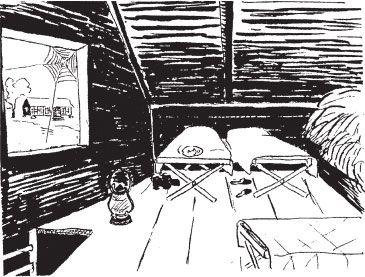
Papá, Mother, and Johannes lived in another part of the old house that was still standing, but the rest of us slept in tents at the edge of the woods and in the hay loft in the horse barn. Camping is the name for this kind of accommodation. Camping was nothing new for us. We had done it years ago on an island along the shore of the Adriatic Sea. We knew how to go about it. It was a wonderful adventure.
People from the Vermont Nature Conservation Department told us they would give us saplings of pines, larches, and fruit trees if we were willing to plant them ourselves. We were willing, and they gave us about a thousand pine saplings and as many young fruit trees as we wanted. They even explained to us how easy it was to plant them: “Push a shovel upright into the ground to open up the soil, stick in the sapling, step on the ground where one opened it, and it is ready to grow on its own.” We planted them, and they grew! Now, more than fifty years later, a forest of beautiful tall pines stands on the hill behind the Trapp Family Lodge. When I visit my family at the Lodge, I can hardly believe that we planted all of these trees.
In addition to trees, we planted a vegetable garden and a large strawberry patch. Papá and the boys learned to make maple syrup and worked the maple orchard in the early spring. The girls helped, and again, it was a wonderful time being in the woods. The result was three hundred gallons of grade A maple syrup the first year!
One necessity inevitably becomes vital, especially in the country—a cesspool. No matter what nice name one would like to give it, it is still a cesspool with the ditches that go with it. We learned that from Cliff, a villager who was evaluated as 4-F by the army and, fortunately for us, did not have anything much to do at home. Cliff knew the basics of living in the country and knew all about cesspools and their importance. He knew how wide, how long, and how deep it had to be, and most important in which direction the ditches had to flow. Once all that was established, we girls started digging.
For the first years we did not have or want electricity. Eventually, when guests appeared who were used to switching on the electric light when it got dark instead of lighting a kerosene lamp, the family felt we had better turn to the modern method of lighting our new home. That meant we needed permission from the county and the money to pay for it. The county officials told us if we dug the holes for the electrical poles, they would set up the poles and do the wiring. What a challenge! Because of the war, there was a shortage of men. Yes, we would dig the holes. We girls dug the holes, and the county gave us the electricity.
When the house was finally finished, it looked like an Austrian farmhouse similar to Gromi’s Erlhof. Red and white geraniums in green flower boxes looked down from the balconies, and a little bell tower with a bell, on the roof above the entrance, completed our new home. The big living room had a cozy bay window where we could rehearse. There was enough space for our large family and the guests who started to arrive. No longer did we spend our vacations in borrowed places. We had a home, some of it built with our own hands.
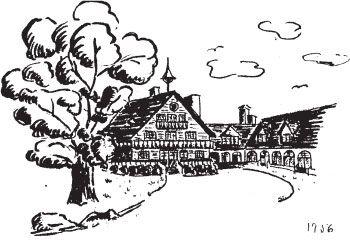
Now we had a piece of land, a home, and the enthusiasm for it but not much time. We could work there only from June until the end of August. Then we had to prepare for another concert tour. When we came home from that concert tour, there was not enough money left after paying for our manager’s fee and our publicity agent’s fee and our hotels, meals, and transportation to see us through the summer months. What could we do?
Mother came up with an idea. Why not start a music camp? Once, when still in Austria, she, my sister Maria, and some other members of the family attended a music camp in the mountains. There they learned about the ancient recorders, how to play them, and where to buy them. Singing was also included in these camp programs. Why not do something like that in Vermont for music lovers during the summer months? A music camp would be beautiful for people on vacation, and it would give us a living through the off-season. The whole family liked the idea, and the Trapp Family Music Camp was on the map. Again, all fell into place.
Just at the time we considered starting the music camp, the abandoned Civilian Conservation Corps (CCC) camp in the valley below our property was about to be torn down. Papá and Mother applied for it, and it was leased to us for fifteen years. It had a fabulous setting, with barracks for the guests, a huge dining hall with an adjacent kitchen, an outdoor amphitheater, and several other buildings, which were needed to accommodate members of our family. There was also a barrack for a chapel, a gift shop, and a recreation hall. Perfect for our music camp! After our concert tour of 1943–44, we prepared the camp buildings for our guests. Advertising flyers went out and guests came in.
Father Wasner led the singing, and after three days, the voices of people who had never before seen each other melded into a beautiful choir. They could hardly believe it was possible to turn a group of strangers into a harmonious ensemble. But there it was. Some of the guests formed their own singing groups after they returned home. One such group was formed of guests from Boston, one from New York City, and one from Rochester, New York. These groups got together once a month in their respective cities to sing and reminisce about the wonderful time they had in the Green Mountains of Vermont at the Trapp Family Music Camp.
During each Sing Week (of ten days), two picnics were scheduled for our camp guests: one was on top of Mt. Mansfield, the highest mountain in Vermont, and the other on one of the large meadows on our property. The food for the picnics was provided not by a caterer, but by the camp kitchen headed by Johanna, and later by Lorli, and the kitchen crew. The crew consisted of ten seminarians from New York City, who were vacationing in Vermont. After the picnic, group singing and recorder lessons were conducted by my sister Maria.
Every evening after dinner, the guests assembled for folk dancing on the grassy area between the dining hall and the recreation hall. Everyone had fun while getting healthy exercise. The family provided music: Papá played the violin, Maria the accordion, and Werner the clarinet. Sometimes guests played additional instruments. Evening prayers in the chapel concluded the day. All the guests, staff, and family joined in prayer and songs of thanksgiving.
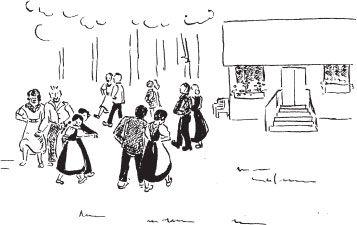
These are only highlights of the program at the Trapp Family Music Camp. Many people came back year after year. Our camp became an institution for twelve years, ending then only because our tour schedule did not allow us to continue it.
Now the site of the camp is overgrown with trees, grass, and bushes. No one who had not been part of the music camp would ever know, when passing through, that once a music camp stood there, bustling with people, alive with music, fun, and laughter. There is no longer any physical reminder of the camp. Only the many guests who came to the summer music camp will remember the joys of singing and making music there.
In 1946, after our Christmas break, and just before we left for a concert tour that would take us clear across the continent to California, a letter arrived from Austria. It was from the chaplain of the American Occupation Army in Salzburg, and he told about the great need of the Austrian people after the war. Knowing that our family gave concerts in the United States, he asked if we would be able to do something to help our countrymen. Immediately we created the Trapp Family Austrian Relief, Inc.
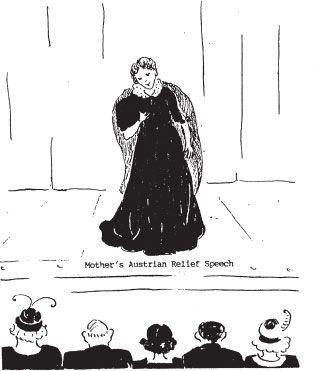
During the next concert tour, Mother made an appeal to our audiences. We called it “Mother’s Austrian Relief Speech.” At the end of each concert, she would tell about the need in Austria. She would ask for donations of canned and dry foods, clothing, shoes, toys for children, and any usable items. She also asked for medicines such as aspirin and other commodities not available overseas, but readily bought here.
The response was overwhelming. Early in the morning after the concert, before our bus left, the donations arrived. Our audiences brought boxes and bags filled with food, clothing, toys, shoes, blankets, coats, and sweaters. In California a school sent a truck full of goods, which the pupils collected from their homes between two concerts. The effort and trust given to us were incredible.
At every stop on our concert tour, Mother made the same speech, and we received donations, which we stowed in the back of our bus. At the next opportunity, we obtained clean new flour bags, and while driving to our next destination, Werner stood in the middle of the bus transferring all items into these bags. At the next train station, we sent them by freight to Waterbury, Vermont. There, someone from our home staff picked them up and took them by pickup truck to the now empty music campsite. We stored the donations in the only barrack that was not in use when the camp was in session. The bags and boxes were piled up to the very ceiling and remained there until the next music camp started.
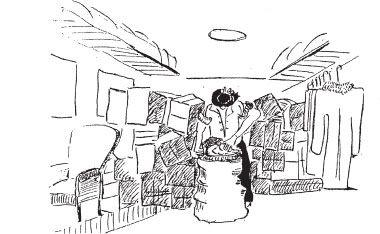
One particularly energetic camp guest, Mrs. Harper, realized the enormity of the work ahead even before these things could be shipped overseas. She took it upon herself to form a group of volunteers from the guests to sort and repack all these items. This wonderful group of people checked every item, then sorted and packed them into huge crates. These crates, donated by the Stowe Lumber Company, were made especially for this enterprise under the direction of our good friend Craig Burt. They were then sent to New York City where Catholic Charities transported them along with other donations to Salzburg, to the attention of Chaplain Saunders, who with his staff distributed the contents to the needy victims of the war.
The cooperation we received once we started this relief work was miraculous. Donations continued to flow into the bus. Sometimes there was hardly any room for the family to sit. The bus was packed to the ceiling with precious cargo.
Then a letter came from Salzburg containing five thousand addresses. In the letter was a plea for American families to “adopt” one family or person in Austria and regularly provide life’s necessities. Mother again announced the need after the concerts, and again, a miracle happened. We were overwhelmed, not only by the response of goods, but also by the generosity of the American people and their willingness to help a country other than their own.
There were official requests directed to us as well as private letters with pleas for special items that were not available in Austria anymore. Martina worked in the cellar for lack of another suitable place that was large enough to hold all the boxes of donations. There she labored to fill box after box with food, clothing, and other necessities, according to the directions given in these letters. These boxes had to be wrapped in a very specific way: in brown wrapping paper with strong string tied crosswise around them and with the address written on them in big letters. I learned to wrap packages in this perfect way prescribed by the United States Postal Service. This skill came in handy later after I left home.
When letters came to us, thanking us for clothing and supplies, we began to learn how badly war affects civilians. We had had no contact with friends or relatives in Austria during the war, and it was not until years later that we learned how our beloved Gromi had fared. When the Russians invaded Austria, Gromi, in her late eighties, was living with Tante Joan in the Martinschlössl, still owned by Uncle Bobby. On the way to Vienna and its surroundings, the Russians had to go through Klosterneuburg. Unfortunately they did their job well, entering homes, raping women, and stealing whatever they could.
Gromi had a loyal Hungarian servant named Loyosz, who succeeded in keeping the household unharmed. Also with Gromi when the Russians arrived were Tante Joan and her friend Lisa, who was a nurse in Pakistan in her early years. She was the daughter of former Admiral Haus of the Austrian Navy. When the Russians entered the house and ordered everyone to the basement, Gromi went downstairs without a word, conducting herself with dignity. Tante Joan, trying to provide food for the duration, grabbed a loaf of bread and a knife as she went to the basement. When one of the soldiers saw the knife in her hand, he was ready to shoot her, but Lisa quickly intervened, saying in Pakistani, “The knife is only to cut the bread.” The soldier, amazed to hear a language he understood, let Tante Joan go. He was from the same area in Pakistan where Lisa had been stationed. Coincidence?
The Russians left the area after a few weeks, but Gromi died shortly afterward. There was just enough time to bury her before the Russian troops returned. Gromi was buried with her daughter Agathe, our mother. Tante Joan and Lisa fled together on foot, pulling a Leiterwagen that held all their belongings. They walked almost the entire way, and it took them two years to reach Switzerland where Tante Joan owned a house.
We wondered at times how long we must keep up the Austrian Relief work, helping victims of the war in similar predicaments as Gromi and Tante Joan had been. Although we were glad to help, our Austrian Relief effort came to an end in 1950. We had concert tours in South America and Europe that same year, which included a stop in Salzburg. When we arrived in Salzburg, the station was filled with people. We did not understand why so many people were there. Then we saw familiar faces, and an official welcoming committee consisting of Archbishop Rohracher of Salzburg, Governor Joseph Klaus, and other dignitaries appeared through the crowd.
We met some of our school friends and Stutz von Jedina, our former playmate, who had become an attorney in Salzburg.1 It was a great surprise for all of us to receive such an enormous welcome, but there was more to come. A few days later an official ceremony was arranged in the Aula, a large hall for official gatherings. The archbishop and the governor thanked us for our Austrian Relief effort. A poetess from the Salzburg area had written a special poem for our family, and she read it to us from the stage.
Little girls in dirndl dresses presented each of us with a lovely bouquet of alpine flowers. The next day, the festivities continued with Mass in the seminary where Father Wasner had been the music teacher, followed by lunch.
Werner’s wife, Erika, had arranged three concerts for the Trapp Family Singers under the auspices of the governor and the archbishop. One concert was in the large concert hall in the Mozarteum. The second concert was staged in front of the cathedral, which was a special honor since our ensemble would be allowed to sing on the large stage where Jedermann (Everyman, a medieval morality play performed annually at the Salzburg Festival) was the only performance ever permitted. At that time, I was not aware of this special honor. As we stood on stage, my thought was, Could they not have a found a smaller place to give us for this concert? The third concert was held in the Kollegien Church in Salzburg.
Having been away from Salzburg for twelve years, we had the strangest feeling being back in the place that had been our home for fourteen years. The Nazi occupation had left its mark not only on the language but also on other aspects of life. We rented bicycles so we could go back and forth between our old home in Aigen, where we were staying, and the town of Salzburg. Unaware of the new traffic rules, we were stopped by a policeman when we tried to cross the main bridge on our bicycles. “Don’t you know this is a one-way street? You cannot proceed,” his firm voice said. I answered that we did not know since we had been away for twelve years. He looked puzzled and asked, “Where have you been?” “In America,” I said. He was not sure whether or not to believe me. We wore the native Salzburg dress, and we still knew how to speak German. But after some discussion, he let us go.
We later experienced a similar incident. Chaplain Saunders, the man from the army who had corresponded with us, lent us a jeep to get around the area. Everyone there knew that jeeps belonged to the American Occupation Army. An American officer stopped us because he suspected the vehicle was stolen. The officer interrogated us about why we were riding in an American jeep. Only after we mentioned Chaplain Saunders’s name, and after we showed our American passports, did he let us go.
Times had changed so drastically, and yet everything still seemed so familiar. We had been given permission to stay in our old home in Aigen because the seminarians were away on vacation. Yes, it was the same house, but it was not the same. The order of priests who bought it after the war had renovated it to suit their needs; they had put in walls where there were not any before. Despite these changes in our former home, we appreciated the fact that we could stay there while we visited in Salzburg. Personally, I had no regrets that we did not live there anymore.
We retrieved some of our furniture that had been stored in different places in Salzburg by friends. Most of the pieces were so damaged that I suggested to Mother that they be auctioned and then we could use the money to buy clothing for the family. I was getting tired of sewing our dresses. She accepted this suggestion. We rescued only a few special pieces of furniture for ourselves and sold the rest. In addition, we gave many household items to our Austrian friends.
As long as we had lived in Salzburg, we had never eaten in a restaurant there. However, from showing our guests around town and visiting the castle, we knew that strawberries with Schlag (whipped cream) were served in the Castle Restaurant. Now that we were visitors in Salzburg, some of us decided that we would also enjoy this delicacy.
From Salzburg our concert schedule took us to Germany, Denmark, and Sweden. In Copenhagen, Erika, who had joined us in Salzburg, was asked to be the tenth member of our group because Rosmarie was sick at the time and our contract called for ten singers on stage. Erika consented with “trepidation” to sing in the second part of the program, which consisted of folk songs. Johannes remarked that Erika turned pale in spite of the makeup.
From Sweden, we went to Holland and Belgium before taking a ship to England where we were booked in the Royal Albert Hall in London. England was the only country where Johannes was not allowed to play the recorder on stage because he was a minor.
In England it was apparent that our manager, Mr. Levitoff, had not done sufficient advance publicity; thus, some of our concerts were canceled. We had no money for our return tickets, so after a successful concert in Paris, Mother telephoned Mr. Schang in America. He purchased tickets for us on the Liberté. Since we had some free time until the day of our departure, Mother decided that the whole family should go to Rome. It was the Holy Year,2 and she thought we might get an audience with Pope Pius XII.
We were granted the opportunity to sing for the pope during a general audience. It was held in a special room in the Vatican under the watchful eye of the Swiss Guard. The female members of our group wore long-sleeved black dirndls and black lace veils, and we performed Mozart’s “Ave Verum” for the pope.
From Rome we went back to Paris, via Milan, for our departure on the Liberté. At the time, Erika, Werner’s wife, had to return to her parents’ home in Salzburg to pick up their baby and Rosmarie. The three of them were to meet us in Milan, to join us on the train going to Paris and on to Cherbourg. Their train was late arriving in Milan, and we had already left, but Werner had stayed behind to wait for Erika, Rosmarie, and the baby. They took the next train to Paris. In Lyon both trains were coupled together and, lo and behold, the complete family emerged in Paris from their respective coaches. Greatly relieved to be reunited, we spent the night in Paris, and the next day took the train to Cherbourg where we boarded the Liberté.
The crossing was uneventful until we hit the end of a hurricane. The ship rolled to such an extent that the portholes of the uppermost deck went underwater on one side, then shifted to the other side and continued rolling back and forth. The captain was said to have been concerned that the ship might remain lying on one side during one of these rolls. Everything was made as tight as possible in the dining room and salons. Many people disappeared into their cabins, and the crew ran around trying to help. One could not walk up or down the stairs without sliding helplessly into the corners. A priest was trying to say Mass in one of the salons, but suddenly in the midst of the service, the priest and the table, with all that was on it, fell over and slid along the floor. All activities were interrupted, and anyone who was still around was trying, somehow, to get where he or she wanted to go.
After a day of being tossed about by the severe storm, calm was restored, and we were able to continue on our voyage to the New York harbor. It was good to be home again in the United States of America.