
The Christmas of 1914 was the first Christmas I remember. I was not quite two years old. I stood in front of the Christmas tree, which in its full height stretched from the floor to the ceiling. The soft light of its candles brightened the room. In its glow, I stood alone. A tall, slender man came toward me. He was blond, wearing a bluish-gray uniform with a high green collar and green trim on the sleeves; it was the gala uniform of the Emperor’s House Regiment.
I heard someone say, “This is Uncle Werner.” I looked up at him.
He bent down and gently kissed me on my forehead. I knew immediately that he was a very kind person, but I never saw him again. Uncle Werner was killed in an offensive by the Russians against the Austrian troops in Galicia on May 2, 1915. In my memory, though, Uncle Werner is still as alive today as he was on that long ago Christmas Eve.
In Austria at that time, children learned that it was the Christ Child who came at Christmastime, bringing gifts with Him. Angels were His helpers. A room was set aside to give the Christ Child privacy, and children knew they should not disturb Him.
In the Erlhof, our nursery was on the second floor. From there a big open staircase led directly into the big living room, which was called “the Hall.” A week before Christmas, the Hall was closed off from the staircase. We were told not to use the staircase because the Christ Child with His angels was preparing a surprise for Christmas Eve in the Hall. Everyone whispered and wondered what the angels might be doing, now that Christmas was so close.
“Silent Night…”
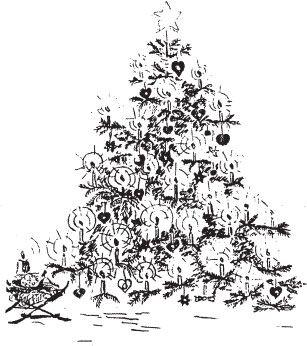
On Christmas Eve, we children were dressed in our best clothes for the holy occasion; expectation was at its height. Then, there it was—the sound of a silver bell announcing that it was time for us to go to the Hall. Slowly, with rapidly beating hearts, we went down the wide staircase. Oh, wonder! There stood the Christmas tree in its entire splendor. The Hall was illuminated in soft candlelight, magnified a million times by the brightly colored balls of glass and a glistening veil of angel hair. We just stood, taking it all in.
As we edged closer to the tree, we detected cookies hanging on golden strings. Also there was candy wrapped in colored paper, fringed at each end and fastened to the tree with silver strings. Birds of paradise with long glass tails and other colorful ornaments were visible through the fine veil of angel hair. All of this was even more wonderful because we children believed that heaven came down to earth in the person of Jesus in order to leave us presents and share His wonders.
Beside the tree, lying in a manger, was the Baby Jesus. He was smiling and held out His arms to us. His hair was curly and light, the color of the straw He was laid on. I was glad to see that He was not lying on the straw itself but on a fine white doily with lace edging. I wished so much that the Baby Jesus in the manger was real instead of waxen, and that He could move around as real babies do.
After a few moments of admiration, the entire household, family and staff, sang together “Silent Night, Holy Night.” Then each person was shown the place where his or her presents were laid out on white tablecloths, covering the furniture. Everything was a surprise. Of course, we did what all children do at Christmas; we showed our presents to our parents. They admired everything, just as if they had never seen these things before. The girls usually received dolls, for which Mamá made clothes, and doll furniture. I cannot remember many of the boys’ presents, but at least one Christmas a hobby horse and a stable with animals were given to Werner.
The picture of my uncle, the Christmas tree, and me remains indelibly imprinted in my mind. I will always cherish this memory of my Uncle Werner on that wonderful Christmas Eve of 1914.
Another memorable event from my childhood took place at the Erlhof when I was five and a half years old. I met my great-grandmother, Countess Agathe Breuner, for the first and only time. The occasion? It was her eighty-fifth birthday, and a celebration was arranged for her at the Erlhof. I remember seeing a photograph, taken earlier, which showed the four generations with the name of Agathe. It pleased my grandmother that her mother lived long enough to have this picture taken. I was the baby in the photo. When Great-grandmother came to visit at the Erlhof, she was accompanied by friends and relatives because Great-grandfather had died many years before. At my great-grandmother’s birthday celebration, I remember my mother’s cousin, Tante Lorlein Auersperg, and one of Papá’s officers and friends, Erwin Wallner, who later married Tante Lorlein. Erwin Wallner had a beautiful baritone voice and loved to sing arias, and he would do so at the drop of a hat.
I remember my great-grandmother as a very old lady in black, a little stooped over, and with many wrinkles in her face. She wore a white round lace cap on her head with a black ribbon woven along the edge of it. I have no recollection of her personality, but she must have been greatly loved by her family to receive such a grand birthday celebration.
Weeks before she came, Mamá, Tante Mary, and Tante Connie sewed costumes for us and themselves to create tableaus as part of the festivities after lunch. The performance was set up in the barrack on the old tennis court. There was a little stage on which was placed an enormous wooden picture frame. In it we were positioned like statues, dressed in old-fashioned costumes. The grown-ups staged a tableau of a pirate ship with its crew. Maria and I were costumed in empire dresses, which were long with high waists and had pink sashes. We also wore matching bonnets made of white chiffon with a pattern of little pink roses. Rupert wore a blue-and-white-striped suit in the same style with a black mortarboard hat. I had a second costume that was my favorite. I was dressed as a medieval page in dark red velvet knickers and a matching tunic edged with fur that had a belt with a knife on the side. I wore little red velvet slippers edged with fur and a red velvet beret also edged with fur with a red feather stuck sideways into its band.
Gromi had a stack of old-fashioned magazines, Münchner Bilder Bogen, which were actually artistic picture books for grown-ups with gorgeous illustrations of historical events. There were also fashion pictures from different centuries with pages of costumes from different regions and countries of Europe. This hardcover magazine, edited in Germany, was probably the inspiration for our tableaus.
Before the big performance, I saw the whole party walking from the main house to the barrack, where the stage and seats were set up. Werner, who was almost three years old, ran ahead of the party, singing clearly with a booming voice, “Ich hatt’ einen Kameraden” (I had a comrade), a song that was sung by the Austrian population and soldiers throughout the war. Fräulein Zimmermann, our governess at the time, composed a long poem and made me memorize it. I did memorize it but only by sound. I had no idea what I was saying. Fräulein had instructed me to stand up at the festive dinner table, ring my glass with my dessert spoon, and recite the poem. But, oh, after a few sentences, I had forgotten what came next, and I got stuck! There was dead silence. Embarrassment gripped me, as it did the whole dinner table. No one said a word; no one helped me, and I burst into tears. From then on and even well into adulthood, I remained tongue-tied in front of strangers. Fortunately I eventually conquered this affliction.
The next morning, a home Mass was arranged for all the guests. Because of a space problem, the Mass was held in the barrack where we had staged the still life performances. The priest had come from Zell am See and, during Mass, distributed Holy Communion. I did not know what Mass was all about and thought he was giving out peppermint candy! Since everyone went forward to get this “candy,” so did I. But before I could reach the priest, someone caught me, and I was told I could not have it. Later my mother explained to me that I would have to wait until I was older to receive what they received, and she said that it was not peppermint candy.
Two years later, on November 20, 1920, Great-grandmother died in Goldegg bei St. Pölten, in the home of her daughter Lori. Gromi went to the funeral.
Fräulein Zimmermann told me that I must write a sympathy letter to my grandmother. I had never written a letter in my seven and a half years of life. I was stuck with a problem. Somehow I connected dying with going to heaven. Why was my grandmother sad when her mother went to heaven? Why should I write to tell my grandmother that I was sorry that her mother had died? She went to heaven. My grandmother must know that. Why should I write to her about something that she knows? What can I tell her that she does not know already? She is the grandmother who is so much older and wiser than I am.
I do not remember what I finally wrote or whether the governess dictated something to me. But I remember distinctly thinking these thoughts and the conflict that arose from the command that I should write this letter. I am sure my great-grandmother would have helped me and consoled me in my distress if she could have. But she was in heaven. I did not understand grief that can override the understanding of things.
Although it may seem unusual for a young child to have such vivid recollections, the images of both that very special Christmas and my great-grandmother’s visit will always remain with me.