
On November 11, 1918, the war was over. Our soldiers came back from the front in troop trains, which were overcrowded. Some were so eager to get home that they climbed onto the roofs of the railroad cars. But they did not make it home because they were swept off the trains or were beheaded by the entrances to the tunnels, which took the trains through the mountains.
The Austro-Hungarian Empire was in shambles. Hungary separated itself from Austria, as did Czechoslovakia and Croatia. Istria and South Tyrol were given to Italy by the Treaty of Versailles. Emperor Karl I of Austria went into exile with his family in 1919. The pinch of hard times was felt by all as food, textiles, and other commodities became scarce.
The borders between the Austrian provinces were closed. Anyone traveling from one province to the other was subjected to a body search if suspected by the train personnel of smuggling food. All necessities of life were difficult to obtain. Because of this on Sundays and holy days, in spite of all restrictions, droves of people went from the cities into the country to visit their “relatives” on farms in order to get vegetables, fruits, butter, and meat. If people were caught hamstering (black-marketing), the food would be confiscated, or high duties would be imposed on the items. The economy was so deflated that the government printed emergency money, which was worth nothing.
Austria was impoverished to the bone. Poor people were given a patch of land (Schräbergarten) on the peripheries of the cities where they could grow their own vegetables and fruits. Each patch of land contained a homemade shack for tools and was surrounded by a wire fence.
In those first days after the war, people ate dogs, cats, rabbits, and squirrels. They caught ducks and geese from other people’s ponds. They ate anything just to keep alive. The bread was made of a dark crust stuffed with cornmeal that was mixed with sawdust. Materials for clothing were mixed with paper. String was made of paper, twisted tightly, but of course it dissolved when it got wet.
Although we had a very good cook, she could not prepare the meat. No matter what she did, it was as tough as shoe leather—especially the boiled beef. After the adults had finished the meal, we children would sit for hours and hours, chewing and chewing the unchewable meat. In those days, children had to eat what was put on their plates, whether they liked it or not, and could not leave the table until their plates were cleared. The adults seemed to be able to chew the meat, but we could not. Spending hours into the afternoon, my sister Maria suffered greatly, battling with this tough meat.
The pork was even worse. One could say, “Well, it is better to have tough meat than none.” But that did not solve the problem of chewing it! The pork was not only tough but also unappetizing. It took all my willpower to put a bite of pork shoulder into my mouth. I sat after lunch—which is the main meal in Austria served at 1:00 p.m.—and chewed and chewed and chewed. When Mamá’s maid saw me still eating alone in the dining room around three o’clock one afternoon, she asked me what was the matter. I said I could not chew the meat. She asked me, “Would you let me eat this piece of meat?” referring to the meat that I had already chewed and placed back on the plate. I said, “Yes, if you want it.” She took it and ate it, finishing all the meat on my plate, thus allowing me to leave the table. I embraced her for this unselfish deed.
Sauerkraut was another dish that was not easy to swallow because of the very strong smell. The odor was due to the method of preparation. Onion sauce accompanied every meat dish, supposedly to enhance it. Unfortunately some of us did not like the onion sauce. Another very healthy, but hated, vegetable was the red beet. Beets came from Gromi’s vegetable garden. We did not like them, although we were told that they contained iron, which was needed for a healthy body. There were also the yellow beets (die Rucken), which were raised primarily to feed the pigs. But what do you do if there is a food shortage of other, more appetizing foods? You eat die Rucken. In those days, Werner prayed, “Lieber Gott lass Mehlspeis wachsen!” (Dear God, please let desserts grow!).
Sugar and flour were Papá’s presents to the family. In Hungary the sugar was made from sugar beets. Since Papá’s route home from the navy took him through Hungary, he was able to buy some sugar to bring back to Austria, where it was a thing of the past. He gave some to Gromi and the rest to us. He also brought some flour—real, white flour that was not mixed with sawdust. Pure, white flour was a precious commodity in Austria and unavailable for a long time. Mamá put it into a wooden bin for storage, to be used slowly as the need arose. To her dismay, she discovered only a few days later that mice had gnawed a hole in one corner of the bin and had helped themselves to the flour, leaving their droppings mixed in. What to do? Since the flour was so precious, Mamá and the cook sieved the droppings out of the flour. I remember watching the procedure, and it took some time to accomplish the task. Mamá then put the cleaned flour into tin boxes.
One morning I heard Mamá say that she must take Werner to Vienna because he had “bow legs.” As a result of the poor nourishment during the war years, his legs needed to be straightened by a specialist. Of course, I wanted to go to Vienna too. I must have heard stories from Gromi about how beautiful and exciting Vienna was. Mamá told me I could not come along because there was nothing wrong with my legs. “But,” she said, “if you are good and don’t cry and will wait until you are older, you will travel to Vienna and to many other places.” With that promise, I resolved to wait until my time for traveling came. Mamá had no idea that she had made a prediction that did come true many years later.
The soldiers who came back from the war did not find a homeland that took care of their needs, a homeland where peace and security would soon help them recover from what they had suffered in body and soul. Instead, they came back to a boiling pot of social changes. There were no jobs, no food, no clothing. Many soldiers who had fought bravely for their country were walking from door to door, sometimes in rags, on crutches, begging for food. The soldiers and sailors who went from door to door were also looking for a little work so they could buy cigarettes and anything they needed, perhaps a railroad ticket to visit their relatives. I remember one Italian navy man who came to our door and asked my father whether he could work for him. He advertised himself in Italian as “forte come un toro” (strong like a bull). My father was intrigued by his ingenuity and hired him to do garden work. He had dark curly hair and spoke only Italian. We called him “Toro.” He stayed a while and then went on.
After the end of the war, the Austrian Navy ceased to exist, and Yugoslavia and Italy took over its ships. Some of our naval officers who were Italians or Yugoslavs were willing to serve under the new regimes. But for Papá, that was impossible. His loyalty was to Austria, victorious or defeated. Before he came home, we were told that the war was over. Papá was coming home for good, but he was very sad, and we were told to be very kind to him. Only later did I realize what an adjustment my father had to make from his life as the captain of a submarine to the position of the head of a family with five young children. When Papá returned to the Erlhof, he wanted to find a home for us as soon as possible because we had been living in Gromi’s house.
To show his appreciation to Gromi, Papá decided that before we left the Erlhof, he would do something special for her. Up to the end of World War I, the lighting in the Erlhof consisted of kerosene lamps with large white lampshades. At that time an electric power station was being built high up in the mountains near Zell am See, so Papá and Uncle Franky worked to wire the Erlhof for the blessing of electric lights. Gromi was delighted at the prospect of illuminating the living room and other rooms with the flick of a switch. Everyone was looking forward to this momentous event.
We assembled in the living room to watch the first bulb light up, but when the electricity was switched on, we could see only a thin rose-colored wire inside the bulb. Too many people had turned on their switches at the same time, and the powerhouse did not have enough power. So the kerosene lamps were in use again for a while until enough power became available. Papá and Uncle Franky could put the wiring in—but not the electricity.
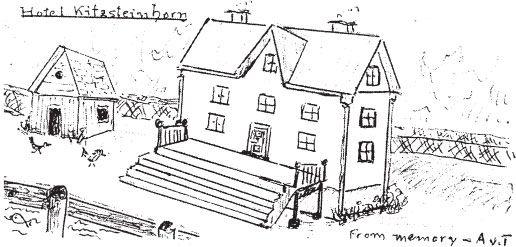
After the electric wiring was installed, it was time to move out of Gromi’s house. Papá did not want to impose any longer on Gromi’s generosity. Papá and Mamá looked around various parts of Austria to find a house that was adequate for a big family. But they could not find anything suitable. Mamá’s brother Franky owned the house next to Gromi’s property, which had previously been a hotel. He offered it to my parents until they could find something to buy.
It was right on the lakeshore and just big enough for our family, the cook, two maids, the governess (for the two older children, Rupert and me), and the nanny (for the three little ones: Maria, Werner, and Hedwig). The house was called “Hotel Kitzsteinhorn,” after the high mountain across the lake. The Kitzsteinhorn was built before the war, close to the water’s edge. At that time, a pier reached out into the lake to accommodate the motorboat from Zell am See, which stopped there for the convenience of hotel guests. During the war, however, the hotel became vacant, and the pier fell into disrepair, after which Uncle Franky bought the property.
At that time, girls did not go out to make a life for themselves before they married. Therefore, Mamá’s two unmarried sisters lived with Gromi. Despite the fact that Gromi had two single daughters in her house, she did not want us to leave her. She had already endured loss. Her oldest son, John, a test pilot in England’s Royal Air Force, was killed in a test flight of one of the first planes to be used in warfare. Her second son, Franky, eventually worked in the travel bureau in Zell am See. Her third son, Robert, lived in Hungary.
The Erlhof was built for her children. Without them, it meant nothing to Gromi. Now her beloved daughter Agathe was going to depart with her husband and their five children, three of them born in the Erlhof. She could not bear the thought of parting with them, but it had to be done. The change was made so that we hardly noticed it. One day we had a new home half a mile down the road from Gromi’s Erlhof.
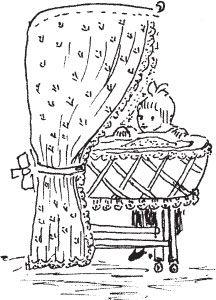
There was also a new baby on the way, and when it was the right time, Mamá went back to the Erlhof. Johanna was born in the very same room where three other young von Trapps had found their way into the world. I remember the first time I saw her. She was lying in a baby basinette with a canopy of delicate curtains that had little flowers printed on them. The nurse moved the curtains away, and there was the new baby with big brown eyes.
Hedwig, two years old, took a look at her baby sister and said, “Ich werd mit der Lute kommen! [I will come with the switch!]” (unable to pronounce Rute, Hedwig called the switch Lute). Then Johanna started to cry. Hedwig must have heard this phrase addressed to her many times from her nanny and so thought this was what one said to little children! But Johanna obviously did not like the sound of it. Someone took Hedwig out of the room.
After a few weeks in the Erlhof with Gromi, Mamá returned to the Kitzsteinhorn. While our family lived there, Rupert once came down the many steps that led to the place where the pier should have been a bit too fast. He fell head over heels into the water. Perhaps that accident triggered the repair of the pier.
One day some men appeared who were appointed to do the job. In order to build the new pier, the men had to drive heavy wooden posts into the bottom of the lake. While standing on a scaffold, they placed a huge iron block with six handles on top of the post, to be used as a hammer. As they began to work, they started to sing a song, not to the post, not to each other, not because it was a beautiful, sunny day and they felt like singing, but to coordinate their blows on the post. The rhythm of the song told each man when to lift the block and when to let it fall. It was a very wonderful sight to see the men at work.
As we watched them, we also learned their song, never to forget it. The words are in the local dialect of the Pinzgau. The song went like this:
Auf und z’am
Der Tag is lang
Der Schaegl is schwar
Von Eis’n er war
Da Lercha Kern
Er geht nit gern
Er muass hinein
Durch Sand und Stein
Durch Stein und Sand
In’s Unterland
HOCH AUF!
Up and down
The day is long
The sledge hammer is heavy
It is made of iron
The larch post
Does not want to move
It must go down
Through sand and stone
Through stone and sand
Into the land below
LIFT UP!
The melody to this song was not written down. If it had been written down, it would have become a hit song in the United States! But it was forever imprinted into the memories of the men who sang it probably thousands of times, and into our memories as we watched them pound the posts into the “land below.” The rhythm of this song gave them the coordination to do the otherwise impossible. HOCH AUF!
The motorboat was no longer in operation, and we did not own a boat. So Papá bought a horse and buggy with a few warm blankets to keep us warm as we traveled around the lake to the town on errands. The horse was lodged under the balcony of our house where Papá had built a stable. For us it was a great thing to have a horse and buggy for our own use, even though we children did not ride in it very often. The horse’s name was Dagie, after a friend of Papá’s from the navy, whose name was Dagobert Müller. Papá took care of the horse himself.
To improve our diet, and to provide entertainment, Papá bought chickens—nine hens and a rooster. When he saw how much we loved the chickens and enjoyed finding the eggs, he bought three dwarf chickens just for us—a rooster and two hens. The dwarf hens laid little eggs, and we were delighted.
Every day we went to watch and feed them. Papá kept the chickens in a little wooden building next to our “hotel,” and he made small boxes where they could lay their eggs. Every morning he collected the eggs. One morning, however, there were only two hens and the eggs were crushed. What had happened? There were feathers on the floor and little pools of blood on the ground, even outside. Who had taken the chickens? How had he gotten into the chicken house, whoever he was?
Papá went all around the chicken house to find some tracks on the ground in order to find out who the robber was. That afternoon he took us on a walk onto the wooded hillside behind the house to look for mushrooms. As we came down the hill, he saw one of our chickens half buried under the fallen leaves. Then we saw another and yet another. Who was this mysterious thief that left part of the spoil? Perhaps it was an animal. A person would surely have taken them all.
So Papá constructed a big wooden trap. He covered the far end of the trap with a piece of chicken wire. The trap was constructed so that when an animal went in and got to the end of the trap, the door would fall down behind him. Papá set this trap into the entrance of the chicken house.
The next two days were quiet. Nothing happened. But on the third day the thief was caught. It was a huge, gray wild cat. I had never seen a wild cat before; therefore, I was fascinated.
One day there was excitement in Zell am See to rival our chicken thief. A moving picture film came to town and was to be shown! That was a very novel event in 1919. The film was advertised as a picture where animals and people could move, just as in real life. Impossible! But the promoters claimed it was true.
How I wanted to see that film! But only Rupert, then eight years old, was allowed to go. I stayed home, being told I was “too young.” I questioned Rupert about the film when he came back home, and he confirmed that the pictures really moved. I would not see my first movie until several years later in Vienna.
In the Kitzsteinhorn, our schoolroom was in the attic. From a point where the roof sloped, a curtain was suspended to hide the family’s trunks and suitcases stored there. We called this area the “North Pole.” When Stutz von Jedina visited, we played all kinds of wild games there, most of them imported by Stutz! War games, Red Indian, and Cops and Robbers—all of the games were accompanied by wild gestures and fierce words, but we never hit or hurt each other. Sometimes we hid in houses, which we formed with our schoolroom furniture; other times we were prisoners bound by imaginary rope. Our imaginations ran wild, and when we were tired, we smoked a make-believe peace pipe.
When the dinner bell rang, we knew it was time to clean up. No more imaginary surprise attacks from the dark, awesome place behind the curtains where the trunks stood! We put the furniture in order, washed our hands, and went down to the living room to wait for the meal. The days when Stutz came to see us were the highlights of our time at the Kitzsteinhorn. His visits were a pleasant diversion from our daily routine. I adored Stutz.
It was 1919 when we settled in to live at the Kitzsteinhorn. Our dear Nenni had left, and in her stead the “little ones,” baby Johanna included, came under the care of a new nanny. We older ones called her “the Dragoner.”1 Of course, we addressed her as “Fräulein” (Miss). She was rather stern, with her sparse black hair pulled straight back into a little knot on the back of her head. The Dragoner always wore a white nurse’s uniform and spoke with a deep voice, using the mannerisms of a sergeant.
The Dragoner loved baby Johanna and disliked Hedwig. She often punished Hedwig by taking away her favorite doll, Liesl. The nanny used to make Maria, Hedwig, and Werner, who resisted her at times, sit quietly on a bench while baby Johanna slept. Then when Johanna awoke, they had to take their naps. My sister Maria is still puzzled by this arrangement, but a story that she recently told me may shed some light on this extraordinary ruling.
At one time, the Dragoner most likely went to check on Johanna sleeping in her crib and left Maria, Werner, and Hedwig for a moment in the adjacent playroom. Suddenly she heard a loud bump and a child screaming. Rushing into the next room, she found a crying Hedwig on the floor in her overturned high chair. Werner, trying to prove his strength, had pushed the high chair over. The nurse picked up Hedwig, who was frightened but unhurt. After a stern reprimand, she told Werner that he would have to go to Mamá for a spanking.
Meanwhile, Maria, who had overheard the punishment pronounced, ran quickly for her doll’s pillow, inserting it into the back of Werner’s pants to soften the blow, at the same time that the Dragoner was trying to soothe the sobbing child. Werner, fortified for the paddling, was escorted to Mamá’s room by the nanny, who left him there. Mamá, who never spanked us anyway, inquired about the mishap and, upon finding the pillow, was touched by Maria’s compassion. Then Mamá spoke kindly to Werner and kept him with her for a while before sending him back to the Dragoner.
Why did Mamá hire such a person to take care of her little ones? The only explanation I can think of is that there was no one else available at that time when a nanny was sorely needed.
The older ones, Rupert and I, did not fare much better. Since there was no school on our side of the lake, it was necessary for us to be tutored at home. Fräulein Zimmermann, from northern Germany, became our governess. It quickly became evident to me that Fräulein disliked Rupert and loved me. She should never have become a teacher; she simply did not understand children. She constantly had a switch ready for Rupert, although I did not see any good reason for that kind of threat. She assigned me, his younger sister, to watch over him so he would not do anything that was forbidden. This responsibility did not help our relationship. All I remember as a response from Rupert for my efforts to keep him on the “right path” was, “That is none of your business.”
In addition to the switch, Fräulein was always ready with sarcastic remarks directed at Rupert and made fun of him at every opportunity. What a terrible experience for a child! We never told our parents about her treatment of him. We considered Fräulein to be without blame because she was an adult and in charge of us.
Fräulein tried to teach me mathematics. I especially remember division. Because I was only six, I did not understand what she explained to me. When I was not able to master division, she called me lazy. I do not know whether Rupert could learn from her either, but I suspect not.
I recall sitting in an unfamiliar room, in front of a lady I did not know, and being asked questions I could not answer. I believe I was in a classroom and being given a test at the end of first grade. Needless to say, I failed. From that time on, I did not have any more lessons with Fräulein Zimmermann. She departed, claiming that Tante Joan, age eighteen and still living with Gromi, needed a tutor. That was a blessing for us. Fräulein Zimmermann’s best service to us was recommending the next governess, who fortunately was an excellent teacher. Her name was Fräulein Freckmann, and she was from Bremen, Germany. Well educated herself, she was determined to give us the best possible education.
During the turbulent days following the end of the war with food shortages and the lack of all daily necessities, a levelheaded person like Fräulein Freckmann was a blessing. Throughout Austria, everyone was affected by the aftermath of the war; the change from monarchy to a makeshift government created insecurity and confusion. Even traveling became extremely difficult. My parents were looking for a permanent home to buy, but they could not find anything suitable for our big family. Another temporary solution, however, was already on the horizon.