
When Mark Antony returned to Rome in 50 BC his first goal was to enter the priesthood by becoming an augur. This was not from a sudden outbreak of piety, but another step up the political ladder. There were fifteen members of the college of augurs, and along with the pontiffs they were the most prestigious of Rome’s priests. They were always from senatorial families and, once elected, the post was held for life. This meant that vacancies were rare and hotly contested when they did occur.
In this case the appointment was prompted by the death of Quintus Hortensius Hortalus, consul in 69 BC and Cicero’s rival as the greatest orator of the age. The other members of the college had to choose two nominees. It was common to select men from families who had held the priesthood before, but this was not compulsory. Being selected was a sign of prominence and the ability to call in political favours. Pompey was an augur, and Julius Caesar the senior pontiff or Pontifex Maximus — a title now preserved by the pope. The choice between the two candidates was then made by a special assembly consisting of seventeen tribes chosen by lot out of the thirty-five. As in any election, all means from canvassing to outright bribery were pursued to convince the voters. Caesar himself decided to go to Cisalpine Gaul to ‘speak in the towns and colonies … and support his bid for the priesthood. For he was happy to use his influence in favour of a man who was very close to him … and especially against the small, but powerful faction, who hoped through the defeat of Mark Antony …’ to weaken Caesar’s own prestige.1
The main priesthoods at Rome were not associated with any particular deities. Augurs had a special role in interpreting messages sent by the gods to show their attitude towards a planned course of action. This might take the form of examining a sacrifice or often simply observing the skies and interpreting the future on the basis of the flights of birds. Cicero was an augur, and although he wrote a book dismissing divination in general, he made an exception in the case of his own college. However, there is absolutely no indication that candidates were judged at all on their knowledge of such things.2
Antony was picked as one of the candidates and ran against Lucius Domitius Ahenobarbus, an ancestor of Emperor Nero. The latter was older and much more experienced, having been consul in 54 BC when he had tried and failed to replace Caesar as governor of Gaul. Domitius was also Cato’s brother-in-law, which was another reason for him to dislike Caesar and anyone associated with him. Well connected, and from a successful and distinguished family, he could expect to win against his much more junior rival. In the event, Caesar’s influence and Caesar’s money were lavished through intermediaries to give the victory to Antony. The news of this success reached Cisalpine Gaul before the proconsul had arrived there and begun to canvass. Instead, Caesar toured the communities thanking them for supporting his former quaestor and encouraging them to back Antony in the autumn’s election for the tribunate.3
There were ten tribunes of the plebs each year and it was a post that a man of Antony’s age and experience could reasonably expect to win at this stage in his career. The tribunate was not compulsory and its duties were restricted to Rome itself and never extended to service in the provinces. Yet its powers were considerable. Actively, a tribune could summon the Concilium Plebis and propose a bill that the Assembly could then make into a law. The tribunate had been created to protect citizens from the abuse of power by senior magistrates and especially patricians. They possessed the right of veto – literally, ‘I forbid’ – which allowed them to block any decision or action in the Senate or an assembly. This was not a collective thing and the veto of just one tribune was enough to stop a motion in its tracks.4
Caesar’s money and backing helped again and Antony was comfortably elected as tribune for 49 BC. Amongst his colleagues were several other men from well-established families. Not all of the candidates Caesar backed were so fortunate. One of his former legates, Servius Sulpicius Galba, tried and failed to win the consulship.5
THE ROAD TO THE RUBICON
Caesar was coming to the end of his tenure in Gaul. Since 58 BC he had expanded Roman territory on a grand scale, defeating tribes most Romans considered as traditional enemies. His victories were celebrated by a succession of public thanksgivings and plans were under way to commemorate them by rebuilding on a grand scale the saepta voting area on the Campus Martius at Rome. Caesar had been voted his initial command and its five-year extension in bills proposed by tribunes and passed in the Popular Assembly. This was legal, since the People could legislate on anything. In the past, Pompey had benefited in the same way, but it broke the tradition that provinces should be first allocated and then renewed or reassigned by the Senate.
There had been worries about what Pompey would do when he returned to Italy from his eastern campaigns and widespread fear that the successful commander would seize control of the state by force. In the event he had disbanded his army and entered politics as a private citizen in the proper way, which allowed other senators to block him, until in frustration he allied with Crassus and Caesar. Crassus had died in Parthia in 53 BC, unbalancing the alliance. Another very personal connection between Pompey and Caesar had also been removed a year before. In 59 BC Pompey had married Caesar’s daughter Julia, his only legitimate child. Caesar’s new son-in-law was six years older than he was and yet the marriage proved genuinely happy. Pompey craved adoration, whether from his soldiers, the wider population or a wife, and Julia seems to have been as charming as her father.6
Then, in August 54 BC, Julia died in childbirth, and the baby followed her a few days later. Caesar had searched around for another female relation to renew the alliance, but instead Pompey had married into a well-established senatorial family, wedding the daughter of Quintus Caecilius Metellus Pius Scipio Nasica. This man’s lengthy name was the product of successive adoptions, which had combined the fortunes of several famous lines. His daughter was simply Cornelia, the feminine form of his name before his own adoption. Scipio himself never gave any evidence of sharing the talent of his famous ancestors, but he was extremely well connected. This encouraged Pompey to marry his daughter and make Scipio his colleague in the consulship of 52 BC. Cornelia was also a remarkable woman and, once again, the marriage to a bride at least thirty years his junior proved extremely happy.7
Pompey did not need Caesar as much as he had done in 59 BC. With Crassus gone, there was now no single senator who could match his wealth and importance. In spite of Caesar’s new-found glory and great fortune from the conquest of Gaul, Pompey did not yet consider him to be his equal. From at least 52 BC many senators sensed that the two men were becoming much less close. In that year Pompey was made sole consul – dictator in all but name – and his command of the Spanish provinces was renewed. Although he never had any intention of going to the Iberian Peninsula, the provinces gave Pompey control of an army and the immunity from prosecution of a serving magistrate. Once Caesar’s command expired in Gaul, then he would have neither of these things. Back in 59BC he had forced measures through against stubborn opposition. The Roman system allowed acts in the past to be attacked even when they were legal at the time.
Caesar had charisma, which he displayed in his courting of other senators and his frequent seduction of their wives. Anyone who felt that he had seen past this charm tended to loathe him with a hatred that was almost visceral. Cato was one of his bitterest opponents, but there were other men who resented being overshadowed by Caesar’s glory and achievements. Several boasted that as soon as Caesar returned home he would be put on trial in a court surrounded by soldiers and condemned.8
Simply being brought to trial was a major blow to a senator’s prestige, even if he was not condemned. No one had ever thought of prosecuting Crassus, or indeed of charging Pompey with anything. Caesar refused to risk such an insult to his auctoritas. He was equally reluctant to trust for his defence to the friendship of Pompey, both because this would have admitted that the latter was the more important man and because his past record of supporting friends was patchy. Instead, Caesar wanted to go straight from his command into a second consulship in 48 BC, which would give him immunity from prosecution during that year and then the option of taking a province. All ten tribunes of 52 BC were persuaded to pass a law permitting him to stand for election without actually leaving his province and returning to Rome.9
The question of how Caesar would return home from Gaul overshadowed public life for more than two years, although this was not to the exclusion of everything else. Individual senators still pursued their own ambitions and agendas, joining in the struggle over this when it suited them. The men who knew themselves as the boni (the good) or even the optimates (the best) were almost all hostile to Caesar and determined that he should come to Rome as a vulnerable private citizen. They were all from well-established families, who were reluctant to see so much fame, honour and profit from service to the Republic go to someone other than themselves. Many, including Scipio, were heavily in debt and desperately in need of lucrative provincial commands to restore their fortunes. Most had in the past been deeply hostile to Pompey, but now came to believe that they could use him against Caesar.
The dominance of a few old families was well illustrated by consecutive consulships of three men called Claudius Marcellus – two brothers and a cousin. All of them attacked Caesar’s position, encouraged by the shift in Pompey’s attitude, who had backed the tribunes’ law in 52 BC, but over time seemed first ambiguous and then increasingly unsympathetic towards his former son-in-law and ally. One suggestion was to recall Caesar, since after suppressing the rebellion of 52 BC the war in Gaul was clearly over. Pompey did not support this, but wanted the Gallic command to end as soon as the full term expired. There was a divide over precisely when this was and whether the five years granted to him in 55 BC had begun immediately or was in addition to the original five-year term. Pompey was repeatedly questioned over this. In October 51 BC. Cicero’s correspondent Caelius Rufus reported the following exchange: ‘“What if,” someone else said, “he wants to be consul and still retain his army?” To this Pompey responded mildly, “What if my son wants to attack me with a stick?” These words have made people suspect that Pompey is having a row with Caesar.’10
Caesar could not legally leave his province without laying down his command, so was unable to talk to Pompey or represent his own interests directly. Instead, he had to work through others, and the profits of conquest were again freely spent to win allies. A massive gift to Lucius Aemilius Lepidus Paullus, one of the consuls in 50 BC, secured his support. He was busy restoring the Basilica Aemilia et Lepida on the edge of the Forum and needed money to pay for the renewal of this monument to his ancestors. In the past he had not been close to Caesar, but had good reason to dislike Pompey, who had executed his father after his unsuccessful coup in 78 BC. It was rumoured that he received 9 million denarii from Caesar.
Another newly purchased ally at first kept the association secret. This was Curio, Antony’s friend from youth and now tribune for 50 BC. His open criticism of the triumvirate in 59 BC had been followed by periodic attacks since then, which had often been popular. Everyone expected his tribunate to see more hostility towards them, especially against Caesar. Yet this time there was little enthusiasm outside the self-styled boni for attacking Caesar and this would not be the road to popularity.11
Curio’s father had died some years before, removing one, albeit limited, restraining influence on his son, who marked the event with spectacular funeral games. These included two semi-circular wooden theatres, which were able to rotate and join together forming a single amphitheatre to stage gladiatorial fights. In this period such extremely popular shows could only be staged as part of a funeral. The cost of all this was enormous, adding to the already huge debts that came from Curio’s extravagant lifestyle. It was a fragile position. His creditors gambled on his future success, just as they did with other up and coming men, and as with them this gave a desperate edge to his need to reach the very top of public life or face utter ruin.
Caesar is said to have paid Curio 2.5 million denarii by one source, and no less than 15 million by another. The money was vital, but it was not the whole story. Curio had clearly decided that he had other things to gain by allying with Caesar. There was no particular advantage for him in backing Caesar’s opponents, since the most ardent of these were as likely to block his own legislation. Curio had married Clodius’ widow Fulvia and in other respects was doing his best to cultivate the dead man’s former followers. Just like Clodius, Curio was an independent senator with aims of his own and not simply Caesar’s puppet. However, Clodius’ older brother Appius Claudius Pulcher was tied by marriage to Cato and was now one of Caesar’s more enthusiastic critics. Not all members of a family necessarily followed the same line in politics.
Curio did his job well throughout 50 BC, vetoing any senatorial decree that threatened Caesar’s right to go straight from his provincial command into the consulship. In April, Caelius described some of this to Cicero:
As for the situation of the Republic, all contention is focused on a single cause, namely the provinces. At the moment Pompey seems to be backing the Senate in demanding that Caesar leave his province by the Ides [13th] of November. Curio is utterly determined to prevent this – he has abandoned all his other projects.… This is the scene – the whole thing – Pompey, just as if he was not attacking Caesar, but making a fair settlement for him, blames Curio for making trouble. At the same time he is absolutely against Caesar becoming consul before giving up his province and army. He is getting a rough ride from Curio, and his entire third consulship is attacked. You mark my words, if they try to crush Curio with all their might, Caesar will come to the rescue; if instead, as seems most likely, they are too frightened to risk it, then Caesar will stay as long as he wants.12
Cicero was at the time a reluctant proconsul of Cilicia and was determined to remain there no longer than the minimum term of a year. Caelius noted earlier in the same letter that he and Curio had helped to prevent an extension of his term. Again, this is an indication that many other issues were fiercely contested as part of, or just alongside, the wider struggle. Cicero had little sympathy for Curio’s support for Caesar, but welcomed his aid in his own case. Pompey remained outside the city, since he, too, could not enter and retain his provincial command. The Senate obligingly met outside the formal boundary (pomerium), of Rome.13
On 1 December there was a major debate, at which Curio cleverly scored a point against his opponents. The Senate voted by a large majority to recall Caesar from Gaul, while a similar motion to end Pompey’s term as proconsul of Spain was defeated by just as big a margin. Both decrees were vetoed by tribunes, and Curio then asked the Senate to divide on the proposal that both men should lay down their commands simultaneously. No fewer than 370 senators backed this and only 22 voted against. If few men actively favoured Caesar, and most were sympathetic to Pompey, the overwhelming majority dreaded the civil war that seemed so very likely if the dispute was not resolved peacefully. The consul Marcellus ignored the outcome and dismissed the meeting, bawling out, ‘If that is what you want, be Caesar’s slaves!’14
By the end of the year Curio had ensured that Caesar remained as proconsul of Gaul, but his direct attacks on Pompey had only fed the tension. All of the issues were carried over into 49 BC. Curio hurried to confer with Caesar and returned early in January with a message from him. By this time Antony had become tribune and taken over the role of defending Caesar’s position, aided in this by one of his colleagues, Quintus Cassius Longinus. Both of the consuls were vehemently opposed to Caesar who claimed that one boasted of becoming a second Sulla as the only way of surviving his staggeringly large debts. Men on both sides were desperate and more than a few thought they would benefit should civil war break out. There was also mutual suspicion, not helped by the inability of the main protagonists to meet face to face. On top of that was a deep-rooted confidence that the other side would back down.15
Curio brought a letter from Caesar, but Antony and Curio had to insist before this was read out in the Senate. It contained a restatement of his services to the Republic and claimed that he should only have to lay down his command if Pompey did the same. Cicero had now returned from Cilicia and was waiting outside Rome in the hope of being awarded a triumph. To him the letter’s tone was ‘fierce and threatening’. A motion was passed demanding that Caesar immediately lay down his command, but Antony and Cassius vetoed it. There were still attempts at private negotiation, Caesar writing to many leading senators and offering concessions, for instance that he give up Transalpine Gaul and Illyria, keeping only Cisalpine Gaul and a single legion. This way he would be safe from prosecution, but too weak to risk fighting a civil war. Some of his opponents saw this as weakness, confirming their belief that he would give in if they refused to compromise.16
Antony had grown into a big, barrel-chested and thick-necked man. While in Greece he had studied oratory and adopted the flamboyant Asiatic style. He had huge force of personality and threw all his energy into defending Caesar, but he was not a man to whom subtlety came naturally. He was also highly inexperienced politically, having spent little time in Rome since becoming a senator. In later years, Cicero talked of Antony ‘vomiting his words in the usual way’ when he made a speech. Like Curio, he decided now to attack Pompey’s career and especially his third consulship and use of force to restore order. Political exchanges at Rome were often strong, but this was seen as particularly vitriolic and included repeated threats of war. At one public meeting late in December, the tribune elect Antony had been so aggressive that Pompey complained, ‘What do you reckon Caesar himself will be like, if he gets to control the Republic, if now his weak and worthless quaestor acts like this! ’17
On 7 January the Senate passed its ultimate decree, suspending law and calling on ‘the consuls, praetors and tribunes, and all the proconsuls near the city to ensure that the Republic comes to no harm’. It was obvious that ‘the proconsuls’ first and foremost meant Pompey. Attempts by Antony and Quintus Cassius to veto this decree were ignored and one of the consuls told them that he could not ensure their safety if they remained in Rome. There does not seem to have been an actual attack on them, but the two tribunes disguised themselves as slaves and were carried out of the city in a hired cart.18
Caesar was at Ravenna, just inside his province of Cisalpine Gaul. With him he had the Thirteenth Legion supported by some 300 cavalry. It was a small force, and it was also very unusual for armies to go on campaign in the winter months. Pompey and the hard-line senators opposing Caesar did not think that he could begin the war quickly. They may even have still thought that he would back down, seeing this final proof of their determination.
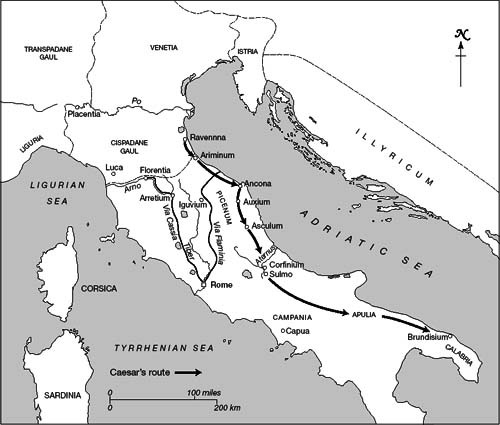
The Italian Campaign 49 BC
They were wrong. On the night of the 10/11 January 49 BC, Caesar led his men from Ravenna to Ariminum (modern-day Rimini). When he crossed the River Rubicon – so insignificant a stream that we cannot now be sure of its location – he left his province, where he could legally command troops, and entered Italy, where he could not. He is said to have used a gambler’s tag when he did so, the famous ‘the die is cast’ (iacta alea est). Later he would place the blame for the civil war squarely on his enemies, saying that ‘They wanted it; even after all my great deeds I, Caius Caesar, would have been condemned, if I had not sought support from my army’ Whatever the rights and wrongs of the conflict, the simple fact was that crossing the Rubicon turned him and all his supporters into rebels.19
It is unclear whether Antony, Cassius and Curio joined Caesar at Ariminum or earlier at Ravenna, but the former seems more likely. In either case, the Thirteenth was paraded and the proconsul addressed them and explained how he had been forced to act by the bitter and illegal hostility of his enemies, who had lured Pompey away from him. The two tribunes were still dressed as slaves when they were brought before the soldiers to underline the way that his opponents had trampled on the laws. The persons of the tribunes of the people were sacrosanct and yet these representatives of the people had been threatened with violence. All Romans had a deeply emotional attachment to the idea of the tribunate and by the end of the parade the legionaries and their officers were shouting that they were ready to set things right.20
Antony was a few days short of his thirty-fourth birthday. Years later Cicero would blame him for starting the civil war. That was a huge exaggeration, for it is hard to see enough trust on either side to have made a peaceful resolution possible. It is fair to say that Antony was an active participant in the actual events that sparked the war. He also showed no reluctance about taking part in an invasion of Italy.21
TRIBUNE WITH PROPRAETORIAN POWERS
Caesar did not linger, but pressed on. His opponents were unprepared and had no reliable troops to oppose even the small invading army. Town after town opened its gates to Caesar’s men. Antony was sent with a force of five cohorts from the Thirteenth to occupy Arretium (modern-day Arezzo). There was no fighting. A little later Curio led another column to Iguvium. The Pompeian commander fled, his soldiers deserted and the townsfolk welcomed the cohorts. From the beginning, Caesar maintained very strict discipline and forbade his soldiers from looting or indiscriminate acts of violence. They were to fight only when actively resisted.22
Absolutely no one had anticipated Caesar’s strategy. Even men like Cicero who knew Caesar personally and had hoped to avoid the war, expected him to advance like Sulla or Marius, plundering and slaughtering all his opponents. Instead, he paraded his clemency. When he surrounded a large force at Corfinium under the inept leadership of Domitius Ahenobarbus, the town surrendered after a brief siege. Ahenobarbus — Antony’s rival for the augurate — and all of the senior officers were allowed to go free, taking their possessions with them. His soldiers nearly all changed sides and joined Caesar, who proclaimed that this was ‘a new way of conquest — we grow strong through pity and generosity’.23
Early on Pompey had decided that it was impossible to defend Rome. He had very few trained and reliable soldiers. Levies were held, but the raw legions raised in this way would take many months to be trained. Everything had to be improvised and for the moment he and his supporters were weak. Hotheads like Ahenobarbus tried to force him to fight, refusing to obey orders and retire to join him. Attempts at negotiation continued, some involving Antony’s cousin, the son and namesake of Lucius Julius Caesar. Both sides repeated their desire for peace and much of this may have been intended to win support from the undecided. The bulk of the Senate, let alone the wider population, felt no strong commitment to either side and tried to remain out of the conflict.24
Pompey retreated to Brundisium in the south and began transporting his men by sea across to Greece. There he planned to assemble and train a great army, drawing on the resources of the eastern provinces he himself had organised. Once he was ready, he would return and crush Caesar. As he put it, ‘Sulla did it, so why can’t I?’ Caesar pursued and tried to prevent his escape, but failed to close the harbour. Brundisium fell, but only after Pompey and his forces had escaped.25
Caesar had won the first campaign, but he remained a rebel with many strong enemies at large. He lacked the ships needed to follow Pompey, so instead decided to march by land to Spain and defeat the Pompeian legions there. First he needed to make arrangements for the governance of Italy. He returned to Rome, but at first did not enter the city itself. Antony and Cassius as tribunes summoned a meeting of the Senate to a spot outside the pomerium on 1 April. Few attended, and only two of these were former consuls. Nevertheless, Caesar took the opportunity to address the meeting and later an Assembly of the Roman people to lay out his case. The Senate decreed that an embassy should be sent to Pompey and his allies in the hope of agreeing a peace. No one was willing to serve on the delegation, however, and so the whole matter was dropped. Needing funds to pay his soldiers, Caesar took money from the Republic’s Treasury, in spite of the opposition of another of the tribunes. This was only a few months after proclaiming his willingness to fight on behalf of the rights of the tribunate.26
Caesar then left for the campaign in Spain. Antony’s brother Caius Antonius was given command of two legions and sent to Illyricum, nearest to the massing enemies in Greece. Curio received the legions that had defected at Corfinium and was sent to Sicily, with orders to proceed to North Africa once this was secured. On his way, the young aristocrat visited Cicero and spoke with his usual freedom, claiming that Caesar’s clemency was a sham and that soon he would reveal his true and far more cruel nature, becoming another Sulla.27
As well as generals, Caesar needed administrators. Rome was put under the charge of the praetor Marcus Aemilius Lepidus, the younger brother of the consul of 50 BC and a man who would later play a major role in Antony’s life. Antony himself was given special propraetorian imperium to add to his office of tribune and was tasked with overseeing the rest of Italy. Both men were appointed because they were already properly elected magistrates and also because they came from well-established families. It was still an unprecedented responsibility for a tribune. Antony revelled in the power.28