
Pompey ought to have won the civil war, for he had far greater resources at his disposal and appeared to have much wider political support. He had lost Italy, but that was principally a blow to prestige and did not seriously reduce his capacity to fight. By the summer of 49 BC Caesar had outmanoeuvred the Pompeian armies in Spain and forced them to surrender. The leaders were permitted to go and duly returned to Pompey. The junior officers and soldiers switched sides or were demobilised. The legions in Spain had been the most experienced under Pompey’s command, but they were trapped in a strategic backwater and the campaign decided nothing. If Caesar had been beaten, then the civil war would have been over, for the rebel could not afford to lose even once. To Pompey the defeat was of only minor significance and, more importantly, the campaign had given him time to prepare for the real confrontation. Organisation had always been Pompey’s forte and the fifty-eight-year-old seemed rejuvenated as he gathered and trained his army in Greece.1
There was also encouraging news from other theatres, as Caesar’s subordinates failed to match his successes. Caius Antonius led one and a half legions into Illyricum, but was overwhelmed and captured. Curio at first did well against weak opposition and had enjoyed a bloodless victory in Sicily – a minor reverse for Pompey’s cause. The Pompeian commander of the island was Cato, but he had no significant forces and decided not to waste citizens’ lives in a futile defence, so left and went to Greece. Curio then took two of his four legions over to North Africa. Lack of transport ships severely restricted the Caesareans, just as it had prevented Caesar from following Pompey across the Adriatic, and the invasion was a gamble. At first the risk paid off and his legions of recently captured Pompeians proved remarkably loyal, with only a handful of desertions. One enemy army was routed at the cost of only a single fatality. Curio had very little military experience, but was bold and charismatic. He was also fighting against an opponent with hastily raised soldiers and inexperienced officers. In the early campaigns of the civil war, both sides contained a high proportion of unskilled amateurs.
Then things started to go wrong. King Juba of Numidia was a staunch ally of Pompey – not least because while on an embassy to Rome he had been insulted by both Caesar and Curio. Acting on false intelligence, Curio force-marched his men in the hope of ambushing the king’s vanguard. He won a minor victory, but then realised that the entire Numidian army was closing on his position. Impulsively, Curio chose to fight. He was killed and only a handful of his men escaped. There was panic and chaos when these survivors reached the troops left back at the Caesarean base camp on the coast, a horde of fugitives swamping the boats trying to take them off. The historian Asinius Pollio was one of the few who managed to get away by ship to Sicily. Juba executed all those who surrendered, in spite of the protests of his Roman allies.2
By the end of 49 BC one of Antony’s brothers was a captive of the enemy, and the severed head of his old friend Curio had been triumphantly presented to King Juba. His cousin, the younger Lucius Julius Caesar, was with the Pompeian forces in Africa and would lose his life during the course of the war. The boy’s father remained a Caesarean. The Roman aristocracy was close knit and everyone had some connections in the opposing camp.
The split in the senatorial class was not even and its more distinguished members – including nearly half of the former consuls – actively supported Pompey. This gave him a deep political strength and an impression of legitimacy, which Caesar could not match. In spite of his victories in Italy and Spain, Caesar was a rebel and the Pompeians could still make a better claim to be defending the Republic. Only a handful of ex-consuls actively supported Caesar and these included three discredited men recalled from exile. One was Gabinius, and another was Antony’s uncle, Caius Antonius, although the nephew was later accused of having done little to encourage Caesar to recall him. Cicero was contemptuous of the Caesareans, dubbing the ones he saw accompanying their commander in March 49 BC as a ‘rabble’.3
Like Antony and Curio, quite a few Caesareans came from noble families, but they were generally young, had reputations for wild living and radical politics, both of which had drained away their inheritances. The older men who followed Caesar were the failures and the desperate, descendants of the men who had backed Marius and paid the price, survivors of Catiline’s rebellion or those who had fallen foul of the courts. Caesar had a well-proven record for generosity, saying that he would reward even bandits if they served him well. Some had simply taken a pragmatic judgement of who was likely to win the conflict. Cicero’s correspondent Caelius believed that Pompey had the better cause, but Caesar the better army, and so became a Caesarean.4
The Pompeians had little to offer men like Antony. Not only did Caesar promise lavish reward once victory was won, but also there was the chance of important commands and responsibilities in the meantime. There were plenty of Pompeians who had been consul or praetor, and who had governed provinces and led armies. Such men expected to receive tasks in keeping with their status. Had he been a Pompeian, there were no imaginable circumstances where the thirty-four-year-old Antony would have been given such an important task as the supervision of Italy.
Caesar had far fewer distinguished men to call upon. Antony was an elected magistrate, and was also an Antonius, both of which made him more qualified for this task than most of the other Caesareans. It is also clear that Caesar had confidence in his ability to do the job, although interesting that for the moment he did not choose to employ him in a more overtly military role. As we have seen, Antony’s military experience was still relatively modest and it is quite possible that he had been as much or more an administrator as a soldier during his years in Gaul. Caesar did take his fellow tribune Cassius Longinus with him on the Spanish campaign, and left him behind as provincial governor. Cassius had both a brother and a cousin fighting for Pompey, but the appointment was to prove a bad one for other reasons.
Antony did a better job as tribune with propraetorian power in Italy. The peace was kept, with no upsurge of Pompeian resistance. In the meantime, progress was made in preparing the army and fleet for crossing to Macedonia. How much either of these things was a direct result of Antony’s personal involvement is impossible to know, as we have very little information about these months. Plutarch claims that he was energetic in organising and training the troops, and popular with the soldiers for his generosity. In contrast, he was supposed to have shown little energy when it came to receiving petitions from civilians. He does seem to have travelled widely, visiting many of the towns of Italy. People noticed Antony, and this was not always a good thing for the Caesarean cause, because he paraded his power. Cicero claimed that:
A tribune of the people was driven in a British chariot, preceded by lictors crowned in laurel [the symbol of victory], and in the middle a mime actress carried in an open litter; respectable men from the towns were obliged to greet her, and address her as Volumnia, rather than her stage name. Following behind were his shameful companions — a whole band of pimps — and at the back his mother, attending her wicked son’s mistress just as if she was a daughter-in-law.5
This description comes from a speech made years later, but although the orator may have exaggerated a little, there is evidence from the time that he was not inventing the whole story. In May of 49 BC he mentioned in a letter that Antony carried his mistress ‘about with him in an open litter just like a second wife, and had seven other litters with male and female friends’.6
At some point in the last few years Antony had married for the second time. We do not know what happened to his first wife, but he may have divorced her because of her undistinguished family. Instead, he married his first cousin, the daughter of Caius Antonius. This connection made it seem all the more strange that he did little to encourage Caesar to recall Antonius, but the marriage seems not to have been a happy one. A year later he would divorce Antonia amidst rumours that she had taken a lover. Gossip claimed that Antony had affairs with the wives of several other men, but Roman society did not grant the same licence to a wife as it did to a husband.7
Antony himself reserved his passion for his mistress in a relationship that lasted several years. She was a freed slave, and the name Volumnia was the feminine form of her old master’s name. Professionally she was known as Cytheris. Taking a mistress was common for Roman aristocrats and there existed a distinct class of courtesans, some of whom became famous. These women were usually foreign, and often freed slaves, but were educated and witty, stylish and in many cases able to sing, dance and play musical instruments. Quite a few, like Cytheris, had first won fame on the stage in the mimes — stories told through dance and music in which women took part, unlike drama where female parts were generally performed by male actors.8
Such a mistress could not be taken for granted. Suitors competed to win her favour, offering gifts and ultimately providing a house or apartment for the lover to live in. Both parties knew that the affair would not be permanent, and a mistress could end the relationship if she found a more appealing protector. Able to flatter and flirt in a way that would have been socially unacceptable for a wife, expensive mistresses offered exciting and glamorous company in affairs that were spicy, but without long-term commitment. Cytheris had already had an affair with Servilia’s son Brutus, a man whose philosophical leanings and sober nature seem so opposite to Antony’s character. Considerable licence was allowed to senators’sons during their adolescence — a period that the Romans felt lasted into the late thirties. Yet they were expected to show at least some discretion, and this was something Antony seems never to have mastered or even thought necessary. A story circulated that he had a chariot pulled by a team of lions rather than horses. Whether or not such an absurdly impractical and dangerous experiment was actually made, it gives an idea of what people were willing to believe about him.9
He paraded his power in a way that was both blatant and vulgar, giving the impression of enjoying himself in luxurious debauchery instead of labouring diligently. For Cicero, this confirmed his worst fears that Caesar would eventually throw off the facade of clemency and preside over a bloodbath. The orator believed the war to be unnecessary and had tried to encourage a negotiated settlement. He had been shocked by the militancy of many leading senators, then dismayed by the evacuation first of Rome and then of Italy itself. Yet he was still drawn to Pompey and more comfortable siding with him and his allies than Caesar and his ‘rabble’. For a while he stayed in Italy, avoiding taking part in the meetings of the Senate at Rome or committing himself in any way to Caesar. His protege Caelius Rufus and several friends who were with Caesar repeatedly encouraged him to take this step, or at the very least maintain his neutrality. Another voice came from his son-in-law Dolabella, but Cicero despised the man. The marriage to his daughter had been arranged by his wife while he was away in Cilicia and without his approval.10
Antony kept an eye on Cicero, for it was obvious that the famous orator was tempted to leave the country and join the Pompeians. In early May, Cicero mentioned that he had repeatedly written to the tribune, assuring him that he planned nothing rash, but expressing a desire to go abroad, perhaps to Malta, and avoid all involvement in the war. Antony had replied:
Had I not such strong affection for you — far greater than you think — then I would not have been disturbed by the rumour which has spread about you, particularly as I believed it to be untrue. However, because I am so very fond of you, I cannot pretend to myself that the report, even if false, does not greatly worry me. That you are about to go abroad I cannot believe, given your love for Dolabella and your [daughter] Tullia, the finest of women, and because you are so highly esteemed by all of us.… But I felt it unbecoming in a friend not to be concerned even by loose talk, particularly as our disagreement made things more difficult for me, the whole thing caused more by my jealousy [Antony uses the Greek word] rather than any wrong deed of yours; for I wish to assure you that nobody is more dear to me than you, apart from Caesar, and I am sure Caesar counts Marcus Cicero amongst his foremost friends. And so, my dear Cicero, I implore you not to make a mistake … and not to flee from one [Caesar], who, even if he cannot love you — for that is now impossible – will always want you to be safe and held in the highest honour.11
Again, Cicero assured Antony of his resolution to remain neutral and asked permission to leave Italy and go somewhere peaceful. Antony was unhelpful:
Your plan is quite correct. For anyone who wants to remain neutral should not leave his homeland, while the man who leaves is seen to take one side or the other. However, it is not my place to determine whether anyone has the legal right to leave. The task Caesar has given me is not to permit anybody to leave Italy. It really does not matter what I think of your plan, since I am not permitted to allow you to go. I think you ought to write to Caesar and ask his permission. I have no doubt that you will be successful, especially as you assure us of our friendship.12
Some of this may have been a smokescreen, for Cicero had secretly arranged some time before for a ship to be ready to transport him. When he finally slipped away, it was to go directly to Pompey.
MACEDONIA
Caesar came back from the Spanish campaign in the autumn of 49 BC. En route he had to deal with a mutiny amongst the Ninth Legion encamped in northern Italy. The soldiers complained that they had not yet received the rewards he had promised them, but the real cause was said to be the tight discipline that prevented them from plundering. Boredom during a lull in the fighting fostered the discontent. Caesar arrested the ringleaders and executed a proportion of them, restoring order very quickly.13
There was no consul to preside over the consular elections for 48 BC. Caesar suggested that the praetor Lepidus be allowed to perform this task, but the college of augurs refused to accept this. Presumably Antony had voted in favour, and Pompey and Cicero were both in Macedonia, but there must have been enough other members of the priesthood to block this idea. Instead, Caesar had Lepidus declare him dictator and held the elections himself. It was common for a dictator to be appointed to oversee voting when a consul was unavailable, but never before had one been named by a praetor. The legality was questionable, but there was no other obvious solution. The senators with Pompey did not presume to hold elections of their own and instead simply extended the command of all elected magistrates on their side.14
Caesar was elected to a second consulship, with Publius Servilius Vatia Isauricus as his colleague and, that task done, then resigned the dictatorship. After eleven days he left Rome and went to the army mustering at Brundisium, eager to press on with the war. Antony and his other subordinates had gathered a considerable number of transport ships, but there were still nowhere near enough to carry the entire army and only a dozen warships to escort them. Cutting baggage to the bare minimum, Caesar managed to cram 15,000 legionaries and 500 cavalry into the available ships. On 4 January 48 BC he set sail, reaching Epirus and disembarking without meeting the enemy.
Antony does not seem to have been elected to any magistracy for this year, but continued to wield imperium either as an extension of his extraordinary tribunate or now as one of Caesar’s legates. He did not go with the expedition to Greece, but was one of those left behind with instructions to bring more soldiers as soon as possible. This proved longer than expected. Caesar had sneaked across because the Pompeians had not expected him to risk the voyage and begin a campaign in winter. Now they were waiting, with a fleet of some 500 warships under the overall command of Bibulus.15
For a while it was impossible to break the blockade and Bibulus showed himself an especially ruthless opponent, burning captured ships with their crews still on board. Some of this was deliberate atrocity intended to terrify the enemy. There was also the long years of jealousy and loathing for Caesar himself, and perhaps the bitterness of a father whose sons had been murdered. Oared warships carried a very large crew of rowers in proportion to their size and there was little space for food and fresh water. This meant that a navy was heavily dependent on land bases. Caesar tried to break the blockade by seizing the ports and coastline suitable for landing. It was a tough campaign and at some point the exhausted Bibulus fell ill and died.16
The blockade continued unabated, preventing news as well as supplies and men from reaching Caesar. As the weeks dragged on, he is said to have decided that the only way to get things moving was to return to Italy himself. Sneaking out of camp, he secretly set sail in a small boat accompanied by a handful of slaves. In spite of his immense self-confidence – as the storm grew worse he assured the captain of the vessel that everything would be fine because he carried ‘Caesar and Caesar’s good fortune’ – the weather proved too bad and they had to turn back. Another story claims that he then sent messengers to give orders summoning the rest of the army. The order was to be given first to Gabinius, and if he did not instantly obey, they were to give it next to Antony, and finally to a third officer if Antony failed to act.17
The last story is probably an invention, for there is no good evidence that the loyalty of his subordinates was ever in question. It is possible that Caesar became nervous, although as usual his Commentaries present a picture of perfect assurance in his ultimate success. In fact, Antony does seem to have worked hard to get across the Adriatic, because the Pompeian squadrons not only patrolled the sea, but also raided Brundisium itself and tried to close the port altogether. On one occasion Antony set up an ambush, luring the enemy ships close into the harbour and then overwhelming them with a swarm of small rowing boats packed with soldiers. After this success, and finding it difficult to land on shore and fetch water without falling prey to Caesarean cavalry patrols, the Pompeian squadron withdrew.18
Antony finally broke the blockade and led some 10,000 legionaries and 800 cavalry to land at Lissus in the north of Greece on 10 April. It was the largest independent command of his career so far and he handled it competently, but it was short-lived. Caesar managed to hear of his arrival and the two halves of the Caesarean army were united before Pompey could intervene. They were still heavily outnumbered by the Pompeians, especially in cavalry, but had the advantage that most of their legionaries were veterans confident of victory. Caesar offered battle and, when Pompey declined to risk an engagement, he decided to strike at the Pompeians’ main supply depot at Dyrrachium on the coast. His opponent swiftly realised what was happening, and managed to get there first.
A surprise attack having failed, Caesar turned instead to blockade, trying to hem the Pompeians in against the sea by building a line of fortifications on the high ground. Pompey responded by ordering his men to construct their own fortified line, aiming to build it quicker and so prevent the enemy from completely encircling them. Caesar’s men toiled just as they had done at Alesia. Antony was now in command of the Ninth Legion, the same veteran formation that had mutinied the previous year. The tough old soldiers – the formation had been raised before Caesar arrived in Gaul in 58 BC and had seen constant service since then, being described as ‘veterans of exceptional courage’ – once again laboured and fought hard.19
There was a series of small-scale engagements to control key ground on which to build the fortifications. Early on the Ninth seized a hilltop position and began to fortify it, but were soon under a hail of missiles from enemy skirmishers and artillery. As casualties mounted Caesar ordered a withdrawal, but when the legionaries pulled back they were hard-pressed by the enemy. Troops were brought up to cover the retreat. Then Caesar decided that he did not want the enemy to think they had chased his men away. Antony was ordered to charge back up the hill, which he did, the Ninth routing their pursuers and inflicting heavy losses. After this, they were able to retreat unmolested.20
Pompey had a large force of cavalry, and in the confined plain outside Dyrrachium there were limited supplies of forage and so the horses began to suffer. Yet overall his men had more food than Caesar’s soldiers, who were making do with minimal rations. Some gathered a local root called charax and baked it into a substitute for bread. Pompey had far more men, and since he was on the inside, these had a shorter distance of fortified line to build. It was a race Caesar’s men could not win and it soon became clear that they would not be able to complete the encirclement. Even so, they repulsed a succession of Pompeian assaults on sectors of the line. Three cohorts of the Ninth managed to hold one fort for an entire day, although in the process almost every man was wounded. Caesar claims that 30,000 enemy arrows were collected from within the fort and the shield of one centurion was struck by no fewer than 120 missiles. This man lost an eye during the fighting, but remained on his feet and kept fighting. Antony led up the reserves, which finally drove the attackers away.21
Yet the pressure continued and, after a lull when Pompey’s men strengthened their line, he launched another assault that finally punched a hole in a vulnerable section of Caesar’s line. Caesar countered with an attack of his own on what seemed to be an isolated enemy camp containing a single legion. The Ninth was part of a force of thirty-three cohorts sent to overwhelm this position, but after initial success the attackers got lost and the attack bogged down. Failure turned to panic when the enemy rushed reinforcements to the spot and drove the Caesareans back. Casualties were heavy — 960 soldiers and thirty-two tribunes and centurions. The Pompeians also captured thirty-two standards as well as some prisoners, who were subsequently executed.22
It was a serious setback and forced Caesar to acknowledge that he had failed in his objective. There was little point remaining where he was and allowing the soldiers to suffer with no prospect of success. Under cover of darkness he sent away his baggage train and his wounded under the guard of a single legion. The main part of the army followed later, leaving only a rearguard, which managed to convince the enemy that nothing was amiss. After a while these, too, followed on. At last Pompey realised what was happening and sent his cavalry in pursuit. Caesar’s horsemen were outnumbered and their mounts probably in as poor a condition as those of the enemy cavalry. However, they were closely supported by a strong force of legionaries and able to drive off the pursuers.23
Caesar’s men now marched through country untouched by the recent campaign and found it much easier to gather supplies. The town of Gomphi refused to let them in, so he stormed the place and allowed his men to sack it in a drunken orgy of looting and destruction that was credited with restoring both their morale and health. It was also a dreadful warning that persuaded other communities in the path of the army to be more welcoming.24
Pompey followed. Dyrrachium had been a clear victory and vindicated his strategy of avoiding battle and slowly wearing down the enemy army. Caesar had left the coast to march inland and was now cut off from Italy and any reinforcement or supply convoy. Pompey had twice as many legionaries, and many more cavalry and allied soldiers. Some of the senior senators in his camp urged him to ignore Caesar and return to Italy, but he was reluctant to leave the campaign unfinished and permit his enemy to escape. Therefore the main question was whether to continue to avoid battle and harass the Caesarean army, whittling it away until it withered from lack of food or was forced to surrender. This would take time, but seems to have been Pompey’s own choice. The other option was to rely on his advantage in numbers and crush the enemy in battle.
That was the view of most of the senior senators and some whispered that Pompey only wanted to prolong the campaign because he revelled in exercising supreme command. Confident of success and eager to enjoy its spoils, they put steady pressure on the commander to risk a battle. This was the great disadvantage that came with the political benefits of having so many distinguished men in one camp. Cato was sent off on detached duty largely because Pompey became tired of his acidic comments. Cicero was equally unpopular, for he found himself almost as disgusted by the leading Pompeians as he had been by Caesar’s followers. Unlike his opponent, Pompey did not have a completely free hand. His character was also different, for he craved popularity. For whatever reason, he chose to give battle. Caesar readily accepted the offer.25
On 9 August 48 BC, near the small town of Pharsalus, Pompey formed his 45,000 legionaries into three lines of cohorts, each one ten ranks deep. His right flank rested on the River Enipeus, but the left was on an open plain and it was here that he massed most of his 7,000 cavalry, placing them under the command of Labienus, Caesar’s old legate from Gaul. Caesar matched the frontage of the enemy infantry, forming his 22,000 legionaries in three lines of cohorts, each of which was in a shallower formation. Mark Antony was given command of the left flank, resting on the river. On the very left of the formation his Ninth Legion was so depleted in numbers that it was merged with the Eighth Legion to form a more viable unit. Caesar had about 1,000 horsemen to face the massed enemy cavalry.
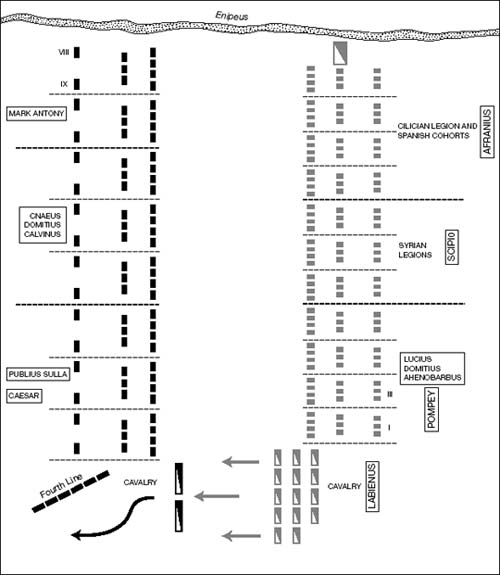
The Battle of Pharsalus, first phase
Caesar took six cohorts from the third line of cohorts and stationed them behind his mounted troops. In the dust thrown up by so many marching feet and hoofs, and with the cavalry screening their front, the Pompeians do not seem to have noticed this deployment.
Pompey relied solely on the great cavalry attack to sweep Caesar’s horsemen away and then roll up the right flank of his army. It was not a subtle plan, but it could well have worked. Instead, his inexperienced cavalry had merged into one great unmanoeuvrable mass by the time they drove back the Caesarean horse. Suddenly the cohorts of the fourth line advanced through the clouds of dust and stampeded the Pompeian cavalry into a panicked flight. In the centre the Pompeian infantry had not charged to meet the Caesarean legionaries. They were slowly driven back, and when the fourth line swung round against the flank left exposed by the rout of the cavalry, the entire army began to dissolve.
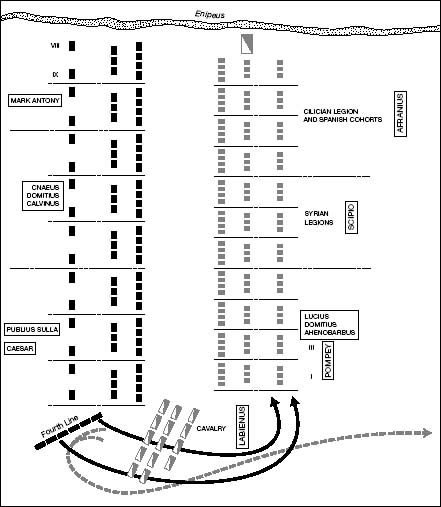
The Battle of Pharsalus, second phase
We know little about what Antony did during the battle, but it is safe to say that he performed well, and Plutarch claims that his valour was conspicuous throughout the campaign. His role was not one that required any great tactical decision making, for all the key moves were made on the right flank under Caesar’s direct supervision. Nevertheless, the flanks were considered places of honour and it was a mark of trust that Caesar gave him this major responsibility. It marked him out as one of Caesar’s senior subordinates. Later, there was criticism that he was overly bloodthirsty during the pursuit, killing men Caesar had wanted to capture, but this may simply be propaganda. Ahenobarbus was one of the most conspicuous Pompeians to be killed and Cicero later blamed Antony for his execution, but the majority surrendered or escaped.26
Pompey was one of the first to flee the battle. When his grand cavalry attack failed, he does not seem to have had an alternative plan. He had been reluctant to fight in the first place, and now despaired. He made his way to the coast, gathered his family and a small force and set sail. For a while he was uncertain of where to go, but determined to rebuild his strength and continue the struggle. Soon he thought of Egypt, remembering his past support for Auletes and his family, the presence of the Gabinians as the basis for a new army and the country’s wealth and resources.27
When Pompey the Great came to Egypt it was not as conqueror, but a fugitive.