
To curb the rise of Octavian, Antony had made some public offers of compromise with Brutus and Cassius, but this alienated many of his supporters who were staunch Caesareans and loathed the assassins. It was a difficult, probably impossible balancing act. In August Calpurnius Piso criticised Antony in the Senate. Cicero, who had planned to go abroad, was sufficiently encouraged to return to Rome, but failed to attend a meeting on 1 September, pleading fatigue from his journey. In his absence Antony attacked him and then proposed fresh honours for Caesar. The next day Antony was not in the Senate, but Cicero did go and delivered a speech that would later form the basis for his First Philippic. The original Philippics had been delivered by the famous Athenian orator Demosthenes, warning his fellow citizens of the danger posed by King Philip II of Macedon, the father of Alexander the Great. Cicero’s first speech was fairly moderate, but still represented a concerted attack on Antony’s position and actions.
The consul responded angrily, although it was not until 19 September that he lambasted the orator in a speech. Antony blamed him as the real instigator of the Ides of March, criticising him for his ‘ingratitude’ to a man who had treated him generously in 48BCand, in true Roman fashion, freely damning his character and politics. Cicero retired to the country and wrote his Second Philippic. This was never delivered as a speech, but took the form of a pamphlet, and copies were sent out to a few associates, although opinion is divided on how widely it was circulated. The text replied in kind, liberally slinging invective at Antony’s whole life and career.1
About this time, Antony had a statue of Caesar erected on the Rostra in the Forum, which referred to him as ‘father and benefactor’. Such a statement made it harder to agree any compromise with the conspirators. Then he accused Octavian of sending an assassin to murder him. Cicero was deeply suspicious of the ‘young Caesar’, but was cheered by this news and slowly began to wonder if the boy might be useful. It was probably no more than a rumour. Octavian had little to gain by killing Antony and could not yet risk an open confrontation. A few weeks later, his hand became stronger.2
Three legions of the Macedonian army arrived at Brundisium, and a fourth was soon to follow. By the vote of the people, these soldiers were placed under Antony’s command and their officers had obeyed the summons to come to Italy. They were well trained, and it is reasonable to think that they were strong in numbers and perhaps even close to their full strength. Antony had no prior connection with these units, which had been training in Macedonia since they were formed in 48 BC. Their officers had all been appointed by Caesar and both they and the men were loyal to his memory. They did not know Antony and he did not know them. When he went to meet them in October 44 BC there were angry complaints that he had done nothing to avenge Caesar’s murder.
Antony promised the soldiers a special bounty of 100 denarii apiece, less than half of a legionary’s annual pay of 225 denarii. Octavian’s agents had already visited the camps and promised the men 500 denarii, and ten times as much on the eventual discharge, and so the legions were unimpressed, jeering the consul. It is always worth remembering that officers received far larger sums, so that the centurions and tribunes stood to become very wealthy indeed. Caesar had broken the spirit of the mutinous Tenth Legion with supreme self-confidence and a single word, backed by limited punishment. They were his ‘comrades’, men he had led to victory after victory for twelve years, with whom he had shared hardships and on whom he had lavished rewards, decorations and praise. The bond between soldier and commander was deep and not to be shattered by one disagreement.
Antony and these legions were strangers to each other. On top of that he had no great victories of his own to show and there were no stories of his rewards to his own soldiers. He lacked Caesar’s experience and his gifts, as well as his charisma, and when the soldiers jeered, he lost his temper and tried to bully them into submission. Demanding the names of malcontents from the officers, he ordered executions, although he may have stopped short of a full decimation. Cicero claimed that the victims of this purge included centurions as well as ordinary soldiers, and he seems unlikely to have invented such a detail. It is a lot less likely that the men were killed in front of Antony and his wife, so that their blood spattered onto Fulvia, who was egging her husband on. She may well have been with Antony and possibly urged him to take strong action, but the rest will have come readily to Cicero’s imagination and such invective was rarely expected to restrict itself to the actual truth.
The punishment made the troops angry and resentful, and that was a mistake when Octavian’s agents were still promising far more attractive service under Caesar’s son. The discontent and Antony’s wrath had fallen mainly on the Fourth Legion and theMartiaLegion, whose number has not been preserved and seems to have preferred being known as the war god Mars’ own. As these troops marched north from Brundisium both of these units deserted Antony and marched under discipline to join Octavian. They brought with them some supplies, including a number of war elephants.3
The young Caesar had already gathered some 3,000 volunteers from amongst the veterans and had led these to Rome earlier in November. Few of them had proper weapons and equipment, and they showed a reluctance to back him against Antony. They were also disappointed that he was taking no immediate action to punish the conspirators. Caesar’s heir had yet to prove himself and his strength and connections were still modest, so he left Rome and began recruiting again. When the fully equipped and trainedFourthand Martia legions joined him, he at last had the basis for a proper army. Alongside them he formed new versions of Caesar’s old Seventh and Eighth, as well as a praetorian cohort of picked troops to act as bodyguard and an elite reserve. The young Caesar now had more than ‘just a name. He had an army.4
One legion remained faithful to Antony and another soon arrived at Brundisium and joined him. These were the Second and Thirty-Fifth. Their loyalty was helped at the end of November when he gave them a bounty of 500 denarii, matching Octavian’s promise. He also had a substantial force of auxiliaries, including light infantry and Moorish light horsemen. At some point, he reformed Caesar’s old V Alaudae, the ‘Larks’, originally recruited from Gauls and then given citizenship. There was little to be gained by fighting Octavian at the moment, nor was there any pretext. Instead, Antony decided to march to Cisalpine Gaul and occupy the province allotted to him by the Popular Assembly. Before he went, he made those senators who gathered to see him take an oath of loyalty to him. His soldiers did the same and could probably be relied on more readily to keep it. Given time, Antony had the knack of getting troops, and especially officers, to like him. He now had a force of perhaps 10,000–15,000 men. It would be his first campaign as overall commander.5
CONSUL OR PUBLIC ENEMY?
Decimus Brutus refused to give up Cisalpine Gaul. Earlier in the year he had led the provincial garrison on an expedition against the Alpine tribes. He won some small victories, sharing the rigours of a campaign with his men and rewarding them with plunder to ‘make them firm for the defence of our concerns’. He told Cicero that he thought he had ‘succeeded; for they have practical experience of my liberality and spirit’. There were two legions already in Cisalpine Gaul and soon after his arrival Decimus Brutus began raising another two. Antony also continued to recruit, forming three new legions by the beginning of 43 BC. These new units were inexperienced and needed intensive training before they would become effective. All seem to have been quite small in size, far below their theoretical strength. The normal practice was to establish a cadre, appointing officers and setting up the structure for the entire legion, and then allocate recruits as these became available. This made practical sense, but there was also a propaganda element. An army of four or six legions sounded impressive, even if in reality most of these units were mere shadows of their normal size.6
Decimus was determined to retain the province and the army, although it is probable that his command was supposed to expire at the end of 44 BC. He was unwilling to face Antony in the open and perhaps still hoped that fighting could be avoided. Slaughtering his baggage oxen and smoking the meat to bolster his store of food, he took his army into the town of Mutina and prepared to defend it. Antony established a blockade, but does not seem to have attempted a direct assault. He, too, was reluctant to begin an open war, and anyway it was winter, with poor weather and difficult conditions for foraging. Brutus’ men were doubtless happier to be billeted in a town rather than camping in siege lines outside.7
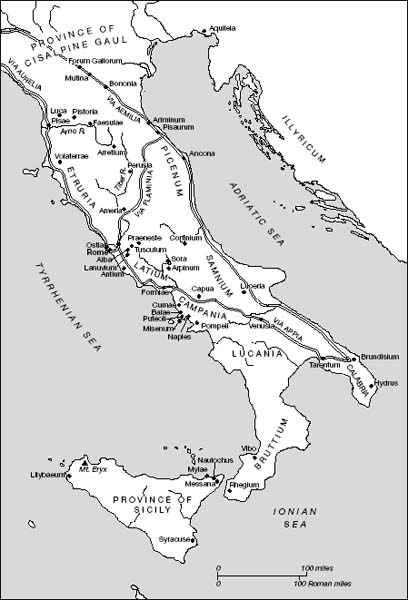
Italy
From late in 44 BC Cicero lobbied hard to have the Senate name Antony as a public enemy and formally declare hostilities against him. Most senators were reluctant to take this step, and Fulvia and Antony’s mother Julia were very visible expressing their dismay that a consul of Rome should be condemned in his absence and without trial. Some senators had connections to Antony, although his two uncles, Caius Antonius and Lucius Julius Caesar, were never more than lukewarm in their support and at times hostile. Many had no particular sympathy for Decimus Brutus or the other conspirators; almost all feared the return of civil war and felt that any compromise would be preferable. To Cicero’s disgust, the Senate sent a delegation of three former consuls – Caesar’s father-in-law Calpurnius Piso, Octavian’s stepfather Philippus and Sergius Sulpicius Rufus – to negotiate with Antony.
The fear of civil war was the most powerful emotion, made worse because it remained so uncertain what the sides would be and who was likely to win. Lepidus was now proconsul of Transalpine Gaul and Nearer Spain, and Asinius Pollio governed Further Spain. Both were Caesareans, but that did not mean they would automatically ally themselves with Antony, and the latter was in any case busy enough trying to contain the resurgent Sextus Pompey. On 1 January 43 BC, the new consuls Hirtius and Pansa took office. They were also Caesareans, although they had not been especially close to Antony in recent months.8
Antony’s brother Caius had gone out to Macedonia, but the legion left there had been subverted by Brutus. Caius was placed under arrest and Brutus took his place as governor and was soon recruiting more soldiers. More violent confrontations had already erupted in the eastern provinces. On his way to Syria, Dolabella had visited Asia, the province allocated by Caesar to Trebonius. Feigning friendship, Dolabella had taken the proconsul by surprise and had him killed. Cicero claimed that Trebonius was tortured first and there were grisly stories of his severed head being thrown about like a ball until the face was unrecognisable. While Dolabella enthusiastically plundered Asia, Cassius went to Syria and brought the army there under his control. He and Brutus now led armies and governed provinces without any authority to do so. At Rome, Cicero struggled and eventually succeeded in getting this recognition for them.9
Sulpicius died on the way back from meeting Antony. The other two delegates returned in February and reported that the latter was willing to give up Cisalpine Gaul, as long as he kept the other Gaul and retained command of his six legions for five years. Antony was insistent that before this period lapsed, Brutus and Cassius must have given up their own commands, tacitly accepting that they held them. He also demanded formal recognition of all his acts as consul and, in due course, discharge bonuses for his soldiers equal to those promised by Octavian.10
Since the beginning of the year, the consuls had led the Senate in making preparations for war. Both gathered armies and Octavian was awarded propraetorian Imperium, although he was still a private citizen. A man with his own fiercely loyal army simply could not be ignored. Decimus Brutus was also confirmed in his command. The Senate rejected Antony’s terms, but only after a fierce debate. Lucius Caesar blocked the move to name Antony as a public enemy. The senatus consultum ultimum was passed, but rather than a formal declaration of war, the crisis was termed a tumultus – something closer in sense to a state of emergency. In many ways the situation was similar to the build-up to war in 49 BC. Both sides were reluctant to commit themselves irrevocably and still hoped that the other would make concessions. There was another attempt to form a delegation to go to Antony, but this came to nothing. Lepidus sent letters urging compromise. Yet while all this went on, Decimus Brutus’ army was steadily consuming its stocks of food and would starve or surrender if not relieved within a few months.
By the start of spring, Hirtius, Pansa and Octavian were ready to.11 move – two former Caesareans and Caesar’s son marching against Antony to save one of the dictator’s murderers. Cicero had decided that the dangers of recognising Octavian were outweighed by his usefulness. He provided three of the seven legions marching to relieve Mutina, the only experienced troops in an army that otherwise was formed of levies. For the moment he placed the Fourth and the Martia under Hirtius’ command, but the soldiers remained loyal to him. Brutus and Cassius both felt that Cicero and the Senate were unwise to trust the young Caesar, but as was so often the case they did not suggest any practical alternative. Three veteran legions could not be ignored and had a fighting power far greater than their numbers. Cicero felt the nineteen-year-old could be used, saying, ‘we must praise the young man, decorate him, and discard him’ (laudanum aduluscentem, ornandum, tollendum).12
Hirtius approached Mutina first, but on his own did not have the strength to attack Antony, and this remained true even when he was joined by Octavian. To let Decimus Brutus know that relief was on the way, they tried lighting beacons, but in the end the news was carried by a man who sneaked through the lines and then swam a river. The same method was used to reply and in the coming days Decimus also employed carrier pigeons with some success. In April, Pansa led the four newly raised legions to join them.13
Antony had word of his coming and saw an opportunity to destroy these inexperienced troops before the enemy forces combined. It was similar to the bold attacks he had led in Judaea and Egypt, if on a much larger scale. He decided to take the SecondandThirty-Fifth legions, along with two elite praetorian cohorts (one his own and the other raised by one of his supporters), and some of his enrolled veterans, as well as supporting cavalry and light troops. Yet unlike Judaea and Egypt, this time his opponents were a lot more capable. Hirtius and Octavian moved first, sending the Martia and their own praetorian cohorts to rendezvous with Pansa’s column. On 14 April the combined force advanced towards the town of Forum Gallorum, moving along the Via Aemilia, which at this point ran on a causeway through patchy marshland. Patrols spotted some of Antony’s cavalry and then noticed the gleam of helmets and equipment amongst the long reeds.
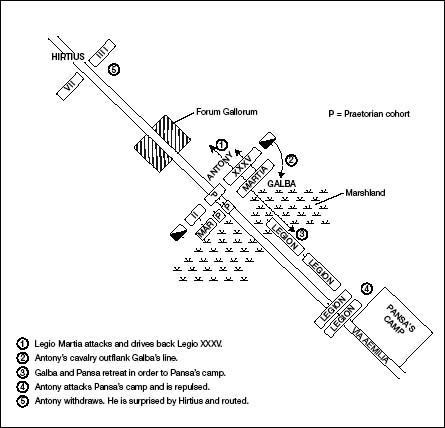
The Battle of Forum Gallorum
Remembering the executions of the previous summer, the men of the Martia boiled over with rage and attacked immediately, supported by the two praetorian cohorts. As yet they had only spotted Antony’s cavalry and skirmishers, for the Second and Thirty-Fifth were concealed in Forum Gallorum itself. It was a confused, unplanned engagement and the broken terrain produced several separate combats. Pansa sent two of the raw legions up in support, but the battle was already well advanced before these arrived.
The commander of the Martia was another of Caesar’s former officers named Servius Sulpicius Galba, and he later reported that they had formed the ten cohorts of the Martia and the two of praetorians in a single line – an unusually shallow formation for a Roman army. On the right, he led eight cohorts of the Martia and drove back the Thirty-Fifth no less than half a mile. This left his flank exposed and Antony’s cavalry led by the Moors began to envelop the line. In the confusion of this fluid combat, the general found himself riding amongst Antony’s soldiers. Antony himself was some distance behind him, for a Roman commander was expected to direct and encourage from just behind the fighting line. Galba was spotted as he fled back to his own troops. Chased by the Antonians, he had to sling his shield behind him to stop himself being killed by his own side when the recruits coming up in support mistook him for a bold enemy leader.
The veteran soldiers of the Macedonian legions fought each other with a grim and, according to Appian silent, savagery. Octavian’s praetorians were ground down as they stubbornly held the Via Aemilia itself. On the left side of the road, there were only two cohorts of the Martia and Hirtius’ praetorians. Before long Antony’s cavalry was threatening their flank. They were forced to retreat and soon the whole line was giving ground. Pansa was wounded by a missile, but the resistance of the experienced troops permitted the whole army to withdraw to its camp without suffering catastrophic losses. Antony pressed them and tried to make the victory decisive by storming the camp. His men were now weary and the enemy still numerous and determined enough to repulse them.
Antony led his men back to their camp some miles away. They were cheered by their success, but physically tired, emotionally drained and hungry after hours of waiting, marching and fighting. Caesar would probably have camped on the spot and brought supplies to them. Antony saw no danger and as the column marched carelessly along, Hirtius led the Fourth and the Seventh in a surprise attack. The Antonian soldiers fled, surrendered or were killed. The eagle standards of the Second and Thirty-Fifth were captured, along with half of their other standards, and the two effectively ceased to exist as units. The survivors spent the night in the houses of Forum Gallorum.14
The blockade of Mutina was still intact, but Octavian and Hirtius moved the combined army closer. A week later they tried to break through the siege lines. A battle developed and Antony was defeated, making him abandon the siege and retreat. When news reached Rome, the Senate was finally persuaded to declare him a public enemy. Yet control of events was slipping away from Cicero and the others eager to prosecute the war against Antony. Hirtius had been killed as he led his men into the Antonian camp. Pansa succumbed to his wounds soon afterwards. Octavian was left in command of the entire army and this was clearly very convenient for him. There need not have been anything suspicious about the consuls’ deaths and neither is it certain that he would not have found them sympathetic to him if they had lived. Neither had shown much enthusiasm for the conspirators.
Octavian asked the Senate for a triumph. Cicero tried and failed to get him the lesser honour of an ovation. Caesar’s triumph after the Munda campaign in 45 BC had shocked people for blatantly commemorating a victory in a civil war. Less than two years later it seemed much easier to discuss such things. On the whole, the Senate was relieved to see Antony defeated, but was not inclined to be generous. Rewards to the soldiers of the Fourth and Martia were reduced and Octavian was not included in the commission tasked with providing land for the soldiers on discharge. It was a sign that moves were now under way to discard the young Caesar.15
ALLIANCE AND PROSCRIPTION LISTS
Antony had been outmanoeuvred and out-fought during the campaign. Once again, it is worth emphasising that this was his first campaign in sole command and his military experience of large-scale operations was limited to Italy in 49 BC and Macedonia in 48BC. The civil wars were fought by improvised armies containing many inexperienced amateurs. Yet he was at his best during the retreat, sharing the same poor rations as his men, even drinking stagnant water and eating wild fruit and roots scavenged during the march into the Alps. There was encouragement when he was joined by Publius Ventidius Bassus with three legions recruited from the colonies set up for Caesar’s veterans. Ventidius had himself served Caesar in Gaul and the civil war, which probably made it easier for him to re-enlist these old soldiers.
Octavian’s veterans were bitterly opposed to serving under Decimus Brutus, whom the Senate now appointed to overall command of the forces in Cisalpine Gaul. The young Caesar himself was scarcely any more enthusiastic. The victors were divided amongst themselves and this prevented any concerted pursuit, helping Antony to escape into Transalpine Gaul, where Lepidus controlled a powerful army that included many experienced soldiers and officers. The former Magister Equitum had proclaimed his loyalty to the Republic on numerous occasions, but Cicero and many others found it difficult to trust him. It did not help the situation that around this time Cassius received formal recognition of his command, while even Sextus Pompey was finally appointed to a naval command instead of being simply a rebel. Caesar’s enemies seemed to be growing strong and little incentive was being offered to former Caesareans to support the Senate. The veterans were frustrated by the failure to punish his assassins. For Lepidus, as for the other leaders at this time, power and security depended ultimately on control of his army. His men struggled to see Antony as the real enemy and his best troops were re-enrolled veterans, for Lepidus had reformed several of Caesar’s legions including the Tenth.
The two armies camped near each other. Antony made no hostile moves, and no doubt encouraged his men to fraternise with those of Lepidus. Plutarch tells us that he had not shaved since the defeat at Mutina — a mark of mourning Caesar himself had employed until he avenged the massacre of fifteen cohorts at the hands of rebels in 54–53 BC — and that he wore a black cloak. Within days, the army defected to Antony en masse. Lepidus claimed to have been forced to follow his men, but it seems more likely that he preferred to join Antony as he had little to gain from fighting him. One of Lepidus’ legates committed suicide, but everyone else seems to have been happy at the change. In Spain, Pollio protested his loyalty for a little longer, but also eventually aligned himself with Antony. Joined by all the governors of the western provinces, Antony and his allies controlled something like eighteen or nineteen legions. Many were small in size, and not all could be safely deployed in the civil war, but the quality of the troops was high. Within months of his defeat, Antony had grown far stronger militarily.16
Decimus Brutus was in no position to confront them. Some of his troops defected and he fled, only to be captured and held prisoner by a Gallic chieftain. Octavian had command of his own and most of the legions of Hirtius and Pansa – with new recruits, some eight legions. He sent some of his centurions to Rome, demanding that he be elected to the now vacant consulship. There was a rumour that Cicero would be his colleague. The orator had vainly tried to persuade Brutus to bring his army from Macedonia to Italy and provide forces to face Antony and his allies. The Senate refused to consider a man who was still weeks short of his twentieth birthday. In response, Octavian marched his army south from Cisalpine Gaul, this crossing of the Rubicon no more than incidental.
Pansa had left one legion behind to protect Rome. Three more were summoned from the province of Africa. All of them defected to Octavian when he camped outside the city. Reluctantly – Cicero most reluctantly of all – the senators went out to greet him and agree to his terms. He was elected suffect consul on 19 August 43 BC, with Quintus Pedius as colleague. The latter was also a relative of Caesar and had been named as a secondary heir in the will. Octavian’s adoption was also officially confirmed. Both Antony and Dolabella had finally been condemned as public enemies in the previous months. Now this was repealed and, instead, the surviving conspirators as well as Sextus Pompey were outlawed. There were rewards for the soldiers, each of whom received immediately 2,500 denarii from state funds – half of what they had been promised on discharge.17
Octavian took his army north again. He was not marching to war, but the military basis of power was blatant when he met with Lepidus and Antony for three days on an island near Bononia. Finally, all of Caesar’s associates joined in alliance against the conspirators and anyone else who opposed them. They agreed to form a ‘board of three to restore the state’, the tresviri rei publicete constituendae. Unlike the informal alliance between Pompey, Crassus and Caesar, this was formally established in law when they reached Rome and their powers voted to them for five years. Antony and Lepidus retained the provinces already under their control, and Octavian was given Africa, Sicily and Sardinia. Between them the triumvirate soon led more than forty legions, although many of these formations were small in size and some consisted mainly of untested recruits.18
The law creating the triumvirate, the Lex Titia after the tribune who proposed it, was passed by the Concilium Plebis on 27 November 43 BC. It granted the three men power to make law without consulting either Senate or people, and made them the supreme judicial authorities. Elections were controlled as they had been under Caesar’s dictatorship. Antony and his two colleagues publicly rejected Caesar’s policy of clemency, since his mercy had spared the men who subsequently murdered him. More urgently, their army was now vast and the soldiers had been promised generous rewards. The triumvirs needed money to pay and the quickest way to get this was to take it from the wealthy. Instead of Caesar, they chose to copy Sulla and began a new set of proscriptions. Enemies were to be killed and so, too, were many men whose chief crimes were to be rich and not to have sufficient ties to the triumvirate.
A connection to just one of them was not always sufficient. Octavian is said to have wanted to spare Cicero, but Antony was determined that he should die and had his way. In return he sacrificed his uncle, Lucius Julius Caesar. Lepidus allowed – some claimed that he inspired – the addition to the lists of his brother Lucius Aemilius Lepidus Paullus, the man whose loyalty Caesar had bought during his consulship in 50 BC. It is not clear how many people died in these purges. Appian claims that as many as 300 senators and 2,000 equestrians were killed, but these might equally be the overall number of names on the proscription lists. Lucius Caesar went to his sister Julia and Antony’s mother protected him. Plutarch claims that she confronted the men who came to kill him, blocking the doorway and said repeatedly, ‘You shall not kill Lucius Caesar without first killing me, the mother of your commander!’ They gave up and Antony later granted his uncle a pardon after his mother had accosted him in the Forum. Lepidus’ brother escaped to Miletus and lived on in exile.19
They were not the only survivors. Many of the proscribed were hidden or managed to escape abroad and take refuge with Sextus Pompey or one of the conspirators. Yet many did die, and there were even more stories of savagery and betrayal. Cicero calmly faced his executioners on 7 December. His brother and nephew had already been killed, but his son was in Greece and joined Brutus’ army.
The proscription lists consisted solely of men. Their children did not suffer, unless they had sons already come to manhood. No women were included or deliberately harmed, and their own property was untouched. They did run risks if they protected proscribed husbands or children, although there is no record of any actually being killed. Women were credited with both saving and condemning. Julia was able to save her brother; Fulvia was said to have cajoled Antony into adding names to the list. The sources are hostile to her, but a woman who had lost two husbands might well have scores to settle. For all the savagery of the civil war and proscriptions, a measure of restraint remained. Julia certainly spent time in Rome when her son was declared as a public enemy, and Fulvia may also have been there. Servilia, her daughters and Brutus’ wife were similarly able to live in the city and lobby on behalf of the conspirators when Antony was dominant, and later when the triumvirs arrived and Brutus and Cassius were now enemies of the state. Struggles with a rival politician did not require the death or exile of his family and only adult male relations were at all likely to be attacked. Despite the brutality of the civil war, some conventions were still respected. All sides purported to be fighting for the Republic against its enemies; ideology played no major part, and it was only men who could hold power, so only men who were both acceptable to fight and worth killing.
The overwhelming majority of all classes had hoped to avoid a renewal of civil war after the Ides of March. The conspirators were too young and not yet of sufficient status and influence to take control of the Republic. Brutus wanted to emphasise that they had acted reluctantly to remove a tyrant and restore the Republic and the rule of proper law. Yet even if he and his colleagues had wanted to take charge of the state, it is unlikely that they could have done so. Dislike of the dictatorship, and sometimes of Caesar personally, did not automatically transfer into enthusiastic support for Brutus, Cassius and the others. Most senators had no appetite for going to war to protect the conspirators or to destroy Antony. Cicero tried to rally support for this cause and never really succeeded, but in many ways the conspirators were a liability, permanently resented by Caesar’s veterans and many of his more senior associates. The orator may have made things worse, forcing a crisis and demonising Antony, provoking a war that he failed to win. Civil war might have broken out anyway. Fear and the difficulty of trusting political rivals contributed as much to this conflict as they had to the struggle between Caesar and Pompey. Once again, policy played little or no part, and the essence of the struggle was personal rivalry.
On the 15 March 44 BC, Antony was consul, but had no troops under his command. By the end of 43 BC, he shared supreme power far greater than the consulship and was joint leader of the most powerful army in existence. None of this would have come if he had simply completed his term as consul and then become proconsul of an enlarged Gallic province. Antony had taken advantage of the opportunities offered as order broke down and the Republic lurched towards civil war, and he had survived the dangers that accompanied them. There is no reason to suggest that he followed a planned path. Like any Roman aristocrat, he was determined to rise to the top of public life, to gain as much power, influence, wealth and glory as he could. It should also be emphasised that he was legally elected consul and allocated a province and command of an army. The conspirators had a far weaker constitutional position.
This was even more true of Octavian, who had been similarly opportunistic. His rise was even more spectacular than Antony’s and could not have happened so quickly had he not been ‘praised’ and ‘decorated’. Neither he nor Antony had much reason to respect the traditions of a Republic that they had never seen working properly. What both men planned for the future, other than a general desire to excel, is unlikely to have been very clearly developed even in their own minds. There was still a war to be fought and vengeance to be exacted for the death of Caesar.