
{PROLOGUE}
I AM A SLOTH.
Or so says my wife.
In a moment of mental weakness, I asked my spouse about her perceptions of me: good qualities, bad qualities, areas for improvement. The animal thing was a throwaway—a little humor to lighten the mood. If I were an animal, what would I be? That’s when she hit me with sloth. My companion to the grave thinks of me as a tree-hanging herbivore.
{He is ill clothed that is bare of virtue.}
Maybe, I told myself, she had mis- taken the sloth for another animal. Bright as she is, she’s no zoologist. Did she know that up to two-thirds of a sloth’s body weight consists of the contents of its stomach? Did she know that a sloth can muster the ambition to poop and pee only once a week? Did she know that their only real defense is to move so slowly that predators miss them altogether, walking right past without even noticing?
Surely she meant to say shark . . . or stallion. I’d have taken stallion in a heartbeat.
“Why?” I asked, clearly compounding my earlier error. “Why a sloth?”
“Well, maybe not a sloth,” Michelle answered. I said a quiet, prayerful thank-you before she continued. “Maybe a hippopotamus.”
I blame Benjamin Franklin for all of this.
How could anyone blame good old Ben? After all, Franklin is the one figure of American history that seems so unabashedly un-blameworthy . Inventor, scientist, diplomat, politician, soldier, and, of course, printer. A Revolutionary Renaissance man.
Friendly and affable, Franklin charmed kings and commoners, loyalists and revolutionaries. As a diplomat, he excelled at emulating, to his advantage, the backwoods gentleman. He started a long and successful career as a writer by passing anonymous letters to his unsuspecting publisher brother in the guise of a sharp-tongued widow. His most famous accomplishment as an inventor (or philosopher, as scientists of the day were called) came through the use of a kite. How can you not like someone who conducts experiments by flying kites? He is, as biographer Walter Isaacson has said, the Founding Father “who winks at us.”1
So how was this brilliant, quirky visionary implicated in my wife’s matter-of-fact stomp on my ego? Ironically, it was my discovery of Ben’s struggles to become a better person that led to this moment of domestic disharmony. That and what I call the “Triple T” syndrome.
I am a living, breathing example of the Triple T syndrome. Were you able to see me, you would notice two things about my physical appearance. First, my hair is Thinning (that’s T No. 1). Once endowed with thick, wavy tresses, I am now a victim of one of life’s cruel ironies. With each passing day, a few more hairs fall from my scalp to the shower floor. They are, metaphorically, the dropping of the blooms of my youth—a visceral reminder that my time is passing. I’m not sure of the female equivalent to Thinning. I might guess the “change of life,” but that doesn’t start with a T, and I’m liable to be swarmed by emails from perimenopausal women enraged that I’d compare their state of hormone-induced agony to the relative insignificance of a few missing follicles. In any event, as my hair goes, so, I am reminded, goes my time on this mortal coil.
A glance down my frame reveals T No. 2: a Thickening of my waist (I actually spelled that waste at first—a nice Freudian slip). With each new dawn, I seem to take up a larger portion of the universe. I am not alone, of course, in this matter of my appearance. On this continent, our level of girth has become an epidemic. I’m sure you’ve seen the same statistics as I have that suggest that over half of all Americans are overweight. They are usually displayed on some chart with a graphic of a little silhouette man with love handles and a potbelly. Sadly, that’s me. Another reminder of T No. 2: I can’t run like I once could. I get tired just watching basketball games now. I am less attractive than I was in my youth (in my case, this is truly unfortunate since I was starting that particular race from a long way back in the pack). I could be William Shatner’s body double (give or take a few inches off the top). I am Thickening and Thinning; I am more and less than I once was.
If the first two T’s seem like harbingers of doom, it is the third T that offers a glimmer of hope—false, battle-scarred, unreasonable hope, but hope nonetheless. The third T is Thirsting. In the face of the first two T’s—with their foretaste of aging and waning prowess, with their glimpse into the maw of mortality, with their backhand to the cheek of youthful promise—we seek to achieve before it is too late. It is these first two T’s that feed the last. We (read “I” in this case) see that our lives are finite, we feel our strength ebb, and we know that the time to make our mark on the world draws short. We are a beagle on its morning walk—we long to pee on the tree of life to mark our passing. We thirst to be better, to be more, to be “something.” Like Marlon Brando, we long to be a contender.
Perhaps that is how I discovered Ben; my radar was up for fellow Thirsters. As I scanned the newsstand one day, I spotted Franklin’s face on the cover of Time magazine. In the article, “Citizen Ben’s Great Virtues,” Walter Isaacson describes Franklin this way:
Through his self-improvement tips for cultivating personal virtues and through his civic-improvement schemes for furthering the common good, he helped to create, and to celebrate, a new ruling class of ordinary citizens who learned to be tolerant of the varied beliefs and dogmas of their neighbors.2
Who knew? A “ruling class of ordinary citizens”? “The common good”? And what about these “self-improvement tips for cultivating . . . virtues”? For a Thirster, this appeared as an oasis in the desert.
Isaacson goes on to caution that “the lessons from Franklin’s life are more complex than those usually drawn by either his fans or his foes. Both sides too often confuse him with the striving pilgrim he portrayed in his autobiography.” With that warning, he throws out a challenge—an invitation, if you will, to more closely examine “Citizen Ben”:
It is useful for us to engage anew with Franklin, for in doing so we are grappling with a fundamental issue: How does one live a life that is useful, virtuous, worthy, moral and spiritually meaningful?3
So I took up the invitation. I researched, I surfed the web, and I read books. Most important, I discovered Franklin’s autobiography. Started in 1771 as a series of letters intended for his son, William, Franklin wrote a remarkably readable chronicle of his life. Along with musings on science, literature, and philosophy, Franklin described a course of self-improvement he devised when he was a young man. It was a “bold and arduous project of arriving at moral perfection.” Franklin’s stated rationale was a desire to “live without committing any fault at any time.” You may call him delusional, but you can’t fault his ambition.
{ Each year one vicious habit discarded, in time might make the worst of us good.}
Franklin’s course required him to focus, for a week at a time, on a particular virtue. There were thirteen virtues in total. After a week, he would go on to the next virtue until he had completed the entire course. Each virtue was accompanied by an explanation, or “precept,” as he called them. In truth, and in the harsh light of almost three hundred years of hindsight, the “precepts” look more like “outs.” Chastity, for instance, didn’t mean “no sex.” To Franklin, it meant “rarely use venery but for health or offspring, never to dullness, weakness, or the injury of your own or another’s peace or reputation.” That’s a pretty wide-open virtue. Probably a good thing, too; a course of self-improvement that included a complete prohibition on sex would have a very small market—monks, nuns, and maybe some diehard Star Trek conventioneers.
The list of virtues reads like an ethical dinner menu:
1. Temperance: Eat not to dullness; drink not to elevation.
2. Silence: Speak not but what may benefit others or yourself; avoid trifling conversation.
3. Order: Let all your things have their places; let each part of your business have its time.
4. Resolution: Resolve to perform what you ought; perform without fail what you resolve.
5. Frugality: Make no expense but to do good to others or yourself, i.e., waste nothing.
6. Industry: Lose no time; be always employed in something useful; cut off all unnecessary actions.
7. Sincerity: Use no hurtful deceit; think innocently and justly, and if you speak, speak accordingly.
8. Justice: Wrong none by doing injuries or omitting the benefits that are your duty.
9. Moderation: Avoid extremes; forbear resenting injuries so much as you think they deserve.
10. Cleanliness: Tolerate no uncleanliness in body, clothes, or habitation.
11. Tranquillity: Be not disturbed at trifles, or at accidents common or unavoidable.
12. Chastity: Rarely use venery but for health or offspring, never to dullness, weakness, or the injury of your own or another’s peace or reputation.
13. Humility: Imitate Jesus and Socrates.
Franklin’s “moral perfection” project is not without its critics. Micki McGee, author of Self-Help, Inc.: Makeover Culture in American Life,4 suggests that Franklin was the progenitor of the modern self-help movement—our cultural obsession with single-handedly making ourselves “better.” The self-help bookshelves groan with advice on how to be happy, how to handle sadness, how to maximize potential, how to minimize stress. Articles abound on how to overcome anxiety, depression, panic, mother issues, father issues, and just about every other kind of issue you can think of. Materials on self-esteem seem to be very popular, though I can’t help wondering if being seen with a book on how to build self-esteem is good for self-esteem. “Coping” is also a popular theme: cope with difficult parents, cope with difficult kids, cope with difficult employers, cope with difficult employees. I imagine that somewhere there are two people sitting on opposite sides of a wall reading books on how to cope with each other.
The self-help industry churns out multimedia fixes for everything, usually with catchy titles and blue-sky promises. There are motivational speakers and business speakers, life coaches and self-esteem gurus. They scream at you from infomercials and smile at you from promotional cutouts. They practically plead with you to recognize how pathetic you’ve been and how only they can help. Embrace success (they scream!): All for only three easy payments of $29.95. Money-back guarantee if not completely satisfied. Some restrictions may apply.
SO WHY IS IT THAT SO MANY SEEM COLLECTIVELY SO ENAMORED OF these “programs”? Why do books on self-improvement and programs of personal empowerment seem to capture our imagination and our wallets? Some commentators have said it is a result of our narcissism. Others claim that it is some combination of the twin philosophies of empowerment and victimization. I think there are just a lot of Triple T sufferers. Remember Thinning, Thickening, and Thirsting?
Whatever the reason, we buy books, we take courses, and we attend seminars. And we also fail. In Sham: How the Self-Help Movement Made America Helpless, Steve Salerno points out that the likeliest customer for a self-help book is someone who bought a similar book within the preceding eighteen months. “If what we sold worked,” he says, “one would expect lives to improve. One would not expect people to need further help.” 5
Surely Benjamin Franklin, with his “arduous project of arriving at moral perfection,” wasn’t, as Micki McGee suggests, the father of such a dissolute and self-indulgent industry. He wasn’t after profit or luxury. Franklin wasn’t motivated by personal self-interest (okay, maybe a little). Though he may have desired financial security and personal achievement, history shows us that his was truly a quest for the common good.
He formed America’s first lending library, a volunteer fire department, and a mutual insurance association. When he invented something with commercial potential, he refused to patent it so that it could be widely copied. He created a club for the exchange of political and philosophical ideas, and he promoted and practiced tolerance in matters of conscience and religion. The motto for his lending library was, “To pour forth benefits for the common good is divine.” Citizen Ben was no self-help huckster.
In establishing his program of virtue, Franklin was simply trying to improve the lot of mankind by creating a habit of doing good in himself and others. Habit is a powerful thing. Habit is the bane of antismoking advocates and the boon of marketers. It is the spokes in the wheels of religion and commercialism and politics. It is the foundation of a successful exercise program and the gravestone of an unsuccessful diet. Cicero said, “Great is the power of habit. It teaches us to bear fatigue and to despise wounds and pain.”6 This was the power that Franklin sought to exploit to make himself and others better—a program for harnessing routine into a force for good. And he believed in it. As Isaacson notes, “His morality was built on a sincere belief in leading a virtuous life, serving the country he loved and hoping to achieve salvation through good works.”7
And so, to return to the sloth, I blame Ben. For how can a person, a Thirster, who reads of Franklin’s virtues not seek to emulate him? Franklin issued that very challenge when he wrote of his course, “I hope, therefore, that some of my descendants may follow the example and reap the benefit.”
Now, if you knew me, as my wife, Michelle, does, you might be saying to yourself at this point, “Here we go again”; something sloth-like this way comes. John Hay once said of Theodore Roosevelt that if “you can restrain him for the first fifteen minutes after he has conceived a new idea,” he would calm down and behave like a reasonable human being.8 No one caught me before minute sixteen.
Who, I ask (rhetorically—no need for an answer here), needs more help seeking moral perfection than a scatterbrained lawyer? Who needs civic-minded intellectual hydration more than a chronic Thirster? Who should be more diligent in seeking virtues like Order and Resolution than an admitted procrastinator? Who requires help in seeking Justice if not a prosecutor? Who, I ask (a note of desperation creeping into my voice), needs more guidance than I?
So, I decided . . . no . . . I resolved to enter upon the course of virtue created and tried by this man of science, this inventor, this philosopher, this diplomat, this writer, this Founding Father.
That brings us back to the sloth. If I was going to do this, I wanted to be able to track my success—to see if I would truly become a better man. So it was that I came to ask my wife (and others, whom you will meet shortly) to describe me so that I would know from whence I was starting. This is what social scientists call the baseline. With such an invitation, my wife called me a sloth. Well, this tree-hanging, all-stomach, once-a-week-pooping (I hope you realize by now this is a metaphor), slow-moving sloth was set to follow in the footsteps of Benjamin Franklin. Thirteen weeks to moral perfection! The Founding Father’s reputation and my own might not survive the effort.
{ Search others for their virtues, thyself for thy vices.}
The Preparations
Either master the devil or throw him out
IF I WAS GOING TO SUCCEED AT FOLLOWING ONE OF HISTORY’S MOST beloved characters on the path to moral perfection, then I needed a plan. Actually, I thought I’d need a miracle, but I decided to start with a plan.
Channeling my inner Sun Tzu, I decided I needed to understand the objective, the enemy opposing me, and the keys to victory. But before I get too far ahead of myself, I think it best to begin the entire program of virtue from a position of honesty. I offer complete disclosure here—no room for half-truths or hidden secrets. Let me deal with my mea culpas up front. If one is to fight the demon of mediocrity, one must at least acknowledge in which foxhole one is cowering. Here goes.
{ By failing to prepare, you are preparing to fail.}
This was my fourth attempt at starting Franklin’s course of virtues. You might have guessed from my use of the word “attempt” that I had never completed the course. I had not (in the previous three attempts) even progressed past the fifth virtue. That’s three swings and not even a foul tip to show for my efforts. What does it say for my potential moral perfection that I had tried and failed three times? Too bad perseverance wasn’t one of the virtues (or slothfulness—apparently I’d have that one wrapped up).
Indeed, my first try at Franklinism was never intended to be a matter of public record; it was a purely personal venture. I had no intention of writing about the experience. Heaven forbid that I should display my failures for all to see. After my first aborted attempt to remove vice from my life, however, I perceived the value in laying bare my soul (or at least my sins). If I was to fail, why not profit from my lack of achievement? Could greed be a catalyst to moral perfection? So I tried again and failed again. If I wasn’t becoming morally perfect, at least I was gathering fodder for my literary efforts.
At some point, amid the wreckage of failed attempts, it became clear that I needed help. They say the first step is admitting you have a problem. First, as I mentioned above, I needed a plan—more on that later. But more than a plan, I needed some direct assistance. Virtue and ethics are not my bailiwick. I needed someone to lead me through the minefields of Franklin’s virtues. I needed a guide, a sort of ethical sponsor. Of course I had Franklin, but I couldn’t go to him for clarification or an explanation of how his course might translate to the modern world. I needed something more contemporary—a real live coach. I just had no idea who that could be.
And then I got drunk.
Sometime after Failed Attempt No. 3, I attended a work-related conference. There I was, away from home, among my peers, without responsibility. I did the opposite of what any man seeking a path to a more virtuous life should do: I went out with my friends and drank too much. A meal at a local pub with a colleague and a detective from the local police force led to a trip to another pub and then to the conference’s hospitality suite. We made entirely too merry and I, as much as it pains me to admit it, was wholly intemperate. I struck a crushing blow to Franklin’s first virtue. As is the way in this world, I paid for my vice the next morning.
One of the speakers at the conference was a friend of mine, Dr. Chris Levan, who is a writer, university professor, minister, and speaker in the areas of spirituality, professional ethics, and theology. He is the author of eight books on religion and moral values, and he has been the principal of St. Stephen’s College in Edmonton, Alberta, and acting president of Huntington College. He’s one of those spooky-smart people. Sometimes when we talk, he says things that go completely over my head. Then I have to decide if I should ask him what he’s talking about or just nod, pretend I know what he means, and hope he doesn’t ask any questions.
I had heard Chris speak on numerous occasions. Never, however, had I heard him in such an environment. This was a conference on preventing wrongful criminal convictions. I had no idea what Chris was doing there.
His talk, a general lecture on ethical decision making, was a tough pitch. The audience at this conference was almost exclusively made up of police officers and prosecutors. The theme of the conference, and the impetus for it, already had many in the audience spoiling for a fight. The premise underlying the whole event was that there had been a number of people wrongfully convicted and jailed and that it was somehow law enforcement’s fault. Our brothers and sisters in arms had screwed up, and we were going to be told (generally by people with no frontline experience in the criminal justice system) how not to screw up in the future. Tough crowd. Some with guns.
To deliver a successful talk, you have to know your audience and pick your topic, speaking style, and message carefully. Chris started his speech to jaded police and prosecutors by showing them a painting by Rembrandt. It was, I thought, courageous. Strange, but courageous. Don’t ask me what the painting represented.
By the end of his talk, despite the audience’s misgivings, he had this hardened group of law enforcement officials enthralled. He had them considering the mechanics of ethical decisions through the use of classic artwork. It occurred to me—flaunter of Franklin’s virtues, intemperate soul, and failed moral perfectionist—that I had found my sponsor. Thus, in the wake of intemperance, the good ship Morally Perfect was about to set sail . . . again (with a better captain and crew this time).
Chris wasn’t prepared to sign on without some idea of what I was trying to do. He asked, “What do you want people to get out of this book?” It was a reasonable question, and it deserved a cogent and thoughtful answer. If I was capable of that, however, I wouldn’t need a course dedicated to moral perfection (or at least I would have passed it on one of my first three attempts).
Of course, I wanted the book to be about my attempts to follow Benjamin Franklin’s list of virtues, but that was a premise, not a goal, and I was sure that Chris wanted specifics. He wanted to know what benefit, specifically, readers would gain from following my quest. Still, I had nothing.
Perhaps if I couldn’t answer what I wanted the book to be, I could tell him what I knew it would not be.
First, this was not to be, and is not, a history book or a biography of Benjamin Franklin. Except for Ben’s autobiography and other writings, I have relied almost exclusively on secondary and tertiary sources for my information about good ol’ Ben. I have done no independent research, analytical study, or even critical examination of the sources I have relied on. The basis of my knowledge of American history comes largely from Schoolhouse Rock, those catchy educational cartoons on Saturday morning television in the 1970s (if you know the tune to “But I know I’ll be a law someday, / At least I hope and pray that I will, / But today I am still just a bill,” then you know what I’m talking about). Let me repeat: This is not a book of history; most sixth-grade students would know more about Benjamin Franklin than I do. (At this point I should acknowledge that I am Canadian. That might make me even less qualified to write about an American icon, but knowing my nationality might help readers understand the reason an occasional hockey or lumberjack reference pops up.)
Likewise, no analytical scholarship will have wheedled its way into the pages of this text; as I said above, my sources are largely secondary, and I rely on the Internet more than an online Texas Hold ’em addict.
Nor is this a book of philosophy, religion, or spirituality. My credentials to speak on any of the above topics are decidedly scanty; I dropped first-year philosophy when I learned that there was a mathematical component, I almost got kicked out of my religious confirmation class for acting up, and you wouldn’t get your ankles wet wading in the pool of my spiritual knowledge. Indeed, you will find nothing in this book that advocates following a particular creed, religious doctrine, or any form of theological thinking. Franklin himself, as best I can understand it, believed in a higher power but not in dogmatic religion.
This is not a book that contains answers to the fundamental questions of existence. Arthur Herman, author of How the Scots Invented the Modern World, poses the question, “How do human beings become moral beings, who treat one another with kindness, regard and cooperation, rather than brutality and savagery?”1 Good question. If you were expecting an answer to such a question in the pages of this book, you were mistaken. I have no qualifications, professional credentials, or history of past successes that might make me a candidate for offering advice on how to be a better person. I’ll leave that to Ben.
{ ’Tis easier to prevent bad habits than to break them.}
Finally, this was not to be a book of great adventures or extravagant gestures. If I was to achieve anything, it had to be consistent with how Ben would have approached things. His was a course of daily living, not a journey up Everest.
At this point, you’re probably asking yourself (as I’m sure my friend Chris was) if there is anything of value to be found in this book. Having spelled out what it is not, perhaps I had better give some idea of what this book is (or rather what I hope it is).
This is a diary of frequent failure and rare success. It is the account of one man’s largely unsuccessful attempts at self-improvement through emulating one of history’s giants. It is the journal of a quest. It is a tale for Thirsters. That’s it. Nothing more.
Let’s get on with the preparations.
Franklin’s Course
To understand Franklin’s course (and thus to replicate it), one must understand Franklin. He was clearly, in the language of twenty-first-century management courses, goal oriented; one does not discover electricity or invent the armonica (no, there is no h missing from this word—look it up!) without good project management skills. In fact, his course has all the features of a well-planned venture: a defined goal, a daily task list, and a method for measuring success.
To ensure a daily compliance to the project, he developed what must have been the world’s first day planner. He allotted times to all his business and assigned himself the task of conceiving a “good deed” day. Here’s an example from his autobiography:
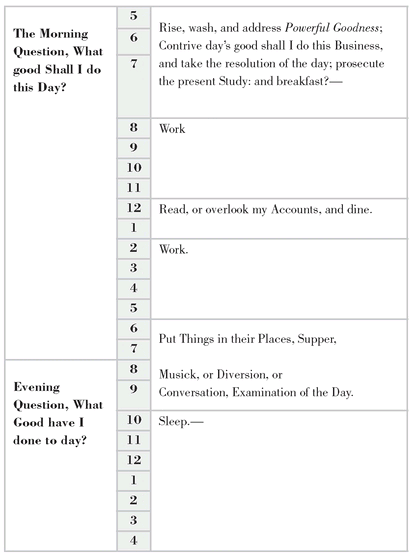
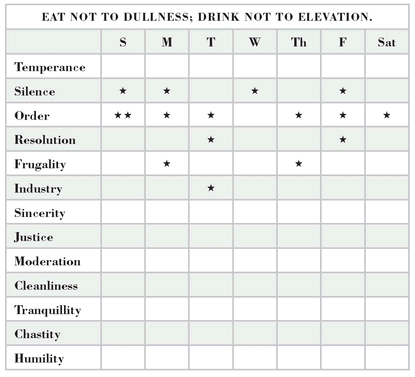
Of course, Franklin felt the need to track his successes and failures. To do so, he created a graph, recognizable to first graders everywhere as the “Gold Star” chart. Instead of rewards for good deeds, however, he marked down each transgression of the virtues. Here’s how he described it:
I made a little book, in which I allotted a page for each of the virtues. I rul’d each page with red ink, so as to have seven columns, one for each day of the week, marking each column with a letter for the day. I cross’d these columns with thirteen red lines, marking the beginning of each line with the first letter of one of the virtues, on which line, and in its proper column, I might mark, by a little black spot, every fault I found upon examination to have been committed respecting that virtue upon that day.
In his autobiography he showed the form of the pages:
TEMPERANCE
Finally, despite the project’s secular context, Ben did not discount the hand of providence or the effect of inspiration. Among several mottos, prayers, and credos that he would recite daily to get over the hurdles was one he composed himself:
O powerful Goodness! bountiful Father! merciful Guide! increase in me that wisdom which discovers my truest interest. Strengthen my resolutions to perform what that wisdom dictates. Accept my kind offices to thy other children as the only return in my power for thy continual favors to me.
Oh, how I like the way that Ben’s mind worked. So practical and pragmatic; so focused on the goal. And yet for all his practicality he was a dreamer of the first order. This practical, yet wistful, approach to the program offered real opportunity for an acolyte such as me. I could copy the “tools” that Ben used in his quest. Thus, in preparation for stumbling after Ben, I created my own virtuous day planner and progress chart—a modern equivalent of Franklin’s little book. I call it the Virtue Tracker™. Maybe I’ll market it for those intrepid souls foolhardy enough to follow in the wake of both Franklin and me. (The Virtue Tracker™ is not really trademarked. This was just an attempt to be funny. Forgive me—I suppose it’s a bit of lawyer humor.)
So I had the book, its virtue-tracking pages clean and ready to record my transgressions. Within its pages were the very poems Ben used to inspire himself. But just buying a toolbox does not make you a carpenter. Or is that a tool belt?
If Franklin’s course is about changing and creating habits, replacing the bad with the good, then I next decided that I must know who I am. I must know from whence I am starting this particular journey. I call this section . . .
. . . The Good, the Bad, and the Ugly
It is difficult to be introspective. I am reminded every time I see a picture of myself or hear my voice on a recording that my own self-image is not consistent (even in superficial ways) with how others see me (or, more important, with reality). I decided, in preparing for this course, to begin by making things easy on myself and to let others begin the process. What do those around me think of me? I decided to take a survey.
That’s where the sloth thing came up. It was not a promising start.
I came up with some very unscientific questions as I sat on the couch and interviewed my wife (while watching TV, mind you). Immediately thereafter I lost both my questions and her answers. Make a mark under “Disorganized.” Maybe I was traumatized by the sloth comment. Perhaps it just hit too close to the bone. Or possibly as a male, I am unable to watch TV and carry on a conversation at the same time.
{ How few there are who have courage enough to own their faults, or resolution enough to mend them.}
I soon regrouped and re-created the survey from memory. Essentially I asked the participants to rate me relative to Franklin’s virtues and then list my good and bad qualities (I did pose the animal question to all—once I got sloth, I assumed it could get no worse). In order to lessen the blow to my ego, I’ll reproduce my email to my parents along with their responses (a good rule of thumb: If you are going to reveal your character to the world, start off with your mother’s assessment). Here it is:
1. Please make a list of my good and bad qualities (honesty is required).
2. If I were an animal, what animal would I be?
3. Please consider the 13 virtues (I listed them) as described by Benjamin Franklin, and rate me on a scale of 1 to 10, 10 being the best.
That’s it. Thanks and don’t forget to be honest.
And now the answers (from, mind you, the two people who gave me life, raised me, and saw me off into the world. I should also acknowledge that I am their only child):
We were not too smart with the virtues, Benjamin was too sophisticated for us; not sure we understood them. Any way here goes.
Good Qualities—Honest, loyal, intelligent, easygoing, great memory, proud, kind, fair, compassionate, interested in everything, a leader, a teacher, great father and son, very much a family man, curious, happy, content with lot in life, ambitious for the right things, listens to his mother (joke). Someone must have brought you up right, ha. Perfect sunny boy or is it Sunshine And Lollipops.
Faults—Has difficulty saying no and asking for help, not sure that is a fault. Picks at his nose, doesn’t tie his shoelaces. Sometimes forgets he is not in the Court Room and interrogates his wife.
Newfoundland Dog because he is lumbering, friendly and happy, strong and may have descended from The Vikings as did the Gunns.
Virtues—1, 2, 3, 4, 5, 6, 10, 11, 13 were a 9 and the rest a 10, we are not sure about Socrates’ teachings.
Mom and Dad
Ha! Take that, Michelle! A Newfoundland dog is scarcely what I want written on my tombstone, but it was a whole lot better than sloth. How can you not start off the day with a song in your heart and a smile on your face when you know that your parents regard you in such a way?
About now, you are probably having the same concerns as I was. As warm and fuzzy as my parents’ survey made me feel, they are not the most objective observers. A note of neutrality was required. It was time to move on to other participants.
I decided to try coworkers and friends. I should have quit while I was ahead. Their assessment was far less biased (and far more realistic). A coworker described me as honest and principled but egocentric and scatterbrained. The friend I had chosen refused to respond.
In the end, it was apparent to me that I was only engaging in procrastination. The most important assessment had to be my own. I had asked others who I was (in the context of Franklin’s specific virtues), but no one knows me like I do—kinda.
So here we go. As Oliver Cromwell said, “Paint me warts and all.”
I am, if I am being forthright, egotistical but sometimes suffer from low self-esteem. I am smart but not nearly as smart as I suppose. I speak well but do so before I think. I am impulsive but overly cautious in some of life’s most important decisions. My use of money is not frivolous, but I have accumulated no wealth in forty years on the earth. I love sports and exercise, but not as much as I love food; the result is a waistline that grows ever so slightly each year. The words “order” and “organization” invoke in me a sense of dread—a notion of something Orwellian. My wife describes me as a Boy Scout (except when it comes to manual tasks). I have a sense of what is right and wrong, and on occasion, I, too, rigidly adhere to that code (read uptight). Patience is probably my greatest virtue and arrogance my worst vice. In short (has this been short?), I am like most other people: I am a bag of contradictions, constantly changing and evolving.
As I read the list over, I am struck by one notion: It’s not as bad as I suspected. But that’s only half the equation. This is a book about change, a journey of self-improvement. So the next question, the destination for this book, was: Who do I want to be? Chris, my new ethical guide, suggested that a useful way to pose the question is: What do you want people to be saying as you die?
Frankly, I want them to say: Isn’t there anything else we can do to save him?
But assuming all heroic measures have been taken and my time is past, I think that I just want to be remembered. That may seem simple, but it seems to me that life’s purpose is to first live (in the fullest sense) and then to leave some sort of legacy. Maybe that’s just vanity, but in the spirit of honesty, that is what I think. So how about this: He was a wonderful father, husband, and son. He saw things, went places, and, most important, he made a difference. Is that simple enough?
Could Ben help me with these rather vague but universal goals? Well, we’ll see. Each week, for thirteen weeks, I would concentrate on the virtues that made Benjamin Franklin America’s most beloved son. I would be Temperate and Sincere and Moderate. I’d attempt to carry out Justice and practice Cleanliness. When I didn’t understand what these things meant, I’d seek direction. (Chris Levan had agreed to write a twenty-first-century translation of each virtue, some of which I’ll share with readers.) Along the way, I hoped to find some answers as to why we do this—why we constantly seek to improve.
Armed, then, with some sense of myself, an ethical guide, and a homemade copy of Ben’s day planner and progress chart, I stepped, tentatively, forward. So began my journey—my humble attempt to follow a course of virtuous behavior invented 250 years before my birth. I had no preconceived notions of where this journey would take me, nor was I deluded about my potential level of virtuousness at its conclusion.
In truth, I had no idea what I was doing or where I was going.