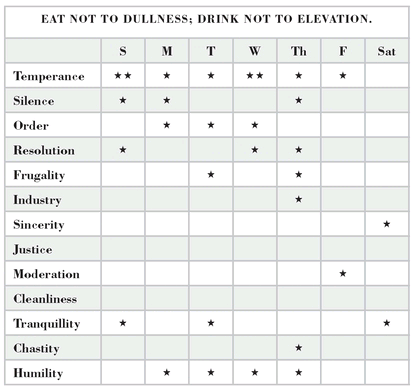
{CHAPTER 1}
Eat not to dullness;
drink not to elevation
OH DEAR.
I had visions of such promise with this whole endeavor. It would be a walk through the proverbial park. How tough could it be to follow a course of virtues that included things like Tranquillity? Sit under a tree reading a book and I’m already a master’s candidate. Perhaps I should have paid more attention to the order of the virtues.
{ I guess I don’t so much mind being old, as I mind being fat and old.}
Franklin’s choice of Temperance as Virtue No. 1 was no accident. Temperance would be easy for a man who had already decided against excessive drinking or eating. But what about those of us for whom excess is a hobby?
I am not Ben Franklin, as we’ve already established. Temperance, for me, is not easy. This is not the virtue I would have picked to start things off with. I might not normally be intemperate in drink, but I am a candidate for a twelve-step program when it comes to food. I’ve been trying since I was a boy not to “eat to dullness,” and yet dull I am. If the idea was to start with a virtue that would establish a pattern of success, Justice or Cleanliness would have been a nice beginning. But Temperance!?
Of course, I was being too literal. In my friend Chris’s instructions to me on this virtue he warned against such an interpretation. Franklin’s view of Temperance, Chris indicated, is bound up more in his notions of usefulness and life’s purpose than it is in his concern about overindulgence. He wrote (I swear I’m not making this up) that Franklin would have regarded Intemperance as slothful. Slothful! (I should rush to point out that Chris had no knowledge of Michelle’s views on my animal doppelganger). Could this be just a coincidental use of the word by Chris? Would Franklin have actually used that word?
It turns out he did. Over and over again. He wrote, apparently, things like: “Diligence overcomes difficulties, sloth makes them,” and “Sloth makes all things difficult, but industry, all things easy.”
Whoa. Franklin abhorred sloth; I am, according to my wife, a sloth. I found more Franklin sloth quotes. Not surprisingly, none of them were in favor of it. I felt Franklin fixing me with his steely gaze across almost three hundred years of virtuous history. It was an inauspicious beginning, but let us return to Temperance.
The drinking I didn’t anticipate to be a problem. I have a weekend beer and occasionally a drink after work on Friday with my coworkers, but except for a yearly golf trip and an annual get-together with work colleagues, I almost never drink to elevation. Of course, in college I majored in drinking to elevation, with a minor in leering, but I’m a long way from those days.
Food, on the other hand, is my nemesis. Ahab had his whale (once again, that’s a little Freudian), Superman his Lex Luthor. I have midnight snacks and trans fats. I am the “before” picture in the advertising campaign for exercise programs—the one that women at high school reunions are relieved “got away.” My daughters call me “the Big Fat Teddy Bear.” Clearly they have inherited their mother’s tact.
Lest you think my dimensions are a recent problem, let me disabuse you of that notion. My weight is no middle-age albatross, shot with the arrow of a slowing metabolism and hung around the shoulders of paunchy adulthood. No, my corpulence is long-standing. It’s a sad story really, one of those tales best told to therapists and self-help groups. “Hi, I’m Cameron, and I was a chunky kid.”
I was a stout child. Childhood pictures of me show the progression of my intemperance. Chubby-faced infancy gave way, for all too brief a time, to childhood fitness, the product of a raging metabolism overcoming gluttony. By the time I was approaching adolescence, however, I was beginning to resemble Chunk from The Goonies. (If this is outside your cultural framework, go rent this movie and watch it with your family. You won’t be disappointed.)
The dealers to my habit were my mother and my grandmother—wonderful, well-meaning women who displayed their love and affection through butter and sugar. For my grandmother (a woman who had a special dessert for each grandchild), it was cherry no-bake cheesecake. My mom’s drug of choice was blueberry pie. If I close my eyes, I can still see the flaky crust clinging to the side of the glass pie plate, sweet, plump, freshly picked blueberries oozing up from any available crevice. In the middle of the pie there was a porcelain bird, its mouth open in eternal song, venting heat and, more important, scent and calling to me—my own personal siren urging me onto the rocks of overindulgence.
I’m not sure I knew that I was chubby when I was in elementary school. I should have recognized my condition in the fifth grade when the salesman at the local clothing store took one look at me and said, “I think he needs a husky size.”
Husky. At the time I thought it was a compliment, an indication of an imposing physical presence. Only later did I understand that it was seventies clothing-salesman code speak for “fat.” Sometimes being dim-witted is a blessing.
Neither dim-wittedness nor childhood delusions, however, could save me in junior high school. No, in that psychological torture chamber, that killer of the esteem of youth, it became apparent to me that “husky” was not a desirable physical characteristic in the minds of thirteen-year-old girls. I was beginning to become painfully aware of my size and shape. In gym class, I would try a host of tricks not to display myself to my classmates.
Somehow, despite my girth, I managed to play competitive hockey, volleyball, and, starting in the eighth grade, varsity basketball. I had not anticipated that it would necessitate me taking my clothes off in front of my teammates. No amount of trickery or gimmickry developed over the past year was going to allow me to maintain my “keep it covered” policy. And so there I was, bare to the world (or at least to twelve other teenage boys).
A ninth-grade student (who happened to play the same position as me, as I remember) noticed either my girth or my reluctance to change, or both, and decided to make me the object of scorn. He gave me the first nickname I can remember having. It was an ode to my size and my low shooting percentage (I was always a better rebounder than a shooter). It was to stick for some time. He called me “Fat Chance.”
By high school, I had shed my boyhood fat. But I have remembered my first nickname. I have dragged that little scrap of memory with me into adulthood. In my mind, though I am now a husband, father, prosecutor, would-be author, and Benjamin Franklin emulator, there will always be a little “Fat Chance” in me.
So there it is. I approached this first virtue of Temperance with a history of self-indulgence. Maybe this was the perfect virtue with which to begin. Maybe I could start my moral perfection project with a little corporal improvement. After all, it was Franklin who said, “I guess I don’t so much mind being old, as I mind being fat and old.” Thus, notwithstanding Chris’s instructions not to take things too literally and Ben’s intentions, I decided to take the virtue of Temperance, at least in part, literally.
But how? It was not as if Ben left a menu planner and an exercise schedule along with his day planner. How could I turn Franklin’s eighteenth-century virtue of Temperance into a twenty-first-century weight loss program?
I had no interest in a diet, being opposed to them based largely on a long-standing history of failure. More than that, however, they seem un-Franklinian. While they do follow the create-a-habit premise, they do it in an unsustainable way. Who, even if they manage to follow a diet for six weeks, is going to spend a lifetime eating nothing but oat bran, salmon, and lentils? No one! Not even the person who created the diet. Not even the mother of the guy who created the diet. “Oh, I’m very proud of Lionel. But lentils? Please, they make me bloat.” No one follows a diet for the rest of their lives. Mostly, they follow them in short, miserable spurts. They feel horrible while they’re on the diet, guilty when they go off of it, and then anxious when they start another one. It’s all too much like a Dostoyevsky novel for me.
Finally, I decided on a simple plan that required no change in the diets of others; no support from friends, family, or coworkers; indeed, almost no change in how I eat. I resolved, as part of the Virtue of Temperance, not to eat between meals or eat after supper. My “diet” during Temperance Week (sounds like freshman week at a Bible college) was simple: I would not snack. That’s it. Nothing else. (Well, I tried to eat more fruit, too, but that was just to set an example for the kids.)
There. Even I could follow such a program of Temperance. Of course, it was not earth-shattering nor did it deserve its own trademarked name; this was no OrganoPath or FiberFiesta. The program did, however, have the benefit of being achievable.
Having decided on a plan, I realized I needed a little mile marker on my virtuous journey. Food being my original sin, I needed to know to what level of Hell it had taken me. I don’t often weigh myself—no one wants to be reminded that he is as heavy as a Smart car—but in the interests of my rush to moral perfection, I stood upon my electronic judge.
As I gazed down over my expanding middle, the little needle edged 250 pounds. I tried changing positions, sucking in, feeling lighter. No good; 250 it was—a depressing way to start a program of self-improvement. Why couldn’t I have read a biography of William Howard Taft or Kirstie Ally?
Day 1: The Journey Begins
Maybe starting the program on a Monday wasn’t a great idea. I probably shouldn’t have sprung it on myself with so little notice. I went to bed a perfectly happy, if morally imperfect, man and woke up to the pressure of beginning a course of commitment that lasts longer than the NHL playoffs. The entire enterprise started wrong-footed. I had resolved to go back to my morning routine of dog walking but quickly fell into my alternative routine of hitting snooze on my alarm clock. By the time I got up, both the dog and I were disappointed with me.
The trick, I discovered from my last adventure with Ben, was not to let early failures get the best of me. Thus, I sat in the relative peace of my downstairs bathroom and read the poems of inspiration. Or in Franklin’s words, I addressed Powerful Goodness! I’m not sure how Powerful Goodness felt being addressed from my porcelain perch, but with three children, several drop-ins my wife was looking after for the day, and a disappointed beagle nearby, it was the only private spot in the joint.
Notwithstanding my initial trepidation, I began to feel better about my chances. After all, Ben was trying to make this easy. He didn’t say, “Abstain.” He said, “Be Temperate.” That’s one of the things I like about Ben and his virtues—he gave himself an out with each one. He didn’t even demand pure, unspoiled Temperance; he qualified his virtue. Don’t eat so much you can’t move, and if you drink, don’t throw up on yourself. These are “virtue light”; I could do them.
And thus it began.
Upon my arrival at work, I was presented with an interesting opportunity to consider virtue and ethics in both a personal and a professional aspect. I spent most of the day dealing with people held in custody over the weekend: the sad, the bad, and the frequent flyers. From a strung-out twenty-year-old with hypodermic needles sewn into the lining of her coat, to two alcoholics caught up in their addictions, there were opportunities aplenty to consider the virtues of Temperance and Justice. The most ethically demanding, however, was an intellectually challenged man accused of a serious assault on a woman.
As the father of a special-needs child, I am acutely aware of the struggle between my duty as a prosecutor and my duty as a human being. I watched the man’s elderly parents wait anxiously for his appearance and his own embarrassment as he glanced back at them, while his lawyer described the reasons why a mental health assessment was appropriate. At the conclusion of his bail hearing, the man was sent for a thirty-day assessment. Unfortunately, there were no spaces immediately available at the mental health facility, so he was to be sent to a jail to await transfer. Remembering Franklin (and thinking particularly of Justice), I alerted the jail to the accused’s special needs and requested they segregate him for his own protection. Hardly a home run for virtue, as I was simply following my responsibility as a prosecutor, but it was at least a baby step down the road to moral perfection.
And the early victories for virtue continued. Not only was I working on the virtues but I was passing on the wisdom. One of my coworkers confided about a seething resentment (okay, maybe “seething” is strong, but I know she would say that she had every right to seethe) over the actions of a mutual acquaintance. It wasn’t a new topic, so I came somewhat prepared. Remembering Franklin, and thinking particularly of Tranquillity (though in the moment I got it confused with Justice), I told her that life is a long road, and we are all drivers. If we choose to look at what has happened in the past, it is like looking in the rearview mirror; do it too often and you risk going off the road. Look ahead, I suggested, not back.
My colleague, a very bright professional woman with more than twenty years of experience in her field, shot me a look like she might a brazen child and then said, “That’s not bad. I guess you’re right.”
Wooo hoooo! This Franklin thing was a breeze. Could it all be this easy? I am reminded here of the opening words of Book the First in A Series of Unfortunate Events: “If you are interested in stories with happy endings, you would be better off reading some other book.”
One might think that being so occupied with Justice and Tranquillity would make the no-snacking/Temperance credo a breeze. One would be wrong.
All day long, despite the distractions, I had the fidgety, nervous twitches of someone in the grips of the DTs. I craved sugar . . . or salt . . . or starch. Maybe I didn’t crave any of those things. Maybe I just craved snacking itself. Like a smoker dangling a wooden cigarette out of his mouth, maybe I’d be satisfied with some snack surrogate. I remember reading once that if you ate slowly, you could trick your body into believing it was full. Maybe I could do the same with snacks. Perhaps I could try to fool whatever compels me to snack by chewing on a straw or something. Of course, chewing on plastic can’t be much better for me than overeating, but there is no censure against plastic consumption anywhere in Ben’s autobiography. I decided it was worth a try.
The straws didn’t work. I just had a bunch of chewed plastic in my wastebasket.
As I contemplated my straw failure and the merits of a snack in the midst of the day, I began to negotiate with myself. What could one little snack hurt? I reasoned. I can have just one. I can stop at any time.
What was I saying?
I’d gone from a generally happy, if slightly chubby and morally imperfect, person to a self-delusional food addict on Day 1 of my program. On a positive note, I was gaining a better understanding of the plight of the addicts in custody over the weekend.
If the workday had been daunting, the evening presented a distraction from my food struggles and an opportunity to flex my ethical muscles. I had managed to start my course of virtues not only nine days after Ben’s three hundredth birthday but also on the date of Canada’s federal election. This was not any old election, mind you, but a bitter, nasty, recrimination-filled slugfest between two ideologically opposite parties (actually, more than two parties run in a Canadian election, but much like the United States, there are only two that have a realistic hope of forming a government).
I had been, for the entire campaign, vacillating on my electoral choice. On Election Day, I was no closer to making a decision. By the time I came home from work, my wife had not only voted but told our two youngest daughters, five- and seven-year-olds, that she had cast her ballot for the local Green Party candidate (the Green Party is a small environmentally conscious party that garners no seats in parliament and less than 5 percent of the vote). She had told the girls that the reason she voted for a candidate she didn’t know, from a party that she had barely heard of, was that they were the only party that had not run attack ads. I resisted, mindful of Franklin’s dictate to “Speak not but what may benefit others or yourself,” explaining that the absence of Green Party attack ads was a direct result of the absence of campaign finances, independent resources, and, indeed, the complete absence of Green Party ads of any sort.
After supper, I took my children with me to the polling station with the idea that it would be an excellent lesson in civics. I brought them both into the voting booth and showed them the ballot, explaining how one marked it. At this point, I still had not yet decided how I would vote.
Harper, the seven-year-old, looked at the ballot and said, “Vote for the Green Party. They’re not mean like the other parties.”
Now my first inclination was to say that there were better reasons to vote for people—strong public policy ideas, powerful leaders, economic considerations. But then it struck me: there was no better reason to vote for someone, at least not in this election. Green Party it was. I voted for a candidate I didn’t know from a party that I had barely heard of on the basis of how “not mean” they were. It felt strangely right.
Bringing this all back to Franklin, I initially felt pretty darn good. First, I had been industrious (always employed in something useful), and I had enough humility to recognize that a child could come up with as valid a reason as I for casting a ballot. However, my pleasure at being virtuous suffered an almost immediate double blow.
As we left the polling station, Harper asked, “Is that it?”
“Yes. That’s it.”
“That was no fun,” she said, her voice tinged with disappointment.
Slightly taken aback but undaunted in my quest for virtue, I comforted myself with the fact that Darcy, the five-year-old, still seemed almost euphoric from the whole experience. She literally bounded to the car, not an unusual manner of stride for her. She maintained her positive disposition right up to the point that we left the parking lot and headed for our neighborhood.
“Where are we going?” she asked.
“Home,” I replied.
There was pause before she asked, “But when do we go to the green party?”
At least I had been temperate at the polling station. It was a good thing they didn’t supply snacks.
{ In general, mankind, since the improvement of cookery, eats twice as much as nature requires.}
The Struggle Begins Anew
My grandfather, used to years of waking at 4 a.m. to go to work in the mosquito-infested woods, would say about rising, “Put the palms of your feet on the floor and get ready to face the horrors of a new day.” Inspiring stuff.
Notwithstanding the “horrors” that faced me, I was slightly more prepared for starting my second day as an acolyte of Ben. I addressed Powerful Goodness while drawn to my full height (as opposed to my bathroom conversation from Day 1) and prepared to meet the day in all its virtuous glory.
Reviewing the results of my scorekeeping is a little like wandering through a store knowing that there is a security camera trained on you. I felt the eye of Franklin hovering above me, and there seemed to be, though I recognized it was very early, at least a slight change in my conduct. I was conscious of trying to be good. I felt good leaving the house. Kisses all around, a hearty fruit breakfast, and I was skipping out the door.
And it continued at work. My boss and I discussed a trial victory from the morning before, and I can tell that he was impressed with my conduct of that matter and the bail hearings. I should say, at this point, that notwithstanding all the campaign ads that feature alarmingly high conviction rates, the role of a prosecutor in the criminal justice system is not really to win or lose but rather to place all the relevant evidence fairly before the court so that justice might be done. No, I’m serious. They even give us little plaques that say something like that. Thus, I had a nagging sense that my happiness at the victories might, in fact, be transgressions on the virtue chart. Justice, in the Franklin sense, would seem consistent with the quasi-judicial role of a prosecutor. I, on the other hand, was patting myself on the back over a couple of courtroom triumphs. The more I thought about it, the worse I felt.
And then, of course, there is Humility. I was gloating. That seemed to be the direct opposite of Humility. Personal backslapping would certainly merit a tick on the transgression chart. Maybe, I reasoned, I should keep my eye on the ball and concentrate more on Temperance.
As Karma would have it, I paid the price that afternoon. I took a beating in another trial continuation. This one involved a sister stabbing her brother during a drunken argument. Not only did I go down in flames, but an inebriated, homeless woman came into the courtroom during my cross-examination of the accused and began to shout, “She’s innocent!” I assumed this was a message from Powerful Goodness. He (or she) was probably still upset about being addressed from the toilet.
I was also a little concerned about my adherence to the schedule part of the program: Ben’s day planner. Ben began the day with asking himself what “good” he would do and then ended the day with a self-check on his success. I’d taken a shot at this but it had been halfhearted. On Day 1, I forgot to come up with a “good.” On Day 2, I chose “follow up on planning golf trip.” While I accomplished that goal, it was hardly altruistic—more self-centered, really. No one is going to bestow on me the Nobel Peace Prize because I successfully planned a trip where I, my dad, a couple of uncles and cousins, and assorted friends beat the bejesus out of a little ball, eat steak, and drink beer. Tomorrow, I resolved, I’d pick something far less self-centered.
I owed it to myself.
On the plus side, I had managed, on Day 2, not to eat any between-meal snacks or anything after supper. This, for a man of my proclivities, was a major victory. It would have been nice to think that I’d mastered this Temperance thing, but I had a feeling that I might not be getting the full flavor of what Temperance means. I was concerned that perhaps I was not committed enough to this first virtue and its real essence. I needed to do more research.
Temperance: The Early Years
As I carried on through my week of Temperance, I was still a little confused about how to follow Ben’s virtue. Stuck with it, as I was, I rededicated myself to ferreting out what Ben was after with Temperance. It was more confusing than I had first thought. Perhaps the problem was that despite Ben’s admonition to be temperate, he himself was something less (maybe Ben would forgive my snacking after all).
He, of course, acknowledged a level of consistent imperfection early on in his description of the program, but a look at any of his portraits or busts reveals a man given to at least a little intemperance. Willard Randall says that in 1755 Franklin’s “face was puffy and smooth from gout, his body overweight and rounded into the peculiar barrel shape of the once-powerful swimmer too long out of the water.”1 That doesn’t sound like someone who has completely eschewed eating to dullness. So why put this virtue first, and what did he mean by it? Perhaps the answer is to be found in a little journey into history.
According to an editorial in the Canadian Medical Association Journal,2 a Philadelphia physician named Benjamin Rush, a contemporary of Franklin, penned an article titled “Inquiry into the Effects of Spirituous Liquors on the Human Body and the Mind.” Part of the article was a “moral thermometer” that linked drink with points on a scale of intemperance. At the top of his scale, Rush placed water, milk, and molasses, which he associated with health, wealth, and happiness. Wine, port, and beer were farther down, delivering cheerfulness and nourishment “when taken only at meals and in moderate quantity.” Spirits and morning drams, at the bottom, delivered “dropsy, epilepsy and apoplexy,” leading to “obscenity, fraud and the workhouse or a whipping.”
Did Rush influence Franklin, or was it vice versa? Did they compare “moral thermometers”? If they did, I like to think they might have done so over a wee dram, just enough for cheerfulness and not nearly so much that a whipping or the workhouse would follow.
Was Rush the inspiration for Franklin’s Temperance, and if so, did that provide any answer to what Franklin meant (and, in turn, what I should have been doing)? Of course, Rush and Franklin must have known each other. Philadelphia was not so big in the late eighteenth century that two learned men would not have encountered each other. Rush’s article sold 170,000 copies and is credited with starting the American temperance movement. If Franklin was influenced, what did he take from Rush?
The answer is in the same editorial. Temperance, the editorial declares, is often confused with abstinence. “Abstinence is an extreme and rigid state that sometimes results in prohibition and condemnation; temperance, on the other hand, is a process of self restraint and moderation, the middle road. Plato regarded temperance as one of the cardinal virtues of a society and of an individual.”3
That helped. I had been wary of the big T because I was thinking of abstinence, which has far too monastic a quality for me. I could live with being temperate, so long as I was not asked to abstain. Besides, who can argue with Ben Franklin and Plato? I resolved to do better.
But then night fell.
Snacks called to me as darkness descended. Like alcohol and smoking and gambling for others, snacking is a rest stop on my personal road to perdition. Not only do I do it with alarming regularity, but I have created new and innovative ways to make foods bad for me. On Night 3, it was one of my favorite fixes for late-night munchies. I took the humble cracker and a block of cheddar—very old cheddar. I cut the strips as thick as a two by four, then arranged the crackers around a plate and lay mounds of these thick slabs of artery-clogging goodness over them so that they became no more than a rumor—a memory under cheese. I then microwaved these bad boys until the cheese had melted enough that it was soft and gooey and the oils had leached onto the plate.
{ Behold the rain which descends from heaven upon our vineyards; there it enters the roots of the vines, to be changed into wine; a constant proof that God loves us, and loves to see us happy.}
I was weak. I was intemperate. I was sad. I was full of cheesy cholesterol.
But I would not be defeated in the first week of the virtues. I would carry on, be temperate, and lead a virtuous life (at least for thirteen weeks). Out, out, damn cheddar!
Four Less-Than-Temperate Days Later
Temperance week had come and gone. Had I been temperate? Would Ben be proud?
I had done, at best, okay. No great failures, but no overwhelming success either. I read somewhere that a habit takes about six to twelve weeks to develop, so I suppose I shouldn’t have expected the habit of Temperance to be hardwired into my brain just yet. I was only slightly consoled by the fact that my biggest failures during the week were on the other virtues. Given Franklin’s formula of concentrating on one virtue at a time, this wasn’t a huge concern. I was just being true to the course (that sounds a lot like rationalization, I know).
Had even my mild improvement in Temperance made any difference in my life? Well, I am not sure about it being, as Plato wrote, a cardinal virtue, but I did feel a bit better. Probably psychosomatic.
I certainly think I completed more tasks during the week; thus, I was relatively industrious. I was more aware of Resolution and Justice. Even Order had a greater place in my consciousness. This incremental accumulation of virtue was clearly Franklin’s goal. As others have noted, these virtues are not heroic. Indeed, they are a bit pedestrian. No one will become a hero simply by being temperate or moderate. Saints are not borne of Silence or Chastity (okay, maybe they are . . . but not Industry and Order). Yet there is virtue in his virtues. Franklin, seeker of pedestrian virtues in his twenties, became a Founding Father in his seventies.
Yet as I patted myself on my back and started dreaming of Founding Father-type perfection, I began to feel both guilty and inadequate at the same time. I know the source of both feelings. I think it is time for a little confession and personal pep talk, an admission of intemperance at the end of Temperance. Here goes.
I am a felon.
Okay, well, that’s overstating it a bit . . . maybe a lot (technically we don’t even call felons “felons” where I come from). The truth is that when I was sixteen, I got caught in a bar.
There I was, with several friends, being intemperate in a local pub when in walked several police officers. We tried to escape, only to run headlong into a cop roughly the size of Arkansas. Soon thereafter, my friend and I (along with several other unfortunates) were sent off with a promise of a court date in the near future. I kept the fact of my arrest a secret from my parents.
On the day of my court appearance, dozens of teenagers who had been caught up in the same liquor raid had shown up for court, but apparently none had a surname beginning with A to F. I was the first person called on to plead. As my guilty plea brought the anticipated fine and a stern lecture from the judge, I noticed a man in the front bench of the court house taking notes. This was a concerning development.
After court I approached the note taker and inquired if he was a reporter (the court beat was big in my hometown, there being little other news beyond the 4-H Club and high school hockey scores). When he confirmed that he was indeed a journalist, I asked if he was going to report my name. “What’s your name?” he asked. With the foresight of John McCain choosing a running mate, I said, “Cameron Gunn.” He smiled, scribbled in his notebook, and said, “I am now.”
I thought it best, at this point, to come clean.
It was not a pleasant scene. There was no yelling or screaming. I’m not even sure I got grounded. There were just looks of profound disappointment and ominous promises that the “grandparents” would have to be told. That was worse even than the parental displeasure.
About two weeks after my mea culpa, I was told I was going to help my grandfather (the same one with the cheerful waking ritual) put vinyl siding on a house he was building for my aunt. I had been dreading any contact with my grandparents. The day progressed largely in silence until my grandfather said nonchalantly, “Heard you got in a little trouble.”
“I guess so,” I replied with trepidation.
“Got caught drinking in a bar?”
“I guess so.”
After a little pause and without ceasing his labors, he said, “Well, if that’s the worst sin you ever commit, I suspect there’s still a place in Heaven for you.”
That was it. Nothing else was ever said. Like Bill with Hillary, I was being given a second chance.
I think my grandfather understood that some sins were greater than others and that I had probably beaten myself up enough.
As I reexamined my scorecard for the week, I noticed too many incidents of intemperance. But as my grandfather did, I thought I’d give myself a second chance. My sins were small, and it was early in the game. Perhaps there was still a place in Heaven for me.
TEMPERANCE