{CHAPTER 13}
Imitate Jesus and Socrates
REMEMBER HIGH SCHOOL? THAT GREAT SEETHING GALAXY OF hormones, emotions, angst, and drama? I remember my first day, walking through the front doors and making my way to the cafeteria, where a thousand other students milled about like a great herd of wildebeests fearing the arrival of the lions. It was Day 1, and I was a skinny, pimply fifteen-year-old. And I was afraid. As I stood among the other wildebeests, my hope—my most fervent hope—was that no one would notice me. Or at least not beat me up. It was one of the worst days of my life.
{He that falls in love with himself will have no rivals.}
It was one of the best days of my life.
That first day might have been a day of fear and anxiety and an overwhelming desire to run screaming from the school, but it gave way to the next day, which was better, and the next, which was better still. As time passed, there were sports and activities and girls and friends and dances and everything good that high school can bring. The bad came, too, of course—broken hearts and broken friendships and disasters great and small. These lows, however, were fewer and less memorable than the highs. Overall, high school was a fantastic experience.
That is, if you don’t count the day my favorite teacher staged an intervention for me.
One day in the twelfth grade, this teacher, my teacher, took me aside and said, “Cameron, you like yourself too much.”
That was Bob Gillis. He understood kids, he listened to us, and—perhaps most important—he cared. He wasn’t being mean or vindictive when he told me I was arrogant. He was trying to help. So when Bob (which is what he let us call him) warned me of my conceit, I should have paid attention. Every neuron should have been thinking of ways to right this character flaw. It should have been a watershed moment.
I’m not even sure it dented my ego armor.
I did not become more humble that day. I did not become more humble that year. I don’t know that I ever became more humble. The plain, simple, sad truth is that I have never mastered the virtue of Humility. I understand its need, its benefits, and the dangers associated with its opposite vice. But just as I cannot stop eating chips, I cannot (or will not) avoid liking myself. I probably could have written one of those seventies-era self-help manuals: I Like Myself and I Don’t Care What My Teacher Thinks. Maybe I could combine it with a nude encounter group.
So, then, Humility was a virtue that offered both hope and fear. It was certainly an area that offered the greatest possibility for improvement. Yet if my favorite teacher couldn’t stop my ego train, what chance did Ben Franklin stand?
One would think that after the previous twelve-plus weeks I’d have had this virtue locked down. The problem with arrogance, however, is that it does not dwell in the land of logic. It makes us believe the unbelievable. Despite ample evidence of failure, I had a steadfast, resolute, unswerving, and wholly unreasonable belief in myself. That is good. Confidence and self-esteem are the keys to success. But the universe is a place of balance. Too much of one quality and too little of another and the universe is without equilibrium. The yin to the yang of confidence is Humility. I needed a little of that yin to restore my balance.
Fortunately, Ben offered some specific guidance on this virtue. He said in his autobiography:
My list of virtues contain’d at first but twelve; but a Quaker friend having kindly informed me that I was generally thought proud; that my pride show’d itself frequently in conversation; that I was not content with being in the right when discussing any point, but was overbearing, and rather insolent, of which he convinc’d me by mentioning several instances; I determined endeavouring to cure myself, if I could, of this vice or folly among the rest, and I added Humility to my list.
There is a hint of Bob Gillis in that Quaker and a hint of me in Franklin. On this issue, as with difficulties surrounding Order, Ben and I share common traits: pride, being overbearing, insolence. We are like hubristic doppelgangers.
Like me, Franklin also acknowledged his difficulty in mastering Humility:
In reality, there is, perhaps, no one of our natural passions so hard to subdue as pride. Disguise it, struggle with it, beat it down, stifle it, mortify it as much as one pleases, it is still alive, and will every now and then peep out and show itself; you will see it, perhaps, often in this history; for, even if I could conceive that I had compleatly overcome it, I should probably be proud of my humility.
{ Pride that dines on vanity, sups on contempt.}
It’s a virtuous catch-22: Be humble, feel good about being humble, realize you’re not being humble, start all over.
Franklin did offer some explanation of how he achieved a modicum of success achieving Humility. He faked it. He claimed no success in achieving Humility, but he did achieve a significant measure of success in the appearance of Humility.
That hardly seems virtuous, but it does have the distinct advantage of being more successful than whatever I’d been trying for the last forty years or so. So I would follow Franklin. I would adopt a respectful, diffident, restrained manner of discourse. I would make an effort to deny myself the pleasure of correcting the errors of others and thus at least achieve the appearance of Humility.
I hear a tinge of boastfulness in that pledge—I’d watch that.
The Four Stages of Learning and a Little Humble Pie
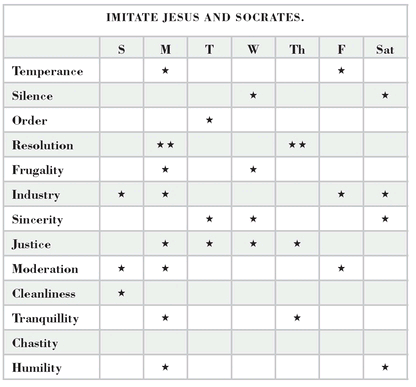
Perhaps, I reasoned, the way to begin a quest for Humility was in the precept to Franklin’s virtue: Imitate Jesus and Socrates. It is one of the most direct pieces of guidance in the entire course.
I talked to Chris about this. Remember that among Chris’s many hats, one of the most prominent is being a minister. In fact, he has a PhD in theology. Of all the virtues, here was the one for which I was certain he could point me down a safe and well-traveled road. I even had some notion he would be excited that I might seek guidance on how to follow Jesus.
Instead, Chris provided me a cautionary tale about Humility.
“Two years ago,” he told me, “I went to pick up a babysitter, and when she opened the car door, I noticed she was sporting a new, bright yellow plastic bracelet, and it had the letters ‘WWJD’ printed into the band. I had no idea what the inscription meant, so I asked.”
These bracelets are everywhere. You know the kind. They range from advertisements for bands or sports heroes to secret codes for dating emergencies to charitable promotions to awareness campaigns for debilitating diseases.
Chris continued, “When I asked what it was, the babysitter smiled, knowing I was a minister, and replied proudly, ‘WWJD . . . It means: “What Would Jesus Do?” ’ She went on to explain that the bracelets were part of her youth group Bible project. They had decided as a group that they would wear these wristbands to remind them of an important principle. Whenever they were uncertain about their action, or whenever they were facing a decision that was novel or difficult, they would ask themselves, ‘What would Jesus do?’ ”
Sounded exactly like what I should be asking, at least on this week. One had only to follow the direction Jesus led. That’s exactly what Franklin advised (as had many others before and after him). Franklin’s final virtue directs us to imitate Jesus. To be ethical, we have only to ask ourselves what he would do and then do the same. Virtue is a matter of imitation.
“But it’s not that simple,” said Chris.
Great, I thought. It all sounded very simple a few moments before. So why was it not so simple? What Chris said was that imitation is a poor basis for virtue. “Imagine,” he said, “if I was to suggest that you imitate Mozart. You can’t do it. Mozart was pure gift.”
Imitation leads, Chris cautioned, to dependence and immaturity. If we are constantly gauging our behavior by our perception of another person’s actions, we fail to grow our own intellectual and spiritual strength, we fear having a novel thought, and we allow our own ethical maturity to lie dormant.
For once, I might have been ahead of the curve. Promising, as I did, not to make this a book about religion, I do not need to digress too deeply into my own spiritual past. Suffice it to say that I was raised and remain a Christian, but I’ve never been too doctrinaire about it. I decided I wouldn’t be slavishly imitating anyone. I still, however, needed to do something.
Chris offered a little more advice and explained that there are four stages of learning, and Humility is a key component.
First: “I don’t know that I don’t know.” We all start off not aware of what is beyond our comprehension. This seems all too familiar.
Step 1 quickly leads to Step 2. When Step 1 is revealed to us, if we accept the truth of it, we are struck by our inadequacy and we whisper, “I now know that I don’t know.”
This, Chris told me, is where Humility is key. If we revert to a position based on the fear of looking stupid and defend our original misinformed belief, then we will never get further.
“I don’t know that I know” is Step 3, a place Chris describes as the wilderness of unknowing, a frightening transition time during which we wander without direction, searching and hoping for a pathway—a place where we are closer to our goal than we realize. It is an intuitive place, where we must trust in our intuitive self to guard us from misplaced boasts and misguided presumptions. If we do, we may move on to Step 4, the final stage—when the light comes on and we finally can say to ourselves, “Now I know that I know.”
So there I was, somewhere in the first stage of learning, expecting very soon to “know I don’t know” anything about Humility, when once again, I was offered a real-world lesson on virtue. This time it came from the imagination of a twelve-year-old boy.
Several years ago my cousin, a woman who lives thousands of miles away and whom I see only every decade or so, was injured in a car accident. It was a serious accident, and she and her husband were lucky to survive. Sadly, she was left permanently disabled. Kathy, at just over forty years old and the mother of a young boy, was blind.
It is with some shame that I acknowledge that I did not one thing for her. Not a get-well-soon card, not a call to say I was thinking of her. Nothing. Wrapped up in my own busy life, sheltered by the miles between us, I did no more than offer sympathetic platitudes when my mother gave me periodic updates on her condition. It was not one of my bright, shining moments.
Then, two years plus after the accident, and in the midst of my final week of Franklin’s virtues—a week devoted to Humility—I received the following poem written by her twelve-year-old son.
BLIND
The blind, you think they are slow
You think they are stupid
But they are just like you, they are very intelligent, they have lives
They are hard to understand because they have to learn—they are
very odd, but if you get to know them, they will tell you a story
So don’t look at them strange and don’t call them stupid
they are already learning how to read—learning how to read
bumps is kind
of hard—you think they are just people trying to make a living in
the world,
so try and cut them slack.
There is no such thing as stupid or rolling your eyes
because they can’t see you so the joke’s on you
If you roll your eyes they won’t care because
they can’t see.
They don’t care if you make fun of them and they
don’t care if you call them stupid, so if you think they are stupid
you’re going to get the same reply—wait your turn please.
Here was a boy who had moved way past “I now know that I don’t know.” I’d say he is in that brief shining moment when he can say, “Now I know that I know.”
How’s that for making you humble? How’s that for a lesson in Humility?
Great Teachers, Bad Students
As anyone who made it through college or even just high school knows, there is simply no way to overstate the importance of a good teacher. A good one can make a dull subject palatable and a subject of interest a thing of wonder. A bad one can turn a student off a particular subject or learning in general.
I remember my first college English course. I had been a successful student of English in high school, but after my first Introductory English exam, on which I received a grade of B−, I was concerned that my success had been illusory. Determined to understand how I dropped from the lofty marks of high school English to a rather pedestrian B−, I visited the professor in his office. He looked a little like Doctor Octopus from Spider Man, if Doctor Octopus were dressed in a wool sports coat with accompanying turtleneck and spoke like Anthony Hopkins in Remains of the Day (that movie wouldn’t come out for a decade or so, but that’s how I remember him).
I explained that I was not disputing my mark, just seeking some explanation. “It’s not that I’m saying I didn’t deserve the B−,” I explained, “it’s just a bit of a surprise. I was an A student in English in high school.”
He looked at the paper, peered up at me as if he had never seen a creature like me before, and asked, “And what high school did you attend?”
“Miramichi Valley,” I replied.
Letting his eyes drift back to his work and handing me back my exam dismissively, he said, “Well, that explains it, doesn’t it?”
I never enjoyed another English class.
On the other hand, I also had some good teachers—some very good ones. Mark Milner, a professor of military history, made his lectures come to life. When he spoke about sailors manning the watch on a Corvette plying the North Atlantic during World War II, I could almost feel the cold saltwater stinging my face. Talks on Renaissance art from Gary Waite made me want to visit Italy—or paint a naked woman (well, Gary’s lessons were a nice justification).
What does all this have to do with Ben Franklin? Well, Franklin’s precept for Humility, as we know, suggests imitating Jesus and Socrates. I’d already had my brief run-in with the Big Fellow, so I thought, despite Chris’s warning against imitation, that it was time to give ol’ Socrates a try.
The problem was that I didn’t know the first thing about Socrates. I had a vague memory of him from a single classics course. I also ran into him in philosophy until I dropped the course. Another encounter with a bad teacher and so endeth Cameron the philosopher.
Classics was better. And again, thank the teacher.
Dr. James Murray, my classics professor, was still at my alma mater. He was, by the time of the week of Humility, the Dean of Arts, and since that classics course twenty years ago, our paths had not crossed. Still, if he straightened me out on Socrates once, then surely he could do it again. Despite being in charge of a faculty of thousands of students, he took my call. The best teachers are the ones who want to teach.
“When did you say I taught you?” Dr. Murray asked when I’d explained my dilemma.
“About twenty years ago. It was a first-year classics course.”
“I’ve had a lot of students since then,” he said. “Anyway, how is it that I can help?”
After giving him an idea of Benjamin Franklin’s course of virtues and his precept for Humility in particular, I asked, “Why would Franklin want us to imitate Socrates?”
“You know,” he said, “almost everything we know about Socrates comes not from him but from his students. Plato in particular in his Dialogues gives us the fullest account of Socrates. What we do know is that Socrates considered himself a teacher, but not in the sense that he was imparting knowledge. He viewed his role as something like a midwife.”
Dr. Murray directed me to The Theaetetus, one of Plato’s Dialogues , in which Socrates speaks of his role as a teacher. That was where he, through Plato, described his function as akin to being a midwife. Like a midwife, he could see when a student was having trouble giving birth to an idea. His purpose was not to give knowledge; it was simply to help with the delivery.
On Humility, it seemed that Socrates was of the admission-of-ignorance school; I suppose he probably invented it. That, at least, was consistent with Chris’s four stages of learning. But that wasn’t really what interested me about what Dr. Murray said. The theme that I kept coming back to was this: Socrates was, above all else, a teacher. (I should note that he was an unpaid teacher and was ultimately tried and sentenced to death for teaching. Where were the teachers’ unions in ancient Greece?)
That was the missing piece, the common element, the theme that bound up Jesus, Socrates, and Benjamin Franklin. They were all, in their way, teachers. That was what Humility was for me.
{ He was so learned that he could name a horse in nine languages; so ignorant that he bought a cow to ride on.}
For Franklin, I decided, Humility—imitating Jesus and Socrates—was about being a teacher. Had I done that? Had I been a teacher? No, I didn’t think so. Instead, I had been taught. I thought back over the week. Chris had taught me about Jesus and the four stages of learning. My cousin’s twelve-year-old son had taught me about tolerance and Humility, and finally, Dr. Murray had tied the entire week up in a nice big bow.
Of all, I think I appreciated Dr. Murray’s lesson the most. Not because of what it told me about Socrates but for what it compelled me to do next. Dr. Murray’s lesson was responsible for my last act as a devotee of Benjamin Franklin.
My last Franklinian gesture was a telephone call to a teacher to say thanks.
An Apple for the Teacher
I love the symmetry of life—the way things come full circle. There is something satisfying and poetic about a resolution that takes the long view to appreciate. Thus, I decided that my course of Franklin’s virtues and, particularly, my week of Humility needed a spectacular finish—a symmetrical, symbolic ending to a virtue that has been my undoing for nearly four decades. Given that the last week was the week of Humility, the course should end with gratitude.
I reached into my past, into the days when I had strived too hard to be somebody, to offer a long overdue thank-you to the teacher who made an effort to take a long view of my potential. I had started the week of Humility with Bob Gillis on my mind—Bob, who had gone beyond the simple obligations of curriculum and course materials and tried to teach me a real life lesson. I’m sure my vice of arrogance was apparent to all of my teachers, but he was the only one who pulled me aside and tried to teach me the virtue of Humility—to teach me that achieving Humility raises us above our base selves. He tried to get me to recognize the benefit of communal living, of shared experience, of our place in the grand scheme.
In this week of Humility, I decided it was time to let Bob know what that gesture, and he himself, had meant to me.
“Hello, Cameron, it’s good to hear from you.” It was a pleasant start, and as we shared bits of our recent history, I was reminded of why Bob was my favorite teacher. He understood us, our needs and desires, our frustrations at being restrained from running headlong into the wide world that lay before us. He loosened the reins just a bit (and in my case, snapped them back at least once).
“Bob, the real reason I’m calling is to say thanks.” I had never done this before. I had never called someone to offer thanks for something done years before. It felt awkward but, at the same time, strangely right. “I wanted to thank you,” I repeated.
“For what?” he asked.
Here it was. The circle was closing. A lesson had finally been learned and was about to be acknowledged. “Do you remember,” I asked, “taking me aside and telling me that I needed to be more humble?”
There was only the briefest of pauses before he replied, “No, not really.”
“Oh.” I was stunned. “I see.” I couldn’t think of what else to say.
Why had I thought that this instant in a school hallway was as important a moment in his life as it had been in mine? I could remember where we were standing, what his exact words were, how I had felt at that instant. For him, I realized, it was just one moment in a career of teaching. Why did I think he would remember? I considered his answer for a moment and then understanding began to dawn.
“Bob, did you give these little gems of advice to a lot of students?”
“Oh, sure,” he replied. “Sometimes I would see someone who needed a little kick in the pants and so I’d tell them what was what. Adults don’t tell kids what they need to hear enough.”
And I realized that the moment truly had come full circle. The lesson was really now complete. Only my own self-centeredness—my hubris—had led me to believe that this was a watershed moment for anyone other than me. I was so arrogant that I thought this was some priceless counsel passed to a favorite student. In truth, it was just one bit of friendly advice among many from a caring teacher. A kick in the pants for someone who needed it. I wasn’t the hero of this episode; Bob was.
Now that was a lesson in Humility.
Thanks, Bob Gillis. Thanks to all my teachers. Thanks, Benjamin Franklin.
HUMILITY