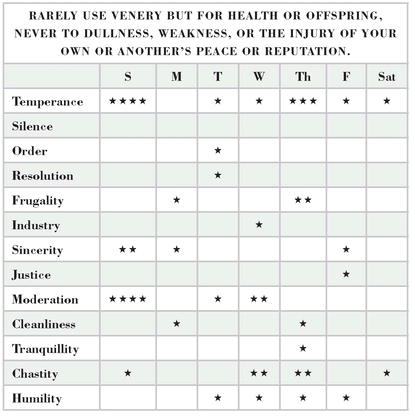
{CHAPTER 12}
Rarely use venery but for health or offspring, never to
dullness, weakness, or the injury of your own or
another’s peace or reputation
IF YOU’RE EXPECTING SALACIOUS DETAILS ABOUT MY SEX LIFE IN THIS chapter, you will be disappointed. After nearly two decades of marriage, I’m not sure I could even provide such details. Even if I could, however, I would not.
Indeed, the week of Chastity presented a unique problem and, perhaps, an opportunity. As a husband of many years—a devoted and loyal husband—Franklin’s dictate to be chaste presented no serious difficulty for me. In fact, much like Moderation and Tranquillity, all I had to do was live my life exactly as I had been living it and Ben would be proud.
This, however, is not a book about doing nothing (notwithstanding my efforts at Tranquillity). This is a book about seeking virtue, about being better, about following in the footsteps of Ben Franklin. Franklin wrote about this virtue, and indeed all his virtues, in his old age. The course, however, if we accept Mr. Franklin at his word, was designed and used when he was a young man. And for a young man, Chastity might indeed have been a concern. Biographies are replete with suggestions, speculations, and innuendos about his dalliances. Certainly he was a man with an active sexual appetite. He acknowledges in some of his writings that he may have “consorted with low women.” His son, William, was born out of wedlock, and the maternity of the boy has never been confirmed—indeed, it remains one of the few great mysteries of Franklin’s life. In that respect, then, Franklin may have needed to work on the virtue of Chastity. I will not, for the sake of my mother, give any indication of whether or not this was ever an issue for me. I can say that since my marriage, it has not been.
What, then, does a loyal husband do—a husband seeking to better himself—when he is directed to work on the virtue of Chastity?
The answer might lie in my preparations for this course. In my precourse interviews I got, for the most part, answers that I had expected. There were no great surprises in people’s perceptions of me. I was a bit taken aback by Michelle’s description of me as a sloth, but in truth, I wouldn’t have described myself as a cheetah (I still like stallion, but really, I’m just kidding myself ).
The one answer I was truly not expecting, however, came from Michelle. She told me that I was a wonderful father but not such a great husband. How’s that for honesty—brutal honesty.
Happily, she did qualify the answer. It was not that I was a bad husband but that I put my focus and my energies on the family unit as a whole. I was, and am, concerned with the well-being and happiness of my children. And, she acknowledged, I am good at it. What I am not so good at, she claimed, was our relationship. I was not dedicating the same sort of energy, interest, and focus to our relationship as a couple. She pleaded guilty to her own responsibility in that regard, but that didn’t soften the blow. She was telling me, quite simply, that I was ignoring our marriage.
Now that could’ve been a showstopper right there. A smarter man might have said, “Forget this book, I have more important work to do.” By now you are undoubtedly aware that I am not a “smarter” man. I forged on with this project, but at least I never forgot her response.
Where had I gone wrong? You’ll remember my vision of myself as a romantic. I remember thinking as a teenager, after watching some television show or movie about a loveless marriage, that I would never find myself in such a situation. I made sure that dates, especially first dates, were memorable—a late-night picnic on an island in the middle of the river, a romantic dinner at an abandoned farmhouse, stream-side picnics at a secluded waterfall. After that, it was often a slow downhill slide.
Add to that complacency the everyday pressures and time constraints of raising children, gathering income, and simply living life, and the time devoted to the actual relationship gets short shrift.
The secret, according to experts, is hard work and focus, along with a commitment to the relationship. Trying new things together can also stimulate romance.
I SHOULD BE BETTER AT BEING A SPOUSE. I’VE HAD GOOD ROLE models. My parents communicate well, viewed (and view) their marriage as a partnership, and have managed to see and do new things together throughout their married lives. I’m sure they’ll shudder when I hold them out as examples of what romance should be, but theirs is an exemplary marriage. My paternal grandparents were role models as well. They were together since they were essentially children.
But when I think of real-world romances, I think of my maternal grandparents. Hazen and Mary Dickson, like my paternal grandparents, met when they were little older than children. He was nineteen and she was seventeen when they married. Youth, however, wasn’t their biggest problem. This was the 1930s, and Haze was a Protestant and Mary a Catholic. The community in which they lived, settled almost entirely by Irish Catholics and Scots Protestants, was not a place, at the time, of religious tolerance. Prejudices died hard, and theirs was not a marriage particularly welcomed by their families.
But they persevered, perhaps because of the struggles rather than in spite of them. They survived the death of a child and the Depression. They never made much money, but that didn’t seem to matter. Their children and grandchildren viewed them as the center of the universe and a safe haven against all of life’s storms. Theirs was a simple life, but it was a good one—one that they made together. On the tombstone that they share in the quiet country cemetery not far from their family home, the epitaph reads, “Life’s Work Well Done.”
That was the type of romance I had imagined as a young man. I had my example of what Ben Franklin meant by Chastity.
This, then, was to be the focus for the week’s virtue. I decided to dedicate the week of Chastity to rekindling the romance in my own marriage. Not the fake, greeting-card-company romance, but the real-world, shared-mission romance. The type of romance that never gets made into a TV movie but that leaves a mark on the world, even if only a small one. The type of romance that would set an example for my own children.
The type of romance about which someone might say, “Life’s work well done.”
Operator, Can You Help Me Place This Call?
The secret to projects like this is to start small. Don’t overextend yourself in the early going. To stretch the metaphor to a prize fight, you need to pace yourself in the early rounds, feel out your opponent, and settle in for the long haul. I decided to begin with a phone call.
One can never overestimate the impact of the unexpected phone call. The normal (at least in my world) daytime phone call between husband and wife concerns errands for the day, activities and children, or everyday complaints. A phone call for no purpose other than to describe how much your spouse means to you may be, I assured myself, an effective and simple way to begin the week of Chastity (as I had defined it). I made the call.
Strangely, it worked exactly as I had thought it might. My wife seemed genuinely happy to have had me call for no other reason than to say “I love you.” I followed up the call with a conscious effort to remember in all circumstances how I had first felt about my wife. The effect, obvious to me because I was aware of my efforts, was instantaneous. We were partners rather than opponents.
Now, I don’t want to give the impression that there is ongoing strife between my wife and me; there is not. There are, however, instances where our interests diverge. For the most part, these surround household responsibilities. There are children to be cared for and tasks to be completed. At the end of a long day, volunteers are hard to find. On Day 1, instead of shirking my responsibilities in such situations, I decided to be just such a volunteer.
Instead of delaying at the dinner table in hopes that Michelle would do the dishes, I sprung into action. Before she had a chance to lift a finger, the kitchen was clean. Then came the myriad of activities that surround putting young children to bed; any non-parents out there should imagine cattle herding on a tricycle. Our routine is complicated by Kelsey, who is now physically a teenager but remains an infant developmentally. Her activities of personal care require time, a strong back, and patience. But I was up to the task. Finally, there was the postbedtime downtime. Generally this consists of literally falling on the couch, remote in hand, and eventually waking up with drool running down one’s cheek and an infomercial blaring. On Day 1, however, I made some effort to see to my spouse’s comfort before my own. A cup of herbal tea and an offer of whatever else she wanted. I was solicitous.
{ A single man has not nearly the value he would have in a state of union. He is an incomplete animal. He resembles the odd half of a pair of scissors.}
And I could tell it was appreciated. There were no outward displays of gratitude, but certainly there was a general sense of calm where normally there might be the stress and conflict of the children’s bedtime ritual. Maybe Franklin was on to something here. I decided not to press my luck on the first day. Day 2 would be telling.
Red, Red Wine, Goes to My Head
Day 2 provided a strange twist in my week of Chastity. I had nothing special planned. In fact, planning would be almost an impossibility. There were conflicting schedules—Michelle going somewhere one night, I somewhere different the next, soccer for the girls, a soccer skills and drills session on the weekend, a promise to do yard work for my mother-in-law. It seems that in the modern family, there is very little time that is not scheduled. This, of course, is part of the problem with maintaining a positive relationship with a spouse. The second night of this virtue seemed to present just such a problem. My wife reminded me that we had agreed to talk about finances and home renovations—hardly a task that inspires romance. Bemused expressions and occasional angry words maybe, but usually no romance.
On this week of Chastity, however, a strange thing happened on the way to our conversation—we actually talked. After the kids were in bed, my wife produced a bottle of red wine and said, “I thought this might help things run smoothly.” Indeed it did. Instead of the rancorous, vexing, anxious conversation that often accompanies the subject of money, we had a long, pleasant, calm conversation about everything from the actual topic at hand to how people achieve happiness and my wife’s plans for the future.
This was the type of communication on which studies of successful marriages place such emphasis. This was real talking. It reminded me of how we talked when we first became a couple—like two explorers planning a grand adventure. And isn’t that the spirit of hope and dreams that should pervade a marriage?
And I wasn’t the only one who appreciated the tone of our talk. At some point Michelle made the comment that it was nice to just talk and that we didn’t do it enough. Now, I am not suggesting that every conversation between husband and wife should be lubricated by red wine or should be about life’s grand ambitions; there are dogs to walk and dry cleaning to be picked up. It’s just that in between the dogs and the errands there has to be something more.
Despite my pleasure at the evening’s conversation, I found myself slightly suspicious at my wife’s motives. She knew nothing, I thought, of the particular virtue of the week, but this seemed almost too coincidental. Could she have seen through my Day 1 activities? Or was she reading my virtue diary?
Finally, I dismissed my suspicions. Coincidence or design, what did it matter? We had conversed amiably about the most contentious of marital topics and turned it into a pleasant talk about the future. That was enough for me. This Chastity thing was working out far better than I had hoped.
You’ve Got Mail
Chastity was moving up in the favorite virtue sweepstakes. Though it was a work in progress, I was already seeing the benefits. A greater concentration on my marriage was paying early dividends. I needed to keep up the pace.
A bit of inspiration hit me while I sat idly at my desk. I decided to send Michelle a message thanking her for the conversation from the night before. I composed a short note and sent it, via email, to our home computer. Here is what I wrote:
Hi
I enjoyed our talk last night. You’re absolutely right that we need to sit down and talk more often.
We are raising a beautiful family and have a great life but we need to make sure that by the time our kids leave we are not strangers to each other. We should set aside time every week for each other.
Thanks for being a great wife and a great mother.
Love
Your Husband
Now, I should point out that a note like this could go either way. You’ve met my wife. She is a practical woman with plenty of experience with me. Instead of the legitimate and sincere note of love that I intended this to be, she might view it as the first salvo in a battle to obtain some marital pass, like a golf weekend—I am not above such chicanery. For several hours I received nothing in reply, and I feared the worst. Did she see mischief in my intentions? Was she angry that I had ruined the spirit of the previous evening? Was she suspicious that this had something to do with the book and was offended at seeing our personal life as fodder for my stumbling efforts at virtue (which, of course, it was—though I sincerely meant what I said and my purpose was noble)? Had she even checked the email? Finally, near the end of the workday, I received this reply:
Hey Cameron,
Surprised to get an email from you. I had fun too but the next time only one glass of wine for me or maybe a corona on a hot day. You’re the best even though I give you a hard time.
Love ya, Michelle
Wow! That was exactly the response I had hoped for. I had made her happy. This Chastity thing was too easy. Given my experience with the virtues to this point, I should have known I was too smug. Fate can’t let such an opportunity pass it by. I was in for yet another lesson.
The secret of Ben Franklin’s system, as I thought from the beginning, is that it encourages the forming of new habits. The concentration on one virtue to the near exclusion of others builds a sort of virtuous muscle memory. You get so used to doing something that it becomes natural, almost instinctive. The problem with that formula is that you actually have to do the thing (or not do it, as the case may be) to form the habit. The foot must, most decidedly, remain on the gas. No coasting in this exercise. I should have learned that from Tranquillity. Yet as with the last virtue, once I started to feel good about myself, I took the virtue for granted. I started to coast.
As with the problems I had encountered in the late stages of the other virtues, I blame my early success. Like a hockey team that gets up a few goals on an opponent, I decided to play more conservatively. Wait out the clock and celebrate the victory. Maybe it was just the nature of my life. Remember, I am Mr. In-Between. I am not a risk taker.
On Wednesday, I had made a long-standing commitment to play a friendly game of poker with some friends after the kids went to bed. That was my first mistake. Michelle is not opposed to poker. Indeed, she likes me to have fun with my buddies. She hates it, however, when I lose (and when you play poker like I do, loss is an inevitability). Even the loss of twenty bucks (my maximum) sticks in her craw. That turns poker from harmless amusement to a gratuitous drain on family finances.
I’m sure quite a few of you are shaking your heads (and not for the first time), thinking, “What was he thinking?” I had committed to a week of being a better husband, and here I was going out to play poker? It gets worse. I lost.
I would do better tomorrow, I told myself. Again, I lied.
The next day, there was soccer for the girls. Now being a good father (usually), I had agreed to (assistant) coach Harper’s team this year. This was my third year doing so. That, one would think, would not be a problem. Indeed, my wife supports the idea wholeheartedly. It does, however, cut into couple time. But so long as it is in the pursuit of our children’s happiness, I would not notch this down as a transgression on the Chastity table.
However.
Taking the girls for an ice cream after soccer and coming home almost two hours postbedtime with two tired, cranky, sugar-filled youngsters did nothing to endear me to my wife. She offered the ultimate rebuke when we returned home: “You know better than that.”
{ Marriage is the most natural state of man, and . . . the state in which you will find solid happiness.}
Scolded like a child, I wondered if I could redeem the week. Could I dust off the recriminations that had been justifiably heaped on me and surprise my wife again? Not likely. Perhaps it is my nature to be a devoted father, but a not-so-devoted husband. Where was the romantic who frolicked beside waterfalls, who rowed canoes through the midnight waters of an ancient river, who read poetry by candlelight?
At the moment that I was asking myself these questions, he was watching the Stanley Cup Playoffs.
Where had I gone wrong? Of all the weeks, given what was at stake, why could I not rise above my infuriating ability to muck things up and truly be virtuous? My attempts to change that were coming to naught—I was blowing it. I was allowing the very things that had hampered me in the past be anchors on my voyage of virtue.
You Ain’t Seen Nothing Yet
As I struggled through the last days of Chastity, I tried, in vain, to up my game. I took on household chores that I might normally avoid like an influenza outbreak, I did yard work for my mother-in-law (actually, I got to use a big saw doing the yard work, so that was really more for me), and I even assisted an accident victim (all right, that had nothing to do with Chastity, but I was grasping here). Despite these efforts, I could not replicate the early success of the week. The fates, soccer schedules, work, and a poor imagination all conspired against me. Finally, by Friday of the week of Chastity, I’d had enough.
Maybe the problem, I reasoned, was that I was in this thing alone. A relationship is, after all, a two-person dance. If only one person knows that the steps have changed, there are bound to be a few toes stepped on.
On Friday morning I called Michelle about some household renovations we had been discussing. During the course of the conversation I decided that it was time to let my dance partner in on the new tune.
“Did you know,” I inquired gingerly, “that this week was Chastity in my Ben Franklin virtue course?” When she replied in the negative, I explained my plan for the week.
“I decided that I would take you seriously when you said that I was not always dedicated to being a good husband. So this week I decided to work on being a better husband.”
“Really,” she replied, “I hadn’t noticed.”
I gathered myself and, with as much dignity as I could muster, asked, “Didn’t you notice the calls to tell you that I love you, the extra chores, the email telling you what a great wife you are?”
“I wondered what that was all about,” she said. “I thought you wanted something.”
I had! I had wanted to become a better husband. I had wanted to make this virtue about fixing one of the most concerning aspects of my precourse preparations. I wanted my wife to think of me in the same way that my children think of me. I wanted to be Superman to my wife.
Instead, I felt more like Clark Kent adjusting his clunky glasses. Virtuously speaking, I was clearly no superhero. The most my efforts had produced was suspicion from my wife. Not affection, not appreciation, not romance, just suspicion.
But did I really deserve anything other than suspicion? My focus on my relationship was unfocused and ill-planned. What early success I had achieved I squandered with self-centered and, sadly, all too typical behavior. No Superman indeed.
At least this would make the virtue of Humility easier to stomach.
CHASTITY