{CHAPTER 4}
Resolve to perform what you ought;
perform without fail what you resolve
AT THE RISK OF HAVING SOMEONE FROM THE TELEVISION SHOW INTERVENTION turn up at my door, I have yet another confession. By my senior year in college, my mother believed I drank too much (she may have developed the belief long before that, but she kept it to herself up to that point). I don’t want this to sound overdramatic. She didn’t drag me to an AA meeting or kidnap me and have me deprogrammed. She was simply concerned that, having invested heavily in my postsecondary education, I was spending too much of my time in the campus bar.
{ Tomorrow, every Fault is to be amended; but that Tomorrow never comes.}
My mother is a clever creature. She knew that interminable parental lectures have little effect on inveterate behavior. Better the carrot than the stick, especially with men/boys barely out of their teens. So she waited, picked her shot, and when I came looking for a favor, she went all Don Corleone on me.
At Christmas of my senior year, my roommates had signed up for a spring break bus trip to Florida. After nearly begging my parents to send me as a graduation present, my mother surprised me. Notwithstanding the burden it would place on their own finances, they quickly agreed to the trip. “There’s a catch,” said my mother. “We’ll send you if you agree not to touch a drop of alcohol from Christmas to spring break.”
If ever there was a time for Resolution, this was it.
So I took up the challenge (a little chagrined that it was proposed at all) and steadfastly refused to imbibe for a solid three months. I was on the honor system. My university was only two hours from my hometown, but there would be no motherly monitoring, no daily checkups. If I was to keep up my end of the bargain, it was all on me. In the end, in the conflict between youthful intemperance and honor-driven resolution, it was no contest.
For three months I didn’t hold, smell, drink, or even clean up alcohol. I became the world’s most dependable designated driver.
Finally, the three months came to an end, and I duly reported to my mother (who had already paid for my spring break trip) that I had maintained my end of the deal. I had been resolute; I had, in the words of Franklin, “performed without fail what I resolved.” And never had there been a more concrete reward for resolution: I was on my way to Florida. I, several of my closest friends, and eighty other students gathered at the front doors of the Student Union Building to board two buses bound for sunshine, girls in bikinis, and—my deal being over—beer.
In fact, the deal having been completed, the beer started to flow even before the bus arrived. I joined my friends, and the other bus trippers, in toasting our voyage. We continued to toast as the bus left the university. The consumption continued following a trip to the duty-free shop at the border and kept right on after a stop at the world’s cheapest liquor store (or so it seemed to us) in tax-free New Hampshire. It flowed and flowed and flowed.
And then the bathroom on our bus broke.
Short of actual physical violence or serious illness, there can be little to compare in discomfort to a bus full of . . . well . . . full bladders, a driver on a schedule, and an interstate short on rest stops.
Things looked to be coming to a head (so to speak) when I decided that the driver must stop. Deputized by my fellow travelers, I spoke to our bus driver and asked politely if he could stop. “Nope. My instructions are to get to Florida as fast as I can. No stops until we get to the next rendezvous point.”
I explained our dire circumstances. No luck. I appealed to his conscience. He had none. I begged for a little understanding. He ignored me. It was only when I threatened—Mom, don’t read this—to use his head as a urinal that he came to a screeching halt at the next rest stop.
It was as if someone had opened the doors to a stockade. Drunken college students poured from the doors of the bus like runners before the bulls of Pamplona. I was struck, after my own relief was found, with the folly of three months of clear-headed resolution wasted in so stark and crass a fashion.
So I know the need for Resolution. And I know that even the mastery of it can be undone all too easily.
And never has there been a more timely resolution than Resolution. Like a white knight charging forth at the climactic moment in a battle, Franklin’s admonition to do what I ought came just at the moment in his course of virtues that I was failing (or at least faltering). Sure, I was still following the virtues, tracking my successes and failures, and generally heeding the words of Mr. Franklin, but my heart just wasn’t in it. My ethical mentor, Chris, had taken the week before Order off, and when he returned, I took up the course again. Unfortunately, even a one-week interruption in the process of a course of virtue seems to take some of the steam out of virtuousness. To add to my dilemma, I had already done much of the work for Order; thus, the week was easier than it should have been. The end result of all this was that I was being less than virtuous. And then along came Resolution.
But like my bus trip failure, I simply needed some relief and a second chance. What has been undone can be done again.
Chris’s guidance to me was generally in the form of written interpretations of Franklin’s, but occasionally we would meet over a glass of wine at a local café. At one of these, he told me that Resolution was all about second chances. Resolution, Chris explained, is about the belief in imagination, hoping, laughing, and loving. These things sound really good over a glass of red wine.
And so I resolved to set forth with renewed vigor. A second chance was all I needed (okay, technically a fifth, a sixth, maybe an eighth chance—the number is not important).
I was feeling good.
I’m sure you can imagine where all this was headed.
Undone by Email
Email.
The very word makes me shudder. If there is any single villain in my efforts to follow Franklin, it is email. If Resolution is Superman, emails are Kryptonite. Pervasive, invasive, insidious.
What did we do before email? It seems that 50 percent of my day is spent reading, responding, considering, or ignoring emails. And now, with the advent of web-enabled smartphones, they stalk us like emotionally disturbed exes. There should be someone you can call to get a restraining order against emails.
I find that emails have also engendered in me an irrational dislike of those who seem incapable of surviving without instant access to an email server. On buses, in coffee shops, at malls, in meetings, and at dinner and over drinks, there is always someone pulling out a BlackBerry or a PDA and checking to see what issue of global importance has just deposited itself in his or her in-box (it’s amazing how in one generation the word “in-box” has acquired an entirely new meaning). As I watch them tap away with their little calloused thumbs, I feel like wrenching the device from their hands, flinging it as far as I can, and screaming, “You’re not that important. You can wait until you’ve finished your soup before you see what other fool is rudely sending off generally trivial information.”
I know, that doesn’t seem very virtuous, but stick with me. Maybe Tranquillity is going to be a welcome week.
And yet, as much as I hate emails, I’m not sure how I would survive without them. Perhaps my annoyance for those that draw their PDAs like weapons is that I see myself in them. Their weakness is my weakness; their addiction is my addiction. And so it was on Day 1 of Resolution. Blue tights and flowing cape gave way to bits, bytes, and a glowing monitor. The story really starts with an overweight politician with oversized ambition.
On the weekend that Order ended, and before Resolution began, a politician (from my hometown, no less) quit the caucus of the governing party in protest. (Okay, time for another dose of Canadian electoral education. Canada is a parliamentary democracy, as are its provinces. Governments hold power when they have the majority of seats in their respective legislative assembly. Thus, when someone quits the caucus—leaves the government—it’s a big deal. It’s a bigger deal if you’re clinging to power with a margin thinner than butterfly wings, as was the party in question.) The reasons for the rift were unclear. The politician claimed it was a principled stand. He had been passed over for an important position and insisted that his constituency deserved representation at the seat of power. His departure was a blow to a party holding a slim majority.
The party’s leader alleged far less scrupulous motives for the departure. He suggested that the departure was the last act of a blackmailer who had sought a job (for a friend), a position of power (for himself ), and a judicial appointment (for an adviser).
The politician loudly denied the allegations of his former leader and took up his place as an Independent. The drama was made all the more spectacular by the shoot-from-the-hip style of the politician in question. It was the talk of the town by Monday morning (and coincidentally Day 1 of Resolution).
So there I was, reining in my gossip tendencies with as much virtuous strength as I could muster, when I read a newspaper column on the scandal by a former politician. It was well written, engaging, entertaining, but, in my opinion, completely and utterly wrong on the virtues of the parties involved. This would have been of no import except that this columnist happened to be my cousin.
I am fortunate in my family, and to say that I am close to my cousins would be an understatement. Since I am an only child, they serve as my brothers and sisters. I have cherished, and still cherish, that strong familial bond. Indeed, as we have grown from children playing in my grandparents’ yard to adults spread across the vast expanse of North America, we have remained not simply relatives but friends. We attempt to keep in contact, to spend time together, and to support one another.
In the case of this particular cousin, the former politician, we talk on a regular basis, used to try to have coffee at least once a week (before he moved for work), and entertain each other with our views on politics and the world. Our views on this scandal were, as I’ve said, in diametric opposition. The disagreement (friendly to be sure) was too entertaining an opportunity to pass up.
I dashed off a quick email assailing his take on the scandal, and congratulated myself on my wit and intelligence. I ignored how many of the virtues I had trammeled in both my email and my self-congratulations.
Shortly after sending off my missive, I received a reply. It was sarcastic, challenging, opinionated, and unrestrained. It was also very funny. It could not go unanswered.
I reaffirmed my earlier points on the merits of the two principles (indeed, my general take on the issue was that neither side had any merit, there were no “Mr. Smith Goes to Washington” types among the players, it smacked of political opportunism, and it called for, in the words of the Bard, a plague on both their houses). Satisfied that my argument was unassailable, I hit send. Almost before I could turn in my chair, a tinny chime announced a new message. This was war.
As the day passed, I cursed not the distraction of the emails but the business of my day that in turn distracted me from my electronic debate. Indeed, notwithstanding my Resolution to be resolute, by the end of the day I had spent at least two hours of my work time composing and responding to emails with my cousin. The repartee was witty, the writing entertaining, and the dialogue stimulating; it was not, however, something I get paid to do, and certainly not something that had been on my to-do list.
I had, over the course of the afternoon, run roughshod over Franklin and his virtues. I had gossiped, I was anything but industrious, I was immoderate in my views and unjust in my comments, and I had not been silent. Sincerity surrendered to humor in my email exchange; Humility was nowhere to be found; and, above all, I had not resolved to perform what I ought, nor had I performed without fail what I had resolved. If I had been drunk, been unwashed, and bought something I didn’t need, I would have bowled a perfect anti-Franklin game.
{ Energy and persistence conquer all things.}
It is too easy to blame the whole episode on the ease of email. My failure was more elemental. Despite my best efforts to be resolute, I had been the opposite. As I contemplated my debacle, a colleague came into my office and commented, with some amazement, on the level of organization I had achieved. “Wow, you must really be getting some things done,” she said.
I thought of Chris and said to myself, “I believe in third chances.”
No . . . Well, Maybe
Part of my problem in keeping my Resolutions is what my mother described in her initial assessment of me: an inability to say no. I don’t know why I can’t say it. I just know that the problem manifests itself, as it always does, in my taking on too much. In the last few weeks I have agreed to lecture to a criminology class at one of the local universities (for free), teach a course on the justice system to a group of private-investigation students (for free), and establish a charity to facilitate pro bono work by local lawyers (obviously for free).
Given my need to focus on Franklin, this little personality flaw is becoming a problem. It seems just as I begin to master one of the virtues, a transgression of another occurs. Like holes in the dike, I stretch to plug one as another stream of vice-filled sludge spews forth. There seems to be no end to the things that I should resolve to do. Perhaps that’s a good thing; Franklin has made me conscious of my deeds and actions. On the other hand, I may be suffering from a significant bout of overcommitment.
I have also noted a particular pattern in my vice-like behavior. It seems the further I progress past a particular virtue—Temperance, for instance—the less likely I am to follow it. For instance, once my family had gone to bed last night, I opened up a package of Hershey’s Kisses, nibbled away, and then went to some pains to hide the evidence of my action. This was not a one-time occurrence. Cheese and crackers, salami, chips, and chocolate have all been the source of my undoing over the past two weeks.
So why do I stretch myself too thin; why can’t I say no? I expect it may be some innate need to be liked, some fear of rejection born of low self-esteem. It doesn’t matter. This book isn’t about following Sigmund Freud; it’s about following Benjamin Franklin. And Franklin won’t put up with obstacles to moral perfection.
Perhaps, then, one of my resolutions should be to do less. Now that may be antithetical to the very notion of this book, but there is something to be said for focus. Franklin wasn’t suggesting that we needed to resolve to do everything but rather that we resolve to do what “we ought.” Maybe what I ought, in this case, is to do less and be better at it. Maybe if I finally learned to say no, I would have an easier time achieving yes. Geez, that’s almost profound.
I have known the freedom of no once before. Overcommitted, overworked, overtired, and overexposed, I decided that I needed to scale back. One by one, as fiscal years ended, I shed volunteer and nonessential work-related committees, paring them down to . . . none. As people called to seek confirmation that I would continue to serve at the end of a yearly mandate, I politely declined. When asked the reason, I was honest. It was surprising how understanding people were. My fears of disapproval or a lack of approbation were unfounded. As more and more of my responsibilities evaporated, I felt free. A burden, albeit an important one, had been cast off. I was unencumbered (except for all my nonvolunteer responsibilities). It was a good feeling.
It didn’t last. Once the initial euphoric sense of freedom diminished, it was replaced by some sense of longing with a healthy dollop of guilt. There was a reason, I came to understand, that I had volunteered in the first place. There was a purpose for my commitments; there was a goal with my burden. So, slowly, with a self-made promise not to take on too much, I began to reacquire volunteer commitments. A committee here, a sports team there. It felt good to give back again.
THEN ONE DAY I LOOKED UP AND I WAS HELPING COACH TWO SOCCER teams (a sport I know almost nothing about), sitting on the board of several community foundations, and representing my company on no less than eight work-related national committees. I was right back where I had started.
{ Does thou love life? Then do not squander time; for that’s the stuff life is made of.}
So the lesson, I’m sure, is this: Resolve to say no—no to being overburdened, no to being overcommitted, no to the things that take you away from what is important. Then resolve to say yes. Say yes to those things that are important and only those things.
So here I go; I resolve to say no to being overburdened. The next person who asks me to contribute to a worthy project is going to get a resounding NO . . . well, maybe.
A Tale of Castration and Second Chances
There ought to be some sort of rule against engaging in nostalgia-inducing activities while conducting life-altering programs of virtue. No good can come from long plaintive looks at life’s journey past while one is so intensely contemplating the future.
At the request of one of my colleagues, who supplements his inadequate prosecutor salary as a part-time lecturer at one of the local universities, I agreed to speak to his fourth-year criminology class on the law of search and seizure. Doing the lecture was no great difficulty; I often lecture to law students, police, lawyers, and even judges on the topic. Going to the actual class was, however, more than a little traumatic.
Looking out at the bored, slack-jawed students near the end of term, indeed likely near the end of their college lives, I was struck by the notion that their futures were like a great unmapped expedition—unknown, yet full of promise. I hated them.
Not so long ago, I, too, was a slightly bored student facing the end of my university career. In fact, if I had liberally applied Grecian formula (to the spots where there is still hair) and sucked in my gut, I could have been one of them. That’s not the real problem, of course. The real problem is that these students reminded me of why I was doing what I was doing, why I was following Franklin. I was doing it because I am a failure.
Perhaps you feel I am being too hard on myself. Cut it however you want, there is no disputing that I have done less, given less, achieved less, earned less . . . am less than I could have been when I sat in the same seats that those students did. As I looked out at them, trying as they were to stay interested in my talk, I could barely restrain myself from rushing down from the podium, grabbing them by the shoulders, shaking them violently, and screaming, “Live every day!”
For a moment I flashed back to a motivational speaker who visited my high school when I was in the twelfth grade. You know the type. A self-promoting, supercheerful, somewhat humorous professional speaker dedicated to motivating the graduating students by some variation on the theme “these are the best years of your life.” That message was always quickly followed by “you have the whole world in front of you.” Maybe I was jaded, but even as an eighteen-year-old, I thought it seemed slightly incongruous (and less than motivational) that I was being told that my whole life stretched in front of me but that the best of it had already passed. Maybe that’s why I wanted to slap some enthusiasm into my temporary students (metaphorically speaking, of course).
I should have told them about Héloïse and Abelard. Theirs is a tale of second chances.
According to Chris, Abelard was a renowned scholar in medieval France and Héloïse one of his most brilliant students. In an age when women were treated as little more than slaves to their husbands, Héloïse was learned, spoke several languages, and was recognized as an intellectual giant. It didn’t go unnoticed that she was also a hottie. Abelard fell madly in love with her, seduced her, and got her pregnant. Then, for his transgressions, he was castrated by her uncle.
Really. They castrated him.
Bet you didn’t see that coming. Not with all that talk of second chances.
Héloïse, getting in my mind the better part of the deal, went to Britain to give birth out of the limelight, and Abelard fled into the wilderness. That could have been it: one baby, one woman shamed, and one eunuch. But it wasn’t. That was actually the beginning of their romance.
Years pass . . . the two lovers were separated by geography and obscurity . . . not to mention the castration. Eventually they began a correspondence, until Abelard got himself into trouble with the Vatican, was threatened with excommunication, and fell ill. Héloïse heard of his dilemma and had her now dying lover brought to her priory, where she nursed him. After all the road blocks and obstacles, two people who had run out of second chances got a final second chance to be together. Abelard died soon after and was buried in the graveyard of the nunnery so that Héloïse could be close to him, and when she died, she was buried with him . . . two coffins, one grave.
That was what I wanted to tell the students—okay, not this specific story. I’m not sure how they would have taken a story about a teacher seducing his student and then getting castrated. What I wanted to tell them was that there are no second chances and yet there are always second chances. “Calling all slugs and sloths! Time to get off the couch of self-induced complacency.” Television instills in us a spectator mentality. We watch our lives from the stands. We live and love vicariously through the stories of others. And to those of us who are caught in this kind of life-by-proxy, Ben Franklin strengthens our resolve. “You are more than a lifeless lump. Don’t do it. Don’t put off until tomorrow what you ought to resolve for today.”
If I can do it, a self-professed failure, then they could do it, before their failures were upon them. If Abelard could do it, minus his . . . well, you know . . . anyone can do it. That’s what I ought to have told them. Unfortunately, all I did was bore them with details of the law of search and seizure. Although they did perk up at the mention of strip searches.
Maybe I’ll get a second chance next year.
My brief return to the halls of academia had put me in an introspective mood. Why is it, I asked myself, that I should want to change my behavior? Notwithstanding my self-effacing barbs about my admitted failures, I like myself. I like the choices I’ve made. I like the person I’ve become, I like my family, I like my job, I like my life. Why had I taken up this challenge to follow somebody else’s suggestions on what constitutes virtue?
Maybe the answer was wrapped up in the very reason that I wanted to give a metaphorical kick in the ass to my slump-seated criminology students. My journey to virtue is more about embracing every day as an opportunity for improvement rather than wholesale change.
I remembered an article I had read and saved from the American Psychological Association online magazine. It was called “Solutions to Resolution Dilution”1 and was written by author Sadie F. Dingfelder (I love that name). The article detailed some chilling realities for anyone seeking to be resolute: After two years, only 19 percent of resolvers still stuck to their resolutions.
The author found that a predictor of success was self-efficacy, or the belief that one can effect and maintain change. Certainly Ben was the ultimate believer in self-efficacy.
Right. Time for a little affirmation. Say this along with me if you’re following this program (if you’re not, this would be a good time for a snack break—please get me a hunk of cheese and some crackers while you’re up). “I am not a failure. My moments of weakness are not full-on relapses. I resolve to carry on. I resolve to be better. I resolve to be more virtuous.” Are the cheese and crackers here yet?
Lessons in Resolution and Humility
As the week of Resolution wound its way to its inevitable conclusion (a lack of success, a feeling of shame, and a commitment to do better), I was struck with the notion that I should at least be learning lessons from my failures.
What, then, were the lessons of Resolution?
Lesson No. 1: Beware the enemies of Resolution (even the unwitting ones). This virtue has enemies and challengers that lurk around us everywhere. Take my cousin. He is an honor-able, intelligent, erudite man, and I find discussions with him intellectually stimulating. Unfortunately, faced with the chance to discuss an ongoing political scandal with him, I failed to be resolute. I gave in to temptation and I stopped doing what I ought.
Lesson No. 2: Learn to say no. If we allow ourselves to be overwhelmed with activities and projects, nothing will be achieved.
Lesson No. 3: Acknowledge transgressions, fix the problem, and move on. This lesson is a hybrid. It is human nature to want to achieve; it is just that we don’t understand our natures very well until we see time passing us by. It is important to understand that life is finite, that there are no do-overs, and that carpe diem has nothing to do with fish. On the other hand, don’t become wrapped up in achievement. Enjoy life. Be resolute in doing so. And above all else, don’t give up. Little failures are not “full-on relapses.”
Lesson No. 4: Finally, pay attention to the small things. I like the big picture, but if we don’t pay some attention to detail, there will be no big picture. You might, at this point, be flipping through the preceding pages wondering where that little nugget of wisdom arose. Stop flipping; you won’t find it above. Look below.
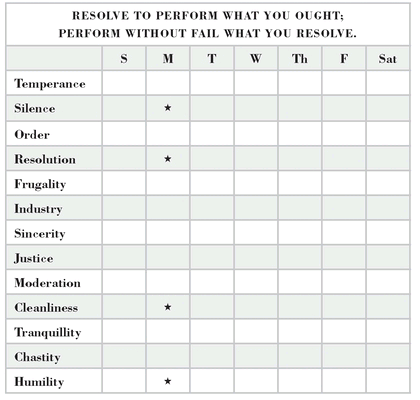
If you looked at my weekly chart of transgressions and thought that I had been particularly virtuous, you would have been wrong. At the end of the week of Resolution, so wrapped up was I in being resolute that I failed to do what I had resolved. I had not filled in my weekly chart since the first day. Not a mark. That was an embarrassing lesson in Resolution. I just wasn’t sure where to note the transgression.
RESOLUTION