{CHAPTER 3}
Let all your things have their places;
let each part of your business have its time
MY DOG IS INSANE. WAIT, I DON’T WANT TO OFFEND ANYONE. MY DOG has canine mental health challenges.
I’m not sure what the Diagnostic and Statistical Manual of Mental Disorders diagnosis might be, but whatever is wrong with her tiny beagle brain manifests itself through acute bouts of anxiety. She pees at the sight of bald men (a problem of growing—or receding—proportions in my household), fears all creatures great and small (with the exception of insects, which she hunts with the ferocity of a lion), and once walked backward for two blocks because a frog leapt at her.
{ A place for everything, everything in its place.}
Her “issues” would be of little concern if they were not accompanied by serious physical health problems. Billy (whenever we told someone her name, my youngest daughter, Darcy, used to yell, “She’s a girl dog!”) has Addison’s disease. That was the same condition that caused President Kennedy such discomfort during his life. And like the American electorate, we didn’t find out about her condition until it was too late to make any decisions about our selection. Addison’s is an endocrine disorder in which the adrenal gland produces insufficient amounts of steroid hormones. We discovered it when it produced, in Billy, two of its most common symptoms: vomiting and diarrhea. A 3 a.m. cleaning of runny beagle feces from a child’s bed is a true test of the strength of the human-pet bond.
I blame Billy, or more precisely our selection of her, on a personal character flaw (my person, not hers): I am perpetually disorganized.
Getting a dog was a natural stage in the evolution of our family. First came courtship, then marriage, next children, and finally, a dog. Michelle and I both had dogs as children. My dog was an overprotective collie named Scottie. Michelle had Chico, a dangerous Dalmatian. So we wanted a dog for our family. A smart, organized, ordered dad would have . . . well, I don’t know what he would have done because I am not organized or ordered, and if my selection process for Billy was any indication, I am not smart.
In the dog choice, I dithered and delayed; I procrastinated and postponed. Instead of some systematic assessment of appropriate dog choices—considering their behavior around children, acclimatization to an urban environment, reaction to daytime isolation—I chose another path. I told people we were thinking of getting a dog.
This led to Billy.
Billy came into our life in a manner that has helped me develop a new personal rule: Never conduct business at a funeral.
An elderly relative had passed away, and as often is the case, the funeral service and reception were an opportunity to reacquaint myself with relations with whom I had lost touch. One, a cousin who lived five hours away, said she had heard of our quest for a new dog, was working at a shelter, and had a wonderful dog for us. Had I been more organized, more ordered in my thinking, I would have asked appropriate questions (see above). Instead, all I could think of was, “How much?”
“She’s free.”
In hindsight, this should have occasioned an amendment to my rule, or perhaps a new rule altogether: Beware of free beagles.
Emails were exchanged. A picture of Billy in repose was our first clue of any problem. “She seems sad,” commented my wife.
“And fat,” I added. “She’s not the best-looking dog I’ve ever seen.”
We decided that physical attractiveness, especially in dogs, wasn’t really relevant, and that her sadness, if real, would be dissipated by becoming the newest member of our loving family. One five-hour drive later and we had our new dog.
It would be difficult, in a few short words, to describe the adventures and misadventures of Billy and the Gunns (sounds like a country band), but let me just say that I have learned the following lessons from our time together:
1. The consistency of a dog’s stool is a good indication of its health.
2. If a dog vomits or has diarrhea outside the house repeatedly, it will almost certainly vomit or have diarrhea inside the house.
3. Beagles will eat anything, and I mean anything, including things they have already eaten and passed (if that is too disgusting to contemplate, consider it in conjunction with No. 2).
4. Beagles, regardless of their state of health, will run into the woods and engage in No. 3—you just won’t know what it is they have eaten until the beagle returns (see No. 2).
5. Doses of dog medication are not to be missed—the results of such neglect will be immediate (see No. 2).
6. Make assessments about how much you are prepared to spend in health-care costs for your beagle before your young children come to love it more than they love you.
7. Once your vet bills pass $5,000, your vet will treat you very much like a part of his family (without giving you a family discount).
8. Never mock pet health insurance.
All that said, Billy has been, on the whole, a great dog. She is patient with the children and loyal to the family. Indeed, she outranks me by several notches on the family popularity scale. Her popularity notwithstanding, she has been a learning experience.
Maybe being more organized about getting a dog might not have changed the result. I’ll never know for sure because I went about our canine acquisition like I do everything else: stumbling blindly about until something happens, for better or worse.
I have no Order. I am the anti-Descartes. I don’t think, but nonetheless I am.
So I was excited and anxious about Order. Temperance and Silence had a whiff of abstraction about them, a sense of the idealistic. Order, though, is pragmatic and practical—a meaty virtue with a chance, in my case, for real-world success.
If only I had better prepared.
Let There Be Order
My initial excitement for Order had been tempered by the stark realization that I am to Order what Tiger Woods is to fidelity. My desk looks like an exploded stationery store. My room (at least my side of it—my wife takes no blame for my disorder) is a World War I trench (absent the rats and cholera outbreaks—most of the time). And my mind is like the London Underground. I am the poster child for nonlinear thinking.
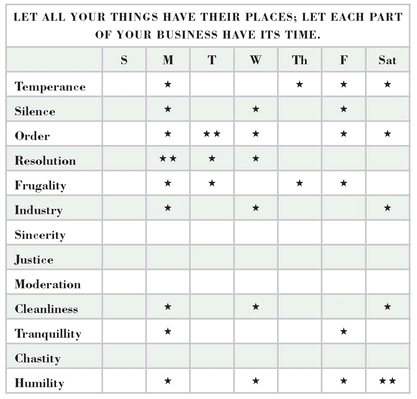
Until the week of Order, I took it as a compliment when I was described as disorganized. But as I stared down at my little chart for the week and thought of the struggle ahead, I was reminded that chaos was not on the list of virtues. Even Ben felt inadequate when it came to Order. He wrote:
My scheme of ORDER gave me the most trouble; . . .
In truth, I found myself incorrigible with respect to Order; and now I am grown old, and my memory bad, I feel very sensibly the want of it. But, on the whole, tho’ I never arrived at the perfection I had been so ambitious of obtaining, but fell far short of it, yet I was, by the endeavour, a better and a happier man than I otherwise should have been if I had not attempted it; as those who aim at perfect writing by imitating the engraved copies, tho’ they never reach the wish’d-for excellence of those copies, their hand is mended by the endeavor, and is tolerable while it continues fair and legible.
My heart sank when I read this. If Benjamin Franklin was undone by Order, what was to become of me?
Now, if you knew Chris Levan, my contemporary adviser, you would have undoubtedly told me to take a pass on his advice for this week. If I am a student of impetuousness, he is the master. He has a bit of the whirling dervish about him: a thousand projects going at one time, each in some state of chaos but all coming off in the end despite his lack of organizational skills.
The first time I met Chris, I got some sense of his nature. I was invited to a meeting of a committee at the church I attended. It was my favorite type of committee. We met irregularly, had very little responsibility, and got fed snacks. The purpose of this meeting was to introduce ourselves to the new minister at the church. I anticipated nothing to come of it except for some reasonably good snacking. I was wrong.
Within a few moments, Chris, the new minister, had us all agreeing to take on three new tasks (none of which had the potential for snacking), and he himself had committed to at least five significant endeavors. When he opened his schedule to set up our next meeting, I saw that there wasn’t a free hour for the next two months. Indeed, the inside of his day planner looked like it was completed by someone in the throes of a manic episode, with notes and scribbles everywhere. The leftover eraser shreds from numerous deletions and corrections still clung to its pages. It was all more than a little overwhelming.
The thing is that I can’t remember what happened to any of those projects and tasks. Maybe they got done, maybe they didn’t. What I do remember was that whatever Chris did accomplish, he did through energy and force of will, not organization.
Despite Chris not being an Order guru, he did give me some hope when we discussed this virtue. He told me that Franklin, like John and Charles Wesley of Methodist fame, was living in a social context where abuses of all kinds had shred the fabric of society. Corruption and mismanagement had dealt out destitution and starvation to the masses. Order and control were the only solutions to a decaying political system. So here was a virtue tied up in the very roots of the revolution that was to come. This virtue was very much a product of the circumstances of Franklin’s world.
If I was to understand and abide by the virtue of Order, Chris went on to explain, then I needed to seek the right Order for my world, not Franklin’s.
Well, that made sense! Though Ben’s scheme of virtue was conceived in the early part of the eighteenth century, Ben’s musings were cast among the chaos of an imperial power unresponsive to its colonies’ and colonists’ legitimate concerns and, eventually, a revolution. I, on the other hand, was surrounded by relative peace and tranquillity. But what, then, did Order, in my world, demand of me?
For a lawyer, Order is an imperative that is often ignored. Lawyers need to be prepared and to be organized. But the very nature of the work is dynamic, fluid, and volatile. Order and organization become like Cinderella, the forgotten stepchild waiting for the glass slipper. Prosecutors are the worst offenders against lawyerly Order for three reasons: Prosecutors participate in trials all the time, and thus, through experience (or weariness) they begin to rely on instinct rather than preparation; the volume of cases requires more flexibility of thought than organization of files; and most of the scheduled trials end in a guilty plea at the last minute, and prosecutors come to rely on this outcome (sometimes) to their detriment. Three strikes and you’re out at the Order ball game.
On Day 1, I went down swinging.
The whole thing started out rather well. It was a trial of a man accused of defrauding his employer, a political organization, out of a small (in the grand scheme of things) amount of money. The trial was to last the whole day, though I had anticipated being finished in less time. Part of my optimism was based on what I felt were impeccable preparations. I had interviewed the prosecution witnesses on two occasions (a rarity in such a small trial), organized my file completely, and served procedural notices well before the required dates. I was, in the prosecution world, almost overprepared. The Order gods had even taken notice of my efforts. My first witness was an old university professor of mine, indeed one of my favorite professors. My organization and effectiveness would undoubtedly, I reasoned, impress him and show him that I wasn’t the dolt that I suspect all my old professors believed me to be.
I called him as my initial witness. His evidence was not that significant. He was there as a setup guy for the big evidence to come later on—a straight man. Notwithstanding that, I had done a run-through of his evidence in my office (twice). Principally he was there to talk about the organizational structure of the association, explain how the office ran, and describe the responsibilities of the accused.
Things went very well—too well (if there were theme music, it would be taking on an ominous tone at this point—imagine the score from The Omen). As I concluded my questions, all that remained was to have him identify some checks he had endorsed in blank and that we alleged the accused then took to finance a wardrobe makeover rather than restock the supply closet. The checks themselves were really not in issue, and counsel for the accused had agreed that they be admitted into evidence. More as a final inquisitorial flourish than out of evidentiary necessity, I asked the witness to identify his signature on the checks. Remember the one-question rule from Sincerity? Never ask a question to which you do not know the answer. Remember my inner voice telling me to sit down and shut up? Where was Peter Lorre when I needed him?
I knew things were coming undone when the witness answered, “Yes, on check 412, that is my signature. Yes, on check 413, that is my signature.” However, he paused as he examined check 414. A long, uncomfortable pause. It occurred to me as he carefully examined the check that I had never actually asked him to look at them in our preparations. As each second passed, the knot in my stomach tightened.
Finally, the professor looked up and said, “Well, check 414 is signed in my name, but it’s not my signature. In fact, there are several checks here that appear to be forgeries.”
{ Employ thy time well, if thou meanest to gain leisure.}
The defense lawyer was on his feet screaming (okay, talking loudly) about undisclosed evidence (of course, he was afraid I was now alleging that the accused was also a check forger, when in truth I was just ill prepared . . . or stupid . . . or both), the judge was looking completely perplexed (this was not a check-forging trial), and the professor looked anything but impressed. I suspect he was saying, “I always knew this guy was a dolt.”
Things eventually worked out. The accused pleaded guilty (months later, after we sorted out the check-forgery issue), the political organization received restitution, and my old professor went on with his life. No long-term harm was done from my failure, but at that moment, standing there with all eyes on me, I was feeling less than Franklin-like.
The virtue of Order had gotten off to a marvelous start.
It Was the Best of Times, It Was the Worst of Times
My struggles with Order are a tale of two women. Like many men, I am torn between my mother and my wife.
I don’t know that these two women know they are in competition for my virtuous soul, but their natures pull me in two directions. While they share many common traits, get along very well, and both love and accept me (I hope), they are, in at least one respect, very different. My wife, as you may have gathered, is a pragmatist. She believes in lists and plans and order. She does not like to keep things (other than records), as “things” generally serve no purpose in her mind. She sells keepsakes and discards mementos. She is a creature of practicality, not sentimentality
My mother, on the other hand, is a keeper of things. Her basement is a treasure trove (or minefield if you seek my father’s opinion) of kitsch, knickknacks, and life’s souvenirs. She preserves her own memories and acquires those of others. She does not believe in throwing anything away because it may have historical value. She does not make lists or have plans—she just does. Though she loves my wife, I have standing orders from her that when she (my mother) passes, Michelle is not allowed to clean out her “things.”
So I am torn between these two poles of Order. I see the value of my wife’s organization and pragmatism. As a man trained in the law, I know there is benefit in the realism of Michelle’s nature. The logician in me likes her approach.
On the other hand, I share, as a product of nature or nurture, my mother’s desire to keep the pieces of the past. She is a historian of sorts, and I seem to have inherited that mantel. I eschew lists and plans and seek spontaneity. The romantic in me appreciates her attachment to the preservation of memories.
And thus I tackled Order (still having a limited understanding of the concept) in the context of this struggle (though unknown to the players) for my orderly soul.
The problem was that I was not sure that I could change a lifetime of disorder in the course of a week. Despite my misgivings, I tried. I awoke, again, with good intentions. Hope seemed to spring from my bed with me as I prepared for a new day of Order. But then good intentions met bad habits, or at least disorganized ones. As I have managed to have a pretty good life without Order, I was having a little trouble with self-motivation.
But that was not the quest. No one stands in his stirrups, raises his sword, and calls back to the troops, “To mediocrity!” I was seeking moral perfection here, damn it, and I would not be denied by my own shortcomings (well, actually, that was exactly my expectation, but I was not ready to write things off at that point).
I started off slowly. I cleaned up my office a little, but I think the operative phrase here is “a little.” I needed organization on a grander scale. I have attempted organization in the past. I have made checklists and shortcuts for processes at work, but I still seem disorganized. I’d buy one of those “how to get organized” books, but I’m sure I’d lose it.
I needed something grand in vision.
I turned, at least metaphorically, to my wife, keeper of lists and maker of plans. She makes lists for everything: food, recreation, school, housework. Even romance is a matter for a to-do list. I have to tell you, it is a little disconcerting to see something like: “Be nice to Cameron” on a list among: “Buy bell peppers” and “Clean out garbage can.”
You can’t argue with success, though. If my wife has a list, she is productive—if she doesn’t have one, she’s a basket case. So maybe on Order, I reasoned, Ben could get an assist from Michelle.
I had a sense, though, that just making a list wasn’t going to cut it. Some things don’t fit nicely on a list. When does something need a plan rather than a list? Can a task be too big to go onto a notepad on the fridge? Perhaps that was the key to Order: Decide what you want or need to do, figure out how it can get done, break it down into smaller tasks, and write it down. If I actually did this and achieved any goals, I could get a big star on the virtue of Resolution, which was up next.
So on Day 3 (you might note, if you are following along, that I had done nothing in furtherance of this virtue in two days), my first work task would be to sit down and write out a list of things I needed/wanted to get done, break it down/write it down, and get it done. I felt more organized immediately. Baby steps.
{ Keep thy shop, and thy shop will keep thee.}
Clearly, I was easily impressed with myself.
A Little Satisfaction
Okay, I felt morally good. Not morally perfect. Not even morally great. Just morally middle of the road. But that was a huge step in the right direction. As much as I like myself (and so many people have told me that I like myself that it must be true), I often feel a sense of . . . I don’t know how to describe it . . . disappointment. Maybe that’s too strong a word, but I know that life is finite, and with every day that passes, goals go unachieved. Every day the world remains unchanged is a day that is wasted—just a little bit.
Isn’t that what schemes of self-improvement are all about? Isn’t it some kernel (or more) of personal dissatisfaction that drives us to change?
Now don’t go jumping down my throat. I am happy. I am very happy. I feel confident. I believe in the potential of mankind (by which I mean man- and womankind, and I believe in gender equality enough to point this out). The problem is, like my beagle at the end of mealtime, I still want more. That’s what this book is about, isn’t it?
Or is it? I think my uncertainty comes, in part, from my lack of understanding about why Americans seem so fixed on self-improvement. Why do they long to be something different than what they are? Chris has been very helpful on the specific virtues, but I haven’t asked him to address the big question.
When you have a big ethical question like that, you find a big ethical guru to help answer it. Like the Pope or the Dalai Lama or Larry King.
While I didn’t have access to any of the above, I did have a pretty good resource close to home.
The Very Reverend Dr. Peter Short was the 38th Moderator of the United Church of Canada from 2003 until 2006. The Moderator is the leader of the church, which is the second largest denomination in Canada. The Moderator, according to the church’s website, is “expected to give spiritual leadership and public representation” for the church. Peter has written books, was a minister for thirty-one years, and spends his time now speaking and teaching on issues of spirituality across North America. He is a heavyweight on issues of morality and ethics. He agreed to give me a bit of a crash course on why people want to improve.
In his years of ministry and counseling, Peter has seen and counseled untold numbers of people who want to lead a more meaningful life. When I asked him what is the first thing he says to people who ask, “How do I change my life? How do I find more meaning?” his reply was simple. The first thing he tells them is to change the question. How is a strategy question: a determination of method. The real question, the one he wants them to ask themselves, is, “Why do I want to change my life?” When you figure that out, the how becomes clearer.
So I suppose, in following Franklin, I might have gotten into this thing backward. I was not sure I had any real desire to change at all. I was not even sure I could ask why.
I told Peter that maybe I was looking to Franklin to provide a boost on the ladder of achievement. His response gave me pause. He said, “The world would be a healthier place if there was less ambition.”
Okay, so maybe I needed to give more thought to the why questions. But for the moment Franklin called. For the moment, the why would have to be simply that I already had one-third of a social experiment finished. The book I had agreed to author on the subject wasn’t going to write itself.
Unfortunately, like most of our driven, ambitious, overly committed society, all I had to offer was chaos. Ben, however, wanted Order, so Order it would be.
How was I to create a system to wring Order from my chaos? There is an old saying, “If you want to make God laugh, tell him your plans.” I like that sentiment, but I think that it misses an essential characteristic of humanity, part of the reason for our creation. So I would add after those wise words, “If you want to make him cry, tell him you have none.” So then as not to make God cry or Ben cringe, here were my plans.
We all (I assume) have dreams, desires, and goals. Remember when you were a kid and adults would ask you what you wanted to be when you grew up? Those early answers were great and dramatic and exciting: astronaut, ballerina, cowboy. No one ever wanted to be an accountant or a mortician. If you are like me, however, the answers, over time, became less grandiose and more realistic (although I looked back at old school materials and found “lawyer” listed as an alternative to astronaut . . . must have been a slow year). Whatever the answer, though, very few of us would have been able to describe a plan to achieve that goal. Yet of all the things in our life, the big goals are the most likely to require some organization and order to come to fruition. No one (other than Homer Simpson and Bugs Bunny) becomes an astronaut by mistake. No one climbs Mount Everest because he or she is staying at a Nepalese Holiday Inn and has a few hours to kill before checkout time.
So for the purpose of my scheme of Order, I decided that the big things should be called Visions. These are the world-changing, earthshaking, fall-to-your-knees types of dreams. As I said, Visions need plans to become reality. So I called the next part of the program Plans. I am nothing if not literal.
Plans are the more concrete version of Visions. If your Vision is to become an astronaut, then the Plan is the answer to the question, “Well, little Cameron, how will you become an astronaut?”
But even Plans need some deconstruction. If your answer to the question above was, “Well, I’m going to become a pilot and go to NASA to become an astronaut,” then your Plan to achieve your Vision still needs some specific tasks. Keeping with my literal theme, I called these Tasks. Tasks are those things that are immediate, small things that can be done quickly. These can be part of a larger Plan broken down, or they can simply be part of the detritus of day-today living.
So there. If you have a Vision, break it down into Plans, which you then break down into Tasks. Do these, and the next thing you know you’re staring out of the front windshield of the space shuttle. I had a plan of Order.
I tried it on Day 4. It worked—sort of. The problem with the scheme was that it seemed too easily defeated by the plans of others. I had my breakdown, all written out into Visions/Plans/Tasks, but just as I would get started on one of my Tasks, someone else would ask me to do something for him or her. The needs of others were getting in the way of my wants.
Didn’t they know I was trying to be morally perfect? Didn’t they understand that I had a scheme of Order to follow?
Of course, that’s what life is like, isn’t it? Often the plans of others get in the way of our own.
Maybe that was why Ben wanted to achieve the virtue of Order.
Maybe that’s why he had to admit that he never did.
A Detour on the Road to Perfection
Ben is a tease.
With my scheme of Order, he had given me just a small taste of what success might await if I follow him, a tempting morsel designed to allure and lure. Then came a significant bump in the road.
My initial success with Order ran headlong into my moral imperfection, manifesting in two aspects of my character: (1) a slavish desire to use technology (boys need toys), and (2) overexuberance.
I should be smarter about technology. Once during an arson prosecution, the projector I was using to show crime scene photographs flashed and then went blank.
Frantically, I got the other prosecutor to ask for a recess, and when the judge and jury went out, I tried in desperation to discover what had gone wrong. I poked at keys and wiggled the mouse. I pulled at cables and prodded at connections. Nothing worked. There was still just a blank screen. The gods of technology were mocking me, I felt sure. As the time neared for court to resume, I stood in the middle of the courtroom and nearly cried. My high-diving act was rapidly approaching a fatal fall.
Then I looked down and noticed that the projector had come unplugged. I will never forget the feeling in the pit of my stomach when that screen went blank.
At least I thought I would never forget it. And yet I forged ahead with my love of technology in trials, with predictable results. In a murder prosecution, we were using a simple program (at least I was learning some lessons) to display photographs. All was working well until, as defense counsel and a police officer sparred over the contents of her notes, my screen saver activated. This particular screen saver was a silly phrase keyed in, as a joke, by a police officer during a previous trial. There were plenty of reasons it managed to come up during an important trial: I hadn’t set the timer on the screen saver at a sufficient duration; the police officer operating the computer became distracted by the testimony. It doesn’t matter—it just happened. So, as the defense counsel stood beside the witness and in front of an eight-foot-by-eight-foot screen, a message began scrolling in three-foot letters directly behind him:
I’M A SPECIAL DONKEY I’M A SPECIAL DONKEY
Given my past experiences, you might surmise that I would be cautious and careful in too readily relying on technology.
You’d be wrong (you’re wrong about me a lot; I think you overestimate me).
I decided that if my new Vision/Plan/Task program worked, it would work better with the aid of a computer. Perhaps, I reasoned, I could adapt some of the features of my calendar and email program to create an electronic list with reminders and Tasks. Maybe I could create templates and ticklers and all manner of productivity enhancements. I would develop Vision screens and Plan screens and link them to the Task screens preprogrammed into the database. I would be able to track progress and assess my Order skills as I went. As I considered the possibilities, I was almost giddy.
As I sat in front of the computer, no real plan in mind (irony rears its head again), I started playing around with my regular scheduling software. I could easily establish a Task, but I couldn’t figure out exactly how I would create grander things like Plans and Visions. I couldn’t simply make them a Task; that would have been too basic. I needed higher-level thinking. A little more tinkering produced something that resembled a Plan template. I field-tested it and lost everything I had done. Not to be undone, I tried to reproduce the Plan template and failed. This was going to be more difficult than I had first anticipated.
Finally (and reluctantly) I turned to the Help feature. As I searched around for features of the program, I found a design form and thought I had an “aha” moment. It didn’t work. I don’t know why; it just didn’t.
Okay, I decided, back to the Help feature. I stumbled onto something called InfoPath—another part of the off-the-shelf software about which I had no knowledge. It seemed to hold some promise for creating forms. As I ran through the Help menu and tried to replicate its instructions, I discovered that I had created . . . absolutely nothing. I tried again, and again and again. After several attempts, it occurred to me that the program’s designers must have created this as some kind of nerd prank. “Let’s put in these instructions for something that doesn’t work. Some idiot will putter around until he feels like throwing himself in front of a bus.” In disgust, I gave up on InfoPath . . . if that’s its real name.
Back to Tasks. Maybe I could simply use the Categories function. That took some jigging. Finally, I managed to get all of the above Tasks turned into parts of Plans (now renamed Categories in the Task feature because I couldn’t figure out how to name them anything else). Next I assigned due dates and recurrences where appropriate.
I stood back and examined my creation. It was . . . mundane, hardly the stuff of moral perfection. And it was midnight, so I had wasted almost an entire day.
I could have cursed myself. I could have decried my folly and cast my efforts aside. It seemed as if in seeking Order I had been wasteful of my most precious resource: time. The truth, however, was more nuanced, as it often is. I had, in fact, created a system of organization for myself where none had previously existed.
I am a special donkey. Of course, that might be a step up from sloth. Maybe I was making progress.
It’s a Small World
Ben’s precept for Order is: “Let all your things have their places; let each part of your business have its time.”
I like these precepts. I initially viewed them as outs for Ben, a little moral bet-hedging. But the more I look at them, the more they seem like a real attempt to put flesh on the bones of the virtues. Franklin knew that a virtue like Order meant more than being organized in your business. He wanted (at least I hope he did) life balance, though he would never have named it thus. He knew that a person would not be successful in life until all the parts of his or her life received attention.
But if he knew this, he wasn’t particularly good at it. He was a man of accomplishment. He invented, he worked, he led. He was an adventurer and a traveler. Ambassador, politician, author—he was one of history’s most accomplished men.
And yet, in one respect—his relationship with his family—he seems to have been . . . imperfect. He had an illegitimate son, William, whom he raised without apparent concern for his status or how it might be viewed. Indeed, he used his influence and wealth to make his son a powerful figure in colonial America. The Revolution, however, came between them when William chose the Royalist side. Franklin eventually cut off all ties with him. They never really reconciled, despite William’s attempts to do so.
Franklin’s wife also fell victim to his ambitions. As he became more important and successful, he spent more and more time away from home. As the relationship between England and her colonies deteriorated, Franklin was dispatched to England to make the case for several of the colonies directly to the British. He ended up spending years away from his wife, Deborah. Eventually she fell ill and died while her husband politicked across the ocean.
Some of Franklin’s critics have used his family relationships to malign his character, but I think it points only to his humanity. He was, as we all are, morally flawed, and I think he recognized this, both when he created his course of virtues and when he wrote about it later in his autobiography. And when he calls for attention to all parts of one’s life, it seems to me that it is said with a note of sadness, a point of regret he would have wanted to spare others. And so I decided to dedicate the last day of Order to my family.
Mindful of the project in which I was engaged, I didn’t want to entirely abandon the program of virtue. As I examined my course of Order, it was apparent that it was weighted heavily on personal and work achievements and largely ignored the most important aspect of my life, my family. My wife and I often speak of our dreams for the future but wonder why so many plans seem to pass by unaccomplished. Such is the nature of life for parents of young children—too busy living to plan. I think that there is something good in simply living life, but perhaps by doing so we miss an opportunity. As part of my virtue-seeking program, I decided that on the weekend of Order, as I communed with my family, I would actually impose some Order on my home life. My Vision/Plan/Task scheme would get field-tested, Gunn style.
The first step, I decided, was to sit down with my five- and seven-year-old daughters and ask them what it was that they wanted out of life. As I asked the question, it occurred to me that I was an idiot. Who asks a five- and a seven-year-old what they want out of life? They’re five and seven! They want whatever makes them feel good in the moment. Despite being relatively intelligent girls, they have no concept of big and small in the metaphysical sense (nor should they be asked to make the distinction). They are creatures of the concrete, not the abstract. They are five and seven. All they wanted out of life was another cookie.
But I was not to be deterred. I would have Order—a plan for my home life. I would create Visions. I would break those down into Plans. These Plans would become Tasks. We would have Order in this family, Order in the best traditions of Benjamin Franklin.
In the end what I got was a nascent plan to take a trip to Disney World. Hardly grand Vision stuff, but by the end of the morning, we were checking out the Disney website and guessing which rides we’d like the most. We assigned a date to the trip, put it on the calendar, and took the first tentative steps toward planning a family vacation. We were having fun in a very middle-class, bourgeois sort of way—hardly virtuous. Oh well, Mickey, here we come. Ben would have to wait. I bet he would have liked Space Mountain.
ORDER