{CHAPTER 6}
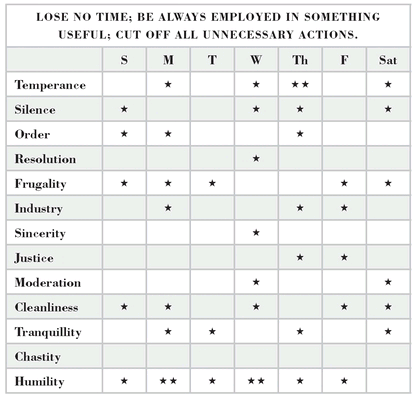
Lose no time; be always employed in something useful;
cut off all unnecessary actions
{A life of leisure and a life of laziness are two things. There will be sleeping enough in the grave.}
HERE IS ONE OF MY FAVORITE STORIES OF BEN FRANKLIN. FOR MORE than a decade leading up to the American Revolution, Franklin had been America’s point guy in the mother country. He was the representative for several of the colonial assemblies, he had made the case for a peaceful reconciliation between England and her colonies, and he had raised the world’s consciousness about the not-yet-born country. More than anything, Franklin wanted America (or what would become America) to remain part of the British Empire, but not at any cost. Eventually, it became apparent to Franklin that matters had come to a head, and in March 1775 he finally saw the end of any hope and left for home. It must have been a desperate trip. He was going back to an uncertain future, he had failed in his role in England, and his wife had died the year before in his absence. So what did Franklin do on the journey home?
He discovered the Gulf Stream (well, sort of ).
Instead of moping or pouting or despairing, Franklin took the temperature of the water as he crossed the Atlantic. He had already developed a chart of the Gulf Stream in 1769 with his cousin Timothy Folger, but he used this most depressing of trips to confirm and explain his earlier work. In a word, he was industrious.
Were that I was so.
When I think of Industry, I remember the day we got cable television.
Like Gabriel announcing the Virgin birth, it was a revelation. There may even have been an angelic hallelujah chorus (at least in my mind).
The details are burned into my memory. A small box was installed atop our bulky television, its digital readout like something from the space program. I can see my father fiddling with the remote control searching for the right channel (this was predictive—he’s been playing with television remotes constantly since that moment). And then there it was: my first cable television program. Feel the heart thumping faster, cue the chorus, rise and join in the call. Hallelujah!
It was The Jetsons.
Up to that point The Jetsons was like kissing a girl: something I had heard about at school but never experienced. Yet with the twist of a coaxial wire and the click of a remote, my universe went from two fuzzy, rabbit-ear-captured stations to a multichannel bonanza (well, I think we were hauling in a maximum of ten, maybe twelve, signals with out first cable feed, but that seemed like a viewing smorgasbord at the time). And unlike perhaps any media intervention before or since, my introduction to the joys of cable television changed my world.
Before cable I was a rugged, self-entertaining, athletic child (at least that’s my memory). After a cable signal broadcast from WLBZ Channel 2 in Bangor, Maine, however, I was lost in the exotic world of afternoon soap operas, television sitcoms, and Eddie Driscoll and The Great Money Movie. From the moment I came home from school until supper, my world was consumed by television.
I even became a momentary star myself as an audience member on a show called Dick Stacey’s Country Jamboree, a gloriously bad musical variety show filmed in the basement of Dick’s motel. Anyone could get up, without audition, and have a go. Viewers all over New England and Eastern Canada were entranced (or aghast) as an eclectic group of performers took the stage. Dick sponsored the show as an advertisement for his gas stations. His famous tag line from the commercials interspersed throughout the show was: “See these hands? These hands pump gas and they stink.” This was quality fare.
Somehow, during the run of Dick’s musical showcase, my parents and I found ourselves as both visitors to Bangor and guests at Dick’s motel. After supper that night, Mom and Dad decided that we’d take in a live performance of the Country Jamboree. Things progressed as one might expect until, to my thirteen-year-old amazement and horror, the host stopped beside me during his meanderings. I’m not sure what he asked me—probably where I was from—nor am I sure how I replied. All I knew, and I was keenly aware of it even as I was being interviewed, was that I had officially been on television. Cable television. Cable television that was seen in my hometown. The only long-term effect is a mild phobia about being interviewed on camera (which has lasted to this day).
Television has played a significantly diminished role in my life as I’ve aged, both by choice and as a result of increasing demands on my time. There is no more Eddie Driscoll; he passed on after a battle with Alzheimer’s not long ago. The Jamboree has long since been retired, and you can’t even get the Bangor channels where I live. But television is still the siren that calls me onto the rocks of lethargy and slothfulness.
I am not alone. According to the American Academy of Pediatrics, American children watch an average of three to fours hours of television daily, and by the time they reach seventy, they will have watched seven to ten years of television.1
As a parent, it is frightening to see how thoroughly television has invaded our lives. It is the background noise of existence. If our forefathers lived to the murmur of the forests or the drone of industry, our ambient noise is cable news, a laugh track, and an endless stream of ShamWow commercials.
Most modern criticism of television has focused on the effect that it has on younger viewers. Anyone who has seen a six-year-old stare, slack-jawed and droopy-eyed, at the screen for more than five minutes understands this concern. But how much time is lost by adults with that same glazed-over stare?
I am not, of course, advocating a ban on television. But somewhere between Dick Stacey’s Country Jamboree and American Idol, it occurred to me that at the very least I should feel guilty about my viewing habits. Other than a few memories of the famous people of Maine, what have I gained from watching TV? Certainly no one, Benjamin Franklin in particular, would call my TV viewing hours “industrious.”
And so, as part of my week of Industry, I decided to change my viewing habits. I thought that I might convince my family to join me, but coming so close on the heels of Frugality, I decided to avoid a family coup d’état and restrict this virtue to myself.
I also chose not to impose a complete prohibition. Mindful of one of the upcoming virtues, I decided to do this in Moderation. I resolved to limit my TV viewing to no more than one hour per day. I would use my time that had in the past been devoted to an absence of Industry to surround myself in a blanket of Franklin’s middle virtues. I would become industrious.
See these hands? These hands write books.
One Is the Loneliest Number
By the end of Day 1, I felt like I had the DTs.
Like many assessments of my capabilities, I badly overestimated my ability to withstand the lure of television. I assumed, given that I don’t watch that much television, that I would saunter through the day almost oblivious to my own commitment.
Oh, did I say I’d watch only an hour a day? I’d forgotten. Nothing to me really.
Ha! Never was an hour more thought about, never was unfettered access to a television more coveted. I was like an inmate waiting for telephone access. Every few seconds I reached for the remote, stopping only when I remembered that it was verboten. I was fidgety and anxious. Worse than that, rather than being a wedge in the door of Industry as I had hoped, my program of television abstinence was becoming a hindrance to any productivity. I thought that when not watching TV, I would be doing something useful. Instead, all my intellectual energy was being expended on trying not to think about the fact that I was not to be watching television. I felt like a crack addict in a convent.
Why was I having such difficulty? The answer was no real mystery. First, though I hadn’t opted for total abstinence, I had treated this too much like TV detox. Ben Franklin clearly knew the dangers of complete denial—as I thought I had when I planned for an hour of television a night. Notwithstanding that, I was acting as if even a momentary glance at the remote would turn me into stone. The self-denial made me covetous.
My second problem was a familiar { Industry need not wish.} one. Lack of preparation. I relied, to my detriment, on whatever had gotten me through the rest of my life—brains, chutzpah, cheese and crackers—to get me through my first day of self-imposed television restrictions. Bad idea.
Finally, I should have tried, even at the risk of serious injury, to involve my family in this adventure. Misery is often borne easier if shared. As it was, I was actively rebuffed in my efforts.
At some point during the evening, Michelle came into the living room, sat in her favorite chair, and noticed that I was sitting in silence, looking as if I were waiting for the dentist.
“What are you doing?” she asked.
“Not watching television. I’ve decided to be more industrious, and watching TV isn’t useful.”
She looked at me with the sort of weary expression only a spouse can display and sighed. “I thought we weren’t supposed to be part of this. If you don’t want to watch TV, go do it downstairs.”
On Day 1, I could add Banishment to my list of accomplishments.
A Bad Week for Industry
Being a prosecutor in a small town is like being an emergency room physician. You need to have a firm grasp on almost every different type of situation that might present itself, be flexible in your thought processes, get used to the sight of a little blood, and be prepared for some dry spells. My community is very safe. However, there are still enough impaired drivers, wife beaters, shoplifters, convenience store burglars, and occasional murderers to keep all of the local prosecutors in court almost every day during the week. Each day presents a new challenge. My day runs from the tragic to the ridiculous, from the peculiar to the perverse. It is, however, as I said, very rarely boring.
One minute your victim is demanding the accused’s blood, the next they are kissing in the hallway and pronouncing their undying love for each other. A witness one day is an accused the next, and there never seems to be a shortage of things that can go wrong immediately before a trial begins.
In short, those of us in the criminal justice system tend to be seat-of-the-pants types. We thrive on in-the-moment pressure and are not necessarily what you would call self-starters.
As bad luck would have it, my week of Industry coincided with a very slow week for the court system—the midwinter break. Thus, few trials, hearings, or other court activity. How could I be industrious, how could I follow Franklin’s dictate to “Lose no time; be always employed in something useful; cut off all unnecessary actions” when the fates had taken away the very thing that drives my productivity in the first place?
My wise friend Chris had warned me, in our discussions on Industry, not to lose important achievements by being “too busy.” His was an admonition not to lose the moments in the drive.
Maybe I am just too thick to understand. Or perhaps I am too simple to view the admonition to be industrious as anything but a call to work. Whatever the reason, I decided that I would take Franklin’s words literally. I would ensure that I was always employed in something useful.
When I had finished my preparations for the next day’s cases, I knew I needed to remain engaged. I needed to do something that would benefit myself and others. I looked around, drumming my fingers on my desk (at least metaphorically), and wondered exactly what would be a benefit.
I could prepare for future cases, but that seemed too pedestrian. I might work on my book, but given that I was contemplating Industry during work hours—on the taxpayer’s nickel, so to speak—whatever I did should at least be a benefit to said taxpayers. I was at a loss.
You might think, given that the week was to be devoted to Industry and Order and Resolution had already passed, that I might be better prepared. All I can say to such naiveté is that you haven’t been paying attention.
Finally, unsure of how else to be industrious, I decided to create a practice manual for prosecutors doing criminal appeals. In the end it was more assembling than creating. When I prepare for appeals, I create checklists for procedures—annotated Rules of Court—and anticipate potential judicial questions. In my efforts to “be always employed in something useful,” I compiled these materials, did some editing, and developed a guide for my fellow prosecutors. While I didn’t complete it in one day, I was off to a reasonable start.
Had I been industrious? Well, I’m sure the manual will prove useful, but I have a sense that Franklin was hoping for something grander. After all, he was an inventor, a creator. He didn’t simply assemble the Franklin stove—he gave it life. His bifocals were not some lame conglomeration of earlier pairs of glasses. Franklin’s Industry was purposeful and directed and inventive.
Industry in the Franklinian sense has, I think, less to do with simply being busy and more to do with getting busy. As Chris said to me in his lead-up to the week, “It is not in the nose-to-the-grindstone busy-ness that we find truth. It is in the small gestures of understanding and compassion, the little distractions, that we shine.”
I think Franklin’s notion of being busy was tied up in his desire to do good works, to be a benefit to others. My little appeal manual might have been a start, but I could do better.
Of all the virtues, this is the one (so far) for which I have the most affinity. Indeed, Industry was what I was hoping for when I started this project. Or, more precisely, it was the absence of this from my life that drove me on. Guilt is a great motivator.
We’ve lost perspective. We, in the West, are simply so privileged that we no longer have a true sense of sacrifice and hardship. Now before some guy who lost his job at an assembly plant and had his home taken from him loads up his shotgun and tries to find my house on Google Maps, hear me out. Even in our most desperate times, a nostalgic look back at the good old days is fiction. Life might have been simpler before, but it was also exponentially more difficult. Beyond those in abject poverty, even the poor in modern North America have luxuries and conveniences of which our ancestors could not have dreamt.
What we have lost with this relative affluence is a sense of self-sufficiency. That is one of the motivations behind Benjamin Franklin’s admonition to be industrious—a drive to be self-reliant. The other is something Franklin displayed in abundance: selflessness. It is the paucity of these in my own life and the abundance of these in Franklin’s that make this the most personally appealing of the virtues. When I think of Industry, beyond my earlier reference to television, I think of my grandfather.
So, for the rest of this week, I decided this would be the week of . . .
Big Haze
My mother’s father, Hazen Wood Dickson (or Big Haze, as we call him at the annual golf tournament named in his honor), was not a man of means. Indeed, I would say for a good portion of his life he was poor. He always worked and worked hard, but he never earned much money. Despite this, he raised a happy and close-knit family and left a considerable legacy. He was also the most self-reliant man I have ever known. In fact, though he holds no patents, and no royalty checks from licensing schemes pad the coffers of his estate, he was much like Franklin: an inventor.
Tread on the concrete walkway from his driveway to his house and you’d never be encumbered by snow or ice. He created a self-cleaning walkway using steam generated from a woodstove. His pantry was accessible by a trapdoor that was raised or lowered by an electronic pulley system, which might not have been revolutionary, or an invention at all, but was very impressive to a ten-year-old boy. My grandmother told me he invented the world’s first self-loading pulpwood truck and that he would have been rich if he had thought to find a partner with business acumen. He had a backyard filled with ancient single-stroke engines and portable sawmills run by steam motors, and I never saw him turn to a mechanic, plumber, carpenter, or handyman for assistance. It was others who turned to him.
For me there was a little bit of Franklin in my grandfather, particularly his Industry. He was always busy, never idle, and he did it for the love of doing it, and perhaps to make the world a little better. There are lessons there for me. That is why I decided that the week of Industry should be Big Haze week: a week of invention.
For a time I considered actually trying to invent something. I’ve always been fascinated by the notion of creating something new. Fascination, however, does not equal creation. The truth is that I am simply not my grandfather or Benjamin Franklin. If I was going to be original, I would need to look a little closer to home. The appeal manual was in the right ballpark but not quite, well, inventive enough. I needed something new, original, beneficial, and industrious. I needed to do something no one else had done.
One of the most time-consuming jobs for police and prosecutors is obtaining a search warrant. It is, of course, essential, both in a practical sense and constitutionally. No one, certain exceptions aside, should have his or her privacy invaded unless a judge agrees beforehand. The process is, however, laborious and frustrating. First, we expect police officers to draft documents that will stand up to judicial scrutiny despite the fact that they generally have little, if any, legal training. Second, we expect them to draft the documents requesting a warrant in the dynamic environment of a criminal investigation. Prosecutors help, but the real burden falls on the police. This was the perfect opportunity for an “invention.” This, I reasoned, was more like Ben (and Big Haze): industrious.
I started planning a database for the preparation of warrants. It would automate the type of advice that I offer to police on a daily basis and help replicate the tombstone data that must be repeated in the affidavits used in warrant applications. I had visions of keystroke-saving measures, data replication, alerts when deadlines neared. It would be glorious. It would be inventive. It would be industrious.
It would be . . . a long process.
I quickly realized that I was not going to finish this project in a day, or a week, or a month. I contacted some friends in the IT field, and we came up with some relatively unsophisticated templates, which made it clear that this was a project that would require a long-term commitment. At this point, my desire to be industrious ran headlong into my terribly short attention span. If Industry takes more than twenty minutes, I am in trouble; twenty minutes is my “sit still” limit. I once heard someone suggest that conversations have a twenty-minute life span. That is, every conversation has a lull or pause or dead spot approximately every twenty minutes. It seems also to apply to my working life. Absent some external restriction, I have to rise and take a short walk every twenty minutes.
On another day, that might have been the end of my warrant preparation database. I might have chucked the whole idea and gone back to my slothful ways. But this week I was in the hands of Benjamin Franklin. This week I was dedicated to Industry. So despite my recognition of my twenty-minute attention span, I resolved that I would remain industrious. I resolved that every time I felt like getting up at the twenty-minute mark, I would remind myself that Ben insists we be always employed in something useful—not always except for twenty-minute stretch breaks. I knew I would not finish the warrant preparation software before the end of the week, but I also knew that I would not give up.
I think Ben was actually having some effect on me. By the end of the workweek, Ben’s virtue of Industry seemed to have helped. I had found that I was indeed more industrious that week. I had completed my appeal manual, made substantial inroads on my warrant data- { base, finalized arrangements for a golf trip, and furthered my plans for the pro bono charity.
{ It is the working man who is the happy man. It is the idle man who is the miserable man.}
Okay, so I hadn’t invented an odometer, mapped the Gulf Stream, or created the armonica (all things, you might have guessed, done or invented by Ben Franklin . . . and yes, again, there is no h . . . I don’t think Franklin had anything to do with the harmonica). I had, however, been doing useful things in the small sense. Baby steps, I told myself, baby steps.
The Industry of Rest
If television is the enemy of virtue, it has two allies that are almost as effective at killing Franklin’s notion of Industry.
The first is simply the nature of the modern family. As with every generation before us, today’s parents strive to give their kids every opportunity they had growing up. The difference now is that my generation, having grown up in the 1970s and ’80s, had a whole lot of opportunities. So when we want to give our children a better life, we’ve got some work to do.
Thus, the Industry of the modern family: the dance classes, piano lessons, and swim classes, soccer, basketball, and hockey. There are art classes and play dates. How about a foreign language? I think the BlackBerry was invented just so parents could keep up with their children’s schedules.
One can debate the relative merits of this hyperbusy lifestyle, but what is certain is that it does not engender Industry from the parents. Who has time to invent a self-contained stove when soccer practice is over only ten minutes before swimming lessons? The only things that get created in that environment are fatigue, strife, and burnout. That, surely, is not Ben Franklin’s idea of Industry.
The other creativity killer these days is the Internet. It is like a superhero gone bad—it was created for good, but it has turned to the forces of evil. Maybe that’s an exaggeration, but I find the online world so compelling—so much information, so little time—that I have a hard time resisting its call. As captain of the good ship Industry, its siren call lures me onto the rocks of wasted time.
In any case, despite the challenges arrayed against me, the week of Industry was perhaps my most successful. I need not rehash my achievements, but it was the virtue to which I committed the most time and effort, and the reward was that the success is transferrable to the other virtues.
As a reward, instead of trying to cram more activities into our already busy family schedule, I did the most useful, industrious, and beneficial thing I had done all week: I relaxed with my family. We played games (I’m learning that even a seven-year-old can beat me at chess), read books, and went for walks. This was time well spent, not wasted. I’m sure Mr. Franklin would have approved.
About the TV thing. Like the junkie I had clearly become, the first few days were the hardest. The craving was almost physical; I was jonesing. By the end of the week, however, I was out of the woods. I didn’t reach absently for the remote, the sound of the TV in the next room didn’t cause Pavlovian salivation and a sudden craving for carbohydrates, and I didn’t find myself wondering about what was on the History Channel at any given moment. I’m not claiming that I was on the wagon completely, but I didn’t miss it—not much. Besides, I had committed to this television avoidance for only a week. The next week was Sincerity. During the week of Sincerity, I could admit that I liked a little useless, mind-numbing pastime. During the week of Sincerity, I could get back to the History Channel.
I just wouldn’t watch as much. I was too busy trying to figure out how to beat a seven-year-old at chess.
INDUSTRY