{CHAPTER 7}
Use no hurtful deceit; think innocently and justly,
and if you speak, speak accordingly
AT LONG LAST! I WAS ON MY OWN TURF. I KNEW THE SEAMS IN THE floor, the bounce of the rim, the cast of the lights. I was no longer playing in front of a hostile crowd. After a long road trip through the minefield of Franklinian virtues, I finally had home field advantage.
The next three virtues had a recognizable, comfy blanket quality for me. Sincerity, Justice, and Moderation. Finally, words that didn’t seem like they were written in some long dead language. Temperance I can’t do, but I was all over Sincerity.
{ Half a truth is often a great lie.}
What is that old saying? Pride goeth before the fall.
Honesty is one of the qualities that I most admire in myself and others. In a world where lies and deception are part of some morally ambiguous game plan for success, I treasure the truth. And it is not even pure lies that fire my boiler. My ire is reserved for half-truths and “plausible deniability.” I cringe when I see people, the powerful and the pathetic alike, twist information to create something that is not an outright lie but at least a distorted version of reality. This spin-doctored, language-massaged messaging is a symptom, in my crotchety view, of a denial of personal responsibility. Do you know how you spot a mistake in our modern world? Look for all the people trying to “distance” themselves from it.
I hope I have not set the bar too high here. I believe that I have developed a reputation, personally and professionally, as someone whose word can be trusted. I endeavor never to lie to my children, my spouse, my family, my friends, or even strangers . . . but . . . knowing that perfection, even in this limited virtue, is impossible, I acknowledge that I have transgressed this virtue on occasion. Some have been minor, some not so. Let me explain. (If you are under the age of twelve, read no further—there is information below that you do not want to know.)
ARE YOU STILL READING, TWELVE AND UNDERS? STOP, I IMPLORE YOU.
OKAY, ONLY ADULTS HERE? GOOD. NOW LISTEN CLOSELY, I HAVE A REVELATION of profound importance to our experiment.
There is no Santa Claus. There, I said it. But that’s the most benign sort of deception.
On the more fundamental side of Sincerity, however, I have engaged in some significant acts of deception. For instance, for three months I did not tell my parents that I had been caught in a bar during a raid by liquor inspectors (you know the story from one of the earlier chapters . . . my parents had to wait longer for the truth). I was anxious to plead guilty, pay my fine, and pack this particular skeleton far back in my closet.
I know what you’re thinking. A lie about Santa and underage drinking. That can’t be the full extent of my deceptions. These really are the best lies I could recall. I really don’t lie (okay, little white lies maybe, but we’ll talk about that later). It’s not that I am better or more moral than the average person. I am just really bad at lying.
Let me give you an example. I had to take transfer examinations to get admitted to the bar in my jurisdiction. The executive director of the law society left me and the two others taking the exam in a room with the tests and told us to leave them on the desk when we were finished. “You have three hours,” he said as he left.
Well, I didn’t finish in three hours. It took me a full half an hour extra, and by the time I laid my exam on the desk, I was breaking out in a cold sweat. No one would know how long it took me, I rationalized. It wasn’t like I cheated, I told myself. By the time I reached my apartment, my conscience had taken hold of me, given me a good shake, and yelled, in its best conscience voice, “CONFESS!”
I called the law society. When I told the executive director what I had done, he laughed. “You think I care how long it took you?” he asked. “This isn’t kindergarten. Don’t worry about it.”
But I had. I had worried about it. For the twenty minutes between my completion of the exam and my guilt-wracked telephone call, I had nearly had an aneurysm from worry. Lying is simply not for me. On the few occasions when I’ve managed to maintain a lie or deception for some period of time, the fates conspire against me. Remember how I was undone by a nasty little journalist sitting in the front row of the courtroom during my underage drinking story? That’s what happens to me when I try to lie. It comes apart faster than a Sarah Palin interview on foreign policy.
So I am no saint, but I don’t lie. My few feeble attempts at deception have led me to several core beliefs on Franklin’s virtue of Sincerity. First, the truth is fundamental to the human community. Second, even truth is not an absolute. Third, no matter how hard you struggle against it, the truth will always come out. Fourth, don’t trust small-town newspaper reporters (okay, that last one isn’t very profound or perhaps even true, but I’ve held a two-decade-old grudge).
But here is a little more truth about truth.
We don’t want it. And we don’t engage in it. Not the bare, unmasked, whole truth. There is just no way we can handle it.
Can you imagine honest answers all the time? “How do I look in this dress?” “It shows the fact that you’ve gained fifteen pounds in the last year.” “Do you think I’m losing my hair?” “Losing? You hardly have any left to lose.”
I recently saw a reference to a study of forty thousand workers that found 93 percent of them admit to lying habitually and regularly in the workplace. Does it surprise you? How could it? We all lie (at least a little). The only thing the study shows is that 7 percent of the participants were lying.
SO WHY DO WE LIE? WE ARE SOCIALLY CONDITIONED TO LIE. WE reward and encourage deception. And maybe some of it isn’t bad. Little white lies are what keep our relationships together, our work-places tolerable, and our dinner parties interesting. Without them, people would be strangling each other with alarming regularity.
It was in this garden of understanding that I stopped to smell the lovely bouquet of Sincerity. (If you didn’t say that was the worst line of narrative you have ever read, you haven’t gotten into the spirit of Sincerity yet.) But if you look at Ben’s precept for the week, you’ll notice that he doesn’t advocate complete honesty.
“Use no hurtful deceit; think innocently and justly, and if you speak, speak accordingly.”
No hurtful deceit. Isn’t that the key? Be completely honest? Always tell the absolute truth? Well, I would never want to advocate lying, but to suggest that absolute truth is desirable would be a tad naive (and possibly dangerous). Instead, it seems to me that what we are trying to avoid is deceit in its real form.
In trying to help me get a grasp on Franklin’s meaning, Chris suggested that Franklin was an optimist. By asking us to avoid hurtful and deceptive thoughts and to think innocently of the world, he was suggesting that we use the power of our words to shape it into a wholesome, honest realm, uncorrupted by negativity.
Indeed, Chris suggested I go forward with three tenets for the week: optimism, a positive alternative, and a penchant for thinking innocently about the world. I could do that. If Franklin was an optimist, then that is just one more reason to admire him. I might not be able to discover electricity, but I can avoid hurtful deceit.
I just hope no one asks me how her dress looks.
A Day of Rest
Physician, heal thyself ! In the previously mentioned spirit of Sincerity, I started the week by being honest with myself. I hate to admit personal weakness (though it may be painfully obvious to others), and therefore I rarely take a vacation. I don’t need vacations, I tell myself. Vacations are for weaklings. I am not a weakling. On the first day of Sincerity, however, I admitted fatigue. I was tired. I was pooped from trying to be morally perfect. I needed a break, and I admitted that to myself (okay, now I’m starting to sound a little bit like a clinical psychologist or a guest on Oprah).
In keeping with this theme of honesty, aren’t we all a little, well, driven? Don’t we mistake effort for progress? A little time to stop and smell the flowers might not kill us; indeed, it might make us all the more virtuous.
Thus, I decided to take a “mental health” day. I would do nothing useful (so much for Industry), be of no help to anyone, and basically just enjoy my day. No helping with the kids, no housework. No projects so long neglected that Michelle has forgotten that she proposed them. No, this was to be a day of the completely useless. Following so closely on the heels of Industry, it had a delightfully anarchistic feeling.
Of course, doing nothing takes some effort.
Staying home and putting my feet up was not an option. Sooner rather than later some unfinished business would call to me. I expected it would come in the guilt-inducing voice of my wife. “If you’re just going to sit there, maybe you could take five minutes to fix the toilet that’s been running for two years.”
She’d have been right, of course. There were many things I could have been doing, but the honest point of the day was to take a break. I needed to work at not working.
After helping get my children off to school, I left on my regular bus. I wasn’t going anywhere, mind you. The idea was not to end up at any particular destination. If I had started to think about where to go, my unconscious mind would take me somewhere to do something. I wanted no somethings, so I needed to go nowhere—or at least nowhere I had planned.
It struck me as I exchanged small talk with my fellow travelers (most of whom seemed mildly concerned that I wasn’t in a suit and tie) that I knew where to go.
I live in a suburb on the eastern extremes of the city. I knew from a glance at a transit map that my regular bus, after dropping me off in the city center, then traveled to the western suburbs. Where, specifically, I had no idea. I’ve often joked to my bus mates (a group of acquaintances who share little more in common than a neighborhood and a friendly rapport in the rear seats of our aging bus) that we should skip work, stay on the bus, and see where it takes us. We all laugh, take a deep breath, and head off to the daily grind. Worker bees heading back to the hive. On Day 1 of Sincerity, however, it wasn’t a joke. On my sincere day off, I decided to see where the bus went.
“I’m doing it today,” I announced. “I’m seeing where this bus goes.” The reactions ranged from uninterested to mildly alarmed. Good to my word, I stayed on the bus as, one by one, my bus mates trudged off to another day of whatever it was they did all day. “Good luck,” said one man as he got off at his stop, as if I were heading off into the Outback with no guide. In hindsight, there may have been a touch of sarcasm in his voice. “Tell us where it goes,” said another. Maybe another touch of sarcasm.
As more and more stops passed, however, and I remained on the bus, a certain level of envy seemed to be developing among my fellow travelers. Like wishing someone off at the airport, there was a sense of “I wish I were going, too” among the regulars. It would not have been entirely surprising if someone threw down his or her briefcase and said, “The heck with work! I’m coming, too.”
Okay, in the spirit of Sincerity, that would have been a total surprise and a little creepy. I was just riding to the end of a bus line, not flying to Casablanca on a whim.
Eventually, only the bus driver and I remained. At that point, a minor flaw in my hastily conceived plan emerged. My refusal to disembark appeared to make the driver nervous. As we drove farther and farther toward the opposite end of the city, I could see him examining me in his rearview mirror, concern creasing his brow. Indeed, he seemed on the verge of pulling the bus over to the side of the road and making a break for it. Clearly no one had ever taken a bus out of downtown at this time of the morning. “Fear not, good sir,” I longed to say, “I am but a traveler on the bus to virtue.” I decided that wouldn’t quell his fears.
Fortunately, the extreme end of the run was only about a fifteen-minute ride. As we started our loop back through the western suburbs, picking up passengers at various stops, the driver relaxed in the presence of other commuters. When I finally rang the bell for a stop and disembarked back near the city center, he eyed me suspiciously.
{ Trickery and treachery are the practices of fools that have not the wits enough to be honest.}
The rest of the day was exactly what I had intended it to be: a day of “nothing.” A Seinfeldian celebration of antiachievement. I wandered, I ate, I wandered some more. I sat on benches and watched the world go by. Nothing industrious was accomplished. I did no “good,” I was not frugal. I was decidedly nonvirtuous . . . except I had been sincere. I needed a break, and I took it. Nothing was what I had needed, and nothing was what I had done. My personal honesty had been rewarded.
I should have explained all that to the bus driver. I really think I scared him.
Karma Takes a Hand
Sincerity is a strange beast. Most people would like to believe, I think, that they are honest. They value their reputations, their good names, and their ability to be trusted. And yet, we lie. Possibly we are not creatures of integrity but creatures of opportunity. It is said that there is no profit in lying. But what if there were? What if our jobs, our careers, our fortunes, or our lifestyles were at stake? What if our “profit” were the absence of losing something critical to us? Would we be likely to be truthful? Perhaps the best test of someone’s integrity is when the jar holds the most cookies.
I got a chance to both see someone be tested and be tested myself in the week of Sincerity, thanks to the trial of an (alleged) impaired driver and a grandmother.
The trial was a run-of-the-mill impaired-driving trial, and notwithstanding an inevitable constitutional challenge, some scanty evidence on essential points, and a consistently well-prepared defense lawyer on the other side, I went into the trial with some (largely unwarranted) confidence. What I didn’t know was that my main witness and the principal investigator differed, though neither of them knew it, on a central point of the evidence.
Here was Ben calling me out. In my pretrial interview of the main witness, an impossibly honest, hardworking man, it became apparent that though his testimony was going to provide most of the evidence against the accused, it was clearly going to strengthen the constitutional argument I was sure the defense was going to raise.
One of the obligations of a prosecutor is to reveal all of the relevant information in the hands of the prosecution to the accused. What the witness had told me was not really new. The rules of disclosure, looked at in a certain way, would not have required me to reveal what I had learned in the pretrial interview. Legal ambiguity aside, there was no way that I was going to hide the information from the defense. Even if my own personal moral code did not compel me to reveal it (which it did), my own sense of long-term career survival assured its revelation.
As I suspected, the lawyer used what I passed on from the witness. It strengthened the defense’s case, and as a result of that and an error in some documents prepared by another witness, the charges were dismissed. Sincerity had taken a sizable bite out of my metaphorical derriere. Still, I knew I had done the right thing.
I’d like to give Ben Franklin all the credit for this little lesson in virtue. Unfortunately for the premise of this book, the real lesson had come from a grandmother and her troubled grandson.
Earlier in the day, before the unsuccessful prosecution of the impaired driver, I received a call from a woman who had been victimized by her grandson. She wanted me to know that over the weekend, her grandson had tried to take his own life with the assistance of his biological mother (yes, you read that right), who had provided him with a handful of pills. The grandmother, in the face of this colossal human tragedy, was depressed, frightened, and lost. She was watching her grandson, whom she had raised as her own, spiraling into a life of despair. She wasn’t really seeking information or asking me to do anything. She was just letting me know that she had nowhere else to turn.
Later that day, during the sentencing of the young man, that same grandmother read her victim impact statement—a process that allows a victim to describe how a particular offender has affected his or her life. It was the epitome of Sincerity. The grandmother, often turning her attention directly to her grandson, told the court how much the financial burden of the theft was going to hurt her. What was worse, she explained, was the emotional burden of being betrayed. When it was the grandson’s turn to speak—he had refused to be represented by legal aid—I saw another view of Sincerity. Cynical though I have become, it was difficult not to be moved as this young man cried, apologized to his grandmother, and confirmed her report that he had tried to take his own life the week before. His medication was not working, and he had nowhere to go.
As the judge struggled with what to do, the grandmother, who twenty minutes before wanted no contact with this man who had betrayed her trust, agreed to trust him again. She offered to let him live in her house. As I leaned back and conferred with her, concerned about why she was changing her mind, her answer was simple: “He has nowhere else to go.” When we took a brief adjournment to see what other arrangements could be made, the young man looked at me, honest desperation in his eyes, and said, “I just want to go home so my grandmother can watch me.”
{ Honesty is the best policy.}
Later, when my own personal test came, the answer to my dilemma was simple. I turned over the evidence, and the charges were dismissed. An old woman with more problems than I could imagine had shown me the way to virtue. Are we honest only when it is profitable? Can we be honest when it costs us? That is the Sincerity that Franklin demanded.
Making the “How Do I Look in This Dress?” Question Seem Simple
Early in his autobiography, Franklin tells a story about how, in his youth, he and some friends stole some stones intended for house construction to build a wharf from which he could fish. In the morning, the men working on the house discovered their loss of building material. Of what came next, Franklin wrote:
Inquiry was made after the removers; we were discovered and complained of; several of us were corrected by our fathers; and though I pleaded the usefulness of the work, mine convinced me that nothing was useful which was not honest.
I suspect that Franklin’s father’s method of instruction was decidedly old school. Undoubtedly, however, the lesson was well learned: “Nothing was useful which was not honest.” On the other hand, Albert Camus said: “How can sincerity be a condition of friendship? A taste for truth at any cost is a passion which spares nothing.”
Where is the truth in this search for truth? Is there a balance between the socially acceptable “little white lie” and the brutal honesty that repelled Camus?
I’m not sure if there is, but the need for balance in Sincerity was tested by the most daunting of challenges. A request by my wife to tell her what I thought of her.
Let me begin by saying that I love my wife. We have been together now close to two decades and have survived life’s journey with an equal measure of respect, humor, and affection. We have survived, as a couple, despite the challenges of being the parents of a special needs child, losing another child at birth, and all of the other various and sundry crap that hits life’s fan. That is not to say that our marriage has been complete and unending bliss. Anyone who makes this claim is not going to win any awards for Sincerity. We have, however, made a good life together—a good life that could not possibly be made better by her asking me what I think of her. Of course, the irony of the situation is not lost on me. I had asked Michelle the very same question at the beginning of my Franklin experiment.
As we sat in the living room of our home, children tucked snugly in their beds, my wife turned to me and said, “Some days I feel like I’m a failure. I feel like I’m not doing enough. I’m trying to be a good mother, good at my job, and a good wife, and some days it just feels like I’m not good at any of them. Am I a failure?”
So why had Michelle asked me if she was a failure? Was she planning her own Franklinian quest? Why is it even important to know why she was asking? If this is a week of Sincerity, shouldn’t Sincerity be the order of the day? Dare I answer “sloth” when she asks what type of animal she is?
Let me tell you why it is important and why such a question might be an occasion for a nuanced answer.
A question from one’s spouse is filled with the context of the entire relationship. The answer given must likewise be colored by that context. A harsh word spoken ten years before, a forgotten anniversary, a chance meeting with a former girlfriend—any of these things and a hundred others may form the background or even the rationale for the question and must be anticipated in the answer. There is simply no way that the human mind, at least the 10 percent of it we use, can take into account all the possibilities. Thus, there can be no right answer. Honesty, in these circumstances, is a myth and, on a practical level, potentially dangerous.
And yet in the throes of the conclusion of the virtue of Sincerity, I was confronted with a question that called for this textured honesty. From the standpoint of the chronicler, this was an unbelievable opportunity—manna from heaven for the virtue seeker.
A big pile of sidewalk dog poo for a husband.
But whatever it meant to me, my wife’s question meant so much more to her. She was seeking a real, honest assessment for her own reasons. She deserved Sincerity. You see, I knew, when my wife asked me what I thought of her, that she asked it in the context of her ongoing internal struggle over whether or not she had made the right choice to forgo her career—at least temporarily—to stay home with our three young children (she was just returning to work on a part-time basis). It is a classic struggle manifested by the nature of our modern society, one made all the more poignant for my wife by the fact that we are the parents of a child who requires special attention. That was, I understood, the context of my wife’s question.
In that moment, I felt like a veil was lifted. For the first time in Ben Franklin’s course, I understand a virtue completely, and that understanding had given me instant results. Sincerity, in the Franklin sense, provided a context for the answer my wife was seeking.
So I told my wife the truth. I told her that I think she is an extraordinary person, strong-willed, opinionated, and an excellent mother. I told her that I think she would be remembered by her children as a mother who made a sacrifice so that they could be happier. I told her that I believe in the fullness of time that she will regard this as a right decision regardless of what our children think. I told her the truth.
No “Do you like my dress?” questions and answers here. No textured truth. No Albert Camus. Just Sincerity, in the way I believe Franklin intended it.
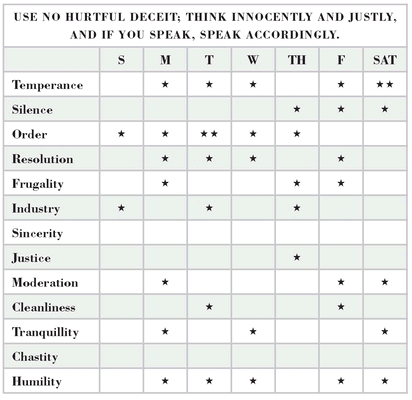
I noted, for the first time, a clean slate on my virtue checklist.
I could have hugged Ben.
SINCERITY