
PART FOUR
20
At forty-six, Benjamin Netanyahu was the youngest prime minister in Israel’s history, the first who had been born after independence. He was also the first to be elected by direct vote. As such, Bibi believed he had the right to go about things very differently from his predecessors.
Netanyahu planned a presidential-style administration with far-reaching powers for his prime minister’s office (PMO). He wanted national security and economy councils and a special hasbara unit under his aegis. Powerful government departments, such as the Civil Service Commission and the Treasury Ministry’s budget department, would also be moved to the PMO. He had served as a special forces officer, had a master’s degree in business management from MIT, and had been a BCG management consultant. He was convinced he could hold the reins of Israel’s military and economy.
He was determined as well not to repeat what he saw as the mistakes of the previous Likud prime ministers, Begin and Shamir. “Leftist” holdovers from Labor governments would not be allowed to influence policy.
Many of Netanyahu’s ideas made sense. Israeli prime ministers have historically lacked staff powerful enough to effect significant change and stand up to entrenched civil servants, IDF generals, and Treasury Ministry economists. The problem was that the ideas flew in the face of political reality.
Direct election of the prime minister hadn’t changed Israel’s parliamentary system. Worse, many Likud voters had made do in 1996 with casting one ballot for Netanyahu and another for a different sectoral party. As a result, Likud had only thirty-two seats. To build a Knesset majority, Netanyahu had to make deals with five other parties and grant them ministries. This left Likud with only four key ministries and a clutch of junior ones. David Levy had been promised the Foreign Ministry. Netanyahu believed he would run Israel’s foreign policy himself anyway. Yitzhak Mordechai got the Defense Ministry. That left Finance and Justice.
Ariel Sharon and Dan Meridor had both put aside their rivalries with Bibi during the elections. Sharon had been key in bringing Levy back into the fold and was Netanyahu’s plenipotentiary to the ultra-Orthodox rabbis. Meridor had been the “moderate” face of Likud’s campaign. They both expected to be rewarded. Avigdor Lieberman, who was to remain Netanyahu’s right-hand man as director-general of the PMO, urged him to keep Sharon and Meridor out of the cabinet. Bibi needed little urging. He appointed Yaakov Neeman, the secretive lawyer who had helped him reconcile with Sara after the “hot-tape” scandal, as justice minister. He planned to appoint the governor of the Bank of Israel, Yaakov Frenkel, who was also a former economist for the International Monetary Fund (IMF), to Finance. But he was blindsided by a cabinet revolt even before the cabinet was sworn in. Levy, who saw in Sharon a potential ally, refused to serve if Sharon was kept out. Benny Begin, who had initially accepted the Science Ministry, made Meridor joining a condition.
Netanyahu’s first crisis broke out on June 18, 1996, the day he was to present his government to the Knesset. He was forced to back down. Meridor became finance minister, and the furious Sharon was mollified by a “National Infrastructure Ministry,” which was hastily cobbled together from parts of other ministries. The press, which had briefly been stupefied by Bibi’s shock victory, had a field day as prospective ministers criticized their soon-to-be boss off the record. Finally, as evening fell, Netanyahu was sworn in as Israel’s ninth prime minister. Benzion, Tzila, and Sara watched proudly from the gallery. But it was a sour ending to what Bibi hoped would be a perfect day. As the ministers were sworn in and took their seats beside him, there was an acrimonious atmosphere. Following the election, because of his incredible win, Netanyahu’s old rivals had been prepared to forgive previous trespasses. Now they were getting the feeling that he saw them as superfluous courtiers. They had to be prepared to protect their new fiefdoms.
Netanyahu would suffer from a fractious cabinet from Day One, a situation that was only exacerbated by the ineptitude of his personal team. Bibi’s staff at the PMO was the opposite of his professional election campaign staff. He selected his aides, who then had to be approved by Sara, according to their loyalty rather than for their expertise. This was the case for Lieberman, the domineering director-general, whose sole managerial experience was purging Likud of Bibi’s enemies. Netanyahu appointed a classical pianist and right-wing polemicist, David Bar-Ilan, as director of policy planning and communications. His diplomatic adviser was Dore Gold, an academic with no actual diplomatic experience. The cabinet secretary would be the ineffectual but loyal Danny Naveh, a former aide to Arens. Efforts to hire a professional chief of staff foundered. In the space of eighteen months, four men would try—and fail—to impose some sort of order on the prime minister’s office. But Bibi, preparing for his first trip to Washington as prime minister, was still oblivious to the chaos around him.
BILL CLINTON IS only three years older than Netanyahu. Perhaps that is why he never seemed to have the same kind respect for him that he had for the elder statesmen Rabin and Peres. As politicians, however, Clinton and Netanyahu had much in common. Both reached the highest office in their country at a young age with relatively meager records. Both had risen largely because they presented a fresh image and were able to connect with their constituents. But whereas Clinton was naturally trusting and optimistic, Netanyahu believed the worst of people and was eternally suspicious. He refused to meet US diplomats to prepare for the meeting in advance. It would be him and POTUS meeting as equals.
As they sat down in the Oval Office on July 9, Clinton was anxious for assurances that Netanyahu would continue the Oslo process. Instead, Netanyahu delivered a lengthy lecture on the Arabs and why his government, while honoring previous agreements, would first need to review outstanding issues with the Palestinians. After Bibi left, an exasperated Clinton remarked, “Who the fuck does he think he is? Who’s the fucking superpower here?”1 But outwardly, the president remained all smiles and compliments to his guest.
Clinton was hardly comforted the next day by Netanyahu’s rapturous reception at the Republican-dominated Congress. In a rare honor for a freshman foreign leader, he was invited to address a joint session. Netanyahu used the word “peace” sixty-two times but did not once mention his interlocutor, Palestinian president Yasser Arafat. He promised that Israel was “ready to resume negotiations with the Palestinian Authority,” as well as with Syria and Lebanon, but insisted on strict security conditions for any peace agreement.2
By far the biggest standing ovation came when he announced that “in the next four years, we will begin the long-term process of gradually reducing the level of your generous economic assistance to Israel.”3 Two decades since that speech, the process has yet to begin. The United States gives even more annually to Netanyahu’s Israel now than it did then, though now it’s called “defense assistance” instead of “economic assistance.”4
Though Clinton pressured him to get the peace process back on track, Netanyahu regarded his Washington visit as a resounding success. To his indignation, much of the Israeli media focused on the fact that the taxpayers had paid not only for Sara to join him, but also his small children, Yair and Avner. Photographs of nannies carrying them onto the plane filled the papers. By then Sara and the nannies were a national issue.
A week before the trip to Washington, reporters in Jerusalem had been alerted to a young woman on the sidewalk outside the Netanyahu residence. Weeks earlier, Sara had hired Tanya Shaw, a young South African, as a nanny, and then summarily fired her for “burning a pot of soup.” Shaw’s belongings had been dumped outside the door, by security, after another employee had been ordered by Sara to open her bags and shake out the clothes to ensure that she had not stolen anything. Shortly after Shaw spoke to the press, two other nannies came forward to relate their own stories of short and traumatic employment under Sara. They were the first in a long list of domestic employees and secretaries who left in tears, in many cases suing for abusive employment.
What had been a closely guarded secret in Likud circles was now public. Ever since Sara had allowed Bibi to return home after the “hot-tape” scandal, she had demanded, and received, full control of his schedule and vetted his aides. Upon Netanyahu’s election, she received her own taxpayer-funded staff. She wasn’t the first prime minister’s wife to attract negative attention. Part of the problem was the lack of an established practice regarding the prime minister’s wife or a budget for her staff. It had never been much of an issue until Sara arrived. She received two secretaries from the PMO staff and a personal public relations adviser who was hired under the guise of being the “prime minister’s adviser on religious issues.”
The extensive coverage of Sara’s affairs in the Israeli media could have been regarded as unfair if not for the endless string of employees complaining of abuse, the stories of her demands for gift-bags at every event she attended, her detailed demands regarding hotel rooms before foreign trips, which she relayed through Israeli embassies, and other abuses of the system. Sara had made herself “fair game” by involving herself in every detail of her husband’s job, insisting on attending nearly every public event he attended to stand at his side. She had made sure that their children received attention in the media during the election as well. She had even demanded her own election ad, insisting that she was an electoral asset. The campaign team humored her and filmed an ad, which was then sent for editing, but it was not completed in time for election day.
Netanyahu, despite paying a heavy price in the media, never tried to curb Sara. Instead he has severely chastised journalists. He paid another heavy price in his relationship with his eldest child, Noa, with whom he has been close, despite never having lived together. Their meetings became much less frequent after he married Sara. When Bibi entered the prime minister’s office, he placed a photograph of Noa on the bookshelf, alongside one of Sara and their two sons. A few weeks later, it disappeared. A friend who inquired about it was told that it had been sent for reframing. Twenty years later, Bibi has grandchildren from Noa, but his office décor has never included their pictures. Nor has Noa’s picture reappeared.
TOGETHER WITH SARA stories, the main issue early in Netanyahu’s term was when he would meet Arafat.
In his victory speech, four days after the election, Netanyahu said, “We intend to further the process of dialogue with all our neighbors to reach a stable peace, a real peace, a peace with security.” But he was in no hurry: “First and foremost, peace must be reached at home,” he insisted.5
For weeks, he allowed others to maintain contact with the Palestinian leadership. Dore Gold called the Palestinian president’s office to introduce himself the day after the election. Foreign Minister Levy was sent first to meet Arafat, though he was not given any mandate to negotiate. Meanwhile, Netanyahu received Arafat’s deputy, Mahmoud Abbas, for a cordial but meaningless meeting. After nearly three months in office, Netanyahu finally relented to American pressure and to threats from Israel’s president, Ezer Weizman, who said that if Netanyahu didn’t meet with Arafat, Weizman himself would open negotiations with the Palestinians, though he had no political powers.
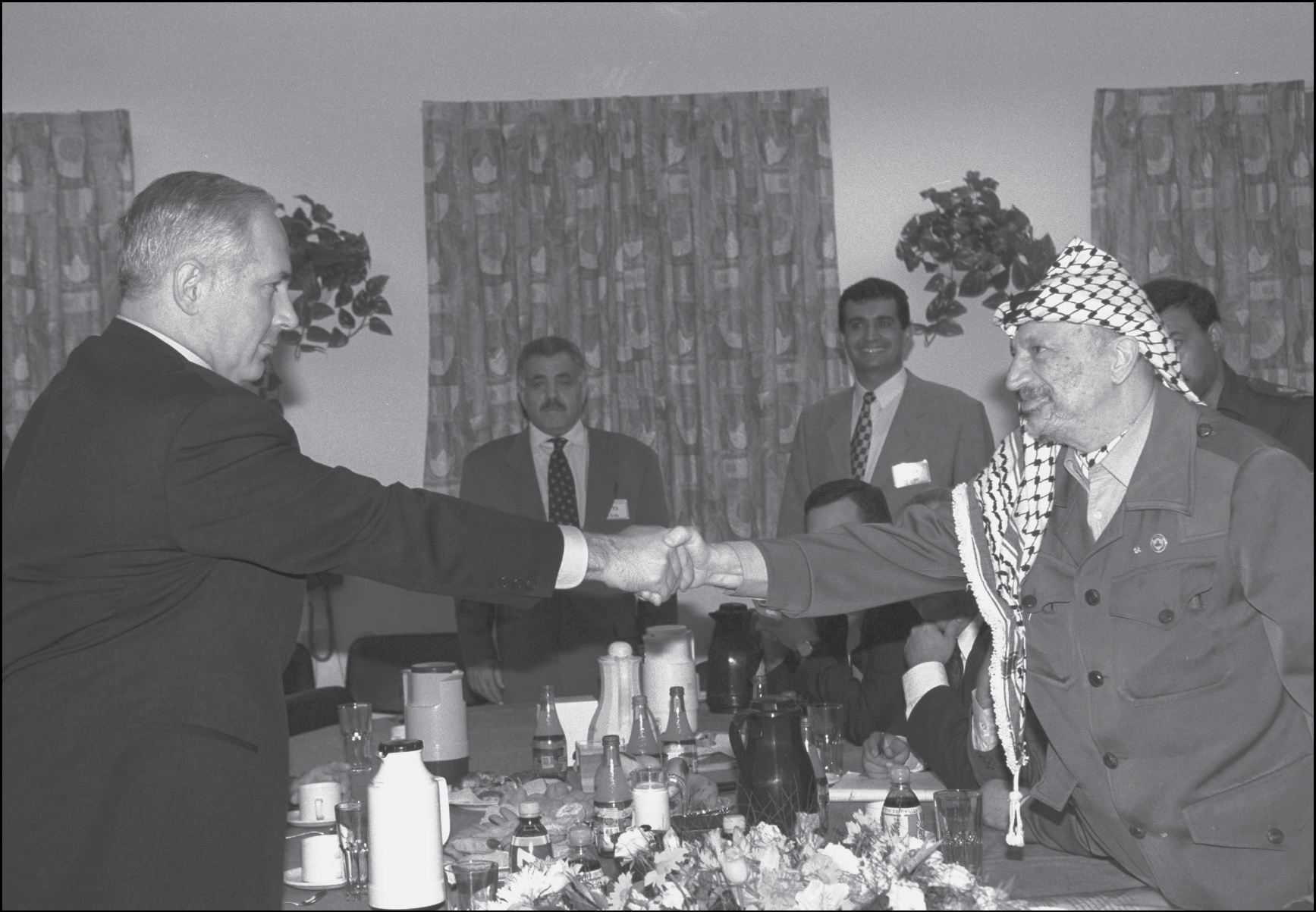
Netanyahu and Arafat during their awkward first meeting in 1996 on the border with Gaza.
The first meeting between the Palestinian president and the leader of the Zionist Revisionist movement, which until recently had refused to even recognize the existence of a Palestinian people, took place in a cramped meeting room at the Erez border crossing to the Gaza Strip. Anxious to escape one of Arafat’s famous embraces, Netanyahu awkwardly shook hands across the table. Little of substance was said as he exchanged banalities with the man whom he had been sent to capture as a young soldier in 1968 on his first operation.
In a statement after the meeting, Netanyahu stressed three concepts: reciprocity, security, and prosperity. These would remain the elements of his policy toward the Palestinians. His demands for reciprocity and security arrangements would stymie the development of any meaningful agreement moving forward, and the promise of economic prosperity for the Palestinians became a substitute for actual statehood.
There was no follow-up meeting. Instead, anxious to appease his base in the aftermath of meeting with Arafat, Netanyahu authorized the building of 1,500 new homes in the settlements and threatened to close down Orient House, the PLO’s “foreign ministry” in East Jerusalem. As far as he was concerned, not canceling the Oslo Agreements and sitting down with Arafat was as much as anyone should expect for the time being. But the Oslo II agreement included further commitments.
The Israeli pullback from the Palestinian cities was completed by the end of 1995, except from Hebron. In a forlorn attempt to gain their endorsement, Peres had acquiesced to the rabbis’ demands to delay the Hebron pullback because of its special place in Jewish history (both as the site of the Tomb of the Patriarchs and the location of the 1929 massacre) and the difficulty of organizing security for the settlers living within the city. To help Peres, Arafat had agreed to reschedule the pullback to June 15, two weeks after the election. Netanyahu was committed to standing by former agreements, but he had also promised the settlers and the Chabad rabbis that he would stand by them, saying, “You can trust me on Hebron.” The date passed, and Netanyahu stonewalled, telling the Americans that he was still reviewing the Palestinians’ compliance with the security requirements of the Oslo Accords. If the Palestinians were out of compliance, it would give him an excuse to stop following the pullback schedule.
The deadlock was broken from an unexpected direction. For nearly three decades, Israeli archaeologists had been excavating under East Jerusalem, revealing the base of the massive Western Wall, the edge of the Jerusalem Temple rebuilt by King Herod, and the street level of ancient Jerusalem. It was a scientific, religious, and political project underlining the Jewish connection to the city. The Jerusalem Islamic Waqf objected to the dig, claiming falsely that the tunnel was damaging the foundations of the Haram al-Sharif mosques on the Temple Mount. For years there was only one entrance to the tunnel. An exit existed behind a wall in the Old City’s Muslim Quarter, but it had remained sealed for fear of provoking an outbreak of violence.
On September 23, the night after Yom Kippur, Netanyahu came under pressure from Jerusalem mayor Ehud Olmert and Jewish American religious-nationalist donors to assert Israeli sovereignty by opening the exit to the tunnel. The security chiefs, in a rushed consultation, gave their guarded assessments, saying they thought violence could be averted. Netanyahu gave the order, and the exit was unsealed.
The Waqf protested, saying that the Al Aqsa Mosque was “in danger,” and there were angry denunciations from Arafat, who quoted Koran passages calling upon believers to “kill and be killed” in protection of their possessions. The message was clear. The following morning, violent clashes broke out throughout East Jerusalem, the West Bank, and the Gaza Strip. Palestinian security personnel, who for two years had been patrolling the area with the IDF as part of the Oslo security arrangements, now turned their guns against the IDF.
For three days, battles raged, as all the Oslo procedures collapsed. For the first time since 1967, the IDF began to deploy tanks around Palestinian cities. Netanyahu, on a visit to Germany, frantically tried to manage the situation over the phone with Defense Minister Mordechai, while at the same time fielding calls from the US secretary of state, Warren Christopher. Arafat now wasn’t answering his calls. Netanyahu was forced to cut his trip short and return to Jerusalem. Finally, after Washington cajoled him and Netanyahu threatened to send the IDF into Palestinian cities, Arafat ordered his men to stand down. Seventeen Israeli soldiers and nearly a hundred Palestinians had been killed.
Netanyahu justified opening the tunnel because it “touches the bedrock of our existence.” It was the most grievous blow to the Oslo process since Rabin’s assassination. Trust between Israeli and Palestinian security forces had been shattered. Netanyahu was accused at home and abroad of provoking the Palestinians, and Arafat now had the diplomatic upper hand. Clinton summoned them, along with Jordan’s King Hussein, for an emergency summit, to be held on September 30.
Bibi was rattled. He had spent barely three months in office, and he was experiencing his first security crisis. He was being criticized at home for not having held proper consultations with the military and intelligence chiefs before opening the tunnel. At the White House, Hussein spoke to him sternly, accusing him of arrogance and disrespect. A chastened Netanyahu sat by Arafat on a couch and began to work his charms. Bizarrely, it seemed to work, as the two men spoke for hours.
“I found a friend in the White House,” Netanyahu announced. But his sudden embrace of Arafat, and the relief among the Americans and Jordanians that he and Arafat were getting along, obscured the fact that little had been accomplished, except for Netanyahu’s agreement to launch intensive negotiations on the Hebron pullback. It would take three and a half months of frustrating shuttle diplomacy between Jerusalem and Gaza by US negotiator Dennis Ross before the Hebron Agreement could be reached. Arafat was a much more difficult customer now, and Netanyahu, who rapidly grew less affectionate toward the Palestinian leader after their White House meeting, sent his personal attorney, Yitzhak Molcho, to “babysit” the Israeli negotiators. The tunnel crisis had forced the Clinton administration—which since the start of the Oslo process had largely been cheerleading from the sidelines, while Israelis and Palestinians did their own negotiating—to take to the field. Clinton was invested and he would remain in the game, no matter how much both sides disappointed him.
It was a miserable compromise. The 450 Jewish settlers in the heart of the Palestinian city were not relocated. Hebron was split into two parts, with 80 percent of the city under Palestinian control and 20 percent under Israeli control, though the settlers constituted only 0.3 percent of its population. The deal meant that thousands of Palestinians, as well as the city’s old commercial center, would remain under Israeli military occupation.
Even this compromise—not moving one settler and keeping full Israeli control of the Tomb of the Patriarchs—was met with an outcry from the ideological right, however. Former prime minister Shamir said that “anyone who voted Netanyahu should be tearing his hair out.”6 More damaging was the resignation of Science Minister Begin, who, in protest, established an opposition faction within Likud. On January 16, 1997, the Knesset passed the Hebron Agreement 87–17. Most of those voting against it were members of Netanyahu’s coalition.
The Hebron Agreement included a redeployment of Israeli military forces that had already been agreed to in Oslo II, and it affected only a tiny portion of the West Bank. It was historic nonetheless. For the first time, a Likud prime minister had ordered Israeli troops to pull out from part of the historical Land of Israel and allowed the Palestinians to take control of a piece of the historical Jewish homeland.
OF ALL THE Israeli elites Netanyahu tried to break, the ones who would prove most obdurate were the members of the legal establishment. The followers of Jabotinsky had been taught to revere the law. Menachem Begin famously heralded a Supreme Court ruling by exclaiming, “There are judges in Jerusalem!” The Likud “princes” had been part of Jerusalem’s Rehavia neighborhood milieu, where most of the Supreme Court justices lived. Socially, Netanyahu also belonged to this group—his uncle, Benzion’s brother Elisha, was married to Supreme Court justice Shoshana Netanyahu. Politically, however, he was much closer to a new generation of Likud activists who saw the Supreme Court, under the presidency of “legal activist” Professor Aharon Barak, as a group of left-wingers sabotaging the decisions of an elected government.
Netanyahu’s political allies, the far right and religious politicians, accused the Supreme Court of standing up for the rights of Palestinians at Israelis’ expense (though the Supreme Court rarely challenges Israel’s security policies) and upholding “secular” values over the commandments of the Torah. When his political allies attacked the Supreme Court, Netanyahu failed to speak up for the justices, and in the coalition agreement he gave the National Religious Party chairmanship of the Knesset Justice Committee. His appointment of Yaakov Neeman, a religious and socially conservative lawyer, as justice minister was an attempt to get the justices to toe the line.
Seven weeks after his appointment, Neeman was indicted for attempting to suborn a witness and lying in court and forced to resign. Neeman and Netanyahu were convinced that the charges, of which Neeman was ultimately cleared, had been trumped up by the legal establishment. Netanyahu appointed another loyalist, Tzachi Hanegbi, as justice minister, vowing to get back at the judicial elite by naming an attorney general who would sort out the legal system.
The identity of the new attorney general announced by Hanegbi on January 10, six days before the Knesset vote on the Hebron Agreement, astonished even many of Netanyahu’s supporters. Ronny Bar-On was a successful commercial lawyer and veteran Likud activist, but he was largely unknown outside of Jerusalem, had never been considered a leading legal mind, and had scant experience of public service. Previous attorneys general, who in Israel are both the government’s senior legal adviser and head of the state prosecutor services, had all been prominent legal scholars, former judges, or senior prosecutors. Bar-On simply didn’t fit the bill, and his appointment was met with intense criticism, which only intensified when some ill-timed sightings of Bar-On gambling in London were reported. (While there was nothing illegal in his activities, the Israeli public had a puritanical streak when it came to non-sports betting.) Two days later, Bar-On decided he didn’t want the job after all. The Jerusalem district judge Elyakim Rubinstein, the man who fourteen years earlier had been the leading candidate for ambassador to the United Nations, before Netanyahu elbowed him aside, became attorney general instead. It was just another botched appointment in a series of many.
Israel’s Channel 1 reported that Bar-On’s appointment had been part of a deal to secure the votes of members of Shas, the Mizrahi ultra-Orthodox party, in favor of the Hebron Agreement. According to the report, Bar-On, as attorney general, was to have approved a plea bargain for Shas leader Arye Deri, who was on trial for accepting bribes from a Torah seminary in return for government funding. Netanyahu, Lieberman, Hanegbi, and Deri were all alleged to have been in on the plot.
For the first time, an Israeli prime minister was accused of being involved in bribery. Netanyahu denied any knowledge of an illegal deal, but the police who were called in to investigate believed he had been part of it. In another first, Netanyahu was questioned twice as a suspect, and within weeks the police recommendation that Netanyahu be indicted was leaked to the media. Those were the worst days of his first term. By Israeli law, the prime minister does not have to resign if indicted, but such a situation was unprecedented. Senior Likud ministers made it clear they would not remain in the cabinet if Netanyahu was to stand trial. Their departure would almost certainly have led to a stampede and the fall of the coalition. Under siege, Netanyahu kept his silence, while his aides darkly spoke to the media of a plot to bring down the prime minister.
Less than a year in power, Netanyahu faced the prospect of an ignominious end. His fate was now in the hands of his old rival Elyakim Rubinstein, who, as attorney general, had final say on the indictments of senior figures.
On April 20, Rubinstein announced his decision. Sufficient evidence for an indictment had been found only against Deri. He accepted the police findings that there had been a criminal plot to appoint a lenient attorney general in exchange for votes for the Hebron Agreement among Shas members, but did not believe there was enough evidence to put Netanyahu, Hanegbi, and Lieberman on trial. Rubinstein issued a “public report,” however, in which he admitted that the prime minister’s actions had been “questionable.”
A relieved Bibi rushed to appear on television, insisting that he had been exonerated, but accepting that he had made mistakes; he said he had learned from the affair. Treasury Minister Dan Meridor and Communications Minister Limor Livnat both kept him waiting for another twenty-four hours while they “studied” Rubinstein’s report before deciding not to resign. For Meridor, who was being lampooned by TV satirists for being a weak and ineffectual kitten, it was a political mistake. He was already on a collision course with Netanyahu.
ONE OF NETANYAHU’S greatest frustrations during his first term was that, despite considering himself an expert, he failed to fundamentally change Israel’s economy. He had sweeping plans to push ahead privatization, cut personal and corporate taxes, shrink the government, and liberalize the money markets. In three years, these policies were to remain largely on paper.
The Labor government’s major investment in infrastructure had widened the deficit, making it impossible to cut taxes—especially as Netanyahu’s coalition partners had extracted commitments for increased spending on benefits and subsidies for special-interest groups such as religious communities, ultra-Orthodox families, Haredi schools, and settlements. His attempts to achieve structural changes were opposed by the veteran Finance Ministry bureaucracy, supported by their minister, Meridor. Netanyahu clashed frequently with the minister he had never wanted to appoint.
“My opponents don’t understand the main thing, because they’ve never worked in the economy. Never been in the market,” he once remarked. He preferred to talk economics with his original candidate for the Finance Ministry, Yaakov Frenkel. From early 1997, Frenkel and Meridor were locked in a conflict on the best method for keeping inflation down. Since the near-meltdown of Israel’s economy in the mid-1980s, the Bank of Israel had maintained strict controls on the shekel’s rate of exchange. Frenkel believed the Israeli economy was strong enough to ease these controls and instead use other methods, particularly the interest rate, to control inflation when necessary. Meridor, on the advice of the ministry economists, strenuously objected. Netanyahu supported Frenkel’s reasoning, but Meridor demanded that as minister, it was his call. Netanyahu overruled him, and on June 20, Meridor resigned.
Meridor and Netanyahu had been rivals for the past decade, practically from the moment Bibi had entered politics. But Meridor never had it in him to put up a hard fight, and Netanyahu outfoxed him every step of the way. When Meridor finally struck back, he chose an obscure economic issue—which most of the public barely understood—as his issue to stand on. Had he chosen to resign over the Bar-On Hebron scandal, he may have started a chain reaction that would have brought Netanyahu down. Instead, his departure was just another resignation, one more in a series of blows that were slowly eroding the prime minister’s authority.
“THE PREVIOUS GOVERNMENT ignored the terrible terror wave. I set myself a goal to stop this terrible thing we had here and it’s hard, but we’ve done it,” Netanyahu bragged in a television interview on July 28.7 But as his predecessors Rabin and Peres had learned, terrorist attacks came at the worst and most unexpected moments. Two days later, two Hamas bombers disguised as Haredi Jews detonated themselves simultaneously in Jerusalem’s crowded Mahane Yehuda Market. Sixteen Israelis were killed and 178 wounded in what for decades had been the most iconic of Likud strongholds, the first stop on any budding Likudnik candidate’s campaign tour.
The security cabinet authorized striking at Hamas leaders, and Netanyahu called in Mossad chief Danny Yatom, who proposed, as a target, the Hamas political bureau chief, Khaled Mashal. Assassinating Mashal would mean overturning Rabin’s order from three years ago to cease clandestine operations in Jordan. The team chosen for the hit would not have much time to study Mashal’s movements between his home and his office in Amman. Another Hamas suicide bombing took place on September 4 on Jerusalem’s Ben Yehuda Street, a pedestrian mall, killing five, which added further urgency.
To avoid angering Jordan, the plan against Mashal was to use an aerosolized toxin that wouldn’t be detectable in a postmortem. But as the Mossad team approached Mashal as he was leaving his car on an Amman street, he turned to his daughter, whom the team had not noticed sitting in the back. The spray hit Mashal’s ear, and realizing that he was under attack, he dove back into the car, shouting to the driver to take him to the hospital. Mashal’s bodyguard gave chase, grappling with the two Mossad agents. A crowd gathered, leading to a Jordanian police officer detaining the two, who were carrying fake Canadian passports. Four other agents in the getaway team escaped to the Israeli embassy.
The agents’ covers didn’t stand up for long, and a furious King Hussein soon discovered that Israel had been carrying out assassinations in his capital. Mossad chief Yatom flew immediately to Amman in an attempt to extricate the agents. Upon arrival, he was informed that should Mashal die, they would be accused of murder. On Netanyahu’s orders, the antidote, which was being held by the team in case of accidental discharge, was rushed to the hospital, saving Mashal’s life. Hussein still refused to release the two agents under arrest or allow the other four to leave the embassy. He threatened to tear up the peace agreement.
Israel’s ambassador to the European Union, Efrayim Halevy, who in his previous position, as deputy Mossad chief, had led the secret diplomacy with Jordan, and had become close to Hussein, was sent to Amman to negotiate a solution. The outcome proved a further humiliation for Israel. Netanyahu was forced to agree to the release of Hamas’s founder, Sheikh Ahmed Yassin, and seventy other Palestinian prisoners, a step that helped boost Hussein’s standing among his Palestinian subjects.
Netanyahu was barely keeping the Oslo process alive, and he had been on the brink of losing the other peace agreement he had inherited, one he actually supported. He had been publicly shamed by Mossad’s botched assassination. Yatom resigned a few months later, after a string of operational mishaps, and was replaced by Halevy. However, much of the blame stuck to Bibi, who had failed to inform the defense minister, Mordechai, and the IDF chief of staff, Amnon Shahak, in advance of the operation. A year into his premiership, he was looking increasingly impetuous and accident-prone.
The Economist, one of the few newspapers Netanyahu truly respected, ran a cover story calling for his resignation, branding him “Israel’s Serial Bungler.”8