
21
The Israeli elites, having lost the election in 1996, set about delegitimizing Netanyahu. Yitzhak Rabin’s former chief of staff, Shimon Sheves, said on the day after the election, “The state is finished.” Leah Rabin remarked, “I’d like to pack a suitcase and very quickly disappear from here.” A Haaretz columnist, Ari Shavit, wrote, “For us, for the enlightened elite, since the morning of May 30, we have been forced to contend with a situation we could not control…. The mechanism we have developed to work our way out of this tangle is to work up a psychosis of hatred for the elected prime minister.”1 Netanyahu had many things in common with the Israeli left—he was well-educated, cosmopolitan, and secular. Perhaps part of their hostility to him was that they were so similar, yet he shared the ideology of the “other Israel.”
The antipathy was mutual. For Netanyahu, the vanguard of unjustified hatred toward him was the media. In his victory speech, he told Likudniks they had beaten “a hostile and mud-slinging press.” Winning would not cure him of the obsession. At a literary event in November 1997, he complained that “most of the media organizations are not objective and their reports are unreliable.” If it wasn’t for the media, he was certain the entire public would realize what a success his government was. It was the media enticing his recalcitrant ministers to incessantly speak against him instead of toeing the line.
Typically, Netanyahu’s first daily staff meeting, after reading the intelligence briefing, was with his press officers, analyzing the newspapers. Throughout his first term he was continuously giving interviews and calling up journalists at all hours. He would usually complain, but he would also call with praise. “The press is always attacking me. When a balanced article is so rare, I feel the need to speak with the person and say thank you.”
He conveniently forgot the first decade of his public career, before Oslo, when he had been the media’s star. Bibi never grasped the irony that thanks to the abominable media, he had risen so quickly to the top. And as unfair as the coverage could be, it couldn’t be blamed for all the endless blunders and falling-outs during his tenure.
THE MEMBERS OF the IDF General Staff were Netanyahu’s age. As a young Matkal officer, he had served with some of them. Many had served with Yoni. But the moment he became prime minister, there was a barrier. It wasn’t just Bibi’s insecurity and his need to assert himself as their political master. He had spent five years in a small elite unit and had never shaken his disdain for “the big and stupid army.” Netanyahu had little trust in unwieldy armored divisions and was inclined to favor secret, special operations.
The generals of 1996 had been promoted by Netanyahu’s political rivals. Rabin, the IDF’s commander in 1967, was their father figure. They had been on the negotiation teams that had crafted the Oslo Accords. In Netanyahu’s eyes, they were all politically suspect. One of his first decisions was to stop including serving officers in talks with the Palestinians. It was time for them to “change disk,” he said, making an analogy to changing the programming for a computer. Senior generals routinely attended cabinet meetings. Now Netanyahu ordered them to leave once they had finished their briefings.
He suspected that they had been tainted by politics, and therefore he doubted their loyalty. His suspicion was confirmed when Maariv exposed a major general who had continued briefing Shimon Peres months after the election.
Relations were particularly rocky with the chief of general staff, Lieutenant General Amnon Shahak. The charismatic officer, a protégé of Rabin’s, was doubly suspect in Netanyahu’s eyes for having established a warm working relationship with Arafat. In one cabinet briefing, Netanyahu reprimanded Shahak, saying, “It isn’t the [chief of general staff’s] role to provide political analyses.”2
Shahak clashed with members of the cabinet who demanded decisive action against Hezbollah in south Lebanon. He told them it was unrealistic to expect the Shi’a militia to stop attacking Israel. But as talks with the Palestinians foundered, Netanyahu found that he had no choice but to bring the generals back in. There was no one else to provide security assessments.
As serving officers, they obeyed the government’s orders, but the division between the prime minister and the General Staff quickly found its way to the media. When Netanyahu claimed to have received intelligence that Arafat had “given a green light to terror,” generals told reporters it wasn’t that clear-cut. When Shahak’s term as chief of general staff ended in June 1998, it was widely assumed that he would soon join politics in opposition to Netanyahu.
The low morale of the generals spread, infecting an influential community, the senior reserve officers, many of whom signed petitions against Netanyahu’s policies and in 1999 volunteered for the Barak campaign. The IDF has always been the most respected institute in Israeli society. Of all the elites, it would ultimately be the nonpolitical officer corps that caused him the most political damage.
Netanyahu’s relationship with other parts of the security establishment were better. These entities were directly responsible to the prime minister and never leaked information to the press. The Mossad chiefs Danny Yatom and Efrayim Halevy praised Netanyahu in their memoirs for backing them up, even after operational mistakes.
Netanyahu was particularly enthusiastic in his position as chairman of the Israel Atomic Energy Commission, paying visits to the Israeli nuclear reactor in Dimona and increasing funding for the nuclear project. He challenged the Israeli defense orthodoxy of “nuclear opacity,” advocating more acknowledgment of the country’s arsenal. In February 1998, as Saddam Hussein refused to allow UN inspectors to visit his military facilities, a “senior source in the prime minister’s office” was quoted threatening Saddam, saying that if a missile with a chemical warhead was fired at Israel, the response would be a neutron bomb.
This report caused consternation within the security establishment, and Netanyahu put major changes to nuclear policy on hold. A few months later, he demanded, and received, written assurances from President Clinton that the Fissile Material Cut-off Treaty his administration was proposing would not force Israel to abandon its opacity. But Netanyahu would revisit the issue later, arguing that Israel’s deterrence strategies would be enhanced by acknowledging its full capabilities.
MEANWHILE, NETANYAHU WAS busy fighting the Oslo philosophy that peace would bring security. He would always insist that only security could eventually, one day, bring peace.
In August 1996, Netanyahu had to decide how to respond to intelligence reports that Hafez al-Assad of Syria was planning a surprise attack to snatch back part of the Golan Heights, which Syria had lost in 1967. The reports came from a legendary Mossad agent-runner who claimed to have received details from a retired Syrian general. A Syrian division had just returned from Lebanon, and forces were exercising near the border. The IDF’s intelligence branch disputed the Mossad report. Shahak and Mordechai counseled caution, and Netanyahu accepted their views. The IDF quietly put its units on alert without calling up reserves or launching a preemptive attack. It was a difficult decision for a new prime minister. He remembered rushing back in 1973 to an Israel under surprise attack by Syria and Egypt.
One of the first questions the Americans had for Netanyahu was whether he would honor the commitment that Rabin had secretly given them, that he would withdraw from the Golan for peace with Syria. Netanyahu argued that it was not a signed agreement and he had no obligation to follow it. Reluctantly, Secretary of State Warren Christopher agreed and gave Netanyahu written assurances confirming that. Netanyahu told the Americans that he would be willing to pull back on the Golan, to the edge of the ridgeline, but he would not permit a retreat down the cliffs, to the original border. For Assad, this was a nonstarter.
In mid-1998, Netanyahu’s position suddenly changed. He sent his friend Ronald Lauder to Damascus to meet Assad. This was classic Netanyahu diplomacy, using unaccountable personal emissaries instead of diplomats. Lauder met Assad nine times, and they reached a number of points of agreement, including one specifying that the border would be on “the line of June 4, 1967,” as the Syrians demanded. To continue negotiating, Assad wanted a map on which the border would be drawn.
Netanyahu has categorically denied ever promising Assad the Golan. Senior Israeli and US officials have claimed that he was prepared to send a map, but members of his inner cabinet, Mordechai and Sharon, vetoed him. No map was sent, and the Lauder mission ended in September 1998. Lauder has backed up Netanyahu, saying the proposals were his own ideas.
Lauder may have been exceeding his mandate. A complete withdrawal from the Golan certainly would fly in the face of everything Netanyahu has ever written and said publicly. However, it’s clear that Netanyahu was deeply involved in Lauder’s secret diplomacy. His old friend and benefactor was acting with the prime minister’s blessing. While Lauder was secretly negotiating with Assad, Netanyahu commissioned at least six polls to gauge the Israeli public’s positions on a withdrawal from the Golan Heights. The lack of enthusiasm among Israelis for such a move played a part in the demise of the talks.3 Netanyahu, throughout his political career, has been obsessed with polls. His pollster in his first term, Shai Reuveni, was one of his closest advisers, often eating Shabbat meals with the Netanyahu family, and had instructions to call him at all hours with the latest poll results.4
Netanyahu was hoping the Syrian negotiations could relieve the pressure from the Clinton administration to make progress with the Palestinians. He also hoped that by opening a channel to Assad he could obtain his support in disarming, or at least curbing, Hezbollah. Since 1985, on average, twenty IDF soldiers had been killed annually in the “Security Zone” in south Lebanon. The year 1997 had been the bloodiest for over a decade, with seventy-three servicemen dying in September in a collision between two packed helicopters flying to Lebanon. In September, twelve more soldiers died in a commando raid on the Lebanese coast.
The IDF’s presence in Lebanon was becoming a deeply unpopular and dangerous liability. Israel needed an exit strategy that would allow it to pull out while guaranteeing the safety of its civilians living near the border. Netanyahu tried to engage with the Lebanese government, in the hope that it would rein Hezbollah in, but Prime Minister Rafik Hariri made it clear that Assad was calling the shots.
Netanyahu failed, just like Rabin, Peres, and Barak, to overcome Assad’s deep suspicion of Israel. Unlike them, he denies even trying.
WHILE LAUDER WAS meeting Assad in Damascus, another set of secret talks was taking place in Jerusalem.
By the summer of 1998, Ehud Barak, Netanyahu’s old Matkal commander, had been Labor leader for a year. Like Bibi in 1992, he had begun his leadership campaign immediately after the election defeat. Unlike Bibi, who had a clear run after Shamir’s resignation, Barak had had to contend with Peres, who insisted on remaining leader for another year, until the primaries of June 1997, which Barak won by a landslide.
Now Barak was finding it difficult to acclimatize to a civilian environment where his orders weren’t obeyed unquestionably. It showed in his public appearances and on television. No one doubted his brilliance. One-on-one, Barak could be both charming and devastatingly persuasive. In larger settings he still appeared aloof and standoffish. Many considered him to be arrogant, and many in Labor resented him—behind his back, he was called “Napoleon.”
After the first year of chaos, Netanyahu’s administration had attained a level of precarious calm. The blunder rate was down, and he was relatively secure in the polls. Meanwhile, in Labor, the frequent complaint was “Ehud isn’t taking off.”
Throughout that summer, Barak held a series of secret meetings with Netanyahu’s consigliere Yaakov Neeman on forming a Likud-Labor national unity government. Neeman, who had recently been cleared in court, had been appointed finance minister in Meridor’s place. He and Netanyahu had two major reasons to desire a more centrist coalition. Clinton was pressuring Netanyahu for further redeployments in the West Bank, which would enrage the right-wing and ultra-Orthodox parties, whose demands for more sectoral funding was making it difficult to deal with the deficit.
Barak, languishing in the polls while facing two more years in opposition, followed by the prospect of another defeat to Netanyahu, wanted to prove himself in government. Under the deal he negotiated with Neeman, Labor would be an equal partner, and Barak would be defense minister. It wasn’t the first attempt to form a national unity government. Immediately after the elections, Labor had been eager to do so, but Netanyahu, after stringing them along, preferred a right-wing religious coalition. Another attempt in early 1997, this time initiated by Bibi, was kiboshed by Barak, who believed the government was about to fall as a result of the Bar-On Hebron scandal.
The deal was almost done. But it was leaked to the press, probably by Mordechai, who was anxious not to lose the Defense Ministry. There were reports as well of a separate deal being negotiated by Peres behind Barak’s back. He cut contact.
With national unity off the table, Barak swung into full campaign mode. Elections weren’t even on the horizon, but he was determined to take Bibi down. He attacked Netanyahu’s alliance with the ultra-Orthodox, knowing he was unlikely ever to get votes in that constituency. Just as right-wing politicians could always fall back on their voters’ hatred of Arabs, the center-left could rely on resentment of Haredi “parasites” who studied Torah, lived on government handouts, and refused to serve in the IDF.
Netanyahu’s alliance with the religious Jews was an easy target. He had done everything he could to curry favor with the rabbis, even though not all of them respected him. In July 1997, Rabbi Ovadya Yosef had publicly mocked his bungling, calling him “a blind goat.” Bibi continued courting them. In a meeting with Rabbi Yitzhak Kaduri, a radio-journalist’s microphone caught Netanyahu whispering in the sage’s ear that “people on the left forgot what it is to be Jewish. They think we will get our security from the Arabs. We’ll give them part of our land and the Arabs will take care of us. Unheard of.”5
The Haredim made unprecedented inroads during Netanyahu’s first term. He showered them with subsidies and ministries. Under Haredi pressure, the Transport Ministry closed Jerusalem’s Bar-Ilan Road to vehicles on Shabbat, although the high court ordered the main transportation artery reopened.
Shas leader Arye Deri became Bibi’s political confidant, speaking with him on the phone every few hours. The secular Netanyahu always had a deeper trust in religious allies than in his own Likudniks. He hired Uri Elitzur, a settler leader and prominent National Religious Party member, as his fourth chief of staff in 1998.
In April 1998, Israel celebrated fifty years of independence. The star-studded main event, attended by Netanyahu and guest of honor Vice President Al Gore, was scheduled to include a number by the Batsheva Dance Company. Before the event, religious politicians objected to the piece, which had been performed earlier in another venue, because the dancers would be scantily dressed. Refusing to adapt their costumes, the dancers withdrew at the last moment, and the company’s director read a letter complaining of censorship from the stage.
Netanyahu’s subservience to the rabbis angered many moderate Likudniks as well as some of his American supporters. It was also one of the factors leading to his irrevocable split with Foreign Minister Levy.
Netanyahu was falling out with his Likud ministers one after another. In November 1997, a stormy Likud conference had voted on canceling the primaries for the Knesset list and returning power to the Central Committee. Only five years earlier, Netanyahu had championed primaries. Now his ministers were convinced that he was behind the move to abolish them, as part of a plan to use the Central Committee, which was dominated by Bibi loyalists, to cut them down to size. One by one they faced the rowdy Likudniks. “Did we come to power just to dole out jobs [to party cronies]?” asked Communications Minister Limor Livnat. She was shouted down by cries of “Yes! Yes!” Sharon pledged Netanyahu his support, but added, acerbically, “I don’t know whether to help your right hand or your left hand.”6
Netanyahu denied being behind the proposal, but his right-hand man, Lieberman, certainly was. Lieberman’s people were caught surreptitiously filming party members planning to vote against the proposal. A few weeks later, exasperated at what he saw as Bibi’s failure to assert himself over his ministers, Lieberman resigned. Netanyahu would later blame him for many of the mistakes in his first eighteen months in power. The Likud chaos receded somewhat, but the loss of his chief political enforcer confirmed the impression that even Bibi’s oldest allies no longer wanted to work with him.
David Levy had never been an ally, but Netanyahu had recognized that he needed him in Likud, in order to keep the party’s Mizrahi working-class constituency together, and had honored his commitment to appoint him as foreign minister. But foreign minister was an empty title. Netanyahu only saw the ministry as a hasbara platform. Foreign policy was to be run through his office, by his personal messengers, not through leftist professional diplomats. Netanyahu’s team begrudgingly allowed the security experts to take part in the negotiations with the Palestinians, but the Foreign Ministry remained in the dark. Levy was constantly finding out about the latest developments in his meetings with American diplomats. He remonstrated with Netanyahu, who promised to include him. Nothing changed.
Levy led his Gesher faction of five MKs. As the 1998 budget was prepared for its Knesset vote, Gesher presented a list of demands for social projects. Most were turned down by Neeman, who claimed lack of funding. As the final version was brought to the Knesset, an enraged Levy discovered that similar demands made by Shas, as well as increased funding for the ultra-Orthodox community, had been met, and were now being presented as Deri’s achievements on behalf of the Mizrahi working-class sector. On January 4, 1998, he announced his resignation, telling reporters, in an emotional press conference, “I’ve finished with this partnership.”
Gesher officially remained part of the coalition, but Netanyahu could no longer rely on its votes. His coalition was down to the bare minimum of sixty-one MKs. He didn’t rush, however, to appoint a replacement for Levy as foreign minister, leaving the post vacant for another nine months.
TWO WEEKS AFTER Levy’s resignation, Netanyahu was back in Washington. Since the Hebron agreement in January 1997, the diplomatic process with the Palestinians had barely budged. Israel was committed to further redeployments, but Netanyahu constantly found reasons to delay, and the deadlines lapsed. The indefatigable Dennis Ross managed to engineer a Netanyahu-Arafat summit in October, after the two leaders hadn’t met for eight months. But while Bibi and Yasser were now comfortable in each other’s company, even friendly, there was no breakthrough.
The Clinton administration fully recognized that Netanyahu had his work cut out for him getting his right-wing coalition to go along with any pullback, and Clinton and those who represented him in discussions with Bibi had infinite patience for him. But even infinity was wearing thin. They began to suspect that coalition troubles were just another item on Netanyahu’s never-ending list of excuses that allowed him to delay. Along with requests for revisions in the security arrangements, and the (partly justified) accusations that Arafat was turning a blind eye to terrorist attacks and allowing murderous incitement against Israelis, there were demands to limit the number of Palestinian security personnel, and to finally amend the Palestinian Charter. Meanwhile, Arafat had his own growing list of demands and infringements. Israel had yet to allow the Palestinians to operate an airport in Gaza, would not release prisoners, would not arrest violent settlers, and would not stop building in the settlements, on top of not carrying out the further redeployments in the West Bank.
As the new US secretary of state, Madeleine Albright, prepared for her first visit to the region, she planned to deliver Netanyahu a stern lecture. But once again terrorism changed the agenda, with the two Hamas suicide bombings on Ben Yehuda Street in Jerusalem in September 1997. Albright found herself lecturing Arafat instead on the “revolving door,” whereby suspects were arrested and then released, a practice that allowed Hamas militants to walk free. Arafat grumbled that he could not be expected to fight Hamas while Netanyahu authorized more settler homes. Albright took the Israeli line, responding, “There is no moral equivalency between suicide bombings and bulldozers, between killing innocent people and building houses.”7
Once again, President Clinton was prepared to put his own credibility on the line. He invited Netanyahu and Arafat to separate meetings in Washington. The timing could hardly have been worse. Netanyahu arrived in the White House on January 20, 1998. Clinton tried to concentrate on the issues at hand, but he was continuously called out of the room for mysterious consultations. Arafat was due on the 22nd. On the 21st, news broke that Clinton was accused of having enjoyed sexual relations in the Oval Office with a White House intern.
Bibi called Clinton to commiserate. As someone who had survived a sex scandal, he promised him “it will all blow over.”8 He was not entirely convincing. A weakened administration would obviously work in his favor. Neither could Clinton miss the fact that while Netanyahu had been in Washington, he had met with GOP leaders who were now calling for impeachment, and had addressed rallies alongside his fieriest critics, such as the evangelical leaders Jerry Falwell and Pat Robertson. Small wonder that Arab media was full of conspiracy theories casting the Jewish Monica Lewinsky as a Mossad agent.
It wasn’t just the Lewinsky affair causing delays. The Clinton administration was dealing with the threat of war in Iraq, with Saddam Hussein defying the United Nations Special Commission (UNSCOM) inspectors. Despite all these personal and international troubles, and despite facing crucial midterm elections, which could define the last two years of his presidency, Clinton was determined to continue with the peace process. He needed to complete his joint legacy with Rabin, and he wanted to prove to the American public that he would not let the scandal deny him his place on the international stage.
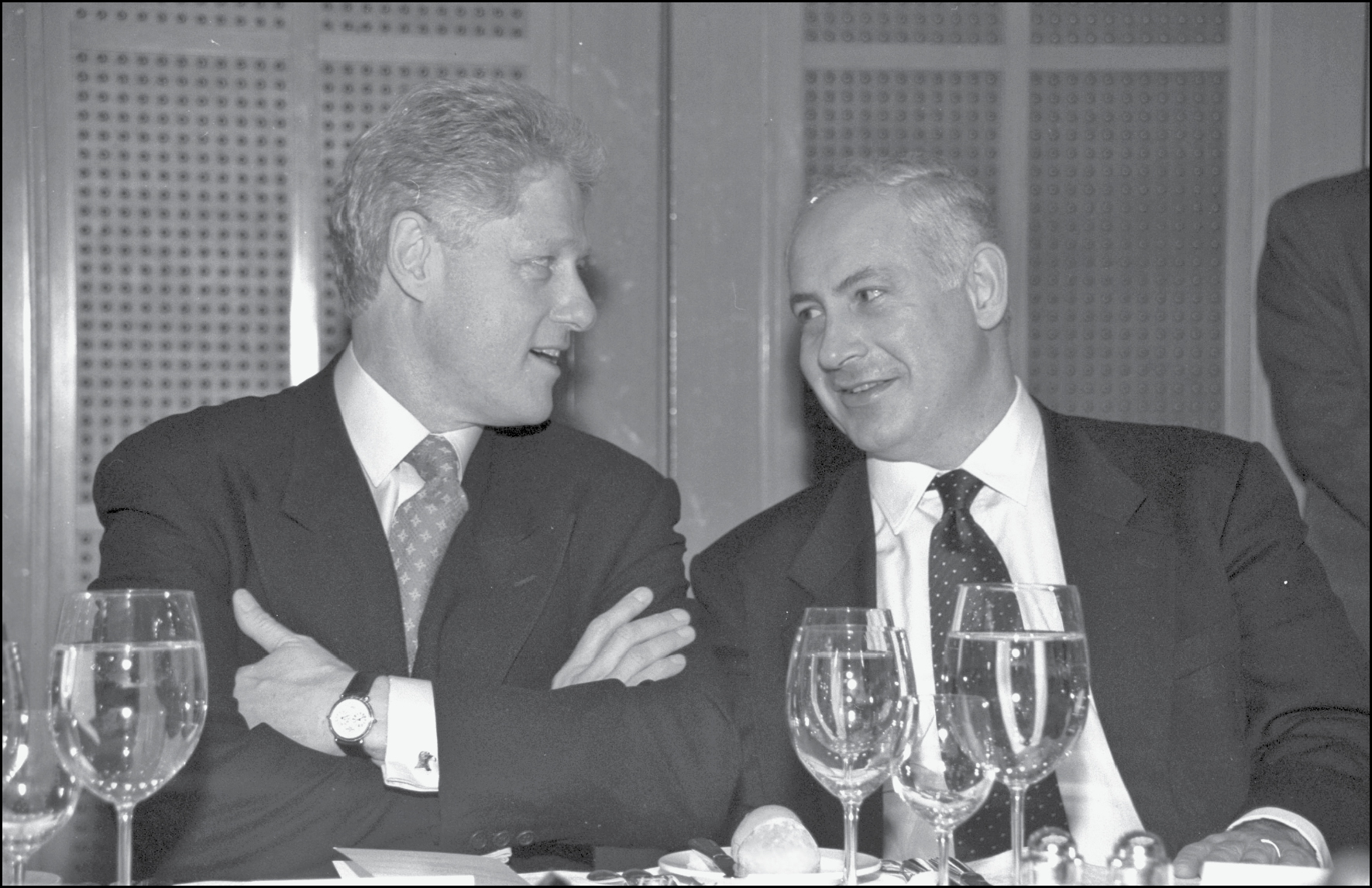
Clinton did everything he could to prevent Netanyahu’s election.
But Netanyahu, who was hearing from his Republican friends that Clinton’s chances of impeachment were increasing, was in no hurry to make deals. In March, he sent David Bar-Ilan, one of his most right-wing aides, to Washington to brief congressional leaders on Arafat’s support for Hamas terrorists. Netanyahu believed that he could continue to get away with dragging feet on the diplomatic process, just as he had a year earlier, when he had authorized a new neighborhood in East Jerusalem.
Mayor Ehud Olmert and the settler leadership held more sway over Netanyahu during that period than the US president. The Har Homa settlement in East Jerusalem had originally been planned by the Rabin government, but had not yet been built. In early 1997, after the Hebron pullback, Netanyahu approved construction and allowed bulldozers to go to work on the rocky hilltop. American diplomats were sympathetic when Arafat complained that Israeli construction on the site was driving a wedge between Bethlehem and East Jerusalem, but they also understood Netanyahu’s political constraints. When the United Nations voted to condemn the work, the United States vetoed the resolution. Netanyahu promised to delay the next phase of construction permits. More construction was approved in 2014. To most Israelis, it is now just another neighborhood in Jerusalem, but by international law, it is an illegal settlement.
A year later, the US administration was growing fed up with Netanyahu’s political problems. Albright favored calling him out publicly; National Security Adviser Sandy Berger agreed and accused Bibi of “playing rope-a-dope with us.”9 The media carried headlines about a crisis between Jerusalem and Washington, but Clinton preferred to try and work with Netanyahu rather than against him. Clinton had no reason to fear a backlash from his own considerable Jewish base—polls consistently showed that 80 percent of American Jews supported Clinton’s approach on pressuring Israel to freeze settlement building and make concessions to the Palestinians for peace. Bibi’s Republican choir was in a clear minority. But Clinton either felt weakened by the ongoing Lewinsky scandal or truly believed that playing hardball with Netanyahu wouldn’t work.
The main obstacle remained the overdue redeployment. The Palestinians already had military or civilian control of 27 percent of the West Bank. Jerusalem, the settlements, and “security areas” were to be discussed in the “permanent status” talks. The redeployment was expected to include the remaining territory, and Arafat insisted this would give him control of 91 percent of the West Bank. Netanyahu had a very different security map, according to which Israel could cede less than 40 percent. In months of grueling back-and-forth diplomacy, the American negotiators settled on redeployment from 13 percent as the maximum they could hold Netanyahu to and get Arafat to accept. But Bibi wanted to go lower.
Ross had told Netanyahu that the minimal redeployment would have to be in the “lower teens,” but when he came up with thirteen, Netanyahu, the master of the English language, complained that he had “understood eleven.” After further haggling, he agreed to transfer 10 percent to Palestinian control and define a further 3 percent as “nature reserves,” to be administered by the Palestinian Authority. Any building there would have to receive Israeli authorization.
It had taken a year and a half to reach this formula. Clinton was once again prepared to invest political capital, inviting the sides to a joint summit where they would cross the finishing line. He was taking a major risk in committing himself for as long as it would take when it was just weeks from the midterms. Arafat agreed to arrive. Netanyahu said yes, then twice tried to find reasons to postpone. But ultimately, he had no choice.
The day before leaving for the summit at the Wye Plantation, Netanyahu made a deft political move. He appointed Ariel Sharon as foreign minister. Fifteen years after being forced out of the Defense Ministry in the wake of the Sabra and Shatila massacres, the man who had been shunned as an international pariah since 1983 was back in a top cabinet job. Sharon had been positioning himself for months, toning down his criticism of Netanyahu. He had even invited Arafat’s deputy, Mahmoud Abbas, to his farm.
A few months earlier, the US administration had ended its long ostracism of Sharon when Ross met him to discuss the peace process. They were willing to accept Sharon back into the fold to secure a breakthrough. As foreign minister and a senior member of the Israeli negotiating team, the settlers’ champion was expected to help Netanyahu sell the Wye agreement to the right wing. Upon his arrival at the summit, Clinton invited Sharon for a private conversation, sitting with him past midnight. The Americans were so eager to have Sharon on board that they were prepared to overlook his rudeness when, upon meeting the Palestinian delegation, he refused to shake Arafat’s hand.
THE WYE RIVER Summit of October 1998 lasted for nine days. It seems incredible that an embattled US president spent so much time and effort trying to solve a conflict over a tiny, by American standards, parcel of land so far away. It attests to Clinton’s dedication and the obduracy of Netanyahu and Arafat. The outcome, determined in advance by nearly two years of diplomacy, was, as far as the Americans and Palestinians were concerned, just an interim stage before the permanent status talks. But nothing less would have brought Netanyahu to finally sign a further withdrawal agreement in the West Bank.
Secluded in Wye River’s pastoral surroundings on Maryland’s rural Eastern Shore, the Americans had hoped that an agreement could be reached in four or five days. But the sides reopened and fought over nearly every detail. Toward the end, King Hussein, who was dying of Non-Hodgkin’s lymphoma, was flown in from the Mayo Clinic to urge them to completion.
As the summit ground on to its ultimate end, Netanyahu precipitated three crises. On the seventh day, feigning an objection to the security memorandum in the draft, Netanyahu had the Israeli delegation pack their suitcases and inform the Americans that they were about to fly home. He later agreed to stay for another day, and talks on the interim peace accord continued. The first crisis had been averted.
The next evening, Clinton lost his temper. Israel had demanded that the Palestinians arrest a number of men who appeared on a list of terrorist suspects. Netanyahu seemed to hint that one of them, a high-ranking Palestinian officer, ought to simply be assassinated on Arafat’s orders. Clinton burst out at him, “This is chickenshit, I’m not going to put up with this kind of bullshit.” The self-pitying Bibi sat on a couch, complaining to Ross, asking, “Why is Israel treated this way? Why am I treated this way? What have I done to deserve this?” Eventually, Bibi backed down. The second crisis was over.10
Shortly after he agreed to sign the Wye River Memorandum, Netanyahu added a couple of caveats. He told the Clinton administration that to appease Israel’s right wing, he would have to authorize building permits in Har Homa. In addition, of the 750 Palestinian prisoners he had agreed to release, most of them would be common criminals, not the “political prisoners” whom Israel considered terrorists.
At 6:30 a.m. on October 23, as they were finally wrapping up and about to put out press statements announcing that an agreement had been reached, Clinton dropped a bombshell on Netanyahu. A few days earlier, Netanyahu had privately asked Clinton to release Jonathan Pollard, an American Jewish US Navy analyst who was serving a life sentence for spying for Israel. Netanyahu had been the first Israeli prime minister to publicly acknowledge that Pollard had been in Israel’s service. Pollard’s release, he told Clinton, would help him sell the Wye agreement to his supporters in Israel. Clinton was favorable to the request, but his team was against it, some adamantly. CIA Director George Tenet said he would resign if Pollard was released.
The news from Clinton, which came just before the signing, brought about the third crisis, with Netanyahu withdrawing to his room and refusing to speak to the Americans. The Israelis still believe that Clinton reneged on a promise to release Pollard, though Clinton claimed he never actually said yes. In the end, it was Sharon who urged Netanyahu to come out and proceed with the deal. Bibi once again folded under pressure.
Netanyahu had agreed to a three-stage redeployment from 13 percent of the West Bank over a period of twelve weeks. As part of the implementation process, Clinton promised to fly in December to Israel and Gaza, where he would attend a meeting of the Palestinian National Council, finally amending the Palestinian Charter. With breathtaking optimism, the Wye River Memorandum included a commitment from both sides to try and reach a “permanent status” within six months, by May 4, 1999.
On Friday afternoon, the teams scrambled for helicopters to make it to the signing ceremony at the White House before sundown and the beginning of Shabbat. For the American hosts and the Palestinians, there was relief, but also bitterness. So much effort had to be expended to obtain such a meager result. There was none of the jubilation of the previous Oslo signing ceremonies with Rabin and Peres. For Netanyahu, there remained the grim job back home of trying to get his crumbling coalition to sign off on the agreement as well. He knew his government might not survive Wye.