
27
Israel has two nuclear doctrines. The first—nuclear opacity—was formulated by David Ben-Gurion and Shimon Peres in the early 1960s in response to the Kennedy administration. Israel and the United States agreed to a formula whereby “Israel will not be the first nation to introduce nuclear weapons to the Middle East” and will not publicly acknowledge whatever military nuclear capabilities it has.
The second is the Begin Doctrine, whereby Israel will never allow one of its enemies to acquire nuclear weapons. In 1981, Begin ordered an air strike on Saddam Hussein’s Osirak nuclear reactor to block Iraq’s nuclear ambitions.
In his first term, Netanyahu struggled with the opacity doctrine, proposing that Israel deter its enemies by unveiling its capabilities. One of his advisers was quoted threatening Iraq with a “neutron bomb.” In his second term, Netanyahu struggled to fulfill the Begin Doctrine as he sought to prevent Iran from developing nuclear weapons.
In September 2007, Ehud Olmert ordered an air strike on a nuclear reactor that the Assad regime had secretly built in northern Syria with North Korean assistance. To prevent further escalation, Olmert decided that Israel would not acknowledge the attack on Syria, allowing President Bashar al-Assad to save face.
As conflicting reports swirled through the international media, Israeli journalists were prohibited from reporting what they knew. Of all people, it was the leader of the opposition, Netanyahu, who first broke the official silence, two weeks after the strike. “I was a partner to the strike from the first moment,” he boasted. “I congratulated Olmert personally.”1 Olmert, who had indeed conferred with Netanyahu before ordering the operation, was enraged at Bibi for jeopardizing his non-attribution policy, which had prevented a Syrian retaliation.
Netanyahu considered himself an expert on the nuclear threats facing Israel, especially from Iran. He vividly remembered sitting in the United Nations in 1985, hearing the Iranian ambassador call for Israel to be “excised like a cancerous tumor” and “thrown into the dustbin of history.”2 For years, much of the talk in international forums was of Saddam Hussein’s “weapons of mass destruction.” Netanyahu would routinely make sure to mention Iran, along with Iraq, as another rogue nation trying to acquire nuclear weapons.
In his book A Place Among the Nations, Netanyahu had stipulated that in the peace agreement he envisaged Israel signing one day, there would have to be provisions for sanctions to prevent countries like Iran from developing nuclear weapons.3 In his first term as prime minister, he would often bring Iran up during meetings with foreign leaders. Visiting China in 1999, he implored President Jiang Zemin not to allow the People’s Republic to sell the Islamic Republic equipment that could help the Iranians with their nuclear research.4
For Netanyahu, the threat of Iran’s nuclear bomb was on par with the extermination of six million Jews in the Holocaust. As early as 1996, on a visit to the Bergen-Belsen concentration camp in Germany, he had spoken of Iran as a new incarnation of Nazi Germany.
In his three years as leader of the opposition after losing the 2006 election, with little else to occupy him, Iran became his primary obsession. Without explicitly saying so, he implied that the Kadima government was not doing enough to counter Iran’s nuclear ambitions. Ariel Sharon’s policy was “Iran is the world’s problem.” Sharon believed that Israel should not be seen leading the anti-Iran campaign. He preferred working closely behind the scenes with other governments on the issue, particularly on intelligence-sharing and secret sabotage operations. Olmert continued Sharon’s policy.
Netanyahu was convinced that Israel must sound the alarm bells. He saw himself as Ze’ev Jabotinsky, who had spent the 1930s warning an uncaring world of the impending Holocaust. In every meeting with a foreign delegation or speech to a Jewish American organization, he issued a constant warning: “It’s 1938 and Iran is Germany. And Iran is racing to arm itself with atomic bombs.”5
IN HIS FIRST White House meeting with Obama in May 2009, Netanyahu was dismayed to discover that Obama wasn’t interested in talking about Iran at any length. For Bibi, the Palestinian issue was a distraction from the real threat, not just to Israel, but to the entire world. How could Obama expect Israel to waste time and resources on a local side-show and make dangerous concessions to the Palestinians while its very existence was being threatened by Iran?
Obama’s approach was the exact opposite. He argued that the best way for Israel and the international community to confront Iran was through a joint diplomatic front to pressure it, through sanctions, to negotiate, and that solving the Israeli-Palestinian conflict was the key to building that front. Netanyahu was all in favor of sanctions, but he countered that Iran, through its financial and military support for Hamas and the Palestinian Islamic Jihad, was sabotaging any chance of peace. Iran had to be dealt with first. But Obama at that point was still convinced Iran was Netanyahu’s excuse to avoid dealing with the Palestinians. He was only half-right. Netanyahu was desperate to avoid the Palestinian issue. But the Iranian threat was no excuse. It was the core reason Netanyahu believed he was destined to lead Israel.
On Obama’s orders, the US military was preparing withdrawal plans from Iraq at the time. He hoped to end the war in Afghanistan as well in the not-too-distant future. Nothing was further away from his thinking than a third war. Obama instead believed he could engage with the Shi’a Iranian regime, even partner with it in “balancing” Sunni extremism. On the campaign trail, Obama had said he would reach out to the Iranian people and their leaders. With the rabidly anti-Western president Mahmoud Ahmadinejad in office in Iran, that seemed impossible, but, undeterred, Obama sent Iran’s supreme leader, the Ayatollah Ali Khamenei, a personal letter in May 2009 in the hope of opening a dialogue.
A month later, Khamenei referred to the letter in a speech in Tehran, citing it as proof that the United States and other foreign powers had interfered in Iran’s presidential election. It was a baseless accusation as far as Obama was concerned. Not only had the United States done nothing to interfere in the June 12 election, but after thousands of Iranians took to the streets to protest widespread fraud during the vote-counting in favor of Ahmadinejad, defying the Basij paramilitary forces who fired on the crowds, killing dozens, and the mass detentions and torture of thousands, it took Obama ten days to condemn the Iranian government’s actions. He finally said, “The United States and the international community have been appalled and outraged by the threats, beatings, and imprisonment.”6 But there was no questioning of the legitimacy of the elections, or the regime itself. Nothing came even close to Obama’s demand for the transition in Egypt to “begin now,” eighteen months later, when demonstrations broke out against America’s old ally Hosni Mubarak.
Obama was anxious to avoid any impression of trying to effect regime change in Iran. In his defense, it has to be said that the Iranian protesters and the leaders of the “Reformist” camp were anxious not to be tainted by foreign support. Regretfully, Obama conceded that for the time being, direct negotiations with Iran were unlikely. Meanwhile, he was resolved to prevent Netanyahu from making matters worse with a military attack on Iran’s nuclear installations.
EVEN WHEN NETANYAHU was not prime minister, Israel was preparing for a possible strike on Iran. During his decade out of office, Israel had purchased squadrons of long-range F-15I and F-16I fighter-bombers from the United States, developed and launched spy satellites, and spent billions enhancing Israel’s strategic intelligence and strike capabilities. “Ninety percent of our equipment and training is for a much larger war. The fighter jets weren’t built for attacking Gaza or even Lebanon,” said one squadron commander.
Both Olmert and Sharon had considered preemptive strikes against Iran’s nuclear plants. They had decided that Israel had time to first try and slow down Iran’s nuclear development by other means. Neither wanted to act without the blessing of the United States, and George W. Bush had enough on his hands in Iraq and Afghanistan. American intelligence assessments also differed with Israel’s over how close Iran was to a nuclear military capability, or if it even was working on one.
The United States was aware of Israel’s plans under Olmert, and it knew about the long-range sorties the Israeli Air Force was conducting over the Mediterranean to simulate the 2,000-mile flight path to Iran and back. But US officials were fairly confident that Olmert would not surprise them. They had no such confidence in Netanyahu.
It was Ehud Barak who convinced the Obama administration that Netanyahu wasn’t just using Iran as an excuse to avoid negotiations with the Palestinians. When he had returned to Labor leadership and to government, as defense minister, in July 2007, Barak had agreed with Olmert’s low-profile policy on Iran. Two years later, he still didn’t agree with Netanyahu on the issue, saying, in an interview, “I am not among those who believe Iran is an existential issue for Israel.”7 Soon after that, however, he adjusted his views to those of his new boss. For the next three years, Bibi and Barak would hold the Obama administration in suspense regarding their plans to attack Iran.
Barak still had credibility in Washington, where he was seen as the “moderate” pole of Netanyahu’s government. For three years, he was Israel’s real ambassador to the United States, flying there twice a month and meeting with senior administration officials. Israel’s official ambassador, the American Israeli historian Michael Oren, a fellow at a Jerusalem think tank funded by Sheldon Adelson, had the full confidence of neither Netanyahu nor the US administration.
When Barak told US administration officials how serious his government was about using military force to destroy Iran’s nuclear program, they were dismayed. Unlike Netanyahu, Barak didn’t indulge in historical doomsaying when describing the threat to Israel. Instead he employed crisp and detailed strategic analysis. He failed to convince the US administration of the urgent need to act, but he scared the hell out of them over Israel’s intentions.
Back in Israel, he was Bibi’s soulmate, their political rivalry forgotten. Thirty-five years earlier, in Matkal, Lieutenant Netanyahu had worshiped his unit commander as a hero. Behind his back he called Barak “the wise man.” Now he outranked him, but they were in effect equals, sharing the same intimate language and codes, cocooned from the rest of the cabinet. It was the closest political relationship either of them ever had.
The United States has never fully trusted its Israeli ally, devoting considerable intelligence resources to finding out what Israel is up to before the Israelis deign to tell them. But there was no precedent for the effort that the Obama administration put into ensuring that Israel was not about to launch a strike on Iran. For three years, beginning in late 2009, there was all manner of surveillance and intelligence-gathering. The procession of high-ranking administration officials, from the vice president on down, landing at Ben Gurion Airport and making the rounds between Jerusalem and Tel Aviv was never ending. There were periods in which it seemed like a week couldn’t go by without the CIA director, the chairman of the joint chiefs of staff, or the national security adviser, or at the very least a deputy secretary of state, arriving to visit with Israeli officials.
They all asked the same questions, made the same arguments, and issued the same warnings. Before leaving, they gave the standard assurance that Obama had Israel’s back and personally guaranteed that he would never allow Iran to acquire nuclear weapons. They all returned to Washington without crucial answers to whether and when Israel planned to attack.
Israel gave them plenty to guess about. The long-range exercises of air force squadrons intensified. New military technologies, many shared and even financed by the United States, were quickly made operational. Meanwhile, the secret war against Iran continued. Mysterious explosions at arms plants destroyed missile assembly lines and killed Iranian generals. Nuclear scientists were assassinated in daylight on the streets of Tehran. Shipments of military and nuclear materials disappeared at sea. The prime suspect, Israel, never took responsibility.
The United States was a partner in the secret campaign against Iran. Bush had authorized the cooperation, which continued, and even intensified, under Obama. Their most famous success was Stuxnet, a malicious computer worm that found its way into the operating system of Iran’s uranium enrichment centrifuges. According to the New York Times, Stuxnet had been developed by a joint American-Israeli team in “Operation Olympic Games” to sabotage Iran’s nuclear program.8
Contrary to the “throwing Israel under the bus” narrative pushed by Netanyahu’s people in Jerusalem and Washington, Obama authorized taking the intelligence-sharing and operational coordination between the two countries to unprecedented levels. Israel’s intelligence and security chiefs were also Obama’s unlikely allies in his effort to hold the war plans of Netanyahu and Barak at bay.
WHEN NETANYAHU RETURNED to office in March 2009, he inherited Meir Dagan as Mossad chief and Yuval Diskin as head of the Shin Bet. Both had originally been appointed by Sharon, and their old boss’s deep disdain for Bibi, whom he called “the male model,” had rubbed off on them. Dagan, in particular, enjoyed rubbing Netanyahu the wrong way. He had been close to Sharon since the early 1970s, when as a young officer under Sharon’s command he had led an IDF death squad, eliminating PLO fighters in the close alleyways of Gaza. Dagan detested the sight of Netanyahu sitting in Sharon’s chair. He regaled his friends, and even journalists, with stories of the prime minister’s lack of decisiveness.
Dagan was the only person in government who allowed himself to clash openly with Netanyahu. In their weekly meetings to approve sensitive operations outside Israel, he insisted that the prevaricating Netanyahu take responsibility and give precise instructions. Once, he created a scene at the prime minister’s residence. While he was briefing Netanyahu, Sara walked in. Bibi asked him to continue, as Sara was privy to all his secrets. That wasn’t enough for Dagan, who inquired whether she had official Shin Bet clearance. Sara left. Dagan was never asked back to the residence.
In some ways, Dagan resembled Netanyahu. He believed Iran was a mortal threat to Israel. In his office at Mossad headquarters hung a photograph of a religious Jew kneeling down before Nazi soldiers. For Dagan it symbolized “my grandfather just before he was murdered. I look at this picture every day and promise that the Holocaust will never happen again.” But Dagan believed the clandestine war he waged as Mossad chief in 2002 was the only way to fight Iran. A military strike would be a blunt and ineffective instrument, to be used only as a last resort. He didn’t believe in Netanyahu as Israel’s leader.
There was no consensus in the security establishment over military action against Iran. But Dagan and Diskin had a crucial ally in the IDF chief of staff, Lieutenant General Gabi Ashkenazi, a gruff and aggressive Golani Brigade veteran who disliked Matkal sophisticates, including his direct boss, Barak, and the prime minister, Netanyahu. Ashkenazi was a soldier’s soldier, and he never shied away from a fight, whether in the field or in the corridors of the Defense Ministry. But he believed that a long-range operation in Iran would unnecessarily expose Israeli pilots and jeopardize cooperation with the United States.
Most of the details of how the three service chiefs worked to block a strike on Iran have yet to emerge. Opposing their elected political masters was no easy matter, however, and supporters of Netanyahu have described their actions as tantamount to “a military coup.” But they did have the blessing of the president of Israel.
SHIMON PERES, STILL the eternal optimist at eighty-five, in his last role of seven decades of public service, wanted to believe that the Netanyahu who returned to power in 2009 was a more grown-up and pragmatic Bibi than the one of 1996–1999. For months, Peres assured world leaders that “Bibi has changed” and advised they give him a chance. Netanyahu reciprocated, allowing Peres to open up his own back channel to Palestinian president Abbas, on the condition that Peres report back on everything. Peres held five secret meetings with Abbas in 2010, making progress on permanent status issues. However, Netanyahu’s suspicions eventually got the better of him and he pulled the plug on the talks, ordering Peres to cancel a sixth meeting shortly before it was to take place. Peres fumed, but he was forced to accept the limits of his largely ceremonial position.
But Peres refused to accept the limits when it came to a strike on Iran. He was the only president to have previously served as prime minister, and had been privy to all of Israel’s secrets. Olmert, who had lobbied for Peres’s election (presidents in Israel are elected by the Knesset in a secret ballot), valued Peres’s advice and authorized his continued access to confidential materials. The communications infrastructure in the president’s office was connected to the “black” network, and his new military adjutant was a veteran intelligence officer. Netanyahu, discovering this upon replacing Olmert, was perturbed, but was loath to insult Peres by downgrading his access.
With Sharon in a coma, Peres was the last of the founding generation in government. During that period, one senior officer who opposed the Iran operation described him as “our Western Wall”—a combination of father-confessor and ringleader. One of Peres’s closest aides put it more bluntly—“Shimon is doing everything to help Ashkenazi and the service chiefs to stop this Iranian madness.”
Ashkenazi was both responsible for preparing a military strike against Iran and at the forefront of trying to stop it from taking place. In 2010, he twice played a key role in preventing what could have been an actual strike. Earlier in the year, Barak had ordered the army to be ready for an operation, and Ashkenazi had responded that in his professional opinion, intelligence was lacking and other logistical preparations had to be made before the IDF could guarantee it was capable of carrying out the operation. Barak disagreed with Ashkenazi’s assessment, but had no choice but to defer. He ordered the necessary preparations to be made as soon as possible.
A few months later, there was a showdown between both Barak and Netanyahu, on the one hand, and, on the other hand, the security chiefs at Mossad headquarters north of Tel Aviv. It was the most dramatic political-military clash since the eve of the Six-Day War, when the generals had demanded that Prime Minister Eshkol give an attack order. This time, the roles were reversed, with the generals holding back the politicians.
Netanyahu and Barak ordered Ashkenazi to place the IDF at its highest alert status, essentially on a war footing. The status alert, using a term that in Israeli military slang means “cocking the gun,” meant discreetly calling up essential reserve personnel, canceling all leave, placing aircraft and missiles on twenty-four-hour readiness, and opening emergency storage facilities. It would cost the army millions of shekels a day and keep it just hours from actually launching the strike. Sensing that the two leaders were trying to sneak something behind the government’s back, Ashkenazi said that “cocking the gun” was equivalent to an act of war and by law had to be authorized by the full cabinet. Barak insisted it was a legal order, and that an alert status was not the same as going to war. A heated exchange ensued, with Dagan joining Ashkenazi.
“If you play with this accordion, music will come out,” warned Ashkenazi. “You could be making an illegal decision to go to war,” added Dagan. Netanyahu remained silent during the argument, and eventually Barak backed down.9
In an attempt to influence public opinion, Ashkenazi and the officers close to him briefed journalists, informing them that an attack on Iran would cause Iran’s proxy, Hezbollah, to counterattack immediately by firing thousands of rockets at civilian targets in Israel. “We are facing a war with thousands of civilian casualties,” warned one of the officers in an off-the-record briefing. “It’s going to be like nothing we’ve experienced before.” And those opposing the Iran attack weren’t just briefing Israeli journalists.
“We assumed the Americans knew everything about the operation and also about the opposition to it,” said Barak in April 2017. “There was someone among us talking to them on a daily basis.”10 Barak confirmed what had been an open secret for years in the Israeli establishment—that senior Israeli officials were leaking details of the ongoing argument within the Israeli leadership to the Obama administration. Peres and Dagan were the main suspects.
A year earlier, in an interview with Dagan that appeared on Israeli TV after his 2016 death, he described how he had been in contact with CIA director Leon Panetta when he felt that Barak was not truthfully presenting the Obama administration’s objections to an attack on Iran to the cabinet. In a subsequent interview, Panetta said that Dagan had “indicated the frustrations with them [Netanyahu and Barak] moving forward.”11
“I think he was worried that decisions were made for political reasons and I think that troubled him,” Panetta recalled. Dagan, Panetta said, was “very concerned that somebody [would] push the wrong button.”12
Whether there was actual collusion between Israeli officials and a foreign government to thwart Israel’s elected leaders is still not clear. With both Dagan and Peres dead, the truth may never be fully known. Naturally, views in Israel on the presumed actions of the officials involved are split between those on the right, who would accuse those who spoke to the Obama administration of treason, and those on the left who praise the same men for doing whatever was necessary to prevent a potentially illegal order and avert a disastrous war.
WITHIN THE FIRST five months of 2011, Dagan, Ashkenazi, and Diskin all ended their terms. They were replaced by security chiefs selected by Netanyahu and Barak who were less likely to strenuously object to an Iranian strike.
Finally a civilian, Dagan lost no time in openly continuing his crusade against a military strike, telling journalists that Iran was still at least four years away from developing a nuclear weapon, and that within the Iranian leadership there was “deep division on continuing to develop the nuclear program.”13 The message was clear—there was no need to rush and strike. The secret sabotage campaign, together with diplomatic pressure and sanctions, were working.
With the three combative security chiefs out, the battle within the Israeli leadership over attacking Iran moved to the “Octet”—the inner cabinet of eight senior ministers. But despite all of Netanyahu and Barak’s arguments, a majority of the forum opposed the attack. On January 17, Barak announced that he was leaving the Labor Party, along with four other hawkish MKs. He blamed the rest of the party for acting against its elected leader and trying to pull Labor in a “combative, leftist-socialist” direction. Barak continued as defense minister, while the remaining Labor MKs left the coalition. But his hopes that a coalition positioned further to the right would help to shift opinion in the cabinet proved groundless. At least half the Octet continued to oppose a strike. An earlier attempt by Netanyahu to boost the pro-strike faction by appointing one of his protégés, Finance Minister Yuval Steinitz, to the inner cabinet, which had only seven members at that point, had failed as well.
With the battle now becoming more political, the Obama administration focused its campaign against a strike on the cabinet. Individual cabinet members were invited to Washington for meetings with senior administration officials. Octet meetings were devoted to long discussions on the Iranian issue, with Netanyahu and Barak delivering interminable lectures, but a firm group of four ministers held out.
From 2010 to 2012, the tension and debate over a possible strike reached a crescendo every spring and summer. A complex long-range operation stretching the Israeli Air Force to its limits could almost certainly be carried out only in perfect weather conditions. In early 2012, as the indicators in favor of a possible Israeli strike came around again, the debate spilled out into the open. The Obama administration embarked on a new tactic to influence both decision-makers and public opinion in Israel—it started to cast doubt on whether Israel could destroy Iran’s nuclear program by itself.
Pentagon analysts briefed journalists on how difficult such an operation would be. There would be multiple targets, many of them hidden underground within reinforced steel and concrete bunkers. Former senior officials were trotted out to deliver their verdicts, including former CIA director Michael Hayden, who said, in January 2011, that an attack against Iran was “beyond the capacity” of Israel.14 It was a high-risk tactic, potentially pushing Israel to prove that it could indeed pull it off, and had the effect of undermining Israel’s deterrence capability in Iranian eyes. It also wasn’t entirely truthful.
Israel’s armed forces may be only a fraction of the size of America’s, but Israel had been preparing and building up for such an attack for two decades, ever since the Iraqi Scud missiles had hit Tel Aviv in the 1991 Gulf War. Israel’s military planners fully appreciated the difficulties and had prepared various options for a series of attacks against multiple fortified targets. They had at their disposal sufficient warplanes and aerial tankers to carry out a sustained bombing campaign in waves, as well as back-up from land- and submarine-launched missiles. There was also the option of inserting special forces on the ground to destroy some of the more difficult targets. All of these options were high-risk. There would be casualties, and aircraft and pilots would be lost. There were fierce arguments within the Israeli defense establishment over whether the operation would be worthwhile.
But the real argument was not over the viability of the operation, but just how much damage it would cause to the Iranian nuclear program and how long it would take Iran to get back on track. One particularly gung-ho air force general said that if the government ordered a strike, “my pilots will be breaking down my office door to be on it, no matter the risks. And we don’t have any illusions that the Iranians will rebuild and we will have to bomb them again three years later.”
Netanyahu dithered. For all the tough talk coming out of Jerusalem, the Octet was not convened again to discuss a strike on Iran throughout 2012. In their discussions with Obama and other senior US officials, Netanyahu and Barak refused to say whether or not Israel would attack. Obama had ordered upgraded intelligence-sharing, but as Israel refused even to guarantee sufficient warning time before launching an attack, the US intelligence community began withholding information from Israel that could help Israel’s generals in a strike.
The anti-Iran rhetoric and threats to act yielded at least one significant result: the United States and European leaders, in particular Prime Minister David Cameron in Britain, had ramped up sanctions against Iran, effectively cutting its financial system off from the international banking networks and ending its oil sales to the West.
The sanctions would eventually bring Iran to the negotiating table, but this wasn’t enough for Netanyahu, who wanted a more credible military threat against Iran from the United States. Obama refused to publicly go beyond his standard formulation—“All options are on the table,” and the United States would “do what is necessary.” The United States was indeed working on operational plans to strike Iran if necessary. For one, it was developing massive bunker-buster bombs capable of taking out the underground uranium enrichment plants. But what Israelis and Iranians heard was a president who had no intention of going to war and who would do whatever it took to prevent Israel from doing so.
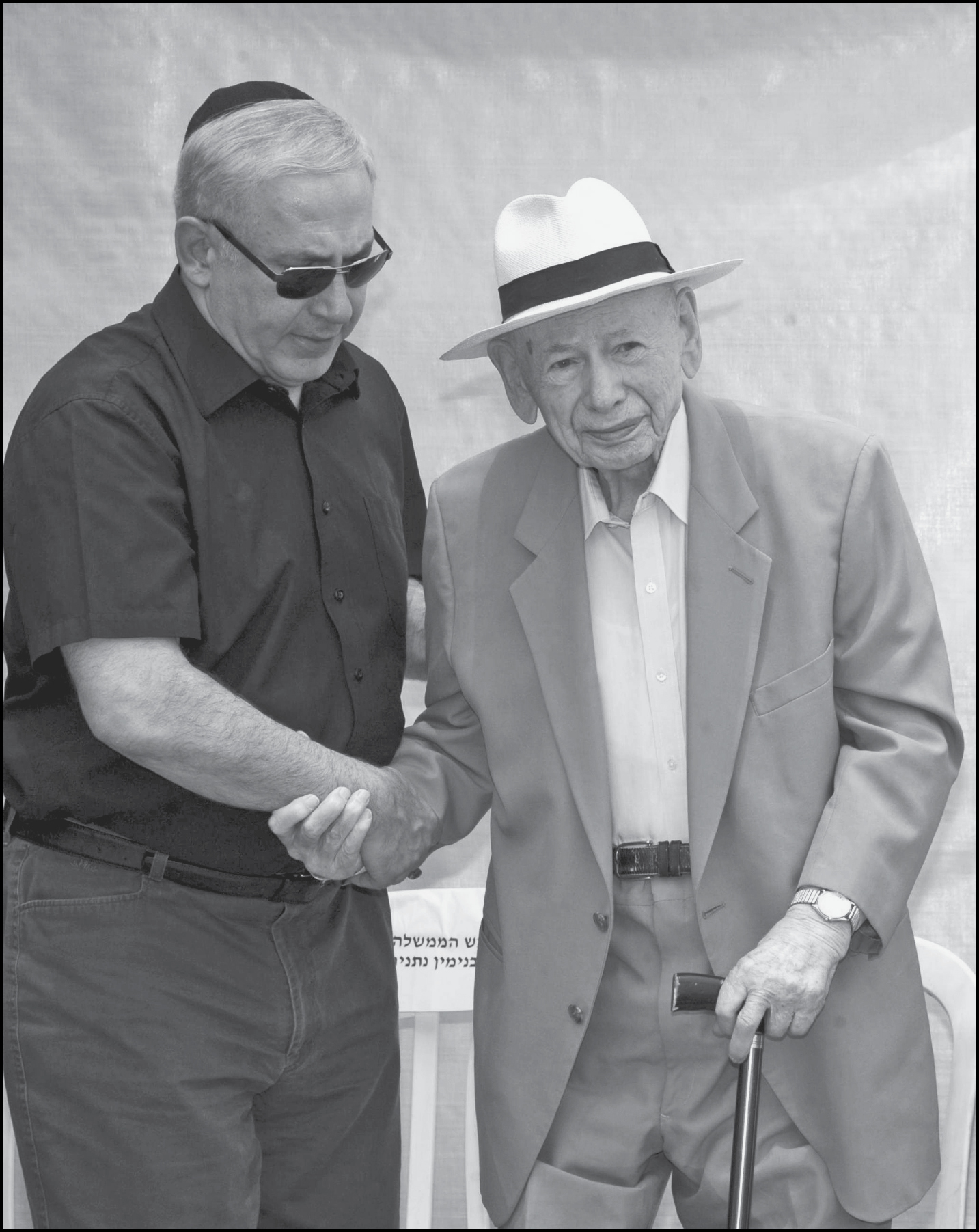
Bibi with Benzion at age 101.
ON APRIL 30, 2012, Benzion Netanyahu passed away at the age of 102. Well into his late nineties, he had soldiered on with his research, spending long periods in the United States, where he often read and wrote in the New York Public Library. He never moderated his views. In his last interview, shortly after his son’s Bar-Ilan Speech, he denied that Bibi had made an ideological concession by offering the Palestinians a state. “He doesn’t support [a Palestinian state]. He supports conditions that they [the Palestinians] will never accept. That’s what I heard from him…. This land is Jewish land, not for Arabs. There is no place here for Arabs and won’t be. They will never agree to the conditions.”15 In another interview a few months earlier, he had said, “We are under threat of extermination. People think the Holocaust, the threat, is over. It isn’t over. It continues all the time.”16
At his funeral, Netanyahu eulogized him at length. Trying to show a softer side of the stern father, he recalled how in a New York snowstorm, when the young Bibi was clamoring for food, Benzion went out, returning drenched with a hot tray. He recounted how he had played soccer with his sons in Central Park. His best memories of his father were from America.
Bibi said he had learned from his father that “a vital characteristic of every living organism, and a nation is a living organism, is the ability to identify danger in time. An ability our nation lost during the period of exile.”17
President Peres also spoke, ending his eulogy with a message to the prime minister: “Bibi, your father wrote history. You are making history. With the same feeling, the same destiny, the same heritage.”18 The last historical showdown between Netanyahu and Peres was reaching its peak. This time, Peres would win.
DURING BENZION’S shiva, secret talks were in progress with Kadima. In March, Tzipi Livni had lost the centrist party’s leadership primary to Shaul Mofaz, the former defense minister, a political ally turned fierce critic of Netanyahu. On May 8, Netanyahu and Mofaz appeared together, announcing a new coalition deal. Netanyahu, who had been in danger of losing his majority, owing to disagreements over a new state budget, now enjoyed the largest majority of any government in Israel’s history.
Two weeks later, Netanyahu was back on the cover of Time, the magazine that had boosted his popularity twenty-six years earlier with a cover story on his prescriptions against terror. This time he was crowned “KING BIBI.” Time managing editor Richard Stengel profiled him, noting that he was “poised to become the longest-serving Israeli Prime Minister since David Ben-Gurion, the founding father of Israel. He has no national rival. His approval rating, roughly 50%, is at an all-time high. At a moment when incumbents around the world are being shunted aside, he is triumphant.” Faced with the challenge of a nuclear Iran and resolving the Palestinian issue, wrote Stengel, “the question is whether he is a prisoner of that history or he can write a new narrative.”19 The answer was to be negative.
Mofaz joined the cabinet and became the ninth member of the Octet. But Netanyahu’s hopes that he could win Mofaz’s support for a strike on Iran were soon dashed. The new minister flew in June to Washington for talks with the Obama administration and returned firmly opposed to a unilateral Israeli operation. The new coalition lasted only two months. Netanyahu had promised Kadima that he would pass a new law on drafting Haredi yeshiva students into the IDF, but once again his alliance with the ultra-Orthodox parties took precedence. Early elections loomed.
THE LATE SUMMER of 2012 was the peak period of Iran war talk in Israel. On August 10, an interview with a source called only “the decision-maker,” a very thinly veiled Barak, appeared in Haaretz. “The decision-maker” strongly argued in favor of a strike. “A nuclear Iran is one of the most serious things that can happen to Israel,” he said. “If Iran goes nuclear, everything here will be different. Everything. We will move to a different mode of existence. If Iran goes nuclear, down the road, Israel will face a threat of existential proportions.”20
Horrified by the tone, a group of five former senior intelligence officers, including ex-commanders of Sayeret Matkal, sent Netanyahu and Barak a private letter. All of them knew Barak well and were convinced that he was dragging Netanyahu and the rest of the country to war. They warned them of “terrible chaos that will come in various ways after the euphoria of victory.” Striking Iran would cause “a war in which the damage will not be measured only in casualties, but in long-term damage for Israel’s economic and social functioning.” It would be “a dramatic and colossal historical mistake to try and force the US into a war against its will.”
With an election months away, many in government and in the opposition began to talk of “political motives” behind a possible strike. In the polls, nearly 60 percent of Israelis opposed the strike, but Netanyahu’s right-wing voters were overwhelmingly in favor, and a successful operation would change the minds of many more. Peres, who in 1981 had lost an election to Likud right after the attack on Iraq’s Osirak nuclear reactor, decided to free himself of the restraints of the Israeli presidency and speak out in public.
On August 16, he gave a series of interviews to the main Israeli news organizations. “It’s clear to us we can’t do this on our own,” he said. “We can postpone [Iran’s nuclear development], but it’s clear to us we need to go together with America.” He urged Israelis to trust Obama, who a month earlier had decorated Peres in the White House with the Presidential Medal of Freedom. Denying Iran nuclear weapons, said Peres, “is an American interest and Obama sees that. He doesn’t just say it to make us feel good.”21
Peres didn’t mention Netanyahu or Barak by name, but the address was clear. Bibi was livid. “Peres forgot his role as president,” Netanyahu’s people told the media. “Peres forgot as well that he promised a new Middle East after Oslo and instead a thousand Israelis were murdered.” Peres, they said, had also opposed the Osirak bombing, which had saved Israel and the world from Saddam Hussein’s nuclear bomb.22
Netanyahu, in public, refrained from attacking Peres or the opponents of an operation. He had called the public debate “irresponsible and damaging to national security…. The political leadership decides. The professional level executes. I have not yet decided.”23
On September 27, Netanyahu addressed the United Nations General Assembly. Most of his speech focused on the Iranian nuclear issue, “because the hour is getting late, very late.” At the global forum he put forward his strongest case for military action against Iran. “Iran uses diplomatic negotiations as a means to buy time to advance its nuclear program,” Netanyahu said. And “sanctions have not stopped Iran’s nuclear program either.”24
He had even brought a diagram, in the shape of a cartoon bomb, on which he drew with a marker a thick red line, highlighting the 90 percent uranium enrichment threshold. From the red line, “it’s only a few months, possibly a few weeks, before they get enough enriched uranium for the first bomb…. The relevant question is not when Iran will get the bomb. The relevant question is at what stage can we no longer stop Iran from getting the bomb. The red line must be drawn on Iran’s nuclear enrichment program because these enrichment facilities are the only nuclear installations that we can definitely see and credibly target.”25
Netanyahu was imploring Obama and the world to stop Iran from crossing the red line. The implication was that if they wouldn’t, he would.
THE SUMMER OF 2012 passed without an Israeli attack on Iran. Netanyahu, meanwhile, had other problems. Despite a growing deficit, his coalition partners refused to pass a new state budget including sweeping cutbacks in social programs. On October 15, Likud tabled a motion to dissolve the Knesset and bring the election forward to January 22, 2013. In his speeches Netanyahu continued to constantly warn of the Iranian threat, but reports and leaks on strike plans disappeared.
On November 26, Barak announced that he would not be running in the election; he was leaving politics to spend more time with his family. At seventy, he had hoped to lead Israel in one last war. Now he realized it wasn’t going to happen, and he had better things to do with his time. Three days later, he flew to Washington for his last working visit at the Pentagon. Defense Secretary Leon Panetta, who together with so many other senior administration officials had spent so much time over the past three years trying to stop Barak and Netanyahu from striking Iran, awarded Barak the Defense Department’s Medal for Distinguished Public Service.
Unlike Peres and Barak, Netanyahu was not about to receive any medals from the Obama administration. Barack Obama had been reelected president on November 6. Throughout the campaign, as Republican candidates accused him of having “thrown Israel under the bus,” and Netanyahu’s benefactor, Sheldon Adelson, plowed $93 million into the GOP campaign, Netanyahu did little to fix the impression that he couldn’t wait to see Obama kicked out of the White House.
In July, Netanyahu’s old colleague from the Boston Consulting Group, the recently nominated Republican candidate, Mitt Romney, arrived in Jerusalem. Netanyahu could of course argue that Obama had also flown four years earlier as a candidate to meet Israel’s leaders. But there was no mistaking the rapture in Netanyahu’s greeting of Romney at his office. Later that day, they met a second time, for an intimate dinner at the prime minister’s residence. Romney held a fundraising event in Jerusalem, where there was no mistaking the correlation between Romney’s donors and staunch Bibi supporters.
Netanyahu, with his insider knowledge of American politics, might have been expected to be a bit more circumspect, but he had been convinced by his Republican contacts that the polls predicting an Obama victory were not to be trusted.
Disappointed with the re-election, Netanyahu should have taken some time to reflect on how to engage with Obama in his second term. But he had an election of his own to fight.
FIVE YEARS AFTER his resignation, Barak, no longer an ally, hinted that in 2012 Netanyahu had become less eager to attack Iran, and had instead been pinning his hopes on somehow getting the United States to strike. This sounds likely only under a Romney administration.26 Obama had given Netanyahu little reason to believe this was a serious option.
Many in Jerusalem and Washington alike are convinced that Netanyahu and Barak never seriously planned to strike Iran—that all the preparations, the “cocking of the gun,” the tough talk that scared Obama, were all an elaborate bluff. Netanyahu, of course, denies this, claiming he was prepared then, and still is prepared, to bomb Iran’s nuclear installations.
Only Netanyahu and Barak know the true answer. Nearly all of those who retroactively accused Bibi of bluffing were certainly taken in during those three years. If he was bluffing, he succeeded in making the Western governments dramatically ramp up their sanctions on Iran. And the focus on Iran significantly reduced the pressure on Netanyahu to make concessions to the Palestinians. By the start of his second term, Barack Obama no longer had much faith in his ability to solve the Israeli-Palestinian conflict. He still had high hopes, though, for his engagement with Iran.
ON NOVEMBER 14, 2012, an Israeli drone flying over Gaza City fired a missile, killing Ahmed Jabari, the Hamas military chief who had held Gilad Shalit and forced Israel to release 1,027 prisoners in exchange for the soldier. It was the starting shot for Operation Pillar of Defense. Israel attacked hundreds of Hamas targets in Gaza, and Hamas fired rockets at Israeli cities. Eight days later, the Muslim Brotherhood government in Egypt brokered a ceasefire. Six Israelis and 223 Gazans, three-quarters of them members of Hamas and the Islamic Jihad, had been killed. Tens of thousands of ground troops were on stand-by, but Netanyahu opposed sending in ground troops.
Obama supported Israel throughout, branding Hamas the aggressor for firing on civilian targets. Israeli casualties were low, though Hamas rockets reached as far as Tel Aviv. Nearly all the missiles threatening urban areas were intercepted by the Israeli-built Iron Dome system. The Obama administration had allocated Israel, in addition to the annual $3 billion in military assistance, hundreds of millions of dollars to build more Iron Dome interceptors. Some on the Israeli left accused Netanyahu of an “elections war.” The operation was widely popular in Israel.
The election on January 22, 2013, gave Netanyahu the easiest win he had ever experienced. Kadima, which only seven years earlier had replaced Likud as the party of power, was wiped out. Labor, under yet another new leader, Shelly Yachimovich, a former journalist who valiantly tried to run a campaign focused on social and economic issues, was a shadow of its former self. As the center-left votes split between five different parties, there was no real alternative to Bibi.
Likud, which on Arthur Finkelstein’s advice had linked up in a joint list with Lieberman’s far-right party Yisrael Beiteinu, hardly covered itself in glory. Likud Beiteinu received a quarter of the votes—translating into thirty-one seats—eleven less than the two parties had together in the outgoing Knesset. But all the other parties in the new Knesset were much smaller.
Netanyahu, having spoken about little else besides Iran during the campaign, won his third term in office virtually unopposed.