
28
Netanyahu began his third term as “King Bibi,” master of all he surveyed. But his kingdom was divided.
No other party leader emerged from the 2013 election with a chance of forming a coalition, but the Knesset arithmetic put Netanyahu at the mercy of his potential partners. The joint Likud Beiteinu list had received only thirty-one seats. Together with Bibi’s old allies, the ultra-Orthodox parties, they were still ten seats short of a majority. Surprising everyone, Netanyahu signed a coalition agreement with Tzipi Livni, who was now leader of a new centrist party, Ha’Tnuah (The Movement). Livni would hold the dual role of justice minister and chief negotiator with the Palestinians, giving Netanyahu’s government a moderate gloss. That still left the coalition four seats short.
The natural partner would have been another traditional Likud ally—the National Religious Party, now rebranded as HaBayit HaYehudi (Jewish Home). But along with its new name, Jewish Home had a new leader—Naftali Bennett, Netanyahu’s chief of staff before their falling-out in 2008. Bennett had committed the cardinal sin of saying to Sara, who demanded a full report on Bibi’s whereabouts, “I work for your husband, not for you.”
With Bennett vetoed, Netanyahu turned to Labor, but its socialist leader, Shelly Yachimovich, turned him down. There was a third option—the new ultra-centrist party Yesh Atid (There Is a Future), led by talk-show host Yair Lapid, which seemed incapable of taking a position even minutely deviating from the mainstream. Yesh Atid had attracted middle-class voters, leapfrogging over Labor to become the second-largest party in the Knesset. But Lapid was a strident secularist, and the ultra-Orthodox vetoed him. The Haredi veto overrode Sara’s. Netanyahu was forced to open talks with Bennett, who had a surprise in store.
Bennett and Lapid had secretly established a “bond of brothers.” Bennett refused to enter government without Yesh Atid. Netanyahu fumed that he had “a mandate from the nation” and that Bennett couldn’t dictate to him which other partners to choose. Bennett, enjoying seeing his old boss squirm, wouldn’t budge. Netanyahu was forced to ditch his Haredi friends and form a coalition with three party leaders he deeply distrusted—Bennett, Lapid, and Livni. It was to be an unhappy and short-lived Netanyahu government.
ON MARCH 20, 2013, Obama landed in Israel. Many of his aides, including some who felt it had been a mistake not to fly to Israel after the Cairo Speech in 2009, didn’t see the point by then in a presidential visit. Bibi and Barack were never going to trust each other, and the president no longer rated his chances of making progress in the Israeli-Palestinian diplomatic process to be very high. Obama was to meet with Palestinian president Abbas as well. He had not brought any new diplomatic plans with him, but he was willing to humor his new secretary of state, John Kerry, who never gave up faith.
Both consummate actors, Obama and Netanyahu managed to make the three-day visit seem friendly enough. None of the meetings with Israelis or Palestinians contained substantive policies. The visit was memorable only because of two moments at the very start and finish, on the Ben Gurion Airport tarmac. Upon landing in Air Force One, Obama was taken for a quick tour of an Iron Dome battery, which had been brought to the airport. The missile defense system, developed indigenously by Israel, would have been useless in intercepting incoming Hamas rockets without sufficient interceptor missiles, which Obama had agreed to fund. The tour over, the two leaders walked back to the motorcade, Obama nonchalantly shrugging off his jacket. Netanyahu quickly copied him, affording the photographers the enduring not-quite-mirror-image of the svelte Barack and the slightly pudgy Bibi, identically attired in dark trousers, white shirts, and light blue ties, with their jackets slung over their shoulders, walking side-by-side in the sun—two men who hated each other’s guts, putting on an amiable show for the sake of the enduring American-Israeli relationship.
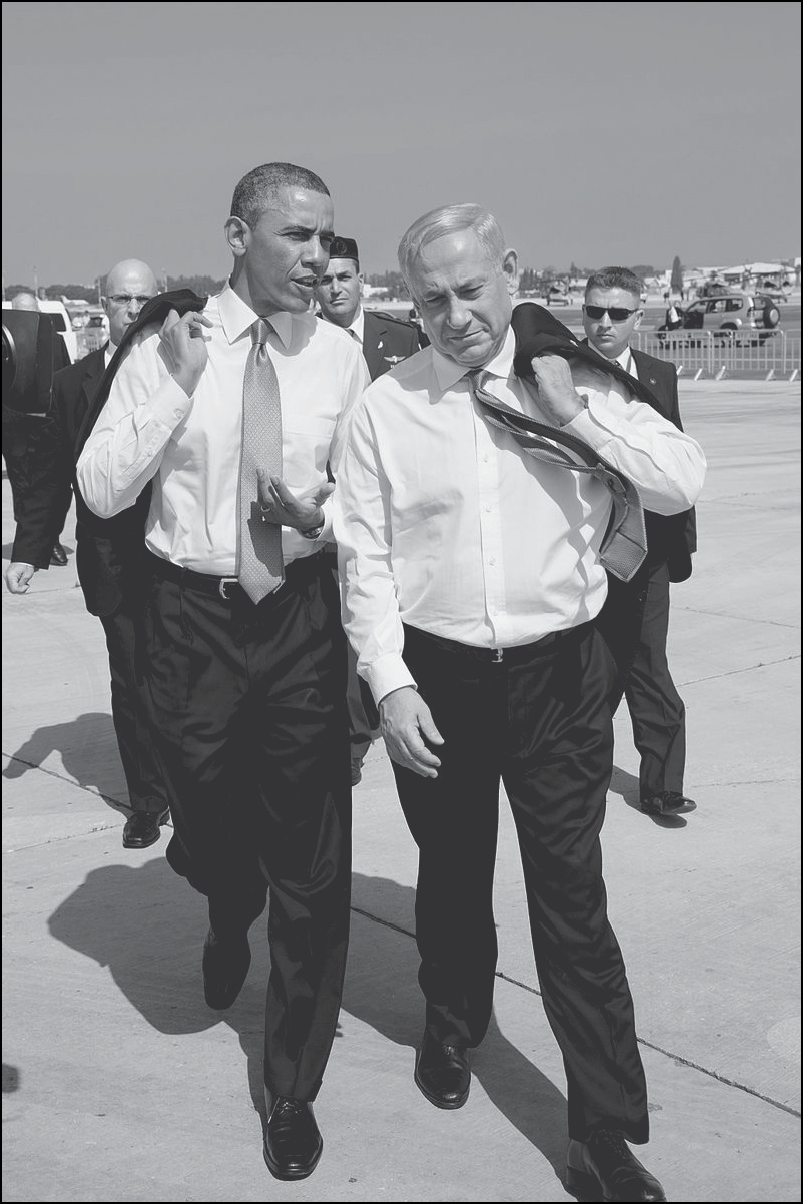
Obama and Netanyahu putting on a show of friendship for the sake of the Israeli-US relationship in March 2013.
Just before his departure on March 22, Obama held a final meeting with Netanyahu in a portable cabin on the runway. Obama had Turkey’s Recep Tayyip Erdoğan on the phone and pressured Netanyahu into reading out an apology that had been prepared in advance. It was an exercise fraught with tension, as the hyper-suspicious Israeli and Turkish leaders had no channel of communication, and the US ambassador in Israel, Dan Shapiro, was redrafting the wording of the apology all the way to the airport. What had once been a strategic alliance between Israel and Turkey had been going downhill for years, even before Netanyahu’s return to office. Diplomatic relations were finally cut following an Israeli raid on a flotilla that had been trying to break the blockade that Israel had imposed on Gaza. In the May 2010 raid, nine Turkish activists had been killed. The apology to Erdoğan allowed Obama to leave Israel feeling he had achieved something; if nothing else, he had brought two of America’s wayward allies together. But it would take another three years for Israel and Turkey to resume diplomatic ties, and even then, there was little hope of them rebuilding an alliance.
No one was under illusions that the outwardly successful visit had repaired the relationship between Netanyahu and Obama. Four months later, Netanyahu appointed his closest adviser, Ron Dermer, as Israel’s new ambassador to Washington, replacing Oren. Dermer was known as a virulent critic of Obama, so much so that at one point there was concern the administration would not accept his appointment. This “nuclear option” was not exercised, but it was clear that the new envoy was Israel’s ambassador to the GOP. Dermer’s appointment was a snub to Obama, and he would receive little access to the administration.
With Netanyahu’s representative in Washington, virtually a persona non grata with the administration, Ambassador Shapiro in Israel often remained the only effective personal link between the two leaders. Appointed in 2011, Shapiro was a consummate professional. He was personally committed to Obama, on whose 2008 campaign he had worked as senior policy adviser and Jewish outreach coordinator. He often found himself torn as an American Jew with a deep connection to Israel, as well, when having to maintain a working relationship with an Israeli prime minister whose policies he firmly opposed and who openly dismissed the views of the president he served.
The White House did not keep up any pretenses either. Over the next few years, there would be a steady stream of invective from unnamed senior officials criticizing Netanyahu, including calling him “a coward” and “chickenshit.”1 Meanwhile, Netanyahu may have given up on a military strike against Iran, but he focused all his rhetoric and lobbying on trying to prevent an agreement between Iran and the United States.
DURING THE VISIT, Obama was asked by journalists about his reaction to reports of sporadic use of chemical weapons by the Assad regime in Syria. Evidence at that point was sketchy, but Obama said, “We have been very clear to the Assad regime—but also to other players on the ground—that a red line for us is we start seeing a whole bunch of chemical weapons moving around or being utilized. That would change my calculus.”2
The United States had “led from behind,” reluctantly joining other Western and Arab nations to intervene on the side of the rebels in Libya. Dictator Muammar al-Qaddafi had been deposed and then brutally murdered in October 2011. In the midst of the chaos of the Arab Spring and the Libyan Civil War of that year, the American diplomatic compound in Benghazi was attacked, claiming the life of US Ambassador J. Christopher Stevens and three other Americans on September 11, 2012. The Libyan quagmire convinced Obama not to get involved in the even bloodier civil war in Syria, where the Assad regime, backed by Iran and Hezbollah, was killing hundreds of thousands of civilians. However, incontrovertible proof of chemical weapons use would be a different matter. Or so, at least, Obama had promised.
For Israel, Syria, just across the border, was a much closer concern. In the early months of the Syrian Civil War, many Israeli intelligence analysts gleefully predicted Bashar al-Assad’s imminent downfall. Netanyahu was more ambivalent. He had no love for the Assad family, whose soldiers he had fought together with his brothers Yoni and Iddo in 1973. Assad was an ally of both Iran and Hezbollah. But he had also been a stable presence, preventing escalation on the Golan. In Assad’s absence, Netanyahu feared, Syria could become the playground of Hezbollah and other Islamic jihadists. In the first years of the civil war, he counseled other Western leaders not to supply weapons, especially shoulder-launched antiaircraft missiles, to the rebels. There was no way of telling in whose hands they might end up, he warned.
In early 2013, Israel launched the first in a series of air strikes on Hezbollah convoys and storage facilities in Syria. Israel officially refused to take responsibility for the attacks, but no one in the region had any doubt as to their origin. The objective was to prevent Iran’s Lebanese proxy from transferring advanced weapons to its strongholds in Lebanon’s Bekaa Valley. Netanyahu established a series of his own red lines in Syria—Israel would not allow Hezbollah to acquire advanced weaponry, would respond forcefully to any firing on its territory, and would prevent Iran or Hezbollah from establishing a presence on the Golan.
On August 21, 2013, Obama’s red line in Syria was blatantly crossed. The Assad regime attacked rebel-held Ghouta, east of Damascus, with sarin gas, a highly toxic nerve agent, killing 1,429 civilians. Obama had no choice but to order preparations for a missile strike on the regime. And then he dithered, seeking congressional approval as a delaying tactic. Stating his reasons for holding back, he explained that one strike wouldn’t topple the regime, and there was no one prepared to take over in Damascus if the regime did topple. Many suspected him of being loath to jeopardize negotiations with Iran by attacking its Syrian ally. Russia snatched Obama’s chestnuts from the fire, brokering a deal whereby Assad committed to dismantling his chemical weapons arsenal under international supervision as an alternative to being on the receiving end of an American strike.
Israel and America’s other allies in the region were shocked by Obama’s backing down. It served as proof that their skepticism about his truthfulness when he said, in regard to Iran, that “all options are on the table” had not been unfounded. For Israel, the elimination of most of Syria’s chemical arsenal, which originally had been manufactured to attack Israel, was a strategic windfall. It eliminated an arsenal of weapons of mass destruction across the border and allowed the Netanyahu government to save hundreds of millions in civil defense preparations. But that hardly made up for the strategic vacuum created by Obama’s indecision—a vacuum that would soon be filled by ISIS, Russia, and Iran.
Obama, impervious to criticism from Washington’s foreign policy establishment for having “tarnished America’s credibility” in the Middle East, would be sucked back into Syria a year later, when the Islamic State, a group he had dismissed as “a jayvee team,” began beheading Western hostages. All that, however, was in the future as Obama tuned out the foreign policy “experts” and Netanyahu, focusing his efforts instead on reaching a deal with Iran.
In June 2013, a new Iranian president, Hassan Rouhani, had been elected. Rouhani was a member of the clerical class that had been behind Ayatollah Khomeini’s Islamic Revolution in 1979, but, unlike his predecessor as president, Mahmoud Ahmadinejad, who had led an outwardly hardline attitude toward the world, the Western-educated Rouhani projected a more flexible image. Netanyahu, in both public appearances and in conversations with other Western leaders, tried in vain to convince his interlocutors that Rouhani and his new government were simply a more user-friendly face of the same extreme regime, and that the real power in Tehran still resided with Supreme Leader Ali Khamenei and the Islamic Revolutionary Guard Corps (IRGC). But the leaders of the West, especially Obama, were eager to find a way to engage diplomatically with Iran openly, and the soft-spoken Rouhani, along with his sophisticated foreign minister, Mohammad Javad Zarif, offered them the opening they had been looking for. Essentially, Netanyahu was right. Rouhani governed at the supreme leader’s pleasure, and on the ground in the Middle East, especially in Syria and Lebanon, the IRGC commanders did not take orders from him. But after nearly a quarter of a century of treating Iran as a pariah, the Western political classes warmed to the silver-tongued Zarif, who, just like Netanyahu, had spent some of his formative years in the United States, and served as a diplomat at the United Nations. As one Israeli diplomat put it, “The Iranians have pulled a Bibi,” appointing an English-speaking charmer as their chief diplomat.
THE SHARON GOVERNMENT had unilaterally withdrawn from Gaza in September 2005 after dismantling the settlements there. No arrangements were put in place to help alleviate the plight of the Palestinians in Gaza, over one and a half million people living in a narrow coastal strip stuck between the Mediterranean, Israel, and Egypt (an area measuring 365 square kilometers, or 141 square miles). In June 2007, Hamas launched a coup in Gaza, ousting the Fatah-dominated Palestinian Authority. In response, Israel imposed a blockade, allowing only basic foodstuffs and medications to get through. The blockade failed to stop Hamas from smuggling in and building an impressive array of rockets. In response to the Hamas attacks, Israel launched a series of operations in Gaza—Summer Rains, Hot Winter, Cast Lead, and Pillar of Defense—causing hundreds of Palestinian deaths and widespread damage to the already crumbling infrastructure.
In the lulls between fighting, Olmert, and then Netanyahu, had more pressing matters to attend to than searching for a solution for Gaza’s population. The National Security Council (founded in 1999 on Netanyahu’s instructions, but awarded no real powers) had drawn up comprehensive plans for Gaza’s future, but the cabinet routinely ignored them.
On June 12, 2014, three Israeli teenagers were kidnapped and then murdered by Hamas members in the West Bank. Their fate unclear, the government ordered the IDF on a widespread search operation with the additional objective of degrading Hamas networks. Four hundred Hamas operatives were arrested, including fifty who had been released three years earlier in the Shalit prisoner exchange deal.
Hamas, in response, launched daily salvos of rockets from Gaza against Israel. Most of the rockets threatening built-up areas were intercepted by Iron Dome and there were no casualties. But despite the intensifying Israeli air strikes on Hamas targets in Gaza, the salvos continued, with Hamas firing at targets deeper within Israel. On July 8, Israel announced Operation Protective Edge.
At every stage of the operation, Netanyahu, with backing from Defense Minister Moshe Yaalon, held out against demands from the IDF General Staff and the more combative members of his cabinet to expand the operation to a wider ground campaign. At one point, he even fired Deputy Defense Minister Danny Danon for criticizing him in public for holding back. Netanyahu was concerned the IDF would get bogged down in a high-casualty conflict in Gaza’s narrow alleyways. Even after finally authorizing a ground campaign on July 17, he stipulated the incursions would be limited to a few kilometers.
What forced Netanyahu’s hand was Hamas’s use of tunnels reaching under the border into Israeli territory. The IDF demanded time to destroy the tunnels before any ceasefire. Israeli intelligence had been aware of Hamas burrowing under the border for years, but Netanyahu’s cabinet had only cursorily debated this threat to Israeli civilians. The IDF had devoted scant resources to the tunnels, and its units going into Gaza were untrained and lacked suitable equipment for underground warfare.
Netanyahu was anxious for a ceasefire, but unlike in previous rounds in Gaza, this time Egypt was less enthusiastic about mediating. The new military regime of General Abdel Fattah al-Sisi regarded Hamas as the proxy of its enemy, the Muslim Brotherhood, and was happy to see Israel bleed them. Secretary of State Kerry arrived in the region, but he enraged the Israelis by seeking to include Turkey and Qatar—both supporters of Hamas—in the ceasefire talks. It took fifty days of fighting until the Egyptians finally roused themselves to broker a lasting ceasefire on August 26.
Operation Protective Edge was the closest thing to full-out war in Netanyahu’s entire time as prime minister thus far. It ended in bitter stalemate. The number of Palestinians who had been killed reached 2,100, half of them civilians. Tens of thousands of buildings in Gaza were destroyed, but Hamas received only empty promises for ending the blockade and rebuilding the Strip. On the Israeli side, 73 soldiers and civilians were killed. The IDF, with its overwhelming firepower, had significantly degraded Hamas’s arsenal, but rockets were still launched daily, throughout the operation, against Israel’s cities, including Tel Aviv and the vicinity of Ben Gurion Airport, leading to most foreign airlines suspending services to Israel for forty-eight hours.
As the ceasefire held, there was desultory talk of long-term solutions for Gaza, but Netanyahu’s attention quickly became focused elsewhere. His conduct during the Gaza conflict highlighted two contradictory traits in his leadership: a deep reluctance to address burning issues on the Palestinian front, alongside his extreme aversion to risk and large-scale military adventures.
ON MAY 30, 2014, a French citizen of Algerian origin who had spent a year fighting for ISIS in Syria opened fire inside Brussels’s Jewish Museum of Belgium, killing four people, including two Israelis. It was the first terrorist attack that had been carried out by a follower of the Islamic State outside the Middle East and the start of a global spree of attacks against Western civilians. Jewish communities were often chosen as targets. On January 9, 2015, two days after the attack on the Charlie Hebdo offices, killing twelve and wounding twelve others, four Jews were killed in an attack on a kosher supermarket in Paris.
Israeli officials pressured the families of the four victims to have them buried in Israel. Netanyahu, anxious to be seen as protector of all Jews, attended the state funeral. He insisted on traveling to Paris, despite President François Hollande’s office trying to dissuade him, and attended a march organized by the French to demonstrate unity following the Paris terrorist attacks, pushing himself to the front row. Many other world leaders had arrived to show their support for France—Netanyahu was the only one who had been asked to stay away. He also demanded an invitation to join Hollande on his solidarity visit to Paris’s Grand Synagogue, where he was met by cheers from the largely Zionist congregation. But as Netanyahu ended his twenty-seven-minute speech with a call “to join your Jewish brothers in our historical homeland, in the land of Israel,” they responded by singing the French national anthem, “La Marseillaise.”3 It was a typically French response to Netanyahu advising they abandon the country they considered their homeland.
Most Jews are not Israeli citizens, and many more Jews voted for Barack Obama than for Netanyahu’s Likud. Yet Netanyahu regarded himself as the “representative of the entire Jewish people.”4 His attitude polarized Jews around the world like no previous Israeli leader. Many were enraged by the way Netanyahu monopolized the memory of the Holocaust to brand Israel’s enemies as reincarnations of the Nazis and his own critics as collaborators. At the AIPAC conference in 2012, Netanyahu brought up the historical controversy over President Franklin Roosevelt’s decision not to bomb Auschwitz. “My friends, 2012 is not 1944. Never again!” he cried, to stormy applause from the pro-Bibi crowd.5 Many other American Jews were scandalized by what sounded like an admonishment of Obama for ignoring a second Holocaust.
Three years later, Netanyahu invented his own history, telling the Zionist Congress in Jerusalem that Mufti Haj Amin al-Husseini, the godfather of Palestinian nationalism, had suggested that Hitler exterminate the Jews in their meeting in November 1941. “Hitler didn’t want to exterminate the Jews at the time, he wanted to expel them,” claimed Netanyahu.6 Husseini had indeed been a virulent anti-Semite and admirer of Hitler, but no serious historian agrees that he had been the author of the Final Solution.
Netanyahu had no patience for his Jewish Diaspora critics. Since his teens in Philadelphia, he had developed a deep disdain for liberal American Jews who had the chutzpah to not support Israel, and its leader, unquestionably.
Throughout most of his public career, most of the American Jews surrounding Netanyahu have been part of the admiring minority supporting his views. The few Jewish critics he has met have tended to be administration officials, diplomats, and journalists—habitual sell-outs of Jewish values, as far as Netanyahu is concerned. Earlier during his career, Netanyahu made more of an effort to hide these feelings and worked on his relationships with liberals. But as he stayed in power, it became more obvious that he did not respect them. In private, he has agreed with assessments that they will eventually assimilate and disappear. “He has a true disdain for progressive Jews,” said a senior official in the Obama administration who was intensely proud of his Jewish heritage. “He talks about stuff they like—high tech and gay rights—but it’s clear he disrespects people who put their liberalism on par with their Jewishness.”
Sheldon Adelson, the casino mogul who was prepared to spend $100 million trying to oust Obama in 2012, and at least twice that on the Netanyahu-worshiping Yisrael Hayom newspaper, came to embody the best of American Jewry for Bibi. Netanyahu even ended his decades-long friendship with Ronald Lauder, who since 2007 has been the president of the World Jewish Congress. Lauder had refused to force Israel’s Channel 10, in which he was a majority shareholder, to stop conducting its “Bibitours” investigation into the lavish travel arrangements the Netanyahu couple demanded, and received, from wealthy benefactors. Once Adelson delivered Netanyahu his “own media,” Lauder was cast out of Netanyahu’s circle.
On November 12, 2014, the Knesset held a preliminary vote on the “Law for the Advancement and Protection of Print Journalism in Israel.” It was an anti-dumping bill, preventing free newspapers from being distributed nationally. Its target was Yisrael Hayom, which would be forced to charge readers a minimum fee, eliminating its Adelson-sponsored advantage over competing newspapers that were critical of Netanyahu. The vote passed 43–23, with most of those voting in favor members of the coalition. Netanyahu turned on his ministers and cried “shame.”
Three weeks later, he suddenly escalated his routine legislative disagreements within the coalition and gave Finance Minister Lapid an ultimatum to follow his orders or resign. Without waiting for an answer, Netanyahu announced the firing of Lapid and Livni the next day, citing their “attacking the government and its head from within the government.”7 Livni had voted in favor of the “Yisrael Hayom Law,” as had members of Lapid’s Yesh Atid party.
Netanyahu’s third government had served for only twenty months. Bibi was calling early elections, squandering the time remaining in his term, two and a half years, to save Adelson’s free newspaper.
NETANYAHU EXPECTED THE 2015 election to be a rerun of 2013. With the Israeli political scene as splintered as ever, none of the other party leaders seemed to jeopardize his primacy. The campaign strategy was to be the tried and true candidate who could be trusted. He would run as the only politician with the experience and will to stand up to Obama over the Iranian issue and deny the Palestinians a share of Jerusalem. To demonstrate the clear gulf of competence between the prime minister and his would-be rivals, Likud produced humorous online campaign ads in which Netanyahu played himself as the “Bibisitter,” the only person trusted to take care of the nation’s children, and as a kindergarten teacher, dealing with an unruly mob of urchins who played the other parties’ leaders. His next move was less amusing.
On January 21, 2015, House Speaker John Boehner announced that Netanyahu would be addressing a joint session of Congress. It was an unprecedented breach of protocol. Although the Speaker does officially invite foreign leaders to address Congress, it had never before happened without prior consultation with the White House. Ron Dermer and the Republican leadership had hatched their plan in secret, blindsiding the Obama administration, which was informed about the visit just an hour before the invitation became public.
It wasn’t just the absence of any consultation that was the problem, or even that Netanyahu would be addressing Congress only two weeks before the Israeli election. The leader of an ally of the United States was coming to Washington to tell Congress to oppose the president’s key foreign policy initiative—the nuclear deal with Iran.
In November 2013, Iran and the United Nations Security Council’s P5+1 group of world powers, led by the United States, had reached an interim agreement in Geneva whereby Iran accepted some temporary limits on its nuclear program in return for sanctions relief. As part of the deal, some of its frozen assets would be released. It was a time-limited partial agreement, and the parties struggled to reach a final deal throughout 2014.
Netanyahu surprised no one in lambasting the interim agreement, calling it “not a historic agreement, but a historic mistake.” It had made the world, he said, “a much more dangerous place because the most dangerous regime in the world has taken a significant step toward attaining the most dangerous weapon in the world.”8
But the real battle with Obama would commence over the final deal. Netanyahu’s speech to Congress was a preemptive strike. He was relying on the Republican-dominated Senate to block the president. Shrugging off criticism, he insisted this was no election stunt. He would be speaking in Congress “not just as the prime minister of Israel but as a representative of the entire Jewish people.”9 Nothing deterred him, not the Jewish American leaders discreetly begging him to reconsider, or the dozens of Democratic representatives threatening to boycott his address, or the White House itself, which made clear that Netanyahu would not be meeting the president or any other member of the administration while in Washington.
On March 3, with his guests Adelson and the Holocaust survivor and author Elie Wiesel, looking on from the gallery, Netanyahu became only the second foreign leader in history to address Congress three times—equaling the record set by his hero and role model Winston Churchill. He opened with a nod to bipartisanship, singling out old Democratic friends and singing Obama’s praises for all he had done for Israel. But there was no mistaking the message that came next.
Netanyahu pronounced the Iran deal that Secretary Kerry was working on “a bad deal that will at best curtail Iran’s nuclear ambitions for a while.” It would allow Iran to keep its nuclear infrastructure intact, imposing only a decade-long moratorium on further development and uranium enrichment. And it wouldn’t curtail Iran’s support for the Assad regime or terrorist organizations. “It’s a very bad deal,” Netanyahu intoned. “We’re better off without it.”10
He had thrown down the gauntlet to Obama, months before the Iran deal was even signed. The Republicans, and some Democrats, applauded him rapturously, interrupting the forty-five-minute speech with twenty-six standing ovations. That night on The Daily Show, comedian Jon Stewart said it was “by far the longest blowjob a Jewish man has ever received.”11
It was also an abject failure. The speech failed to boost Netanyahu in the polls back home. And when, four months later, the nuclear agreement was finally signed, it was clear that it had failed to deliver a veto-proof majority.
EVEN BEFORE NETANYAHU took off for Washington, it was clear that his campaign strategy had backfired. Six years of Iran-talk had wearied Israelis. Not that the voters blamed Netanyahu for damaging Israeli-US relations. Obama-hatred remained an electoral asset, and a large majority still believed the president was anti-Israel. But the scare tactics that had worked in 2009 and 2013 had lost their potency. Too many Israelis were just too tired of hearing Bibi go on about Iran while they couldn’t afford to buy a decent-sized apartment.
In mid-February, the state comptroller published a report on the prime minister’s residence budget, revealing a rise of hundreds of thousands of shekels in public money spent on the upkeep of the Netanyahu family. Israelis had long known that Netanyahu lived a lavish lifestyle at their expense, but enough of them were still willing to vote for him as long as they believed he was taking care of their interests. Fewer now seemed convinced of that. A week later, a second comptroller’s report came out severely criticizing the Netanyahu government for not acting to rein in the spiraling cost of housing.
In a speech responding to the report, Netanyahu reprimanded those who fretted over such minor things. “When we talk about housing prices and the cost of living, I don’t forget for a moment life itself. And the biggest threat facing us in our life as Israeli citizens and as a state is the threat of Iran acquiring nuclear energy weapons with a stated intention of exterminating us.”12 Netanyahu had badly misjudged the public mood. “Life itself ” instantly became a byword for his disconnect from the daily concerns of ordinary Israelis.
With only a month until the elections, Likud was tied in the polls with the Zionist Union (HaMahaneh HaTziyoni), a joint list of Labor and Tzipi Livni’s Ha’Tnuah. The latest Labor leader, Isaac “Buzhi” Herzog, a slight and mild-mannered lawyer with a high-pitched voice, was an unlikely challenger. Herzog’s strategists even tried artificially adding some stubble on his campaign photographs, to give him a more rugged image. And yet, by the end of February, Herzog had opened up a small but steady gap.
The polls and atmosphere on the streets were beginning to feel like a rerun of the 1999 election, when Netanyahu lost to Barak. Whether it was a rekindling of the social protests of 2011, or simply Netanyahu-fatigue, there was an “Anyone but Bibi” dynamic. Parties from left and right barely spoke about the issues; it was all about replacing Netanyahu. Likud was hemorrhaging votes in all directions, in particular to Bennett’s Jewish Home and to Kulanu (All of Us), a new center-right party led by Moshe Kahlon, a popular Likud minister who, like so many others, had fallen out with Bibi. Kahlon presented himself as the “real Likud” of the working classes. By the time Netanyahu left for Washington, Likud was down to nineteen seats in the polls. Returning to Israel on March 4, thirteen days before the election, Bibi was dismayed to discover that his speech to the US Congress had failed to deliver a bounce in the polls.
On March 7, Meir Dagan, the Mossad chief who had clashed with Netanyahu over the Iran strike, addressed an “Israel Wants Change” rally in Tel Aviv’s Rabin Square. Dying from liver failure, he told a reporter on the eve of the rally, “I have to keep my last shreds of strength to push him out.” In tears, Dagan delivered the only political speech of his life, telling fifty thousand Israelis, “For the first time in my life I’m afraid of our leadership. This the biggest leadership crisis in the state’s history. We deserve a leadership that will serve the public and not itself.”13
But the pollsters and pundits predicting Netanyahu’s political demise were reckoning without Bibi’s base. Netanyahu, who hadn’t given an interview to the Israeli media for nearly two years, stormed the airwaves, predicting a divided Jerusalem and an Islamic State on Israel’s borders if the weak and ineffectual “Buzhi and Tzipi” were to win. Settler leaders were called in for meetings with Netanyahu, who sternly warned them that anything but a vote for Likud would lead to the rise of the left and a resumption of the Oslo process. Few of them were great admirers of Netanyahu—they had known him for too long—but many of them were convinced. Meanwhile, millions of text messages were being sent to a million targeted recipients, warning that the right wing was in danger of losing power.14
Three months earlier, Netanyahu’s campaign team had determined that many traditional Likud voters were tired of Bibi and planned to vote for another party or stay home. Their contingency plan was to broadcast panic. As the settler activists fanned out throughout their communities, the text-message bombardment intensified. Likud sent eighteen million text messages in the last week of the campaign, five million on election day.
The last media polls, broadcast two days before the election, had Likud lagging behind the Zionist Union by four seats. But they were out of date. By then, Netanyahu’s private pollsters had already picked up a resurgence of support, putting him back in the lead. Nevertheless, in all his public appearances, Netanyahu stuck to the panic message, saying, “The right wing is in danger.”
All pretenses were dropped as Bibi played shamelessly to his base. In an interview with the settlers weekly Makor Rishon (First Source), which Adelson had recently acquired, Netanyahu promised, “If I’m elected, there won’t be a Palestinian state.” In a second interview, he elaborated, saying, “Anyone today who wants to establish a Palestinian state and retreat from territory is giving radical Islam a launching-pad to attack Israel.”15
On previous election days, Netanyahu had crisscrossed the country, bringing out the vote. On March 13, 2015, he made do with one short visit to a run-down pedestrian mall in the southern coastal town of Ashkelon. He spoke for three minutes, warning, “There is still a gap between the Zionist Union and Likud.”16 On previous election days, he had been surrounded by ambitious MKs who were angling for cabinet positions. Sensing Likud’s defeat, they had now disappeared. This time, only an old rival, Energy Minister Silvan Shalom, turned up. He was preparing to challenge Netanyahu on the day after the election. But Netanyahu was relying on text messages, Facebook, and racism.
Wavering right-wing voters received a steady stream of messages. “Turnout is three times higher in the Arab sector.” “Herzog promised to appoint an Arab minister to his cabinet.” “Hamas called on Israeli-Arabs to go and vote.”
At noon, a twenty-eight-second clip was posted on Netanyahu’s Facebook page: “The right is in danger of losing power, the Arab voters are moving in droves to the polling stations,” he warned. “We only have you. Go to vote. Bring your friends and relatives. Vote Likud to close the gap between us and Labor. And with your help, and God’s help, we will form a national government that will protect the state of Israel.”17
Hours before the voting ended, a relatively low turnout was predicted. At 10:00 p.m., the exit polls forecast a tie between Likud and the Zionist Union. Loud cheers went up in Likud headquarters. They had closed the gap, and the predicted results of the other parties suggested that Netanyahu would be able to build another right-wing religious coalition. But the exit polls had closed two hours earlier than the actual voting stations to give the pollsters time to tabulate their results. They missed a massive surge of over half a million voters in the last two hours. Turnout was the highest since 1999.
As the official results started coming in, Likud’s lead grew. In the last days and hours of the campaign, disappointed Likudniks planning to vote for Jewish Home or Kulanu had been panicked home to Likud. The night ended with Likud on thirty seats, six more than Zionist Union. Israelis may have been tired of Bibi, but he had won a fourth term.