
7
The Netanyahus arrived in snowy Philadelphia in January 1963 and settled in a two-story house in Elkins Park. For the next year and a half, the brothers were a unit of two, neither of them making much effort to make friends or create a lasting impression at Cheltenham High. The younger brother’s grasp of English was swifter, though both were already relatively fluent from their two years in New York. Both were voracious readers—Bibi carried around a small notebook in which he jotted down any new word he read or heard, a system Yoni eventually adopted as well.
It wasn’t just the foreign surroundings that knitted the brothers together. It was also their silent but defiant opposition to their father. The narrative told by the family years later was that there was no question that upon graduation they would both immediately return for military service in Israel. Any other version of the family history would have marked them in the eyes of ordinary Israelis as deserters and shirkers. But from the collection of Yoni’s letters published in Israel in 1978, a year after his death, it is clear that as far as Benzion was concerned, his sons should take advantage of the opportunity to enjoy a superior academic education and remain in the United States. For all the talk of how Benzion influenced his sons’ views of the world, their most formative years were marked by a resentment of their father for uprooting them from Jerusalem and for resisting their determination to return to join the army.
Neither Yoni nor Bibi found the standards of Cheltenham High difficult, and language was not a barrier to either of them becoming honors students.
Success in class didn’t extend to social life. Yoni encapsulated the brothers’ feelings toward their American classmates in an April 1963 letter to a friend back in Jerusalem. “People here talk about cars and girls. Life revolves around one subject—sex, and I believe Freud would have rich ground here to seed and pick his fruit. Slowly I am being convinced that I live among monkeys, not humans.”1
The Netanyahu brothers were eager to proselytize for Israel. In another letter from that period, Yoni wrote,
I’ve adopted a new role in the U.S.—making propaganda for Israel. A month ago they interviewed me for the student newspaper. It seems the interview was very successful and has caused invitations to homes, parties etc., since ‘the parents want to get to know me.’ Yesterday I sat until one in the morning with four girls and preached Zionism. Etc. I’m happy to note, that I’ve discovered here a few humans, with brains and wisdom of a high order. The problem with the young people here is that their lives are so poor in substance and are passed as if in a dream or game.2
The two teenagers were anxious to remain untainted by the host culture. “It is a terrible world, there is nothing to do here, everything is stunted, without any real life,” grumbled Yoni.3
There were a few aspects of their new lives that appealed to them. Yoni discovered that Cheltenham High offered well-taught courses in mathematics and physics, and found himself warming to his science teachers, much more than to his classmates. Bibi was drawn to American history, which remains among his favorite subjects for reading in his spare time. In the prime minister’s office he still often whiles away hours with a biography of an American statesman or general.
Yoni spent his only summer vacation in the United States as a counselor at a Young Judea camp in New Hampshire, where he ended up teaching rudimentary Hebrew to his young Jewish charges and lecturing them on the wonders of Israel. By July 1964, both brothers were back in Jerusalem: Bibi for a summer’s reunion with his school friends, Yoni for the draft.
Joining the IDF in early August, Yoni volunteered for the Paratroopers Brigade. While the twenty-first-century Israeli army abounds with crack infantry and special forces units, in the 1960s the paratroopers were the sole undisputed elite. The brigade had been created in the mid-1950s when the legendary Unit 101, which had carried out the first cross-border retribution raids against Fedayun bases, had been merged with an earlier paratrooper battalion. Led by their first battalion commander, Ariel Sharon, the paratrooper battalions bore the main brunt of IDF ground operations. Paratroopers worked under extremely strenuous and physically demanding conditions. Attrition was high: over 50 percent of recruits didn’t make it through the seven months of basic and advanced training.
Yoni had promised his parents that at the end of the mandatory two-year period of service he would return to the United States to attend college, but it was not a promise he intended to keep. A year into his service, he was selected for officer training. He assured Benzion, who in his letters continued to badger Yoni about college applications, that it would only mean an additional four months of service. In January 1966, he completed the training as the outstanding cadet of his company, receiving his officer’s badge from the IDF chief of staff, Lieutenant General Yitzhak Rabin. He was commissioned back to the paratroopers as a new platoon commander.
MEANWHILE, BACK IN Philadelphia, his brother pined for him. Although Bibi’s letters from that period have never been published, it’s clear from Yoni’s that the bond between them only intensified during their period apart. In a letter Yoni wrote to his girlfriend, he described Bibi as “the person I love more than anyone else in the world” and “who knows me better than anyone.”4 He relied on Bibi to give him an accurate picture of the family’s life back in the United States. They supported each other through letters in their joint determination to serve in Israel against their father’s wishes.
Not that Bibi and Yoni were alike in every way. Bibi spent four and a half years in Philadelphia; Yoni had spent only eighteen months there. The younger brother was shaped by America to a much greater degree than his older sibling was, though in unexpected ways.
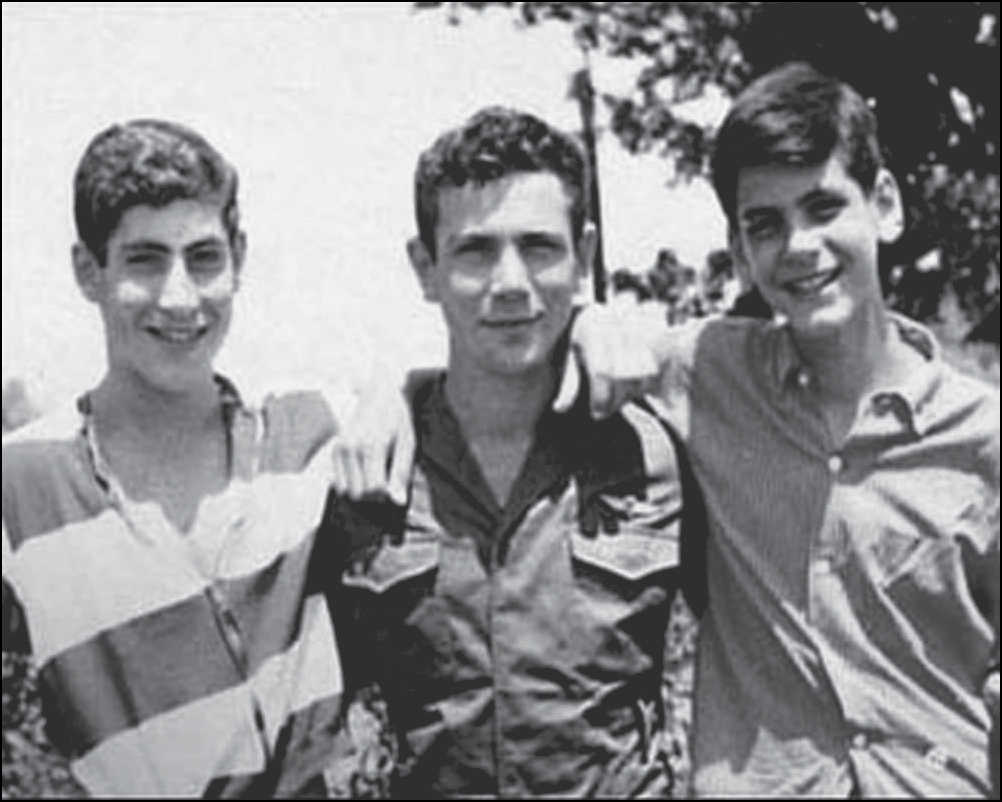
Bibi (left) and Iddo arrive from Philadelphia for vacation in Israel with paratrooper Yoni (in uniform).
Benjamin Netanyahu still enjoys recounting how he would work evenings and weekends washing dishes in local restaurants. He says that he didn’t want to take any money from his parents, though they were willing to give it. The real reason was that he was saving up for airfare. With the exception of 1963, he spent his high school summers alone in Israel. During their first four and a half years in America, the entire family visited Israel together only once.
At the age of fourteen, not only was Bibi much more independent than his peers, with his own travel plans and finances, but he was also developing the dual persona that would characterize him for life. There emerged the American Netanyahu and the Israeli Netanyahu, which were so distinct from each other that they had different names, and he toggled between them depending on the season. At Cheltenham High he was Ben, a studious and rather detached teenager. Outside of class, the only extracurricular activities he participated in were those that fit his competitive personality and that were familiar to him from back in Israel. He played on the school’s soccer team and was a member of the chess society. At home and during the two summer months of each year that he spent in Israel, he was more gregarious and outgoing, though he kept mainly to the close-knit circle of friends he had made before leaving in 1963. To them he would always be Bibi.
Without Yoni, who never felt at ease in America and never lost his Hebrew accent, Bibi became a chameleon. His Israeli friends began to detect a man-of-the-world swagger about him. He affected an urban cosmopolitanism among his Israeli friends, wearing American clothes and talking about pop culture and television, which at the time were all but nonexistent in provincial Jerusalem. It helped that despite his soft life in Philadelphia he kept physically fit on the soccer field. By his mid-teens he had grown into the bulky, muscular physique of his adulthood, and he never lagged behind his friends on the desert hikes and weeks of agricultural work on kibbutzim.
America was also informing his political outlook. Growing up in the post-Kennedy years, amid the intensifying civil rights struggle, doesn’t seem to have made much of a lasting impression on the young Netanyahu. This was due partly to the Manichean worldview he inherited from Benzion and partly to his disdain for the liberal-leaning, Democrat-voting American Jews he was encountering. What he did appreciate was American capitalism, which he contrasted favorably with Israel’s centralized and collectivist economy under Mapai. In the summers, when they visited kibbutzim, where all property and income was shared among the members, Netanyahu would lecture his friends on the evils of socialism.
An early influence was a book he read on Yoni’s recommendation—The Fountainhead, by Ayn Rand. Bibi was taken with its hero, the architect Howard Roark, and his struggle as an independent thinker against the conformism and socialism dominating his profession. Rand’s muscular blend of capitalism and individualism appealed to Netanyahu and has influenced his political and economic thinking ever since. Roark, Rand’s “ideal man,” was also one of his inspirations to utilize his talent for sketching and studying architecture.
Netanyahu has never publicly acknowledged any ideological debt to Rand, preferring to refer to more mainstream thinkers. The antireligious elements of her philosophy would constitute electoral suicide for an Israeli politician dependent on religious votes. But the leading lights of the small community of Rand admirers in Israel are by and large also secular supporters of Netanyahu, seeing in him an iron-willed and nonconformist Israeli exemplar of the classic Randian hero.
Toward the end of his high school years, it seemed that Bibi had given in to Benzion and was resigned to going to college before returning to Israel for his military service. Bibi had applied and been accepted to Yale, but a few months later, Yoni was already sending him advice for his upcoming return and enlistment. Israeli Bibi had prevailed over American Ben, for now.
Netanyahu rarely speaks of his American adolescence. In his book A Place Among the Nations, he summed up in one short paragraph the “three years I spent in high school in Philadelphia,”5 though he was actually there for over four years. He claimed to have moved up his departure on account of the winds of war that were blowing once again in the Middle East, although Yoni had already advised him to spend a few months back in Israel before enlisting. Bibi’s real incentive for returning as early as possible was to spend time with his brother.
Yoni had been discharged from the IDF at the end of January 1967 after two and a half years of service. He had turned down the entreaties of his battalion commander to sign up for another year or two and take command of a company. He had received a scholarship to Harvard, but despite his plans to start college in the fall, and the fact that he had seen his father only once over the previous three years, he seemed in no hurry to fly back to the United States. Instead he rented a room in Jerusalem and worked as a gardener.
AFTER A RELATIVELY lengthy period of calm on Israel’s borders, tension had arisen with Syria over attempts by Israeli farmers to work on land in contested areas of the demilitarized zone between the two countries, and, more crucially, over a joint Syrian-Lebanese plan to divert water from the rivers feeding into the Jordan—and Israel’s main water source, the Sea of Galilee—for their own use.
In 1964 the Arab states held two special summits in Egypt at which they endorsed the plan to divert the Jordan waters. They also made a joint decision to set up a unified Arab military command and establish the Palestine Liberation Organization (PLO). The security situation deteriorated as Israel launched a series of ground and air strikes against the heavy machinery the Syrians planned to use to divert the Banias River, a tributary of the Jordan. Palestinian guerrillas, mainly from the Fatah movement, which had been founded in 1959 by a group of students at Cairo University, and was led by Yasser Arafat, began launching raids against Israeli targets from Syria and Jordan.
As a soldier and officer in the IDF’s busiest combat unit, in between exercises and training Yoni was often in the thick of action. In the Samu raid of November 13, 1966, or, as the IDF called it, Operation Shredder, the paratroopers blew up dozens of buildings in the village Fatah was using as a base. When Jordan’s Arab Legion unexpectedly counterattacked, they beat them off, killing at least fifteen Jordanian soldiers.
The devastating raid brought international condemnation and was another step in the escalation toward inevitable war. The mild-mannered Israeli prime minister, Levi Eshkol, was particularly concerned about the effect it could have on Israel’s rapidly improving ties with the United States.
Throughout the early 1960s, France had remained Israel’s main strategic partner and arms supplier. Meanwhile, the Kennedy administration was still considering the possibility of an alliance with the Arab states and was concerned about reports on Israel’s nuclear reactor in the Negev Desert. In a series of meetings in Washington, Israel and the United States agreed to nonintrusive American inspections of the reactor, and in 1963, Israel’s deputy defense minister, Shimon Peres, assured John F. Kennedy that “we shall not introduce atomic weapons to the region. We certainly shall not be the first to do so.” Israel maintains this policy of “nuclear opacity,” of neither acknowledging nor denying that the country has nuclear weapons, to this day.
Kennedy gave the green light for the first sale of an American weapons system to Israel—Hawk antiaircraft missiles, which were classified as “defensive.” The relationship continued to improve under President Lyndon Johnson, who invited Eshkol for the first official visit of an Israeli prime minister to the White House. In 1965, Johnson authorized the first sale of military aircraft to Israel—A-4 Skyhawk light attack jets, although a number of “offensive” capabilities were removed from the plane.
The rapid escalation to war in 1967 was caused by a combination of factors, including Syria’s bombardment of the kibbutzim in northern Israel, its support of Fatah, Israel’s tough response, the even tougher rhetoric by Chief of Staff Rabin and Prime Minister Eshkol warning the Syrian regime of dire consequences, and the Soviet Union’s support for its client-state in Damascus. In mid-May 1967, the Soviets passed on false reports to Egyptian president Gamal Abdel Nasser claiming that Israel was amassing troops in the north to attack Syria. Egypt was ill-prepared for war and suspected that the Soviets were lying, but Nasser had presented himself as the leader of the Arab nation for over a decade, and Egypt had a defense treaty with Syria. In the space of a week he embarked on three fateful acts of brinkmanship.
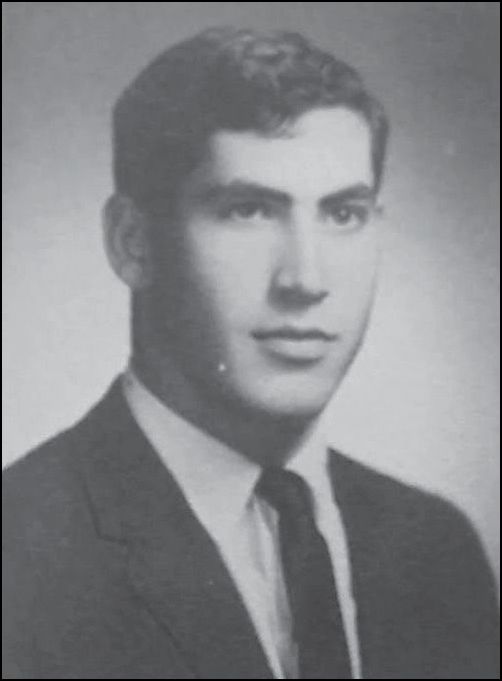
American Ben, in his high school yearbook.
Was Nasser seriously contemplating going to war on May 15, when he ordered his army into Sinai and expelled the United Nations observers who had been there since 1956? Many historians today claim that he was only bluffing. But as far as Israel was concerned, the massing of troops on its borders—not just with Egypt, but in Jordan and Syria as well—along with the rhetoric about destroying the “Zionist entity” coming from Arab capitals, was an existential threat . Nasser’s announcement, on May 22, that he was closing the Straits of Tiran, a crucial waterway for Israel’s oil supplies from Iran (which was then still a friendly state), was a closing gauntlet.
The next two and a half weeks would become known as “the waiting period.” Israelis were starkly split between those who were petrified of a second Holocaust and those who were confident of an Israeli victory. The IDF’s reserves, including Yoni, who was assigned to Reserve Brigade 80, were mobilized, and then they were sent to cool their heels in staging areas. Eshkol’s cabinet dithered while the generals demanded immediate action. Once again, the drama played out not only in the Middle East, but also in Washington.
Eshkol was adamant about not going to war without some form of backing from the US administration. Israeli foreign minister Abba Eban traveled to Washington, but succeeded in receiving only vague promises that the United States would send a flotilla to ensure Israel’s maritime rights in Tiran. The more forthright Mossad (Israeli intelligence agency) chief, former major general Meir Amit, flew out for meetings at CIA headquarters and with the US secretary of defense, Robert McNamara. He returned with the tacit understanding that as long as it appeared that Israel hadn’t fired the first shot, and that it could achieve a swift victory without US military support, it could proceed.
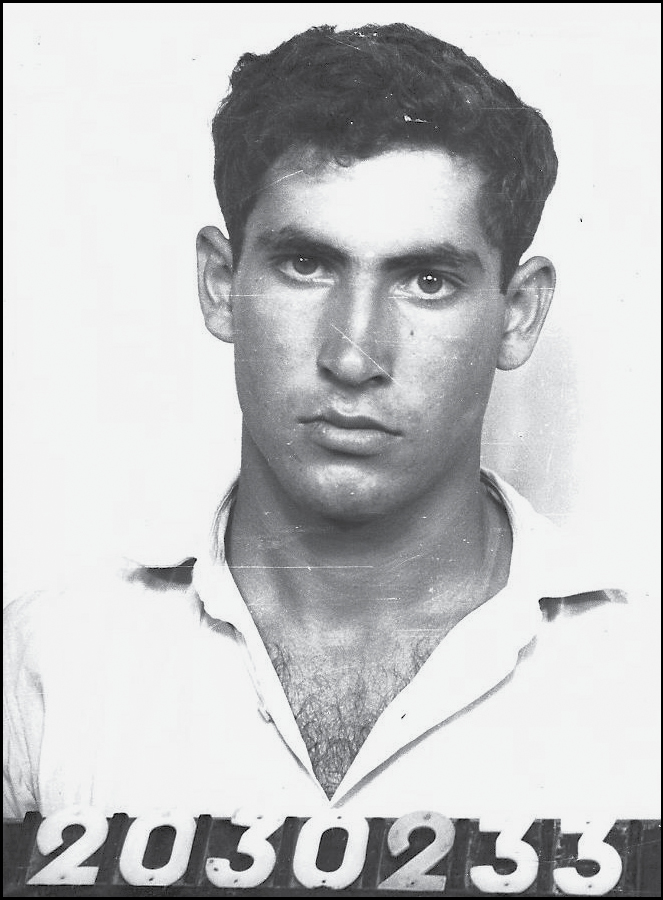
Two months later, Israeli Bibi, in his IDF induction ID photo.
As Eban and Amit were shuttling between Washington and Israel, Bibi was about to board one of the same flights. He returned to Israel a week before war broke out. He later wrote, “My parents didn’t try to talk me out of it. ‘Are you sure there will be a war?’ they asked. ‘Sure,’ I answered. ‘And besides, I want to see Yoni before it breaks out.’ That was it.”6
It was the end of Netanyahu family life as they had known it for twenty-one years. Along with Bibi, the fifteen-year-old Iddo was also to return to Israel. Unlike his older brothers, he would be allowed to finish high school back in Jerusalem. Benzion and Tzila, however, had no intention of returning. Benzion soon became a professor of Jewish history and Hebrew literature at the University of Denver, and he wasn’t about to give up on his career. At the age of fifty-seven he was finally beginning to prosper. The three Netanyahu boys would never live with their parents again.
There are only two photographs of “Ben Netanyahu” in the Cheltenham High School yearbook for 1967—his graduation picture, in a dark suit and tie, and another of him playing soccer. In both photos he looks a fair bit older and more mature than his classmates. He was also listed among the students in his class who received a National Merit Letter of Commendation. In the school’s archives there is a note saying that he did not attend the graduation ceremony. By then, he was back in wartime Israel.