
8
Landing at Lod Airport on the night of June 1, 1967, Bibi encountered a blacked-out terminal in a country bracing for war. Foreign nationals, as well as some well-to-do Israeli families, were scurrying for tickets on the few departing flights. Bibi made his way to Jerusalem, and with his bags stowed at his friend Uzi Beller’s home, set out searching for Yoni, who had been summoned to his reserve unit.
A quarter of a million reservists had been called up over the previous two weeks. Once in uniform, they awaited the government’s decision or an Arab attack. The paratroopers camped in the citrus groves south of Tel Aviv.
Three days before war broke, Bibi found Yoni drinking coffee with a group of older officers under an orange tree. Not far away, in Tel Aviv and other Israeli cities, they were digging thousands of graves, preparing makeshift mortuaries and burial grounds for the expected casualties. As Yoni and his fellow officers greeted the admiring younger brother, their quiet confidence was unmistakable. This was a war they had spent years training and preparing for. “We’ll win, we have no choice,” said Yoni.1
After his coffee with Yoni, Bibi returned to Jerusalem and spent the next two days with his friend Uzi, cleaning out the air raid shelter beneath the Bellers’ apartment building in Jerusalem. Bibi later claimed to have been woken on the morning of June 5 by explosions.2 He had overslept the beginning of the Six-Day War, which had begun two hours earlier with a preemptive air strike on Egypt’s airfields, wiping out most of the Egyptian Air Force. Half an hour later, ground forces were on the move toward the Sinai border. Israel sent repeated messages to Jordan’s King Hussein not to intervene in its war with Egypt. Hussein was misinformed by the Egyptians, who told him they were gaining an advantage on Israel. Having already put his troops under the command of an Egyptian general, he gave the fateful order to attack.
At 9:40 a.m., Jordanian soldiers opened fire across the border in Jerusalem, followed a quarter of an hour later by a massive artillery barrage on civilian targets. Netanyahu recalled watching from the Bellers’ rooftop as shells impacted the city. A mobile company of the Jerusalem Brigade swiftly repulsed a Jordanian incursion and went on the counterattack. Thus started the Battle for Jerusalem and the West Bank and the beginning of the Israeli occupation of territories, which lasts to this day.
Yoni’s brigade was on the Egyptian front, part of the division commanded by Ariel Sharon, which was breaking its way into the central sector of the peninsula. On the first night of the war, he was in an airborne force helicoptered to the rear of the fortified Egyptian division formation to take out its artillery batteries on the Umm Katef plateau. By dawn, the battle of Umm Katef was over. The decimation of its Second Division led the Egyptian high command to order all units to retreat eastward across the Suez Canal.
Three days later, with war against Egypt and Jordan won, Yoni’s battalion was transported two hundred miles northward. Israeli defense minister Moshe Dayan, who had initially opposed broadening the ground war in the north, gave the order to capture the Golan Heights in the time left until the United Nations imposed a ceasefire.
Late on the afternoon of June 10, hours before the ceasefire was set to begin, Yoni led a small squad flanking the Jalabina outpost, the point from which the Israeli villages of Mishmar Ha’Yarden and Gadot had been shelled for years. A machine gun opened fire, killing the soldier standing next to Yoni. As Yoni dove to the ground, another burst hit him in the arm, smashing his elbow. Yoni dragged himself back over the battlefield to a dressing-station. He ended the war in Safed Hospital. Bibi was by his bedside the next day. “You see, I told you we would win,” grinned Yoni.3
THE IMMEDIATE AFTERMATH of the Six-Day War was a euphoric and bewildering period for most Israelis. Many Israelis believed it was the last war they would fight. The Arabs would surely understand now that the Jewish state was a permanent reality. But Israel had half-planned, half-blundered into the war. Now it would approach a long military occupation of another nation in the same manner.
Dazed, Israelis flocked to the Western Wall in Jerusalem’s newly liberated Old City and toured the biblical homeland of Judea and Samaria. The local Palestinians were picturesque extras in their home movies. Israel annexed eastern Jerusalem days after the war, but the rest of the territories captured remained under military governance, ostensibly as bargaining chips. As Dayan said, Israel “waits for a phone call from Hussein.” Since 1937, the Zionist mainstream had in principle accepted the partition of the land to separate Jewish and Arab states. In 1967, they suddenly found themselves in possession of the entire land of Israel, but without a strategy to deal with it.
A million and a half stateless Arabs now lived under Israeli rule in East Jerusalem, the West Bank, and the Gaza Strip. A week after the war, Eshkol said in a cabinet meeting, “Sooner or later, everyone will ask: Tell us clearly, what do you want to do with the Arabs?”4 Over fifty years later, Israel still hasn’t come up with an answer.
Netanyahu claims not to have shared in the postwar euphoria. A quarter of a century later, he wrote, “I remember that even as an eighteen-year-old I found inanely childish this notion that the Arab leaders would pick up the phone and call the whole thing off any moment now. Yet it is remarkable how many in Israel actually believed this at the time, making no allowance for the possibility that the Arabs would pursue the war against Israel by other means until they were ready for the next military round.”5
Meanwhile, there was family business to attend to. Recovering in the hospital, Yoni had proposed to his girlfriend, Tirza. Still only twenty-one, he was fully aware that he could have been one of the 779 Israeli soldiers killed in the war, and now he wanted to grab all that life had to offer. Other parents may have been expected to fly immediately to attend their wounded son, but Benzion was on his annual visit to the medieval archives in Spain, and Tzila was ill back in Philadelphia.
The first member of the family to arrive in Israel was fifteen-year-old Iddo, who had returned to high school in Jerusalem alone. It was left to the two older brothers to find Iddo a school and lodgings, organize Yoni’s wedding and the young couple’s departure for the United States, and prepare for Bibi’s upcoming military service.
The small ceremony on August 17 took place at the Mount Scopus amphitheater at the Hebrew University campus. For nineteen years it had remained empty, lying in a tiny Israeli enclave within Jordanian-occupied territory. Bibi’s role for most of the ceremony was keeping away tourists at the site, which overlooked the newly conquered Judean Desert. Although Benzion and Tzila had not been able to come visit Yoni in the hospital, they did come to the wedding. Benzion, back at his alma mater, gloomily predicted that a weak Israeli leadership would soon relinquish the territories.
The week after Yoni’s wedding, Bibi joined up.
PRIVATE BINYAMIN NETANYAHU enlisted with the intention of following in Yoni’s footsteps and serving in the Paratroopers Brigade. Those reporting for duty in August 1967 donned uniforms feeling they had “missed the war.” Bibi, however, believed there would still be plenty of soldiering to come.
Hovering around the new conscripts who had just passed the strenuous physical tests to join the brigade were two young officers. They approached the well-built Netanyahu, who had just been accepted to the elite corps, and asked if he would be interested in joining a special unit.
Israel’s most secretive special operations unit was undergoing a transformation. The Six-Day War had ended with Israel controlling greatly expanded borders. Its intelligence services had to lay down new surveillance networks.
From Israel’s earliest days, its intelligence community had made great efforts to penetrate its enemies’ communications. This meant developing both the necessary technology and the expertise to operate deep behind enemy lines. In 1957, a new unit had been formed within the IDF’s intelligence branch specializing in covert penetration missions.
To hide its true purpose, it was called Sayeret Matkal—General Staff Reconnaissance Unit. For thirty-five years, its existence remained an official secret, military censorship allowing it to be revealed only in late 1992. Its members wore uniforms similar to those of the paratroopers, including red berets and boots, but with no insignia. Even within the army it was usually referred to as “Ha’Yechida”—The Unit, or by its number, 269. In the rare cases when its operations came to the public’s attention, they were attributed to “an elite unit,” or “special paratroopers.”
In the years leading up to the Six-Day War, Matkal carried out a series of intelligence-gathering missions, painting a detailed picture of the Egyptian, Syrian, and Jordanian forces it would face in 1967. During the war itself, the unit played only a minor role, as it was being kept in reserve for a raid on Egypt’s air bases, should the opening strike of the war fail.
The details of one contingency mission were revealed only fifty years later. A Matkal team was to be flown deep into Sinai, where it would lay an “object” at the top of a remote mountain. The “object,” a small nuclear device, would be detonated as a warning to the Egyptians in the event they used chemical or biological weapons, bombarded Israeli cities, or simply seemed to be winning the war. Shimon Peres, then a backbench Knesset member, but until recently the deputy defense minister in charge of nuclear development, had advocated Israel carrying out a nuclear test to prevent the war’s outbreak. Ultimately, Eshkol trusted that Israel’s conventional forces would be sufficient, and the operation went no further than the planning stage.
In its first decade, Matkal had accepted its soldiers and officers mainly on referrals. The new postwar missions called for enlarging the unit, however, and its commanders arrived at the induction center to draft two new teams. Many of the men Netanyahu met in his early days as a soldier would go on to fill the most senior posts in Israel’s security establishment. The first officer to interview him for the unit was Danny Yatom, who was just a lieutenant at that time. Twenty-nine years later, when Netanyahu became prime minister, Yatom was head of Mossad.
Out of over 150 candidates, 30 were selected. Once accepted, they were sent for four months of basic training and a parachutist course with the Paratroopers Brigade. Basic infantry training in the IDF has barely changed in six decades, although reforms have been made to reduce the number of dropouts due to stress fractures. Conscripts are now given six hours of sleep and the physical demands are scaled up more gradually, but the basic framework remains the same. The first month is dedicated to rifleman’s proficiency. In 1967, recruits used a Belgian FN FAL rifle, though once in Matkal they would use AK-47s and Uzis. The next month was mainly devoted to developing field skills. Training is taken off-base, and from this point the soldiers live almost entirely in tiny two-men tents. In the third and fourth month they learn open-fire tactics, first as individual riflemen, and then as part of three-man fire teams and larger squads. Throughout basic training the soldiers go on weekly pack marches, often carrying stretchers.
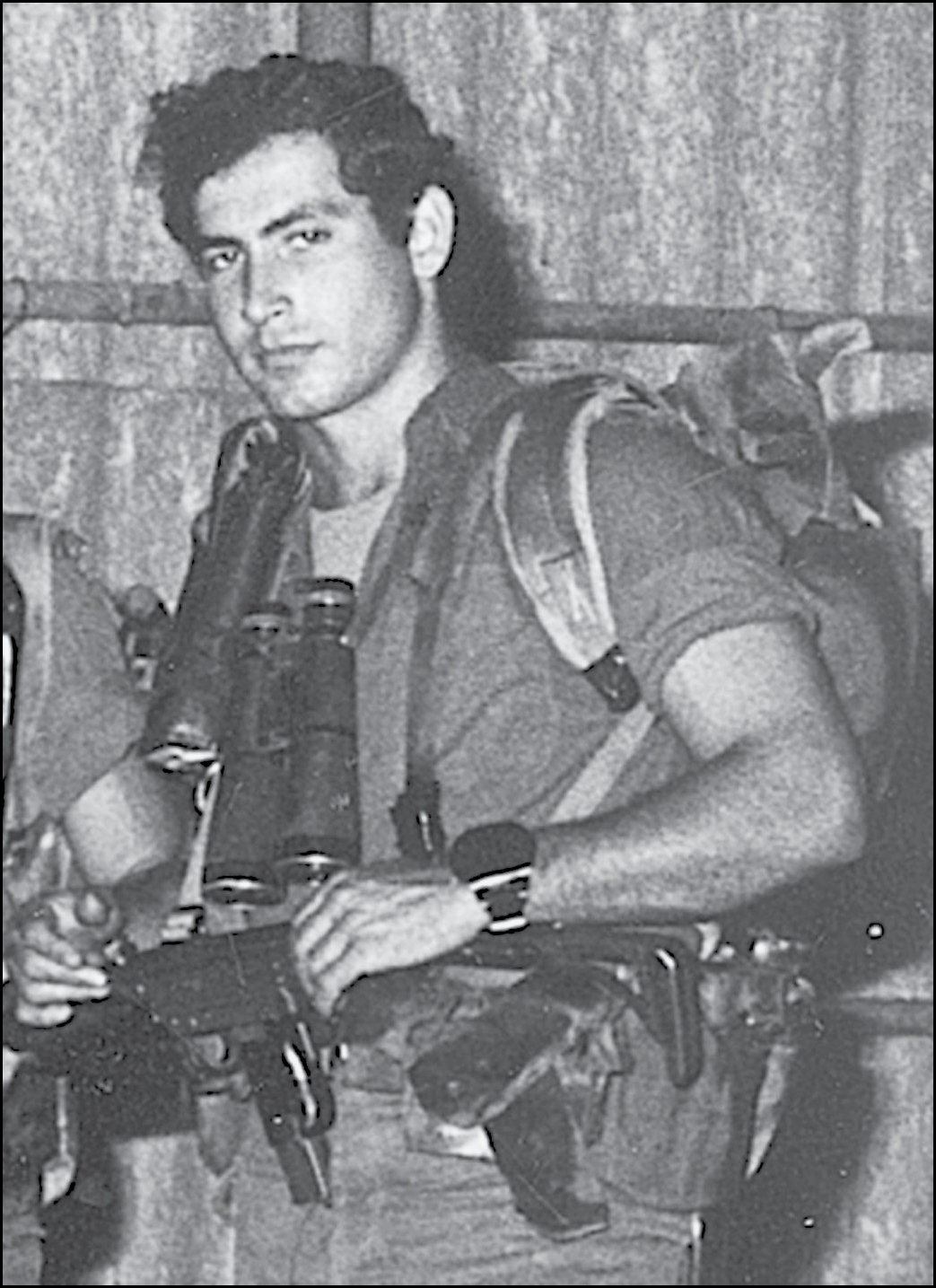
Netanyahu demonstrated a near-fanatical level of physical fitness while in the IDF.
During his basic training Netanyahu was noted for his near-fanatic level of physical fitness—he often got up early for an extra run—and for his ability to carry heavy loads, due to which he was assigned the platoon’s machine gun. Similarly to his scruffy childhood friends from Jerusalem, who remembered an always neatly dressed boy, Bibi’s basic training comrades recalled how the private always seemed to keep his combat fatigues immaculate. He was also known for spending his rare free moments reading magazines and books in English. For the next five years, these would be his main connection to the United States and its current affairs.
Only twenty of the original thirty candidates made it to the morning in January 1968 when, outside Haifa, they were met by their new Matkal officers and split into two teams. Led by Second Lieutenant Amiram Levin, Bibi and his fellow team members began the traditional twenty-four-hour, 120-kilometer march to the unit’s base at Sirkin, near Petach Tikva, where there had been a British air base during the Mandate.
Most of Netanyahu’s actions over the next four and a half years remain classified. The new teams were trained for Matkal’s cross-border core mission. Much of the training consisted of long and grueling navigation treks.
Much of this training took place in the West Bank and used populated Palestinian villages as mock-up enemy targets. Twenty-five years later, musing on the historical memories evoked by ancient Jewish sites in Judea and Samaria, Netanyahu waxed lyrical about Mount Shiloh, the site of the Tabernacle, or Tent of Meeting, during the biblical period of the judges; Bet Horon, where the Maccabees fought the Greeks in the second century BCE; and Beitar Fortress, the scene of the last revolt against the Romans in the second century CE. “We stood there,” Netanyahu later wrote. “A handful of nineteen-year-old boys, breathing the night air and drinking from our canteens—silent. Because what we felt didn’t need to be put into words: we were back, for all the generations of the Jewish people who had dared to dream from the depths of humiliation and persecution that we would return to this land.”6
The IDF’s operational workload increased in the wake of the Six-Day War. Clashes with the Egyptian Army on the Suez Canal resumed in late 1967; meanwhile, the Palestinian armed groups, particularly the PLO’s Fatah and the Popular Front for the Liberation of Palestine (PFLP), emerged as independent entities, no longer just proxies of Egypt and Syria. Using Jordan and Lebanon as staging grounds, they unleashed a series of attacks against military and civilian targets within the West Bank and the Gaza Strip as well as against sovereign Israel. The PFLP, a Marxist-Leninist-inspired organization, cooperating with like-minded groups outside the Middle East, began expanding its operations and attacked Israeli targets abroad, especially the aircraft of the national El Al Israel Airlines.
Within the IDF there was increasing pressure on Matkal to commit its considerable resources and highly skilled operators to battle on these new fronts. Eventually this period would lead to a broadening of the unit’s portfolio and an increasing emphasis on counterterrorism. Initially there was reluctance at Sirkin to deviate from the core deep-penetration missions, and often it was the younger soldiers who were sent on the more conventional operations—which is how, after seven months in the army, Netanyahu found himself in Jordan, at the Battle of Karameh.
THE JORDAN VALLEY town of Karameh, north of the Dead Sea, had been taken over by Fatah as its main headquarters. Operation Inferno, launched against Karameh on March 21, 1968, did not go to plan. Armored units that were to secure the main approaches were bogged down in difficult terrain. The airborne force could not take off on account of the weather. Leaflets warning civilians to evacuate were dropped on schedule, however, and this gave Fatah time to prepare for the attack and Yasser Arafat time to escape.
Israel lost 33 soldiers in Karameh. Enemy casualties were much heavier, with the Jordanians losing 61 soldiers and Fatah over 100 of its fighters, with another 150 taken prisoner.
Netanyahu’s team had only a minor role in the battle, manning one of the roadblocks out of town and then helping evacuate wounded tank crews. Twenty-eight years later, when he met Arafat as prime minister, he remarked that they had both been there. It was Bibi’s first taste of war and death.
Death would come again soon, and much closer to home. Only four days after the Karameh operation, on a training exercise, a mortar shell exploded while being launched, fatally wounding two members of the team—Zohar Linik and David Ben Hamo. Bibi cradled Ben Hamo’s head in the evacuation vehicle on the way to the hospital. The next day, immediately after the funerals, Levin took the team north to continue training. The meticulous planning of Matkal’s operations often stood in stark contrast to the cavalier approach to safety in the unit. Sudden, arbitrary death, whether in training accidents or on operational duty, was all around. Bibi would soon become accustomed to it, but the first deaths of his comrades shook him. Normally an extremely circumspect letter writer, he wrote a detailed account of the incidents to Yoni, but sent it to his parents by mistake.
Along with carrying out secret intelligence-gathering missions, Matkal was engaging in more offensive operations during that period. One of the biggest was the attack on Beirut Airport on December 28, 1968, in retaliation for attacks on El Al planes. The decision to target the largest airport in the Middle East sent a message to the government of Lebanon, which was becoming a base for terrorist activity. It was Matkal’s largest operation to date, deploying forty-four of its soldiers, Netanyahu among them, as well as twenty-two paratroopers in three large helicopters. Within twenty-nine minutes they had lain explosives on fourteen Lebanese airliners, in some cases firing in the air and emptying them of passengers. They took off back toward Israel before the charges blew up the planes.
Prime Minister Eshkol responded angrily upon receiving the initial report. “We spoke of three, four, five planes. How did we destroy so many?” Israel’s Beirut operation was condemned by an emergency session at the United Nations, but the more lasting effect was to effectively end Israel’s military ties with France, the source of much of its advanced weapons systems over the previous fifteen years.
French president Charles de Gaulle, who had already imposed a temporary arms embargo on the eve of the Six-Day War, was enraged by the attack—the Israeli commandos had landed in Beirut in French-made helicopters, and most of the airliners destroyed belonged to Middle East Airlines, in which French shareholders had a large stake. He declared the arms embargo permanent.
The end of French arms sales to Israel would spur two major developments. First, it would seal Israel’s reliance on its by then flourishing strategic ties with the United States. Israel had already signed the first contracts for the American F-4 Phantom fighter-bomber, which was more capable than the French Mirage 5 fighter-bombers that had been ordered but not received due to the embargo. Israel was well on its way to becoming a main customer for advanced US weaponry, much of which would be financed by American taxpayers under the Foreign Military Financing (FMF) program. Second, the cancelation of arms deals with France gave a major impetus to Israel’s indigenous arms industry, which over the next few years would build its own local versions of the French Mirage 5: the Nesher (Vulture), and the upgraded Kfir (Lion Cub) fighter jets. The investments in an indigenous advanced arms industry would give rise, decades later, to Israel’s civilian high-tech sector.
YONI AND BIBI had now both fought in Israel’s main battles and operations. Defying Benzion’s wishes that they remain effectively bystanders and academic observers, they had chosen to join the mainstream and become members of Israel’s military elite. At Samu and Karameh, on the battlefields of the Six-Day War and in the attack on Beirut, the two brothers had taken part in the events that would influence the trajectory of Israel and the region for decades hence. After two semesters studying philosophy, mathematics, and physics at Harvard, Yoni was coming back for more.
In a letter to Bibi from the United States, Yoni complained of the weak response of Israel’s politicians to the Palestinian attacks. “I’m getting the impression that the civilian sector in Israel has despaired of solving [the problem] and even of military solutions to terror operations. It’s clear that this is the only way to fight them. All this campaign of tiny terrorists just reinforces the Israeli consciousness within me.” He concluded, “I just have to return to Israel—and live there. Now more than ever.”7
In another letter, to Iddo, he wrote, “I find it hard to understand the Israelis who live [in the US] year after year.” He could have been describing their parents. Benzion tried to convince him to remain in Boston, arguing, “If you want to serve Israel the best thing you can do is finish Harvard. The Foreign Ministry needs Harvard graduates.”8
After only ten months in the United States, Yoni and Tirza returned to Jerusalem. “I belong to Israel, Abba, as Israel belongs to me and every Jew,” Yoni wrote Benzion. “I belong to her now, at this moment, as things are about to blow up again.” Even at that point, Benzion’s sons were incapable of fully confronting the contradictions between their father’s Zionist ideals and his living in America. Yoni tried to mollify him. “You dedicated more years of life than I have to Israel,” he said to justify his move.9
Benzion could hardly have been mollified by his son passing up on a Harvard education to study at Hebrew University instead. But as it turned out, Yoni didn’t spend much time there either. “I’m finding it hard to concentrate on studying,” he wrote in January 1969 to his parents, who had just moved to Denver, where Benzion had been made professor.10 In another letter he predicted, “We are getting close to war—gradually and inexorably. The Arab world will not agree to see us living within it.” He couldn’t remain at the university. “I find it hard to bear the thought that I am living thanks to others, who protect me with their bodies, while I have to ‘play’ the role of civilian.”11
Despite running five miles every day in Boston and undergoing an operation on his elbow at Walter Reed in Washington, Yoni was hardly fit to return to combat service. In early 1969, facing increasing warfare on the Suez Canal with the Egyptians as well as nearly daily incursions by Palestinian fighters from Jordan, the IDF was anxious for experienced officers to return to service. Yoni had little trouble in getting a medical board to declare him fit for combat. But he didn’t just want to go back to the Paratroopers Brigade. For the first time in their lives, Bibi, serving in a more elite unit, had an advantage over him.
By then, Bibi had completed a year in the unit, and Matkal’s commanders were pressuring him to attend an officers’ course, return to the unit as a team commander, and sign up for an extra year’s service. He recommended they take his older brother instead. Over the years, Netanyahu has told interviewers that at that point he had no intention of remaining in the army; he had planned to return to the United States to study architecture at Yale, and it had been his idea to recommend Yoni. But Iddo, in his 1991 hagiography of his oldest brother, Yoni’s Last Battle, told a different story, portraying Bibi as unwilling to offer his spot to Yoni.12 Iddo describes walking in on a conversation between his two brothers in Jerusalem, where Yoni was telling a reluctant Bibi what to say to his commanding officers. It seems that Bibi at first wasn’t eager to see Yoni take his place as one of Matkal’s new officers.
In any event, the plan worked. In February 1969, Yoni returned to active service. Lieutenant Jonathan Netanyahu was in uniform again for what would be a meteoric seven-year military career. The Matkal commanders were initially skeptical that the twenty-three-year-old who could have taken command of an entire infantry company would “go backwards” and fit in as team commander of a handful of conscripts, but once they interviewed him, they were convinced that he was motivated to do so. In April, he became a Sayeret Matkal team commander. The natural order was reestablished: Yoni was serving with Bibi in the same unit, but in a more senior role. Whatever his original intention, Bibi wasn’t prepared to return to the United States just yet, and a month later he left for officers’ school. He almost never made it.
FOR THREE YEARS, until a US-brokered ceasefire was reached in August 1970, there was almost constant artillery fire exchanges between the Israelis and the Egyptians, escalating to sea battles, commando raids, and air strikes deep within Egyptian territory. For the Israeli troops taking cover under fire in fortified positions overlooking the Suez Canal, it would become known as the “War of Attrition.” Matkal and other special forces were called in to do their bit. Or, as the IDF’s southern commander, Major General Ariel Sharon, bluntly told Amiram Levin, “You have to kill Arabs.”13
The two depleted teams that had begun training fourteen months earlier had been amalgamated under Levin’s command. Their mission was to cross the canal—on the rubber dinghies of Flotilla 13, the naval commando unit—and wreak havoc on Egyptian positions. The joint raids by the two elite and extremely competitive units were dubbed Operation Frenzy. On May 11, 1969, in Frenzy 3, Levin’s team crossed over undetected, destroyed an Egyptian truck, killing two soldiers, and returned without casualties. Bibi, the team’s heavy-machine-gunner, put down the covering fire.
Two nights later, they launched Frenzy 4, and this time, the Egyptians were waiting. The force was detected while still in the water and the boats came under fire. Chaim Ben Yona, the first member of Bibi’s original team to have graduated from an officers’ course, was killed on the spot. Taking hits, the next boat listed, and Netanyahu fell into the canal. Weighed down by his machine gun and boxes of ammunition, he began to sink into the dark water. His life was saved when one of the naval commandos reached down and grabbed his hair, while another Matkal soldier took hold of his combat webbing. The two men dragged him back to the edge of the canal, where, oblivious to the explosions all around them, Bibi was able to catch his breath.
Despite the failure of Frenzy 4, the raids continued. On July 19, in Frenzy 6, Flotilla 13 and Matkal forces stormed a large fortified island at the canal’s southern exit, near Suez Port. Six Israeli and eighty Egyptian soldiers were killed in the raid. The War of Attrition was rapidly escalating. Bibi wasn’t on that operation—by then he was in an officers’ course, which, like Yoni, he would complete as the outstanding cadet of his company. By January 1970 he was back in Matkal commanding a team.
For a short while Yoni and Bibi were back together. Yoni was already a captain, while Bibi was just a second lieutenant. Yoni by that point intended to pursue a long-term military career. An IDF psychologist who worked with Matkal officers during the period later recalled seeing the brothers arriving together at the army’s headquarters. “Yoni had a meeting at the operations branch, Bibi waited for him outside. I still remember the look of complete and utter admiration on Bibi’s face, watching Yoni going in. It wasn’t the kind of look you see on an adult. It was completely astonishing.”
PRIME MINISTER ESHKOL and some of his colleagues had sent out half-hearted feelers, particularly to Jordan’s King Hussein and local leaders of the West Bank Palestinians, offering a limited autonomy. Both engagements were nonstarters. The Jordanians and Egyptians were prepared to negotiate only with the precondition that Israel retreat from all the territories it had captured in the Six-Day War. The local Palestinian leadership wouldn’t dare enter formal talks with their own younger revolutionary generation pledging “armed struggle until the liberation of all Palestine.” Meanwhile, in September 1967 in Khartoum, the Arab leaders delivered their “three no’s”—no recognition, no negotiation, and no peace with Israel. For the Israelis, this was reason enough to stop even trying to hold talks.
In November, the United Nations Security Council passed Resolution 242 calling for “respect and acknowledgement of the sovereignty, territorial integrity and political independence of every State in the area and their right to live in peace,” and for the “withdrawal of Israeli armed forces from territories occupied in the recent conflict.” The wording of the resolution, which passed unanimously in the council, allowed both sides to cling to their positions. The Arabs demanded Israeli withdrawal, while Israel demanded recognition. The fact that Resolution 242 mentioned “territories,” not “the territories,” enabled Israel to stick to the interpretation that it didn’t mean “all the territories,” and that they shouldn’t be expected to withdraw all the way to the pre-1967 war frontier. No other country accepted this interpretation, not even the United States.
Although the alliance between the two countries intensified over the years, the United States continued to refuse to accept Israel’s perpetual control of the occupied territories. Israel has received over $100 billion in military and financial assistance from the United States since 1962, but has never received diplomatic backing for its conquests.
On February 26, 1969, the day Yoni returned to serve in the IDF, Levi Eshkol died. He was replaced by Golda Meir, who, like him, was an old and ailing member of Ben-Gurion’s founding generation. Unlike Eshkol, Meir was suspicious of any attempt at reaching a peace agreement with the Arabs, and she rarely challenged the generals. Born in Russia, her family moved when she was eight to Milwaukee; from there she emigrated to Palestine at the age of nineteen. She was the first Israeli prime minister to have spent her formative years in the United States, and until Netanyahu, the only one. And, like him, she was prepared to challenge America openly.
In December 1969, the US secretary of state under President Richard Nixon, William Rogers, presented a plan whereby Israel would retreat to its prewar borders, with a few modifications, and enter talks toward solving the Palestinian refugee problem. Israel had legitimate reservations about the plan, as it didn’t include any commitment by the Arab nations to recognize Israel or make peace with it. But instead of treating it as a starting point for negotiations, Meir attacked it publicly as “a disaster for Israel” and launched a political campaign against it in Washington. This was the administration that was supplying fifty advanced F-4 Phantom fighter jets to Israel. Over the misgivings of her “dovish” foreign minister, Abba Eban, Israel’s new ambassador to the United States, the former IDF chief of staff Yitzhak Rabin, promised Meir that Israel had sufficient support in Washington to call the administration’s bluff.
Rabin also assured Meir that she could go ahead and approve the IDF’s plan to escalate the War of Attrition by launching a campaign of air strikes deep within Egypt against power plants, factories, and military bases. Not for the first time, Israel succeeded in influencing the US administration and Congress by playing one off against the other.
While the State Department remained in favor of an “even-handed” policy in the Middle East, there were those in Washington who saw Israel’s attacks on Egypt as an extension of the global contest with the Soviet Union being fought in Vietnam. The Soviets certainly saw it as such and in response to Israel’s deep strikes deployed an airborne division, fighter squadrons, and advanced antiaircraft missiles to Egypt. Soon Israeli and Soviet pilots were engaging in dogfights over Egypt. In June 1970, Secretary Rogers proposed a new plan. This one called for a ceasefire and disengagement of forces between Israel and Egypt and an agreement from both countries, along with Jordan, to enter UN-brokered negotiations based on Resolution 242.
Meir initially rejected this “Rogers Plan” as well, but after receiving a personal letter from Nixon promising that nothing would be imposed on Israel—including final borders and any solution to the Palestinian issue—and that the United States would continue its military and financial assistance to Israel, she agreed. The administration also silently acquiesced to Israel’s nuclear ambitions.
The ceasefire ending the War of Attrition between Israel and Egypt went into effect on August 7, 1970. Both sides immediately broke the agreement—Egypt by moving its antiaircraft missiles to the banks of the Suez Canal, and Israel by refusing to join negotiations. Nevertheless, a period of wary calm began on the southern frontier.
Not everyone in Israel’s security establishment had supported escalation against Egypt. Some generals even dared to say, in private, that while Egypt had suffered far worse casualties, as well as massive damage to its civilian economy, Israel had not won the War of Attrition.
Many Matkal officers were dovish kibbutz members. Bibi enjoyed taking them on. “He would hold forth at length that more than Israel needs America, America needs Israel as its ally against global communism,” one officer later remembered. Netanyahu “understood” America and was convinced that if only Israel held to its guns, it would continue to have Washington’s support and respect. The Netanyahus had no sympathy for the Palestinians. In one of his letters, Yoni described them as “a rabble of cave-dwellers, fighting for ‘liberty and progress etc.,’”14 and in another he wrote, “My national identity is much stronger than theirs.”15 In March 1972, he described an operation against Fatah in Lebanon dismissively as “nearly a friendly hike.”16
Yoni had been seconded in late 1970 to command a company of Sayeret Haruv, a reconnaissance group carrying out ambushes against Palestinian fighters infiltrating the border with Jordan and in the West Bank. He returned in mid-1971, when he was put in charge of Matkal training. Bibi, meanwhile, had been planning to leave military service, but the new Matkal commander, Lieutenant Colonel Ehud Barak, prevailed upon him to sign on for another year; in return, he promised he would get to plan and lead more complex missions.
Colonel Yossi Langotzky, a senior intelligence officer who was involved during that period in directing Matkal’s special operations, and who later on was no fan of Prime Minister Netanyahu’s policies, remembered him well. “The system was that I set the Matkal officers a target and they had to come up with the method,” he said. “I was very impressed by Bibi, not that it should come as a surprise, but he was part of the crème de la crème of the IDF. He was extremely professional and achieved a very high operational level. He planned and carried out two operations, deep in enemy territory, in extremely difficult conditions, one of them at high altitude in the snow. He dealt with changing circumstances very well.”
By then all three Netanyahu brothers were serving in the unit. Iddo, who was less militarily inclined than Yoni and Bibi, never became an officer, but the ethos his older brothers had created, in defiance of Benzion, pushed him to overcome the physical and mental obstacles and become a special forces operator as well.
In June 1972, Lieutenant Colonel Barak appointed Yoni as his deputy. The older officer had become by then Yoni’s closest friend as well as something of a mentor to Bibi. Yoni and Barak shared a keen intelligence and wide interests in the world outside the army. They both loved classical music but held a deep disdain for generals and politicians. Barak, who had been selected originally for Matkal because he was a “natural navigator” and had a passion for taking apart clocks, was one of the first officers to “grow up” within Matkal, and he personified the unit’s unorthodox spirit. The Matkal officers witnessed him disobeying orders in the field and cutting off radio communications when senior commanders ordered him to abort missions. He was capable of shouting at generals when they disagreed with his aggressive plans. Bibi believed then that Ehud and Yoni would in the future serve as Israel’s prime minister and the IDF chief of staff, respectively. He still saw himself as an iconoclastic architect.
Barak insisted on deploying Matkal in every high-risk situation, even when it had no special advantage or expertise. One such case nearly got Bibi killed: Operation Isotope, Matkal’s first hostage rescue operation.
On May 8, 1972, a cell of “Black September,” a Palestinian terrorist group formed on Arafat’s orders, hijacked a Sabena Boeing 707 airliner on its flight from Brussels to Tel Aviv. The hijackers ordered the plane to land at the intended destination, Lod Airport in Tel Aviv, and demanded the release of 315 Palestinian prisoners in exchange for the passengers and crew. The four hijackers, two men and two women, placed explosive charges throughout the aircraft.
Hundreds of security personnel descended on Lod Airport. Following the first attacks on Israeli airliners in 1968, Israel’s Shin Bet security service had formed a specialist unit to combat hijackers. As the experts, its agents expected to be sent in, but Barak convinced Defense Minister Moshe Dayan, who was on the scene, to give the operation to Matkal. Barak quickly requisitioned a nearby hangar and began training on a similar Boeing. He assembled a team that included a number of Matkal reservists who had recently served in Shin Bet. It also included Bibi Netanyahu.
Shortly before the operation was to get under way, Yoni arrived at the airport and asked to be placed on the team. Bibi, who feared that an explosion could kill everyone who boarded the plane, tried to dissuade him. “Are you crazy? Think of our parents, what would happen if both of us are killed?” Yoni snapped back, saying, “My life is mine alone and so is my death.”17 He argued that as the more experienced officer, he should replace Bibi. For once Bibi stood up to his brother, insisting that he would be leading soldiers from the team he had trained. It was left to Barak to rule that Yoni had arrived too late—he would not change the team.
The plan was for the team members to approach the aircraft wearing white overalls in order to pose as technicians, with handguns hidden in their belts. The hijackers would be led to believe that their demands were about to be met and that the plane was being prepared for takeoff with the released prisoners. The team would enter the plane through different entrances in five groups, coordinated by Barak, and attempt to overcome the terrorists in just seconds. It was a reckless operation, based on the assumption that even though they had prepared explosives, the hijackers did not intend to commit suicide. Matkal had accumulated valuable experience in conducting secret operations behind enemy lines and in commando raids, but had not dealt until then with a hostage situation. Twenty-five years later, Netanyahu admitted in an interview that, like most other members of the team, he had never even held a handgun before that day, only rifles and machine guns.18
This attitude was to cost twenty-two lives in May 1974, when Matkal was sent into a school in the northern town of Maalot, where Popular Front for the Liberation of Palestine members held 102 students and 10 teachers hostage. The botched assault was detected in advance by the terrorists, who opened fire on the children. The Maalot tragedy led to drastic changes in Matkal’s counterterrorism training and the formation of a new elite antiterror police unit.
Despite the lack of experience, the Sabena raid worked just as planned. Within ninety seconds of the team entering the plane, Operation Isotope was over. The two male hijackers, who had been holding guns, were shot dead, and the female hijackers, who were holding grenades and detonators, were overwhelmed. One hostage was killed in the cross fire and two others injured. Bibi, who had led his squad through the emergency door above the left wing, had run to the back of the plane, where passengers had pointed out one of the female hijackers. He had grabbed her hair, and her wig had come off in his hand. Grabbing her again, he demanded to know where the explosives were. Another soldier joined him, pistol-whipping her face. His gun went off, and the bullet passed through the hijacker, wounding her, and then hit Bibi’s arm. For years, until the full details of the operation were published, the story told in Israel was that one of Bibi’s soldiers had shot him in the ass.
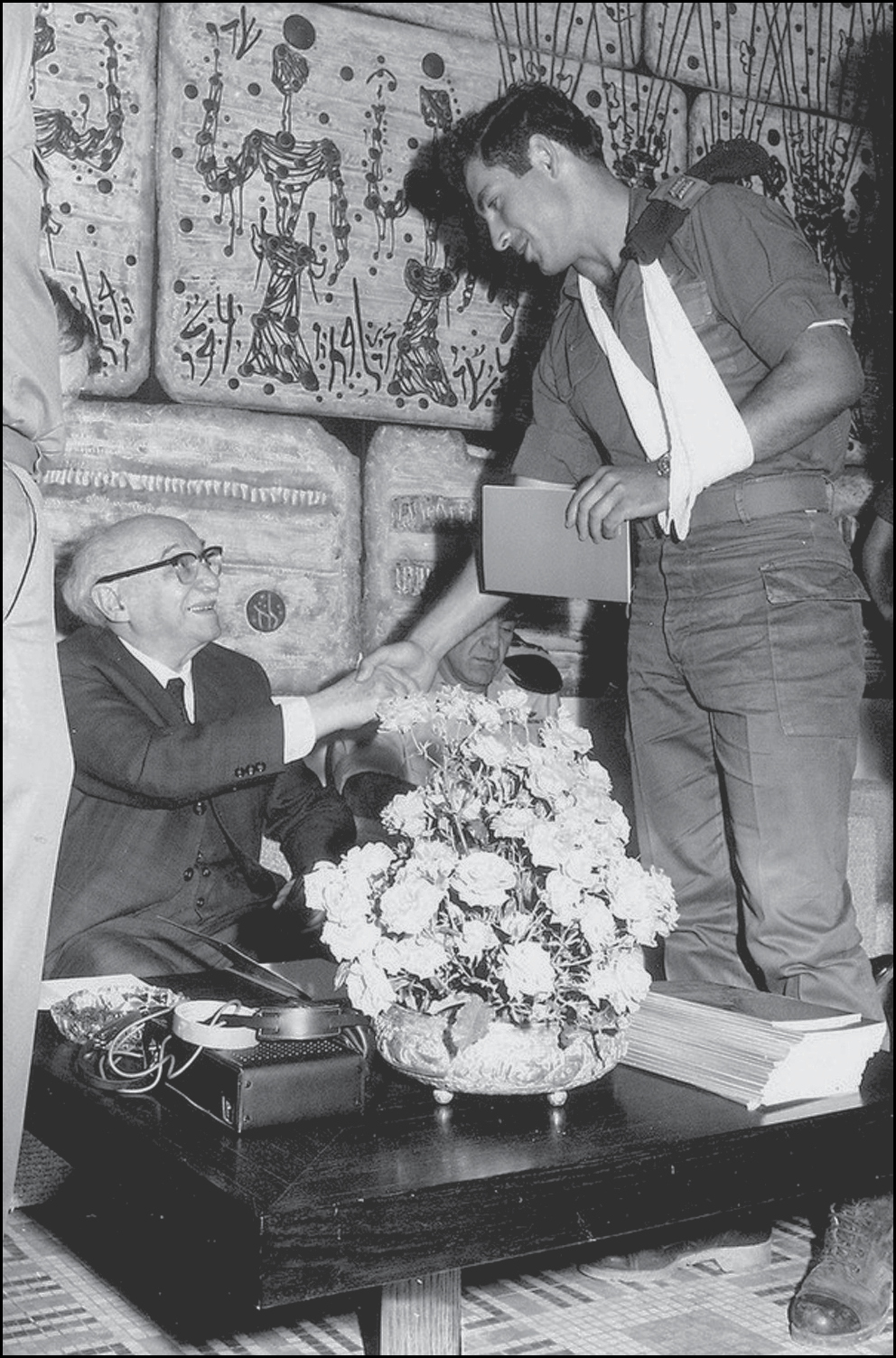
Lieutenant Netanyahu receiving a citation from President Zalman Shazar for his actions in the Sabena operation.
Bibi was carried down to the tarmac, and Yoni rushed over as he was administered morphine. When Yoni realized the wound was not serious, he grinned. “You see? I told you not to go,” he joked. On the Boeing’s wing, a press photographer captured a picture of Ehud Barak, still in his white overalls and holding a gun, shepherding the hostages off the plane.19 Twenty-eight years later this image would feature heavily in Barak’s campaign to oust Prime Minister Netanyahu in the 1999 elections.