
New York/Dublin
2005/201022
It was six years ago that Mojo magazine ranked “Masters of War,” Bob Dylan’s 1963 song about arms merchants—“war profiteers,” Franklin Roosevelt liked to call them, his voice dripping with contempt—number one on a chart of “The 100 Greatest Protest Songs.”
It was followed by Pete Seeger’s version of “We Shall Overcome,” James Brown’s 1968 “Say It Loud—I’m Black and I’m Proud,” the Sex Pistols’ 1977 “God Save the Queen,” and Billie Holiday’s 1939 “Strange Fruit.” Not to mention Lesley Gore’s 1963 “You Don’t Own Me,” one of the first feminist rock ’n’ roll hits (written by a man, of course), let alone Eddie Cochran’s 1958 “Summertime Blues”—a record about a teenager with a mean boss, mean parents, and a congressman who won’t help because the kid’s too young to vote.
But really, “Masters of War”—that lumbering old warhorse? Why not Barry McGuire’s “Eve of Destruction,” which in 1965 was such an obvious jump on the protest-song trend it went past parody and became the thing itself, and which didn’t make the chart at all?
Except for “Eve of Destruction,” all of these songs were less obvious, less self-deciphering, than “Masters of War”—but for “Masters of War” the lack of subtlety was the point. “Come you masters of war, you that build the big guns,” Dylan begins slowly: “You that build the death planes / You that build the big bombs.” He goes on, flattening a somehow mysterious, inviting melody. The masters of war cause death and destruction: that’s their bottom line. It’s like a cartoon from The Masses. You can see the fat businessmen smoking cigars and gorging on huge meals as their feet rest on the necks of honest workers. They’re old, evil, and rich: cannibals. “Not even Jesus would forgive what you do,” the twenty-two-year-old Bob Dylan sings.
And then he does something that, even for a protest song, was shocking in 1963 and is shocking now: he calls for the death of the people he’s singing about. “I hope that you die,” he says, directly, without embellishment, like a gunfighter in a western shootout—like Marshal Matt Dillon of Gunsmoke, whom Bob Dylan might as likely named himself for as Dylan Thomas, Matt Dillon standing in the middle of main street for a shootout in Dodge City in the 1955 Hollywood version of Kansas in 1873, Dillon waiting for the bad guy to draw first, Dillon’s draw a split-second later, but his nerves cooler, the bad guy’s shot going wide, his own true.

I hope that you die
And your death will come soon
I’ll follow your casket
In the pale afternoon
And I’ll watch while you’re lowered
Down to your death bed
And I’ll stand over your grave till I’m sure that you’re dead
No matter what Bob Dylan has done in the last forty-seven years, or what he will do for the rest of his life, his obituary has already been written. “Bob Dylan, best known as a protest singer from the 1960s, died yesterday . . .” The media loves a simple idea. No matter how famous you are, how complex you are, how not obvious you are, when you die, you get one idea, and one only.
In 1963, in the world of folk music, the protest song was a speech a lot of people wanted to hear and a language a lot of people wanted to learn. Protest songs were the currency. They said that the world should be changed, even implied that songs could change it, and no one wrote better protest songs—or as many—than Bob Dylan. It was a way of jumping on the train of his own career, he’d say years later. But to the high-school and college students who had begun to listen to Bob Dylan because, they said, he could say what they felt but couldn’t express—because he could draw on their own unshaped anger and rage, terror and fear, and make it all real, even, they said, make it poetry—for these people, more with each passing day in the early 1960s, the songs seemed not to contain the cynicism Dylan later proclaimed but to banish it.
They felt like warnings that the world couldn’t turn away from, crimes that had to be paid, promises that had to be kept. Bob Dylan wrote songs about the nuclear war that, in 1963, almost everyone was sure would happen sometime, somewhere—and in 1962, with the Cuban Missile Crisis, almost had happened, the war that, Robert McNamara said just a few years ago, in the film The Fog of War, holding his thumb and forefinger not a half-inch apart, came closer than even the most paranoid protest singer dared imagine.
Dylan wrote and sang long, detailed songs about racial injustice, from “The Death of Emmett Till” to “The Lonesome Death of Hattie Carroll” to “Only a Pawn in Their Game,” called “The Death of Medgar Evers” when Dylan sang it on the steps of the Lincoln Memorial at the March on Washington in 1963. He wrote visionary protest songs, like “A Hard Rain’s A-Gonna Fall.” He wrote funny protest songs like “Talking World War III Blues,” where he dreamed of himself alone in the city after the bomb has fallen: he walks into a Cadillac dealership, gets into a Cadillac, and heads out. “Good car to drive,” he says with a smile-when-you-say-that pause: “Good car to drive . . . after a war.”
Most of all, Dylan wrote and sang songs that told stories about the wrong inside a nation that believed it was always right: “With God on Our Side,” “The Times They Are A-Changin’,” “Blowin’ in the Wind.” These were the songs that brought Bob Dylan into the common imagination of the nation, and those were the songs that fixed him there. “You have to have power and dominion over the spirits,” Dylan said in 2004, in Chronicles, of what it took to write these songs.
But even in the heyday of the protest song, “Masters of War” seemed like too much. Too sententious, too self-righteous, too full of itself—stilted, as if it was less a matter of someone writing a protest song than the protest song as such spontaneously generating its own copy, or its own cartoon. “You hide in your mansion / While young people’s blood/ flows out of their bodies / And into the mud,” Dylan sang in “Masters of War”—still, that almost was poetry compared to “You Been Hiding too Long,” another Bob Dylan protest song from the same moment.
“Come all you phony super-patriotic—” OK, stop right there, we don’t need to hear any more—but there is more, a lot more, no melody, no rhythm, no meter, no heart, no conviction, really no song at all, but press a button and the protest song comes out: “You lie and mislead / You—for your aims and your selfish greed . . . Don’t think that I’ll ever stand on your side . . .” And on, and on, and on.
This song is so awful it’s been erased from Dylan’s published song collections. Look through the Archive section on his Web site: it isn’t there. Dylan probably never recorded it. He may have only performed it once, at a concert in New York in 1963, when he also sang “Masters of War”—but this self-congratulatory spew is inside “Masters of War” as much as President Eisenhower’s 1961 Farewell Address about the military-industrial complex, which Dylan would later claim as his inspiration: “The spirit was in the air,” he said in 2001, as if he were quoting himself, “and I picked it up.” This song is the deformed spawn of the impulses behind “Masters of War.” Even if “You’ve Been Hiding Too Long” was only performed once, it was once too often: someone had a tape recorder that night, and thirty years later the thing turned up on a bootleg.
Unlike “You’ve Been Hiding Too Long,” “Masters of War” does have a melody—the melody of “Nottamun Town,” a British folk song that might go back five hundred years, though it seems older than that, from a time beyond historical ken. In the feeling it carries, it seems to come from the devastation that fell on Arthur’s kingdom when Guinevere turned to Lancelot.
It’s often described as a nonsense song; that’s the last thing it is. Today it communicates as 20th century surrealism in 16th century clothes: “Not a soul would look up, not a soul would look down . . . Come a stark-naked drummer a-beating the drum . . . Ten thousand stood round me, yet I was alone . . . Ten thousand got drownded that never was born.” It is a protean song, bottomless: just as Dylan took its melody for “Masters of War,” he took its language for “A Hard Rain’s A-Gonna Fall,” where a man travels the world and returns with a tale to tell: “I heard one hundred drummers whose hands were a-blazing / Heard ten thousand whispering and nobody listening . . . I saw ten thousand talkers whose tongues were all broken.” And yet even in “A Hard Rain’s A-Gonna Fall,” which is a great song, Dylan couldn’t find the road that would take him all the way back to the strangeness of “Nottamun Town”—where the world turns upside down, and the curse is that, somehow, nothing has changed. “Ten thousand got drownded that never was born”: this is the first protest song; this is the end of the world.
The British song collector Cecil Sharpe found “Nottamun Town” in Kentucky in 1917; the old ballads had held their shape in Appalachia far longer than they had in Britain. Traditional versions of “Nottamun Town” were in a major key; that put a sardonic smile in the music. But at Gerde’s Folk City in Greenwich Village, Dylan heard a version in a minor key by the Cambridge folk singer Jackie Washington.
The twist put a chill on the melody. It gave Dylan an opening into the bad dream he was after for “Masters of War”: shadowed, doomstruck, the sound of a funeral procession, or a crowd chasing one.
Dylan himself stopped singing the song by 1964. Songs like “Masters of War” were “lies that life is black and white,” he sang that year. The protest song was a prison of meaning, or anti-meaning; Dylan’s refusal of the protest song was a prison break. Protest songs destroyed the songs that gave them life, ate them. As “Nottamun Town” disappeared into the belly of “Masters of War,” you could understand that protest songs were themselves cannibals.
Singing “Masters of War,” knowing what lay behind it, Dylan might have flinched at what he had himself created: flinched at how he’d cheated “Nottamun Town” of its own mysteries, cheated it to make a point or outrun his folk-song rivals. He might have stepped back at the recognition that audiences didn’t want to be taken to far distant lands that never were, let alone to a world that made no sense—they wanted to be told that the world was exactly what they thought it was. They wanted to be told that the world was divided into two sides, right and wrong, and they wanted to be told that they were right. And that’s what he gave them.
It was a sensibility—a way of being the world—that has never gone away. In 1988, Sut Jhally of the University of Massachusetts and Ian Angus of Simon Fraser University in British Columbia published an anthology called Cultural Politics in Contemporary America. In their introduction, they attacked Bruce Springsteen for his protest song “Born in the U.S.A.” They attacked him because that song—released in 1984, a song about a Vietnam veteran who, a decade after the war ended, still feels like an outcast in his own country—could be heard, and understood, in more than one way. Ronald Reagan could appropriate it for a campaign speech, trumpeting the song as a celebration of shared values—even though someone else might have heard the song as damning the betrayal of those values. But John Lennon protest songs, Jhally and Angus said, were different—such absolutely forgotten work as “Sunday Bloody Sunday,” “Attica State,” “Angela,” for Angela Davis, and “John Sinclair,” which FBI agents in an audience for a John Lennon-Yoko Ono concert in Detroit reported “probably will become a million-seller”—even though, the agents wrote in their report, inaugurating the new genre of FBI rock criticism, “Yoko Ono can’t even remain on key” and the song itself “was lacking Lennon’s usual standards.”
John Lennon “suffered from no such ambiguity” as Bruce Springsteen, Jhally and Angus said, and there was “no possible misunderstanding of his art”—and really, aren’t they writing like FBI agents in academic clothes? Forget that when there is no possibility of misunderstanding, there is no art. That is what Bob Dylan remembered when he stopped singing “Masters of War.”
Dylan brought “Masters of War” back into his repertoire in the late 1970s. He was playing more than a hundred shows a year, and to fill the nights he brought back everything. It was a crowdpleaser, the number-one protest song even before anyone bothered to run a poll on the question. Even so many years after the fact, many of Bob Dylan’s fans were still uncomfortable with songs that didn’t divide the world into right and wrong; they still liked the old protest songs the best. But nothing in the song as Dylan was playing it the second time around hinted at what it would turn into on 21 February 1991, at the Grammy Awards telecast, where Dylan was to receive a Lifetime Achievement Award.
These days Lifetime Achievement Awards at the Grammys are handed out like parking passes; most of the many recipients don’t even bother to show up. In 1991 the idea was new; it was a big deal. And that year the Grammy show came square in the middle of the first Iraqi-American war—as television, a break from round-the-clock footage of the bombing of Baghdad.
Just a week or two before, at the unprestigious American Music Awards telecast, Donnie Wahlberg of the pioneering boy-band New Kids on the Block appeared wearing a “WAR SUCKS” T-shirt. It was a brave thing to do. He had a lot to lose, and he may have lost his career—today Donnie Wahlberg is mostly remembered as the older brother of the actor Mark Wahlberg, who in 1991 was still the would-be rap star Marky Mark. The Grammys officials announced that nothing like what Donnie Wahlberg had done would take place on their show.
“Uncle Bobby,” Jack Nicholson said, introducing Dylan, as Dylan and his four-piece band came onstage to play one song. In dark suits, with fedoras pulled down over their faces, the musicians looked like small-time hipster gangsters who’d spent the previous ten years in the same bar waiting for the right deal to break and finally said the hell with it; Dylan held himself with authority, as if he were the bartender. He looked terrible, bloated and pig-eyed. He wore a gray hat and there was a white thunderbolt on his red guitar strap.
It was an instantly infamous performance, and one of the greatest of Dylan’s career. He sang “Masters of War,” but in disguise: a version, the film critic Amy Taubin wrote in 2005, “as abstract as a black hole.” At first, you couldn’t tell what it was; you couldn’t understand a word Dylan was singing, but not because he was mumbling. Whatever Dylan was doing, he was pressing hard. He was all tension, all vehemence.
He slurred the words as if whatever narrative they contained was irrelevant. He was saying that the performance had to communicate as a symbol or not at all. He broke the words down and smashed them up until they worked as pure excitement, until the appearance of a single, whole signifier—“Jesus,” “Guns,” “Die”—lit up the night like a tracer bullet. The performance was almost unbearably fast, the beat snapping back on itself, then fragmenting as guitar lines shot out of the music as if without human agency—and it might have been a minute, it might have been two, it might have been as long as the performance lasted for the melody to creep out of the noise, for the song to reveal itself for what it was.
Dylan was asked why, on this night of all nights, he chose to sing “Masters of War.” “The war going on,” he said. Why did he slur the words, he was asked. “I had a cold,” he said.
With that night, the song began its second life. Three years later, on 16 February 1994, without his band, Dylan sang “Masters of War” in Hiroshima. On 5 October 2001, in Spokane, Washington, at Dylan’s first concert after the terrorist attacks on New York City and Washington, D.C., he played “Masters of War” as some of the crowd shouted “Death to Bin Laden!” A year later, when George W. Bush made plain his intent to launch a second Iraq war—on 11 November 2002, just after the mid-term elections that Bush had used the specter of war to win—Dylan appeared at Madison Square Garden, and again offered “Masters of War,” and again as an answer record to real life. He gathered three musicians in a circle, with himself at the center: playing acoustic guitars and a bass fiddle, seated on chairs, they looked like a coven, and the song sounded like a curse dug out of the ground.
The song began to travel. In May of 2003, with the war under way, the jazz drummer Scott Amendola and the singer Carla Bozulich of Berkeley put a nine-minute version on the Internet. They made a storm; cowering under a harsh, seemingly inexhaustible solo by the saxophonist Eric Crystal, they took the song’s rage into the realm of fairy tale, all mist and lightning, a storm so strong there were moments when the sound made it difficult to remember what you were listening to. The hectoring self-satisfaction of speakers at anti-war rallies began to creep into Bozulich’s voice—the tone that let you know that the last thing such people want is for the powerful to do good; if that happened, how could they feel superior?—but then came the final verse. The instrumentation dropped to almost nothing, only bare taps and silences, and you could hear someone speaking for herself: a single voice, letting you imagine that this was all that was left, after the war.
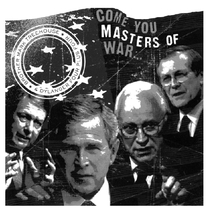
More than a year later, in October 2004, with Bush and John Kerry battling for the presidency and Minnesota up for grabs, a Minneapolis record-store owner, Mark Trehaus, working with the St. Paul punk band the Dillinger Four—in the thirties, St. Paul was the gangster John Dillinger’s favorite hideout—released their own version of the song. It was credited to Brother Mark Treehouse and the Dylanger Four plus Four.
Except for Arzu D2 of the great St. Paul punk band Selby Tigers, who spoke the words of the song in the flat, plain tones of a young woman accusing her parents of looting her college fund, it was a pure, tuneless rant. But the record was perhaps more about the cover, which pictured Bush, his Secretary of Defense Donald Rumsfeld, his Attorney General John Ashcroft, and Vice President Dick Cheney—Cheney pointing his finger, but not, like Uncle Sam, looking you in the eye. It wasn’t immediately clear what you were looking at; the faces were washed in the reds, whites, and grays of an old 3-D comic book, the kind you needed 3-D glasses to read.
A month after that, on November 2, on election night 2004, in Oshkosh, Wisconsin, with the votes cast but the outcome still unknown, Dylan sang the song once more, again in the middle of a war—a middle, that night, without an end. At first his delivery was clipped, the words rushed and stuttered. As certain lines seemed to draw more from him, the song seemed to rewrite itself. “You put a gun in my hand,” Dylan sang to the arms merchants in an old-cowboy voice; it sounded like “You put a gun to my head.” An electric guitar came down hard, and the music turned fierce. “I’ll stand over your grave till I’m sure that you’re dead”—as the words came out of Dylan’s mouth his voice was shaking, or he was making it shake. And none of this matched what happened in Boulder, Colorado, at Boulder High School, the very next day.
The day after the election, students staged a sit-in in the school library: “Bush will directly affect our generation’s future,” one Boulder freshman said, “and we were upset we didn’t have a voice in that.” The principal refused to have the students removed. Congressman Mark Udall came to the school to speak with the students; so did U.S. senator-elect Ken Salazar. TV crews arrived. And then the stakes were raised.
The annual school talent show was scheduled for November 12; a teacher named Jim Kavanagh helped bring a group of students together as a band. “Your basic juvenile delinquent types,” he said later, in plain English, then dropping into teacher’s language: “at risk.” Fooling around on guitar, someone began playing in D Minor. “That sounds like ‘Masters of War,’” one student said. That wasn’t what the guitar player thought he was playing, but in a moment it was what the group was playing. The students came up with a name for their group: the Taliband. A singer came forward, a student named Allyse Wojtanek. “Not a singer,” Kavanagh said: “a very brave kid.” The group went to the audition. “Nobody did anything close to what we did,” Kavanagh said—at the start, he and another teacher were in the group—“and we really sucked. I never heard such a horrible sound. We found out the next day that not only did we make the show, we were the last act. And at this point, one of the kids who was doing karaoke stuff went home and said to her mother, ‘I didn’t make the show, but this other band that wants to kill Bush did.’” Instead of “I hope that you die,” the student had heard “Die, Bush, Die”—or so she said.
The mother got on the phone to the local right-wing radio stations—and once again news trucks hit the school. Talk show hosts called for the Taliband to be kicked out of the talent show. And then the Secret Service arrived. They collected the lyrics to “Masters of War” and left. The story went over the AP wire. The principal had to take his phone off the hook.
The band changed its name—to Coalition of the Willing.23 They opened negotiations with the school administration over video footage to be projected onto the musicians as they played: they wanted footage of Bush and Iraq. “Does it have to be Bush?” the principal asked. “Why not lots of masters of war,” a student suggested: Bush, Hitler, and Stalin. “Why do there have to be any faces?” the administration begged. Finally they settled for generic war footage and the American flag. It was in 1958 that Bob Dylan, leading the Golden Chords, played his own high school talent show. The story has always been that a teacher, outraged by the noise from the likes of “I Want You to Be My Girl” and “Let the Good Times Roll,” brought the curtain down while the band was still playing. “That never happened,” Monte Edwardson, the guitarist in the Golden Chords, recently told a reporter—but the Coalition of the Willing had to worry that they were setting themselves up for the same fate.
As the talent show began, three gangly boys came on to MC the show, miming to ZZ Top’s “Sharp-Dressed Man.” They didn’t miss a step all night.
A twelve-student assemblage did the Eurythmics’ “Sweet Dreams (Are Made of This).” A young woman played a classical piano piece. Another danced. The crowd gave everyone wild applause.
As one of the MCs began a joke, an off-stage electric guitar drowned him out. “I can’t work under these conditions!” he shouted. “I’m going to protest this next act!” “Oh my God,” said a second MC. “You’re protesting it? Can you do that? This could be national newsworthy!” Dressed now in a black suit, the third MC pulled out a video camera and began filming the other two. The three accused each other of planning to burn down the school—not a casual joke, thirty-five miles from Columbine High School, just five years before the site of the worst school shooting in the history of the country. “This next act,” said one MC, “is the controversial act you’ve been waiting for—the Russian Jugglers!”
Aside from Coalition of the Willing, brother and sister Olga and Vova Galdrenko were the highlight of the show. There were ten more acts—and then the seven-student Coalition came out, with Allyse Wojtanek in a black halter. There were video battlefield images of Korea, Vietnam, Iraq then, Iraq now, projected right onto the musicians.
The sound was big and atonal, with guitar and saxophone on the top and Wojtanek screaming. When she got to “I hope that you die” she talked the line, making each word stand alone. When she hit “SURE THAT YOU’RE DEAD” she all but tore her throat out.
Backstage, students came up to Wojtanek to congratulate her. “Perspiration had run Allyse’s thick black eyeliner into her bright green eye shadow,” wrote Brittany Anas, a reporter for the Boulder Daily Camera. “We were misunderstood,” Wojtanek told Anas. “People thought we were like communists, and that was not it at all.” “We think that the war we are involved in is wrong, and that people need to come to their senses,” said Brian Martens—he had played guitar. One student announced that she and her friends were going to get fake IDs so they could vote.
The band and its audience got through the night, and nobody got hurt. They made their moment. For the moment, the war was theirs, perhaps waiting for them six months or a year down the line—and the song was theirs, waiting for them for more than forty years.
People continue to sing the song. One of the most memorable performances came on 7 November 2007, at the Beacon Theatre in New York, at a show celebrating the release of Todd Haynes’s film I’m Not There, by the Roots.
The Philadelphia band—never definable, not as hip-hop, not as soul, but closer to rock ’n’ roll as the word made sense in 1965 than anything else—was, this night, singer and guitarist Captain Kirk Douglas, drummer Questlove, and Damon “Tuba Gooding Jr.” Bryson, playing a sousaphone so enormous he looked as if he had an elephant wrapped around his neck. There was a long military drum roll. Douglas cleared his throat and sang the first two verses of “Masters of War” in the exact cadence of “The Star-Spangled Banner.”
Barely strumming his guitar, with Questlove and Bryson waiting silently behind him, Kirk sang in the clearest tone imaginable, filling the room with sound, hitting every note. When he came to that point where, in the National Anthem, the word “free” is shot into the sky—
O’er the land of the free
—Kirk held the word “far”—
And you turn and run far—
—for a gorgeous, shattering twelve seconds before the tune broke back to its original body and Questlove and Bryson came into the song.
The greatest protest song of all time wasn’t even on the Mojo poll: Jimi Hendrix’s Woodstock version of “The Star-Spangled Banner.” As both “A Hard Rain’s A-Gonna Fall” and “Masters of War” go back to “Nottamun Town,” the Roots’ “Masters of War” twice reaches back to Hendrix: for the National Anthem at the beginning, and, for the rest of their performance, to Hendrix’s “Machine Gun,” from 1970, the year after Woodstock, the year Hendrix died. And it wasn’t altogether a new idea. That same year, 1970, the singer-songwriter Leon Russell sang a single verse of “Masters of War” to the tune of “The Star-Spangled Banner,” called it “Old Masters,” and put it out as the last track of his first solo album. It was just him at a piano, fooling around; within weeks it had disappeared from the record. Because the idea was too controversial? Because it was so obviously a rehearsal, a throw-away? When the album was reissued in 1995, the little song was put back on. Had the Roots ever heard it? “Very much so,” Questlove said when I asked. “My dad had that record when I was younger and actually I remember hearing that before I even heard the Dylan version.”
Shouldering “Machine Gun,” the Roots smashed their way through the song after those first two verses. They were so alive to the theatricality buried in “Masters of War” it came across as an action movie: you could see Jim Brown and Bruce Willis in it. The band pushed a stair-climbing rhythm—Questlove playing ever more quietly, running a parade-ground funeral march through the firefight Douglas was orchestrating with his guitar. With strange, displacing, seemingly endless instrumental breaks thrown in between the last two lines of each verse after the “Star-Spangled” beginning, it went on and on, unpredictably, all the familiarity one might have brought to the song blown away. And those instrumental passages opened up the territory the song claimed. It no longer had any limits. It seemed as if it could speak any language, mark any spot—that it could expand, year after year, into the future, taking in the whole of the country, all of its wars.
As the Roots played, you could feel how the song had outlived its callow adolescence. And it was the Iraq war, five years on that night, with, some were planning as the Roots played, lifetimes of it to come, that let the song walk the land like someone who had lived to see the world, his or her own country, double down on every bad dream.
People are still afraid of the song. Joan Baez could never bring herself to sing the last verse; she couldn’t say “I hope that you die.” The late historian Howard Zinn’s Artists in Times of War, from 2003, is a return-with-us-now-to-the-golden-days-of-yesteryear book of left-wing American martyrs that has almost nothing to do with art or artists; still, as an example of great art produced in times of war, Zinn quoted in full the first seven verses of “Masters of War”—and like Joan Baez he omitted the last verse. To have associated his heroes—Thomas Paine, Emma Goldman, Helen Keller, Kurt Vonnegut—with such venom might have robbed them of their saintliness. “I hope that you die”? Howard Zinn wouldn’t sing that song either.
But songs play tricks. In 2008, a Boston public television station put on The People Speak, in part a series of dramatic readings based on Zinn’s best-known book, A People’s History of the United States. The actor Viggo Mortensen, the heroic killer of David Cronenberg’s daunting movies A History of Violence and Eastern Promises, appeared to sing “Masters of War.”
He sang it, probably, as no one ever sang it before. He sang with no accompaniment, the way a murder ballad like “Omie Wise” or “Tom Dooley” would have been sung in the Appalachian mountains a hundred or two hundred years ago. Dressed in a brown suit and an orange T-shirt, he began with a deep, otherworldly hum—a burrowing sound that might have come out of the ground. Sometimes looking into a distance, sometimes turning to face the camera directly, he sang quietly but in a full voice, reading from a lyric sheet as if giving a speech, ringing certain words near the ends of lines: “won,” “eyes,” “watch.” His demeanor was considered, as if he’d thought through what he was saying many times. As the song went on Mortensen seemed to gather authority from the speech he was giving; when he reached “Let me ask you one question,” you saw a prosecutor from Law & Order. When he came to the beginning of the last verse, and said the words “I hope that you die,” he nodded, as if confirming the judgment of a higher court; at the end of the verse, he dragged out the last word, “dead,” until the harsh, grating vowels dissolved the word and returned it to the hum with which he’d begun. He sang the song as if it were itself the old folk song that had passed unchanged from then to now, from old England to Kentucky, from there to New York, and now to Boston, one place where the nation began.
Following these stories, it becomes clear that, beyond new wars, what has kept the song alive is its melody, and its vehemence: that final “I hope that you die.” It’s the elegance of the melody and the extremism of the words that attract people—the way the song does go too far, to the limits of free speech. Those are scary words to sing; you need courage to do it. You can’t come to the song as if it’s a joke; you can’t come away from it pretending you didn’t mean what you’ve just said. That’s what people want: a chance to go that far. Because “Masters of War” gives people permission to go that far, the song continues to make meaning, to find new bodies to inhabit, new voices to ride.
“The Mojo 100 Greatest Protest Songs,” Mojo, May 2004.
Bob Dylan, “Masters of War” and “A Hard Rain’s A-Gonna Fall, from The Freewheelin’ Bob Dylan (Columbia, 1963).
———. “Masters of War,” Grammy Awards, 21 February 1991. The performance can be found on YouTube. See Amy Taubin, “From There to Here,” Film Comment, Nov./Dec. 2005.
———. “You Been Hiding Too Long,” Town Hall, New York, 12 April 1963; see Bob Dylan at Town Hall—The Complete Concert (bootleg) and The Genuine Bootleg Series (bootleg).
———. Chronicles, Volume One. New York: Simon and Schuster, 2004, 219.
The Fog of War: Eleven Lessons from the Life of Robert S. McNamara, directed by Errol Morris (Sony Pictures Classics, 2003).
Jackie Washington, “Nottamun Town,” on Jackie Washington (Vanguard, 1962). The best known traditional version, from which Washington worked, was recorded in 1957 by Jean Ritchie, who, after threatening to sue Dylan over “Masters of War,” claimed “Nottamun Town” as “a Ritchie Family song” and attempted to copyright the number along with the likes of “O Love Is Teasin’” and “Lord Randal,” on which Dylan based “A Hard Rain’s A-Gonna Come.” (Cecil Sharpe apparently took down his version of “Nottamun Town” from a Ritchie great-aunt; Ritchie’s story is that the song was brought to America by a great-great grandfather, that it would have been lost to history had he not done so and had she not kept it alive, and that it was thus part of her legal patrimony.) For “Nottamun Town” see Ritchie’s Mountain Hearth & Home: Jean Sings the Songs of Her Kentucky Mountain Family (Elektra Rhino, 2004, recorded 1952-1965); for “Lord Randal” see her Ballads from her Appalachian family tradition (Smithsonian Folkways, 2003, recorded 1961).
Cultural Politics in Contemporary America, edited by Sut Jhally and Ian Angus. London and New York: Routledge, 1988.
Jon Wiener, “FBI Rock Criticism,” in Come Together: John Lennon in His Time. New York: Random House, 1984, xvi.
Scott Amendola and Carla Bozulich, “Masters of War,” included on the Scott Amendola Band’s Cry (Cryptogramaphone, 2003).
Brother Mark Treehouse and the Dylanger Four Plus Four, “Masters of War” (Heart of a Champion/Treehouse Records, 2004).
Roots, “Masters of War,” Beacon Theatre, New York, concert for I’m Not There, 7 November 2007. The concert recording can be found at Wolfgangsvault.com.
Leon Russell, “Masters of War (Old Masters)” from Leon Russell (Shelter, 1970/The Right Stuff, 1995).
Jimi Hendrix, “Star Spangled Banner,” from Live at Woodstock (MCA, 1999).
———. “Machine Gun,” from Band of Gypsies (Capitol, 1970).
Howard Zinn, Artists in Time of War. New York: Seven Stories Press, 2003.
Viggo Mortensen’s “Masters of War” is not included on the DVD of The People Speak. It appeared briefly on YouTube and was taken down.