

SITTING ABOVE THE COWCATCHER,1 on an observation bench rigged for him by British East Africa Railway officials, he feels the thrust of the locomotive pushing him upland from Mombasa, over the edge of the parched Taru plateau. He has the delightful illusion of being transported into the Pleistocene Age.
His own continent recedes to time out of mind. Is it only seven weeks since he was President of the United States? His pocket diary indicates the date is 22 April 1909—not that the calendar matters much in this land of perpetual summer, with equal days and nights. Nor will many of its natives be able to read, let alone recognize the name THEODORE ROOSEVELT, prominently stenciled on a gun case riding behind him in the freight car. They are more likely to be impressed by what the case contains: a “Royal” grade2 .500/.450 double-barrel Holland & Holland Nitro Express, the most magnificent rifle ever made. (It contrasts with3 a portable library of about six dozen pocket-size books, ranging from the Apocrypha to the Pensées of Pascal, all bound in pigskin and shelved in a custom-made aluminum valise.)
He gazes through eager pince-nez at the prehistoric landscape opening ahead. Waves of bleached grass billow in all directions. Baobab trees, pale gray and oddly elephantine, writhe amid anthills the color of dried blood. Black men and women, naked as the stick figures in cave paintings, stare expressionlessly as he bears down upon them. He will have to get used to that opaque scrutiny wherever he treks in Africa. It is a look that neither absorbs nor reflects, the stone face of savagery.
Less disconcerting,4 but just as foreign, are the birds that flap and flash around the locomotive’s progress: tiny, iridescent sunbirds, green bee-eaters, yellow weavers and rollers, a black-and-white hornbill rising so late from the track he could catch it in his hands. Much as he loves all feathered things, the zoologist in him is distracted by horizon-filling herds of wildebeest, kongoni, waterbuck, impala, and other antelope. Errant zebras have to be tooted off the rails. Long-tailed monkeys curlicue from tree to tree. A dozen giraffes canter alongside in convoy, their tinkertoy awkwardness transformed into undulant motion.
Polish his lenses as he may, he cannot see the Tsavo reserve, “this great fragment5 of the long-buried past of our race,” through twentieth-century eyes. The word race, with its possessive pronoun, comes easily to him, connoting not color but culture. Even when culture is at its most primitive, as here, something in him thrills at the prospect of soon being where there is no culture at all.

EITHER THESE FLORA and fauna are reluctantly giving way to him, as an armed intruder from the future, or he is, in a sense, regressing into them, finding again the Dark Continent6 he embraced as a child, in a copy of David Livingstone’s Missionary Travels and Researches in South Africa. Before he could read that book, let alone manage its weight, he had dragged it around his father’s Manhattan townhouse, begging adults to “tell” him the pictures: elephants spiked with assegais; surging, snap-jawed hippos; a lion mauling a white man.
From then on, the rule of tooth and claw in nature seemed as supreme as his own success at becoming “one of the governing class.”
At puberty he had set out to prove that it was possible for the frailest of small boys, nearly dead at three from asthma and nervous diarrhea, to punish bone and muscle till both grew strong. If an overstrained heart fluttered in protest, it must be ignored.
“Doctor,” he had said7 on leaving college, “I’m going to do all the things you tell me not to do. If I’ve got to live the sort of life you have described, I don’t care how short it is.” Privately, he allowed for sixty years.
At first, paradoxically, he had had to struggle free of privilege. His eminence, at twenty-two, as the head of one of New York City’s “Four Hundred” best families disqualified him for politics, in the opinion of the rough professionals who dominated the state Republican party. Hustling for votes8 was not the business of a young gentleman with a magna cum laude Harvard degree.
So he had fought—if not with tooth and claw, then with whatever weapons, blunt or subtle, cleared his path—north to Albany as assemblyman from the “Silk Stocking” district, west to Dakota Territory as ranchman and deputy sheriff, south to Washington as civil service commissioner, back to New York City as police commissioner, south again to Washington as assistant secretary of the navy. In the process he won wide admiration for political skills so great as to render him unstoppable in his quest for power. If he was not alone in plotting the Spanish-American War, he did more than anyone else in the McKinley administration to bring it about. Then, as colonel of his own volunteer regiment, “Roosevelt’s Rough Riders,” and generalissimo of its faithful press corps, he transformed himself into a military hero. Fresh out of uniform at forty, he became governor of New York, and at forty-two, vice president under the reelected William McKinley. In September 1901, an assassin’s bullet made him President of the United States.
Not surprisingly9, given his physical and rhetorical combativeness, many Americans greeted his accession to the presidency in 1901 with dread. Those of nonconfrontational temper shuddered at his “despotic” reorganization of the army, and demands for a navy big enough to dominate the Western Hemisphere. Their fears seemed realized when he used warships to safeguard the Panamanian Revolution of 1903, securing for the United States the right to build an isthmian canal—and, not incidentally, the ability to move its battle fleet quickly from ocean to ocean. At the same time, they had been amazed at his promptness in granting independence to Cuba in 1902, his willingness to accept less than total victory in exchange for a cease-fire in the Philippines insurrection, and his discreet mediation of the Russo-Japanese peace settlement in 1905—not to mention intervention in the Morocco crisis of 1906, which for a while seemed likely to plunge Europe into war.
His Nobel10 Peace Prize, the first won by an American, was in recognition of these last two achievements. Had the prize committee been aware of how successfully—and secretly—he had worked to contain the Weltpolitik of Kaiser Wilhelm II, the most dangerous autocrat on the international scene, it might have made its award sooner.
Nevertheless, he has never been quite able to resolve whether action is not preferable to negotiation, and might the superior of right. Even the most scholarly of his books, The Naval War of 1812 and the four-volume Winning of the West, are muscular in their bellicose expansionism. Read in sequence, his biographies of Thomas Hart Benton, Gouverneur Morris, and Oliver Cromwell amount to a serial portrait of himself as a prophet of Manifest Destiny, a cultured revolutionary, an autocrat reconciling inimical forces. For bloodlust—strangely combined with tenderness toward the creatures he shoots—few memoirs match his Western trilogy, Hunting Trips of a Ranchman, Ranch Life and the Hunting Trail, and The Wilderness Hunter.
Sexual lust is a subject he deems unfit for print. He is as delicate about the most intimate of acts as a Dutch Reformed dominie. That does not stop him11 from condemning birth control as “race suicide”—using the word race, now, in the loose sense ofnationality. An advanced society must reproduce more and more, to swell its economic power and keep its “fighting edge.” He rejoices in having sired six children and betrays an obvious, if unconscious, desire to castrate men “who think that life ought to consist of a perpetual shrinking from effort, danger and pain.” Such are the intellectual12 elitists “whose cult is nonvirility,” and other “mollycoddles” unwilling to play a masterful role in making the world. Masterful remains one of his favorite adjectives. This British railroad, for example: this “embodiment of the eager, masterful, materialistic civilization of today,” pushing through the Pleistocene!
THE ICE CAP OF KILIMANJARO floats like a bubble, the blue of its lower slopes dissolving into the blue of heat haze. Somewhere in that southern swim, parallel with the line of the railway, runs the uneasy border between British and German East Africa. He has no plans to cross it. Having spent much13 of his presidency perfecting Anglo-American relations, and much of his life visiting and corresponding with well-placed English friends, he is almost an honorary British citizen. “I am the only14 American in public life whom the Europeans really understand,” he says. “I am a gentleman and follow the code of a gentleman.”
Right now he is the guest of His Majesty’s Colonial Office, as an honored collector of specimens for the National Museum in Washington, D.C. King Edward VII has sent him an official telegram of welcome to the Protectorate. Fifty-six eminent15 English peers, parliamentarians, naturalists, and men of letters are the donors of his Holland & Holland rifle. Given a high state of alarm in Parliament over Germany’s current arms buildup16 (the Reichstag has announced the construction of three new dreadnought battleships), it would be undiplomatic of him to quit one empire for another, even if a record rhinoceros beckons.
Packed among his safari gear is the typescript of a speech he has been asked to make at Berlin University next spring. In it, he praises the Wilhelmine Reich for its “lusty youth”—a compliment he feels unable to bestow on France or Britain, in similar addresses written for delivery at the Sorbonne and Oxford. He has taken pains to make all three speeches sound as academic as possible, not wanting to exacerbate the rivalries of Europe’s main powers. Like it or not, he will still be listened to as an American foreign policy spokesman.
So much for his fantasy of fading from popular memory in Darkest Africa. His safari has generated17 worldwide interest. British East African authorities have extended him special privileges: this train, for instance, comes courtesy of the acting governor. For as long as he roams the Protectorate, he must pay reciprocal respects to every district commissioner who flies a Union Jack over a hut of mud and wattle.
The East African phase of the expedition will end sometime in early December. If personal funds permit, he will then lead a smaller safari through Uganda to the headwaters of the Nile. In the new year, he will cruise down the great river to Egypt, stopping at leisure to hunt northern big game, not reconnecting with civilization until his wife meets him at Khartoum. That should be about eleven months from now. He wants to show18 her Aswan and Luxor and Karnak, where as a boy he first felt himself regressing in time. (She has somehow always figured in his recall: at twelve, the mere sight of a photograph of little Edith Kermit Carow was enough to stir up in him “homesickness and longings for the past which will come again never, alack never.”) From Alexandria, they plan to sail to Italy and revisit the scenes of their honeymoon. After that, his northern speech engagements beckon. He does not expect to return to the United States until the early summer of 1910.
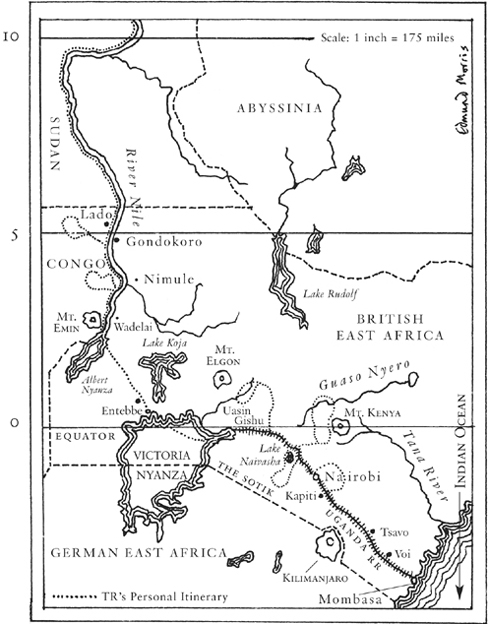
Roosevelt’s safari route through British East Africa, 1909–1910. (photo credit p.1)
“JAMBO BWANA KING YA AMERIK!”19
The shout comes from more than three hundred porters, gunbearers, horse boys, tent men, and askari guards. They stand in two lines outside the little station of Kapiti Plains, five and a half thousand feet above sea level. Pitched behind them are sixty-four tents, and the half-distributed paraphernalia of the largest safari yet mounted20 in equatorial Africa. Were it not sponsored by the Smithsonian Museum and financed in large part by Andrew Carnegie, it could almost be a British military foray, with its crates of guns, ammunition, and rocket flares, its show of blue blouses and puttees, its sun helmets shading a few authoritative white faces. But four tons of salt, scalpel kits, powdered borax, and enough cotton batting to unspool back to Mombasa betray the safari’s field purpose. And instead of the Union Jack, a large Stars and Stripes floats over the field-green headquarters of the “King of America.”
His original plan, conceived while fending off Republican attempts to nominate him for a third term in 190821, was for a private hunting trip in the environs of Mount Kenya22. “If I am where23 they can’t get at me, and where I cannot hear what is going on, I cannot be supposed to wish to interfere with the methods of my successor.” But as his preparatory reading extended from J. H. Patterson’s The Man-Eaters of Tsavo to Lord Cromer’s Modern Egypt, and anti-hunting advocates protested his bloody intentions, he let scientific and political considerations reshape a more public-minded itinerary. The Smithsonian Museum is avid for male and female specimens of all the big-game species he can shoot, plus a complete series of smaller East African mammals. He is also expected to collect flora. The Colonial Office wants him to advertise its new railway, and attract settlers along the line to Victoria Nyanza. The British foreign secretary hopes he will cast a sympathetic American eye on Anglo-Egyptian problems in Khartoum and Cairo.
He has, besides24, his own image to worry about. Having made almost a religion of conservation in the White House, and laid the groundwork for a world conference on the subject, he can ill afford to be seen again, as he was in youth, as an indiscriminate killer of big game. In fact, he has always hunted for constructive reasons: as a boy, to fill the glass cases of his “Roosevelt Museum of Natural History,” and teach himself the minutest details of anatomy and coloration; in youth, to fight his way out of invalidism, choosing always to make the chase as difficult as possible; and in early middle age, to promulgate, as founder-president of the Boone & Crockett Club, the paradox that hunters are practical conservationists, needing to preserve what they pursue—not only birds and animals and fish, but the wilderness too.
Hence this highly professional expedition25 organizing itself at Kapiti. It does so under the orders of his official guide and manager, R. J. Cuninghame, a bearded, bowlegged Scot and slayer of many elephants. Burned nearly black by wanderings extending from South Africa to the Arctic Circle, Cuninghame affects a Viking look that does not quite conceal the cultured poise of a Cambridge man. Leslie Tarlton, representing a Nairobi safari agency, is assistant manager, a tense little Australian and virtuoso sharpshooter. Three American naturalists represent the scientific side of the expedition. Edgar A. Mearns, a retired army surgeon, began his zoological career by collecting “a most interesting series of skulls” on active duty in the Philippines. He is also a botanist. Edmund Heller is a field taxidermist from Stanford University, and J. Alden Loring a mammalogist from New York. Seventh and last in the ranks of command is the official photographer, Kermit Roosevelt, a willowy nineteen-year-old on leave from Harvard. Kermit isBwana Mdogo (“Little Master”) to the safari porters.
As for Bwana Mkubwa Sana (“Very Great Master”), he congratulates himself on putting together a team of the kind of sinewy, well-bred, not overly scrupulous men he has always admired. His son may not qualify26. Kermit is handy with a Kodak, and also with a mandolin; he is a reader and lover of languages, sure to profit from exposure to Africa’s tapestry of cultures. But the boy needs, or seems to need, toughening, having a broody, mother-fixated quality that sets him apart from the rest of the family.
How Edith Roosevelt feels27 about consigning them both to a year in the wilderness is another matter. She accepts that her husband craves danger, perhaps in compensation for his own inclination to bury himself in books. He has proved to be practically indestructible. So has Ted, their grown son. Archie, halfway through Groton, is if possible even flintier. Quentin, the youngest and brightest, is currently a fiend hidden in the cloud of late puberty, yet promises to emerge from it a natural leader and risk taker.
Kermit is made of more fragile material. He, his brothers, and his sisters, Alice and Ethel, worship their father as a sort of sun-god emanating power and love. Edith trusts that in Africa, the aura will be protective.
BY NOW SHE SHOULD28 have answered or destroyed most of the fifteen thousand farewell letters that had poured into Sagamore Hill before he left. He has retained just one, hand-delivered the day he sailed, along with a gold expanding ruler—just the thing a man needs on safari. The ruler is engraved THEODORE ROOSEVELT FROM WILLIAM HOWARD TAFT: Goodbye—Good luck—and a safe return, and the letter, on heavy White House stationery, reads:
My dear Theodore29: If I followed my impulse, I should still say “My dear Mr. President.” I cannot overcome the habit. When I am addressed as “Mr. President,” I turn to see whether you are not at my elbow.…
I write to you to say “farewell,” and to wish you as great pleasure and as much usefulness as possible in the trip you are about to undertake. I have had my qualms about the result, but in thinking it over they disappear. You will undertake no foolhardy enterprise, I know.…
I want you to know that I do nothing in the Executive office without considering what you would do under the same circumstances and without having in a sense a mental talk with you over the pros and cons of the situation. I have not the facility for educating the public as you had through talks with correspondents, and so I fear that a large part of the public will feel as if I had fallen away from your ideals; but you know me better and will understand that I am still working away on the same old plan.
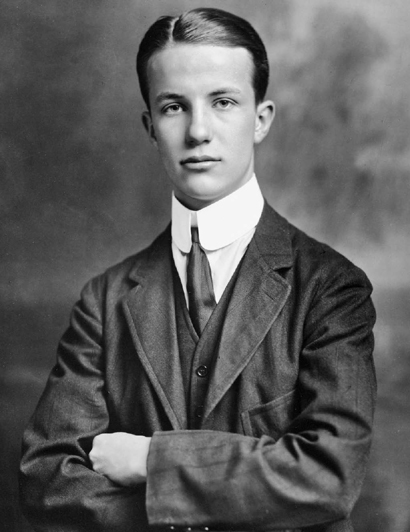
“KERMIT IS MADE OF MORE FRAGILE MATERIAL.”
Kermit Roosevelt in 1909. (photo credit p.2)
Taft cannot find it easy to succeed the most confident executive in modern memory. “Mr. President,” in contrast, is happy to sacrifice supreme power—and along with it, a third term virtually guaranteed by the Republican Party and the American electorate. He waves aside token respect. “I am no hanger-on30 to the shreds of departing greatness.”
That said, there is one title31 he cherishes, and asks everybody to use from now on: “Colonel Roosevelt.” He feels that it is both valid, reflecting his rank in the Reserve Army of the United States, and merited through bravery in battle. He was, after all, briefly and gloriously commander of a regiment of volunteer cavalrymen in ’98. If war ever comes32 again and finds him fit to serve, he intends to reactivate his brevet at once.
He is already “Roosevelt, (Col.) Theodore” in The New York Times Index. Reporters do not intend to drop him as a subject, even as he retreats into the wilds of Africa. For more than a quarter of a century they have pursued him, drawn by his “Teddy-bear” caricaturability, perpetual motion, heroic glamour, machine-gun quotes, and ricochet denials. Most attractive of all is his disaster potential—the likelihood that one day he will spend the last cent of his legendary luck, and be destroyed by either violence from outside, or hubris within.
This potential seems especially fraught now that he has elected to test his fifty-year-old body, and faulty vision, in some of the world’s riskiest hunting grounds. Aware of it himself, he has announced that his safari will be closed to all press coverage, save for occasional statistical bulletins that he may issue through cable facilities in Nairobi. Any attempt to follow in his footsteps will be “an outrage and an indecency.”33 He does not want every missed shot headlined—or, worse still, captured on camera by the increasingly annoying phenomenon of news photographers.
And should he survive, he wishes to tell his own story. A lucrative publishing contract with Charles Scribner’s Sons calls upon him to write an account of his safari, in articles that will appear monthly in Scribner’s Magazine. After the safari is complete, the series will be edited for republication in book form. His payment for the articles is to be $50,000, and the book will earn him a 20 percent royalty. This is the most money he has ever negotiated as a writer. He could have gotten twice as much from Collier’s Weekly, but feels that periodical is too slick. A touch34 bon marché, as Edith would say.
HE RIDES OUT to hunt35 with Kermit, while Cuninghame, Tarlton, and the naturalists continue their preparations. Two local ranchers act as guides. The sortie amounts to a rehearsal for the big safari soon to begin, with gunbearers, grooms, and porters trailing in a precedence as formal as any line he had led as President.
Kapiti’s dry veldt, a word he recognizes as a particle of his own Dutch surname36, does not compare in fecundity with the well-watered Athi preserve he passed through on the train. After two years of drought37, it is largely depopulated of game. But the Intertropical Convergence Zone seems finally about to drift north across the equator, ahead of them as they ride. When it does, this plain will turn green, and masses of game arrive to graze. At present, ticks alone seem to thrive, attaching themselves like miniature grape clusters to the legs of the ponies. He is grateful for his leather-patch trousers, buttoned tight from knee to boot. A stiff sun helmet, de rigueur for all white travelers in the tropics, uncomfortably covers his large head. He yearns for his beloved slouch hat, but defers to the notion that solar rays are lethal in these latitudes.
He strains to adjust his one good eye to the veldt’s visibility, particularly illusive when the sun is overhead, and makes out the delicate prancings of two species of buck. He aims his custom-sighted Springfield .30 at a Grant’s gazelle, but undershoots and misses. Focusing on a small Thomson’s at 225 yards, he breaks its back with a bullet that goes only slightly too high. It is his first African kill, and he looks forward to venison for dinner.
What he really wants38 to shoot this afternoon, to set the right collecting tone, is “two good specimens, bull and cow, of the wildebeest.” It is the scientist in him, not the hunter, who first responds to a glimpse of brindled gnu moving blue-black and white across the plain, like shadows of the advancing storm clouds. He sees no evidence in that chiaroscuro of the fashionable theory of “protective coloration,” one of his pet biological peeves. How protective is a white throat mane, in angled light? How inconspicuous are zebra, to a lion? He notes, for his book, that Africa’s large game animals “are always walking and standing in conspicuous places, and never seek to hide or take advantage of cover.” Only the smaller quadrupeds, “like the duiker and steinbuck … endeavor to escape the sight of their foes by lying absolutely still.”
Wildebeest, duiker, steinbuck—he is already picking up the Cape Dutch nomenclature that Afrikaans settlers have brought to British East Africa. Their language reminds him of the nursery songs his grandmother used to croon to him, in earliest memory:
Trippa, troppa39, tronjes,
De varken’s in de boonjes.
Reminiscent, too, is the Paleolithic profile of a wildebeest, as he closes on it in a sudden squall of rain. His first big trophy was an American buffalo, hunted in similar conditions twenty-three years ago. Then, the rain was so dense on his spectacles, he could not be sure what was bison, and what mere beading water. This shape shrinks at four hundred yards to something more slender than massive. Nevertheless, it is a good-sized bull. He wounds it into a run. Kermit, galloping with teenage abandon over rotten ground for more than six miles, administers the coup de grâce.
By “veldt law,”40 credit goes to the man who shot first.
AFTER A WEEK OF hunting around Kapiti, he feels confident enough to stalk lion with dogs. They do not have to sniff far. The hair rises on their backs as they follow catspaw prints down a dry donga, and his horse boy hisses, “Simba.”
He follows41 the line of the pointing black finger. Just four yards away, something yellow moves in a patch of tall grass. He fires at once with his .405 Winchester. With nothing but color to aim at, he does not know if the movement will materialize into a lion. Kermit fires too. Presently two half-grown cubs emerge, both wounded. They have to be finished off.
Disappointed as the day wanes without result, he allows one of his party to reconnoiter another ravine. More prints show in the sand, much larger this time, and at once he and Kermit are off their horses, alert to crashing, grunting noises in the brush ahead.
Right in front42 of me, thirty yards off, there appeared, from behind the bushes which had first screened him from my eyes, the tawny, galloping form of a big maneless lion. Crack! the Winchester spoke; and as the soft-nosed bullet ploughed forward through his flank the lion swerved so that I missed him with the second shot; but my third bullet went through the spine and forward into his chest. Down he came … his hind quarters dragging, his head up, his jaws open and lips drawn up in a prodigious snarl, as he endeavored to turn to face us. His back was broken.… His head sank, and he died.
There is no time to exult over the carcass, because he sees a second lion escaping. He runs it down and fires. The lion rolls over, one foreleg in the air, then takes two more bullets before dying at his feet.
Three days later he kills a much bigger lion, plus another half-grown cub and a lioness. All are destined for the Smithsonian. He hopes that his trophy quota, set by Protectorate authorities, will eventually allow him to shoot a simba for himself. It is dark before the lioness is borne back to camp, swinging between two poles. A nearly full moon illumines the porters as they lope into view, intoning a deep, rhythmic song. He tries to notate43 it phonetically: Zou-zou-boulé ma ja guntai. They cluster around44 him as he stands by the fire, then begin to dance. Their chanting rises to a climax. He adds a descant of his own, obscurely derived from Irish folksong: “Whack-fal-lal for Lanning’s Ball.”
The firelight glows45 on the body of his prey, and on the white and ebony of his jostling celebrants. Around them, the plain lies pale under the moon.
LIKE A PYTHON46 TOO enormous to shift all its coils at once, the safari begins to move while still based at Kapiti Station. By early May it is in full motion, carrying its own weight, hunting as it goes, sending out flickering forays in search of choice specimens.
As leader47, he does his share of collecting and cataloging. Dendromus nigrifons, Arvicanthis abyssinicus nairobae, Myoscalops kapiti heller, Thamnomys loringi, Pelomys roosevelti.… Latin classifications come easily to him; he has been inscribing zoological labels since boyhood. He assists Heller and Loring in writing life histories, enjoying the precision of scientific description. Before politics, this was what he wanted to be: a naturalist in the field. Coarse bristly hair, he writes of the meadow mouse named in his honor. The dorsal coloration is golden yellow overlaid by long hairs with an olive iridescence; the under parts are silky white.
But his main48 literary labor, at night in camp after dinner, is to process pocket-diary jottings and fresh memory into serial installments for Scribner’s Magazine. By 12 May he has completed his first article, “A Railroad Through the Pleistocene.” Eight days later he finishes another, describing his wildebeest hunt and visit to a Boer ranch, not failing to quote Trippa, troppa, tronjes. With a storyteller’s instinct for pacing, he reserves his lion kills for installment three, betting that readers who stay with him that long will stay to the end—unless his own end intervenes. “During the last decades in Africa,” he reports, “hundreds of white hunters, and thousands of native hunters, have been killed or wounded by lions, buffaloes, elephants, and rhinos.” A unique feature of his book is that it is being written on the march. The possibility of foreclosure adds an agreeable note of suspense to the narrative.
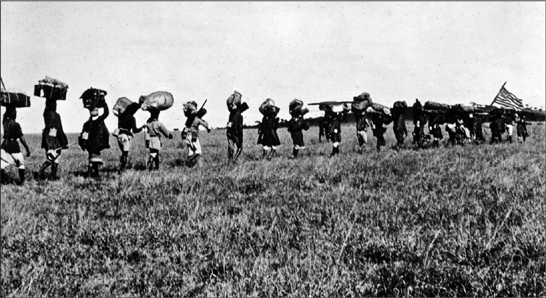
“A PRECEDENCE AS FORMAL AS ANY LINE HE HAD LED AS PRESIDENT.”
Roosevelt’s safari gets under way, May 1910. (photo credit p.3)
He writes it as he talks—superabundantly, always interestingly, with clarity and total recall. Elegance of style is not his concern. He sometimes repeats himself, relying on his sharp ear to protect him from cliché, not always with success. He is aware49 of the page-filling benefits of purple passages, and scatters dying sunsets and brilliant tropic moons with a fine hand.
Beyond these indulgences, the power of his prose comes from its realism. He is an honest writer50, incapable of boasting, or even the discreet omissions tolerated by nonfiction editors. If he kills any animal clumsily, wasting bullets, he tells how, in detail. The same truthfulness keeps him from false modesty—the “my poor self” affectation of so many German and English memoirists. Being brave, he admits to acts of bravery; swelling with new experiences, he does not hide the breadth of his knowledge. As a result, his indelible pencil51 gouges the capital letter I with a frequency tending to blunt the point.
Pressing down is necessary, because he writes with two sheets of carbon stuffed into his manuscript pad. One copy of each52 article is sealed in a blue canvas envelope and dispatched to Nairobi by runner, thence to be sent down the railroad to Mombasa and shipped via two oceans to New York. To insure against loss, a duplicate goes by the next sea mail, and he retains the third copy for himself.
As he falls53 into the cross-rhythms of riding and shooting, collecting and writing, he becomes in effect a hunter of Africa itself, seeking to capture it whole—alive or dead—and process it into food for mind and body. His pursuit is not for the squeamish. Each new animal fixed in his sights poses a different combination of danger and documentary interest, whether in the number of bullets it absorbs, or the sounds it makes as it dies, or the inches it registers on his tape measure, or the browsing habits he deduces from the contents of its stomach. A bull rhino, shot through lungs and heart, bears down with such momentum that it skids to death just thirteen paces away, plowing a long furrow with its horn. A lion, nine feet long and copiously maned, comes on even faster, only to be hit in the chest, “as if the place had been plotted with dividers … smashing the lungs and the big blood vessels of the heart.” Two swamp buffalo bulls, black and glistening in the early morning light, fall to his biggest rifle, and two giant eland, heavy and dewlapped as prize steers, to his smallest. A lioness yields not only herself, but two unborn cubs. Three giraffes topple over in a single morning, followed by a whole family of rhinos, the bull needing nine bullets to finish off, the cow performing a “curious death waltz,” and the calf dropping with “a screaming whistle, almost like that of a small steam-engine.” His kills become repetitive. Yet another rhino, then another, and another, and another; two more lions and a lioness, somersaulting left and right in her final agony; more buffalo, more eland, more giraffes.
In a sudden54 translocation to a world of water, he finds himself in a rowboat with Kermit, gliding among purple and pink water lilies. Delicate jacana birds race across the pads, treading so lightly the flowers barely dip. His ornithologist’s eye and ear rejoice at a wealth of other bird life: tiny kingfishers coruscating in the sun like sapphires, white-throated cormorants, spur-winged plover clamoring overhead, little rills threading the papyrus, grebes diving, herons spearing, and baldpate coots resembling the kind he collected as a teenager, except, he notes, for “a pair of horns or papillae at the hinder end of the bare frontal space.”
But he is looking55 for hippos. The prodigious beasts prove surprisingly fast and difficult to kill in the water. He hits one, this first day on Lake Naivasha, and another the next; but they submerge at once, and decline to float up dead. On the third day, just as he feels an attack of malaria coming on, he encounters a big bull wading. He fires shakily, breaking its shoulder, whereupon it flounders at him with open jaws. He fires again and again, trying to control his tremor, and finally shoots right down its throat. The tusks clash like a sprung bear trap. At point-blank range, the hippo swerves a little, and he drills it through the brain.
Then, curling up56 on the floor of the boat, he succumbs to his fever.
HE KNOWS THIS IS NOT African malaria, but the Cuban variety that has plagued him since Rough Rider days. Always the sudden convulsions, the cracking headache, then zero at the bone57. And always, since he believes illness is weakness (like grief or fear or self-doubt), he fights it off until it fells him. Fortunately, attacks never last long. He is well enough after five days to go out looking for more hippos. This time he leaves Kermit behind, and orders two “boys” to row him alone across the lake.
Although he assures himself58 that he has spilled no more blood, so far, than is necessary to satisfy the Smithsonian and feed his safari, he is aware that his hunter’s luck has been extraordinary. It is the talk of the sundowner set in Nairobi. In just three months, he and Kermit have bagged multiple specimens of most of the major African species. Thanks to herculean skinning and salting by Heller and Mearns, he can congratulate himself on having shipped, via the railway to Mombasa, “a collection of large animals such as has never been obtained for any other museum in the world on a single trip.”
The trouble with such luck59 is that it is bound to be perceived by critics of big-game hunting as indiscriminate slaughter. Local “bush telegraph” exaggerates the number of his kills, not to mention his profligacy with bullets. He is sensitive of being caricatured as anything other than the serious leader of a scientific expedition, and begins to regret his press ban. Perhaps he should do more than send the occasional scrawled trophy tally60 to the little pool of reporters in Nairobi. It is not the kind of “copy” they want.
Whenever he veers near the capital, he can feel their avid interest61 pulling at him, like magnetic current. The fact is62, he is magnetized himself. Despite his pose of privacy, he remains irredeemably a public figure, obsessed with his own image, half wanting to confide in those he holds at bay. He misses the worshipful cadre of young scribes who took virtual dictation from him in Washington. That “Newspaper Cabinet” is now disbanded, and Taft’s self-deprecating envoi (“I have not the facility for educating the public as you had”) suggests that the White House is going to be a poor source of news for the next four years. American editors63 will have to look farther afield for good material. No story could be more surefire than that of Colonel Roosevelt daily risking death in Africa!
Hence the presence64, this day in Naivasha, of F. Warrington Dawson, a young United Press correspondent who has pursued him all the way to Kapiti. Dawson—Southern, French-educated, the author of two successful novels—is obviously eager to serve him. They might discuss how in camp tonight. That hippo “bull”65 of five days ago turned out, embarrassingly, to be an old cow. The misidentification was excusable, for she was barren, and had developed male characteristics. But it is exactly the sort of thing he does not wish broadcast, as some kind of joke.
IF ONLY TO IMPRESS DAWSON, he wants to get a big bull, and get it cleanly—not an easy task with low-profile quarry.
The lake lies almost still66. For an hour of stealthy progress, he cannot be sure what are mere strips of mud, wetly gleaming, and what the possible heads of hippos. At last he distinguishes a dozen flat foreheads. He fires at seventy yards, and they all sink without trace. He thinks he may have hit one of them. Still standing, he orders his rowers to advance. He catches their sudden fear, then the boat shudders over some vast upheaval, knocking him off his feet. The water roils as back after huge back rises in rage. Repeatedly, he fires his .30-caliber Springfield at the closest heads (one with a lily-pad eye patch that reminds him, in the midst of panic, of “a discomfited prize-fighter”). The other hippos plunge for cover.
Calm returns to the lake. He waits for it to give up its dead. After an hour, to his surprise and shame, four carcasses surface. One of them is the bull he wanted, but the rest are cows, unneeded as trophies, undeniable as kills. He persuades himself that they will be a food bonanza for his porters, and for the natives of Naivasha.
Darkness falls67 as he supervises the laborious business of belaying, mooring, and towing tons of meat. The night grows stormy. Long swells roll through the reeds. He does not get back to camp until three the next morning. Before dawn, he awakes with an attack of acute despair. Alarmed at his haggard look, servants go to fetch Dawson. “Bwana Mkubwa kill mingi kiboko!” Many hippos.
“Warrington,” he says when the reporter appears, “the most awful thing has happened.”
He need not worry68. Dawson is so touched to be confided in (“I don’t know what to do.… We shall have to let the papers know”) that the story goes out as an attack by, rather than on, the herd of hippos. It is released by a young man who can now style himself secretary to the former President of the United States. In his diary for 23 July, Dawson proudly notes, “Wrote letters for the Colonel.”
THE LETTERS, DICTATED69 with much snapping of teeth, pacing back and forth, and smacks of right fist into left palm, are in response to the first overseas mail the safari has received in nearly two months. Senator Henry Cabot Lodge and other politically obsessed correspondents report that President Taft is proving an inept executive, and that Republican insurgents now pose a serious threat to the unity of the Republican Party. But the immediacy of such bulletins fades in proportion to the distance they have come, and the leisurely pace of African “runners.”
There is, in any case, little that a former Party head can do, other than express polite concern. Lodge must understand that he has divorced himself from affairs of state. “Remember that I never70 see newspapers.… I am now eating and drinking nothing but my African expedition.”
He admits71 to Dawson that he would rather not hear anything about the Taft administration. Insofar as he will discuss his own future, he talks of returning to Oyster Bay for a quiet life of writing books and articles. He says he would like to become “a closer father” to his two youngest sons, whom he feels he may have neglected during his years as President.
However, he does dictate one startling remark72 that Dawson fails to recognize as news. It occurs in a message of sympathy to Henry White, whom President Taft has dismissed as American ambassador to France: “He said without any qualification that he intended to keep you. It was, of course, not a promise any more than my statement that I would not run again for President was a promise.”
HE IS NEARER DEATH73, around midday on the nineteenth of August, than he was on Kettle Hill in Cuba, or when he battled for breath as an asthmatic child. An elephant bears down upon him in dense jungle, creepers snapping like packthread in its rush. There are no bullets74 left in his Holland & Holland rifle: both barrels were needed to dispatch another elephant, only moments before. He dodges behind a tree, ejecting the empty cartridges and jamming in two fresh ones. R. J. Cuninghame fires twice, with the hair-trigger reaction of a professional. The elephant stops in its tracks, wheels, and vanishes, trumpeting shrilly. A copious trail of blood marks its departure.
Hunters’ etiquette75 requires that it be followed. But the contrary duty of a collector is to begin, at once, the task of skinning the specimen already killed, a big bull carrying a hundred and thirty pounds of ivory. Several days’ work lies ahead, in humid weather (they are on the lush piedmont of Mount Kenya). He watches fascinated as the safari team—porters, gunbearers, and ’Ndorobo guides alike—throw themselves bodily into the work of flaying and cutting up his quarry.
Soon they were all splashed76 with blood from head to foot. One of the trackers took off his blanket and squatted stark naked inside the carcase, the better to use his knife. Each laborer rewarded himself by cutting off strips of meat for his private store, and hung them in red festoons from the branches round about. There was no let-up in the work until it was stopped by darkness.
Our tents were pitched in a small open glade a hundred yards from the dead elephant. The night was clear, the stars shone brightly, and in the west the young moon hung just above the line of tall tree-tops. Fires were speedily kindled and the men sat around them, feasting and singing in a strange minor tone until late in the night. The flickering light left them at one moment in black obscurity, and the next brought into bold relief their sinewy crouching figures, their dark faces, gleaming eyes, and flashing teeth.… I toasted slices of elephant’s heart on a pronged stick before the fire, and found it delicious; for I was hungry, and the night was cold.
BLOOD, NAKEDNESS77, FLESHY festoons, music, moon, and fire, his mouth full of cardiac meat: after four months, he has arrived at the heart of darkness. He is at one with the mightiest of animals, its life juices mingling with his own, at one with all nature, with the primeval past. No longer a mere time traveler in the Pleistocene, he has become a virtual denizen of it. The pages of his safari diary, covered with sketches of every animal he has slain (usually shown in motion, extremities tapering off into blankness), uncannily recall Paleolithic art. Yet a part of him is repelled by much of what he observes: baboons tearing open newborn lambs to get at the milk inside them, a hyena suffocated by the very guts it burrows into, flies walking around the eyes of children. “Life is hard and cruel78 for all the lower creatures, and for man also in what the sentimentalists call a ‘state of nature,’ ” he writes. “The savage of today shows us what the fancied age of gold of our ancestors was really like; it was an age when hunger, cold, violence, and iron cruelty were the ordinary accompaniments of life.”
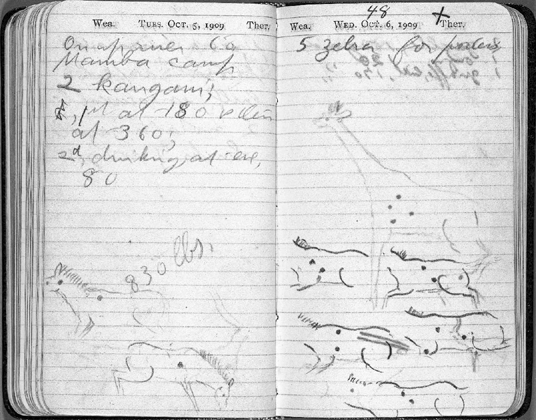
“THE PAGES OF HIS SAFARI DIARY UNCANNILY RECALL PALEOLITHIC ART.”
Roosevelt records his kills on 5 and 6 October 1909. (photo credit p.4)
The intense physicality of Africa so stimulates him intellectually that he has already read79 most of his Pigskin Library—some covers stained with blood, oil, ashes, and sweat till they look like saddle leather. He balks only at three or four of Shakespeare’s plays. The aphorisms of Omar Khayyám, Sir Walter Scott, Ferdinand Gregorovius, and Lewis Carroll are as apt to flavor his campfire conversation as ornithological data. He seems to register everything he reads, just as he mentally photographs everything he sees—the new moon reflected among water lilies, a clutch of hartebeest droppings, a mirage’s “wavering mockery,” ostriches “mincing along with their usual air of foolish stateliness.” His ear for sounds80 is just as acute, and he notes them down with extreme precision: the “batrachian” croaks of hyraxes, the “bubbling squeals” blown through the nostrils of a submerging hippo, the pack of a bullet hitting rhino hide, the “bird-like chirp” of a cheetah.
One sound falls81 with especial sweetness on his ear: Kermit playing “Rolling Down to Rio” on the mandolin. He is proud82 of his son, who despite a weedy physique has managed to emulate all his own hunting feats—even shooting an elephant. The boy has taken surprisingly well to the African wilderness—so much so, he would seem born for life in an alien environment. He has a linguistic gift, and has added a fairly fluent command of Swahili to the French, Latin, and Greek he learned at Groton. Socially, Kermit tries to be friendly, but is inhibited by a lackluster personality. He is happiest when hunting, and remains cool in the face of danger.
Possibly the image83 of another narrow-chested Harvard undergraduate, thirty years ago, amazing the backwoodsmen of Maine with equal feats of courage and endurance hovers in a father’s memory. Nothing dull about that youth! Even then, people seemed to be irradiated in contact with him. His peculiar glow, which he gives off as naturally as a firefly, has not transmitted to any of his children—unless Alice’s fitful sparks of conversational brilliance, and signs that Quentin is developing an exceptional charm, can be regarded as genetic.
He has grown used84, over the years, to being surrounded by crowds wearing the strange fixed smile, half-awed, half-predatory, that is celebrity’s reflection. On the rare occasions he visits Nairobi to pick up supplies and mail, the smile greets him as if he were still President, as if he were not a private hunter in one of the remotest colonies in the world. He has to laugh85 when he returns to the trail, and finds himself surrounded by a “thoroughly African circle of deeply interested spectators.” Wildebeest and kongoni form the perimeter; a rhino peers shortsightedly with small pig’s eyes, less than half a mile away; four topi advance for a closer look; a buck topi and a zebra follow suit; and high overhead, vultures wheel. So long the center of other circles, social, intellectual, and political, he is now, apparently, a focal point of the Sotik plateau.
Quitting the safari entirely for a week, with only Kermit and a few Kikuyu servants for company, he camps in the cold highlands of the Guaso Nyero. Freak rains fall almost every night. Snug in his tent86 and stoutly clad by Abercrombie & Fitch, he is concerned at the way his half-naked men cower under bushes, instead of building some sort of roof for themselves. He has to drive87 them to chop and plait leafy boughs.
It is plain to him88 that the pagan tribes of British East Africa are in a state of development far behind that of the Pawnee and other aboriginal peoples. It would be useless to offer them any kind of independence: “The ‘just consent of the governed,’ in their case, if taken literally, would mean idleness, famine, and endless internecine warfare.” He declines, however, to treat them as irredeemable, in the manner that comes so naturally to their colonial masters. They have as much civilized potential as his own ancestors did, back in the days when bison roamed the forests of Europe. He shocks the complacency of a dinner in his honor, at the Railway Institute in Nairobi, by saying, “In making this a white man’s country, remember that not only the laws of righteousness, but your own real and ultimate self-interest demand that the black man be treated with justice, that he be safeguarded in his rights and not pressed downward. Brutality and injustice are especially hateful when exercised on the helpless.”
AS HIS FIFTY-FIRST BIRTHDAY approaches on 27 October, he begins to pine for Edith. A mighty hunter, with much killing yet to do, should not give way to “homesickness” (the word he applies to all private desires), but he finds himself counting the months and days until they meet in Khartoum. A chance reference to the Song of Solomon89, in the midst of a letter he addresses to an editorial friend, makes him segue into a rhapsody on domestic bliss: “I think that the love of the really happy husband and wife—not purged of passion, but with passion heated to a white heat of intensity and purity and tenderness and consideration, and with many another feeling added thereto—is the loftiest and most ennobling influence that comes into the life of any man or woman, even loftier and more ennobling than the wise and tender love for children.”
In November, on the seventeenth, another anniversary looms: that of his engagement to Edith. He writes to her from his camp beside the River ’Nzoi:
Oh, sweetest of all90 sweet girls, last night I dreamed that I was with you, that our separation was but a dream; and when I waked up it was almost too hard to bear. Well, one must pay for everything; you have made the real happiness of my life; and so it is natural and right that I should constantly [be] more and more lonely without you.… Do you remember when you were such a pretty engaged girl, and said to your lover “no Theodore, that I cannot allow”? Darling, I love you so. In a very little over four months I shall see you, now. When you get this three fourths of the time will have gone. How very happy we have been these twenty-three years!
He signs it “Your own lover.”
Moving on to Londiani91 on the last day of the month, he disbands the main body of his safari. He has already spent almost all of the $75,000 Andrew Carnegie and a few other American sponsors have lavished upon the expedition. It has collected all it needs in British East Africa—indeed, more than it is officially entitled to: almost 4,000 mammals large and small, plus 3,379 birds, 1,500 reptiles, frogs, and toads, and 250 fish. In addition there are uncounted numbers of crabs, beetles, millipedes, and other invertebrates, and several thousand plants.
From now on92, he and Kermit will hunt in Uganda Protectorate and the Sudan with a much smaller retinue of porters and horse boys. Heller, Loring, and Dr. Mearns insist on staying with him. They are insatiable for more specimens, and airily confident that the safari will stay in business for another three very expensive months. This worries him. He is generous93 by nature, but also improvident, with little understanding of the real value of money. He has insisted on paying his and Kermit’s own way so far, not dipping into sponsor funds. Edith is bound to remind him, if the funds run out, that he has two more sons to put through Harvard—with Quentin unlikely to graduate until the spring of 1919. He is by no means financially secure. His entire presidential salary went toward entertaining, and his Nobel Peace Prize award, totaling almost94 $40,000, has been placed at the disposal of Congress, as something he feels he has no right to keep. Nor is he likely ever again to negotiate a publishing contract as big as his current one.
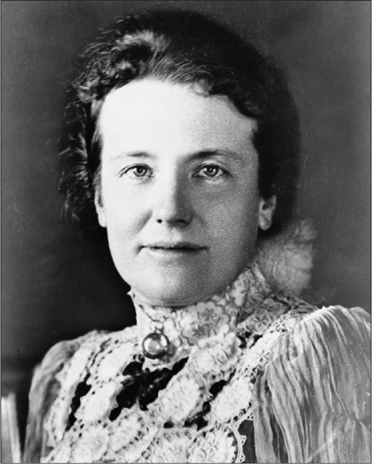
“ ‘OH, SWEETEST OF ALL SWEET GIRLS.’ ”
Edith Kermit Roosevelt in 1909. (photo credit p.5)
He is therefore relieved95 to hear that Carnegie will be sending him a check for $20,000 for the naturalists, along with a promise of further cash if needed. “I am now entirely easy as to the expense of the scientific Smithsonian part of the trip,” he writes, emphasizing that he and Kermit will continue to finance themselves. He does not want to become personally indebted to anyone. His experience as a professional politician has been that donors always look for repayment in the coin of their choice. What Carnegie craves is influence over affairs of state. Already there have been indications that the steelmaker, an ardent pacifist, wants to draft him into the international arms control movement—a cause he has never much cared for.
Revisiting Nairobi in mid-December, he sends off another plump envelope to his publisher. He is pleased to hear from Robert Bridges, the editor of Scribner’s Magazine, that the first installment of his safari story has been a runaway publishing success. “The very large edition96 of the October number (much the largest we have ever printed) is completely exhausted.” Subsequent print runs are to be even larger. With eleven installments already mailed, he has only two more to write, and can look forward to publication of his complete African book in less than a year.
In Nairobi’s little bookstore97, he amplifies the Pigskin Library with Darwin’s Voyage of the Beagle, nine volumes of Julian Huxley’s Essays in Popular Science, and every classic he can lay his hands on: Cervantes, Goethe, Molière, Pascal, Montaigne, Saint-Simon. Then, on 18 December, he takes the Uganda Railway to Lake Victoria, and sails in a small steamer for Entebbe. As he does so, he crosses the equator and reenters his home hemisphere.
CHRISTMAS DAY FINDS him marching northwest toward Lake Albert, parallel with the Victoria Nile. It is elephant country98, and he cannot resist downing another leviathan—his eighth—and guzzling the “excellent soup” made from its trunk. He is in superb health99, having (perhaps with the aid of Cuban fever) deflected all local diseases. If the rheumatism he began to complain of in his last years as President still troubles him, he has stopped mentioning it. His stride is tireless100, unusually long for a small-boned man five feet nine inches tall. He can run, carrying a heavy gun, for one and a half miles in 102°F heat. He eats enormously, but his constant activity burns up fat. He looks better101 than at any time in his adult life: tanned, hard-muscled, sun bleach gilding the slight gray in his hair. Even his monocular eyesight seems improved. He is the first in his party to spot a distant herd of buffalo, “their dark forms picked out by highlights on the curve of their horns.” His hearing remains phenomenal, and he is intrigued to find that his sense of smell has become animal-like, alerting him to the nearness of invisible prey.
He has, in short, reached his peak as a hunter, exuberantly altered from the pale, overweight statesman of ten months ago. Africa’s way of reducing every problem of existence to dire alternatives—shoot or starve, kill or be killed, shelter or suffer, procreate or count for nothing—has clarified his thinking, purged him of politics and its constant search for compromise. Yet on the seventh day102 of the new year, as he enters the valley of the White Nile at Butiaba, he begins to accept that his retreat into the Pleistocene is over. A reverse journey is under way: he feels himself “passing through stratum after stratum of savagery and semicivilization … each stage representing some thousands of years of advance upon the preceding.”
The advance is as slow as he can make it. It proceeds amphibiously, with most of his porters trekking inland from Kobe to Nimule, while the white command meanders downriver in a flotilla of five small boats. He orders a three-week halt103 just south of the third parallel, and in a hunting orgy with Kermit, kills nine white rhinos.
A MONTH LATER, he reaches Gondokoro in the southern Sudan. By now, after a final chase after giant eland, he feels that he has advanced104 at least as far as the seventh century. A letter from Henry Cabot Lodge105 jerks him further forward. It warns that a phalanx of foreign correspondents will waylay him at Khartoum, 750 miles north. “There is a constantly growing thought of you and your return to the Presidency.… They will all try to get you to say things. I think it is of the first importance that you should say absolutely nothing about American politics before you get home.”
He insists in reply that all he wants to do is finish his book, tour Europe with Edith, Kermit, and Ethel, and then come home as a private citizen. “At present it does not106 seem to me that it would be wise, from any side, for me to be a candidate. But that can wait.”
THREE MEMBERS107 OF THE KHARTOUM press contingent, however, cannot. On 11 March they emerge from the Nile’s dawn mist in a commandeered steamboat, waving sun helmets and the Stars and Stripes. Encouraged by his return of salute, they introduce themselves as representatives of the Chicago Tribune, New York World, and United Press. He invites them to dinner aboard his new ship, the Dal, a luxury sternwheeler made available by the Governor-General of the Sudan. But when they row over that evening, they find the table laid on its forward barge, full of malodorous hides. The message is clear: he still considers himself a traveling hunter.
They listen frustrated108 as he tells story after safari story, his face silhouetted against a papyrus fire in the swamp of Ar Rank. Eventually he gives them a statement—of sorts—for publication: “We [sic] have nothing to say and will have nothing to say on American or foreign policy questions.… I will give no interviews and anything purporting to be an interview with me can be accepted as false as soon as it appears.”
Courteously, the next morning, he orders the newsmen back downriver, and spends the next two days writing in his stateroom. Every time he goes on deck for a breather, he recognizes more and more of the Nile birds he pursued109 and stuffed as a boy, thirty-seven years before on his father’s rented dahabeah: cow herons, hoopoos, bee-eaters, black-and-white chats, plover, kingfishers, desert larks, and trumpet bullfinches. At night, he sits under the stars and listens to other, unseen species calling to one another in strange voices. He watches crocodiles and hippos slide through the black water and thinks up a phrase to describe the luminosity they shed from their backs: “whirls and wakes110 of feeble light.” His narrative has caught up with him: he is writing now almost in real time.
All that remains111 is to list the game he has shot on safari: 9 lions, 8 elephants, 6 buffalo, 13 rhino, 7 giraffes, 7 hippos, 2 ostriches, 3 pythons, 1 crocodile, 5 wildebeest, 20 zebras, 177 antelope of various species, from eland to dik-dik, 6 monkeys, and 32 other animals and birds: 296 “items” in all. Kermit has bagged 216—a total almost as impressive as the young man’s ability to match Heller and Mearns drink for drink.
“Kermit and I112 kept about a dozen trophies for ourselves,” Roosevelt writes in a final defensive paragraph. “We were in hunting-grounds practically as good as any that ever existed; but we did not kill a tenth, nor a hundredth, part of what we might have killed had we been willing.”
Shortly before noon on 14 March, Khartoum’s palms and minarets emerge from a red dust haze downriver. The Dal swings into the mouth of the Blue Nile and bears down on the private dock of the governor-general’s palace, where at last he sees, in his own half-regretful image, “the twentieth century113 superimposed upon the seventh.”