
PART ONE

The epigraphs at the head of every
chapter are taken from the poems of
Edwin Arlington Robinson (1869–1935),
whom Theodore Roosevelt rescued from
poverty and obscurity in 1905. He went on
to win three Pulitzer Prizes.

Equipped with unobscured intent
He smiles with lions at the gate,
Acknowledging the compliment
Like one familiar with his fate.
THE KISS THAT THEODORE ROOSEVELT longed for did not materialize when he stepped ashore in Khartoum on 14 March 1910. Instead, he had to return the salute of Sir Rudolf Anton Karl von Slatin Pasha, G.C.V.O., K.C.M.G., C.B., inspector-general of the Sudan, and pass an honor guard of askaris into the palace garden, where the elite of Anglo-Sudanese society awaited him amid the silver paraphernalia of afternoon tea. He was informed2 that Edith’s train from Cairo was delayed, and that she and Ethel would not arrive for another couple of hours. In the meantime, Slatin would not hear of the Colonel checking in to a hotel. A suite for his party had been readied in the palace, and a private yacht was standing by for sightseeing during his stay.
What Roosevelt wanted to see, more than anything but Edith’s face, was Omdurman. The battlefield, where General Kitchener’s Twenty-first Lancers had staged the last great cavalry charge of the nineteenth century, lay only ten miles away. Kitchener had been on his mind in recent days, if only because HMS Dal, the boat that had brought him north from Gondokoro, had been the triumphant commander’s flagship. On its boards3, twelve years before, Kitchener had proclaimed British control over the entire Nile Valley, from Uganda to the Mediterranean.
The success of that dominion—or condominium, as the Foreign Office called it, as a sop to Sudanese, Egyptian, and Turkish sensibilities—was palpable in Khartoum’s tranquil, orange-blossom-scented air. Rebuilt by Kitchener4 from the ruins of a thirteen-year Muslim interregnum, the city was laid out like the Union Jack, its crossbars lined with stone villas and its triangles filled with seven thousand trees. Once the most violent flashpoint on the African continent, it now lazily breathed pax Britannica. In the sunburned, aristocratic faces of his hosts, in their perfect manners and air of unstudied authority, Roosevelt recognized the attributes he had always admired in the English ruling class, along with “intelligence, ability, and a very lofty sense of duty.”
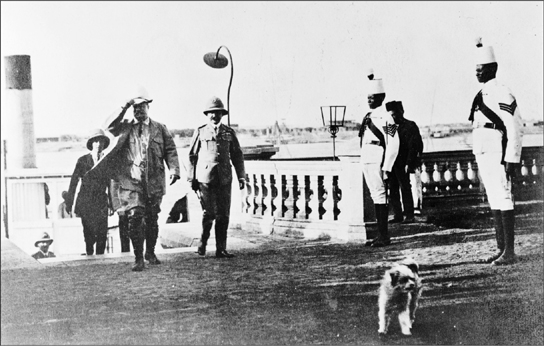
“THE ELITE OF ANGLO-SUDANESE SOCIETY AWAITED HIM.”
Roosevelt arrives in Khartoum, 14 March 1910. (photo credit i1.1)
Yet he was aware of the constant menace of Arab nationalism, obscure yet encircling, like the mirages wavering on the desert horizon. The haze that hung over the city seemed, to his vivid historical imagination, to be red with the blood of General Gordon5, murdered in this very palace by Mahdist dervishes.

KHARTOUM’S NORTH STATION6 was cordoned off when he met the Cairo express at 5:30 P.M. He climbed into his wife’s private car the moment it came to a halt, and remained inside for a long time. Finally the two of them emerged arm in arm, with Kermit and Ethel close behind. All four Roosevelts were laughing.
Edith’s smile transformed her normally stiff public face, exposing perfect teeth and lighting up the blue of her eyes. At forty-eight, she was no longer slender, but had just enough height to carry off the consequences of never having had to cook for herself, and her wrists and ankles and sharp profile were as elegant as ever. She had suffered during her year-long separation from Theodore, more from worry about him on safari than distress about herself: books and music and children had always been her solace.
That evening, Roosevelt7 changed into a tuxedo and replaced the wire spectacles he had worn on safari with beribboned pince-nez. Transformed thus, he looked dapper for the first time in nearly a year, and worthy of the place card that confronted him at Slatin Pasha’s table: THE HONORABLE COLONEL ROOSEVELT.
So far he had managed to keep at bay the reporters that Henry Cabot Lodge had warned him about. They were clamoring for statements on a hot local news item—the murder, by a Nationalist student, of Egypt’s Coptic prime minister, Boutros Ghali Pasha. Roosevelt had heard about this incident before arriving in Khartoum.
He was not unwilling8 to speak about it, but preferred to wait until he made a scheduled address on the issue of condominium at Cairo University in two weeks’ time. As for commenting on American issues, he needed first to go through a fat sack of telegrams and letters from home. John Callan O’Laughlin of the Chicago Tribune had collared the sack and was offering to serve as his traveling stenographer, as F. Warrington Dawson had in British East Africa. Roosevelt was fond of O’Laughlin, an experienced foreign policy man, and admired his sass. (It had been “Cal” who, scattering piastres like couscous, chartered the steamboat that met the Dal at Ar Rank.) However, another contender9 for secretarial honors was at hand: Lawrence F. Abbott, president of The Outlook. Roosevelt felt that, as an employee of that magazine himself (he was listed in its masthead as “Contributing Editor”), he could not turn Abbott down. His work for Scribner’s Magazine was done, and he must look to The Outlook for income—and, not incidentally, space to promulgate his political views.
So O’Laughlin was consoled with a promise of special access, the press corps invited to accompany the Omdurman excursion, and Abbott granted a close-up position from which to observe, and record, the Colonel’s return to public life.
EDITH KERMIT ROOSEVELT10 was a woman of impeccable sang-froid—a phrase that came naturally to her, as did other Gallicisms deriving from her Huguenot ancestry. About the only scrutiny that shook her public composure was that of the camera lens. As mistress of the White House, she had managed to avoid it almost entirely. But now, to her consternation, she found a battery of photographers waiting at Omdurman. Worse still, they continued clicking as camels kneeled to carry the Roosevelt party to the battlefield.
In the event11, she withstood the swaying journey better than her husband, enjoying herself as Slatin Pasha pointed out the plain on which Arab bodies had piled up in masses under the fire of Kitchener’s artillery. Roosevelt chafed, not having been in a saddle of any kind for more than a year. But Slatin was impressed by his knowledge of every detail of the battle.
They dismounted12 by the dry watercourse where four hundred cavalrymen, trailed by vultures, had collided with Arab troops in a charge as suicidal as that of Pickett at Gettysburg. It had occurred only two months after Roosevelt’s own charge up the Heights of San Juan in 1898. “All men who have any power of joy in battle,” he had written then, “know what it is like when the wolf rises in the heart.”
Slatin certainly13 knew, having fought for British control of the Sudan no fewer than thirty-eight times, endured eleven years of Arab imprisonment, and been forced to watch the presentation of Gordon’s head to Mahdi Muhammad Ahmad.
Roosevelt stood on the crest of Jebel Surgham, from which Winston Churchill had looked down on wave after wave of black-clad Arabs, firing bullets into the air and waving banners imprinted with verses from the Koran. Now he saw only empty sand, and the shabby sprawl of Omdurman Fort, and the Mahdi’s tomb rising like a ruined beehive. His soul revolted14 against all he had read about “the blight of the Mahdist tyranny, with its accompaniments of unspeakable horror.” Those sons of the Prophet had tortured and killed two-thirds of their own number—mostly blacks in the southern Sudan—in a fanatic interpretation of jihad. If that was what15 today’s Egyptian Nationalists looked for, as they smuggled in bombs through Alexandria and called for the murder of every foreign official in the condominium, then it was plainly the duty of the British government to stand for humanity against barbarism.
Omdurman fascinated16 Roosevelt so much that he was loath to leave. By the time the camelcade got back to the riverbank it was already dark, and a quarter moon had risen. Khartoum’s stately buildings glowed white across the Nile.
CAL O’LAUGHLIN AND ABBOTT were generous in sharing all the domestic news the Colonel had missed, or failed to register, in nearly a year. The contents of his mail sack amplified every story they had to tell, from betrayal of the Roosevelt legacy on the part of Taft administration officials to what looked like significant stirrings of strength in the Democratic Party, long dormant as a national political force.
One long, anguished letter17, from his protégé Gifford Pinchot, was especially disturbing. It confirmed a rumor Roosevelt had heard some weeks before (courtesy of the naked messenger from Gondokoro) and refused to believe. Taft had dismissed Pinchot as chief forester of the United States.
It was understandable that the President might find such a passionate reformer difficult to deal with. But of all men, Pinchot was the one most identified with Roosevelt’s conservation record, and by extension, with all the progressive reforms they had worked on together after 1905—reforms that Taft was supposed to have perpetuated.
“We have fallen18 back down the hill you have led us up,” Pinchot wrote, “and there is a general belief that the special interests are once more in substantial control of both Congress and the Administration.” He portrayed a well-meaning but weak president, co-opted by “reactionaries” careless of natural resources. Wetlands and woodlands Roosevelt had withdrawn from commercial exploitation had been given back to profiteers. The National Conservation Commission was muzzled. Pinchot’s longed-for World Conservation Conference had never happened. His main villain was his boss, Interior Secretary Richard A. Ballinger, whom he had publicly accused of trading away protected waterpower sites in Alaska, and allowing illegal coal claims19 in a forest that had been Theodore Roosevelt’s final presidential gift to the American people. Taft, consequently, had had no choice20 in dismissing Pinchot from office.
Other letters made clear that “the Ballinger-Pinchot Controversy” had become a flashpoint of American political anger, as recriminatory on both sides as the Coal Strike of 1902. Except now, the sides were not free-market adversaries, but the left and right of a Grand Old Party that Roosevelt thought he had left unified.
Taft had endorsed21 an equally divisive overhaul of the nation’s revenue system, already infamous as “the Payne-Aldrich tariff.” Touted as a downward revise of protectionist duties on products ranging from apricots to wool, and debated in the Senate with extraordinary acrimony, it had somehow become law, to the continuing enrichment of America’s corporate elite.
“Honored Sir:22 Please get back to the job in Washington, 1912, for the sake of the poor,” one plaintive note read.
Captain Archibald Willingham Butt, the gossipy military aide who now served Taft as he had once served Roosevelt, reported that the President had been cast down by a stroke suffered by Mrs. Taft, the previous spring. “I flatter myself23 that I have done something in the way of keeping him from lapsing into a semi-comatose state by riding with him and playing golf.…”
Roosevelt paid no attention to several appeals for him to run for mayor of New York, or senator in the New York state legislature—stopgap positions, obviously, from which he would be expected to launch another run for the presidency in 1912. “My political career24 is ended,” he told Lawrence Abbott. “No man in American public life has ever reached the crest of the wave as I appear to have done without the wave’s breaking and engulfing him.”
THE LATE EVENING of 17 March found the Colonel, his party, and press pool clattering north by train toward Wadi Halfa. He was not sorry to leave Khartoum, where an excess of formal engagements, climaxing in a thousand-plate dinner, had tried his patience after nearly a year in the wilderness.
At least one delicate encounter25, with a group of “native” army officers whom Slatin suspected of anti-British sentiments, had gone well. Roosevelt had reminded them of their sworn duty to the Crown, without saying anything controversial about Arab nationalism, and they had been polite enough to cheer him.
There was no question in his mind that all the North African lands west of Suez were better off as imperial protectorates. He admired what the French had done in Algeria, and hoped they would do the same for Morocco. Likewise, he thought that the British should continue to govern Egypt—if only to protect it from the Turks and that self-proclaimed “friend of three hundred million Muslims,” Kaiser Wilhelm II. His own country was constitutionally unfit for empire, yet he approved of its missionary work in the Nile Valley and in Lebanon. He had not hesitated26, as President, to send gunboats into the Mediterranean whenever American interests seemed threatened, and he had followed up with the Great White Fleet in 1908, signaling that the United States would henceforth be a strategic presence in the Near East.
On the morning27 of the eighteenth, desert sands disclosed themselves, undulating unbroken to the horizon. Phantom lakes shimmered, running like mercury with the progress of the train. This Nubian landscape was the last depopulated country Roosevelt would see. For several months, he was told, a series of imperial or royal capitals had been bidding for the privilege of entertaining him. So many invitations were already on hand that Lawrence Abbott warned he would need another secretary, if not two, when he got to Europe. “Darkest” Africa had polished his public image to a dazzle of celebrity.
The appearances he had long promised to make at the universities of the Sorbonne, Berlin, and Oxford were now but stops on an ever-expanding grand tour28 of Europe. In Rome, both the Pope and the King of Italy insisted on receiving him. So did the Emperor of Austria-Hungary, who expected him to visit both Vienna and Budapest. Next in line were the President of France, the Queen of Holland, and the monarchs of Belgium, Denmark, Sweden, and Norway, where the Nobel Prize committee wished him to make an address on world peace. Kaiser Wilhelm II wanted to show him the German army, and King Edward VII the British. Not only têtes couronnées, but aristocrats, intellectuals, industrialists, press lords, and politicians of every persuasion clamored for a few moments of the Colonel’s time. Even the Calvinist Academy29 of Geneva was threatening hospitality.
Roosevelt’s reaction was a half-humorous, half-resigned willingness to do what diplomacy required—as long as his schedule permitted, and he was treated as a private American citizen. He prepared himself for the coming ordeal in typical fashion. Around sunset, Abbott became concerned by his absence from the family car.
I searched30 the train for him and finally discovered him in one of the white enameled lavatories with its door half open.… He was busily engaged in reading, while he braced himself in the angle of the two walls against the swaying motion of the train, oblivious to time and surroundings. The book in which he was absorbed was Lecky’sHistory of Rationalism in Europe. He had chosen this peculiar reading room both because the white enamel reflected a brilliant light and he was pretty sure of uninterrupted quiet.
ROOSEVELT WAS NOT31 new to the scholarship of William Edward Lecky (1838–1903). In his youth, he had found the great historian too Old World, too Olympian. Now he was mesmerized by an intellect that encompassed, and gave universal dimensions to, the odyssey he had embarked on. Lecky showed how Europe had passed, age by age, from heathenism through paganism, early Christianity, Islamic infiltration, totalitarian Catholicism, Reformation, and Renaissance—arriving finally at an Enlightenment based on scientific discovery, materialistic philosophy, and the secularization of government. Roosevelt’s present passage out of the Pleistocene into lands still medieval-Muslim in atmosphere duplicated this vast arc of human progress.
Right now, he had to deal diplomatically with two clerical provocations32 that suggested that rationalism still had a way to go before the twentieth century could consider itself emancipated from the intolerances that Lecky chronicled. The head of an American missionary school in Asyūt wrote to say that if he did not come to visit, Presbyterians everywhere would be “very seriously” offended. The Vatican advised that Pope Pius X would grant him an audience on the fifth of April, providing that he did not embarrass His Holiness by associating with any Methodists in Rome.
Roosevelt was prepared to stop by the mission. But he could not permit Vatican officials to tell him whom he might see or not see, as a private traveler en route through the Eternal City. To him, no faith was superior to another, and none to the dignity of individual will. “Moi-même, je suis libre-penseur,”33 he confided to a French diplomat.*
He had done his Sunday school bit as a teenager, teaching children the rudiments of Christianity, more out of duty than conviction. Throughout adulthood he had been a regular worshipper, gradually switching from the Dutch Reformed Church of his forefathers to Edith’s Episcopalian Church—though without her piety. He had no capacity for devotion, unless his love of nature qualified as that. He scoffed at theories34 that could not be proved, sentimentalities that put a false face on reality, and extremes of religious belief, whether morbid or mystical. As President, he35 had tried to remove the phrase “In God We Trust” from the national coinage. When consoling bereaved people, he would awkwardly invoke “unseen and unknown powers.” Aside from a few clichés of Protestant rhetoric, the gospel he preached36 had always been political and pragmatic. He was inspired less by the Passion of Christ than by the Golden Rule—that appeal to reason amounting, in his mind, to a worldly rather than heavenly law.
Much as Roosevelt admired the contributions of medieval Islam to the development of European civilization, he had no patience with the interfaith squabble now going on in Egypt between Muslims and Coptic Christians. Their inability to tolerate each other proved the necessity of condominium with the British, who at least had advanced far enough into the modern age to know there were more important things than dogma.
Public works, for example37. His dinner guest this evening was Sir William Garstin, the builder of the Aswān Dam. And what had the defeat of the Sudanese caliphate been, if not a triumphant demonstration of the superiority of British railway engineering?
TRANSFERRING OVERNIGHT at Wadi Halfa to the Nile steamer Ibis, the Roosevelts cruised downriver to Shellal, where they were welcomed to Egypt by condominium officials. They toured the tomb of Rameses II and Sir William’s great waterworks at Aswān before proceeding to Luxor. There, on 21 March38, a colder greeting awaited them, in the form of a Nationalist warning that if the Colonel condemned the assassination of Boutros Pasha during his Cairo address, he would suffer the same fate. Roosevelt at once began work on a speech in direct defiance of this threat.
Three days later at Giza, Cleveland H. Dodge, a wealthy friend of Taft’s, was amused to see the Colonel, arms folded, contemplating the Sphinx.
“Theodore, what39 are you thinking about?” Roosevelt seemed startled by the question.
One thing he had40 in common with the Sphinx at the moment was inscrutability—at least on the subject of American politics. The New York Times was reporting that he had “summoned” Gifford Pinchot to meet with him somewhere in Europe, for a briefing on the Taft administration’s anti-progressive policies. Apparently the former chief forester was already halfway across the Atlantic.
Roosevelt remained mute41 on Pinchot, but swung into action on other matters as soon as he had settled into Shepheard’s Hotel in Cairo. He dictated a telegram to the American minister in Rome: “It would be a real pleasure for me to be presented to the Holy Father, for whom I entertain a high respect both personally and as the head of a great Church … [but I] must decline to make any stipulations or to submit to any conditions which in any way limit my freedom of conduct.”
Next, he embarked on a series of local excursions, in order to weigh up Egypt’s current security situation. Remembering the squalor42 he had seen in Cairo as a boy, he marveled at the “material and moral” improvements brought about by twenty-eight years of British rule. Yet he was dismayed at the quality of the current army regime, some of whose officers reminded him of the worst caricatures in Kipling. Arrogant in their Englishness, obsessed with tennis and polo, they seemed unmindful of what the assassination of Boutros Ghali portended. Egyptian Nationalists had made plain that the former prime minister had been murdered for being a proponent of condominium, and for supporting long-term extension of Great Britain’s Suez Canal rights.
Roosevelt detected43 an uncertainty of purpose behind the hauteur of British officials in Cairo. He knew that Herbert Asquith’s Liberal government at home was plagued by anti-imperialists who felt that Egypt should be returned to self-government. But he saw44no local elite, Coptic or Muslim, capable of holding the country’s teeming multitudes together—or even apart, since various sects seemed intent on slaughtering one another. Native Christians had democratic ideals, but were hugely outnumbered. Nationalist leaders, with their red fezzes and European clothes, struck him as “quite hopeless as material on which to build,” given only “to loud talk in the cafés and prone to emotional street parades.”
The real danger45 to condominium, in Roosevelt’s opinion, throbbed among “the mass of practically unchanged bigoted Muslims to whom the movement meant driving out the foreigner, plundering and slaying the local Christian, and a return to all the violence and corruption which festered under the old-style Muslim rule, whether Asiatic or African.” This threatened the world balance of power, for Germany, with its East African protectorate, clearly coveted British control of the Nile.
Sir Eldon Gorst46, the new British consul general in Cairo, entreated him to stay off the subject of political assassination in his forthcoming speech at Cairo University. Roosevelt reacted as he had to the Pope’s attempt to strong-arm him. He said that if he could not address “the one really vital question which was filling the minds of everyone,” he would rather not speak at all. Gorst backed down.
Islamic fundamentalists47 resented the establishment of the university, only two years earlier, as a school for their accommodationist brethren. So on 26 March, Roosevelt made a goodwill visit to Al-Azhar Mosque, the world’s oldest religious academy. He found nine thousand students, all male, squatting on classroom floors and chanting in Arabic. To the amazement of the library staff, he asked to see a scroll of the fourteenth-century Travels of Ibn Battuta, and proceeded, with the aid of a translator, to locate and recite passages he had read in French, many years before. This so pleased his hosts that he left the mosque with a copy of the Koran under his arm. It was the first ever presented by Al-Azhar to an infidel.
Interest on all sides was therefore intense two days later, when Roosevelt rose to address the general assembly of Cairo University. Small and struggling48, with only apathetic support from local authorities, the institution typified, for him, Great Britain’s loss of imperial will. He tried not49 to show his contempt for the khaki-clad soldiers around him on the platform, so querulous about native feelings, and the Nationalist Muslims whose tarbooshes dotted his audience.
At first he was tactfully equivocal. “Those responsible for the management of this University should set before themselves a very high ideal,” he said. “Not merely should it stand for the uplifting of all Mohammedan peoples and of all Christians and peoples of other religions who live in Mohammedan lands, but it should also carry its teaching and practice to such perfection as in the end to make it a factor in instructing the Occident.”
Swinging into50 the preaching mode that came naturally to him, he counseled the university professors headed for study in Great Britain to embrace, rather than resist, the best findings of Western Enlightenment. He emphasized that a full education “is attained only by a process, not by an act,” and compared it to the political gradualism inevitable in any backward nation’s attempt to modernize itself. “The training of a nation to fit itself successfully to fulfill the duties of self-government is a matter, not of a decade or two, but of generations.” He quoted an Arab proverb: “Allah ma el saberin, izza sabaru, God is with the patient, if they know how to wait.”
The tarboosh-wearers51 found this so patronizing that they broke into derisive laughter. But the soldiers applauded, and Roosevelt ploughed on toward the reference Sir Eldon was bracing for:
All good men52, all the men of every nation whose respect is worth having, have been inexpressibly shocked by the recent assassination of Boutros Pasha. It was an even greater calamity for Egypt than it was a wrong to the individual himself. The type of man who turns out an assassin … stands on a pinnacle of evil infamy; and those who apologize for or condone his act, those who by word or deed, directly or indirectly, encourage such an act in advance, or defend it afterward, occupy the same bad eminence.
Englishmen used to pomposities, and Levantines to elaborate circumlocutions, were aghast at Roosevelt’s readiness to call a spade a spade. What Lawrence Abbott described as an “electrical” thrill ran around the hall. But there were loud cheers when Roosevelt ended with a call for mutual respect between Islam and Christianity.
Next day, comments53 on the speech in native newspapers expressed widespread resentment of Roosevelt as a stooge for the British. He was accused of not really caring whether Arabs were oppressed or not. “How,” asked the Shaab, “could a man who so denies liberty and individual rights have been chosen president of a free people?” Hundreds of furious students marched on Shepheard’s Hotel and shouted, “Give us a constitution!” at his terrace windows. The Colonel was engaged elsewhere, but got back to the hotel in time to see the demonstration breaking up.
When he embarked54 with his family from Alexandria the following afternoon, the dockside jostled with both Copts and Muslims. He was pursued across the water with roars of “Long live Roosevelt!” and “Down with Roosevelt!”
* “I myself am a free thinker.”