

Are we no greater than the noise we make
Along one blind atomic pilgrimage
Whereon by crass chance billeted we go
Because our brains and blood and cartilage
Will have it so?
TO DEMOCRATS PREPARING for their own convention in the spring of 1912, there was a pleasing symbolism in the rainstorm that drowned out 2 a baby parade in New Jersey, on the last day of the Republican primary campaign in that state. A plump competitor dressed as “President Taft” had his silk hat and frock coat ruined, while “Baby Roosevelt,” riding on another float, cried so loudly he had to be rescued and comforted.
Après le déluge, qui? Next morning3, the New York World had an endorsement to offer all adult voters tired of childish squabbles in the GOP: FOR PRESIDENT—WOODROW WILSON.
Ideologically, there was less difference between Wilson and Roosevelt than between any of the Republican candidates. The governor’s success in bestowing a raft of progressive reforms upon New Jersey had helped Roosevelt to his big win there. But it also bolstered Wilson’s own campaign for the Democratic nomination. A further similarity4 was that he and Roosevelt were both running a strong second to holders of high office in their own parties. And they were both hopeful of sweeping their respective conventions, if they could shake “organization” control of the proceedings.
Champ Clark, Speaker of the House of Representatives, was the man ahead of Wilson: a garrulous, vaguely progressive, cornpone Westerner. With Democrats not scheduled to meet in Baltimore until after the Republican convention in Chicago, Wilson might yet benefit from Clark’s propensity for political gaffes—as Roosevelt had already done from Taft’s.
In the interim, the governor did not have to worry about getting his delegates seated. Roosevelt did. Most of his convention support, over and above the delegates he had won in primaries, lay in the claims of 254 “shadow” delegates to be recognized as the true representatives of their states, on grounds ranging from miscarried conventions to outright fraud. Only seven of them were Taft men. As Roosevelt well knew, a fair number of his own claimants5 were wishful, especially those purchased with snake oil and other charms by his Southern salesman, Ormsby McHarg. Still, he had6 considerable strength on paper. The New York Tribune, a pro-administration paper, put him ahead of Taft, at 469½ potential delegates to 454. Taft’s vaunted total of 583, or 43 more than necessary for a first-ballot win, presupposed winning virtually all the seating contests. The New York Times allotted the Colonel only 355 delegates, 85 short of the number he needed, and reported that Taft hoped to unseat a further twenty.
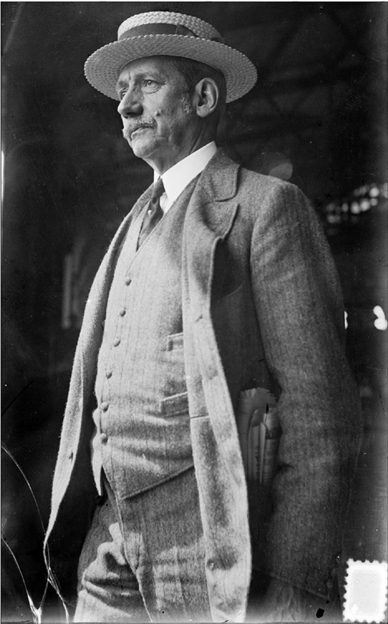
“ ‘SEVEN-EIGHTHS LAWYER AND ONE-EIGHTH MAN.’ ”
Senator Elihu Root. (photo credit i10.1)
But all these calculations were little more than chalk on a blackboard due to be dusted, rewritten, and dusted again when the Republican National Committee began its convention eligibility hearings early in June. Only two figures could not be erased: 1,078, the legal number of seats available to delegates, and 540, the number needed to nominate.

EVEN BEFORE THE RNC arrived in Chicago, it had decided to recommend Elihu Root, the Party’s most rational conservative, as chairman of the convention7. Roosevelt found himself in the painful position of having to oppose this choice, which boded well for Taft and ill for himself and La Follette. If Senator Root was acceptable to a majority of the delegates, he would influence the proceedings more than any other Party official. And the nature of that influence could be predicted.
“Elihu,” Roosevelt8 used to joke, “is seven-eighths lawyer and one-eighth man.” That had been in happier days, when Root served only his purpose. Now the legal construct had a new brief: to defend orthodox Republicanism at a convention under radical siege, and ensure the renomination of William Howard Taft.
Old friendship could not survive such a clash of interests. Roosevelt had to accept that Root, along with Henry Cabot Lodge and many other former political allies, must henceforth be a stranger to him. Or rather, he had become strange to them. They could not understand why he had rejected their advice not to run.
The issue of the chairmanship was forced by William Barnes, Jr., Taft’s principal tactician on the Republican National Committee. On 3 June9, he telegraphed all delegates elected to the convention, except those pledged to the Colonel:
I AM WIRING YOU IN BEHALF OF THE NEW YORK DELEGATION, WITH THE EXCEPTION OF A VERY FEW10, TO ASK YOUR SUPPORT FOR SENATOR ROOT FOR CHAIRMAN. WE BELIEVE THIS CONTEST IS THE MOST SERIOUS ONE WHICH HAS AFFLICTED THE REPUBLICAN PARTY, AND THAT THE ATTEMPT TO NOMINATE MR. ROOSEVELT CAN LEAD ONLY TO DISASTER.… WILL YOU PLEASE WIRE ME, NEW YORK CITY COLLECT, WHETHER WE CAN RELY ON YOUR SUPPORT FOR SENATOR ROOT FOR CHAIRMAN?
Thus goaded, Roosevelt announced that he would instruct his delegates to vote for Governor Francis E. McGovern of Wisconsin, a progressive sympathetic to both himself and Senator La Follette. “Root,” he complained11, “is simply the representative of Barnes in this matter.”
He relied on his organization in Chicago to seat as many as possible of his contesting delegates—potentially almost a quarter of the convention. Fifty more would make his bid for the nomination serious, and he hoped for 80 or 90. Assuming a minimum of 278 uncontested delegates from his primary victories, and another minimum of 133 non-primary pledges, his solid first-ballot strength was 411, with 540 needed to win. He therefore had to press another 129. There were 166 uninstructed delegates. Perhaps he could persuade enough of them to combine with his accreditees for a winning edge, however narrow.
Unfortunately, most12 of the uninstructed seemed to favor Taft. And so did a majority of the Republican National Committee.
ROOSEVELT COULD ONLY hope the Committee would be fair, rather than blacken the GOP’s already tarnished political image with a show of discrimination. Many of the delegates pledged to Taft were obviously fraudulent. To seat a decent number of progressive challengers would make for good public relations, and confound the RNC’s pro-Roosevelt minority. That group was dominated by William Flinn, Francis J. Heney, and Senator Borah of Idaho, an austere, brooding maverick who had once voted for Bryan. All were formidable men, determined to shame their opposing trio of senior reactionaries: Barnes, Boise Penrose, and W. Murray Crane.
Barnes, of course, was already the Colonel’s open enemy. “Big Grizzly” Penrose was Taft’s chief supporter on Capitol Hill, infamous for reactionary machine politics. He would be seeking revenge on Roosevelt and Flinn for recently unseating him as boss of the Pennsylvania GOP. Crane was a Yankee paper manufacturer, as stiff and traditional as his own business cards. As for the Committee chairman, Victor Rosewater of Nebraska, the best that could be said of him was that he was not a professional13 politician. Moderate, frail, and with luck, malleable, Rosewater might be receptive to arguments that progressivism was a social force that the Republican Party had to accommodate, or else cede to the candidacy of Woodrow Wilson. He was a key figure, since he would serveex officio as temporary chairman of the convention until giving way to either Root or McGovern.
The rest of the Committee14, apart from ten or so members friendly to Roosevelt and La Follette, consisted of about thirty-five Party regulars who served at the President’s pleasure.
ROOSEVELT CHAFED AT Sagamore Hill as the hearings proceeded alphabetically, state by state. On the first day, all twenty-four of his delegates from Alabama and Arkansas were barred from the convention, and on the second, his entire slate from Georgia. In electoral terms, those states counted for nothing. Still, the Committee’s bias against him seemed clear. Senator Dixon complained to reporters of “theft, cold-blooded15, premeditated and deliberate.”
For a while16, Roosevelt tried to maintain control of his representatives by long-distance telephone. But he hated the instrument and suspected it was being tapped. A private telegraph in the attic, a relic of his time as president, was even less satisfactory. He preferred the clicking of his own teeth in face-to-face confrontations, the feel of lapels gripped in his hand.
Behind his frustration lay the embarrassing fact—harped on in many newspapers—that about a hundred of the delegates he needed to seat were no more legitimate than the machine men on Taft’s list. The kind of progressives-for-hire rounded up by Ormsby McHarg would have sold themselves quite as willingly to the Socialist candidate for the presidency, had Eugene V. Debs reached them first. Roosevelt remained convinced, however, that bona fide claimants were being discriminated against. Asked by a reporter whether he intended to barnstorm the convention, he said, “If circumstances demand17, of course I’ll go!”
That was as good as a threat to the Republican National Committee, which proceeded to throw out18 all but 19 of his delegates, and seat 235 of Taft’s.
TWO FACTS WERE clear in the aftermath of the Committee’s action: first, that Roosevelt no longer had a credible chance of being nominated, and second (what he was prevented by blind rage from seeing) that most of the contests had been decided fairly. Perhaps thirty19to thirty-five had not. But there would have been as much bias in favor of himself, had Taft been the challenging candidate, and he the Party leader. An impartial observer20 might conclude that neither man had enough honestly elected delegates to nominate him.
All the same, Roosevelt21 had reason to accuse the Committee of being out of touch with current Republican sentiment. Penrose, Crane, Rosewater, and a dozen other members were themselves ineligible to serve as delegates, having been defeated in their home primaries. Ten further members hailed from Southern states in the grip of the Democratic Party, and four from “territorial possessions” (including the District of Columbia) that could not vote in November. These eunuchs, comprising more than two-thirds of the Committee, had power before the convention to defeat a candidate who was overwhelmingly the people’s choice.
“The Taft leaders22 speak as if they were regular Republicans,” Roosevelt said in an icy public statement. “I do not concede that theft is a test of party regularity.” He had never deluded himself that he could be elected in the fall, even if nominated in the spring. But the pugilist in him, so bruisingly evident on the stage of the Boston Arena, was now aroused beyond control. It was the phenomenon Root had seen coming: When he gets into a fight he is completely dominated by the desire to destroy his adversary. There was nothing23 for him now but to go to Chicago and beat the convention into submission—or else bolt through the ropes and precipitate a riot.
Specifically, Roosevelt intended to use his huge primary vote to persuade the Party as a whole not to ratify the exclusion of his delegates, and to accept that progressivism was a natural, desirable evolution of Republican doctrine. Root, whose gavel would probably determine the issue, sent out word that any attempt by the Colonel to rewrite convention rules would lead to “confusion and comparative24 anarchy.”
EIGHTEEN-YEAR-OLD Nicholas Roosevelt, one of the Oyster Bay cousins who had grown up as virtually a member of the Colonel’s own brood, visited Sagamore Hill on Friday, 14 June. He found Roosevelt25 unusually silent over breakfast, and “Cousin Edith” exuding frosty disapproval of whatever was brewing in the house beside coffee. Later, without saying why, she insisted on accompanying her husband into town.
“Well, Nick,”26 Roosevelt called out, as their automobile started down the driveway, “I guess we’ll meet at a lot of Philippics soon.”
This was a clear hint to the young man to pack his bags for Chicago—and maybe other cities as well. Nicholas was ardently interested in politics. Confirmation came by telephone at noon that Colonel and Mrs. Roosevelt were booked on the Lake Shore Limited, departing New York at 5:30 P.M. When Nicholas arrived at Grand Central, he found Kermit and two other cousins, George Roosevelt and Theodore Douglas Robinson, also ready to go. Word had also gone out to Ted and Eleanor (tired, now, of San Francisco, and keen to reestablish themselves in New York). They would travel to Chicago separately. So would Alice, to whom conventions were catnip. The New York party27 was amplified by Regis H. Post—rich, progressive, retired, a willing workhorse—two or threeOutlook staffers, and Frank Harper, the Colonel’s tiny English secretary. And like bees attracted to the sudden popping of a lily, newsmen swarmed to ride along.
For twenty-two hours the Limited puffed west. A hot damp inversion enveloped it the following morning as it crossed from Ohio into the industrial flats of Indiana. Roosevelt laid aside his current reading—Herodotus—and labored on the text of a speech that he planned to deliver in the Chicago Auditorium on Monday night, the eve of the convention. He declined to provide reporters with an advance copy, but told Nicholas it would be “the great effort28 of his life.”
In mid-afternoon29, the train stopped at South Bend, and the ubiquitous Cal O’Laughlin climbed aboard. He had an optimistic projection to deliver. According to campaign headquarters, some of Taft’s uncontested delegates were wavering. They had been recruited under pressure, and resented it. If they defected, the President would find himself four votes short of a majority on Tuesday.
This was a number easier for Taft to reduce than for Roosevelt to expand, but it caused the Colonel to bubble over with joy. He began to talk about winning rather than bolting—an act that should be considered “only in the very last extremities.”
At 4 P.M. he stepped down onto the platform of Chicago’s LaSalle Street station. He wore a new, tan campaign hat30 that said, louder than words, that the Rough Rider was back in the saddle. Its brim, fully five inches wide, failed to obscure the brilliancy of his teeth. A howling crowd broke through barriers erected by the police and surged so voraciously that Nicholas, George, and two other youths had to form a wedge around him and batter their way toward the station exit. Meanwhile, a band thumped out his old marching song, “There’ll Be a Hot Time in the Old Town Tonight.” Outside in Van Buren Street, the crowd was even larger and louder. Two other bands blared in Ivesian discord. A line of flag-decked automobiles stood waiting. Roosevelt hauled himself into the first, accompanied by Senator Dixon. The motorcade got under way with difficulty. As Nicholas recorded in his diary:
People packed31 the windows and lined the roofs and the elevated tracks and were so thick in the streets we could hardly move in the procession.… Everyone was howling with delight, and cries of “Teddy!” filled the air. At the cross streets, as far as we could see to either side, or back or forward, people were wedged in like pins. Everyone cheered. Everyone screamed. Everyone was hurled along in the irresistible force of the delighted mob. Ahead rode Cousin Theodore, bowing to right and to left.… Even now the thought of it makes shivers run up and down my back.
It was as if Chicago sought to emulate the welcome that New York had given Roosevelt on his return from Africa. The noise reminded one reporter of a boiler factory, with all the station bands following, and trumpets sounding ragtime riffs ahead. By the time he arrived at the huge Congress Hotel, the crowd was so dense as to be dangerous. But another protective wedge was waiting for him. Five large guards handy with their fists got him inside with minimal violence, preceded by yet another band. It played “Hail, Hail, the Gang’s All Here” until displaced by a large number of screaming suffragists. Roosevelt had no sooner found sanctuary in the hotel’s presidential suite than the crowd, resurgent up the stairs and jamming the corridor outside his door, drove him to climb through a window onto a stone balustrade overlooking Michigan Avenue. His grin reassured the thousands below that he was not about to jump.
Far to his left and right, a flotsam of faces swirled. The smoky, coppery sky seemed to press down on the city, concentrating its heat and noise. Waving his hat for quiet, he yelled in his high voice, “Chicago is32 a mighty poor place in which to try and steal anything.”
“And they better not try to steal anything from you!” somebody shouted.
“From us, you mean,” Roosevelt replied.
This caused a roar of delight. He pointed at a banner declaring that the California delegation was solid for him, in defiance of exclusions by the Committee. “California’s twenty-six votes are mine. They are mine, and they will be counted for me.”
“Hurrah for Teddy!” came another shout.
He leaned over the parapet, still holding his hat in the air. “The people have spoken, and the politicians must learn to answer or understand. They will be made to understand that they are the servants of the rank and file of the plain citizens of the republic.”
For several minutes, the cheering made it impossible for him to continue. Red-faced and sweating, he listed a few of the derelictions of the Committee. “It is a fight33 against theft,” he said again, “and the thieves will not win!”
With that, he climbed back inside. The crowd in34 the street dispersed, but a lone band kept playing as evening came on. Hotel guests unassociated with the Republican Party enjoyed little rest that night. In the Gold and Florentine banquet rooms, tabletop orators respectively barked the merits of Taft and Roosevelt to whoever would listen. “We are in danger of monarchy,” Boss Barnes bawled. “The country must be saved!” Groups of delegates roamed the corridors in long frock coats and black beaver hats, singing and shouting.
THE FERVOR OF35 the Colonel’s supporters—much more truculent, in scattered brawls and curses, than Taft’s or La Follette’s—reached its peak at 8:15 P.M. on Monday in the Chicago Auditorium. The immense, five-thousand-seat hall was packed to the doors, and could have been filled four times over with the multitude outside. Two hundred and fifty policemen struggled to keep Congress Street clear.
Roosevelt got only a short burst of applause when he strode onstage, after being introduced by Senator Borah. The audience was so eager to hear what he had to say that it fell silent almost immediately. Indeed, once he began talking, attempts by barkers to generate ovations were thwarted by hisses and cries of “Shame.”36 Addressing his listeners as “fellow Americans” rather than “fellow Republicans,” Roosevelt said that the fundamental issue at hand was moral. It transcended petty politics, and even the personal fates of a president and former president.
If the methods adopted by the National Committee are approved by the convention which is about to assemble, a great crime will have been committed. The triumph of such proceedings at the moment would mean the wreck of the Republican Party; and if such proceedings became habitual, it would mean the wreck of popular government. The actions of the Taft leaders … are monstrous, and they should be indignantly condemned by the moral sentiment of the whole country.
Before describing the “naked robbery” that had deprived him of “sixty to eighty” first-ballot votes, Roosevelt appealed to Senators La Follette and Cummins to release the forty-six delegates they controlled. His primary successes proved, he said, that he was the Party’s overwhelming popular favorite, and the only candidate strong enough to bring about social reform. “If I had not made the progressive fight … there would have been no substantial opposition to the forces of reaction and political crookedness.”
The last few words set him off on an overlong tirade against the Taft administration, its corporate beneficiaries, and political bosses. Reporters who had followed him over the past two years could scribble the catchphrases in advance: treason … conspiracy … the led captains of mercenary politics … the great crooked financiers … privilege in its most sordid and dangerous form … corrupt alliance between crooked business and crooked politics … an oligarchy of the representatives of privilege. William Jennings Bryan37(attending in his new guise as a syndicated columnist) looked bored. Roosevelt was imputing guilt by association to the RNC, which became the focus of his wrath for ignoring the message of the primaries.
“It is our duty to the people of this country to insist that no action of the convention which is based on the votes of these fraudulently seated delegates binds the Republican party or imposes any obligation upon any Republican.”
The last five words, full of implication of a bolt, earned Roosevelt his first standing ovation of the evening. Encouraged, he launched into an analysis of the Committee’s recent rulings that was so dense with numbers and labyrinthine in its arguments of conspiracy as to annoy anyone immune to his charisma. But there were few such unbelievers present. Almost in spite of himself, he moved from the particular to the philosophical. Conservatives, he said, “are taught to believe that change means destruction. They are wrong.… Life means change; where there is no change, death comes.”
By now the applause was thunderous. “I am never surprised38 at anything Theodore may say,” Edith remarked to Cal O’Laughlin, her face lit up with pride.
Again and again he declared that American society wished to transform itself. “The trumpets sound the advance, and their appeal cannot be drowned by repeating the war-cries of bygone battles, the victory shouts of vanquished hosts. Here in this city—”
He seemed about to identify Chicago as the civitas Dei. By now he had been orating for well over an hour, and Bryan looked ready to nod off. But a magnificent peroration was coming:
Assuredly the fight will go on whether we win or lose.… What happens to me is not of the slightest consequence; I am to be used, as in a doubtful battle any man is used, to his hurt or not, so long as he is useful, and then cast aside or left to die. I wish you to feel this. I mean it; and I shall need no sympathy when you are through with me, for this fight is far too great to permit us to concern ourselves about any one man’s welfare.… The victory shall be ours, and it shall be won as we have already won so many victories, by clean and honest fighting for the loftiest of causes. We fight in honorable fashion for the good of mankind; fearless for the future; unheeding of our individual fates; with unflinching hearts and undimmed eyes; we stand at Armageddon, and we battle for the Lord.
Never before had Roosevelt used such evangelical language, or dared to present himself as a holy warrior. And never before had he heard such cheering. Intentionally or not, he invested progressivism with a divine aura. Secular Republicans were repelled by the fanaticism of his followers39, and wondered which “Lord” the Colonel really had in mind to command his mythical army. A flyer circulated around Chicago, arousing much hilarity:
At Three o’Clock40
Thursday Afternoon
THEODORE ROOSEVELT
Will Walk
on the
Waters of
Lake Michigan
BARBED WIRE PROTRUDED from the bunting around the rostrum of the Republican National Convention when it opened in the Coliseum on Tuesday, 18 June. Nothing could have more graphically signaled the Party leadership’s desire to fortify itself against a hostile takeover. The surrounding platform, edged in red-white-and-blue, stood shoulder-high and was inaccessible from the floor. Anyone hoisting himself up onto it would get his hands and chest slashed by the wire. A stairway just wide enough to admit one man led up from the National Committee room below, and was guarded at top and bottom by security agents. Behind yawned a dry moat, twelve feet deep. A line of Chicago policemen was deployed facing the front row of seats, and others stood in a tight circle around the delegate enclosure. One of them told a reporter, “I am for Teddy41 and I don’t care who knows it.”
By the time42 the building opened its doors at 10:30 A.M., Henry James’s description of Roosevelt as “the mere monstrous embodiment43 of unprecedented and resounding Noise” was fully borne out. The bands that had44 greeted the Colonel’s arrival in town were amplified five times over by those of marching clubs escorting the various delegations. Other kinds of din, beginning with the first nervous knock of Victor Rosewater’s gavel45 at two minutes past noon, were clearly on the agenda, and set to build in a continuous crescendo through the nomination on Friday. One of the strangest, accompanied by whistles and screams of “Toot, toot!” was the spine-stiffening hiss of sheets of sandpaper scraped together. It was meant to express the conviction among Roosevelt Republicans that an organization “steamroller” was under way, intent on flattening their spirit of revolt.
But first46 came a bang of flashbulbs, as the delegates sat still for a group photograph. (Conspicuously missing, anywhere in the room, was the usual overhanging portrait of the President of the United States.) The brief glare illuminated 1,078 faces, only a few managing smiles. “It’s the last time the convention will look pleasant,” Rosewater said.
Contrary to rumors47, Roosevelt had not asked permission to attend. Edith and all his children represented him in a special box in the gallery. He remained at the Congress Hotel, looking, in Nicholas’s words, “fresh as an apple and rosy and happy as a child,” and monitoring the proceedings by means of a telephone line rigged through to his floor manager, Governor Herbert S. Hadley of Missouri.
Hadley, a calm48, fine-featured man of forty, cut an imposing figure on the floor. Although he had been one of the signers of the petition requesting Roosevelt to run, he was no radical, and enjoyed the distinction of having been eyed as a running mate by both major candidates. He engineered the day’s first surprise by taking the rostrum as soon as the official convention call had been read. “Mr. Chairman,” he said49 to Rosewater, “I rise to a question of information.”
William Barnes, Jr50., jumped up in shock from his seat with the New York delegation. Simultaneously, the President’s personal representative, former congressman James E. Watson of Indiana, rushed to the edge of the stage. Neither was able to stop Hadley from asking, in an easy sonorous voice, if the Committee had drawn up its temporary roll of the convention. If not, he had an alternative roll to offer. He was sure that the Committee’s draft included the names of certain delegates unacceptable to Roosevelt Republicans, and he moved that they be replaced by the names on his own list, which he felt the rank and file might prefer.
Rosewater overruled Barnes and Watson, who were protesting that the convention was not yet organized, and said that in the spirit of fairness, the governor would be allowed twenty minutes to argue his point. Hadley said51 that a substantial minority of the National Committee believed that the recent hearings had been manipulated. As a result, seventy-two usurpers were now sitting before him, “without any honest title to their seats.”
This was a focusing of Roosevelt’s assertion that “sixty to eighty” names on the draft roll were fraudulent. The latest52 New York Times estimate of Taft’s majority over him (contradicting O’Laughlin’s projection) was one hundred, at 466 to 566. If that was correct, the substitution of 72 progressive alternates would put him only two votes short of a first-ballot win, with plenty of time to round up a bunch of waverers.
Hadley stood no real chance of persuading the convention to set aside the National Committee’s roll in favor of his own. But he had cleverly cast doubt on the former before the convention had begun to develop its own will. He was also exploiting the fact, apparent to all who had mustered at Armageddon, that Roosevelt could win in November, whereas Taft could only lose. The forecast was based on the Colonel’s nearly one and a quarter million primary votes, and made more exciting by his palpable proximity to the Coliseum. Four-fifths of the spectators in the gallery, and (Hadley hoped) most people on the floor, were infused with a sense of a giant, available, reconciling personality.
“We contend,” Hadley said to loud cheers, “that this convention should not proceed with the transaction of any business until it either disproves the charges of fraud and dishonesty that have been made against this roll of delegates, or until it sustains those charges, and purges the roll.”
Watson again complained about improper procedure. He dropped the name of Elihu Root, in a clear hint as to whom Taft expected to succeed Rosewater on the podium. Hisses, sandpaper scrapes, and cries of “liar!” “thief!” “swindler!” rose over a roar of conservative approbation. At 1:30 P.M., Root and McGovern were announced as candidates for permanent chairman.
Tension at once mounted in the room. More than any newspaper tabulation, the vote on these nominations promised to show the President’s exact strength. The first speaker for Root, Job E. Hedges of New York, scored devastatingly by quoting Roosevelt’s own panegyric of some years before—“Elihu Root is the ablest53 man I have known in our governmental service … the ablest man who has appeared in the public life of any country in my time.” Progressives tried to mute the guffaws this aroused by shouting “Roosevelt! Roosevelt!” Hedges fended them off with mock weariness. “You need not hesitate to cheer Roosevelt in my presence. I cheered him for seven years, and I am just trying to take a day off, that is all.”
The debate that followed was vituperative, degenerating to personal abuse between rival orators. Almost forgotten, as they bellowed face-to-face and policemen raced down the aisles, breaking up fistfights, was the fact that there were more than two sides in contention. McGovern hailed from Wisconsin, Robert La Follette’s home state. In backing the governor for chairman, Roosevelt had counted on the senator to approve—and, in due course, release the Wisconsin and North Dakota delegations from their pledges.
A shock comparable to a sudden shower of ice therefore descended when, at the hottest point of the afternoon, a spokesman for La Follette announced that McGovern “did not represent the interests” of Wisconsin’s favorite son. Evidently La Follette was still furious at Roosevelt for entering the presidential race. After this, there was little any McGovern supporter could say except, weakly, that progressives would go home guilty if they voted for Senator Root.
“Cousin Theodore54 could be wrecked,” a dispirited Nicholas Roosevelt wrote in his notes of the session.
At 3:21 P.M. the temporary roll was called and voting proceeded, state by state and delegate by delegate, with crushing slowness. The only note of novelty in an otherwise dutiful recitation of partisan sentiments occurred when California took the floor, and for the first time55 in American history the clear voice of a woman registered a vote at a national convention.
Along with 23 of her progressive colleagues, Florence Collins Porter favored McGovern.
So, about three hours later, did 13 Wisconsin delegates irked by La Follette’s petulance. But the final count—558 votes for Root and 501 for McGovern—indicated that Roosevelt was still 49 votes short of the majority he needed in his quest for the nomination.
Meanwhile, the ablest public man he had ever known, in a previous life, mounted the rostrum and appealed for Party unity, to rows of emptying benches56.
WHEN ROOT GAVELED the delegates to order at 11:15 the next morning, Wednesday, 19 June, the Coliseum was so crammed that the Chicago Fire Department had to bar entry to further would-be spectators. “The unfinished business before the convention,” the chairman announced, “is the motion of the gentleman of Missouri.” He said that Governor Hadley and Mr. Watson had agreed that debate on the subject of substitute delegates would be limited to three hours, divided equally.
Hadley, elegant in57 a double-breasted, knee-length coat that he somehow carried off casually, spoke first, expanding on his remarks of the day before. He used language as strong as Roosevelt’s to describe the “naked theft” of convention seats by Taft delegates, but his manner was unprovocative and his response to every objection patiently polite. The odor of partisanship, lingering over the hall from the day before, cleared, and the convention grew calm. Even Barnes listened attentively as Hadley presented a declaration, signed by the progressive minority of the National Committee, that the validity of plausible claims for seats among the delegations of eleven states “should be determined by the uncontested delegates of this convention.”
Much of the respect accorded Hadley came from a general awareness that he was the Colonel’s potential running mate. Taft had wanted him too, until he became one of the governors asking Roosevelt to run. (In a sure sign that the President despaired of reelection, he had chosen to retain Vice President Sherman, who was moribund with heart disease.) “I do not know if a majority of this convention agrees with me upon the proposition that Theodore Roosevelt ought to be our candidate for President of the United States,” Hadley said to a round of applause. “But there can be no difference on the proposition in the mind of any intelligent man that his voice today is the greatest voice in the western world.”
A series of more provocative, fist-waving speakers took up the seating debate. The noise level of the convention began to rise. Senator Lodge’s son-in-law, Congressman Augustus Peabody Gardner of Massachusetts, was so exasperated by the threat of a progressive, Henry J. Allen, to unload “two hundred pounds” of documents disqualifying the Washington State delegation that he stood on a chair repeatedly bellowing, “Are you going to abide58 by the decision of this convention?”
“I will support59 the nominee on one condition,” Allen replied. Pandemonium broke out, and for some minutes he could not continue. He waited for quiet. “Upon the one condition that his nomination is not accomplished by fraud and thievery.”
Instantly every Roosevelt delegate60 in the hall, with the exception of a few from Illinois, was leaping and cheering. William Flinn emerged as a major loudmouth, hurling insults at Elihu Root. He punctuated them with jets of tobacco juice. The chairman listened with indifference, showing disapproval only when anyone tried to interrupt a reasonable argument. Root’s voice was not strong, and his orders had to be amplified by aides sprinting down the aisles with megaphones. But he projected such an air of chilly rectitude, in his morning coat and gray trousers, that usually it was enough for him to step to the front of the rostrum to restore order.
His fairness extended to stopping the clock between speeches, so that prolonged ovations could expend themselves. The hours dragged on. In mid-afternoon Hadley and Watson had an emergency conference and agreed, with mutual alarm, that the proceedings were on track to a deadlock. Unless the question of the seventy-two contested delegates was resolved, it could split the GOP—no matter whose name was placed in nomination. Watson, gray-faced, took the podium and declared, “The convention is not in a fit condition, neither is it in a fit temper … to judge intelligently upon any one of these contests.” He said that Governor Hadley was willing, on behalf of the Roosevelt forces, to allow all seating claims to be decided by the credentials committee.
That body was not yet appointed, but for the moment, Hadley was seen as the savior of the Party. Delegation by delegation, an ovation for him built up until observers in the press box stared at the sight of William Flinn and William Barnes, Jr., cheering in tandem. The demonstration was61 that rare phenomenon in a national convention, a spontaneous expression of emotion, and it went through several mood changes. For the first twenty minutes it was bipartisan, with the potential of whipping up into a draft of the governor as a compromise nominee. But then rhythmic cries of “Teddy, Teddy—we want Teddy!” developed in the uproar, like the drumbeat of a coming fanfare. Attention began to divert from Hadley on the floor to a pretty woman standing in a high gallery. She wore a white dress, with a bunch of pinks at her waist. Whatever mysterious force focused fourteen thousand pairs of eyes on her, she was thespian enough to revel in it. She blew kisses at the crowd, then, leaning over the balustrade, unrolled a portrait of Theodore Roosevelt. The noise became deafening. Unfazed, she began to yell, and proved to have the lungs of a Valkyrie. “Boys—give three cheers for Teddy!”
A golden bear materialized beneath her, in the shape of the mascot of the California delegation. She reached out and cuddled it as it rose on the top of a proffered totem, whereupon the poles of other Roosevelt delegations joined in and jiggled up and down in phallic rivalry. The woman in white vanished for a minute. When she reappeared on the floor, it seemed improbable that the Coliseum could contain more sound. She marched up the main aisle, flushed with excitement, followed by stampeding delegates in an unconscious parody of Delacroix’s Liberty Leading the People. As William Jennings Bryan watched from the press box, perhaps remembering a far-off day when he had stimulated almost as great a riot, she was hoisted giggling onto a shelf of shoulders and carried to the rostrum. Elihu Root tolerantly let her take control of the proceedings.
She did so without the aid of the gavel or megaphones, merely waving a long-gloved arm to increase or decrease the applause inundating her. When she again brandished Roosevelt’s portrait—looking rather tattered now—the cries of “We want Teddy!” broke out with renewed force. It took fifty minutes for the tumult to die down and for the woman to be coaxed, as gently as possible, back into her box.
Hadley rejoined Root and Watson onstage. His luster of an hour before had been much diminished. As Roosevelt’s floor leader, he had to regret that he had agreed to let the credentials committee decide the matter of the contested delegates. If his alternative list could have been resubmitted to the whole convention, at this moment of maximum affection for the Colonel, it would almost certainly have been approved, with Roosevelt cleared for nomination, and he generally accepted as the likely next vice president of the United States.
Under the circumstances, the best Hadley could do was persuade Governor Charles S. Deneen of Illinois to move that none of the seventy-two men whose seats were being contested should be allowed to participate in the election of members of the still-unconstituted committee. Nor should they be allowed to approve or disapprove the committee’s report, when it was issued. The morality of this was to prevent any possibly fraudulent delegate from voting on the rightness of his own case, or the cases of his seventy-one contested colleagues.
Watson countered by moving to lay Deneen’s amendment on the table.
By no flicker of expression did Root, gavel in hand, reveal that he recognized that the determining moment of the convention had arrived. He ordered a roll call on Watson’s motion. “That question is not62 debatable.”
Hadley tried to debate it anyway. “I wish to ask if the individuals whose titles to seats are here challenged are to vote upon this motion.”
“The chair will rule upon that question at the conclusion of the roll call.”
As the roll slowly proceeded, the heat of the demonstration went out of the room, and instinctual loyalties reasserted themselves. There were minor variations on yesterday’s vote—Wisconsin announced itself as “solid this time” against Taft—but at the end of the call, the President’s strength had increased by nine votes, to 567 over Roosevelt’s 507, with four abstentions.
It was small comfort to Hadley and Flinn that their candidate was now only thirty votes short of being nominated, since Taft could afford to lose plenty and still defeat the Colonel. And here was Root moving in for the kill. “No man can be63 permitted to vote on the question of his own right to a seat in the convention,” he said. “But the rule does not disqualify any delegate whose name is upon the roll from voting on the contest of any other man’s right, or from participating in the ordinary business of the convention so long as he holds his seat.”
Otherwise, Root pointed out, any minority could assure control of a deliberative body by bringing in enough rebels, under a surprise resolution, to transform themselves into a majority. He cited as precedent the procedural manual of the House of Representatives. Adopting Hadley’s motion implied that every seat in the Coliseum could be contested, “and there would be no convention at all, as nobody would be entitled to participate.”
As the realization spread that Roosevelt had no hope of seating any more delegates, his dispirited supporters in the galleries streamed out of the hall, not bothering to hear who had been appointed to the various operational committees. They knew now that the White House would control all agenda concerning credentials, permanent organization, rules, and resolutions.
THAT NIGHT THE WOMAN64 in white, identified as Mrs. W. A. Davis of Chicago, was brought to the Congress Hotel to meet the Colonel. He emerged briefly from his conference room, where urgent discussions were under way, and acknowledged her contribution. “It was a bully piece of work,” he told her, then hurried back inside.
Had he been under less nervous strain, he might have thanked her more profusely. But throughout the day65 Roosevelt had been resisting moves to get him to withdraw in favor of Hadley, or even La Follette or Cummins, along with blandishments to keep him from bolting. He said he would not give way to any candidate unless the temporary roll was purged. And he told some furtive Old Guard emissaries, offering him a face-saving number of delegates if he would stay in the convention, that under no circumstances could he subscribe to the renomination of William Howard Taft.
He seemed convinced that the President was personally responsible for every dubious name on the roll. Thugs every one of them, they had stuck together in vote after vote on the individual state and district slates, completing the organization of the convention and proving that crime did pay in Republican politics. Or so it seemed to Roosevelt, in his red rage against Elihu Root as a “receiver of stolen goods.”66 There could be no debate on the subject: his old friend was his mortal enemy. Having won the chair through the machinations of Rosewater, Watson, Barnes, and other unconvicted felons67, Root had shut out the legitimate delegates on Hadley’s list, all of them radiant with righteousness. Convention attendees who thought they had seen a solemn, impartial statesman on the podium were therefore subject to group delusion. Roosevelt did not need to have been there, or even listen down his telephone wire: he knew what venality68 looked and sounded like.
Party regulars and progressive rebels crammed his suite until well after midnight, alternately preaching loyalty and revolt. “I never saw69 the Colonel so fagged,” Henry Stoddard wrote afterward. “For hours, his fighting blood had been at fever heat.” At one point, Roosevelt sent for Edith and asked, “I wonder if it would be better for Hadley to head the Party.”
Her reply was unhelpful. “Theodore, remember70 that often one wants to do the hardest and noblest thing, but sometimes it does not follow that it is the right thing.”
The last of his visitors71 was Senator Borah, a man so divided that the cleft on his chin, lining up with his center part and frown, seemed to separate him into halves. He dragged Roosevelt into the bathroom and said, “This far I have gone with you. I can go no further.”
Borah made it clear that many progressives like himself would be loath to risk their political careers by bolting to a third party that might not last. Roosevelt emerged from the bathroom looking furious. But he was plainly wavering.
It was now nearly two o’clock in the morning, and the suite was almost empty. Would-be bolters had gone to the Florentine Room to hold a defiant rally against the GOP organization. Their cheers and oratory72 could be heard down the corridor. Three tired intimates remained: Stoddard, Frank Munsey, and George Perkins. They urged Roosevelt to go on with his fight.
“My fortune73, my magazines and my newspapers are with you,” Munsey said. Perkins pledged his own wealth.
Roosevelt’s moment of decision arrived when a delegation from the Florentine Room burst in to request that he present himself. He reached for his campaign hat and turned to Borah. “You see74, I can’t desert my friends now.”
When he arrived75 at the rally he found it consisted largely of progressive delegates with legitimate seats at the convention. Some of them, indeed, were appointees to the credentials committee, but had vowed not to serve, in solidarity with their banned colleagues. His reception was tumultuous.
“As far as I76 am concerned I am through,” he said. “If you are voted down,”—he was referring to the roll call on the committee report, expected later that day—“I hope you, the real and lawful majority of the convention, will organize as such, and you will do it if you have the courage and loyalty of your convictions.”
Roosevelt went on talking for several minutes, berating the callowness of the RNC and the perfidy of Senator Root, but nothing he said matched the impact of his opening statement.
After he left77 the room, Hiram Johnson jumped on a table and confirmed to dazed delegates what they had just heard. “Gentlemen.… We are prepared for the birth of a new Republican party which will nominate for president Theodore Roosevelt.” Gifford Pinchot thanked God. But Nicholas Roosevelt wrote in his diary, “I am depressed. It spells death.”
AS OFTEN ON the eve of some climactic battle, there ensued a period of uneasy calm78 in downtown Chicago, with no bands playing and traffic in the streets returning to normal. Convention officials announced a twenty-four-hour recess, purportedly because the various committees needed time to complete their work. The real reason was that Taft’s managers dreaded the coming bolt and were hoping that secessionist passions would cool.
If any sightseers were on hand that Thursday to watch the Colonel take his scheduled walk on Lake Michigan, they were disappointed. The weather was hot and damp. He spent most of the afternoon out of sight, conferring with intimates. Ominously, the Illinois delegation, which had been elected in the first great success of his primary campaign, announced that it was 56 to 2 against bolting. Four other states expressed similar qualms. Roosevelt was alarmed enough to issue a statement rejecting reports that he intended to march into the Coliseum and precipitate a riot. But he confirmed that he would bolt if it suited him, no matter how many cowards chose not to follow. “There will probably be a new national convention,” he said, “and we will then build up a new party.”
After that he was79 so much at leisure that he was able to spend four hours at dinner with his family and Munsey and Perkins. Timothy Woodruff, chafing under Boss Barnes’s iron control of the New York delegation, came over to report a threat from Mrs. Woodruff: “Timmy, if you don’t bolt, I’m going to Reno.”
“The crisis of the convention is at hand,” William Jennings Bryan wrote that evening.
It is no pleasant80 situation in which the ex-president finds himself, nor is it an ordinary situation. Twice chief executive of the nation, the second time elected by the largest majority that a president ever achieved; the recipient of honors in foreign lands and supreme dictator in his own party, he now finds the man whom he nominated and elected pitted against him in the most bitter contest that our country has ever seen, and he sees that opponent operating with a skill of a past master the very machinery which the tutor constructed and taught him to use.
There was no immediate resumption of hostilities when the convention opened for business at midday on Friday. But the report of the credentials committee served only to increase Taft’s majority to 605. This could not have been achieved81 without the defection of forty or fifty Roosevelt delegates. Significantly, the day’s warmest applause was for Bryan, when he lumbered in to take his seat in the press box. Old, bald, and Democratic he may have been, but at least he had once stood for a common cause. “If you don’t look out82,” a fellow correspondent joked, “the Baltimore convention will nominate you for President.”
“Young man,” Bryan said with mock sternness, “do you suppose that I’m going to run for President just to pull the Republican Party out of a hole?”
At the end of the day, it was obvious that the Taft forces were still playing for time, dragging out roll calls in order to exhaust whatever energy was left in the progressive opposition. By now, in any ordinary convention, the candidates should have been nominated. Root remarked, “Evidently there are delegates here who do not wish to go home for Sunday.” During the umpteenth83 procedural intermission, the band played “You’ll Do the Same Thing Over and Over and Over Again.”
THE ATMOSPHERE on Saturday84, 22 June, was different and dangerous from the start. Root gaveled the convention to order early, at 10:43 A.M., and at once the fake steamroller whistles shrilled, accompanied by accelerating, chugging puffs and a mocking cry of “all aboard.” The Roosevelt family85 box was noticeably empty, with only Alice sitting like Cassandra, sure of coming catas trophe.
She joined in86, however, when a group of delegates started chanting, “We want Teddy!” and “Roosevelt, first, last and all the time!” There was no fear of her father storming the hall and imperiling what was left of his presidential dignity. He had simply sent a message expressing the “hope” that his delegates would take no part in the nomination of a tainted candidate.
Since Hadley (secretly racked with tuberculosis87, and running a 103°F fever) had joined Borah in declining to bolt, the Colonel authorized Henry J. Allen of Kansas to read this message aloud. But to general frustration, there were four further hours of roll calls to endure before Root announced that the convention was ready to hear any statement the Roosevelt forces wished to make. Allen rose at 2:54 P.M. He said that all he needed was “ten minutes of quiet attention.”
What he got was forty-four minutes of such bedlam that for much of the time he could not be heard. But the pertinent88 phrases of Roosevelt’s message sounded clear, and were telegraphed simultaneously to ten thousand newspapers across the country: The convention [is] in no proper sense any longer a Republican convention representing the real Republican Party. Therefore, I hope the men elected as Roosevelt delegates will now decline to vote on any matter before the convention.
From then until shortly before six, when 343 of Allen’s fellow progressives boycotted the adoption of the platform, mutual hatreds seethed. At last Root ordered each state that had a presidential candidate to present its nomination, in alphabetical order. Iowa, home of Albert B. Cummins, was called first. There was no response, signaling that the governor would join the progressive bolt. An even more deathly silence followed the call for New York. The progressive delegate who would have risen to name Theodore Roosevelt remained in his seat. At four minutes past the hour, Warren Harding of Ohio spoke for President Taft, and delivered an attack on the Colonel that had clearly cost him many hours with a dictionary:
Sirs, I have heard89 men arrogate to themselves the title of “progressive Republicans.” … Progression is not proclamation or palaver. It is not pretense nor play on prejudice. It is not of personal pronouns, nor perennial pronouncement. It is not the perturbation of a people passion-wrought, nor a promise proposed. Progression is—
Harding ran out of plosives at this point, to the relief of the megaphone men, and went on to other alliterations. But in conclusion, he reverted to his favorite consonant, accusing Roosevelt of “pap rather than patriotism,” and elevating Taft to the “party pantheon.” His speech touched off a wild demonstration. Yet there was something fatalistic about the chants and portrait-waving. Everyone knew that the RNC had decided to field a losing candidate in November, rather than gamble on one who would radicalize its traditional platform.
After a last-minute attempt to swing the convention for Robert M. La Follette had been laughed down, Root asked the states to vote. The only disturbance to a droning succession of calls came when Massachusetts was polled, and two loyal Rooseveltians declined to vote, leaving the delegation evenly split. Root at once recognized their alternates, who happened to be Taft men, and a howl of rage90 arose, such as had never been heard in a convention before.
At 9:28 P.M., William Howard Taft was renominated with 561 votes. One hundred and seven of Roosevelt’s supporters carried out their primary instructions and voted for the Colonel. They stayed in their seats while 344 others declared themselves “present and not voting.” Then, as Root wound up the Fifteenth National Republican Convention, the bolters rose and went out into the night. They headed91, not for their hotel rooms, but for Orchestra Hall, where the galleries were already full and telephone and telegraph linemen were installing wires to broadcast the birth of a new party.
WILLIAM ALLEN WHITE was so intent upon reporting Taft’s nomination that he did not even notice where his colleagues from Kansas were going. Three hours later, having written and filed his story, he entered the Congress Hotel restaurant and found it filling up with late diners. One of them jovially accosted him.
“Why weren’t you92 over to Orchestra Hall?”
White said he had been busy.
“Well, you missed the big show.”
“What show?”
“Oh, we have organized the Progressive Party. Roosevelt made a ripsnorting speech, and the crowd tore the roof off and we are on our way!”
White struggled with conflicting emotions. Chagrin at being scooped was not the worst of them. He felt as he had93 in Boston earlier in the year, when the Colonel had talked to him and Judge Grant of il gran rifiuto, and they had tried to dissuade him from running. Willing as White was to join the bolt, he secretly feared that the neonate cause might smother in Roosevelt’s too-lusty embrace. Better for progressivism to fight and survive as a broad-based movement for social reform, drawing strength from both parties, than for it to be identified with one man’s obsessed mission.
The fight promised94 to be a long one—only getting under way, he thought, this year, with little chance of premature success. White admired Roosevelt so much that he could not bear to think of his hero being humiliated in November, as a certain consequence of splitting the Republican vote, just when the Democrats (already congregating for their convention in Baltimore) were so strong.
Here was the splitter himself, coming into the restaurant and asking in a teasing falsetto where White had been. Somebody who knew him less well would have seen only the exuberance of a man who had just worked up a crowd and been bathed in acclamation. White, however, noticed something more disturbing. Roosevelt was bent on revenge. “He was not downcast;95 indeed he was triumphant, full of jokes and quips as though the teakettle of his heart were humming and rattling the lid of his merry countenance. But rage was bubbling inside him.”
Elsewhere in the hotel, supporters of the President were disinclined to celebrate their victory. And from the far side of the divide that had opened up between the Colonel and the victims of his wrath came the sad voice of Elihu Root: “I care more96 for one button on Theodore Roosevelt’s waistcoat than for Taft’s whole body.”