

And what is this that comes and goes,
Fades and swells and overflows,
Like music underneath and overhead?
What is it in me now that rings and roars
Like fever-laden wine?
“MY PUBLIC CAREER2 WILL end next election day,” Roosevelt said to a visitor on the morning after Woodrow Wilson was nominated as the Democratic candidate for President.
It was 3 July 1912. For about a week3 he had been able to hope against hope that his decision to run as a progressive independent might return him to the White House. Although Wilson’s brand of progressivism was not radical, it had so agitated the Baltimore convention as to make the proceedings in Chicago look sedate. No fewer than forty-three ballots had been required to persuade Bourbon reactionaries that the governor was the best man to win a four-way race against Taft, Roosevelt, and the Socialist Eugene V. Debs4.
Roosevelt understood that, having encouraged progressives to leave the GOP, he ran the risk of many of them choosing Wilson over himself. The man looked like a winner: already there was a group that called itself the “Wilson Progressive Republican League.” A large majority of the country’s editors and commentators praised this new celebrity who had proved so effective a gubernatorial reformer. Wilson appealed to what Roosevelt called the “rural tory” element, opposing, for example, recall of judicial decisions, while tacitly catering to the anti-Negro prejudice5 that was a powerful, if unstated, aspect of progressivism. The white, corn-fed Midwestern farmers, small businessmen, professionals, and middle-class moralists who largely composed the movement’s membership did not subscribe to the lynch mentality of Dixie Democrats. But neither did they think blacks were good for much more than field labor. Word had gotten out6 that the Colonel favored the idea of a Negro delegate to second his nomination when the new party established itself. Veteran politicians recalled him attending his first GOP convention in 1884, and pushing for the election of a black chairman. One could not imagine Wilson, born in Virginia and bred in the South, carrying democracy quite that far.
Another factor against Roosevelt’s chances of success was the lack of nerve among GOP progressives in retreat from Armageddon. Four of the seven governors7 who had petitioned him to run in February now declined to support him. Chase Osborn of Michigan had come out as a Republican for Wilson, railing against “malcontents” seeking to destroy the two-party system. Herbert Hadley wrote that as the head8 of the Republican party in Missouri, he would have to be “thoroughly convinced that it had ceased to be a useful agency of good government before I abandoned it and joined in the formation of a new party.” He argued that the local machinery was “in the hands of progressives” anyway. As for veterans9 of the Progressive Republican League, Jonathan Bourne had answered his own question (“If we lose, will we bolt?”) in the negative, while Robert La Follette, who could have followed Roosevelt out and then challenged him for the leadership of the apostates, elected to stay put and support Wilson. Eight other former insurgents, including Senator Cummins, sent regrets, saying they did not want to lose all power in their states.
In short, the nascent Progressive Party10 (it was not yet formally organized, and must stage its own convention as soon as possible) was already fighting for life. Money it had, and plenty of political passion left over from “the big show” in Chicago, but its frailties were obvious. Chief among these was a lack of ideological unity—not only between intellectuals of the Herbert Croly stamp and petty bosses like William Flinn, but between city men and hayseeds, suffragists and social workers, temperance advocates and the Irish, muckraking journalists and self-made millionaires. Had Wilson not11 been nominated, Roosevelt might conceivably have managed to compress all this dissent into one hot mass of energy. Now he saw that he had no choice but to lead a quixotic campaign on his own principles.
He left his Sagamore Hill guest, E. A. Van Valkenburg, alone for a moment, and went to fetch Edith. When they returned, he asked her to say what she thought.
“She was quite radiant12 with trust and affection,” Van Valkenburg reported, “as she expressed her faith that the path through honor to defeat was the one to take.”

IN CHICAGO, EDITH had given off such waves of foreboding, as she sat quietly knitting amid the tumult around her, that she reminded William Allen White of Madame Defarge—“weaving the inevitable13 destiny ahead of us out of the yard and skein where it had been wound by the hand of some terrible fate.” Since then, evidently, she had reconciled herself to the idea of Roosevelt’s crusade—a word that was often on the lips of his family and followers these days. Protestant for the most part, and not a few of them puritanical in their ardor (Edith herself was a descendant of Jonathan Edwards, the New England divine), they saw themselves as a persecuted minority, bound to grow stronger as their numbers diminished.
Her radiance, remarked on by other visitors as well14 as Van Valkenburg, may indeed have been a matter of idealism. But there was also the thought that Theodore’s retirement from politics, so distressingly interrupted, must surely become permanent after November.
The Roosevelt children15 reacted to the coming campaign with varying degrees of excitement and fear. Alice was torn, even more than in 1910, between loyalty to her father and dread that her husband would be swept out of Congress on Taft’s coattails. She did not think she could stand any more of “Cincinnasty” than she already had to endure.
To the puzzlement16 of many of her own relatives, Alice adored everything about Nicholas Longworth except his willingness to serve the President. His baldness, his boozing, his lust for other women—she had taken them on when she married him, and found them perversely attractive. She had even come to like the kind of echt German chamber music he played with some of his friends (usually on first violin: behind the Midwestern swagger, a gifted musician lurked). “Darling Nick, I love him so much.” But for all her floaty, expensive clothes and party chat, Alice was as political as a ward heeler. Progressivism meant little to her as a cause. It was simply a platform that her father had chosen to run on, and in any race, she was for him “first, last and always.”17
Representative Longworth’s position18 was an agonizing one. He had come to share many of Roosevelt’s beliefs. But his political ties to Taft were so old, and so intertwined with those of friendship between their respective clans, that bolting the Ohio Republican party was simply not an option for him. Alice—pale and coughing, existing mainly on fruit and eggs and Vichy water—suffered along with him, finding it difficult to contain her fury against the bile his mother and sister showed toward the Colonel. If Nick lost his seat in Congress, she saw little in his future but more alcohol, and more women.
Ted was an ardent19 progressive who had learned much by working to elect Hiram Johnson as governor of California. In Chicago he had been ubiquitous at planning sessions for the new party. Recently hired as a bond salesman for the New York banking house of Bertron, Griscom & Co., he was staying at Sagamore Hill until he and Eleanor could find a house in the city. This gave him an inside position to observe the workings of a presidential campaign. But he soon found out that the name of Theodore Roosevelt did not help him sell many bonds on Wall Street.
Kermit had no interest in politics. His new Harvard degree and Porcellian circle of acquaintance promised him a charmed entry into the world Ted prized—clubs, banks, lunches, squash courts, smokers, balls. But Africa had left an ache in his heart for the Land of Beyond20. His parents had made it clear to him, as to all their children, that they could not afford to support adult dependents. So if he wanted the career of a gentleman adventurer, he was either going to have to do it on salary, or find himself a rich wife. Kermit had already made overtures in both directions, securing a job with the Brazil Railway Company, and courting Belle Willard, daughter of the owner of a chain of Southern hotels. The girl’s financial expectations were rosy, but to distress at Oyster Bay, her parents were Democrats. So far, fortunately, Belle had not given Kermit much encouragement. He was due to sail21 for South America in a matter of weeks, and would see if she pined for him.
Ethel would, at any rate. For the last couple of years, brother and sister had been inseparable, swapping their favorite poems, united in their disapproval of Ted’s “fast” way of life. A sedate and colorless moth in contrast to butterfly Alice, Ethel was being wooed by a thirtyish surgeon22, Richard Derby. His job—not an easy one at the moment—was to convince her that life away from her father was worth living. Roosevelt was touched by her devotion, and aware of the desperate shyness that made her cling to him. “How is my sweet23 little apostle?” he would tease, enfolding her in bear hugs. Ethel was a devout churchgoer who had been overwhelmed, in Chicago, by the fervor of his followers. “Oh Dorothy,”24 she told a friend about the post-bolt meeting, “every person in that hall felt as if it were the Holy War—and they crusaders.”
Archie had little patience25 with holiness, but he loved the sound of the word war. Through dogged self-improvement he had managed to conquer his learning disabilities and beat back ill health, much as his father had done in the summer of ’76. “His frail-looking body,” Roosevelt noted approvingly, “has a certain tough whipcord-like quality to it.” Terse and touchy, Archie would have liked nothing better than to enlist with firearms in the “battle for the Lord”—perhaps at the side of his hero, U.S. Marshal Seth Bullock. But a remedial term at Phillips Academy in Andover awaited him in the fall, and he must cram his slow brain for that.
Quentin was still boy enough to enjoy the political activity at Sagamore Hill (daily delegations, a constant racket of typewriters and telegraphers, reporters camping out on the lawn) without any curiosity about what, exactly, was going on. In an affectionate pen portrait written that summer, his father described him as “tranquil, efficient26, moon-faced and entirely merry … busy about affairs which mostly have to do with machinery.”
ROOSEVELT SEEMED A relieved man after the catharsis of Chicago. He had lingered there long enough to transmute what was left of rage into momentum, declaring, “I’m feeling like27 a bull moose.” Cartoonists seized upon the image with joy, and a new political animal, all teeth and antlers, pranced onto the pages of a thousand newspapers, shouldering aside the elephant and the donkey. Gifford and Amos Pinchot and other serious souls might insist that they were at work on the constitution of the Progressive Party, but to popular perception it was already the “Bull Moose Party,” and “Teddy” a rambunctious critter.
For as long as he stayed home, however, recuperating after his strenuous spring, Roosevelt’s behavior was tame. He made a few mild complaints about the “miserable showing” of his lost supporters. Yet Governor Osborn wrote28 to apologize and explain, he was forgiving, and hinted that he might have supported Wilson himself, were it not for the reactionary bosses behind the Democratic Party’s promises of social reform. Senator Dixon, reappointed as his campaign manager, could only hope that the velvet on the Bull Moose’s antlers would soon wear off.
“I suppose that29 as we grow older, we naturally lose the natural feeling of young men to take an interest in politics just for the sake of the strife,” Roosevelt wrote the British novelist H. Rider Haggard. That did not make him any less keen to fight for distributive justice. His challenge over the next four months, he felt, was to convince a majority of the American people that he was not personally ambitious. “The great bulk of my wealthy and educated friends regard me as a dangerous crank.… But all this is of little permanent consequence. It is a fight that must be made, and it is worth making; and the event lies on the knees of the gods.”
ON 7 JULY30, DIXON issued a formal call for delegates of the new party to convene in Chicago in the first week of August. The publication of this letter forced Roosevelt to confront an almost insoluble political dilemma. After being nominated by the convention (a foregone conclusion), he would be expected to campaign across the country on the Progressive Party ticket. Yet what was the sense of running on such a ticket in states where a majority of “Roosevelt Republicans” were sworn to support him? He would in effect be asking these loyalists to follow him out of the GOP, and give up their local power and affiliations.
How, though, could he claim to be the leader of a new national party unless it had a full ticket in every state? Lack of local and federal candidates would fatally weaken it in regions where Taft or Wilson were strong. And his own campaign would look like a search for glory, rather than leadership of a popular upsurge.
In weighing this and other tactical problems before the convention, Roosevelt turned less to the Pinchot brothers than to a man identified with everything they despised: big-business, laissez-faire, monopolistic capital. George Walbridge Perkins—fifty years old, flush with the proceeds of a fabulous career at the House of Morgan—was a convert to the cause of progressivism. He had surpassed Frank Munsey as the Party’s biggest bankroller31. To old-money liberals like the Pinchot brothers, there was something suspect about a nouveau riche altruist declaring that he had the welfare of the people at heart. “Roosevelt has the right32 idea,” the historian Frederick Jackson Turner commented, “but if he keeps Mr. Perkins as his chef, he is likely to have to take his omelet with Mr. Morgan’s spoon instead of the people’s spoon.”
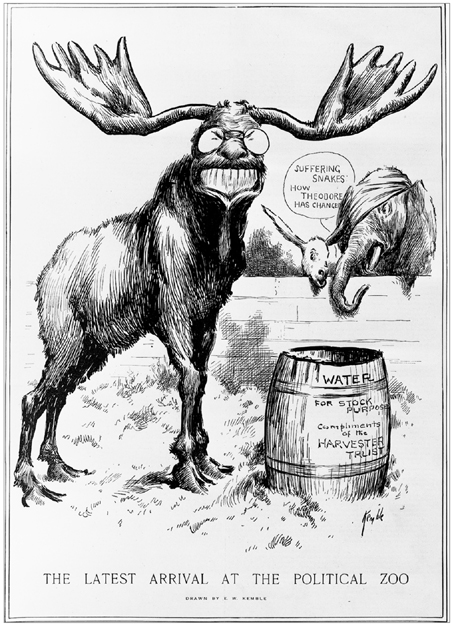
“A NEW POLITICAL ANIMAL, ALL TEETH AND ANTLERS.”
Roosevelt emerges as a third-party candidate for the presidency, summer 1912. (photo credit i11.1)
Conversely, it was difficult for small-town Midwesterners such as William Allen White to believe that Perkins—so sleek, so at ease entertaining on his palatial estate overlooking the Hudson33 River—had started out as an office boy in Chicago. He had come34by his millions through adroit corporate climbing, up through the executive ranks of insurance and banking companies to the top echelon of some of the world’s greatest conglomerates, including U. S. Steel. For well over a decade this rise had coincided, not always harmoniously, with that of Theodore Roosevelt.
If anything had converted Perkins, fully and finally, to the progressive cause, it was the Colonel’s famous blast against the Taft administration for finding fault with the merger of U.S. Steel and Tennessee Coal & Iron. He believed, with Roosevelt, that there should be an entente between socially responsible entrepreneurs and a powerful, yet non-prosecutorial, government.
Exquisitely undertailored35, in custom clothes that favored shades of gray and white, Perkins was a slender man with a trim, soft mustache and a soft voice. He smiled often, and was in constant motion even at rest: toe-tapping, thumb-flicking, black eyes snapping. The pudgy little White envied the drape of his mohair suits, while Gifford Pinchot despaired of ever being able to make Roosevelt laugh the way Perkins did. Behind their jealousy, however, lay an honest concern. They wondered if his real cause was not Roosevelt, but regulatory policy. If he ever became Secretary of Commerce, champagne would surely foam in a thousand corporate boardrooms.
Deep down, Roosevelt preferred the society of sophisticates (Perkins was “George,” White always a surname36), as long as they embraced the values of the middle class. Perkins shared his own cheerful nature and freakish ability to be both fast and thorough in dispatching great quantities of work. There was no question as to who should become the chief executive officer of the Progressive Party.
Pinchot, White, and Hiram Johnson, respectively burgeoning as leaders of eastern, central, and West Coast delegations to the convention, worried less about this than about Perkins’s influence on the drafting of the Party platform. He was heard to say that competition in the marketplace was a waste of energy. To White, that sounded37 like a trust lord talking. It would be a cruel irony if Roosevelt allowed the platform’s antitrust plank to be edited by this silky-smooth, check-writing ambassador from Wall Street.
ONE OF THE REASONS38 the Colonel liked Perkins was that they could talk about things other than policy, unlike the “moonbeamers,” as Frank Munsey called ideologues of the far left, obsessed with social and economic theory. Roosevelt himself was so bored by some of the doctrinaires who droned around him through the first week of August that he would excuse himself and sneak off somewhere with a novel, until retrieved and reprimanded by his wife.
He had plenty of patience, however, for crucial discussions, choosing eventually to run on “a straight-out progressive ticket” in most states of the union. Excepted only were39 those in the hopelessly reactionary South, Wisconsin as the pocket principality of Senator La Follette, and six Republican states (Maine, West Virginia, South Dakota, Kansas, Nebraska, and California), progressive enough to have voted for him already. Elsewhere, he felt the third-party ticket would give him a chance to cut into Wilson’s support.
More than that, he wanted to cut into Taft’s. He would show no mercy for the entire Fagin’s den who had ganged up on him in Chicago. “I regard40 Taft as the receiver of a swindled nomination,” he wrote Van Valkenburg. “I cannot consent to do anything that looks as if I was joining with him. I won’t go into a friendly contest with a pickpocket as to which of us should keep my watch which he stole.”
AS THE CONVENTION loomed nearer, Roosevelt had to decide a moral issue that, agonizingly for him, related to the cause of his departure from the party of Abraham Lincoln. It concerned the right of certain delegations to attend a national convention over the claims of others. Except that this time, the rivals were all for him, and all hailed from Southern states41. They differed only in that some were white and some black.
Since he personified the Progressive Party, his opinion in the matter would define its larger attitude to the question of race. A firm, yet compassionate statement would, he hoped, offer voters an alternative to the Democratic Party’s “lily-white” philosophy, and the Republican Party’s sectional mix of tolerance and exploitation on either side of the Mason-Dixon Line.
Such a statement would help clarify his racial views42, which had confused many people over the years. Was he still, to white Southerners, the “coon-flavored” President of 1901, who had wined and dined Booker T. Washington? Or was he rather the reactionary commander in chief of 1906, who had dishonorably discharged a whole Negro regiment in Brownsville, Texas, on trumped-up evidence of rioting?
In his own mind, Roosevelt was a fair man, inclined neither to patronize nor sentimentalize those darker and poorer than himself. He was proud of having fought to elevate blacks to federal office as President, and if the number was small, it was better than Taft’s deliberate score43 of zero. He had appointed an anti-peonage judge in the South, and been the first chief executive ever to speak out against the “inhuman cruelty and barbarity”44 of lynching. Brownsville was the one race-related incident in his career that might be ascribed to prejudice. But even then, he had prejudged only in the sense that he had been too quick to uphold an army investigation of the case.
Without exception, black people who knew him, from Dr. Washington down to James Amos, his valet, found his goodwill to be sincere, and never more so than when they advanced themselves by their own efforts—some farther, in the relative scheme of things, than he with all his privileges. Yet stray observations45 over the years had revealed him to be enlightened only in contrast to those of his peers who were outspoken in their xenophobia. Associating with such friends, he was as inclined to agree as disagree, assuring the novelist Owen Wister that blacks were “altogether inferior to the whites,” and the historian James Ford Rhodes that the Fifteenth Amendment had been “bad policy,” and the elephant hunter Quentin Grogan that if he could eliminate every Negro in America at the touch of a button, he would “jump on it with both feet.” Or so they chose to remember.
Roosevelt was struck by the extremes of advice he was now getting on the race question, from visitors and correspondents who all assumed he was their soul mate. Some wanted the Progressive Party to be exclusively white; others, segregated. He wondered if he could not persuade the former element—concentrated in the Old Confederacy—that he posed no reconstructive threat. If so, many of those who found Wilson’s brand of progressivism attractive might find his more so. To break up the “solid” Democratic South, with its 126 electoral votes, would stamp his campaign as truly revolutionary.
He decided to publish an open letter on the subject, and addressed it to Julian Harris, son of the Georgian folklorist Joel Chandler Harris.
“We have made46 the Progressive issue a moral, not a racial issue,” he wrote. “I believe that in this movement only damage will come if we either abandon our ideals on the one hand, or, on the other, fail resolutely to look facts in the face, however unpleasant these facts may be.” One fact was that Southern Democrats would never be wooed if their most unifying neurosis was threatened. “Our objective must be the same everywhere, but the methods by which we strive to attain it must be adapted to the needs of the several states, or it will never be attained at all.”
He noted that47 in a broad swath of the North, extending from Rhode Island west to Illinois, as well as in Maryland, the Progressive Party was already selecting black officials and delegates—acting “with fuller recognition of the rights of the colored man than ever the Republican party did.” In the South, however, it was confronted with the phenomenon that over forty-five years, “colored” and “Republican” had become synonymous terms. That was to say, Southern Negroes had been persuaded to trade disenfranchisement for the privilege, and cash profits, of sending representatives to Northern Republican presidential conventions. Roosevelt did not have to reach back any further than last June to cite the venal, “rotten-borough” black delegates who had stood by in Chicago while the RNC “defied and betrayed the will of the mass of the plain people of the party.”
In view of this ugly record, he felt that the Progressive Party would be doomed if it “prostituted” itself at the outset to Southern politicians of color.
The machinery does not48 exist (and can never be created as long as present political conditions are continued) which can secure what a future of real justice will undoubtedly develop, namely, the right of political expression by the negro who shows that he possesses the intelligence, integrity and self-respect which justify such right of political expression in his white neighbor.
We face certain actual facts, sad and unpleasant facts, but facts which must be faced if we are to dwell in the world of realities and not of shams.… I earnestly believe that by appealing to the best white men in the South, the men of justice and of vision as well as of strength and leadership, and by frankly putting the movement in their hands at the outset, we shall create a situation by which the colored men of the South will ultimately get justice as it is not possible for them to get justice if we are to continue and perpetuate the present conditions.
MANY OF THE Progressive49 delegates converging on the Chicago Coliseum on Monday, 4 August, could be excused a sense of déjà vu, having been there as Republicans only seven weeks before. Once again the streets reverberated with bands, straw-hatted politicos strode along arm in arm, and flags bedecked the enormous turreted building on Wabash Avenue. Again Roosevelt established himself in the Congress Hotel, at the end of the same telephone line through to the convention floor. Except now, the only suspense was over whom he would pick as his running mate.
Further differences were apparent inside the Coliseum. Barbed wire no longer50 spiked the rostrum. Bright red was the prevailing color, save for scores of Stars and Stripes hanging from high rafters, interspersed with mysterious bags of white cotton. From opposite ends of the hall, a giant stuffed moose head and an oil-painted Roosevelt exchanged comradely stares.
In June, the prevailing mood among delegates had been sour and fractious. Now all was unity and exaltation. The semi-religious glow51 that had infused the bolters then, with Hiram Johnson declaiming, “Our work is holy work,” warmed into flame as the New York delegation, led by Oscar Solomon Straus, marched into the hall singing,
Onward, Christian soldiers, marching as to war,
With the cross of Jesus going on before.
The record size52 of the convention (two thousand delegates and alternates, representing every state in the Union except South Carolina) astounded political reporters aware of the difficulty of organizing a new party in less time than corn took to grow. A sense of mass belonging thrilled the delegates themselves, many of whom had suffered, back home, the obloquy of heresy. Squads seating themselves under the banners of New Hampshire and Maine were encouraged by the sight of others in Western sombreros, or the white starched suits of Mississippi and Florida. All could be excused the delusion that Progressivism (at last styled with a capital P) was strong everywhere in the country, unified behind the most formidable campaigner in American history. Their common accessory was a red bandanna, tied around the neck in Rough Rider style—“common” indeed to observers who associated red with the rise of the proletariat.
Yet there was nothing lumpen about these Progressives, no representation of the poor-white element seen at Democratic conventions. They were scrubbed53 and prosperous-looking, well dressed and well behaved, churchgoing, charitable, bourgeois to a fault. Even the cigar-chomping Boss Flinn of Pennsylvania took care to spit sideways, so as not to stain his immaculate clothes. William Allen White surveyed the crowd and saw the sort of people he wrote for in the Emporia Gazette. He figured that there was not a delegate on the floor making less than two thousand dollars a year, or more than ten thousand—with a few conspicuous exceptions, such as George Perkins, “spick-and-span, oiled and curled like an Assyrian bull.”
White was struck54 by how many women he saw in the delegate rows, looking as businesslike as possible in their frilly shirtwaisters: female doctors, lawyers, teachers, and community activists. Not a few were in their early twenties—“rich young girls who had gone in for settlement work.” All seemed to take it for granted that the Progressive platform would recognize universal woman suffrage.
The social pioneer Jane Addams, founder of Chicago’s Hull House project and arguably the most famous woman in America, entered to reverential applause, a Bull Moose badge on her breast. She took her place in the front row of the VIP enclave, to the joy of officials who had feared she might stay away. Roosevelt’s decision not to seat Southern black delegates had disturbed her, and she had pleaded in vain with the provisional Party Committee to modify it. She was also a pacifist, and thought that the Colonel was too fond of battleships55. Only the overriding importance he attached to social reform persuaded Miss Addams to support him rather than Wilson. She had agreed56 with some reluctance to second his nomination.
The convention came to order at 1:40 P.M., with an opening prayer57 remarkable for the loudness of its “Amens.” Then Albert J. Beveridge mounted the rostrum, a short, handsome figure dwarfed by a yellow soundboard that hung above him like an airfoil.
The former senator58 had to get things going with a keynote address that would compensate for the absence of the one man everybody wanted to see. Roosevelt had in fact wanted to make a brief, inspirational appearance after the first fall of the gavel. But Beveridge, a narcissist of the purest bloom, had demanded the afternoon’s headlines to himself. He was then prepared to act unflamboyantly as chairman of the convention.
Roosevelt could not argue against the wisdom of giving a better speaker than himself a chance to articulate the basic tenets of Progressivism—in a voice more silvery, with gestures less punchy. Back in the days of McKinley59, Beveridge had won fame as a boyish, golden-haired prophet of America’s imperialistic destiny. Now he was older, darker, and less jingoistic, but still full of frustrated ambition. He had agonized for a long time about leaving the Republican Party, aware that he might never again represent Indiana in Congress. His ego60, however, could not resist this new opportunity to be an oracle.
He spoke for an hour and a half, beginning with a rhythmic affirmation of the Progressive creed: “We stand for61 a nobler America.… We stand for social brotherhood as against savage individualism. We stand for an intelligent cooperation instead of a reckless competition.… Ours is a battle for the actual rights of man.” The Party, he said, had been gestating for years, as ordinary Americans of all political persuasions grew to resent special-interest rule, “the invisible government behind our visible government.” He called for the reforms that Roosevelt had itemized at Osawatomie and elsewhere—direct primaries, direct election of senators, the initiative, referendum, and recall—arguing that popular rule would alleviate bossism, social insecurity, worker abuse, and the oligarchical concentration of wealth. America was blessed in being prosperous and thinly peopled, but cursed in making a cult of selfishness. “The Progressive motto is, ‘Pass prosperity around.’ ”
Vigorously, his fine eyes glowing, Beveridge also inveighed against child labor, neglect of the elderly, and sex discrimination. The Party, he said, demanded that women be paid as much as men. What was more, “Votes for women are theirs as a matter of natural right alone.” At this, the convention exploded. Delegates of both sexes clambered onto their chairs and shouted approval. Jane Addams controled her emotions, but her face was triumphant. Even men were seen wiping away tears everyone sang “The Battle Hymn of the Republic.”
“It was not a convention62 at all,” a New York Times reporter wrote that night. “It was an assemblage of religious enthusiasts.”
ENTHUSIASM BECAME ECSTASY63 the following day, when Theodore Roosevelt materialized beneath the yellow airfoil. No presidential candidate had ever before attended a national convention. For fifty-eight minutes he stood grinning as the Coliseum shook with noise.
At least ten thousand people flooded the floor in a red tide of bandannas. Hats encircled with rings rose on the ends of canes. Two black Northern64 delegates climbed onstage, and Roosevelt gratefully reached out for them. They huddled with him as he talked and gesticulated, his words inaudible a few feet away. Then one pounded him on the shoulder, and for a moment the trio stood hand in hand, to roars of applause and imitation moose calls.
Jane Addams mounted in her turn. As she posed beside the Colonel, the band struck up “Onward, Christian Soldiers.” Roosevelt led the singing65, both arms held high.
Like a mighty army moves the church of God,
Brothers, we are treading where the saints have trod.…
The hymn was not quite to Miss Addams’s taste. But its tune was impossible to resist, and not all the words embarrassed her:
We are not divided, all one body we—
One in hope and doctrine, one in charity.
“I have been66 fighting for progressive principles for thirty years,” she said as she descended from the platform into a sea of well-wishers. “This is the biggest day in my life.”
The celebration went on and on. Eventually Roosevelt was left alone onstage, bowing to the crowd. Senator Root’s mocking prophecy67 appeared to have been fulfilled: He aims at a leadership far in the future, as a sort of Moses and Messiah for a vast progressive tide of a rising humanity. His smile betrayed68 a hint of alarm, as if he was bewildered by the religiosity that surged around him. Vitality he had, and passion too, for earthly attainments and even abstract ethical aims, but he could not abandon himself to this communal rapture. The crowd was unlike any other he had seen before, chaotic in its variety.
Here, waving bandannas, were former Democrats like Judge Benjamin B. Lindsey of Colorado, a power in the juvenile court movement, Raymond Robins, a wealthy labor activist, Don Dickinson, postmaster general under President Cleveland, and Bourke Cockran, the legendary orator of Tammany Hall. Senators Dixon, Poindexter, Clapp, Bristow, and Norris represented the Republican insurgency of recent years. James Garfield, the brothers Pinchot, and other “moonbeamers” were in transports at finding their long-planned third party an actuality. The sculptor Gutzon Borglum and the novelist Winston Churchill were prominent in the Connecticut and New Hampshire delegations. Ambitious young intellectuals included the lawyer Felix Frankfurter, the essayist Walter Lippmann, Judge Learned Hand of New York, and Harold L. Ickes, a Chicago municipal reformer. Academics not normally inclined to prance and sway with party bosses brandished the same signs as Boss Walter F. Brown of Ohio and “Tiny Tim” Woodruff of Brooklyn (dazzling in white flannel, as if to advertise his conversion from Republican orthodoxy). Suffragists, political scientists, social theorists, lapsed priests, and exponents of Adlerian ethical culture looked forward to hearing Roosevelt address their respective causes.
It said something69 for his range of acquaintance that he knew hundreds of these people by name. Many of them, in turn, knew him from his past lives. Professor Albert Bushnell Hart of Harvard remembered him as a reed-thin freshman, punching the air in a student demonstration for “Hayes and Honest Ways.” Joe Murray and Isaac Hunt had witnessed his baptism in the New York Republican Party—and now his apostasy from it. Sylvane and Joe Ferris, Bill Merrifield, and George Myers, his former ranch partners and Badlands buddies, were in attendance as excited delegates half inclined to shoot out the lights. Present too was the ubiquitous Seth Bullock, who thought Armageddon was a town in Oklahoma. The veteran civil service reformers William Dudley Foulke and Lucius B. Swift could testify that Roosevelt had been their idealistic ally as far back as 1889. W. Franklin Knox led a contingent of graying Rough Riders, all prepared to follow their Colonel up another dangerous hill.
Crowns and thrones may perish, kingdoms rise and wane.…
The person whose support meant most to Roosevelt may have been the quietest spectator in the hall. Edith sat as before in the family box. Only now she had none of their children with her— not even Alice70, whom Nick had begged to stay away. Incredibly, for a woman who flinched at public exposure, Edith stood up when the crowd yelled for her, and smiled and waved at her husband. He responded with his bandanna.
Mine eyes have seen the glory of the coming of the Lord.…
They were singing the “Battle Hymn” again. After the last salvo of “Hallelujahs,” the tumult finally subsided. Delegates returned to their seats. Roosevelt could not begin speaking until the formal convention photograph had been taken. Everybody froze as a corona of flashbulbs popped. The explosion somehow71 ignited one of the dangling white cotton bags (which apparently functioned as air purifiers) and, to screams from below, a tongue of flame leaped out. Before panic could spread, a fireman crawled catlike up the nearest beam and smothered the blazing bag with his bare hands.
ROOSEVELT’S ADDRESS72, ENTITLED “A Confession of Faith,” lasted for two hours. “And they wished more!” he wrote Kermit afterward. Applause stopped him 145 times, most loudly when he espoused the cause of woman suffrage, and berated the “twilight zone” between federal and state judiciaries. For all the cheers it aroused, the speech was a dry statement of policy, resembling one of the giant Messages he used to inflict on Congress every December during his presidency. It amounted to a survey of the entire Progressive program, more detailed and less self-referential than the blueprint he had issued at Osawatomie in 1910. Throughout, Roosevelt used the pronoun we rather than I.
He dismissed73 the Republican and Democratic parties as “husks,” saying they were “boss-ridden and privilege-controlled.” In the new one, only the people would rule against yesterday’s alliance of Wall Street lawyers and Old Guard congressmen, aided and abetted by conservative newspaper publishers. That meant a nationwide presidential primary system, popular election of senators, votes for women, full disclosure of campaign funding, and laws to prevent fraud and trickery at the polls. The triple power of the initiative, referendum, and recall would be made available to various states, on the understanding that it should be exercised with extreme caution, in situations where representative government was threatened. Caution was not elsewhere going to be a feature of the Progressive Party’s attitude toward protecting what Roosevelt, in one of his few passages of eloquence, called “the crushable elements” at the base of American society.
The dead weight74 of orphanage and depleted craftsmanship, of crippled workers and workers suffering from trade diseases, of casual labor, of insecure old age, and of household depletion due to industrial conditions are, like our depleted soils, our gashed mountainsides and flooded river bottoms, so many strains upon the national structure, draining the reserve strength of all industries and showing beyond all peradventure the public element and public concern in industrial health.
He declared, as he had so often done as president, “There can be no greater issue than that of conservation in this country.” He promised a sheaf of new federal statutes to set minimum wage and workplace standards, compensate for job-related injuries, strengthen his own pure-food law of 1906, and institute a system of “social insurance” with medical coverage for the poor. He endorsed an income-tax amendment to the Constitution. If he was returned to the White House, new or revived federal agencies75 would include a department of public health, plus commissions to inquire into the rising cost of living, improve rural conditions, and regulate interstate industrial corporations. He warned that the last-named commission would have “complete power” to investigate, monitor, publicize, and if necessary prosecute irresponsible trusts.
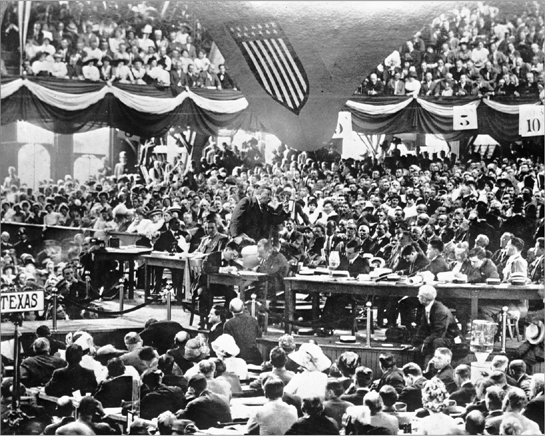
“ ‘AND THEY WISHED MORE!’ ”
Roosevelt’s two-hour address to the Progressive National Convention, 6 August 1912. (photo credit i11.2)
Once or twice, quailing at the bulk of his twenty-thousand-word typescript, he suggested that sections of it should be omitted “as read.” The crowd was insatiable: “Go on, go on.” He tried to skip the tariff, his least favorite subject, and was reprimanded. Even so, he tore out and crumpled some later pages. It was plain that he had written them for press release, rather than to be declaimed.
At last came the line all wanted to hear, from his oration at the Chicago Auditorium. “I say in closing76 what in that speech I said in closing: We stand at Armageddon, and we battle for the Lord.”
The response was tumultuous. If Progressivism was, as more and more critics were suggesting, a religion, it needed its mantras, and could not hear them enough. Roosevelt ducked out of the hall at 3:30 P.M., pursued by the sound of ten thousand voices singing his name77, to the tune of “Maryland, My Maryland.”
WHEN RAYMOND ROBINS* saw him again, in his hotel parlor late that night, he was resting his tired head against the mantelpiece.
“Colonel,” Robins said78, “they have just voted down four planks.”
In another room79, a subcommittee of the Resolutions Committee, chaired by William Draper Lewis, dean of the University of Pennsylvania law department, was trying to nail down the Party’s campaign platform. Lewis had been agonizing over this all-important “contract with the people” since July. A group of moonbeamers, led by Gifford and Amos Pinchot, was determined to substitute some radical planks for the more pragmatic ones favored by Perkins, Beveridge, and the Colonel himself. Their efforts had apparently succeeded.
“Each one of those80 81 planks will go back,” Roosevelt angrily told Robins, “or I am not a candidate.”
The result, in the small hours of Wednesday morning, was a compromise platform82 that mentioned neither prohibition nor race, but awarded the Colonel his battleships and retained the regulatory plank as written by himself and Perkins—more accurately, handwritten on various slips of paper, some of them dating as far back as May. It formalized in prose all the other promises Beveridge and Roosevelt had made verbally, committing the Progressive Party to a vast program of social, economic, and environmental reform. For once, Roosevelt was entitled to a superlative when he called it “much the most important83 public document promulgated in this country since the death of Abraham Lincoln.”
A day of steady drizzle dawned. Delegates found the visitor galleries of the Coliseum largely deserted when they filed in under the giant moose head, shaking their umbrellas. Hours of report-reading by various committee chairs, as well as presentation and adoption of the platform, had to be endured before the nominating speeches could begin. Since there was only one candidate, those were unlikely to be news. Only then would the convention be informed whom the Colonel had chosen as his running mate. Most bets were on Benjamin B. Lindsey of Colorado.
In the late afternoon, William A. Prendergast, comptroller of New York City, presented Roosevelt’s name to automatic cheers. His remarks cost him no effort, as he had written them over two months before to deliver at the Republican convention. “There is no84other man in American life,” he said, “who, in public office or out of it, has by his devotion to its interests, made so complete and genereous a contribution to the cup of its achievements.”
When Judge Lindsey85 rose to give the first seconding speech, realization spread that the diminutive Democrat was not going to be on the ticket. Jane Addams followed him to the rostrum. “I second the nomination of Theodore Roosevelt because his is one of the few men in our public life who has been responsive to the social appeal, and who has caught the significance of the modern movement,” she said, in the first address ever made by a woman to a national convention.
Finally, at seven o’clock, Beveridge announced that the Colonel had chosen Governor Hiram Johnson of California to run with him.
The two men came out together (Johnson notably shorter and stockier) to a roar of acclaim that formalized their nomination. Roosevelt seemed genuinely moved. The religiosity in the hall surged to the point of delirium, but yesterday’s alarm was gone from his face. He stood arm-in-arm with Johnson as fifes and drums, a trombone quartet, and a full band led the crowd of ten thousand in singing the Doxology86—its meter syncopated by the popping of a minute gun in the organ loft:
Praise God, from whom all blessings flow;
Praise Him, all creatures here below;
Praise Him above, ye heavenly host,
Praise Father, Son, and Holy Ghost.
* Convention delegate, chairman of the Illinois Progressive Central Committee.