

The coming on of his old monster Time
Has made him a still man; and he has dreams
Were fair to think on once, and all found hollow.
THE WINTER OF2 1914–1915 found the Allies and Central Powers entrenched opposite each other in two freezing fissures that divided Western Europe like a fault line, all the way north from Switzerland to Ypres and the Belgian ports. Another fissure ran alongside the Bzura-Ravka riverline west of Warsaw and cracked down the map into Galicia, holding eight ill-supplied Russian armies at bay. Gone was the mobility that had characterized the early months of the war: the Schlieffen Plan’s rotation, the cavalry sweeps, the cuts and thrusts of maneuvers at Tannenberg and in the Marne. Abandoned, too, was the delusion of the soldiers dug in that a trench was a temporary thing that would last only as long as it took for politicians to settle the misunderstandings of last summer. The war was going to be long, and mortal beyond calculation: a continuum of attrition, to be won by whichever power had the largest reserves of blood, bread, industrial plant, and patience. Germany had by now lost well over a million men, France almost that number. On the Eastern Front, 750,000 Russian, German, and Austrian soldiers had fallen in just six weeks.
Across the Atlantic, Woodrow Wilson and Theodore Roosevelt hunkered down in their own psychological ditches. They were two melancholy men counterposed on either side of a foreign issue that most Americans chose to ignore—in Wilson’s words, “a war with which3 we have nothing to do.” White House aides4 were alarmed at the President’s inability to recover from the death of Ellen Wilson, five months before. He was not the type to share deep emotion with anybody except Colonel House and the few women closest to him: his two daughters, his sister and cousins, and a clutch of married confidantes. None could console him. From time to time grief forced Wilson to reveal that he felt “wiped out,” unable to think straight. The unremarkable Democratic vote in the recent elections made him feel that his domestic reform program had failed. He frightened Colonel House by saying he would not mind being assassinated.
Roosevelt appeared5 on the surface to be content. He insisted, as he had in late 1910 and 1912, that his politicking days were over (“I never wish to leave Sagamore again!”) and that his heart and mind were at ease. Family and friends used to such protestations saw that he was, on the contrary, unhappier than at any time they could remember. He had regained the seventy pounds of flesh he lost to malaria, and it was not the firm musculature of earlier years, but a fatness around the waist and neck that disgusted him. “I am now pretty nearly done out,” he confided to his former White House physician, Dr. Presley Rixey. “The trouble is that I have rheumatism or gout and things of that kind to a degree that make it impossible for me to take very much exercise; and then in turn the fact that I cannot take exercise prevents my keeping in good condition.” Like many another ovoid person, he did not relate his weight gain to compulsive eating.
Ted was concerned enough about him to call old Rough Riders and ask them to rally round. “Father is6 in very bad shape. Won’t you come out and see if you can cheer him up.” Those who did tried the dubious therapy of encouraging Roosevelt to think of raising a volunteer division to fight in Mexico or, if need be one day, overseas. Edith lost patience with these fantasies. “Both you men,”7 she said to her husband and Frank Knox, “are exactly like small boys playing at soldiers.”
She sat in glowing firelight, with needlework on her lap.
“It’s a lovely game. But as far as the Mexican trouble is concerned, Theodore, you know quite as well as I do that Mr. Wilson will never let you, or your division, get into it at all.”
William Allen White correctly diagnosed that the Colonel was suffering from power deprivation. As the ambivalent leader of a dying party, he no longer looked or sounded presidential. It was inconceivable, given what was happening in Europe, that he could ever again call upon straw-hatted idealists to stand and fight at Armageddon. In his despair that nothing was being done for the Belgians (or was it frustration at not being in control?), he was resorting increasingly to ugly language against Wilson and Bryan. His series of articles on the war had become near-libelous after the election. That infallible sign of Rooseveltian frustration, the tendency to castrate political opponents, had resurged: “Weaklings who raise8 their shrill piping for a peace that shall consecrate successful wrong occupy a position quite as immoral as and infinitely more contemptible than the position of the wrong-doers themselves.… It comes dangerously near flattery to call the foreign policy of the United States under President Wilson and Secretary Bryan one of milk and water.”
White tried to tease him back into the kind of civilized essay-writing that suited him best. “Your cistern9 is dry on politics.… I understand that you have a contract with the Metropolitan11. If I were you I would go strong on the discussion of modern tendencies in architecture with here and there a few remarks on Sir Oliver Lodge’s views on abnormal psychology, and I might take a swipe at the national moving picture censorship, but I would not have anything to do with friend Bryan or friend Wilson.”
Roosevelt did not rise to White’s humor. “I am more like10 a corpse than like the cistern of which you spoke.” He laboriously explained that Metropolitan magazine was interested only in his views on “international, social and economic questions,” and would not permit him to write literary essays—much as he might want to. “Like you I make my living largely by my pen. I don’t care to go into work that will take me beyond the time when Quentin, my youngest son, is launched into the world, but that won’t be for three years yet.…”
He did not mention a financial threat that loomed ahead of him: the $50,000 libel suit he had brought on himself, last July, by accusing William Barnes, Jr., of aiding and abetting the “rotten” state government of New York. The case had been expensively delayed and relocated from Albany to Syracuse, on the ground that Boss Barnes’s dominance of the former city would preclude a fair jury. It was now due to be tried in April. Roosevelt knew from his libel suit against George Newett that even if he successfully defended himself, the costs he would incur were likely to be enormous. If he lost—and Barnes was a wealthy and formidable adversary—Quentin might have to be “launched” much sooner than 1918.
Metropolitan was a large, lavishly illustrated monthly owned by Harry Payne Whitney, a racehorse breeder so blinkered with wealth that he did not seem to notice that its editor, Henry J. Whigham, had a radical bias that veered close to socialism. Roosevelt was willing to live with that as long as Whigham let him preach his own, more paternalistic brand of politics. The magazine, in addition, was a strong supporter of preparedness.
“After this January,”12 he told White, “I shall do my best to avoid mentioning Wilson’s and Bryan’s names.”

AS THE NEW YEAR progressed, however, he managed to mention them often, and harshly. Always his anger was directed at their interpretation of neutrality. They seemed to think it was a right that could be proclaimed, he wrote, whereas in fact it was only a privilege conceded by belligerent nations—for as long as those nations felt so disposed. Nor was it necessarily virtuous: “To be neutral13 between right and wrong is to serve wrong.” Roosevelt felt that American apathy about the war was solidifying, and decided to move quickly before it became a cement resistant to chipping. Taking advantage of the New York publishing industry’s extraordinary ability to print and distribute a bound book in little more than two weeks, he edited his ten war articles of the previous fall for publication before the end of January. He supplemented them with two newer pieces on military training and “utopian” peace plans.
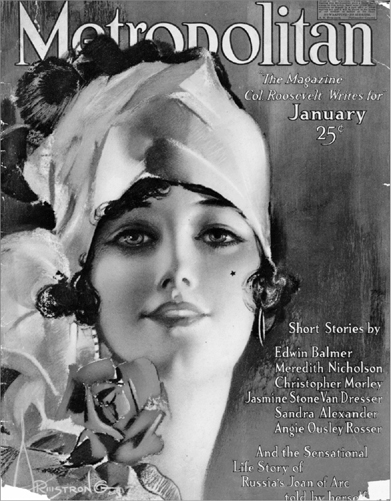
“A LARGE, LAVISHLY ILLUSTRATED MONTHLY.”
Metropolitan magazine, TR’s main journalistic outlet from 1915 to 1918. (photo credit i20.1)
The resultant twelve-chapter volume14, entitled America and the World War, was issued by Scribners. It made permanent the breach between him and the administration, and established him as Wilson’s doctrinal foil. Critical reaction15, when not dismissive, was divided. To Roosevelt’s chagrin, reviewers sympathetic to Britain, Belgium, and France accused him of favoring Germany. The reverse obtained with those who described themselves as “German-American,” a locution he detested.
In a letter to a woman asking him to announce that he was an “Anglo-American,” he disclaimed all hyphenated allegiances. “England is not16 my motherland any more than Germany is my fatherland. My motherland and fatherland and my own land are all three of them the United States.”
His new book, hortatory by purpose, lacked such plain eloquence. Its few statesmanlike passages were obscured by a surf of words so repetitive and overstated as to numb any reader. Roosevelt had always excused his habit of saying everything three, or thirty-three times with the rationale that it was the only way to drum certain basic truths into the public mind. But America and the World War took repetition to the point of pugilism, as if he wanted to knock out everyone who did not feel as strongly as he did.
Many bookstore browsers glancing through its table of contents felt that they had already gotten the Colonel’s message, and would gain little by reading further:
1. THE DUTY OF SELF-DEFENSE AND OF GOOD CONDUCT TOWARD OTHERS
2. THE BELGIAN TRAGEDY
3. UNWISE TREATIES A MENACE TO RIGHTEOUSNESS
4. THE CAUSES OF THE WAR
5. HOW TO STRIVE FOR WORLD PEACE
6. THE PEACE OF RIGHTEOUSNESS
7. AN INTERNATIONAL POSSE COMITATUS
8. SELF-DEFENSE WITHOUT MILITARISM
9. OUR PEACEMAKER, THE NAVY
10. PREPAREDNESS AGAINST WAR
11. UTOPIA OR HELL?
12. SUMMING UP
It was unfortunate that Roosevelt, in his haste to cram together articles originally published separately, had not blended them into a more sequential argument. America and the World War had some passages of real power, especially in pieces written after the election, when all gloves were off. His call for a posse comitatus, or central police force of neutral nations, sounded all the more urgent now that the Hague tribunal had adjourned for the duration of the war. It was unfortunate, though, that he used the wordposse, which invited jokes about his youth in the Wild West even though he construed it as Latin. He insisted that he was not advocating unilateral armed action by the United States, only its commitment (perhaps as the founding member) to a postwar peacekeeping league. “I ask those17 individuals who think of me as a firebrand to remember that during the seven and a half years I was President not a shot was fired at any soldier of a hostile nation by any American soldier or sailor, and there was not so much as a threat of war.… The blood recently shed at Vera Cruz … had no parallel during my administration.”
He poured scorn18 on Wilson and Taft for allegedly neglecting the navy since he left office. As a result, the Great White Fleet of 1909 was now underfunded and demoralized. The condition of the army was even worse: it numbered only 80,804 officers and men, half of whom were deployed overseas. Yet Wilson, in his latest message to Congress, had scorned preparedness and declared that the United States was secure. This enabled Roosevelt to demolish some of the approving comments that had followed:
Mr. Bryan came19 to his support with hearty enthusiasm and said: “The President knows that if this country needed a million men, and needed them in a day, the call would go out at sunrise and the sun would go down on a million men in arms.” … I once heard a Bryanite senator put Mr. Bryan’s position a little more strongly. [He] announced that we needed no regular army, because in the event of war “ten million freemen would spring to arms, the equals of any regular soldiers in the world.” I do not question the emotional or oratorical sincerity either of Mr. Bryan or of the senator. Mr. Bryan is accustomed to performing in vacuo; and both he and President Wilson, as regards foreign affairs, apparently believe they are living in a world of two dimensions, and not in the actual workaday world, which has three dimensions.…
If the senator’s ten million men sprang to arms at this moment, they would have at the outside some four hundred thousand modern rifles at which to spring. Perhaps six hundred thousand more could spring to squirrel pieces and fairly good shotguns. The remaining nine million men would have to spring to axes, scythes, hand-saws, gimlets, and similar arms.
In his summary chapter, looking back at the events of late July 1914, Roosevelt wrote, “I feel in the20 strongest way that we should have interfered, at least to the extent of the most emphatic diplomatic protest at the very outset [of the war] and then by whatever further action was necessary, in regard to the violation of the neutrality of Belgium.” He thus made it plain that had he been in the White House, he would have been willing to resort to force, on the same grounds that Britain had cited. Wilson would argue that the United States had no treaty obligation to do anything of the kind, but Roosevelt considered its endorsement of The Hague conventions of 1897 and 1907 to be binding. “As President,”21 he boasted, “I ordered the signature of the United States to these conventions.”
Elihu Root was no longer at his elbow to remind him, with a sarcastic smile, that his enthusiasm for both documents had been slight. But as Roosevelt pointed out in his peroration, there had been epic changes since then.
In the terrible22 whirlwind of the war all the great nations of the world, save the United States and Italy, are facing the supreme test of their history.* … Yet, in the face of all this, the President of the United States sends in a message dealing with national defense, which is filled with prettily phrased platitudes of the kind applauded at the less important types of peace congress, and with sentences cleverly turned to conceal from the average man the fact that the President has no real advice to give, no real policy to propose.…
For us to assume superior virtues in the face of the war-worn nations of the Old World will not make us more acceptable as mediators among them.… The storm that is raging in Europe is terrible and evil; but it is also grand and noble. Un25 tried men who live at ease will do well to remember that there is a certain sublimity even in Milton’s defeated archangel, but none whatever in the spirits who kept neutral, who remained at peace, and dared side neither with hell nor with heaven.
WISTER WAS ONE of several friends who saw, with varying degrees of alarm, that Roosevelt’s obsession with the war had darkened his personality. David Goodrich, a fellow veteran of the Santiago campaign, went riding with him, and noticed that he kept swinging his half-blind head as he scoped out the icy countryside. He was playing23 the German game of Kriegsspiel—imagining battlefields and figuring out how to deploy troops across them. Hamlin Garland visited him in his new office at Metropolitan magazine and found him distinctly older in looks and demeanor. His eyes were dull, and his manner subdued. “He will never24 run for President again,” the novelist lamented. “That he may never lose his sense of humor is my prayer.”
Finley Peter Dunne, a fellow contributor to Metropolitan, caught the Colonel on a more spirited day, dictating an article to a stenographer. Dunne was put off by the hectoring tone of his sentences, so at odds with the literary grace he was capable of. At a pause in the dictation, Dunne told Roosevelt he felt his recent pieces were unworthy of him.
TR (laughing) They read all right to me.
DUNNE But you’re no judge. You are damaging your reputation as a writer. Look at those wonderful things you wrote about your experiences in South America.
TR Oh well (laughing), you must suit your implement to your subject. A pen is all right for a naturalist, with a poetic strain in him.
DUNNE A what?
TR A poetic strain. You didn’t know I had it, but I have and I can use it at times. But when you are dealing with politics you feel that you have your enemy in front of you and you must shake your fist at him and roar the Gospel of Righteousness in his deaf ear.
Shortly afterward, Dunne left Metropolitan to write for Collier’s. He took with him the memory of Roosevelt marching up and down, “striking his palm26 with a clenched fist and shouting an article that no one but himself ever read.”
WOODROW WILSON MAY HAVE been isolated by grief that February, but he was not immobilized by it. He fully understood that he had to do something soon to revise his definition of neutrality, in the view of growing tensions between the United States, Germany, and Great Britain. “We cannot remain27 isolated in this war,” he said to Joseph Tumulty, “for soon the contagion of it will spread until it reaches our own shores. On the one side Mr. Bryan will censure the administration for being too militaristic, and on the other we will find Mr. Roosevelt criticizing us because we are too pacifist in our tendencies.”
On 4 February, the German government issued a shipping advisory so menacing that Wilson had to reply in a similar tone. The issue was America’s protectionist policy toward England, under which it exported prodigious quantities of munitions there for war use. Technically, such cargo was contraband and subject to seizure by German warships. But since the Royal Navy controlled the Atlantic, the arms flow might have been on a conveyor belt. Britain had begun to take further advantage of her naval superiority to seize American vessels carrying non-contraband goods to Germany. Sir Edward Grey insisted with a straight face that because the Reich had placed flour, wheat, and corn in official distribution, those items were de facto militarized. Cotton, too, was declared contraband, since it was used to clean German rifles. Britain proposed28 to apply these restrictions even to shipments to Germany’s neutral neighbors—countries as harmless as Sweden and Holland—on the grounds that landed goods could be relabeled and reshipped to the Reich.
To that end, it had for the last three months unilaterally blockaded both entrances to the North Sea and sown the water with mines. Desperate for food and humiliated at the impotence of its dreadnoughts, which were jammed in Wilhelmshaven like toys in a drawer, Germany now announced that it had no choice but to use the only marine weapon it could still deploy: the Unterseeboot, or U-boat. “The waters surrounding29 Great Britain, including the whole English Channel, are hereby declared to be a war zone,” the advisory ran. “On or after the 18th of February, 1915, every enemy merchant ship found in the said war zone will be destroyed.… Even neutral ships are exposed to danger [and] neutral powers are accordingly forewarned not to continue entrusting their crews, passengers, or merchandise to such vehicles.”
As Sir Cecil Spring Rice advised the State Department, “This is in effect30 a claim to torpedo at sight … any merchant vessel under any flag.”
Wilson hesitated only six days before sending Berlin a note that used the kind of specific language he usually avoided.
If the commanders31 of German vessels of war … should destroy on the high seas an American vessel or the lives of American citizens, it would be difficult for the Government of the United States to view the act in any other light than as an indefensible violation of neutral rights, which it would be very hard, indeed, to reconcile with the friendly relations now happily subsisting between the two governments.
If such a deplorable situation should arise, the Imperial German Government can readily appreciate that the Government of the United States would be constrained to hold the Imperial Government of Germany to a strict accountability for such acts of their naval authorities, and to take any steps it might be necessary to take to safeguard American lives and property and to secure to American citizens the full enjoyment of their acknowledged rights on the high seas.
ROOSEVELT WAS NOT impressed by the phrase strict accountability, because he doubted (against the evidence of Vera Cruz) that Wilson was capable of military action. The President did not seem to hold Britain equally accountable for mining the North Sea. That was the trouble with pacifists: when they tried to assert themselves, they often behaved without logic. It could be argued that a torpedo aimed at a merchantman known to be carrying contraband was less despicable than floating bombs that blew up any ship indiscriminately—an American freighter, say, laden with nothing more lethal than seeds. Wilson’s threat to Germany did not insure against an upsurge of anti-British feeling in the United States, should either kind of accident occur. It was bad enough that the Royal Navy had taken to stopping and searching American ships, with scant respect for their flag or passengers. “I hope that32 at all costs your people will avoid a clash with us, where we are right,” Roosevelt wrote Spring Rice. “Your government evidently feels a great contempt for the Wilson-Bryan administration; and I don’t wonder.… But it is just weak and timid but shifty creatures of the Wilson-Bryan type who are most apt to be responsible for a country drifting into war.”
In a censuring tone33 such as he had never directed at his old friend before, he added the hope “that you will under no circumstances yourselves do something wrong, something evil, as regards which I and the men like me will have to clearly take the stand on the other side.”
Spring Rice took no offense, believing that Theodore had still not recovered, emotionally or physically, from his near-death experience in Brazil. Sir Edward Grey reacted with similar mildness to a long and almost treasonous letter34 from the Colonel, saying that Wilson was quite capable of reversing any foreign-policy initiative to win reelection, and reproaching Britain for “assuming” that its naval power gave it the “right” to harass American exporters. He merely replied, “People here will not stand letting goods go past our doors to Germany.”
For as long as35 the winter lasted, Roosevelt picked or sought quarrels with friends whose war views did not agree with his. He clashed so furiously with the pro-German editor George Sylvester Viereck over “divided allegiance” to the American flag that they returned each other’s letters. He told St. Loe Strachey that Britain’s desire for an Allied monopoly of American trade was indistinguishable from German Weltmacht; he accused Count Apponyi of being a latter-day Austrian patriot, and when, in late March, Lord Bryce asked him to endorse a World League for Peace, he wrote back declining to be associated with sentimentalists “who seemingly are willing to see the triumph of wrong if only all physical danger to their own worthless bodies can thereby be averted.”
Everyone, except perhaps Apponyi, understood that “T. Vesuvius Roosevelt”36 had to release lava periodically. But such eruptions were usually short. This one lasted through 13 April, when he checked Edith37 in to hospital for a hysterectomy. He then had to hurry to Yale to serve as honorary pallbearer at the funeral of the literary scholar Thomas R. Lounsbury.
Upon arrival38 in the anteroom of Battell Chapel, he found that one of his fellow bearers was William Howard Taft. They had not met face-to-face in almost four years.
Taft made the first move. “How are you, Theodore?”
Roosevelt shook hands, but remained silent and unsmiling.
* Italy entered the war on the Allied side on 23 May 1915.