

My tomb is this unending sea
And I lie far below.
My fate, O stranger, was to drown;
And where it was the ship went down
Is what the sea-birds know.
BY 16 APRIL 1915, two of New York’s most patrician law firms had completed their briefs for what promised to be the most entertaining libel suit2 since Roosevelt v. Newett: case 164 A.D. 540 on the Onondaga County court calendar, William Barnes, plaintiff-appellant, against Theodore Roosevelt, defendant-respondent. Both sides agreed there was plenty of evidence to show that Barnes had been defamed by Roosevelt nine months before. The only question was whether the latter had been telling the truth or not. If so, there was no libel.
Barnes’s counsel3, William M. Ivins of Ivins, Wolff & Hoguet, told Elihu Root that he was going to Syracuse “to nail Colonel Roosevelt’s hide” to the courthouse wall.
“I know Colonel Roosevelt,” Root said. “Be very careful whose hide you nail to that courthouse.”
John M. Bowers of Bowers & Sands had already secured a coup for the defendant by getting the trial moved away from Albany, Barnes’s power base, to Syracuse, a former Progressive stronghold. To make sure his client got the right jurors, he retained an attorney, Oliver D. Burden, on terms billable to the Colonel. All told, there were four lawyers acting for either party in the case, and a roster of nearly a hundred witnesses. The proceedings seemed likely to last a month.
Barnes and Roosevelt were not only looking at heavy potential costs, but at dire political consequences for whichever of them lost. Defeat for Roosevelt would tarnish his reputation as a square dealer. Defeat for Barnes would probably destroy his dream of running in 1916 for the U.S. Senate. Since they were both Harvard men of distinguished families (Barnes was the grandson of Thurlow Weed, a co-founder of the GOP), they were equally encouraged to hear that Justice William S. Andrews, assigned by the New York Supreme Court to hear their case, boasted the same background. He was in fact Roosevelt’s classmate4.
Much, therefore, hinged on his reaction to Bowers’s motion, when proceedings began on Monday, 19 April: “Your Honor, I move5 to dismiss the complaint on the ground that the article [Exhibit No. 1, Roosevelt’s widely published anti-Barnes press release of 22 July 1914] is not libelous per se, and that the complaint contains no innuendo, and therefore, there is nothing to go to the jury.” Bowers argued that in a pre-election season, the Colonel had just been asking voters to back a non-machine candidate for governor of New York State. Obviously, he had been unsuccessful. But as a free-speaking citizen, he was “privileged” under the Constitution to draw attention to suspicious dealings in Albany.
Andrews rejected the motion, and ordered testimony to begin the following morning.

SYRACUSE MAY HAVE VOTED for Roosevelt in 1912, but if the jurors taking their seats at ten o’clock on Tuesday represented its current political mood, the local GOP had reclaimed many lost sheep. Nine were Republicans, two Progressives, and one Democrat. They worked, in exactly equal proportion, as small businessmen, farmers, and artisans. Roosevelt had once been able to call such people his own—except perhaps the Democrat, a coal dealer who might not have approved his interceding in the anthracite strike of 1902. But now he could not be sure what any might think of him.
The rain-spattered crowd that awaited his arrival at the courthouse was sparse, more curious than welcoming. Only one woman tried to raise a “Hurrah for Teddy!” It was not taken up by other spectators. From their point of view, and from that of newsmen clustering around, the Colonel was a disappointing sight—stout, unsmiling, yielding at every turn to the direction of his lawyers. He wore a shapeless suit of brown and a black hat pulled low, as if to discourage stares. As soon as he sat down in the courtroom, facing the jury across the Bowers table, he put on a pair of bowed spectacles. Their lenses were so thick that they obscured the power of his gaze. A roll of fat6 unflatteringly rested on his collar.
Barnes came in a few minutes later and sat ten feet away and slightly behind him. Big and well-tailored in dark blue, with silver wings of hair framing his center part, he looked what he was, and had never denied being: a political businessman, at home in boardrooms and the cigar-fragrant hideaways of state legislators. He swung in his chair and shot a glance at Roosevelt, who declined to return it. From then on they ignored each other, often swiveling back to back.
If anybody looked likely to dominate the trial, it was William M. Ivins7. Sixty-four years old and meticulously overdressed, with gray spats, ribbon pince-nez, and an emerald pin securing his ascot, he arrived escorting a pretty secretary, the only woman admitted to the floor. His appearance might have prompted titters (especially when he donned a popish skullcap), were he not known to be one of the sharpest cross-examiners in the New York bar. Ivins was a lawyer of international repute, fluent in six languages, widely read in philosophy, finance, and diplomatic history, a collector in his spare time of Shakespearean folios and Napoleonic medals.
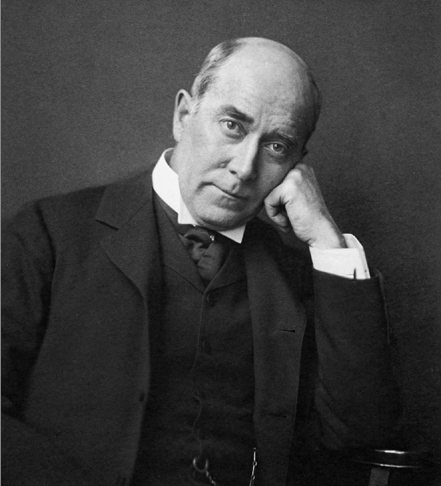
“A LAWYER OF INTERNATIONAL REPUTE, FLUENT IN SIX LANGUAGES.”
William M. Ivins. (photo credit i21.1)
He was also mortally ill. Few, if any in the courtroom realized it, so quiet and genial was his manner.
At five after the hour everybody rose for Justice Andrews, who entered carrying two bowls of carnations. Plonked down on either side of him, they merely emphasized his austere severity. He directed counsel for the plaintiff to lay out the “merits of the controversy” before any witness was called. Ivins began by describing Theodore Roosevelt as a political giant who happened to be a gifted writer as well—“probably the greatest8 arbiter of opinion in this country who has been known in its history.” The jury, he said, should bear in mind that the libel complained of had not been an impromptu remark, but the deliberate work of the Colonel’s “very eloquent pen.” Every word of it would therefore have to be documented and proved.
Ivins turned to William Barnes, Jr., as a person substantial in his own right, being the owner-operator of an important newspaper, the Albany Evening Journal, and for many years the most powerful figure in New York politics. The jury would learn that Governor Roosevelt had depended on Barnes’s services as long ago as 1899, and that President Roosevelt had twice reappointed him to state office. The two men had met and corresponded regularly, exchanging mutual compliments, until their political ways had diverged in 1910. Ever since then, for reasons best known to the defendant, Barnes had become persona non grata at Sagamore Hill. Counsel for the plaintiff would attempt to show in cross-examination just what it was that Roosevelt had against him.
Before doing so, however, Ivins wanted jurors to hear the Colonel’s exact words of July 1914—words addressed to more than two and a half million newspaper readers, and written “with the same care9 and the same skill that he had shown in preparing The Winning of the West and African Game Trails.”
It was evident that Ivins’s strategy was to appeal to the anti-intellectualism ingrained in the average American juror. He was subtly portraying Roosevelt as a littérateur, an elitist, a poison-pen scribe who visited his political prejudices upon those less “privileged” than himself. Reading with dramatic incisiveness, Ivins gave life to the words complained of by Barnes:
In New York State10 we see at its worst the development of the system of bipartisan boss rule.
In New York State the two political machines are completely dominated, the one by Mr. Barnes, the other by Mr. Murphy.
The state government is rotten throughout in almost all its departments, and this is directly due to the dominance in politics of Mr. Murphy and his sub-bosses … aided and abetted where necessary by Mr. Barnes and the sub-bosses of Mr. Barnes.
Mr. Murphy and Mr. Barnes are of exactly the same political type.
Roosevelt sat mutely11 listening, his elbow on the defense table, his head wedged against one fist. He seemed unaware of the stares of fifty reporters ranged near him. Each had a small silk American flag to raise whenever a dispatch was ready to be picked up by court attendants.
It occurred to Louis Siebold, Washington correspondent of the New York World, that the Colonel was more than just tired, or worried about his ill wife. He was depressed.
After lunch, Ivins called Roosevelt as his first witness.
IVINS Have you read12 the statement complained of in the complaint?
TR I wrote it.…(laughter)
IVINS Did you write it of and concerning the plaintiff William Barnes, Jr.?
TR I did.
“That is all,” Ivins said, returning to his table. Roosevelt sat dumbfounded while the silk flags fluttered, releasing the news that the plaintiff had already rested its case.
Bowers, courtly and trim-bearded, came to the Colonel’s rescue with some questions about the highlights of his career. Inevitably these led to the Battle of San Juan. Had Bowers consulted Elihu Root beforehand, as Ivins had, he might have learned that the quickest way to get his client to make a fool of himself was to mention Cuba.
TR My regiment was13 in the Santiago fight and lost in killed and wounded, over a third—
IVINS I object to the number lost in killed and wounded as immaterial in this case.
COURT We all know what the result of that battle was.
Roosevelt recited his later résumé. Since coming back from Brazil, he said, he had worked as a writer, with some side activity in politics.
Bowers asked him to describe his early relations with Senator Thomas Platt, the “Easy Boss” of New York State and Barnes’s political mentor. It was an adroit defense move, because it forestalled what was sure to be the prosecution’s main line of questioning. Ivins jumped up. “Why all this14 1899? Case is in praesenti, if your Honor please.” Andrews overruled him.
Roosevelt said that he had worked with Platt throughout his two years as governor, and thus gotten to know Barnes as their mutual go-between. Bowers asked if he remembered any meetings in which Platt or Barnes had tried to stop him calling for a franchise tax on big businesses. Roosevelt said he did, but to the attorney’s frustration, he could not recall how many, or what either man had specifically asked him to do. “Mr. Barnes spoke15 of our duty to protect corporations.… I cannot give you the language, the exact language.”
The spectacle of Theodore Roosevelt straining both to hear and think clearly was a shock to many observers. He had always been famous for the perfection of his memory, but here he was unable to drum up facts in his own defense. When he did think of something, it was too late:
TR Mr. Bowers and16 your Honor, may I be allowed to state the conversation that I had with Mr. Barnes on the propriety and nature of the boss and the domination of the machine?
COURT That is not important.…
TR (incredulous) May I not be permitted to show that there was this boss system, that there was a system of complete control by bosses of politics?
COURT That is entirely immaterial so far as this libel is concerned.
Roosevelt was not used to being silenced. Clearly, Andrews was a different breed of judge from the one who had treated him so well in Marquette. Whether out of anger or annoyance, he sharpened up, and Bowers was able to elicit germane evidence by a different line of questioning. On one occasion, the defendant now recalled, Barnes had cynically said, “The people are not17 fit to govern themselves. They have got to be governed by the party organization, and you cannot run an organization, you cannot have leaders, unless you have money.” Barnes and Platt had often lobbied him in this fashion, insisting that reform legislation, or failure to reappoint conservatives to office, would result in corporate campaign funds being withdrawn from the GOP. As for his allegations of bipartisan corruption, he remembered Barnes pleading the case of a Democratic legislator named Kelly, who protested against the franchise tax bill in behalf of two wealthy businessmen, Robert Pruyn and Anthony N. Brady.
This sounded more like the old Roosevelt, with precise citation of names18 and growing animation on the stand. The rest of the afternoon went well for him, although he played into Ivins’s hands by describing Barnes as “a very able man,”19 and saying that they had cooperated amicably for ten years.
THROUGHOUT THE FOLLOWING DAY, Roosevelt made the most of Bowers’s gentle interrogation. He became comfortable with court procedure, learning not to be upset by Ivins’s objections, and conversationally drawing the judge as well as the jury into his accounts of private lobbying by Barnes in the New York State Capitol, Senator Platt’s “Amen Corner” in Manhattan, and even Sagamore Hill and the White House. Some anecdotes sounded prosy, as if he had gotten them by heart. Ivins was seen staring at him quizzically whenever he became orotund. But there was no denying that the Colonel was back on form, and the silk flags shook often as he scored point after evidentiary point against Barnes.
The most telling was his introduction of a letter from the boss, begging him not to propose a state printing house in his 1900 gubernatorial message. For years, Barnes’s own printing company had been the contractor of choice for the Albany legislature. It is not my desire20 to intrude my personal matters upon you, Barnes had written, but I wish merely to state that the establishment of a state printing house here would be a serious, if not a fatal, blow to me financially. Andrews permitted Bowers to read the governor’s curt rebuff: There is a perfect consensus of opinion that there should be a state printing office.
In other testimony21, Roosevelt exposed Barnes’s animus against the progressive administration of Governor Hughes, admitting that he did not care for Hughes himself. He tellingly dropped the name of “my cousin, Franklin D. Roosevelt,” who, as a Democratic state senator, had had to fight Barnes and Murphy in combination to get an electoral reform bill passed. Young Franklin was now in Washington, and, if the tense state of affairs there permitted, would come north to confirm this collusion.
Partnership between bosses was not illegal, but the Colonel made it sound like the pact between Wilhelm II and Franz Ferdinand. He quoted Barnes as saying before the Saratoga convention in 1910 that direct nominations, “if ever adopted by the state, will lead to untold evils in public life and place therein the cheapest citizens.” Such prejudice was liable to impress members of the jury, none of whom looked as if he could afford Barnes’s standard of living.
Bowers asked22 when he had last seen the plaintiff. Roosevelt said it had been at the annual Lincoln Day banquet in New York in 1911. Effectively and dramatically, he described how Barnes had boasted that conservatives were now in control of the state GOP, jeering that progressives and their ilk “were out.”
The Colonel looked a happier23 man when the court adjourned at 5 P.M.
BY NOW THE TRIAL was being treated as a major story in New York newspapers, shouldering aside headlines bearing the words YPRES and DARDENELLES. Court artists24 rejoiced in the contrasting physical presences of Roosevelt and Barnes (ignoring each other in court) and Ivins, with his skullcap and spats, looking like an illustration from a Dickens novel.
Thursday was the day the old lawyer had been waiting for, and he lit into Roosevelt with relish.
IVINS Has your occupation25 in life, apart from your public service, been that of an author?
TR An author and a ranchman and an explorer.
IVINS Then you have had three professions?
TR I have followed all three vocations, or avocations.
IVINS And more or less simultaneously?
TR More or less simultaneously. (Laughter)
“I have also been an officeholder,” he tried to add, but Ivins had already managed to imply that, by spreading himself too thin, he could be seen as a dilettante.
Roosevelt smelled danger, and was uncharacteristically terse as Ivins pressed him to talk more about himself. A series of easy autobiographical questions soothed him. He began to answer at greater length. Ivins congratulated him on his memory. “It is pretty good26,” Roosevelt admitted.
Ivins switched to a much more detailed interrogation. He focused on one of the low points of Roosevelt’s career: the tax-avoidance controversy27 that had nearly disqualified him from the gubernatorial nomination in 1898, until Elihu Root rescued him with an argument just short of fraud. Campaign finance was one of Ivins’s specialties—he had published a little book on the subject28—and it was emphatically not one of the defendant’s. Roosevelt soon had cause to regret that he had been tricked into praising his own memory. After drawing a few more blanks, he fell back on vehement protestations that he stood for “righteousness” in politics.
IVINS Now, does that29 rule apply to other people, in their judgment with regard to righteousness and the opportunities for its expression, as well as it does for you?
TR Of course it does.
IVINS Does that apply to Mr. Barnes just as much as it does to you?
TR It does apply to Mr. Barnes just as much as it does to me.
IVINS …Has not every man an equal right to determine his own rule of righteousness and his time of applying it?
TR He has if he has the root of righteousness in him. If he is a wrongdoer, he has not.
IVINS Who is the judge, you or he?
TR It may be that I am the judge, of him. If I had to be the judge—
Justice Andrews sat expressionless between his two bowls of carnations. Roosevelt began to flounder, punching the air as he had in the courthouse in Marquette, Michigan.
TR I will give you an exact example. Senator Burton—
IVINS You need not gesticulate.
BOWERS (for the defense) Why not?
IVINS I do not object to his answering. I object to his manner.
BOWERS Oh, is that it?
IVINS I do not want to be eaten up right here now. (Laughter)
Pleased to have exposed the defendant as both complacent and excitable, Ivins went on to taunt him about his infallibility (“You did not30 at that time have an attack of righteousness?”) and reprimand him for making speeches (“You need not treat me as a mass meeting, because I am not.”). Roosevelt managed to control his temper through the rest of the day, arguing that he could not be blamed for using the services of political bosses when they saw their way clear to supporting his policies.
Ivins kept harping on his literary productivity. One exchange between them caused gasps around the courtroom:
IVINS Since [1898]31 you have probably written more than any other man in the United States, haven’t you?
TR I don’t know, but I have written from 100,000 to 150,000 letters.
When he returned to the witness chair on Friday, Ivins asked why, after more than ten years of working with Barnes, he had excluded the boss from his autobiography.
“I particularly wished32 not to make any wanton or malicious attack on him.”
Ivins tried to disconcert him by revealing that many of the things he had said about the plaintiff in court were taken, word for word, from his general remarks on corruption in that Barnes-free book. “It is because33 of your excellent memory, is it not?”
Roosevelt let the sarcasm go. He had noticed that he had an avid audience in the jury. They leaned forward every time he spoke, as if activated by a jolt34 of electric current. He began to address them directly, and Ivins scolded him.
COURT Mr. Ivins, this witness35 will be treated as any other ordinary witness. I cannot have any discussion of that kind in this court room.
IVINS I apologize to your Honor.
Returning to Roosevelt’s autobiography, Ivins quoted a line about Senator Platt, Some of his strongest and most efficient lieutenants were disinterested men of high character, and asked if Barnes was included. The Colonel hedged. “Mr. Ivins, that is not a question that I could answer by a yes or no. Do you wish me to answer how I feel about it?”
“If you cannot answer it, I do not care for your feelings. I want to know whether you can answer yes or no.”
Andrews ruled that Roosevelt must respond accordingly. The stenographer repeated Ivins’s question.
TR Now—
IVINS No, one moment—I ask for a categorical answer. Yes or no?
TR Then I must answer you, no.… That I did not so include him.
IVINS Then I will ask you this. If you did not so regard him as a man of high character, why did you invite him to the executive mansion? Why did you consult him in the Capitol? Why did you associate with him? Why did you advise with him?
TR Because I thought he was above the average of the ordinary political leaders.… I believed that he had it in him…to become a most useful servant of the state, and I believed that there was a good chance of him so becoming.
BOWERS (hinting) Have you finished, Mr. Roosevelt?
TR I have.
For the first time, the defendant was beginning to sound like a small boy trying to fib his way out of a situation. By using the phrase some of to qualify his praise of Platt’s aides in 1899–1900—a group effectively consisting only of Barnes—Roosevelt the autobiographer had adopted a technique he affected to despise in other writers: the employment of “weasel words” that sucked the specificity out of statements. Some of enabled him to plead that he had not, in fact, ever thought of Barnes as a “disinterested man of high character.” He now cast about desperately for another literary device to save himself, and thought of Robert Louis Stevenson’s novel about a man both good and evil. That was it: Barnes was “Doctor Jekyll36 and Mr. Hyde.” He said he had known only the former during his time as governor.
Ivins noted that37 he had, nevertheless, retained Barnes in a position of high Republican responsibility long after becoming President in 1901. Roosevelt said he had done so as a consequence of his vow to honor President McKinley’s legacy. Ivins asked if that had still been the case on 29 January 1907, when he wrote to Barnes on White House stationery: It was a pleasure to send your reappointment [as surveyor of the port of Albany] to the Senate today. Sincerely, Theodore Roosevelt.
TR Yes, sir38.
IVINS Then which Mr. Barnes—Mr. Jekyll Barnes or Mr. Hyde Barnes, did you appoint to office and express your pleasure in appointing?
TR I appointed Mr. Barnes to office and until 1910 I hoped that we were going to get his Dr. Jekyll side uppermost, and I did not abandon hope until 1911.
Ivins let this protestation speak for itself. But he submitted for the jury’s further consideration a long series of cordial notes from Roosevelt to Barnes, indicating that Mr. Hyde had not begun to prowl the streets of Albany in his full monstrosity until the Progressive/Republican split of 1912.
THE DEFENDANT REMAINED in the witness stand for four more court days. He suffered further lapses of memory, principally on questions of campaign financing. Ivins tried to represent them as selective amnesia, but they looked to impartial observers like the forgetfulness of a man with larger things on his mind. The trial so far amounted to an entertaining exposé of unremarkable political facts. Both parties to Barnes’s lawsuit were—always had been—pragmatic politicians, the one looking for votes and reliable appointees, the other able to supply them, but at a price. As a young governor, Roosevelt had understood that reform legislation was impossible unless he could rely on a Party majority that was boss-controlled and lubricated with corporate contributions. As a power broker, Barnes knew that cooperation with the minority machine was sometimes necessary; the will of the people might even demand it.
Ivins’s evidence showed only that early on, Roosevelt had been naïvely eager to believe that Platt’s machine men were altruistic. He was certainly so himself ( even the most wheedling39 letters Ivins obtained from the archives showed him to have been active in the public interest). But he had often kept his long-distance glasses on, rather than focus too closely on what the Easy Boss was doing.
Under hard interrogation by William L. Barnum, one of Ivins’s associates, Roosevelt admitted that he had once appointed a Democrat to office because Platt needed to do Tammany Hall a favor. Barnum said that in exchange, the man’s sponsor, a state senator, had asked them both to cooperate on a $12 million appropriation for one of his real estate interests. Had such a bill been passed? The Colonel could not remember.
“A little matter40 of twelve million wouldn’t make any impression on you?”
“After sixteen years,” Roosevelt snapped, “during which I have had to do with billions of expenditures, the item does not remain in my mind.”
It irked him that day after day of cross-examination was being devoted to his operations in Albany, long ago, rather than to Barnes’s later behavior as the successor of Boss Platt. Justice Andrews seemed to be in no hurry to summon witnesses like Cousin Franklin, who could testify to the venality of the plaintiff in recent years. The trial threatened to drag on indefinitely. Barnes quit attending41 on 26 April, saying that he would return only when called for.
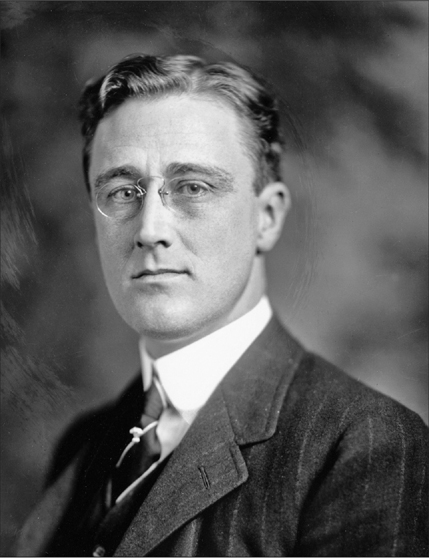
“ ‘WHAT RELATION ARE YOU TO THE DEFENDANT?’ ”
Assistant Secretary of the Navy Franklin D. Roosevelt. (photo credit i21.2)
Roosevelt finally stepped down as a witness at noon on the twenty-ninth, with his reputation for total recall much damaged. Nevertheless, Bowers succeeded in introducing some damning evidence against Barnes, including ledger-book proof that the boss had enriched himself on state printing contracts. Whether that made him corrupt or not, the jury would have to decide.
Assistant Secretary of the Navy Franklin Roosevelt’s appearance in court on Tuesday, 4 May, created a stir.
“What relation42 are you to the defendant?” Bowers wanted to know.
“Fifth cousin by blood and nephew by law,” Franklin replied, grinning. The line was obviously well rehearsed.
He confirmed that Barnes and Boss Murphy had been partners in legislative shenanigans to which he had been privy. But the lift he gave to the Colonel’s case was mainly psychological. As a senior official of the Wilson administration, he was manifestly an important man. His department was on high alert over attacks on transatlantic shipping by German submarines. No fewer than twenty-three merchantmen had been torpedoed since the beginning of May—among them an American oil freighter, the Gulflight, with three lives lost—and persistent rumors were circulating that a major liner was being targeted for destruction soon.
Franklin did not comment on the Gulflight incident to reporters, but his cousin was under no such compunction. It had been “an act of piracy, pure and simple,” the Colonel declared out of court.
DURING THE NEXT TWO days Roosevelt returned to the stand again and again, clarifying and amplifying his testimony for Bowers. When not being questioned, he looked bored. He flinched as Ivins, given the chance to cross-examine, said with mock exhaustion, “I don’t know43 that I care to have anything more to do with Mr. Roosevelt.”
The old lawyer was trying for a laugh, but what sounded like a collective groan ran through the courtroom. His witness was, after all, a former head of state.
That night, Thursday44, 6 May, an ominous letter reached Roosevelt in the house of his local host, Horace S. Wilkinson. It came from Cal O’Laughlin, who was always ahead of the news, and transmitted the written warning of a “high German official” that the administration’s shipping policy was putting American national unity “to a dangerous test.” Citizens of German or Irish ancestry had the right to protest, even sabotage, a neutrality so obviously favoring Great Britain. Their target might be the Cunard flagshipLusitania, currently en route from New York to Liverpool.
She had sailed on the first day of the month, amid a strange flurry45 of other threats—some wired pseudonymously to passengers as they checked in to their cabins—that she might be struck by a U-boat. An advisory signed46 and paid for by the German Embassy in Washington had appeared alongside her final sailing notice in several newspapers, reminding travelers “intending to embark on the Atlantic voyage” that a state of war existed between the Reich and Great Britain. Any vessel flying the Union Jack in “waters adjacent to the British Isles,” was therefore “liable to destruction.”
Roosevelt was infuriated by the arrogant tone of the document O’Laughlin enclosed. “It makes my blood boil to see how we are regarded,” he wrote back. “Lord, how I would like to be President in view of what he says about the huge German-Irish element and the possible sinking of the Lusitania.” Personally, he would hang any such scaremonger, “and I would warn him that if any of our people were sunk on the Lusitania, I would confiscate all the German interned ships, beginning with the Prinz Eitel.”
Perhaps it was just as well that Roosevelt was out of office in his current mood. He confessed to O’Laughlin that “if I didn’t keep a grip on myself,” a provocation of this kind “would make me favor instant war with Germany.”
He was back in court the following day, Friday, to hear Bowers begin to wind up the case for the defense. For hours, legal arguments droned back and forth between floor and bench, and Roosevelt looked, if possible, even more bored than he had the day before. Ivins took pity on him and walked over with a little green-covered edition of the plays of Aristophanes. “I came across this47 yesterday, Colonel, and it struck me that it was a first-class translation, and that if you cared to amuse yourself with anything of this sort while this uninteresting testimony is going on, you might enjoy it.”
Roosevelt was profoundly touched. “Thank you, thank you. I certainly am de-light-ed, Mr. Ivins.”
He remained buried in the book until late in the afternoon, when a messenger brought him a telegram. Reading it, his face48 changed. At five o’clock the court adjourned, with Andrews warning Bowers that unless more conclusive evidence was offered regarding Barnes’s state printing contracts, he would strike out all testimony heard so far on the subject. This was gloomy news for Roosevelt to ponder over the weekend, but it did not compare with the front-page story in the Syracuse evening newspaper, just then going on sale:

“ ‘LORD, HOW I WOULD LIKE TO BE PRESIDENT.’ ”
The evening newspaper that greeted TR as he emerged from the courthouse, 7 May 1915. (photo credit i21.3)
On an inside page, it was reported that President Wilson had no comment. This was not surprising, since the story was so fresh, terrible, and incomplete. If the fate of those aboard was “unknown,” how could it be that most were “believed” to be safe?
It was clear, all the same, that a German torpedo had sunk the biggest ship in the Cunard fleet, with a mostly American manifest, just offshore of County Cork in Ireland. Many of the first49-class passengers listed were known to Roosevelt, including Alfred G. Vanderbilt and Miss Theodate Pope, a young architect and member of the Progressive Party. He went to his lodgings and paced up and down in front of Horace Wilkinson, debating what to say about the catastrophe. On Monday, the twelve Syracusans who would pass judgment on him were due to start hearing from William Barnes, Jr. Two or three50 had German-sounding names. What verdict were they likely to render, if he criticized Germany’s action against an enemy vessel?
“I’ve got be right in this matter,” he said, and went to bed early.
The inevitable telephone call from an Associated Press reporter came around midnight. Wilkinson took it and went to wake Roosevelt.
“All right, I’ll speak to him.”
The reporter gave him the full story that would appear in tomorrow’s papers. There had been 1,918 souls aboard51 the Lusitania, and only 520 had so far been rescued. The ship had sunk in fifteen minutes, going down so fast that at least a thousand passengers were presumed dead, many of them mothers with children.
“That’s murder,”52 Wilkinson heard the Colonel saying. “Will I make a statement? Yes, yes. I’ll make it now. Just take this.”
It appeared as dictated on Saturday, 8 May, in newspapers across the country.
I can only repeat53 what I said a week ago [sic], when in similar fashion the American vessel the Gulflight was destroyed off the English coast and its captain drowned.…
This represents not merely piracy, but piracy on a vaster scale of murder than any old-time pirate ever practiced. This is the warfare which destroyed Louvain and Dinant, and hundreds of men, women and children in Belgium. It is warfare against innocent[s] traveling on the ocean, and to our fellow countrywomen, who are among the sufferers.
It seems inconceivable that we can refrain from taking action in this matter, for we owe it not only to humanity but to our own national self-respect.
WOODROW WILSON’S FIRST54 reaction to the sinking of the Lusitania had been to flee the White House. Evading his secret service detail, he walked the drizzly streets of Washington unrecognized, while newsboys shrieked the story he already knew. When he came back he retired to his study and refused to see any advisers through the weekend. The White House issued a statement saying that the President was pondering “very earnestly, but very calmly, the right course of action to pursue.”
Colonel House, who was in London, tried to point him in the direction of an ultimatum. “America has come55 to the parting of the ways,” he cabled, “when she must determine whether she stands for civilized or uncivilized warfare. We can no longer remain neutral.”
It seemed to Wilson that all warfare was uncivilized. After going to church56 on Sunday he spent most of the afternoon being chauffeured around the countryside. It was dark before he got home. Sitting down57 at his typewriter, he began to tap out a formal note to the German foreign minister, pursuant to the one he had issued in February holding the Reich responsible for any act of violence against American citizens. He called no special session of his cabinet for the following morning. Late in the afternoon58 he traveled to Philadelphia to speak at a gathering of recently naturalized immigrants. By the time he stepped onstage in Convention Hall, three and a half days had elapsed since the tragedy in the Celtic Sea, and expectation around the world was intense as to what he would say. William Howard Taft had no doubt that if the President called for revenge, Congress would oblige him with a declaration of war.
To general amazement, Wilson did not mention the Lusitania, or Germany, or the war. He talked about59 “ideals” and “visions” and “dreams,” and “touching hearts with all the nations of mankind.” But one declaration, expressing his personal attitude toward conflict, rang out with particular impact: “The example of America must be the example not merely of peace because it will not fight, but of peace because peace is the healing and elevating influence of the world and strife is not. There is such a thing as a man being too proud to fight.”
ONE CONSEQUENCE OF the sinking of the Lusitania was that Barnes v. Roosevelt was swept off the front pages of newspapers everywhere, even in New York. Suddenly the squabbles of libel lawyers in a salt town upstate sounded petty and irrelevant, in contrast to cable stories of five-ton lifeboats skidding down the decks of the tilted liner, crushing passengers by the dozen, and dead blue babies being fished from the sea like mackerel.
Roosevelt was not sorry60 for the distraction. He felt that his case was going badly, and disliked having millions of people read Justice Andrews’s rulings against him. He was, besides, angered to the point of frenzy by Wilson’s Philadelphia speech. According toThe New York Times, some four thousand people, many of them German-born, had roared support when the President talked about being “too proud to fight.” Stocks had surged next day, and editorials nationwide rejoiced that the administration was keeping a cool head in the crisis. William Randolph Hearst blustered that Germany had every right to sink a ship flying an enemy flag. Taft expressed relief and support of Wilson, in a rebuff to Roosevelt that was lavishly praised by The New York Times.
The Colonel raged against them all in a letter to his most militant son:
Dear Archie:61
There is a chance of our going to war; but I don’t think it is much of a chance. Wilson and Bryan are cordially supported by all the hyphenated Americans, by the solid flubdub and pacifist vote. Every soft creature, every coward and weakling, every man who can’t look more than six inches ahead, every man whose god is money, or pleasure, or ease … is enthusiastically in favor of Wilson; and at present the good citizens, as a whole, are puzzled and don’t understand the situation, and so a majority of them also tend to be with him. This is not pardonable; but it is natural. As a nation, we have thought very little about foreign affairs; we don’t realize that the murder of the thousand men, women and children in the Lusitania is due, solely, to Wilson’s cowardice and weakness in failing to take energetic action when the Gulflight was sunk but a few days previously. He and Bryan are morally responsible for the loss of the lives of those American women and children—and for the lives lost in Mexico, no less than for the lives lost on the high seas. They are both of them abject creatures, and they won’t go to war unless they are kicked into it.
He was overwrought, but this kind of language appealed to Archie. The youth was already asking permission to quit Harvard and serve in an American expeditionary force to Europe, should Wilson decide to send one. Roosevelt did not see that happening soon. He was sure, nonetheless, that America would eventually enter the war.
Like most Northeasterners, he sympathized with the Allied cause, and admired Britain’s decision to stand by Belgium and France. Nevertheless, there was much that disturbed him about the blockade policy of the Royal Navy, which Winston Churchill, first lord of the Admiralty, frankly described as a tactic to “starve the whole62 [German] population—men, women and children, old and young, wounded and sound—into submission.”
Dr. Bernhard Dernburg63, the Kaiser’s personal spokesman in the United States, complained in a public statement that Britain had made the North Sea a war zone long before Germany, “in retaliation,” applied a similar designation to the other waters around England and Ireland. American travelers had been repeatedly warned that any vessel suspected of transporting contraband in that theater would be destroyed, whether large or small or belligerent or neutral. The master of the Gulflight had been delivering oil to France. As for the Lusitania, New York’s own collector64 of customs had certified that she carried “for Liverpool, 260,000 pounds of brass; 60,000 pounds of copper; 180 cases of military goods; 1,271 cases of ammunition, and for London, 4,200 cases of cartridges.” Cunard might claim that these items were technically non-contraband, yet Dernburg was correct in saying that the Lusitania was registered as “a British auxiliary cruiser.” She had gun mounts to prove it. Germany’s official notice published on her day of departure could not have more clearly hinted that she was doomed.
Roosevelt knew Dernburg65, and five months before had agreed with him that a great nation “fighting for its life” must do what was essential to defend itself and feed itself. But he scoffed at Dernburg’s insistence that the rape of Belgium had been “an absolute necessity.” Nor did he see that any civilized power had the right to sink ships, whatever their cargo, by means of submarines unable to rescue innocent passengers.
Now that the inevitable calamity had occurred, Roosevelt felt that he had no alternative but to support English democracy against Prussian autocracy. It was not a palatable choice, given Britain’s own arrogance at sea. But at last report, Allied forces had not yet drowned any babies or torched any universities.
He decided that he and his sons would show publicly that they had a different idea of pride than Woodrow Wilson. A monthlong “preparedness” camp to train civilians for military duty was scheduled to take place in Plattsburg, New York, in August. Leaving Ted to sign up for himself, Roosevelt put down the names of Archie and Quentin. He promised that he would visit the camp personally and advertise it to the world in his journalism.
Meanwhile, Barnes v. Roosevelt dragged on into its fourth week.
THE PRESIDENT REGRETTED his gaffe in Philadelphia, and tried to get it deleted from the official transcript of his speech. He claimed that he been expressing “a personal attitude.”66 But to some ears, There is such a thing as a man being too proud to fight had the same smug sound as his confession over the bodies of the marines who died at Vera Cruz: There are some things just as hard to do as to go under fire.
On 13 May, his note responding67 to the Lusitania disaster was cabled to James W. Gerard, the American ambassador in Berlin. Gerard had been expecting to be recalled, preparatory to a complete severance of diplomatic relations. Instead, he found himself charged with the delivery of a polite document appealing to the peaceable emotions of the Kaiser’s war cabinet.
Wilson stated that68 the situation was “grave.” He reported that several recent German attacks upon his countrymen at sea, traveling freely as was their privilege, had caused “concern, distress, and amazement” in the United States. Over a hundred Americans had died aboard the Lusitania; his administration was “loath to believe” that the U-boat commander responsible could have been obeying orders. The man must have been “under a misapprehension” of “the high principles of equity” for which Prussian war planners were famed. Making no mention of Belgium, the President praised Germany’s long-standing “humane and enlightened attitude … in matters of international right.” Surely Germans must agree that underwater attacks upon any merchantman, neutral or belligerent, were going “much beyond the ordinary methods of warfare at sea.”
He granted that the action of certain adversaries who sought “to cut Germany off from all commerce” had forced the Reich to resort to extraordinary countermeasures. But the United States was not responsible for either policy. It declined to surrender its travel and trading rights as a neutral nation. Wilson felt obliged to repeat that he held Germany “to a strict accountability for any infringement of those rights, intentional or incidental.” He was confident that the Imperial Government would “disavow” the attacks he complained of, make appropriate reparations, and promise that no such outrages would happen again.
The note won general approval, especially in Britain, when its text was released. Wilson’s elaborate courtesies fell within the norms of diplomatic style, and did not hide his determination to get satisfaction from the Wilhelmstrasse. At best, that would be an apology and a promise not to attack any more passenger vessels. More likely, there would be an apology and a counter-move, designed to draw him into protracted negotiations.
Only the most cynical69 readers of the President’s text (and Americans were not good at cynicism) might wonder if he hoped to be so drawn. In little over a year, he was almost certain to win renomination for another term in the White House. But he could not dream of being reelected, unless he acted now as a man of peace: the mood of the country was overwhelmingly antiwar. It was remotely possible that Wilson might agree with Roosevelt that the nation would, sooner or later, have to fight for the survival of democracy. If so, his pose of unctuous expectation of a humane response from Germany now was just a tactic to gain him five more years of power—and his note a masterpiece of deceptive rhetoric, designed to ensure that when all the belligerents had spent their wrath, they would turn to him as their savior.
ROOSEVELT FACED HIS FIFTH frustrating week in Syracuse, chafing under the mockery of William Ivins and jotting furious rebuttals with a green and gold fountain pen70. Barnes, summoned from Albany, made a dignified witness71, testifying coolly and precisely. It was noticed, however, that the jurors did not stare at him with the undisguised fascination they accorded the defendant. He was honest in his self-portrayal as a professional politician who understood that lawmakers needed the counsel and financial backing of corporate interests. Posturing ideologues and ill-informed common voters (Barnes denied ever calling them “riff-raff”) only impeded the legislative process.
On Thursday, 20 May72, Ivins summed up his case by accusing Roosevelt of a lifetime habit of turning on former associates. He quoted Shakespeare’s famous directive I charge thee, fling away ambition; by that sin fell the angels. The last words members of the jury heard were those of Justice Andrews, who instructed them to forget that the defendant had ever been President of the United States, and concentrate only on whether one man’s libelous charges against another were true. If not, malice could be established by circumstantial evidence, and punitive damages imposed.
At 3:45 P.M.73 the jurors withdrew. Three hours later they sent out for dinner, and at 11:30 P.M., reported that they were unable to agree. Andrews escorted them across the street to the city jail and locked them up for the night. They remained at loggerheads all day Friday and through to 10:15 on Saturday morning, by which time Roosevelt was red-faced with tension. The court clerk asked if they had reached a verdict, and the foreman said yes.
“How do you find?”
“For the defendant.”
Roosevelt had never been one to display deep emotion in public, and he kept himself in check now, merely grinning as spectators roared applause. But he fought tears afterward as he took the jury aside and thanked each member personally. “I will try74 all my life,” he said, his voice shaking, “to act in private and public affairs so that no one of you will have cause to regret the verdict you have given this morning.”
William Ivins returned75 to New York an exhausted man, with few weeks left to live. Legal analysts concluded that his performance had been impeccable and his cross-examinations brilliant, but that he had been defeated by a defendant beyond the reach of ordinary justice. Behind him in Syracuse he left, securely tacked to the courthouse wall, the hide of William Barnes, Jr.