

They are all gone away,
The House is shut and still,
There is nothing more to say.
HAVING LITTLE RELIGION, Roosevelt was confessedly fatalistic. “I have always believed2 in the truth of the statement that ‘He who seeks his life shall lose it.’ ” Perhaps the same applied to seeking a soldier’s death. He was being punished3 for the fatal insolence of wanting to go gloriously.
Sagamore Hill had been a lonely place before, after his various political defeats and the marriages and resettlements of his children. But he had always been able to count on the politicians returning, and even when Ted and Kermit had tried to seek their lives, on the West Coast and in South America, somehow or other the same flame kept bringing them back. Alice, too. Although she was now a fixture of the Washington establishment, she was never happier than when she could leave Nick to his violin and his mistresses and revisit the home of her childhood.
But the diaspora of four sons to the war—not to mention Eleanor and Belle, hurrying to beat an imminent law against the wives of servicemen going overseas—plus an almost total transferal of press attention to what was happening “over there,” filled the old house with an emptiness that only extreme youth could assuage. Ethel brought her little boy and baby girl often, but not often enough for a wistful grandfather. And there was Flora Whitney, with a gulf of her own inside her. She visited the Roosevelts again and again, as if she were already their daughter-in-law.
Quentin had done what he could to create interdependence between her and them, leaving a farewell note to Flora in his father’s hands: “I love you, dearest4, and always shall, far, far, more than you will ever know or believe.… Ah, sweetheart, war is a cruel master to us all.”

“FLORA CAME OVER5 for dinner with Mother and me,” Roosevelt wrote Quentin on 28 July. “So darling and so pretty.… I cannot overstate how fond I have grown of her, and how much I respect and admire her—so pretty and young and yet so good and really wise.”
His praise might have signified more, were he not in the habit of applying the same adjectives to all the women in his family. It was too early6 for him to adjust to Flora as a species different from those others, so avant-garde in her affectations (“I am perfectly mad about amber”), mercurial, hungry for new experiences that she could not quite specify, except to be certain that Quentin would provide them. She found a sympathetic friend in Ethel, to whom she poured out emotions the Roosevelts would have recoiled from: “If the fates can be as cruel as to take him from me, I need all the courage I can get from him and his influence now, while he is concretely mine, so that my life has to be lived for him and not with him.… It was hard during that last day but toward evening I got to a point where I couldn’t cry. I felt as if the tears of the centuries had amassed themselves somewhere between my throat and my stomach and intended to remain there.”
In the midst of her anguish, Flora could tell that Edith was also pining for Quentin—the most vulnerable of the Roosevelt children, with his bad back and unmilitary nature. If that aloof woman had more particular reasons for loving him, Flora was too shy to ask. The Colonel was more approachable, yet again, there was a uniformity about the way he talked about his sons, except in occasional references to Kermit. They were equally brave and fine and determined to do their duty. Dick Derby was also brave and fine, in arranging to be sent back to France as a military doctor—and Nick Longworth would be brave and fine too, except that members of Congress were barred from enlisting. In his all-embracing pride, Roosevelt was actually harder than Edith for Flora to reach. She begged Ethel to tell her what she could do to help the family. “I am so sorry7 for your Mother that when I am with her … I almost forget my own troubles.”
The secrecy and slowness of troopship movements was such that the Roosevelts had to wait for weeks to hear if their last son had crossed over safely. On 9 August8, a letter came from Major Theodore Roosevelt, Jr. He had not yet seen anything of Quentin in Paris, or of Kermit, who was due to pass through en route to Mesopotamia. But Ted had tremendous news of his own: he was appointed commander of the First Battalion, Twenty-sixth Infantry, AEF First Division—so far, the only war-ready unit Pershing had been able to establish in France. Archie expected to be assigned a place in the same division soon.
Roosevelt was overjoyed. “I had no idea,”9 he wrote back, “that you could make a regular regiment in a line position.” Evidently Pershing had felt Ted’s bulldog drive and decided to make use of it as soon as the AEF started fighting. Nobody knew when that might be.
“I am busy writing and occasionally speaking,” Roosevelt reported. “I have had various offers which are good from the financial side; but my interest of course now lies entirely in the work of you four boys, for my work is of no real consequence—what I did was in the Spanish War and in the decade following.…”
His habit of referring back to his days as Rough Rider and commander in chief had become compulsive as he adjusted to the fact that he was not wanted by the War Department. In a snub10 the Colonel’s friends could not see as anything but cruel, Secretary Baker announced that William Howard Taft had been appointed a major general. On close inspection of the official order, it became clear that Taft’s title was only a “certificate of identity,” awarded to him as a high officer of the American Red Cross. But the thought of the peace-loving former president lumbering around in khaki was grotesque. Roosevelt tried to make a joke of it. “Major General Taft! How the Kaiser must have trembled when he heard the news!”
As August dragged on with no further word from France, he showed symptoms of extreme stress11. For the first time in his life, he had difficulty sleeping. He agonized about possibly having to tell Edith that one of her sons had been killed. An attack of Cuban fever laid him low in mid-month. It did not lapse as quickly as usual, and inflamed the leg he had hurt in Brazil. He sat around the house with his head and back throbbing and his thigh done up in a moistened clay poultice.
His tendency to rant returned. Once more Woodrow Wilson was “an absolutely selfish12, cold-blooded, and unpatriotic rhetorician.” Seven months after13 the start of Germany’s submarine offensive, Wilson and the “well-meaning little humanitarian” in the War Department were still struggling to create and supply a fighting force. “With our enormous wealth and resources,” Roosevelt wrote Arthur Lee, “I still believe that we shall become a ponderable element in the war next spring; but until that time I doubt if we will count for as much as Belgium or Romania.”
He was diverted14 by the arrival of some more army-stamped letters, although Quentin had yet to be heard from. Kermit and Belle were at last in Paris, and stopping at the Ritz. Ted and Archie had been transferred near the Front—where, the censor would not let them say. Archie had been put in Ted’s regiment. Roosevelt did not like the sound of that. Having one brother under the other was prejudicial to discipline. He would not have allowed it, back when he was in command of a regiment!
Another thing15 that disturbed him was the way Belle and Kermit were sticking together. They had eighteen-month-old “Kim” with them, and Belle was pregnant again. Eleanor at least had gone over with the independent purpose of working for the American YMCA in Paris. She had the use of a large house on Rue de Villejust, in the sixteenth arrondissement. Belle talked of joining her parents in Madrid after Kermit moved on to Mesopotamia. But she was a clingy woman, and Kermit was capable of yielding to pressure from her to seek a staff assignment with the British army in France. He had never had a sense of career direction. “This is war,” his father cajoled him. “It needs the sternest, most exclusive, and most business-like attention; and no officer (especially an officer of a foreign nationality who has been approved by favor) must try to get his wife near him on the campaign.… He must devote himself solely to his grim work.”
As ever, Roosevelt sought comfort in books. He was not always successful. “One of the16 most ominously instructive things in history,” he wrote a correspondent, “is the difference between Hannibal’s career when, although in an incredibly difficult position, he had behind him the war party of Carthage and an army … and the last unhappy decade of his life when he was in Asia Minor, continually asked by Asiatic kings to help them do something against Rome, and yet absolutely powerless to accomplish anything in positions in which they had put him.”
SAGAMORE HILL
SEPT 1ST 1917
Dearest Quentin17,
We were immensely pleased to get a note from Miss Emily Tuckerman saying that you, and the blessed Harrahs, were all in Paris together. I hope you saw Eleanor.
Miss Given Wilson* is just leaving for six months in France with the Red Cross; she is immensely pleased. The other evening she and darling Flora came over to dinner. Really, we are inexpressibly touched by Flora’s attitude towards [us]; she is the dearest girl; and the way that pretty, charming pleasure-loving young girl has risen to the heights as soon as the need came is one of the finest things I have ever seen. By George, you are fortunate.
I suppose you are now hard at work learning the new type of air-game. My disappointment at not going myself was down at bottom chiefly reluctance to see you four, in whom my heart was wrapped, exposed to danger while I stayed at home in do-nothing ease and safety. But the feeling has now been completely swallowed in my immense pride in all of you. I feel that Mother, and all of you children, have by your deed justified my words!!
I hope to continue earning a good salary until all of you are home, so that I can start Archie and you all right. Then I intend to retire. An elderly male Cassandra has-been can do a little, a very little, toward waking the people now and then; but undue persistence in issuing Jeremiads does no real good and makes the Jeremiah an awful nuisance.
I am just publishing a book, for which Mother gave me the title: “The Foes of our own Household;” I dedicate it on behalf of both of us to our sons and daughters—the latter to include daughters in law, and Flora shall have her copy with a special inscription to show that she is included among those of whom I am most proud.
I make a few speeches; I loathe making them; among other reasons because I always fear to back up the administration too strongly lest it turn another somersault. At the moment New York City, having seen the National Guard, fresh from gathering at the Armories, parade, believes that Germany is already conquered!
Your loving
Father
QUENTIN DID NOT remain in Paris more than forty-eight hours. He was dispatched to Issoudun, in central France, where a huge American aviation instruction center was being built in a quagmire of Auvergnois mud. To his chagrin, it was far from the zone des arméeswhere Ted and Archie were girding for battle.
“I confess18 I’m sorry,” he wrote Flora, “for I wanted to get started flying and have it over with, I know my back wouldn’t last for very long.”
He doubted that he would get into the air for another two months, so preliminary and bureaucratic was all the organization of the base. It was possible he might not be assigned to the Front until next spring. Remote as Issoudun was, he had already seen enough of the war’s effects in Paris (streets and cafés strangely quiet and lacking in laughter, haunted-looking women in black, a gas-blinded boy his age being helped along) to understand its “appalling reality,”19 and how serious was the challenge of “driving the Boche back.” He could feel the wall of German expansionism pressing on France like a tectonic plate. Until the Allies were reinforced by America’s draft army, “no amount of talk, of airplane fleets that loom large only in the minds of newspapermen,” would relieve the pressure.
Quentin felt changed by his translocation from a life of promise to a life of threat. “The thing that20 it brings home the most is the greatness of the responsibility,” he told Flora, “—and the fact that it has got to be fought to a decision. For if there is no decision, we will go through it all again in fifteen years. That would be about the time we had settled down.”
In more cheerful letters he reported being absorbed in mechanical work, as supply officer in charge of a fleet of fifty-two trucks. Since he had an easy command of French, he was also constantly called on to interpret21 between American and local officials, and mediate when quarrels broke out—a task that suited his genial personality. He had taken to smoking a pipe, and made friends with a wealthy French family, the Normants, who had a riverside château nearby at Romorantin.
Flora registered22 the presence of a daughter about her own age chez Normant. But the tone of Quentin’s last August letter, written under a full moon, was reassuring: “Ah, dearest23, if I have to pay the price of war, yet I am happy, in that earth has no higher blessing than the knowledge of a love that fills one’s heart and soul.”
AMONG THE LUCRATIVE24 speaking and writing opportunities that the Colonel had mentioned to Ted was an invitation to write war commentary for the Kansas City Star, one of the most admired newspapers in the country. It paid $25,000 a year. He accepted, liking both the quickness of newspaper publication and the chance to address himself, once again, to a Midwestern readership. War spirit was lacking in many areas of the breadbasket states. At the same time, Harry Whitney (aware, at last, of Flora’s engagement to Quentin) offered a new, nonexclusive contract at the Metropolitan. It would pay him $5,000 for a “short monthly editorial” in the magazine, on whatever subject caught his attention. Roosevelt accepted that too, and in the third week of September, set off with Edith to meet with the Star’s editorial team in Missouri.
It was therapeutic25 for them both to get away. Edith found herself constantly imagining the sound of Quentin’s step on the piazza at Sagamore Hill, as if he were about to show up for dinner. Then she would hear the real sound of Flora’s. Every appearance of the girl, however welcome, was a reminder that Quentin and she might never have what Roosevelt delicately called “their white hour.” To that end, he had suggested to Flora that he should try to use his influence to get her over to France, so she could marry Quentin before the Air Corps was ready for frontline deployment. The Whitneys were resignedly agreeable, and Flora had written to see what Quentin thought about the idea. Everybody awaited his reaction.
No less a bandmaster26 than Lieutenant Commander John Philip Sousa, USN, conducting a two-hundred-piece ensemble, welcomed the Roosevelts to Kansas City with a performance of “The Stars and Stripes Forever.” The lovely town rippled with flags and ghastly portraits of the Colonel. Ten thousand citizens cheered his way to the newspaper office, a magnificent Italianate brick pile by Jarvis Hunt. Although Roosevelt was not required to contribute any articles before October, he wrote a couple before lunch. They observed only the third of the Star’s famous style rules (“Use short sentences. Use short first paragraphs. Use vigorous English”), and they were penned on manuscript paper, front and back, to the distress of the production department. His copy editor was tolerant, but the rules were applied to good effect on the prose of the paper’s next recruit, the cub reporter Ernest Hemingway.
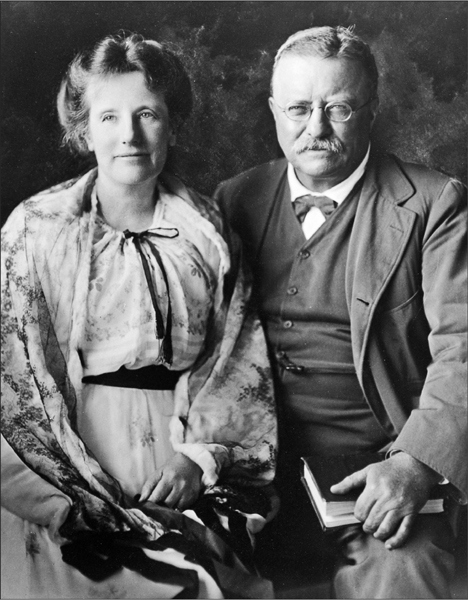
“IT WAS THERAPEUTIC FOR THEM BOTH TO GET AWAY.”
Theodore and Edith Roosevelt, 1917. (photo credit i26.1)
The Roosevelts moved27 on to Chicago, where on 26 September the Colonel gave a speech for the National Security League, assailing Senator La Follette and other pacifists as “old women of both sexes.” He noticed soldiers among his segregated audience and said he would give anything to go to war with them. “I greet you as comrades, you with the white faces and you with the black faces.” In a separate address at Camp Grant, he sarcastically complimented the troops in training on having one rifle for every three men, saying that he had seen camps on Long Island where recruits were still drilling with broomsticks. A spokesman for the War Department promised that there would be guns aplenty when America’s new army was ready to go overseas.
Edith became concerned28 about her husband’s psychological and physical condition as she accompanied him to several more speaking engagements in Illinois, Wisconsin, and Minnesota. “He is in good spirits with his head up,” she wrote Corinne Roosevelt Robinson, “but at times the horrid futility of beating the air comes upon him in a great wave.” On occasion he publicly allowed his gloom to show, and said that he felt “blackballed” by the Wilson administration. He was graying faster now, his mustache almost white, his belly and buttocks massive. Energy still animated his speeches, but it came in sporadic bursts, as from a fading battery.
Other women29 besides Edith—the novelist Mary Roberts Rinehart, Ida Tarbell, and Josephine Stricker, his new secretary—noticed how quickly the Colonel had deteriorated. He was prone to irrational rages. Back in New York at the beginning of October, he showed such fatigue in an appearance at Madison Square Garden that Edith sentenced him to two weeks at Jack Cooper’s Health Farm, outside Stamford, Connecticut.
He reported there on the tenth, and found himself the camp’s only patient. Arrangements had been made to keep his treatment private. “The household enthralls30 me,” he wrote Eleanor. “The men are professional athletes, touching the underworld on one side, and gilded youth and frayed gilded age on the other.” Jack Cooper was “an old-time skin-glove fighter [and] intimate friend of noted criminals and millionaires.” His partner was another retired pugilist, whose only reading seemed to be YMCA Weekly. An Irish domestic and a dismayingly fat Hungarian cook made up the rest of the establishment.
Cooper examined Roosevelt and told him that he was hypertense and thirty-five pounds overweight. “What’s the matter31, Colonel?”
“Well, I feel myself slipping a bit both mentally and physically. I’m an abnormal eater and I can’t see how you’re going to do much good … but I’m told you can.”
Cooper said that32 he could continue to eat as much as he liked, providing he consented to a daily routine of long hikes, gym exercise, massage, and sessions on something called “the Reducycle.” Roosevelt was agreeable. For the next ten days, until he could stand the monotony no longer, he obeyed every house rule—even breaking his lifetime habit of dressing for dinner.
The Reducycle, a machine33 of Cooper’s own invention, was designed to cause prodigious sweating. Roosevelt had to pump its pedals for twenty-five minutes every morning, while steam nozzles enveloped him in a miasma of humid heat. He lost up to two pounds per session. Cooper monitored his heart and lungs, which performed satisfactorily.
On 22 October, the Colonel returned to Sagamore Hill, looking much thinner but exhausted. “Cooper’s not34 a success,” Edith wrote in her diary.
FLORA RECEIVED35 A chilling rejection from Quentin. He wrote that he dreaded “temporarily” marrying her, only to be killed a month later, or becoming one of the war’s many paraplegics, “a useless chain to which you were tied.” In a follow-up letter, he changed his mind and asked what she thought of a wedding in Paris next summer, when he should have completed his term of duty at the Front and would be eligible, with luck, for some leave.
He wrote that he was back to flying practice and enjoying it, although cramped hours in the cockpit of a little French Nieuport, at freezing high altitudes, badly bothered his back. “I don’t see36 how the angels stand it.” He also liked the male comradeship of camp, but referred often to a dull longing for Flora that would not go away.
She felt the same37. “Oh, Quentin … I want you so desperately & the hollow, blank feeling that is a living nightmare almost kills me at times.” His letters came irregularly, sometimes one a day, sometimes none for a week. Their datelines indicated that the fault was not always due to shipping delays. Like Flora, Quentin was easily cast down. He confessed to her38 that all he saw ahead was “endless gray vistas of war.” His engineer’s nature, loving coordination, was outraged by the reshufflings and reversals that kept the Aviation Service in a perpetual state of organizational flux. At any given moment he was truck officer, groundskeeper, pilot, purchasing agent in Paris, or recalled to Issoudun to fly again. About his only certainty was that he would, eventually, be put into service as a “fighter up in the ceiling,” not as “a bomb dropper.” His commander had promised him that, but warned that he would not be sent forward to the line for at least three months.
Ted and Archie were already there, but they were not seeing any action. The Allies, concerned at the AEF’s greenness, had persuaded Pershing to dig his First Division into a relatively quiet sector of the Front, near Nancy. Ironically, it was Kermit, the last brother to be commissioned, who looked likely to taste battle first. Belle had allowed39 him to proceed to Mesopotamia, where he was now on duty with the British army, and ranked as an “honorary” captain.
For Theodore Roosevelt40, as his fifty-ninth birthday approached, the mere fact that all his sons were trained and ready for war was thrilling. He hung a huge service flag, with four stars on it, from the upper story of Sagamore Hill. In a letter to Ted, who had just turned thirty, he wrote, “You and your brothers are playing your parts in the greatest of the world’s great days, and what man of spirit does not envy you? You are having your crowded hours of glorious life; you have seized the great chance, as was seized by those who fought at Gettysburg, and Waterloo, and Agincourt, and Arbela and Marathon.”
AT THE BEGINNING OF November41, Russian troops defending imperial outposts in the Baltic yielded to Bolshevik calls that they lay down their arms and fraternize with the enemy. Kerensky’s provisional government, weakened by transport and railroad strikes, desperately ordered the Petrograd garrison to reinforce the Eastern Front. There was no response. Nor would troops outside the capital move to prevent Vladimir Ilyich Lenin’s revolutionary detachments from seizing control of key communications, banking, and transport infrastructures. On the morning of the sixth, Lenin published a proclamation of “Soviet” government in Russia, undertaking to give all citizens communal ownership of land, control over industrial production, and freedom from war. Kerensky’s government took refuge in what used to be Nicholas II’s Winter Palace.
For forty hours, civilian, military, and naval forces besieged the gilded redoubt, threatening to destroy it if power was not transferred to the proletariat. By daybreak on 8 November, Lenin was the presumptive ruler of Russia. He was elected chairman of the Council of People’s Commissars later in the day, and Trotsky became his commissar for foreign affairs. Their first joint action was to issue a decree of peace with Germany, pending negotiation of a formal armistice.
Coincidentally, Roosevelt had just finished writing a foreword to Herman Bernstein’s edition of The Willy-Nicky Correspondence:42 Being the Secret and Intimate Telegrams Exchanged Between the Kaiser and the Tsar. He said the telegrams not only illuminated the dark relationships of despots just before the war, but that they were prophetic in showing “the folly of43 the men who would have us believe that any permanent escape from anarchy in Russia can come from the re-establishment of the autocracy, which was itself the prime cause of that anarchy.”
IN THE MIDDLE of the month, he suffered the most devastating review of his literary career. Stuart P. Sherman, chief book critic of The Nation, took advantage of the publication of The Foes of Our Own Household44 to speak out on behalf of all the antiwar mollycoddles Roosevelt had sought to emasculate over the years. He argued that45 the Colonel had become a split personality because of his tendency to be “impressed with the two-sidedness of things.” Foes, consisting of twelve reprinted articles on domestic and foreign policy, was really two books, Sherman observed. “Just as one of them was written by a judicious, progressive, and patriotic Aristotelean, exactly in the same way the other was written by a willful, angry, and furiously inequitable extremist.” Roosevelt’s musings on social and political questions were “judicious, progressive … timely and weighty,” the thought of an eminently skilled polemicist. But when dealing with matters of defense and warfare, he perverted the words of past statesmen to suit his rhetorical purpose. “Any man who desires to believe that Washington and Lincoln saw eye to eye with Mr. Roosevelt,” Sherman remarked, “should give his days and nights to the study of The Foes of Our Own Household; but any man who desires to know what [they] actually thought and said had better go to the original documents.”
The critic was46 less effective in comparing Roosevelt’s executive philosophy to that of Wilhelm II, if only because Woodrow Wilson had also come to believe in strong central control, compulsory military service, national self-assertion, patriotism, and preparedness. But Sherman drew attention to the “pervasive and sustained ugliness” of the Colonel’s personal campaign against Wilson, and to his love of war for war’s sake. “Apparently he cannot contemplate with equanimity a future in which our children shall be deprived of the ‘glory’ of battle with their peers.”
For once, Roosevelt elected to let a pacifist berate him without reply. His silence implied, more than an attempt at self-defense would have, that he was beginning to doubt himself. He had entered his sixtieth year. An impotent old age was being forced on him, while Georges Clemenceau had been made prime minister of France at seventy-six. “I have never47 regretted anything so much as the absence of the Roosevelt army, nor understood the reason for it,” his fellow Cassandra wrote him.
A bitter winter was settling in, with a national coal famine threatening, and obligatory fasts imposed upon all citizens by the President’s new food czar, Herbert Hoover. Flora no longer48 offered youthful cheer. Quentin had inexplicably stopped writing to her, and she exuded misery. Her visits became fewer, and in early December stopped altogether. Just before Christmas, subzero temperatures gripped Oyster Bay. Theodore and Edith found themselves so alone and cold that they closed off most of Sagamore Hill and tried to keep warm in just two or three west-facing rooms with wood-burning fireplaces. In blustery weather, the flag with four stars flapped loudly enough to disturb their sleep. Often they repeated to each other the lines of Edwin Arlington Robinson that most addressed their situation: There is ruin49 and decay / In the House on the Hill: / They are all gone away, / There is nothing more to say.
* Irene M. Given-Wilson, a Red Cross official close to Quentin Roosevelt. The Harrahs are unidentified.