

The beauty, shattered by the laws
That have creation in their keeping,
No longer trembles at applause,
Or over children that are sleeping;
And we who delve in beauty’s lore
Know all that we have known before
Of what inexorable cause
Makes Time so vicious in his reaping.
ALICE ROOSEVELT LONGWORTH, who could be relied upon to be au centre of the gayest, most fashionable crowd on New Year’s Eve, was partying with the Ned McLeans2 at their annual dance in Washington when the lights doused, signaling the approach of midnight. As the hour struck, a huge electric sign at the end of the ballroom blazed out in red, white, and blue: GOOD LUCK TO THE ALLIES IN 1918.
Her parents, at the same time, were trying to keep warm in one of the last big houses on Long Island that still relied on gaslight after dark. The northeastern weather that January was so arctic—colder than any ever recorded—that they decided to make their third great concession to modern times, after buying an automobile and paving the driveway. The Colonel agreed3 to pay an electrical contractor something over $1,500 to wire his mansion. Unfortunately, the system promised only light, not warmth. But he would no longer have to strain his one good eye when he read, and the freezing hallways and bathrooms would at least look more welcoming.
Comforts, real or imagined, had to be seized upon in a season that offered little in the way of good news. Quentin’s long silence was disturbing. Even allowing for the irregularity of military mail (with as much as four or five weeks needed for an exchange of letters), something had to be wrong with him. It was likely not serious, or his commanding officer—or Ted, or Archie, or Eleanor—would have cabled. Edith was so exasperated at his failure to reply to her letters that she refused to write any more until he became ashamed of himself.
Roosevelt felt Flora’s desolation enough to have sent Quentin a stern reproof: “If you wish to4 lose her, continue to be an infrequent correspondent. If however you wish to keep her, write her letters—interesting letters, and love letters—at least three times a week. Write no matter how tired you are … write if you’re smashed up in a hospital; write when you are doing your most dangerous stunts; write when your work is most irksome and disheartening; write all the time!” He signed himself, “Affectionately, a hardened and wary old father.”
The strange thing was that Quentin was the most epistolary of his children, quick to pour out jokes, stray observations, confessions, even poems on paper. Not that the others were slack correspondents. Ted and Dick Derby5 sent long letters through Eleanor, whose house in Paris functioned as a Rooseveltian hostel and information center. Kermit’s mail from Mesopotamia took many weeks to come, but could otherwise be relied on. Even taciturn Archie (due to become a father in six or seven weeks’ time) kept Grace fully briefed in Boston. His latest proud news was that he had been promoted to captain. Neither he nor Ted had much to say about Quentin, but being at the Front, that was not surprising. Or were they holding something back?

IF SO, THEY WERE AMATEURS compared to Woodrow Wilson, preparing with fanatical secrecy to make yet another surprise appearance before Congress. He had sensed a misalignment among the war’s strategic blocks since the Bolshevik coup of last November, and especially after Russia’s negotiation of a provisional peace with Germany. Now, thanks to the transferal of 77 German divisions from the Eastern Front to the Western, the Central Powers were at last ascendant over the Anglo-French Entente, at 177 divisions to 173. And they could draw on a further 30 divisions in consequence of Austria’s epic defeat of the Italian army at Caporetto. This imbalance6 would prevail until General Pershing’s army (still only four divisions strong, and untested in any major engagement) began to swell with a steady influx of stateside troops in the summer.
By then the war might be over—or so Lloyd George and Clemenceau, two deeply worried ministers, kept warning Wilson. Their messages combined impatience at the slowness of American mobilization with a craven dependence on the administration’s goodwill. Britain had lost an estimated four hundred thousand men in its last six-month offensive, with a blindly determined General Haig sending his last reserves to die in the mud and7 Scheisse of Passchendaele. Wilson could not help being sympathetic, although he had lost much of his earlier sentimental attachment to Great Britain. He saw that its protectiveness toward France was really motivated by fear that a victorious Reich might threaten its overseas empire, and prevent the British Petroleum Company from acquiring significant real estate in Mesopotamia.
Logistically and psychologically, the Allies would seem to need all the good luck that Ned and Evalyn McLean wished them. But Wilson’s sharp-pencil mind, never clearer than when plotting dynamic curves against a timeline, saw that the Central Powers were not yet as strong as they needed to be, to win the war. Their principal weapon—the U-boat—had been made much less lethal by new detection techniques and American-built patrol craft and destroyers. The German navy was still landlocked. Perhaps most to the point, Marxist discontent was surging powerfully among Europe’s labor and peasant classes. The Bolsheviks had called upon Western workers to throw over their governments. Trotsky sounded not unlike the Pope in urging a peace conference, before the belligerents became so degenerate as to keep fighting for the sake of fighting.
Wilson’s phenomenal instinct for the right moment prompted him to move toward a sudden announcement of settlement terms that he believed the whole world would ascribe to. On Saturday, 5 January8, he huddled with Colonel House, who at his behest had spent several months soliciting and collating the recommendations of experts on the European situation. Even as the two men met, Lenin was moving murderously to overturn the results of an election that had, to Bolshevik rage, placed a liberal majority in control of Russia’s constituent assembly. By late Sunday night, totalitarianism reigned again in the land of the tsars, and Wilson had a typed “Statement of the War Aims and Peace Terms of the United States,” for democratic governments to consider, negotiate, and adopt—he hoped, at a conference to end all wars.
The statement listed a series of talking points. They were bound, at first, to antagonize the parties that Wilson most wanted to bring together: Germany, France, and Britain. All three nations still claimed they were at war for defensive reasons. So, less plausibly, did America. But it was the only belligerent sure to gain strength, no matter how long it fought. Wilson was gambling on the exhaustion, not to say internal rebellion, of the others. Sooner rather than later, a pax Americana should prevail.
Wilson presented9 his “Fourteen Points” to Congress on Tuesday afternoon, carefully speaking in plain language that ordinary people could understand. Not for him, this time, the fine style and sly syntax that so irritated Roosevelt. His propaganda chief, George Creel of the Committee on Public Information, had arranged for the address to be broadcast around the world via a Marconi station in New Jersey, equipped with a one-hundred-thousand-cycle alternator. Wilson was not bothered by the sight of empty seats in the House chamber, including a few in the row reserved for cabinet members. He was addressing the larger audience he liked to refer to, with a sense of suzerainty, as “mankind.”
It was an audience largely ignorant of American foreign policy, and therefore unaware that not one of the Fourteen Points was new. Lansing had presented each of them in various diplomatic communications. But they gained in impact now by being presented all together, just when their relevance was broadest. Wilson said he wanted to see open peace negotiations; absolute freedom of the seas; radical disarmament; impartial settlement of colonial disputes; recognition of Russia’s right to shape its own future “unhampered and unembarrassed” by outside constraints; the evacuation by Germany of Belgium, Alsace, and Lorraine, and by Austria-Hungary of the Balkans; Serbian access to the Mediterranean; an ethnic redrawing of Italy’s northern frontier; national liberation of Ottoman provinces from Turkish rule; free passage through the Dardenelles; an independent Polish state with seaboard facilities; and—closest to his heart—“A general association10 of nations [with] specific covenants for the purpose of affording mutual guarantees of political independence and territorial integrity to great and small states alike.”
The last point11 was yet another bang on the peace-league gong that Roosevelt and others had sounded over the years. This time, however, its reverberations refused to die. Creel printed the President’s speech for translation and distribution as far away as China and Lapland (and projection over German territory in scattershot “leaflet shells”), achieving a saturation of international opinion that made Woodrow Wilson, the former girls’-school teacher and parochial Presbyterian, look like the only visionary statesman in the world.
THE FOURTEEN POINTS registered seriously, if not favorably, on both sides of the Western Front. “Le bon Dieu12 n’avait que dix,” Clemenceau grumbled.* Britain balked at Wilson’s freedom-of-the-seas demand, which would compromise its blockade capability. France wanted stronger language to guarantee war reparations. Vague conciliatory noises came from Germany and Austria. But on the whole, the President seemed to have succeeded brilliantly in drafting a text negotiable by all the governments concerned. No immediate move could be expected toward the great peace conference he envisaged. If and when it happened, the United States had earned a coequal place at the table. Not a few political prophets saw Wilson himself sitting there as chief negotiant.
“I am sorry13 from the bottom of my heart for Colonel Roosevelt,” William Howard Taft said to a dinner companion. “Here he is, the one man in the country most capable of doing things, of handling the big things in Washington, denied the opportunity.… My heart goes out to him.”
Roosevelt emerged from his doldrums, as he had so often before, by launching into a period of manic public activity. Pausing only to write his January quota of articles for Metropolitan magazine and the Kansas City Star, plus an introduction to Henry Fairfield Osborn’s The Origin and Evolution of Life, he delivered ten speeches in nine days14 in New York, to audiences as diverse as the National Security League and the Boy Food Scouts of P.S. 40. Ray Stannard Baker caught up with him at a memorial service for Joseph Choate, and noted how his personality galvanized the somber proceedings. Witty and graceful15, able both to conjure up the ghost of Sir Horace Walpole in the same breath as a Latin epigram (suaviter in modo, fortiter in re),* he seemed almost the Bull Moose of old. Jack Cooper’s Reducycle had trimmed his waistline by several inches. “Roosevelt remains a virile and significant figure in American life,” Baker wrote.
Republican strategists16 in Washington were of similar opinion. Already thinking ahead to November’s congressional elections and the presidential campaign of 1920, they lured Roosevelt down late in the month for four days of policy talk. He took Edith17 with him, and Alice again made her town house available as a place where the Colonel could hold court, in the manner of a deposed king plotting a return to the throne. Father and daughter enjoyed the comings and goings of Party stalwarts who believed that Wilson’s current pride preceded a fall from public esteem. But for Edith, who had not seen the capital since she left it in 1909, the visit was painful. M Street was noisy and dirty now with automobile traffic. There were uniforms everywhere, and ugly wooden army buildings. She could not sit in Henry Adams’s parlor without seeing, across Lafayette Square, the radiant mansion where she had brought up Archie and Quentin, married Alice off, and entertained so many of the world’s best people. Its gates were shut to her, its servants obeyed another Edith. Adams was clearly dying, a little gray dormouse of a man. Henry Cabot Lodge had lost his wife’s reflected charm. Springy was gone from the British Embassy, a failed envoy, maligning his replacement, Lord Reading, with the single wordJew. Boozy Nick and brittle Alice went their separate ways.
“Mother found18 much sadness,” Roosevelt reported to Kermit after returning home. “Our old friends are for the most part dead or else of hoary age.” A quotation from Oscar Wilde occurred to him: The dust is dancing with the dust, the dead are whirling with the dead.
TWO MONTHS’ WORTH of snow lay thick around Sagamore Hill in early February, and still the iron cold persisted. On the morning of Tuesday the fifth, when the Colonel motored to Manhattan to work in his Metropolitan office, the thermometer dropped to seven degrees below zero.
For obvious reasons, he did not inform Josephine Stricker, his secretary, that he had a severe pain in the rectum19. An abscess had formed20 there, brought on by an attack of fever. Since returning from Brazil, Roosevelt had noticed a correlation between these proclivities of his system. The abscess had been lanced less than twenty-four hours before in Oyster Bay, but he did not feel much relief. His habit was to ignore body signals, so he kept his morning appointments, lunched at the Harvard Club, and dictated through the afternoon to Miss Stricker.
Around four21 o’clock he felt his trousers filling with blood and fled to the Langdon Hotel, where he kept a suite of rooms. Miss Stricker followed, unsuspecting, and continued to take dictation until she noticed his face was white. She gave him a glass of whiskey that seemed to revive him, but then he staggered to the sofa and fainted, leaving a trail of blood across the carpet. By the time his city physician, Dr. Walton Martin, arrived to treat him, his temperature was 103°F and he sat in a red puddle. He had to be forced to go to bed. Edith found him there later, in care of three implacable nurses. “What a jack I am,” he said. “Did you ever see such a performance?”
His pain22 increased during the night, aggravated by an ominous throbbing in both ears. On Wednesday morning Dr. Martin and an otologist, Arthur B. Duel, agreed that he had to be taken to the Roosevelt Hospital on West Fifty-ninth Street, for examination and surgery under general anesthesia.
The name of the23 facility, deriving from a great-uncle who had founded it in 1871, was coincidental: it was known for its modern technology, and was rated as one of the finest hospitals in New York. Roosevelt declined an ambulance, and asked to be chauffeured in his own car. A distraught Ethel Derby visited him before he was wheeled to the operating theater. “Father looks terribly24 white and seems so sick,” she wrote her husband. “I can’t bear to have him suffering so.”
Roosevelt’s only complaint25 was to say that he was weary of malaria relapses, and would like “to be fixed up once and for all.” At 4:1026 P.M. he was anesthetized. The rectal abscess proved not to have leached into his intestines, as Dr. Martin had feared. But a contributory fistula was found and had to be removed. Two more, potentially lethal abscesses were discovered in his left and right aural canals. Dr. Duel punctured both ears. Knowing his patient’s tendency to bleed heavily, he had to work at risky speed to avoid another hemorrhage. As it was, the operation took almost an hour and a half. An exhausted Martin told Edith and Ethel afterward that the Colonel “should have no27 further trouble.”
On the contrary28, Roosevelt was so ill the following morning that newspapermen posted a death watch in the hospital lobby. His fever resurged. He was racked by labyrinthine dizziness, vomited repeatedly, and complained of being deaf in the left ear. His eyes kept oscillating from side to side. Duel and Martin could not hide their pessimism.
A fall in his temperature to 99°F proved only temporarily encouraging. That evening his condition became desperate. He was given morphine to ease the agony that pulsed from all three of his wounds. Shortly before dawn next morning, Friday, 8 February, it was announced that Theodore Roosevelt was fighting for life. At 9 A.M. a rumor hit the wires that he had died.
The hospital denied this, but conceded that his surgeons were on emergency call. Another operation, however, was as likely to kill the Colonel as blood poisoning. His left ear was still suppurating, and now the mastoid process appeared to be involved, threatening the base of the brain. Probing that deep might have terrible consequences. Ethel found her father so mummified in bandages that she could see little of his face, and his voice—whispering something about her fighting brothers—was almost inaudible. The infection advanced to the limit of his tolerance, then stopped and began to subside. By the end of the day he was asking for food.
“He’s a peach,”29 one of the nurses said.
ROOSEVELT REMAINED HOSPITALIZED for a month. His recovery from sepsis was rapid, but extreme vertigo afflicted him through the middle weeks of February. The slightest movement of his head brought on waves of nausea. That made it doubly difficult for him to reorient himself to his surroundings, because of his blind left eye. He was told30 that the deafness in his left ear would probably be permanent.
Edith and Ethel alternated in sitting with him. They read him newspaper articles soothing to his blood pressure, and get-well letters from the sackfuls delivered daily by Miss Stricker. The first he31 answered came from William Howard Taft, who mentioned that he had been through a similar rectal experience. Roosevelt dictated a sympathetic reply, and said of himself, “Am rather rocky, but worth several men.”
The President wrote. Cables came from King George V and Clemenceau. Edwin Arlington Robinson penned32 a few touching words. There was no message from Cecil Spring Rice: Edith suppressed the news that he had just died of a heart attack, en route home to England.
A letter arrived from Quentin. It had been mailed before he had heard of his father’s illness, and did not explain his mysterious silence earlier that winter. But visits from Flora, looking pretty and more in love than ever, reassured Roosevelt that all was now well. Quentin’s only complaint was that he was still being held back from the Front. His commanding major had “called him down” for demanding to be transferred to the lines, saying that he was needed at Issoudun as an instructor for draftees. Roosevelt advised him to keep trying nevertheless. He should remember for the moment that he had been one of the first volunteers of the war. “You stand33 as no other men of your generation can stand. You have won the great prize.”
When, at last34, Quentin confessed what had been wrong with him for so long, he wrote not to his parents but Ethel. Horrified, she shared the truth with them on 27 February. He had succumbed to pneumonia a few weeks before Christmas, as a result of high-altitude training, and had been sent to the Riviera to recuperate. Archie, in a sharp letter endorsed by Ted, had accused him of “slacking” behind the lines. Quentin had consequently sunk into a depression, compounded by his longing for Flora and guilt over the fact that he had a taste for what doughboys in the trenches called la guerre de luxe—shopping and theatergoing with Eleanor on visits to Paris, and hopping his Nieuport over to Romorantin for weekends with the hospitable Normants. His Plattsburg buddy Hamilton Coolidge often accompanied him in convoy. They had their own rooms on the château’s second floor, overlooking the river Sauldre, and liked to laze up there on Sunday mornings, wearing white robes and breakfasting on croissants and café au lait.
Edith Roosevelt was furious at Archie’s insensitivity, and more than a little protective. Of all of her children, Quentin was the one most like her in Gallic tastes35 and temperament. The others spoke French, but Quentin did so with instinctive rapidity, gesturing as he talked. He identified with the gaîté, the elegance and subtle snobbery of French culture, as opposed to the Nordic, Slavic, and even Mongol militarism his father admired. Archie and Ted were warriors, cut from coarser cloth. In her own hand, Edith wrote a cable of support, and signed it simply, “Roosevelt.”
YOUR LETTER36 TO ETHEL CAME. AM SHOCKED BY ATTITUDE OF TED AND ARCHIE. IF YOU HAVE ERRED AT ALL IT IS IN TRYING TOO HARD IN GETTING TO THE FRONT. YOU MUST TAKE CARE OF YOUR HEALTH. WE ARE EXCEEDINGLY PROUD OF YOU.
The Colonel was released from hospital on 4 March, the same day that news came from Brest-Litovsk that Russia had capitulated to Germany in a peace treaty of alarming import. Whether out of desperation or long-term design, the Bolsheviks had sacrificed vast areas of formerly Tsarist territory to the Central Powers, including the Ukraine, Georgia, Poland, Finland, and the Baltic provinces. Germany could henceforth count on nearly all of Russia’s oil production, most of its iron ore, and a cornucopia of its food products. Instead of retreating behind its own borders, as Wilson had demanded in the sixth of his Fourteen Points, the Reich had effectively occupied a large swath of Russia west of Moscow. With relief forces daily amplifying those entrenched along the Hindenburg Line, a major offensive against Paris looked inevitable—most likely in the early spring, before Pershing’s army achieved its full fighting mass.
Enraged, Woodrow Wilson began to sound like Clemenceau. The Prussians, he publicly declared, had shown what they thought of his formula for world peace. “There is therefore37 but one answer open to us. Force, force to the utmost, force without stint or limit.”
THE APPROACH OF SPRING had cracked most of Oyster Bay’s ice by the time Roosevelt, still unsteady38 on his feet, returned to Sagamore Hill. Cove Neck exuded39 its ancient reek of salt marsh, clam flats, tangled rigging, and seawater. The first crocuses were out. It would be a long time before the enfeebled squire could walk around his property, much less ride a horse. “The destruction of my left inner ear,” he wrote Quentin, “has made me lose my equilibrium … but in two or three months I should be all right.”
Looking over the letter after Miss Stricker had typed it, he scrawled an impulsive postscript: “I wish you40 could get darling Flora to cross the ocean and marry you! I would escort her over.”
On 13 March41, Edith came down to breakfast and found her husband already up, pondering a telephone call from United Press. Captain Archibald Roosevelt of Company B, Twenty-sixth Infantry, AEF, had reportedly won France’s Croix de Guerre “under dramatic circumstances.” A War Department telegram later in the morning advised that Archie had been “slightly wounded.” Then a cable from Ted came to say that he had been hit in an arm and leg by shrapnel. Ted’s terseness implied there could be worse medical news to come. As soon as Archie was transferable, Eleanor would look after him in Paris.
The Roosevelts were especially moved because Grace, staying with her parents in Boston, had just given birth42 to Archibald Roosevelt, Jr.—their eighth grandchild. That evening a proud Colonel wrote to tell Archie, Sr., how they had celebrated his blooding in battle: “At lunch Mother43 ordered in some madeira; all four of us filled the glasses* and drank them off to you; then Mother, her eyes shining, her cheeks flushed, as pretty as a picture, and as spirited as any heroine of romance, dashed her glass on the floor, shivering it in pieces, saying ‘that glass shall never be drunk out of again’; and the rest of us followed suit and broke our glasses too.” He did not add that his own eyes had been wet at that moment.
A few days44 later he read in an upstate newspaper the prediction of an AEF official in France that Quentin was a young officer worth watching, “as game as they make ’em in aviation.” Roosevelt did not hesitate to rebroadcast this quote, along with reports that Ted had nearly been killed in the same battle that wounded Archie, and that Kermit, having acquitted himself bravely in Mesopotamia (learning Persian as he did so), now wished to fight45 under General Pershing.
Roosevelt’s paternal pride swelled steadily. So did his stomach, as every day of improved health turned him back into the trencherman of yore. He argued that the government’s food restrictions did not apply to comestibles produced by the Sagamore Hill farm. Ethel was amazed at the amount of lunch he could put away. After one feast she wrote Dick Derby, “Father had 246 plates (cereal plates) of tomatoes, 2 plates of applesauce, 1 plate of potato, grouped around the pièce de résistance which was spare ribs of pork. I counted 18 which he ate, & then he refused to let me count further!! He certainly ‘eat hearty.’ ”
Although Roosevelt still chafed over his inability to fight in France, he had become resigned to it enough to accept whatever political or journalistic assignments gave him a feeling of being useful. One of these was a request from Will H. Hays, the new chairman of the RNC, to deliver a formal statement of Party war policy at Portland, Maine, on 28 March. It was intended47 to be the keynote of the fall Congressional campaign, for which Hays had high hopes.
The Colonel’s consultations and correspondence on the speech—he sent a draft to William Howard Taft for suggestions—helped distract him from headlines confirming that the German offensive in northeastern France had begun promptly, on the first day of spring. A bombardment of unbelievable intensity battered Allied artillery emplacements around Arras, while poisonous phosgene fumes48 spilled like fog into every bunker. The phosgene was mixed with lacrimators, which so stung the eyes of gunners that they pulled off their gas masks, weeping, only to inhale the fog and die. Then concentrated units of storm troopers moved in and drove the British Fifth Army westward, effectively wiping it out.
Under the circumstances49, Roosevelt’s prediction, in Maine, of three more years of war, necessitating a five-million-man American army, did not sound alarmist. He returned home50 to hear that the Germans had recaptured all the territory they had lost in the Battle of the Somme. A terrified Jules Jusserand51 told President Wilson that the Arras salient was now no farther from Paris than Baltimore was from Washington. Clemenceau’s government was considering a retreat to Bordeaux.
Wilson remained outwardly impassive, but the emergency was so acute that Jusserand and Lord Reading begged him to allow units of the AEF to be “brigaded” among the French and British armies. General Pershing was adamant against such dissipation of American strength. The President’s growing number of critics in Washington suggested that he look to Oyster Bay for guidance. “Wilson always follows52 T.R., eventually,” one of them sneered at a dinner party attended by the secretary of the treasury, William G. McAdoo. “I suppose soon we will hear that he’s deaf in one ear.”
“Many think he’s already deaf in both,” McAdoo replied.
Wilson reluctantly agreed to a temporary transfer of ninety thousand U.S. troops. The Allied line held from Reims in the south to Amiens in the north, and the war of attrition resumed. Pershing went back to building up his army and found a place for Kermit53 as a captain of artillery in the armored car service.
QUENTIN HAPPENED TO have been in Paris just after the first German shells landed. He calculated54 his chance of being hit at one hundred thousand to one, and with a boy’s bravado found the slight danger thrilling. It was enough, however, to remind him of the tenuousness of life, and his father’s obsession about getting Flora over to marry him. Letters to that effect kept arriving, written in the Colonel’s forceful hand, and not mincing words:
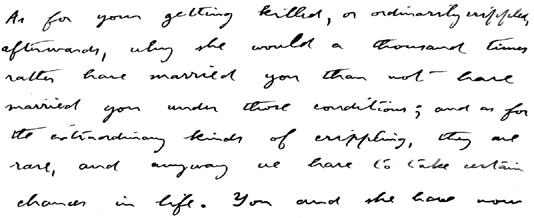
Quentin foresaw56 trouble with Flora’s parents, and with the passport authorities who were making it difficult for American civilians to cross the Atlantic unless they had war duties in Europe. Perhaps, he wrote her, she could work with Eleanor in the Parisian YWCA, or as a military secretary. She was fluent in French. He was sure he would be flying at the Front by the time she arrived, but wedding leave was permitted. After that he would be able to join her “every six months for a couple of days.”
When Quentin next heard57 from his father, in a letter dated 8 April, Sagamore Hill’s maple buds were red and its willow tips green. Robins and sparrows and redwing blackbirds had begun to sing, and frogs were noisy in the lawn ponds. “The Hon. Pa,” as Quentin affectionately called him, was still capable of an ecstatic response to the sights and sounds of nature—all the more, this season, because he had come so close to death.
A second German offensive in the Lys sector, recapturing Passchendaele and driving another twelve miles toward Paris, hampered communications between the Roosevelts and their sons for the rest of the month. What information reached58 them was mostly disturbing. A medical report indicated that Archie’s wounds were more serious than they had thought. His left arm had been so severely fractured that the main nerve was cut, and his left kneecap smashed by a shrapnel fragment deeply embedded in lower bone. Medics wanted to amputate the leg, but Eleanor and Ted had managed to dissuade them. There was a photograph of him lying in traction, with his medal pinned to his pillow.
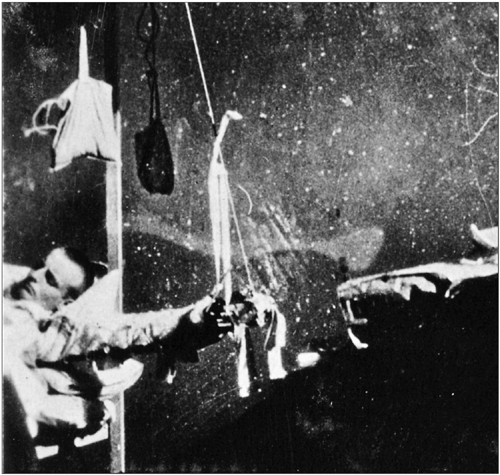
“ARCHIE’S WOUNDS WERE MORE SERIOUS THAN THEY HAD THOUGHT.”
Captain Archibald Roosevelt, Croix de Guerre, in traction. (photo credit i27.1)
Quentin was lucky59 not to be in the same hospital. Flying to Paris to see Archie, he had snapped a connecting rod in low clouds, and crash-landed in a pine grove. He had broken his right arm and hurt his always-vulnerable back. The accident had led to a “ghastly” week of depression when “everything looked black.” He shared this information with Flora but not his father, who thought soldiers should be positive. (Archie, scarcely able to move, was already swearing to report back for duty.)
Roosevelt chafed60 at Quentin’s renewed silence. “I simply have no idea what you are doing—whether you are fighting, or raging because you can’t get into the fighting line.” Nor could he guess that Ted was in Flanders, helping to hold back the Lys offensive at Saint-Mihiel. All he knew was that the imbalance there between German and Allied forces, and the passing of the first anniversary of America’s entry into the war, had revived his contempt for un-preparedness. He wrote two articles for the Kansas City Starso savagely critical of the administration that his editor, Ralph Stout, rejected them.
For some time now the Colonel and his youngest son had been unconsciously moving in tandem, with alternate or parallel fluctuations of mood, and physical ups and downs. Through the middle of May, they both showed signs of rising tension—Quentin over intimations from his commanding officer that he and Ham Coolidge would soon be in action, and Roosevelt over two arduous tours he had agreed to undertake on behalf of the National Security League’s “Committee on Patriotism.”
Ethel wrote Dick61 on the seventeenth that she was sitting on the piazza at Sagamore Hill with her parents. “Just across from me is Father, rocking violently to & fro—and ever so busy talking to himself. Poor lamb—he is having a horrid time, for he has too much to do, and it frets him terribly, this looking ahead [and] feeling driven.”
Two days later62, at Romorantin, Edith Normant took photographs of Quentin and Ham swimming in the Sauldre, then posing in the cockpits of their freshly painted Nieuports, ready to take off for the Front.
ROOSEVELT HAD THE63 NOVEL experience of being pelted with peonies at his first speaking stop in Springfield, Ohio, on 25 May. He was the guest of Wittenberg College, a Lutheran school so saturated with Teuton Kultur it could well have been an adjunct of its namesake university in Saxony. There to hear him was an audience crammed with German-speaking farmers. They carried great bouquets of the fragrant flowers, which a local nursery had given away free as part of a war chest drive.
John Leary, reporting for the New York Tribune, was alarmed when Roosevelt walked onstage and the first soft bombs were tossed at him. Any one could have contained something dangerous. The Colonel’s appearance was not calculated to please these Volk, because they already knew that he disapproved of their preference for the German liturgy in church. (He felt it was sure to alienate younger worshippers, and turn them away from the faith, as had happened in his own Dutch Reformed Church.)
Roosevelt took his64 time walking to the podium, as if to emphasize his lack of hostility. The rain of petals continued, until he stood grinning on a perfumed carpet of pink and white.
Moving on to Chicago, he checked in to the Blackstone Hotel. The first person he saw on entering its restaurant was William Howard Taft. Fellow diners applauded as Taft stood up and called, “Theodore!”65 The two former presidents shook hands with obvious pleasure, straining to hear each other over cheers around the room. They took a small window table and plunged into conversation.
Afterward, a happy Roosevelt told Leary, “He feels66 exactly as I do about those creatures in Washington and the way they’re carrying on.”
QUENTIN AND HAM may have wanted to give Edith Normant the impression that they were headed straight into action, but their orders were to fly first to Orly. It was a ferry-pilot field just east of Paris, at any rate closer to glory than the mudflats of Issoudun. If present trends67 continued, the Front might well come to them: the Germans had launched another offensive, driving the Allies back from the Aisne to the Marne. Wilhelm II, delighted to pretend that he, and not General Erich Ludendorff, was the strategist of this newKaiserschlacht, posed for photographs on the lookout at Craonne, where Napoleon had faced the powers that eventually overwhelmed him.
Quentin went to see Eleanor in her house on the Avenue du Bois de Boulogne. From its east-facing windows, the flashing of guns could be seen like summer lightning68. Just as disturbing69 was the sight of Ted, crimson-eyed and racked with such spasms of coughing that he had to sleep sitting up. He had been gassed and temporarily blinded at Cantigny, in the first American group action of the war. Two hundred of his comrades had been killed around him. But he had refused to give up command of his battalion, or to be evacuated until the three-day assault was over. His superiors were saying they had never seen such heroism.
With this and70 Archie’s example to ponder, not to mention the news that Kermit had been awarded the British Military Cross for bravery in Mesopotamia, Quentin felt compelled to prove himself as the last whelp of “the old Lion.” But his only assignment was to test the airworthiness of new planes shipped through Orly. He fell into another of his depressions, worsened by a report from Oyster Bay that Flora had almost no chance of getting a passport to France. Given that, it was small consolation that her parents had agreed to let them marry. “It seems to me now,” he wrote her, “as tho’ nothing could ever fill that void that the last year has left in my heart.”
It was a year that had taken him from Newport to Nieuport, and Quentin could not see how the experience had bettered him. If French soldiers retreating from the Front were right in shouting “La guerre est finie”71 at Americans going the other way, he might at least survive, and unite with Flora after all; but what sort of world would they have to adjust to?
General Pershing tried72 to persuade a despairing Clemenceau that the war was not over. The United States was ready to announce that it had a million troops in France, and a million—or more—on the way. The Allies simply needed to hold the Germans off, at this moment of the Reich’s maximum advancement west and east. Overextension always preceded collapse, in Pershing’s view. The strategic situation was poised. “It may not look encouraging just now,” he said, “but we are certain to win in the end.”
On 7 June73, the day Quentin hoped he might be sent into action, Roosevelt was hit by an attack of erysipelas, a streptococcal inflammation of the leg that had bothered him so often since his traffic accident in 1902. He was in Chicago en route to Omaha, still traveling as a spokesman for the National Security League. “Jack, I’m pretty sick,” he confided to John Leary. It was his way of saying that he was running a temperature of 104°F. Fortunately Edith was at hand to nurse him on the train, along with a doctor to control his fever. Roosevelt insisted on keeping every engagement the League had mapped out for him, distracting himself from pain by reading Polybius and what his wife described as “hundreds of thousands” of ten-cent magazines.
When they got back74 home in the middle of the month, a cable from Quentin was waiting. He and Ham Coolidge had been ordered forward at last.
“My joy for you75 and pride in you drown my anxiety,” Roosevelt wrote. “Of course I don’t know whether you are to go in the pursuit planes—or battle planes or whatever you call them.”
In fact, as Quentin reported to Flora, he had already ridden to the Front on his motorcycle, after detaching himself from an emotional, one-armed embrace by Archie. “He evidently felt76 that he was saying a last fond farewell to me.”
That lugubrious soul was convinced that no Roosevelt in uniform would return to America alive. Quentin thought this funny, as well as the fact that the anti-aircraft shells he would be dodging in the future were known among pilots as “Archies.” He had already, he boasted, experienced flak on his maiden patrol along the lines as a member of the First (U.S.) Pursuit Group. “It is really77 exciting when you see the stuff bursting in great black puffs around you, but you get used to it in about fifteen minutes.”
WITH KERMIT NOW attached to the Seventh Field Artillery Regiment of the First Division in France, Roosevelt could congratulate himself on the “first-ness” of all his sons. News that Ted had been cited for both a Croix de Guerre and American Silver Star turned him into something of a paterfamilial bore. Finley Peter Dunne heard him out and said, “Colonel, one of78 these days those boys of yours are going to put the name of Roosevelt on the map.”
As his erysipelas ebbed, he spent the latter part of June at Sagamore Hill, lazing on the piazza with a pile of books79 and listening to birds. “I have finished80 my last tour of speechmaking,” he wrote Quentin, in words that his family had long learned to ignore. Immediately came the disclaimer: “From now on I shall speak … only just enough to put whatever power I have back of the war, and to insist that we carry it through until we win such a peace as will ensure against danger from Germany for at least a generation to come.”
For at least a generation to come. Before Quentin left Romorantin, a son had been born to one of the Normants, and he had found a macabre souvenir81 on his pillow. It was a baby doll and box of chocolates labeled, “From the poilu of 1938.”
In the place he was now—the censor would not allow him to say where—men had no interest in times beyond the present. The average life of a chase pilot on the Front in the summer of 1918 was eleven days. Quentin was clear-eyed about his own vulnerability, having lost a Mineola comrade earlier in the year. In an attempt to condition Flora to the prospect of him being shot down, he assured her that death came quickly to aviators, as opposed to gassed doughboys or drowning sailors. “There’s no better82 way,—if one has got to die.… 30 seconds of horror and it’s all over,—for they say that it’s all in that length of time, after the plane’s been hit.”
To his mother, he was determinedly upbeat. “The real thing83 is that I’m on the Front—cheers, oh cheers—and I’m very happy.” Then he learned that he was being transferred to a “hot” sector on one of the salients threatening Paris.
On the Fourth84 of July, Roosevelt dined with Fanny Parsons in Manhattan. She too had a son in uniform abroad. They both felt, and shared, a lift in the national morale. After the terror of March and April and the good news in June of U.S. troops repelling Ludenorff’s last offensive at Château-Thierry and Belleau Wood, the war finally looked winnable. For however many more months it continued, American power, burgeoning with the force of lava long suppressed, was evidently going to shape the outcome.
Little tricolors85 decorated the Colonel’s table. He was in the same high spirits that had enchanted Fanny forty years before. Then the headwaiter brought over an evening paper, pointing to a cable report that Quentin had just made his first sortie over the German line. Roosevelt read it without comment and set the paper aside, but Fanny noticed that his face had darkened. For the rest of the meal they talked with less animation.
SIX DAYS LATER86, Quentin shot down his first “Boche.” He was in command of a small squadron of Nieuports, and was flying as top man on a high patrol when he got blown off course at 5,200 meters. Descending out of the sun, he came upon a trio of Pfalz monoplanes. “Great excitement!” he wrote Flora. “They had white tails with black crosses.… I was scared perfectly green, but then I thought to myself that I was so near I might as well take a crack at one of them.” He fired, then hustled for home, fifteen kilometers away beyond Château-Thierry. In his rearview mirror was the pleasing sight of his victim tumbling into lower clouds, and two outraged pursuers unable to catch up with him. There was no confirmation yet that he had scored a kill, but he had tasted what passed for blood in the air, and that evening tooled in to Paris to celebrate. He and Eleanor87 had dined at Ciro’s and gone on to Grand Guignol.
Now (Quentin was writing on 11 July) his squadron had relocated yet again. He was billeted in a little French town88 not far from Reims, where he had first seen airplanes flying, nine summers before. Flora would want to know about his quarters: a ground-floor room in a white plaster house with a weathercock on the roof and a blooming garden behind. “O ruin!89 There goes an alerte & I must run, or rather fly, so I’ll just finish this off. Goodbye, dear sweetheart, & a kiss from your QR.”
ROOSEVELT HEARD ABOUT Quentin’s score that same day, in a cable dispatch that thrilled him. He wrote to tell Ethel, who had taken her children to Islesboro, Maine, for the hot months. “Whatever now befalls90 Quentin, he has had his crowded hour, and his day of honor and triumph.”
On the afternoon91 of Tuesday, 16 July, a cryptic advisory from Paris alerted reporters: WATCH SAGAMORE HILL IN EVENT OF [DELETED BY CENSOR]. The Colonel was dictating to Miss Stricker when Philip Thompson, a reporter from the Associated Press, showed the cable to him. “Something has happened to one of the boys,” Roosevelt said, closing the door in case Edith was within earshot.
Rapid deduction (Archie and Ted incapacitated, Kermit not yet at the Front) made it plain that the news concerned Quentin. But what news? He had no choice but to ask Thompson not to alarm Edith, and continue to dictate as if nothing had happened. One of his letters of the day was to Kermit. He made no mention of the AP advisory, but could not resist saying, “It seems dreadful92 that I, sitting at home in ease and safety, should try to get the men I love dearest into the zone of fearful danger and hardship.… Mother, who has the heroic spirit if ever a woman had, would not for anything in the world have you four behave otherwise than you have done, although her heartstrings are torn with terrible anxiety.”
Then a cable93 from Pershing arrived:
REGRET VERY MUCH THAT YOUR SON LT. QUENTIN ROOSEVELT REPORTED AS MISSING. ON JULY 14 WITH A PATROL OF TWELVE PLANES HE LEFT ON A MISSION OF PROTECTING PHOTOGRAPHIC SECTION. SEVEN ENEMY PLANES WERE SIGHTED & ATTACKED, AFTER WHICH ENEMY PLANES RETURNED AND OUR PLANES BROKE OFF COMBAT RETURNING TO THEIR BASE. LT. ROOSEVELT DID NOT RETURN. A MEMBER OF THE SQUADRON REPORTS SEEING ONE OF OUR PLANES FALL OUT OF THE COMBAT AND INTO THE CLOUDS AND THE FRENCH REPORT AN AMERICAN PLANE WAS SEEN DESCENDING. I HOPE HE MAY HAVE LANDED SAFELY. WILL ADVISE YOU IMMEDIATELY ON RECEIPT OF FURTHER INFORMATION.
At sunset94 Roosevelt changed out of his knickerbocker suit, bathed, and dressed for dinner as usual. With Ethel and the grandchildren away, the house was as quiet as it had ever been. For whatever reason, Edith left her daily diary blank when they went to bed.
Before breakfast the next day, Thompson returned to say that further dispatches from Europe indicated that Quentin had been killed. The reports, already printed in the morning papers, were unconfirmed but ominously definite. The Colonel paced up and down the piazza. “But—Mrs. Roosevelt?95 How am I going to break it to her?”
He disappeared96 into the house. Thompson was left alone as early morning breezes swept up the hillside from the bay.
Thirty minutes later Roosevelt emerged with a one-line statement. “Quentin’s mother97 and I are very glad that he got to the Front and had a chance to render some service to his country, and to show the stuff there was in him before his fate befell him.”
He was due in town around noon, preparatory to leaving early Thursday for Saratoga Springs, where he had promised to address the New York State Republican convention. An organizer of the event called to ask, sympathetically, if he wanted to cancel. Roosevelt replied that on the contrary, he would honor his engagement. Taft was going to be there. Together, they had to set the Party on a course that would humiliate Woodrow Wilson in the fall Congressional elections. “I must go;98 it is my duty.”
Telegrams of condolence99 began to arrive by the hundreds. Roosevelt spent a couple of hours dictating acknowledgments to them. At times he choked and cried, but would not stop until his chauffeur came to take him and Miss Stricker into Manhattan. Edith emerged from the house to see them off, then turned red-eyed to Philip Thompson.
“We must do100 everything we can to help him,” she said, as if her own feelings did not matter.
Roosevelt had no sooner101 reached his office than Hermann Hagedorn, a thirtyish writer at work on a biography of him, came to pick him up for lunch. They walked through streets emblazoned with press posters announcing Quentin’s death. Albert Shaw, editor of American Review of Reviews, awaited them at the Harvard Club.
“Now, Colonel102, you know it may not be true,” Shaw said. “I would not make up my mind until I hear from General Pershing direct.”
“No, it is true,” Roosevelt said. “Quentin is dead.”
With that he changed the subject, and talked lucidly throughout the meal, giving Hagedorn his take on the events of 1912. But there was a dim look behind his spectacles. Afterward Hagedorn noted103, “The old side of him is gone, the old exuberance, the boy in him has died.”
Edith came104 later by train to stay with her husband overnight. Alice telegrammed to remind them that the newspaper reports were still unconfirmed. She was coming up from Washington anyway.
Roosevelt went upstate the following morning, Thursday, 18 July, not knowing that during the night, the Allies had launched the Second Battle of the Marne. It was a devastatingly powerful counterattack, driving German forces back from Château-Thierry toward the country west of Reims where Quentin had disappeared.
At 3:20 that afternoon the chairman of the convention in Saratoga Town Hall announced that the next speaker would be Theodore Roosevelt. “Before the Colonel105 begins, I wish to voice on behalf of this audience our common sorrow and our common pride in what has come to afflict him in these fateful days of the war.”
There was a tumultuous standing ovation when Roosevelt walked onstage in a gray suit with black cravat. But it subsided the moment he laid his speech on the lectern and held up his hand. Isaac Hunt, an upstate delegate who had been his first ally in the New York Assembly, thirty-six years before, was chilled by the anguish on his face.
Roosevelt looked around the room, noticed a number of women on the floor for the first time in state party history, and hailed them as “My fellow voters106, my fellow citizens, with equal rights of citizenship here in New York.” For the next hour, whenever he spoke off the cuff, he addressed himself to them. His typed text was a standard appeal for an end to hyphenated Americanism, a speeded-up war effort under Republican governance, and postwar preparedness. He wanted to see the current army extended so as to be able to completely overwhelm the Central Powers. “Belgium must be reinstated and reimbursed [applause]. France must receive back Alsace and Lorraine [applause]. Turkey must be driven from Europe [applause]; Armenia must be made free and the Syrian Christians protected and the Jews given Palestine [applause].”
He made no reference whatever to Quentin, except obliquely toward the end of his script, when he looked again at the female delegates and said, “Surely in this great crisis107, where we are making sacrifices on a scale never before known, surely when we are demanding such fealty and idealism on the part of the young men sent abroad to die, surely we have the right to ask and to expect an equal idealism in life from the men and women who stay home.”
The words said little, but his listeners were transfixed by what he left unsaid. Before he got108 back to New York the following morning, Friday, an urgent effort was under way to draft him for governor. Taft, Elihu Root, Charles Evans Hughes, and even William Barnes, Jr., subscribed to it. Roosevelt declared that he was not available. “I have only one109 fight left in me,” he told his sister Corinne, “and I think I should reserve my strength in case I am needed in 1920.”
She was alarmed. “Theodore, you don’t really feel ill, do you?”
“No, but I am not what I was.”
Later in the day he motored to Oyster Bay with Edith, Alice, and Ethel, who had come down from Maine. When they got home, a cable from Eleanor in Paris was waiting for them: QUENTIN’S PLANE110 WAS SEEN TO DIVE 800 METERS, NOT IN FLAMES. SEEN TO STRIKE GROUND. COULD HAVE BEEN UNDER CONTROL AS DID NOT SPIN. CHANCE EXISTS HE IS A PRISONER.
Flora Whitney was nowhere to be seen.
IT TURNED OUT that Flora had also received a cable from Eleanor—EVERY REASON111 BELIEVE REPORT QUENTIN ABSOLUTELY UNTRUE—and was clutching to it like an oar in a storm. Newspapers got112 hold of the story, and a new uncertainty built up through Saturday morning.
The Colonel, clutching113 himself at every “duty” that would keep him from breaking down, went ahead with a prearranged reception for some Japanese Red Cross officials. They were brought to Sagamore Hill by Henry P. Davison, chairman of the American Red Cross war council, and his son Trubee. The young man watched fascinated as Roosevelt took his guests on a trophy tour of the North Room, then delivered a speech of welcome, which he had evidently composed earlier in the week.
After the Japanese bowed their way out, bearing copies of the speech exquisitely calligraphed114 on rice paper, Trubee Davison took Roosevelt aside and asked, “What hope115 have you for Quentin?”
Roosevelt reached into his pocket. “Trubee, just twenty minutes before you arrived, I received this telegram from President Wilson.”
The telegram confirmed116 that Quentin had been killed in action. His death had been certified by German military authorities and broadcast by the Wolfe press agency in Berlin. A handwritten translation of the dispatch was brought to the Roosevelts later in the day:
On Saturday117 July 14th an American squadron comprising of 12 planes tried to break the German defense over the Marne. In a violent combat one American aviator stubbornly made repeated attacks. This culminated in a duel between him and a German non Commissioned officer who after a short fight succeeded in getting a good aim at his brave but inexperienced opponent whose machine fell after a few shots near the village of Chamery 10 kilometers north of the Marne.
His pocket case showed him to be Lieut. Quentin Roosevelt of the Aviation section of the U.S.A. The personal belongings of the fallen airman are being carefully kept with a view of sending them later to his relatives.
The earthly remains of the brave young airman were buried with military honors by the German airmen near where he fell.
* “The good Lord only had ten.”
* Courtly in manner, courageous in action.
* A family friend was visiting.